EP0966449B1 - 1,4-diazacycloheptan-derivate und deren verwendung in oxidationshaarfärbemitteln - Google Patents
1,4-diazacycloheptan-derivate und deren verwendung in oxidationshaarfärbemitteln Download PDFInfo
- Publication number
- EP0966449B1 EP0966449B1 EP98912353A EP98912353A EP0966449B1 EP 0966449 B1 EP0966449 B1 EP 0966449B1 EP 98912353 A EP98912353 A EP 98912353A EP 98912353 A EP98912353 A EP 98912353A EP 0966449 B1 EP0966449 B1 EP 0966449B1
- Authority
- EP
- European Patent Office
- Prior art keywords
- diazacycloheptane
- bis
- group
- methyl
- alkyl
- Prior art date
- Legal status (The legal status is an assumption and is not a legal conclusion. Google has not performed a legal analysis and makes no representation as to the accuracy of the status listed.)
- Expired - Lifetime
Links
Classifications
-
- A—HUMAN NECESSITIES
- A61—MEDICAL OR VETERINARY SCIENCE; HYGIENE
- A61Q—SPECIFIC USE OF COSMETICS OR SIMILAR TOILETRY PREPARATIONS
- A61Q5/00—Preparations for care of the hair
- A61Q5/10—Preparations for permanently dyeing the hair
-
- A—HUMAN NECESSITIES
- A61—MEDICAL OR VETERINARY SCIENCE; HYGIENE
- A61K—PREPARATIONS FOR MEDICAL, DENTAL OR TOILETRY PURPOSES
- A61K8/00—Cosmetics or similar toiletry preparations
- A61K8/18—Cosmetics or similar toiletry preparations characterised by the composition
- A61K8/30—Cosmetics or similar toiletry preparations characterised by the composition containing organic compounds
- A61K8/49—Cosmetics or similar toiletry preparations characterised by the composition containing organic compounds containing heterocyclic compounds
- A61K8/494—Cosmetics or similar toiletry preparations characterised by the composition containing organic compounds containing heterocyclic compounds with more than one nitrogen as the only hetero atom
-
- C—CHEMISTRY; METALLURGY
- C07—ORGANIC CHEMISTRY
- C07D—HETEROCYCLIC COMPOUNDS
- C07D243/00—Heterocyclic compounds containing seven-membered rings having two nitrogen atoms as the only ring hetero atoms
- C07D243/06—Heterocyclic compounds containing seven-membered rings having two nitrogen atoms as the only ring hetero atoms having the nitrogen atoms in positions 1 and 4
- C07D243/08—Heterocyclic compounds containing seven-membered rings having two nitrogen atoms as the only ring hetero atoms having the nitrogen atoms in positions 1 and 4 not condensed with other rings
-
- D—TEXTILES; PAPER
- D06—TREATMENT OF TEXTILES OR THE LIKE; LAUNDERING; FLEXIBLE MATERIALS NOT OTHERWISE PROVIDED FOR
- D06P—DYEING OR PRINTING TEXTILES; DYEING LEATHER, FURS OR SOLID MACROMOLECULAR SUBSTANCES IN ANY FORM
- D06P1/00—General processes of dyeing or printing textiles, or general processes of dyeing leather, furs, or solid macromolecular substances in any form, classified according to the dyes, pigments, or auxiliary substances employed
- D06P1/32—General processes of dyeing or printing textiles, or general processes of dyeing leather, furs, or solid macromolecular substances in any form, classified according to the dyes, pigments, or auxiliary substances employed using oxidation dyes
Definitions
- the invention relates to new diazacycloheptane derivatives, their use for dyeing of keratin fibers and dyes containing these compounds.
- oxidation colorants They play for dyeing keratin fibers, especially human hair so-called oxidation colorants because of their intense colors and good fastness properties a preferred role.
- colorants contain oxidation dye precursors, so-called developer components and coupler components.
- developer components form under the influence of oxidizing agents or Atmospheric oxygen with each other or with coupling with one or more coupler components the actual dyes.
- Good oxidation dye precursors primarily have the following requirements : You have to achieve the desired color shades in the oxidative coupling train sufficient intensity and authenticity. You must also have good windability own on the fiber, especially with human hair no noticeable differences between stressed and newly grown Hair may exist (leveling ability). They should be resistant to light Heat and the influence of chemical reducing agents, e.g. B. against perm fluids. After all, if they are used as hair dye, they should Do not stain the scalp too much, and above all, they should be toxicological and be safe from a dermatological point of view.
- Primary aromatic amines are usually used as developer components another, in the para or ortho position, free or substituted Hydroxy or amino group, diaminopyridine derivatives, heterocyclic hydrazones, 4-aminopyrazolone derivatives and 2,4,5,6-tetraaminopyrimidine and its derivatives used.
- Coupler components m-phenylenediamine derivatives, naphthols, Resorcinol and resorcinol derivatives, pyrazolones and m-aminophenols are used.
- Coupler substances are particularly suitable 1-naphthol, 1,5-, 2,7- and 1,7-dihydroxynaphthalene, 5-amino-2-methylphenol, m-aminophenol, resorcinol, resorcinol monomethyl ether, m-phenylenediamine, 1-phenyl-3-methyl-pyrazolone-5, 2,4-dichloro-3-aminophenol.
- Also preferred according to the invention are those compounds of the formula (I) in which at least three, in particular all four, groups R 1 , R 2 , R 3 and R 4 are hydrogen.
- 1,4-diazacycloheptane derivatives according to formula (1) have also proven to be particularly suitable according to the invention in which the two substituents X and Y on the two aromatic rings independently of one another represent hydrogen, fluorine, chlorine or a C 1- 4 alkyl group. Hydrogen and methyl groups have proven to be particularly advantageous groups X and Y.
- N N'-bis (4-aminophenyl) -1,4-diazacycloheptane and N, N'-bis (4-amino-3-methylphenyl) -1,4-diazacycloheptane is preferred.
- a second object of the present invention is the use of the aforementioned 1,4-diazacycloheptane derivatives as a developer component in oxidation hair dyes.
- oxidation colorants for dyeing keratin fibers containing coupler components and developer components in a hydrous vehicle that acts as a developer component contain one of the aforementioned 1,4-diazacycloheptane derivatives.
- keratin fibers are furs, wool, feathers and especially human Understand hair.
- the oxidation colorants of the invention in the first Line for dyeing keratin fibers is basically one use also in other areas, especially in color photography, nothing to oppose.
- the oxidation colorants according to the invention contain those according to the invention Developer components and, if desired, other developer components as well as coupler components included. Regarding the other developer and coupler components is listed at the beginning of the description Refers to substances that are preferred further dye components.
- Preferred developer components according to the invention are p-phenylenediamine, p-toluenediamine, p-aminophenol, o-aminophenol, 1- (2'-hydroxyethyl) -2,5-diaminobenzene, N, N-bis (2-hydroxyethyl) p-phenylenediamine, 2- (2,5-diaminophenoxy) ethanol, 1-phenyl-3-carboxyamido-4-aminopyrazolone-5, 4-amino-3-methylphenol, 2,4,5,6-tetraaminopyrimidine, 2-hydroxy-4,5,6-triaminopyrimidine, 4-hydroxy-2,5,6-triaminopyrimidine, 2,4-dihydroxy-5,6-diaminopyrimidine, 2-dimethylamino-4,5,6-triaminopyrimidine, 2-hydroxyethylaminomethyl-4-aminophenol, 4,4'-diaminodiphenylamine
- Very particularly preferred further developer components are 2,4,5,6-tetraminopyrimidine, 1- (2'-hydroxyethyl) -2,5-diaminobenzene, 3-methyl-4-aminophenol, o-aminophenol, 2-aminomethyl and 2-hydroxymethyl-4-aminophenol.
- Coupler components preferred according to the invention are 1-naphthol, pyrogallol, 1,5-, 2,7- and 1,7-dihydroxynaphthalene, o-aminophenol, 5-amino-2-methylphenol, m-aminophenol, Resorcinol, resorcinol monomethyl ether, m-phenylenediamine, 1-phenyl-3-methyl-pyrazolon-5, 2,4-dichloro-3-aminophenol, 1,3-bis (2,4-diaminophenoxy) propane, 4-chlororesorcinol, 2-chloro-6-methyl-3-aminophenol, 2-methylresorcinol, 5-methylresorcinol, 2,5-dimethylresorcinol, 2,6-dihydroxypyridine, 2,6-diaminopyridine, 2-amino-3-hydroxypyridine, 2,6-dihydroxy-3,4-diaminopyridine, 3-amino-2-methylamino-6-methoxypyr
- coupler components are 1-naphthol, resorcinol, 1,3-bis (2,4-diaminophenoxy) propane, 2-hydroxy-4-aminophenoxyethanol, 4-chlororesorcinol, 2,4-diaminophenoxyethanol, 2-methyl-resorcinol, 2-methyl-5 (2-hydroxyethylamino) phenol, 3-amino-2-methylamino-6-methoxy-pyridine.
- the hair colorants according to the invention contain both the developer components and also the coupler components, preferably in an amount of 0.005 to 20% by weight, preferably 0.1 to 5% by weight, in each case based on the total oxidation colorant.
- Developer components and coupler components are generally described in about molar amounts used to each other. Even if the molar insert turns out to be Has proven to be useful is a certain excess of individual oxidation dye precursors not disadvantageous, so that developer components and Coupler components in a molar ratio of 1: 0.5 to 1: 3, in particular 1: 1 up to 1: 2, can be included.
- Direct dyes are usually nitrophenylenediamines, nitroaminophenols, Azo dyes, anthraquinones or indophenols.
- Preferred substantive dyes are those under the international names or trade names HC Yellow 2, HC Yellow 4, HC Yellow 5, HC Yellow 6, Basic Yellow 57, Disperse Orange 3, HC Red 3, HC Red BN, Basic Red 76, HC Blue 2, HC Blue 12, Disperse Blue 3, Basic Blue 99, HC Violet 1, Disperse Violet 1, Disperse Violet 4, Disperse Black 9, Basic Brown 16 and Basic Brown 17 known compounds and 4-amino-2-nitrodiphenylamine-2'-carboxylic acid, 6-nitro-1,2,3,4-tetrahydroquinoxaline, hydroxyethyl-2-nitrotoluidine, Picramic acid, 2-amino-6-chloro-4-nitrophenol 4-ethylamino-3-nitrobenzoic acid and 2-chloro-6-ethylamino-1-hydroxy-4-nitrobenzene.
- preparations according to the invention can also be used in nature occurring dyes such as henna red, henna neutral, henna black, Chamomile flower, sandalwood, black tea, sapwood, sage, blue wood, Madder root, catechu, sedre and alkanna root included.
- Further dye components contained in the colorants according to the invention can also be indoles and indolines, and their physiologically tolerable salts.
- Preferred examples are 5,6-dihydroxyindole, N-methyl-5,6-dihydroxyindole, N-ethyl-5,6-dihydroxyindole, N-propyl-5,6-dihydroxyindole, N-butyl-5,6-dihydroxyindole, 6-hydroxyindole, 6-aminoindole and 4-aminoindole.
- 5,6-dihydroxyindoline N-methyl-5,6-dihydroxyindoline, N-ethyl-5,6-dihydroxyindoline, N-propyl-5,6-dihydroxyindoline, N-butyl-5,6-dihydroxyindoline, 6-hydroxyindoline, 6-aminoindoline and 4-aminoindoline.
- oxidation dye precursors or the optional ones direct dyes contained each represent uniform compounds. Rather, in the hair dye according to the invention, due to the Manufacturing process for the individual dyes, in minor quantities still Other components may be included, provided that these do not adversely affect the coloring result influence or for other reasons, e.g. toxicological, to be excluded have to.
- Dyes are further expressly referred to the monograph Ch, Zviak, The Science of Hair Care, Chapter 7 (pages 248-250; direct dyes) and Chapter 8, pages 264-267; Oxidation dye precursors), published as Volume 7 of the "Dermatology" series (Ed .: Ch., Culnan and H. Maibach), Marcel Dekker Inc., New York, Basel, 1986, as well as the "European inventory of cosmetic raw materials" from the European Community, available in disk form from the Federal Association German industrial and trading company for pharmaceuticals, health products and Personal Care Products, Mannheim, referred to.
- the oxidation dye precursors are used to produce the colorants according to the invention incorporated into a suitable water-containing carrier.
- suitable water-containing carrier e.g. Creams, emulsions, gels or surfactants foaming solutions, e.g. Shampoos, aerosols or other preparations that are suitable for use on the hair.
- the colorants according to the invention can also all be used for such preparations known active ingredients, additives and auxiliary substances. In many cases they contain Colorant at least one surfactant, in principle both anionic and zwitterionic, ampholytic, nonionic and cationic surfactants are suitable. In many cases, however, it has proven advantageous to use anionic, select zwitterionic or nonionic surfactants.
- Preferred anionic surfactants are alkyl sulfates, alkyl polyglycol ether sulfates and Ether carboxylic acids with 10 to 18 carbon atoms in the alkyl group and up to 12 glycol ether groups in the molecule and especially salts of saturated and in particular unsaturated C8-C22 carboxylic acids such as oleic acid, stearic acid, isostearic acid and Palmitic acid.
- Zwitterionic surfactants are surface-active compounds that contain at least one quaternary ammonium group and at least one -COO (-) - or -SO 3 (-) group in the molecule.
- Particularly suitable zwitterionic surfactants are the so-called betaines such as the N-alkyl-N, N-dimethylammonium glycinate, for example the cocoalkyl-dimethylammonium glycinate, N-acyl-aminopropyl-N, N-dimethylammonium glycinate, for example the cocoacylaminopropyldimethylammonium glycinate, and 2-alkyl-3 -carboxymethyl-3-hydroxyethyl-imidazolines each having 8 to 18 carbon atoms in the alkyl or acyl group and the cocoacylaminoethylhydroxyethylcarboxymethylglycinate.
- a preferred zwitterionic surfactant is the fatty acid
- Ampholytic surfactants are surface-active compounds which, in addition to a C 8-18 alkyl or acyl group, contain at least one free amino group and at least one -COOH or -SO 3 H group in the molecule and are capable of forming internal salts.
- suitable ampholytic surfactants are N-alkylglycine, N-alkylpropionic acid, N-alkylaminobutyric acid, N-alkyliminodipropionic acid, N-hydroxyethyl-N-alkylamidopropylglycine, N-alkyltaurine, N-alkylsarcosine, 2-alkylaminopropionic acid and alkylaminoacetic acid each with about 8 to 18 C. Atoms in the alkyl group.
- Particularly preferred ampholytic surfactants are N-cocoalkylaminopropionate, cocoacylaminoethylaminopropionate and C 12-18 acyl sarcosine.
- Cationic surfactants are especially quaternary ammonium compounds.
- Prefers are ammonium halides such as alkyl trimethyl ammonium chlorides, dialkyl dimethyl ammonium chlorides and trialkylmethylammonium chlorides, e.g. B. cetyltrimethylammonium chloride, Stearyltrimethylammonium chloride, distearyldimethylammonium chloride, Lauryldimethylammonium chloride, lauryldimethylbenzylammonium chloride and tricetylmethylammonium chloride.
- cationic surfactants are the quaternized protein hydrolyzates.
- Cationic silicone oils such as that are also suitable according to the invention
- Commercially available products Q2-7224 (manufacturer: Dow Corning; a stabilized Trimethylsilylamodimethicone), Dow Corning 929 emulsion (containing a hydroxylamino-modified Silicone, also known as amodimethicone), SM-2059 (Manufacturer: General Electric), SLM-55067 (manufacturer: Wacker) and Abil®-Quat 3270 and 3272 (manufacturer: Th. Goldschmidt; diquaternary polydimethylsiloxanes, Quaternium-80).
- Alkylamidoamines especially fatty acid amidoamines like the one under the name Tego Amid®S 18 available stearylamidopropyldimethylamine, stand out alongside a good conditioning effect especially due to its good biodegradability out.
- Quaternary ester compounds so-called “Esterquats”, such as the dialkylammonium methosulfates sold under the trademark Stepantex® and methyl hydroxyalkyl dialkoyloxyalkyl ammonium methosulfates.
- quaternary sugar derivative that can be used as a cationic surfactant is provided represents the commercial product Glucquat®100, according to CTFA nomenclature a "Lauryl Methyl Gluceth-10 hydroxypropyl dimonium chloride ".
- the compounds with alkyl groups used as surfactants can in each case act as uniform substances. However, it is usually preferred at Manufacture of these substances from native vegetable or animal raw materials to go out, so that one mixes substances with different, from the respective raw material dependent alkyl chain lengths.
- the adducts of ethylene and / or propylene oxide Fatty alcohols or derivatives of these adducts can represent both Products with a "normal” homolog distribution as well as those with a narrow Homolog distribution can be used.
- Under "normal” homolog distribution are understood as mixtures of homologues that are used in the Reaction of fatty alcohol and alkylene oxide using alkali metals, Alkali metal hydroxides or alkali metal alcoholates as catalysts.
- homolog distributions are obtained if, for example, hydrotalcites.
- Alkaline earth metal salts of ether carboxylic acids, alkaline earth metal oxides, hydroxides or alcoholates can be used as catalysts.
- the use of Products with a narrow homolog distribution can be preferred.
- the constituents of the water-containing carrier are used to produce the inventive Colorants used in the usual amounts for this purpose; e.g. become Emulsifier in concentrations of 0.5 to 30 wt .-% and thickener in Concentrations of 0.1 to 25 wt .-% of the total colorant used.
- the oxidative development of the coloring can in principle take place with atmospheric oxygen.
- a chemical oxidizing agent is preferably used, especially when if, in addition to the coloring, a lightening effect on human hair is desired.
- Oxidizing agents are persulfates, chlorites and especially hydrogen peroxide or its adducts with urea, melamine and sodium borate in question. It is also possible to carry out the oxidation with the aid of enzymes. there can use the enzymes to transfer atmospheric oxygen to the developer component or to enhance the effect of small amounts of oxidizing agents present serve.
- An example of an enzymatic process is the procedure that Effect of small amounts (e.g. 1% and less, based on the total agent) Enhance hydrogen peroxide with peroxidases.
- the preparation of the oxidizing agent is expediently immediately before Hair coloring mixed with the preparation from the oxidation dye precursors.
- the resulting ready-to-use hair dye preparation should preferably have a pH value have in the range of 6 to 10.
- the use of is particularly preferred Hair dye in a weakly alkaline environment.
- the application temperatures can be in a range between 15 and 40 ° C.
- the hair dye is rinsed from the one to be dyed Hair removed. There is no need to rinse with a shampoo if it contains a lot of surfactants Carriers, e.g. a coloring shampoo was used.
- the ingredients were mixed together in order. After adding the Oxidation dye precursors and the inhibitor was initially concentrated Ammonia solution the pH of the emulsion was adjusted to 10, then was with water made up to 100 g.
- the oxidative development of the color was with 3% hydrogen peroxide solution performed as an oxidation solution.
- the coloring cream was applied to approx. 5 cm long strands of standardized, 90% gray, but not specially pretreated human hair and left there at 32 ° C for 30 minutes. After the dyeing process was complete, the hair was rinsed, washed with a conventional shampoo and then dried.
- the following coupler and developer components were used for the colorations:
Landscapes
- Health & Medical Sciences (AREA)
- Life Sciences & Earth Sciences (AREA)
- Chemical & Material Sciences (AREA)
- Organic Chemistry (AREA)
- Public Health (AREA)
- Animal Behavior & Ethology (AREA)
- General Health & Medical Sciences (AREA)
- Veterinary Medicine (AREA)
- Birds (AREA)
- Textile Engineering (AREA)
- Engineering & Computer Science (AREA)
- Epidemiology (AREA)
- Cosmetics (AREA)
- Coloring (AREA)
- Organic Low-Molecular-Weight Compounds And Preparation Thereof (AREA)
Description
1,4-Diazacycloheptan-Derivate der allgemeinen Formel (I),
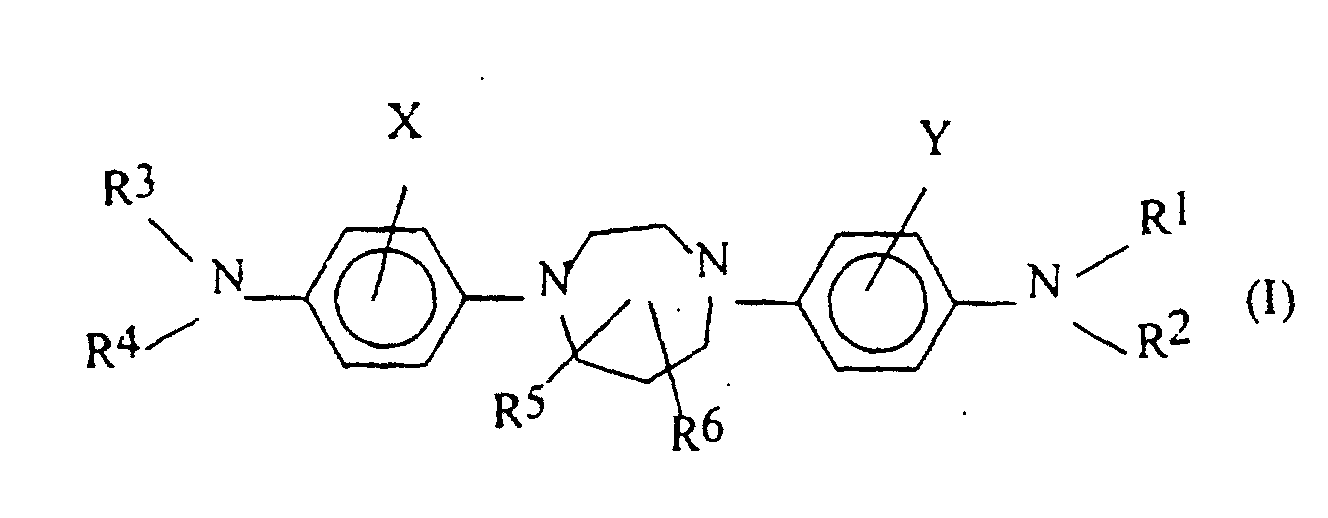
- R1, R2, R3 und R4 unabhängig voneinander stehen für Wasserstoff, eine C1-4-Alkyl- oder Hydroxyalkylgruppe oder eine C2-4-Dihydroxyalkylgruppe,
- X und Y unabhängig voneinander stehen für Wasserstoff, Chlor, Fluor, eine C1-4-Alkyl-. -Hydroxyalkyl-, -Aminoalkyl- oder -Alkoxygruppe, eine C2-4-Dihydroxyalkylgruppe oder eine Allylgruppe und
- R5 und R6 unabhängig voneinander stehen für Wasserstoff oder eine C1-4- Alkylgruppe.
- N,N'-Bis(4-aminophenyl)-1,4-diazacycloheptan,
- N,N'-Bis(4-amino-2-methyl-phenyl)-1,4-diazacycloheptan und
- N,N'-Bis(4-arnino-3-methyl-phenyl)-1,4-diazacycloheptan.
- lineare Fettsäuren mit 10 bis 22 C-Atomen (Seifen),
- Ethercarbonsäuren der Formel R-O-(CH2-CH2O)x -CH2-COOH, in der R eine lineare Alkylgruppe mit 10 bis 22 C-Atomen und x = 0 oder 1 bis 16 ist,
- Acylsarcoside mit 10 bis 18 C-Atomen in der Acylgruppe,
- Acyltauride mit 10 bis 18 C-Atomen in der Acylgruppe,
- Acylisethionate mit 10 bis 18 C-Atomen in der Acylgruppe,
- Sulfobernsteinsäuremono- und -dialkylester mit 8 bis 18 C-Atomen in der Alkylgruppe und Sulfobernsteinsäuremono-alkylpolyoxyethylester mit 8 bis 18 C-Atomen in der Alkylgruppe und 1 bis 6 Oxyethylgruppen,
- lineare Alkansulfonate mit 12 bis 18 C-Atomen,
- lineare Alpha-Olefinsulfonate mit 12 bis 18 C-Atomen,
- Alpha-Sulfofettsäuremethylester von Fettsäuren mit 12 bis 18 C-Atomen,
- Alkylsulfate und Alkylpolyglykolethersulfate der Formel R-O(CH2-CH2O)x-SO3H, in der R eine bevorzugt lineare Alkylgruppe mit 10 bis 18 C-Atomen und x = 0 oder 1 bis 12 ist,
- Gemische oberflächenaktiver Hydroxysulfonate gemäß DE-A-37 25 030,
- sulfatierte Hydroxyalkylpolyethylen- und/oder Hydroxyalkylenpropylenglykolether gemäß DE-A-37 23 354,
- Sulfonate ungesättigter Fettsäuren mit 12 bis 24 C-Atomen und 1 bis 6 Doppelbindungen gemäß DE-A-39 26 344,
- Ester der Weinsäure und Zitronensäure mit Alkoholen, die Anlagerungsprodukte von etwa 2-15 Molekülen Ethylenoxid und/oder Propylenoxid an Fettalkohole mit 8 bis 22 C-Atomen darstellen.
- Anlagerungsprodukte von 2 bis 30 Mol Ethylenoxid und/oder 0 bis 5 Mol Propylenoxid an lineare Fettalkohole mit 8 bis 22 C-Atomen, an Fettsäuren mit 12 bis 22 C-Atomen und an Alkylphenole mit 8 bis 15 C-Atomen in der Alkylgruppe,
- C12-22-Fettsäuremono- und -diester von Anlagerungsprodukten von 1 bis 30 Mol Ethylenoxid an Glycerin,
- C8-22-Alkylmono- und -oligoglycoside und deren ethoxylierte Analoga,
- Anlagerungsprodukte von 5 bis 60 Mol Ethylenoxid an Rizinusöl und gehärtetes Rizinusöl,
- Anlagerungeprodukte von Ethylenoxid an Sorbitanfettsäureester
- Anlagerungsprodukte von Ethylenoxid an Fettsäurealkanolamide.
- nichtionische Polymere wie beispielsweise Vinylpyrrolidon/Vinylacrylat-Copolymere, Polyvinylpyrrolidon und Vinylpyrrolidon/vinylacetat-copolymere und Polysiloxane,
- kationische Polymere wie quaternisierte Celluloseether, Polysiloxane mit quaternären Gruppen, Dimethyldiallylammoniumchlorid-Polymere, Acrylamid-Dimethyldiallylammoniumchlorid-Copolymere, mit - Diethylsulfat quaternierte Dimethylaminoethylmethacrylat-Vinylpyrrolidon-Copolymere, Vinylpyrrolidonlmidazoliniummethochlorid-Copolymere und quaternierter Polyvinylalkohol,
- zwitterionische und amphotere Polymere wie beispielsweise Acrylamidopropyltrimethylammoniumchlorid/Acrylat-Copolymere und Octylacrylamid/Methylmethacrylat/tert.Butylaminoethylmethacrylat/2-Hydroxypropylmethacrylat-Copolymere,
- anionische Polymere wie beispielsweise Polyacrylsäuren, vernetzte Polyacrylsäuren, Vinylacetat/Crotonsäure-Copolymere, Vinylpyrrolidon/Vinylacrylat-Copolymere, Vinylacetat/Butylmaleat/Isobornylacrylat-Copolymere, Methylvinylether/Maleinsäureanhydrid-Copolymere und Acrylsäure/Ethylacrylat/Ntert.Butylacrylamid-Terpolymere.
- Verdickungsmittel wie Agar-Agar, Guar-Gum, Alginate, Xanthan-Gum, Gummi arabicum, Karaya-Gummi, Johannisbrotkernmehl, Leinsamengummen, Dextrane, Cellulose-Derivate. z. B. Methylcellulose, Hydroxyalkylcellulose und Carboxymethylcellulose. Stärke-Fraktionen und Derivate wie Amylose, Amylopektin und Dextrine, Tone wie z. B. Bentonit oder vollsynthetische Hydrokolloide wie z.B. Polyvinylalkohol,
- Strukturanten wie Glucose und Maleinsäure,
- haarkonditionierende Verbindungen wie Phospholipide, beispielsweise Sojalecithin, Ei-Lecitin und Kephaline, sowie Silikonöle,
- Proteinhydrolysate, insbesondere Elastin-, Kollagen-, Keratin-, Milcheiweiß-, Sojaprotein- und Weizenproteinhydrolysate, deren Kondensationsprodukte mit Fettsäuren sowie quaternisierte Proteinhydrolysate,
- Parfümöle, Dimethylisosorbid und Cyclodextrine,
- Lösungsvermittler wie Ethanol, Isopropanol, Ethylenglykol, Propylenglykol, Glycerin und Diethylenglykol,
- Antischuppenwirkstoffe wie Piroctone Olamine und Zink Omadine,
- weitere Substanzen zur Einstellung des pH-Wertes,
- Wirkstoffe wie Panthenol, Pantothensäure, Allantoin, Pyrrolidoncarbonsäuren und deren Salze, Pflanzenextrakte und Vitamine,
- Cholesterin,
- Lichtschutzmittel,
- Konsistenzgeber wie Zuckerester, Polyolester oder Polyolalkylether,
- Fette und Wachse wie Walrat, Bienenwachs, Montanwachs, Paraffine, Fettalkohole und Fettsäureester.
- Fettsäurealkanolamide,
- Komplexbildner wie EDTA, NTA und Phosphonsäuren,
- Quell- und Penetrationsstoffe wie Glycerin, Propylenglykolmonoethylether, Carbonate, Hydrogencarbonate, Guanidine, Harnstoffe sowie primäre, sekundäre und tertiäre Phosphate,
- Trübungsmittel wie Latex,
- Perlglanzmittel wie Ethylenglykolmono- und -distearat,
- Treibmittel wie Propan-Butan-Gemische, N2O, Dimethylether, CO2 und Luft sowie
- Antioxidantien.
| Talgfettalkohol | 17,0 |
| Lorol®techn. | 4,0 |
| Texapon®N 28 | 40,0 |
| Dehyton®K | 25,0 |
| Eumulgin®B 2 | 1,5 |
| destilliertes Wasser | 12,5 |
| Cremebasis | 50,0 |
| Entwicklerkomponente | 7,5 mmol |
| Kupplerkomponente | 7,5 mmol |
| Na2SO3 (Inhibitor) | 1,0 |
| (NH4)2SO4 | 1,0 |
| konz. Ammoniaklösung | ad pH 10 |
| Wasser | ad 100 |
Für die Ausfärbungen wurden folgende Kuppler- und Entwickler-Komponenten verwendet:
- N,N'-Bis(4-aminophenyl)-1,4-diazacycloheptan (E1)
- N,N'-Bis(4-aminophenyl)-piperidin (E2) -Vergleichsbeispiel-
- N.N'-Bis(4-amino-2-methyl-phenyl)-1,4-diazacycloheptan (E3)
- N,N'-Bis(4-amino-3-methyl-phenyl)-1,4-diazacycloheptan (E4)
- 2,4,5,6-Tetraaminopyrimidin (E5)
- 4-Amino-3-methylphenol (E6)
- 2-Aminomethyl-4-aminophenol (E7)
- p-Aminophenol (E8)
- 1-(2-Hydroxyethyl)-2,5-diaminobenzol (E9)
- 4-Hydroxy-2,5,6-triaminopyrimidin (E10)
- N,N-Bis(2-hydroxyethyl)-p-phenylendiamin (E11)
- p-Toluylendiamin (E12)
- 2-(2,5-Diaminophenoxy)-ethanol (E13).
- 1-Naphthol (K1)
- Resorcin (K2)
- 2-Methyl-5-aminophenol (K3)
- 1,3-Bis(2,4-diaminophenoxy)propan (K4)
- 2-Chlor-6-methyl-3-aminophenol (K5)
- 3-Amino-6-methoxy-2-methylaminophenol (K6)
- 2-Hydroxy-4-aminophenoxyethanol (K7)
- 2-Amino-3-hydroxy-pyridin (K8)
- 4-Chlorresorcin (K9)
- 2,4-Diaminophenoxyethanol (K10)
- 2,6-Dimethyl-3-amino-phenol (K11)
- 2,4-Dichlor-3-amino-phenol (K12)
- 3,4-Methylendioxy-phenol (K13)
- 2-Methyl-resorcin (K14)
- m-Aminophenol (K15)
- 2-Methyl-5-(2-hydroxyethylamino)-phenol (K16)
- 2.6-Dihydroxy-3.4-dimethylpyridin (K17)
- 3-Amino-2-methylamino-6-methoxy-pyridin (K18)
- 1-Methoxy-2-amino-4-(2-hydroxyethylamino)-benzol (K19)
- 2.6-Bis(2-hydroxyethylamino)-toluol (K20)
- 1,7-Dihydroxynaphthalin (K21)
- 2,7-Dihydroxynaphthalin (K22).
| Entwickler | Kuppler | Nuance des gefärbten Haares | Intensität |
| E1 | K1 | lasurblau | sehr intensiv |
| E2 | K1 | graumagenta | sehr schwach |
| E1 | K2 | dunkelbraun | intensiv |
| E2 | K2 | dunkelblond | schwach |
| E1 | K3 | dunkelviolett | intensiv |
| E2 | K3 | rotbraun | sehr schwach |
| E1 | K4 | schwarzblau | sehr intensiv |
| E2 | K4 | dunkelviolett | sehr schwach |
| E1 | K5 | dunkelviolett | sehr intensiv |
| E2 | K5 | violett | sehr schwach |
| E1 | K7 | dunkelviolett | intensiv |
| E1 | K8 | dunkelviolett | intensiv |
| E1 | K9 | graubraun | intensiv |
| E1 | K10 | schwarzblau | intensiv |
| E1 | K11 | tiefviolett | intensiv |
| E1 | K12 | schwarzblau | intensiv |
| E1 | K13 | graubraun | intensiv |
| E1 | K14 | dunkelbraun | intensiv |
| E1 | K15 | schwarzblau | intensiv |
| E1 | K16 | dunkelviolett | intensiv |
| E1 | K17 | graublau | intensiv |
| E1 | K18 | dunkelgrün | intensiv |
| E1 | K19 | schwarzblau | intensiv |
| E3 | K1 | mattrot | intensiv |
| E3 | K5 | graurot | intensiv |
| E4 | K4 | dunkelblau | intensiv |
| E4 | K5 | schwarzblau | intensiv |
| E4 | K6 | dunkeltürkis | intensiv |
| E1+E5 | K4+K14 | dunkelblau | intensiv |
| E1+E6 | K8 | rotbraun | intensiv |
| E1+E7 | K3 | photobraun | intensiv |
| E1+E8 | K3 | photobraun | intensiv |
| E1+E9 | K3 | dunkelviolett | intensiv |
| E1+E10 | K20 | schwarzblau | intensiv |
| E1+E11 | K2+K15 | blaugrau | intensiv |
| E1+E8 | K4+K9 | marineblau | intensiv |
| E1+E10 | K11+K21 | dunkelviolett | intensiv |
| E1+E12 | K18+K22 | nordischblau | intensiv |
| E1+E6 +E13 | K3 | dunkelrubin | intensiv |
Claims (12)

Applications Claiming Priority (3)
| Application Number | Priority Date | Filing Date | Title |
|---|---|---|---|
| DE19707545A DE19707545A1 (de) | 1997-02-26 | 1997-02-26 | Neue Diazacycloheptan-Derivate und deren Verwendung |
| DE19707545 | 1997-02-26 | ||
| PCT/EP1998/000986 WO1998038175A1 (de) | 1997-02-26 | 1998-02-20 | Neue 1,4-diazacycloheptan-derivate und deren verwendung in oxidationshaarfärbemitteln |
Publications (2)
| Publication Number | Publication Date |
|---|---|
| EP0966449A1 EP0966449A1 (de) | 1999-12-29 |
| EP0966449B1 true EP0966449B1 (de) | 2003-04-16 |
Family
ID=7821441
Family Applications (1)
| Application Number | Title | Priority Date | Filing Date |
|---|---|---|---|
| EP98912353A Expired - Lifetime EP0966449B1 (de) | 1997-02-26 | 1998-02-20 | 1,4-diazacycloheptan-derivate und deren verwendung in oxidationshaarfärbemitteln |
Country Status (15)
| Country | Link |
|---|---|
| US (1) | US6165230A (de) |
| EP (1) | EP0966449B1 (de) |
| JP (1) | JP2001513766A (de) |
| CN (1) | CN1248250A (de) |
| AT (1) | ATE237598T1 (de) |
| AU (1) | AU731108B2 (de) |
| BR (1) | BR9807857A (de) |
| CA (1) | CA2281500A1 (de) |
| DE (2) | DE19707545A1 (de) |
| ES (1) | ES2196554T3 (de) |
| HU (1) | HUP0001491A2 (de) |
| NO (1) | NO994115D0 (de) |
| PL (1) | PL335025A1 (de) |
| SK (1) | SK115599A3 (de) |
| WO (1) | WO1998038175A1 (de) |
Families Citing this family (27)
| Publication number | Priority date | Publication date | Assignee | Title |
|---|---|---|---|---|
| FR2767685B1 (fr) † | 1997-09-01 | 2004-12-17 | Oreal | Composition pour la teinture d'oxydation des fibres keratiniques comprenant du 2-chloro 6-methyl 3-aminophenol et une base d'oxydation, et procede de teinture |
| KR100681228B1 (ko) | 1998-06-23 | 2007-02-09 | 헨켈 코만디트게젤샤프트 아우프 악티엔 | 케라틴 섬유 염색용 염색제 |
| DE19951010A1 (de) * | 1999-10-22 | 2001-04-26 | Henkel Kgaa | Mittel zum Färben von keratinhaltigen Fasern |
| DE19951009A1 (de) * | 1999-10-22 | 2001-04-26 | Henkel Kgaa | Mittel zum Färben von keratinhaltigen Fasern |
| FR2805741B1 (fr) * | 2000-03-06 | 2003-06-20 | Oreal | Composition de teinture d'oxydation des fibres keratiniques avec un derive particulier de la paraphenylenediamine et un colorant direct particulier |
| FR2805739B1 (fr) * | 2000-03-06 | 2003-01-10 | Oreal | Composition de teinture d'oxydation des fibres keratiniques et procede de teinture mettant en oeuvre cette composition |
| FR2805740B1 (fr) * | 2000-03-06 | 2003-09-05 | Oreal | Composition de teinture d'oxydation des fibres keratiniques et procede de teinture mettant en oeuvre cette composition |
| FR2805738B1 (fr) * | 2000-03-06 | 2003-03-14 | Oreal | Composition de teinture d'oxydation des fibres keratiniques et procede de teinture mettant en oeuvre cette composition |
| FR2806299B1 (fr) | 2000-03-14 | 2002-12-20 | Oreal | Compositions pour la teinture des fibres keratiniques contenant des derives de paraphenylenediamine a groupement pyrrolidinyle |
| FR2817474B1 (fr) * | 2000-12-06 | 2003-01-03 | Oreal | Composition de teinture d'oxydation a base de 1-(4-aminophenyl) pyrrolidines substituee en position 2 et procede de teinture de mise en oeuvre |
| FR2817472B1 (fr) * | 2000-12-06 | 2003-01-03 | Oreal | Composition de teinture d'oxydation a base de 1-(4-aminophenyl)pyrrolidines substituees au moins en position 2 et 3 et procede de teinture de mise en oeuvre |
| FR2817471B1 (fr) * | 2000-12-06 | 2005-06-10 | Oreal | Composition de teinture d'oxydation a base de 1-(4-aminophenyl) pyrrolidines substituees en position 3 et 4 et procede de teinture de mise en oeuvre |
| DE10101206A1 (de) * | 2001-01-11 | 2002-07-18 | Henkel Kgaa | Entwickler/Entwickler-Hybridfarbstoffe und hybridfarbstoffvorprodukte |
| FR2822697B1 (fr) * | 2001-04-02 | 2003-07-25 | Oreal | Nouvelle composition tinctoriale pour la teinture des fibres keratiniques comprenant un colorant azoique cationique particulier |
| FR2828488B1 (fr) * | 2001-08-08 | 2005-06-10 | Oreal | Composition pour la teinture de fibres keratiniques contenant une paraphenylenediamine substituee par un radical diazacycloheptane |
| DE10144226A1 (de) * | 2001-09-07 | 2003-03-27 | Henkel Kgaa | Neue verbrückte p-Phenylendiamine |
| US6946005B2 (en) | 2002-03-27 | 2005-09-20 | L'oreal S.A. | Pyrrolidinyl-substituted para-phenylenediamine derivatives substituted with a cationic radical, and use of these derivatives for dyeing keratin fibers |
| US7132534B2 (en) | 2002-07-05 | 2006-11-07 | L'oreal | Para-phenylenediamine derivatives containing a pyrrolidyl group, and use of these derivatives for coloring keratin fibers |
| US6923835B2 (en) * | 2002-09-09 | 2005-08-02 | L'oreal S.A. | Bis-para-phenylenediamine derivatives comprising a pyrrolidyl group and use of these derivatives for dyeing keratin fibres |
| FR2844271A1 (fr) * | 2002-09-09 | 2004-03-12 | Oreal | Derives bis-paraphenylenediamine a groupement pyrrolidinyle et utilisation de ces derives pour la coloration de fibres keratiniques |
| US7090703B2 (en) | 2003-03-24 | 2006-08-15 | L'oreal | Para-phenylenediamine derivatives comprising a cyclic diaza group substituted with a cationic radical, and use of these derivatives for dyeing keratin fibers |
| FR2852830B1 (fr) * | 2003-03-24 | 2008-04-18 | Oreal | Composition de teinture des fibres keratiniques comprenant un derive de para-phenylenediamine cationique substitue par un cycle diazacyclohexane ou diazacycloheptane |
| FR2852955A3 (fr) * | 2003-03-24 | 2004-10-01 | Oreal | Derives de paraphenylenediamine a groupement cyclique diaza substitue par un radical cationique et utilisation de ces derives pour la coloration de fibres keratiniques |
| US7186277B2 (en) | 2003-03-24 | 2007-03-06 | L'oreal Sa | Composition for dyeing keratin fibres, comprising a cationic para-phenylenediamine derivative substituted with a diazacyclohexane or diazacycloheptane ring |
| FR2860232B1 (fr) * | 2003-09-26 | 2006-01-27 | Oreal | Derives de triacyclonane substitue sur l'un au moins des atomes d'azote par un groupement 4'-aminophenyle substitue ou non substitue pour la teinture des fibres keratiniques |
| WO2008015785A1 (en) * | 2006-07-31 | 2008-02-07 | Kao Corporation | Hair dye composition |
| JP5962381B2 (ja) * | 2011-12-27 | 2016-08-03 | Jsr株式会社 | 液晶配向剤、液晶配向膜、液晶表示素子及び重合体 |
Family Cites Families (12)
| Publication number | Priority date | Publication date | Assignee | Title |
|---|---|---|---|---|
| DE2834605A1 (de) * | 1978-08-07 | 1980-02-28 | Henkel Kgaa | Neue bis-aminopyridine, deren herstellung und verwendung als komponenten in oxidationshaarfarben sowie diese enthaltende haarfaerbemittel |
| DE3627922A1 (de) * | 1986-08-18 | 1988-03-03 | Henkel Kgaa | Neue tetraaminopyrimidin-derivate und deren verwendung in haarfaerbemitteln |
| DE3723354A1 (de) * | 1987-07-15 | 1989-01-26 | Henkel Kgaa | Sulfatierte hydroxy-mischether, verfahren zu ihrer herstellung und ihre verwendung |
| DE3725030A1 (de) * | 1987-07-29 | 1989-02-09 | Henkel Kgaa | Oberflaechenaktive hydroxysulfonate |
| JPS6461449A (en) * | 1987-08-31 | 1989-03-08 | Terumo Corp | Diazonium salt compound and production thereof |
| US5344464A (en) * | 1988-09-08 | 1994-09-06 | L'oreal | Oxidation dye composition containing at least one double base in combination with at least one single base and dyeing process making use of it |
| FR2635976B1 (fr) * | 1988-09-08 | 1994-01-21 | Oreal | Composition tinctoriale d'oxydation contenant au moins une base double associee a au moins une base simple et procede de teinture la mettant en oeuvre |
| DE3926344A1 (de) * | 1989-08-09 | 1991-02-28 | Henkel Kgaa | Verfahren zur herstellung von hellfarbigen oelsaeuresulfonaten |
| DE4008049A1 (de) * | 1990-03-14 | 1991-09-19 | Henkel Kgaa | Paraphenylendiamin-derivate und deren verwendung in oxidationsfaerbemitteln |
| DE4234887A1 (de) * | 1992-10-16 | 1994-04-21 | Wella Ag | Oxidationshaarfärbemittel mit einem Gehalt an 4,5-Diaminopyrazolderivaten sowie neue 4,5-Diaminopyrazolderivate und Verfahren zu ihrer Herstellung |
| US5413082A (en) * | 1994-01-19 | 1995-05-09 | Siemens Electric Limited | Canister purge system having improved purge valve |
| EP0917531B1 (de) * | 1996-07-03 | 2002-01-09 | Hans Schwarzkopf GmbH & Co. KG | Piperazin-derivate und oxidationsfärbemittel |
-
1997
- 1997-02-26 DE DE19707545A patent/DE19707545A1/de not_active Withdrawn
-
1998
- 1998-02-20 AT AT98912353T patent/ATE237598T1/de not_active IP Right Cessation
- 1998-02-20 SK SK1155-99A patent/SK115599A3/sk unknown
- 1998-02-20 CA CA002281500A patent/CA2281500A1/en not_active Abandoned
- 1998-02-20 ES ES98912353T patent/ES2196554T3/es not_active Expired - Lifetime
- 1998-02-20 WO PCT/EP1998/000986 patent/WO1998038175A1/de not_active Ceased
- 1998-02-20 AU AU67229/98A patent/AU731108B2/en not_active Ceased
- 1998-02-20 HU HU0001491A patent/HUP0001491A2/hu unknown
- 1998-02-20 DE DE59807968T patent/DE59807968D1/de not_active Expired - Fee Related
- 1998-02-20 CN CN98802793A patent/CN1248250A/zh active Pending
- 1998-02-20 JP JP53727498A patent/JP2001513766A/ja active Pending
- 1998-02-20 PL PL98335025A patent/PL335025A1/xx unknown
- 1998-02-20 EP EP98912353A patent/EP0966449B1/de not_active Expired - Lifetime
- 1998-02-20 US US09/380,041 patent/US6165230A/en not_active Expired - Fee Related
- 1998-02-20 BR BR9807857-7A patent/BR9807857A/pt not_active Application Discontinuation
-
1999
- 1999-08-25 NO NO994115A patent/NO994115D0/no not_active Application Discontinuation
Also Published As
| Publication number | Publication date |
|---|---|
| NO994115L (no) | 1999-08-25 |
| EP0966449A1 (de) | 1999-12-29 |
| NO994115D0 (no) | 1999-08-25 |
| SK115599A3 (en) | 2000-05-16 |
| AU6722998A (en) | 1998-09-18 |
| CN1248250A (zh) | 2000-03-22 |
| US6165230A (en) | 2000-12-26 |
| AU731108B2 (en) | 2001-03-22 |
| BR9807857A (pt) | 2000-02-22 |
| WO1998038175A1 (de) | 1998-09-03 |
| PL335025A1 (en) | 2000-03-27 |
| ES2196554T3 (es) | 2003-12-16 |
| CA2281500A1 (en) | 1998-09-03 |
| DE19707545A1 (de) | 1998-08-27 |
| HUP0001491A2 (hu) | 2000-09-28 |
| ATE237598T1 (de) | 2003-05-15 |
| JP2001513766A (ja) | 2001-09-04 |
| DE59807968D1 (de) | 2003-05-22 |
Similar Documents
| Publication | Publication Date | Title |
|---|---|---|
| EP0792139B1 (de) | Oxidationsfärbemittel | |
| WO1998038175A1 (de) | Neue 1,4-diazacycloheptan-derivate und deren verwendung in oxidationshaarfärbemitteln | |
| EP1233744B1 (de) | Mittel zum färben von keratinhaltigen fasern | |
| EP0883598B1 (de) | Verwendung von aminophenol-derivaten in oxidationshaarfärbemittel | |
| WO1998001434A1 (de) | Neue piperazin-derivate und oxidationsfärbemittel | |
| DE10144226A1 (de) | Neue verbrückte p-Phenylendiamine | |
| EP0832640B1 (de) | Oxidationsfärbemittel zum Färben von Keratinfasern | |
| EP1037592B2 (de) | Neue entwicklerkombinationen für oxidationsfärbemittel | |
| EP1803438B1 (de) | Entwickler-Kuppler-Kombination | |
| EP1044185A2 (de) | Neue p-aminophenol-derivate und deren verwendung | |
| EP1210060B1 (de) | Entwickler-kuppler-kombinationen | |
| EP0873987B1 (de) | Perfluoracylierte 3-Aminophenol-Derivate und deren Verwendung in Haarfärbemitteln | |
| WO1999065891A1 (de) | Neue 2,4-diaminophenolderivate und deren verwendung | |
| EP0979064B1 (de) | Oxidationsfärbemittel | |
| EP1218344B1 (de) | Neue oxidationsfarbstoffvorprodukte | |
| EP1185234B1 (de) | Neue kupplerkomponenten für oxidationshaarfarben | |
| WO1999065865A1 (de) | Neue 3,4-diaminophenolderivate und deren verwendung | |
| DE19746249A1 (de) | Neue Aminophenol-Derivate und deren Verwendung | |
| EP1229891A1 (de) | Mittel zum färben von keratinhaltigen fasern | |
| WO1999066889A1 (de) | Neue kupplerkomponenten für oxidationshaarfarben | |
| DE19746250A1 (de) | Verwendung von substitutierten alpha-Naphtolen zum Färben von Keratinfasern |
Legal Events
| Date | Code | Title | Description |
|---|---|---|---|
| PUAI | Public reference made under article 153(3) epc to a published international application that has entered the european phase |
Free format text: ORIGINAL CODE: 0009012 |
|
| 17P | Request for examination filed |
Effective date: 19990817 |
|
| AK | Designated contracting states |
Kind code of ref document: A1 Designated state(s): AT BE CH DE DK ES FI FR GB GR IT LI NL PT SE |
|
| RTI1 | Title (correction) |
Free format text: 1,4-DIAZACYCLOHEPTANE DERIVATIVES AND THEIR USE IN HAIR OXIDATION DYES |
|
| GRAH | Despatch of communication of intention to grant a patent |
Free format text: ORIGINAL CODE: EPIDOS IGRA |
|
| RTI1 | Title (correction) |
Free format text: 1,4-DIAZACYCLOHEPTANE DERIVATIVES AND THEIR USE IN HAIR OXIDATION DYES |
|
| GRAH | Despatch of communication of intention to grant a patent |
Free format text: ORIGINAL CODE: EPIDOS IGRA |
|
| GRAA | (expected) grant |
Free format text: ORIGINAL CODE: 0009210 |
|
| AK | Designated contracting states |
Designated state(s): AT BE CH DE DK ES FI FR GB GR IT LI NL PT SE |
|
| PG25 | Lapsed in a contracting state [announced via postgrant information from national office to epo] |
Ref country code: FI Free format text: LAPSE BECAUSE OF FAILURE TO SUBMIT A TRANSLATION OF THE DESCRIPTION OR TO PAY THE FEE WITHIN THE PRESCRIBED TIME-LIMIT Effective date: 20030416 |
|
| REG | Reference to a national code |
Ref country code: GB Ref legal event code: FG4D Free format text: NOT ENGLISH |
|
| REG | Reference to a national code |
Ref country code: CH Ref legal event code: EP |
|
| REF | Corresponds to: |
Ref document number: 59807968 Country of ref document: DE Date of ref document: 20030522 Kind code of ref document: P |
|
| PG25 | Lapsed in a contracting state [announced via postgrant information from national office to epo] |
Ref country code: SE Free format text: LAPSE BECAUSE OF FAILURE TO SUBMIT A TRANSLATION OF THE DESCRIPTION OR TO PAY THE FEE WITHIN THE PRESCRIBED TIME-LIMIT Effective date: 20030716 Ref country code: PT Free format text: LAPSE BECAUSE OF FAILURE TO SUBMIT A TRANSLATION OF THE DESCRIPTION OR TO PAY THE FEE WITHIN THE PRESCRIBED TIME-LIMIT Effective date: 20030716 Ref country code: DK Free format text: LAPSE BECAUSE OF FAILURE TO SUBMIT A TRANSLATION OF THE DESCRIPTION OR TO PAY THE FEE WITHIN THE PRESCRIBED TIME-LIMIT Effective date: 20030716 |
|
| REG | Reference to a national code |
Ref country code: GR Ref legal event code: EP Ref document number: 20030402495 Country of ref document: GR |
|
| GBT | Gb: translation of ep patent filed (gb section 77(6)(a)/1977) | ||
| REG | Reference to a national code |
Ref country code: ES Ref legal event code: FG2A Ref document number: 2196554 Country of ref document: ES Kind code of ref document: T3 |
|
| ET | Fr: translation filed | ||
| PLBE | No opposition filed within time limit |
Free format text: ORIGINAL CODE: 0009261 |
|
| STAA | Information on the status of an ep patent application or granted ep patent |
Free format text: STATUS: NO OPPOSITION FILED WITHIN TIME LIMIT |
|
| 26N | No opposition filed |
Effective date: 20040119 |
|
| PGFP | Annual fee paid to national office [announced via postgrant information from national office to epo] |
Ref country code: NL Payment date: 20070204 Year of fee payment: 10 |
|
| PGFP | Annual fee paid to national office [announced via postgrant information from national office to epo] |
Ref country code: AT Payment date: 20070213 Year of fee payment: 10 |
|
| PGFP | Annual fee paid to national office [announced via postgrant information from national office to epo] |
Ref country code: GB Payment date: 20070214 Year of fee payment: 10 Ref country code: CH Payment date: 20070214 Year of fee payment: 10 |
|
| PGFP | Annual fee paid to national office [announced via postgrant information from national office to epo] |
Ref country code: DE Payment date: 20070215 Year of fee payment: 10 |
|
| PGFP | Annual fee paid to national office [announced via postgrant information from national office to epo] |
Ref country code: ES Payment date: 20070327 Year of fee payment: 10 |
|
| PGFP | Annual fee paid to national office [announced via postgrant information from national office to epo] |
Ref country code: IT Payment date: 20070522 Year of fee payment: 10 |
|
| PGFP | Annual fee paid to national office [announced via postgrant information from national office to epo] |
Ref country code: FR Payment date: 20070208 Year of fee payment: 10 |
|
| PGFP | Annual fee paid to national office [announced via postgrant information from national office to epo] |
Ref country code: BE Payment date: 20080415 Year of fee payment: 11 |
|
| REG | Reference to a national code |
Ref country code: CH Ref legal event code: PL |
|
| GBPC | Gb: european patent ceased through non-payment of renewal fee |
Effective date: 20080220 |
|
| PG25 | Lapsed in a contracting state [announced via postgrant information from national office to epo] |
Ref country code: LI Free format text: LAPSE BECAUSE OF NON-PAYMENT OF DUE FEES Effective date: 20080229 Ref country code: CH Free format text: LAPSE BECAUSE OF NON-PAYMENT OF DUE FEES Effective date: 20080229 |
|
| NLV4 | Nl: lapsed or anulled due to non-payment of the annual fee |
Effective date: 20080901 |
|
| PG25 | Lapsed in a contracting state [announced via postgrant information from national office to epo] |
Ref country code: AT Free format text: LAPSE BECAUSE OF NON-PAYMENT OF DUE FEES Effective date: 20080220 Ref country code: NL Free format text: LAPSE BECAUSE OF NON-PAYMENT OF DUE FEES Effective date: 20080901 |
|
| REG | Reference to a national code |
Ref country code: FR Ref legal event code: ST Effective date: 20081031 |
|
| PG25 | Lapsed in a contracting state [announced via postgrant information from national office to epo] |
Ref country code: DE Free format text: LAPSE BECAUSE OF NON-PAYMENT OF DUE FEES Effective date: 20080902 |
|
| PGFP | Annual fee paid to national office [announced via postgrant information from national office to epo] |
Ref country code: GR Payment date: 20080116 Year of fee payment: 11 |
|
| PG25 | Lapsed in a contracting state [announced via postgrant information from national office to epo] |
Ref country code: FR Free format text: LAPSE BECAUSE OF NON-PAYMENT OF DUE FEES Effective date: 20080229 |
|
| REG | Reference to a national code |
Ref country code: ES Ref legal event code: FD2A Effective date: 20080221 |
|
| PG25 | Lapsed in a contracting state [announced via postgrant information from national office to epo] |
Ref country code: GB Free format text: LAPSE BECAUSE OF NON-PAYMENT OF DUE FEES Effective date: 20080220 |
|
| PG25 | Lapsed in a contracting state [announced via postgrant information from national office to epo] |
Ref country code: ES Free format text: LAPSE BECAUSE OF NON-PAYMENT OF DUE FEES Effective date: 20080221 |
|
| BERE | Be: lapsed |
Owner name: *HENKEL K.G.A.A. Effective date: 20090228 |
|
| PG25 | Lapsed in a contracting state [announced via postgrant information from national office to epo] |
Ref country code: IT Free format text: LAPSE BECAUSE OF NON-PAYMENT OF DUE FEES Effective date: 20080220 |
|
| PG25 | Lapsed in a contracting state [announced via postgrant information from national office to epo] |
Ref country code: GR Free format text: LAPSE BECAUSE OF NON-PAYMENT OF DUE FEES Effective date: 20090902 Ref country code: BE Free format text: LAPSE BECAUSE OF NON-PAYMENT OF DUE FEES Effective date: 20090228 |