EP0966680B1 - Verfahren und vorrichtung zur kontrolle der reife oder festigkeit von obst und gemüse - Google Patents
Verfahren und vorrichtung zur kontrolle der reife oder festigkeit von obst und gemüse Download PDFInfo
- Publication number
- EP0966680B1 EP0966680B1 EP98909592A EP98909592A EP0966680B1 EP 0966680 B1 EP0966680 B1 EP 0966680B1 EP 98909592 A EP98909592 A EP 98909592A EP 98909592 A EP98909592 A EP 98909592A EP 0966680 B1 EP0966680 B1 EP 0966680B1
- Authority
- EP
- European Patent Office
- Prior art keywords
- fruit
- impactor
- output signal
- force
- ripeness
- Prior art date
- Legal status (The legal status is an assumption and is not a legal conclusion. Google has not performed a legal analysis and makes no representation as to the accuracy of the status listed.)
- Expired - Lifetime
Links
- 238000000034 method Methods 0.000 title claims description 20
- 235000012055 fruits and vegetables Nutrition 0.000 title description 2
- 235000013399 edible fruits Nutrition 0.000 claims description 152
- 238000012545 processing Methods 0.000 claims description 22
- 238000005259 measurement Methods 0.000 claims description 21
- 238000012360 testing method Methods 0.000 claims description 14
- 230000004044 response Effects 0.000 claims description 9
- 238000001228 spectrum Methods 0.000 claims description 9
- 238000010998 test method Methods 0.000 claims description 3
- 230000001960 triggered effect Effects 0.000 claims description 3
- 239000013078 crystal Substances 0.000 claims description 2
- 230000000694 effects Effects 0.000 claims description 2
- 238000010606 normalization Methods 0.000 claims description 2
- 239000004810 polytetrafluoroethylene Substances 0.000 claims description 2
- 229920001343 polytetrafluoroethylene Polymers 0.000 claims description 2
- 238000010079 rubber tapping Methods 0.000 description 8
- 235000011236 Persea americana var americana Nutrition 0.000 description 5
- 240000002426 Persea americana var. drymifolia Species 0.000 description 5
- 239000000463 material Substances 0.000 description 4
- 230000005070 ripening Effects 0.000 description 4
- 235000013311 vegetables Nutrition 0.000 description 4
- 238000010276 construction Methods 0.000 description 3
- 239000002184 metal Substances 0.000 description 3
- 241000894007 species Species 0.000 description 3
- 244000025272 Persea americana Species 0.000 description 2
- 235000008673 Persea americana Nutrition 0.000 description 2
- 238000010304 firing Methods 0.000 description 2
- 238000009863 impact test Methods 0.000 description 2
- 238000002372 labelling Methods 0.000 description 2
- 230000008569 process Effects 0.000 description 2
- 208000034656 Contusions Diseases 0.000 description 1
- 241000196324 Embryophyta Species 0.000 description 1
- 230000009471 action Effects 0.000 description 1
- 239000000853 adhesive Substances 0.000 description 1
- 230000001070 adhesive effect Effects 0.000 description 1
- 230000008901 benefit Effects 0.000 description 1
- 208000034526 bruise Diseases 0.000 description 1
- 230000006835 compression Effects 0.000 description 1
- 238000007906 compression Methods 0.000 description 1
- 230000007423 decrease Effects 0.000 description 1
- 230000032798 delamination Effects 0.000 description 1
- 230000001419 dependent effect Effects 0.000 description 1
- 230000001066 destructive effect Effects 0.000 description 1
- 238000010586 diagram Methods 0.000 description 1
- 239000006260 foam Substances 0.000 description 1
- 239000006261 foam material Substances 0.000 description 1
- 239000002783 friction material Substances 0.000 description 1
- 230000007246 mechanism Effects 0.000 description 1
- 238000012986 modification Methods 0.000 description 1
- 230000004048 modification Effects 0.000 description 1
- 239000004033 plastic Substances 0.000 description 1
- 229920003023 plastic Polymers 0.000 description 1
- 238000003825 pressing Methods 0.000 description 1
- 239000012858 resilient material Substances 0.000 description 1
- 230000000717 retained effect Effects 0.000 description 1
- 238000005096 rolling process Methods 0.000 description 1
- 239000007787 solid Substances 0.000 description 1
- -1 such as Substances 0.000 description 1
- 229920003051 synthetic elastomer Polymers 0.000 description 1
- 239000005061 synthetic rubber Substances 0.000 description 1
Images



Classifications
-
- G—PHYSICS
- G01—MEASURING; TESTING
- G01N—INVESTIGATING OR ANALYSING MATERIALS BY DETERMINING THEIR CHEMICAL OR PHYSICAL PROPERTIES
- G01N3/00—Investigating strength properties of solid materials by application of mechanical stress
- G01N3/40—Investigating hardness or rebound hardness
- G01N3/48—Investigating hardness or rebound hardness by performing impressions under impulsive load by indentors, e.g. falling ball
-
- G—PHYSICS
- G01—MEASURING; TESTING
- G01N—INVESTIGATING OR ANALYSING MATERIALS BY DETERMINING THEIR CHEMICAL OR PHYSICAL PROPERTIES
- G01N33/00—Investigating or analysing materials by specific methods not covered by groups G01N1/00 - G01N31/00
- G01N33/02—Food
- G01N33/025—Fruits or vegetables
-
- G—PHYSICS
- G01—MEASURING; TESTING
- G01N—INVESTIGATING OR ANALYSING MATERIALS BY DETERMINING THEIR CHEMICAL OR PHYSICAL PROPERTIES
- G01N2203/00—Investigating strength properties of solid materials by application of mechanical stress
- G01N2203/02—Details not specific for a particular testing method
- G01N2203/06—Indicating or recording means; Sensing means
- G01N2203/0617—Electrical or magnetic indicating, recording or sensing means
- G01N2203/0623—Electrical or magnetic indicating, recording or sensing means using piezoelectric gauges
Definitions
- the present invention relates to a method and apparatus for testing fruit and vegetables to assess their firmness or ripeness.
- a penetrometer which comprises a pin or spike for pushing into the fruit, and a force meter which detects the force required to push the spike into the fruit and, hence, the degree of ripeness.
- Another instrument devised by the industry for testing the ripeness of an avocado pear is a firmometer. This instrument utilises a lever for applying a fixed force to the exterior of the fruit and measures the resulting deflection of the lever to provide a reading indicative of ripeness.
- US-A-5 315 879 describes a measuring apparatus which may be used for measuring the firmness of fruit and other objects and which operates on similar principles to a firmometer.
- Both the penetrometer and firmometer type of instrument have the disadvantage that they damage or bruise the fruit being tested so that, particularly, in the case of the penetrometer, the fruit tested becomes unsaleable. Hence, they are used for testing on a selective basis and do not enable each individual fruit to be tested and individually assessed for shelf-life and treated and/or packaged accordingly.
- EP-A-0 267 737 describes apparatus for testing all fruit in a batch so as to measure individual ripeness. It makes use of a transducer comprising a polymeric piezoelectric film having electrodes and secured by adhesive to a metal plate which in turn is mounted on a resilient block of foam material. The fruit to be tested is caused to impact on the transducer which produces an electrical output from the film.
- the metal plate is selected so as to have a mass which is small in relation to that of the fruit and is made of a metal which is non-resonant under the impact.
- the foam support is such that the film, the plate and the fruit move in contact during the impact. This arrangement has the result that the output signal from the film represents the resonance of the fruit due to the impact, which can be used as a measure of the firmness or ripeness of the fruit.
- WO94/29715 describes a method and apparatus for testing the quality of a fruit by applying a dynamic force to the fruit and detecting the mechanical response of the fruit by means of piezoelectric film transducers supported on a displaceable supporting member. Hence, in so far as it measures the mechanical response of the fruit, it is similar to EP-A-0 267 737.
- EP-A-0 351 430 and US-A-4 542 639 both relate to the impact testing of engineering structures, such as laminates or honeycomb constructions, for delaminations and desponds.
- a sensor is mounted on a hammer which imparts a non-destructive impact to a material which is to be measured, and a signal produced by striking the material with the hammer is used to indicate the period of time of contact of the hammer with the material.
- the impact drive force applied to the hammer is removed by using a signal from the sensor as soon as the hammer comes into contact with the material being measured.
- US-A-4 542 639 describes the impact testing of structures in which a structure is struck by an impactor associated with a force transducer the output of which is related to the force which the transducer experiences on impact and encompasses a frequency range including the lowest frequencies which that force contains to any substantial degree.
- the impactor may be driven by an electromagnetic arrangement. The maximum amplitude indicates whether the structure is faulty or not.
- US-A-4 217 614 describes apparatus for automatically applying pressure sensitive labels to objects which utilises an application device in the form of a bellows which is pressure/vacuum operated in order to extend and contract the bellows in a label applying operation.
- the present invention consists in a method of testing a fruit to assess its ripeness, comprising the steps of applying a driving force to an impactor so as to cause the impactor to strike the fruit, detecting the reaction by means of a force transducer incorporated in the impactor and producing an electrical output signal representing a reaction force generated by the impactor striking fruit, and processing the output signal to produce a measurement indicative of the ripeness of the fruit, characterised by terminating the application of the driving force before the impactor strikes the fruit so that the impactor strikes the fruit with an impact in the form of a tap and the transducer produces an electrical output signal in the form of a pulse in response to the reaction force generated by the impactor striking the fruit.
- the invention consists in apparatus for testing a fruit to assess its ripeness, comprising at least one impactor having a force transducer which, when the impactor strikes the fruit, produces an electrical output signal representing the reaction force generated by the impact, driving means operable to apply a driving force to the impactor and urge the impactor towards the fruit, and means for processing the output signal to produce a signal indicative of the ripeness of the fruit, characterised in that the driving means is operated so as to terminate the application of the driving force before the impactor strikes the fruit, whereby the impactor strikes the fruit with an impact in the form of a tap and the transducer produces an output signal in the form of a pulse, said output signal being linearly related to the reaction force to which the transducer is subjected by reason of the impact.
- the force of the tap with which the fruit is struck must be of such a magnitude that it is not so small that the skin of the fruit absorbs most of the blow and not so hard as to damage the fruit.
- the impactor is provided in a plunger means which is adapted to move the impactor towards and away from a fruit item.
- the plunger means is a bellows which can be expanded by the admission thereto of pressurised air and retracted by application of a vacuum.
- the impactor is movable relatively to the plunger means so that, when the plunger means stops moving towards a fruit item whose condition is to be assessed, the impactor will continue to move under its own momentum to strike the surface of the fruit.
- the reaction force resulting from the tap is detected by the force transducer and the latter produces an electrical output signal in the form of a single pulse corresponding to the reaction force.
- Both the peak value and the duration of this pulse depend on the firmness and, therefore, the ripeness of the fruit.
- the peak value of the reaction force and resulting electrical pulse increase as the firmness of the fruit increases whilst the duration of the pulse decreases with increase in firmness.
- the electrical pulse can be processed in several different ways in order to derive from the pulse an indication of the ripeness of the fruit tapped. Hence, the measurement of ripeness may be based on peak force or the peak value of the resulting electrical output pulse.
- the momentum of the impactor at the instant before striking the fruit must be constant for the fruits being tapped. In practice, this may be difficult to achieve with irregularly shaped fruit.
- the output signal may be processed on the basis of duration in order to produce an indication of ripeness.
- the duration is only a weak function of the momentum of the impactor on striking the fruit so that maintaining constant momentum at this stage is not as important as when processing is based on peak value.
- problems may occur with the accuracy of measurement based on duration because of the difficulty in accurately defining the duration of a pulse owing to the fact that there is frequently a "tail" on the pulse.
- the signal processing may involve some form of frequency domain processing.
- the output signal is electronically resolved into a frequency spectrum encompassing a predetermined frequency range, including the lowest frequency which the output pulse comprises to any significant degree, and the frequency components in the frequency spectrum are processed. as a function of the reaction force.
- such a processing stage comprises computing a graph of the variation of the frequency components in the frequency spectrum as a function of the reaction force based on a logarithmic scale (frequency along the x-axis, log force along the y-axis) and measuring the ripeness based on the area of a predetermined zone below the graph and between, for example, two lines of constant force F1,F2 corresponding respectively to the log values of the maximum force component and a force component 25dB less than the maximum.
- the measured area of the graph may be presented as a percentage of a fixed reference area which, in the present example, may be selected as the rectangular area defined between the lines of constant force F1, F2, and the same frequency limits as the measured area.
- the lower end of the frequency range may be substantially zero frequency and the upper end may be in the range from 2-5kHz.
- the area calculated is substantially independent of the level of the spectrum at zero frequency and is therefore only a very weak function of the momentum of the impactor at impact.
- Another form of frequency domain processing is electronically to plot a graph of force against frequency on a linear force scale and simply integrate force with respect to frequency, thus obtaining the area under the curve. This avoids the need to define predetermined down points as is required by the previously described frequency domain process.
- the area under the curve of the graph increases as the firmness increases.
- the momentum of the impactor must be controlled very accurately as the area under the curve is proportional to momentum and, in practice, this method may not be a very attractive.
- the area under the force-frequency curve of the frequency domain processing described above may also be normalised by dividing by momentum H although, in this case, a simpler normalisation is to divide by X(0) which is the dc (zero frequency) level of the spectrum which is obtained via the Fourier analysis utilised for converting from force-time to force-frequency.
- the preferred method of signal processing is to use either the peak force/H or the S/H parameter, as described above. This has the advantage of not requiring a Fourier transform and is quicker to implement than frequency domain techniques. It can also be implemented in analogue electronics, rather than digital electronics, which makes the signal processing system potentially cheaper.
- the measurement can be provided as a numerical output directly indicative of the ripeness of the fruit, it will be necessary to calibrate the measurements produced against known ripening data for each species of fruit and its individual cultivars.
- the invention enables a ripeness test to be performed in any position on a fruit and the tap may be applied to the fruit either manually or mechanically.
- the resulting signals indicative of the ripeness may be used, for example, to control a gating mechanism which directs the fruit to different collecting stations depending on the degree of ripeness, and hence shelf-life, indicated by the ripeness signal.
- the apparatus illustrated in Figure 1 is designed to tap test fruit, such as avocado pears, as they are conveyed along a so-called "singulator" which is used in sorting depots to place fruit into individual cups from which they are deposited into different hoppers depending on the degree of ripeness sensed by the test.
- the apparatus includes an impactor arm 1 which is pivoted at one end 2 above the singulator or conveyor (not shown) arranged to convey the items of fruit one at a time beneath the arm.
- the arm mounts the impactor device 3.
- the latter comprises a solenoid 4 having its armature 5 projecting at one end from the solenoid casing and serving as an impactor which is arranged to tap the fruit passing beneath the arm.
- the armature 5 is advanced to apply a tap to a fruit in response to an electrical driving pulse applied to the solenoid and is spring biassed to return to its retracted position.
- the armature incorporates a force transducer in the form of a piezoelectric crystal which produces an electrical output pulse in response to the reaction force exerted on the armature as a result of applying a tap to a fruit.
- the solenoid 4 is triggered to apply a tap in response to the actuation of a microswitch 6 by a fruit travelling beneath the impactor and engaging a downwardly projecting actuating arm 7 of the microswitch.
- the arm 1 is fitted with rollers 8 to permit the arm to ride smoothly over fruit travelling beneath and engaging the arm preparatory to being tapped by the impactor.
- the fruit is protected from damage by the outer end of the arm by a further roller 9.
- Suitable stops 10,11 are mounted below and above the arm adjacent its pivot in order to limit movement of the arm and prevent it from dropping too low and engaging the conveyor or being raised too high.
- the conveyor is of a known construction and, desirably, it should position the avocado pears or other fruit, under the impactor with the widest or most bulbous part of the fruit below the impactor.
- the fruit may be advanced along the conveyor with a rolling motion or be stationary about its axis. Referring also to Figure 2, as each fruit 12 travels below the impactor arm 1, it engages the arm and pushes it upwards so as to move the impactor 3 into a position for tapping the fruit.
- the fruit and impactor are in a predetermined position relative to one another, the fruit actuates the microswitch 6 by engaging the actuating arm 7 so that an electrical driving pulse is supplied to fire the solenoid 4 and the armature 5 is actuated to tap the fruit.
- the firing position of the solenoid is at A on large fruit 12 and at B on small fruit 12' whilst the first contact position is C on large fruit and D on small fruit. These differences in contact positions are accommodated by firing the solenoid with the microswitch 6. After tapping, each fruit continues to travel beneath the arm 1 and subsequently the arm is released from the fruit (position E) and returns to a rest position against the lower stop preparatory to engaging the next fruit on the conveyor line.
- the roller 9 at the outer end of the arm protects the fruit from damage as the arm is released.
- the solenoid driving pulse 13 is a square pulse and has finished before the tap impacts on a fruit so that the solenoid 4 does not drive the armature into the fruit.
- the reaction force resulting from a tap applied by the solenoid armature striking the fruit is detected by the force transducer and is reproduced as a single electrical output pulse similar to pulses 14, 15 shown in Figure 3.
- the peak value and duration of the resulting output pulse depends on the firmness and therefore the ripeness of the fruit.
- the pulse 14 represents the pulse resulting from a tap test on an unripe or hard avocado whilst pulse 15 results from a tap test on a ripe or soft avocado.
- Figure 4 illustrates an electronic circuit for use with the tapping device described above and for processing the electrical output pulses produced by the device upon tapping fruit.
- the output pulses from the piezoelectric transducer of the impactor device 3 are fed by way of leads 16, an amplifier 17 and trigger unit 18 to an analogue-to-digital converter 19 and then to a buffer store 20.
- the trigger unit 18 operates in response to actuation of the microswitch 6 and ensures that the value of the output from the amplifier 17 covers the full duration of the pulse.
- the output from the store 20 is fed to a computer 21 which processes the digital signal from the store in any of the ways described above to produce a measurement indicative of the ripeness of the fruit. In order that the measurement can be provided as a numerical output directly indicative of the ripeness, it will be necessary to calibrate the measurements produced against known ripening data for each species of fruit and its individual cultivars.
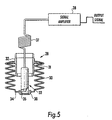
- an alternative embodiment of the impactor device 28 comprises a bellows 30 of resilient material, such as, plastics or synthetic rubber, and of lightweight construction.
- a bellows is already known in connection with labelling machines for example as described in US-A-4 217 164.
- the bellows is mounted on the projecting annular flange 31 of a rigid, tubular support 32.
- Means (not shown) are provided for applying a vacuum to the bellows to hold it in a retracted disposition, as illustrated in Figure 5, and when appropriate, to supply pressurised air to the bellows to expand it downwardly (as viewed in Fig. 5).
- An impactor 33 is mounted on the inner surface of the free end 34 of the bellows above an aperture 35 in a shaped nose piece 36 at the free end 34.
- the impactor 33 is movable with the bellows when the bellows is expanded and retracted. It is electrically coupled by wires 37 to an amplifier 38 for signals from the impactor.
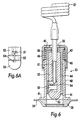
- the impactor 33 is shown in more detail in Figure 6. It is mounted in a tubular housing 40 having an out-turned flange 41 at one end mounting the impactor on the inner surface of the free end 34 of the bellows 30.
- a cap 42 is provided at the opposite end of the housing which with said opposite end defines an internal annular shoulder or abutment 43.
- the impactor itself, comprises an inner housing 44 slidably disposed in housing 40.
- the end of the inner housing 44 adjacent the cap 42 is provided with a flange 45.
- a compression spring 46 is positioned around the inner housing and bears at one end on the shoulder 43 and at its opposite end on the flange 45 so that the inner housing is urged upwardly (as viewed in Fig. 6). The upward movement of the inner housing is limited by engagement of the inner housing against the cap 42.
- a solid slug 52 which mounts a piezoelectric transducer 50 adjacent the end 51 of the inner housing remote from the cap 42.
- the end 53 of the slug projects from the end 51 of the inner housing for striking a fruit to be tested and is part spherically shaped.
- the transducer 50 is mounted in contact with the slug and the signal wires 37 are fed to a cavity 54 providing access to opposite sides of the transducer and permitting connection of the wires 37 thereto, via an aperture 55 in the cap and passageways 56,57 in the inner housing and slug (see also Figure 6A).
- the impactor device 28 is shown installed in a ripeness testing machine and mounted above a fruit 60 which is passing below the device.
- the latter is mounted on a frame structure 58 which is disposed above a conveyor 59 upon which the fruit 60 is transported.
- the tubular support 32 for the bellows of the impactor device communicates with a chamber 61 mounted on the frame structure 58 above the device.
- the chamber 61 is connected at one side, via a port 62, to a pressurised air chamber 63 which is coupled to a source of air presure by an inlet conduit 64.
- the chamber 61 is connected, via a port 65, to a vacuum chamber 66 which is connected to a source of vacuum by an outlet conduit 67.
- the ports 62,65 are controlled by valve members 68,69 attached to a slidable valve rod 70 which is reciprocated by means of an electrical solenoid 71 and a return spring 72.
- the spring 72 urges the valve members 68,69 into positions in which the air inlet port 62 is closed and the vacuum port 65 is open so that vacuum is applied to the support tube 32 and the bellows 30 are retained in a retracted rest position.
- Actuation of the solenoid 71 slides the valve control rod 70 against the action of the spring 72 to open the air inlet port 62 and close the vacuum port 65, thereby momentarily expanding the bellows so as to cause the nose 36 to contact a fruit 60 conveyed below the impactor device and the impactor to tap the fruit and produce an output pulse from the transducer 50.
- the solenoid 71 can be controlled in any convenient manner so as to actuate the impactor device as each fruit 60 is advanced below it.
- the solenoid is triggered so as to open the valve member 68 only briefly and apply air pressure to the bellows for a sufficient time to produce a driving force to initiate movement of the bellows and impactor towards the fruit, the arrangement being such that the impactor striking the fruit under its own momentum when the nose piece 36 of the bellows contacts and stops against the fruit.
- the bellows are contracted by exhaustion of air therefrom through the vacuum port 65 and vacuum outlet conduit 67 to return the impactor device to its rest position.
- two or more impactor devices 28 may be mounted side-by-side in a row transversely of the conveyor 59 for simultaneously tapping each fruit so as to produce an output signal for each of a plurality of positions along the fruit axis disposed transversely to the direction of movement of the conveyor.
- the conveyor 59 may be adapted to rotate each fruit as it is advanced by the conveyor and a plurality of the impactor devices 28 may also be mounted in succession, or in successive rows, along the conveyor for successively tapping each fruit and producing an output signal for each of a plurality of positions about the fruit.
- the signal processing may not require that the analogue output signal from the piezoelectric transducer be converted into a digital signal for processing by the computer, in which event, the analogue to digital converter 19 may be omitted from the circuit.
- the rollers 8,9 on the impactor arm 1 may be replaced by strips of low friction material, such as PTFE.
Landscapes
- Chemical & Material Sciences (AREA)
- Health & Medical Sciences (AREA)
- Life Sciences & Earth Sciences (AREA)
- Immunology (AREA)
- Analytical Chemistry (AREA)
- Biochemistry (AREA)
- General Health & Medical Sciences (AREA)
- General Physics & Mathematics (AREA)
- Physics & Mathematics (AREA)
- Pathology (AREA)
- Engineering & Computer Science (AREA)
- Food Science & Technology (AREA)
- Medicinal Chemistry (AREA)
- Investigating Or Analyzing Materials By The Use Of Ultrasonic Waves (AREA)
- Investigating Strength Of Materials By Application Of Mechanical Stress (AREA)
- Investigating Or Analysing Materials By Optical Means (AREA)
Claims (22)
- Ein Verfahren zum Kontrollieren einer Frucht zum Beurteilen ihrer Reife, beinhaltend die Schritte des Aufbringens einer Antriebskraft auf einem Prallelement (5, 33), um so das Prallelement zu veranlassen, die Frucht zu berühren, des Ermittelns der Reaktion mittels eines Kraftaufnehmers (50), eingegliedert in dem Prallelement und ein elektrisches Ausgangssignal erzeugend, welches eine Reaktionskraft, erzeugt von dem die Frucht berührenden Prallelement. repräsentiert und des Aufbereitens des Ausgangssignals zum Erzeugen eines Messhinweises auf die Reife der Frucht, gekennzeichnet durch das Abbrechen des Aufbringens der Antriebskraft bevor das Prallelement (5, 33) die Frucht mit einem Aufprall in Form eines leichten Schlages berührt und der Aufnehmer (50) ein elektrisches Ausgangssignal in Form eines Impulses erzeugt, in Erwiderung auf die Reaktionskraft, erzeugt von dem die Frucht berührenden Prallelement.
- Ein Verfahren gemäß Anspruch 1, worin das Aufbereiten des Ausgangssignals das Ermitteln des Spitzenwertes der Reaktionskraft beinhaltet.
- Ein Verfahren gemäß Anspruch 1, worin das Aufbereiten des Ausgangssignals das Zerlegen des Ausgangssignals in ein Frequenzspektrum, welches einen vorbestimmten Frequenzbereich umfasst und das Aufbereiten der Frequenzkomponenten des Spektrums als Funktion der Reaktionskraft beinhaltet.
- Ein Verfahren gemäß Anspruch 3, welches das Berechnen eines Graphen der Variation der Frequenzkomponenten in dem Frequenzspektrum als eine Funktion der Reaktionskraft basierend auf einer logarithmischen Skalierung und das Erzeugen der Messung der Reife basierend auf dem Bereich einer vorbestimmten Zone unterhalb des Graphen beinhaltet.
- Ein Verfahren gemäß Anspruch 3, worin das Aufbereiten des Ausgangssignals das Einordnen der Kraft bezogen auf die Frequenz für eine Darstellung der Kraft bezüglich der Frequenz auf einer linearen Kraftskalierung beinhaltet.
- Ein Verfahren gemäß Anspruch 1, worin das Aufbereiten des Ausgangssignals das Berechnen des Parameters S beinhaltet, welcher durch die Gleichung
- Ein Verfahren gemäß einem der vorangehenden Ansprüche, worin die Momentenwirkung des Prallelements (5, 33) beim Aufprall auf die Reifemessung durch Normalisieren der Messung verringert wird.
- Ein Verfahren gemäß Anspruch 7, worin das Normalisieren das Teilen der Messung durch das Moment H des Prallelements (5, 33) beim Aufprall beinhaltet, welches durch den Ausdruck
- Ein Verfahren gemäß den Ansprüche 4 und 7, worin der Wert, der für den Bereich unterhalb des Kraft-Frequenz-Graphen erhalten wird, durch Teilen durch den DC-Pegel des Spektrums normalisiert wird.
- Ein Verfahren gemäß einem der vorangehenden Ansprüche, worin die Frucht gedreht wird und von einer Vielzahl von Prallelementen (5, 33) getroffen wird, so dass Ausgangsimpulse für eine Vielzahl von Positionen um die Frucht herum produziert werden.
- Eine Vorrichtung zum Kontrollieren einer Frucht zum Beurteilen ihrer Reife, beinhaltend mindestens ein Prallelement (5, 33), das einen Kraftaufnehmer (50) aufweist, welcher, wenn das Prallelement die Frucht berührt, ein elektrisches Ausgangssignal erzeugt, das die Reaktionskraft, erzeugt von dem Aufprall, repräsentiert, eine Antriebsvorrichtung (40, 30) fähig, eine Antriebskraft auf das Prallelement aufzubringen und das Prallelement in Richtung der Frucht zu drängen und Mitteln (16 - 21) zum Aufbereiten des Ausgangssignals, um ein Signal, indikativ für die Reife der Frucht, zu erzeugen, dadurch gekennzeichnet, dass die Antriebsvorrichtung (40, 30) so betrieben wird, dass sie das Aufbringen der Antriebskraft abbricht, bevor das Prallelement die Frucht berührt, wobei das Prallelement die Frucht mit einem Aufprall in Form eines leichten Schlages berührt und der Aufnehmer (50) ein Ausgangssignal in Form eines lmpulses erzeugt, wobei das Ausgangssignal linear bezogen auf die Reaktionskraft, welcher der Aufnehmer aufgrund des Aufpralls unterworfen ist, ist.
- Eine Vorrichtung gemäß Anspruch 11, worin das Prallelement (33) auf einer Kolbeneinrichtung (30) befestigt ist, welche so angepasst ist, das Prallelement zu und weg von der Frucht zu bewegen.
- Vorrichtung gemäß Anspruch 12, worin die Kolbeneinrichtung ein Faltenbalg (30) ist, welcher so angeordnet ist, bei Zufuhr eines verdichteten Gases zu expandieren und sich bei Aufbringen eines Vakuums zurückzuziehen.
- Vorrichtung gemäß den Ansprüchen 12 oder 13, worin das Prallelement (33) relativ zu dem Kolben (30) bewegbar befestigt ist, so dass, wenn der Kolben stoppt, sich zu der Frucht zu bewegen, das Prallelement die Bewegung fortsetzt, unter seinem eigenen Moment, um so die Frucht zu berühren.
- Vorrichtung gemäß Anspruch 11, worin das Prallelement den Anker (5) eines Elektromagneten (4) beinhaltet, welcher als Antriebsvorrichtung dient.
- Vorrichtung gemäß den Ansprüchen 11 oder 15, worin das Prallelement (5) an dem Ende eines Schwenkarms (1) befestigt ist, welcher von der Frucht, die unterhalb des Arms befördert ist kontaktierbar ist, um das Prallelement zum Berühren der Frucht zu positionieren.
- Vorrichtung gemäß Anspruch 16, worin der Arm (1) eine Vielzahl von Rollen, PTFE-Streifen oder andere reibungsverringernde Mittel (8, 9) in Positionen, die Frucht, welche unterhalb des Arms befördert ist, befestigt, um dem Arm zu ermöglichen, sanft über die Frucht zu fahren.
- Vorrichtung gemäß einem der vorangehenden Ansprüche 11 bis 17, worin der Aufnehmer einen Piezo-Kristall (50) beinhaltet.
- Vorrichtung gemäß einem der Ansprüche 11 - 18, beinhaltend eine Fördereinrichtung (59) zum Befördern der Frucht retativ zu dem Prallelement (5, 33).
- Vorrichtung gemäß Anspruch 19, worin das Prallelement von der Frucht, die einen Mikroschalter (6) kontaktiert, wenn sie von der Fördereinrichtung relativ zu dem Prallelement befördert wird, ausgelöst wird.
- Vorrichtung gemäß den Ansprüchen 19 oder 20, beinhaltend mindestens zwei der Prallelemente (5, 33) nebeneinander schräg zu der Fördereinrichtung (59) befestigt, um so die Frucht anzutippen und ein Ausgangssignal für jede einer Vielzahl von Positionen entlang einer Achse der Frucht, welche quer zur Bewegungsrichtung der Fördereinrichtung angeordnet ist, zu erzeugen.
- Vorrichtung gemäß den Ansprüchen 19, 20 oder 21, worin die Fördereinrichtung (59) angepasst ist, die Frucht, wenn sie von den Fördermitteln befördert wird, zu drehen und eine Vielzahl von Prallelementen (5, 33) in Reihe entlang der Fördereinrichtung befestigt sind, um die Frucht anzutippen und ein Ausgangssignal für jede einer Vielzahl von Positionen um die Frucht herum zu erzeugen.
Applications Claiming Priority (5)
| Application Number | Priority Date | Filing Date | Title |
|---|---|---|---|
| GB9704908 | 1997-03-10 | ||
| GBGB9704908.4A GB9704908D0 (en) | 1997-03-10 | 1997-03-10 | Method and apparatus for assessing the ripeness or firmness of fruit and vegetables |
| GB9716196 | 1997-07-31 | ||
| GBGB9716196.2A GB9716196D0 (en) | 1997-03-10 | 1997-07-31 | Method and apparatus for assessing the ripeness or firmness of fruit and vegetables |
| PCT/GB1998/000709 WO1998040737A1 (en) | 1997-03-10 | 1998-03-10 | Method and apparatus for assessing the ripeness or firmness of fruit and vegetables |
Publications (2)
| Publication Number | Publication Date |
|---|---|
| EP0966680A1 EP0966680A1 (de) | 1999-12-29 |
| EP0966680B1 true EP0966680B1 (de) | 2004-12-22 |
Family
ID=26311148
Family Applications (1)
| Application Number | Title | Priority Date | Filing Date |
|---|---|---|---|
| EP98909592A Expired - Lifetime EP0966680B1 (de) | 1997-03-10 | 1998-03-10 | Verfahren und vorrichtung zur kontrolle der reife oder festigkeit von obst und gemüse |
Country Status (10)
| Country | Link |
|---|---|
| US (1) | US6240766B1 (de) |
| EP (1) | EP0966680B1 (de) |
| JP (1) | JP3985197B2 (de) |
| AU (1) | AU731111B2 (de) |
| CA (1) | CA2283770C (de) |
| DE (1) | DE69828264T2 (de) |
| ES (1) | ES2235318T3 (de) |
| IL (1) | IL131832A (de) |
| NZ (1) | NZ337981A (de) |
| WO (1) | WO1998040737A1 (de) |
Families Citing this family (24)
| Publication number | Priority date | Publication date | Assignee | Title |
|---|---|---|---|---|
| BR0012894B1 (pt) * | 1999-07-30 | 2009-05-05 | processo e dispositivo para determinar a dureza de um produto. | |
| NL1015949C2 (nl) * | 1999-12-01 | 2001-06-21 | Greefs Wagen Carrosserie | Werkwijze en inrichting voor het bepalen van de hardheid/elasticiteit en/of andere eigenschappen van groente of fruit. |
| NL1013720C2 (nl) * | 1999-12-01 | 2001-06-21 | Greefs Wagen Carrosserie | Werkwijze en inrichting voor het bepalen van de hardheid/elasticiteit en/of andere eigenschappen van groente of fruit. |
| US6553814B2 (en) | 1999-12-01 | 2003-04-29 | De Greef's Wagen-Carrosserle-En Machinebouw B.V. | Method and device for determining the hardness/elasticity and/or other properties of vegetables or fruit |
| ITPN20000040A1 (it) * | 2000-07-03 | 2002-01-03 | Unitec Srl | Impianto e procedimento di misurazione automatica del grado di maturazione di prodotti vegetali |
| US6643599B1 (en) * | 2000-10-17 | 2003-11-04 | Charles L. Mohr | Automated machine and method for fruit testing |
| GB0205667D0 (en) | 2002-03-12 | 2002-04-24 | Sinclair Int Ltd | Improvements in or relating to apparatus for the assesment of the condition of fruit and vegetables |
| US7024942B1 (en) | 2004-05-10 | 2006-04-11 | The United States Of America As Represented By The Secretary Of Agriculture | Method and apparatus for non-destructive detection of pits and seed fragments in fruit |
| JP2007064938A (ja) * | 2005-09-02 | 2007-03-15 | Mitsui Mining & Smelting Co Ltd | 青果類の浮皮識別装置および青果類の浮皮識別方法 |
| JP4681989B2 (ja) * | 2005-09-02 | 2011-05-11 | 三井金属鉱業株式会社 | 青果類の浮皮識別装置および青果類の浮皮識別方法 |
| BRPI0705830B1 (pt) | 2007-07-16 | 2018-04-03 | Embrapa - Empresa Brasileira De Pesquisa Agropecuária | Sistema de aplanação para avaliar a firmeza dependente da pressão celular em folhas e segmentos de face plana de órgãos macios |
| US8346388B1 (en) * | 2007-12-15 | 2013-01-01 | Jared Michael Tritz | System and method for automated tactile sorting |
| US20090274811A1 (en) * | 2008-05-01 | 2009-11-05 | Brock Lundberg | Defect separation from dry pulp |
| US8001826B2 (en) * | 2009-05-26 | 2011-08-23 | Raytheon Company | Methods and apparatus for high frequency impact testing |
| ITPN20110022A1 (it) * | 2011-04-05 | 2012-10-06 | Unitec Spa | Procedimento ed apparato per la valutazione della durazza e per la selezione di prodotti orto-frutticoli |
| BRPI1107358B1 (pt) * | 2011-12-30 | 2017-09-26 | Embrapa - Empresa Brasileira De Pesquisa Agropecuária | Pressure measurement and flow control device |
| CN104165794A (zh) * | 2014-07-21 | 2014-11-26 | 华南农业大学 | 农业物料工况模拟机构及农业物料物理特性测试仪 |
| AU2017238652B2 (en) | 2016-03-24 | 2022-04-21 | Sumier SLEIMAN | Labeller and method of using the same |
| MX2019010766A (es) | 2017-03-10 | 2019-12-11 | Walmart Apollo Llc | Metodos y sistemas de determinacion de propiedad interna de producto alimenticio. |
| RU2704620C1 (ru) * | 2019-01-14 | 2019-10-30 | Юрий Викторович Митник | Йодная композиция для определения содержания остаточного крахмала в овощах и фруктах |
| US11113808B2 (en) | 2019-02-04 | 2021-09-07 | Walmart Apollo, Llc | System and method for assessing quality of produce |
| KR20220027975A (ko) * | 2019-07-01 | 2022-03-08 | 미갈 갈릴리 리서치 인스티튜트 리미티드. | 생산물의 변형 임계치 측정 |
| CN117990788B (zh) * | 2023-12-22 | 2025-03-11 | 浙江大学 | 一种基于气动电磁结合的敲击式水果质地无损检测装置 |
| TWI887013B (zh) * | 2024-06-24 | 2025-06-11 | 千農科技股份有限公司 | 智慧敲擊分級系統及其智慧品質分級系統 |
Family Cites Families (12)
| Publication number | Priority date | Publication date | Assignee | Title |
|---|---|---|---|---|
| GB1202993A (en) * | 1967-08-01 | 1970-08-26 | Hunt Co Rodney | Method and apparatus for wet processing a continuous length of moving material |
| SU678434A1 (ru) * | 1974-12-24 | 1979-08-05 | Предприятие П/Я Р-6303 | Устройство дл измерени одиночных и многократных ударных импульсов |
| US4217164A (en) | 1975-10-01 | 1980-08-12 | Mers Herbert | Labelling system |
| FR2381270A1 (fr) * | 1977-02-22 | 1978-09-15 | Alsthom Cgee | Dispositif de detection des impacts sur une cible |
| GB8309030D0 (en) | 1983-03-31 | 1983-05-11 | Cawley P | Testing of structures by impact |
| JPS60260852A (ja) | 1984-06-08 | 1985-12-24 | Toshiba Corp | ゆるみ測定方法及びその装置 |
| EP0351430B1 (de) * | 1986-08-28 | 1994-05-04 | Mitsui Engineering and Shipbuilding Co, Ltd. | Impakttyp-vorrrichtung zum inspizieren von strukturen |
| GB8626711D0 (en) | 1986-11-08 | 1986-12-10 | Syrinx Innovations | Measuring firmness |
| JP2694965B2 (ja) | 1988-04-27 | 1997-12-24 | 株式会社マキ製作所 | 青果物の品質検査装置 |
| FR2679995B1 (fr) * | 1991-08-01 | 1993-12-03 | Cemagref | Dispositif de mesures non destructives et en temps reel sur des objets fragiles se deplacant en continu. |
| IL106005A (en) | 1993-06-13 | 1996-12-05 | Technion Res & Dev Foundation | Method and instrument for testing the quality of fruit |
| US5811680A (en) * | 1993-06-13 | 1998-09-22 | Technion Research & Development Foundation Ltd. | Method and apparatus for testing the quality of fruit |
-
1998
- 1998-03-10 US US09/380,861 patent/US6240766B1/en not_active Expired - Lifetime
- 1998-03-10 IL IL13183298A patent/IL131832A/en not_active IP Right Cessation
- 1998-03-10 JP JP53934898A patent/JP3985197B2/ja not_active Expired - Lifetime
- 1998-03-10 EP EP98909592A patent/EP0966680B1/de not_active Expired - Lifetime
- 1998-03-10 ES ES98909592T patent/ES2235318T3/es not_active Expired - Lifetime
- 1998-03-10 DE DE69828264T patent/DE69828264T2/de not_active Expired - Lifetime
- 1998-03-10 WO PCT/GB1998/000709 patent/WO1998040737A1/en not_active Ceased
- 1998-03-10 CA CA002283770A patent/CA2283770C/en not_active Expired - Fee Related
- 1998-03-10 AU AU64083/98A patent/AU731111B2/en not_active Ceased
- 1998-03-10 NZ NZ337981A patent/NZ337981A/en not_active IP Right Cessation
Also Published As
| Publication number | Publication date |
|---|---|
| CA2283770C (en) | 2008-01-29 |
| NZ337981A (en) | 2001-02-23 |
| JP2001514752A (ja) | 2001-09-11 |
| JP3985197B2 (ja) | 2007-10-03 |
| US6240766B1 (en) | 2001-06-05 |
| DE69828264D1 (de) | 2005-01-27 |
| CA2283770A1 (en) | 1998-09-17 |
| EP0966680A1 (de) | 1999-12-29 |
| DE69828264T2 (de) | 2005-12-08 |
| AU731111B2 (en) | 2001-03-22 |
| IL131832A0 (en) | 2001-03-19 |
| WO1998040737A1 (en) | 1998-09-17 |
| ES2235318T3 (es) | 2005-07-01 |
| IL131832A (en) | 2002-05-23 |
| AU6408398A (en) | 1998-09-29 |
Similar Documents
| Publication | Publication Date | Title |
|---|---|---|
| US6240766B1 (en) | Method and apparatus for assessing the ripeness or firmness of fruit and vegetables | |
| EP0981744B1 (de) | Vorrichtung zur beurteilung der zustand von obst und gemüse | |
| Delwiche et al. | An impact force response fruit firmness sorter | |
| US6539781B1 (en) | Method and device for determining the hardness of products such as fruit | |
| WO1991005618A1 (en) | Agricultural commmodity condition measurement | |
| US4117718A (en) | Internal pressure and vacuum monitoring apparatus | |
| CA2171979A1 (en) | Non-destructive firmness measuring device | |
| EP0295755B1 (de) | Verfahren zum Überprüfen von Eiern auf das Vorhandensein von Rissen oder Löchern in den Eierschalen durch Prüfung der Elastizität jener Schalen und Vorrichtung zur Ausführung des Verfahrens | |
| Khalifa et al. | Usage of fruit response to both force and forced vibration applied to assess fruit firmness-a review | |
| US9442055B2 (en) | Process and apparatus for the measurement of the hardness and for the selection of agricultural products | |
| US4213329A (en) | Method and apparatus for inspecting containers | |
| Delviche et al. | Second generation impact force response fruit firmness sorter | |
| WO2008004895A1 (en) | Sorting by softness: method and apparatus | |
| JP2694965B2 (ja) | 青果物の品質検査装置 | |
| JP2820282B2 (ja) | 青果物の内部品質検査装置 | |
| Hung et al. | Firmness-measurement methods | |
| EP0689671A1 (de) | Ultraschall-leckdetektion | |
| US4236401A (en) | Frequency response tester | |
| JPH04279840A (ja) | 目的物の硬さを検査するための装置及び方法 | |
| Akinaga | The development of a device to measure the ripeness and internal quality of watermelons | |
| Garcia-Ramos et al. | Study of parameters that affect the performance of an on-line fruit firmness sensor | |
| JPH01274060A (ja) | 青果物の内部品質検出機構 | |
| JPH01231975A (ja) | 青果物の内部品質検査方法 |
Legal Events
| Date | Code | Title | Description |
|---|---|---|---|
| PUAI | Public reference made under article 153(3) epc to a published international application that has entered the european phase |
Free format text: ORIGINAL CODE: 0009012 |
|
| 17P | Request for examination filed |
Effective date: 19990917 |
|
| AK | Designated contracting states |
Kind code of ref document: A1 Designated state(s): BE DE ES FR GB IT NL |
|
| GRAP | Despatch of communication of intention to grant a patent |
Free format text: ORIGINAL CODE: EPIDOSNIGR1 |
|
| GRAS | Grant fee paid |
Free format text: ORIGINAL CODE: EPIDOSNIGR3 |
|
| GRAA | (expected) grant |
Free format text: ORIGINAL CODE: 0009210 |
|
| AK | Designated contracting states |
Kind code of ref document: B1 Designated state(s): BE DE ES FR GB IT NL |
|
| REG | Reference to a national code |
Ref country code: GB Ref legal event code: FG4D |
|
| REF | Corresponds to: |
Ref document number: 69828264 Country of ref document: DE Date of ref document: 20050127 Kind code of ref document: P |
|
| REG | Reference to a national code |
Ref country code: ES Ref legal event code: FG2A Ref document number: 2235318 Country of ref document: ES Kind code of ref document: T3 |
|
| PLBE | No opposition filed within time limit |
Free format text: ORIGINAL CODE: 0009261 |
|
| STAA | Information on the status of an ep patent application or granted ep patent |
Free format text: STATUS: NO OPPOSITION FILED WITHIN TIME LIMIT |
|
| 26N | No opposition filed |
Effective date: 20050923 |
|
| ET | Fr: translation filed | ||
| PGFP | Annual fee paid to national office [announced via postgrant information from national office to epo] |
Ref country code: NL Payment date: 20090928 Year of fee payment: 12 |
|
| PGFP | Annual fee paid to national office [announced via postgrant information from national office to epo] |
Ref country code: IT Payment date: 20090924 Year of fee payment: 12 |
|
| REG | Reference to a national code |
Ref country code: NL Ref legal event code: V1 Effective date: 20101001 |
|
| PG25 | Lapsed in a contracting state [announced via postgrant information from national office to epo] |
Ref country code: NL Free format text: LAPSE BECAUSE OF NON-PAYMENT OF DUE FEES Effective date: 20101001 |
|
| PG25 | Lapsed in a contracting state [announced via postgrant information from national office to epo] |
Ref country code: IT Free format text: LAPSE BECAUSE OF NON-PAYMENT OF DUE FEES Effective date: 20100310 |
|
| PGFP | Annual fee paid to national office [announced via postgrant information from national office to epo] |
Ref country code: DE Payment date: 20110526 Year of fee payment: 14 |
|
| REG | Reference to a national code |
Ref country code: DE Ref legal event code: R119 Ref document number: 69828264 Country of ref document: DE Effective date: 20121002 |
|
| PGFP | Annual fee paid to national office [announced via postgrant information from national office to epo] |
Ref country code: GB Payment date: 20140314 Year of fee payment: 17 |
|
| PG25 | Lapsed in a contracting state [announced via postgrant information from national office to epo] |
Ref country code: DE Free format text: LAPSE BECAUSE OF NON-PAYMENT OF DUE FEES Effective date: 20121002 |
|
| REG | Reference to a national code |
Ref country code: FR Ref legal event code: PLFP Year of fee payment: 18 |
|
| GBPC | Gb: european patent ceased through non-payment of renewal fee |
Effective date: 20150310 |
|
| PG25 | Lapsed in a contracting state [announced via postgrant information from national office to epo] |
Ref country code: GB Free format text: LAPSE BECAUSE OF NON-PAYMENT OF DUE FEES Effective date: 20150310 |
|
| REG | Reference to a national code |
Ref country code: FR Ref legal event code: PLFP Year of fee payment: 19 |
|
| REG | Reference to a national code |
Ref country code: FR Ref legal event code: PLFP Year of fee payment: 20 |
|
| PGFP | Annual fee paid to national office [announced via postgrant information from national office to epo] |
Ref country code: FR Payment date: 20170323 Year of fee payment: 20 |
|
| PGFP | Annual fee paid to national office [announced via postgrant information from national office to epo] |
Ref country code: BE Payment date: 20170323 Year of fee payment: 20 |
|
| PGFP | Annual fee paid to national office [announced via postgrant information from national office to epo] |
Ref country code: ES Payment date: 20170323 Year of fee payment: 20 |
|
| REG | Reference to a national code |
Ref country code: BE Ref legal event code: MK Effective date: 20180310 |
|
| REG | Reference to a national code |
Ref country code: ES Ref legal event code: FD2A Effective date: 20220127 |
|
| PG25 | Lapsed in a contracting state [announced via postgrant information from national office to epo] |
Ref country code: ES Free format text: LAPSE BECAUSE OF EXPIRATION OF PROTECTION Effective date: 20180311 |