EP0967483A2 - Méthode sans combustion pour la détermination de la valeur calorifique d'un gaz carburant - Google Patents
Méthode sans combustion pour la détermination de la valeur calorifique d'un gaz carburant Download PDFInfo
- Publication number
- EP0967483A2 EP0967483A2 EP98203278A EP98203278A EP0967483A2 EP 0967483 A2 EP0967483 A2 EP 0967483A2 EP 98203278 A EP98203278 A EP 98203278A EP 98203278 A EP98203278 A EP 98203278A EP 0967483 A2 EP0967483 A2 EP 0967483A2
- Authority
- EP
- European Patent Office
- Prior art keywords
- measurement
- sound
- calorific value
- fuel gas
- gas
- Prior art date
- Legal status (The legal status is an assumption and is not a legal conclusion. Google has not performed a legal analysis and makes no representation as to the accuracy of the status listed.)
- Withdrawn
Links
- 238000000034 method Methods 0.000 title claims abstract description 49
- 239000002737 fuel gas Substances 0.000 title claims description 46
- CURLTUGMZLYLDI-UHFFFAOYSA-N Carbon dioxide Chemical compound O=C=O CURLTUGMZLYLDI-UHFFFAOYSA-N 0.000 claims abstract description 82
- 238000005259 measurement Methods 0.000 claims abstract description 65
- 239000007789 gas Substances 0.000 claims abstract description 56
- 229910002092 carbon dioxide Inorganic materials 0.000 claims abstract description 41
- 239000001569 carbon dioxide Substances 0.000 claims abstract description 27
- IJGRMHOSHXDMSA-UHFFFAOYSA-N Atomic nitrogen Chemical compound N#N IJGRMHOSHXDMSA-UHFFFAOYSA-N 0.000 claims abstract description 22
- 229910052757 nitrogen Inorganic materials 0.000 claims abstract description 10
- VNWKTOKETHGBQD-UHFFFAOYSA-N methane Chemical compound C VNWKTOKETHGBQD-UHFFFAOYSA-N 0.000 claims description 72
- 239000003345 natural gas Substances 0.000 claims description 8
- 238000011144 upstream manufacturing Methods 0.000 claims description 3
- 238000001514 detection method Methods 0.000 claims 1
- 230000008569 process Effects 0.000 abstract description 6
- 238000009795 derivation Methods 0.000 abstract 1
- 150000001335 aliphatic alkanes Chemical class 0.000 description 36
- 239000000203 mixture Substances 0.000 description 21
- ATUOYWHBWRKTHZ-UHFFFAOYSA-N Propane Chemical compound CCC ATUOYWHBWRKTHZ-UHFFFAOYSA-N 0.000 description 14
- OTMSDBZUPAUEDD-UHFFFAOYSA-N Ethane Chemical compound CC OTMSDBZUPAUEDD-UHFFFAOYSA-N 0.000 description 9
- 230000008901 benefit Effects 0.000 description 9
- 230000008859 change Effects 0.000 description 6
- TVMXDCGIABBOFY-UHFFFAOYSA-N octane Chemical compound CCCCCCCC TVMXDCGIABBOFY-UHFFFAOYSA-N 0.000 description 6
- VLKZOEOYAKHREP-UHFFFAOYSA-N n-Hexane Chemical compound CCCCCC VLKZOEOYAKHREP-UHFFFAOYSA-N 0.000 description 5
- 239000001294 propane Substances 0.000 description 5
- IMNFDUFMRHMDMM-UHFFFAOYSA-N N-Heptane Chemical compound CCCCCCC IMNFDUFMRHMDMM-UHFFFAOYSA-N 0.000 description 4
- OFBQJSOFQDEBGM-UHFFFAOYSA-N Pentane Chemical compound CCCCC OFBQJSOFQDEBGM-UHFFFAOYSA-N 0.000 description 4
- UGFAIRIUMAVXCW-UHFFFAOYSA-N Carbon monoxide Chemical compound [O+]#[C-] UGFAIRIUMAVXCW-UHFFFAOYSA-N 0.000 description 3
- UFHFLCQGNIYNRP-UHFFFAOYSA-N Hydrogen Chemical compound [H][H] UFHFLCQGNIYNRP-UHFFFAOYSA-N 0.000 description 3
- 238000009530 blood pressure measurement Methods 0.000 description 3
- 238000009529 body temperature measurement Methods 0.000 description 3
- 229910002091 carbon monoxide Inorganic materials 0.000 description 3
- 238000004817 gas chromatography Methods 0.000 description 3
- 239000001257 hydrogen Substances 0.000 description 3
- 229910052739 hydrogen Inorganic materials 0.000 description 3
- IJDNQMDRQITEOD-UHFFFAOYSA-N n-butane Chemical compound CCCC IJDNQMDRQITEOD-UHFFFAOYSA-N 0.000 description 3
- 238000010079 rubber tapping Methods 0.000 description 3
- 239000000654 additive Substances 0.000 description 2
- 230000000996 additive effect Effects 0.000 description 2
- 238000004364 calculation method Methods 0.000 description 2
- 238000006243 chemical reaction Methods 0.000 description 2
- 238000002485 combustion reaction Methods 0.000 description 2
- 238000001739 density measurement Methods 0.000 description 2
- 238000011161 development Methods 0.000 description 2
- 229930195733 hydrocarbon Natural products 0.000 description 2
- 150000002430 hydrocarbons Chemical class 0.000 description 2
- NNPPMTNAJDCUHE-UHFFFAOYSA-N isobutane Chemical compound CC(C)C NNPPMTNAJDCUHE-UHFFFAOYSA-N 0.000 description 2
- QWTDNUCVQCZILF-UHFFFAOYSA-N isopentane Chemical compound CCC(C)C QWTDNUCVQCZILF-UHFFFAOYSA-N 0.000 description 2
- JCXJVPUVTGWSNB-UHFFFAOYSA-N nitrogen dioxide Inorganic materials O=[N]=O JCXJVPUVTGWSNB-UHFFFAOYSA-N 0.000 description 2
- 239000000126 substance Substances 0.000 description 2
- 238000012546 transfer Methods 0.000 description 2
- 241001295925 Gegenes Species 0.000 description 1
- 239000000571 coke Substances 0.000 description 1
- 230000001419 dependent effect Effects 0.000 description 1
- 238000010586 diagram Methods 0.000 description 1
- AFABGHUZZDYHJO-UHFFFAOYSA-N dimethyl butane Natural products CCCC(C)C AFABGHUZZDYHJO-UHFFFAOYSA-N 0.000 description 1
- 238000011835 investigation Methods 0.000 description 1
- 239000001282 iso-butane Substances 0.000 description 1
- 230000031700 light absorption Effects 0.000 description 1
- 239000007791 liquid phase Substances 0.000 description 1
- 238000012423 maintenance Methods 0.000 description 1
- 238000000691 measurement method Methods 0.000 description 1
- -1 methane Chemical class 0.000 description 1
- 239000012071 phase Substances 0.000 description 1
- 238000000053 physical method Methods 0.000 description 1
- 230000009467 reduction Effects 0.000 description 1
- 230000008439 repair process Effects 0.000 description 1
- 230000035945 sensitivity Effects 0.000 description 1
- 238000004088 simulation Methods 0.000 description 1
- 238000012549 training Methods 0.000 description 1
Images




Classifications
-
- G—PHYSICS
- G01—MEASURING; TESTING
- G01N—INVESTIGATING OR ANALYSING MATERIALS BY DETERMINING THEIR CHEMICAL OR PHYSICAL PROPERTIES
- G01N33/00—Investigating or analysing materials by specific methods not covered by groups G01N1/00 - G01N31/00
- G01N33/22—Fuels; Explosives
- G01N33/225—Gaseous fuels, e.g. natural gas
-
- G—PHYSICS
- G01—MEASURING; TESTING
- G01N—INVESTIGATING OR ANALYSING MATERIALS BY DETERMINING THEIR CHEMICAL OR PHYSICAL PROPERTIES
- G01N2291/00—Indexing codes associated with group G01N29/00
- G01N2291/02—Indexing codes associated with the analysed material
- G01N2291/028—Material parameters
- G01N2291/02863—Electric or magnetic parameters
-
- G—PHYSICS
- G01—MEASURING; TESTING
- G01N—INVESTIGATING OR ANALYSING MATERIALS BY DETERMINING THEIR CHEMICAL OR PHYSICAL PROPERTIES
- G01N27/00—Investigating or analysing materials by the use of electric, electrochemical, or magnetic means
- G01N27/02—Investigating or analysing materials by the use of electric, electrochemical, or magnetic means by investigating impedance
- G01N27/22—Investigating or analysing materials by the use of electric, electrochemical, or magnetic means by investigating impedance by investigating capacitance
- G01N27/221—Investigating or analysing materials by the use of electric, electrochemical, or magnetic means by investigating impedance by investigating capacitance by investigating the dielectric properties
Definitions
- the invention relates to a Method for the combustion-free measurement of the calorific value of fuel gas and on a use of the method for combustion-free measurement and / or regulation of the Supply of heat to gas appliances, especially to natural gas consumption facilities.
- the combustion-free method for measuring the calorific value or for heat quantity measurement calorimetric methods in which a controlled Partial stream combustion of the transmitted gas stream is carried out the advantage that it is essential are cheaper.
- the technical Realization often complex, apart from the fact that Difficulties with calibration can occur.
- On the combustion-free measuring method include indirect and correlative methods. Both indirect process is the gas composition analyzed. From the composition of the gas can then with the calorific values for the pure substances the calorific value of the fuel gas can be determined. These procedures (e.g. gas chromatography) give very precise results, are technically complicated and therefore for the Hardly suitable for use in households, for example. They are also prone to failure.
- the correlative Method for measuring the calorific value or Heat measurement becomes a relationship between one easily measurable physical or chemical measurand and the calorific value exploited. The technical Execution is easier here, however Reproducibility and accuracy of measurement of the Calorific value or the amount of heat to an undesirable extent limited.
- the first reference conditions preferably set standard conditions (273.15 K and 1 bar) or a pressure between 1 and 10 bar, more preferably between 3 and 7 bar.
- the temperature is not very critical and within a wide range Range can be chosen, lies from technical Establish the temperature above 225 K, for example between 270 K and 295 K.
- the second Reference conditions are preferably a pressure above 30 set in bar.
- the temperature is not very is critical and within a wide range can be chosen, is due to technical reasons Temperature between 225 K and 350 K. Most preferred are the operating conditions for this parameter.
- the preferred values for the third Reference conditions are a pressure above 150 bar, more preferably over 175 bar, for example 200 bar. In the The use of a third reference condition is said to Printing of the second reference condition preferably below 70 bar can be set.
- the speed of sound at the named Reference including operating conditions can be in a separate measuring unit, for example via the Resonance frequency of whistles or hollow bodies or a distance-time measurement e.g. in ultrasonic meters be recorded.
- the dielectric constant can be inexpensive even with operating conditions high accuracy.
- the percentage of carbon dioxide is simply too under all the conditions mentioned determine with known measuring devices, e.g. about the Measurement of light absorption in the infrared range.
- the calorific value determined in this way can e.g. used to control combustion processes become.
- the volume related calorific value under reference or Operating conditions the specific (mass-related) Calorific value or the molar calorific value can be determined.
- the inventive method for measuring the Calorific value of fuel gas There are three variations of the inventive method for measuring the Calorific value of fuel gas.
- the speed of sound has the advantage that everyone Measurements are carried out in a measuring device can.
- the pressure in the device can be varied by squeezing or expanding the Measuring volume. When squeezing or stretching the temperature of the fuel gas also changes, with what the setting of changed reference conditions can be facilitated. If desired, the Measuring device for determining the Sound velocities can still be assigned to changed temperature setting.
- the second variant in addition to the two Speeds of sound still that Dielectric constant, to achieve a great accuracy, preferably at a pressure of at least 10 bar, e.g. in the second Reference conditions, e.g. operating conditions, measured.
- the third variant in addition to the two speeds of sound Determines the carbon dioxide content of the fuel gas.
- the determination of the dielectric constant and the Carbon dioxide content can be carried out in the same measurement environment as that in which Speeds of sound can be determined. This enables a very compact measuring device.
- the Speed of sound under second reference conditions and the dielectric constant or the Carbon dioxide share under the same Reference conditions, preferably under Operating conditions in a common measurement environment detected.
- the speed of sound offers the further advantage that dispensing with the determination of the density of the fuel gas can be. Density measurements are, especially under Operating conditions, expensive and complex. At the The method according to the invention is preferably especially if this is the third measurand Carbon dioxide content is detected, no additional Density measurement carried out.
- the measurands temperature and pressure are required. These can also be recorded in step a). If a lower measuring accuracy is permissible, can for this parameter also from practice estimated values are used. The measurement accuracy can be further increased in that in step a) in addition, the nitrogen content is recorded.
- process step a) with several reference gases of known calorific value is carried out. Then on the reference gas for the different variants of the processes required measured quantities recorded.
- reference cycles is determined from the ratio of the different Measurement signals corresponding to the number of measurement cycles Number of reference signal patterns in association with the known calorific values.
- the signal pattern a later measurement cycle of fuel gas unknown Calorific value is used with the reference signal patterns Assignment of a certain calorific value compared.
- a major advantage is that the correlation between calorific value and measured Parameters using any number of Reference cycles for a special application only once must be found.
- the one-time expense is relatively small.
- the reference conditions should as true as possible to those expected later Measurement conditions can be selected. So it should be for everyone Measured variables only those that actually come into question Measuring ranges with sufficient accuracy as Reference signal pattern can be detected.
- a preferred development of the invention is characterized in that within the arithmetical determination of the calorific value of the respective Proportion of a predetermined number of alkanes, including methane, is determined by determining the Share of the individual alkanes, with the exception of methane Help each one associated, from a selected one physical measurand, preferably the molar Calorific value, depending on the sum of the specified alkanes Function is determined and that the methane content from the Difference between the proportion of the sum of the given Alkanes and the sum of those determined by the functions Proportions of the alkanes is determined.
- alkanes should, if possible all alkanes actually present in the fuel gas are selected and be given.
- the molar calorific value of the sum of the predefined alkanes can be used, for example, with Can be determined using reference signal cycles. There with the composition of the reference gases is known also their molar calorific value of the sum of the given Alkanes known. Consequently, from the ratio of the reference gases detected measurement signals one of the number of Number of reference measuring cycles Reference signal patterns in association with the known ones molar calorific values of the sum of the specified alkanes get saved. In a later measurement cycle the molar calorific value of the sum of the given alkanes of the fuel gas only by comparing the detected Measurement signals with the stored reference signal patterns be determined.
- the methane, ethane, propane, isobutane, n-butane, isopentane, n-pentane, hexane, heptane and octane content is determined using the functions. It has been shown that the proportion of all other hydrocarbons, especially natural gas, can be neglected.
- X C2H6 [ ⁇ 1 (H CH - H CH4 ) + ⁇ 1 (H CH - H CH4 ) 2nd ]
- X CH X C3H8 [ ⁇ 2nd (H CH - H CH4 ) + ⁇ 2nd (H CH - H CH4 ) 2nd ]
- X CH X i-C4H10 [ ⁇ 3rd (H CH - H CH4 ) + ⁇ 3rd (H CH - H CH4 ) 2nd ]
- X CH X n-C4H10 [ ⁇ 4th (H CH - H CH4 ) + ⁇ 4th (H CH - H CH4 ) 2nd ]
- X CH X i-C5H12 [ ⁇ 5 (H CH - H CH4 ) + ⁇ 5 (H CH - H CH4 ) 2nd ]
- X CH X i-C5H12 [ ⁇ 5 (H CH - H CH4 ) + ⁇ 5 (
- ⁇ i and ⁇ i constants and H CH4 are the molar calorific value of methane.
- Step a) is carried out with several reference gases, their composition and their selected physical measure of the sum of the given alkanes it is known that from those recorded in the reference gases Measurement signals the constants, e.g. Coefficient of the Proportion of descriptive alkanes, excluding methane Functions are determined that the constants of the Functions in association with the respective alkanes are stored and that the proportion of alkanes, except methane, from a later measurement cycle Fuel gas of unknown composition using the Functions is determined.
- the constants e.g. Coefficient of the Proportion of descriptive alkanes, excluding methane Functions
- the constants ⁇ i and ⁇ i can be found with the help of two reference cycles for all natural natural gases. Any number of reference cycles can be carried out to increase the measuring accuracy. The effort remains relatively low even with a large number of reference cycles, since the constants ⁇ i and ⁇ i only have to be determined once.
- the proportion of the sum of the alkanes in the fuel gas can be determined on the assumption that the fuel gas consists only of a predetermined number of alkanes, nitrogen and carbon dioxide.
- X N2 and X CO2 indicate the proportion of nitrogen and carbon dioxide.
- a preferred embodiment is characterized in that the sound velocities are derived from the gas composition under three different conditions. These speeds of sound can be easily calculated from the composition of the gas using an equation of state such as the AGA-8 equation often used in the gas compartment.
- W i, ber f (p i , T i , X CH4 , ... X n-C8H18 , X CO2 , X N2 )
- An example of further training in Invention is characterized in that from the Composition of the fuel gas values for Sound speeds under three different Measurement conditions are derived that the difference between the derived and the recorded value of the Velocity of sound is formed that if the Difference exceeds a predetermined threshold, the proportion of at least one of the ones to be determined Components of the fuel gas is fixed modified that based on the changed value or the modified values, the composition is calculated again the values of the selected parameters again can be calculated and the difference to the measured values is determined and that the last two steps be repeated until the difference below of the threshold.
- the calorific value be determined, but also other important parameters of the gas such as. the real gas factor, the density, the Speed of sound, enthalpy, methane number or the Wobbe index of the fuel gas is derived from the Have the composition calculated.
- the with the inventive method have certain physical quantities essentially the same kindness as that with the help of a Gas chromatography determined values. According to the invention it succeeds with the help of only three measured variables, e.g. two speeds of sound and the Dielectricity constant, a variety of carry out procedural calculations.
- changes in state in gas stores or Storage volume can be determined.
- You can also the relevant gas transport data e.g. temperature or pressure drop can be determined.
- For natural gas powered Vehicles can provide the necessary interpretation of the Gas filling stations are calculated.
- Level measurements can with the invention Procedures are controlled and interpreted.
- Performance measurements on heat exchangers can be evaluated with the method. Finally, you can Compressor maps and compressor performances with the method according to the invention can be determined.
- the methane number can also be reduced with the method according to the invention can be determined.
- Are considered Input measurement signals for the method according to the invention uses the gas quality data that were originally measured for billing purposes, so the methane number can be essentially the same Accuracy as when using a gas chromatograph be determined.
- the deviation of the methane numbers is less than 2%.
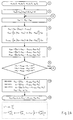
- 2A and 2B show a flow chart for Determination of the gas composition according to a preferred embodiment.
- step 1 three Speeds of sound, depending on the different Conditions, measured. From the conditions the Pressure set, the temperature can can be set or the measurement can take place at the temperature after a possible Pressure change has set. The actual pressure and the temperature of each measurement are measured.
- step 3 the proportion of the sum of the alkanes X CH is then determined from the starting values for the nitrogen fraction and the carbon dioxide fraction.
- step 4 the molar calorific value of the sum of the alkanes H CH is used to determine the proportion of alkanes, with the exception of methane, using equations (1.1) to (1.9). Accordingly, the methane content X CH4 is determined according to equation (2).
- values of the speed of sound are calculated in step 5 from the calculated composition of the gas under the same conditions as the measured values recorded in step 1. This can be done, for example, using the well-known AGA8-DC92 equation of state.
- step 6 it is determined whether the amount of the difference between the calculated values of the speed of sound w 1, ber , w 2, ber , w 3, ber and the measured values w 1 , w 2 , w 3 recorded in step 1 is smaller for each value than the threshold set at 10 -6 . If no, the process continues with step 6.
- steps 7 to 11 the sensitivity of the input parameters X N2 , X CO2 and H CH is determined.
- values are first set for ⁇ X N2 , ⁇ X CO2 , and ⁇ H CH . Good results are achieved with 0.1 mol% for ⁇ X N2 and ⁇ X CO2 , and 1.0 MJ / mol for ⁇ H CH .
- step 8 the sum of the alkanes X ' CH is calculated from the new values of the carbon dioxide content X' CO2 and the nitrogen content X ' N2 according to equation (3).
- step 9 with the help of the new sum of the alkanes X ' CH and the new molar calorific value of the sum of the alkanes H' CH, the proportion of the alkanes, with the exception of methane, is determined with the help of equations (1.1) to (1.9) and is finally determined the methane fraction X ' CH4 calculated according to equation (2).
- step 10 the values of the speed of sound are determined under the three different conditions given in step 1. Only one of the three input parameters is varied each time. After completion of step 10, there are values for the speed of sound as a function of X ' CO2 , X' N2 and H ' CH for each condition.
- step 11 the partial Derivatives are determined. To do this, first change the Speed of sound depending on one of the Input parameters determined. This is the difference determined between the values calculated in step 10 the speed of sound, one of the Input parameters is changed a little, and that in Step 5 calculated value. The partial derivative leaves now simply calculate yourself from the quotient of Above change in the speed of sound and the Change to affected in step 6 Input parameters.
- step 12 general equations are given to describe the propagation of changes in the input variables in an output variable.
- the system of linear equations can be solved according to the quantities x N2 , x CO2 and H CH using generally known mathematical techniques. The result is an estimate of the required changes in the parameters X N2 , X CO2 and H CH .
- step 13 the new values for the nitrogen content X N2 , the carbon dioxide content X CO2 , and the molar calorific value of the sum of the predetermined alkanes HCH are then newly set, namely by the deviations of these three parameters calculated in step 12, simply to the previous value be added.
- Steps 3 to 6 are then repeated with the newly set value for the nitrogen content. If the limit values of ⁇ w 1 , ⁇ w 2 and / or ⁇ w 3 are exceeded again in step 6, steps 7 to 13 and 3 to 6 are carried out again. Only when the limit values of 10 -6 of ⁇ w 1 , ⁇ w 2 and ⁇ w 3 are observed in step 6, are the proportions of the alkanes and the nitrogen content determined with the desired accuracy.
- Steps 14 and 15 all desired gas parameters calculated. This is done with the help of the well-known ISO 6976 and ISO 12213.
- the described method can be carried out analogously be carried out for the combinations of two Velocity of sound with the dielectric constant or the carbon dioxide content of the Fuel gas.
- the object of the invention is also solved by using the invention Method for combustion-free measurement and / or Regulation of the supply of heat to gas appliances, especially to natural gas consumption facilities, in addition in step a) Fuel gas. or a partial flow of the fuel gas through a Volume or mass counter directed and the volume or the mass of the supplied fuel gas measured becomes.
- the Heat supply to households already from four Parameters namely firstly the volume or the mass, secondly two speeds of sound and thirdly the Dielectric constant or a third Speed of sound or the percentage of carbon dioxide derived under the conditions mentioned above become.
- the technical effort and the costs for this are minimal.
- any number of others Measured variables are recorded.
- it is advantageous in addition to the above three parameters are pressure, temperature and to record the nitrogen content. If less Measurement accuracy is allowed for this parameter Estimated values can also be used.
- Fig. 3 shows a fuel gas line 1, in the a gas meter 3 is arranged.
- two measuring points 5 and 6 are also arranged.
- the Measuring point 5 is a temperature sensor 7 and Measuring point 6 assigned a pressure sensor 8.
- the tapping point 9 is over a Pressure reducing valve 15 with a measuring device for Measurement of the speed of sound under first Reference conditions 17 connected.
- the tapping point 11 is via a pressure reducing valve 19 with a Measuring device for measuring the carbon dioxide content 21 connected.
- Withdrawal point 13 is with a Measuring device for measuring the speed of sound connected under operating conditions 23.
- the gas meter 3 measures the Volume flow and the time and calculates from it Volume of fuel gas supplied.
- the Temperature sensor 7 measures the temperature and the Pressure sensor 8 the pressure in the fuel gas line 1.
- the signal outputs of the temperature sensor 7, the pressure sensor 8 and the measuring devices 17, 21 and 23 are connected to the inputs of a correlation corrector 25 for the correlative determination of the calorific value H SV, b , either directly from the measured variables or via the iterative method described above.
- the output of this correlation converter and the signal output of the gas meter 3 are connected to the inputs of the energy converter 27.
- the energy converter 27 then calculates the heat quantity Q by multiplying the calorific value H SV, b by the volume under operating conditions V b .
- the correlation conversion and the energy conversion are integrated in a computer as program steps connected in series.
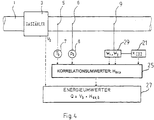
- Fig. 4 shows an arrangement for Implementation of a second embodiment of the Invention. 4 differs differs from the arrangement according to FIG. 3 in that both Velocity of sound in a measuring device 29 for Measurement of the speed of sound can be recorded.
- the Fuel gas becomes immediate without pressure reduction Measuring device 29 supplied so that the Speed of sound under operating conditions can be detected immediately.
- Measuring device 29 are Means allocated to increase or decrease the Pressure up in the range of the first or second Reference conditions.
- the measuring device 29 is over a gas line with a measuring device 21 for Determination of the carbon dioxide content linked.
- the amount of heat is about Correlation corrector 25 from the energy corrector 27 this embodiment, as in the first Embodiment, based on the volume of Temperature and pressure under operating conditions, the Speed of sound under first reference conditions, the speed of sound under operating conditions and the carbon dioxide content calculated. Because in the 3 and 4 the measuring devices for the speed of sound and the carbon dioxide content outside the Fuel gas line are arranged, the maintenance of this Facilities as well as a possible repair without perform special technical effort. Furthermore are relatively few reference cycles required because the sound speeds below given conditions can be measured. It exists thus a direct correlation between a change the speeds of sound and a change in Gas composition.
- a third embodiment of the invention is shown schematically.
- the arrangement differs from the arrangement according to FIG. 4 in that, instead of the volume counter, a mass counter 31 is provided for measuring the mass of the fuel gas supplied and that instead of a measuring device for determining the carbon dioxide content, a measuring device for determining the dielectric constant 33 is provided.
- the measuring devices for dielectric measurement 33 and for measuring the speed of sound under operating conditions 23 are arranged in a common measurement environment 39.
- a separate removal point 35 is assigned to the measuring device for determining the speed of sound under first reference conditions 37.
- the correlation corrector 41 first calculates the calorific value H Sm correlatively.
- the energy converter 43 then calculates the heat quantity Q by multiplying the calorific value H Sm by the mass m.
- Embodiment of the invention is only one Measuring device 45 for measuring the speed of sound intended.
- the Speed of sound under operating conditions 47 detected and then by setting the desired pressure values below the speed of sound first and third reference conditions, 49 and 51, respectively detected.
- the rest of the procedure is as in the previous embodiments above Correlation corrector 53 and energy corrector 55.
- All of the exemplary embodiments have the Advantage that it is not necessary regarding the Speed of sound to make measurements around the To determine the amount of heat reliably because the required data can be derived from the known Relationships between the gas composition and the Speed of sound. This already known data can be used to calculate the calorific value from the Derive the speed of sound.
- the common measurement environment for dielectric measurement or the measurement of the carbon dioxide content and the Sound velocity measurements have the advantage that only a pressure and temperature measurement in addition to the pressure and Temperature measurement in the fuel gas line required becomes.
- the third embodiment has one particularly high accuracy in determining the Amount of heat and is therefore particularly advantageous. It is also possible to use some of the facilities Determination of the measured variables under operating conditions to be arranged within the fuel gas line.
Landscapes
- Chemical & Material Sciences (AREA)
- Health & Medical Sciences (AREA)
- Engineering & Computer Science (AREA)
- Life Sciences & Earth Sciences (AREA)
- Medicinal Chemistry (AREA)
- Biochemistry (AREA)
- General Chemical & Material Sciences (AREA)
- Food Science & Technology (AREA)
- Chemical Kinetics & Catalysis (AREA)
- Physics & Mathematics (AREA)
- Analytical Chemistry (AREA)
- Oil, Petroleum & Natural Gas (AREA)
- General Health & Medical Sciences (AREA)
- General Physics & Mathematics (AREA)
- Immunology (AREA)
- Pathology (AREA)
- Investigating Or Analyzing Materials Using Thermal Means (AREA)
- Investigating Or Analyzing Materials By The Use Of Ultrasonic Waves (AREA)
Priority Applications (3)
| Application Number | Priority Date | Filing Date | Title |
|---|---|---|---|
| EP98203278A EP0967483A2 (fr) | 1998-05-20 | 1998-09-29 | Méthode sans combustion pour la détermination de la valeur calorifique d'un gaz carburant |
| EP99201548A EP0959354A3 (fr) | 1998-05-20 | 1999-05-18 | Méthode pour la détermination sans combustion de la valeur calorifique d'un gaz carburant |
| US09/315,237 US6279380B1 (en) | 1998-05-20 | 1999-05-20 | Noncombustive method of determining the calorific value of fuel gas |
Applications Claiming Priority (3)
| Application Number | Priority Date | Filing Date | Title |
|---|---|---|---|
| EP98201675 | 1998-05-20 | ||
| EP98201675 | 1998-05-20 | ||
| EP98203278A EP0967483A2 (fr) | 1998-05-20 | 1998-09-29 | Méthode sans combustion pour la détermination de la valeur calorifique d'un gaz carburant |
Publications (1)
| Publication Number | Publication Date |
|---|---|
| EP0967483A2 true EP0967483A2 (fr) | 1999-12-29 |
Family
ID=26150359
Family Applications (1)
| Application Number | Title | Priority Date | Filing Date |
|---|---|---|---|
| EP98203278A Withdrawn EP0967483A2 (fr) | 1998-05-20 | 1998-09-29 | Méthode sans combustion pour la détermination de la valeur calorifique d'un gaz carburant |
Country Status (2)
| Country | Link |
|---|---|
| US (1) | US6279380B1 (fr) |
| EP (1) | EP0967483A2 (fr) |
Cited By (6)
| Publication number | Priority date | Publication date | Assignee | Title |
|---|---|---|---|---|
| EP1193488A1 (fr) * | 2000-09-29 | 2002-04-03 | Ruhrgas Aktiengesellschaft | Procede et dispositif pour determiner la nature de gaz naturel |
| EP1063525A3 (fr) * | 1999-06-04 | 2003-12-17 | N.V. Nederlandse Gasunie | Méthode de mesure de la quantité de chaleur présente dans un gaz combustible |
| CN105806886A (zh) * | 2016-03-16 | 2016-07-27 | 新奥科技发展有限公司 | 气体热值测量方法及装置 |
| CN105807027A (zh) * | 2016-03-16 | 2016-07-27 | 新奥科技发展有限公司 | 气体能量计量方法及装置 |
| WO2018082875A1 (fr) * | 2016-11-07 | 2018-05-11 | Endress+Hauser Flowtec Ag | Procédé permettant de déterminer des propriétés d'un mélange gazeux contenant des hydrocarbures et dispositif à cet effet |
| EP3543655A1 (fr) | 2018-03-20 | 2019-09-25 | EnBW Energie Baden-Württemberg AG | Procédé de détermination de la consommation de gaz et système de mise en uvre dudit procédé |
Families Citing this family (8)
| Publication number | Priority date | Publication date | Assignee | Title |
|---|---|---|---|---|
| FR2776776B1 (fr) * | 1998-03-24 | 2000-04-28 | Schlumberger Ind Sa | Dispositif et procede de mesure directe de l'energie calorifique contenue dans un gaz combustible |
| US6539775B2 (en) * | 2001-02-13 | 2003-04-01 | Wolfgang H. Driftmeier | Method and apparatus for the measurement of the interchangeability of LPG/air mixtures with natural gas |
| US20030187606A1 (en) * | 2001-12-13 | 2003-10-02 | Curry Jimmie L. | Method and apparatus for a combustionless BTU measurement meter |
| ATE352770T1 (de) * | 2002-08-22 | 2007-02-15 | Ems Patent Ag | Thermisches gasdurchfluss-messgerät mit gasqualitätsindikator |
| JP6402387B2 (ja) * | 2015-06-11 | 2018-10-10 | 理研計器株式会社 | 熱量測定装置および熱量測定方法 |
| JP6759206B2 (ja) * | 2015-07-22 | 2020-09-23 | 理研計器株式会社 | メタン価算出方法およびメタン価測定装置 |
| FR3060796B1 (fr) | 2016-12-15 | 2019-07-05 | Engie | Procede pour calculer en temps reel l'indice de methane mn d'un gaz naturel liquefie |
| JP6530575B1 (ja) | 2019-01-17 | 2019-06-12 | 理研計器株式会社 | 組成分析装置および組成分析方法 |
Family Cites Families (21)
| Publication number | Priority date | Publication date | Assignee | Title |
|---|---|---|---|---|
| US2197370A (en) * | 1935-11-07 | 1940-04-16 | Power Patents Co | Calorimeter |
| US3264862A (en) * | 1963-09-25 | 1966-08-09 | Du Pont | Process and device for analyzing binary fluid mixtures |
| US3507146A (en) * | 1968-02-09 | 1970-04-21 | Webb James E | Method and system for respiration analysis |
| US4255964A (en) * | 1978-11-30 | 1981-03-17 | The Garrett Corporation | Fluid monitor |
| US4236406A (en) * | 1978-12-11 | 1980-12-02 | Conoco, Inc. | Method and apparatus for sonic velocity type water cut measurement |
| US5141331A (en) * | 1988-02-19 | 1992-08-25 | Oscar Oehler | Ultrasonic temperature measurement and uses in optical spectroscopy and calorimetry |
| US5117676A (en) * | 1991-02-25 | 1992-06-02 | Hughes Aircraft Company | Leak detector for natural gas pipelines |
| US5285675A (en) * | 1992-06-05 | 1994-02-15 | University Of Florida Research Foundation, Inc. | Acoustic fluid flow monitoring |
| DE4221922C1 (de) * | 1992-07-03 | 1994-01-13 | Bosch Gmbh Robert | Wärmetönungssensor |
| JP3083025B2 (ja) * | 1992-12-24 | 2000-09-04 | キヤノン株式会社 | 密閉空間内の気体制御方法とこれを用いたチャンバ装置と露光装置、並びにデバイス製造方法 |
| US5537854A (en) * | 1993-05-24 | 1996-07-23 | Phillips; Scott | Acoustic natural gas fuel sensor |
| US5524477A (en) * | 1993-11-29 | 1996-06-11 | Leybold Inficon Inc. | Quantitative determination of air present in refrigerant sample by measurement of pressure coefficient of resonance frequency |
| FR2713777B1 (fr) * | 1993-12-07 | 1996-03-01 | Marwal Systems | Dispositif de mesure de la composition d'un liquide, en particulier de la mesure du taux d'additif dans un carburant de véhicule automobile. |
| US5392635A (en) * | 1993-12-30 | 1995-02-28 | At&T Corp. | Acoustic analysis of gas mixtures |
| US5886262A (en) * | 1994-03-25 | 1999-03-23 | The Regents Of The University Of California | Apparatus and method for comparing corresponding acoustic resonances in liquids |
| GB9424430D0 (en) * | 1994-12-02 | 1995-01-18 | British Gas Plc | Measurement of a gas characteristic |
| US5748492A (en) * | 1995-05-24 | 1998-05-05 | Badger Meter, Inc. | Measuring heating value using catalytic combustion |
| US5768937A (en) * | 1996-11-13 | 1998-06-23 | Leybold Inficon, Inc. | Acoustic sensor for in-line continuous monitoring of gasses |
| US5948967A (en) * | 1997-12-26 | 1999-09-07 | Lucent Technologies, Inc. | Acoustic analysis of gas mixtures |
| US6442996B1 (en) * | 1998-01-16 | 2002-09-03 | Lattice Intellectual Property Limited | Method and apparatus for measuring the calorific value of a gas |
| DE19808533A1 (de) * | 1998-02-28 | 1999-09-02 | Ruhrgas Ag | Verfahren zur Bestimmung der Gaszusammensetzung von Brenngas |
-
1998
- 1998-09-29 EP EP98203278A patent/EP0967483A2/fr not_active Withdrawn
-
1999
- 1999-05-20 US US09/315,237 patent/US6279380B1/en not_active Expired - Fee Related
Cited By (10)
| Publication number | Priority date | Publication date | Assignee | Title |
|---|---|---|---|---|
| EP1063525A3 (fr) * | 1999-06-04 | 2003-12-17 | N.V. Nederlandse Gasunie | Méthode de mesure de la quantité de chaleur présente dans un gaz combustible |
| EP1193488A1 (fr) * | 2000-09-29 | 2002-04-03 | Ruhrgas Aktiengesellschaft | Procede et dispositif pour determiner la nature de gaz naturel |
| CN105806886A (zh) * | 2016-03-16 | 2016-07-27 | 新奥科技发展有限公司 | 气体热值测量方法及装置 |
| CN105807027A (zh) * | 2016-03-16 | 2016-07-27 | 新奥科技发展有限公司 | 气体能量计量方法及装置 |
| WO2018082875A1 (fr) * | 2016-11-07 | 2018-05-11 | Endress+Hauser Flowtec Ag | Procédé permettant de déterminer des propriétés d'un mélange gazeux contenant des hydrocarbures et dispositif à cet effet |
| CN109937362A (zh) * | 2016-11-07 | 2019-06-25 | 恩德斯+豪斯流量技术股份有限公司 | 用于确定含烃气体混合物的性质的方法及设备 |
| CN109937362B (zh) * | 2016-11-07 | 2021-12-03 | 恩德斯+豪斯流量技术股份有限公司 | 用于确定含烃气体混合物的性质的方法及设备 |
| US11474092B2 (en) | 2016-11-07 | 2022-10-18 | Endress+Hauser Flowtec Ag | Method for determining properties of a hydrocarbon-containing gas mixture and device for the same |
| EP3543655A1 (fr) | 2018-03-20 | 2019-09-25 | EnBW Energie Baden-Württemberg AG | Procédé de détermination de la consommation de gaz et système de mise en uvre dudit procédé |
| DE102018106576A1 (de) | 2018-03-20 | 2019-09-26 | EnBW Energie Baden-Württemberg AG | Verfahren zum Bestimmen eines Gasverbrauchs und System zur Durchführung des Verfahrens |
Also Published As
| Publication number | Publication date |
|---|---|
| US6279380B1 (en) | 2001-08-28 |
Similar Documents
| Publication | Publication Date | Title |
|---|---|---|
| EP0967483A2 (fr) | Méthode sans combustion pour la détermination de la valeur calorifique d'un gaz carburant | |
| EP1193488B1 (fr) | Procede et dispositif pour determiner la nature de gaz naturel | |
| DE69924828T2 (de) | Methode und gerät zur messung des brennwertes eines gases | |
| EP3535581B1 (fr) | Procédé permettant de déterminer des propriétés d'un mélange gazeux contenant des hydrocarbures et dispositif à cet effet | |
| EP3362790B1 (fr) | Procédé permettant de déterminer des propriétés d'un mélange gazeux contenant des hydrocarbures | |
| EP3602040B1 (fr) | Procédé de détermination de l'indice de méthane d'un mélange de gaz combustibles contenant des hydrocarbures | |
| DE19736528A1 (de) | Verfahren zur verbrennungslosen Messung des Brennwertes von Brenngas | |
| DE19724167A1 (de) | Verfahren und Vorrichtung zum Ermitteln eines Meßwerts einer Zielmeßgröße einer Mehr-Phasen-Strömung | |
| DE2928739B1 (de) | Verfahren und Vorrichtung zur verbrennungslosen Messung und/oder Regelung der Waermemengenzufuhr zu Gasverbrauchseinrichtungen | |
| DE69619415T2 (de) | Verfahren zur Leckprüfung von Rohren und Gerät zur Leckprüfung | |
| DE19535354B4 (de) | Verfahren und Vorrichtung zur Optimierung der Steuerung eines pneumatischen Systems eines Gaschromatographen | |
| EP0939317A2 (fr) | Méthode pour déterminer la composition gazeuse du gaz combustible | |
| DE19949327A1 (de) | Verfahren und Einrichtung zur Bestimmung der Gaskonzentrationen in einem Gasgemisch | |
| EP0345562B1 (fr) | Procédé et appareil pour le traitement de données de mesures | |
| EP1181531A1 (fr) | Procede et dispositif de mesure de la puissance calorifique et/ou de l'indice de wobbe de gaz combustible, en particulier de gaz naturel | |
| AT406096B (de) | Verfahren und vorrichtung zur erzeugung präziser, kontinuierlicher mischgasströme | |
| DE102012006767B4 (de) | Verfahren zum Betreiben einer Brennkraftmaschine sowie entsprechende Brennkraftmaschine | |
| DE10331698B4 (de) | Vorrichtung und Verfahren zur Bestimmung des Durchflusses von dampf- oder gasförmigen Stoffen durch eine Rohrleitung | |
| Islam et al. | Mixed Poiseuille-Knudsen flow model for Gas Liquid Displacement porometry data treatment | |
| EP1081494A1 (fr) | Procédé permettant de mesurer sans combustion le pouvoir calorifique d'un gaz combustible | |
| CH661798A5 (de) | Verfahren und vorrichtung zum aufnehmen dreidimensionaler kernresonanzspektren. | |
| DE19707659A1 (de) | Verfahren und Vorrichtung zum Messen verbrennungstechnischer Eigenschaften von Gasen | |
| DE202008006925U1 (de) | Dampffeuchtemesssystem für Nassdampfströme | |
| DE19857329A1 (de) | Fließbank und Verfahren zum Prüfen und Kalibrieren eines Massenstrommessers | |
| DE102015120636A1 (de) | Verfahren zur Ermittlung einer Eigenschaft eines Kohlenwasserstoffgemisches und Ultraschall-Durchflussmessgerät |
Legal Events
| Date | Code | Title | Description |
|---|---|---|---|
| PUAI | Public reference made under article 153(3) epc to a published international application that has entered the european phase |
Free format text: ORIGINAL CODE: 0009012 |
|
| AK | Designated contracting states |
Kind code of ref document: A2 Designated state(s): AT BE CH CY DE DK ES FI FR GB GR IE IT LI LU MC NL PT SE |
|
| AX | Request for extension of the european patent |
Free format text: AL;LT;LV;MK;RO;SI |
|
| STAA | Information on the status of an ep patent application or granted ep patent |
Free format text: STATUS: THE APPLICATION IS DEEMED TO BE WITHDRAWN |
|
| 18D | Application deemed to be withdrawn |
Effective date: 20030401 |