EP0967767A1 - Echtzeit-Kommunikationsverfahren auf dem Internet und Endgerät für die Durchführung des Verfahrens - Google Patents
Echtzeit-Kommunikationsverfahren auf dem Internet und Endgerät für die Durchführung des Verfahrens Download PDFInfo
- Publication number
- EP0967767A1 EP0967767A1 EP99401215A EP99401215A EP0967767A1 EP 0967767 A1 EP0967767 A1 EP 0967767A1 EP 99401215 A EP99401215 A EP 99401215A EP 99401215 A EP99401215 A EP 99401215A EP 0967767 A1 EP0967767 A1 EP 0967767A1
- Authority
- EP
- European Patent Office
- Prior art keywords
- appointment
- terminals
- terminal
- communication
- time
- Prior art date
- Legal status (The legal status is an assumption and is not a legal conclusion. Google has not performed a legal analysis and makes no representation as to the accuracy of the status listed.)
- Granted
Links
- 230000006854 communication Effects 0.000 title claims abstract description 69
- 238000004891 communication Methods 0.000 title claims abstract description 66
- 238000000034 method Methods 0.000 title claims abstract description 27
- 230000000977 initiatory effect Effects 0.000 claims description 4
- 230000005540 biological transmission Effects 0.000 description 27
- 238000012545 processing Methods 0.000 description 3
- 238000010586 diagram Methods 0.000 description 2
- 239000000284 extract Substances 0.000 description 2
- 238000005457 optimization Methods 0.000 description 1
- 238000012546 transfer Methods 0.000 description 1
- 238000012800 visualization Methods 0.000 description 1
- 230000001755 vocal effect Effects 0.000 description 1
Images
Classifications
-
- H—ELECTRICITY
- H04—ELECTRIC COMMUNICATION TECHNIQUE
- H04M—TELEPHONIC COMMUNICATION
- H04M7/00—Arrangements for interconnection between switching centres
- H04M7/006—Networks other than PSTN/ISDN providing telephone service, e.g. Voice over Internet Protocol (VoIP), including next generation networks with a packet-switched transport layer
-
- H—ELECTRICITY
- H04—ELECTRIC COMMUNICATION TECHNIQUE
- H04L—TRANSMISSION OF DIGITAL INFORMATION, e.g. TELEGRAPHIC COMMUNICATION
- H04L67/00—Network arrangements or protocols for supporting network services or applications
- H04L67/14—Session management
-
- H—ELECTRICITY
- H04—ELECTRIC COMMUNICATION TECHNIQUE
- H04N—PICTORIAL COMMUNICATION, e.g. TELEVISION
- H04N1/00—Scanning, transmission or reproduction of documents or the like, e.g. facsimile transmission; Details thereof
- H04N1/00127—Connection or combination of a still picture apparatus with another apparatus, e.g. for storage, processing or transmission of still picture signals or of information associated with a still picture
- H04N1/00204—Connection or combination of a still picture apparatus with another apparatus, e.g. for storage, processing or transmission of still picture signals or of information associated with a still picture with a digital computer or a digital computer system, e.g. an internet server
- H04N1/00209—Transmitting or receiving image data, e.g. facsimile data, via a computer, e.g. using e-mail, a computer network, the internet, I-fax
-
- H—ELECTRICITY
- H04—ELECTRIC COMMUNICATION TECHNIQUE
- H04L—TRANSMISSION OF DIGITAL INFORMATION, e.g. TELEGRAPHIC COMMUNICATION
- H04L69/00—Network arrangements, protocols or services independent of the application payload and not provided for in the other groups of this subclass
- H04L69/30—Definitions, standards or architectural aspects of layered protocol stacks
- H04L69/32—Architecture of open systems interconnection [OSI] 7-layer type protocol stacks, e.g. the interfaces between the data link level and the physical level
- H04L69/322—Intralayer communication protocols among peer entities or protocol data unit [PDU] definitions
- H04L69/329—Intralayer communication protocols among peer entities or protocol data unit [PDU] definitions in the application layer [OSI layer 7]
-
- H—ELECTRICITY
- H04—ELECTRIC COMMUNICATION TECHNIQUE
- H04N—PICTORIAL COMMUNICATION, e.g. TELEVISION
- H04N2201/00—Indexing scheme relating to scanning, transmission or reproduction of documents or the like, and to details thereof
- H04N2201/0008—Connection or combination of a still picture apparatus with another apparatus
- H04N2201/0015—Control of image communication with the connected apparatus, e.g. signalling capability
- H04N2201/0024—Converting image communication control signals, e.g. group 3 facsimile protocol signals, to non-image communication control signals or vice versa
-
- H—ELECTRICITY
- H04—ELECTRIC COMMUNICATION TECHNIQUE
- H04N—PICTORIAL COMMUNICATION, e.g. TELEVISION
- H04N2201/00—Indexing scheme relating to scanning, transmission or reproduction of documents or the like, and to details thereof
- H04N2201/0077—Types of the still picture apparatus
- H04N2201/0093—Facsimile machine
Definitions
- a computer network such as the Internet allows terminals, connected to this network, to communicate between them by exchanging e-mails, by mailboxes interposed, or by talking in real time.
- a communication terminal on the Internet does not connect to the Internet, via an access server, only when it wants to send an email to a correspondent, consult information on a site, navigate to different sites or, again as an example, communicate in real time with another terminal through the Internet.
- a calling terminal wishes communicate in real time, over the Internet, with a terminal called not connected to the Internet, the calling terminal can address to its server to access a request in order to get in touch with the terminal called.
- the access server of the calling terminal then contacts the server of the called terminal and transmits the request to it.
- the access server of the called terminal notifies, or notifies, it that the calling terminal wishes communicate with him in real time over the Internet, for example by a telephone call in the event that the called terminal is connected to its telephone network access server (switched telephone network PSTN, or ISDN integrated services digital network, or other).
- the called terminal connects to the Internet and initiates a real-time communication session with the terminal appellant.
- the present invention proposes to overcome these drawbacks.
- the invention relates to a time communication method real between at least two communication terminals, across a network Internet-type communication computer, in which, during of a prior communication, the two terminals set an appointment on the computer network, at a determined future time, to, at the time of the meeting, get in touch with one the other through the computer network and initiate communication in real time across the computer network.
- the terminals are fax machines with access to the Internet, so they can meet on the Internet at one o'clock determined, and when communicating in real time over the Internet, exchange skills, fax each other and pay receipt thereof. Capacity exchange, fax transmission and the acknowledgment of reception is accomplished in a communication single, in one piece, as in an ordinary communication to through a telephone network.
- one of the two terminals fixes the appointment at the other terminal, by email.
- the two terminals set the appointment, during of a communication through a communication network other than said computer network.
- the two terminals set the appointment, at during a real-time communication through said network computer science.
- the two terminals each having an address electronic on said computer network, one of the terminals sends to the other terminal its e-mail address, so that the two terminals get in touch with each other.
- the two terminals each having an email address on said computer network, at least one of terminals transmits its email address to the other terminal by through an appointment server, so that both terminals connect with each other.
- the invention also relates to a communication terminal comprising applicative means for implementing the above method.
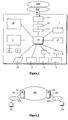
- the communication method described below is intended to make communicate with each other two communication terminals 30, 130, in real time, through a computer network, in this case the Internet 200.
- the terminals 30, 130 are two identical fax machines.
- Each fax machine 30, 130 has access to the Internet 200 from a access server 40, 140, an electronic address on the Internet 200 and a mailbox 41, 141, for receiving e-mails from of the access server 40, 140.
- the email address of a terminal on the Internet 200 means a indication to locate this terminal on the Internet 200.
- a email address can be expressed in two equivalent forms, one digital and the other textual.
- the electronic address consists, in its numerical form, in a succession of figures, and, in its textual form, in a succession of characters corresponding to names (name and domain names).
- the numerical form of the address electronic more commonly known as an Internet Protocol (IP) address, is used by the Internet 200 to route data, while the form equivalent text, which will hereinafter be called "Internet address textual ", more explicit and easier to remember, is the one used by Internet users 200.
- IP Internet Protocol
- the textual Internet addresses of fax machines 30, 130 are fixed, definitively assigned. However, the corresponding IP addresses are temporary, newly allocated by the access servers 40, 140 to each of the connections to the Internet 200 of the fax machines 30, 130.
- facsimile machine 30 One of the facsimile machines, in this case facsimile machine 30, will now be described.
- the facsimile machine 30 comprises a block 1 for connection to the Internet 200, a email management block 2, an image analyzer 3, a printer 4, a display screen 5 and an input keyboard 10.
- the analyzer 3 and the printer 4 are respectively connected to a memory transmission 6 fax storage to send and a memory of reception 7 for storing received faxes.
- the facsimile machine 30 also has a TCP / IP processing block 11, explained below, a modem 12 connected to the TCP / IP processing block 11 and to a transmission and reception unit 13 connected to a telephone network, in the PSTN 201 switched telephone network.
- the TCP / IP processing block 11 is intended, on transmission, to decompose the data to be sent in data packets, according to a protocol Internet 200 communication, in this case the standard TCP / IP protocol (Transfer Control Protocol / Internet Protocol - Control protocol for transmission / Internet Protocol), and, on reception, to collect suitably data using received data packets, according to the TCP / IP protocol.
- a protocol Internet 200 communication in this case the standard TCP / IP protocol (Transfer Control Protocol / Internet Protocol - Control protocol for transmission / Internet Protocol), and, on reception, to collect suitably data using received data packets, according to the TCP / IP protocol.
- TCP / IP data packets packets of data established according to the TCP / IP protocol.
- the modem 12 is intended, in a conventional manner, to modulate the data to transmit on the PSTN 201 network and demodulate the received data signals by the PSTN 201 network.
- the facsimile machine 30 includes a block 14 for managing appointments on the Internet 200, explained below, and a control block 16, in this case a microprocessor, intended to control the operation of the facsimile machine 30 and to which all the elements of the facsimile machine 30 are connected.
- a control block 16 in this case a microprocessor, intended to control the operation of the facsimile machine 30 and to which all the elements of the facsimile machine 30 are connected.
- the appointment management block 14 also comprises, in memory, a appointment book containing fax 30 appointments with other fax machines, on the Internet 200, and the features of these appointment (time of appointment, method of contact, etc.).
- an email includes in particular a provenance field containing the terminal's textual Internet address having sent the mail and a destination field containing the address Textual Internet of the terminal for which the mail is intended.
- An appointment booking email also includes a specific field, of appointment, containing a command word, explained below, and the time of the meeting.
- a letter of contact also includes a specific field, linking, containing the IP address of the fax machine that sent the mail.
- the elements of the facsimile machine 130 will bear references whose values are equal to the values of the element references fax machine 30 correspondents, incremented by one hundred.
- One of the terminals here the terminal 30, prepares an appointment booking letter, in order to fix an appointment at the fax machine 130, on the Internet 200, at a determined future time t 1 .
- This time consists of a specific date and time, in this case the same day at 22:00.
- the facsimile machine 30 wishes, on the occasion of this meeting, to transmit a facsimile machine, previously recorded in the transmission memory 6, to the facsimile machine 130.
- Indication of an appointment time in the appointment field constitutes in itself a notification of the appointment.
- connection block 1 the fax machine 30 connects to its access server 40, by link over the PSTN 201 network to connect to the Internet 200.
- the facsimile machine 30 After connection to the Internet 200, under the command of block 14, the facsimile machine 30 transmits to its access server 40, via the PSTN network 201, the appointment booking mail.
- the appointment booking mail is then routed through the Internet 200 from the access server 40 to the access server 140 which stores it in the mailbox 141 of the fax machine 130.
- the consultation application in slow mode of the mailbox 141 being activated the fax machine 130 consults its mailbox 141 automatically, every hour, and, on the occasion of one of these consultations, at time t 0 , finds there the appointment booking mail, brings it back and stores it in the reception memory 108.
- the facsimile machine 130 examines the appointment booking mail by looking for a specific field there, finds the appointment field there and becomes aware of the content of this field, in other words the word of consultation command in fast mode of mailbox 141 and of time t 1 of the appointment.
- the instant t 1 is later than the instant t 0 of effective reception of the appointment booking mail by the facsimile machine 130.
- the transmission of the appointment booking electronic mail from the facsimile machine 30 to the facsimile machine 130 constitutes a communication, prior to the appointment, during which the facsimile machine 30 sets up an appointment on the Internet machine 200, to an subsequent moment determined t 1 .
- the two fax machines 30 and 130 each connect to their access server 40, 140, by telephone link through the PSTN network 201, in order to connect to the Internet 200.
- the two fax machines 30, 130 acquire each a new IP address, assigned by their access server 40, 140.
- the facsimile machine 30 then completes the correspondence letter indicating their new IP address in the contact field.
- the facsimile machine 30 transmits the correspondence mail to its access server 40 which sends it, via the Internet 200, to the server of access 140 which stores it in the mailbox 141 of the fax machine 130.
- the facsimile machine 130 After having connected to the Internet 200, substantially at the time of the appointment t 1 , the facsimile machine 130 activates the consultation application in rapid mode of its mailbox 141 in order to consult frequently, every minute, its mailbox 141. At one of these consultations, at 10:02 p.m., the fax machine 130 finds the connecting mail in the mailbox 141, brings it back and stores it in its reception memory 108.
- the facsimile machine 130 examines the contact letter by looking for the contact field relation, becomes aware of the content of this field, in other words of the current IP address of the fax machine 30, and transmits to it first TCP / IP data packets, across the Internet 200, thus initiating a real-time communication session with the fax machine 30.
- TCP / IP packets routed through the Internet 200 each convey the IP address of their origin, as well as the IP address of their destination.
- the facsimile machine 30 After having sent the connecting letter, the facsimile machine 30 remains connected to the Internet 200 while waiting to receive the first packets of TCP / IP data from the fax machine 130. On receipt of these, the Fax 30 extracts the current IP address from Fax 130.
- the two fax machines 30, 130 have thus exchanged their IP addresses and have connected with each other through the Internet 200.
- the two fax machines 30, 130 therefore start the communication session in real time through the Internet 200, during which they interact with each other in real time, or "live", in full duplex, without letters interposed, exchanging TCP / IP data packets.
- the two fax machines 30, 130 thus establish a "TCP / IP link" between them, according to the vocabulary used by those skilled in the art.
- the fax 30, In the event that the fax machine 130 misses the appointment, the fax 30, after having sent the connecting letter, waits in vain to receive the first TCP / IP data packets from the facsimile machine 130, for a predefined waiting time. At the expiration of this time, the facsimile machine 30 transmits to the facsimile machine 130 the facsimile which is sent to him by email. This is routed through Internet 200 and stored in mailbox 141 of fax machine 130.
- the missed appointment constituting for the fax machine 130 a notification implicit receipt of a letter in his mailbox 141 electronic, fax 130, after having missed the appointment, consult in mailbox mode 141 his mailbox 141, find the mail containing the fax and bring it back to its reception memory 108.
- the other fax machine In the event that one of the fax machines misses the appointment (30 or 130), the other fax machine, present at the meeting, could wait during a predefined waiting period and, at the end of this period, send a fax to the fax machine that missed the appointment electronic scheduling a new appointment at a later time determined.
- the facsimile machine 30 sets an appointment to fax 130 and, substantially at the time of the appointment, sends him their current IP address by email.
- the fax machine 130 to whom the appointment has been set, which, substantially at the time of the appointment, sends its IP address by email to fax machine 30.
- the outlet mail appointment, sent by fax 30 to fax 130 would include, instead of the consultation command word in mode quick from the mailbox, a word to order by fax 130 to send his IP address by email substantially at the time of the appointment.
- the two fax machines 30, 130 could also take advantage of this to set up a new Internet 200 appointment at a later time determined, to communicate with each other in real time.
- the two fax machines could also be arranged to communicate through the PSTN 201 telephone network. In this case, they could make an appointment at a later determined time, at during a prior communication through the PSTN 201 network, by example during the transmission of a fax, by frames specific to the fax protocol, or during a communication specific appointment scheduling.
- the two fax machines exchange their IP addresses respective via an Internet appointment server 200. Noticeably at the time of the appointment, each fax machine connects to the Internet 200 and sends a request to the appointment server to obtain the current IP address of the other fax machine.
- the TCP / IP communication protocol allows a terminal to multiplex a plurality of real-time communications to through the Internet 200, or TCP / IP links, with other terminals.
- the facsimile machine 30 sets appointments at a determined later time t 1 , here at 10 p.m. the same day, to the facsimile machines A, B, C and D, by sending them an e-mail for making an appointment.
- the facsimile machine 30 wishes, on the occasion of these meetings, to transmit a facsimile to each of these facsimile machines.
- the appointment booking letters each contain, as previously explained, in an appointment field, the time t l of the appointment and an command word to order the fax machines A, B, C and D to consult frequently their mailbox substantially at time t 1 of the appointment.
- Faxes A, B, C and D repatriate the appointment booking letter, during a consultation with their mailbox, and take note of the time of the appointment and the associated command word.
- the fax machine 30 Shortly before time t 1 of the meeting, here at 21.58 hours, the fax machine 30 connects to the Internet 200, via its access server 40, thus acquires a new IP address and sends to each of the faxes A, B, C, D a contact letter. This contains, in a connection field, the new current IP address of the fax machine 30. Then the fax machine 30, while remaining connected to the Internet 200, waits to receive TCP / IP packets coming from the fax machines A, B, C and / or D.
- each of the fax machines B, C and D connects to the Internet 200, consults their mailbox in fast mode, finds the correspondence mail there, repatriates it , examines it, takes note of the IP address of the facsimile machine 30 and finally sends the first TCP / IP data packets to the facsimile machine 30, thereby initiating a real-time communication session with the latter.
- fax machine 30 receives the first packets TCP / IP from fax machines B, C and D respectively, in extract the current IP address of each of these fax machines and continues the three real-time communication sessions started with fax machines B, C and D, as previously explained. During these three sessions of communication in real time, which are at least partly simultaneous, the facsimile machine 30 transmits a facsimile to each of facsimile machines B, C and D, to over the Internet 200, following the fax protocol previously explicit.
- fax machine B decides send a fax to fax machine 30.
- Fax machine B takes advantage of the link Existing TCP / IP to open another TCP / IP link with the fax machine 30 and send the fax to it.
- the facsimile machine 30 has no more communication sessions in real time in progress but still has not received TCP / IP packets from fax machine A.
- the facsimile machine 30 Before disconnecting from the Internet 200, the facsimile machine 30 checks, in his appointment book, if he has an imminent appointment and, an appointment being scheduled at 10:20 p.m. with a fax machine E, decides to stay connected to the Internet 200 to wait for this appointment.
- the fax machine 30 consults its mailbox quickly. letters, find a link letter containing the IP address fax machine E, and, as previously explained, initiates a real-time communication with fax machine E.
- the real-time communication session between the fax machine 30 and fax machine E ends and fax machine 30, still not received TCP / IP packets from fax machine A, send faxes to the fax machine which was intended for him by e-mail, through the Internet 200.
- the fax machine 30 consult his mailbox 41 and, if necessary, repatriate the new one (s) letters received.
- the facsimile machine 30 sets up an appointment plurality of facsimile machines at a determined future time, so that the plurality of communication sessions with these fax machines are at least partly simultaneous.
- Fax machines may include telephony application vocal. In this case, they could multiplex sessions of real-time voice communication and communication sessions in real time for fax transmission over the Internet.
- the invention applies not only to fax machines, but also to telephones, and other communication terminals at through the Internet and more generally through a computer network.
Landscapes
- Engineering & Computer Science (AREA)
- Signal Processing (AREA)
- Computer Networks & Wireless Communication (AREA)
- General Engineering & Computer Science (AREA)
- Computing Systems (AREA)
- Multimedia (AREA)
- Data Exchanges In Wide-Area Networks (AREA)
- Facsimile Transmission Control (AREA)
- Facsimiles In General (AREA)
Applications Claiming Priority (2)
| Application Number | Priority Date | Filing Date | Title |
|---|---|---|---|
| FR9806818 | 1998-05-29 | ||
| FR9806818A FR2779303B1 (fr) | 1998-05-29 | 1998-05-29 | Procede de communication en temps reel sur l'internet et terminal pour la mise en oeuvre du procede |
Publications (2)
| Publication Number | Publication Date |
|---|---|
| EP0967767A1 true EP0967767A1 (de) | 1999-12-29 |
| EP0967767B1 EP0967767B1 (de) | 2003-10-22 |
Family
ID=9526870
Family Applications (1)
| Application Number | Title | Priority Date | Filing Date |
|---|---|---|---|
| EP99401215A Expired - Lifetime EP0967767B1 (de) | 1998-05-29 | 1999-05-20 | Echtzeit-Kommunikationsverfahren auf dem Internet und Endgerät für die Durchführung des Verfahrens |
Country Status (3)
| Country | Link |
|---|---|
| EP (1) | EP0967767B1 (de) |
| DE (1) | DE69912194T2 (de) |
| FR (1) | FR2779303B1 (de) |
Citations (2)
| Publication number | Priority date | Publication date | Assignee | Title |
|---|---|---|---|---|
| EP0669733A2 (de) * | 1994-02-28 | 1995-08-30 | AT&T Corp. | Netzwerkagenten |
| EP0818916A2 (de) * | 1996-07-12 | 1998-01-14 | Murata Kikai Kabushiki Kaisha | Übertragungsendgerät |
-
1998
- 1998-05-29 FR FR9806818A patent/FR2779303B1/fr not_active Expired - Fee Related
-
1999
- 1999-05-20 DE DE69912194T patent/DE69912194T2/de not_active Expired - Fee Related
- 1999-05-20 EP EP99401215A patent/EP0967767B1/de not_active Expired - Lifetime
Patent Citations (2)
| Publication number | Priority date | Publication date | Assignee | Title |
|---|---|---|---|---|
| EP0669733A2 (de) * | 1994-02-28 | 1995-08-30 | AT&T Corp. | Netzwerkagenten |
| EP0818916A2 (de) * | 1996-07-12 | 1998-01-14 | Murata Kikai Kabushiki Kaisha | Übertragungsendgerät |
Non-Patent Citations (2)
| Title |
|---|
| HUI S -C ET AL: "A dynamic IP addressing system for Internet telephony applications", COMPUTER COMMUNICATIONS, vol. 21, no. 3, 25 March 1998 (1998-03-25), pages 254-266, XP004115293 * |
| YU S -F ET AL: "A multimedia gateway for phone/fax and MIME mail", COMPUTER COMMUNICATIONS, vol. 20, no. 8, 25 August 1997 (1997-08-25), pages 615-627, XP004126715 * |
Also Published As
| Publication number | Publication date |
|---|---|
| EP0967767B1 (de) | 2003-10-22 |
| FR2779303A1 (fr) | 1999-12-03 |
| FR2779303B1 (fr) | 2001-10-12 |
| DE69912194T2 (de) | 2004-07-01 |
| DE69912194D1 (de) | 2003-11-27 |
Similar Documents
| Publication | Publication Date | Title |
|---|---|---|
| EP0928534B1 (de) | Verfahren und system für interaktive kommunikation über internet zwischen zwei telefongeräte | |
| EP1514396A1 (de) | System zum konsultieren und/oder aktualisieren von dns-servern und/oder ldap-verzeichnissen | |
| FR2748172A1 (fr) | Equipement d'adaptation de protocole pour poste telephonique et poste equipe d'un tel equipement | |
| FR2873526A1 (fr) | Procede et systeme de gestion de la surcharge d'identite et de la disponibilite privee/publique d'une adresse de messagerie instantanee | |
| FR2788918A1 (fr) | Procede d'etablissement d'une communication entre deux appareils de transmission d'informations relies a un reseau informatique du type de l'internet, et serveur de liaison entre les equipements | |
| EP1453276B1 (de) | Kommunikationsverwaltungsgerät mit Auswahl von Netzwerkendgeräten und eines Kommunikationsmediums | |
| EP0967767B1 (de) | Echtzeit-Kommunikationsverfahren auf dem Internet und Endgerät für die Durchführung des Verfahrens | |
| EP1142269B1 (de) | Adressierungsverfahren und namen- und adressen- server in einem digitalen netz | |
| US20010000441A1 (en) | Virtual real-time facsimile transmission over the internet | |
| EP1037435B1 (de) | Verfahren zur Konfiguration einer Verbindung mit einem Netzwerk (z. B. Internet) | |
| EP1346292A1 (de) | Server für verteilte verzeichnisse | |
| EP0976240B1 (de) | Faksimilegerät für ein informationsnetz wie das internet | |
| EP1016265B1 (de) | Verfahren zur datenübertragung und endgeräte zur durchführung des verfahrens | |
| EP1501248B1 (de) | System und Verfahren zur elektronischen Benachrichtigung | |
| WO1984000072A1 (fr) | Procede d'echange, de chargement et de consultation d'informations et circuit de commutation entre un terminal et une banque d'informations | |
| FR2800956A1 (fr) | Systeme de telecopie a annuaire central | |
| EP1104162B1 (de) | Faksimilegerät für Datennetzwerk | |
| WO2000027081A1 (fr) | Systeme economique de mise en communication de deux terminaux de communication a travers l'internet | |
| EP1135922A1 (de) | Verfahren um eine verbindung zwischen zwei endgeräten über das internet aufzubauen durch einen anrufserver, verschiedene endgeräte und server | |
| FR2783993A1 (fr) | Systeme et procede de communication entre serveur et telephone vocal | |
| EP0946023A1 (de) | Echtzeit-Kommunikationsverfahren über ein Informationsnetz wie das Internet und Kommunikationsanlage zur Durchführung des Verfahrens | |
| FR2805111A1 (fr) | Procede pour l'execution d'une tache par un serveur informatique multitache, sur requete d'un terminal telephonique | |
| FR2765435A1 (fr) | Procede de transmission economique de telecopie et telecopieur pour la mise en oeuvre du procede | |
| FR2771883A1 (fr) | Procede de transmission d'une telecopie entre deux telecopieurs standards a travers un reseau informatique tel que l'internet et telecopieurs-passerelles pour la mise en oeuvre du procede | |
| FR2777724A1 (fr) | Procede de communication d'un telecopieur a travers un reseau informatique de type internet, telecopieur et serveur passerelle pour la mise en oeuvre du procede |
Legal Events
| Date | Code | Title | Description |
|---|---|---|---|
| PUAI | Public reference made under article 153(3) epc to a published international application that has entered the european phase |
Free format text: ORIGINAL CODE: 0009012 |
|
| AK | Designated contracting states |
Kind code of ref document: A1 Designated state(s): DE FR GB |
|
| AX | Request for extension of the european patent |
Free format text: AL;LT;LV;MK;RO;SI |
|
| 17P | Request for examination filed |
Effective date: 20000623 |
|
| AKX | Designation fees paid |
Free format text: DE FR GB |
|
| 17Q | First examination report despatched |
Effective date: 20020110 |
|
| GRAH | Despatch of communication of intention to grant a patent |
Free format text: ORIGINAL CODE: EPIDOS IGRA |
|
| GRAS | Grant fee paid |
Free format text: ORIGINAL CODE: EPIDOSNIGR3 |
|
| GRAA | (expected) grant |
Free format text: ORIGINAL CODE: 0009210 |
|
| AK | Designated contracting states |
Kind code of ref document: B1 Designated state(s): DE FR GB |
|
| REG | Reference to a national code |
Ref country code: GB Ref legal event code: FG4D Free format text: NOT ENGLISH |
|
| GBT | Gb: translation of ep patent filed (gb section 77(6)(a)/1977) |
Effective date: 20031022 |
|
| REF | Corresponds to: |
Ref document number: 69912194 Country of ref document: DE Date of ref document: 20031127 Kind code of ref document: P |
|
| PLBE | No opposition filed within time limit |
Free format text: ORIGINAL CODE: 0009261 |
|
| STAA | Information on the status of an ep patent application or granted ep patent |
Free format text: STATUS: NO OPPOSITION FILED WITHIN TIME LIMIT |
|
| 26N | No opposition filed |
Effective date: 20040723 |
|
| PGFP | Annual fee paid to national office [announced via postgrant information from national office to epo] |
Ref country code: GB Payment date: 20050506 Year of fee payment: 7 |
|
| PGFP | Annual fee paid to national office [announced via postgrant information from national office to epo] |
Ref country code: DE Payment date: 20050510 Year of fee payment: 7 |
|
| PGFP | Annual fee paid to national office [announced via postgrant information from national office to epo] |
Ref country code: FR Payment date: 20050530 Year of fee payment: 7 |
|
| PG25 | Lapsed in a contracting state [announced via postgrant information from national office to epo] |
Ref country code: GB Free format text: LAPSE BECAUSE OF NON-PAYMENT OF DUE FEES Effective date: 20060520 |
|
| REG | Reference to a national code |
Ref country code: FR Ref legal event code: TP Ref country code: FR Ref legal event code: CD Ref country code: FR Ref legal event code: CA |
|
| PG25 | Lapsed in a contracting state [announced via postgrant information from national office to epo] |
Ref country code: DE Free format text: LAPSE BECAUSE OF NON-PAYMENT OF DUE FEES Effective date: 20061201 |
|
| GBPC | Gb: european patent ceased through non-payment of renewal fee |
Effective date: 20060520 |
|
| REG | Reference to a national code |
Ref country code: FR Ref legal event code: ST Effective date: 20070131 |
|
| PG25 | Lapsed in a contracting state [announced via postgrant information from national office to epo] |
Ref country code: FR Free format text: LAPSE BECAUSE OF NON-PAYMENT OF DUE FEES Effective date: 20060531 |