EP0967814A1 - Verfahren zum mobilen Kommunikation - Google Patents
Verfahren zum mobilen Kommunikation Download PDFInfo
- Publication number
- EP0967814A1 EP0967814A1 EP99201880A EP99201880A EP0967814A1 EP 0967814 A1 EP0967814 A1 EP 0967814A1 EP 99201880 A EP99201880 A EP 99201880A EP 99201880 A EP99201880 A EP 99201880A EP 0967814 A1 EP0967814 A1 EP 0967814A1
- Authority
- EP
- European Patent Office
- Prior art keywords
- data
- mobile communication
- relating
- communication device
- cdata
- Prior art date
- Legal status (The legal status is an assumption and is not a legal conclusion. Google has not performed a legal analysis and makes no representation as to the accuracy of the status listed.)
- Withdrawn
Links
- 238000010295 mobile communication Methods 0.000 title claims description 43
- 238000000034 method Methods 0.000 claims abstract description 12
- 239000000284 extract Substances 0.000 claims abstract description 3
- 230000005540 biological transmission Effects 0.000 claims description 9
- 238000004590 computer program Methods 0.000 claims 1
- 238000013500 data storage Methods 0.000 claims 1
- 239000011159 matrix material Substances 0.000 description 37
- 238000004891 communication Methods 0.000 description 14
- 239000012855 volatile organic compound Substances 0.000 description 8
- 238000010586 diagram Methods 0.000 description 5
- 230000006870 function Effects 0.000 description 4
- 230000001131 transforming effect Effects 0.000 description 3
- IRLPACMLTUPBCL-KQYNXXCUSA-N 5'-adenylyl sulfate Chemical compound C1=NC=2C(N)=NC=NC=2N1[C@@H]1O[C@H](COP(O)(=O)OS(O)(=O)=O)[C@@H](O)[C@H]1O IRLPACMLTUPBCL-KQYNXXCUSA-N 0.000 description 2
- 238000006243 chemical reaction Methods 0.000 description 2
- 238000003491 array Methods 0.000 description 1
- 230000009286 beneficial effect Effects 0.000 description 1
- 238000006073 displacement reaction Methods 0.000 description 1
- 235000021183 entrée Nutrition 0.000 description 1
- 238000011328 necessary treatment Methods 0.000 description 1
- 230000004044 response Effects 0.000 description 1
Images




Classifications
-
- H—ELECTRICITY
- H04—ELECTRIC COMMUNICATION TECHNIQUE
- H04W—WIRELESS COMMUNICATION NETWORKS
- H04W88/00—Devices specially adapted for wireless communication networks, e.g. terminals, base stations or access point devices
- H04W88/02—Terminal devices
-
- G—PHYSICS
- G01—MEASURING; TESTING
- G01S—RADIO DIRECTION-FINDING; RADIO NAVIGATION; DETERMINING DISTANCE OR VELOCITY BY USE OF RADIO WAVES; LOCATING OR PRESENCE-DETECTING BY USE OF THE REFLECTION OR RERADIATION OF RADIO WAVES; ANALOGOUS ARRANGEMENTS USING OTHER WAVES
- G01S19/00—Satellite radio beacon positioning systems; Determining position, velocity or attitude using signals transmitted by such systems
- G01S19/01—Satellite radio beacon positioning systems transmitting time-stamped messages, e.g. GPS [Global Positioning System], GLONASS [Global Orbiting Navigation Satellite System] or GALILEO
- G01S19/13—Receivers
- G01S19/14—Receivers specially adapted for specific applications
Definitions
- the invention relates to mobile communication such as, for example, mobile telephony.
- the 'Fizz' mobile phone user guide document marketed by Philips contains the following remarks in the section 'Optimal use of the telephone 'on page 22. If reception is zero, the two symbols indicating reception does not appear and the message 'No network' is displayed. You may be in an area where reception is particularly poor (in a tunnel or behind a very tall building, for example). Move around and try again.
- An object of the invention is to allow better user satisfaction of a mobile communication device.
- the invention takes the following aspects into consideration. If a mobile communication is not usable in a certain place, this may be due to the fact that communications signals are too weakened by the surroundings. In that case, the user can move, as suggested by the document cited above, until he find in an environment that does not weaken communication signals too much. However, it is also possible that there are no communication partners fairly close as, for example, a base station operating according to the same standard mobile communication (in English: standard mobile communication) than the device. In the latter case, the user would move in vain one or more times until let him be tired of moving.
- a mobile communication device comprises a memory for storing data relating to the geographical scope (coverage area) of a mobile communication standard according to which the mobile communication device can operate.
- the mobile communication device includes an interface for obtaining situation data from the outside geographical.
- the mobile communication device includes an indicator which indicates whether the mobile communication device can be used or not based on data relating to the geographical scope and data relating to the geographic location.
- such a mobile communication device indicates that it is usable while the user in a certain location is unable to establish communication. This indication lets the user know that a moving nearby may be sufficient to establish communication. However, if the device indicates that it is not usable, this lets the user know that it it would generally be useless to move around or even try to establish a communication. Consequently, the invention makes it possible to reduce the number of unnecessary trips intended to establish communication, or even to avoid such displacements. Therefore, the invention allows greater satisfaction of the user.
- Situation data geographic can be learned from outside in a relatively short time. Through example, they can be pulled from the outside by a receiver that receives signals the Global Positioning System (GPS) and deduce coordinates geographic. This can be done in a relatively short time. To indicate if the mobile communication device is usable or not, just read in the store the data that is relevant according to the geographic location deduce a conclusion. This can be done in a relatively short time, by example using a fairly powerful processor. So the invention allows the user to know in a relatively short time if the communication device mobile is usable or not. This is another reason why the invention allows greater user satisfaction.
- GPS Global Positioning System
- a transmission signal comprises data relating to the geographical scope of a communication standard mobile.
- This allows a mobile communication device defined above to receive such a signal and replace the data relating to the scope previously stored in memory, by the transmitted data.
- the data transmitted may include a change of scope which was not included in the data previously stored in the memory.
- the signal defined above makes it possible to update relative data the scope of a mobile telephone standard. So the present aspect of the invention helps to indicate fairly accurately whether the communication device mobile is usable or not.
- a device of MCA mobile communication includes MEM memory for storing data CDATA relating to the geographic scope of COV (in English: coverage area) of a mobile communication standard according to which the communication device mobile can operate.
- MCA mobile communication device includes interface INT to extract from the outside PDATA geographic data LOC of MCA mobile communication device.
- the mobile communication device MCA includes an IND indicator to indicate whether the mobile communication device is usable or not, U: Y / N, based on CDATA field data application and PDATA data relating to the geographical location.
- CDATA data relating to the geographic scope of VOC in the manner next.
- the CDATA data contains for each geographical area, an element which indicates whether the mobile communication standard is applied in this area or not, by example by giving the element a binary value 0 or 1.
- the geographic scope of COV of a mobile communication will have a limit located in certain geographic areas.
- a element associated with such a geographical area will give a false indication: the element will indicate either that the standard is applied in the whole area, or that the standard is not applied in the entire area while neither is true. So the CDATA data related to the scope will be partially false. Smaller are the geographic areas in which we divide the extent geographic, smaller is the false part of the CDATA field data VOC geographic application. However, the smaller the geographic areas, the greater the number of elements in the CDATA data relating to the field VOC geographic application and therefore the greater the memory SAME.
- CDATA data relating to geographic scope VOCs contain EA, EB elements of different types. Each element EA, EB is associated with a specific geographic area Z whose size depends on the type of element EA, EB.
- the characteristics illustrated in FIG. 2 produce the beneficial effects following.
- the scope can be described by elements of the EB type which are associated with relatively small geographic areas Z [*, *; *, *].
- the CDATA data describes with relatively great accuracy the field VOC geographic application.
- the scope can be described by elements of the type EA which are associated with relatively large geographic areas Z [*, *]. So, CDATA data can describe the geographic scope of VOC with relatively few elements. Therefore, the features illustrated in FIG. 2 allow a description of the geographic scope of VOC with a satisfactory accuracy without the MEM memory in which the data is stored CDATA relating to the geographic scope of use VOC is too large. So the characteristics illustrated in FIG. 2 contribute to implementing the invention economically.
- each element EA, EB may include a description of the geographic area Z to which the item applies.
- a sequential search can be made on the basis descriptions to find the relevant EA, EB element (s).
- this method is relatively complex and therefore may take relatively a lot of time.
- FIG. 3 illustrates the following features.
- An EA element [2,2] of a type refers REF to a group of elements EB [2,2; *, *] of another type.
- the elements EB [2.2; *, *] of the referenced group are associated with geographic areas Z [2,2; *, *] which, in combination, correspond substantially to the geographical area Z [2,2] to which the referencing EA element [2,2] is associated.
- the characteristics illustrated in FIG. 3 allows to apply the method which follows.
- this EA element indicates that the concerned is not applied.
- the selected EA element refers to EB elements describing more in detail the part concerned by the geographical scope of COV.
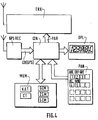
- Fig. 4 illustrates an example of a mobile telephone according to the invention which includes the characteristics illustrated in Figs. 1, 2 and 3.
- the mobile phone is capable to operate according to several mobile telephony standards such as for example known by the abbreviations GSM, DCS-1800 and AMPS.
- the mobile phone illustrated in FIG. 4 includes a transmission circuit and TRX reception for mobile communications, GPSREC receiver, screen DPL display panel, PAN control panel, CON controller and MEM memory.
- the TRX transmission and reception circuit performs the necessary treatments for establish a communication link over the air with a base station.
- the GPSREC receiver receives GPS signals and deduces geographic coordinates of the CO [GPS] geodesic type.
- the PAN control panel allows the user to compose command words.
- DPL display screen displays characters alphabetical and numerical informing the user about the state of the mobile phone.
- the CON controller provides PAR setting signals to the transmission circuit and TRX reception which allow this circuit to be adapted to one of several standards mobile telephony.
- the CON controller sends display signals to the screen display panel and receives control signals from the PAN control panel.
- the MEM memory contains several types of data which allow the mobile phone to perform different functions.
- MEM memory contains between others a RAT radio access board which lists the different standards of mobile telephony according to which the mobile telephone illustrated in FIG. 4 can operate.
- MEM memory for each mobile phone standard contains a table CT configuration, a GCM global scope matrix (in English: global coverage matrix), and one or more field of application matrices per zone ZCM (in English: area coverage matrices) and one or more field matrices of application according to a SCM grid (in English: square coverage matrices).
- the two types of arrays RAT, CT and the three types of matrices GCM, ZCM, SCM are described below in more detail.
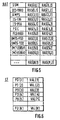
- Fig. 5 illustrates an example of the RAT radio access table stored in the MEM memory.
- the table has three columns and rows with the number N corresponds to the number of different standards by which the mobile phone can operate.
- the left column contains descriptions of the telephony standards mobile.
- the middle and right columns contain RAS pointers which respectively point to CT configuration tables and matrices of GCM global scope.
- Each line belongs to a telephony standard mobile. So each line contains a description of the mobile phone standard to which it belongs, a RAS pointer [*, 1] which points to an array of standard CT configuration, and a RAS pointer [*, 2] which points to a GCM global scope matrix specific to the standard.
- Fig. 6 illustrates an example of a CT configuration table.
- the table of CT configuration contains two columns and rows whose number K corresponds to the number of different parameters to configure the transmission circuit and TRX reception according to a mobile telephone standard.
- the left column contains PD parameter descriptions and the right column contains values of VAL parameters to configure the TRX transmission and reception circuit according to the standard.
- Each line belongs to a different PD parameter. So each line contains a PD description of the parameter to which it belongs, and the VAL value of setting.
- Fig. 7 illustrates an example of the GCM global scope matrix.
- the GCM matrix illustrated in FIG. 7 contains 60 columns and 20 rows and, by Therefore, 1200 GC elements.
- Each GC element is associated with a zone different geographic area obtained by a global division of the land area according to the 'Mercator Transversal Universal Projection' (MTUP) projection.
- MTUP Transversal Universal Projection'
- Projection MTUP is recommended by the Association of Geodesy and Geophysics International.
- a geographic area obtained by this global division according to the MTUP projection makes 6 degrees in longitude and 8 degrees in latitude.
- Each GC element in the GCM global scope matrix is a pointer.
- a GC element points to a field of application matrix by ZCM zones if, in the geographic area with which the GC element is associated, the standard of mobile phone concerned is at least partially applied.
- This ZCM matrix describes in more detail the availability of the mobile telephony standard in the area geographic associated with the GC element. If, on the other hand, the standard of mobile telephony is not applied in this geographic area, the GC element points to a flag which indicates that the scope of the standard does not cover this area geographical.
- Fig. 8 illustrates an example of a zone scope matrix ZCM.
- the ZCM matrix illustrated in FIG. 7 contains 8 columns and 9 rows and, by Consequently, 72 ZC elements.
- Each ZC element is associated with a geographic area different. These geographic areas are obtained by dividing into areas according to the MTUP projection, the geographic area associated with the GC element which refers to the ZCM matrix.
- the geographic areas with which the ZC elements are associated constitute 100 km by 100 km squares. It should be noted that the number of elements ZC contained in a field of application matrix by ZCM zones, may vary in function of the referencing GC element. This is because the areas geographic elements with which the GC elements are associated, do not all have the same cut.
- Each ZC element of the ZCM zone scope matrix is a pointer.
- a ZC element points to a scope matrix according to a SCM grid if, in the geographic area with which the ZC element is associated, the relevant mobile telephony standard is at least partially applied.
- This SCM matrix describes in more detail the availability of the mobile phone standard in the geographic area associated with the ZC element. If, on the other hand, the telephony standard mobile is not applied in this geographic area, the ZC element points to the flag indicating that the scope of the standard does not cover this area geographical.
- Fig. 9 illustrates an example of a scope matrix according to a SCM grid, to which a ZC element of a scope matrix by ZCM zones can reference.
- the SCM matrix illustrated in FIG. 9 contains 10 columns and 10 rows and, therefore, 100 SC elements.
- Each SC element is associated with a different geographic area, obtained by grid in areas 10 km by 10 km geographic areas associated with the SC element which refers to the SMC matrix.
- Each SC element includes an indicator bit whose value is 1 if the geographic scope of COV of the mobile telephony covers at least part of the geographic area associated with the ZC element. Otherwise, the value of the flag bit is 0.
- Fig. 10 illustrates a way in which the mobile telephone can operate illustrated in Fig. 4 and whose MEM memory contains tables and matrices illustrated in Figs. 5-9.
- a user makes known to the CON controller according to which mobile telephony standard the mobile telephone illustrated in Fig. 4 must operate.
- the controller CON collects GPS receiver the geographic coordinates of the CO [GPS] geodesic type defining the location of the mobile phone.
- the controller CON transforms the geographic coordinates of the CO [GPS] geodesic type into geographic coordinates in accordance with the MTUP projection: CO [MTUP].
- the controller CON selects, from the access table RAT radio, the line specific to the GSM standard including the RAS pointer [0,2] which points to the GCM global scope matrix belonging to the GSM standard.
- the controller CON selects, from this GCM matrix, the element GC associated with the geographic area in which the mobile phone is located.
- the controller selects the GC element based on geographic coordinates CO [MTUP], for example by transforming them into an address where the GC element is stored.
- the CON controller evaluates whether the GC element points to a matrix of scope by ZCM zones, or towards the FLAG flag indicating that the geographic scope does not cover the geographic area associated with the selected GC element. In the latter case, the CON controller displays on the DPL display screen that the mobile phone cannot be used according to the standard GSM: NO GSM.
- the CON controller selects, from this ZCM matrix, the ZC element associated with the geographic area in which the mobile phone is located.
- the controller select the element ZC based on the geographic coordinates CO [MTUP], for example by transforming them into an address at which the ZC element is stored.
- the controller CON evaluates if the element ZC selected points to a field of application matrix according to a SCM grid, or towards the FLAG flag indicating that the geographic scope does not cover the geographic area associated with the selected ZC element. In the latter case, the CON controller displays on the DPL display screen that the mobile phone cannot be used according to the standard GSM: NO GSM.
- the controller CON selects, from this matrix SCM, the element SC associated with the geographic area in which the mobile phone is located.
- the controller selects the SC element based on geographic coordinates CO [MTUP], for example by transforming them into an address at which the element SC is stored.
- the CON controller If the indicator bit of the SC element is 1, a step takes place in which the CON controller will configure the TRX transmission and reception circuit according to the standard GSM by providing it with appropriate PAR setting signals. So that this can be performed, the CON controller collects the VAL parameter values contained in the CT configuration table specific to the GSM standard. The CON controller select this CT configuration table using the RAS pointer [0,1] in the RAT radio access panel. This RAS pointer [0,1] can be collected at the same time as the RAS pointer [0.2] in step S5 described above.
- the mobile telephone illustrated in FIG. 4 updates the GCM, ZCM and SCM scope matrices regularly. This can take place through one or more information centers which are committed to update a database relating to the geographical fields of application of one or several mobile telephony standards.
- this database contains scope matrices having the same format as those described above.
- the mobile phone shown in Fig. 4 can update the GCM, ZCM and SCM scope matrices as follows.
- the mobile phone regularly contacts an information center which keeps up to date database relating to the geographic scope of one or more standards. It checks whether the GCM, ZCM and SCM scope matrices are of the last version. In this case, the update is complete. Otherwise, the mobile phone replaces elements of the GCM, ZCM and SCM scope matrices that have been changed.
- the mobile phone can contact an information center over the air using the TRX transmission and reception.
- the mobile phone can contact an information center over the air using the TRX transmission and reception.
- several standards of mobile telephony make it possible to establish dedicated data communications.
- the GSM standard is equipped with a 'Global Packet Radio System' which allows data communication with a speed up to 115kbits / s.
- the information center can be contacted, for example, via the Internet.
- the mobile phone illustrated in FIG. 4 resumes the characteristics illustrated in Figs. 1, 2 and 3. With regard to characteristics illustrated in FIG. 1, the following is observed.
- the mobile phone contains a memory MEM to store GCM, ZCM and SCM matrices which, in their together constitute data relating to the geographical fields of application GSM, DCS-1800, AMPS, etc. mobile telephony standards, according to which the mobile phone can operate.
- the mobile phone contains a GPSREC receiver which provides an interface for drawing CO geographic coordinates from outside constituting data relating to the geographic location of the mobile telephone.
- the mobile phone contains a CON controller and a DPL display screen which, in their together constitute an indicator to indicate whether the mobile communication device can be used or not based on data relating to the fields of application geographic and geographic location data.
- the elements of the GCM, ZCM and SCM matrices constitute data relating to geographic fields of different types.
- Each element GC, ZC, SC of a matrix GCM, ZCM, SCM, respectively, is associated with a zone specific geographic area, the size of which depends on the type of the GC, ZC or SC element.
- a GC element of a GCM matrix refers to a ZCM matrix. This last constitutes a group of ZC elements of a type other than the type of the GC element referring to.
- the ZC elements of the referenced ZCM matrix are associated with geographic areas which, in combination, correspond substantially to the area geographic to which the referencing GC element is associated.
- Fig. 10 illustrates a method in which the user defines a desired standard, this does not exclude that a search for the applied standards is carried out first, after which these standards are displayed so that the user can select the standard that suits him. Alternatively, the selection of a standard applied can be done automatically.
- Fig. 10 illustrates a method in which a signal receiver GPS extracts data relating to geographical location from the outside
- a system of satellite mobile phone may include means for locating a mobile phone, so that a satellite can point its antenna at the phone mobile. So, such a telephone system will know the geographic location of the mobile phone.
- the latter may include a receiver for obtaining data. relating to its geographical location of the satellite telephone system.
- geographic location data can be drawn from the outside via a keyboard that allows a user to make known to the device the geographic location, for example by typing the name of a place.
- the panel PAN control can include such a keyboard and the CON controller can translate the name location in geographic coordinates.
Landscapes
- Engineering & Computer Science (AREA)
- Computer Networks & Wireless Communication (AREA)
- Radar, Positioning & Navigation (AREA)
- Remote Sensing (AREA)
- Signal Processing (AREA)
- Physics & Mathematics (AREA)
- General Physics & Mathematics (AREA)
- Mobile Radio Communication Systems (AREA)
- Position Fixing By Use Of Radio Waves (AREA)
Applications Claiming Priority (2)
| Application Number | Priority Date | Filing Date | Title |
|---|---|---|---|
| FR9807916 | 1998-06-23 | ||
| FR9807916 | 1998-06-23 |
Publications (1)
| Publication Number | Publication Date |
|---|---|
| EP0967814A1 true EP0967814A1 (de) | 1999-12-29 |
Family
ID=9527733
Family Applications (1)
| Application Number | Title | Priority Date | Filing Date |
|---|---|---|---|
| EP99201880A Withdrawn EP0967814A1 (de) | 1998-06-23 | 1999-06-14 | Verfahren zum mobilen Kommunikation |
Country Status (4)
| Country | Link |
|---|---|
| US (1) | US6424839B1 (de) |
| EP (1) | EP0967814A1 (de) |
| JP (1) | JP2000032569A (de) |
| KR (1) | KR20000006351A (de) |
Families Citing this family (8)
| Publication number | Priority date | Publication date | Assignee | Title |
|---|---|---|---|---|
| KR100390804B1 (ko) * | 2000-05-31 | 2003-07-10 | 조성준 | 무선통신 단말기의 통화모드/통화금지모드 자동 전환 장치및 그 방법 |
| US6710933B2 (en) * | 2000-05-31 | 2004-03-23 | Matsushita Electric Industrial Co., Ltd. | Zoom lens and video camera comprising the same |
| US6928300B1 (en) * | 2000-11-09 | 2005-08-09 | Palmsource, Inc. | Method and apparatus for automated flexible configuring of notifications and activation |
| US7194278B1 (en) * | 2000-11-20 | 2007-03-20 | Sprint Spectrum L.P. | Method and system for managing device functions based on location |
| US20030013479A1 (en) * | 2001-07-13 | 2003-01-16 | Dan Vassilovski | Mobile communication device preferential system selection |
| US20050113113A1 (en) * | 2001-11-15 | 2005-05-26 | Reed Mark J. | Enhanced wireless phone |
| DE102011087778B4 (de) | 2011-12-06 | 2015-05-07 | Rohde & Schwarz Gmbh & Co. Kg | Mobilfunkgerät mit Signalqualitätsanzeige und entsprechendes Betriebsverfahren |
| US9748024B2 (en) | 2014-06-20 | 2017-08-29 | Schneider Electric USA, Inc. | Passive arc control with sequestered phases in a vertical bus system of a motor control center |
Citations (7)
| Publication number | Priority date | Publication date | Assignee | Title |
|---|---|---|---|---|
| EP0603049A1 (de) * | 1992-12-16 | 1994-06-22 | Alcatel Mobile Communication France | Anordnung zum Verbindungsaufbau von Endgerät zum Netz eines Funkkommunikationssystem mit mehreren Netzen |
| WO1994027398A1 (en) * | 1993-05-07 | 1994-11-24 | Everett Dennison | Cellular telephone system that uses position of a mobile unit to make call management decisions |
| EP0749254A1 (de) * | 1995-06-15 | 1996-12-18 | Nokia Mobile Phones Ltd. | Methode zur Preisermittlung im Stammgebiet von zellularen Mobiltelefonen |
| WO1997019570A1 (en) * | 1995-11-22 | 1997-05-29 | Jarlab Ab | Telecommunications system |
| WO1997030561A1 (en) * | 1996-02-16 | 1997-08-21 | Ericsson Inc. | Method and apparatus for roaming using dual mode/band equipment including sim cards |
| US5678182A (en) * | 1995-06-19 | 1997-10-14 | Trimble Navigation Limited | Self-locating radio system that automatically configures to the radio regulations for the location |
| GB2313257A (en) * | 1996-05-17 | 1997-11-19 | Motorola Ltd | Selecting data relevant to multiple communication systems in vicinity of a programmable subscriber unit |
Family Cites Families (10)
| Publication number | Priority date | Publication date | Assignee | Title |
|---|---|---|---|---|
| US5442805A (en) * | 1988-10-05 | 1995-08-15 | Motorola, Inc. | Location-based adaptive radio control |
| US5678194A (en) * | 1994-03-10 | 1997-10-14 | Motorola, Inc. | Method for providing geographic dependent instructions to a user of a communications unit |
| US5613213A (en) * | 1994-03-31 | 1997-03-18 | Motorola, Inc. | Determining and displaying available services for a communication unit |
| JPH08307946A (ja) * | 1995-05-12 | 1996-11-22 | Nec Corp | Phs端末無効化方式 |
| US5857155A (en) * | 1996-07-10 | 1999-01-05 | Motorola, Inc. | Method and apparatus for geographic based control in a communication system |
| JP2885721B2 (ja) * | 1996-09-13 | 1999-04-26 | 日本電気アイシーマイコンシステム株式会社 | セルラー方式移動体通信システム |
| JP3119173B2 (ja) * | 1996-09-13 | 2000-12-18 | 日本電気株式会社 | 移動通信システム |
| US6011973A (en) * | 1996-12-05 | 2000-01-04 | Ericsson Inc. | Method and apparatus for restricting operation of cellular telephones to well delineated geographical areas |
| JPH10276473A (ja) * | 1997-03-28 | 1998-10-13 | Nec Corp | 移動体通信システムおよび移動体通信装置 |
| JP3005496B2 (ja) * | 1997-05-21 | 2000-01-31 | 日本電気株式会社 | 送信規制装置及び無線送受信端末装置並びにこれ等を用いた送信規制システム |
-
1999
- 1999-06-14 EP EP99201880A patent/EP0967814A1/de not_active Withdrawn
- 1999-06-17 US US09/335,017 patent/US6424839B1/en not_active Expired - Fee Related
- 1999-06-21 JP JP11173971A patent/JP2000032569A/ja active Pending
- 1999-06-22 KR KR1019990023500A patent/KR20000006351A/ko not_active Withdrawn
Patent Citations (7)
| Publication number | Priority date | Publication date | Assignee | Title |
|---|---|---|---|---|
| EP0603049A1 (de) * | 1992-12-16 | 1994-06-22 | Alcatel Mobile Communication France | Anordnung zum Verbindungsaufbau von Endgerät zum Netz eines Funkkommunikationssystem mit mehreren Netzen |
| WO1994027398A1 (en) * | 1993-05-07 | 1994-11-24 | Everett Dennison | Cellular telephone system that uses position of a mobile unit to make call management decisions |
| EP0749254A1 (de) * | 1995-06-15 | 1996-12-18 | Nokia Mobile Phones Ltd. | Methode zur Preisermittlung im Stammgebiet von zellularen Mobiltelefonen |
| US5678182A (en) * | 1995-06-19 | 1997-10-14 | Trimble Navigation Limited | Self-locating radio system that automatically configures to the radio regulations for the location |
| WO1997019570A1 (en) * | 1995-11-22 | 1997-05-29 | Jarlab Ab | Telecommunications system |
| WO1997030561A1 (en) * | 1996-02-16 | 1997-08-21 | Ericsson Inc. | Method and apparatus for roaming using dual mode/band equipment including sim cards |
| GB2313257A (en) * | 1996-05-17 | 1997-11-19 | Motorola Ltd | Selecting data relevant to multiple communication systems in vicinity of a programmable subscriber unit |
Non-Patent Citations (1)
| Title |
|---|
| R.STEELE ET AL.: "Third generation PCN and the intelligent multimode mobile portable", ELECTRONICS AND COMMUNICATION JOURNAL, vol. 5, no. 3, 1 June 1993 (1993-06-01), London,UK, pages 147 - 156, XP000377790 * |
Also Published As
| Publication number | Publication date |
|---|---|
| JP2000032569A (ja) | 2000-01-28 |
| KR20000006351A (ko) | 2000-01-25 |
| US6424839B1 (en) | 2002-07-23 |
Similar Documents
| Publication | Publication Date | Title |
|---|---|---|
| US9091555B2 (en) | Map version control methods and apparatus for updating the use of network-maintained map data sets for mobile communication devices | |
| CN102783189B (zh) | 根据区域名称对兴趣点进行分组的方法和装置 | |
| US9420453B2 (en) | Correlating and mapping mobile device locations on a mobile device | |
| US20080162037A1 (en) | Location-based interactive display and communication system | |
| US7259668B2 (en) | Mapping the location of a mobile communications device systems and methods | |
| CA2294401C (en) | Map downloading system with gps and transceiver | |
| US20090191892A1 (en) | Integrating position-determining and wi-fi functions | |
| EP2572269A1 (de) | Persönliches funknavigationssystem | |
| US20100010740A1 (en) | Permission module on mobile computing device | |
| WO2008122854A2 (en) | Identifying interesting locations based on commonalities in location based postings | |
| US20090240428A1 (en) | Mobile phone having gps navigation system | |
| KR20110082881A (ko) | 휴대전화 컨넥티비티 기반에 차량용 컨버전스 방법 및 그 장치 | |
| KR101615504B1 (ko) | 휴대용 단말기에서 컨텐츠를 저장하고 검색하는 방법 및 장치 | |
| Ferraro et al. | Location-aware applications | |
| CN111161101A (zh) | 一种自助导览装置及方法 | |
| US20070069946A1 (en) | Systems and methods for position based services in a mobile device | |
| US20050202834A1 (en) | System and method for determination of meeting place utilizing telephone auto location system | |
| US8175618B2 (en) | Mobile device product locator | |
| CN116709501B (zh) | 业务场景识别方法、电子设备及存储介质 | |
| US7089022B1 (en) | Systems and methods for obtaining location based information using a mobile communication device | |
| GB2422669A (en) | Article and a mobile networkable device for reading navigational data from an article | |
| FI119953B (fi) | Menetelmä, järjestelmä ja palvelutuote kohteiden tunnistamiseksi | |
| US6424839B1 (en) | Mobile communication | |
| SE513544C2 (sv) | Anläggning och förfarande för att tillhandahålla en tjänst | |
| CN101017092A (zh) | 结合导航网站的导航系统及其方法 |
Legal Events
| Date | Code | Title | Description |
|---|---|---|---|
| PUAI | Public reference made under article 153(3) epc to a published international application that has entered the european phase |
Free format text: ORIGINAL CODE: 0009012 |
|
| AK | Designated contracting states |
Kind code of ref document: A1 Designated state(s): DE ES FR GB IT |
|
| AX | Request for extension of the european patent |
Free format text: AL;LT;LV;MK;RO;SI |
|
| 17P | Request for examination filed |
Effective date: 20000629 |
|
| AKX | Designation fees paid |
Free format text: DE ES FR GB IT |
|
| RAP1 | Party data changed (applicant data changed or rights of an application transferred) |
Owner name: CELLON FRANCE SAS |
|
| 17Q | First examination report despatched |
Effective date: 20040105 |
|
| STAA | Information on the status of an ep patent application or granted ep patent |
Free format text: STATUS: THE APPLICATION IS DEEMED TO BE WITHDRAWN |
|
| 18D | Application deemed to be withdrawn |
Effective date: 20031231 |