EP0967821A2 - Sprachpausenerkennung und -entfernung in Sprachverbindungen über einem ATM-Netz - Google Patents
Sprachpausenerkennung und -entfernung in Sprachverbindungen über einem ATM-Netz Download PDFInfo
- Publication number
- EP0967821A2 EP0967821A2 EP19990104882 EP99104882A EP0967821A2 EP 0967821 A2 EP0967821 A2 EP 0967821A2 EP 19990104882 EP19990104882 EP 19990104882 EP 99104882 A EP99104882 A EP 99104882A EP 0967821 A2 EP0967821 A2 EP 0967821A2
- Authority
- EP
- European Patent Office
- Prior art keywords
- silence
- atm
- oam
- suppression
- network
- Prior art date
- Legal status (The legal status is an assumption and is not a legal conclusion. Google has not performed a legal analysis and makes no representation as to the accuracy of the status listed.)
- Withdrawn
Links
- 230000001629 suppression Effects 0.000 title claims abstract description 58
- 238000001514 detection method Methods 0.000 title description 7
- 238000000034 method Methods 0.000 claims abstract description 41
- 238000011084 recovery Methods 0.000 claims description 12
- 230000001960 triggered effect Effects 0.000 claims description 3
- 108091006146 Channels Proteins 0.000 description 33
- 239000000872 buffer Substances 0.000 description 13
- 230000006835 compression Effects 0.000 description 6
- 238000007906 compression Methods 0.000 description 6
- 238000012545 processing Methods 0.000 description 5
- 238000012546 transfer Methods 0.000 description 5
- 230000006978 adaptation Effects 0.000 description 4
- 230000003044 adaptive effect Effects 0.000 description 4
- 230000005540 biological transmission Effects 0.000 description 4
- 238000005516 engineering process Methods 0.000 description 4
- 238000013508 migration Methods 0.000 description 4
- 230000005012 migration Effects 0.000 description 4
- 230000011664 signaling Effects 0.000 description 4
- 230000001360 synchronised effect Effects 0.000 description 4
- 238000013459 approach Methods 0.000 description 2
- 230000008901 benefit Effects 0.000 description 2
- 230000008859 change Effects 0.000 description 2
- 238000007796 conventional method Methods 0.000 description 2
- 238000005259 measurement Methods 0.000 description 2
- 230000007246 mechanism Effects 0.000 description 2
- 238000012986 modification Methods 0.000 description 2
- 230000004048 modification Effects 0.000 description 2
- 108700010388 MIBs Proteins 0.000 description 1
- 238000010420 art technique Methods 0.000 description 1
- 230000003139 buffering effect Effects 0.000 description 1
- 238000004364 calculation method Methods 0.000 description 1
- 239000000969 carrier Substances 0.000 description 1
- 230000006727 cell loss Effects 0.000 description 1
- 238000006243 chemical reaction Methods 0.000 description 1
- 238000007596 consolidation process Methods 0.000 description 1
- 230000000694 effects Effects 0.000 description 1
- RGNPBRKPHBKNKX-UHFFFAOYSA-N hexaflumuron Chemical compound C1=C(Cl)C(OC(F)(F)C(F)F)=C(Cl)C=C1NC(=O)NC(=O)C1=C(F)C=CC=C1F RGNPBRKPHBKNKX-UHFFFAOYSA-N 0.000 description 1
- 238000007726 management method Methods 0.000 description 1
- 238000013507 mapping Methods 0.000 description 1
- 239000003550 marker Substances 0.000 description 1
- 238000012544 monitoring process Methods 0.000 description 1
- 230000002028 premature Effects 0.000 description 1
- 230000004044 response Effects 0.000 description 1
- 230000011218 segmentation Effects 0.000 description 1
- 238000012360 testing method Methods 0.000 description 1
Images




Classifications
-
- H—ELECTRICITY
- H04—ELECTRIC COMMUNICATION TECHNIQUE
- H04Q—SELECTING
- H04Q11/00—Selecting arrangements for multiplex systems
- H04Q11/04—Selecting arrangements for multiplex systems for time-division multiplexing
- H04Q11/0428—Integrated services digital network, i.e. systems for transmission of different types of digitised signals, e.g. speech, data, telecentral, television signals
- H04Q11/0478—Provisions for broadband connections
-
- H—ELECTRICITY
- H04—ELECTRIC COMMUNICATION TECHNIQUE
- H04L—TRANSMISSION OF DIGITAL INFORMATION, e.g. TELEGRAPHIC COMMUNICATION
- H04L12/00—Data switching networks
- H04L12/54—Store-and-forward switching systems
- H04L12/56—Packet switching systems
- H04L12/5601—Transfer mode dependent, e.g. ATM
- H04L2012/5625—Operations, administration and maintenance [OAM]
-
- H—ELECTRICITY
- H04—ELECTRIC COMMUNICATION TECHNIQUE
- H04L—TRANSMISSION OF DIGITAL INFORMATION, e.g. TELEGRAPHIC COMMUNICATION
- H04L12/00—Data switching networks
- H04L12/54—Store-and-forward switching systems
- H04L12/56—Packet switching systems
- H04L12/5601—Transfer mode dependent, e.g. ATM
- H04L2012/5638—Services, e.g. multimedia, GOS, QOS
- H04L2012/5671—Support of voice
Definitions
- This invention relates to Asynchronous Transfer Mode (ATM) networks. Specifically, it deals with a method for transmitting digital voice samples from one switch to another with silence suppression.
- the present invention specifies an arrangement for an ingress multiplexer of an ATM network to suppress the silence periods and play them back at the egress multiplexer of the ATM network.
- the present invention is embodied in methods for transmitting voice and silence in an ATM network, in an OAM cell system for use in suppressing silence and in an ATM network system that incorporates silence suppression.
- PSTN Public Switched Telephone Networks
- ATM Asynchronous Transfer Mode
- FIG.1 A conventional network system is shown in FIG.1.
- class 5 switches 110 are used to route and separate various services such as 800 services, 900 services, special services often carrying Internet traffic, and Plain Old Telephone Services (POTS) ; boxes 130, 140, 150 and 160 respectively.
- This network is a collection of class 5 switches and Network Service Points (NSPs) forming part of an STM network 120 interconnected with DS1/DS3 (T1/T3) links.
- NSPs Network Service Points
- Class 5 switches 210 are connected using DS1/DS3 (T1/T3) lines to an ATM access multiplexer 220, which accesses an ATM network 230.
- the requirements on the ATM network in general and the ATM access multiplexer in particular include the efficient transport of a large number of voice streams (PCM and ADPCM based) on the ATM network.
- PCM and ADPCM based voice streams
- Each OC-3 link on the ATM trunk can transport as many as 2000 voice channels without any compression.
- DSI Digital Speech Interpolation
- DSI Digital Speech Interpolation
- a fat pipe to multiplex the voice channels is being considered by practitioners, statistical multiplexing using silence suppression is a very effective solution for increasing the bandwidth efficiency. Such a solution also avoids using conventional speech compression techniques that involve transcoding and other complexities.
- AAL ATM Adaptation Layer
- DBCES Current dynamic bandwidth utilization scheme
- ITU ITU
- ATM Forum ATM Forum VTOA working group draft.
- DBCES uses an NxDS0 solution for voice suppression. This conventional technique is based on the premise that entire T1 frames are shipped across the ATM network and if slots in the frame are not active, the egress multiplxer is notified of it using a separate signaling channel carved out of the AAL-1 payload.
- the ATM Forum/ITU has defined a Service Specific Convergence Sublayer (SSCS) for trunking.
- SSCS Service Specific Convergence Sublayer
- the SSCS defines packet formats and procedures for encoding various information types over a single ATM VC.
- the SSCS accommodates known techniques for audio encoding, silence compression and fax demodulation. In this scheme, depending on the audio coding scheme, a fixed length segment is sent periodically. The segment is either active voice or silence. The silence is indicated by a non-zero value of the SID field in the convergence sub-layer. Once a non-zero SID is transmitted the receiver assumes silence suppression is ON and plays the fill out based on the coding algorithm and the SID.
- the AAL-2 solution unlike the present invention, uses the convergence sublayer to convey the SSF function.
- the prescribed ATM Forum/ITU solution places more processing onus on the demultiplexing unit as the coding and the statistical multiplexing functions are all combined in one SSCS while the present invention separates the two functions.
- the lack of an explicit SSF ON flag also puts an additional onus on the receiver to detect idle subchannels implicitly based on a field hidden in the SSCS layer. Also there are no hand shake mechanisms to ensure that silence notification is received reliably in this scheme.
- the SSCS for AAL-2 achieves bandwidth utilization by its own silence suppression scheme. See ITU-T I.TRUNK -AAL-2 SSCS for Trunking.
- AAL-1 fails to suppress silence in active channels
- AAL-2 solution is closely tied to AAL-2 protocol. Further, because of the way standards evolve, a skilled artisan will realize that silence suppression is a feature that can be accommodated only using AAL-2. However, for the migration of existing PSTN to the ATM backbone, AAL-2 is not viewed favorably by practitioners. Most operators consider using AAL-1 or AAL-5 as the means of transporting voice samples and not AAL-2. The reasons for that are:
- a method of transmitting silence in an ATM network wherein a specific silence representation model known to ingress multiplexer and egress multiplexer is used, said method comprising: modeling silence at the ingress multiplexer; describing silence based on the model using silence descriptors; transmitting the silence descriptors using a medium; receiving silence descriptors at the egress multiplexer; and recreating silence using the silence descriptors.
- a decision to suppress or not to suppress is based on streams with known encoding formats.
- the streams are selected from a group consisting of digital PCM, ADPCM, CELP, PLC and HDLC.
- Further improvements include the method of transmitting silence wherein OAM cells are used to transmit silence descriptors. Still further improvements include the method of transmitting silence wherein the silence descriptors can be changed dynamically, said change being conveyed to egress multiplexer by dynamically refreshing the medium.
- Another aspect of the present invention is a method of transmitting voice in an ATM network with silence suppression, said method comprising: preparing a start notification and a corresponding end notification on detecting an epoch of silence in a speech sample; converting speech samples without silence into ATM cells at an ingress multiplexer; appending a 5-byte ATM header to the ATM cells; sending the ATM cells; sending the ATM cells, said start notification and corresponding end notification at appropriate times; and recreating the voice sample at an egress multiplexer based on the ATM cells, said start notification and corresponding end notification.
- the start and corresponding end notification are prepared using OAM cells.
- Further improvements include the method of transmitting voice with silence suppression wherein in an OAM cell a silence suppression flag is set to ON to indicate silence, the ingress multiplexer transmits the last valid ATM cell before transmitting an OAM cell with silence suppression flag set to ON on a VC and then marks the VC as inactive.
- all low energy PCM is designated as silence
- silence descriptors are transmitted representing silence
- a function of the silence descriptor is played out at the egress multiplexer.
- a subchannel ID in the SSF OAM cell is added to indicate a subchannel to facilitate demultiplexing at the egress multiplexer.
- idle code suppression is provided by removing HDLC flags.
- idle code suppression is also provided by removing Fax idle codes.
- Further improvements include the method of transmitting voice with silence suppression wherein error recovery is provided by sending OAM cells periodically.
- error recovery is provided by having a 2-way OAM handshake protocol that guarantees that an OAM cell has been received.
- the OAM cell is an end to end OAM cell corresponding to payload type indicator of 101.
- an OAM cell with a silence suppression flag set to OFF is transmitted followed by marking the VC as active.
- Yet another aspect of the present invention is an OAM cell for use in suppressing silence in an ATM network, said cell comprising a silence suppression function.
- the OAM cell carries a sub-channel ID for an AAL-2 subchannel.
- the OAM cell structure has a sequence number field for an AAL-1 subchannel, said sequence number being a last sent out SSCS-PDU, and wherein a receiver ensures that the SSCS-PDU is received in full and played out before silence is played when said silence is triggered by an OAM cell carrying the sequence number.
- Still another aspect of the present invention is an ATM network with silence suppression wherein silence suppression is carried out at an ingress multiplexer by multiplexing silence start and silence end notifications at beginning and end of silence, wherein only voice data is converted into ATM cells and playing out silence and voice at appropriate instances at egress multiplexer.
- the notifications are done using an OAM cell.
- an AAL-2 subchannel ID is added to indicate a subchannel to facilitate demultiplexing at the egress multiplexer.
- idle code suppression is provided by removing HDLC flag.
- idle code suppression is also provided by removing Fax idle codes.
- Further improvements include the ATM network wherein error recovery is provided by sending OAM cells periodically. Still further improvements include the ATM network wherein error recovery is provided by having a 2-way OAM handshake protocol that guarantees that an OAM cell has been received.
- the OAM cell is an end to end OAM cell corresponding to payload type indicator of 101.
- FIG. 1 shows a conventional Synchronous Transfer Mode (STM) Network.
- STM Synchronous Transfer Mode
- FIG. 2 shows a scenario depicting a migration to Asynchronous Transfer Mode (ATM).
- ATM Asynchronous Transfer Mode
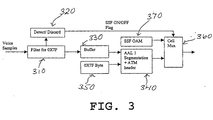
- FIG. 3 shows an arrangement for an Ingress Access Multiplexer to discard Idle Code.
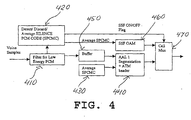
- FIG. 4. shows an arrangement for an Ingress Access Multiplexer for Low Energy Suppression.
- FIG. 5 shows an explicit OAM cell handshake to ensure robust operation.
- FIG. 6 shows an SSF OAM Cell Format.
- the present invention relates to the transportation of digital voice samples (PCM) from one class 5 switch to another through an ATM network while incorporating silence detection and suppression to achieve better compression, across the ATM network, for voice calls.
- PCM digital voice samples
- this invention specifies an arrangement at the ingress ATM access multiplexer to suppress the silence periods and replay them back at the egress ATM access multiplexer using a combination of ATM technology and PCM technology.
- silence is transmitted in an ATM network using a model that represents silence.
- a model is known to, and can be recognized by, both the ingress and egress multiplexers used in the network.
- Silence is detected at the ingress multiplexer and modeled using the known model.
- Silence descriptors are used by the model to describe the silence detected.
- These silence descriptors are then transmitted across the network media to the egress multiplexer.
- the egress multiplexer which knows the model can recreate the silence using the descriptors.
- a function of the silence descriptors that are received at the egress multiplexer is played out as silence.
- OAM cells are used to transmit these descriptors. If the values produced by the model used to represent silence changes, then the OAM cells are refreshed to incorporate such changes.
- a key aspect of this invention is the detection of silence in a voice stream.
- voice streams entering the access multiplexer are streams with known encoding formats. Examples of such formats include digital PCM or ADPCM streams with known idle codes and low energy codes (this is based on the well-known A-law and ⁇ -law PCM rules).
- the present invention performs silence detection by merely observing encoding formats (for example PCM, ADPCM, CELP, PLC and HDLC samples). Based on the samples of encoding formats, a decision to suppress (or not to suppress) a segment of the voice stream is made.
- the coding style of each channel is known apriori through call setup or provisioning. Based on this known coding style, a preferred silence filter is constructed. Silence is measured and the silence descriptor is dynamically updated, while ensuring that the egress multiplexer is notified about it. Such a technique ensures realistic playout of silence.
- the speech samples are converted into ATM cells at the ingress access multiplexer.
- a well known ATM Adaptation Layer (AAL) is used; namely AAL-1, AAL-2 or AAL-5, for converting speech samples to ATM cells.
- AAL-1 takes 47 bytes of data and adds an one byte AAL header to form the payload of an ATM cell (48 bytes).
- AAL-2 multiplexes multiple voice channels onto the same ATM VC.
- the technique of the present invention involves appending 5-byte ATM headers to the ATM cells followed by transmitting them across the ATM network.
- each voice channel is assigned its own unique ATM virtual circuit while in the preferred embodiment using AAL-2 an ATM VC is shared between many voice subchannels.
- the ATM cells are transported across the network using ATM cell multiplexing and transport technology.
- ATM introduces a variable queuing delay inside the network; therefore cells on a given VC may arrive jittered and bunched up or spread out. This introduces a problem at the egress multiplexer in playing the voice samples out.
- SRTS Synchronous Residual Time Stamp
- the egress multiplexer plays the voice samples out based on a clock that adapts to a buffer fill. It starts playing the voice samples out based on a threshold in the buffer. The threshold is chosen based on the probability of a buffer being underflow or overflow. Such a probability is determined apriori for the underlying ATM network.
- the adaptive clock reads the data out slower or faster depending on whether the buffer is underflowing or overflowing.
- the present invention is independent of the clock recovery scheme and will work on both the techniques.
- the original voice bytes are played out again. Because of the variable delay through the ATM network, merely throwing silence codes at the ingress multiplexer and playing it out at the egress multiplexer (with silence codes being used to fill in whenever the buffers are empty) will not work.
- Some notification for the beginning of the silence period to the end of the silence period needs to be sent from the ingress multiplexer access node to the egress multiplexer access node.
- the notification needs to satisfy certain properties, namely:
- a special control cell is used to perform the notification.
- This special control cell is called an OAM cell and has been defined in the ATM standard to perform in-band control on a per VC basis.
- PTI Payload Type Indicator
- the first 6 bits of the OAM Cell Payload is called the Function Id bits (FID).
- the current functions defined in the ATM standards for end to end OAM cells are:
- SSF Silence Suppression Function
- a sub-channel ID for an AAL-2 subchannel can also be carried as described further in the examples.
- the present invention is illustrated using a few examples. These examples show preferred embodiments that use the methods of silence suppression of the present invention. The examples also describe in detail preferred embodiments of ATM networks that incorporate silence suppression techniques of the present invention. They also describe OAM cells used for transmitting silence according to the present invention.
- the PCM idle code (OX7F) is suppressed across an ATM network and played back at the other end.
- ATM cells are created out of PCM digital voice samples on a per channel basis. The arrangement at the ingress multiplexer accesses node is shown in FIG. 3.
- Voice samples on a per channel basis are sent through a filter 310 which searches for the idle code detector.
- the SSF ON flag is set at the cell multiplexer 360.
- Cell multiplexer can also be set based on getting a continuous sequence of N idle codes (where N is the programmable threshold for triggering a state change). The value of N is decided based on the optimal and efficient use of the network. Further idle codes are discarded at the filter in 320 and not sent to the Buffer 330 until a nonidle code or a sequence of M nonidle codes are detected. The value of M is decided based on the optimal and efficient use of the network.
- the AAL-1 segmentation engine 340 takes 47 bytes of data from the buffer and make valid ATM cells out of it.
- the buffer uses the OX7F byte register 350 to pad the remaining bytes on the ATM cell before presenting it to the cell multiplexer 360. If the SSF ON flag is set, the cell multiplexer 360 transmits the last valid ATM cell from the AAL-1 Engine before transmitting an SSF ON OAM cell from SSF OAM register 370. It marks this VC as being in an IDLE state and will not schedule this VC for future transmission.
- the filter When the filter detects a nonidle Flag, it sets the SSF ON/OFF flag to OFF and the cell multiplexer now marks the VC as ACTIVE. It sends an SSF OFF OAM cell to the egress multiplexer and then starts transmission of valid AAL-1 cells on that VC. This continues until the SSF ON/OFF flag toggles again.
- the reverse operation takes place.
- ATM cells are placed in a playout buffer and played out based on the playout strategy appropriate for the network (either SRTS or adaptive clock), the only difference is that SSF ON/OFF messages triggers the buffer from which to playout.
- the state of the VC is IDLE
- the egress multiplexer plays out OX7F and if the state is ACTIVE, it plays out bytes from the actual playout buffer.
- the actual playout strategy (namely when to play out the bytes from the actual playout buffer) is independent of this scheme.
- the inband nature of this ON/OFF control guarantees temporality of the playout sequence.
- the arrangement at the ingress ATM access multiplexer for low energy suppression is shown in FIG. 4.
- all low energy (read noise) PCM codes are suppressed and an average low energy PCM value is played out at the egress multiplexer access multiplexer.
- the filter 410 is expanded to look for all low energy PCM codes (for ⁇ -law 255 PCM it would be all PCM codes with the SEGMENT bits set to zero for example). Then the SSF ON/OFF procedure is triggered based on the onset of detection of a code word belonging to the targeted set or a lack of detection.
- either a fixed PCM code word is played out during the IDLE period or white noise is played out at a power level that is the average of all the suppressed segments and transmitted by the ingress in the OAM cell.
- the system can also be made more dynamic by maintaining a running average of the PCM codes for a given channel during its IDLE state and transmitting that instantaneous value in the OAM SSF ON message to the egress multiplexer node. The actual functioning of this scheme will be clear to a skilled artisan from FIG. 4.
- AAL-2 multiple subchannels are multiplexed on a given ATM VC.
- AAL-2 adaptation layer some of which includes a variable number of channels that can be multiplexed onto a given channel.
- the notion of a subchannel id that is inherent in the multiplexing scheme, is included.
- the subchannel ID needs to be carried in the OAM message to allow demultiplexing at the egress multiplexer on a subchannel basis.
- the arrangement at the ingress ATM multiplexer is the same as in the previous example except that the AAL-1 engine is replaced with an AAL-2 engine and the buffering arrangement is on a per subchannel basis and not on a per VC basis.
- the AAL-2 engine picks 15 bytes from each channel and adds a one byte AAL-2 overhead before moving to the next subchannel on a given VC. Note that the one byte AAL-2 overhead on each subchannel will carry a subchannel id that can be used in the SSF OAM cell.
- idle code suppression can be provided by detecting HDLC flags and removing them.
- the present invention also allows keying in on Fax idle codes and removing them.
- a soft state error recovery solution is used when the SSF OAM cells are sent periodically.
- the length of the period should be designed to handle the maximum length of time a voice call can be degraded.
- Another advantage of the softstate OAM cell strategy is that the average IDLE CODE PCM value to be played out can be dynamically changed in any given interval by sending the updated value every refresh interval.
- the other option is to provide a two-way CAM handshake protocol to guarantee that the OAM cell has been received. A typical sequence incorporating such a two-way handshake is shown in FIG.5.
- the ingress multiplexer node maintains a timer and resends the SSF OAM cell if it does not receive a response in a certain time. Based on these considerations, the requirements on the OAM cell format is postulated. This is shown in FIG. 6.
Landscapes
- Engineering & Computer Science (AREA)
- Computer Networks & Wireless Communication (AREA)
- Data Exchanges In Wide-Area Networks (AREA)
Applications Claiming Priority (4)
| Application Number | Priority Date | Filing Date | Title |
|---|---|---|---|
| US9068798P | 1998-06-25 | 1998-06-25 | |
| US90687P | 1998-06-25 | ||
| US16518698A | 1998-10-02 | 1998-10-02 | |
| US165186 | 1998-10-02 |
Publications (1)
| Publication Number | Publication Date |
|---|---|
| EP0967821A2 true EP0967821A2 (de) | 1999-12-29 |
Family
ID=26782532
Family Applications (1)
| Application Number | Title | Priority Date | Filing Date |
|---|---|---|---|
| EP19990104882 Withdrawn EP0967821A2 (de) | 1998-06-25 | 1999-03-11 | Sprachpausenerkennung und -entfernung in Sprachverbindungen über einem ATM-Netz |
Country Status (3)
| Country | Link |
|---|---|
| EP (1) | EP0967821A2 (de) |
| JP (1) | JP2000013377A (de) |
| AU (1) | AU2401199A (de) |
Cited By (1)
| Publication number | Priority date | Publication date | Assignee | Title |
|---|---|---|---|---|
| EP1152575A1 (de) * | 2000-05-01 | 2001-11-07 | Lucent Technologies Inc. | Verfahren und Vorrichtung zur Verbesserung der Leistungsfähigkeit eines drahtlosen Kommunikationssystem |
-
1999
- 1999-03-11 EP EP19990104882 patent/EP0967821A2/de not_active Withdrawn
- 1999-04-13 JP JP10555199A patent/JP2000013377A/ja active Pending
- 1999-04-27 AU AU24011/99A patent/AU2401199A/en not_active Withdrawn
Cited By (1)
| Publication number | Priority date | Publication date | Assignee | Title |
|---|---|---|---|---|
| EP1152575A1 (de) * | 2000-05-01 | 2001-11-07 | Lucent Technologies Inc. | Verfahren und Vorrichtung zur Verbesserung der Leistungsfähigkeit eines drahtlosen Kommunikationssystem |
Also Published As
| Publication number | Publication date |
|---|---|
| AU2401199A (en) | 2000-01-13 |
| JP2000013377A (ja) | 2000-01-14 |
Similar Documents
| Publication | Publication Date | Title |
|---|---|---|
| US6490296B2 (en) | Multi-link segmentation and reassembly for bonding multiple PVC's in an inverse multiplexing arrangement | |
| CN1166246C (zh) | 支持有线与无线通信的可变带宽异步传送模式网络接入的系统 | |
| US6038231A (en) | Data suppression and regeneration | |
| JP3786373B2 (ja) | Atm網インタフェース装置 | |
| US7443814B2 (en) | Method and apparatus for segmentation, reassembly and inverse multiplexing of packets and ATM cells over satellite/wireless networks | |
| US7170856B1 (en) | Jitter buffer for a circuit emulation service over an internet protocol network | |
| Baldwin et al. | AAL‐2—A new ATM adaptation layer for small packet encapsulation and multiplexing | |
| US6282196B1 (en) | Dynamic build-out approach for use in packet voice systems | |
| EP0874530A1 (de) | Übertragung von Minipaketen mit variabler Länge unter Verwendung vom statistischem Multiplexen | |
| US20020093949A1 (en) | Circuit emulation system, circuit emulation method, and sender- and receiver-side transmitters for the system | |
| US6404765B1 (en) | Method and apparatus for transporting DS-X signals through a packet network | |
| Wright | Voice over ATM: An evaluation of implementation alternatives | |
| Sriram et al. | Anomalies due to delay and loss in AAL2 packet voice systems: Performance models and methods of mitigation | |
| US5790552A (en) | Statistical gain using ATM signalling | |
| US20030088685A1 (en) | Apparatus and method for controlling QoS in ATM | |
| US6714543B1 (en) | ATM communications system and method | |
| US6618374B1 (en) | Method for inverse multiplexing of ATM using sample prepends | |
| US20020194343A1 (en) | Measurement of time-delay, time-delay-variation, and cell transfer rate in ATM networks | |
| EP0967821A2 (de) | Sprachpausenerkennung und -entfernung in Sprachverbindungen über einem ATM-Netz | |
| WO1997048211A2 (en) | Implementing atm virtual channels in a packet network | |
| EP0979566B1 (de) | Datenunterdrückung und -regenerierung | |
| US6728272B1 (en) | Method and apparatus for transporting private line traffic over an ATM network | |
| JP2002101103A (ja) | 基地局変復調装置及びatmセル送受信方法 | |
| Bentall et al. | ATM and Internet Protocol | |
| KR100380998B1 (ko) | 에이티엠 적응 계층 2에서 동적 결합 사용타이머(Timer_CU) 기반의 호 연결 제어 방법 |
Legal Events
| Date | Code | Title | Description |
|---|---|---|---|
| PUAI | Public reference made under article 153(3) epc to a published international application that has entered the european phase |
Free format text: ORIGINAL CODE: 0009012 |
|
| AK | Designated contracting states |
Kind code of ref document: A2 Designated state(s): AT BE CH CY DE DK ES FI FR GB GR IE IT LI LU MC NL PT SE |
|
| AX | Request for extension of the european patent |
Free format text: AL;LT;LV;MK;RO;SI |
|
| RAP1 | Party data changed (applicant data changed or rights of an application transferred) |
Owner name: EULIX NETWORKS, INC. |
|
| STAA | Information on the status of an ep patent application or granted ep patent |
Free format text: STATUS: THE APPLICATION HAS BEEN WITHDRAWN |
|
| 18W | Application withdrawn |
Withdrawal date: 20010710 |