EP0968657A1 - Lebendig gestaltete Nahrungsmittel, Lebensmittelszusatz und Verfahren - Google Patents
Lebendig gestaltete Nahrungsmittel, Lebensmittelszusatz und Verfahren Download PDFInfo
- Publication number
- EP0968657A1 EP0968657A1 EP99305234A EP99305234A EP0968657A1 EP 0968657 A1 EP0968657 A1 EP 0968657A1 EP 99305234 A EP99305234 A EP 99305234A EP 99305234 A EP99305234 A EP 99305234A EP 0968657 A1 EP0968657 A1 EP 0968657A1
- Authority
- EP
- European Patent Office
- Prior art keywords
- water
- dispersible
- mass
- edible
- food
- Prior art date
- Legal status (The legal status is an assumption and is not a legal conclusion. Google has not performed a legal analysis and makes no representation as to the accuracy of the status listed.)
- Granted
Links
- 235000013305 food Nutrition 0.000 title claims abstract description 121
- 238000000034 method Methods 0.000 title claims abstract description 43
- 235000013373 food additive Nutrition 0.000 title claims description 10
- 239000002778 food additive Substances 0.000 title claims description 10
- 239000006185 dispersion Substances 0.000 claims abstract description 32
- 239000007788 liquid Substances 0.000 claims abstract description 22
- XLYOFNOQVPJJNP-UHFFFAOYSA-N water Substances O XLYOFNOQVPJJNP-UHFFFAOYSA-N 0.000 claims description 134
- 239000007787 solid Substances 0.000 claims description 88
- 238000000576 coating method Methods 0.000 claims description 65
- 239000011248 coating agent Substances 0.000 claims description 56
- 235000000346 sugar Nutrition 0.000 claims description 54
- 239000000463 material Substances 0.000 claims description 36
- 238000004091 panning Methods 0.000 claims description 32
- CURLTUGMZLYLDI-UHFFFAOYSA-N Carbon dioxide Chemical compound O=C=O CURLTUGMZLYLDI-UHFFFAOYSA-N 0.000 claims description 26
- 235000013339 cereals Nutrition 0.000 claims description 26
- 239000000203 mixture Substances 0.000 claims description 25
- 239000001993 wax Substances 0.000 claims description 20
- 239000000853 adhesive Substances 0.000 claims description 19
- 230000001070 adhesive effect Effects 0.000 claims description 19
- 229920002494 Zein Polymers 0.000 claims description 17
- 241000086550 Dinosauria Species 0.000 claims description 15
- 239000001569 carbon dioxide Substances 0.000 claims description 13
- 229910002092 carbon dioxide Inorganic materials 0.000 claims description 13
- KRKNYBCHXYNGOX-UHFFFAOYSA-N citric acid Chemical compound OC(=O)CC(O)(C(O)=O)CC(O)=O KRKNYBCHXYNGOX-UHFFFAOYSA-N 0.000 claims description 12
- 238000002844 melting Methods 0.000 claims description 12
- 230000008018 melting Effects 0.000 claims description 12
- UIIMBOGNXHQVGW-UHFFFAOYSA-M Sodium bicarbonate Chemical compound [Na+].OC([O-])=O UIIMBOGNXHQVGW-UHFFFAOYSA-M 0.000 claims description 8
- 235000013871 bee wax Nutrition 0.000 claims description 8
- 239000012166 beeswax Substances 0.000 claims description 8
- 239000002253 acid Substances 0.000 claims description 7
- 235000013869 carnauba wax Nutrition 0.000 claims description 7
- 239000004203 carnauba wax Substances 0.000 claims description 7
- 241001465754 Metazoa Species 0.000 claims description 6
- 239000011343 solid material Substances 0.000 claims description 5
- 239000006082 mold release agent Substances 0.000 claims description 4
- 229910000030 sodium bicarbonate Inorganic materials 0.000 claims description 4
- 235000017557 sodium bicarbonate Nutrition 0.000 claims description 4
- 238000004519 manufacturing process Methods 0.000 claims description 3
- 239000011260 aqueous acid Substances 0.000 claims 1
- 230000000737 periodic effect Effects 0.000 claims 1
- 239000003925 fat Substances 0.000 description 40
- 235000019197 fats Nutrition 0.000 description 40
- 239000000796 flavoring agent Substances 0.000 description 12
- 235000019634 flavors Nutrition 0.000 description 12
- 230000008569 process Effects 0.000 description 10
- 239000012530 fluid Substances 0.000 description 9
- 239000004615 ingredient Substances 0.000 description 9
- 239000003086 colorant Substances 0.000 description 8
- 235000019441 ethanol Nutrition 0.000 description 6
- 235000013336 milk Nutrition 0.000 description 6
- 239000008267 milk Substances 0.000 description 6
- 210000004080 milk Anatomy 0.000 description 6
- 239000002245 particle Substances 0.000 description 6
- LFQSCWFLJHTTHZ-UHFFFAOYSA-N Ethanol Natural products CCO LFQSCWFLJHTTHZ-UHFFFAOYSA-N 0.000 description 5
- 239000000654 additive Substances 0.000 description 5
- 230000000694 effects Effects 0.000 description 5
- 239000002904 solvent Substances 0.000 description 5
- 239000006188 syrup Substances 0.000 description 5
- 235000020357 syrup Nutrition 0.000 description 5
- IIZPXYDJLKNOIY-JXPKJXOSSA-N 1-palmitoyl-2-arachidonoyl-sn-glycero-3-phosphocholine Chemical compound CCCCCCCCCCCCCCCC(=O)OC[C@H](COP([O-])(=O)OCC[N+](C)(C)C)OC(=O)CCC\C=C/C\C=C/C\C=C/C\C=C/CCCCC IIZPXYDJLKNOIY-JXPKJXOSSA-N 0.000 description 4
- WQZGKKKJIJFFOK-GASJEMHNSA-N Glucose Natural products OC[C@H]1OC(O)[C@H](O)[C@@H](O)[C@@H]1O WQZGKKKJIJFFOK-GASJEMHNSA-N 0.000 description 4
- CZMRCDWAGMRECN-UGDNZRGBSA-N Sucrose Chemical compound O[C@H]1[C@H](O)[C@@H](CO)O[C@@]1(CO)O[C@@H]1[C@H](O)[C@@H](O)[C@H](O)[C@@H](CO)O1 CZMRCDWAGMRECN-UGDNZRGBSA-N 0.000 description 4
- 229930006000 Sucrose Natural products 0.000 description 4
- 240000008042 Zea mays Species 0.000 description 4
- 235000005824 Zea mays ssp. parviglumis Nutrition 0.000 description 4
- 235000002017 Zea mays subsp mays Nutrition 0.000 description 4
- 239000012736 aqueous medium Substances 0.000 description 4
- 235000005822 corn Nutrition 0.000 description 4
- 239000008121 dextrose Substances 0.000 description 4
- 239000008187 granular material Substances 0.000 description 4
- 230000012447 hatching Effects 0.000 description 4
- 239000000787 lecithin Substances 0.000 description 4
- 235000010445 lecithin Nutrition 0.000 description 4
- 229940067606 lecithin Drugs 0.000 description 4
- CKQVRZJOMJRTOY-UHFFFAOYSA-N octadecanoic acid;propane-1,2,3-triol Chemical compound OCC(O)CO.CCCCCCCCCCCCCCCCCC(O)=O CKQVRZJOMJRTOY-UHFFFAOYSA-N 0.000 description 4
- 239000005720 sucrose Substances 0.000 description 4
- 229920002472 Starch Polymers 0.000 description 3
- 230000000996 additive effect Effects 0.000 description 3
- 230000015572 biosynthetic process Effects 0.000 description 3
- CJZGTCYPCWQAJB-UHFFFAOYSA-L calcium stearate Chemical compound [Ca+2].CCCCCCCCCCCCCCCCCC([O-])=O.CCCCCCCCCCCCCCCCCC([O-])=O CJZGTCYPCWQAJB-UHFFFAOYSA-L 0.000 description 3
- 239000008116 calcium stearate Substances 0.000 description 3
- 235000013539 calcium stearate Nutrition 0.000 description 3
- 238000004904 shortening Methods 0.000 description 3
- 239000007921 spray Substances 0.000 description 3
- 238000005507 spraying Methods 0.000 description 3
- 239000008107 starch Substances 0.000 description 3
- 235000019698 starch Nutrition 0.000 description 3
- 235000010469 Glycine max Nutrition 0.000 description 2
- 244000068988 Glycine max Species 0.000 description 2
- 239000005913 Maltodextrin Substances 0.000 description 2
- 229920002774 Maltodextrin Polymers 0.000 description 2
- 230000008859 change Effects 0.000 description 2
- 239000003795 chemical substances by application Substances 0.000 description 2
- 235000012343 cottonseed oil Nutrition 0.000 description 2
- 239000000835 fiber Substances 0.000 description 2
- 239000008172 hydrogenated vegetable oil Substances 0.000 description 2
- 239000012035 limiting reagent Substances 0.000 description 2
- 239000000314 lubricant Substances 0.000 description 2
- 229940035034 maltodextrin Drugs 0.000 description 2
- 239000002609 medium Substances 0.000 description 2
- 238000002156 mixing Methods 0.000 description 2
- 238000012986 modification Methods 0.000 description 2
- 230000004048 modification Effects 0.000 description 2
- 239000011236 particulate material Substances 0.000 description 2
- 229920005862 polyol Polymers 0.000 description 2
- 150000003077 polyols Chemical class 0.000 description 2
- 239000011253 protective coating Substances 0.000 description 2
- 102000004169 proteins and genes Human genes 0.000 description 2
- 108090000623 proteins and genes Proteins 0.000 description 2
- 230000008707 rearrangement Effects 0.000 description 2
- 235000015112 vegetable and seed oil Nutrition 0.000 description 2
- 235000019871 vegetable fat Nutrition 0.000 description 2
- 239000008158 vegetable oil Substances 0.000 description 2
- 239000011782 vitamin Substances 0.000 description 2
- 229940088594 vitamin Drugs 0.000 description 2
- 229930003231 vitamin Natural products 0.000 description 2
- 235000013343 vitamin Nutrition 0.000 description 2
- PZNPLUBHRSSFHT-RRHRGVEJSA-N 1-hexadecanoyl-2-octadecanoyl-sn-glycero-3-phosphocholine Chemical compound CCCCCCCCCCCCCCCCCC(=O)O[C@@H](COP([O-])(=O)OCC[N+](C)(C)C)COC(=O)CCCCCCCCCCCCCCC PZNPLUBHRSSFHT-RRHRGVEJSA-N 0.000 description 1
- GUBGYTABKSRVRQ-XLOQQCSPSA-N Alpha-Lactose Chemical compound O[C@@H]1[C@@H](O)[C@@H](O)[C@@H](CO)O[C@H]1O[C@@H]1[C@@H](CO)O[C@H](O)[C@H](O)[C@H]1O GUBGYTABKSRVRQ-XLOQQCSPSA-N 0.000 description 1
- 229920002134 Carboxymethyl cellulose Polymers 0.000 description 1
- RFSUNEUAIZKAJO-ARQDHWQXSA-N Fructose Chemical compound OC[C@H]1O[C@](O)(CO)[C@@H](O)[C@@H]1O RFSUNEUAIZKAJO-ARQDHWQXSA-N 0.000 description 1
- 229930091371 Fructose Natural products 0.000 description 1
- 239000005715 Fructose Substances 0.000 description 1
- GUBGYTABKSRVRQ-QKKXKWKRSA-N Lactose Natural products OC[C@H]1O[C@@H](O[C@H]2[C@H](O)[C@@H](O)C(O)O[C@@H]2CO)[C@H](O)[C@@H](O)[C@H]1O GUBGYTABKSRVRQ-QKKXKWKRSA-N 0.000 description 1
- 229920000881 Modified starch Polymers 0.000 description 1
- 240000007594 Oryza sativa Species 0.000 description 1
- 235000007164 Oryza sativa Nutrition 0.000 description 1
- 241000304405 Sedum burrito Species 0.000 description 1
- 239000004902 Softening Agent Substances 0.000 description 1
- 238000005054 agglomeration Methods 0.000 description 1
- 230000002776 aggregation Effects 0.000 description 1
- 150000001298 alcohols Chemical class 0.000 description 1
- 230000009286 beneficial effect Effects 0.000 description 1
- 239000011230 binding agent Substances 0.000 description 1
- 230000001680 brushing effect Effects 0.000 description 1
- 150000001720 carbohydrates Chemical class 0.000 description 1
- 235000014633 carbohydrates Nutrition 0.000 description 1
- 239000001768 carboxy methyl cellulose Substances 0.000 description 1
- 235000010948 carboxy methyl cellulose Nutrition 0.000 description 1
- 239000008112 carboxymethyl-cellulose Substances 0.000 description 1
- 239000003638 chemical reducing agent Substances 0.000 description 1
- 235000019868 cocoa butter Nutrition 0.000 description 1
- 229940110456 cocoa butter Drugs 0.000 description 1
- 235000019864 coconut oil Nutrition 0.000 description 1
- 239000003240 coconut oil Substances 0.000 description 1
- 238000004040 coloring Methods 0.000 description 1
- 238000007906 compression Methods 0.000 description 1
- 230000006835 compression Effects 0.000 description 1
- 238000001816 cooling Methods 0.000 description 1
- 238000005336 cracking Methods 0.000 description 1
- 238000011161 development Methods 0.000 description 1
- 230000018109 developmental process Effects 0.000 description 1
- 235000005911 diet Nutrition 0.000 description 1
- 230000037213 diet Effects 0.000 description 1
- 238000007598 dipping method Methods 0.000 description 1
- 238000007907 direct compression Methods 0.000 description 1
- 239000002270 dispersing agent Substances 0.000 description 1
- 238000001035 drying Methods 0.000 description 1
- 239000003995 emulsifying agent Substances 0.000 description 1
- 125000005909 ethyl alcohol group Chemical group 0.000 description 1
- 235000021268 hot food Nutrition 0.000 description 1
- 235000006486 human diet Nutrition 0.000 description 1
- 238000010348 incorporation Methods 0.000 description 1
- 230000003993 interaction Effects 0.000 description 1
- 239000008101 lactose Substances 0.000 description 1
- 235000019426 modified starch Nutrition 0.000 description 1
- 235000008935 nutritious Nutrition 0.000 description 1
- QIQXTHQIDYTFRH-UHFFFAOYSA-N octadecanoic acid Chemical compound CCCCCCCCCCCCCCCCCC(O)=O QIQXTHQIDYTFRH-UHFFFAOYSA-N 0.000 description 1
- 238000004806 packaging method and process Methods 0.000 description 1
- 239000003755 preservative agent Substances 0.000 description 1
- 238000003825 pressing Methods 0.000 description 1
- 238000012545 processing Methods 0.000 description 1
- 239000011347 resin Substances 0.000 description 1
- 229920005989 resin Polymers 0.000 description 1
- 230000000717 retained effect Effects 0.000 description 1
- 235000009566 rice Nutrition 0.000 description 1
- 235000015067 sauces Nutrition 0.000 description 1
- 238000009491 slugging Methods 0.000 description 1
- 239000008347 soybean phospholipid Substances 0.000 description 1
- 230000004936 stimulating effect Effects 0.000 description 1
- 238000003756 stirring Methods 0.000 description 1
- 150000008163 sugars Chemical class 0.000 description 1
- 230000008961 swelling Effects 0.000 description 1
- 230000009466 transformation Effects 0.000 description 1
- MWOOGOJBHIARFG-UHFFFAOYSA-N vanillin Chemical compound COC1=CC(C=O)=CC=C1O MWOOGOJBHIARFG-UHFFFAOYSA-N 0.000 description 1
- FGQOOHJZONJGDT-UHFFFAOYSA-N vanillin Natural products COC1=CC(O)=CC(C=O)=C1 FGQOOHJZONJGDT-UHFFFAOYSA-N 0.000 description 1
- 235000012141 vanillin Nutrition 0.000 description 1
Images
Classifications
-
- A—HUMAN NECESSITIES
- A23—FOODS OR FOODSTUFFS; TREATMENT THEREOF, NOT COVERED BY OTHER CLASSES
- A23G—COCOA; COCOA PRODUCTS, e.g. CHOCOLATE; SUBSTITUTES FOR COCOA OR COCOA PRODUCTS; CONFECTIONERY; CHEWING GUM; ICE-CREAM; PREPARATION THEREOF
- A23G3/00—Sweetmeats; Confectionery; Marzipan; Coated or filled products
- A23G3/34—Sweetmeats, confectionery or marzipan; Processes for the preparation thereof
- A23G3/50—Sweetmeats, confectionery or marzipan; Processes for the preparation thereof characterised by shape, structure or physical form, e.g. products with supported structure
-
- A—HUMAN NECESSITIES
- A23—FOODS OR FOODSTUFFS; TREATMENT THEREOF, NOT COVERED BY OTHER CLASSES
- A23G—COCOA; COCOA PRODUCTS, e.g. CHOCOLATE; SUBSTITUTES FOR COCOA OR COCOA PRODUCTS; CONFECTIONERY; CHEWING GUM; ICE-CREAM; PREPARATION THEREOF
- A23G3/00—Sweetmeats; Confectionery; Marzipan; Coated or filled products
- A23G3/34—Sweetmeats, confectionery or marzipan; Processes for the preparation thereof
- A23G3/50—Sweetmeats, confectionery or marzipan; Processes for the preparation thereof characterised by shape, structure or physical form, e.g. products with supported structure
- A23G3/54—Composite products, e.g. layered, coated, filled
-
- A—HUMAN NECESSITIES
- A23—FOODS OR FOODSTUFFS; TREATMENT THEREOF, NOT COVERED BY OTHER CLASSES
- A23L—FOODS, FOODSTUFFS OR NON-ALCOHOLIC BEVERAGES, NOT OTHERWISE PROVIDED FOR; PREPARATION OR TREATMENT THEREOF
- A23L7/00—Cereal-derived products; Malt products; Preparation or treatment thereof
- A23L7/10—Cereal-derived products
- A23L7/117—Flakes or other shapes of ready-to-eat type; Semi-finished or partly-finished products therefor
- A23L7/135—Individual or non-extruded flakes, granules or shapes having similar size, e.g. breakfast cereals
-
- A—HUMAN NECESSITIES
- A23—FOODS OR FOODSTUFFS; TREATMENT THEREOF, NOT COVERED BY OTHER CLASSES
- A23L—FOODS, FOODSTUFFS OR NON-ALCOHOLIC BEVERAGES, NOT OTHERWISE PROVIDED FOR; PREPARATION OR TREATMENT THEREOF
- A23L7/00—Cereal-derived products; Malt products; Preparation or treatment thereof
- A23L7/10—Cereal-derived products
- A23L7/143—Cereal granules or flakes to be cooked and eaten hot, e.g. oatmeal; Reformed rice products
Definitions
- This invention relates to an animated food, food additive and method. More particularly, the invention relates to an animated cereal that contains an edible food additive that animates the cereal.
- the food additive is composed of an inner substantially non-dispersible in water solid edible mass contained within an outer water dispersible solid edible mass, the inner mass being different in appearance from the outer mass.
- cereals have been a staple of the human diet for many years. However, developments to cereals, both hot and cold have been primarily in the flavor, texture and appearance of the cereal.
- "cereal” means a food made from grain such as oatmeal, corn flakes and puffed rice, for example, and optionally including additives, including but not limited to sugar, vitamins, flavors, preservatives and colorants.
- Cereal both hot and cold, is often a staple of a child's diet as well. However, it is sometimes difficult to encourage some children to eat his or her food, and sometimes the most nutritious food, such as oatmeal, as well as other cereals, are not readily consumed by children.
- an edible animated food comprising a mixture of an edible food, such as cereal, for example, and an animating edible food.
- the animating edible food is composed of an inner substantially non-dispersible in water solid edible mass encased in an outer water dispersible solid edible mass, the inner mass being different in appearance from the outer mass, namely a difference in color, shape, size or a combination thereof.
- “animated” means that an observable change in the cereal occurs that provides or simulates giving life, making alive or otherwise providing a visually stimulating change, including but not limited to the hatching or simulated hatching of an egg, the transformation of one object into another thing (e.g., changing a horse into a car or one cartoon character into another cartoon character, for example).
- the animation is provided by the dispersion of the outer mass which reveals the inner mass.
- the inner mass can be of a shape that holds a person's interest and is ofa size sufficient to provide a discernible shape to the unaided eye, such as the shape of a dinosaur or well-known cartoon character and the outer mass or coating can be in the shape of an egg or smooth pebble.
- the food can be either a food intended to be consumed when it is hot, (e.g., oatmeal, for example) or when cold (e.g., corn flakes, for example).
- the food is either a hot cereal or a cold cereal.
- hot food or cereal is meant that the food is intended to be consumed with a fluid, usually containing water, when at elevated temperature (e.g., hot, such as above 90°F for example) and by "cold” food or cereal is meant that the food is intended to be consumed at ambient temperature and/or with an ambient temperature or cold liquid, such as cold milk or water, for example or other aqueous fluid.
- a fluid usually containing water
- cold ambient temperature or cold liquid
- the presence of the animating additive encourages interaction by the consumer in mixing and observing the food additive in the food (cereal) particularly as the outer mass disperses to reveal the inner mass, thereby providing the animating effect.
- the outer mass is generally egg-shaped and the dispersion of the outer solid edible mass simulates the hatching of an egg to reveal the inner mass which can be an animal shape (e.g., a dinosaur, for example) or any other desired shape.
- an animal shape e.g., a dinosaur, for example
- the outer solid edible mass disperses in hot water, such as above a minimum temperature for dispersion, which generally is above about 100°F and preferably above about, for example, 110°F, 115°F, 120°F, 130°F, 135°F, 140°F, 150°F, 210°F or more, but not below the chosen temperature and not at ambient temperature which as used hcrein is about 75°F.
- the composition ofthe outer mass can be selected based on melting point temperature to provide a desired minimum dispersion temperature and time.
- the inner mass is revealed.
- the outer solid edible mass disperses in hot water by melting.
- the solid edible mass may be composed of an edible fat of a desired melting point or melting point range and sugar.
- the outer edible solid mass disperses in a cold liquid, generally an aqueous liquid such as water or milk, for example, at a temperature in the range of about 35-50°F or greater, for example.
- a cold liquid generally an aqueous liquid such as water or milk, for example, at a temperature in the range of about 35-50°F or greater, for example.
- a method of making discrete food pieces includes forming a substantially non-dispersible in water solid edible mass and encasing the substantially non-dispersible edible solid mass in a water dispersible solid edible mass.
- a plurality of individual food pieces can be separately encased substantially simultaneously in accordance with the invention.
- the non-dispersible in water solid edible mass is formed of a substantially water dispersible solid edible mass that is coated with a non-dispersible in water solid edible coating to thereby protect the coated water dispersible solid edible mass from dispersion in water and render the mass non-dispersible in water. Thereafter, the resulting coated inner mass which has been rendered non-dispersible in water is encased or coated with a water dispersible solid edible outer mass.
- the thickness and/or shape of the outer mass is sufficient to alter or conceal the shape of the coated inner substantially non-dispersible in water solid edible mass and, for example, can be in the range of from about 0.25 to about 4 millimeters in thickness.
- the edible food is composed of an inner substantially non-dispersible in water solid edible mass contained within an outer water dispersible solid edible mass, the inner substantially non-dispersible in water solid edible mass being different in appearance from the outer mass.
- the difference in appearance may result from differences in color, shape, size or any combination of color, shape and size between the inner and outer masses.
- the term "dispersible" means that when a solid mass is placed in a liquid, a dispersion occurs, namely, the solid mass disperses in the liquid.
- the dispersion can occur by melting, by dissolving into the liquid (i.e., as in a true solution) or by dispersing into smaller solid particles, as in a colloidal or non-colloidal solid/liquid dispersion or a liquid/liquid dispersion, for example.
- dispersing should occur in a relatively short period of time, such as from about 15 seconds to about 2 or 3 minutes, for example.
- non-dispersible is meant that the inner mass does not disperse for at least about 3 to 5 minutes or more and preferably 8 minutes, 10 minutes or more after exposure to the intended fluid medium and temperature, such as water at about 150°F, for example.
- non-dispersible is not limited to absolute non-dispersibility but also includes materials having a degree of non-dispersibility based on time and temperature parameters (i.e., the inner mass does not dissolve for at least a minimum predetermined period of time (3 minutes, for example) in a liquid (water, for example) at a specified temperature (180°F, for example).
- non-dispersible in water and “water dispersible” as used herein are not limited to dispersibility or non-dispersibility in water, but refer to dispersibility or non-dispersibility in any aqueous composition or environment.
- an edible food in which a desired or an otherwise known, rccognizable or well-recognized shape (such as, for example, an animal, a dinosaur, a cartoon character or an item (a car, for example)) forms the inner substantially non-dispersible in water solid edible mass of a size that can be viewed by the unaided eye and is contained within an outer water dispersible solid edible mass, the outer mass being of a different appearance from the inner mass.
- the outer mass may form a covering over the inner mass, such as an egg-shaped or pebble-shaped outer mass containing and encasing the inner mass.
- the different appearance can result from a different shape, a different color or combinations of different shape and color.
- the outer mass is in the shape of a well-recognized thing (i.e., an animal (e.g., a horse) or cartoon character) and the inner mass is in the shape of a different well-recognized thing (i.e., another animal or thing (e.g., a car) or another cartoon character).
- a well-recognized thing i.e., an animal (e.g., a horse) or cartoon character
- a different well-recognized thing i.e., another animal or thing (e.g., a car) or another cartoon character
- the edible food can be incorporated into other food, such as a hot cereal (e.g., oatmeal), a cold cereal (e.g., com flakes) or any other desired food, particularly those that are intended for consumption in an aqueous fluid or sauce.
- a hot cereal e.g., oatmeal
- a cold cereal e.g., com flakes
- any other desired food particularly those that are intended for consumption in an aqueous fluid or sauce.
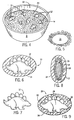
- an edible food 10 which in this case is in the shape of an egg or a small, smooth pebble.
- Edible food 10 is composed of an inner mass 12 and an outer mass 14 that contains and encases inner mass 12.
- inner mass 12 is in the shape of a dinosaur.
- FIG. 6 illustrates edible food 10 with a portion of outer mass 14 being removed to reveal the shape of inner mass 12.
- outer mass 14 is a solid material that completely encases inner mass 12.
- edible food 10 can be of any desired shape and size, in the illustrated embodiment it has a smooth pebble or egg shape, a length of about 0.5 inches, a height of about 0.387 inches and a thickness of about 0.25 inches and otherwise generally should be of sufficient size to provide a discernible shape to the unaided eye.
- Inner mass 12 may be composed of any of a wide variety of materials or combinations of materials as long as the composition of inner mass 12 is edible.
- inner mass 12 is composed of a substantially water dispersible solid edible mass 16 that is coated with non-dispersible in water solid edible inner and outer coatings 18 and 20, respectively.
- Dispersible in water solid mass 16 can be formed into a solid unitary mass by any suitable process known to those skilled in the art, such as by the well known process of tableting.
- dispersible in water solid mass 16 can be, in effect, a tablet of a desired shape and composition.
- the composition for solid mass 16 is formulated in granulated form and fed to the tableting machine where it is compressed into the desired shape.
- a rotary tablet press will be utilized in which a die corresponding to the desired shape is filled with the particulate material which forms the composition of mass 16. Thereafter, the granular material in the die is compressed for a length of time and under suitable pressure to cause the particulate material to bond together as a result of the compression. After the tablet has been formed, it is ejected from the die cavity.
- the substantially water dispersible solid edible mass 16 typically includes a base (which may be of any edible compressible material, such as sugar, starch, carboxymethylcellulose polyols and mixtures thereof), a dispersibility retardant limiting agent (such as powdered or liquid shortening, for example), a lubricant or mold release agent (such as calcium stearate or other stearate, for example) and optionally flavors and colors.
- a base which may be of any edible compressible material, such as sugar, starch, carboxymethylcellulose polyols and mixtures thereof
- a dispersibility retardant limiting agent such as powdered or liquid shortening, for example
- a lubricant or mold release agent such as calcium stearate or other stearate, for example
- Any suitable sugar can be utilized for the base, including dextrose (such as Endex available from Mendell Co., Cantab available from Penford Food Ingredients Co., and Royal T available from CPC Co., for example) and/or sucrose (such as Dipac available from Domino Sugar Co., for example). Coloring and flavoring materials can also be added to the mass 16, as can other materials, such as vitamins, as desired.
- dextrose such as Endex available from Mendell Co., Cantab available from Penford Food Ingredients Co., and Royal T available from CPC Co., for example
- sucrose such as Dipac available from Domino Sugar Co., for example
- Coloring and flavoring materials can also be added to the mass 16, as can other materials, such as vitamins, as desired.
- a typical composition will comprise about 85-95% base, about 2-12% dispersibility limiting or reducing agent (e.g., a shortening), and about 0.5-1% of a mold release agent and colors and/or flavors as desired.
- the base material can be produced by direct compression, wet agglomeration or dry slugging of the ingredients for the base.
- solid mass 16 After solid mass 16 is formed, it should be rendered at least relatively non-dispersible in the intended liquid medium where it will be in use.
- inner mass 12 when edible food 10 is intended for use in a hot cereal such as oatmeal, it is generally desired that inner mass 12 have resistance to dispersion in hot water for at least about 2 and preferably about 3-5 minutes or more at a constant temperature of about 180°F and about 3-10 minutes at a constant temperature of from about 140°F-150°F.
- Ordinary tablets composed of sugar, binder and lubricant generally will not possess such characteristics. Consequently, in accordance with one embodiment of the invention, a protective coating is applied over solid mass 16 to provide the desired degree of non-dispersibility. Any protective coating that provides the desired degree of non-dispersibility can be used as long as it is food compatible and otherwise compatible with the materials of edible food 10.
- solid mass 16 has two coatings, first or inner coating 18 composed of a wax and second or outer coating 20 composed of a confectioner's glaze.
- inner coating 18 is comprised of beeswax (which can be bleached beeswax) and carnauba wax, such as about 50% beeswax and about 50% carnauba wax mixture on a weight basis.
- the wax can be applied to form inner coating 18 by any suitable process, such as by spraying the wax (usually in the presence of a solvent for the wax) or by tumbling solid mass tablets 16 in dry or liquid wax.
- a suitable solvent for beeswax and carnauba wax is ethyl alcohol.
- the thickness of the wax coating is in the range of from about 0.001 to about 0.05 millimeters.
- outer coating 20 of confectioner's glaze is applied.
- the confectioner's glaze can be applied by any suitable method known to those skilled in the art including spraying, dipping, brushing or any other suitable technique. Usually, the confectioner's glaze will be present in alcohol solution. Several coatings of the confectioner's glaze can be applied, as desired.
- Each of coatings 18 and 20 should be continuous coatings and generally coating 20 should be allowed to sufficiently cure to form a coating more resistant to dispersion prior to application of outer mass 14.
- inner coating 18 should preferably be alcohol impermeable when an alcohol solvent is used in the application of the confectioner's glaze to form outer coating 20 (or otherwise impermeable to the coating and/or solvent used to apply a second coating, if present).
- outer mass 14 provides an aqueous dispersible coating that contains and encases inner mass 12.
- Outer mass 14 is in effect a relatively thick coating that is dispersible in the desired liquid, such as an aqueous liquid (such as water, milk, oatmeal or other foods that are aqueous based).
- an aqueous liquid such as water, milk, oatmeal or other foods that are aqueous based.
- outer mass 14 disperses above about 150°F after an exposure time between about 10 seconds and 30 seconds.
- outer mass 14 is sufficiently thick so that the shape, color and/or size of inner mass 12 cannot be discerned by inspecting the shape of outer mass 14.
- water dispersible outer mass 14 is composed of edible fat and sugar, with the fat having a melting point that is in the desired dispersion temperature range for outer mass 14.
- the fat contained in the outer water dispersible solid edible mass will typically have a melting point in the range of about 112°F to about 150°F.
- Typical fats include cocoa butter, coconut oil, partially hydrogenated vegetable oils, such as palm, soybean, cottonseed and mixtures thereof, for example.
- Preferred fats include partially hydrogenated vegetable oils, such as palm, soybean, cottonseed and mixtures thereof.
- outer mass 14 disperses into the aqueous medium revealing inner mass 12 which has a different shape and/or color from the shape of outer mass 14 prior to dispersion.
- dispersion occurs by melting.
- the composition of outer mass 14 is composed of from about 25-60% edible fat and from about 75-40% sugar and more preferably from about 40-60% edible fat and from about 60-40% sugar and more preferably about 50% edible fat and about 50% sugar, all on a weight basis.
- the composition of outer mass 14 may also contain small amounts of soy lecithin and vanillin or other flavors, as desired.
- the edible fat, or combination of two or more fats is chosen to provide a desired melting point temperature or temperature range which in turn determines the temperature or temperature range at which dispersion occurs, which in this embodiment is by melting. Since outer mass 14 is relatively thick, the dispersion can desirably occur over a period of time (for example, about 3 seconds to about 3 minutes) during which the consumer interacts with the food, such as by observing and/or stirring the food, for example.
- Outer mass 14 can be formed over inner mass 12 by any suitable method.
- One particularly preferred method is by panning with fat and sugar, which is sometimes referred to herein as “fat panning.”
- Panning is a process that is well known in the food art in the form of “soft panning”.
- Soft panning involves the alternating application of sugars and corn syrup to an inner material that is to be coated as they are tumbled in a revolving pan.
- Soft panning is often used to prepare jelly beans.
- the fat panning of the present invention is accomplished by the alternating application of an adhesive liquid (here composed of edible fat and sugar, for example) and dry sugar to the inner material that is to be coated as they are tumbled in a revolving pan.
- an adhesive liquid here composed of edible fat and sugar, for example
- a typical fat panning adhesive as used herein has a composition by weight of from about 40-60% fat and from about 60-40% sugar.
- the fat panning adhesive of the present invention may comprise from 0 to about 60% fat, from about 60-40% sugar and from 0 to about 40% carbohydrates, adhesive syrup or other adhesive syrup such as corn syrup, polyol syrup or gums.
- adhesive syrup or other adhesive syrup such as corn syrup, polyol syrup or gums.
- repeated application of adhesive and sugar builds up uniform coatings of desired thickness around the inner mass. Flavor and color ingredients can be added during the coating operation, as desired.
- the most commonly used sugar for the fat panning process is a fine or extra fine granulated, with a particle size of from about 0.2 mm to about 0.4 mm.
- the adhesive used in accordance with the present invention for outer mass 14 for dispersion in a hot aqueous medium is composed of fat and sugar. After fat panning, outer mass 14 of edible food 10 could be fonned into a desired shape, such as by pressing in a die, for example.
- a coating composed of sugar can be utilized for outer mass 14 that is dispersible in a cold aqueous liquid, such as cold water or milk.
- a coating composed of sugar can be utilized.
- the sugar will have a softening or dispersing agent incorporated therein to promote or retard dispersion into the cold fluid, such as swelling agents, which may be fibrous in nature, modified starches that swell in water or combinations of materials having differing degrees of solubility in water, such as sucrose and lactose, maltodextrin and dextrose, maltodextrin and sucrose, crystalline fructose and dry sucrose, for example.
- a solid material that evolves carbon dioxide in water in the presence of an acid, such as sodium bicarbonate and a food compatible acid, such as citric acid could be used in combination which would react chemically in water to evolve carbon dioxide and cause the outer mass to disperse.
- an acid such as sodium bicarbonate
- a food compatible acid such as citric acid
- the outer mass does not melt, but rather disperses or dissolves, for example.
- Other edible materials that disperse to reveal inner mass 12 at a desired temperature can also be used, such as protein, starch, fiber or combinations thereof.
- Inner mass 12 pieces in the shape of adult dinosaur tablets as depicted in FIG. 7 were formed from the following components.
- Ingredient Weight in Grams Weight Percent Dextrose 4830.00 88.91 High stable vegetable oil (AOI 500) melting point of about 141° to about 147°F 50.00 0.96 Calcium Stearate (release agent) 50.00 0.96 Colorants and Flavors 17.50 0.34 Powdered shortening (retards dispersion) 250.00 4.80 50/50 beeswax/carnauba wax (for coating 18) 10.00 0.19 Confectioner's Glaze (3.2 pounds of glaze resin per gallon of solution) (for coating 20) 200.00 3.84 5407.50 100.00
- AOI 500 High stable vegetable oil melting point of about 141° to about 147°F 50.00 0.96 Calcium Stearate (release agent) 50.00 0.96 Colorants and Flavors 17.50 0.34 Powdered shortening (retards dispersion) 250.00 4.80 50/50 beeswax/carnauba wax (for coating
- the finished tablets have a weight of about 0.16 to 0.18 grams each, a size of about 0.30-0.31 inches (height) x about 0.50 inches (length) x about 0.120-0.135 inches (thickness) and resistance to dispersion of from about 3-5 minutes in water at 180°F.
- An adhesive fat panning composition was formed from the following ingredients.
- the fat panning adhesive was formed by the following procedure.
- Another fat panning adhesive was formed having the following formula: Ingredient Weight Percent KLX (Vegetable fat) 47% 17 Stearine (Vegetable fat) 3% 6X Powdered Sugar 49.5501 Lecithin .2500 Colorants and Flavors 0.20
- Example 2 Into a rotating pan is added 300 pounds of adult dinosaur tablets from Example 1. During rotation of the pan, an initial charge of 16 pounds of the fat panning adhesive from Example 2 is added by spraying the fat panning adhesive at a temperature of about 130°F into the rotating pan. The pan continues to rotate and when the dinosaur tablets become sticky, an initial dry charge of 16 pounds of baker's sugar is added and the pan rotation continues. When the dry sugar charge is essentially fully absorbed by the dinosaur tablet/panned coating, that fat panning cycle is completed.
- the cycle consisting of spray of fat panning adhesive, pan rotation until tablets become sticky and dry charge of baker's sugar and continued pan rotation is repeated for a total of 20-30 cycles, whereupon the edible food pieces 10 are removed for cooling and subsequent packaging for eventual incorporation into a desired food product.
- the finished pieces have a weight of about 0.6 grams each and dimensions of about 0.5 inches in length, about 0.387 inches in height and about 0.25 inches in thickness.
- the edible food pieces 10 should not be subjected to temperatures which cause a deleteriously effect (e.g., high temperature, such as above about 120°F, for example.)
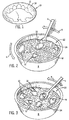
- a cereal bowl B contains a quantity of hot oatmeal cereal 22.
- Pieces of edible food 10 have been previously added to dry oatmeal.
- Hot oatmeal cereal 22 is composed of oatmeal cereal 24 which may contain sugar, flavors and additives as desired and a plurality of edible food pieces 10 in a weight ratio of edible food 10 to oatmeal of about 1:5.
- hot water W at a temperature of about 200°F has just been added to bowl B of oatmeal 22 while in dry form.
- the water when added should be at an elevated temperature above the dispersion temperature of pieces 10 since the water will begin to cool when added to bowl B absent additional heat. Since the water has just been added to oatmeal 22, edible food pieces 10 have just begun to dissolve.
- a consumer using a spoon S interacts with oatmeal 22 by mixing it gently with spoon S in the direction of arrow R to be able to periodically view edible food pieces 10, some of which are beneath the surface of the oatmeal and consequently not always visible.
- Edible food pieces 10 begin dispersing upon contact with hot water W above the dispersion temperature in bowl B. As illustrated in FIG. 3, after about 30 seconds outer mass 14 of edible food pieces 10 have partially dissolved sufficiently to reveal portions of inner mass 12, which is of an adult dinosaur shape.
- outer mass 14 Upon the passage of further time, outer mass 14 has substantially completely dispersed, thereby simulating hatching and revealing the entire inner mass 12 of each edible food piece 10 as shown in FIG. 4.
- FIG. 9 illustrates an alternative embodiment in accordance with the invention.
- an edible food additive 26 which is composed of an inner mass in the shape of an adult dinosaur.
- Inner mass 28 is similar in composition to inner mass 12 and includes coatings similar to coatings 18 and 20, previously described.
- Edible food additive 26 also includes an outer mass 30, which is modified from outer mass 14, previously described with respect to FIGS. 1 and 6.
- Outer mass 30 is water dispersible in water of about 90°F or less.
- outer mass 30 could be dispersible in relatively cold aqueous fluids, such as cold milk or cold water in liquid form.
- Suitable materials for producing an aqueous fluid dispersible outer mass 30 that disperse in aqueous fluid temperatures of about 90°F or less include those as previously described with respect to outer mass 14.
- Outer mass 30 further includes a plurality of discrete particles 32 that are embedded within outer mass 30 preferably relatively close to inner mass 28 and spaced from the surface 34 of outer mass 30 and preferably only located beneath surface 34.
- Discrete particles 32 are composed of relatively small edible granules ofsolid material (which may be sugar, for example), entrained with carbon dioxide gas under super atmospheric pressure.
- an aqueous fluid such as water or milk, for example
- the gas retained inside the carbon dioxide in outer mass 30 is released, causing a crackling sound and thereby imitating the sound of an egg cracking, thereby further adding to the animation effect.
- carbon dioxide gas entrained sugar granules are available from Zeta Espacial S.A. of Barcelona, Spain.
- discrete particles Preferably, discrete particles have a particle size in the range of from about 0.5 to 4.5 mm.
- outer mass 30 can be as previously described with respect to FIGS. 1, 6 or 9 with the addition of a material that evolves carbon dioxide upon contact with water and an acid.
- a material that evolves carbon dioxide upon contact with water and an acid For example, sodium bicarbonate and a food compatible acid, such as citric acid, may be incorporated into outer mass 14 or 30.
- such material may be located at, near or only below the surface of outer mass 14 or 30. The location of such material within outer mass 14 and 13 can be controlled during the fat panning process, for example, by including such material during the dry charging of the fat panning process.
Landscapes
- Life Sciences & Earth Sciences (AREA)
- Chemical & Material Sciences (AREA)
- Engineering & Computer Science (AREA)
- Food Science & Technology (AREA)
- Polymers & Plastics (AREA)
- Health & Medical Sciences (AREA)
- Nutrition Science (AREA)
- Confectionery (AREA)
- General Preparation And Processing Of Foods (AREA)
- Bakery Products And Manufacturing Methods Therefor (AREA)
- Pharmaceuticals Containing Other Organic And Inorganic Compounds (AREA)
Applications Claiming Priority (2)
| Application Number | Priority Date | Filing Date | Title |
|---|---|---|---|
| US09/108,513 US6159511A (en) | 1998-07-01 | 1998-07-01 | Animated food product |
| US108513 | 1998-07-01 |
Publications (2)
| Publication Number | Publication Date |
|---|---|
| EP0968657A1 true EP0968657A1 (de) | 2000-01-05 |
| EP0968657B1 EP0968657B1 (de) | 2005-09-28 |
Family
ID=22322635
Family Applications (1)
| Application Number | Title | Priority Date | Filing Date |
|---|---|---|---|
| EP99305234A Expired - Lifetime EP0968657B1 (de) | 1998-07-01 | 1999-07-01 | Lebendig gestaltete Nahrungsmittel, Lebensmittelszusatz und Verfahren |
Country Status (9)
| Country | Link |
|---|---|
| US (2) | US6159511A (de) |
| EP (1) | EP0968657B1 (de) |
| CN (1) | CN1309320C (de) |
| AT (1) | ATE305226T1 (de) |
| AU (1) | AU761658B2 (de) |
| BR (1) | BR9903494A (de) |
| CA (1) | CA2265203C (de) |
| DE (1) | DE69927436D1 (de) |
| IT (1) | IT1307049B1 (de) |
Cited By (2)
| Publication number | Priority date | Publication date | Assignee | Title |
|---|---|---|---|---|
| FR2803720A1 (fr) * | 2000-01-18 | 2001-07-20 | Roquette Freres | Lozenges a base de dextrose et leur procede de fabrication |
| CN102940202A (zh) * | 2012-11-27 | 2013-02-27 | 哈尔滨派特纳生物科技开发有限公司 | 一种绿茶玉米片及其制作方法 |
Families Citing this family (34)
| Publication number | Priority date | Publication date | Assignee | Title |
|---|---|---|---|---|
| US20040213877A1 (en) * | 2002-05-22 | 2004-10-28 | Anthony Badalucca | Educational systems and methods utilizing edible body parts and associated information cards |
| US20040062836A1 (en) * | 2002-09-27 | 2004-04-01 | Barba Jason A. | Anatomically correct candy novelty |
| ATE377956T1 (de) * | 2002-11-06 | 2007-11-15 | Nestec Sa | Frühstückszerealien |
| US20040131743A1 (en) * | 2003-01-06 | 2004-07-08 | Diran Ajao | Quickly dissolving aerated confections and methods of preparation |
| US20060003055A1 (en) * | 2003-06-09 | 2006-01-05 | Witkowski Daniel D | Edible novelty products and methods |
| SI1721528T1 (sl) * | 2005-05-13 | 2008-08-31 | Barilla Flli G & R | Piškotu podoben slaščičarski prehrambeni izdelek ter postopek in naprava za izdelavo le-tega |
| US7648722B2 (en) * | 2005-11-15 | 2010-01-19 | The Quaker Oats Company | Color-changing cereal and method |
| US8029835B2 (en) * | 2006-09-28 | 2011-10-04 | The Quaker Oats Company, Inc. | Grain-based food product with powder coating |
| US20080268132A1 (en) * | 2007-04-24 | 2008-10-30 | The Quaker Oats Company | Effervescent food products |
| USD563626S1 (en) * | 2007-05-11 | 2008-03-11 | Kellogg Company | Giraffe design for food products |
| CN102919711A (zh) * | 2012-11-27 | 2013-02-13 | 哈尔滨派特纳生物科技开发有限公司 | 一种黑加仑玉米片及其制作方法 |
| CN102940203A (zh) * | 2012-11-27 | 2013-02-27 | 哈尔滨派特纳生物科技开发有限公司 | 一种巧克力玉米片及其制作方法 |
| CN102919701A (zh) * | 2012-11-27 | 2013-02-13 | 哈尔滨派特纳生物科技开发有限公司 | 一种山楂玉米片及其制作方法 |
| CN102919717A (zh) * | 2012-11-27 | 2013-02-13 | 哈尔滨派特纳生物科技开发有限公司 | 一种香蕉玉米片及其制作方法 |
| CN102919698A (zh) * | 2012-11-27 | 2013-02-13 | 哈尔滨派特纳生物科技开发有限公司 | 一种猕猴桃玉米片及其制作方法 |
| CN102919723A (zh) * | 2012-11-27 | 2013-02-13 | 哈尔滨派特纳生物科技开发有限公司 | 一种葡萄玉米片及其制作方法 |
| CN102919706A (zh) * | 2012-11-27 | 2013-02-13 | 哈尔滨派特纳生物科技开发有限公司 | 一种苹果玉米片及其制作方法 |
| CN102919708A (zh) * | 2012-11-27 | 2013-02-13 | 哈尔滨派特纳生物科技开发有限公司 | 一种红茶玉米片及其制作方法 |
| CN102919712A (zh) * | 2012-11-27 | 2013-02-13 | 哈尔滨派特纳生物科技开发有限公司 | 一种芒果玉米片及其制作方法 |
| CN102919705A (zh) * | 2012-11-27 | 2013-02-13 | 哈尔滨派特纳生物科技开发有限公司 | 一种椰子玉米片及其制作方法 |
| CN102919707A (zh) * | 2012-11-27 | 2013-02-13 | 哈尔滨派特纳生物科技开发有限公司 | 一种水蜜桃玉米片及其制作方法 |
| CN102919700A (zh) * | 2012-11-27 | 2013-02-13 | 哈尔滨派特纳生物科技开发有限公司 | 一种苦瓜玉米片及其制作方法 |
| CN102919715A (zh) * | 2012-11-27 | 2013-02-13 | 哈尔滨派特纳生物科技开发有限公司 | 一种胡萝卜玉米片及其制作方法 |
| CN102919720A (zh) * | 2012-11-27 | 2013-02-13 | 哈尔滨派特纳生物科技开发有限公司 | 一种红豆玉米片及其制作方法 |
| CN102919722A (zh) * | 2012-11-27 | 2013-02-13 | 哈尔滨派特纳生物科技开发有限公司 | 一种咖啡玉米片及其制作方法 |
| CN102919703A (zh) * | 2012-11-27 | 2013-02-13 | 哈尔滨派特纳生物科技开发有限公司 | 一种红枣玉米片及其制作方法 |
| CN102919704A (zh) * | 2012-11-27 | 2013-02-13 | 哈尔滨派特纳生物科技开发有限公司 | 一种菠菜玉米片及其制作方法 |
| CN102919713A (zh) * | 2012-11-27 | 2013-02-13 | 哈尔滨派特纳生物科技开发有限公司 | 一种芹菜玉米片及其制作方法 |
| CN102919695A (zh) * | 2012-11-27 | 2013-02-13 | 哈尔滨派特纳生物科技开发有限公司 | 一种黄瓜玉米片及其制作方法 |
| CN102919696A (zh) * | 2012-11-27 | 2013-02-13 | 哈尔滨派特纳生物科技开发有限公司 | 一种木瓜玉米片及其制作方法 |
| CN103478813B (zh) * | 2013-09-05 | 2015-12-02 | 孔赟荣 | 五彩瓜果汁饮料的制备方法 |
| CN103504404A (zh) * | 2013-09-05 | 2014-01-15 | 孔赟荣 | 赤橙黄绿青蓝紫七彩瓜果蔬菜汁饮料的制备方法 |
| CN103610161A (zh) * | 2013-09-05 | 2014-03-05 | 孔赟荣 | 在透明玻璃杯中同时显示红黄绿三种天然颜色的瓜汁饮料的制备方法 |
| KR101698100B1 (ko) * | 2014-11-27 | 2017-01-19 | 엘지전자 주식회사 | 리니어 압축기의 제어 장치, 이를 포함한 압축기 및 제어 방법 |
Citations (5)
| Publication number | Priority date | Publication date | Assignee | Title |
|---|---|---|---|---|
| GB416970A (en) * | 1934-05-16 | 1934-09-25 | Geo Bassett & Company Ltd | Improvements in or relating to the manufacture of sweetmeats |
| GB1596765A (en) * | 1978-02-21 | 1981-08-26 | Cadbury Ltd | Confectionery article and method of manufacturing same |
| GB2306290A (en) * | 1995-10-31 | 1997-05-07 | Nestle Sa | Confectionery containing chocolate shapes |
| WO1997019604A1 (en) * | 1995-11-30 | 1997-06-05 | Societe Des Produits Nestle S.A. | Food product comprising an edible and freely movable article in a hollow body and apparatus for the production thereof |
| EP0781510A1 (de) * | 1995-10-31 | 1997-07-02 | Societe Des Produits Nestle S.A. | Geformten schokoladenpartikelnzur dispersion in oder verteilung auf konfekwaren |
Family Cites Families (18)
| Publication number | Priority date | Publication date | Assignee | Title |
|---|---|---|---|---|
| US3867556A (en) * | 1972-12-21 | 1975-02-18 | Procter & Gamble | Fats with encapsulated flavors |
| US3922354A (en) * | 1973-08-20 | 1975-11-25 | Norda Inc | Production of artificial spice particles |
| US4428927A (en) * | 1981-05-11 | 1984-01-31 | R. P. Scherer Corporation | Masticatory soft elastic gelatin capsules and method for the manufacture thereof |
| US4515769A (en) * | 1981-12-01 | 1985-05-07 | Borden, Inc. | Encapsulated flavorant material, method for its preparation, and food and other compositions incorporating same |
| US4568560A (en) * | 1984-03-16 | 1986-02-04 | Warner-Lambert Company | Encapsulated fragrances and flavors and process therefor |
| US4804548A (en) * | 1984-10-05 | 1989-02-14 | Warner-Lambert Company | Novel sweetener delivery systems |
| US4981698A (en) * | 1986-12-23 | 1991-01-01 | Warner-Lambert Co. | Multiple encapsulated sweetener delivery system and method of preparation |
| US4975270A (en) * | 1987-04-21 | 1990-12-04 | Nabisco Brands, Inc. | Elastomer encased active ingredients |
| US4853235A (en) * | 1987-09-16 | 1989-08-01 | The Quaker Oats Company | Color-changing cereals and confections |
| US5064650A (en) * | 1988-04-19 | 1991-11-12 | Southwest Research Institute | Controlled-release salt sensitive capsule for oral use and adhesive system |
| US5510130A (en) * | 1991-08-16 | 1996-04-23 | The Quaker Oats Company | Ready-to-eat cereal flakes and process for making same |
| US5607708A (en) * | 1992-12-14 | 1997-03-04 | Hunt-Wesson, Inc. | Encapsulated volatile flavoring materials |
| CN1038468C (zh) * | 1995-04-06 | 1998-05-27 | 老延智 | 巧克力糖葫芦 |
| US5622739A (en) * | 1995-06-06 | 1997-04-22 | K.E.S. Associates | Feed block with improved mineral delivery |
| US5743404A (en) * | 1996-03-21 | 1998-04-28 | Melashenko; Connie | Coated container |
| US6245366B1 (en) * | 1996-10-25 | 2001-06-12 | Mccormick & Company, Inc. | Fat-coated encapsulation compositions and method for preparing the same |
| US5804235A (en) * | 1996-12-26 | 1998-09-08 | Altschul Randice L | Edible toy figures constructed of breakfast cereal |
| US5792496A (en) * | 1997-01-10 | 1998-08-11 | Fekete; Ferenc | Edible shell/thermoplastic container system |
-
1998
- 1998-07-01 US US09/108,513 patent/US6159511A/en not_active Expired - Lifetime
-
1999
- 1999-03-10 CA CA002265203A patent/CA2265203C/en not_active Expired - Lifetime
- 1999-06-30 AU AU36886/99A patent/AU761658B2/en not_active Ceased
- 1999-06-30 CN CNB991109724A patent/CN1309320C/zh not_active Expired - Fee Related
- 1999-06-30 IT IT1999TO000560A patent/IT1307049B1/it active
- 1999-07-01 EP EP99305234A patent/EP0968657B1/de not_active Expired - Lifetime
- 1999-07-01 AT AT99305234T patent/ATE305226T1/de not_active IP Right Cessation
- 1999-07-01 DE DE69927436T patent/DE69927436D1/de not_active Expired - Lifetime
- 1999-07-01 BR BR9903494-8A patent/BR9903494A/pt not_active IP Right Cessation
- 1999-12-22 US US09/469,918 patent/US6270818B1/en not_active Expired - Lifetime
Patent Citations (5)
| Publication number | Priority date | Publication date | Assignee | Title |
|---|---|---|---|---|
| GB416970A (en) * | 1934-05-16 | 1934-09-25 | Geo Bassett & Company Ltd | Improvements in or relating to the manufacture of sweetmeats |
| GB1596765A (en) * | 1978-02-21 | 1981-08-26 | Cadbury Ltd | Confectionery article and method of manufacturing same |
| GB2306290A (en) * | 1995-10-31 | 1997-05-07 | Nestle Sa | Confectionery containing chocolate shapes |
| EP0781510A1 (de) * | 1995-10-31 | 1997-07-02 | Societe Des Produits Nestle S.A. | Geformten schokoladenpartikelnzur dispersion in oder verteilung auf konfekwaren |
| WO1997019604A1 (en) * | 1995-11-30 | 1997-06-05 | Societe Des Produits Nestle S.A. | Food product comprising an edible and freely movable article in a hollow body and apparatus for the production thereof |
Cited By (4)
| Publication number | Priority date | Publication date | Assignee | Title |
|---|---|---|---|---|
| FR2803720A1 (fr) * | 2000-01-18 | 2001-07-20 | Roquette Freres | Lozenges a base de dextrose et leur procede de fabrication |
| EP1118270A1 (de) * | 2000-01-18 | 2001-07-25 | Roquette Frˬres | Dextrose enthaltende Pastillen und Verfahren zur Herstellung |
| US6572886B2 (en) | 2000-01-18 | 2003-06-03 | Roquette Freres | Dextrose-based lozenges and process for their manufacture |
| CN102940202A (zh) * | 2012-11-27 | 2013-02-27 | 哈尔滨派特纳生物科技开发有限公司 | 一种绿茶玉米片及其制作方法 |
Also Published As
| Publication number | Publication date |
|---|---|
| CN1309320C (zh) | 2007-04-11 |
| CA2265203A1 (en) | 2000-01-01 |
| IT1307049B1 (it) | 2001-10-23 |
| US6270818B1 (en) | 2001-08-07 |
| EP0968657B1 (de) | 2005-09-28 |
| CA2265203C (en) | 2004-10-26 |
| AU3688699A (en) | 2000-01-20 |
| DE69927436D1 (de) | 2006-02-09 |
| ITTO990560A1 (it) | 2000-12-30 |
| US6159511A (en) | 2000-12-12 |
| CN1242169A (zh) | 2000-01-26 |
| ATE305226T1 (de) | 2005-10-15 |
| AU761658B2 (en) | 2003-06-05 |
| BR9903494A (pt) | 2001-11-20 |
Similar Documents
| Publication | Publication Date | Title |
|---|---|---|
| US6159511A (en) | Animated food product | |
| CA2019987C (en) | Process of preparing cereal-coated dried fruit | |
| EP1143811B1 (de) | Körnerförmiges nahrungsmittel | |
| US5718931A (en) | Fabricated fruit pieces and method of preparation | |
| US6495179B1 (en) | Appearance modified aerated confection and method of preparation | |
| US20030077362A1 (en) | Encapsulated flavors as inclusion in candy confections | |
| US20030161914A1 (en) | Novel caramel food ingredients, processes for the manufacture thereof, and nutritional procucts containing these caramels | |
| JP2007111049A (ja) | 低カロリー食品バー | |
| CA2664877C (en) | Grain-based food product with powder coating | |
| EP1447011B1 (de) | Frühstückszerealien | |
| US20060188644A1 (en) | Novel caramel food ingredients, processes for the manufacture thereof, and nutritional products containing these caramels | |
| US3872229A (en) | Food composition having a nut-like texture and method for producing the same | |
| US20070237873A1 (en) | Jelly candy having electrolytes | |
| US2279203A (en) | Ice cream mixture | |
| KR102942523B1 (ko) | 착색 탄수화물 입자를 갖는 투명하게 코팅된 츄잉껌의 제조방법 | |
| JPH09191829A (ja) | マシュマロおよびその製造方法 | |
| JPH0587214B2 (de) | ||
| MXPA99006002A (en) | Animated food, additive for food and met | |
| CA3070927C (en) | Dried, toasted marbits and method of preparing the same | |
| JPH0529037Y2 (de) | ||
| JPH04127186U (ja) | 組み合わせ菓子 |
Legal Events
| Date | Code | Title | Description |
|---|---|---|---|
| PUAI | Public reference made under article 153(3) epc to a published international application that has entered the european phase |
Free format text: ORIGINAL CODE: 0009012 |
|
| AK | Designated contracting states |
Kind code of ref document: A1 Designated state(s): AT BE CH CY DE DK ES FI FR GB GR IE IT LI LU MC NL PT SE |
|
| AX | Request for extension of the european patent |
Free format text: AL;LT;LV;MK;RO;SI |
|
| 17P | Request for examination filed |
Effective date: 20000308 |
|
| AKX | Designation fees paid |
Free format text: AT BE CH CY DE DK ES FI FR GB GR IE IT LI LU MC NL PT SE |
|
| 17Q | First examination report despatched |
Effective date: 20030604 |
|
| GRAP | Despatch of communication of intention to grant a patent |
Free format text: ORIGINAL CODE: EPIDOSNIGR1 |
|
| GRAS | Grant fee paid |
Free format text: ORIGINAL CODE: EPIDOSNIGR3 |
|
| GRAA | (expected) grant |
Free format text: ORIGINAL CODE: 0009210 |
|
| AK | Designated contracting states |
Kind code of ref document: B1 Designated state(s): AT BE CH CY DE DK ES FI FR GB GR IE IT LI LU MC NL PT SE |
|
| PG25 | Lapsed in a contracting state [announced via postgrant information from national office to epo] |
Ref country code: NL Free format text: LAPSE BECAUSE OF FAILURE TO SUBMIT A TRANSLATION OF THE DESCRIPTION OR TO PAY THE FEE WITHIN THE PRESCRIBED TIME-LIMIT Effective date: 20050928 Ref country code: LI Free format text: LAPSE BECAUSE OF FAILURE TO SUBMIT A TRANSLATION OF THE DESCRIPTION OR TO PAY THE FEE WITHIN THE PRESCRIBED TIME-LIMIT Effective date: 20050928 Ref country code: IT Free format text: LAPSE BECAUSE OF FAILURE TO SUBMIT A TRANSLATION OF THE DESCRIPTION OR TO PAY THE FEE WITHIN THE PRESCRIBED TIME-LIMIT;WARNING: LAPSES OF ITALIAN PATENTS WITH EFFECTIVE DATE BEFORE 2007 MAY HAVE OCCURRED AT ANY TIME BEFORE 2007. THE CORRECT EFFECTIVE DATE MAY BE DIFFERENT FROM THE ONE RECORDED. Effective date: 20050928 Ref country code: FI Free format text: LAPSE BECAUSE OF FAILURE TO SUBMIT A TRANSLATION OF THE DESCRIPTION OR TO PAY THE FEE WITHIN THE PRESCRIBED TIME-LIMIT Effective date: 20050928 Ref country code: CH Free format text: LAPSE BECAUSE OF FAILURE TO SUBMIT A TRANSLATION OF THE DESCRIPTION OR TO PAY THE FEE WITHIN THE PRESCRIBED TIME-LIMIT Effective date: 20050928 Ref country code: BE Free format text: LAPSE BECAUSE OF FAILURE TO SUBMIT A TRANSLATION OF THE DESCRIPTION OR TO PAY THE FEE WITHIN THE PRESCRIBED TIME-LIMIT Effective date: 20050928 Ref country code: AT Free format text: LAPSE BECAUSE OF FAILURE TO SUBMIT A TRANSLATION OF THE DESCRIPTION OR TO PAY THE FEE WITHIN THE PRESCRIBED TIME-LIMIT Effective date: 20050928 |
|
| REG | Reference to a national code |
Ref country code: GB Ref legal event code: FG4D |
|
| REG | Reference to a national code |
Ref country code: CH Ref legal event code: EP |
|
| REG | Reference to a national code |
Ref country code: IE Ref legal event code: FG4D |
|
| PG25 | Lapsed in a contracting state [announced via postgrant information from national office to epo] |
Ref country code: SE Free format text: LAPSE BECAUSE OF FAILURE TO SUBMIT A TRANSLATION OF THE DESCRIPTION OR TO PAY THE FEE WITHIN THE PRESCRIBED TIME-LIMIT Effective date: 20051228 Ref country code: GR Free format text: LAPSE BECAUSE OF FAILURE TO SUBMIT A TRANSLATION OF THE DESCRIPTION OR TO PAY THE FEE WITHIN THE PRESCRIBED TIME-LIMIT Effective date: 20051228 Ref country code: DK Free format text: LAPSE BECAUSE OF FAILURE TO SUBMIT A TRANSLATION OF THE DESCRIPTION OR TO PAY THE FEE WITHIN THE PRESCRIBED TIME-LIMIT Effective date: 20051228 |
|
| PG25 | Lapsed in a contracting state [announced via postgrant information from national office to epo] |
Ref country code: DE Free format text: LAPSE BECAUSE OF FAILURE TO SUBMIT A TRANSLATION OF THE DESCRIPTION OR TO PAY THE FEE WITHIN THE PRESCRIBED TIME-LIMIT Effective date: 20051229 |
|
| PG25 | Lapsed in a contracting state [announced via postgrant information from national office to epo] |
Ref country code: ES Free format text: LAPSE BECAUSE OF FAILURE TO SUBMIT A TRANSLATION OF THE DESCRIPTION OR TO PAY THE FEE WITHIN THE PRESCRIBED TIME-LIMIT Effective date: 20060108 |
|
| REF | Corresponds to: |
Ref document number: 69927436 Country of ref document: DE Date of ref document: 20060209 Kind code of ref document: P |
|
| PG25 | Lapsed in a contracting state [announced via postgrant information from national office to epo] |
Ref country code: PT Free format text: LAPSE BECAUSE OF FAILURE TO SUBMIT A TRANSLATION OF THE DESCRIPTION OR TO PAY THE FEE WITHIN THE PRESCRIBED TIME-LIMIT Effective date: 20060228 |
|
| NLV1 | Nl: lapsed or annulled due to failure to fulfill the requirements of art. 29p and 29m of the patents act | ||
| REG | Reference to a national code |
Ref country code: CH Ref legal event code: PL |
|
| PGFP | Annual fee paid to national office [announced via postgrant information from national office to epo] |
Ref country code: FR Payment date: 20060717 Year of fee payment: 8 |
|
| PGFP | Annual fee paid to national office [announced via postgrant information from national office to epo] |
Ref country code: IE Payment date: 20060726 Year of fee payment: 8 Ref country code: GB Payment date: 20060726 Year of fee payment: 8 |
|
| PLBE | No opposition filed within time limit |
Free format text: ORIGINAL CODE: 0009261 |
|
| STAA | Information on the status of an ep patent application or granted ep patent |
Free format text: STATUS: NO OPPOSITION FILED WITHIN TIME LIMIT |
|
| 26N | No opposition filed |
Effective date: 20060629 |
|
| EN | Fr: translation not filed | ||
| PG25 | Lapsed in a contracting state [announced via postgrant information from national office to epo] |
Ref country code: FR Free format text: LAPSE BECAUSE OF FAILURE TO SUBMIT A TRANSLATION OF THE DESCRIPTION OR TO PAY THE FEE WITHIN THE PRESCRIBED TIME-LIMIT Effective date: 20061124 |
|
| PGFP | Annual fee paid to national office [announced via postgrant information from national office to epo] |
Ref country code: MC Payment date: 20070620 Year of fee payment: 9 |
|
| PGFP | Annual fee paid to national office [announced via postgrant information from national office to epo] |
Ref country code: LU Payment date: 20070731 Year of fee payment: 9 |
|
| GBPC | Gb: european patent ceased through non-payment of renewal fee |
Effective date: 20070701 |
|
| REG | Reference to a national code |
Ref country code: IE Ref legal event code: MM4A |
|
| PG25 | Lapsed in a contracting state [announced via postgrant information from national office to epo] |
Ref country code: GB Free format text: LAPSE BECAUSE OF NON-PAYMENT OF DUE FEES Effective date: 20070701 |
|
| PG25 | Lapsed in a contracting state [announced via postgrant information from national office to epo] |
Ref country code: IE Free format text: LAPSE BECAUSE OF NON-PAYMENT OF DUE FEES Effective date: 20070702 |
|
| PG25 | Lapsed in a contracting state [announced via postgrant information from national office to epo] |
Ref country code: CY Free format text: LAPSE BECAUSE OF FAILURE TO SUBMIT A TRANSLATION OF THE DESCRIPTION OR TO PAY THE FEE WITHIN THE PRESCRIBED TIME-LIMIT Effective date: 20050928 |
|
| PG25 | Lapsed in a contracting state [announced via postgrant information from national office to epo] |
Ref country code: MC Free format text: LAPSE BECAUSE OF NON-PAYMENT OF DUE FEES Effective date: 20080731 |
|
| PG25 | Lapsed in a contracting state [announced via postgrant information from national office to epo] |
Ref country code: LU Free format text: LAPSE BECAUSE OF NON-PAYMENT OF DUE FEES Effective date: 20080701 |