EP0968817A2 - Feuille composite thermoformable - Google Patents
Feuille composite thermoformable Download PDFInfo
- Publication number
- EP0968817A2 EP0968817A2 EP99111880A EP99111880A EP0968817A2 EP 0968817 A2 EP0968817 A2 EP 0968817A2 EP 99111880 A EP99111880 A EP 99111880A EP 99111880 A EP99111880 A EP 99111880A EP 0968817 A2 EP0968817 A2 EP 0968817A2
- Authority
- EP
- European Patent Office
- Prior art keywords
- film
- cyclopentadienyl
- zirkondichlorid
- zirconium dichloride
- thickness
- Prior art date
- Legal status (The legal status is an assumption and is not a legal conclusion. Google has not performed a legal analysis and makes no representation as to the accuracy of the status listed.)
- Withdrawn
Links
Images



Classifications
-
- B—PERFORMING OPERATIONS; TRANSPORTING
- B32—LAYERED PRODUCTS
- B32B—LAYERED PRODUCTS, i.e. PRODUCTS BUILT-UP OF STRATA OF FLAT OR NON-FLAT, e.g. CELLULAR OR HONEYCOMB, FORM
- B32B27/00—Layered products comprising a layer of synthetic resin
- B32B27/32—Layered products comprising a layer of synthetic resin comprising polyolefins
-
- B—PERFORMING OPERATIONS; TRANSPORTING
- B32—LAYERED PRODUCTS
- B32B—LAYERED PRODUCTS, i.e. PRODUCTS BUILT-UP OF STRATA OF FLAT OR NON-FLAT, e.g. CELLULAR OR HONEYCOMB, FORM
- B32B27/00—Layered products comprising a layer of synthetic resin
- B32B27/06—Layered products comprising a layer of synthetic resin as the main or only constituent of a layer, which is next to another layer of the same or of a different material
- B32B27/08—Layered products comprising a layer of synthetic resin as the main or only constituent of a layer, which is next to another layer of the same or of a different material of synthetic resin
-
- B—PERFORMING OPERATIONS; TRANSPORTING
- B32—LAYERED PRODUCTS
- B32B—LAYERED PRODUCTS, i.e. PRODUCTS BUILT-UP OF STRATA OF FLAT OR NON-FLAT, e.g. CELLULAR OR HONEYCOMB, FORM
- B32B27/00—Layered products comprising a layer of synthetic resin
- B32B27/30—Layered products comprising a layer of synthetic resin comprising vinyl (co)polymers; comprising acrylic (co)polymers
- B32B27/304—Layered products comprising a layer of synthetic resin comprising vinyl (co)polymers; comprising acrylic (co)polymers comprising vinyl halide (co)polymers, e.g. PVC, PVDC, PVF, PVDF
-
- B—PERFORMING OPERATIONS; TRANSPORTING
- B32—LAYERED PRODUCTS
- B32B—LAYERED PRODUCTS, i.e. PRODUCTS BUILT-UP OF STRATA OF FLAT OR NON-FLAT, e.g. CELLULAR OR HONEYCOMB, FORM
- B32B7/00—Layered products characterised by the relation between layers; Layered products characterised by the relative orientation of features between layers, or by the relative values of a measurable parameter between layers, i.e. products comprising layers having different physical, chemical or physicochemical properties; Layered products characterised by the interconnection of layers
- B32B7/04—Interconnection of layers
- B32B7/12—Interconnection of layers using interposed adhesives or interposed materials with bonding properties
-
- B—PERFORMING OPERATIONS; TRANSPORTING
- B32—LAYERED PRODUCTS
- B32B—LAYERED PRODUCTS, i.e. PRODUCTS BUILT-UP OF STRATA OF FLAT OR NON-FLAT, e.g. CELLULAR OR HONEYCOMB, FORM
- B32B2327/00—Polyvinylhalogenides
- B32B2327/06—PVC, i.e. polyvinylchloride
-
- B—PERFORMING OPERATIONS; TRANSPORTING
- B32—LAYERED PRODUCTS
- B32B—LAYERED PRODUCTS, i.e. PRODUCTS BUILT-UP OF STRATA OF FLAT OR NON-FLAT, e.g. CELLULAR OR HONEYCOMB, FORM
- B32B2439/00—Containers; Receptacles
- B32B2439/80—Medical packaging
Definitions
- the present invention relates to a thermoformable composite film, a method for Production of a thermoformable composite film and its use as Packing material.
- Flexible films are used to manufacture packaging with high requirements under the influence of heat and pressure with mechanical stamp in case of over and / or Vacuum shaped like a bowl or bowl.
- the film first serves as protection of the filling material.
- the film must protect the contents from environmental influences.
- the foil must therefore have a high water vapor, gas and UV barrier.
- the film must have mechanical stability to protect the contents from physical influences protect and so as not to be damaged by the product itself. The contents may do not interfere with the release of the film's own components.
- the starting material for blister packaging is thermal deformable film. These are plastic films that are heated by heating be brought into a state in which they are relatively easy to use be deformed by pneumatic overpressure or vacuum or by stamp. With a suitable choice of molds, recesses (blisters) can be made in the Insert the foil (bottom foil) that corresponds to the shape of the object to be packaged can be adjusted. After this deformation step, the one to be packed Inserted the object into the blister. After filling the blister a cover film is applied to the bottom film, which the to be packed Includes item in its blister.
- PVC polyvinyl chloride
- uPP Disoriented polypropylene films
- the blister packaging offers automated packaging and presentation of the product protected in the blister, such as medicines in the form of tablets, capsules or similar the possibility of exposure to air humidity and oxygen significantly reduce and thus increase the storage times.
- the object of the present invention is to provide a composite film with high Barrier properties, very good deep-drawing behavior and good fat resistance and an economical and environmentally friendly process for their manufacture and to provide their use for the production of blister packs.
- thermoformable Composite film containing at least one film containing cycloolefin copolymer and thermoplastic PVC film laminated on at least one side.
- the film has a water vapor permeation of 0,0 0.05 g / m 2 d, a puncture resistance of 20 20 N and a thickness of 100 100 ⁇ m.
- the films suitable for the purposes of the invention contain at least one cycloolefin polymer selected from polymers containing 0.1-100% by weight, preferably 10-90% by weight, based on the total mass of the cycloolefin polymer, of polymerized units of at least one cyclic olefin of the formula I , II, II ', III, IV, V or VI wherein R 1 , R 2 , R 3 , R 4 , R 5 , R 6 , R 7 and R 8 are the same or different and a hydrogen atom or a C 1 -C 20 hydrocarbon radical, such as a linear or branched C 1 -C 8- alkyl radical, C 6 -C 18 -aryl radical, C 7 -C 20 -alkylenearyl radical, mean a cyclic or acyclic C 2 -C 20 alkenyl radical, or form a saturated, unsaturated or aromatic ring, where the same radicals R 1 to R 8 in the different formulas I to
- the cycloolefin copolymers can also be at least by ring-opening polymerization one of the monomers with the formulas I to VI and subsequent hydrogenation of the obtained products can be obtained.
- the elastomeric cycloolefin copolymer according to the invention can contain 0 to 45 mol%, based on the total composition of the cycloolefin copolymer, of polymerized units which are derived from one or more monocyclic olefins of the formula VIII where my number is from 2 to 10.
- the proportion of polymerized units derived from cyclic, in particular polycyclic olefins is preferably 3 to 75 mol% based on the overall composition of the cycloolefin copolymer.
- the share of polymerized units derived from acyclic olefins is preferred 5 to 80 mol% based on the total composition of the cycloolefin copolymer.
- the cycloolefin copolymers preferably consist of polymerized units which are derived from one or more polycyclic olefins, in particular polycyclic olefins of the formulas I or III, and polymerized units which are derived from one or more acyclic olefins of the formula VII, in particular ⁇ -olefins with 2 up to 20 carbon atoms.
- cycloolefin copolymers which consist of polymerized units which are derived from a polycyclic olefin of the formula I or III and an acyclic olefin of the formula VII are preferred.
- Terpolymers which consist of polymerized units which are derived from a polycyclic monoolefin of the Formula I or III, an acyclic monoolefin of the formula VII and a cyclic or acyclic olefin which contains at least two double bonds (polyene), in particular cyclic, preferably polycyclic dienes such as norbornadiene or cyclic, particularly preferably polycyclic alkenes which have a C 2 -C 20 -Alkenyl radical wear like vinyl norbornene.
- the elastomeric cycloolefin copolymers according to the invention preferably contain Olefins with a norbornene basic structure, particularly preferably norbornene, Tetracyclododecene and optionally vinyl norbornene or norbornadiene.
- Prefers are also cycloolefin copolymers containing polymerized units that are deriving acyclic olefins with terminal double bonds such as ⁇ -olefins with 2 to 20 carbon atoms, particularly preferably ethylene or propylene.
- norbornene / ethylene and tetracyclododecene / ethylene copolymers are preferred.
- the terpolymers are particularly preferably norbornene / vinyl norbornene / ethylene, Norbornene / norbornadiene / ethylene, tetracyclododecene / vinyl norbornene / ethylene, Tetracyclododecene / vinyl tetracyclododecene / ethylene terpolymers.
- the share of polymerized units derived from a polyene are preferred Vinyl norbornene or norbornadiene is 0.1 to 50 mol%, preferably 0.1 to 20 mol%, the proportion of the acyclic monoolefin of the formula VII is 0 to 99.9 mol%, preferably 5 to 80 mol%, based on the total composition of the Cycloolefin copolymers. In the terpolymers described, the proportion of polycyclic monoolefins at 0.1 to 99.9 mol%, preferably 3 to 75 mol%, based on the overall composition of the cycloolefin copolymer.
- the cycloolefin copolymer according to the invention preferably contains at least one Cycloolefin copolymer containing polymerized units that are derived let polycyclic olefins of formula I, and polymerized units, which can be derived from acyclic olefins of the formula VII.
- the cycloolefin copolymers according to the invention can be produced by Temperatures from -78 to 200 ° C and a pressure of 0.01 to 200 bar, in the presence one or more catalyst systems, which at least one Transition metal compound and optionally a cocatalyst and optionally contain a carrier material.
- catalyst systems which at least one Transition metal compound and optionally a cocatalyst and optionally contain a carrier material.
- transition metal compounds metallocenes are suitable, in particular stereorigid metallocenes.
- Examples for Catalyst systems used for the production of the elastomer according to the invention Cycloolefin copolymers are suitable are described in EP-A-407 870, EP-A-485 893 and EP-A-503 422. These references are expressly referred to here taken.
- the COC films used according to the invention are distinguished by special ones mechanical properties.
- the foils can be used on the machines are processed and have a low puncture resistance and a high barrier, especially against water vapor. These COC films are more suitable Way disoriented. This can be mono or multilayer films.
- the Films can contain organic or inorganic fillers in order to To reduce light transmission so that the contents are not visible (childproof packaging) or the printability or the sealing properties improve.
- the cycloolefin copolymers are produced by a heterogeneous or homogeneous catalysis with organometallic compounds and is in a variety of Patents. Catalyst systems based on mixed catalysts Titanium salts and aluminum organyls are described in DD-A-109 224 and DD-A-237 070 describe. EP-A-156 464 describes the preparation with catalysts Vanadium base. EP-A-283 164, EP-A-407 870, EP-A-485 893 and EP-A-503 422 describe the preparation of cycloolefin polymers with catalysts based on soluble metallocene complexes. To those in these patents for the manufacture of COC described manufacturing process and catalyst systems used hereby expressly pointed out.
- Extruded non-oriented COC films are brittle and can be difficult to make Processing conditions very poorly, cf. DE-A-4304309. So they tend to easily tear or tear when winding or unwinding under tension. For this reason, the mechanical strength must be increased. This can be done by Orientation (mono or biaxial stretching) of the foils is done. The so oriented Foils can be handled much better without the described Have disadvantages as described in DE-A-4304309.
- the puncture resistance of oriented films was examined according to DIN 53373. As a measure of that Puncture resistance can be used among other things. It has now been found that with the orientation the puncture resistance of the films increases. The measured values were, without exception, larger than that of the not oriented foils of comparable thickness.
- DE-A-4414669 describes a value of 450 N / mm as too high for a sensible use of the film as cover films for Blister packaging specified. On blister machines for sensitive drugs much lower values should be aimed for. As a first orientation the values of puncture resistance for aluminum foils can be used become. The puncture resistance of an aluminum foil (16 ⁇ m) is 90 N / mm. A easy removal of the medication from the blister packaging is in use therefore no longer guaranteed by oriented COC foils.
- the blister film In addition to an optimal but not too low puncture resistance, the blister film must have increased toughness. Only the targeted coordination of mechanical Strength (hardness), flexibility and the force required to compress the It enables the filling material, such as tablets, capsules, suppositories or coated tablets without removing the packaging from damage and unnecessary effort. The low effort is especially for use in the elderly as well as in the clinic area, where medical staff continuously take tablets must push through and there is fatigue and sore muscles in the fingers can come.
- the water vapor barrier effect of the films is comparable to the values as for undrawn COC films are observed. I.e. the orientation has none significant influence on the barrier effect of the foils.
- the thicknesses of the cover films the base of COC foils should therefore in the range of the thicknesses of the foils in molded blister. This results in film thicknesses for the cover films in the Range from 20 to 150 microns, preferably in the range from 40 to 100 microns.
- the water vapor barrier effect is not significantly influenced by the addition of organic or inorganic additives. It is in the range of 0.2 to 0.4 g / m 2 * d for a film thickness of 100 ⁇ m.
- the polarity of the surface can be increased by corona treatment of the film.
- the additives can be organic polymers such as polypropylene or Polyethylene as homo- or copolymers, polyester, polyamides, polycarbonate, Trade polyacetals, acrylate and methacrylate polymers.
- organic polymers such as polypropylene or Polyethylene as homo- or copolymers, polyester, polyamides, polycarbonate, Trade polyacetals, acrylate and methacrylate polymers.
- inorganic pigments can be titanium dioxide, barium sulfate, calcium sulfate, calcium carbonate or barium carbonate be used.
- the COC film can be laminated on one or both sides with film, the polymers like disoriented or oriented polyethylene, polypropylene, or polyvinyl chloride contains.
- the thickness of the film laminated on the COC film is from 5 ⁇ m to 150 ⁇ m, preferably from 10 ⁇ m to 100 ⁇ m, particularly preferably from 20 ⁇ m to 50 ⁇ m.
- a solvent-free adhesive is preferably used for the lamination. Especially a solvent-free one-component adhesive is preferably used.
- COC is preferably laminated with PVC on one or both sides.
- COC and PVC result in Laminate is a good-looking, flexible, puncture-resistant multilayer film. Further points a laminate of PVC and COC for the user who is a pharmaceutical blister manufacturer can, the advantage that it can only replace packaging consisting of PVC can.
- the PVC and COC laminate according to the invention is of high quality, has a higher water vapor density, whereby it has the surface contact to the Maintains contents over the PVC layer. This is the approval process simplified.
- the thickness of the overall film is from 200 ⁇ m to 550 ⁇ m, preferably from 160 ⁇ m to 450 ⁇ m and particularly preferably from 20 ⁇ m to 300 ⁇ m.
- the thickness of the PVC film is from 5 ⁇ m to 150 ⁇ m, preferably from 10 ⁇ m to 100 ⁇ m and particularly preferably from 20 ⁇ m to 50 ⁇ m.
- the thickness of the COC film is from 50 ⁇ m to 400 ⁇ m, preferably from 150 ⁇ m to 350 ⁇ m, particularly preferably from 200 ⁇ m to 300 ⁇ m.
- thermoformable composite film according to the invention is used for the production of Blister packaging used. Increased due to the very good water vapor barrier the blister packaging or PTP (push through packaging) made from it Value of the item packed in it. It can be used for filling, such as pharmaceuticals and Food, in particular pelletized and encapsulated drugs, rice-containing Food, biscuits, snacks and water-absorbing articles such as cigarettes and Pack the teabag.
- the at least one side laminated PVC film protects the COC base film against fats, which increases the durability and value of the laminate is increased.
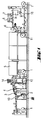
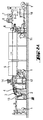
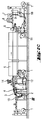
- 1 contains a roll (1), applicator (2), Infrared heater short-wave (3), infrared heater medium-wave (4), floating dryer (5), Dry laminating station (6), corona system (7), web edge control (8), Moistening device (9), cooling station (10), reel (11), electron beam unit (12), wet laminating station (13) and UV lamp (14).
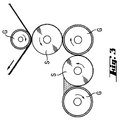
- the application work of the coating system according to FIG. 3 shows the smooth roller application with 4 rollers (wet).
- the rollers are heated and cooled.
- the smooth roller application is preferred for for the lamination of COC with PVC or PVC.
- COC film with a thickness of 190 microns (194 g / m 2 ) from both sides with an unoriented PVC film with a thickness of 35 microns (46 g / m 2 ) with solvent-free one-component adhesive 1K-LF 190X3 from Fa Herberts GmbH laminated.
- the application was 1.50 g / m 2 .
- the corona treatment 48 KW.
- the lamination was carried out at a width of 810 mm, a speed of 50 m / min, a smooth roller application system with four rollers and one pass per laminated side.
- the thermoformable composite film had a thickness of 260 ⁇ m. When measuring the bond strength of the composite film, the high bond strength caused the composite film to tear.
- thermoformable composite film had a thickness of 210 ⁇ m.
Landscapes
- Laminated Bodies (AREA)
- Wrappers (AREA)
Applications Claiming Priority (2)
| Application Number | Priority Date | Filing Date | Title |
|---|---|---|---|
| DE19828866 | 1998-06-29 | ||
| DE19828866 | 1998-06-29 |
Publications (2)
| Publication Number | Publication Date |
|---|---|
| EP0968817A2 true EP0968817A2 (fr) | 2000-01-05 |
| EP0968817A3 EP0968817A3 (fr) | 2000-04-05 |
Family
ID=7872320
Family Applications (1)
| Application Number | Title | Priority Date | Filing Date |
|---|---|---|---|
| EP99111880A Withdrawn EP0968817A3 (fr) | 1998-06-29 | 1999-06-21 | Feuille composite thermoformable |
Country Status (3)
| Country | Link |
|---|---|
| EP (1) | EP0968817A3 (fr) |
| JP (1) | JP2000033670A (fr) |
| CA (1) | CA2276723A1 (fr) |
Cited By (6)
| Publication number | Priority date | Publication date | Assignee | Title |
|---|---|---|---|---|
| EP1213138A1 (fr) * | 2000-12-06 | 2002-06-12 | Huhtamaki Deutschland GmbH & Co. KG | Procédé de fabrication d'une feuille stratifiée |
| WO2003097355A1 (fr) * | 2002-05-17 | 2003-11-27 | Otsuka Pharmaceutical Factory, Inc. | Film multicouche et contenant pour medicament pourvu d'un tel film |
| US7854225B2 (en) | 2002-11-02 | 2010-12-21 | Glaxo Group Limited | Blister package for inhalable medicament |
| US7914867B2 (en) | 2004-10-18 | 2011-03-29 | Otsuka Pharmaceutical Factory, Inc. | Medical gas barrier film and medical bag using the same |
| US8029885B2 (en) | 2002-05-17 | 2011-10-04 | Otsuka Pharmaceutical Factory, Inc. | Multi-layer film and medicine container using the same |
| US11939131B2 (en) | 2021-06-03 | 2024-03-26 | Tekni-Plex,. Inc. | Recyclable blister package |
Families Citing this family (1)
| Publication number | Priority date | Publication date | Assignee | Title |
|---|---|---|---|---|
| DE19832500A1 (de) * | 1998-07-20 | 2000-01-27 | Ticona Gmbh | Thermoformbare Verbundfolie |
Family Cites Families (6)
| Publication number | Priority date | Publication date | Assignee | Title |
|---|---|---|---|---|
| JPH04249149A (ja) * | 1991-02-06 | 1992-09-04 | Nippon Zeon Co Ltd | 複合成形体およびその製造方法 |
| KR100235089B1 (en) * | 1992-05-14 | 1999-12-15 | Mitsui Chemicals Inc | Ptp or blister packaging articles and packaging material therefor |
| CA2134320C (fr) * | 1993-10-26 | 2001-01-09 | Toshiyuki Hirose | Materiau lamine multicouche polyolefinique et son utilisation |
| EP0773102A4 (fr) * | 1994-07-05 | 1997-08-06 | Mitsui Petrochemical Ind | Stratifie multicouche et utilisation |
| DE69713661T2 (de) * | 1996-04-11 | 2003-02-13 | Mitsui Chemicals, Inc. | Mehrschichtfolie und Verpackunsgmaterial |
| JPH11165387A (ja) * | 1997-12-03 | 1999-06-22 | Mitsui Chem Inc | ポリオレフィン系多層積層体およびその用途 |
-
1999
- 1999-06-21 EP EP99111880A patent/EP0968817A3/fr not_active Withdrawn
- 1999-06-28 JP JP11181642A patent/JP2000033670A/ja active Pending
- 1999-06-29 CA CA002276723A patent/CA2276723A1/fr not_active Abandoned
Cited By (8)
| Publication number | Priority date | Publication date | Assignee | Title |
|---|---|---|---|---|
| EP1213138A1 (fr) * | 2000-12-06 | 2002-06-12 | Huhtamaki Deutschland GmbH & Co. KG | Procédé de fabrication d'une feuille stratifiée |
| WO2003097355A1 (fr) * | 2002-05-17 | 2003-11-27 | Otsuka Pharmaceutical Factory, Inc. | Film multicouche et contenant pour medicament pourvu d'un tel film |
| AU2003235910B2 (en) * | 2002-05-17 | 2007-09-20 | Otsuka Pharmaceutical Factory, Inc. | Multi-layer film and medicine container using the same |
| CN100377871C (zh) * | 2002-05-17 | 2008-04-02 | 株式会社大塚制药工厂 | 多层薄膜和使用该多层薄膜的药品容器 |
| US8029885B2 (en) | 2002-05-17 | 2011-10-04 | Otsuka Pharmaceutical Factory, Inc. | Multi-layer film and medicine container using the same |
| US7854225B2 (en) | 2002-11-02 | 2010-12-21 | Glaxo Group Limited | Blister package for inhalable medicament |
| US7914867B2 (en) | 2004-10-18 | 2011-03-29 | Otsuka Pharmaceutical Factory, Inc. | Medical gas barrier film and medical bag using the same |
| US11939131B2 (en) | 2021-06-03 | 2024-03-26 | Tekni-Plex,. Inc. | Recyclable blister package |
Also Published As
| Publication number | Publication date |
|---|---|
| JP2000033670A (ja) | 2000-02-02 |
| EP0968817A3 (fr) | 2000-04-05 |
| CA2276723A1 (fr) | 1999-12-29 |
Similar Documents
| Publication | Publication Date | Title |
|---|---|---|
| EP0974453A2 (fr) | Laminé thermoformable | |
| EP1539867B1 (fr) | Procede de realisation a partir d'un film thermoformable d'un emballage presentant une resistance elevee a la deformation thermique et une grande impermeabilite a la vapeur d'eau | |
| EP0838293B1 (fr) | Feuille mono- ou multicouche | |
| DE3888791T2 (de) | Thermoplastische Folien zur Verwendung bei Dehnungs- und Haftungsanwendungsgebieten. | |
| DE69005461T2 (de) | Atmungsfähiges Deckmaterial. | |
| DE69433089T2 (de) | Mehrschichtige strukturen aus single-site katalysierten polymeren | |
| DE69632814T2 (de) | Leichtzerbrechbare folie | |
| DE60103333T2 (de) | Als wärmeschrumpfbares Schrumpfetikett geeignete Harzzusammensetzung und Folie, die diese enthält | |
| EP0968816B1 (fr) | Feuille revêtue par extrusion | |
| EP0668157B1 (fr) | Films stratifiés thermosoudables en polyoléfines, procédé pour leur fabrication et leur utilisation | |
| EP1740648B1 (fr) | Composition pour film autocollant extensible monoface a faible bruit, et films fabriques a partir de ladite composition | |
| DE19707034A1 (de) | Wärmeaktiviertes Etikett und Verfahren zur Herstellung eines mit einem Etikett versehenen Formkörpers | |
| EP0968818B1 (fr) | Feuille laminée thermoformable | |
| EP0968819A2 (fr) | Procédé pour la fabrication d'un laminé thermoformable | |
| US6641925B1 (en) | Thermoformable composite film and process to make | |
| DE102008051399A1 (de) | Folien und deren Verwendung | |
| DE19725975A1 (de) | Blisterverpackung | |
| CA2276723A1 (fr) | Film multicouche thermoformable | |
| DE19644675A1 (de) | Blisterverpackung | |
| JP7666221B2 (ja) | 積層体及びその製造方法、包装体並びに包装物品 | |
| EP0849074A2 (fr) | Feuilles orientées et scellables comprenant au moins un copolymère cyclooléfinique | |
| DE4231287A1 (de) | Mehrschichtfolienverbund | |
| DE4406931A1 (de) | Siegelbare polyolefinische Mehrschichtfolie, Verfahren zu ihrer Herstellung und ihre Verwendung | |
| DE19652774A1 (de) | Folien |
Legal Events
| Date | Code | Title | Description |
|---|---|---|---|
| PUAI | Public reference made under article 153(3) epc to a published international application that has entered the european phase |
Free format text: ORIGINAL CODE: 0009012 |
|
| AK | Designated contracting states |
Kind code of ref document: A2 Designated state(s): AT BE CH CY DK ES FI GR IE LI LU MC NL PT SE |
|
| AX | Request for extension of the european patent |
Free format text: AL;LT;LV;MK;RO;SI |
|
| PUAL | Search report despatched |
Free format text: ORIGINAL CODE: 0009013 |
|
| AK | Designated contracting states |
Kind code of ref document: A3 Designated state(s): AT BE CH CY DK ES FI GR IE LI LU MC NL PT SE |
|
| AX | Request for extension of the european patent |
Free format text: AL;LT;LV;MK;RO;SI |
|
| RIC1 | Information provided on ipc code assigned before grant |
Free format text: 7B 32B 27/32 A, 7B 32B 27/30 B, 7B 32B 7/12 B, 7C 08J 5/12 B |
|
| REG | Reference to a national code |
Ref country code: DE Ref legal event code: 8566 |
|
| 17P | Request for examination filed |
Effective date: 20001005 |
|
| AKX | Designation fees paid | ||
| STAA | Information on the status of an ep patent application or granted ep patent |
Free format text: STATUS: THE APPLICATION HAS BEEN WITHDRAWN |
|
| 18W | Application withdrawn |
Withdrawal date: 19991213 |