EP0968892A1 - Fahrzeugsteuergerät - Google Patents
Fahrzeugsteuergerät Download PDFInfo
- Publication number
- EP0968892A1 EP0968892A1 EP98954811A EP98954811A EP0968892A1 EP 0968892 A1 EP0968892 A1 EP 0968892A1 EP 98954811 A EP98954811 A EP 98954811A EP 98954811 A EP98954811 A EP 98954811A EP 0968892 A1 EP0968892 A1 EP 0968892A1
- Authority
- EP
- European Patent Office
- Prior art keywords
- wheel
- ground contact
- contact load
- vehicle
- load
- Prior art date
- Legal status (The legal status is an assumption and is not a legal conclusion. Google has not performed a legal analysis and makes no representation as to the accuracy of the status listed.)
- Granted
Links
Images






Classifications
-
- B—PERFORMING OPERATIONS; TRANSPORTING
- B60—VEHICLES IN GENERAL
- B60C—VEHICLE TYRES; TYRE INFLATION; TYRE CHANGING; CONNECTING VALVES TO INFLATABLE ELASTIC BODIES IN GENERAL; DEVICES OR ARRANGEMENTS RELATED TO TYRES
- B60C23/00—Devices for measuring, signalling, controlling, or distributing tyre pressure or temperature, specially adapted for mounting on vehicles; Arrangement of tyre inflating devices on vehicles, e.g. of pumps or of tanks; Tyre cooling arrangements
- B60C23/06—Signalling devices actuated by deformation of the tyre, e.g. tyre mounted deformation sensors or indirect determination of tyre deformation based on wheel speed, wheel-centre to ground distance or inclination of wheel axle
- B60C23/061—Signalling devices actuated by deformation of the tyre, e.g. tyre mounted deformation sensors or indirect determination of tyre deformation based on wheel speed, wheel-centre to ground distance or inclination of wheel axle by monitoring wheel speed
- B60C23/062—Frequency spectrum analysis of wheel speed signals, e.g. using Fourier transformation
-
- B—PERFORMING OPERATIONS; TRANSPORTING
- B60—VEHICLES IN GENERAL
- B60C—VEHICLE TYRES; TYRE INFLATION; TYRE CHANGING; CONNECTING VALVES TO INFLATABLE ELASTIC BODIES IN GENERAL; DEVICES OR ARRANGEMENTS RELATED TO TYRES
- B60C23/00—Devices for measuring, signalling, controlling, or distributing tyre pressure or temperature, specially adapted for mounting on vehicles; Arrangement of tyre inflating devices on vehicles, e.g. of pumps or of tanks; Tyre cooling arrangements
- B60C23/06—Signalling devices actuated by deformation of the tyre, e.g. tyre mounted deformation sensors or indirect determination of tyre deformation based on wheel speed, wheel-centre to ground distance or inclination of wheel axle
- B60C23/061—Signalling devices actuated by deformation of the tyre, e.g. tyre mounted deformation sensors or indirect determination of tyre deformation based on wheel speed, wheel-centre to ground distance or inclination of wheel axle by monitoring wheel speed
-
- B—PERFORMING OPERATIONS; TRANSPORTING
- B60—VEHICLES IN GENERAL
- B60G—VEHICLE SUSPENSION ARRANGEMENTS
- B60G17/00—Resilient suspensions having means for adjusting the spring or vibration-damper characteristics, for regulating the distance between a supporting surface and a sprung part of vehicle or for locking suspension during use to meet varying vehicular or surface conditions, e.g. due to speed or load
- B60G17/015—Resilient suspensions having means for adjusting the spring or vibration-damper characteristics, for regulating the distance between a supporting surface and a sprung part of vehicle or for locking suspension during use to meet varying vehicular or surface conditions, e.g. due to speed or load the regulating means comprising electric or electronic elements
- B60G17/019—Resilient suspensions having means for adjusting the spring or vibration-damper characteristics, for regulating the distance between a supporting surface and a sprung part of vehicle or for locking suspension during use to meet varying vehicular or surface conditions, e.g. due to speed or load the regulating means comprising electric or electronic elements characterised by the type of sensor or the arrangement thereof
-
- B—PERFORMING OPERATIONS; TRANSPORTING
- B60—VEHICLES IN GENERAL
- B60T—VEHICLE BRAKE CONTROL SYSTEMS OR PARTS THEREOF; BRAKE CONTROL SYSTEMS OR PARTS THEREOF, IN GENERAL; ARRANGEMENT OF BRAKING ELEMENTS ON VEHICLES IN GENERAL; PORTABLE DEVICES FOR PREVENTING UNWANTED MOVEMENT OF VEHICLES; VEHICLE MODIFICATIONS TO FACILITATE COOLING OF BRAKES
- B60T8/00—Arrangements for adjusting wheel-braking force to meet varying vehicular or ground-surface conditions, e.g. limiting or varying distribution of braking force
- B60T8/17—Using electrical or electronic regulation means to control braking
- B60T8/172—Determining control parameters used in the regulation, e.g. by calculations involving measured or detected parameters
-
- B—PERFORMING OPERATIONS; TRANSPORTING
- B60—VEHICLES IN GENERAL
- B60T—VEHICLE BRAKE CONTROL SYSTEMS OR PARTS THEREOF; BRAKE CONTROL SYSTEMS OR PARTS THEREOF, IN GENERAL; ARRANGEMENT OF BRAKING ELEMENTS ON VEHICLES IN GENERAL; PORTABLE DEVICES FOR PREVENTING UNWANTED MOVEMENT OF VEHICLES; VEHICLE MODIFICATIONS TO FACILITATE COOLING OF BRAKES
- B60T8/00—Arrangements for adjusting wheel-braking force to meet varying vehicular or ground-surface conditions, e.g. limiting or varying distribution of braking force
- B60T8/18—Arrangements for adjusting wheel-braking force to meet varying vehicular or ground-surface conditions, e.g. limiting or varying distribution of braking force responsive to vehicle weight or load, e.g. load distribution
-
- G—PHYSICS
- G01—MEASURING; TESTING
- G01G—WEIGHING
- G01G19/00—Weighing apparatus or methods adapted for special purposes not provided for in the preceding groups
- G01G19/08—Weighing apparatus or methods adapted for special purposes not provided for in the preceding groups for incorporation in vehicles
-
- G—PHYSICS
- G01—MEASURING; TESTING
- G01G—WEIGHING
- G01G19/00—Weighing apparatus or methods adapted for special purposes not provided for in the preceding groups
- G01G19/08—Weighing apparatus or methods adapted for special purposes not provided for in the preceding groups for incorporation in vehicles
- G01G19/12—Weighing apparatus or methods adapted for special purposes not provided for in the preceding groups for incorporation in vehicles having electrical weight-sensitive devices
-
- B—PERFORMING OPERATIONS; TRANSPORTING
- B60—VEHICLES IN GENERAL
- B60G—VEHICLE SUSPENSION ARRANGEMENTS
- B60G2400/00—Indexing codes relating to detected, measured or calculated conditions or factors
- B60G2400/50—Pressure
- B60G2400/52—Pressure in tyre
-
- B—PERFORMING OPERATIONS; TRANSPORTING
- B60—VEHICLES IN GENERAL
- B60G—VEHICLE SUSPENSION ARRANGEMENTS
- B60G2400/00—Indexing codes relating to detected, measured or calculated conditions or factors
- B60G2400/60—Load
- B60G2400/61—Load distribution
-
- B—PERFORMING OPERATIONS; TRANSPORTING
- B60—VEHICLES IN GENERAL
- B60G—VEHICLE SUSPENSION ARRANGEMENTS
- B60G2400/00—Indexing codes relating to detected, measured or calculated conditions or factors
- B60G2400/90—Other conditions or factors
- B60G2400/91—Frequency
-
- B—PERFORMING OPERATIONS; TRANSPORTING
- B60—VEHICLES IN GENERAL
- B60G—VEHICLE SUSPENSION ARRANGEMENTS
- B60G2800/00—Indexing codes relating to the type of movement or to the condition of the vehicle and to the end result to be achieved by the control action
- B60G2800/18—Starting, accelerating
- B60G2800/182—Traction
-
- B—PERFORMING OPERATIONS; TRANSPORTING
- B60—VEHICLES IN GENERAL
- B60G—VEHICLE SUSPENSION ARRANGEMENTS
- B60G2800/00—Indexing codes relating to the type of movement or to the condition of the vehicle and to the end result to be achieved by the control action
- B60G2800/21—Traction, slip, skid or slide control
-
- B—PERFORMING OPERATIONS; TRANSPORTING
- B60—VEHICLES IN GENERAL
- B60G—VEHICLE SUSPENSION ARRANGEMENTS
- B60G2800/00—Indexing codes relating to the type of movement or to the condition of the vehicle and to the end result to be achieved by the control action
- B60G2800/22—Braking, stopping
-
- B—PERFORMING OPERATIONS; TRANSPORTING
- B60—VEHICLES IN GENERAL
- B60G—VEHICLE SUSPENSION ARRANGEMENTS
- B60G2800/00—Indexing codes relating to the type of movement or to the condition of the vehicle and to the end result to be achieved by the control action
- B60G2800/70—Estimating or calculating vehicle parameters or state variables
-
- B—PERFORMING OPERATIONS; TRANSPORTING
- B60—VEHICLES IN GENERAL
- B60G—VEHICLE SUSPENSION ARRANGEMENTS
- B60G2800/00—Indexing codes relating to the type of movement or to the condition of the vehicle and to the end result to be achieved by the control action
- B60G2800/90—System Controller type
- B60G2800/93—Skid or slide control [ASR]
-
- B—PERFORMING OPERATIONS; TRANSPORTING
- B60—VEHICLES IN GENERAL
- B60G—VEHICLE SUSPENSION ARRANGEMENTS
- B60G2800/00—Indexing codes relating to the type of movement or to the condition of the vehicle and to the end result to be achieved by the control action
- B60G2800/90—System Controller type
- B60G2800/95—Automatic Traction or Slip Control [ATC]
-
- B—PERFORMING OPERATIONS; TRANSPORTING
- B60—VEHICLES IN GENERAL
- B60T—VEHICLE BRAKE CONTROL SYSTEMS OR PARTS THEREOF; BRAKE CONTROL SYSTEMS OR PARTS THEREOF, IN GENERAL; ARRANGEMENT OF BRAKING ELEMENTS ON VEHICLES IN GENERAL; PORTABLE DEVICES FOR PREVENTING UNWANTED MOVEMENT OF VEHICLES; VEHICLE MODIFICATIONS TO FACILITATE COOLING OF BRAKES
- B60T2240/00—Monitoring, detecting wheel/tyre behaviour; counteracting thereof
- B60T2240/06—Wheel load; Wheel lift
Definitions
- the present invention relates to a control apparatus for a vehicle, which estimates a vehicle body load based on a gain of a resonance frequency of a wheel, and varies a braking or acceleration characteristics in accordance with the estimated vehicle body load.
- a tire air pressure detecting apparatus is disclosed in JP-A-8-72514.
- a resonance frequency of a tire is extracted from a wheel speed signal, noises are eliminated, and a decrease in the tire air pressure is detected based on a change in the resonance frequency.
- noises are eliminated in consideration of an influence exerted by a turning of a vehicle.
- a method of indirectly estimating a lateral acceleration indicative of a turning state of a vehicle a method of using a difference between the gains of the resonance frequencies of right and left wheels is disclosed.
- a wheel load of each wheel or a vehicle body load is estimated based on a fact that a fluctuation in vibration (pitch) synchronized with rotation of a tire or in the gain of the resonance frequency of a tire corresponds to a wheel load of each wheel, and the estimated wheel load or vehicle body load is applied to a braking control or an acceleration control. It is an object of the invention to perform a braking control, an acceleration control, or the like at a high degree of accuracy by using an estimated wheel load without requiring any special devices. It is another object to realize an accurate control performance in accordance with a braking control characteristics, an acceleration control characteristics, or the like which changes according to the wheel load or the vehicle body load.
- a control apparatus for a vehicle described in claim 1 comprises: resonance frequency detecting means for detecting each of resonance frequencies generated in tires of a plurality of wheels when a vehicle travels; gain detecting means for detecting a gain of the resonance frequency of each tire, which is detected by the resonance frequency detecting means; and vehicle body load estimating means for estimating a vehicle body load of the vehicle based on the gain of the resonance frequency extracted from each of the tires by the gain detecting means.
- a change in the vehicle body load which varies according to the number of passengers, a loaded weight, and the like can be obtained from the gain of the resonance frequency based on an output of wheel speed detecting means such as a wheel speed sensor.
- wheel speed detecting means such as a wheel speed sensor.
- the vehicle body load can be therefore estimated by a software without additional devices.
- a control apparatus for a vehicle described in claim 2 may be provided with: wheel ground contact load estimating means for estimating a ground contact load of each wheel based on the gain of the resonance frequency of each tire detected by the gain detecting means; and vehicle body load estimating means for estimating a vehicle body load based on the ground contact load of each wheel estimated by the wheel ground contact load estimating means.
- the invention described in claim 3 comprises control means for varying a braking characteristics of the vehicle based on the vehicle body load estimated by the vehicle body load estimating means. For example, when the vehicle body load is large, the control means can control so as to increase the effect of the braking corresponding to the operation of a vehicle driver. A constant braking characteristics can be also realized irrespective of a change in the vehicle body load.
- the invention described in claim 4 comprises control means for varying controlled variables of a throttle angle in response to an operation amount of an accelerator pedal operated by the driver based on the vehicle body load estimated by the vehicle body load estimating means. Consequently, for example, when the vehicle body load is large, the control means can control to increase the brakes at the time of acceleration or the driving force performance corresponding to the operation of the accelerator pedal of the driver.
- a constant acceleration characteristics can be also realized irrespective of a change in the vehicle body load.
- control means for increasing or decreasing an assist power to steering operated by the driver based on the vehicle body load estimated by the vehicle body load estimating means. Consequently, although the steering becomes heavy when the vehicle body load is large, this state can be avoided. A constant steering characteristics can be realized irrespective of the vehicle body load.
- a control apparatus for a vehicle described in claim 6 comprises: wheel speed detecting means for detecting each of wheel speeds of a plurality of wheels when a vehicle travels; resonance frequency detecting means for detecting a resonance frequency generated in a tire of each wheel based on a wheel speed signal corresponding to each wheel detected by the wheel speed detecting means; gain detecting means for detecting a gain of the resonance frequency of each tire detected by the resonance frequency detecting means; wheel ground contact load ratio estimating means for estimating a ground contact load ratio of each wheel based on the gain of the resonance frequency of each tire detected by the gain detecting means; and control means for executing at least one of a braking control, an acceleration control, a power steering control, and a driving force control of a vehicle in accordance with the ground contact load ratio estimated by the wheel ground contact load ratio estimating means.
- the ground contact load ratio between wheels is individually estimated from the ground contact load ratio of each wheel or an equivalent value which is equivalent to the ground contact load ratio of wheels.
- the ground contact load ratio of each wheel is obtained based on the gain of the resonance frequency based on an output of a wheel speed sensor or the like and the vehicle control such as a braking control can be accurately realized based on the wheel ground contact load ratio of each wheel obtained with such a simple construction. That is, since the characteristics of the braking control, the acceleration control, and the like change according to a change in the ground contact load ratio of each wheel, by varying the control according to the change, the stability of the vehicle body, the operability for the driver, reduction in the braking distance, and the like can be realized.
- the braking force control in the case where it is assumed that the road surface state under the wheels is almost even, at least in a region until the slip ratio which reaches the vertex of a ⁇ - S curve characteristics, when a road surface reactive force in each wheel is determined in accordance with the braking force applied to each wheel, that is, the ratio of the wheel cylinder pressure, the ground contact load ratio of each wheel becomes a factor of variation of the road surface reactive force in each wheel.
- the braking force control such as uniformization of the road surface reactive forces in the wheels can be realized.
- the resonance frequency detecting means comprises: means for detecting a vibration frequency of a tire; and means for detecting a linear coefficient by approximating the vibration frequency to a multiple order curve.
- the resonance frequency detecting means detects the resonance frequency from the linear coefficient and the gain detecting means detects the gain of the resonance frequency based on the linear coefficient.
- means for detecting the linear coefficient there is provided means for masking a region apart from the resonance frequency among a plurality of peaks of a waveform of the vibration frequency.
- the vibration frequency can be approximated to a quadric curve.
- means for detecting a pitch as a vibration synchronized with rotation of each wheel based on a wheel speed signal corresponding to each wheel and gain detecting means for detecting a gain of a fluctuation of the pitch are provided.
- the relation of the ground contact load ratio of each wheel can be estimated based on the gain of each tire detected by the gain detecting means.
- the wheel ground contact load ratio estimating means may obtain a front/rear load ratio on the rear side and on the front side of the vehicle body. That is, the ratio between an average or a sum of ground contact load equivalent values of two front wheels and an average or a sum of ground contact load equivalent values of two rear wheels is obtained.
- the ratio is set as a ratio of the ground contact loads on the front and rear sides of the vehicle body and used for various controls.
- the wheel ground contact load ratio estimating means can comprise right and left load ratio estimating means for obtaining the ratio between right and left loads of the vehicle body. That is, for example, the ratio between an average or a sum of values corresponding to wheel loads of left two wheels of the vehicle body and an average or a sum of values corresponding to wheel loads of two right wheels of the vehicle body is obtained and used as a ratio of the right and left loads.
- the control means distributes the first brake pressure to the wheel cylinder on the front wheel side and the wheel cylinder on the rear wheel side based on the front/rear ground contact load ratio.
- the wheel ground contact load ratio estimating means based on the right and left ground contact load ratio estimated by the wheel ground contact load ratio estimating means, at a braking assist time during which a first brake fluid pressure higher than the master cylinder pressure is applied to at least one of the wheel cylinders, even when the control means distributes the first brake pressure to a wheel cylinder on the left wheel side and a wheel cylinder on the right wheel side in accordance with the right and left ground contact load ratio. In this manner as well, similar operation effects can be obtained.
- the control means applies a brake fluid pressure to each wheel cylinder so as to correspond to each wheel ground contact load ratio simply based on each wheel ground contact load ratio estimated by the wheel ground contact load ratio estimating means, estimation can be carried out while including both a change in a static load of each wheel such as the position of the passengers and the position of a load and a change in a dynamic load of each wheel such as a turn state, a brake state, and an acceleration state.
- a vehicle control in consideration of both of the changes can be realized.
- the apparatus may comprise control means for controlling a driving force to be transmitted to each wheel when no brake is applied to the vehicle to a value according to a ground contact load ratio based on the ground contact load ratio of each wheel estimated by the wheel ground contact load ratio estimating means.
- a ground contact load ratio based on the ground contact load ratio of each wheel estimated by the wheel ground contact load ratio estimating means.
- control means for increasing or decreasing an assist force to steering operated by the driver based on the ground contact load ratio of each wheel estimated by the wheel ground contact load ratio estimating means can be provided. Consequently, even when the wheel load becomes heavy, the steering operation by the driver can be assisted, so that the burden of the steering operation on the driver can be reduced.
- control means varies an engine output of the vehicle in response to the accelerator pedal operation based on the ground contact load ratio of each wheel estimated by the wheel ground contact load estimating means.
- control means varies an engine output of the vehicle in response to the accelerator pedal operation based on the ground contact load ratio of each wheel estimated by the wheel ground contact load estimating means.
- the control means can execute an engine output varying control by changing the throttle angle corresponding to the accelerator pedal operation.
- the ratio of front and rear wheel loads estimated by the front and rear wheel load ratio estimating means in a front wheel drive vehicle, it is sufficient to correct so as to increase the throttle angle corresponding to the accelerator pedal operation when the ground contact load on the front wheel side is larger than that on the rear wheel side, and correct so as to decrease the throttle angle corresponding to the accelerator pedal operation when the ground contact load on the rear wheel side is larger than that on the front wheel side.
- the ratio of the front and rear wheel load ratio estimated by the front and rear wheel load ratio estimating means in a rear wheel drive vehicle, it is sufficient to correct so as to decrease the throttle angle corresponding to the accelerator pedal operation when the ground contact load on the front wheel side is larger than that on the rear wheel side, and correct so as to increase the throttle angle corresponding to the accelerator pedal operation when the ground contact load on the rear wheel side is larger than that on the front wheel side.
- the invention described in claim 24 is wherein:, when it is estimated by wheel load estimating means that the load of a rear wheel which is on the inside wheel side at the time of a turning is almost zero, a second brake fluid pressure higher than the master cylinder pressure is generated at least in the front wheel which is on the outside wheel side at the time of the turn.
- the second brake fluid pressure higher than the master cylinder pressure is generated at least at the front wheel which is on the outside wheel side at the time of the turning.
- Fig. 1 is a schematic diagram of an apparatus for estimating a load of each wheel or a wheel load ratio.
- Wheel speed sensors are mounted in correspondence with four front/rear right/left tires 1a to 1d attached to a vehicle.
- the wheel speed sensors comprise toothed-gear shaped pulsers 2a to 2d each made of a magnetic member and pickup coils 3a to 3d, respectively.
- the pulsers 2a to 2d are fixed to rotary shafts (not shown) of the tires 1a to 1d, respectively.
- the pickup coils 3a to 3d are mounted with predetermined intervals from the pulsers 2a to 2d, respectively, and output a.c. signals having periodicity according to the rotation of the pulsers 2a to 2d, that is, the rotational speeds of the tires 1a to 1d.
- the a.c. signals outputted from the pickup coils 3a to 3d are supplied to an ECU (electronic control unit) 4.
- the ECU 4 is constructed by a CPU, a waveform forming circuit, a ROM, a RAM, and the like and processes supplied various signals in accordance with a predetermined program. The result of the process is supplied to an actuator 5, thereby driving each of actuators which will be described hereinbelow.
- a force in the up/down, front/rear, or rotational direction is applied to a tire due to fine asperities on the top face of the road and the tire vibrates in the up/down, lateral, or rotational direction by the applied force.
- peak values are shown by a-point and b-point.
- the a-point indicates a resonance frequency in the up/down direction of the tire.
- the b-point indicates a resonance frequency in the front/rear direction under the spring of the vehicle. That is, the resonance vibration occurs in the tire by the resonance between vibration of the tire as an elastic body when the vibration is caused between the road surface and the tire and the natural vibration of the tire spring part, and the frequencies appear at the a-point and b-point as resonance frequencies.
- the component of the vibration frequency of the tire is included in the sensor signal of the wheel speed sensor. That is, when the frequency of the sensor signal of the wheel speed sensor is analyzed, the tire resonance frequency can be sensed. Since the wheel speed sensor is generally provided for each wheel in a vehicle mounted with an ABS or a braking assist system, in case of sensing the resonance frequency of the tire, the tire air pressure can be sensed without an additional sensor.
- the ground contact load of each wheel changes. It can be considered that the change in the ground contact load is caused by a lateral load shift by a turning of a vehicle or a load shift in the front/rear direction when brake is applied in the vehicle. A static load change in a light load or a constant load can be also considered. As shown in Fig. 3, when such a change in the ground contact load occurs, the power spectrum of the resonance frequency changes. More specifically, the power spectrum of the resonance frequency of a wheel on which the ground contact load becomes low decreases and the power spectrum of the resonance frequency of a wheel on which the ground contact load becomes high increases for the following reason.
- the solid line in Fig. 3 indicates, for instance, a ground contact load of the front right and left wheels in a straight-ahead travel state.
- the upper dotted line in Fig. 3 shows the ground contact load of the front right wheel and the lower dotted line of Fig. 3 shows the ground contact load of the front left wheel, for example, when the vehicle turns left.
- a fourth-order curve having vertexes at about 10 Hz and 70 Hz is shown.
- the vertex at 10 Hz denotes a primary resonance point in the vibrating force with the road surface of the tire and the vertex around 70 Hz is a secondary resonance point.
- the resonance points exist in a quadratic or higher-degree high frequency region.
- the absolute value of the magnitude of the power spectrum (amplitude) in Fig. 3 changes according to a state of the driving road such as an asphalt road, a dirt road, or a concrete road. That is, the vibrating force applied to the tire differs according to the degree of asperities existing on the road surface. It is assumed that Fig. 3 shows a case where the vehicle travels on the asphalt road.
- the ECU 4 repetitively executes a similar process to each of the wheels every fixed reference time interval.
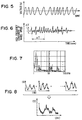
- the waveform of the a.c. signal (refer to Fig. 5) outputted from each of the pickup coils 3 (3a to 3d) is shaped to thereby generate a pulse signal.
- the pulse interval is divided by a predetermined time, thereby calculating a wheel speed VW**.
- ** indicates each wheel.
- the front right wheel, front left wheel, rear right wheel, and rear left wheel are expressed by FR, FL, RR, and RL, respectively.
- the indication of ** is omitted.
- the wheel speed VW usually includes, as shown in Fig. 6, many high frequency components including the vibration frequency component of the tire.
- a road surface state determining process for determining whether the range of fluctuation ⁇ V of the calculated wheel speed VW is equal to or larger than a reference value V0 or not is performed.
- the routine advances to step 120.
- a road surface length determining process for determining time ⁇ T during which the fluctuation range ⁇ V of the wheel speed VW is equal to or larger than the reference value V0 is equal to or longer than a predetermined time t0 is carried out.
- the road surface length determining process is performed in order to determine whether or not the ground contact load of each wheel or the ground contact load ratio can be accurately detected by a detecting method of the embodiment, or whether or not the resonance frequency of the tire of each wheel or the change in the power spectrum of the resonance frequency can be accurately detected with the road surface on which the vehicle travels.
- the ground contact load of each wheel or the ground contact load ratio is detected based on an individual change or a relative change in the power spectrum of the resonance frequency of the tire of each wheel. Consequently, unless the wheel speed VW fluctuates to a certain degree and its fluctuation continues, sufficient data to accurately calculate the resonance frequency or a change in the power spectrum of the resonance frequency cannot be obtained.
- a predetermined time ⁇ t is set at a time point when the fluctuation range ⁇ V of the wheel speed VW becomes equal to or larger than the reference value V0. When the fluctuation range ⁇ V of the wheel speed VW becomes V0 or larger again within the predetermined time ⁇ t, the counting of the time ⁇ T is continued.
- step 110 When NO at either step 110 or step 120, the process is finished and the routine is returned to step 100.
- step 130 the wheel speed VW is subjected to frequency analysis by FFT (fast Fourier transform) operation.
- step 140 from the result of the FFT operation calculated at step 130, data to be used for subsequent processing is selected.
- the condition of not adopting the FFT result is that, for example, a vibration level (that is, noise components) except for a vibration level of the tire resonance related to the spring constant of the tire as a rubber part of the wheel is higher than a predetermined value.
- a vibration level that is, noise components
- the FFT operation result is not adopted.
- the number of FFT operations is integrated.
- a very random frequency characteristics is usually obtained. This is because that the shapes (sizes and heights) of fine bumps and dips existing on the road surface are quite irregular.
- the frequency characteristics fluctuates in one wheel speed data to another.
- an average value of FFT operation results of a plurality of times is obtained. For this purpose, at step 160, whether the number N of operation times of FFT reaches a predetermined number N0 or not is determined.
- steps 100 to 150 are repeated.
- the averaging process is executed in the following step 180. As shown in Fig. 8, the averaging process is executed to obtain the average value of the FFT operation results and the average value of gains of frequency components is calculated. The fluctuation in the FFT operation results according to the road surface can be reduced by the averaging process.
- a moving averaging process is executed at step 180.
- the moving averaging process is performed by obtaining the gain Y n of the (n)th frequency by the following arithmetic expression.
- Y n (y n+1 + Y n-1 )/2
- the gain Y n of the (n)th frequency is set to an average value of the (n+1)th gain y n+1 in the previous operation result and the gain Y n-1 of the (n-1)th frequency which has been already calculated.
- the FFT results show a waveform which smoothly changes.
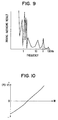
- Fig. 9 shows the calculation results obtained by the moving averaging process.
- the waveform process is not limited to the moving averaging process.
- a differential operation of the wheel speed VW may be executed and the differential operation result may be subjected to the FFT operation.
- a resonance frequency fk related to the spring constant of the rubber part of a tire is calculated.
- a deviation (fk0 - fk) due to reduction between an initial resonance frequency fk0 which is preliminarily set in correspondence with a normal tire air pressure and the resonance frequency fk which is sequentially calculated is obtained.
- a power spectrum Gfk of the resonance frequency of the tire of the wheel as a target of the present control is calculated.
- the power spectrum Gfk is calculated as a value corresponding to the ground contact load of each wheel.
- a ground contact load M of the wheel as a target of the control is estimated based on the power spectrum of the resonance frequency. For example, a standard power spectrum P0 of a resonance frequency at the time of a standard ground contact load M0 when the vehicle which does not have anything such as a driver or a load is used as a reference is preliminarily stored, a difference between the standard power spectrum P0 and the power spectrum P calculated at step 230 is calculated, and the ground contact load M of a wheel as a control target at present is estimated by using the relation map of the difference (P0 - P) and the ground contact load (refer to Fig. 10).
- means for detecting a state of a driving road surface is provided.
- the road surface is selected and the estimation may be permitted so as to estimate the ground contact load at the time of travel only on the asphalt road as a reference.
- a permission of whether or not the estimation result is adopted in a post control such as a braking control or a steering control may be also given according to the road surface.
- the ground contact load can be estimated by multiplying the value of the power spectrum Gfk in the case of the dirt road with a predetermined value such as, for example, 0.75.
- Whether the vehicle travels on the asphalt road or the dirt road can be determined by a known technique. For instance, it can be estimated based on the fluctuation component (differential value) of the wheel acceleration.
- a vehicle control is executed in the subsequent steps.
- a braking control at step 240 an acceleration control at step 250, a power steering control at step 260, and a driving force control (control to distribute the driving force generated by an engine output to the wheels) at step 270 are performed.
- the driving force control is executed in the following manner.
- step 600 the depression of the brake pedal is detected by checking whether a brake switch is ON or not.
- the routine advances to step 610 where a driving force distribution ratio among the wheels is calculated. That is, the driving force control is carried out mainly to avoid a slip state caused by acceleration.
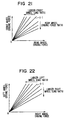
- the driving force distribution ratio among the wheels in a four wheel drive vehicle, the front and rear wheel driving force ratio and the right and left wheel driving force ratio are set based on maps shown in Figs. 21 and 22.
- the right and left wheel driving force ratio is set based on the map of Fig. 22.
- the front wheel driving force is set to be larger than the rear wheel driving force.
- the rear wheel driving force is set to be larger than the front wheel driving force.
- the driving force of the left side wheels is set to be larger than that of the left side wheels.
- the driving force of the right side wheels is set to be larger than that of the left side wheels.
- the driving force can be set not only by the front/rear and right/left load ratios but also in accordance with the absolute value of an average of the front wheel loads and the absolute value of an average of the rear wheel loads.
- the driving force can be also set in accordance with the absolute value of an average of loads of the left side wheels and the absolute value of an average of loads of the right side wheels.
- a driving force control by the brake operation or a driving force control by a torque converter and an LSD can be adopted.
- the driving force control by using the brake operation will be described.
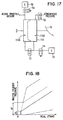
- the differential pressure control valve 14 is set in the closed position, the suction valve 23 is set in the communication position, the brake fluid is sucked from the master cylinder 12 and the master reservoir 13 by the pump 22, and the brake fluid pressure is applied to a wheel having a small ground contact load.
- the second pressure increasing control valve 16 is held in the communication position, the first pressure increasing control valve 15 is driven by a duty ratio control, and the brake fluid pressure is applied to the wheel cylinder 19. Consequently, the driving force of the front right wheel FR on which the brake operation is applied is transferred to the rear left wheel RL via a front differential, so that the driving force transmitted to the rear left wheel RL is increased.
- the driving force namely, the accelerating force of the vehicle is increased.
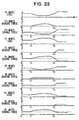
- FIG. 23 shows an example of the operation of the driving force control.
- Fig. 23 an example of the ground contact loads of the respective wheels when the vehicle turns right and then turns left is shown.
- brakes are applied to the front right wheel FR and the rear right wheel RR on which the wheel load decreases, and the driving force is moved to the front left wheel FL and the rear left wheel RL.
- brakes are applied to the front left wheel FL and the rear left wheel RL, and the driving force is moved to the front right wheel FR and the rear right wheel RR.
- the determination of the brake switch at step 600 can be omitted.
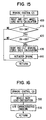
- the acceleration control will be described with reference to the flow diagram of Fig. 24.
- the vehicle body load is calculated.
- accelerator operation angle by the driver is calculated.
- the acceleration operation angle can be also sensed by using a sensor for sensing the present accelerator pedal stroke.
- the throttle angle to be controlled is calculated.
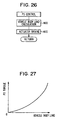
- the throttle angle is set based on a map shown in Fig. 25. That is, as the vehicle body load increases, the ratio of the throttle angle according to the accelerator operation angle by the driver is increased as ⁇ ⁇ ⁇ ⁇ ⁇ .
- the actuator driving is performed.
- the actuator controls and drives a DC motor and the like which varies the throttle angle.
- the vehicle body load is calculated.
- the actuator driving is performed based on the vehicle body load.
- the power steering torque is controlled based on a map shown in Fig. 27. That is, as the vehicle body load becomes heavier, an auxiliary torque by the power steering is increased and the steering operation by the driver is largely assisted.
- Both of an electric power steering and a hydraulic power steering can be applied. For example, in the hydraulic power steering, an oil pressure to assist the steering operation of the driver is increased according to the vehicle body load.
- the load of each wheel is estimated by performing FFT to fluctuation in the tire rotation in the first embodiment
- the load of each wheel is estimated by a linear prediction method. Since the braking control, acceleration control, steering control, and the like executed after the load estimation are similar to those in the first embodiment, the description is omitted here.
- the linear prediction coefficients c1 and c2 are obtained from the speeds of the wheels by approximating the power spectrum which changes according to a frequency to a quadratic curve and mathematically expressing the power spectrum.
- the power spectrum can be approximated to a tertiary curve, a quartic curve, or the like. Peaks except for the peak which is required most can be also masked by a filter.
- the resonance frequency (frequency having the peaks of the quadric curve) is obtained from the linear prediction coefficients.
- the gain of the power spectrum (hereinbelow, referred to as a peak gain) is obtained by the equation (4).
- the peak gain is expressed as shown by the equation (4).
- the peak gain can be obtained by the linear prediction method as described above and the load of each wheel or the load ratio can be estimated based on the obtained peak gain.
- the estimation of the load of each wheel and the load ratio estimation are carried out by using the fluctuation in the rotation of the tires in the first and second embodiments.
- the estimation of the load of each wheel or the load ratio estimation is performed based on a fluctuation in a vibration (hereinbelow, referred to as a "pitch") synchronized with the tire rotation. Since the braking control, acceleration control, steering control, and the like which are performed after the load estimation or the load ratio estimation are similar to those in the first embodiment, the description is omitted here.
- T(n) pulse width of each wheel (width of 1/x rotation of tire (x is a positive number))
- dcT(n) and dccT(n) change amounts in pitch correction pulse width of each wheel
- a pitch component (for example, a pulse-shaped signal generated by a rib or the like of a tire) is included in a signal from each wheel speed sensor.
- the pitch component fluctuates according to the load applied to each wheel and the load applied to each wheel can be estimated based on the fluctuation in the pitch component.
- the pitch correction pulse width change amount dcT(n) of each wheel is obtained based on the pulse width of each wheel.
- the pitch correction pulse width change amount of each wheel is equal to or smaller than k3 ⁇ T(n - k + 1), however, it can be considered that the fluctuation is not as a change in the pitch component by the load but as noise. Consequently, an amount obtained by eliminating the noise from the change as shown by the equation (6) is used as a true pitch correction pulse width change amount dccT(n) of each wheel.
- a pitch fluctuation parameter as shown by the equation (7) can be obtained. Since the pitch fluctuation parameter is a load equivalent value corresponding to the load applied on each wheel as described above, the load applied on each wheel or the load ratio can be estimated by using the pitch fluctuation parameter.
- the load applied on each wheel can be estimated based on the pitch component of a signal from a wheel speed sensor.
- the resonance frequency is calculated and the load of each wheel is estimated based on the power spectrum of the resonance frequency or the power spectrum is used as a value corresponding to the load of each wheel to estimate the wheel load ratio.
- the gain itself is used as a value indicative of the load or a value corresponding to the load, the ratio can be obtained without extracting the resonance frequency.
- the LPC method only a resonance gain can be obtained without acquiring the resonance frequency itself.
- the present invention relates to a control apparatus for a vehicle, for estimating a vehicle body load based on a resonance frequency of a wheel and varying a braking characteristics or an acceleration characteristics in accordance with the estimated vehicle body load. More particularly, the invention can be preferably carried out in a control apparatus for a vehicle in a vehicle in which the vehicle body load is fluctuated largely by a load.
Landscapes
- Engineering & Computer Science (AREA)
- Mechanical Engineering (AREA)
- Physics & Mathematics (AREA)
- General Physics & Mathematics (AREA)
- Transportation (AREA)
- Mathematical Physics (AREA)
- Regulating Braking Force (AREA)
- Control Of Driving Devices And Active Controlling Of Vehicle (AREA)
Applications Claiming Priority (3)
| Application Number | Priority Date | Filing Date | Title |
|---|---|---|---|
| JP32759197 | 1997-11-28 | ||
| JP32759197 | 1997-11-28 | ||
| PCT/JP1998/005283 WO1999028172A1 (en) | 1997-11-28 | 1998-11-24 | Vehicle controller |
Publications (3)
| Publication Number | Publication Date |
|---|---|
| EP0968892A1 true EP0968892A1 (de) | 2000-01-05 |
| EP0968892A4 EP0968892A4 (de) | 2001-01-17 |
| EP0968892B1 EP0968892B1 (de) | 2009-07-15 |
Family
ID=18200775
Family Applications (1)
| Application Number | Title | Priority Date | Filing Date |
|---|---|---|---|
| EP98954811A Expired - Lifetime EP0968892B1 (de) | 1997-11-28 | 1998-11-24 | Fahrzeugsteuergerät |
Country Status (4)
| Country | Link |
|---|---|
| US (1) | US6064931A (de) |
| EP (1) | EP0968892B1 (de) |
| DE (1) | DE69840977D1 (de) |
| WO (1) | WO1999028172A1 (de) |
Cited By (11)
| Publication number | Priority date | Publication date | Assignee | Title |
|---|---|---|---|---|
| WO2003053747A1 (en) | 2001-12-21 | 2003-07-03 | Kabushiki Kaisha Bridgestone | Method and apparatus for estimating road surface state and tire running state, abs and vehicle control using the same |
| WO2006010456A1 (de) * | 2004-07-22 | 2006-02-02 | Daimlerchrysler Ag | Stabilisierungsvorrichtung und verfahren zur fahrstabilisierung eines fahrzeugs durch anwendung einer spektralanalyse |
| EP1637362A1 (de) * | 2004-09-17 | 2006-03-22 | Sumitomo Rubber Industries, Ltd. | Verfahren zur Bestimmung der Belastung eines Fahrzeugreifens |
| EP1765650A4 (de) * | 2004-07-15 | 2009-06-10 | Honda Motor Co Ltd | Bremssteuerverfahren für fahrzeuge unter verwendung von radlastabhängiger dynamischer kraftaufteilung |
| WO2011097667A1 (en) | 2010-02-15 | 2011-08-18 | Transport Certification Australia Limited | System and method for monitoring vehicle mass tamper events |
| EP2818340A4 (de) * | 2011-08-22 | 2015-09-09 | Dehong Wang | Sicherheitsfahrsteuerungs- und rettungssystem für raddurchmesseränderungen und bei hochgeschwindigkeit platzende reifen |
| EP3100877A1 (de) * | 2015-06-01 | 2016-12-07 | Sumitomo Rubber Industries, Ltd. | Vorrichtung zur erkennung des niederdruckzustands eines reifens |
| EP3501924A1 (de) * | 2017-12-22 | 2019-06-26 | Sumitomo Rubber Industries, Ltd. | Radlastschätzungsvorrichtung |
| WO2021159165A1 (en) * | 2020-02-14 | 2021-08-19 | Pedders Shock Absorber Service Pty Ltd | On-board vehicle scales |
| KR20220024151A (ko) * | 2019-06-25 | 2022-03-03 | 젯트에프 프리드리히스하펜 아게 | 차량의 타이어압의 검사 방법 |
| EP4331930A1 (de) * | 2022-08-22 | 2024-03-06 | Sumitomo Rubber Industries, Ltd. | Radlastschätzvorrichtung, -verfahren und -programm |
Families Citing this family (61)
| Publication number | Priority date | Publication date | Assignee | Title |
|---|---|---|---|---|
| JP3366584B2 (ja) * | 1998-12-25 | 2003-01-14 | 住友ゴム工業株式会社 | タイヤ空気圧低下検出装置および方法 |
| JP2001199354A (ja) * | 2000-01-19 | 2001-07-24 | Mitsubishi Electric Corp | 電動パワーステアリング装置 |
| JP4496598B2 (ja) * | 2000-04-06 | 2010-07-07 | 株式会社デンソー | 路面状態識別装置 |
| JP2002172920A (ja) * | 2000-09-29 | 2002-06-18 | Toyota Central Res & Dev Lab Inc | タイヤ空気圧推定装置 |
| JP3657876B2 (ja) * | 2000-11-27 | 2005-06-08 | アイシン精機株式会社 | タイヤ空気圧推定装置 |
| JP4629246B2 (ja) * | 2001-02-13 | 2011-02-09 | 株式会社ブリヂストン | タイヤ走行状態の検出方法とタイヤ走行状態検出装置、及び路面状態の推定方法と路面状態推定装置 |
| DE60205340T2 (de) * | 2001-02-26 | 2006-03-23 | Toyota Jidosha Kabushiki Kaisha, Toyota | Gerät zur reifenzustandabschätzung und gerät zur erfassung eines abnormalen reifenzustandes |
| EP1279584B1 (de) * | 2001-07-28 | 2006-05-10 | Ford Global Technologies, LLC | Benutzung der elektrischen Lenkunterstützung zum Unterdrücken von Bremsvibrationen |
| US20040105664A1 (en) * | 2002-12-03 | 2004-06-03 | Mladen Ivankovic | Linear electric motor controller and system for providing linear speed control |
| US6587338B2 (en) | 2001-12-13 | 2003-07-01 | Carter Group, Inc. | Electronic controller modules and methods for making and using same |
| US7265516B2 (en) * | 2001-12-13 | 2007-09-04 | Lacroix Michael Charles | Linear electric motor controller and system for providing linear control |
| US6728620B2 (en) | 2002-02-08 | 2004-04-27 | Visteon Global Technologies, Inc. | Predictive control algorithm for an anti-lock braking system for an automotive vehicle |
| JP3573134B2 (ja) * | 2002-02-25 | 2004-10-06 | 日産自動車株式会社 | 車両用運転操作補助装置 |
| US6871126B2 (en) * | 2002-05-03 | 2005-03-22 | Donnelly Corporation | Variable blower controller for vehicle |
| US20060186627A1 (en) * | 2003-03-10 | 2006-08-24 | Katsura Koyagi | Axle-supporting device |
| DE10328979B4 (de) * | 2003-06-27 | 2021-07-22 | Robert Bosch Gmbh | Verfahren zur Koordination eines Fahrdynamikregelungssystems mit einem aktiven Normalkraftverstellsystem |
| US20050264253A1 (en) * | 2003-10-21 | 2005-12-01 | Mladen Ivankovic | Linear power module |
| DE602004032510D1 (de) * | 2004-02-06 | 2011-06-16 | Caterpillar Inc | Arbeitsmaschine mit Lenkungssteuerung |
| JP4161923B2 (ja) * | 2004-03-09 | 2008-10-08 | 株式会社デンソー | 車両安定化制御システム |
| JP4269994B2 (ja) * | 2004-03-25 | 2009-05-27 | 三菱ふそうトラック・バス株式会社 | 車両のステア特性制御装置 |
| JP2005271822A (ja) * | 2004-03-25 | 2005-10-06 | Mitsubishi Fuso Truck & Bus Corp | 車両の自動減速制御装置 |
| JP4636230B2 (ja) * | 2004-04-08 | 2011-02-23 | 株式会社アドヴィックス | 輪荷重推定装置及び輪荷重推定方法 |
| JP2005344634A (ja) * | 2004-06-03 | 2005-12-15 | Mitsubishi Electric Corp | 車両制御装置 |
| JP2006060936A (ja) * | 2004-08-20 | 2006-03-02 | Denso Corp | 車両挙動制御システム |
| CN100581858C (zh) | 2004-09-15 | 2010-01-20 | 麦格纳唐纳利工程有限公司 | 一种车辆环境控制系统 |
| US7826948B2 (en) * | 2004-10-15 | 2010-11-02 | Ford Global Technologies | Vehicle loading based vehicle dynamic and safety related characteristic adjusting system |
| US7873459B2 (en) * | 2005-07-29 | 2011-01-18 | Ford Global Technologies, Llc | Load transfer adaptive traction control system |
| US20080281552A1 (en) * | 2005-11-14 | 2008-11-13 | Continental Teves Ag & Co. Ohg | Method for the Detection of the Loading of a Motor Vehicle |
| US10378896B2 (en) * | 2006-02-27 | 2019-08-13 | Trimble Inc. | Method and system for planning the path of an agricultural vehicle |
| FR2898078B1 (fr) * | 2006-03-01 | 2010-07-30 | Michelin Soc Tech | Methode pour determiner l'etat de charge d'un vehicule |
| US7873454B2 (en) * | 2006-05-03 | 2011-01-18 | Eaton Corporation | Method of identifying predictive lateral load transfer ratio for vehicle rollover prevention and warning systems |
| US7864496B2 (en) * | 2006-12-04 | 2011-01-04 | Magna Electronics | Load dump protection for power FET device |
| DE502007001846D1 (de) * | 2007-03-30 | 2009-12-10 | Ford Global Tech Llc | Verfahren zur Detektion periodischer Störungen in der Lenkeinrichtung eines Kraftfahrzeuges sowie Ve |
| US8451140B2 (en) * | 2007-12-20 | 2013-05-28 | International Business Machines Corporation | Monitoring road surface conditions |
| US8744682B2 (en) * | 2008-05-30 | 2014-06-03 | GM Global Technology Operations LLC | Reducing the effects of vibrations in an electric power steering (EPS) system |
| JP4629756B2 (ja) * | 2008-07-14 | 2011-02-09 | 株式会社ブリヂストン | 路面状態推定方法と路面状態推定装置 |
| JP2010070022A (ja) | 2008-09-18 | 2010-04-02 | Hitachi Automotive Systems Ltd | ブレーキ装置 |
| JP5169739B2 (ja) * | 2008-10-30 | 2013-03-27 | 日産自動車株式会社 | 制動制御システム |
| JP4927919B2 (ja) * | 2009-09-16 | 2012-05-09 | 日立オートモティブシステムズ株式会社 | 車両制御装置 |
| US9440674B2 (en) | 2010-09-15 | 2016-09-13 | GM Global Technology Operations LLC | Methods, systems and apparatus for steering wheel vibration reduction in electric power steering systems |
| US9266558B2 (en) | 2010-09-15 | 2016-02-23 | GM Global Technology Operations LLC | Methods, systems and apparatus for steering wheel vibration reduction in electric power steering systems |
| JP5405441B2 (ja) | 2010-11-24 | 2014-02-05 | 日立オートモティブシステムズ株式会社 | 車両制御装置 |
| US9327762B2 (en) | 2010-12-14 | 2016-05-03 | GM Global Technology Operations LLC | Electric power steering systems with improved road feel |
| JP5538279B2 (ja) * | 2011-03-25 | 2014-07-02 | 住友ゴム工業株式会社 | 車両質量推定装置、方法及びプログラム、並びに、タイヤ空気圧低下検出装置、方法及びプログラム |
| US9511633B2 (en) | 2011-08-17 | 2016-12-06 | Deere & Company | Soil compaction management and reporting |
| US8843269B2 (en) | 2011-08-17 | 2014-09-23 | Deere & Company | Vehicle soil pressure management based on topography |
| JP5563004B2 (ja) * | 2012-03-28 | 2014-07-30 | 日信工業株式会社 | 車両用ブレーキ液圧制御装置 |
| US9527352B2 (en) * | 2013-06-17 | 2016-12-27 | Infineon Technologies Ag | Indirect tire pressure monitoring systems and methods using multidimensional resonance frequency analysis |
| JP6338508B2 (ja) * | 2014-10-24 | 2018-06-06 | 日産自動車株式会社 | タイヤ空気圧モニター装置、タイヤ空気圧モニター装置を備える車両、タイヤ空気圧モニター方法 |
| JP2016088266A (ja) * | 2014-11-04 | 2016-05-23 | 株式会社デンソー | ヘッドライトの光軸調整装置 |
| US10246139B2 (en) * | 2015-09-25 | 2019-04-02 | GM Global Technology Operations LLC | Method and apparatus for controlling vehicle tractive effort |
| JP6631233B2 (ja) * | 2015-12-18 | 2020-01-15 | 三菱自動車工業株式会社 | 制動力制御装置 |
| KR102470306B1 (ko) * | 2016-03-11 | 2022-11-25 | 에이치엘만도 주식회사 | 타이어 압력 추정 장치 및 그 추정 방법 |
| FR3058930A1 (fr) * | 2016-11-21 | 2018-05-25 | Compagnie Generale Des Etablissements Michelin | Procede de controle et/ou de suivi de l'utilisation d'un pneumatique |
| DE102017207620B4 (de) * | 2017-05-05 | 2019-05-29 | Continental Automotive Gmbh | Verfahren und Vorrichtung zur Bestimmung von Radlasten an Rädern eines Fahrzeuges |
| EP3643573B1 (de) * | 2017-08-04 | 2021-11-03 | Mazda Motor Corporation | Fahrzeugsteuerungsvorrichtung |
| JP6915507B2 (ja) * | 2017-11-23 | 2021-08-04 | 株式会社デンソー | 路面状態判別装置 |
| MX2021002903A (es) * | 2018-09-25 | 2021-06-08 | Hendrickson Usa Llc | Regulador accionado por valvula auxiliar con presion de suministro minimo ajustable. |
| US11432452B2 (en) * | 2019-01-28 | 2022-09-06 | Deere & Company | Vehicle sink alert system and method |
| JP7823728B2 (ja) * | 2022-03-02 | 2026-03-04 | 三菱自動車工業株式会社 | 車両挙動制御装置 |
| CN118457589B (zh) * | 2022-12-26 | 2026-02-10 | 比亚迪股份有限公司 | 车辆的动力控制方法、装置、介质、车辆控制器及车辆 |
Family Cites Families (20)
| Publication number | Priority date | Publication date | Assignee | Title |
|---|---|---|---|---|
| DE2423978C3 (de) * | 1974-05-18 | 1981-07-23 | Maschinenfabrik Köppern GmbH & Co KG, 4320 Hattingen | Vorrichtung zur Bestimmung des Verhaltens eines Stoßdämpfers in den Massen-Feder-Systemen eines Kraftfahrzeuges |
| JPS5252079A (en) * | 1975-09-19 | 1977-04-26 | Jidosha Kiki Co Ltd | Air brake system distributes pressure of brake that moves accordig to loads |
| JPS6167652A (ja) * | 1984-09-12 | 1986-04-07 | Mazda Motor Corp | ブレ−キ液圧の制御装置 |
| JPH01115760A (ja) * | 1987-10-30 | 1989-05-09 | Nissan Motor Co Ltd | ブレーキシステム |
| KR910019812A (ko) * | 1990-05-09 | 1991-12-19 | 후루다 노리마사 | 차량의 서스펜션장치 |
| JPH0424154A (ja) * | 1990-05-15 | 1992-01-28 | Mazda Motor Corp | 4輪駆動車のトルク配分制御装置 |
| JP2660935B2 (ja) * | 1990-05-17 | 1997-10-08 | エムケー精工株式会社 | 洗車機のワックスがけ方法 |
| JPH0526917A (ja) * | 1991-07-17 | 1993-02-05 | Nissan Motor Co Ltd | 車両用周波数スペクトル分析装置 |
| JP3673284B2 (ja) * | 1991-08-26 | 2005-07-20 | トヨタ自動車株式会社 | 車両用ブレーキ装置 |
| US5553491A (en) * | 1991-11-11 | 1996-09-10 | Nippondenso Co., Ltd. | Tire air pressure detecting device |
| JP3232520B2 (ja) * | 1993-09-29 | 2001-11-26 | 本田技研工業株式会社 | ハイドロプレーニング検出装置 |
| JP3185524B2 (ja) * | 1994-03-14 | 2001-07-11 | トヨタ自動車株式会社 | 操舵アシスト力制御装置 |
| JP3362522B2 (ja) | 1994-09-07 | 2003-01-07 | 株式会社デンソー | タイヤ空気圧検知装置 |
| DE19540161B4 (de) * | 1994-10-28 | 2009-11-19 | Nissan Motor Co., Ltd., Yokohama-shi | Fahrzeug-Radaufhängungsanordnung |
| JP3367277B2 (ja) * | 1995-06-05 | 2003-01-14 | 株式会社豊田中央研究所 | 摩擦状態検出装置及び、パワーステアリング装置 |
| JP3543879B2 (ja) * | 1995-10-11 | 2004-07-21 | 住友ゴム工業株式会社 | タイヤ空気圧異常警報装置 |
| JPH09126932A (ja) * | 1995-10-31 | 1997-05-16 | Aisin Seiki Co Ltd | タイヤの空気圧検出方法及び空気圧検出装置 |
| JP3070465B2 (ja) | 1996-01-17 | 2000-07-31 | 株式会社日本自動車部品総合研究所 | タイヤ空気圧検知装置 |
| JPH10119528A (ja) * | 1996-10-18 | 1998-05-12 | Toyota Motor Corp | 減衰力発生装置のための制御装置 |
| KR0181232B1 (ko) * | 1996-10-31 | 1999-03-20 | 오상수 | 차량의 반 능동 전자 제어 현가 장치 및 방법 |
-
1998
- 1998-11-24 WO PCT/JP1998/005283 patent/WO1999028172A1/ja not_active Ceased
- 1998-11-24 EP EP98954811A patent/EP0968892B1/de not_active Expired - Lifetime
- 1998-11-24 DE DE69840977T patent/DE69840977D1/de not_active Expired - Lifetime
-
1999
- 1999-06-30 US US09/343,678 patent/US6064931A/en not_active Expired - Fee Related
Cited By (21)
| Publication number | Priority date | Publication date | Assignee | Title |
|---|---|---|---|---|
| WO2003053747A1 (en) | 2001-12-21 | 2003-07-03 | Kabushiki Kaisha Bridgestone | Method and apparatus for estimating road surface state and tire running state, abs and vehicle control using the same |
| EP1457388A4 (de) * | 2001-12-21 | 2010-04-21 | Bridgestone Corp | Verfahren und vorrichtung zum abschätzen des fahrbahn- und reifenlaufzustands, abs und fahrzeugsteuerung, die dieses bzw. diese verwenden |
| EP2514640A1 (de) * | 2001-12-21 | 2012-10-24 | Kabushiki Kaisha Bridgestone | Verfahren und Vorrichtung zur Schätzung der Straßenbedingungen und des Reifenlaufzustands sowie ABS und Fahrzeugsteuerung damit |
| EP1765650A4 (de) * | 2004-07-15 | 2009-06-10 | Honda Motor Co Ltd | Bremssteuerverfahren für fahrzeuge unter verwendung von radlastabhängiger dynamischer kraftaufteilung |
| WO2006010456A1 (de) * | 2004-07-22 | 2006-02-02 | Daimlerchrysler Ag | Stabilisierungsvorrichtung und verfahren zur fahrstabilisierung eines fahrzeugs durch anwendung einer spektralanalyse |
| EP1637362A1 (de) * | 2004-09-17 | 2006-03-22 | Sumitomo Rubber Industries, Ltd. | Verfahren zur Bestimmung der Belastung eines Fahrzeugreifens |
| US8019530B2 (en) | 2004-09-17 | 2011-09-13 | Sumitomo Rubber Industries, Ltd. | Judging method of load distribution |
| WO2011097667A1 (en) | 2010-02-15 | 2011-08-18 | Transport Certification Australia Limited | System and method for monitoring vehicle mass tamper events |
| EP2537007A4 (de) * | 2010-02-15 | 2013-08-14 | Transp Certification Australia Ltd | System und verfahren zur überwachung von fahrzeugmassenfälschungen |
| US9020658B2 (en) | 2010-02-15 | 2015-04-28 | Transport Certification Australia Limited | System and method for monitoring vehicle mass tamper events |
| EP2818340A4 (de) * | 2011-08-22 | 2015-09-09 | Dehong Wang | Sicherheitsfahrsteuerungs- und rettungssystem für raddurchmesseränderungen und bei hochgeschwindigkeit platzende reifen |
| EP3100877A1 (de) * | 2015-06-01 | 2016-12-07 | Sumitomo Rubber Industries, Ltd. | Vorrichtung zur erkennung des niederdruckzustands eines reifens |
| JP2016223949A (ja) * | 2015-06-01 | 2016-12-28 | 住友ゴム工業株式会社 | タイヤの減圧状態の検出装置 |
| EP3501924A1 (de) * | 2017-12-22 | 2019-06-26 | Sumitomo Rubber Industries, Ltd. | Radlastschätzungsvorrichtung |
| US10753788B2 (en) | 2017-12-22 | 2020-08-25 | Sumitomo Rubber Industries, Ltd. | Wheel load estimation device |
| KR20220024151A (ko) * | 2019-06-25 | 2022-03-03 | 젯트에프 프리드리히스하펜 아게 | 차량의 타이어압의 검사 방법 |
| WO2021159165A1 (en) * | 2020-02-14 | 2021-08-19 | Pedders Shock Absorber Service Pty Ltd | On-board vehicle scales |
| US12492932B2 (en) | 2020-02-14 | 2025-12-09 | Pedders Schock Absorber Service Pty Ltd | On-board vehicle scales |
| AU2021218472B2 (en) * | 2020-02-14 | 2026-04-02 | Pedders Shock Absorber Service Pty Ltd | On-board vehicle scales |
| EP4331930A1 (de) * | 2022-08-22 | 2024-03-06 | Sumitomo Rubber Industries, Ltd. | Radlastschätzvorrichtung, -verfahren und -programm |
| US12529590B2 (en) | 2022-08-22 | 2026-01-20 | Sumitomo Rubber Industries, Ltd. | Wheel load estimation device, method, and program |
Also Published As
| Publication number | Publication date |
|---|---|
| EP0968892A4 (de) | 2001-01-17 |
| DE69840977D1 (de) | 2009-08-27 |
| WO1999028172A1 (en) | 1999-06-10 |
| US6064931A (en) | 2000-05-16 |
| EP0968892B1 (de) | 2009-07-15 |
Similar Documents
| Publication | Publication Date | Title |
|---|---|---|
| EP0968892B1 (de) | Fahrzeugsteuergerät | |
| US6662097B2 (en) | System for computing a road surface frictional coefficient | |
| US6904349B2 (en) | Method of estimating quantities that represent state of vehicle | |
| US6539298B2 (en) | Driving control device and methods for vehicle | |
| US6842683B2 (en) | Method of controlling traveling stability of vehicle | |
| US6223116B1 (en) | Wheel slip angle detecting system for vehicle | |
| JP3426000B2 (ja) | カーブ走行における車両安定性の制御方法 | |
| EP0943513B1 (de) | Vorrichtung zur Verhaltenssteuerung eines Kraftfahrzeuges mit Hilfe der Bremsen | |
| JP3334647B2 (ja) | 車両のヨーレイト検出装置 | |
| US6304805B1 (en) | Vehicle behavior estimating and controlling method and system as well as body slip angle estimating method and system | |
| JP3760479B2 (ja) | 制動状態検出装置及び車両制御装置 | |
| US6697728B2 (en) | Vehicle motion control system | |
| US6745112B2 (en) | Method of estimating quantities that represent state of vehicle | |
| CN103380034A (zh) | 用于识别和校正车辆参考速度的方法以及车辆系统 | |
| US20150224978A1 (en) | Braking/driving force control device | |
| JPH07165053A (ja) | アンチロック制御装置 | |
| JP3258476B2 (ja) | 車両走行路面の最大摩擦係数推定装置 | |
| US20030089542A1 (en) | Method of estimating quantities that represent state of vehicle | |
| US5686662A (en) | Brake control system | |
| US7185957B2 (en) | Braking force distribution control apparatus and method | |
| US6349256B1 (en) | Turning behavior state detecting system for vehicle | |
| KR100721046B1 (ko) | 차량 안정성 제어 시스템 | |
| JP2007106338A (ja) | 車輌の車体速度推定装置 | |
| US20060004508A1 (en) | Motion state estimation apparatus for vehicle and motion state control apparatus for vehicle | |
| KR100987071B1 (ko) | 차량 안정성 제어시스템의 특이 노면 검출장치 |
Legal Events
| Date | Code | Title | Description |
|---|---|---|---|
| PUAI | Public reference made under article 153(3) epc to a published international application that has entered the european phase |
Free format text: ORIGINAL CODE: 0009012 |
|
| 17P | Request for examination filed |
Effective date: 19990520 |
|
| AK | Designated contracting states |
Kind code of ref document: A1 Designated state(s): DE FR GB |
|
| A4 | Supplementary search report drawn up and despatched |
Effective date: 20001206 |
|
| AK | Designated contracting states |
Kind code of ref document: A4 Designated state(s): DE FR GB |
|
| 17Q | First examination report despatched |
Effective date: 20060907 |
|
| GRAP | Despatch of communication of intention to grant a patent |
Free format text: ORIGINAL CODE: EPIDOSNIGR1 |
|
| RIC1 | Information provided on ipc code assigned before grant |
Ipc: B60T 7/22 20060101ALI20081217BHEP Ipc: B60T 8/17 20060101AFI20081217BHEP |
|
| GRAS | Grant fee paid |
Free format text: ORIGINAL CODE: EPIDOSNIGR3 |
|
| GRAA | (expected) grant |
Free format text: ORIGINAL CODE: 0009210 |
|
| AK | Designated contracting states |
Kind code of ref document: B1 Designated state(s): DE FR GB |
|
| REG | Reference to a national code |
Ref country code: GB Ref legal event code: FG4D |
|
| REF | Corresponds to: |
Ref document number: 69840977 Country of ref document: DE Date of ref document: 20090827 Kind code of ref document: P |
|
| PLBE | No opposition filed within time limit |
Free format text: ORIGINAL CODE: 0009261 |
|
| STAA | Information on the status of an ep patent application or granted ep patent |
Free format text: STATUS: NO OPPOSITION FILED WITHIN TIME LIMIT |
|
| 26N | No opposition filed |
Effective date: 20100416 |
|
| PGFP | Annual fee paid to national office [announced via postgrant information from national office to epo] |
Ref country code: FR Payment date: 20101123 Year of fee payment: 13 |
|
| PGFP | Annual fee paid to national office [announced via postgrant information from national office to epo] |
Ref country code: DE Payment date: 20101117 Year of fee payment: 13 |
|
| PGFP | Annual fee paid to national office [announced via postgrant information from national office to epo] |
Ref country code: GB Payment date: 20101124 Year of fee payment: 13 |
|
| GBPC | Gb: european patent ceased through non-payment of renewal fee |
Effective date: 20111124 |
|
| REG | Reference to a national code |
Ref country code: FR Ref legal event code: ST Effective date: 20120731 |
|
| REG | Reference to a national code |
Ref country code: DE Ref legal event code: R119 Ref document number: 69840977 Country of ref document: DE Effective date: 20120601 |
|
| PG25 | Lapsed in a contracting state [announced via postgrant information from national office to epo] |
Ref country code: GB Free format text: LAPSE BECAUSE OF NON-PAYMENT OF DUE FEES Effective date: 20111124 |
|
| PG25 | Lapsed in a contracting state [announced via postgrant information from national office to epo] |
Ref country code: FR Free format text: LAPSE BECAUSE OF NON-PAYMENT OF DUE FEES Effective date: 20111130 |
|
| PG25 | Lapsed in a contracting state [announced via postgrant information from national office to epo] |
Ref country code: DE Free format text: LAPSE BECAUSE OF NON-PAYMENT OF DUE FEES Effective date: 20120601 |