EP0968939A1 - Dispositif de transport pour pièces - Google Patents
Dispositif de transport pour pièces Download PDFInfo
- Publication number
- EP0968939A1 EP0968939A1 EP99305071A EP99305071A EP0968939A1 EP 0968939 A1 EP0968939 A1 EP 0968939A1 EP 99305071 A EP99305071 A EP 99305071A EP 99305071 A EP99305071 A EP 99305071A EP 0968939 A1 EP0968939 A1 EP 0968939A1
- Authority
- EP
- European Patent Office
- Prior art keywords
- chute
- parts
- conveying
- spring
- blade
- Prior art date
- Legal status (The legal status is an assumption and is not a legal conclusion. Google has not performed a legal analysis and makes no representation as to the accuracy of the status listed.)
- Granted
Links
- 230000002093 peripheral effect Effects 0.000 description 6
- 238000000034 method Methods 0.000 description 5
- 230000000694 effects Effects 0.000 description 3
- 230000007423 decrease Effects 0.000 description 2
- 230000005484 gravity Effects 0.000 description 2
- 239000002184 metal Substances 0.000 description 2
- 229910052751 metal Inorganic materials 0.000 description 2
- 230000002265 prevention Effects 0.000 description 2
- 239000004925 Acrylic resin Substances 0.000 description 1
- 229920000178 Acrylic resin Polymers 0.000 description 1
- 238000005299 abrasion Methods 0.000 description 1
- 230000006835 compression Effects 0.000 description 1
- 238000007906 compression Methods 0.000 description 1
- 230000000630 rising effect Effects 0.000 description 1
- 239000012780 transparent material Substances 0.000 description 1
Images



Classifications
-
- B—PERFORMING OPERATIONS; TRANSPORTING
- B65—CONVEYING; PACKING; STORING; HANDLING THIN OR FILAMENTARY MATERIAL
- B65G—TRANSPORT OR STORAGE DEVICES, e.g. CONVEYORS FOR LOADING OR TIPPING, SHOP CONVEYOR SYSTEMS OR PNEUMATIC TUBE CONVEYORS
- B65G27/00—Jigging conveyors
- B65G27/10—Applications of devices for generating or transmitting jigging movements
- B65G27/12—Applications of devices for generating or transmitting jigging movements of shaking devices, i.e. devices for producing movements of low frequency and large amplitude
-
- B—PERFORMING OPERATIONS; TRANSPORTING
- B65—CONVEYING; PACKING; STORING; HANDLING THIN OR FILAMENTARY MATERIAL
- B65G—TRANSPORT OR STORAGE DEVICES, e.g. CONVEYORS FOR LOADING OR TIPPING, SHOP CONVEYOR SYSTEMS OR PNEUMATIC TUBE CONVEYORS
- B65G47/00—Article or material-handling devices associated with conveyors; Methods employing such devices
- B65G47/02—Devices for feeding articles or materials to conveyors
- B65G47/04—Devices for feeding articles or materials to conveyors for feeding articles
- B65G47/12—Devices for feeding articles or materials to conveyors for feeding articles from disorderly-arranged article piles or from loose assemblages of articles
- B65G47/14—Devices for feeding articles or materials to conveyors for feeding articles from disorderly-arranged article piles or from loose assemblages of articles arranging or orientating the articles by mechanical or pneumatic means during feeding
- B65G47/1407—Devices for feeding articles or materials to conveyors for feeding articles from disorderly-arranged article piles or from loose assemblages of articles arranging or orientating the articles by mechanical or pneumatic means during feeding the articles being fed from a container, e.g. a bowl
-
- B—PERFORMING OPERATIONS; TRANSPORTING
- B65—CONVEYING; PACKING; STORING; HANDLING THIN OR FILAMENTARY MATERIAL
- B65G—TRANSPORT OR STORAGE DEVICES, e.g. CONVEYORS FOR LOADING OR TIPPING, SHOP CONVEYOR SYSTEMS OR PNEUMATIC TUBE CONVEYORS
- B65G47/00—Article or material-handling devices associated with conveyors; Methods employing such devices
- B65G47/02—Devices for feeding articles or materials to conveyors
- B65G47/04—Devices for feeding articles or materials to conveyors for feeding articles
- B65G47/12—Devices for feeding articles or materials to conveyors for feeding articles from disorderly-arranged article piles or from loose assemblages of articles
- B65G47/14—Devices for feeding articles or materials to conveyors for feeding articles from disorderly-arranged article piles or from loose assemblages of articles arranging or orientating the articles by mechanical or pneumatic means during feeding
- B65G47/1407—Devices for feeding articles or materials to conveyors for feeding articles from disorderly-arranged article piles or from loose assemblages of articles arranging or orientating the articles by mechanical or pneumatic means during feeding the articles being fed from a container, e.g. a bowl
- B65G47/1414—Devices for feeding articles or materials to conveyors for feeding articles from disorderly-arranged article piles or from loose assemblages of articles arranging or orientating the articles by mechanical or pneumatic means during feeding the articles being fed from a container, e.g. a bowl by means of movement of at least the whole wall of the container
- B65G47/1428—Devices for feeding articles or materials to conveyors for feeding articles from disorderly-arranged article piles or from loose assemblages of articles arranging or orientating the articles by mechanical or pneumatic means during feeding the articles being fed from a container, e.g. a bowl by means of movement of at least the whole wall of the container rotating movement
Definitions
- the present invention relates to a part-conveying apparatus, particularly, to an apparatus in which parts are aligned along a sloped chute and the parts are slid down the chute.
- the apparatus has a chamber, a sloped chute, and a horizontal guide path.
- the chamber stores a large number of parts.
- the chute aligns the parts from a lower end section of the chamber and ejects the parts.
- the guide path is connected to the lower end section of the chute, and the parts are ejected from the end of the guide path.
- the conveying apparatus allows the parts to slide down with the weight of the parts. Therefore, the larger the slope angle in the chute, the easier the parts slide down the chute. With a large slope angle in the chute, however, the angle at which the chute intersects with the horizontal guide path also increases, in which the parts may not move smoothly in the guide path and at the intersection. In contrast, with a small slope angle in the chute, the parts move smoothly in the guide path and at the intersection, but frictional forces between the parts and the chute increase, thereby frequently causing jamming of the parts. Simple increase of the slope angle in the chute is not a sufficient measure for prevention ofjams in cases where the individual parts are of a small mass, are dirty, or are electrostatically charged.
- the present invention provides a part-conveying apparatus that has a simple configuration and allows parts within a chute to slide therethrough smoothly.
- the present invention provides a part-conveying apparatus that has a chute sloped to align and slide down parts, a mobile member for slidably supporting the parts in a bottom section of the chute either in the direction of or perpendicular to the chute so as to be movable, and driving means for finely moving the mobile member either in the direction of or perpendicular to the chute.
- the mobile member is finely moved either in the direction of or perpendicular to the chute to discontinue the friction, thereby allowing the parts to slide down the chute smoothly.
- the slope angle in the chute can be reduced to allow the parts to slide down smoothly. Therefore, in an arrangement where a guide path is connected to intersect with a lower end section of the chute, the angle at which the chute intersects with the guide path can also be reduced. This allows the parts to move from the chute into the guide path smoothly.
- the present invention may be composed of a horizontal guide path connected to the lower end section of the chute to align and guide the parts, a conveying member in a bottom section of the horizontal guide path arranged movable forward and backward, and a conveying means for reciprocating the conveying member so as to move backward faster than to move forward and for conveying forward the parts on an upper surface the conveying member.
- the driving means may be used as an engaging section formed between the mobile member and the conveying member to finely move the mobile member either in the direction of the chute or perpendicular to the chute in coincidence with forward and backward movement of the conveying member.
- the conveying member can be used to finely move the mobile member, no particular driving mechanism need be provided, thus simplifying the configuration. Furthermore, the mobile member operates in coincidence with every feed of the parts, thereby ensuring prevention of the problem of parts being stacked and jammed.
- the present invention may be arranged to have a guiding means for guiding the mobile member so as to be movable by a constant distance in the direction of the chute.
- the aforementioned driving means may be composed of a first spring for urging down the mobile member, a second spring for urging up the mobile member, and a lever to which at least one of the first spring and the second spring is connected so as to oscillate and move in the direction of the chute.
- the lever oscillates and moves in a first direction to increase a spring force of the second spring to be greater than a spring force of the first spring so as to move up the mobile member. Also, the lever oscillates and moves in a second direction to increase a spring force of the first spring to be greater than a spring force of the second spring so as to move down the mobile member.
- the stroke of the mobile member can be determined according to the guiding means or without depending on the stroke of the lever. Therefore, the stroke of the mobile member can be determined with high precision. Furthermore, the size relationship in the springing force of the first and second springs causes movement of the mobile member without an excessive load being exerted. Therefore, the mobile member operates smoothly, eliminating the problems due to friction.
- the guide path does not need to be connected to the lower end section of the chute.
- the conveying member provided in the bottom section of the guide path is not restricted to a reciprocating type. It may be displaced by a conveying member such as a belt that operates in a single direction.
- conveying means in the guide path is not mandatory. It may be a simple arrangement in which parts that have slid down a chute are conveyed into a horizontal guide path using the falling force of the parts.
- the present invention is simple in configuration. This allows reduction in cost to be achieved.
- the parts can be cased to slide down easily. Therefore, in an arrangement where the guide path is connected to a lower end section of the chute, the angle at which the chute and the guide path intersect can be small, by which the parts can be moved smoothly from the chute to the guide path.
- FIGS. 1 to 7 are various views of a first embodiment of a part-conveying apparatus according to the present invention.
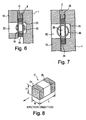
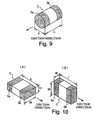
- Ca and Cb denote electrodes formed at two ends in the length direction of the individual parts C.
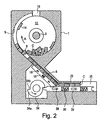
- FIGS. 1 and 2 are overall views of the part-conveying apparatus.
- the apparatus is composed of three divisions: a part-aligning division in an upper portion, a part-ejecting division in a lower portion, and a part-chute division in an intermediate portion.
- the part-aligning division has a circular concave section 2 formed in a main body 1, and a rotating drum 11 fitted in the concave section 2 so as to be rotatable.
- an axis 3 is arranged, and a bearing section 4 is arranged to rotatably journal the axis 3.
- a part-aligning groove 5 is formed in a semicircular arc shape whose width and depth are designed to have a constant clearance allowing the parts C of the width W and height H to pass through.
- a tapered guide face 6 is formed sloping toward the part-aligning groove 5 on the inner peripheral surface of the concave section 2. The guide face 6 guides the parts C into the part-aligning groove 5.
- a gate opening 8 is formed in a lower portion of the part-aligning groove 5. Via the gate opening 8, a chute 9 is formed so as to communicate with the part-aligning groove 5.
- the chute 9 is formed substantially tangential to the part-aligning groove 5 that is semicircular-arc shaped, sloping down at a given sliding angle.
- the gate opening 8 is formed at an intersection of the part-aligning groove 5 and the chute 9, which are tangential to each other.
- the gate opening 8 has dimensions allowing the parts C to pass through one by one in a state aligned on their sides in the length direction; that is, with the height and the width which are larger than H and W, and with the length smaller than L. Also, the width of the gate opening 8 is the same as the width of the part-aligning groove 5.
- a part-storing space 12 is formed between the main body 1 and the rotating drum 11.
- the part-storing space 12 has a storing capacity for a large number of the parts C fed in via a part-feeding opening 10.
- the rotating drum 11 is formed preferably of a transparent material such as an acrylic resin so that the volume of the parts C therein can be checked visually.
- An inner peripheral surface of the rotating drum 11 includes a tapered guide face 13 opposing the guide face 6. The guide face 13 guides the parts C into the part-aligning groove 5 in the same manner as the guide face 6.
- a plurality of protruding tabs 14 (two pieces are shown in the drawing) is formed at a constant angular pitch.
- the tabs 14 have dimensions so as to pass over the gate opening 8 and the part-aligning groove 5. The tabs 14 serve to normalize the parts C jammed at the gate opening 8.
- the axis 3 is connected to a driving means, such as an electric motor, and rotates with the rotating drum 11 in the direction indicated by arrow A. In the rotation, the tabs 14 push back the parts C jammed at the gate opening 8 in the direction opposite to the chute 9, thereby recovering from the jam.
- the rotation method for the rotating drum 11 is not limited to the above, with which the axis 3 rotates, but other methods may be employed. Also, the rotation method is not limited to a continuous rotation method, but an intermittent rotation method may be employed.
- the parts C fed from the part-feeding opening 10 and have been stored in the part-storing space 12 are guided by the guide faces 6 and 13, which are formed respectively in the main body 1 and the rotating drum 11, into the part-aligning groove 5. At this time, the parts C are aligned in a predetermined direction since the part-aligning groove 5 is formed with the width and the depth which have a constant clearance so as to allow passage of parts C having the width W and the height H.
- the tabs 14 of rotating drum 11 remove jams occurring at the gate opening 8, but in addition, they agitate the parts C that are formed like a bridge to disturb sliding in order to expedite sliding down into the part-aligning groove 5.
- the tabs 14 of the rotating drum 11 serve to carry the parts C stored in a bottom section of the part-storing space 12 into the part-aligning groove 5. In this way, all the parts C in the part-storing space 12 can be ejected.
- a lateral section is open in a region from a middle section to a lower section, and the open area is blocked by a lateral cover 15.
- a mobile blade (mobile member) 16 is provided in a bottom section of the chute 9 so as to be slidable in the direction of the chute 9. The mobile blade 16 slidably supports bottom surfaces of the parts C.
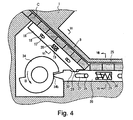
- the mobile blade 16 is made of a thin metal plate whose thickness is substantially the same as the width W or the height H of the part C, and as shown in FIG. 4.
- Long holes 17 each extending in the length direction are individually formed in front and rear portions of the mobile blade 16, and guide pins 18 protruding from the main body I are fitted into the long holes 17 so as to be slidable. In this manner, the mobile blade 16 is slidably guided in the direction of the chute 9.
- a stroke of the mobile blade 16 is limited within the range of the long hole 17, the range being smaller than the length L of the part C.
- a spring-holder hole 19 is formed in a central portion of the mobile blade 16 to store a spring 20.
- two sides in the radial direction of the spring 20 are respectively engaged with a concave section 21 formed on the main body 1 and with an opening 22 formed in the lateral cover 15, continuously urging down the mobile blade 16 in a diagonal direction.
- an projection (engaging section) 23 is formed to engage with a conveying blade 26 that is described below.
- a lower end section of the chute 9 is connected to a rear end section of a horizontal guide path 25 into which the parts C that have slid down the chute 9 are carried.
- a lateral section of the guide path 25 is open and is blocked by the lateral cover 15.
- the conveying blade (conveying member) 26 is arranged so as to be movable forward and backward.
- the conveying blade 26 slidably supports bottom surfaces of the parts C.
- the mobile blade 26 is made of a thin metal plate whose thickness is substantially the same as the width W or the height H of the part C.
- long holes 27 each extending in the length direction are individually formed in front and rear portions of the conveying blade 26, and guide pins 28 protruding from the main body 1 are slidably fitted into the long holes 27. In this manner, the mobile blade 26 is guided so as to be movable horizontally in the back and front direction.
- a plurality of spring-holder holes 29 is formed in the mobile blade 26, each of them retaining a spring 30.
- an shallow groove (engaging section) 33 is formed engageable with the projection 23, which is formed in the lower end section of the mobile blade 16.
- the projection 23 and the groove 33 comprise a driving means that finely moves the mobile blade 16 in the direction of the chute 9.
- a cam 34 for reciprocating the conveying blade 26 in a manner so as to move backward faster than to move forward.
- the rear portion of the conveying blade 26 is urged by the spring 30 so as to contact a peripheral surface of the cam 34.
- the spring 30 and the cam 34 compose a conveying means for reciprocating the conveying blade 26.
- the cam 34 has a crest section 34a and a valley section 34b and is rotationally driven by means of a motor (not shown) in the direction indicated by arrow B.
- a motor not shown
- the advancing speed of the conveying blade 26 is specified so that a predetermined supporting frictional force operates between the conveying blade 26 and the parts C sliding thereon.
- the returning speed of the conveying blade 26 is specified so that the supporting frictional forces are substantially discontinued between the conveying blade 26 and the parts C sliding thereon. Therefore, during backward and forward reciprocating movements of the conveying blade 26, the parts C placed thereon are conveyed forward intermittently.
- the parts C conveyed to a front end section of the guide path 25 are ejected one by one at an ejection position 35 by means of an ejecting device (not shown), such as that called a chip mounter.
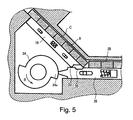
- the projection 23 of the mobile blade 16 repeats the operation of falling into groove 33 and rising therefrom, thereby allowing the mobile blade 16 to finely move in the direction of the chute 9.
- the projection 23 is fallen inside the groove 33 with the mobile blade 16 being positioned at the lower end.
- the cam 34 rotates to move the conveying blade 26 forward, as shown in FIG. 5, the projection 23 rises over an upper surface of the conveying blade 26 with the mobile blade 16 moving upward. In this manner, the mobile blade 16 is finely moved in the direction of the chute 9, whereby the friction between the mobile blade 16 and the parts C can be discontinued. Therefore, the parts C are allowed to slide down the chute 9 smoothly even when the parts C are of a small mass, are dirty, or are electrostatically charged.
- the projection 23 is provided at the lower end of the mobile blade 16, and the groove 33 is provided on the upper surface of the conveying blade 26.
- a projection arranged on an upper surface of the conveying blade 26 provides the same effects as above.
- FIG. 11 is view of a second embodiment according to the present invention.
- a conveying blade 16 is oscillated and moved perpendicular to a chute 9, thereby discontinuing friction occurring between the mobile blade 16 and the parts C.
- an upper end section of the mobile blade 16 is supported by an axis 40 so as to oscillate and move and remains at a lower position to which it has been oscillated and moved by gravity.
- a projection 41 is formed on an upper surface of a conveying blade 26.
- the projection 41 is not in contact with the mobile blade 16.
- the projection 41 oscillates and moves the mobile blade 16 upward by a fine stroke.
- An oscillating and moving stroke of the conveying blade 26 must be restricted so that the parts C on the conveying blade 26 are not sandwiched between the surface thereof and an upward internal surface of a chute 9.
- the mobile blade 16 is caused to oscillate and move synchronously with the forward and backward movement of the conveying blade 26, whereby the parts C on the mobile blade 16 are allowed to slide down smoothly.
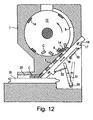
- FIG. 12 is a view of a third embodiment according to the present invention.
- a mobile blade 16 is provided in an entire region of a chute 9. Similarly to the first embodiment, the mobile blade 16 is guided by long holes 17 and pins 18 so as to be movable only by a constant distance in the direction of the chute 9.
- a first spring 50 is provided between a rear end section of the mobile blade 16 and a main body 1.
- the first spring 50 urges down the mobile blade 16 diagonally.
- a lever 51 is provided so as to oscillate and move around an axis 53 in the direction of chute 9.
- a second spring 52 is provided between the lever 51 and a front end section of the mobile blade 16.
- compression springs are used in this embodiment, but these springs may be replaced by tension springs.
- the mobile blade 16 In an initial condition, as shown in FIG. 12, the mobile blade 16 is moved by a force of the first spring 50 in a lower position and is in contact with or close to the conveying blade 26.
- the lever 51 is pulled by a force of the second spring 52, and as a result of oscillating and moving motion, it is located in a left position in FIG. 12.
- the stroke of the mobile blade 16 is determined by long holes 17 and pins 18. Therefore, even though the lever 51 is oscillated and moved by a long distance, the stroke of the mobile blade 16 is in fact not effected.
- This allows an arrangement of a driving mechanism for the lever 51 to be selective.
- the mobile blade 16 and the conveying blade 26 are not directly engaged with each other, whereby producing the advantage of less abrasion.
- the first spring 50 is provided between the main body I and the mobile blade 16. However, it may be provided between the mobile blade 16 and the lever 51. That is, the respective first and second springs 51 and 52 may be arranged at two sides of the lever 51. Furthermore, effects equivalent to the above can be implemented even in a arrangement such as in which one end of the second spring 52 is connected to the main body 1, and one end of the first spring 50 is connected to the mobile blade 16.
- blades are used as mobile members and conveying members, but there is no restriction thereto.
- the present invention may use other members if they are movable in a predetermined direction.
- thin members such as the blades used in these embodiments achieves a reduction in weight, so that inertia effects can be also reduced. This allows the driving mechanism to be simple.
- parts that can be conveyed by the present invention are not restricted to chip parts, but any types of parts may be conveyed as long as they are conveyable through the chute in a state in which they are aligned.
Landscapes
- Engineering & Computer Science (AREA)
- Mechanical Engineering (AREA)
- Feeding Of Articles To Conveyors (AREA)
- Jigging Conveyors (AREA)
- Chutes (AREA)
Applications Claiming Priority (2)
| Application Number | Priority Date | Filing Date | Title |
|---|---|---|---|
| JP18835698 | 1998-07-03 | ||
| JP18835698A JP3539618B2 (ja) | 1998-07-03 | 1998-07-03 | 部品搬送装置 |
Publications (2)
| Publication Number | Publication Date |
|---|---|
| EP0968939A1 true EP0968939A1 (fr) | 2000-01-05 |
| EP0968939B1 EP0968939B1 (fr) | 2004-06-23 |
Family
ID=16222199
Family Applications (1)
| Application Number | Title | Priority Date | Filing Date |
|---|---|---|---|
| EP99305071A Expired - Lifetime EP0968939B1 (fr) | 1998-07-03 | 1999-06-28 | Dispositif de transport pour pièces |
Country Status (8)
| Country | Link |
|---|---|
| US (1) | US6257394B1 (fr) |
| EP (1) | EP0968939B1 (fr) |
| JP (1) | JP3539618B2 (fr) |
| CN (1) | CN1118427C (fr) |
| DE (1) | DE69918223D1 (fr) |
| MY (1) | MY117430A (fr) |
| SG (1) | SG74151A1 (fr) |
| TW (1) | TW446676B (fr) |
Cited By (8)
| Publication number | Priority date | Publication date | Assignee | Title |
|---|---|---|---|---|
| WO2004042381A3 (fr) * | 2002-11-04 | 2004-09-02 | Kimberly Clark Co | Systeme automatique de remballage et d'accumulation |
| US6823981B2 (en) | 2002-11-04 | 2004-11-30 | Kimberly-Clark Worldwide, Inc. | Conveyor system for an automatic accumulation system |
| US6877294B2 (en) | 2002-11-04 | 2005-04-12 | Kimberly-Clark Worldwide, Inc. | Automatic repacking and accumulation system |
| US6884016B2 (en) | 2002-11-04 | 2005-04-26 | Kimberly-Clark Worldwide, Inc. | Positioning system for an automatic accumulation system |
| US6918485B2 (en) | 2002-11-04 | 2005-07-19 | Kimberly-Clark Worldwide, Inc. | Orientation detection and control system |
| US7108155B2 (en) | 2002-11-04 | 2006-09-19 | Kimberly-Clark Worldwide, Inc. | Metering drum for an automatic accumulation system |
| US7159375B2 (en) | 2003-10-08 | 2007-01-09 | Kimberly-Clark Worldwide, Inc. | Multi-product accumulating and packing system |
| EP2130791A4 (fr) * | 2007-04-04 | 2016-11-16 | Sanki Company Ltd | Procédé et appareil de neutralisation pour dispositif d'alimentation de pièces |
Families Citing this family (12)
| Publication number | Priority date | Publication date | Assignee | Title |
|---|---|---|---|---|
| CN101306763B (zh) * | 2008-05-13 | 2011-06-15 | 郑卫星 | 工件输送装置 |
| CN201227799Y (zh) * | 2008-07-03 | 2009-04-29 | 鸿富锦精密工业(深圳)有限公司 | 螺钉供给装置 |
| CN102050327A (zh) * | 2010-09-28 | 2011-05-11 | 慈溪市贝瑞软件有限公司 | 一种别针穿装机中的导轨装置 |
| US9266685B2 (en) * | 2011-07-05 | 2016-02-23 | Conceptromec Inc. | Clip separating system, kit for assembling the same, and corresponding methods of operating and assembling associated thereof |
| CN102826365A (zh) * | 2012-09-17 | 2012-12-19 | 天通(六安)电子材料科技有限公司 | 一种磁环自动排列喷码机装置 |
| KR101871700B1 (ko) * | 2014-02-27 | 2018-06-27 | 가부시키가이샤 무라타 세이사쿠쇼 | 정렬 공급 장치 및 정렬 방법 |
| CN106239094B (zh) * | 2016-08-31 | 2018-05-29 | 赛特威尔电子股份有限公司 | 一种自动调整工件方向的传送装置 |
| CN106241226B (zh) * | 2016-08-31 | 2018-09-14 | 赛特威尔电子股份有限公司 | 一种传送装置 |
| CN106271511B (zh) * | 2016-08-31 | 2018-06-08 | 赛特威尔电子股份有限公司 | 一种可调整工件方向的传送装置 |
| CN106312499B (zh) * | 2016-08-31 | 2018-06-15 | 赛特威尔电子股份有限公司 | 一种发射管传送装置 |
| CN109533885A (zh) * | 2018-11-15 | 2019-03-29 | 吴建德 | 一种餐厨废油蒸馏残渣输送装置 |
| JP7435515B2 (ja) * | 2021-03-17 | 2024-02-21 | 株式会社村田製作所 | 部品収容装置 |
Citations (6)
| Publication number | Priority date | Publication date | Assignee | Title |
|---|---|---|---|---|
| US4732296A (en) * | 1985-06-14 | 1988-03-22 | Michael Heck | Track feed arrangement for an automatic screw feeding machine |
| JPS63127600A (ja) | 1986-11-17 | 1988-05-31 | 日東工業株式会社 | カートリッジ式チップケースを備えたチップ分離整列装置 |
| GB2244482A (en) * | 1990-05-31 | 1991-12-04 | Taiyo Yuden Kk | Parts dispensing device |
| EP0683625A2 (fr) * | 1994-05-18 | 1995-11-22 | Taiyo Yuden Co., Ltd. | Dispositif et méthode pour la fourniture de composants électroniques |
| JPH08222890A (ja) | 1995-02-16 | 1996-08-30 | Matsushita Electric Ind Co Ltd | 電子部品供給装置 |
| US5702028A (en) * | 1995-10-30 | 1997-12-30 | Ykk Corporation | Parts feeder |
Family Cites Families (1)
| Publication number | Priority date | Publication date | Assignee | Title |
|---|---|---|---|---|
| IT1249025B (it) * | 1990-06-29 | 1995-02-11 | Savio Spa | Dispositivo per il caricamento sequenziale di tubetti orientabili ad un filatoio |
-
1998
- 1998-07-03 JP JP18835698A patent/JP3539618B2/ja not_active Expired - Lifetime
-
1999
- 1999-06-22 TW TW088110405A patent/TW446676B/zh not_active IP Right Cessation
- 1999-06-25 SG SG1999003437A patent/SG74151A1/en unknown
- 1999-06-28 DE DE69918223T patent/DE69918223D1/de not_active Expired - Fee Related
- 1999-06-28 EP EP99305071A patent/EP0968939B1/fr not_active Expired - Lifetime
- 1999-06-30 CN CN99108953.7A patent/CN1118427C/zh not_active Expired - Lifetime
- 1999-06-30 MY MYPI99002758A patent/MY117430A/en unknown
- 1999-06-30 US US09/343,701 patent/US6257394B1/en not_active Expired - Lifetime
Patent Citations (6)
| Publication number | Priority date | Publication date | Assignee | Title |
|---|---|---|---|---|
| US4732296A (en) * | 1985-06-14 | 1988-03-22 | Michael Heck | Track feed arrangement for an automatic screw feeding machine |
| JPS63127600A (ja) | 1986-11-17 | 1988-05-31 | 日東工業株式会社 | カートリッジ式チップケースを備えたチップ分離整列装置 |
| GB2244482A (en) * | 1990-05-31 | 1991-12-04 | Taiyo Yuden Kk | Parts dispensing device |
| EP0683625A2 (fr) * | 1994-05-18 | 1995-11-22 | Taiyo Yuden Co., Ltd. | Dispositif et méthode pour la fourniture de composants électroniques |
| JPH08222890A (ja) | 1995-02-16 | 1996-08-30 | Matsushita Electric Ind Co Ltd | 電子部品供給装置 |
| US5702028A (en) * | 1995-10-30 | 1997-12-30 | Ykk Corporation | Parts feeder |
Cited By (8)
| Publication number | Priority date | Publication date | Assignee | Title |
|---|---|---|---|---|
| WO2004042381A3 (fr) * | 2002-11-04 | 2004-09-02 | Kimberly Clark Co | Systeme automatique de remballage et d'accumulation |
| US6823981B2 (en) | 2002-11-04 | 2004-11-30 | Kimberly-Clark Worldwide, Inc. | Conveyor system for an automatic accumulation system |
| US6877294B2 (en) | 2002-11-04 | 2005-04-12 | Kimberly-Clark Worldwide, Inc. | Automatic repacking and accumulation system |
| US6884016B2 (en) | 2002-11-04 | 2005-04-26 | Kimberly-Clark Worldwide, Inc. | Positioning system for an automatic accumulation system |
| US6918485B2 (en) | 2002-11-04 | 2005-07-19 | Kimberly-Clark Worldwide, Inc. | Orientation detection and control system |
| US7108155B2 (en) | 2002-11-04 | 2006-09-19 | Kimberly-Clark Worldwide, Inc. | Metering drum for an automatic accumulation system |
| US7159375B2 (en) | 2003-10-08 | 2007-01-09 | Kimberly-Clark Worldwide, Inc. | Multi-product accumulating and packing system |
| EP2130791A4 (fr) * | 2007-04-04 | 2016-11-16 | Sanki Company Ltd | Procédé et appareil de neutralisation pour dispositif d'alimentation de pièces |
Also Published As
| Publication number | Publication date |
|---|---|
| DE69918223D1 (de) | 2004-07-29 |
| TW446676B (en) | 2001-07-21 |
| CN1241524A (zh) | 2000-01-19 |
| US6257394B1 (en) | 2001-07-10 |
| MY117430A (en) | 2004-06-30 |
| EP0968939B1 (fr) | 2004-06-23 |
| JP3539618B2 (ja) | 2004-07-07 |
| SG74151A1 (en) | 2000-07-18 |
| CN1118427C (zh) | 2003-08-20 |
| JP2000016558A (ja) | 2000-01-18 |
Similar Documents
| Publication | Publication Date | Title |
|---|---|---|
| US6257394B1 (en) | Part-conveying apparatus | |
| US6290095B1 (en) | Chip component take-in apparatus | |
| US2825126A (en) | Fastener slider assembly machine | |
| US4322068A (en) | Receiving hopper for documents | |
| US20050092584A1 (en) | Parts aligner | |
| KR0122599B1 (ko) | 경화수납 및 배출장치 | |
| EP0469886A2 (fr) | Courroie pour le transport successif de pièces de monnaie | |
| JP3244046B2 (ja) | 部品搬送装置 | |
| US5730317A (en) | Structure of chip component feeder | |
| US5170874A (en) | Coin conveyor for successively transporting coins | |
| US6209713B1 (en) | Part transfer apparatus | |
| US6513644B1 (en) | Apparatus and method for aligning parts | |
| EP0690419A1 (fr) | Dispositif pour distribuer des pièces d'argent | |
| CN118907900A (zh) | 卡片回收装置 | |
| US4148475A (en) | Sheet sorting device | |
| EP0085646A1 (fr) | Dispositif pour compter et empiler des découpes | |
| KR20080020467A (ko) | 카드 송출 장치 | |
| JP7199062B2 (ja) | 円盤体案内装置 | |
| US7455579B2 (en) | Overflow chute apparatus for coin storing | |
| RU2208507C2 (ru) | Бункерно-загрузочное устройство для деталей стержневого типа | |
| JPH0844929A (ja) | コイン揚送装置 | |
| US12033453B2 (en) | Coin handling apparatus | |
| JP7752895B2 (ja) | コインホッパ、およびコイン処理装置 | |
| US3973467A (en) | Cartridge infeed apparatus for an automatic firing weapon | |
| SU1511052A1 (ru) | Устройство дл ориентации цилиндрических деталей с кольцевой проточкой |
Legal Events
| Date | Code | Title | Description |
|---|---|---|---|
| PUAI | Public reference made under article 153(3) epc to a published international application that has entered the european phase |
Free format text: ORIGINAL CODE: 0009012 |
|
| 17P | Request for examination filed |
Effective date: 19990707 |
|
| AK | Designated contracting states |
Kind code of ref document: A1 Designated state(s): DE FR GB |
|
| AX | Request for extension of the european patent |
Free format text: AL;LT;LV;MK;RO;SI |
|
| AKX | Designation fees paid |
Free format text: DE FR |
|
| RBV | Designated contracting states (corrected) |
Designated state(s): DE FR GB |
|
| 17Q | First examination report despatched |
Effective date: 20020523 |
|
| GRAP | Despatch of communication of intention to grant a patent |
Free format text: ORIGINAL CODE: EPIDOSNIGR1 |
|
| GRAS | Grant fee paid |
Free format text: ORIGINAL CODE: EPIDOSNIGR3 |
|
| GRAA | (expected) grant |
Free format text: ORIGINAL CODE: 0009210 |
|
| AK | Designated contracting states |
Kind code of ref document: B1 Designated state(s): DE FR GB |
|
| PG25 | Lapsed in a contracting state [announced via postgrant information from national office to epo] |
Ref country code: FR Free format text: LAPSE BECAUSE OF FAILURE TO SUBMIT A TRANSLATION OF THE DESCRIPTION OR TO PAY THE FEE WITHIN THE PRESCRIBED TIME-LIMIT Effective date: 20040623 |
|
| REG | Reference to a national code |
Ref country code: GB Ref legal event code: FG4D |
|
| REF | Corresponds to: |
Ref document number: 69918223 Country of ref document: DE Date of ref document: 20040729 Kind code of ref document: P |
|
| PG25 | Lapsed in a contracting state [announced via postgrant information from national office to epo] |
Ref country code: DE Free format text: LAPSE BECAUSE OF NON-PAYMENT OF DUE FEES Effective date: 20050101 |
|
| PLBE | No opposition filed within time limit |
Free format text: ORIGINAL CODE: 0009261 |
|
| STAA | Information on the status of an ep patent application or granted ep patent |
Free format text: STATUS: NO OPPOSITION FILED WITHIN TIME LIMIT |
|
| 26N | No opposition filed |
Effective date: 20050324 |
|
| EN | Fr: translation not filed | ||
| PGFP | Annual fee paid to national office [announced via postgrant information from national office to epo] |
Ref country code: GB Payment date: 20180620 Year of fee payment: 20 |
|
| REG | Reference to a national code |
Ref country code: GB Ref legal event code: PE20 Expiry date: 20190627 |
|
| PG25 | Lapsed in a contracting state [announced via postgrant information from national office to epo] |
Ref country code: GB Free format text: LAPSE BECAUSE OF EXPIRATION OF PROTECTION Effective date: 20190627 |