EP0969085A2 - Drainageeinrichtung für eine schnelle Biofilmbildung - Google Patents
Drainageeinrichtung für eine schnelle Biofilmbildung Download PDFInfo
- Publication number
- EP0969085A2 EP0969085A2 EP99305057A EP99305057A EP0969085A2 EP 0969085 A2 EP0969085 A2 EP 0969085A2 EP 99305057 A EP99305057 A EP 99305057A EP 99305057 A EP99305057 A EP 99305057A EP 0969085 A2 EP0969085 A2 EP 0969085A2
- Authority
- EP
- European Patent Office
- Prior art keywords
- conduit
- biofilm
- accordance
- drain system
- pilot
- Prior art date
- Legal status (The legal status is an assumption and is not a legal conclusion. Google has not performed a legal analysis and makes no representation as to the accuracy of the status listed.)
- Granted
Links
Images
Classifications
-
- C—CHEMISTRY; METALLURGY
- C12—BIOCHEMISTRY; BEER; SPIRITS; WINE; VINEGAR; MICROBIOLOGY; ENZYMOLOGY; MUTATION OR GENETIC ENGINEERING
- C12M—APPARATUS FOR ENZYMOLOGY OR MICROBIOLOGY; APPARATUS FOR CULTURING MICROORGANISMS FOR PRODUCING BIOMASS, FOR GROWING CELLS OR FOR OBTAINING FERMENTATION OR METABOLIC PRODUCTS, i.e. BIOREACTORS OR FERMENTERS
- C12M29/00—Means for introduction, extraction or recirculation of materials, e.g. pumps
-
- C—CHEMISTRY; METALLURGY
- C12—BIOCHEMISTRY; BEER; SPIRITS; WINE; VINEGAR; MICROBIOLOGY; ENZYMOLOGY; MUTATION OR GENETIC ENGINEERING
- C12M—APPARATUS FOR ENZYMOLOGY OR MICROBIOLOGY; APPARATUS FOR CULTURING MICROORGANISMS FOR PRODUCING BIOMASS, FOR GROWING CELLS OR FOR OBTAINING FERMENTATION OR METABOLIC PRODUCTS, i.e. BIOREACTORS OR FERMENTERS
- C12M23/00—Constructional details, e.g. recesses, hinges
- C12M23/22—Transparent or translucent parts
-
- C—CHEMISTRY; METALLURGY
- C12—BIOCHEMISTRY; BEER; SPIRITS; WINE; VINEGAR; MICROBIOLOGY; ENZYMOLOGY; MUTATION OR GENETIC ENGINEERING
- C12N—MICROORGANISMS OR ENZYMES; COMPOSITIONS THEREOF; PROPAGATING, PRESERVING, OR MAINTAINING MICROORGANISMS; MUTATION OR GENETIC ENGINEERING; CULTURE MEDIA
- C12N1/00—Microorganisms; Compositions thereof; Processes of propagating, maintaining or preserving microorganisms or compositions thereof; Processes of preparing or isolating a composition containing a microorganism; Culture media therefor
- C12N1/20—Bacteria; Culture media therefor
-
- G—PHYSICS
- G01—MEASURING; TESTING
- G01N—INVESTIGATING OR ANALYSING MATERIALS BY DETERMINING THEIR CHEMICAL OR PHYSICAL PROPERTIES
- G01N33/00—Investigating or analysing materials by specific methods not covered by groups G01N1/00 - G01N31/00
- G01N33/18—Water
- G01N33/186—Water using one or more living organisms, e.g. a fish
- G01N33/1866—Water using one or more living organisms, e.g. a fish using microorganisms
Definitions
- This invention generally relates to methodology for production of experimental biofilm matrices on selected surfaces. More specifically this invention relates to the production of simulated natural biofilms for testing the activities of formulated products for inhibition or removal of the simulated biofilms from a drainage system.
- Biofilm science is reviewed in publications such as Food Reviews International, 8 (4), 573 (1992); Microbial Ecology in Health and Disease, 8 , 305 (1995); Annu. Rev. Microbial, 49 , 711 (1995); Applied and Environmental Microbiology, 4014 (Nov. 1996); and "Biofilms” by W. G. Characklis and K. C. Marshall (John Wiley & Sons, Inc., New York, 1989).
- a biofilm consists of cells immobilized on a substratum and embedded in an organic polymer matrix of microbial origin.
- a biofilm is a surface accumulation, which is not necessarily uniform in time or space.
- a biofilm may be composed of a significant fraction of inorganic or abiotic substances held cohesively by the biotic matrix.
- a biofilm is a protective matrix for bacteria, with the essential purpose of survival in an environment of limited nutrient supply.
- Biofilms consist of both host microbes and their extracellular products, usually exopolysaccharides. Microbes have a tendency to form these protective exopolysaccharide matrices after they have adhered to a surface. The formation of biofilm complexes requires only humid conditions and/or water systems and contact with a support surface and/or interface. With respect to nutrients, a nutrient deficiency in fact may increase the biofilm formation capacity of microbes, as reported in Adv. Appl. Microbiol., 29, 93 (1983).
- Biofilms generally can be produced by almost all microbes under suitable conditions.
- the most common biofilm producers belong to the genera Pseudomonas, Enterobacter, Flavobacterium, Alcaligenes, Staphylococcus, and Bacillus.
- biofilms can cause energy losses and blockages in condenser and heat exchange tubes, interfere with water and waste water systems, and form drag-inducing encrustations on ship hulls.
- a biofilm (referred to as "glycocalyx") formed by bacteria such as a Pseudomonas species can be the systemic causation of diseases of the lungs or the gastrointestinal and urinary tracts.
- a biofilm formed by bacteria such as Staphylococcus species can be a serious contamination problem in foreign-body instruments such as cardiac pacemakers, catheters, prostheses, artificial valves, and the like.
- Dental plaque is also a typical form of biofilm.
- biofilms One of the main purposes of natural biofilm formation is for the protection of the host microbes from a hostile environment. As a consequence, there is a combative interaction between microbes in biofilms and biocidal vehicles such as preservatives, disinfectants and antibiotics. Further, the sessile mode of bacterial growth in biofilms differs from that of the same bacteria species that are present as planktonic cells in a circulating aqueous medium which interfaces with the biofilm. Biofilms also act as a trap for nutrient acquisition, which is an important factor when bacteria grow on surfaces and the nutrient supply is oligotrophic.
- biofilm formation Because of the manifold ramifications of biofilm formation, there is a serious commitment to biofilm research in a broad range of scientific investigations.
- Methods of studying biofilm formation include microbiological, physical, and chemical methods. When microbes from extreme natural environments are cultured, standard plate counts usually do not provide accurate estimates. Thus, the classical evaluation methods relying on microbiological plating have questionable value with respect to the laboratory study of biofilms which are intended to achieve authentic correspondence with natural biofilms which exist in the biosphere.
- formation of a natural type biofilm in the laboratory environment is difficult, mainly because there are no standardized methodologies currently available.
- One or more objects of the present invention are accomplished by the provision of a method for rapid biofilm formation in accordance with a monitored protocol which comprises (1) providing a pilot drain system for liquid flow through a conduit having an average internal diameter between about 0.9-5 centimeters (preferably 0.9-2 centimeters); (2) introducing aqueous nutrient medium and bacterial inoculum comprising sheathed bacteria into the influent end of the conduit to full volume capacity without drainage; (3) maintaining the aqueous suspension medium in the drain conduit for an incubation period sufficient to initiate bacterial attachment to the conduit inner surface; (4) draining the suspension from the effluent end of the drain conduit; (5) recharging and draining the conduit with aqueous nutrient medium at least once every 24 hours of elapsed time period under simulated drain usage conditions to promote biofilm formation on the conduit inner surface; and (6) repeating the aqueous medium recharging and draining cycle of step (5) for an elapsed time period up to about 40 days (preferably up to about 15 days) that is
- Sphaerotilus-Leptothrix group of sheathed bacteria are of particular advantage for purposes of the present invention.
- Genera species include Sphaerotilus natans, Leptothrix lopholea, Leptothrix ochracea, Leptothrix cholodnii and Leptothrix discophora.
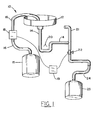
- FIG. 1 is an elevational side view of an invention pilot drain system.
- pilot drain system 10 comprises sink 12 which is at the influent end of conduit 14.
- conduit 14 is structured to include P-trap 20, vent pipe 21, and solenoid valve 22. Drainage from conduit 14 flows through line 24 into effluent receptacle 25.
- Aqueous nutrient medium is supplied through pump 18 from feed receptacle 15 via line 16 to conduit 14.
- Timer 19 controls the flow of the aqueous nutrient feed supply, and the drainage of the system through solenoid valve 22.
- conduit 14 has a 1.5 centimeter internal diameter, and is constructed of transparent polyvinyl chloride. Conduit 14 can have an internal diameter between about 0.9-5 centimeters, and can be constructed of other materials such as metal or glass.
- a standardized nutrient medium can be employed for the biofilm bacterial growth cycles. Suitable nutrient media for biofilm formation are described in technical publications such as Biotechnol. Bioeng., 53 (5), 459 (1997); incorporated herein by reference.
- a typical nutrient medium contains sources of carbon, nitrogen, phosphate and trace nutrients.
- An essential aspect of the present invention pilot drain system is the incorporation of an inoculum comprising Sphaerotilus-Leptothrix type bacteria.
- S. Natans illustrates a preferred species of sheathed bacteria in the present invention.
- Sheathed bacteria are filamentous organisms with a unique life cycle involving formation of flagellated swarmer cells within a long tube or sheath. Under favorable conditions, vegetative growth occurs within the filament, leading to the formation of long cell-packed sheaths. Under unfavorable conditions, the swarmer cells move out and become dispersed into new environments, leaving behind the empty sheath.
- Sheathed bacteria are common in freshwater habitats that are rich in organic matter, such as polluted streams, trickling filters, and activated sludge plants, being found primarily in flowing waters.
- S. natans is a valuable vehicle for purposes of the present invention because of its ability to proliferate rapidly under natural or simulated nutrient conditions.
- An important feature of a present invention pilot drain system is the rapid formation of a biofilm in a drain conduit for the purpose of testing the activity of a product relative to the simulated biofilm.
- the cycled nutrient medium can include household, business and industrial drain contaminants such as shaving cream, hair, skin cells, grease, paper, foodstuffs, tap water, and the like.
- a bacterial inoculum from a natural biofilm is employed together with the S. natans. This is illustrated by a bacterial inoculum which is extracted from a household drain biofilm.
- the monitored protocol in the pilot drain system is designed to provide essential correspondence with simulated household drain conditions, thereby promoting the formation of a simulated biofilm in the reactor which has close correspondence with a household drain natural biofilm.
- simulated biofilm refers to a derivative biofilm which has essential phenotypic correspondence with the bacterial consortia of a drain type natural biofilm.
- natural biofilm refers to a biospheric surface-mediated bacterial consortium which is in a dynamic relationship with environmental parameters.
- the present invention methodology has particular advantage for the preparation of simulated biofilms which are a convenient and reliable vehicle for testing the activities of formulated products, where said products are intended for inhibition or removal of natural biofilms having a phenotypic relationship with the simulated biofilms respectively.
- the present invention methodology can be illustrated by reference to a simulated household drain biofilm which is derived from an inoculum comprising S. natans and a natural household drain biofilm.
- conduit 14 the inoculum and aqueous nutrient medium are introduced into conduit 14, and without drainage the contained liquid volume is recycled through conduit 14 (recycle not shown in FIG. 1) for an incubation period between about 2-48 hours at a temperature between about 15°-45°C.
- fresh nutrient medium is recharged and drained in timed cycles to simulate household drain usage conditions.
- the nutrient medium recharge and drain cycle is repeated at least once every three hours of elapsed time period.
- the simulated biofilm mass inside conduit 14 occupies at least about 20-30 percent ofthe internal volume of conduit 14.
- the methodology of the present invention thus provides a pilot drain system comprising a conduit having an average internal diameter between about 0.9-5 centimeters, and having a biofilm mass on the conduit inner surface which comprises Sphaerotilus-Leptothrix colonies (e.g., S. natans) and which occupies at least about 20 percent of the conduit volume.
- the biofilm preferably contains additional bacterial colonies derived from tap water under simulated household drain usage conditions, and/or bacterial colonies derived from a natural biofilm inoculum.
- the pilot drain system methodology of the present invention has general utility for the production of simulated biofilms which are intended for application in a further protocol for testing the activity of an experimental product or a commercial product.
- the further protocol can include testing the activity of products such as biocides and cleaners, and products for opening conduits which are clogged with biomass, and the like.
- This example illustrates methodology for rapid biofilm growth in a pilot drain system, and the application of the system for testing a drain cleaning product in accordance with the present invention.
- a colony of S. natans (ATCC 15291) is streaked onto a CGY plate, and the plate is incubated for 48 hours at 28°C.
- One colony from the freshly-grown plate is inoculated into 100 mL of CGY medium and incubated overnight in a shaking incubator.
- the CGY medium has the following composition: Casitone (Difco 0259) 5g Glycerol 10g Yeast Autolysate 1g Distilled water 1L
- a pilot drain system corresponding to FIG. 1 is employed, with accessory equipment not illustrated in FIG. 1.
- the drain system is filled with 115 mL of CGY medium, and the medium is inoculated with 10 mL of the S. natans preparation.
- Recycle tubing is used to circulate 125mL of the drain system liquid medium for 24 hours.
- the CGY medium is drained, and timed recharge and draining of medium in the pilot drain system is commenced.
- CGY medium is charged to the drain system conduit, and after 40 seconds the medium is drained. This cycle is repeated once every hour for 10 hours a day, over a lapsed time period of about 10-20 days until there is about a 30 percent reduction in the free volume of the drain conduit.
- the inoculum includes authentic natural drain biofilm bacteria
- the nutrient medium includes shaving cream, hair, skin cells or other household drain contaminants of specific concern.
- a rubber stopper is used to plug the effluent end of the drain system.
- Deionized water 200 grams is poured into the influent conduit until the water level fills the lateral section and reaches the vent pipe. The weight of the added water is determined, and this is converted into a volume value (a density of 1 g/mL).
- the rubber stopper is removed, and the water content is drained. Three volume measurements are conducted and the results are averaged.
- the volume measurements are conducted once every 2-3 days. Flow rate measurement is not commenced until there is at least a 30 percent reduction in the measured volume.
- a rubber stopper is used to plug the effluent end of the drain system.
- Deionized water (1500 mL) is poured into the sink section. The plug is removed, and the time for sink drainage is recorded.
- the flow rate is measured once a day, and the measurement is repeated five times to calculate a statistical average.
- At least two identical pilot drain systems are operated simultaneously to grow biofilm in the respective drain conduits.
- a sample of a cleaning product (Liquid DRANO ® , 4 ounces) is charged to one drain system, and an equal volume of deionized water is charged to a comparable drain system.
- the treatments are held in the conduits for 15 minutes. The treatments then are drained, and the conduits are rinsed with a gallon of warm water (45°C). Flow rate and volume measurements are conducted immediately to determine the effect of the cleaner activity on the pilot drain system biofilm mass. The measurements are repeated about 24 hours after treatment.
Landscapes
- Health & Medical Sciences (AREA)
- Life Sciences & Earth Sciences (AREA)
- Chemical & Material Sciences (AREA)
- Engineering & Computer Science (AREA)
- Zoology (AREA)
- Wood Science & Technology (AREA)
- Organic Chemistry (AREA)
- Bioinformatics & Cheminformatics (AREA)
- Biotechnology (AREA)
- Microbiology (AREA)
- Biochemistry (AREA)
- General Health & Medical Sciences (AREA)
- Genetics & Genomics (AREA)
- Biomedical Technology (AREA)
- General Engineering & Computer Science (AREA)
- Sustainable Development (AREA)
- Medicinal Chemistry (AREA)
- Analytical Chemistry (AREA)
- Immunology (AREA)
- Virology (AREA)
- Food Science & Technology (AREA)
- Physics & Mathematics (AREA)
- Clinical Laboratory Science (AREA)
- General Physics & Mathematics (AREA)
- Tropical Medicine & Parasitology (AREA)
- Pathology (AREA)
- Measuring Or Testing Involving Enzymes Or Micro-Organisms (AREA)
- Micro-Organisms Or Cultivation Processes Thereof (AREA)
- Purification Treatments By Anaerobic Or Anaerobic And Aerobic Bacteria Or Animals (AREA)
- Materials For Medical Uses (AREA)
- Apparatus Associated With Microorganisms And Enzymes (AREA)
Applications Claiming Priority (2)
| Application Number | Priority Date | Filing Date | Title |
|---|---|---|---|
| US09/106,615 US6207405B1 (en) | 1998-06-29 | 1998-06-29 | Pilot drain system for rapid biofilm formation |
| US106615 | 1998-06-29 |
Publications (3)
| Publication Number | Publication Date |
|---|---|
| EP0969085A2 true EP0969085A2 (de) | 2000-01-05 |
| EP0969085A3 EP0969085A3 (de) | 2002-03-06 |
| EP0969085B1 EP0969085B1 (de) | 2006-05-17 |
Family
ID=22312368
Family Applications (1)
| Application Number | Title | Priority Date | Filing Date |
|---|---|---|---|
| EP99305057A Expired - Lifetime EP0969085B1 (de) | 1998-06-29 | 1999-06-28 | Drainageeinrichtung für eine schnelle Biofilmbildung |
Country Status (5)
| Country | Link |
|---|---|
| US (1) | US6207405B1 (de) |
| EP (1) | EP0969085B1 (de) |
| AT (1) | ATE326522T1 (de) |
| CA (1) | CA2275074A1 (de) |
| DE (1) | DE69931310T2 (de) |
Cited By (1)
| Publication number | Priority date | Publication date | Assignee | Title |
|---|---|---|---|---|
| US10336639B2 (en) | 2009-01-13 | 2019-07-02 | Access Business Group International Llc | Gravity feed water treatment system |
Families Citing this family (2)
| Publication number | Priority date | Publication date | Assignee | Title |
|---|---|---|---|---|
| US8070898B2 (en) | 2005-10-04 | 2011-12-06 | Clph, Llc | Catheters with lubricious linings and methods for making and using them |
| US9606035B2 (en) | 2011-12-21 | 2017-03-28 | Ta Instruments-Waters Llc | System for mechanical stimulation and characterization of biologic samples |
Family Cites Families (5)
| Publication number | Priority date | Publication date | Assignee | Title |
|---|---|---|---|---|
| JPS615774A (ja) * | 1984-06-19 | 1986-01-11 | Kyowa Hakko Kogyo Co Ltd | 発酵槽から発酵液の無菌採取装置 |
| JPH06509640A (ja) * | 1991-07-11 | 1994-10-27 | キワ ナームロゼ フェンノートシャップ | 生長及び付着層のためのモニター |
| US5273904A (en) * | 1992-03-18 | 1993-12-28 | Cobe Laboratories, Inc. | Apparatus for purifying islets of Langerhans |
| US5873997A (en) * | 1996-10-18 | 1999-02-23 | The Academy Of Natural Sciences Of Philadelphia | Bioreactor and method of measuring contaminants in an aqueous environment |
| US5928889A (en) * | 1998-02-13 | 1999-07-27 | S.C. Johnson & Son, Inc. | Protocol for simulated natural biofilm formation |
-
1998
- 1998-06-29 US US09/106,615 patent/US6207405B1/en not_active Expired - Fee Related
-
1999
- 1999-06-17 CA CA002275074A patent/CA2275074A1/en not_active Abandoned
- 1999-06-28 AT AT99305057T patent/ATE326522T1/de not_active IP Right Cessation
- 1999-06-28 EP EP99305057A patent/EP0969085B1/de not_active Expired - Lifetime
- 1999-06-28 DE DE69931310T patent/DE69931310T2/de not_active Expired - Fee Related
Cited By (1)
| Publication number | Priority date | Publication date | Assignee | Title |
|---|---|---|---|---|
| US10336639B2 (en) | 2009-01-13 | 2019-07-02 | Access Business Group International Llc | Gravity feed water treatment system |
Also Published As
| Publication number | Publication date |
|---|---|
| DE69931310D1 (de) | 2006-06-22 |
| US6207405B1 (en) | 2001-03-27 |
| EP0969085A3 (de) | 2002-03-06 |
| DE69931310T2 (de) | 2007-05-10 |
| ATE326522T1 (de) | 2006-06-15 |
| CA2275074A1 (en) | 1999-12-29 |
| EP0969085B1 (de) | 2006-05-17 |
Similar Documents
| Publication | Publication Date | Title |
|---|---|---|
| US5928889A (en) | Protocol for simulated natural biofilm formation | |
| Rogers et al. | Influence of plumbing materials on biofilm formation and growth of Legionella pneumophila in potable water systems | |
| Lappin‐Scott et al. | Bacterial biofilms and surface fouling | |
| Moritz et al. | Integration of Pseudomonas aeruginosa and Legionella pneumophila in drinking water biofilms grown on domestic plumbing materials | |
| van der Kooij et al. | Biofilm composition and threshold concentration for growth of Legionella pneumophila on surfaces exposed to flowing warm tap water without disinfectant | |
| Lin et al. | Molecular characterization of natural biofilms from household taps with different materials: PVC, stainless steel, and cast iron in drinking water distribution system | |
| Bagh et al. | Distribution of bacteria in a domestic hot water system in a Danish apartment building | |
| Meyer-Reil | Bacterial growth rates and biomass production | |
| Adogo et al. | Bacteriological and physico-chemical analysis of borehole water in Auta Balefi Community, Nasarawa State, Nigeria | |
| Eboigbodin et al. | A review of biofilms in domestic plumbing | |
| Skovhus et al. | Effects of early biofilm formation on water quality during commissioning of new polyethylene pipes | |
| Green et al. | A laboratory apparatus for the generation and biocide efficacy testing of Legionella biofilms | |
| US6207405B1 (en) | Pilot drain system for rapid biofilm formation | |
| Rawal et al. | Water quality assessment using physicochemical and bacteriological parameters of Fateh Sagar Lake, Udaipur, India | |
| Boe-Hansen | Microbial growth in drinking water distribution systems | |
| Chattopadhyay | Cold-adaptation of Antarctic microorganisms–possible involvement of viable but nonculturable state | |
| Aizaki | Growth rates of microorganisms in a periphyton community | |
| Schofiled et al. | Survial of Legionella pneumophila in a Model Hot Water Distribution System | |
| Donderski et al. | Occurrence and physiological properties of bacterioplankton of Lake Chełmżyńskie (Poland) | |
| ADEYEMI et al. | Comparative bacteriological analysis of stored borehole water sources in Oyo town, Oyo State, Nigeria | |
| Dewailly et al. | Contamination of domestic water heaters with Legionella pneumophila: impact of water temperature on growth and dissemination of the bacterium | |
| Passman | Microbial problems in metalworking fluids | |
| Jeanvoine et al. | Persistent contamination of a hospital hot water network by Legionella pneumophila | |
| Gaju et al. | Distribution of predatory bacteria that attack Chromatiaceae in a sulfurous lake | |
| Machnicka | Accumulation of Phosphorus by Filamentous Microorganisms. |
Legal Events
| Date | Code | Title | Description |
|---|---|---|---|
| PUAI | Public reference made under article 153(3) epc to a published international application that has entered the european phase |
Free format text: ORIGINAL CODE: 0009012 |
|
| AK | Designated contracting states |
Kind code of ref document: A2 Designated state(s): AT BE CH CY DE DK ES FI FR GB GR IE IT LI LU MC NL PT SE Kind code of ref document: A2 Designated state(s): AT BE CH DE DK ES FI FR GB GR IE IT LI LU NL PT SE |
|
| AX | Request for extension of the european patent |
Free format text: AL;LT;LV;MK;RO;SI |
|
| PUAL | Search report despatched |
Free format text: ORIGINAL CODE: 0009013 |
|
| AK | Designated contracting states |
Kind code of ref document: A3 Designated state(s): AT BE CH CY DE DK ES FI FR GB GR IE IT LI LU MC NL PT SE |
|
| AX | Request for extension of the european patent |
Free format text: AL;LT;LV;MK;RO;SI |
|
| 17P | Request for examination filed |
Effective date: 20020425 |
|
| AKX | Designation fees paid |
Free format text: AT BE CH DE DK ES FI FR GB GR IE IT LI LU NL PT SE |
|
| 17Q | First examination report despatched |
Effective date: 20030505 |
|
| GRAP | Despatch of communication of intention to grant a patent |
Free format text: ORIGINAL CODE: EPIDOSNIGR1 |
|
| GRAS | Grant fee paid |
Free format text: ORIGINAL CODE: EPIDOSNIGR3 |
|
| GRAA | (expected) grant |
Free format text: ORIGINAL CODE: 0009210 |
|
| AK | Designated contracting states |
Kind code of ref document: B1 Designated state(s): AT BE CH DE DK ES FI FR GB GR IE IT LI LU NL PT SE |
|
| PG25 | Lapsed in a contracting state [announced via postgrant information from national office to epo] |
Ref country code: NL Free format text: LAPSE BECAUSE OF FAILURE TO SUBMIT A TRANSLATION OF THE DESCRIPTION OR TO PAY THE FEE WITHIN THE PRESCRIBED TIME-LIMIT Effective date: 20060517 Ref country code: LI Free format text: LAPSE BECAUSE OF FAILURE TO SUBMIT A TRANSLATION OF THE DESCRIPTION OR TO PAY THE FEE WITHIN THE PRESCRIBED TIME-LIMIT Effective date: 20060517 Ref country code: FI Free format text: LAPSE BECAUSE OF FAILURE TO SUBMIT A TRANSLATION OF THE DESCRIPTION OR TO PAY THE FEE WITHIN THE PRESCRIBED TIME-LIMIT Effective date: 20060517 Ref country code: CH Free format text: LAPSE BECAUSE OF FAILURE TO SUBMIT A TRANSLATION OF THE DESCRIPTION OR TO PAY THE FEE WITHIN THE PRESCRIBED TIME-LIMIT Effective date: 20060517 Ref country code: BE Free format text: LAPSE BECAUSE OF FAILURE TO SUBMIT A TRANSLATION OF THE DESCRIPTION OR TO PAY THE FEE WITHIN THE PRESCRIBED TIME-LIMIT Effective date: 20060517 Ref country code: AT Free format text: LAPSE BECAUSE OF FAILURE TO SUBMIT A TRANSLATION OF THE DESCRIPTION OR TO PAY THE FEE WITHIN THE PRESCRIBED TIME-LIMIT Effective date: 20060517 |
|
| REG | Reference to a national code |
Ref country code: GB Ref legal event code: FG4D |
|
| REG | Reference to a national code |
Ref country code: CH Ref legal event code: EP |
|
| REG | Reference to a national code |
Ref country code: IE Ref legal event code: FG4D |
|
| REF | Corresponds to: |
Ref document number: 69931310 Country of ref document: DE Date of ref document: 20060622 Kind code of ref document: P |
|
| PGFP | Annual fee paid to national office [announced via postgrant information from national office to epo] |
Ref country code: GB Payment date: 20060626 Year of fee payment: 8 |
|
| PG25 | Lapsed in a contracting state [announced via postgrant information from national office to epo] |
Ref country code: IE Free format text: LAPSE BECAUSE OF NON-PAYMENT OF DUE FEES Effective date: 20060628 |
|
| PGFP | Annual fee paid to national office [announced via postgrant information from national office to epo] |
Ref country code: IT Payment date: 20060630 Year of fee payment: 8 |
|
| PGFP | Annual fee paid to national office [announced via postgrant information from national office to epo] |
Ref country code: DE Payment date: 20060731 Year of fee payment: 8 |
|
| PG25 | Lapsed in a contracting state [announced via postgrant information from national office to epo] |
Ref country code: SE Free format text: LAPSE BECAUSE OF FAILURE TO SUBMIT A TRANSLATION OF THE DESCRIPTION OR TO PAY THE FEE WITHIN THE PRESCRIBED TIME-LIMIT Effective date: 20060817 Ref country code: DK Free format text: LAPSE BECAUSE OF FAILURE TO SUBMIT A TRANSLATION OF THE DESCRIPTION OR TO PAY THE FEE WITHIN THE PRESCRIBED TIME-LIMIT Effective date: 20060817 |
|
| PG25 | Lapsed in a contracting state [announced via postgrant information from national office to epo] |
Ref country code: ES Free format text: LAPSE BECAUSE OF FAILURE TO SUBMIT A TRANSLATION OF THE DESCRIPTION OR TO PAY THE FEE WITHIN THE PRESCRIBED TIME-LIMIT Effective date: 20060828 |
|
| PG25 | Lapsed in a contracting state [announced via postgrant information from national office to epo] |
Ref country code: PT Free format text: LAPSE BECAUSE OF FAILURE TO SUBMIT A TRANSLATION OF THE DESCRIPTION OR TO PAY THE FEE WITHIN THE PRESCRIBED TIME-LIMIT Effective date: 20061017 |
|
| NLV1 | Nl: lapsed or annulled due to failure to fulfill the requirements of art. 29p and 29m of the patents act | ||
| REG | Reference to a national code |
Ref country code: CH Ref legal event code: PL |
|
| PLBE | No opposition filed within time limit |
Free format text: ORIGINAL CODE: 0009261 |
|
| STAA | Information on the status of an ep patent application or granted ep patent |
Free format text: STATUS: NO OPPOSITION FILED WITHIN TIME LIMIT |
|
| 26N | No opposition filed |
Effective date: 20070220 |
|
| EN | Fr: translation not filed | ||
| GBPC | Gb: european patent ceased through non-payment of renewal fee |
Effective date: 20070628 |
|
| PG25 | Lapsed in a contracting state [announced via postgrant information from national office to epo] |
Ref country code: GR Free format text: LAPSE BECAUSE OF FAILURE TO SUBMIT A TRANSLATION OF THE DESCRIPTION OR TO PAY THE FEE WITHIN THE PRESCRIBED TIME-LIMIT Effective date: 20060818 Ref country code: FR Free format text: LAPSE BECAUSE OF FAILURE TO SUBMIT A TRANSLATION OF THE DESCRIPTION OR TO PAY THE FEE WITHIN THE PRESCRIBED TIME-LIMIT Effective date: 20070309 Ref country code: DE Free format text: LAPSE BECAUSE OF NON-PAYMENT OF DUE FEES Effective date: 20080101 |
|
| PG25 | Lapsed in a contracting state [announced via postgrant information from national office to epo] |
Ref country code: GB Free format text: LAPSE BECAUSE OF NON-PAYMENT OF DUE FEES Effective date: 20070628 |
|
| PG25 | Lapsed in a contracting state [announced via postgrant information from national office to epo] |
Ref country code: LU Free format text: LAPSE BECAUSE OF NON-PAYMENT OF DUE FEES Effective date: 20060628 |
|
| PG25 | Lapsed in a contracting state [announced via postgrant information from national office to epo] |
Ref country code: FR Free format text: LAPSE BECAUSE OF FAILURE TO SUBMIT A TRANSLATION OF THE DESCRIPTION OR TO PAY THE FEE WITHIN THE PRESCRIBED TIME-LIMIT Effective date: 20060517 |
|
| PG25 | Lapsed in a contracting state [announced via postgrant information from national office to epo] |
Ref country code: IT Free format text: LAPSE BECAUSE OF NON-PAYMENT OF DUE FEES Effective date: 20070628 |