EP0969113B1 - Acier inoxydable austenitique à basse teneur en nickel - Google Patents
Acier inoxydable austenitique à basse teneur en nickel Download PDFInfo
- Publication number
- EP0969113B1 EP0969113B1 EP99401490A EP99401490A EP0969113B1 EP 0969113 B1 EP0969113 B1 EP 0969113B1 EP 99401490 A EP99401490 A EP 99401490A EP 99401490 A EP99401490 A EP 99401490A EP 0969113 B1 EP0969113 B1 EP 0969113B1
- Authority
- EP
- European Patent Office
- Prior art keywords
- corrosion
- steel
- nickel
- content
- calcium
- Prior art date
- Legal status (The legal status is an assumption and is not a legal conclusion. Google has not performed a legal analysis and makes no representation as to the accuracy of the status listed.)
- Revoked
Links
- PXHVJJICTQNCMI-UHFFFAOYSA-N Nickel Chemical compound [Ni] PXHVJJICTQNCMI-UHFFFAOYSA-N 0.000 title claims abstract description 67
- 229910000831 Steel Inorganic materials 0.000 title claims abstract description 63
- 239000010959 steel Substances 0.000 title claims abstract description 63
- 229910052759 nickel Inorganic materials 0.000 title claims abstract description 34
- RYGMFSIKBFXOCR-UHFFFAOYSA-N Copper Chemical compound [Cu] RYGMFSIKBFXOCR-UHFFFAOYSA-N 0.000 claims abstract description 22
- NINIDFKCEFEMDL-UHFFFAOYSA-N Sulfur Chemical compound [S] NINIDFKCEFEMDL-UHFFFAOYSA-N 0.000 claims abstract description 21
- OYPRJOBELJOOCE-UHFFFAOYSA-N Calcium Chemical compound [Ca] OYPRJOBELJOOCE-UHFFFAOYSA-N 0.000 claims abstract description 20
- 239000011575 calcium Substances 0.000 claims abstract description 20
- 229910052791 calcium Inorganic materials 0.000 claims abstract description 20
- 229910052802 copper Inorganic materials 0.000 claims abstract description 19
- 239000010949 copper Substances 0.000 claims abstract description 19
- VYZAMTAEIAYCRO-UHFFFAOYSA-N Chromium Chemical compound [Cr] VYZAMTAEIAYCRO-UHFFFAOYSA-N 0.000 claims abstract description 18
- 229910052799 carbon Inorganic materials 0.000 claims abstract description 15
- 229910052804 chromium Inorganic materials 0.000 claims abstract description 15
- 239000011651 chromium Substances 0.000 claims abstract description 15
- OKTJSMMVPCPJKN-UHFFFAOYSA-N Carbon Chemical compound [C] OKTJSMMVPCPJKN-UHFFFAOYSA-N 0.000 claims abstract description 14
- ZOXJGFHDIHLPTG-UHFFFAOYSA-N Boron Chemical compound [B] ZOXJGFHDIHLPTG-UHFFFAOYSA-N 0.000 claims abstract description 13
- 229910052796 boron Inorganic materials 0.000 claims abstract description 13
- XEEYBQQBJWHFJM-UHFFFAOYSA-N Iron Chemical compound [Fe] XEEYBQQBJWHFJM-UHFFFAOYSA-N 0.000 claims abstract description 12
- 239000010703 silicon Substances 0.000 claims abstract description 10
- 229910052710 silicon Inorganic materials 0.000 claims abstract description 10
- 229910052750 molybdenum Inorganic materials 0.000 claims abstract description 9
- OAICVXFJPJFONN-UHFFFAOYSA-N Phosphorus Chemical compound [P] OAICVXFJPJFONN-UHFFFAOYSA-N 0.000 claims abstract description 8
- XAGFODPZIPBFFR-UHFFFAOYSA-N aluminium Chemical compound [Al] XAGFODPZIPBFFR-UHFFFAOYSA-N 0.000 claims abstract description 8
- 229910052782 aluminium Inorganic materials 0.000 claims abstract description 8
- QVGXLLKOCUKJST-UHFFFAOYSA-N atomic oxygen Chemical compound [O] QVGXLLKOCUKJST-UHFFFAOYSA-N 0.000 claims abstract description 6
- 239000012535 impurity Substances 0.000 claims abstract description 6
- 229910052742 iron Inorganic materials 0.000 claims abstract description 6
- 229910052760 oxygen Inorganic materials 0.000 claims abstract description 6
- 239000001301 oxygen Substances 0.000 claims abstract description 6
- 229910052698 phosphorus Inorganic materials 0.000 claims abstract description 6
- 239000011574 phosphorus Substances 0.000 claims abstract description 6
- 230000007797 corrosion Effects 0.000 claims description 69
- 238000005260 corrosion Methods 0.000 claims description 69
- 239000000203 mixture Substances 0.000 claims description 21
- PWHULOQIROXLJO-UHFFFAOYSA-N Manganese Chemical compound [Mn] PWHULOQIROXLJO-UHFFFAOYSA-N 0.000 claims description 11
- ZOKXTWBITQBERF-UHFFFAOYSA-N Molybdenum Chemical compound [Mo] ZOKXTWBITQBERF-UHFFFAOYSA-N 0.000 claims description 10
- 229910052748 manganese Inorganic materials 0.000 claims description 9
- 239000011572 manganese Substances 0.000 claims description 9
- 239000011733 molybdenum Substances 0.000 claims description 8
- 239000004411 aluminium Substances 0.000 claims description 4
- 229910000963 austenitic stainless steel Inorganic materials 0.000 claims description 3
- 238000003723 Smelting Methods 0.000 claims 2
- 239000005864 Sulphur Substances 0.000 claims 2
- 229910052717 sulfur Inorganic materials 0.000 abstract description 16
- 239000011593 sulfur Substances 0.000 abstract description 16
- WPBNNNQJVZRUHP-UHFFFAOYSA-L manganese(2+);methyl n-[[2-(methoxycarbonylcarbamothioylamino)phenyl]carbamothioyl]carbamate;n-[2-(sulfidocarbothioylamino)ethyl]carbamodithioate Chemical compound [Mn+2].[S-]C(=S)NCCNC([S-])=S.COC(=O)NC(=S)NC1=CC=CC=C1NC(=S)NC(=O)OC WPBNNNQJVZRUHP-UHFFFAOYSA-L 0.000 abstract description 3
- 230000000694 effects Effects 0.000 description 20
- FAPWRFPIFSIZLT-UHFFFAOYSA-M Sodium chloride Chemical compound [Na+].[Cl-] FAPWRFPIFSIZLT-UHFFFAOYSA-M 0.000 description 14
- IJGRMHOSHXDMSA-UHFFFAOYSA-N Atomic nitrogen Chemical compound N#N IJGRMHOSHXDMSA-UHFFFAOYSA-N 0.000 description 13
- 230000006399 behavior Effects 0.000 description 9
- XUIMIQQOPSSXEZ-UHFFFAOYSA-N Silicon Chemical compound [Si] XUIMIQQOPSSXEZ-UHFFFAOYSA-N 0.000 description 8
- 239000010955 niobium Substances 0.000 description 7
- 239000011780 sodium chloride Substances 0.000 description 7
- 229910052757 nitrogen Inorganic materials 0.000 description 6
- 238000010791 quenching Methods 0.000 description 5
- 230000000171 quenching effect Effects 0.000 description 5
- XLYOFNOQVPJJNP-UHFFFAOYSA-N water Substances O XLYOFNOQVPJJNP-UHFFFAOYSA-N 0.000 description 5
- 230000009286 beneficial effect Effects 0.000 description 4
- 241000272534 Struthio camelus Species 0.000 description 3
- 239000002253 acid Substances 0.000 description 3
- 229910000589 SAE 304 stainless steel Inorganic materials 0.000 description 2
- 238000005275 alloying Methods 0.000 description 2
- 230000000052 comparative effect Effects 0.000 description 2
- 238000010438 heat treatment Methods 0.000 description 2
- 230000010287 polarization Effects 0.000 description 2
- 229910001220 stainless steel Inorganic materials 0.000 description 2
- 239000000126 substance Substances 0.000 description 2
- 238000003466 welding Methods 0.000 description 2
- -1 841 steel Chemical compound 0.000 description 1
- 239000001825 Polyoxyethene (8) stearate Substances 0.000 description 1
- 206010070834 Sensitisation Diseases 0.000 description 1
- 238000005266 casting Methods 0.000 description 1
- 230000001627 detrimental effect Effects 0.000 description 1
- 230000006870 function Effects 0.000 description 1
- 238000007654 immersion Methods 0.000 description 1
- 230000000977 initiatory effect Effects 0.000 description 1
- 238000005259 measurement Methods 0.000 description 1
- 229910052758 niobium Inorganic materials 0.000 description 1
- GUCVJGMIXFAOAE-UHFFFAOYSA-N niobium atom Chemical compound [Nb] GUCVJGMIXFAOAE-UHFFFAOYSA-N 0.000 description 1
- 230000008313 sensitization Effects 0.000 description 1
- 239000010935 stainless steel Substances 0.000 description 1
Images


Classifications
-
- C—CHEMISTRY; METALLURGY
- C22—METALLURGY; FERROUS OR NON-FERROUS ALLOYS; TREATMENT OF ALLOYS OR NON-FERROUS METALS
- C22C—ALLOYS
- C22C38/00—Ferrous alloys, e.g. steel alloys
- C22C38/18—Ferrous alloys, e.g. steel alloys containing chromium
- C22C38/40—Ferrous alloys, e.g. steel alloys containing chromium with nickel
- C22C38/58—Ferrous alloys, e.g. steel alloys containing chromium with nickel with more than 1.5% by weight of manganese
-
- C—CHEMISTRY; METALLURGY
- C22—METALLURGY; FERROUS OR NON-FERROUS ALLOYS; TREATMENT OF ALLOYS OR NON-FERROUS METALS
- C22C—ALLOYS
- C22C38/00—Ferrous alloys, e.g. steel alloys
- C22C38/18—Ferrous alloys, e.g. steel alloys containing chromium
- C22C38/40—Ferrous alloys, e.g. steel alloys containing chromium with nickel
- C22C38/42—Ferrous alloys, e.g. steel alloys containing chromium with nickel with copper
Definitions
- the invention relates to an austenitic stainless steel comprising low nickel content and corrosion resistant in particular, the generalized corrosion, pitting corrosion, and cavernous corrosion.
- Patents are known for steels whose composition contains, in proportion, the basic elements such as chromium, nickel, manganese, copper, silicon, giving an austenitic structure.
- patent application in France N ° 70 27 948 presents an austenitic steel whose composition is as follows: carbon: 0.05% -0.15%; silicon: 0.3% -1.0%; manganese: 4% -12%; nickel: 0.5% -3%; chromium: 13% -16%; nitrogen: 0.05% -0.2%.
- This patent application discloses compositions of austenitic stainless steels with low nickel content and relatively high manganese content having corrosion resistance equivalent or superior to that of conventional commercial grades with high nickel content, such as AISI 304, 301, 201, 202, after immersion tests in chlorinated medium and test in SO 2 . It is well specified the influence of copper, molybdenum and nickel, nickel having to be in low content, but the influence of elements such as calcium, boron, sulfur, is not approached.
- patent JP 54038217 deals with a steel Manganese austenitic with the following composition:: carbon: less than 0.04%; silicon: less than 1%; manganese: 6% -13%; nickel: 1.0% -3.5%; chromium: 13% -19%; niobium: less than 0.3%; copper: 1.0% -3.5%, earth rare: 0.005% -0.3%.
- the steel described has a resistance to corrosion. at least equivalent to that of stainless steel type AISI 304 and, a high resistance to intergranular corrosion. It is not about elements sulfur, calcium and boron or their influence on the different types of corrosion.
- patent JP 52024914 presents a steel austenitic, the composition of which is as follows: carbon: 0.11% -0.15%; silicon: less than 1%; manganese: 8.0% -11%; nickel: 1.0% -3.5%; chromium: 16% -18%; nitrogen: 0.05% -0.15%; copper: 0.5% -3.5%; molybdenum: less than 0.5%. It is taught that lower nickel content will not harm not corrosion. The influence of elements such as sulfur, boron is not not presented.
- the present invention aims to develop an austenitic steel with a very low nickel content which exhibits close corrosion resistance that of AISI 304 steel, in particular in the field of resistance to pitting, cavernous and generalized corrosion.
- the steel may also contain from 0.01% to 2% molybdenum.
- Figures 1 and 2 show the comparative values of the potential pitting, respectively in NaCI, 0.02M, pH 6.6 and 23 ° C and NaCI, 0.5M, pH 6.6 and 23 ° C, for different types of steels taken as reference and for three compositions according to the invention marked with an asterisk.
- FIG. 3 shows the evolution of the pitting potentials, in NaCl, 0.02M, pH 6.6 and 23 ° C, depending on the sulfur content for two reference steels and two steels according to the invention, one of which comprises in its composition a low chromium content.
- Figure 4 presents characteristics of resistance to corrosion cavernous in chlorinated medium for three steels taken as reference and three steels according to the invention and comprising in their composition different nickel contents.
- Figures 5 and 6 show the comparative values of the potential of sting respectively in NaCI, 0.02M, pH 6.6 and 23 ° C and in NaCI, 0.5M, pH 6.6 and 23 ° C for different types of steels allowing highlight the influence of boron.
- the steel according to the invention has been developed in order to meet the corrosion criteria and in particular the criteria for pitting corrosion, widespread and cavernous.
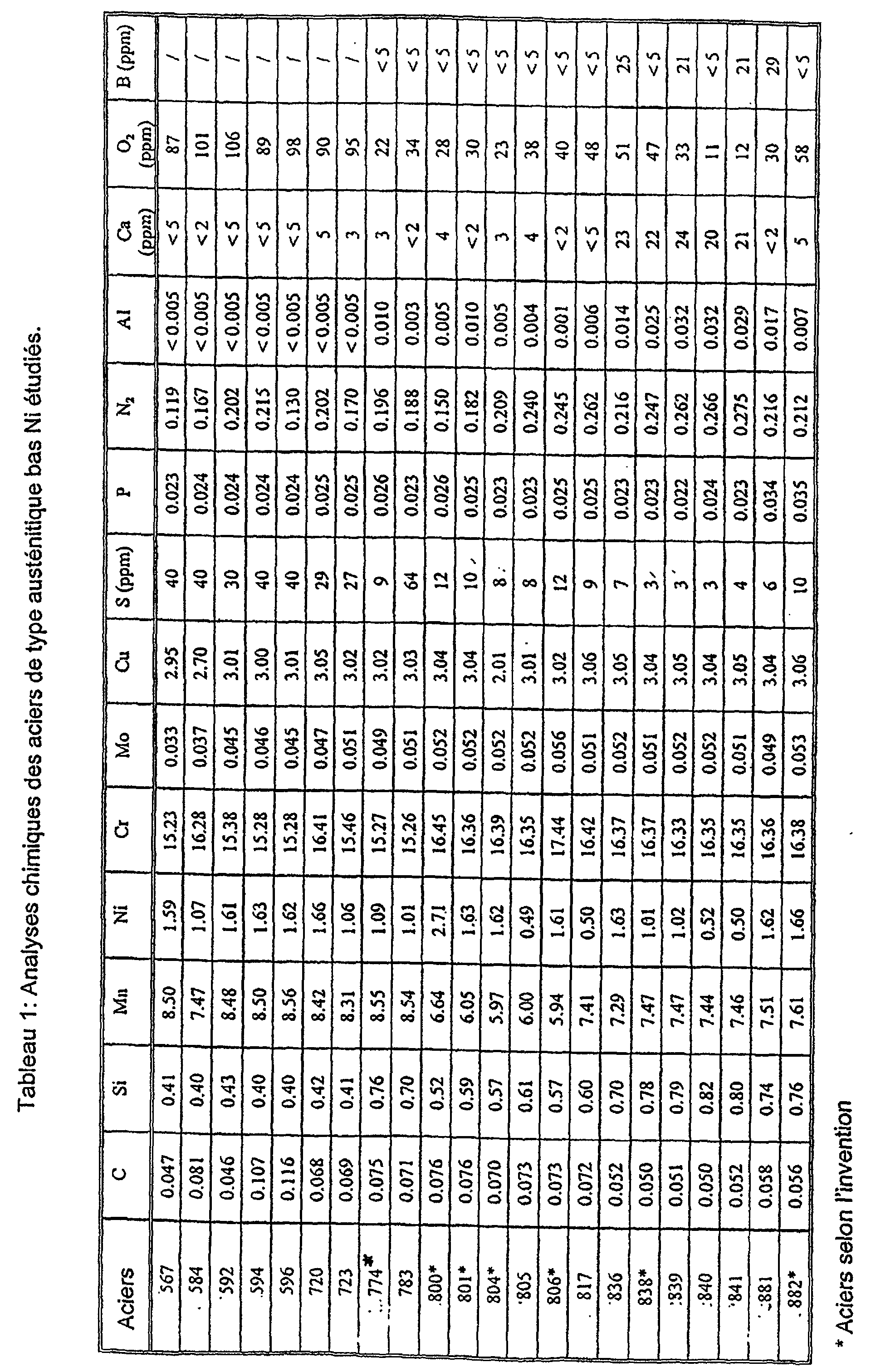
- Table 1 The chemical compositions of the steels tested are presented in Table 1, the first column giving casting references of tested steels, the steels according to the invention being marked with an asterisk.
- Table 2 presents the chemical compositions of the reference steels known and tested, for comparison.
- Tables 3 and 4 show the results of corrosion tests which justify the choice of the composition according to the invention.
- For pitting corrosion we give the potential E1 which corresponds to the probability of 1 pitting per cm 2 .
- For the cavernous corrosion the values of critical current densities i given in different NaCl solutions, 2M of variable pH are given.
- For the generalized corrosion the values of the critical current densities i are given in an acid solution H 2 SO 4 , 2M.
- the intergranular corrosion results are given in Table 4 in the form of mass losses ⁇ m and maximum crack depth in ⁇ m. Results of pitting, cavernous and generalized corrosion tests.
- Sulfur has no effect in terms of general corrosion resistance. In the field of cavernous corrosion, it slightly degrades the resistance to ignition and to the propagation of corrosion, with a higher critical current i at a pH greater than or equal to 2.0 when the sulfur content increases. On the other hand, in the area of pitting corrosion, its effect is much greater. By lowering the sulfur content to levels of the order of 10 10 -4 %, in the composition of steels containing in their composition little nickel, the resistance to initiation of the pitting is greatly improved.
- the steel according to the invention has the same properties as a reference steel AISI 304 or an AISI 430 Ti steel which comprises around 30 10 -4 % of sulfur, while low nickel steel, with a sulfur content of 30 10 -4 %, behaves like a reference steel AISI 430 Nb.
- nickel is very beneficial in the field of generalized corrosion and cavernous corrosion.
- a nickel content of less than 2% is preferable for good resistance to pitting corrosion.
- Figure 4 presents, in the form of curves giving the values activity currents as a function of the pH of a chlorinated solution, the cavernous corrosion behavior of various reference steels and steels according to the invention.
- the activity currents are proportional to the corrosion rate. The more the curve is located towards the abscissa, the lower the corrosion rates and therefore the better the corrosion resistance. The effect of copper.
- Copper has a beneficial effect in the field of corrosion widespread. To have a behavior equivalent to that of a steel of type AISI 304, it is shown by the behavior of steel 804 that a copper content of 2% can be considered insufficient, so that a copper content of 3% is better, as shown by the behavior of steel 801.
- Copper however, has a detrimental effect on resistance to corrosion by pitting, as shown in Figures 1 and 2 or Table 3.
- Steel 801 with a copper content of 3% has pitting potentials less than those of 804 steel with a copper content of 2%.
- the content of copper is according to the invention, preferably limited to 4%.
- the calcium content must be very low, i.e. less than 20.10 -4 % and preferably less than 10.10 -4 %.
- Chromium is beneficial in the field of corrosion generalized, pitting corrosion and cavernous corrosion as it appears in table 3 by comparing the values obtained on steels 584 and 723, 801 and 806. A minimum content of 15% is necessary to ensure good corrosion behavior, but a content of 16.5% is preferable to obtain corrosion resistance that meets a corrosion resistance comparable to that of a standard steel of the type AISI 304 or AISI 430 Ti.
- the steel according to the invention exhibits corrosion resistance comparable to that of AISI 304 reference steel but contains in its little nickel composition.
- the steel according to the invention has a much higher behavior. to that of steels of the type AISI 430 Ti in the field of corrosion widespread and cavernous.
Landscapes
- Chemical & Material Sciences (AREA)
- Engineering & Computer Science (AREA)
- Materials Engineering (AREA)
- Mechanical Engineering (AREA)
- Metallurgy (AREA)
- Organic Chemistry (AREA)
- Preventing Corrosion Or Incrustation Of Metals (AREA)
- Heat Treatment Of Sheet Steel (AREA)
- Heat Treatment Of Articles (AREA)
- Hard Magnetic Materials (AREA)
- Heat Treatment Of Steel (AREA)
- Soft Magnetic Materials (AREA)
- Chemically Coating (AREA)
- Catalysts (AREA)
- Manufacture And Refinement Of Metals (AREA)
- Laminated Bodies (AREA)
Description
le reste étant du fer et des impuretés résultant de l'élaboration.
le reste étant du fer et des impuretés résultant de l'élaboration.
- la corrosion par piqûre en milieu NaCI, 0,02M et 0,5M à 23°C, avec un pH de 6,6,
- la corrosion caverneuse en milieu chloruré à 23°C par un tracé de courbes de polarisation en milieu NaCI, 2M à différents pH acides, puis une mesure des courants d'activité ,
- la corrosion généralisée en milieu sulfurique concentré 2M à 23°C par le tracé de courbes de polarisation et par la mesure de courant d'activité.
- la corrosion intergranulaire par essai STRAUSS sur acier sensibilisé par traitement thermique et sur un acier soudé TIG.
Pour la corrosion par piqûre, on donne le potentiel E1 qui correspond à la probabilité de 1 piqûre par cm2. Pour la corrosion caverneuse, on donne les valeurs de densités de courant i critiques mesurées dans différentes solutions de NaCI, 2M de pH variables. Pour la corrosion généralisée sont données les valeurs des densités de courant i critiques dans une solution acide H2SO4, 2M. Les résultats de corrosion intergranulaire sont donnés sur le tableau 4 sous la forme de pertes de masse Δm et profondeur maximum des fissures en µm.

| Résultats des tests de corrosion par piqûre, caverneuse et généralisée. | ||||||||
| Corrosion par piqûre (E1 en mV/ECS) | Corrosion caverneuse (NaCl 2M) i crit (µA/cm2) | Corrosion généralisée (H2SO2 2M) i crit (µA/cm2) | ||||||
| NaCl 0.02M | NaCl 0.5M | pH = 1.5 | pH = 2.0 | pH = 2.5 | pH = 3.0 | 1er pic | 2eme pic | |
| 584 | 372 | 132 | 359 | 104 | 33 | 12 | 50 | 157 |
| 720 | 317 | 92 | 167 | 79 | 16 | 10 | 0 | 99 |
| 723 | 265 | 56 | 622 | 160 | 25 | 6 | 712 | 343 |
| 774* | 405 | 193 | 1140 | 93 | 4 | 3 | 743 | 329 |
| 783 | 261 | / | / | / | / | / | / | / |
| 800* | 359 | 191 | 84 | 23 | 4 | 3 | 0 | 116 |
| 801* | 494 | 315 | 240 | 24 | 4 | 2 | 0 | 115 |
| 804* | 536 | 316 | 253 | 20 | 6 | 3 | 392 | 160 |
| 805 | 527 | 236 | 730 | 108 | 5 | 3 | 184 | 156 |
| 806* | 576 | 407 | 92 | 19 | 3 | 2 | 0 | 117 |
| 836 | 327 | 134 | 135 | 34 | 6 | 2 | 90 | 148 |
| 840 | 310 | 203 | 247 | 20 | 3 | 2 | 120 | 186 |
| 841 | 388 | 246 | 461 | 30 | 3 | 3 | 0 | 145 |
| 881* | 422 | 215 | 124 | 13 | 3 | 2 | 0 | 104 |
| 881 trempe eau* | 471 | 281 | / | / | / | / | / | / |
| 882* | / | / | 279 | 38 | 4 | 2 | 0 | 112 |
| A-304 | 533 | / | / | / | / | / | / | / |
| B-304 | 491 | 317 | 33 | 35 | 21 | 9 | 0 | 226 |
| C-430 | 367 | 122 | / | / | 25 | 19 | / | / |
| D-430 Nb | / | / | / | 915 | 95 | 12 | 0 | 73 103 |
| E-430 Nb | 385 | / | / | / | / | / | / | / |
| F-430 Nb | 370 | / | / | / | / | / | / | / |
| G-430 Nb | 320 | / | / | / | 440 | 56 | / | / |
| H-430 Ti | 445 | 273 | / | 511 | 11 | 0.3 | / | / |
| I-430 Ti | 517 | 296 | 762 | 401 | 9 | 2 | 0 | 20 103 |
| Résultats des tests de corrosion intergranulaire. | ||||||||
| T2 650°C - 10 min. - trempe eau | T*2 650°C 30 min. - trempe eau | T1 700°C - 30 mm. - trempe eau | Soudure TIG | |||||
| Δm (mg) | profondeur des fissures (µm) | Δm (mg) | profondeur des fissures (µm) | Δm (mg) | profondeur des fissures (µm) | Δm(mg) | profondeur des fissures (µm) | |
| 567 | / | / | / | / | 4.8 | 20 | 5.7 | 0 |
| 584 | 3.3 | 0 | / | / | 27.7 | 2500 | 2.8 | 0 |
| 592 | / | / | / | / | 4.95 | 65 | 2.3 | 50 (zone fondue) |
| 594 | 5.4 | 22 | / | / | 70.6 | 2500 | 4.4 | 50 (zone fondue) |
| 596 | 9.4 | 1250 | / | / | 68.9 | 2500 | 4.2 | 0 |
| 720 | 9 | 250 | 15.7 | 537 | 47 | 550 | 4.1 | 10 |
| 723 | 11 | 50 | / | / | 16.8 | 1600 | 4.5 | 0 |
| 800* | 10.7 | 40 | 26.0 | 2500 | 32.2 | 500 | / | / |
| 801* | 12.2 | 20 | / | / | 31.1 | 1500 | / | / |
| 805 | 5.1 | 0 | / | / | 23.1 | 2500 | / | / |
| 817 | / | / | 11.5 | 663 | 13.9 | 2500 | / | / |
| 836 | 8.6 | 35 | / | / | 3.0 | 60 | 6.2 | 0 |
| 838* | / | / | 6.8 | 24 | 6.0 | 31 | / | / |
| 839 | / | / | 4.4 | 32 | 4.8 | 34 | / | / |
| 840 | / | / | 4.7 | 14 | 5.6 | 44 | / | / |
| 841 | / | / | 6.4 | 20 | 8.3 | 101 | / | / |
| 881* | 7.5 | 90 | / | / | 10.3 | 75 | / | / |
| 882 | / | / | / | / | 7.5 | 30 | / | / |
L'effet du cuivre.
Enfin, dans le domaine de la corrosion intergranulaire, comme présenté sur le tableau 4, il est légèrement néfaste dans certain cas. De préférence, la composition selon l'invention ne contient pas l'élément bore, ou alors, à des teneurs toujours inférieures à 5.10-4%.
Claims (3)
- Acier inoxydable austénitique comportant une basse teneur en nickel et résistant à la corrosion et présentant la composition suivante en pourcentages pondéraux:optionnellement de 0,01% à 2% de molybdène0,01% < carbone < 0,08%,0,1% < silicium < 1%,5% < manganèse < 11%,15% < chrome < 17,5%,1% < nickel < 4%,1% < cuivre < 4%,1.10-4% < soufre < 20.10-4%,1.10-4% < calcium < 50.10-4%,0% < aluminium < 0,03%,0,005% < phosphore < 0,1%,bore < 5.10-4%oxygène < 0,01%,
le reste étant du fer et des impuretés résultant de l'élaboration. - Acier selon la revendication 1, caractérisé en ce que de préférence, la composition est la suivante :optionnellement de 0,01% à 2% de molybdène0,01 % < carbone < 0,05%,0,1% < silicium < 1%,5% < manganèse < 11%,15% < chrome < 17%,1% < nickel < 2%,2% < cuivre < 4%,1.10-4% < soufre < 10.10-4%,1.10-4% < calcium < 10.10-4%,0% < aluminium < 0,01 %,0,005% < phosphore < 0,1%,oxygène < 0,01%,
le reste étant du fer et des impuretés résultant de l'élaboration. - Acier, selon l'une des revendications 1 et 2, caractérisé en ce qu'il comprend en outre de 0,01% à 2% de molybdène.
Applications Claiming Priority (2)
| Application Number | Priority Date | Filing Date | Title |
|---|---|---|---|
| FR9808427 | 1998-07-02 | ||
| FR9808427A FR2780735B1 (fr) | 1998-07-02 | 1998-07-02 | Acier inoxydable austenitique comportant une basse teneur en nickel et resistant a la corrosion |
Publications (2)
| Publication Number | Publication Date |
|---|---|
| EP0969113A1 EP0969113A1 (fr) | 2000-01-05 |
| EP0969113B1 true EP0969113B1 (fr) | 2002-11-06 |
Family
ID=9528148
Family Applications (1)
| Application Number | Title | Priority Date | Filing Date |
|---|---|---|---|
| EP99401490A Revoked EP0969113B1 (fr) | 1998-07-02 | 1999-06-17 | Acier inoxydable austenitique à basse teneur en nickel |
Country Status (14)
| Country | Link |
|---|---|
| US (1) | US6274084B1 (fr) |
| EP (1) | EP0969113B1 (fr) |
| JP (1) | JP2000034546A (fr) |
| KR (1) | KR20000011411A (fr) |
| CN (1) | CN1091168C (fr) |
| AT (1) | ATE227355T1 (fr) |
| AU (1) | AU742519B2 (fr) |
| BR (1) | BR9902524A (fr) |
| CA (1) | CA2274634A1 (fr) |
| DE (1) | DE69903769D1 (fr) |
| FR (1) | FR2780735B1 (fr) |
| ID (1) | ID23569A (fr) |
| TW (1) | TW452600B (fr) |
| ZA (1) | ZA994321B (fr) |
Cited By (1)
| Publication number | Priority date | Publication date | Assignee | Title |
|---|---|---|---|---|
| DE102015005742A1 (de) | 2015-05-05 | 2016-11-10 | Dbi Gas- Und Umwelttechnik Gmbh | Verfahren zur Herstellung von Feinblech aus einem nichtrostenden, austenitischen CrMnNi-Stahl |
Families Citing this family (29)
| Publication number | Priority date | Publication date | Assignee | Title |
|---|---|---|---|---|
| GB2359095A (en) * | 2000-02-14 | 2001-08-15 | Jindal Strips Ltd | Stainless steel |
| DE10046181C2 (de) * | 2000-09-19 | 2002-08-01 | Krupp Thyssen Nirosta Gmbh | Verfahren zum Herstellen eines überwiegend aus Mn-Austenit bestehenden Stahlbands oder -blechs |
| FR2819526B1 (fr) * | 2001-01-15 | 2003-09-26 | Inst Francais Du Petrole | Utilisation d'aciers inoxydables austenitiques dans des applications necessitant des proprietes anti-cokage |
| TWI247813B (en) * | 2002-10-23 | 2006-01-21 | Yieh United Steel Corp | Austenite stainless steel with low nickel content |
| JP4782979B2 (ja) * | 2003-03-31 | 2011-09-28 | 大陽日酸株式会社 | 溶接方法 |
| JP4498847B2 (ja) * | 2003-11-07 | 2010-07-07 | 新日鐵住金ステンレス株式会社 | 加工性に優れたオ−ステナイト系高Mnステンレス鋼 |
| EP1690957A1 (fr) * | 2005-02-14 | 2006-08-16 | Rodacciai S.p.A. | Acier inoxidable austénitique |
| CN100386464C (zh) * | 2006-07-21 | 2008-05-07 | 内蒙古华业特钢股份有限公司 | 稀土低镍铬锰氮不锈钢 |
| CN100464000C (zh) * | 2007-06-12 | 2009-02-25 | 江阴康瑞不锈钢制品有限公司 | 奥氏体冷镦不锈钢及其钢丝的制造方法 |
| CN101348888A (zh) * | 2007-07-18 | 2009-01-21 | 青岛三庆金属有限公司 | 低镍奥氏体不锈钢及其制备方法 |
| SG10201700586QA (en) * | 2007-11-29 | 2017-02-27 | Ati Properties Inc | Lean austenitic stainless steel |
| WO2009082501A1 (fr) * | 2007-12-20 | 2009-07-02 | Ati Properties, Inc. | Acier inoxydable austénitique pauvre résistant à la corrosion |
| US8337749B2 (en) | 2007-12-20 | 2012-12-25 | Ati Properties, Inc. | Lean austenitic stainless steel |
| WO2009082498A1 (fr) * | 2007-12-20 | 2009-07-02 | Ati Properties, Inc. | Acier inoxydable austénitique à faible teneur en nickel contenant des éléments stabilisants |
| JP5388589B2 (ja) * | 2008-01-22 | 2014-01-15 | 新日鐵住金ステンレス株式会社 | 加工性と衝撃吸収特性に優れた構造部材用フェライト・オーステナイト系ステンレス鋼板およびその製造方法 |
| CN101545078B (zh) * | 2008-03-24 | 2011-06-15 | 宝山钢铁股份有限公司 | 一种室温机械性能优良的节镍型亚稳奥氏体不锈钢 |
| EP2163659B1 (fr) | 2008-09-11 | 2016-06-08 | Outokumpu Nirosta GmbH | Acier inoxidable, bande froide fabriquée à partir de cet acier et procédé de fabrication d'un produit plat en acier à partir de cet acier |
| SE533635C2 (sv) | 2009-01-30 | 2010-11-16 | Sandvik Intellectual Property | Austenitisk rostfri stållegering med låg nickelhalt, samt artikel därav |
| JP5444561B2 (ja) * | 2009-02-27 | 2014-03-19 | 日本冶金工業株式会社 | 高Mnオーステナイト系ステンレス鋼と服飾用金属部品 |
| US8182963B2 (en) * | 2009-07-10 | 2012-05-22 | GM Global Technology Operations LLC | Low-cost manganese-stabilized austenitic stainless steel alloys, bipolar plates comprising the alloys, and fuel cell systems comprising the bipolar plates |
| CN101760705B (zh) * | 2010-02-10 | 2011-12-21 | 江苏东阁不锈钢制品有限公司 | 高耐蚀性奥氏体不锈钢 |
| FI125442B (fi) | 2010-05-06 | 2015-10-15 | Outokumpu Oy | Matalanikkelinen austeniittinen ruostumaton teräs ja teräksen käyttö |
| CN102031462B (zh) * | 2010-12-20 | 2012-10-31 | 北京北科德瑞冶金工程技术有限公司 | 一种含硼高锰奥氏体铁基合金 |
| US9028745B2 (en) | 2011-11-01 | 2015-05-12 | Honeywell International Inc. | Low nickel austenitic stainless steel |
| ITRM20120647A1 (it) * | 2012-12-19 | 2014-06-20 | Ct Sviluppo Materiali Spa | ACCIAIO INOSSIDABILE AUSTENITICO AD ELEVATA PLASTICITÀ INDOTTA DA GEMINAZIONE, PROCEDIMENTO PER LA SUA PRODUZIONE, E SUO USO NELLÂeuro¿INDUSTRIA MECCANICA. |
| JP2016169421A (ja) * | 2015-03-13 | 2016-09-23 | 日新製鋼株式会社 | 耐応力腐食割れ性に優れたオーステナイト系ステンレス鋼 |
| KR20210028382A (ko) * | 2019-09-04 | 2021-03-12 | 주식회사 포스코 | 충격인성 및 열간가공성이 우수한 고내식 오스테나이트계 스테인리스강 |
| CN115637376B (zh) * | 2021-07-20 | 2024-01-16 | 上海交通大学 | 一种奥氏体不锈钢及其热处理工艺 |
| CN121109886B (zh) * | 2025-11-17 | 2026-04-24 | 鞍钢股份有限公司 | 一种600MPa级轻质铁素体钢及其制备方法 |
Family Cites Families (14)
| Publication number | Priority date | Publication date | Assignee | Title |
|---|---|---|---|---|
| FR1087022A (fr) * | 1953-09-08 | 1955-02-18 | Armco Int Corp | Procédé de fabrication d'alliages et produits en résultant |
| GB1070317A (en) * | 1963-08-29 | 1967-06-01 | Armco Steel Corp | Stainless steel |
| US3615365A (en) * | 1968-04-18 | 1971-10-26 | Allegheny Ludlum Steel | Austenitic stainless steel |
| US3926685A (en) * | 1969-06-03 | 1975-12-16 | Andre Gueussier | Semi-ferritic stainless manganese steel |
| SU538055A1 (ru) * | 1973-09-21 | 1976-12-05 | Предприятие П/Я В-8469 | Сталь |
| JPS61179835A (ja) * | 1985-01-10 | 1986-08-12 | Sumitomo Metal Ind Ltd | 高温強度の優れた耐食性オーステナイト鋼 |
| JP2602015B2 (ja) * | 1986-08-30 | 1997-04-23 | 愛知製鋼株式会社 | 耐腐食疲労性、耐海水性に優れたステンレス鋼およびその製造方法 |
| JPH02236257A (ja) * | 1989-03-08 | 1990-09-19 | Nippon Steel Corp | 高強度かつ耐食性、耐応力腐食割れ性の優れたマルテンサイト系ステンレス鋼およびその製造方法 |
| JPH0686645B2 (ja) * | 1989-05-31 | 1994-11-02 | 日本金属工業株式会社 | 熱間加工性に優れたニッケル節減型オーステナイト系ステンレス鋼 |
| FR2690169B1 (fr) * | 1992-04-17 | 1994-09-23 | Ugine Savoie Sa | Acier inoxydable austénitique à haute usinabilité et à déformation à froid améliorée. |
| US5286310A (en) * | 1992-10-13 | 1994-02-15 | Allegheny Ludlum Corporation | Low nickel, copper containing chromium-nickel-manganese-copper-nitrogen austenitic stainless steel |
| KR950009223B1 (ko) * | 1993-08-25 | 1995-08-18 | 포항종합제철주식회사 | 프레스 성형성, 열간가공성 및 고온내산화성이 우수한 오스테나이트계 스테인레스강 |
| DE19513407C1 (de) * | 1995-04-08 | 1996-10-10 | Vsg En & Schmiedetechnik Gmbh | Verwendung einer austenitischen Stahllegierung für hautverträgliche Gegenstände |
| FR2766843B1 (fr) * | 1997-07-29 | 1999-09-03 | Usinor | Acier inoxydable austenitique comportant une tres faible teneur en nickel |
-
1998
- 1998-07-02 FR FR9808427A patent/FR2780735B1/fr not_active Expired - Fee Related
-
1999
- 1999-06-08 CA CA002274634A patent/CA2274634A1/fr not_active Abandoned
- 1999-06-17 DE DE69903769T patent/DE69903769D1/de not_active Expired - Lifetime
- 1999-06-17 EP EP99401490A patent/EP0969113B1/fr not_active Revoked
- 1999-06-17 AT AT99401490T patent/ATE227355T1/de not_active IP Right Cessation
- 1999-06-18 AU AU35757/99A patent/AU742519B2/en not_active Ceased
- 1999-06-21 TW TW088110284A patent/TW452600B/zh not_active IP Right Cessation
- 1999-07-01 ZA ZA9904321A patent/ZA994321B/xx unknown
- 1999-07-01 BR BR9902524-8A patent/BR9902524A/pt active Search and Examination
- 1999-07-01 ID IDP990638A patent/ID23569A/id unknown
- 1999-07-01 KR KR1019990026323A patent/KR20000011411A/ko not_active Ceased
- 1999-07-02 JP JP11189124A patent/JP2000034546A/ja not_active Withdrawn
- 1999-07-02 CN CN99110134A patent/CN1091168C/zh not_active Expired - Fee Related
- 1999-07-02 US US09/346,723 patent/US6274084B1/en not_active Expired - Fee Related
Cited By (1)
| Publication number | Priority date | Publication date | Assignee | Title |
|---|---|---|---|---|
| DE102015005742A1 (de) | 2015-05-05 | 2016-11-10 | Dbi Gas- Und Umwelttechnik Gmbh | Verfahren zur Herstellung von Feinblech aus einem nichtrostenden, austenitischen CrMnNi-Stahl |
Also Published As
| Publication number | Publication date |
|---|---|
| TW452600B (en) | 2001-09-01 |
| ID23569A (id) | 2000-05-04 |
| ZA994321B (en) | 2000-01-10 |
| AU3575799A (en) | 2000-01-20 |
| CN1091168C (zh) | 2002-09-18 |
| FR2780735A1 (fr) | 2000-01-07 |
| JP2000034546A (ja) | 2000-02-02 |
| CA2274634A1 (fr) | 2000-01-02 |
| ATE227355T1 (de) | 2002-11-15 |
| BR9902524A (pt) | 2000-03-14 |
| CN1240839A (zh) | 2000-01-12 |
| FR2780735B1 (fr) | 2001-06-22 |
| AU742519B2 (en) | 2002-01-03 |
| EP0969113A1 (fr) | 2000-01-05 |
| US6274084B1 (en) | 2001-08-14 |
| DE69903769D1 (de) | 2002-12-12 |
| KR20000011411A (ko) | 2000-02-25 |
Similar Documents
| Publication | Publication Date | Title |
|---|---|---|
| EP0969113A1 (fr) | Acier inoxydable austenitique à basse teneur en nickel | |
| EP0988130B1 (fr) | Fil fourre de soudage a basse teneur en azote | |
| KR100352644B1 (ko) | 내응력 부식균열, 내공식 성능 및 용접성이 우수한 2상스테인레스강용 플럭스 코어드 와이어 | |
| CA2550454C (fr) | Electrode de rechargement | |
| JP5314473B2 (ja) | 溶接まま及び応力除去焼鈍後の強度、靭性に優れた溶接金属並びにその溶接金属によって接合された溶接構造物 | |
| EP0225263B1 (fr) | Tôle ou bande en acier ferritique inoxydable, en particulier pour systèmes d'échappement | |
| JP5239615B2 (ja) | 耐食性と耐延性破壊特性に優れた原油油槽用溶接継手 | |
| FR2516942A1 (fr) | ||
| CA2395628C (fr) | Acier inoxydable austenitique pour deformation a froid pouvant etre suivi d'un usinage | |
| US6303904B1 (en) | Weld material, gas metal arc welding method, and welded structure | |
| FR2740063A1 (fr) | Electrode de soudage a l'arc enrobee du type a faible teneur en hydrogene pour des aciers cr-mo a haute resistance | |
| EP0567365B1 (fr) | Acier inoxydable austénitique à haute usinabilité et à déformation à froid améliorée | |
| CH675430A5 (fr) | ||
| FR2483961A1 (fr) | Aciers au phosphore resistant a l'eau de mer ayant une meilleure aptitude au soudage | |
| FR2746114A1 (fr) | Procede d'elaboration d'un acier inoxydable ferritique presentant une resistance a la corrosion amelioree, et notamment une resistance a la corrosion intergranulaire et par piqure | |
| SE441455B (sv) | Stal av austenitisk typ | |
| EP0337846B1 (fr) | Acier inoxydable austéno-ferritique | |
| EP1557234A1 (fr) | Procédé de soudage par laser d'acier, en particulier ferritique, avec apport de fil de soudage fusible et gaz de protection; fil fourré de soudage pouvant être utilisé dans ledit procédé | |
| JPH06690A (ja) | Mig溶接用オーステナイト系ステンレス鋼ワイヤ | |
| JP3471570B2 (ja) | 電気防食特性に優れた大入熱溶接用鋼材及びその鋼構造物 | |
| JP4513515B2 (ja) | 耐食性に優れた溶接継手 | |
| JP3679982B2 (ja) | ホウ素含有ステンレス鋼 | |
| JPH058084A (ja) | 耐濃硫酸性高Siオーステナイト系ステンレス鋼溶接用ワイヤ | |
| FR1465791A (fr) | Procédé et électrode pour former un dépôt soudé résistant à l'usure | |
| JPH06262362A (ja) | 亜鉛めっき鋼板の溶接方法 |
Legal Events
| Date | Code | Title | Description |
|---|---|---|---|
| PUAI | Public reference made under article 153(3) epc to a published international application that has entered the european phase |
Free format text: ORIGINAL CODE: 0009012 |
|
| AK | Designated contracting states |
Kind code of ref document: A1 Designated state(s): AT BE CH DE DK ES FI FR GB GR IE IT LI LU NL PT SE |
|
| AX | Request for extension of the european patent |
Free format text: AL;LT;LV;MK;RO;SI |
|
| 17P | Request for examination filed |
Effective date: 20000705 |
|
| AKX | Designation fees paid |
Free format text: AT BE CH DE DK ES FI FR GB GR IE IT LI LU NL PT SE |
|
| GRAG | Despatch of communication of intention to grant |
Free format text: ORIGINAL CODE: EPIDOS AGRA |
|
| 17Q | First examination report despatched |
Effective date: 20020222 |
|
| GRAG | Despatch of communication of intention to grant |
Free format text: ORIGINAL CODE: EPIDOS AGRA |
|
| GRAH | Despatch of communication of intention to grant a patent |
Free format text: ORIGINAL CODE: EPIDOS IGRA |
|
| GRAH | Despatch of communication of intention to grant a patent |
Free format text: ORIGINAL CODE: EPIDOS IGRA |
|
| GRAA | (expected) grant |
Free format text: ORIGINAL CODE: 0009210 |
|
| AK | Designated contracting states |
Kind code of ref document: B1 Designated state(s): AT BE CH DE DK ES FI FR GB GR IE IT LI LU NL PT SE |
|
| PG25 | Lapsed in a contracting state [announced via postgrant information from national office to epo] |
Ref country code: NL Free format text: LAPSE BECAUSE OF FAILURE TO SUBMIT A TRANSLATION OF THE DESCRIPTION OR TO PAY THE FEE WITHIN THE PRESCRIBED TIME-LIMIT Effective date: 20021106 Ref country code: IT Free format text: LAPSE BECAUSE OF FAILURE TO SUBMIT A TRANSLATION OF THE DESCRIPTION OR TO PAY THE FEE WITHIN THE PRE;WARNING: LAPSES OF ITALIAN PATENTS WITH EFFECTIVE DATE BEFORE 2007 MAY HAVE OCCURRED AT ANY TIME BEFORE 2007. THE CORRECT EFFECTIVE DATE MAY BE DIFFERENT FROM THE ONE RECORDED.SCRIBED TIME-LIMIT Effective date: 20021106 Ref country code: IE Free format text: LAPSE BECAUSE OF FAILURE TO SUBMIT A TRANSLATION OF THE DESCRIPTION OR TO PAY THE FEE WITHIN THE PRESCRIBED TIME-LIMIT Effective date: 20021106 Ref country code: GR Free format text: LAPSE BECAUSE OF FAILURE TO SUBMIT A TRANSLATION OF THE DESCRIPTION OR TO PAY THE FEE WITHIN THE PRESCRIBED TIME-LIMIT Effective date: 20021106 Ref country code: GB Free format text: LAPSE BECAUSE OF FAILURE TO SUBMIT A TRANSLATION OF THE DESCRIPTION OR TO PAY THE FEE WITHIN THE PRESCRIBED TIME-LIMIT Effective date: 20021106 Ref country code: FI Free format text: LAPSE BECAUSE OF FAILURE TO SUBMIT A TRANSLATION OF THE DESCRIPTION OR TO PAY THE FEE WITHIN THE PRESCRIBED TIME-LIMIT Effective date: 20021106 Ref country code: AT Free format text: LAPSE BECAUSE OF FAILURE TO SUBMIT A TRANSLATION OF THE DESCRIPTION OR TO PAY THE FEE WITHIN THE PRESCRIBED TIME-LIMIT Effective date: 20021106 |
|
| REF | Corresponds to: |
Ref document number: 227355 Country of ref document: AT Date of ref document: 20021115 Kind code of ref document: T |
|
| REG | Reference to a national code |
Ref country code: GB Ref legal event code: FG4D Free format text: NOT ENGLISH |
|
| REG | Reference to a national code |
Ref country code: CH Ref legal event code: EP |
|
| REG | Reference to a national code |
Ref country code: IE Ref legal event code: FG4D Free format text: FRENCH |
|
| REF | Corresponds to: |
Ref document number: 69903769 Country of ref document: DE Date of ref document: 20021212 |
|
| PG25 | Lapsed in a contracting state [announced via postgrant information from national office to epo] |
Ref country code: SE Free format text: LAPSE BECAUSE OF FAILURE TO SUBMIT A TRANSLATION OF THE DESCRIPTION OR TO PAY THE FEE WITHIN THE PRESCRIBED TIME-LIMIT Effective date: 20030206 Ref country code: PT Free format text: LAPSE BECAUSE OF FAILURE TO SUBMIT A TRANSLATION OF THE DESCRIPTION OR TO PAY THE FEE WITHIN THE PRESCRIBED TIME-LIMIT Effective date: 20030206 Ref country code: DK Free format text: LAPSE BECAUSE OF FAILURE TO SUBMIT A TRANSLATION OF THE DESCRIPTION OR TO PAY THE FEE WITHIN THE PRESCRIBED TIME-LIMIT Effective date: 20030206 |
|
| PG25 | Lapsed in a contracting state [announced via postgrant information from national office to epo] |
Ref country code: DE Free format text: LAPSE BECAUSE OF FAILURE TO SUBMIT A TRANSLATION OF THE DESCRIPTION OR TO PAY THE FEE WITHIN THE PRESCRIBED TIME-LIMIT Effective date: 20030207 |
|
| NLV1 | Nl: lapsed or annulled due to failure to fulfill the requirements of art. 29p and 29m of the patents act | ||
| GBV | Gb: ep patent (uk) treated as always having been void in accordance with gb section 77(7)/1977 [no translation filed] |
Effective date: 20021106 |
|
| PG25 | Lapsed in a contracting state [announced via postgrant information from national office to epo] |
Ref country code: ES Free format text: LAPSE BECAUSE OF FAILURE TO SUBMIT A TRANSLATION OF THE DESCRIPTION OR TO PAY THE FEE WITHIN THE PRESCRIBED TIME-LIMIT Effective date: 20030529 |
|
| PG25 | Lapsed in a contracting state [announced via postgrant information from national office to epo] |
Ref country code: LI Free format text: LAPSE BECAUSE OF NON-PAYMENT OF DUE FEES Effective date: 20030630 Ref country code: CH Free format text: LAPSE BECAUSE OF NON-PAYMENT OF DUE FEES Effective date: 20030630 |
|
| REG | Reference to a national code |
Ref country code: IE Ref legal event code: FD4D Ref document number: 0969113E Country of ref document: IE |
|
| PLBQ | Unpublished change to opponent data |
Free format text: ORIGINAL CODE: EPIDOS OPPO |
|
| PLBI | Opposition filed |
Free format text: ORIGINAL CODE: 0009260 |
|
| PLAX | Notice of opposition and request to file observation + time limit sent |
Free format text: ORIGINAL CODE: EPIDOSNOBS2 |
|
| 26 | Opposition filed |
Opponent name: THYSSENKRUPP NIROSTA GMBH Effective date: 20030802 |
|
| PLAX | Notice of opposition and request to file observation + time limit sent |
Free format text: ORIGINAL CODE: EPIDOSNOBS2 |
|
| REG | Reference to a national code |
Ref country code: CH Ref legal event code: PL |
|
| PLBB | Reply of patent proprietor to notice(s) of opposition received |
Free format text: ORIGINAL CODE: EPIDOSNOBS3 |
|
| REG | Reference to a national code |
Ref country code: FR Ref legal event code: CD |
|
| RAP2 | Party data changed (patent owner data changed or rights of a patent transferred) |
Owner name: UGITECH Owner name: UGINE S.A. |
|
| PLAB | Opposition data, opponent's data or that of the opponent's representative modified |
Free format text: ORIGINAL CODE: 0009299OPPO |
|
| PGFP | Annual fee paid to national office [announced via postgrant information from national office to epo] |
Ref country code: LU Payment date: 20080702 Year of fee payment: 10 |
|
| R26 | Opposition filed (corrected) |
Opponent name: THYSSENKRUPP NIROSTA GMBH Effective date: 20030802 |
|
| RAP2 | Party data changed (patent owner data changed or rights of a patent transferred) |
Owner name: UGITECH Owner name: ARCELORMITTAL-STAINLESS FRANCE |
|
| PGFP | Annual fee paid to national office [announced via postgrant information from national office to epo] |
Ref country code: FR Payment date: 20080617 Year of fee payment: 10 |
|
| RDAF | Communication despatched that patent is revoked |
Free format text: ORIGINAL CODE: EPIDOSNREV1 |
|
| PGFP | Annual fee paid to national office [announced via postgrant information from national office to epo] |
Ref country code: BE Payment date: 20080813 Year of fee payment: 10 |
|
| RDAG | Patent revoked |
Free format text: ORIGINAL CODE: 0009271 |
|
| STAA | Information on the status of an ep patent application or granted ep patent |
Free format text: STATUS: PATENT REVOKED |
|
| 27W | Patent revoked |
Effective date: 20081106 |