EP0969531A2 - Elektrolumineszierende Anordungen mit Bor-Chelaten - Google Patents
Elektrolumineszierende Anordungen mit Bor-Chelaten Download PDFInfo
- Publication number
- EP0969531A2 EP0969531A2 EP99111855A EP99111855A EP0969531A2 EP 0969531 A2 EP0969531 A2 EP 0969531A2 EP 99111855 A EP99111855 A EP 99111855A EP 99111855 A EP99111855 A EP 99111855A EP 0969531 A2 EP0969531 A2 EP 0969531A2
- Authority
- EP
- European Patent Office
- Prior art keywords
- alkyl
- electroluminescent
- optionally substituted
- hole
- independently
- Prior art date
- Legal status (The legal status is an assumption and is not a legal conclusion. Google has not performed a legal analysis and makes no representation as to the accuracy of the status listed.)
- Withdrawn
Links
- 0 Cc1cc(N(c(cc2)ccc2-c2ccc(*C(Cc3c(cccc4)c4ccc3)c3ccccc3)cc2)c2cccc3c2cccc3)ccc1 Chemical compound Cc1cc(N(c(cc2)ccc2-c2ccc(*C(Cc3c(cccc4)c4ccc3)c3ccccc3)cc2)c2cccc3c2cccc3)ccc1 0.000 description 3
- NDNJZNDUHCSYKZ-UHFFFAOYSA-N Cc(cc1)ccc1N(c1ccc(C)cc1)c(cc1)ccc1-c1cc(-c(cc2)ccc2N(c2ccc(C)cc2)c2ccc(C)cc2)cc(-c(cc2)ccc2N(c2ccc(C)cc2)c2ccc(C)cc2)c1 Chemical compound Cc(cc1)ccc1N(c1ccc(C)cc1)c(cc1)ccc1-c1cc(-c(cc2)ccc2N(c2ccc(C)cc2)c2ccc(C)cc2)cc(-c(cc2)ccc2N(c2ccc(C)cc2)c2ccc(C)cc2)c1 NDNJZNDUHCSYKZ-UHFFFAOYSA-N 0.000 description 1
- UUUHOWPHZZTRJG-UHFFFAOYSA-N Cc(cccc1)c1N(c(cc1)ccc1-c1cc(-c(cc2)ccc2N(c2c(C)cccc2)c2c(C)cccc2)cc(-c(cc2)ccc2N(c2c(C)cccc2)c2c(C)cccc2)c1)c1c(C)cccc1 Chemical compound Cc(cccc1)c1N(c(cc1)ccc1-c1cc(-c(cc2)ccc2N(c2c(C)cccc2)c2c(C)cccc2)cc(-c(cc2)ccc2N(c2c(C)cccc2)c2c(C)cccc2)c1)c1c(C)cccc1 UUUHOWPHZZTRJG-UHFFFAOYSA-N 0.000 description 1
- MKYPHTGWVUPPHH-UHFFFAOYSA-N Cc1cc(N(C)C)ccc1-c1cc(-c(cc2)ccc2N(C)C)cc(-c(cc2)ccc2N(C)C)c1 Chemical compound Cc1cc(N(C)C)ccc1-c1cc(-c(cc2)ccc2N(C)C)cc(-c(cc2)ccc2N(C)C)c1 MKYPHTGWVUPPHH-UHFFFAOYSA-N 0.000 description 1
- MCJGNVYPOGVAJF-UHFFFAOYSA-N Oc1c2ncccc2ccc1 Chemical compound Oc1c2ncccc2ccc1 MCJGNVYPOGVAJF-UHFFFAOYSA-N 0.000 description 1
Classifications
-
- H—ELECTRICITY
- H05—ELECTRIC TECHNIQUES NOT OTHERWISE PROVIDED FOR
- H05B—ELECTRIC HEATING; ELECTRIC LIGHT SOURCES NOT OTHERWISE PROVIDED FOR; CIRCUIT ARRANGEMENTS FOR ELECTRIC LIGHT SOURCES, IN GENERAL
- H05B33/00—Electroluminescent light sources
- H05B33/12—Light sources with substantially two-dimensional [2D] radiating surfaces
- H05B33/14—Light sources with substantially two-dimensional [2D] radiating surfaces characterised by the chemical or physical composition or the arrangement of the electroluminescent material, or by the simultaneous addition of the electroluminescent material in or onto the light source
-
- C—CHEMISTRY; METALLURGY
- C09—DYES; PAINTS; POLISHES; NATURAL RESINS; ADHESIVES; COMPOSITIONS NOT OTHERWISE PROVIDED FOR; APPLICATIONS OF MATERIALS NOT OTHERWISE PROVIDED FOR
- C09K—MATERIALS FOR MISCELLANEOUS APPLICATIONS, NOT PROVIDED FOR ELSEWHERE
- C09K11/00—Luminescent materials, e.g. electroluminescent or chemiluminescent
- C09K11/06—Luminescent materials, e.g. electroluminescent or chemiluminescent containing organic luminescent materials
-
- H—ELECTRICITY
- H10—SEMICONDUCTOR DEVICES; ELECTRIC SOLID-STATE DEVICES NOT OTHERWISE PROVIDED FOR
- H10K—ORGANIC ELECTRIC SOLID-STATE DEVICES
- H10K50/00—Organic light-emitting devices
- H10K50/10—OLEDs or polymer light-emitting diodes [PLED]
- H10K50/11—OLEDs or polymer light-emitting diodes [PLED] characterised by the electroluminescent [EL] layers
-
- H—ELECTRICITY
- H10—SEMICONDUCTOR DEVICES; ELECTRIC SOLID-STATE DEVICES NOT OTHERWISE PROVIDED FOR
- H10K—ORGANIC ELECTRIC SOLID-STATE DEVICES
- H10K85/00—Organic materials used in the body or electrodes of devices covered by this subclass
- H10K85/10—Organic polymers or oligomers
- H10K85/111—Organic polymers or oligomers comprising aromatic, heteroaromatic, or aryl chains, e.g. polyaniline, polyphenylene or polyphenylene vinylene
- H10K85/113—Heteroaromatic compounds comprising sulfur or selene, e.g. polythiophene
- H10K85/1135—Polyethylene dioxythiophene [PEDOT]; Derivatives thereof
-
- H—ELECTRICITY
- H10—SEMICONDUCTOR DEVICES; ELECTRIC SOLID-STATE DEVICES NOT OTHERWISE PROVIDED FOR
- H10K—ORGANIC ELECTRIC SOLID-STATE DEVICES
- H10K85/00—Organic materials used in the body or electrodes of devices covered by this subclass
- H10K85/30—Coordination compounds
- H10K85/321—Metal complexes comprising a group IIIA element, e.g. Tris (8-hydroxyquinoline) gallium [Gaq3]
- H10K85/322—Metal complexes comprising a group IIIA element, e.g. Tris (8-hydroxyquinoline) gallium [Gaq3] comprising boron
-
- H—ELECTRICITY
- H10—SEMICONDUCTOR DEVICES; ELECTRIC SOLID-STATE DEVICES NOT OTHERWISE PROVIDED FOR
- H10K—ORGANIC ELECTRIC SOLID-STATE DEVICES
- H10K85/00—Organic materials used in the body or electrodes of devices covered by this subclass
- H10K85/60—Organic compounds having low molecular weight
- H10K85/631—Amine compounds having at least two aryl rest on at least one amine-nitrogen atom, e.g. triphenylamine
-
- H—ELECTRICITY
- H10—SEMICONDUCTOR DEVICES; ELECTRIC SOLID-STATE DEVICES NOT OTHERWISE PROVIDED FOR
- H10K—ORGANIC ELECTRIC SOLID-STATE DEVICES
- H10K85/00—Organic materials used in the body or electrodes of devices covered by this subclass
- H10K85/10—Organic polymers or oligomers
- H10K85/141—Organic polymers or oligomers comprising aliphatic or olefinic chains, e.g. poly N-vinylcarbazol, PVC or PTFE
- H10K85/146—Organic polymers or oligomers comprising aliphatic or olefinic chains, e.g. poly N-vinylcarbazol, PVC or PTFE poly N-vinylcarbazol; Derivatives thereof
-
- Y—GENERAL TAGGING OF NEW TECHNOLOGICAL DEVELOPMENTS; GENERAL TAGGING OF CROSS-SECTIONAL TECHNOLOGIES SPANNING OVER SEVERAL SECTIONS OF THE IPC; TECHNICAL SUBJECTS COVERED BY FORMER USPC CROSS-REFERENCE ART COLLECTIONS [XRACs] AND DIGESTS
- Y10—TECHNICAL SUBJECTS COVERED BY FORMER USPC
- Y10S—TECHNICAL SUBJECTS COVERED BY FORMER USPC CROSS-REFERENCE ART COLLECTIONS [XRACs] AND DIGESTS
- Y10S428/00—Stock material or miscellaneous articles
- Y10S428/917—Electroluminescent
Definitions
- An electroluminescent (EL) arrangement is characterized in that it emits light under the application of an electrical voltage under current flow.
- LEDs light emitting diodes
- LEDs light emitting diodes
- polymers such as poly- (p-phenylene) and poly- (p-phenylene vinylene (PPV)) as electroluminescent polymers: G. Leising et al., Adv. Mater. 4 (1992) No. 1; Friend et al., J. Chem. Soc., Chem. Commun. 32 (1992); Saito et al., Polymer, 1990, vol. 31, 1137; Friend et al., Physical Review B, Vol. 42, No. 18, 11670 or WO 90/13148. More examples of PPV in electroluminescent displays are described in EP-A 0 443 861, WO-A 92/03490 and 92/03491.
- EP-A 0 294 061 presents an optical modulator based on polyacetylene.
- Layers 3 to 7 represent the electroluminescent element.
- an EL arrangement consists of two electrodes, between which there is an organic layer that includes all functions - including that of the emission of light.
- Such systems are e.g. in the registration WO-A 90/13148 based on poly (p-phenylene vinylene).
- the construction of multilayer systems can be carried out by vapor deposition processes, in which the Layers can be applied successively from the gas phase or by casting processes respectively. Casting processes are due to the higher process speeds prefers. However, the process of dissolving an already applied layer can Difficulty when layering with the next layer in certain cases represent.
- the object of the present invention is to provide electroluminescent Arrangements with high luminance, with novel boron complexes or chelates with improved solubility in common solvents as Emitters and / or electron conductors are to be used. These novel boron complexes should also be applied by vapor deposition from the gas phase can be.
- Zone can also be equated with a layer.
- the present invention therefore relates to an electroluminescent arrangement, built up from a substrate, an anode, an electroluminescent Element and a cathode, at least one of the two electrodes in the visible Spectral range is transparent and the electroluminescent element the or more zones from the group of the hole-injecting zone, hole-transporting Zone, electroluminescent zone, electron transporting zone and electron-injecting zone in that order, each of the existing zones also take on tasks of the other zones mentioned can, characterized in that the electroluminescent element is a boron complex of 8-hydroxyquinoline derivatives.
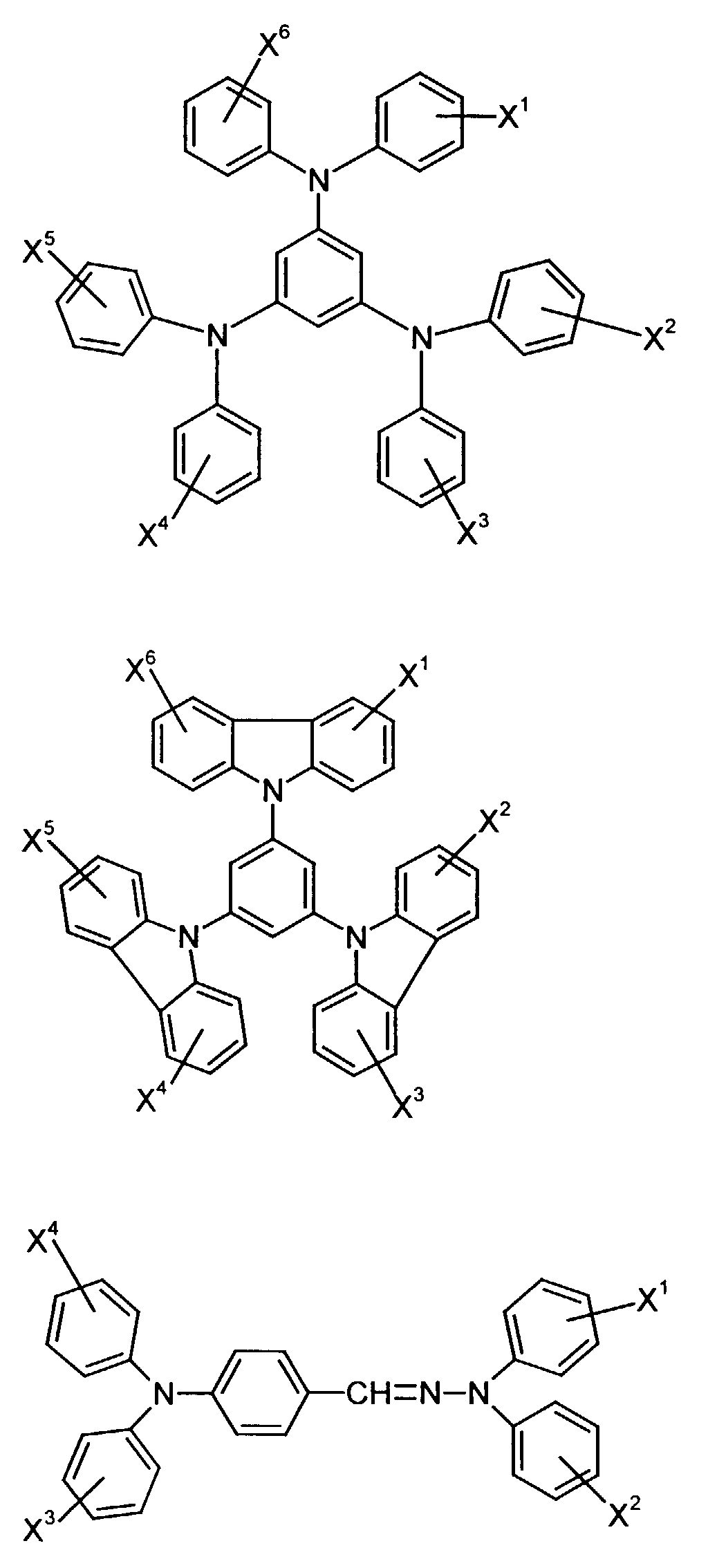
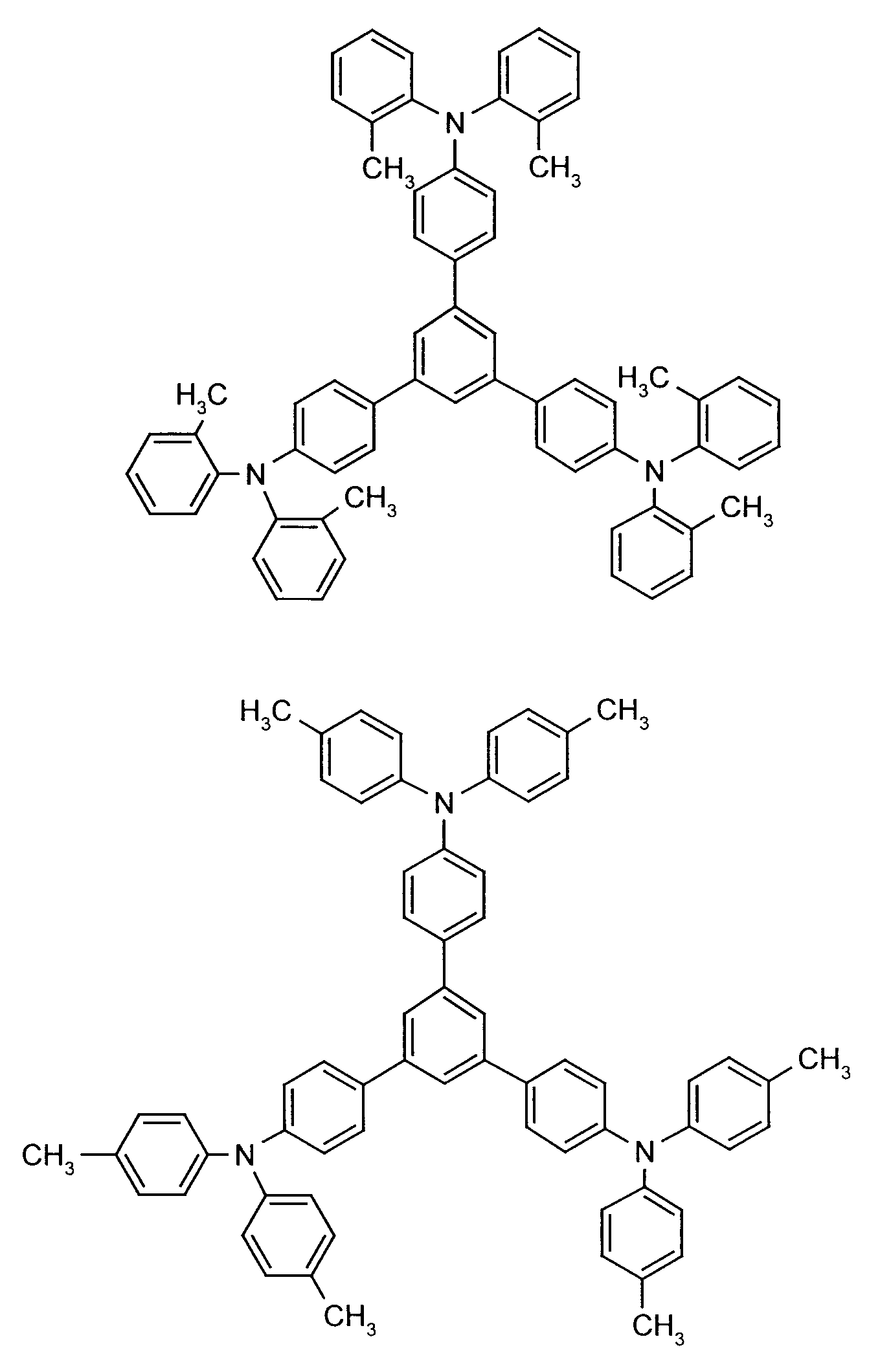
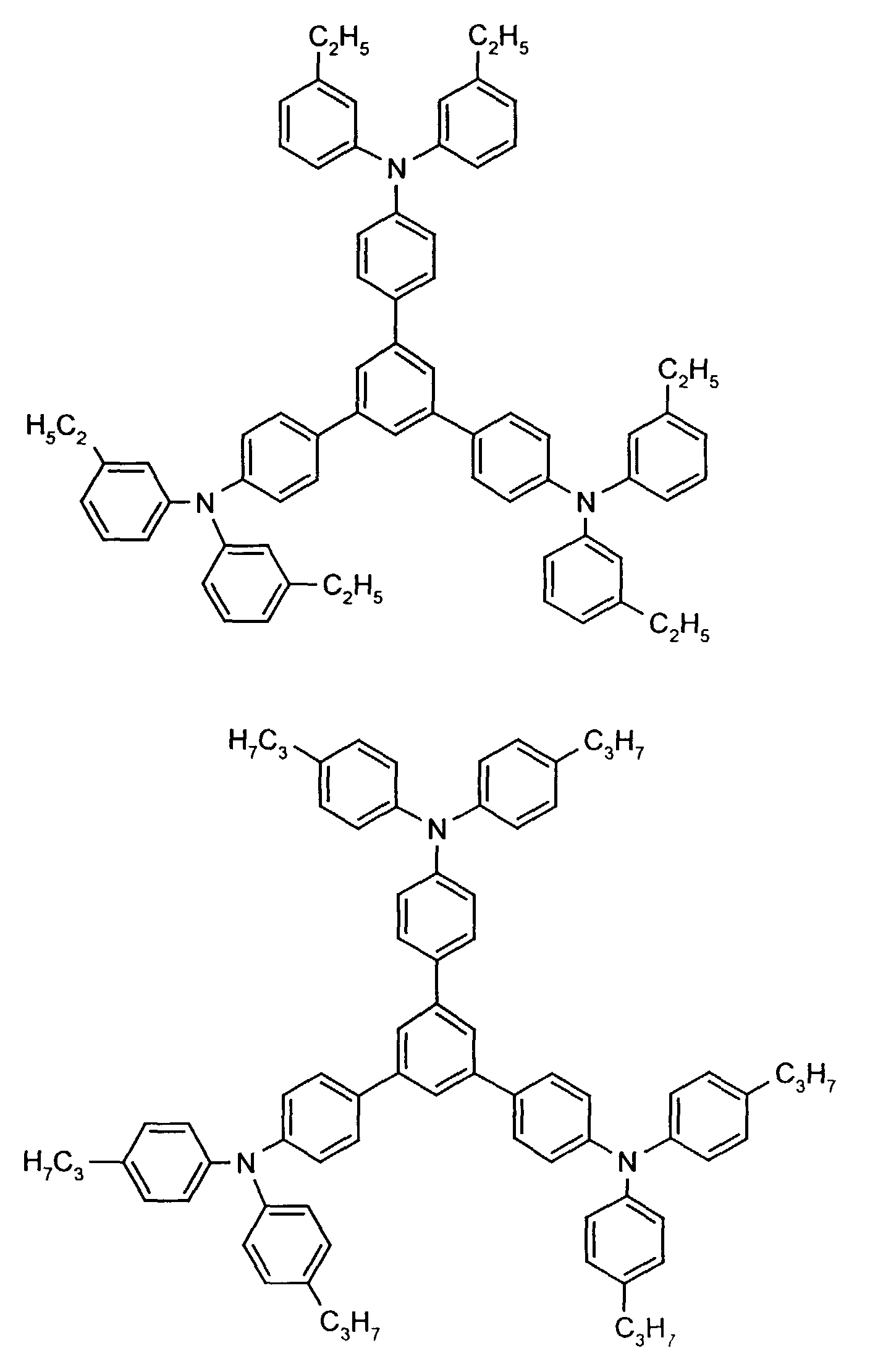
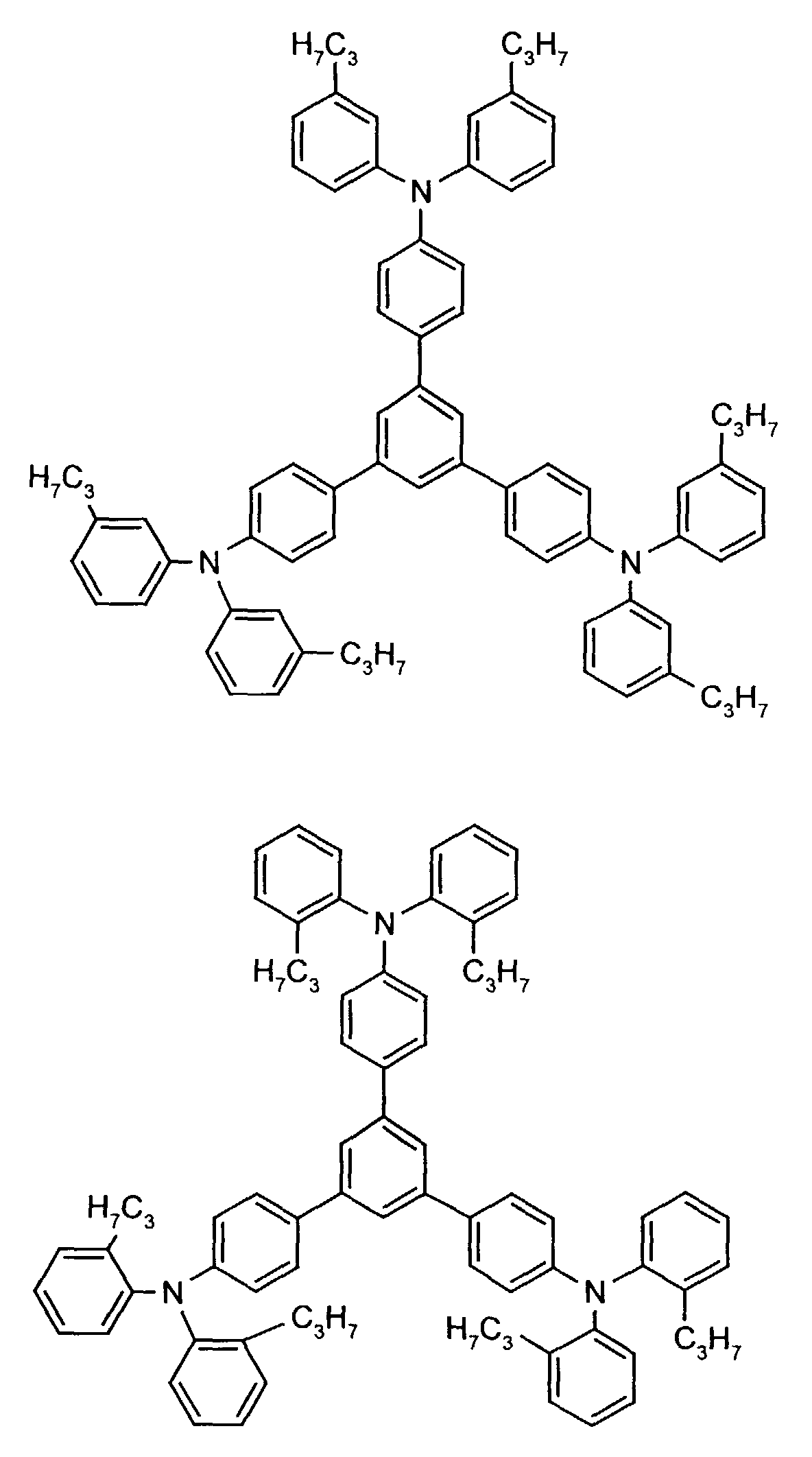
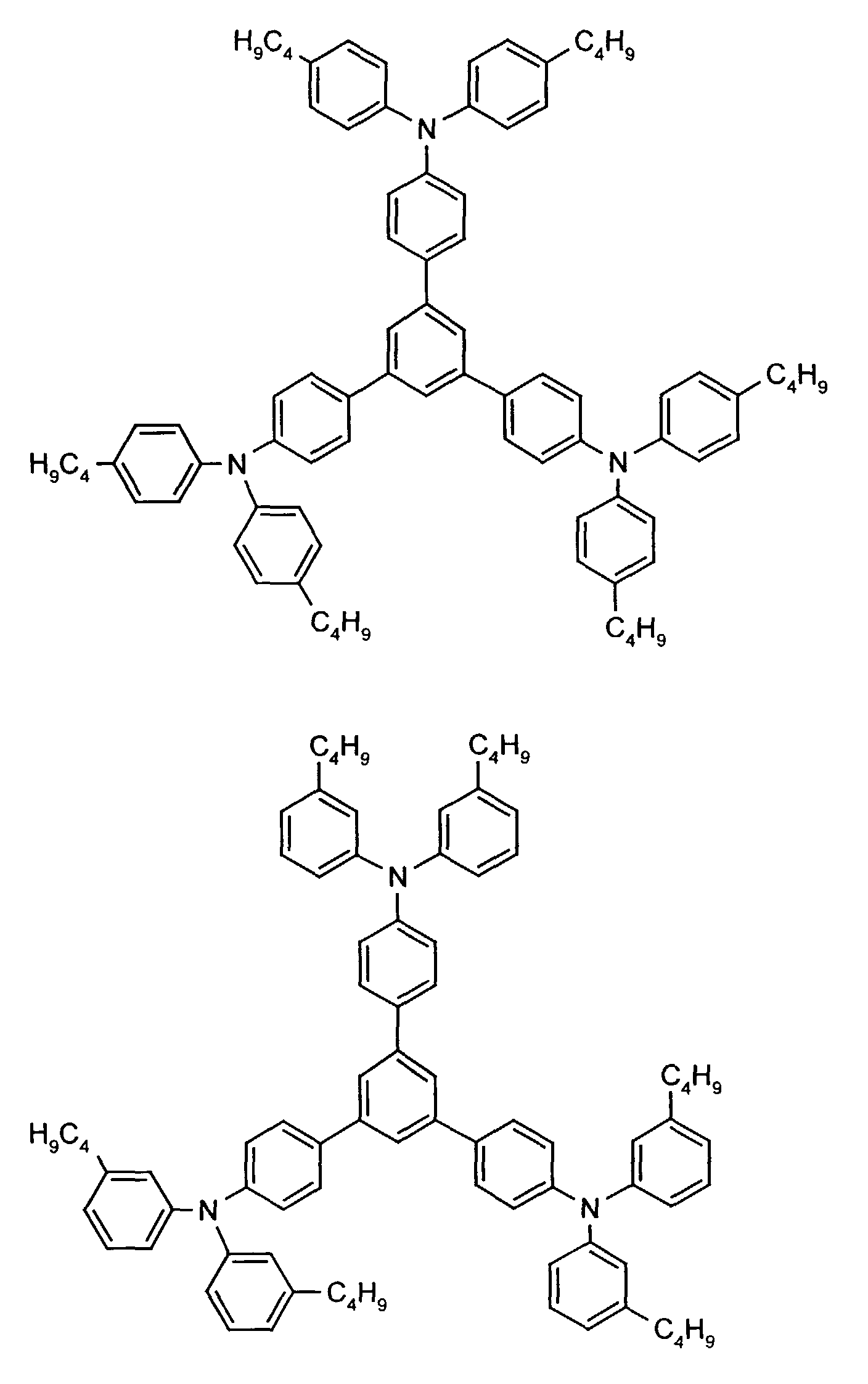
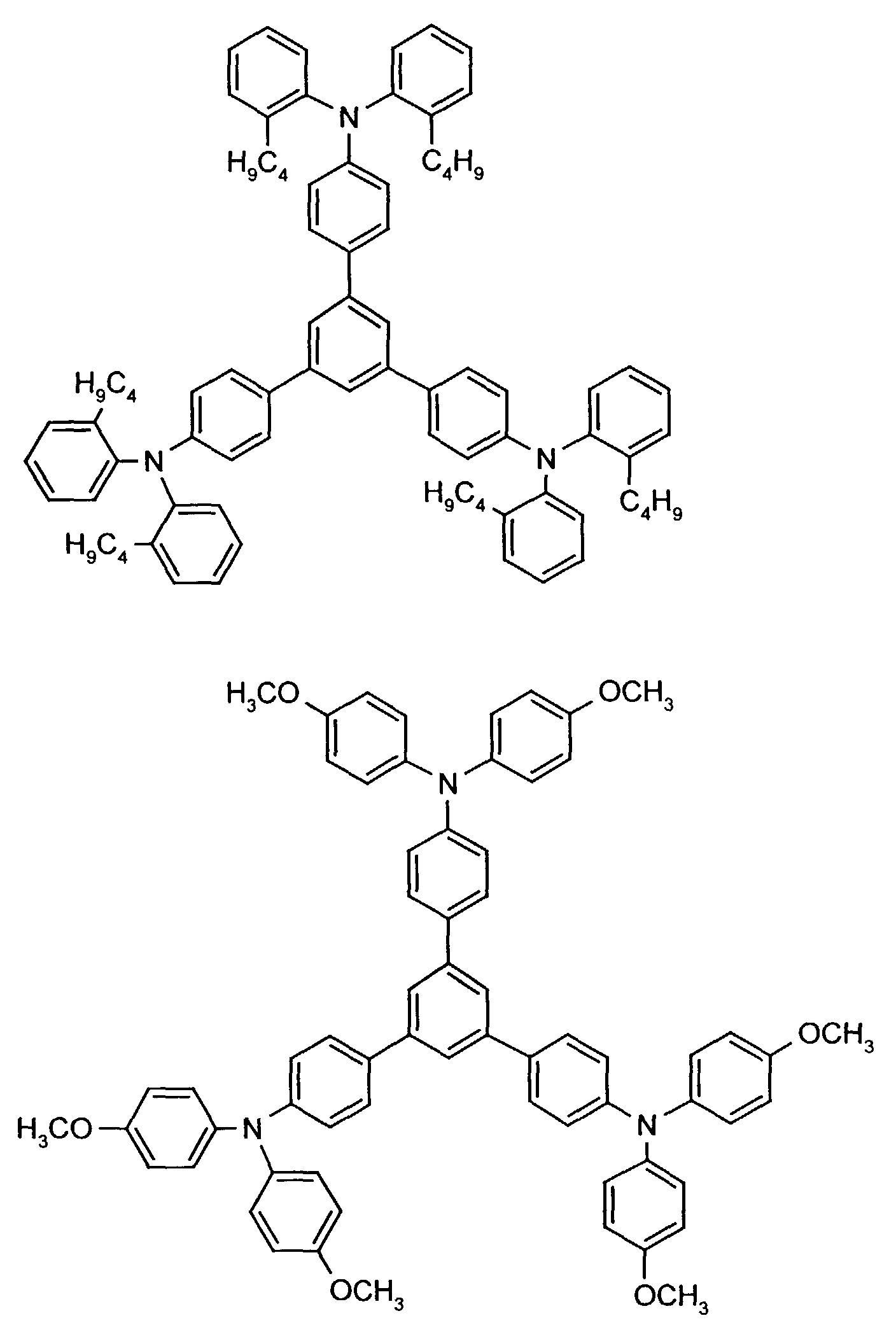
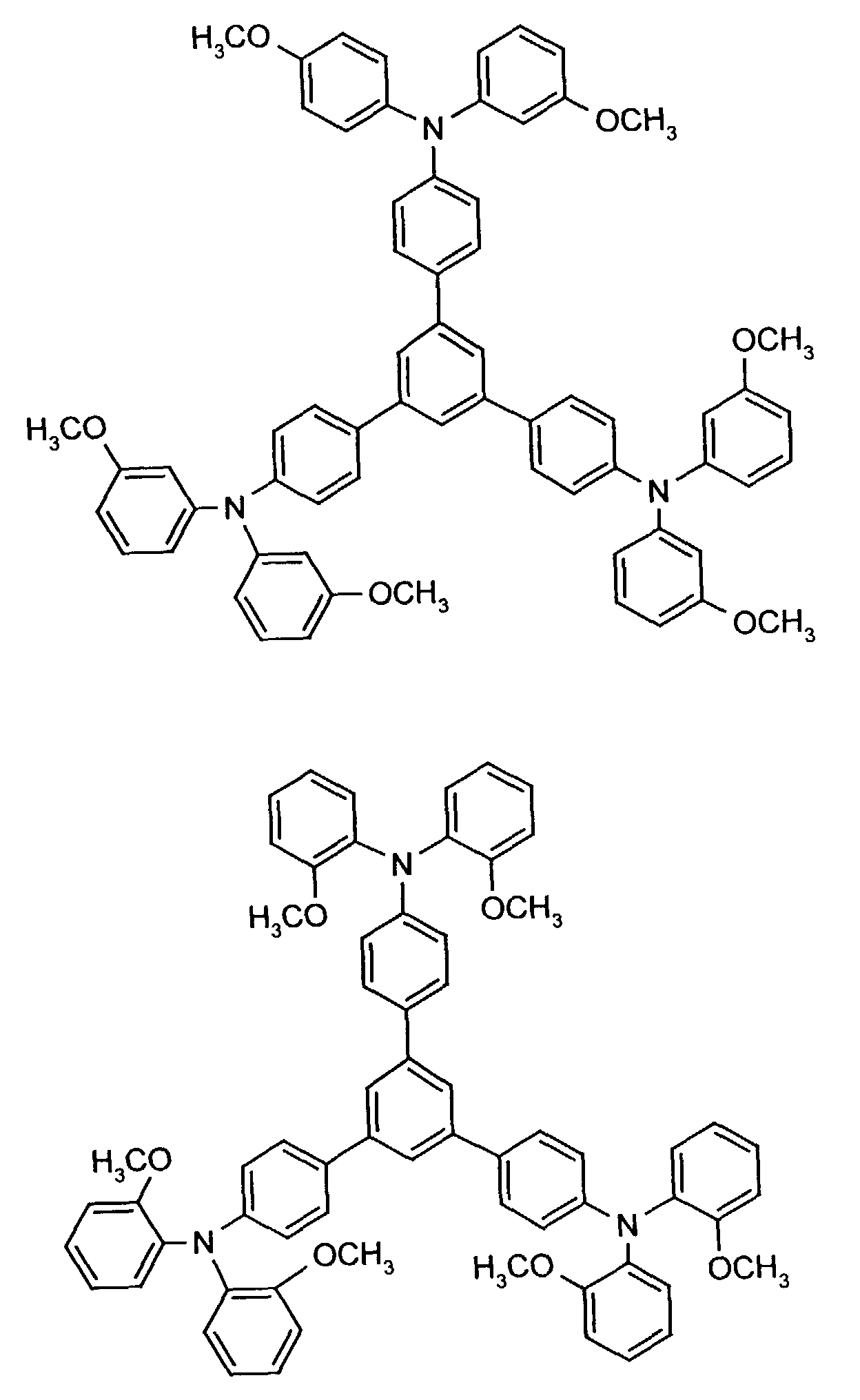
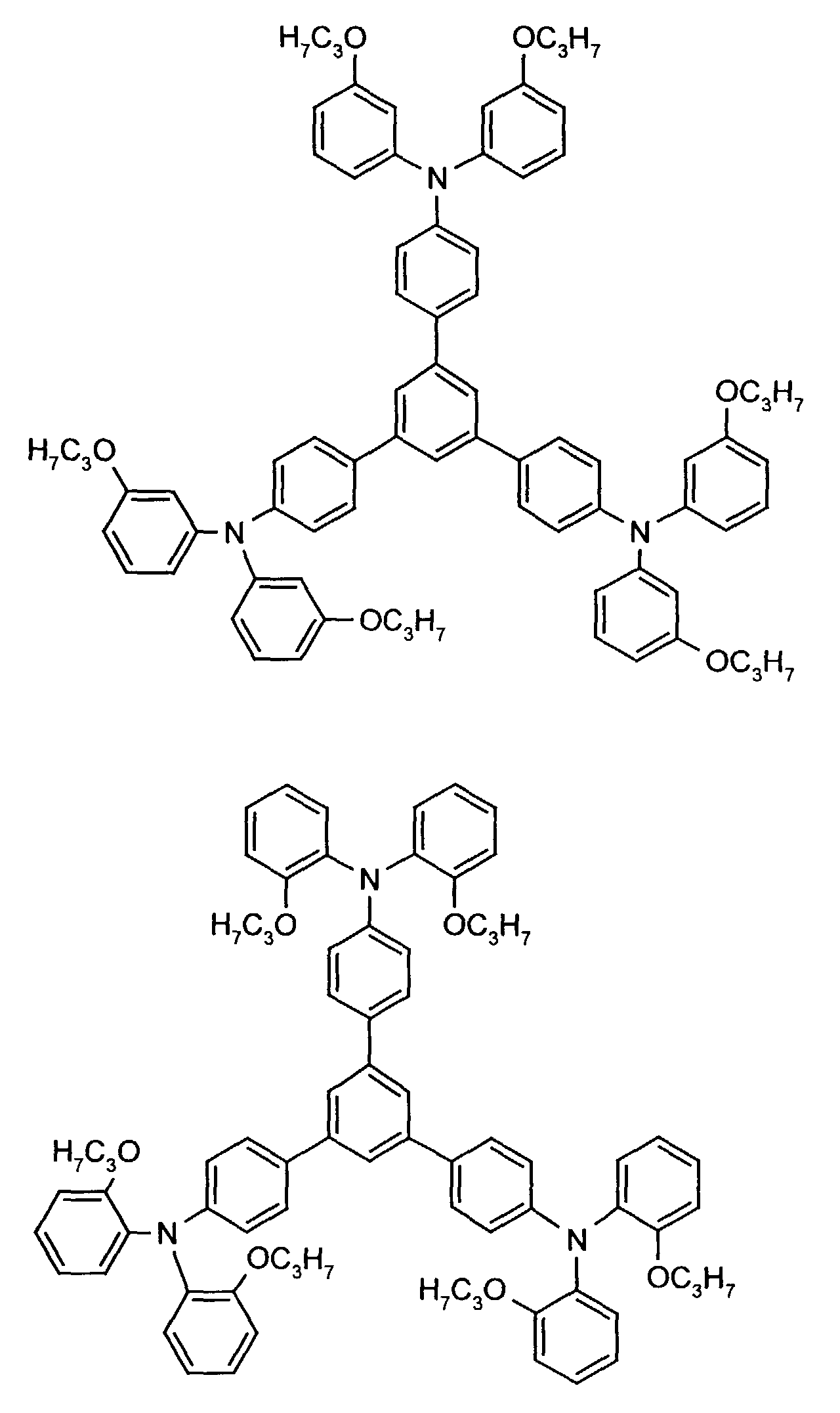
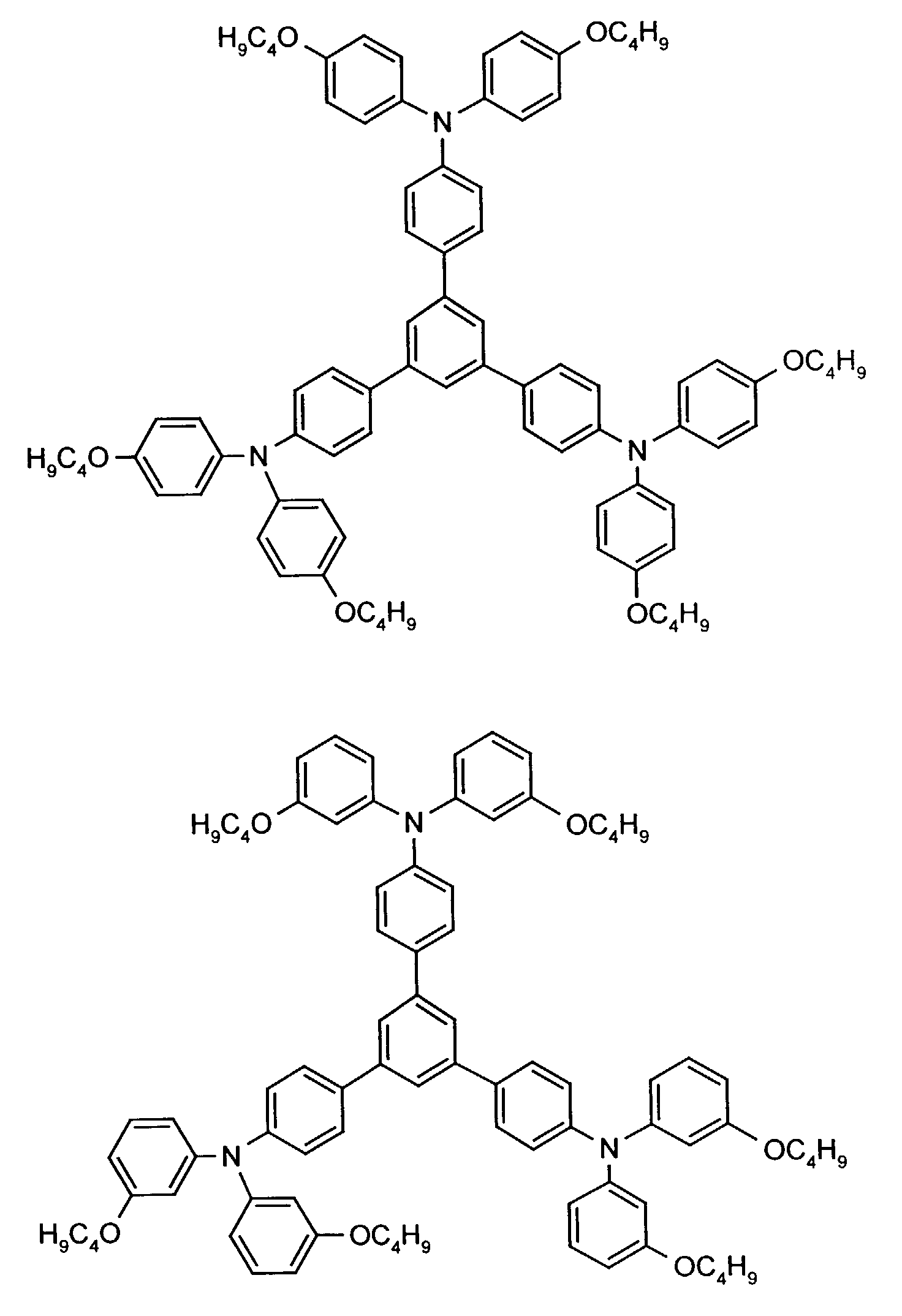
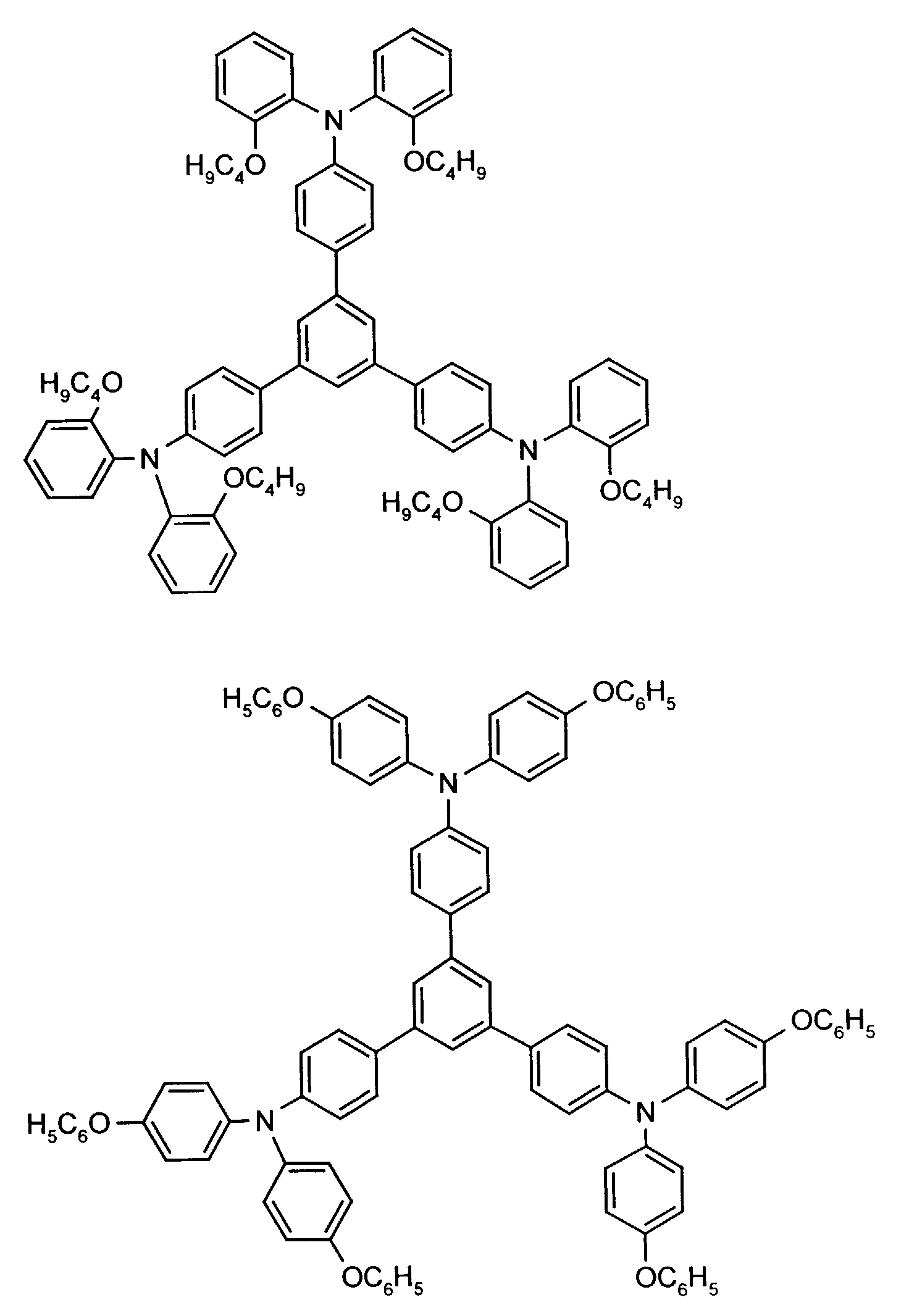
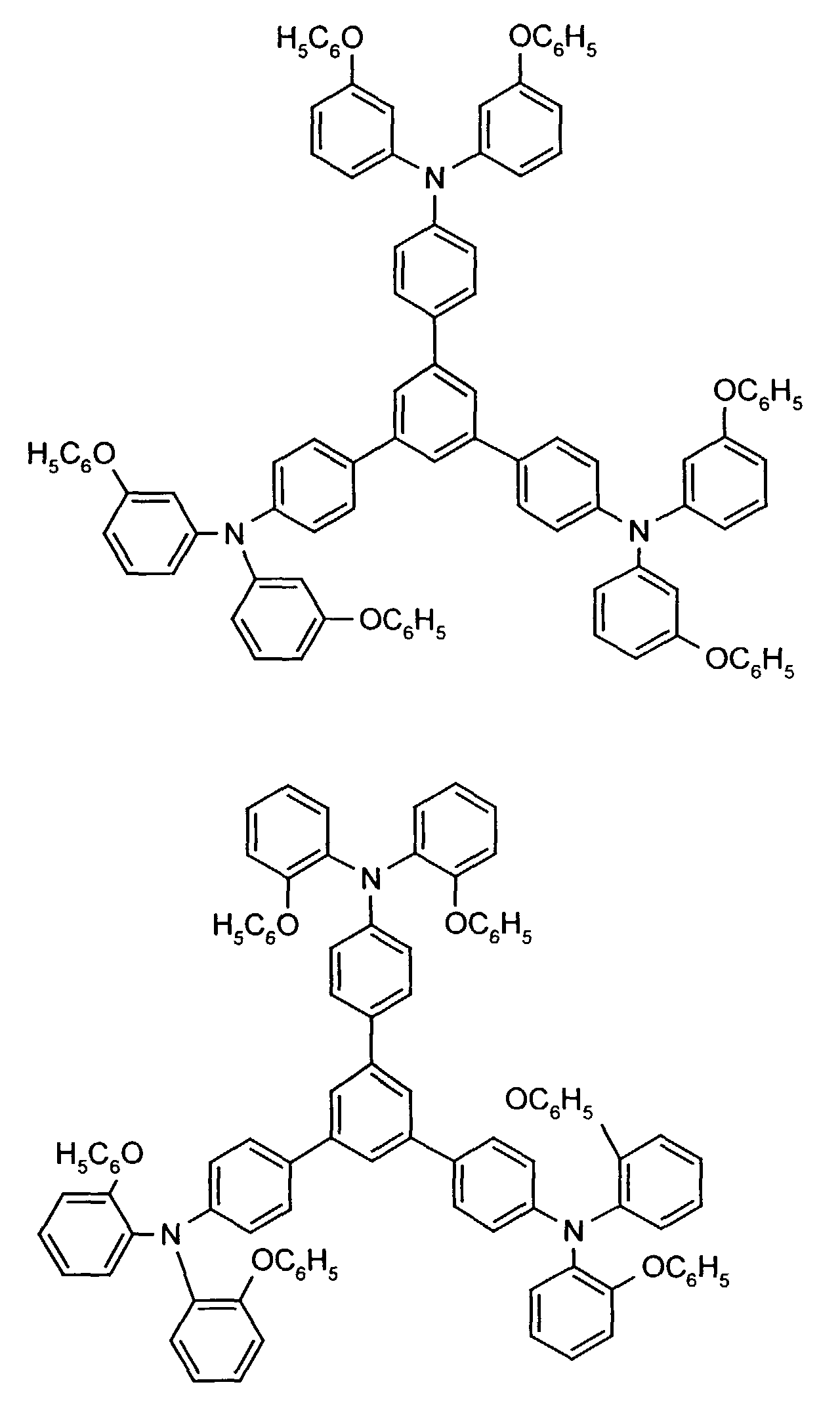
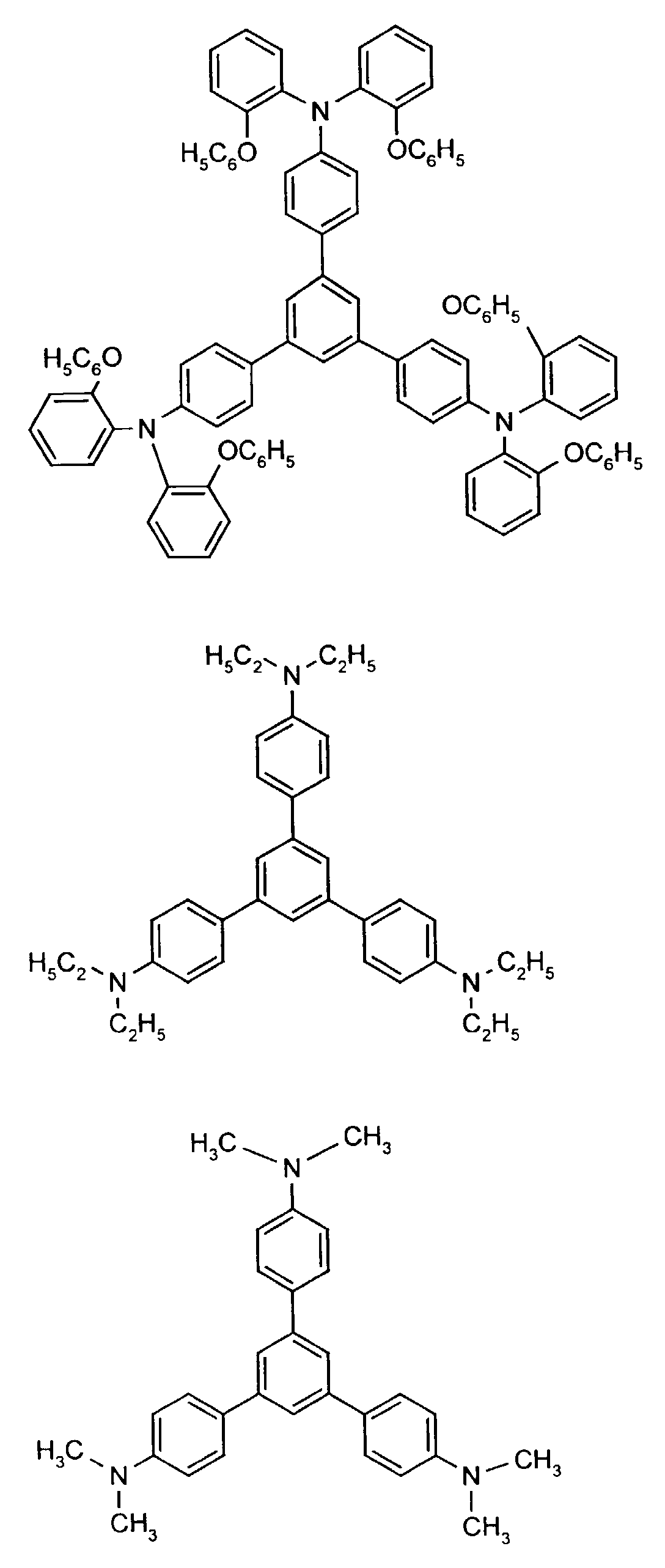
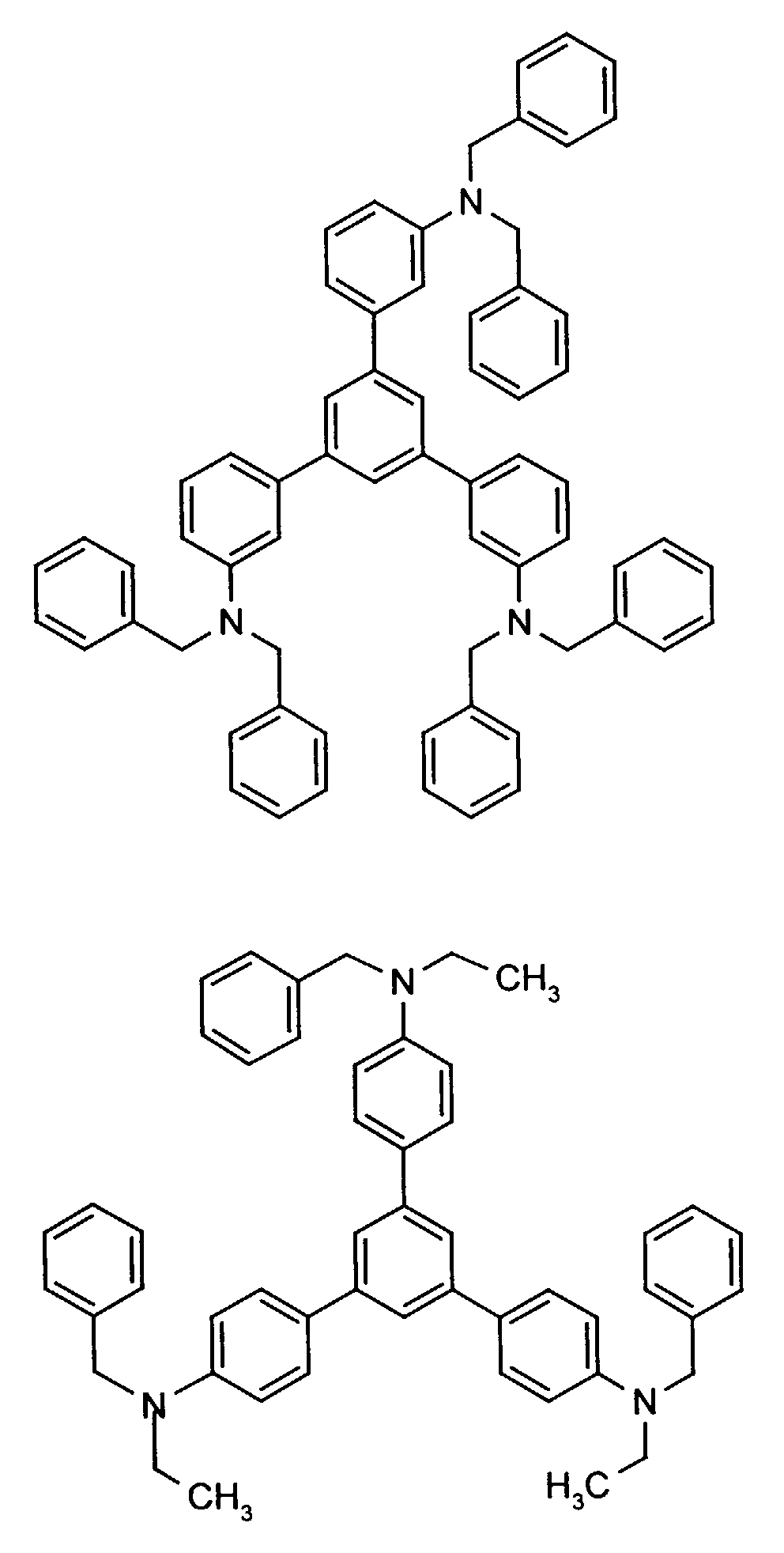
- the hole-conducting zone adjoining the hole-injecting zone preferably contains one or more aromatic tertiary amino compounds, preferably optionally substituted triphenylamine compounds, particularly preferably tris-1,3,5- (aminophenyl) benzene compounds of formula (II).
- the zones or between the hole-injecting zone and the cathode Zones can also perform several functions, i.e. a zone e.g. hole injecting, hole transporting, electroluminescent, electron transporting and / or contain electron-injecting substances.
- a zone e.g. hole injecting, hole transporting, electroluminescent, electron transporting and / or contain electron-injecting substances.
- the electroluminescent element can furthermore one or more transparent contain polymeric binders.
- R 3 and R 4 are particularly preferably independently of one another unsubstituted phenyl or naphthyl or in each case monosubstituted to triple by methyl, ethyl, n-, isopropyl, methoxy, ethoxy, n- and / or isopropoxy substituted phenyl or naphthyl.
- R 2 preferably represents hydrogen, (C 1 -C 6 ) -alkyl, such as, for example, methyl, ethyl, n- or iso-propyl, n-, iso-, sec- or tert-butyl, or chlorine.
- the tris-nitrophenyl compound can, for example, be converted into the tris-aminophenyl compound by generally known catalytic hydrogenation, for example in the presence of Raney nickel (Houben-Weyl 4 / 1C, 14-102, Ullmann (4) 13 , 135-148 ).
- the amino compound is reacted in a generally known manner with substituted halogenobenzenes.
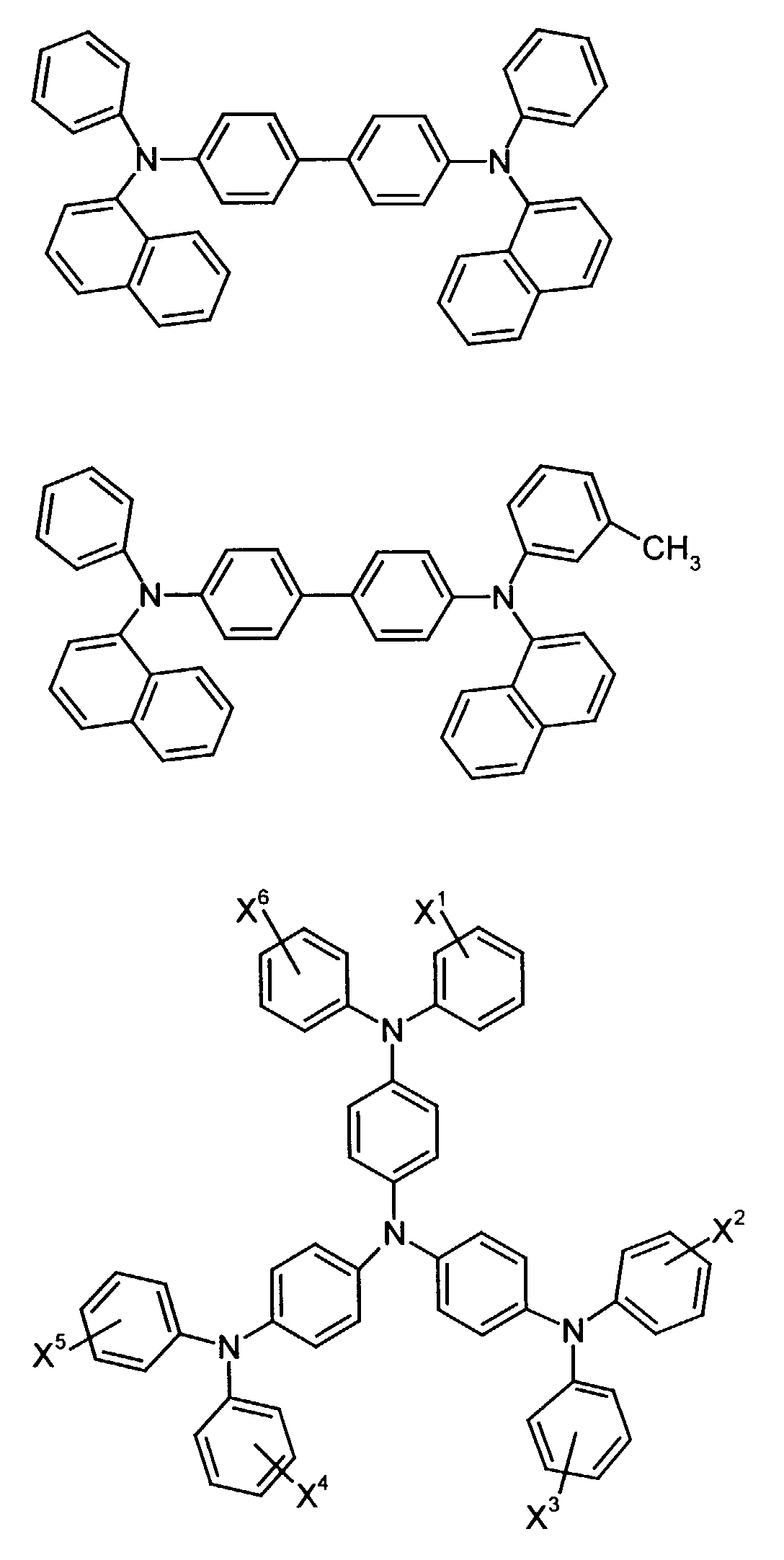
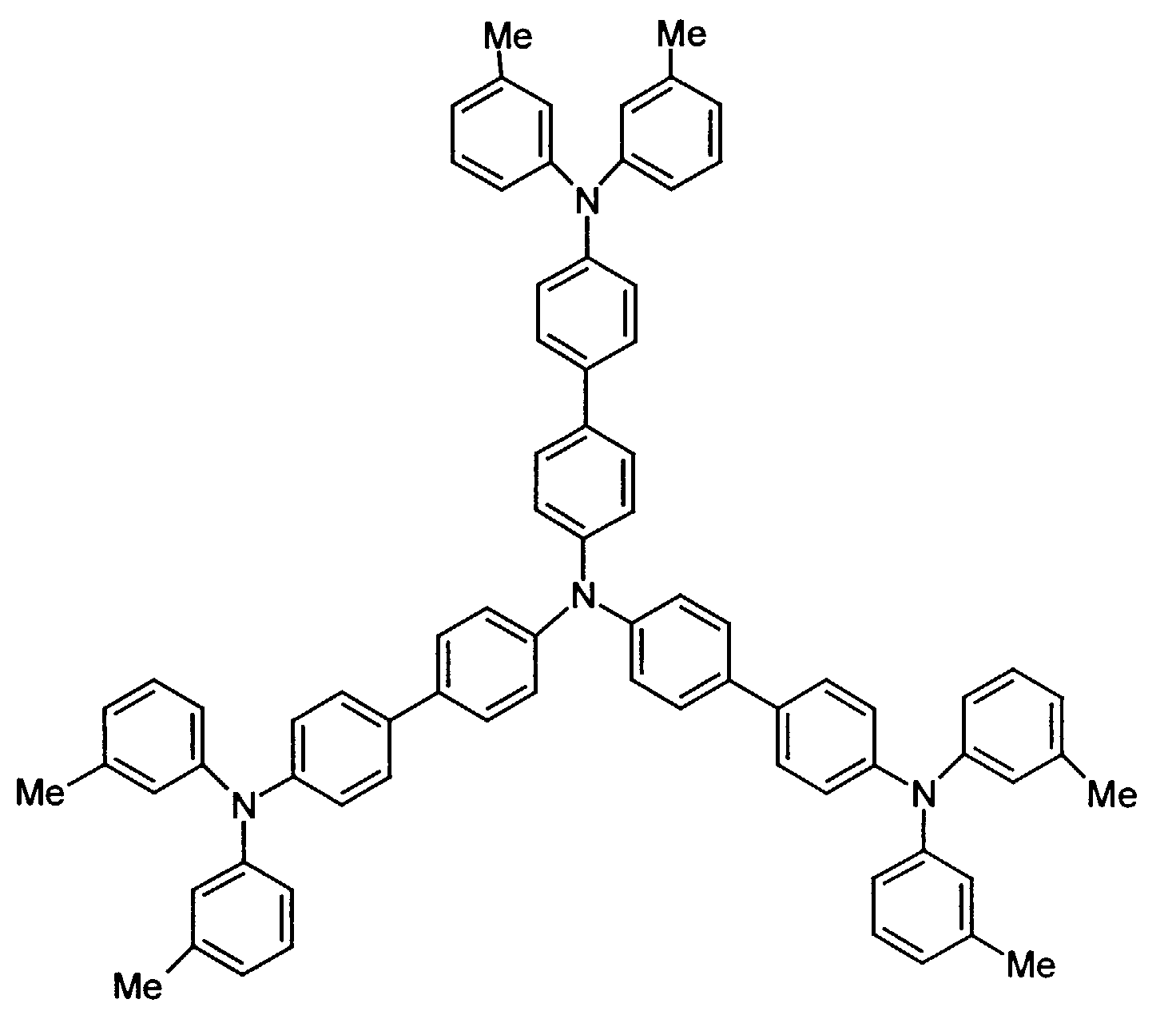
- further hole conductors e.g. in the form of a mixture with the tertiary amino compound, to build up the electroluminescent element can be used. It can on the one hand one or more compounds of the formula (II), mixtures of Isomers are included, on the other hand also mixtures of hole-transporting Compounds with compounds of tertiary amino compounds - with of the general formula (II) - act with a different structure.
- Examples include:
- X 1 to X 6 independently of one another preferably represent hydrogen, fluorine, chlorine, bromine, (C 1 -C 10 ) -, in particular (C 1 -C 4 ) - alkyl or alkoxy, phenyl, naphthyl, phenoxy and / or naphthyloxy .
- the aromatic rings can be substituted one, two, three or four times, identically or differently, by at least one radical X 1 to X 6 .
- polythiophenes of the repeating structural unit of the formula (I) are known (see EP-A 0 440 958 and 0 339 340).
- the preparation of the dispersions according to the invention or solutions is described in EP-A 0 440 957 and DE-A 42 11 459.
- the polythiophenes are preferably cationic in the dispersion or solution Shape as e.g. by treating the neutral thiophenes with oxidizing agents be used. Common oxidizing agents such as potassium peroxodisulfate are used for the oxidation. The oxidation gives the polythiophenes positive charges that are not shown in the formulas because of their number and their Position can not be determined correctly. According to the information in EP-A 0 339 340 they can be made directly on supports.
- To compensate for the positive charge contains the cationic form of the polythiophenes Anions, preferably polyanions.
- polymeric carboxylic acids preferably serve as polyanions, such as polyacrylic acids, polymethacrylic acid or polymaleic acids and polymers Sulphonic acids such as polystyrene sulphonic acids and polyvinyl sulphonic acids.
- polycarbonate and sulfonic acids can also be copolymers of vinylcarbonate and vinyl sulfonic acids with other polymerizable monomers, such as acrylic acid esters and Styrene.
- the anion of the polystyrene sulfonic acid is particularly preferred as the counter ion.
- the molecular weight of the polyacids providing the polyanions is preferably 1,000 to 2,000,000, particularly preferably 2,000 to 500,000.
- the polyacids or their alkali salts are commercially available, e.g. Polystyrene sulfonic acids and Polyacrylic acids, or can be prepared by known processes (see e.g. Houben-Weyl, Methods of Organic Chemistry, Vol. E 20 Macromolecular Fabrics, Part 2 (1987), p. 1141 f).
- the arrangements according to the invention optionally contain, as binders, polymers and / or copolymers such as polycarbonates, polyester carbonates, copolymers of styrene such as SAN or styrene acrylates, polysulfones, polymers based on monomers containing vinyl groups such as poly (meth) acrylates, polyvinylpyrrolidone, polyvinylcarbazole, vinyl acetate, and vinyl alcohol polymers and copolymers, polyolefins, cyclic olefin copolymers, phenoxy resins, etc. Mixtures of different polymers can also be used.
- polymers and / or copolymers such as polycarbonates, polyester carbonates, copolymers of styrene such as SAN or styrene acrylates, polysulfones, polymers based on monomers containing vinyl groups such as poly (meth) acrylates, polyvinylpyrrolidone, polyviny
- the polymeric binders have molecular weights of 10,000 to 2,000,000 g / mol, are soluble and film-forming and are transparent in the visible spectral range. They are described, for example, in Encyclopedia of Polymer Science and Engineering, 2 nd Ed. with A. Wiley-Intersciencepublication. They are usually used in an amount of up to 95, preferably up to 80,% by weight, based on the total weight of the electroluminescent elements.
- Z completes a heterocyclic part of the molecule that consists of at least two condensed Rings exist, one of which is an azole or azine ring, with others additional aliphatic or aromatic rings attached to the two annealed rings could be. In addition, other aliphatic radicals or halogen atoms be tied to the rings.
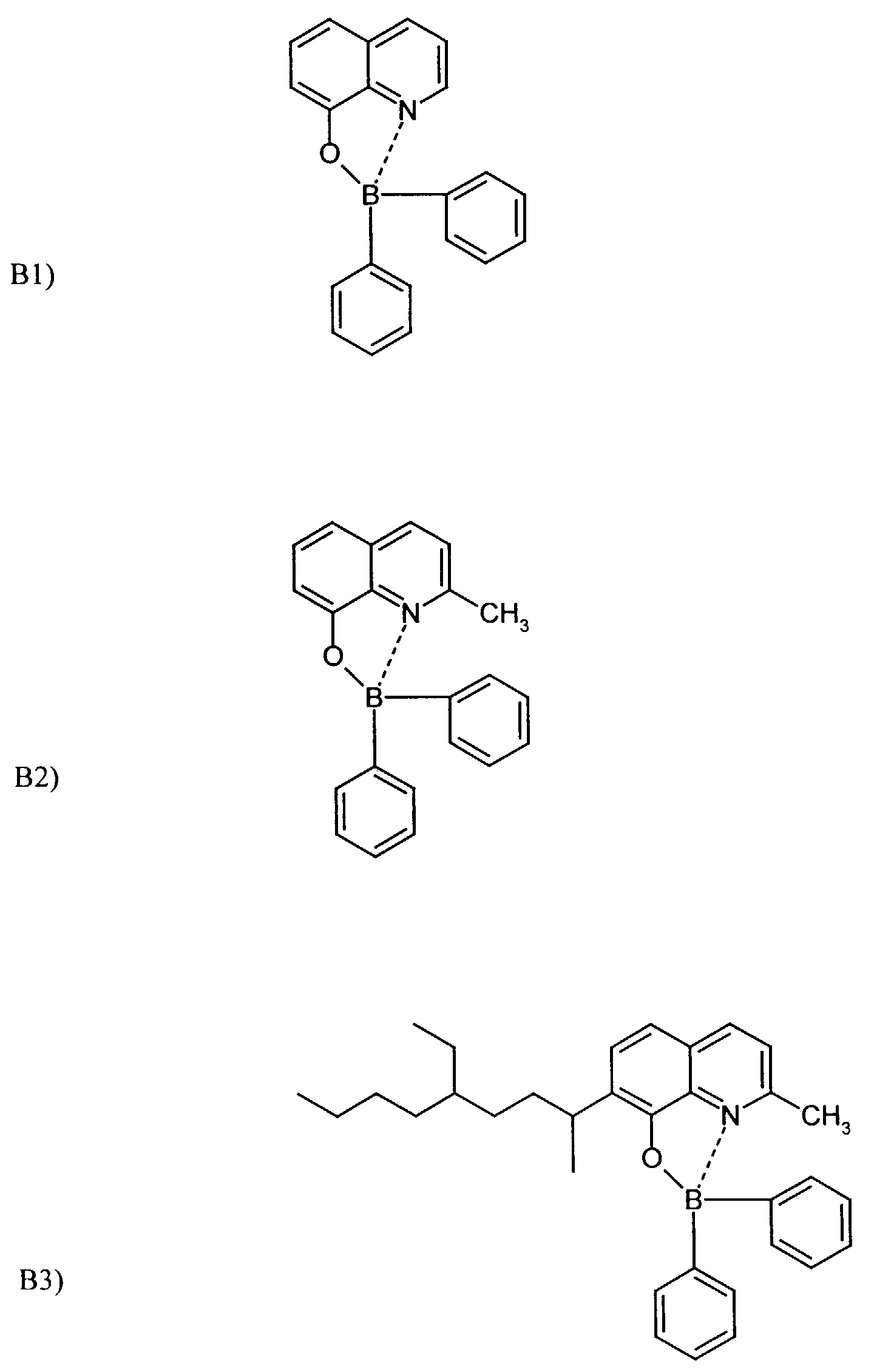
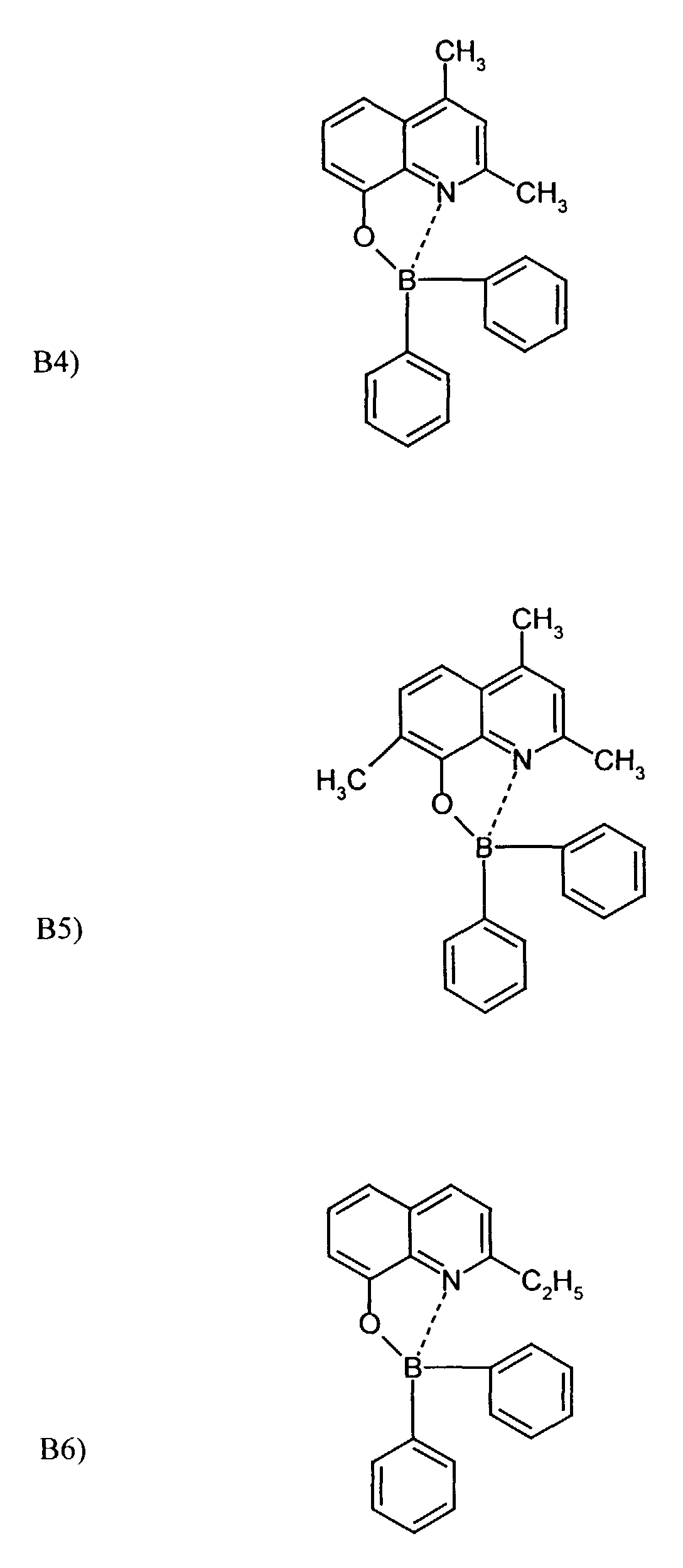
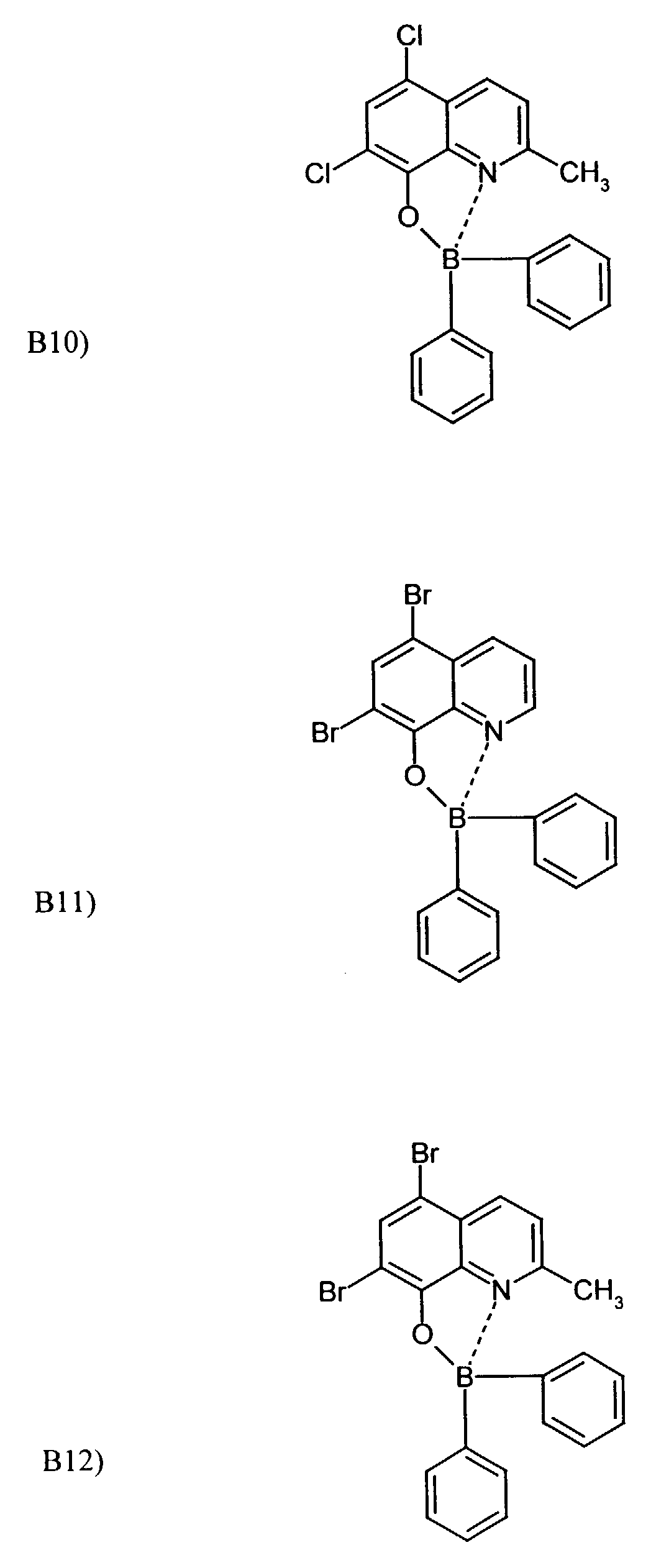
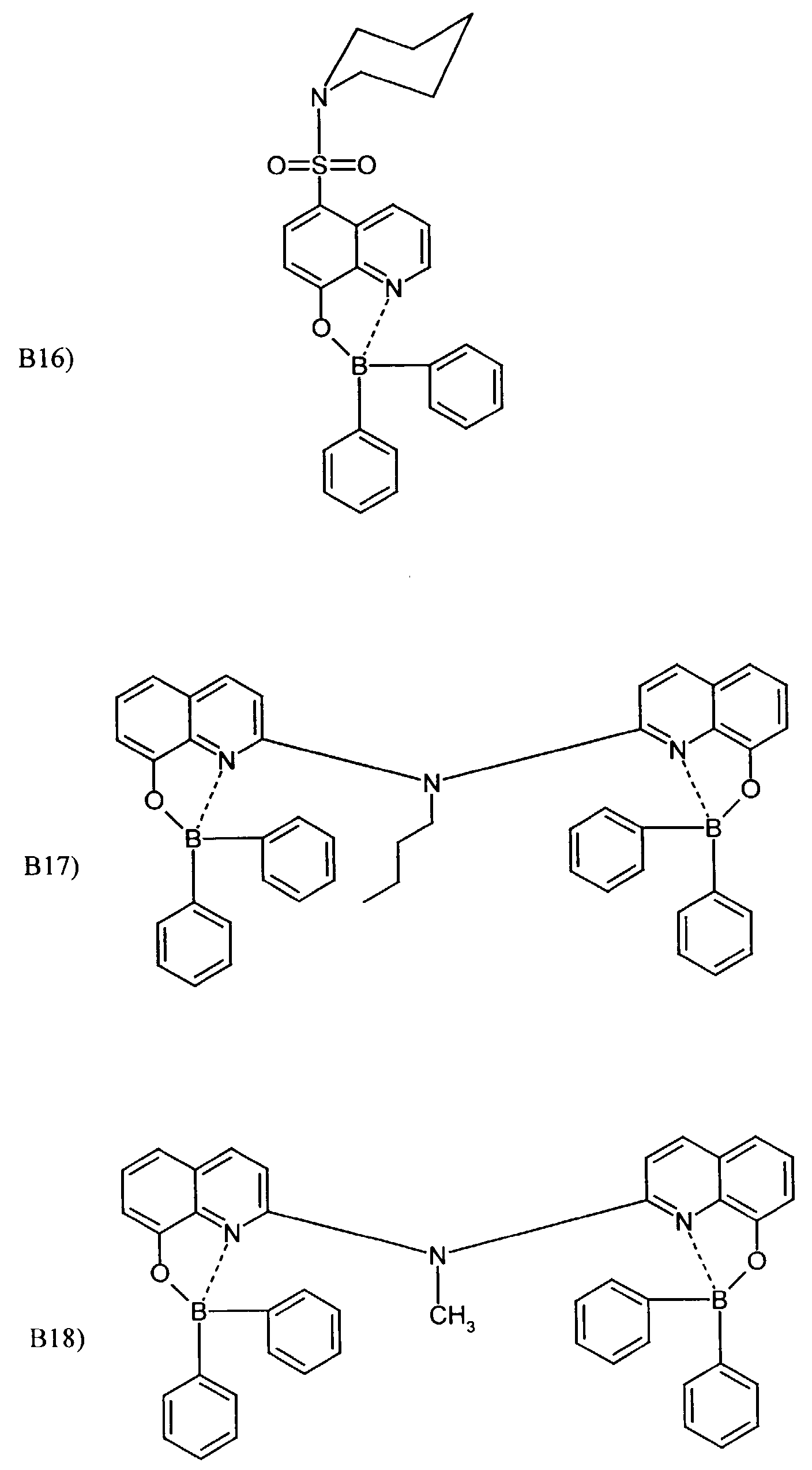
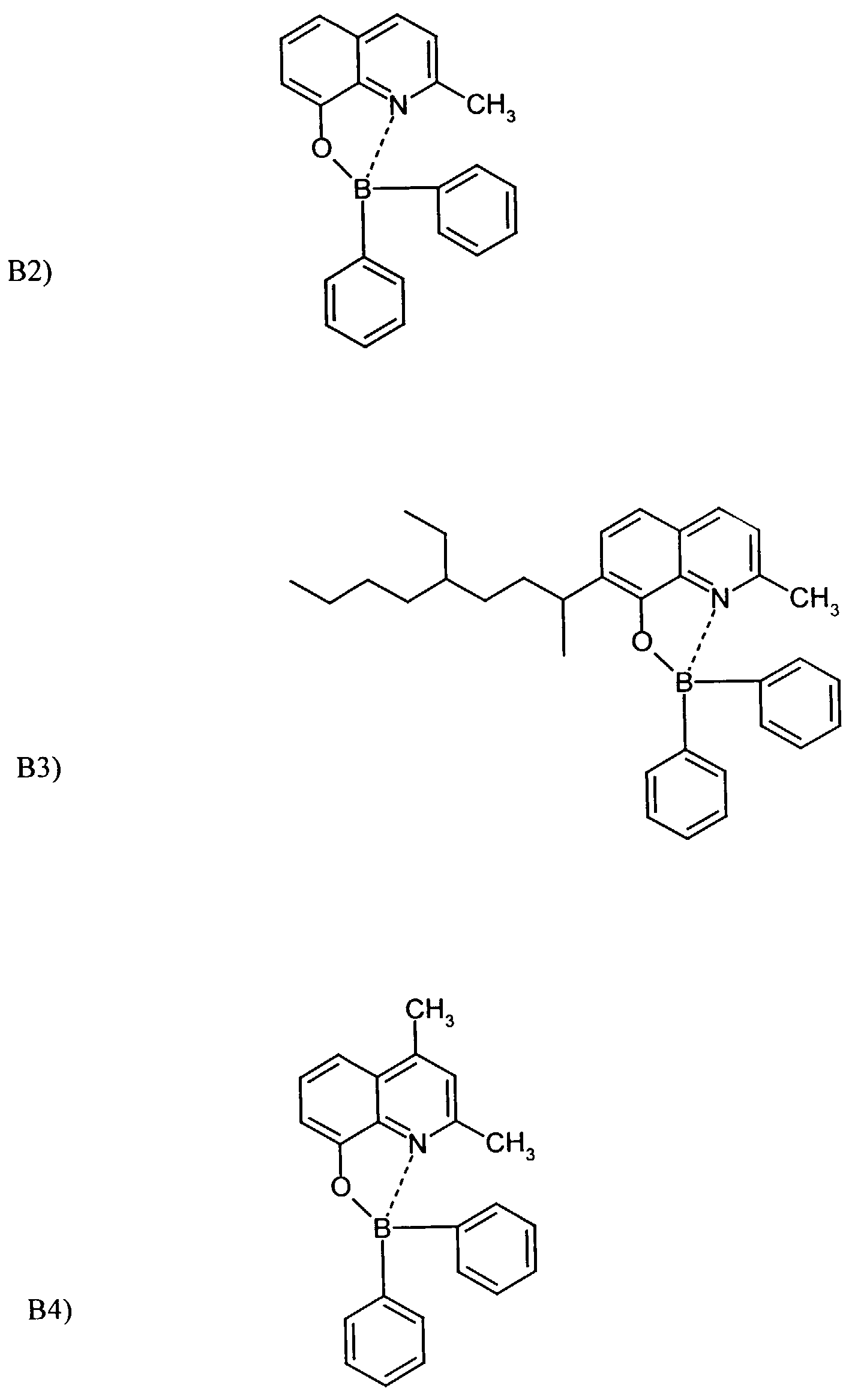
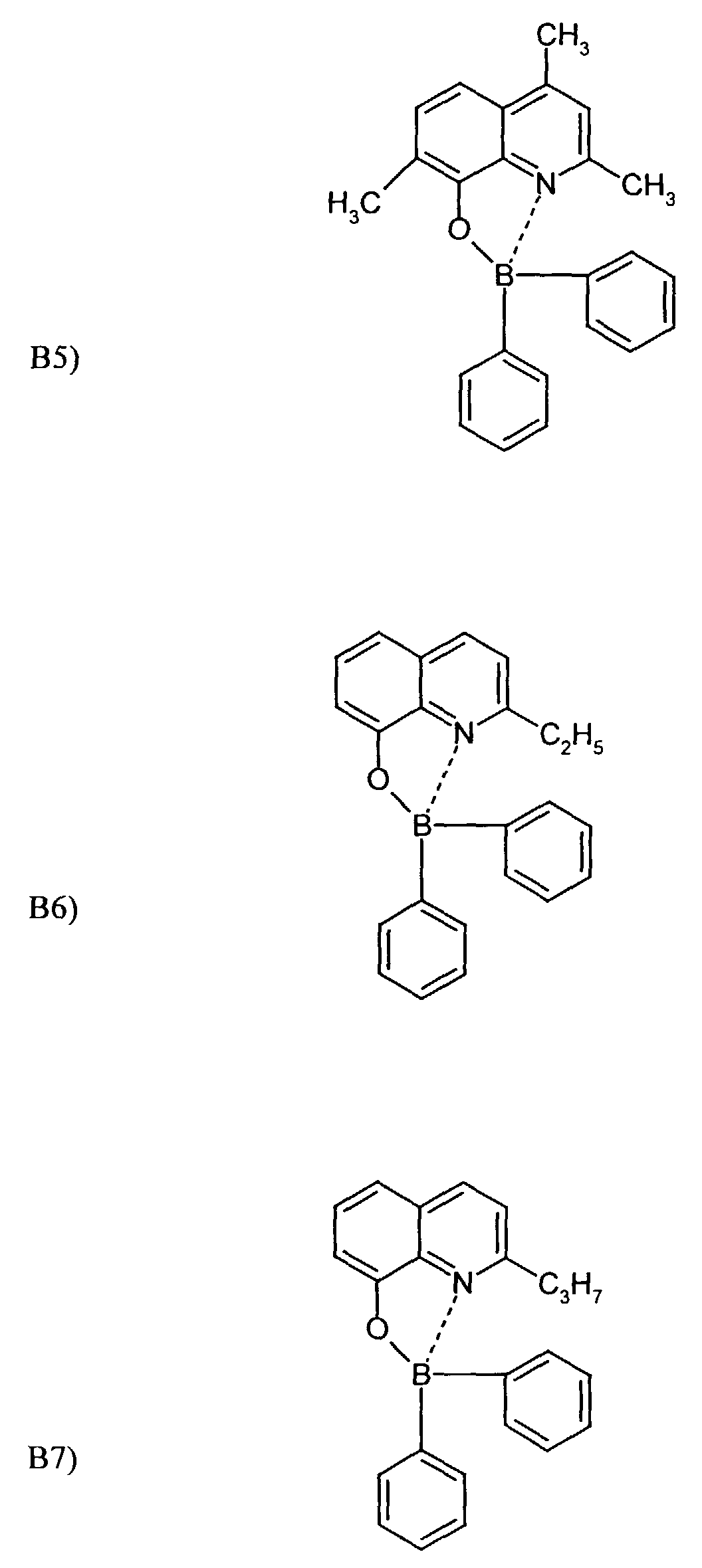
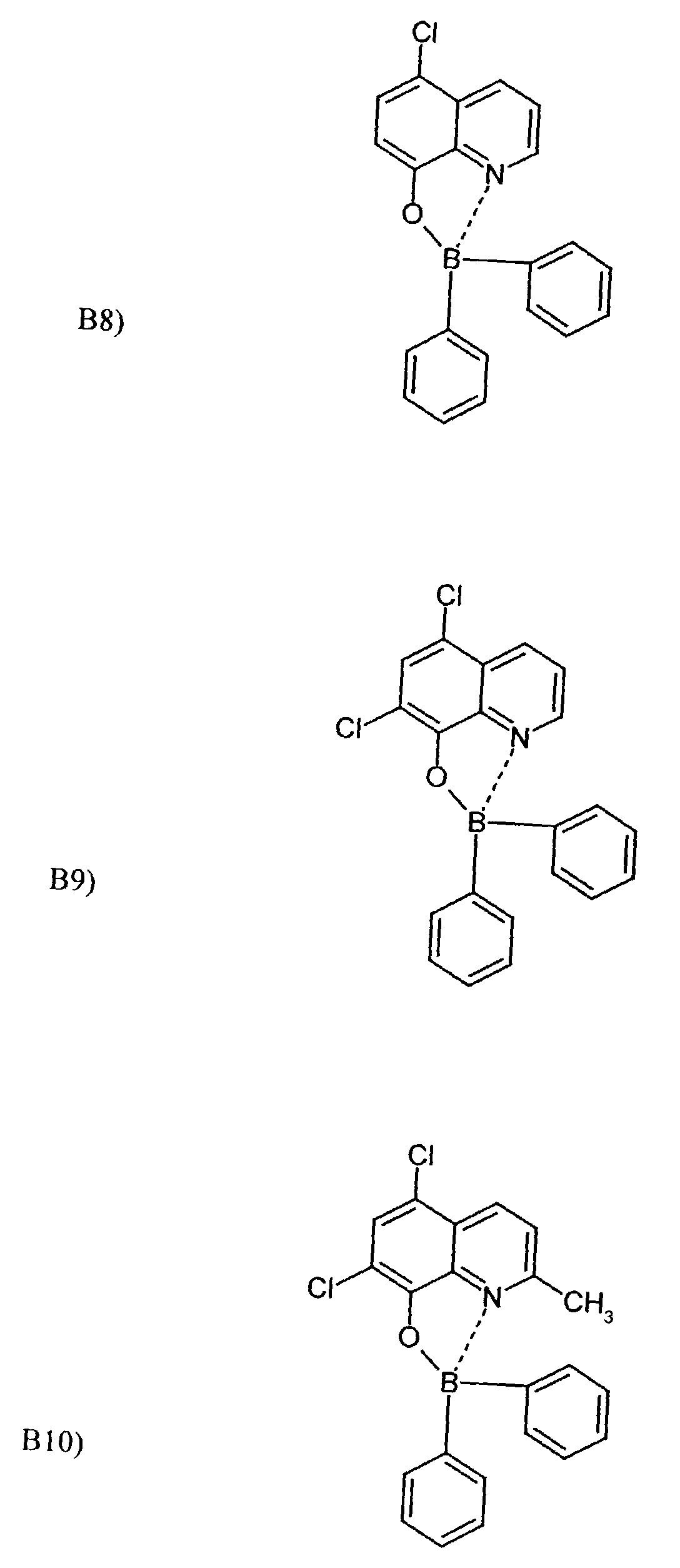
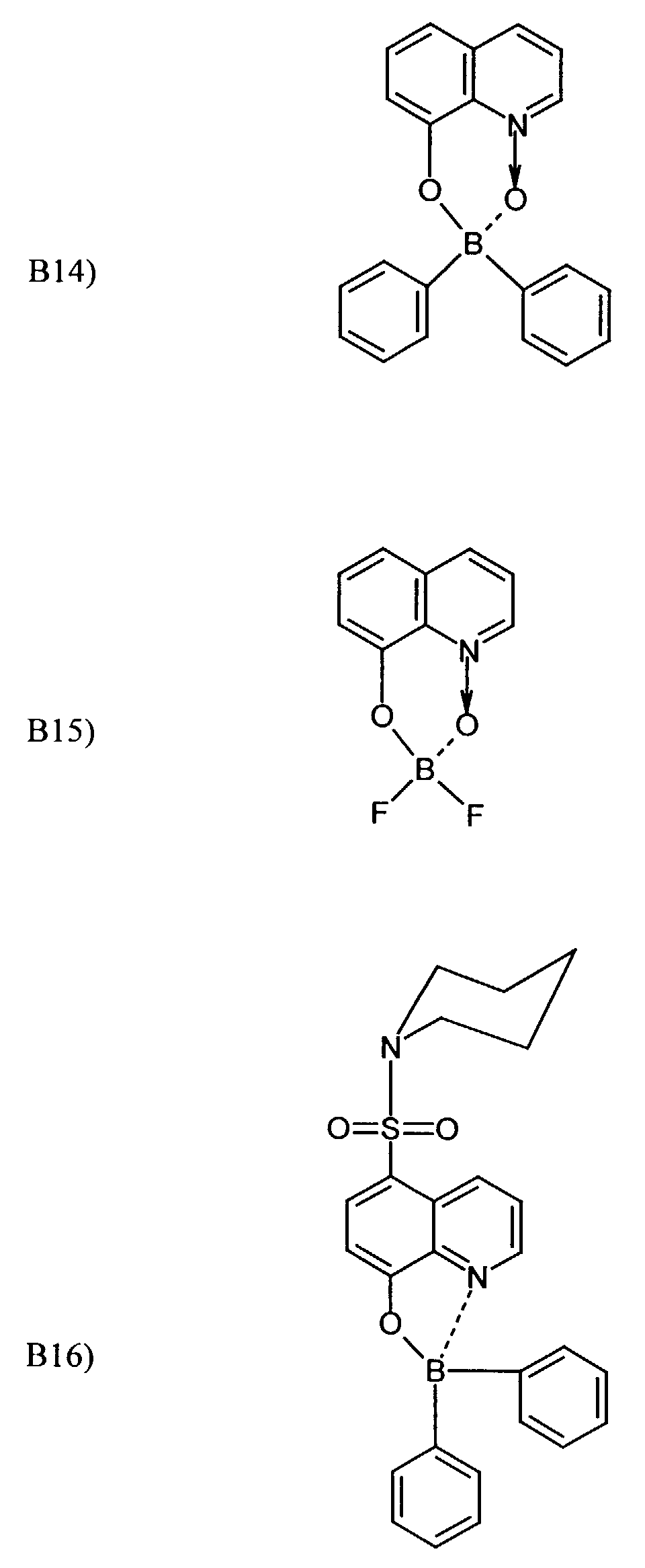
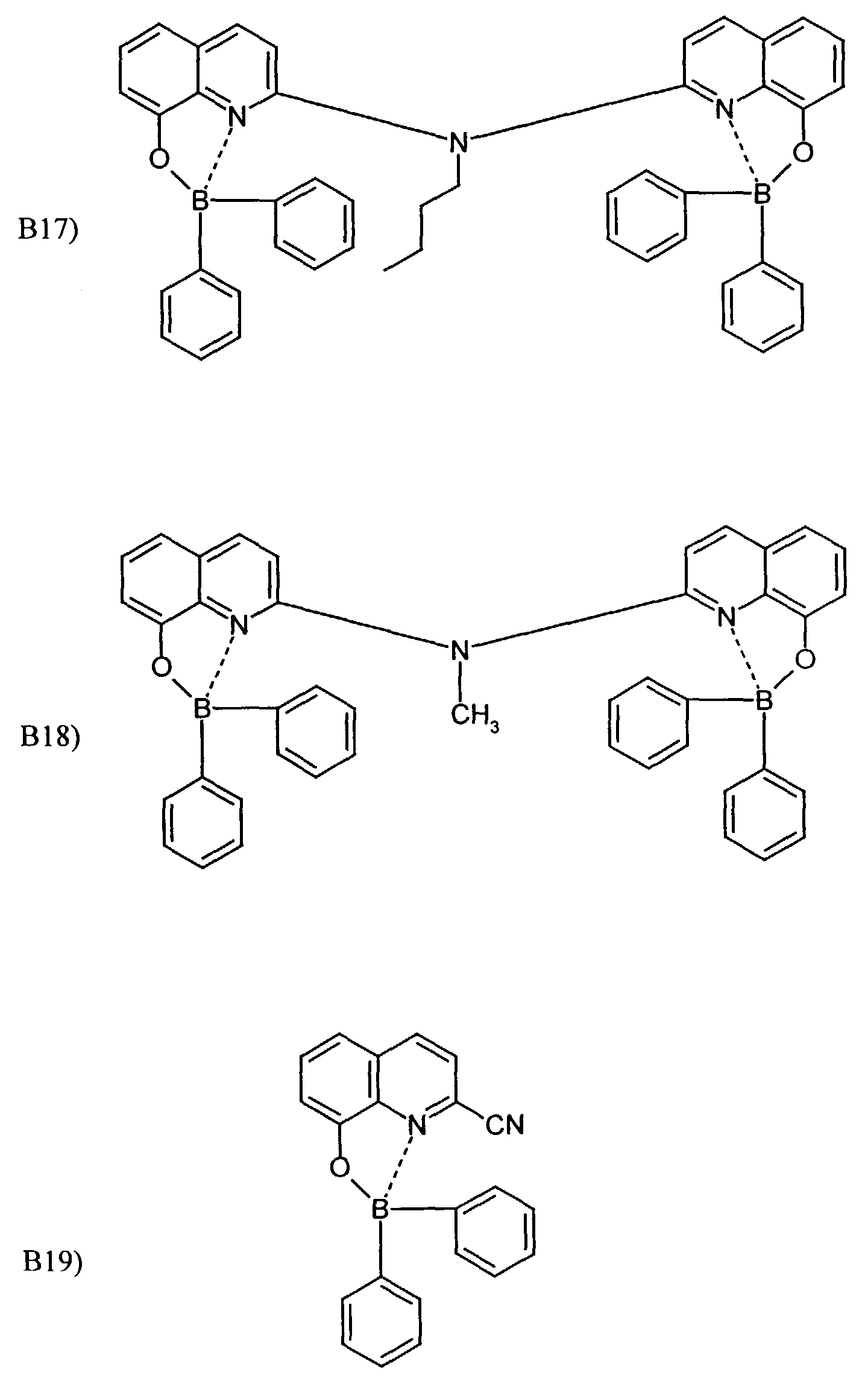
- One or more compounds of the formulas B1 to B19 can be used become.
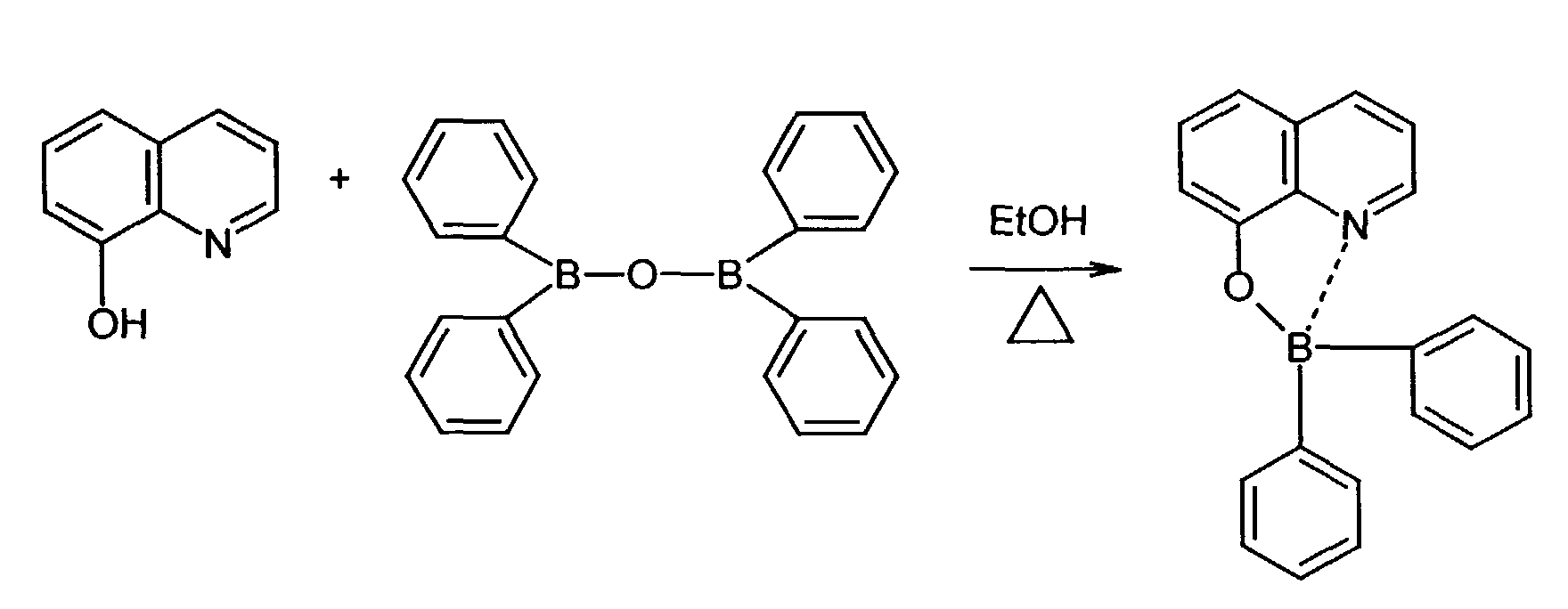
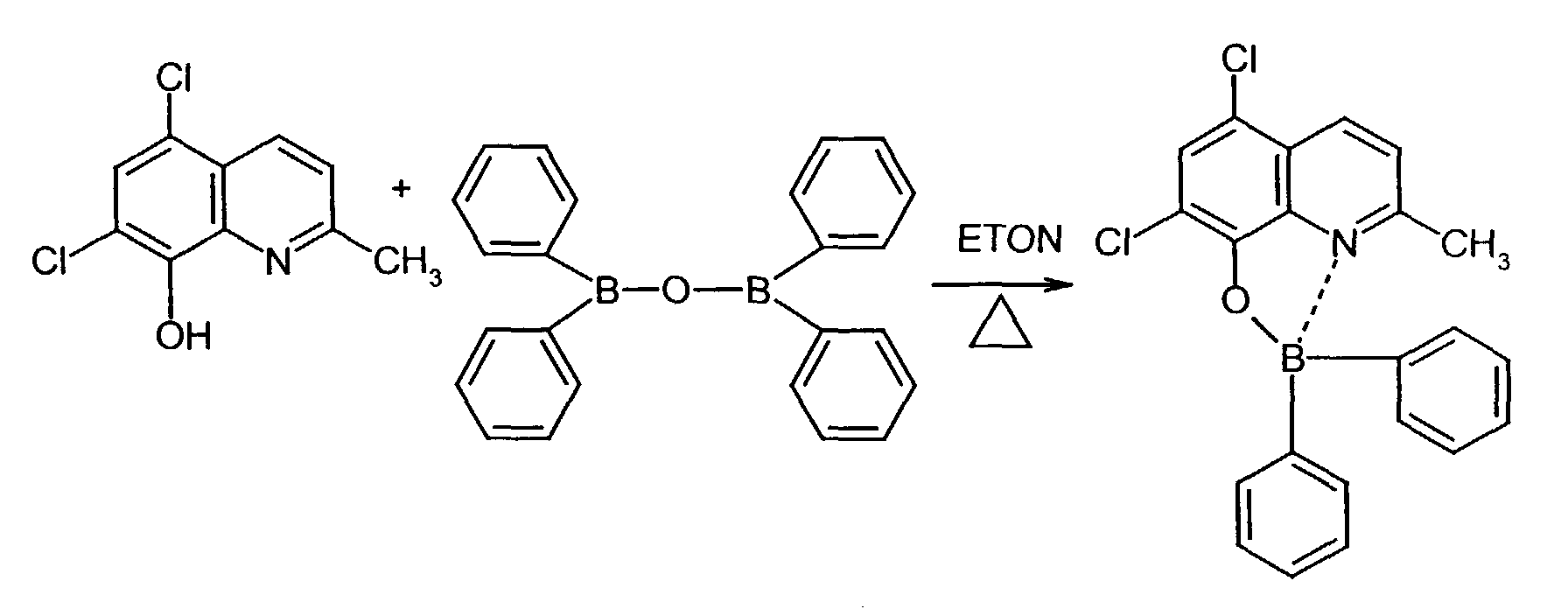
- 8-hydroxyquinoline ligands are commercially available or can be prepared according to known ones organic chemical processes are produced (R.G.W. Hallingshead, Vol.1, Chap.6, Butterworths, London (1954)).
- the boron complex as well optionally the tertiary amino compound and the binder in a suitable one Solvent dissolved and by casting, knife or spin coating to a suitable Pad applied.
- the boron complex can optionally also be used separately Layer can be applied by a vapor deposition process.
- the underlay can e.g. is glass or a plastic material covered with a transparent Electrode is provided.
- a plastic material e.g. a film made of polycarbonate, Polyesters such as polyethylene terephthalate or polyethylene naphthalate, polysulfone or Polyimide can be used.
- the metal oxide and semi-transparent metal film electrodes are made by Techniques such as vapor deposition, sputtering, platinum plating, etc., applied in a thin layer.
- the conductive polymer films are made by techniques such as spin coating, Casting, squeegees etc. applied from the solution.
- the thickness of the transparent electrode is 3 nm to approximately several ⁇ m, preferably 10 nm to 500 nm.
- the electroluminescent layer is applied directly to the transparent electrode or on a possibly present charge-transporting layer as a thin film upset.
- the thickness of the film is 10 to 500 nm, preferably 20 to 400 nm, particularly preferably 50 to 250 nm.
- Another charge-transporting layer can be applied to the electroluminescent layer Layer be inserted before a counter electrode is applied.
- EP-A 0 532 798 A compilation of suitable charge-transporting intermediate layers, which are hole- and / or electron-conducting materials can, which are present in polymer or low molecular weight form optionally as a blend can, is listed in EP-A 0 532 798.
- the content of low molecular hole conductor in a polymeric binder is in the range variable from 2 to 97% by weight; the content is preferably 5 to 95% by weight, particularly preferably 10 to 90% by weight, in particular 10 to 85% by weight.
- the hole injecting or hole-conducting zones can be deposited using various methods become.
- Film-forming hole conductors can also be used in pure form (100%). If necessary, the hole-injecting or hole-conducting zone can also be parts of a contain electroluminescent substance.
- Blends that consist exclusively of low molecular weight compounds can be evaporated; soluble and film-forming blends, which in addition to low molecular weight Compounds may also contain a binder, e.g. be deposited by means of spin coating, casting, knife coating.
- An electroluminescent substance can also be the electron-injecting or electron-conducting layer can be added.
- the content of low molecular weight electron conductors in the polymeric binder is in the range variable from 2 to 95% by weight; the content is preferably 5 to 90% by weight, particularly preferably 10 to 85% by weight.
- Film-forming electron conductors can also be used in pure form (100%).
- the counter electrode consists of a conductive substance that can be transparent.
- Metals are preferably suitable, e.g. Al, Au, Ag, Mg, In, etc. or alloys and oxides of these by techniques such as vapor deposition, sputtering, platinum plating can be applied.
- the arrangement according to the invention is implemented by two electrical leads (e.g. Metal wires) brought into contact with the two electrodes.
- two electrical leads e.g. Metal wires
- the devices emit in the range of 0.1 when a DC voltage is applied up to 100 volts of light with a wavelength of 200 to 2000 nm 200 to 2000 nm photoluminescence.
- the arrangements according to the invention are for the production of units for lighting and suitable for displaying information.
- Example 2 The procedure was as in Example 1 with substance B 2 .
- the maximum of the excitation spectrum is 372 nm, the maximum of the emission is 500 nm.
- Substance B9 was used as in Example 1.
- the maximum of the excitation spectrum is 410 nm, the maximum of the emission is 533 nm.
- the two electrodes of the organic LED are connected via electrical leads connected to a voltage source.
- the positive pole is with the ITO electrode, the negative pole is connected to the MgAg electrode.
- the substance B9 according to the invention is used to build up an organic light-emitting diode (OLED) used.
- OLED organic light-emitting diode
- Example 5 The production and electrical control are carried out as described in Example 5, with the difference that the substance B9 according to the invention is thermally vaporized onto the first two layers as the third organic layer. This is done in a vapor deposition system (Leybold, Univex 350).
- the pressure in the evaporation system is 10 -3 Pa during the evaporation and the evaporation rate is 2 ⁇ / sec.
- the total layer thickness of the 3 organic layers is 200 nm.
- the two electrodes of the organic LED are on the electrical leads connected to a voltage source.
- the positive pole is with the ITO electrode, the negative pole is connected to the MgAg electrode.
- Electroluminescence can be detected with a photodiode (EG&G C30809E) from a voltage of 2.5 volts. At a voltage of 4 volts, an area current of 1 mA / cm 2 flows and the electroluminescence is clearly visible.
- the substance B8 according to the invention is used to build up an organic light-emitting diode (OLED) used.
- OLED organic light-emitting diode
- Example 5 The production and electrical control are carried out as described in Example 5, with the difference that the substance B8 according to the invention is thermally vaporized onto the first two layers as the third organic layer. This is done in a vapor deposition system (Leybold, Univex 350).
- the pressure in the evaporation system is 10 -3 Pa during the evaporation and the evaporation rate is 2 ⁇ / sec.
- the total layer thickness of the 3 organic layers is 200 nm.
- Electroluminescence can be detected with a photodiode (EG&G C30809E) from a voltage of 4.5 volts. At a voltage of 12 volts, an area current of 1 mA / cm 2 flows and the electroluminescence is clearly visible. The color of the electroluminescence is green-blue.
Landscapes
- Chemical & Material Sciences (AREA)
- Engineering & Computer Science (AREA)
- Materials Engineering (AREA)
- Physics & Mathematics (AREA)
- Inorganic Chemistry (AREA)
- Optics & Photonics (AREA)
- Organic Chemistry (AREA)
- Spectroscopy & Molecular Physics (AREA)
- Electroluminescent Light Sources (AREA)
Abstract
Description
- 1
- Träger, Substrat
- 2
- Basiselektrode
- 3
- Löcher-injizierende Schicht
- 4
- Löcher-transportierende Schicht
- 5
- Licht-emittierende Schicht
- 6
- Elektronen-transportierende Schicht
- 7
- Elektronen-injizierende Schicht
- 8
- Topelektrode
- 9
- Kontakte
- 10
- Umhüllung, Verkapselung.
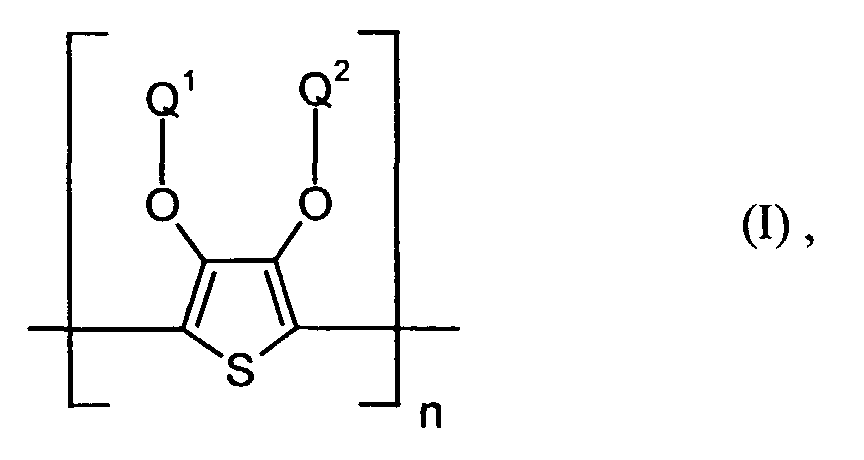
- Q1 und Q2
- unabhängig voneinander für Wasserstoff, gegebenenfalls substituiertes (C1-C20)-Alkyl, CH2OH oder (C6-C14)-Aryl stehen oder
- Q1 und Q2
- zusammen -(CH2)m-CH2- mit m = 0 bis 12, vorzugsweise 1 bis 5, (C6-C14)-Arylen bedeuten, und
- n
- für eine ganze Zahl von 2 bis 10 000, vorzugsweise 5 bis 5 000 steht.
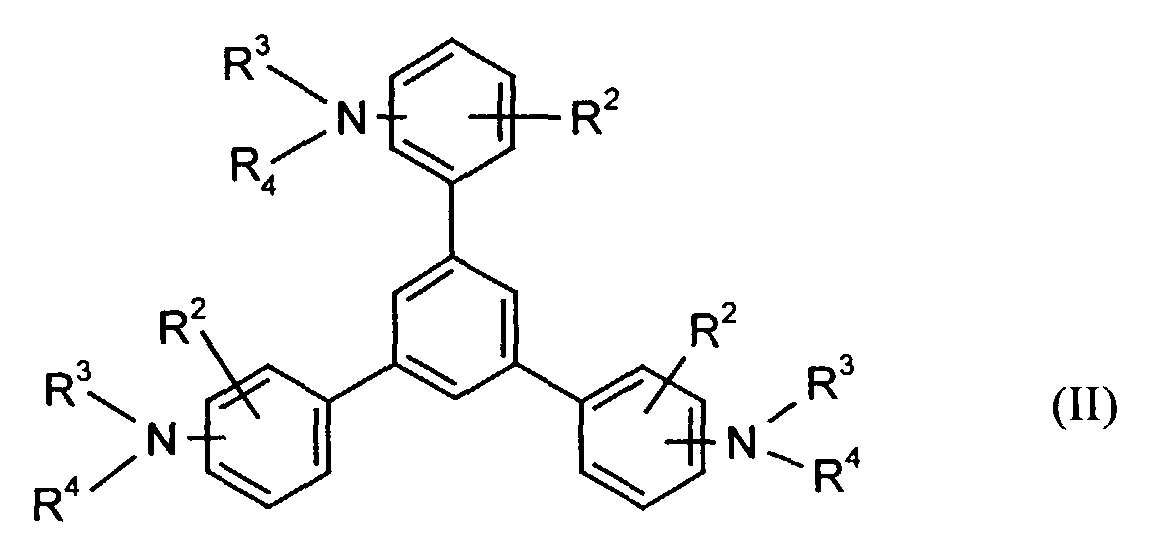
- R2
- für Wasserstoff, gegebenenfalls substituiertes Alkyl oder Halogen steht,
- R3 und R4
- unabhängig voneinander für gegebenenfalls substituiertes (C1-C10)-Alkyl, Alkoxycarbonyl-substituiertes (C1-C10)-Alkyl, jeweils gegebenenfalls substituiertes Aryl, Aralkyl oder Cycloalkyl stehen.
- R3 und R4
- stehen unabhängig voneinander bevorzugt für (C1-C6)-Alkyl, insbesondere Methyl, Ethyl, n- oder iso-Propyl, n-, iso-, sec.- oder tert.-Butyl, (C1-C4)-Alkoxycarbonyl-(C1-C6)-alkyl, wie beispielsweise Methoxy-, Ethoxy-, Propoxy-, Butoxycarbonyl-(C1-C4)-alkyl, jeweils gegebenenfalls durch (C1-C4)-Alkyl und/oder (C1-C4)-Alkoxy substituiertes Phenyl-(C1-C4)-alkyl, Naphthyl-(C1-C4)alkyl, Cyclopentyl, Cyclohexyl, Phenyl oder Naphthyl.




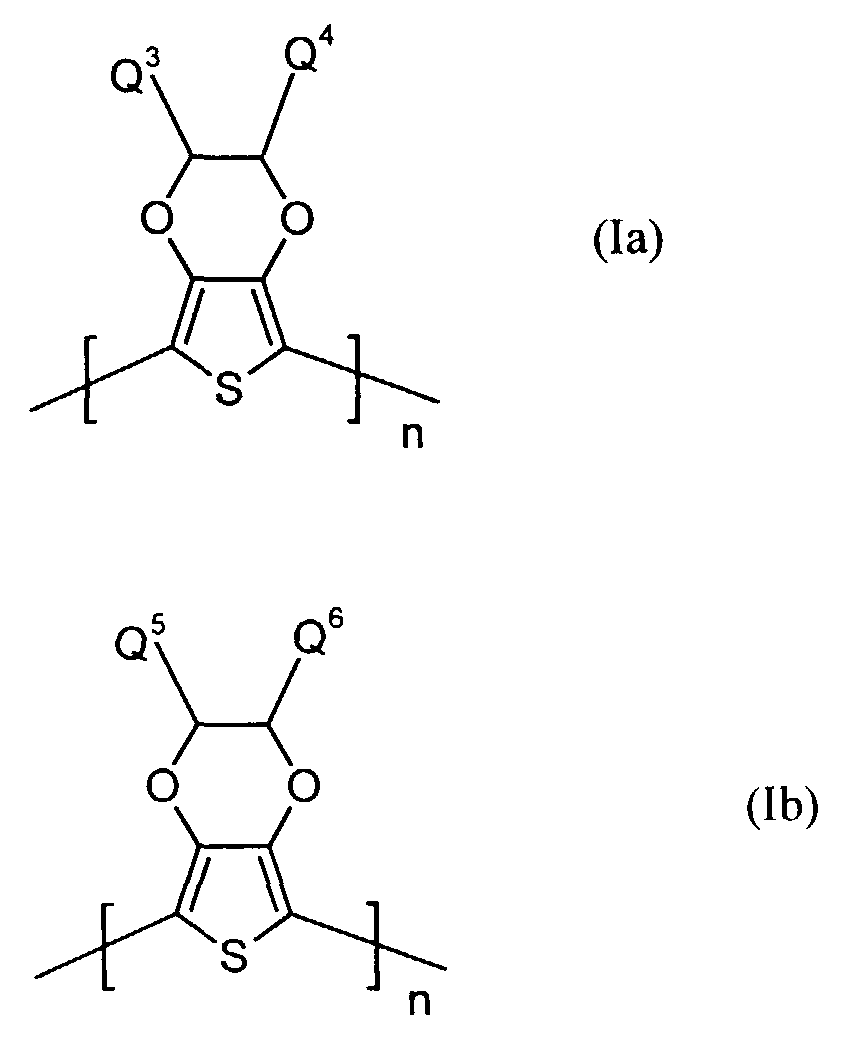
- Q3 und Q4
- unabhängig voneinander für Wasserstoff, gegebenenfalls substituiertes (C1-C18)-Alkyl, vorzugsweise (C1-C10)-, insbesondere (C1-C6)-Alkyl, (C2-C12)-Alkenyl, vorzugsweise (C2-C8)-Alkenyl, (C3-C7)-Cycloalkyl, vorzugsweise Cyclopentyl, Cyclohexyl, (C7-C15)-Aralkyl, vorzugsweise Phenyl-(C1-C4)-alkyl, (C6-C10)-Aryl, vorzugsweise Phenyl, Naphthyl, (C1-C18)-Alkoxy, vorzugsweise (C1-C10)-Alkoxy, beispielsweise Methoxy, Ethoxy, n-oder iso-Propoxy oder (C2-C18)-Alkyloxyester steht und
- Q5 und Q6
- unabhängig voneinander für Wasserstoff, mit jeweils mindestens einer Sulfonatgruppe substituiertes (C1-C18)-Alkyl, vorzugsweise (C1-C10)-, insbesondere (C1-C6)-Alkyl, (C2-C12)-Alkenyl, vorzugsweise (C2-C8)-Alkenyl, (C3-C7)-Cycloalkyl, vorzugsweise Cyclopentyl, Cyclohexyl, (C7-C15)-Aralkyl, vorzugsweise Phenyl-(C1-C4)-alkyl, (C6-C10)-Aryl, vorzugsweise Phenyl, Naphthyl, (C1-C18)-Alkoxy, vorzugsweise (C1-C10)-Alkoxy, beispielsweise Methoxy, Ethoxy, n-oder iso-Propoxy oder (C2-C18)-Alkyloxyester steht, wobei falls Q5 für Wasserstoff steht, Q6 verschieden von Wasserstoff ist und umgekehrt, und
- n
- für eine ganze Zahl von 2 bis 10 000, vorzugsweise 5 bis 5 000 steht.


- Z
- unabhängig in beiden Formen für Atome steht, die eine Struktur vervollständigen, die aus wenigstens 2 kondensierten Ringen besteht, und
- R
- für einen Arylrest oder für ein F-Atom steht.
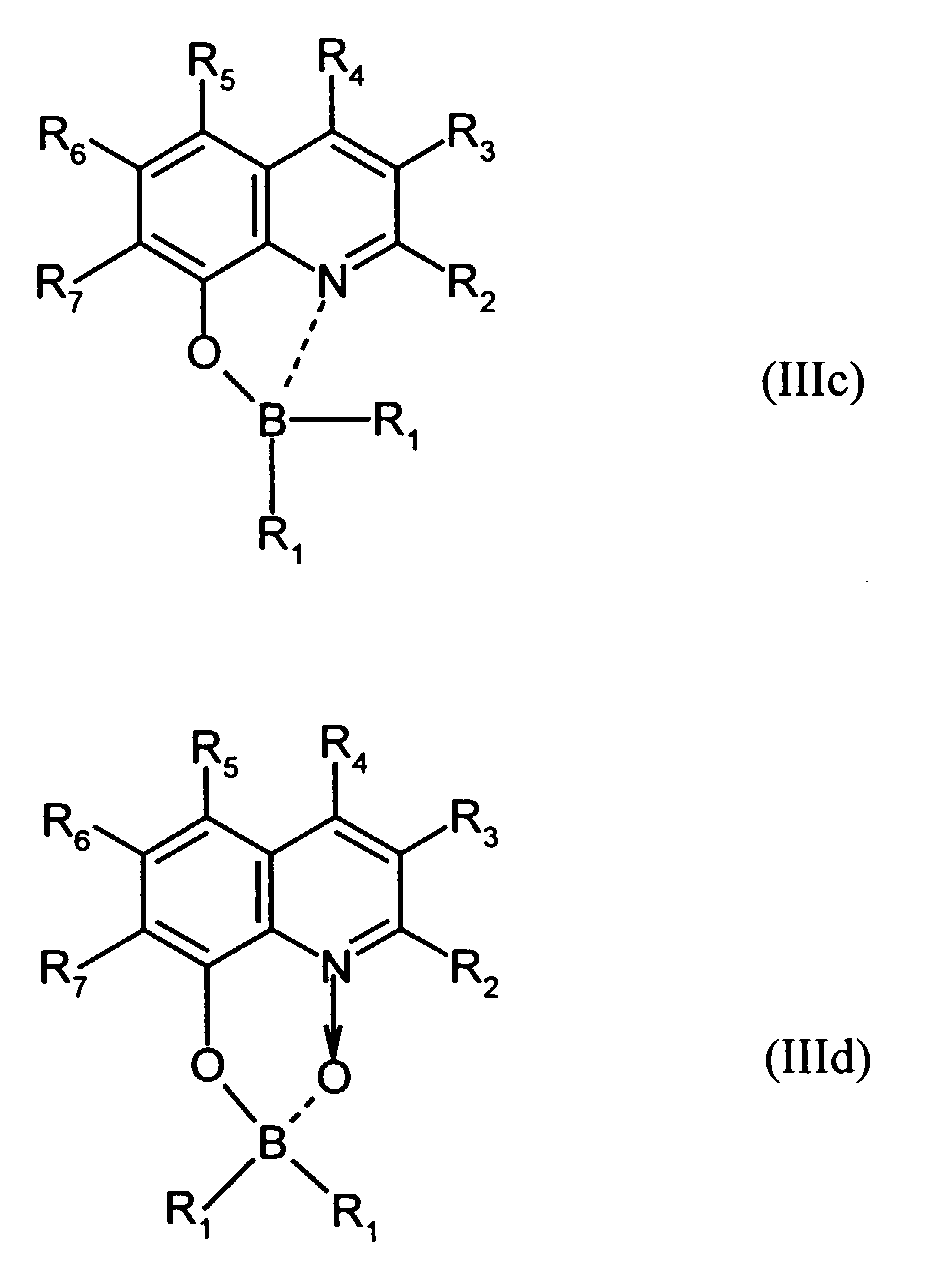
- R1
- für gegebenenfalls substituiertes (C6-C10)-Aryl oder Halogen steht,
- R2, R3, R4, R5, R6 und R7
- unabhängig voneinander für Wasserstoff, gegebenenfalls substituiertes (C1-C16)-Alkyl oder Halogen oder Sulfonamid oder Cyano oder eine gegebenenfalls substituierte Aminogruppe stehen.
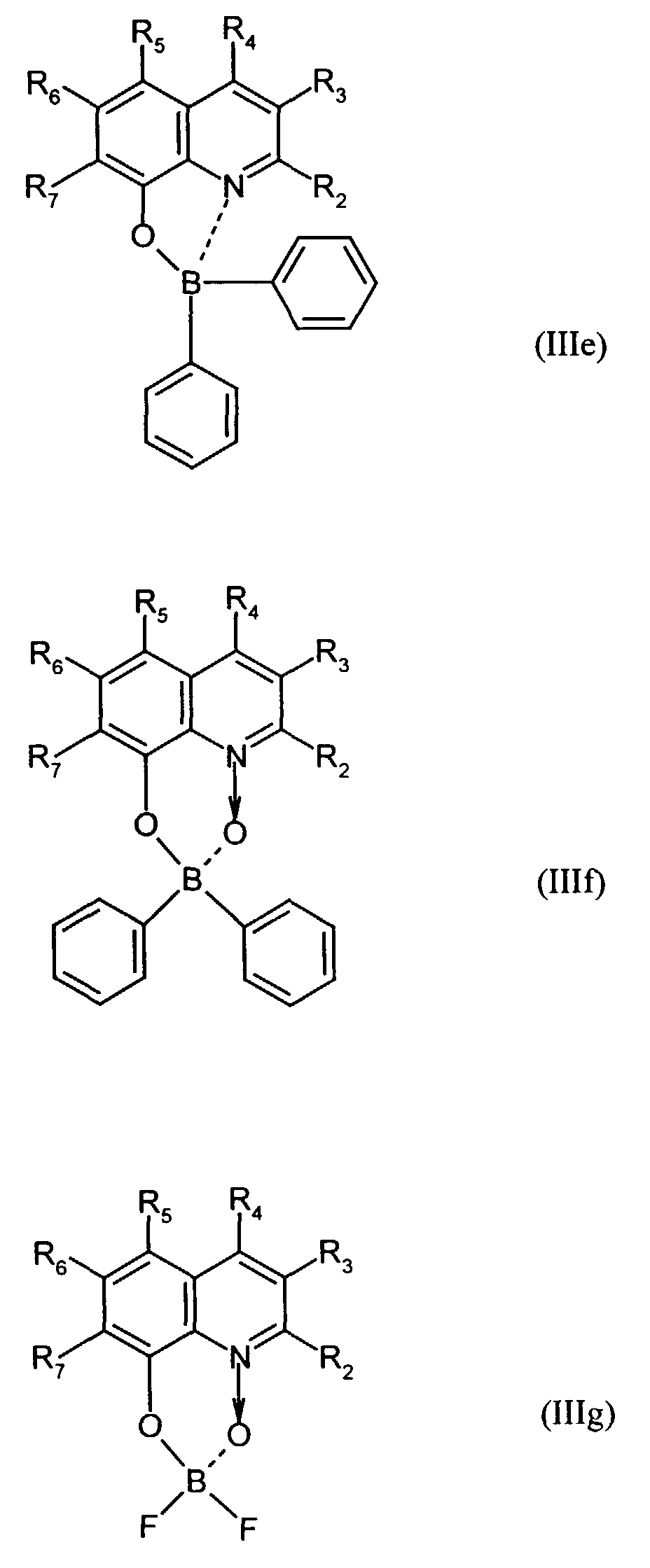
- R2, R3, R4, R5, R6 und R7
- unabhängig voneinander insbesondere für Wasserstoff, gegebenenfalls verzweigtes (C1-C12)-Alkyl, beispielsweise Methyl, Ethyl oder 4-Ethyl-1-methyloctyl, oder Chlor oder ein Sulfonamidrest oder Cyano oder eine substituierte Aminogruppe stehen.






ITO-beschichtetes Glas (Merck Balzers AG, FL, Part. No. 253 674 XO) wird in 50 mm x 50 mm-große Stücke (Substrate) geschnitten. Die Substrate werden anschließend in 3 %iger wäßriger Mukasollösung im Ultrasehalbad 15 min lang gereinigt. Danach werden die Substrate mit destilliertem Wasser gespült und in einer Zentrifuge trocken geschleudert. Dieser Spül- und Trockenvorgang wird 10 mal wiederholt.
Etwa 10 ml der 1,3 %igen Polyethylendioxythiophen/Polystyrolsulphonsäure-Lösung (Bayer AG, Baytron P) werden filtriert (Millipore HV, 0,45 µm). Das Substrat wird anschließend auf eine Lackschleuder gelegt und die filtrierte Lösung wird auf der ITO-beschichteten Seite des Substrats verteilt. Anschließend wird die überstehende Lösung durch Rotation des Tellers bei 500 U/min über den Zeitraum von 3 min abgeschleudert. Danach wird das so beschichtete Substrat 5 min lang bei 110°C auf einer Heizplatte getrocknet. Die Schichtdicke beträgt 60 nm (Tencor, Alphastep 200).
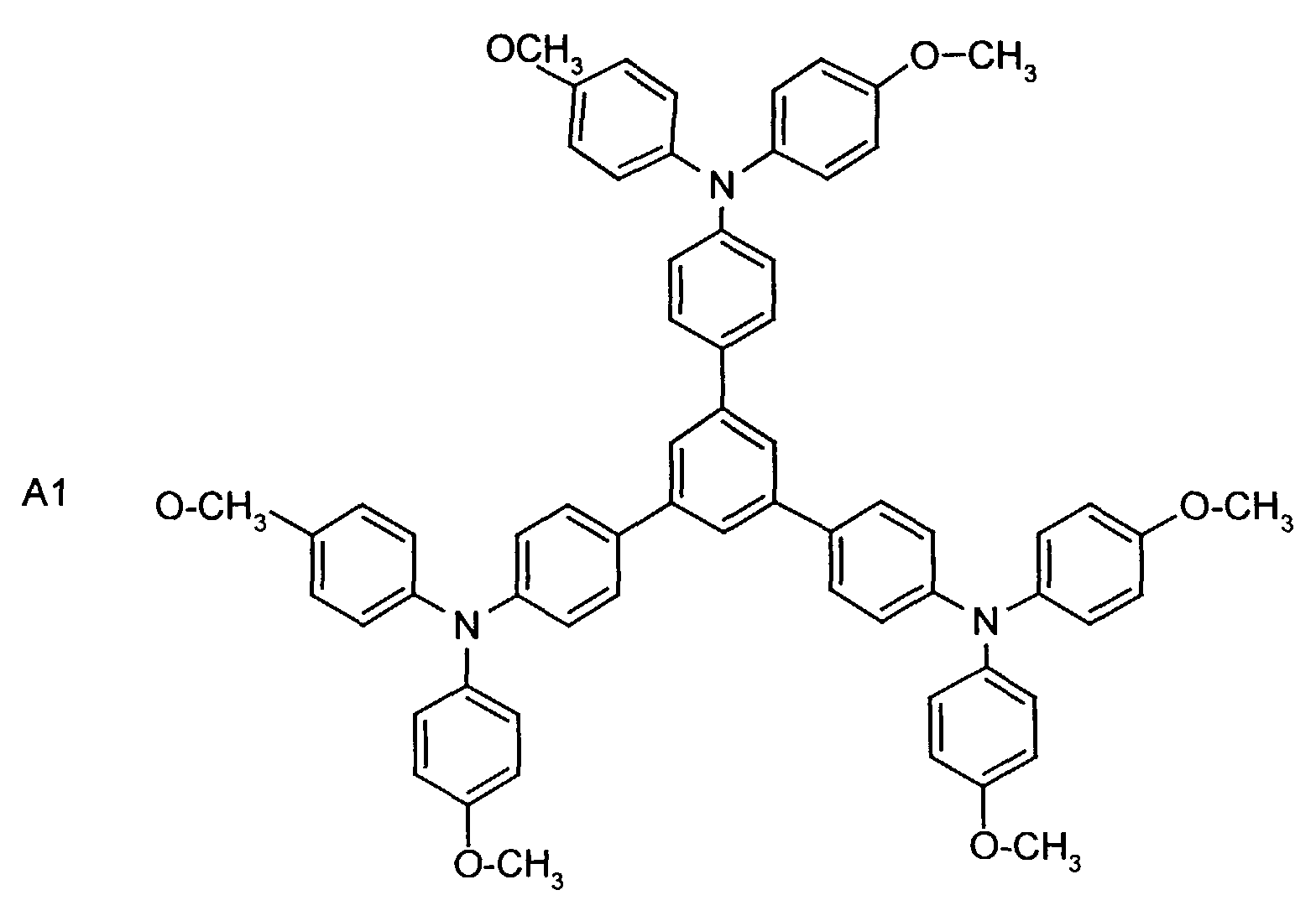
5 ml einer 1,5 %igen Dichlorethanlösung aus 1 Gew.-Teil Polyvinylcarbazol (BASF, Luvican), 1 Gew.-Teil Phenylamin (Agfa-Gevaert, Verbindung A1) und 1 Gew.-Teil Phenylamin (Agfa-Gevaert, A2) werden filtriert (Millipore HV, 0,45 µm) und auf der getrockneten Baytron P Schicht verteilt. Anschließend wird die überstehende Lösung durch Rotation des Tellers bei 800 U/min 30 sec lang abgeschleudert. Danach wird das so beschichtete Substrat 5 min lang bei 110°C auf einer Heizplatte getrocknet. Die Gesamtschichtdicke beträgt 150 nm.
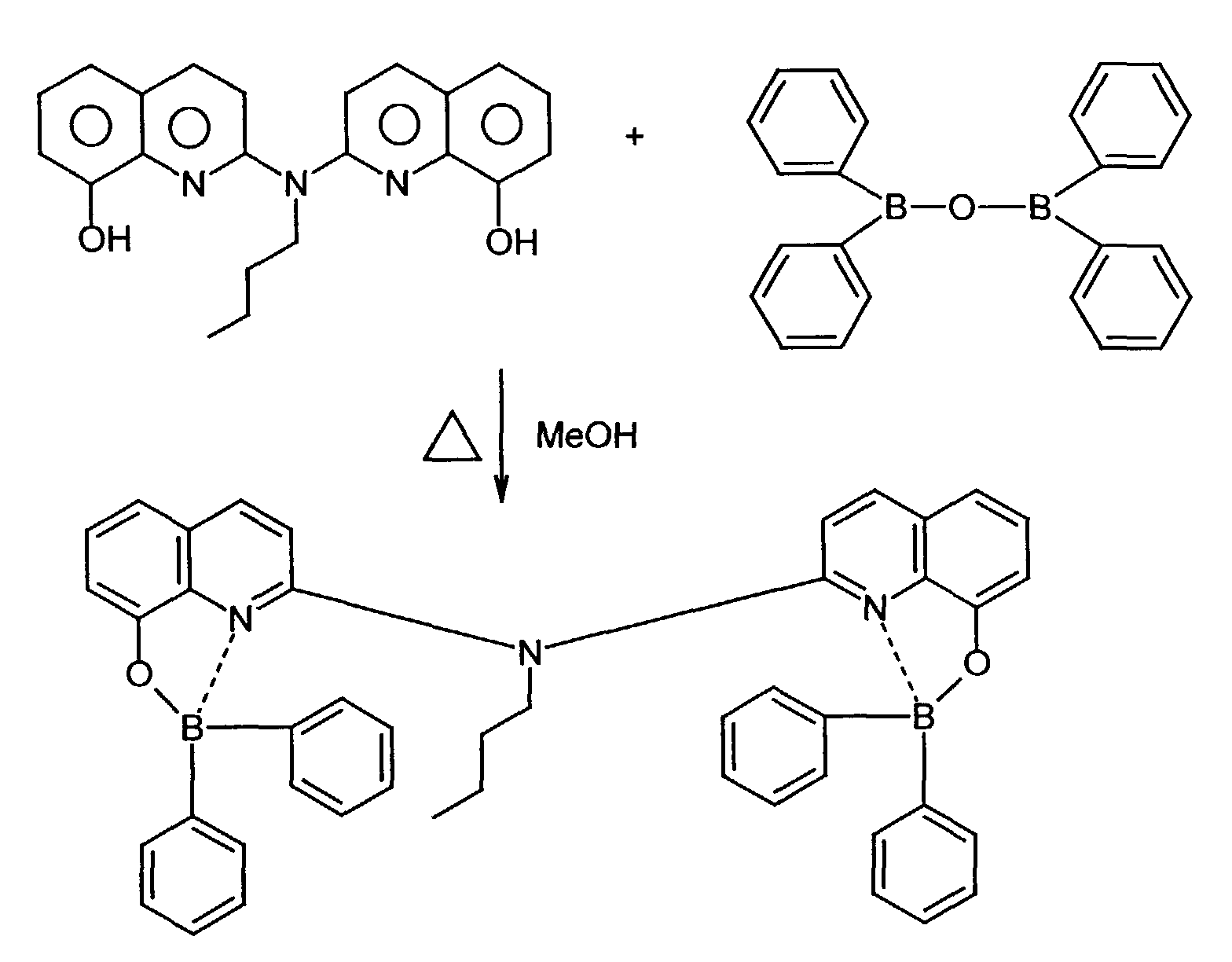
Auf die so hergestellten zwei organischen Schichten wird eine dritte organische Schicht, nämlich die erfindungsgemäße Substanz B1, thermisch gedampft. Dies wird in einer Aufdampfanlage (Leybold, Univex 350) durchgeführt. Der Druck in der Aufdampfanlage beträgt während des Aufdampfens 10-3 Pa und die Aufdampfrate beträgt 2 Å/sec. Die Gesamtschichtdicke der 3 organischen Schichten beträgt 200 nm.
Auf das organische Schichtsystem wird eine Metallelektrode gedampft. Dazu wird das Substrat mit dem organischen Schichtsystem nach unten auf eine Lochmaske (Lochdurchmesser 5 mm) gelegt. Aus zwei Aufdampfschiffchen werden bei einem Druck von 10-3 Pa parallel die Elemente Mg und Ag verdampft. Die Aufdampfraten betragen für Mg: 28 Å/sec. Die Dicke der aufgedampften Metallkontakte beträgt 500 nm.
Claims (12)
- Elektrolumineszierende Anordnung, aufgebaut aus einem Substrat, einer Anode, einem elektrolumineszierenden Element und einer Kathode, wobei wenigstens eine der beiden Elektroden im sichtbaren Spektralbereich transparent ist und das elektrolumineszierende Element eine oder mehrere Zonen aus der Gruppe der lochinjizierenden Zone, lochtransportierende Zone, elektrolumineszierenden Zone, elektronentransportierenden Zone und elektroneninjizierenden Zone in der genannten Reihenfolge enthält, wobei jede der vorhandenen Zonen auch Aufgaben der anderen genannten Zonen übernehmen kann, dadurch gekennzeichnet, daß das elektrolumineszierende Element einen Bor-Komplex eines 8-Hydroxychinolin-Derivats enthält.
- Elektrolumineszierende Anordnung gemäß Anspruch 1, dadurch gekennzeichnet, daß die lochinjizierende Zone ein neutrales oder kationisches Polythiophen der Formel (I) enthält,wobei

- Q1 und Q2
- unabhängig voneinander für Wasserstoff, gegebenenfalls substituiertes (C1-C20)-Alkyl, CH2OH oder (C6-C14)-Aryl stehen oder
- Q1 und Q2
- zusammen -(CH2)m-CH2- mit m = 0 bis 12, vorzugsweise 1 bis 5, (C6-C14)-Arylen bedeuten, und
- n
- für eine ganze Zahl von 2 bis 10 000, vorzugsweise 5 bis 5 000 steht.
- Elektrolumineszierende Anordnungen gemäß Anspruch 1, dadurch gekennzeichnet, daß die lochinjizierende Zone ein neutrales oder kationisches Polythiophen der Formel (Ia) oder (Ib) oder ein Gemisch enthält,worin
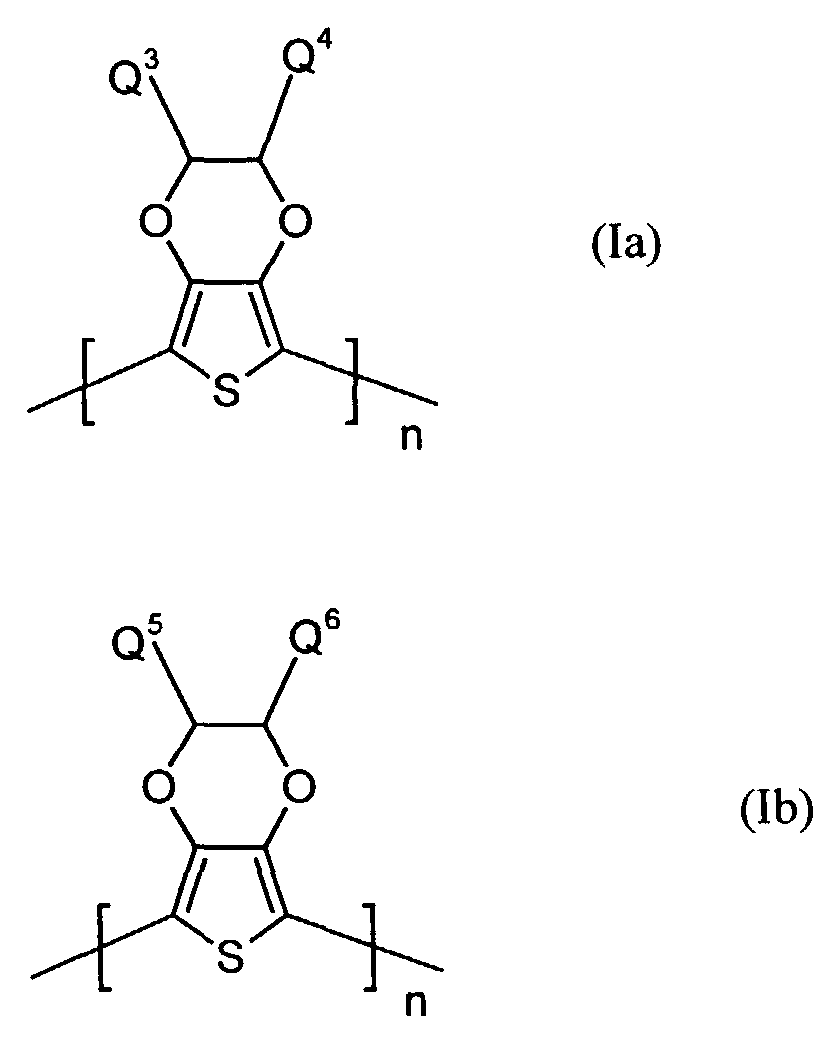
- Q3 und Q4
- unabhängig voneinander für Wasserstoff, gegebenenfalls substituiertes (C1-C18)-Alkyl, (C2-C12)-Alkenyl, (C3-C7)-Cycloalkyl, (C7-C15)-Aralkyl, (C6-C10)-Aryl, (C1-C18)-Alkoxy oder (C2-C18)-Alkyloxyester steht und
- Q5 und Q6
- unabhängig voneinander für Wasserstoff, mit jeweils mindestens einer Sulfonatgruppe substituiertes (C1-C18)-Alkyl, (C2-C12)-Alkenyl, (C3-C7)-Cycloalkyl, (C7-C15)-Aralkyl, (C6-C10)-Aryl, (C1-C18)-Alkoxy oder (C2-C18)-Alkyloxyester steht, wobei falls Q5 für Wasserstoff steht, Q6 verschieden von Wasserstoff ist und umgekehrt,
- n
- für eine ganze Zahl von 2 bis 10 000 steht.
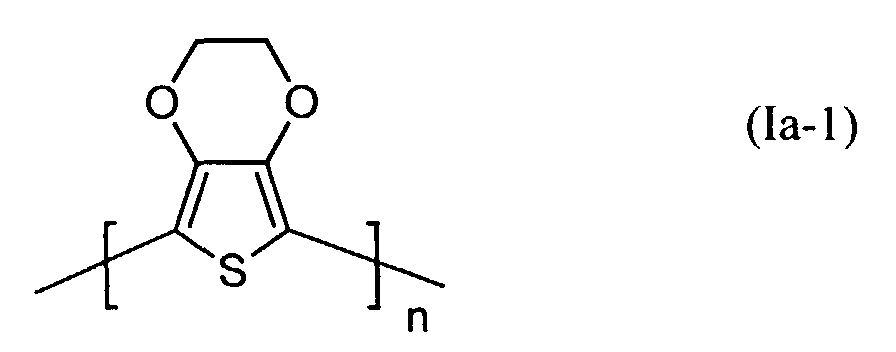
- Elektrolumineszierende Anordnungen gemäß Anspruch 3, dadurch gekennzeichnet, daß die kationischen bzw. neutralen Polythiophene der Formeln (Ia-1) und (Ib-1) entsprechen,worin
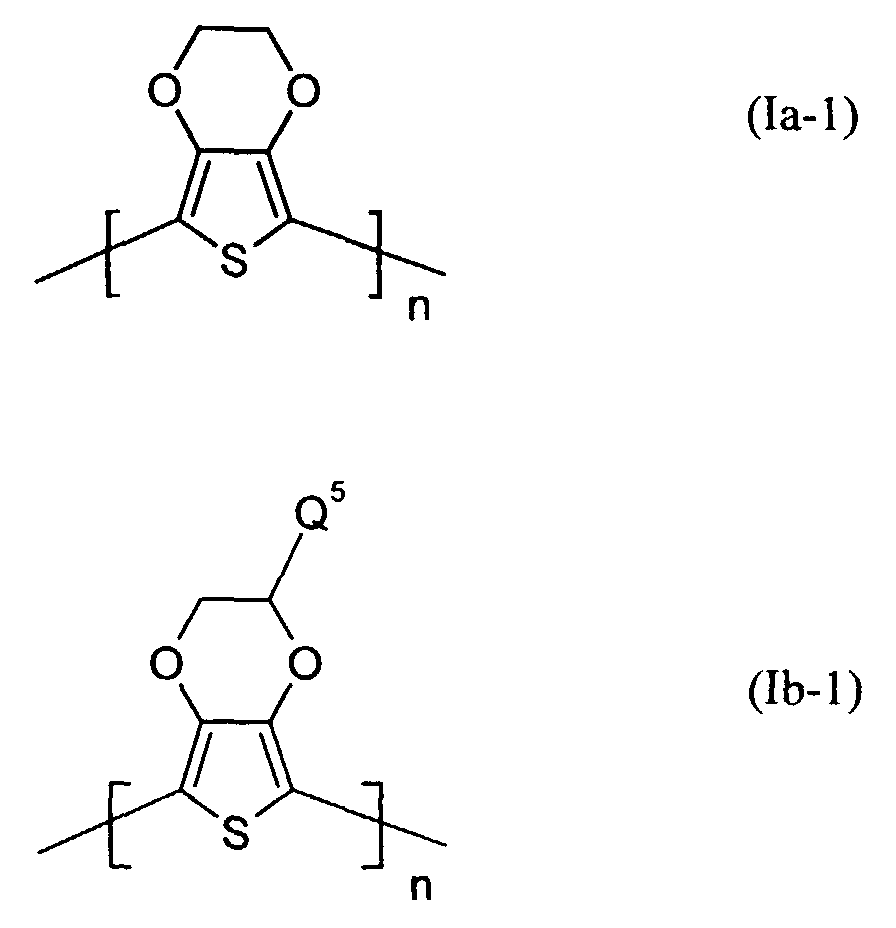 Q5 und n in Anspruch 3 angegebene Bedeutung haben.
 - Elektrolumineszierende Anordnungen gemäß Anspruch 1 bis 4, dadurch gekennzeichnet, daß als Polyanionen die Anionen von polymeren Carbonsäuren und/oder polymeren Sulfonsäuren enthalten sind.
- Elektrolumineszierende Anordnungen gemäß Anspruch 1 bis 5, dadurch gekennzeichnet, daß als Gegenion Polystyrolsulfonsäure und/oder ein Erdalkalisalz davon enthalten ist.
- Elektrolumineszierende Anordnung gemäß Anspruch 1, dadurch gekennzeichnet, daß die lochinjizierende und/oder lochtransportierende Zone eine aromatische tertiäre Aminoverbindung der allgemeinen Formel (II) enthältin welcher

- R2
- für Wasserstoff, gegebenenfalls substituiertes Alkyl oder Halogen steht,
- R3 und R4
- unabhängig voneinander für gegebenenfalls substituiertes (C1-C10)-Alkyl, Alkoxycarbonyl-substituiertes (C1-C10)-Alkyl, jeweils gegebenenfalls substituiertes Aryl, Aralkyl oder Cycloalkyl stehen.
- Elektrolumineszierende Anordnung gemäß Anspruch 2, dadurch gekennzeichnet, daß in Formel (II)
- R2
- für Wasserstoff oder (C1-C6)-Alkyl steht,
- R3 und R4
- unabhängig voneinander für (C1-C6)-Alkyl, (C1-C4)-Alkoxycarbonyl-(C1-C6)-alkyl, jeweils gegebenenfalls durch (C1-C4)-Alkyl und/oder (C1-C4)-Alkoxy substituiertes Phenyl, Naphthyl, Phenyl-(C1-C4)-alkyl, Naphthyl-(C1-C4)-alkyl, Cyclopentyl oder Cyclohexyl stehen.
- Elektrolumineszierende Anordnung gemäß Anspruch 7, dadurch gekennzeichnet, daß die tertiäre Aminoverbindung ausgewählt ist aus den folgenden Verbindungen:
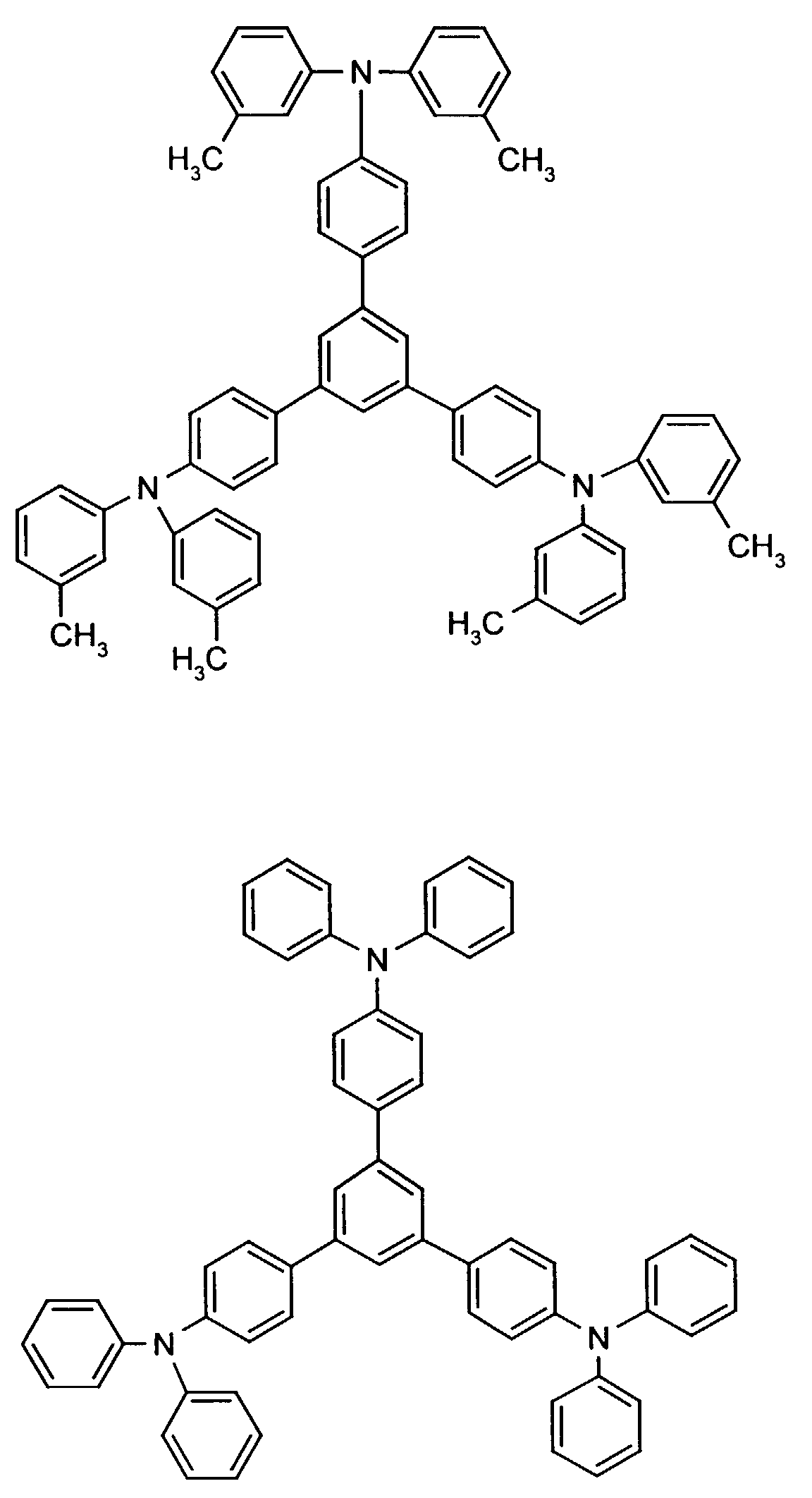




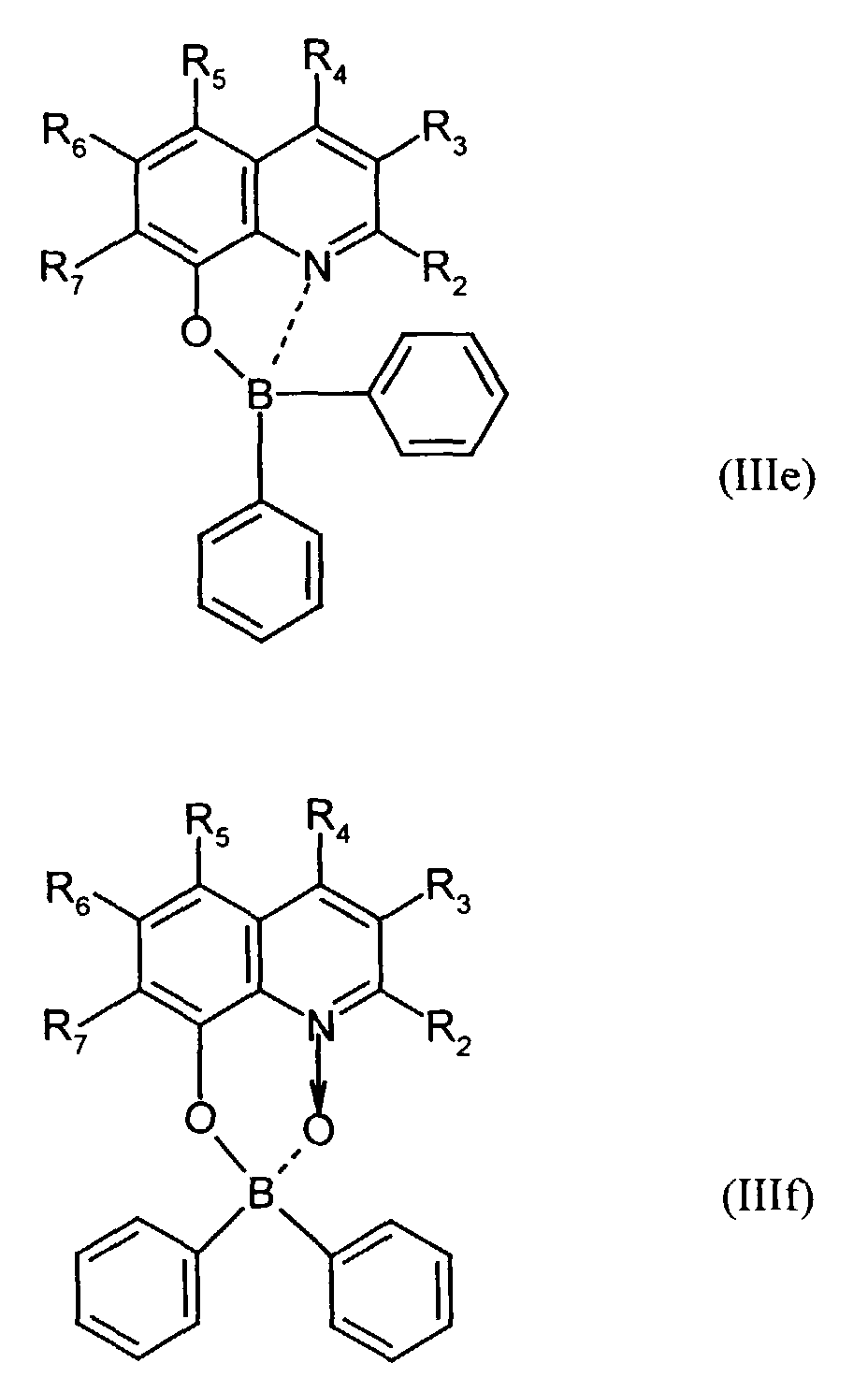
- Elektrolumineszierende Anordnung gemäß Anspruch 1, dadurch gekennzeichnet, daß der Bor-Komplex eine Verbindung ausgewählt aus den allgemeinen Formeln (IIIa) bis (IIIg) ist
 worin
worin
- Z
- für Atome steht, die eine Struktur vervollständigen, die aus wenigstens 2 kondensierten Ringen besteht,
- R
- für einen Arylrest oder für ein F-Atom steht
worin
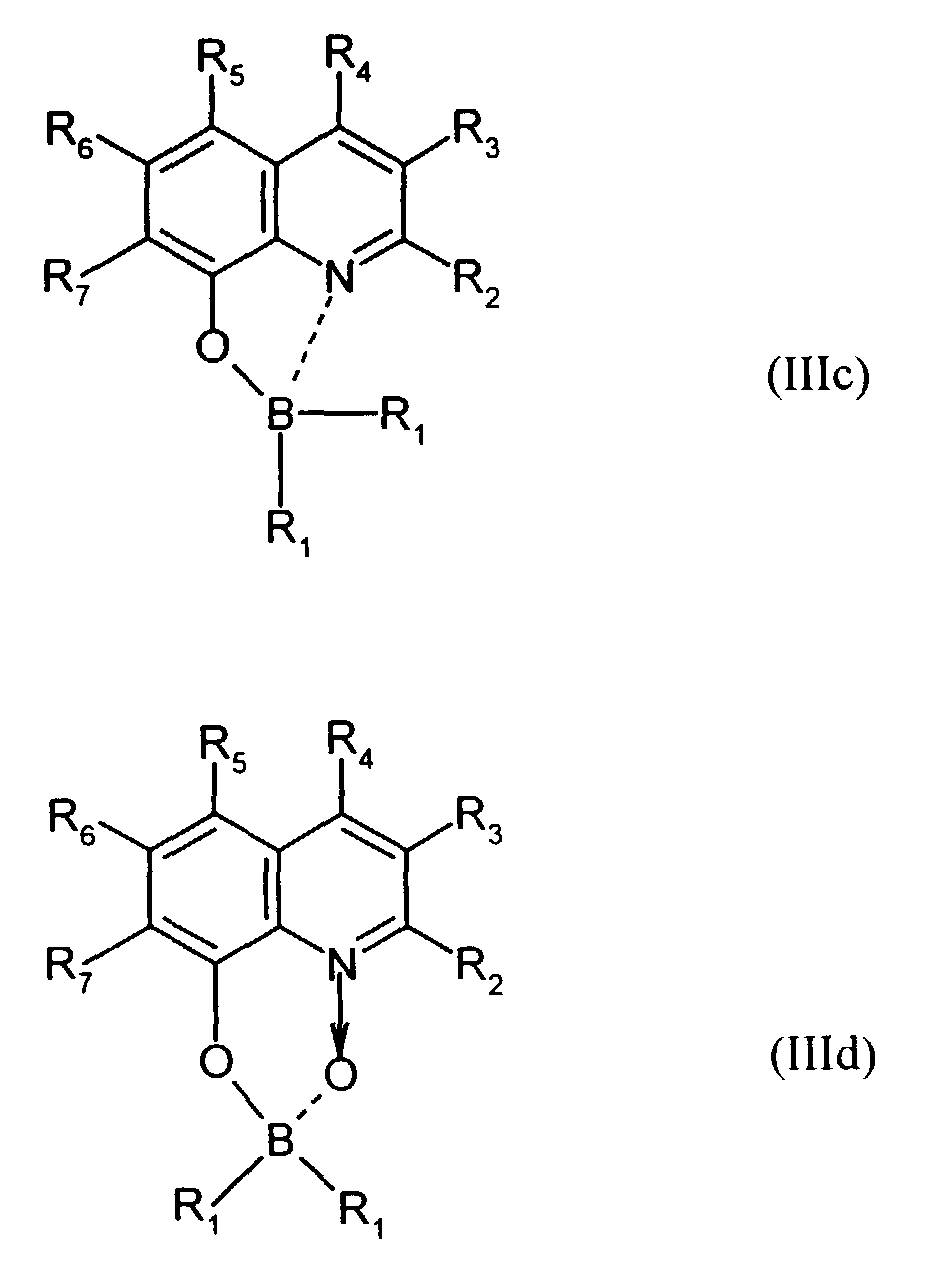
- R1
- für gegebenenfalls substituiertes (C6-C10)-Aryl oder Halogen steht,
- R2, R3, R4, R5, R6 und R7
- unabhängig voneinander für Wasserstoff, gegebenenfalls
substituiertes (C1-C16)-Alkyl oder Halogen oder Sulfonamid
oder Cyano oder eine gegebenenfalls substituierte Aminogruppe
stehen,
 worin
worin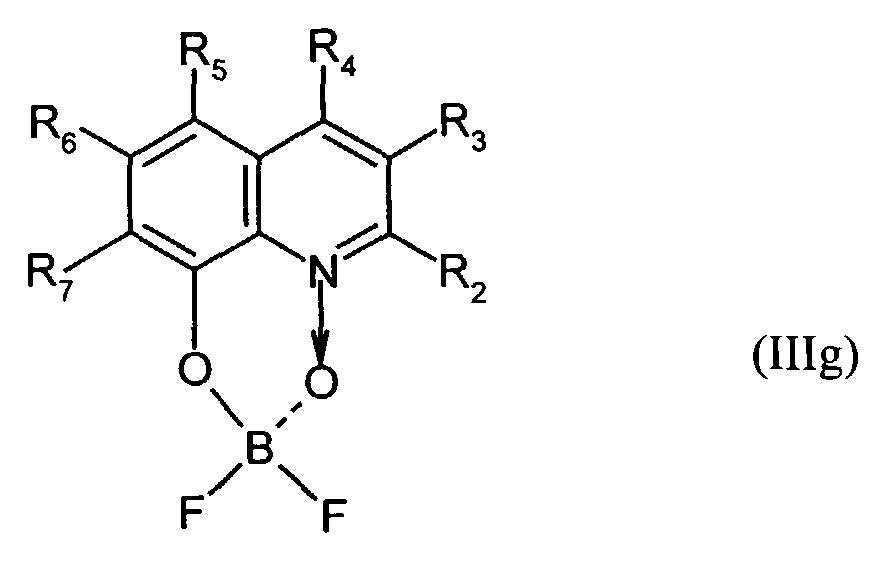
- R2, R3, R4, R5, R6 und R7
- unabhängig voneinander für Wasserstoff, gegebenenfalls verzweigtes (C1-C12)-Alkyl oder Chlor oder ein Sulfonamidrest oder Cyano oder eine substituierte Aminogruppe stehen,
- Elektrolumineszierende Anordnung gemäß Anspruch 1, dadurch gekennzeichnet, daß der transparente Binder ausgewählt ist aus der Gruppe Polycarbonate, Polyestercarbonate, Copolymere des Styrols, Polysulfone, Polymerisate auf Basis von Vinylgruppen-haltigen Monomeren, Polyolefine, cyclische Olelfincopolymere, Phenoxyharze.
- Elektrolumineszierende Anordnung gemäß Anspruch 1, dadurch gekennzeichnet, daß der Bor-Komplex ausgewählt ist aus Verbindungen der Gruppe


Applications Claiming Priority (2)
| Application Number | Priority Date | Filing Date | Title |
|---|---|---|---|
| DE19829947A DE19829947A1 (de) | 1998-07-04 | 1998-07-04 | Elektrolumineszierende Anordnungen mit Bor-Chelaten |
| DE19829947 | 1998-07-04 |
Publications (2)
| Publication Number | Publication Date |
|---|---|
| EP0969531A2 true EP0969531A2 (de) | 2000-01-05 |
| EP0969531A3 EP0969531A3 (de) | 2000-02-23 |
Family
ID=7872989
Family Applications (1)
| Application Number | Title | Priority Date | Filing Date |
|---|---|---|---|
| EP99111855A Withdrawn EP0969531A3 (de) | 1998-07-04 | 1999-06-21 | Elektrolumineszierende Anordungen mit Bor-Chelaten |
Country Status (7)
| Country | Link |
|---|---|
| US (1) | US6287713B1 (de) |
| EP (1) | EP0969531A3 (de) |
| JP (1) | JP2000150163A (de) |
| KR (1) | KR20000011462A (de) |
| CA (1) | CA2276806A1 (de) |
| DE (1) | DE19829947A1 (de) |
| TW (1) | TW419929B (de) |
Cited By (20)
| Publication number | Priority date | Publication date | Assignee | Title |
|---|---|---|---|---|
| WO2000044387A1 (fr) * | 1999-01-29 | 2000-08-03 | Nitto Kasei Co., Ltd. | Composes organobores presentant une activite de coccidiostats |
| EP1217668A1 (de) * | 2000-12-22 | 2002-06-26 | Covion Organic Semiconductors GmbH | Verwendung von Bor- und Aluminium-Verbindungen in Elektronik-Bauteilen |
| WO2002068431A1 (de) * | 2001-02-27 | 2002-09-06 | Siemens Aktiengesellschaft | Organische rot elektrolumineszierende chromophore, herstellungsverfahren und verwendungen dazu |
| WO2004056322A3 (en) * | 2002-12-18 | 2004-09-16 | Anacor Pharmaceuticals Inc | Antibiotics containing borinic acid complexes and methods of use |
| US7405304B2 (en) | 2002-01-10 | 2008-07-29 | The Penn State Research Foundation | Methods for the preparation of alkyl diaryl borinates and complexed diarylboronic acids |
| US8039450B2 (en) | 2008-03-06 | 2011-10-18 | Anacor Pharmaceuticals, Inc. | Boron-containing small molecules as anti-inflammatory agents |
| US8039451B2 (en) | 2005-02-16 | 2011-10-18 | Anacor Pharmaceuticals, Inc. | Boron-containing small molecules |
| US8115026B2 (en) | 2005-02-16 | 2012-02-14 | Anacor Pharmaceuticals, Inc. | Boron-containing small molecules |
| US8168614B2 (en) | 2006-02-16 | 2012-05-01 | Anacor Pharmaceuticals, Inc. | Boron-containing small molecules as anti-inflammatory agents |
| US8343944B2 (en) | 2009-07-28 | 2013-01-01 | Anacor Pharmaceuticals, Inc. | Trisubstituted boron-containing molecules |
| US8461364B2 (en) | 2008-12-17 | 2013-06-11 | Glaxosmithkline Llc | Polymorphs of (S)-3-aminomethyl-7-(3-hydroxy-propoxy)-3H-benzo[C][1,2]oxaborol-1-OL |
| US8461336B2 (en) | 2008-09-04 | 2013-06-11 | Anacor Pharmaceuticals, Inc. | Boron-containing small molecules |
| US8461134B2 (en) | 2009-11-11 | 2013-06-11 | Anacor Pharmaceuticals, Inc. | Boron-containing small molecules |
| US8470803B2 (en) | 2008-09-04 | 2013-06-25 | Anacor Pharmaceuticals, Inc. | Boron-containing small molecules |
| US8623911B2 (en) | 2010-03-19 | 2014-01-07 | Anacor Pharmaceuticals, Inc. | Boron-containing small molecules as anti-protozoal agent |
| US8703742B2 (en) | 2010-09-07 | 2014-04-22 | Anacor Pharmaceuticals, Inc. | Boron-containing small molecules |
| US8716478B2 (en) | 2010-01-27 | 2014-05-06 | Anacor Pharmaceuticals, Inc. | Boron-containing small molecules |
| US9346834B2 (en) | 2009-10-20 | 2016-05-24 | Anacor Pharmaceuticals, Inc. | Boron-containing small molecules as antiprotozoal agents |
| US9440994B2 (en) | 2009-08-14 | 2016-09-13 | Anacor Pharmaceuticals, Inc. | Boron containing small molecules as antiprotozoal agents |
| TWI602799B (zh) * | 2012-07-31 | 2017-10-21 | Sk化學股份有限公司 | 用於有機電致發光裝置的化合物及包括所述化合物的有機電致發光裝置 |
Families Citing this family (14)
| Publication number | Priority date | Publication date | Assignee | Title |
|---|---|---|---|---|
| CN1370170A (zh) * | 1999-05-25 | 2002-09-18 | 宾夕法尼亚州研究基金会 | Dna甲基转移酶抑制剂 |
| US6689494B1 (en) | 2001-09-11 | 2004-02-10 | Bhalchandra M. Karandikar | Light emissive materials for organic light emitting devices (OLED) and OLED based thereupon |
| US20050227933A1 (en) * | 2001-11-29 | 2005-10-13 | Benkovic Stephen J | Treatment of bacterial induced diseases using DNA methyl transferase inhibitors |
| US6846579B2 (en) * | 2002-02-15 | 2005-01-25 | Eastman Kodak Company | Multilayer with radiation absorber and touch screen |
| US6933064B2 (en) * | 2002-02-15 | 2005-08-23 | Eastman Kodak Company | Multilayer with spacers, touch screen and method |
| GB0306097D0 (en) * | 2003-03-15 | 2003-04-23 | Elam T Ltd | Electroluminescent complexes |
| TWI365218B (en) | 2003-11-17 | 2012-06-01 | Sumitomo Chemical Co | Conjugated oligomers or polymers based on crosslinkable arylamine compounds |
| EP1888706B1 (de) * | 2005-05-03 | 2017-03-01 | Merck Patent GmbH | Organische elektrolumineszenzvorrichtung und in deren herstellung verwendete boronsäure- und borinsäure-derivate |
| US8440324B2 (en) * | 2005-12-27 | 2013-05-14 | E I Du Pont De Nemours And Company | Compositions comprising novel copolymers and electronic devices made with such compositions |
| EP2412699A1 (de) * | 2005-12-28 | 2012-02-01 | E.I. Du Pont De Nemours And Company | Zusammensetzungen mit neuen Verbindungen und elektronische Vorrichtungen aus den Zusammensetzungen |
| CN102596893A (zh) | 2009-10-19 | 2012-07-18 | E.I.内穆尔杜邦公司 | 用于电子应用的三芳基胺化合物 |
| KR101782660B1 (ko) | 2009-10-19 | 2017-09-27 | 이 아이 듀폰 디 네모아 앤드 캄파니 | 전자적 응용을 위한 트라이아릴아민 화합물 |
| US8617720B2 (en) | 2009-12-21 | 2013-12-31 | E I Du Pont De Nemours And Company | Electroactive composition and electronic device made with the composition |
| CN105111415B (zh) * | 2015-09-15 | 2017-05-03 | 天津理工大学 | 一种侧链含萘基团的聚噻吩衍生物及其制备方法和应用 |
Family Cites Families (24)
| Publication number | Priority date | Publication date | Assignee | Title |
|---|---|---|---|---|
| US4539507A (en) | 1983-03-25 | 1985-09-03 | Eastman Kodak Company | Organic electroluminescent devices having improved power conversion efficiencies |
| US4720432A (en) | 1987-02-11 | 1988-01-19 | Eastman Kodak Company | Electroluminescent device with organic luminescent medium |
| US4885211A (en) | 1987-02-11 | 1989-12-05 | Eastman Kodak Company | Electroluminescent device with improved cathode |
| US4769292A (en) | 1987-03-02 | 1988-09-06 | Eastman Kodak Company | Electroluminescent device with modified thin film luminescent zone |
| GB8712057D0 (en) | 1987-05-21 | 1987-06-24 | British Petroleum Co Plc | Optical modulators |
| DE3843412A1 (de) | 1988-04-22 | 1990-06-28 | Bayer Ag | Neue polythiophene, verfahren zu ihrer herstellung und ihre verwendung |
| DE68912216T2 (de) | 1988-06-28 | 1994-07-28 | Agfa Gevaert Nv | Elektrophotographisches Registriermaterial. |
| US5077142A (en) | 1989-04-20 | 1991-12-31 | Ricoh Company, Ltd. | Electroluminescent devices |
| GB8909011D0 (en) | 1989-04-20 | 1989-06-07 | Friend Richard H | Electroluminescent devices |
| DE69012892T2 (de) | 1989-07-04 | 1995-05-11 | Mitsubishi Chem Ind | Organische elektrolumineszente Vorrichtung. |
| DE4003255A1 (de) | 1990-02-03 | 1991-08-08 | Bayer Ag | Schwarzes mangan-eisenoxid-pigment, verfahren zu seiner herstellung sowie dessen verwendung |
| DE59010247D1 (de) | 1990-02-08 | 1996-05-02 | Bayer Ag | Neue Polythiophen-Dispersionen, ihre Herstellung und ihre Verwendung |
| DE69110922T2 (de) | 1990-02-23 | 1995-12-07 | Sumitomo Chemical Co | Organisch elektrolumineszente Vorrichtung. |
| JP3069139B2 (ja) | 1990-03-16 | 2000-07-24 | 旭化成工業株式会社 | 分散型電界発光素子 |
| GB9018698D0 (en) | 1990-08-24 | 1990-10-10 | Lynxvale Ltd | Semiconductive copolymers for use in electroluminescent devices |
| US5408109A (en) | 1991-02-27 | 1995-04-18 | The Regents Of The University Of California | Visible light emitting diodes fabricated from soluble semiconducting polymers |
| DE4211459A1 (de) | 1992-04-06 | 1993-10-07 | Agfa Gevaert Ag | Herstellung einer Antistatikschicht für fotografische Materialien |
| DE69305262T2 (de) * | 1992-07-13 | 1997-04-30 | Eastman Kodak Co | Einen inneren Übergang aufweisende organisch elektrolumineszierende Vorrichtung mit einer neuen Zusammensetzung |
| DE19507413A1 (de) | 1994-05-06 | 1995-11-09 | Bayer Ag | Leitfähige Beschichtungen |
| ATE287929T1 (de) * | 1994-05-06 | 2005-02-15 | Bayer Ag | Leitfähige beschichtungen hergestellt aus mischungen enthaltend polythiophen und lösemittel |
| US5554450A (en) | 1995-03-08 | 1996-09-10 | Eastman Kodak Company | Organic electroluminescent devices with high thermal stability |
| DE19627070A1 (de) * | 1996-07-05 | 1998-01-08 | Bayer Ag | Elektrolumineszierende Anordnungen unter Verwendung von Blendsystemen |
| DE19627071A1 (de) * | 1996-07-05 | 1998-01-08 | Bayer Ag | Elektrolumineszierende Anordnungen |
| US5965281A (en) * | 1997-02-04 | 1999-10-12 | Uniax Corporation | Electrically active polymer compositions and their use in efficient, low operating voltage, polymer light-emitting diodes with air-stable cathodes |
-
1998
- 1998-07-04 DE DE19829947A patent/DE19829947A1/de not_active Withdrawn
-
1999
- 1999-06-21 TW TW088110272A patent/TW419929B/zh not_active IP Right Cessation
- 1999-06-21 EP EP99111855A patent/EP0969531A3/de not_active Withdrawn
- 1999-06-29 US US09/342,952 patent/US6287713B1/en not_active Expired - Fee Related
- 1999-06-30 CA CA002276806A patent/CA2276806A1/en not_active Abandoned
- 1999-07-01 JP JP11187807A patent/JP2000150163A/ja active Pending
- 1999-07-03 KR KR1019990026746A patent/KR20000011462A/ko not_active Withdrawn
Cited By (43)
| Publication number | Priority date | Publication date | Assignee | Title |
|---|---|---|---|---|
| WO2000044387A1 (fr) * | 1999-01-29 | 2000-08-03 | Nitto Kasei Co., Ltd. | Composes organobores presentant une activite de coccidiostats |
| EP1217668A1 (de) * | 2000-12-22 | 2002-06-26 | Covion Organic Semiconductors GmbH | Verwendung von Bor- und Aluminium-Verbindungen in Elektronik-Bauteilen |
| WO2002052661A1 (de) * | 2000-12-22 | 2002-07-04 | Covion Organic Semiconductors Gmbh | Verwendung von bor- und aluminium-verbindungen in elektronik-bauteilen |
| US7060369B2 (en) | 2000-12-22 | 2006-06-13 | Covion Organic Semiconductors Gmbh | Use of boron and aluminum compounds in electronic components |
| US7279603B2 (en) | 2000-12-22 | 2007-10-09 | Merck Patent Gmbh | Boron and aluminum compounds in electronic components |
| WO2002068431A1 (de) * | 2001-02-27 | 2002-09-06 | Siemens Aktiengesellschaft | Organische rot elektrolumineszierende chromophore, herstellungsverfahren und verwendungen dazu |
| US7405304B2 (en) | 2002-01-10 | 2008-07-29 | The Penn State Research Foundation | Methods for the preparation of alkyl diaryl borinates and complexed diarylboronic acids |
| WO2004056322A3 (en) * | 2002-12-18 | 2004-09-16 | Anacor Pharmaceuticals Inc | Antibiotics containing borinic acid complexes and methods of use |
| AU2003299821B2 (en) * | 2002-12-18 | 2010-02-18 | Anacor Pharmaceuticals, Inc. | Antibiotics containing borinic acid complexes and methods of use |
| US9353133B2 (en) | 2005-02-16 | 2016-05-31 | Anacor Pharmaceuticals, Inc. | Boron-containing small molecules |
| US8039451B2 (en) | 2005-02-16 | 2011-10-18 | Anacor Pharmaceuticals, Inc. | Boron-containing small molecules |
| US8115026B2 (en) | 2005-02-16 | 2012-02-14 | Anacor Pharmaceuticals, Inc. | Boron-containing small molecules |
| US8889656B2 (en) | 2005-02-16 | 2014-11-18 | Anacor Pharmaceuticals, Inc. | Boron-containing small molecules |
| US8722917B2 (en) | 2005-02-16 | 2014-05-13 | Anacor Pharmaceuticals, Inc. | Boron-containing small molecules |
| US8440642B2 (en) | 2005-02-16 | 2013-05-14 | Anacor Pharmaceuticals, Inc. | Boron-containing small molecules |
| US9572823B2 (en) | 2005-02-16 | 2017-02-21 | Anacor Pharmaceuticals, Inc. | Boron-containing small molecules |
| US9566289B2 (en) | 2005-02-16 | 2017-02-14 | Anacor Pharmaceuticals, Inc. | Boron-containing small molecules |
| US9566290B2 (en) | 2005-02-16 | 2017-02-14 | Anacor Pharmaceuticals, Inc. | Boron-containing small molecules |
| US9549938B2 (en) | 2005-02-16 | 2017-01-24 | Anacor Pharmaceuticals, Inc. | Boron-containing small molecules |
| US9682092B2 (en) | 2006-02-16 | 2017-06-20 | Anacor Pharmaceuticals, Inc. | Boron-containing small molecules as anti-inflammatory agents |
| US8501712B2 (en) | 2006-02-16 | 2013-08-06 | Anacor Pharmaceuticals, Inc. | Boron-containing small molecules as anti-inflammatory agents |
| US9029353B2 (en) | 2006-02-16 | 2015-05-12 | Anacor Pharmaceuticals, Inc. | Boron-containing small molecules as anti-inflammatory agents |
| US8168614B2 (en) | 2006-02-16 | 2012-05-01 | Anacor Pharmaceuticals, Inc. | Boron-containing small molecules as anti-inflammatory agents |
| US9012431B2 (en) | 2008-03-06 | 2015-04-21 | Anacor Pharmaceuticals, Inc. | Boron-containing small molecules as anti-inflammatory agents |
| US9416146B2 (en) | 2008-03-06 | 2016-08-16 | Anacor Pharmaceuticals, Inc. | Boron-containing small molecules as anti-inflammatory agents |
| US8461135B2 (en) | 2008-03-06 | 2013-06-11 | Anacor Pharmaceuticals, Inc. | Boron-containing small molecules as anti-inflammatory agents |
| US8039450B2 (en) | 2008-03-06 | 2011-10-18 | Anacor Pharmaceuticals, Inc. | Boron-containing small molecules as anti-inflammatory agents |
| US8470803B2 (en) | 2008-09-04 | 2013-06-25 | Anacor Pharmaceuticals, Inc. | Boron-containing small molecules |
| US8461336B2 (en) | 2008-09-04 | 2013-06-11 | Anacor Pharmaceuticals, Inc. | Boron-containing small molecules |
| US8461364B2 (en) | 2008-12-17 | 2013-06-11 | Glaxosmithkline Llc | Polymorphs of (S)-3-aminomethyl-7-(3-hydroxy-propoxy)-3H-benzo[C][1,2]oxaborol-1-OL |
| US8343944B2 (en) | 2009-07-28 | 2013-01-01 | Anacor Pharmaceuticals, Inc. | Trisubstituted boron-containing molecules |
| US9440994B2 (en) | 2009-08-14 | 2016-09-13 | Anacor Pharmaceuticals, Inc. | Boron containing small molecules as antiprotozoal agents |
| US10301329B2 (en) | 2009-08-14 | 2019-05-28 | Anacor Pharmaceuticals, Inc. | Boron-containing small molecules as antiprotozoal agents |
| US9346834B2 (en) | 2009-10-20 | 2016-05-24 | Anacor Pharmaceuticals, Inc. | Boron-containing small molecules as antiprotozoal agents |
| US8461134B2 (en) | 2009-11-11 | 2013-06-11 | Anacor Pharmaceuticals, Inc. | Boron-containing small molecules |
| US8716478B2 (en) | 2010-01-27 | 2014-05-06 | Anacor Pharmaceuticals, Inc. | Boron-containing small molecules |
| US9499570B2 (en) | 2010-01-27 | 2016-11-22 | Anacor Pharmaceuticals, Inc. | Boron containing small molecules |
| US9145429B2 (en) | 2010-01-27 | 2015-09-29 | Anacor Pharmaceuticals, Inc. | Boron-containing small molecules |
| US8623911B2 (en) | 2010-03-19 | 2014-01-07 | Anacor Pharmaceuticals, Inc. | Boron-containing small molecules as anti-protozoal agent |
| US8703742B2 (en) | 2010-09-07 | 2014-04-22 | Anacor Pharmaceuticals, Inc. | Boron-containing small molecules |
| US9751898B2 (en) | 2010-09-07 | 2017-09-05 | Anacor Pharmaceuticals, Inc. | Boron-containing small molecules |
| US11008345B2 (en) | 2010-09-07 | 2021-05-18 | Anacor Pharmaceuticals, Inc. | Boron-containing small molecules |
| TWI602799B (zh) * | 2012-07-31 | 2017-10-21 | Sk化學股份有限公司 | 用於有機電致發光裝置的化合物及包括所述化合物的有機電致發光裝置 |
Also Published As
| Publication number | Publication date |
|---|---|
| CA2276806A1 (en) | 2000-01-04 |
| KR20000011462A (ko) | 2000-02-25 |
| US6287713B1 (en) | 2001-09-11 |
| JP2000150163A (ja) | 2000-05-30 |
| DE19829947A1 (de) | 2000-01-05 |
| EP0969531A3 (de) | 2000-02-23 |
| TW419929B (en) | 2001-01-21 |
Similar Documents
| Publication | Publication Date | Title |
|---|---|---|
| DE19829947A1 (de) | Elektrolumineszierende Anordnungen mit Bor-Chelaten | |
| EP0969532A2 (de) | Elektrolumineszierende Anordnungen unter Verwendung von Azomethin-Metallkomplexen | |
| DE69729931T2 (de) | Organische elektrolimineszente vorrichtung | |
| EP0949695B1 (de) | Elektrolumineszierende Anordnungen unter Verwendung von Blendsystemen | |
| DE69422242T2 (de) | El-Element brauchend Polythiophene | |
| DE69511755T2 (de) | Phenylanthracenderivat und organisches EL-Element | |
| EP0933972A2 (de) | Elektrolumineszierende Anordnung unter Verwendung von dotierten Blendsystemen | |
| EP1513911A1 (de) | Phosphoreszierende und lumineszierende konjugierte polymere und deren anwendung in elektrolumineszierenden anordnungen | |
| DE19627070A1 (de) | Elektrolumineszierende Anordnungen unter Verwendung von Blendsystemen | |
| EP0964459A2 (de) | Elektrolumineszierende Anordnungen mit N-Alkyl-2,2'-imino-bis-(8-hydroxychinolin)-Metallkomplexen | |
| DE19627071A1 (de) | Elektrolumineszierende Anordnungen | |
| EP1114474A1 (de) | Elektrolumineszierende anordnungen mit thiophencarboxylat-metallkomplexen | |
| US6368731B2 (en) | Electroluminescent assemblies using boron chelates of 8-aminoquinoline derivatives | |
| EP0949312A1 (de) | EL-Anordnung auf Basis von tert.-Aminen, in Alkohol löslichen Alq3-Derivaten bzw. Mischungen und polymeren Bindern | |
| EP1109851B1 (de) | Aromatische poly(1,3,4-heterodiazole) für den einsatz in optischen vorrichtungen, insbesondere elektrolumineszenzbauelementen | |
| DE69838865T2 (de) | Lichtemittierende Vorrichtung auf Polymerbasis | |
| US6316130B1 (en) | Electroluminescent assemblies using azomethine-metal complexes | |
| DE19839946A1 (de) | Elektrolumineszierende Anordnungen mit mehrkernigen Metallkomplexen | |
| EP1133802A1 (de) | Elektrolumineszierende anordnungen mit metallkomplexen mit angeknüpften fluoreszenzfarbstoffen | |
| EP1074602A1 (de) | Elektrolumineszierende Anordnungen unter Verwendung von Bor-Chelaten von 8-Aminochinolin-Derivaten | |
| DE10224617A1 (de) | Phosphoreszierende konjugierte Polymere und deren Anwendung in elektrolumineszierenden Anordnungen | |
| DE10311767A1 (de) | Lumineszierende konjugierte Polymere und deren Anwendung in elektrolumineszierenden Anordnungen | |
| DE19634387A1 (de) | Oligomere Pyrrol-Verbindungen in elektrolumineszierenden Anordnungen | |
| DE10109465A1 (de) | Organische rot elektrolumineszierende Vorrichtung |
Legal Events
| Date | Code | Title | Description |
|---|---|---|---|
| PUAI | Public reference made under article 153(3) epc to a published international application that has entered the european phase |
Free format text: ORIGINAL CODE: 0009012 |
|
| AK | Designated contracting states |
Kind code of ref document: A2 Designated state(s): AT BE CH DE DK ES FI FR GB GR IE IT LI LU MC NL PT SE |
|
| AX | Request for extension of the european patent |
Free format text: AL;LT;LV;MK;RO;SI |
|
| PUAL | Search report despatched |
Free format text: ORIGINAL CODE: 0009013 |
|
| AK | Designated contracting states |
Kind code of ref document: A3 Designated state(s): AT BE CH CY DE DK ES FI FR GB GR IE IT LI LU MC NL PT SE |
|
| AX | Request for extension of the european patent |
Free format text: AL;LT;LV;MK;RO;SI |
|
| 17P | Request for examination filed |
Effective date: 20000823 |
|
| AKX | Designation fees paid |
Free format text: AT BE CH DE DK ES FI FR GB GR IE IT LI LU MC NL PT SE |
|
| STAA | Information on the status of an ep patent application or granted ep patent |
Free format text: STATUS: THE APPLICATION IS DEEMED TO BE WITHDRAWN |
|
| 18D | Application deemed to be withdrawn |
Effective date: 20031231 |