EP0970800A2 - Structure intersectée continue de composite tressée et procédé pour sa fabrication - Google Patents
Structure intersectée continue de composite tressée et procédé pour sa fabrication Download PDFInfo
- Publication number
- EP0970800A2 EP0970800A2 EP99304541A EP99304541A EP0970800A2 EP 0970800 A2 EP0970800 A2 EP 0970800A2 EP 99304541 A EP99304541 A EP 99304541A EP 99304541 A EP99304541 A EP 99304541A EP 0970800 A2 EP0970800 A2 EP 0970800A2
- Authority
- EP
- European Patent Office
- Prior art keywords
- fibers
- biased
- continuous
- intersecting
- ply
- Prior art date
- Legal status (The legal status is an assumption and is not a legal conclusion. Google has not performed a legal analysis and makes no representation as to the accuracy of the status listed.)
- Withdrawn
Links
Images








Classifications
-
- D—TEXTILES; PAPER
- D04—BRAIDING; LACE-MAKING; KNITTING; TRIMMINGS; NON-WOVEN FABRICS
- D04C—BRAIDING OR MANUFACTURE OF LACE, INCLUDING BOBBIN-NET OR CARBONISED LACE; BRAIDING MACHINES; BRAID; LACE
- D04C1/00—Braid or lace, e.g. pillow-lace; Processes for the manufacture thereof
- D04C1/06—Braid or lace serving particular purposes
-
- B—PERFORMING OPERATIONS; TRANSPORTING
- B29—WORKING OF PLASTICS; WORKING OF SUBSTANCES IN A PLASTIC STATE IN GENERAL
- B29C—SHAPING OR JOINING OF PLASTICS; SHAPING OF MATERIAL IN A PLASTIC STATE, NOT OTHERWISE PROVIDED FOR; AFTER-TREATMENT OF THE SHAPED PRODUCTS, e.g. REPAIRING
- B29C70/00—Shaping composites, i.e. plastics material comprising reinforcements, fillers or preformed parts, e.g. inserts
- B29C70/04—Shaping composites, i.e. plastics material comprising reinforcements, fillers or preformed parts, e.g. inserts comprising reinforcements only, e.g. self-reinforcing plastics
- B29C70/06—Fibrous reinforcements only
- B29C70/10—Fibrous reinforcements only characterised by the structure of fibrous reinforcements, e.g. hollow fibres
- B29C70/16—Fibrous reinforcements only characterised by the structure of fibrous reinforcements, e.g. hollow fibres using fibres of substantial or continuous length
- B29C70/22—Fibrous reinforcements only characterised by the structure of fibrous reinforcements, e.g. hollow fibres using fibres of substantial or continuous length oriented in at least two directions forming a two-dimensional [2D] structure
- B29C70/222—Fibrous reinforcements only characterised by the structure of fibrous reinforcements, e.g. hollow fibres using fibres of substantial or continuous length oriented in at least two directions forming a two-dimensional [2D] structure the structure being shaped to form a three dimensional configuration
-
- D—TEXTILES; PAPER
- D04—BRAIDING; LACE-MAKING; KNITTING; TRIMMINGS; NON-WOVEN FABRICS
- D04C—BRAIDING OR MANUFACTURE OF LACE, INCLUDING BOBBIN-NET OR CARBONISED LACE; BRAIDING MACHINES; BRAID; LACE
- D04C3/00—Braiding or lacing machines
-
- D—TEXTILES; PAPER
- D04—BRAIDING; LACE-MAKING; KNITTING; TRIMMINGS; NON-WOVEN FABRICS
- D04C—BRAIDING OR MANUFACTURE OF LACE, INCLUDING BOBBIN-NET OR CARBONISED LACE; BRAIDING MACHINES; BRAID; LACE
- D04C3/00—Braiding or lacing machines
- D04C3/02—Braiding or lacing machines with spool carriers guided by track plates or by bobbin heads exclusively
- D04C3/04—Braiding or lacing machines with spool carriers guided by track plates or by bobbin heads exclusively with spool carriers guided and reciprocating in non-endless paths
-
- D—TEXTILES; PAPER
- D10—INDEXING SCHEME ASSOCIATED WITH SUBLASSES OF SECTION D, RELATING TO TEXTILES
- D10B—INDEXING SCHEME ASSOCIATED WITH SUBLASSES OF SECTION D, RELATING TO TEXTILES
- D10B2505/00—Industrial
- D10B2505/02—Reinforcing materials; Prepregs
Definitions
- Braiding is a cost effective process for producing cylindrical structures for advanced composites.
- carbon fibers have been braided into the shapes of helicopter drive shafts, launch tubes for shoulder-launched assault weapons, and even rocket nozzles.
- the resultant parts are lightweight and exhibit high strengths.
- composites have a high resistance to most chemical and environmental threats.
- braiding is extremely attractive because of its versatility.
- a standard tubular braid can be used to fabricate any mandrel configuration which can be passed through it. Braiding is excellent for producing non-symmetrical structures with complex curvatures.
- standard braiders can be modified to produce a wide range of components.
- This invention features a continuous intersecting braided composite preform made up of first and second members.
- the first member includes at least one ply having biased fibers and the second member includes at least one ply having biased fibers.
- the first member intersects with the second member and the biased fibers of the first member are intersticially arranged with respect to the biased fibers of the second member at the intersection forming a continuous intersection of the first and second members.
- This invention also features a continuous intersecting structure including a resin impregnated and cured braided preform.
- the preform includes a frame having at least one ply of biased fibers and an intersecting stringer having at least one ply of biased fibers.
- the biased fibers of the frame ply are interticially arranged with respect to the biased fibers of the stringer ply at the intersection thereof forming a continuous intersection of the frame and the stringer.
- This stringer and the frame may include a plurality of piles including biased fibers interticially arranged at the intersection of the stringer and the frame.
- a method of fabricating a continuous intersecting braided preform comprises producing two flat braids of biased fibers simultaneously on a flat braider; transferring the carriers of a first braider bank to a second braider bank; transferring the carriers of the second braider bank to the first braider bank; and continuing to produce two flat braids on the flat braider thereby effecting a continuous intersection of the biased fibers between each flat braid.
- FIG. 1 A typical frame/stringer configuration is shown in Fig. 1.
- Frame member 10 intersects along its length with stringers 12, 14, etc. Such a structure is used in aircraft fuselages and the like. Other terms for such a construction are “rib/spar” and “bulkhead/longeron”.
- the phrase "structural member” will be genetically used herein for the intersecting components which are made up of one or more plies of braided material. Stringers 12 and 14 and frame 10, for example, could each include three plies of material. Each ply contains a number of braided tows and each tow is made up of many filaments. "Preform" is used to denote the intersecting components before they are resin impregnated and formed as a final composite part.
- the previous method of forming the intersection of members 16 and 18 which are made up of material containing biased tows is to use fasteners.
- member 16 is continuous through intersection 28, member 18 would normally be cut as shown by dashed lines 25 and 27.
- Fasteners and/or additional plies of fabric would then be used to secure the intersection of member 16 and 18.
- a hole could be made in member 16 at intersection 28 so that member 18 can be made to pass through member 16. Again, fasteners and additional hand lay-up of additional plies would be required to secure a joint.
- a singe ply with biased braid fiber orientations 47 is also shown in Fig. 4 where tows 40, 42, and 44 are orientated at plus 45° and tows 46, 48, and 50 are orientated at minus 45° Other angles are possible and within the scope of this invention.
- the largest commercially available tubular product braider can lay down up to 216 ends simultaneously in three directions.
- Biaxially braided structures are interlocked in a pattern similar to woven structures and are tailorable to achieve various strength and stiffness requirements.
- Biaxial fiber orientation is controlled by adjusting the ratio or mandrel feed rate to the rotational speed of the braider carriers.
- Unidirectional fibers 52, 54, etc., Fig. 5 can be passed through the center of the machine gearing thus interlocking with the biaxial fibers to form triaxial braid 53.
- a braider available from Wardell was modified into the dual flat braiding machine 58 shown in Fig. 6.
- the round braider was divided into top 60 and bottom 62 flat braiders of 32 carriers each, 64, 66, 68, etc.
- Each braider 60, 62 is capable of forming a 1" wide flat fabric.
- Carbon fibers, such as 6K T-300, or ceramic, glass, kevlar, thermoplastic or even prepreg tows could be used.
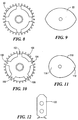
- Reversing section 70 consist of three components which vary from standard tubular braider segments: five slotted horn gear 100, Fig. 10; reversing "tear drop" shaped quoit 110, Fig. 11; and fish plate 120, Fig. 12.
- Preform 150 includes a single ply of biased fibers 152 intersecting with multiple plies 154, 156, and 158 of biased fibers. There could also be additional plies running parallel to ply 152. Plies 154, 156, and 158, form a single stringer, for example, and ply 152 forms a frame member.
- each stringer 170, 172, and 174 intersecting with frame 176 includes three plies of biased braided fabric made up of carbon fibers while frame 176 also includes three plies.
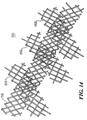
- each ply 180, 182, etc. could include unidirectional fibers as shown in Fig. 5 resulting in a ply which includes a triaxial braid construction 190, Fig. 16.
- Tows 191 and 193 are biased while tows 195 and 197 are not biased in the preferred embodiment of this invention.
- Intersection 192 between two such plies 190 and 194 is also continuous resulting in a stronger part once the preform is resin impregnated in a mold forming a final stringer/frame part.
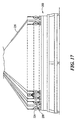
- a braided intersection is formed by exchanging carriers from one braider bed to another. To completely intersect a two ply braid, two exchanges must be completed. The objective is to exchange the carriers of bed 210 with the carriers of bed 212, and the carriers of bed 212 with those of bed 216.
- a carrier exchange utilizes two people to physically pass carriers from one braider to the next. Carriers equipped with quick release mechanisms enable a rapid manual carrier interchange as discussed infra.
- the following step-by-step procedure describes the carrier exchange process.
- the braided material of banks 210, 212, 214, and 216 are clamped at the formation point 220.
- the braiders are reversed until no tows are crossed between bed 200 and clamp 222.
- the selvage rods e.g. selvage rod 236, Fig. 17, are then removed.
- Carriers 224, 226, and 228 from braider 210 and carriers 230, 232, and 234 are transferred to their proper holding positions on beds 214 and 216 respectively.
- Carriers from braiders 214 and 216 are then transferred in a like fashion to braiders 210 and 212 respectively.
- the selvage rods are then reattached.
- the braider is then operated to re-form the braid between bed 200 and clamp 222.
- Clamp 222 is then removed from the braided material.
- the intersection is now complete and braiding is resumed.
- Clamp 222 is used to configure all of the plies as close as possible to one another and to allow the open part of the braid to be unbraided without disrupting the fully braided part. This ensures that the quality of the braid underthe clamps is not compromised.
- the F-22 FS 610 bulkhead was selected as the baseline component from which to derive a composite replacement design. This particular component is a highly loaded carry-through member, and it reacts the main landing gear loads. As such, it was a significant challenge compared to more lightly loaded frames, which are not directly loaded from wing bending.
- the baseline bulkhead design made from titanium, was taken from LMTAS F-22 engineering data to serve as a starting point for the composite design.
- the design problem was simplified by eliminating the landing gear attachments and loads.
- the simplified metallic design maintains the same basic stiffening configuration as the full version.
- Critical loading cases were also obtained for use in the structural analysis tasks. These omitted landing gear loads.
- the internal arrangement of stiffeners and others features was optimized to take advantage of composite materials. Several combinations of stiffener size versus open bay area were analyzed, and the best solution was chosen based on stress analysis, weight savings, and manufacturability.
- the composite design layouts were analyzed against five critical load cases to ensure structural integrity.
- the web bay sizes were traded against the stiffener dimensions to arrive at the simplest and lowest weight design consistent with achievable stiffener dimensions and stiffness. Manufacturing requirements/limitations of the composite fabrication process were also considered during the design.
- a half-scale stiffness component was selected as a technology demonstrator.
- the main 8-braid ply stiffener was used as the baseline for scaling.
- a half-scale this stiffener is 4 plies (0.16 in. thick) and maintains the 1.5 in height.
- An equivalent axial stiffness stiffener 1 in. high, made of 2 braided plies was designed.
- the 2 plies contained 0.08 in. of uni AS4 fiber stiffener.
- the component has two intersected stiffeners attached to a skin.
- One end of the main spar is tapered in both height and thickness.
- the stiffeners are offset at oblique angles to demonstrate the capability of conforming to various geometries.
- the web is 1 in. high and the flanges are 1 in wide. See Fig. 22.
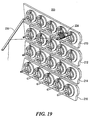
- the flat braider shown in Figs. 17-19 is currently limited to 27 bias carriers when using four braider banks.
- a 2 in. wide tape was necessary to form the 1 in. high web and 1 in, flange. Larger fiber tows are needed to develop this width on a relatively small braider.
- the selected configuration was a 24K AS4 bias and 48K IM7 axial braid architecture.
- the addition of unifibers between plies enabled a true 1/2 scale stiffness match to the primary 8-braid ply spar.
- the thickness taper was accomplished by dropping off these added unidirectional plies.
- Braiding machine carrier 224 Fig. 20, discussed in detail in copending application serial number 08/900,943 filed July 28, 1997 and incorporated herein by this reference, features frame 252 which houses a fiber spool mount subassembly 291 for holding spool 54, fiber take up assembly 256, and magnetic clutch 258.
- Carrier base 260 is affixed to one end of frame 252 as shown via plate 261 and quick release mechanism coupling assembly 263.
- Carrier 224 of this invention eliminates the tortuous path of fiber off the spool of prior carriers and instead, fiber, which may be a carbon or ceramic fiber or even prepeg tow material, is fed directly off spool 54 through fiber guide eyelet 264.
- Fiber take up assembly 256 includes an internal spiral spring which slowly winds as spool 254 pays out fiber during braiding. Upon reaching a preset release tension, the spiral spring stops winding and magnetic clutch 258 slips to let more fiber off the spool thereby preventing overwinding of the spiral spring.
- flat braider 200 Fig. 17, causes carrier 224 to reverse its direction and traverse back to the center of the braider, the spiral spring unwinds and takes up any slack fiber until the fiber begins to pay out again.
- carrier 224 has a 60 inch take-up capacity. Significantly more take-up (100-200 inches) is also possible if larger spiral springs are used.
- Intermediate gear train assembly 270 includes first gear 272 having teeth meshed with take-up gear 274 and second gear 276 having teeth meshed with fiber spool carrier gear 268.
- Take-up gear 274 winds fiber take-up assembly 256 to a preset tension and thereafter magnetic clutch 258 slips letting more fiber off the spool. If there is slack in the fiber fed off spool 254, fiber take-up assembly 256 reverses direction causing gears 268, 272, 274 and 276 to reverse direction thereby winding any slack fiber back onto the spool.
- Shaft 278 of clutch 258 is coupled to take up spring assembly 256 which includes shaft 283 rotatable with respect to frame 252 and connected to gear 274.
- Spool 254 is mounted on spool mount subassembly 291 which includes shaft 292 rotatably mounted with respect to frame 252. Gear 268 is affixed to one end of shaft 292. Spacer 294 is affixed to shaft 292 below bottom spool seat member 296. Top spool seat member 298 includes knurled hand nut 299 and washer 297 combination. To load spool 254, nut 299 is removed from the threaded end 295 of shaft 292. Spool 254 is placed over shaft 292 until the bottom end thereof rests on seat 296. Nut 299 is then tightened until the washer portion 297 firmly locks the spool in place.
- Clutch 258 includes shaft 278 coupled to fiber take-up assembly 256 which has shaft 283 extending through frame 252 and terminating in gear 274.
- Intermediate gear train 270 includes first gear 272 meshed with take up spring gear 274 and second gear 276 meshed with fiber spool carrier gear 268.
- Clutch 258 may be a "Perma-Tork” clutch available from Magnetic Power Systems Inc. and fiber take-up assembly 256 may be an Ametek, Hunter Spring Division, model "ML-1565”. After 30-40 revolutions of spool 254, clutch 258 begins turning to prevent overwinding of the spiral spring within fiber take-up assembly 256.
- Carrier 224 is particularly useful for braiding higher modulus carbon and ceramic fibers because it eliminates the tortuous fiber path associated with prior art carriers which leads to excessive fiber damage during the braiding operation. In addition, the very limited 3 inch take-up with the prior art design is greatly improved and a 60 inch take-up is possible with carrier 224. Clutch 258 can also be set at different tension levels depending on the type of fibers on spool 255.
- Quick release mechanism 263, Fig. 20, allows carrier frame 250 to be quickly disconnected from the braider and moved to another location or stored until its use is required.
- Quick release mechanism 263 includes biased shaft 265 within housing 267. When shaft 265 is pushed in the direction of arrow 267, bearing 269 is released and then mechanism 263 can be withdrawn from hole 271 in plate 261. As shown, there are usually two such quick release mechanism per carrier.
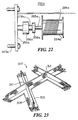
- vertical carrier 250a, Fig. 22 includes frame 252a and fiber take-up assembly 256a coupled directly to clutch 258a via shaft 278a.
- Spool 254a is coupled to clutch 258a via shaft 283a and fiber is fed off spool 254a through eyelet 264a under tension supplied by fiber take-up assembly 256a.
- Clutch 258a then allows additional fiber to fed out once take-up assembly reaches its maximum return limit.
- Carrier 250a is advantageous since there is no need for gear 268, 272, 276, and 274, Fig. 21: everything is coupled directly via shafts 278a and 283a.
- Figure 23 is a depiction of the fiber preform fabricated in accordance with this invention.
- Perform 300 has the fiber architecture described above. There were five steps followed for the fabrication of the perform. Intersections 310 and 312 were fabricated sequentially. Care was taken to ensure the intersections were spaced to match the design specified for the demonstration article.
- the flat braided tape was cut at each intersection halfway through to form the web. This allowed the bottom half of the tape to be folded out to form flanges 302 and 304 of the stiffeners.
- the thickness taper was created by staggering the removal of the uni-tows over the span of 2 in.
- a height taper was formed by staggering the removal of axial fibers over the same 2 in. span as the height taper.
- the web of the preform was stitched together with carbon to provide stability during placement into the cure molding.
- the technology disclosed and claimed in U.S. Patent No 5,667,859 may be used to secure the flanges of each stiffener to plate 303, Fig. 24.
- intersections were formed using the procedures. discussed above. The added complication of incorporating axial fibers between plies was accommodated as well. Uni-plies were made continuous through the intersection in the same basic manner as creating the basic intersection. However, the uni-fibers were mounted to stationary holders between braider banks.
- the thickness an height tapers were hand operations at this time.
- the process of adding and deleting tows from the preform could be automated.
- the hand operation is relatively quick and can form accurate tapers economically for limited production runs.
- Figure 24 is a diagram of the final cured demonstration component.
Landscapes
- Engineering & Computer Science (AREA)
- Textile Engineering (AREA)
- Manufacturing & Machinery (AREA)
- Chemical & Material Sciences (AREA)
- Composite Materials (AREA)
- Mechanical Engineering (AREA)
- Braiding, Manufacturing Of Bobbin-Net Or Lace, And Manufacturing Of Nets By Knotting (AREA)
Applications Claiming Priority (2)
| Application Number | Priority Date | Filing Date | Title |
|---|---|---|---|
| US96987 | 1987-09-16 | ||
| US09/096,987 US6128998A (en) | 1998-06-12 | 1998-06-12 | Continuous intersecting braided composite structure and method of making same |
Publications (2)
| Publication Number | Publication Date |
|---|---|
| EP0970800A2 true EP0970800A2 (fr) | 2000-01-12 |
| EP0970800A3 EP0970800A3 (fr) | 2000-03-22 |
Family
ID=22260117
Family Applications (1)
| Application Number | Title | Priority Date | Filing Date |
|---|---|---|---|
| EP99304541A Withdrawn EP0970800A3 (fr) | 1998-06-12 | 1999-06-10 | Structure intersectée continue de composite tressée et procédé pour sa fabrication |
Country Status (2)
| Country | Link |
|---|---|
| US (2) | US6128998A (fr) |
| EP (1) | EP0970800A3 (fr) |
Cited By (6)
| Publication number | Priority date | Publication date | Assignee | Title |
|---|---|---|---|---|
| WO2003020495A1 (fr) * | 2001-08-28 | 2003-03-13 | Lockheed Martin Corporation | Procede d'impregnation de preformes textiles tissees tridimensionnelles au moyen d'une resine thermofusible |
| US8470404B2 (en) | 2004-08-31 | 2013-06-25 | Henry K. Obermeyer | Process of manufacturing fiber reinforced composite via selective infusion of resin and resin blocking substance |
| WO2014065719A1 (fr) * | 2012-10-22 | 2014-05-01 | Saab Ab | Fixation intégrée de montant en plastique renforcé de fibres à un revêtement en plastique renforcé de fibres pour ailes portantes d'avion |
| WO2014101013A1 (fr) * | 2012-12-26 | 2014-07-03 | 机械科学研究总院先进制造技术研究中心 | Procédé de préparation d'un élément préfabriqué en matériau composite renforcé longitudinalement et matériau composite |
| EP2971309A4 (fr) * | 2013-03-15 | 2016-11-16 | A & P Technology Inc | Tresse tridimensionnelle |
| CN113752588A (zh) * | 2020-06-03 | 2021-12-07 | 上海飞机制造有限公司 | 一种飞机隔框的制造方法 |
Families Citing this family (56)
| Publication number | Priority date | Publication date | Assignee | Title |
|---|---|---|---|---|
| US6128998A (en) * | 1998-06-12 | 2000-10-10 | Foster Miller, Inc. | Continuous intersecting braided composite structure and method of making same |
| US6645333B2 (en) | 2001-04-06 | 2003-11-11 | Ebert Composites Corporation | Method of inserting z-axis reinforcing fibers into a composite laminate |
| US7056576B2 (en) * | 2001-04-06 | 2006-06-06 | Ebert Composites, Inc. | 3D fiber elements with high moment of inertia characteristics in composite sandwich laminates |
| US7105071B2 (en) | 2001-04-06 | 2006-09-12 | Ebert Composites Corporation | Method of inserting z-axis reinforcing fibers into a composite laminate |
| US20050025948A1 (en) * | 2001-04-06 | 2005-02-03 | Johnson David W. | Composite laminate reinforced with curvilinear 3-D fiber and method of making the same |
| US6676785B2 (en) | 2001-04-06 | 2004-01-13 | Ebert Composites Corporation | Method of clinching the top and bottom ends of Z-axis fibers into the respective top and bottom surfaces of a composite laminate |
| US7731046B2 (en) * | 2001-04-06 | 2010-06-08 | Ebert Composites Corporation | Composite sandwich panel and method of making same |
| US7785693B2 (en) | 2001-04-06 | 2010-08-31 | Ebert Composites Corporation | Composite laminate structure |
| US20030190455A1 (en) * | 2002-04-05 | 2003-10-09 | The Boeing Company | Textile joint reinforcement and associated method |
| US20050118448A1 (en) * | 2002-12-05 | 2005-06-02 | Olin Corporation, A Corporation Of The Commonwealth Of Virginia | Laser ablation resistant copper foil |
| JP2004353134A (ja) * | 2003-05-30 | 2004-12-16 | Murata Mach Ltd | 幅広ヤーンによるブレイディング組成基材及びその製造方法 |
| US20050180674A1 (en) * | 2004-02-12 | 2005-08-18 | Panorama Flat Ltd. | Faraday structured waveguide display |
| US20050180723A1 (en) * | 2004-02-12 | 2005-08-18 | Panorama Flat Ltd. | Apparatus, method, and computer program product for structured waveguide including holding bounding region |
| US20050201698A1 (en) * | 2004-02-12 | 2005-09-15 | Panorama Flat Ltd. | System, method, and computer program product for faceplate for structured waveguide system |
| US20060056792A1 (en) * | 2004-02-12 | 2006-03-16 | Panorama Flat Ltd. | System, method, and computer program product for structured waveguide including intra/inter contacting regions |
| US20050180675A1 (en) * | 2004-02-12 | 2005-08-18 | Panorama Flat Limited, A Western Australia Corporation | Apparatus, method, and computer program product for structured waveguide including performance_enhancing bounding region |
| US7224854B2 (en) * | 2004-02-12 | 2007-05-29 | Panorama Labs Pty. Ltd. | System, method, and computer program product for structured waveguide including polarizer region |
| US20050201705A1 (en) * | 2004-02-12 | 2005-09-15 | Panorama Flat Ltd. | Apparatus, method, and computer program product for structured waveguide including recursion zone |
| US20060056794A1 (en) * | 2004-02-12 | 2006-03-16 | Panorama Flat Ltd. | System, method, and computer program product for componentized displays using structured waveguides |
| US20050201654A1 (en) * | 2004-02-12 | 2005-09-15 | Panorama Flat Ltd. | Apparatus, method, and computer program product for substrated waveguided display system |
| US20050180672A1 (en) * | 2004-02-12 | 2005-08-18 | Panorama Flat Ltd. | Apparatus, Method, and Computer Program Product For Multicolor Structured Waveguide |
| US20050180673A1 (en) * | 2004-02-12 | 2005-08-18 | Panorama Flat Ltd. | Faraday structured waveguide |
| US7254287B2 (en) * | 2004-02-12 | 2007-08-07 | Panorama Labs, Pty Ltd. | Apparatus, method, and computer program product for transverse waveguided display system |
| US20050185877A1 (en) * | 2004-02-12 | 2005-08-25 | Panorama Flat Ltd. | Apparatus, Method, and Computer Program Product For Structured Waveguide Switching Matrix |
| US20060056793A1 (en) * | 2004-02-12 | 2006-03-16 | Panorama Flat Ltd. | System, method, and computer program product for structured waveguide including nonlinear effects |
| US20050201679A1 (en) * | 2004-02-12 | 2005-09-15 | Panorama Flat Ltd. | System, method, and computer program product for structured waveguide including modified output regions |
| US20050201651A1 (en) * | 2004-02-12 | 2005-09-15 | Panorama Flat Ltd. | Apparatus, method, and computer program product for integrated influencer element |
| US8551591B2 (en) | 2004-12-20 | 2013-10-08 | Albany Engineered Composites, Inc. | Conformable braid |
| WO2007022218A2 (fr) * | 2005-08-16 | 2007-02-22 | Brigham Young University | Appareil, système et procédé pour fabrication de structure en treillis composite filamentaire |
| US8440276B2 (en) * | 2008-02-11 | 2013-05-14 | Albany Engineered Composites, Inc. | Multidirectionally reinforced shape woven preforms for composite structures |
| US8859083B2 (en) * | 2008-12-30 | 2014-10-14 | Albany Engineered Composites, Inc. | Quasi-isotropic three-dimensional preform and method of making thereof |
| US8585856B1 (en) | 2010-05-13 | 2013-11-19 | Textron Innovations Inc. | Process for fabricating aircraft parts using an integrated form |
| US8397611B2 (en) * | 2010-07-16 | 2013-03-19 | DVM Tecnologia S.A.S | Machine and method with magnets for plaiting threads |
| DE102010054935B4 (de) * | 2010-12-17 | 2013-11-28 | Daimler Ag | Karosseriemodulbauteil |
| DE102011119226A1 (de) * | 2011-11-22 | 2013-05-23 | Daimler Ag | Verfahren zum Herstellen eines Hohlprofilssowie Hohlprofilbauteil |
| US9051062B1 (en) | 2012-02-08 | 2015-06-09 | Textron Innovations, Inc. | Assembly using skeleton structure |
| US9302455B1 (en) | 2012-02-08 | 2016-04-05 | Textron Innovations, Inc. | Fast cure process |
| US9545757B1 (en) | 2012-02-08 | 2017-01-17 | Textron Innovations, Inc. | Composite lay up and method of forming |
| US9050757B1 (en) | 2012-02-08 | 2015-06-09 | Textron Innovations, Inc. | System and method for curing composites |
| US9649820B1 (en) | 2012-02-08 | 2017-05-16 | Textron Innovations, Inc. | Assembly using skeleton structure |
| WO2015117148A1 (fr) * | 2014-02-03 | 2015-08-06 | EverestMedica LLC | Tresses chirurgicales |
| US9610077B2 (en) | 2013-08-08 | 2017-04-04 | EverestMedica LLC | Round-flat-round surgical braids |
| US11447901B2 (en) | 2013-04-12 | 2022-09-20 | EverestMedica LLC | Method of making a surgical braid |
| US10035323B2 (en) * | 2013-09-23 | 2018-07-31 | The Boeing Company | Composite textiles including spread filaments |
| US20160090672A1 (en) * | 2014-09-30 | 2016-03-31 | A&P Technology, Inc. | In-situ conformable triaxial braided structure |
| US10730252B2 (en) * | 2015-03-23 | 2020-08-04 | Khalifa University of Science and Technology | Lightweight composite single-skin sandwich lattice structures |
| US10060056B1 (en) * | 2015-05-04 | 2018-08-28 | A&P Technology, Inc. | Interlocking braided structures |
| US10005267B1 (en) | 2015-09-22 | 2018-06-26 | Textron Innovations, Inc. | Formation of complex composite structures using laminate templates |
| DE102017103561A1 (de) * | 2017-02-21 | 2018-08-23 | Freistaat Bayern vertreten durch Hochschule Hof, Institut für Materialwissenschaften | Schlingengebilde, Verfahren zur Herstellung eines Schlingengebildes und Element |
| US10180000B2 (en) | 2017-03-06 | 2019-01-15 | Isotruss Industries Llc | Composite lattice beam |
| US10584491B2 (en) * | 2017-03-06 | 2020-03-10 | Isotruss Industries Llc | Truss structure |
| USD895157S1 (en) | 2018-03-06 | 2020-09-01 | IsoTruss Indsutries LLC | Longitudinal beam |
| USD896401S1 (en) | 2018-03-06 | 2020-09-15 | Isotruss Industries Llc | Beam |
| CN108532120B (zh) * | 2018-06-27 | 2023-10-24 | 佛山市均凯机械科技有限公司 | 一种床网编织机 |
| EP4428279A1 (fr) * | 2023-03-10 | 2024-09-11 | Iprotex GmbH & Co. KG | Structure textile plane et procédé dedit production |
| CN117867751B (zh) * | 2024-02-27 | 2026-03-20 | 杭州振兴箱包有限公司 | 一种复合织带的编织控制机构及其编织方法 |
Family Cites Families (29)
| Publication number | Priority date | Publication date | Assignee | Title |
|---|---|---|---|---|
| GB1512015A (en) | 1974-07-05 | 1978-05-24 | French & Sons Thomas | Braided electrical tape |
| ES217673Y (es) | 1975-12-23 | 1977-01-01 | Ratera Portella Eliseo | Maquina de trenzar perfeccionada. |
| US4109435A (en) | 1977-08-26 | 1978-08-29 | Rockwell International Corporation | Composite structural joint and method of fabrication thereof |
| DE2757965C3 (de) * | 1977-12-24 | 1980-07-03 | Messerschmitt-Boelkow-Blohm Gmbh, 8000 Muenchen | Schubübertragungselement und Verfahren zu dessen Herstellung |
| US4275638A (en) | 1980-03-10 | 1981-06-30 | Deyoung Simon A | Braiding machine |
| US4292879A (en) | 1980-05-12 | 1981-10-06 | Kokubun Inc. | Hook assembly for spring tension carrier in braiding machine |
| US4494436A (en) | 1983-09-02 | 1985-01-22 | Elfin Corporation | Apparatus for manufacturing resin impregnated fiber braided products |
| US4535675A (en) | 1984-11-20 | 1985-08-20 | James F. Karg | Apparatus for rotating a set of carriers for a strand supply bobbin relative to moving strands from a set of contra-rotating carriers for a strand supply bobbin |
| JPS61179731A (ja) * | 1984-12-29 | 1986-08-12 | 日本マイヤー株式会社 | 三次元構造材料 |
| US4616553A (en) | 1985-02-06 | 1986-10-14 | Nixon Charles E | Fast-moving eyelet guide for a group of braidable strands in a braiding machine |
| US4619180A (en) | 1985-07-26 | 1986-10-28 | Raychem Corporation | Braider carrier |
| US4716807A (en) | 1986-12-17 | 1988-01-05 | Mayer Wildman Industries, Inc. | Speed control apparatus and method for braiding machine |
| US4719838A (en) | 1987-03-02 | 1988-01-19 | Deyoung Simon A | Strand carrier for a braiding machine |
| US4857124A (en) * | 1987-12-14 | 1989-08-15 | Plas/Steel Products, Inc. | Fiber-reinforced plastic strut connecting link |
| US4984502A (en) | 1988-05-09 | 1991-01-15 | Airfoil Textron Inc. | Apparatus and method for braiding fiber strands and stuffer fiber strands |
| JPH0222392U (fr) | 1988-07-23 | 1990-02-14 | ||
| US4903574A (en) | 1989-06-13 | 1990-02-27 | Atlantic Research Corporation | Fiber spool apparatus |
| US5156079A (en) | 1990-06-05 | 1992-10-20 | North Carolina State University | Yarn carrier apparatus for braiding machines and the like |
| WO1992001103A1 (fr) * | 1990-07-12 | 1992-01-23 | Albany International Corp. | Structure tressee |
| US5186092A (en) | 1990-08-06 | 1993-02-16 | Deyoung Simon A | Strand carrier for a braiding machine |
| US5220859A (en) | 1990-08-06 | 1993-06-22 | Deyoung Simon A | Strand carrier for a braiding machine |
| US5146836A (en) | 1990-08-06 | 1992-09-15 | Deyoung Simon A | Strand carrier for a braiding machine |
| US5370031A (en) | 1990-08-17 | 1994-12-06 | United States Surgical Corporation | Braider apparatus with improved bobbin holder |
| TW209258B (fr) * | 1991-03-04 | 1993-07-11 | Us Composites Corp | |
| JPH05311809A (ja) * | 1992-05-12 | 1993-11-22 | Mitsui Constr Co Ltd | メッシュ状繊維補強材 |
| US5392683A (en) | 1992-09-29 | 1995-02-28 | The United States Of America As Represented By The Administrator Of The National Aeronautics And Space Administration | Method and apparatus for three dimensional braiding |
| CA2161547A1 (fr) | 1993-04-30 | 1994-11-10 | Joseph Santin Boyce | Joint renforce pour structures en materiau composite et procede associe |
| US5904087A (en) | 1997-07-28 | 1999-05-18 | Foster-Miller, Inc. | Braiding machine carrier with clutch |
| US6128998A (en) * | 1998-06-12 | 2000-10-10 | Foster Miller, Inc. | Continuous intersecting braided composite structure and method of making same |
-
1998
- 1998-06-12 US US09/096,987 patent/US6128998A/en not_active Expired - Lifetime
-
1999
- 1999-06-10 EP EP99304541A patent/EP0970800A3/fr not_active Withdrawn
-
2000
- 2000-07-14 US US09/618,212 patent/US6647852B1/en not_active Expired - Fee Related
Cited By (9)
| Publication number | Priority date | Publication date | Assignee | Title |
|---|---|---|---|---|
| WO2003020495A1 (fr) * | 2001-08-28 | 2003-03-13 | Lockheed Martin Corporation | Procede d'impregnation de preformes textiles tissees tridimensionnelles au moyen d'une resine thermofusible |
| US6676882B2 (en) | 2001-08-28 | 2004-01-13 | Lockheed Martin Corporation | Methods of hot-melt resin impregnation of 3-D, woven, textile preforms |
| US8470404B2 (en) | 2004-08-31 | 2013-06-25 | Henry K. Obermeyer | Process of manufacturing fiber reinforced composite via selective infusion of resin and resin blocking substance |
| WO2014065719A1 (fr) * | 2012-10-22 | 2014-05-01 | Saab Ab | Fixation intégrée de montant en plastique renforcé de fibres à un revêtement en plastique renforcé de fibres pour ailes portantes d'avion |
| WO2014101013A1 (fr) * | 2012-12-26 | 2014-07-03 | 机械科学研究总院先进制造技术研究中心 | Procédé de préparation d'un élément préfabriqué en matériau composite renforcé longitudinalement et matériau composite |
| EP2971309A4 (fr) * | 2013-03-15 | 2016-11-16 | A & P Technology Inc | Tresse tridimensionnelle |
| US9702069B2 (en) | 2013-03-15 | 2017-07-11 | A&P Technology, Inc. | Three dimensional braid |
| CN113752588A (zh) * | 2020-06-03 | 2021-12-07 | 上海飞机制造有限公司 | 一种飞机隔框的制造方法 |
| CN113752588B (zh) * | 2020-06-03 | 2022-07-01 | 上海飞机制造有限公司 | 一种飞机隔框的制造方法 |
Also Published As
| Publication number | Publication date |
|---|---|
| US6647852B1 (en) | 2003-11-18 |
| EP0970800A3 (fr) | 2000-03-22 |
| US6128998A (en) | 2000-10-10 |
Similar Documents
| Publication | Publication Date | Title |
|---|---|---|
| US6128998A (en) | Continuous intersecting braided composite structure and method of making same | |
| Dow et al. | Development of stitched, braided and woven composite structures in the ACT program and at Langley Research Center | |
| DE2460807C3 (de) | Flächenhaftes Leichtbauteil aus faserverstärktem Kunststoff | |
| US5809805A (en) | Warp/knit reinforced structural fabric | |
| US4686134A (en) | Three-dimensional structural member | |
| US9435060B2 (en) | Continuous wound composite truss structures | |
| EP2937278B1 (fr) | Procédé de fabrication de structures utilisant des modules composites et structures ainsi obtenues | |
| CN102741045A (zh) | 复合芯材及其制备方法 | |
| EP0768167B1 (fr) | Nappe continue à base de fibres de renforcements à 45 degrés liées par des fils adhésifs en deux couches et appareil pour sa fabrication | |
| HUE031749T2 (en) | Multidirectionally molded molds for composite structures | |
| Dexter | Development of textile reinforced composites for aircraft structures | |
| JPH0213060B2 (fr) | ||
| JPH0364301B2 (fr) | ||
| KR20120092203A (ko) | 트러스 구조의 심재를 구비한 샌드위치 패널의 제조방법 | |
| US4584226A (en) | Load transfer structure and method of making the same | |
| US7384585B2 (en) | Method for producing dry preform for composite material | |
| US8511360B2 (en) | Composite intersection reinforcement | |
| WO2010091059A2 (fr) | Structures en sandwich quasi-isotropes | |
| DE102011084438B3 (de) | Verfahren zum Herstellen einer Komponente zur Verbindung von Strukturen, Verfahren zum Herstellen einer Strukturanordnung sowie Vorrichtung zum Herstellen einer Komponente zur Verbindung von Strukturen | |
| JP4286563B2 (ja) | 複合材料用ドライプリフォームとその製造方法および製造装置 | |
| US4788101A (en) | Fibrous structure for reinforcing a composite material and a method for manufacturing the fibrous structure | |
| JP2000178855A (ja) | 空隙部充填用繊維構造体 | |
| Brandt et al. | New approaches in textile and impregnation technologies for the cost effective manufacturing of CFRP aerospace components | |
| RU77842U1 (ru) | Балка пола самолета из полимерных композиционных материалов | |
| CN209757497U (zh) | 一种复合纤维飞机窗框 |
Legal Events
| Date | Code | Title | Description |
|---|---|---|---|
| PUAI | Public reference made under article 153(3) epc to a published international application that has entered the european phase |
Free format text: ORIGINAL CODE: 0009012 |
|
| AK | Designated contracting states |
Kind code of ref document: A2 Designated state(s): AT BE CH CY DE DK ES FI FR GB GR IE IT LI LU MC NL PT SE |
|
| AX | Request for extension of the european patent |
Free format text: AL;LT;LV;MK;RO;SI |
|
| PUAL | Search report despatched |
Free format text: ORIGINAL CODE: 0009013 |
|
| AK | Designated contracting states |
Kind code of ref document: A3 Designated state(s): AT BE CH CY DE DK ES FI FR GB GR IE IT LI LU MC NL PT SE |
|
| AX | Request for extension of the european patent |
Free format text: AL;LT;LV;MK;RO;SI |
|
| 17P | Request for examination filed |
Effective date: 20000329 |
|
| AKX | Designation fees paid |
Free format text: AT BE CH CY DE DK ES FI FR GB GR IE IT LI LU MC NL PT SE |
|
| 17Q | First examination report despatched |
Effective date: 20001110 |
|
| GRAG | Despatch of communication of intention to grant |
Free format text: ORIGINAL CODE: EPIDOS AGRA |
|
| STAA | Information on the status of an ep patent application or granted ep patent |
Free format text: STATUS: THE APPLICATION IS DEEMED TO BE WITHDRAWN |
|
| 18D | Application deemed to be withdrawn |
Effective date: 20011221 |