EP0970982A2 - Verfahren zur Erhöhung des Molekulargewichts von Polykondensaten - Google Patents
Verfahren zur Erhöhung des Molekulargewichts von Polykondensaten Download PDFInfo
- Publication number
- EP0970982A2 EP0970982A2 EP99202853A EP99202853A EP0970982A2 EP 0970982 A2 EP0970982 A2 EP 0970982A2 EP 99202853 A EP99202853 A EP 99202853A EP 99202853 A EP99202853 A EP 99202853A EP 0970982 A2 EP0970982 A2 EP 0970982A2
- Authority
- EP
- European Patent Office
- Prior art keywords
- drum
- rotating
- vessel
- perforated drum
- fluid
- Prior art date
- Legal status (The legal status is an assumption and is not a legal conclusion. Google has not performed a legal analysis and makes no representation as to the accuracy of the status listed.)
- Withdrawn
Links
- 238000000034 method Methods 0.000 title claims abstract description 20
- 229920000642 polymer Polymers 0.000 title claims abstract description 8
- 238000009833 condensation Methods 0.000 title claims abstract description 6
- 230000005494 condensation Effects 0.000 title claims abstract description 6
- 230000001965 increasing effect Effects 0.000 title claims abstract description 6
- 239000000463 material Substances 0.000 claims abstract description 81
- 238000006068 polycondensation reaction Methods 0.000 claims abstract description 7
- 238000010438 heat treatment Methods 0.000 claims abstract description 6
- 239000011261 inert gas Substances 0.000 claims abstract 8
- 238000003756 stirring Methods 0.000 claims abstract 4
- 239000007858 starting material Substances 0.000 claims abstract 2
- 239000004952 Polyamide Substances 0.000 claims 1
- 229920002647 polyamide Polymers 0.000 claims 1
- 229920006149 polyester-amide block copolymer Polymers 0.000 claims 1
- 239000007789 gas Substances 0.000 abstract description 6
- 239000012530 fluid Substances 0.000 description 58
- IJGRMHOSHXDMSA-UHFFFAOYSA-N Atomic nitrogen Chemical compound N#N IJGRMHOSHXDMSA-UHFFFAOYSA-N 0.000 description 18
- 239000000047 product Substances 0.000 description 15
- 239000007788 liquid Substances 0.000 description 14
- 239000010408 film Substances 0.000 description 13
- MTHSVFCYNBDYFN-UHFFFAOYSA-N diethylene glycol Chemical compound OCCOCCO MTHSVFCYNBDYFN-UHFFFAOYSA-N 0.000 description 12
- 238000006116 polymerization reaction Methods 0.000 description 11
- 239000000376 reactant Substances 0.000 description 10
- LYCAIKOWRPUZTN-UHFFFAOYSA-N Ethylene glycol Chemical compound OCCO LYCAIKOWRPUZTN-UHFFFAOYSA-N 0.000 description 9
- 239000011344 liquid material Substances 0.000 description 9
- 229910052757 nitrogen Inorganic materials 0.000 description 9
- 238000002156 mixing Methods 0.000 description 8
- 238000006243 chemical reaction Methods 0.000 description 7
- XLYOFNOQVPJJNP-UHFFFAOYSA-N water Substances O XLYOFNOQVPJJNP-UHFFFAOYSA-N 0.000 description 6
- 238000001311 chemical methods and process Methods 0.000 description 4
- 239000000470 constituent Substances 0.000 description 4
- -1 polyethylene terephthalate Polymers 0.000 description 4
- 229920000139 polyethylene terephthalate Polymers 0.000 description 4
- 239000005020 polyethylene terephthalate Substances 0.000 description 4
- 239000000126 substance Substances 0.000 description 4
- ADCOVFLJGNWWNZ-UHFFFAOYSA-N antimony trioxide Chemical compound O=[Sb]O[Sb]=O ADCOVFLJGNWWNZ-UHFFFAOYSA-N 0.000 description 3
- 239000006227 byproduct Substances 0.000 description 3
- 238000001816 cooling Methods 0.000 description 3
- WGCNASOHLSPBMP-UHFFFAOYSA-N hydroxyacetaldehyde Natural products OCC=O WGCNASOHLSPBMP-UHFFFAOYSA-N 0.000 description 3
- 239000012535 impurity Substances 0.000 description 3
- 238000004519 manufacturing process Methods 0.000 description 3
- 239000002243 precursor Substances 0.000 description 3
- 238000010791 quenching Methods 0.000 description 3
- 238000011179 visual inspection Methods 0.000 description 3
- KKEYFWRCBNTPAC-UHFFFAOYSA-N Terephthalic acid Chemical compound OC(=O)C1=CC=C(C(O)=O)C=C1 KKEYFWRCBNTPAC-UHFFFAOYSA-N 0.000 description 2
- 238000013019 agitation Methods 0.000 description 2
- 239000003054 catalyst Substances 0.000 description 2
- 239000008187 granular material Substances 0.000 description 2
- 239000000155 melt Substances 0.000 description 2
- 239000012815 thermoplastic material Substances 0.000 description 2
- 238000010521 absorption reaction Methods 0.000 description 1
- 229910052787 antimony Inorganic materials 0.000 description 1
- WATWJIUSRGPENY-UHFFFAOYSA-N antimony atom Chemical compound [Sb] WATWJIUSRGPENY-UHFFFAOYSA-N 0.000 description 1
- 238000013459 approach Methods 0.000 description 1
- 230000015572 biosynthetic process Effects 0.000 description 1
- 125000003178 carboxy group Chemical group [H]OC(*)=O 0.000 description 1
- 230000015556 catabolic process Effects 0.000 description 1
- 238000004891 communication Methods 0.000 description 1
- 230000006835 compression Effects 0.000 description 1
- 238000007906 compression Methods 0.000 description 1
- 229920001577 copolymer Polymers 0.000 description 1
- 239000007857 degradation product Substances 0.000 description 1
- 238000006731 degradation reaction Methods 0.000 description 1
- 230000002708 enhancing effect Effects 0.000 description 1
- 230000032050 esterification Effects 0.000 description 1
- 238000005886 esterification reaction Methods 0.000 description 1
- 238000000605 extraction Methods 0.000 description 1
- 239000000835 fiber Substances 0.000 description 1
- 230000005484 gravity Effects 0.000 description 1
- 229920006158 high molecular weight polymer Polymers 0.000 description 1
- 238000007373 indentation Methods 0.000 description 1
- 230000007246 mechanism Effects 0.000 description 1
- 238000002844 melting Methods 0.000 description 1
- 230000008018 melting Effects 0.000 description 1
- 239000000203 mixture Substances 0.000 description 1
- 239000000178 monomer Substances 0.000 description 1
- 239000002245 particle Substances 0.000 description 1
- 229920000728 polyester Polymers 0.000 description 1
- 230000000379 polymerizing effect Effects 0.000 description 1
- 239000002002 slurry Substances 0.000 description 1
- 239000007787 solid Substances 0.000 description 1
- 239000011343 solid material Substances 0.000 description 1
- 239000000725 suspension Substances 0.000 description 1
- 238000010408 sweeping Methods 0.000 description 1
- 229920001169 thermoplastic Polymers 0.000 description 1
- 239000004416 thermosoftening plastic Substances 0.000 description 1
- 239000010409 thin film Substances 0.000 description 1
Images


Classifications
-
- C—CHEMISTRY; METALLURGY
- C08—ORGANIC MACROMOLECULAR COMPOUNDS; THEIR PREPARATION OR CHEMICAL WORKING-UP; COMPOSITIONS BASED THEREON
- C08G—MACROMOLECULAR COMPOUNDS OBTAINED OTHERWISE THAN BY REACTIONS ONLY INVOLVING UNSATURATED CARBON-TO-CARBON BONDS
- C08G63/00—Macromolecular compounds obtained by reactions forming a carboxylic ester link in the main chain of the macromolecule
- C08G63/78—Preparation processes
- C08G63/785—Preparation processes characterised by the apparatus used
-
- B—PERFORMING OPERATIONS; TRANSPORTING
- B01—PHYSICAL OR CHEMICAL PROCESSES OR APPARATUS IN GENERAL
- B01D—SEPARATION
- B01D19/00—Degasification of liquids
- B01D19/0042—Degasification of liquids modifying the liquid flow
- B01D19/0052—Degasification of liquids modifying the liquid flow in rotating vessels, vessels containing movable parts or in which centrifugal movement is caused
-
- B—PERFORMING OPERATIONS; TRANSPORTING
- B01—PHYSICAL OR CHEMICAL PROCESSES OR APPARATUS IN GENERAL
- B01F—MIXING, e.g. DISSOLVING, EMULSIFYING OR DISPERSING
- B01F27/00—Mixers with rotary stirring devices in fixed receptacles; Kneaders
- B01F27/60—Mixers with rotary stirring devices in fixed receptacles; Kneaders with stirrers rotating about a horizontal or inclined axis
- B01F27/74—Mixers with rotary stirring devices in fixed receptacles; Kneaders with stirrers rotating about a horizontal or inclined axis with rotary cylinders
-
- B—PERFORMING OPERATIONS; TRANSPORTING
- B01—PHYSICAL OR CHEMICAL PROCESSES OR APPARATUS IN GENERAL
- B01J—CHEMICAL OR PHYSICAL PROCESSES, e.g. CATALYSIS OR COLLOID CHEMISTRY; THEIR RELEVANT APPARATUS
- B01J19/00—Chemical, physical or physico-chemical processes in general; Their relevant apparatus
- B01J19/18—Stationary reactors having moving elements inside
-
- B—PERFORMING OPERATIONS; TRANSPORTING
- B01—PHYSICAL OR CHEMICAL PROCESSES OR APPARATUS IN GENERAL
- B01J—CHEMICAL OR PHYSICAL PROCESSES, e.g. CATALYSIS OR COLLOID CHEMISTRY; THEIR RELEVANT APPARATUS
- B01J19/00—Chemical, physical or physico-chemical processes in general; Their relevant apparatus
- B01J19/18—Stationary reactors having moving elements inside
- B01J19/1887—Stationary reactors having moving elements inside forming a thin film
-
- B—PERFORMING OPERATIONS; TRANSPORTING
- B01—PHYSICAL OR CHEMICAL PROCESSES OR APPARATUS IN GENERAL
- B01J—CHEMICAL OR PHYSICAL PROCESSES, e.g. CATALYSIS OR COLLOID CHEMISTRY; THEIR RELEVANT APPARATUS
- B01J19/00—Chemical, physical or physico-chemical processes in general; Their relevant apparatus
- B01J19/28—Moving reactors, e.g. rotary drums
-
- B—PERFORMING OPERATIONS; TRANSPORTING
- B29—WORKING OF PLASTICS; WORKING OF SUBSTANCES IN A PLASTIC STATE IN GENERAL
- B29C—SHAPING OR JOINING OF PLASTICS; SHAPING OF MATERIAL IN A PLASTIC STATE, NOT OTHERWISE PROVIDED FOR; AFTER-TREATMENT OF THE SHAPED PRODUCTS, e.g. REPAIRING
- B29C48/00—Extrusion moulding, i.e. expressing the moulding material through a die or nozzle which imparts the desired form; Apparatus therefor
- B29C48/25—Component parts, details or accessories; Auxiliary operations
- B29C48/36—Means for plasticising or homogenising the moulding material or forcing it through the nozzle or die
- B29C48/465—Means for plasticising or homogenising the moulding material or forcing it through the nozzle or die using rollers
-
- C—CHEMISTRY; METALLURGY
- C08—ORGANIC MACROMOLECULAR COMPOUNDS; THEIR PREPARATION OR CHEMICAL WORKING-UP; COMPOSITIONS BASED THEREON
- C08G—MACROMOLECULAR COMPOUNDS OBTAINED OTHERWISE THAN BY REACTIONS ONLY INVOLVING UNSATURATED CARBON-TO-CARBON BONDS
- C08G63/00—Macromolecular compounds obtained by reactions forming a carboxylic ester link in the main chain of the macromolecule
- C08G63/78—Preparation processes
-
- B—PERFORMING OPERATIONS; TRANSPORTING
- B01—PHYSICAL OR CHEMICAL PROCESSES OR APPARATUS IN GENERAL
- B01J—CHEMICAL OR PHYSICAL PROCESSES, e.g. CATALYSIS OR COLLOID CHEMISTRY; THEIR RELEVANT APPARATUS
- B01J2219/00—Chemical, physical or physico-chemical processes in general; Their relevant apparatus
- B01J2219/00049—Controlling or regulating processes
- B01J2219/00051—Controlling the temperature
- B01J2219/00074—Controlling the temperature by indirect heating or cooling employing heat exchange fluids
- B01J2219/00087—Controlling the temperature by indirect heating or cooling employing heat exchange fluids with heat exchange elements outside the reactor
- B01J2219/00094—Jackets
-
- B—PERFORMING OPERATIONS; TRANSPORTING
- B01—PHYSICAL OR CHEMICAL PROCESSES OR APPARATUS IN GENERAL
- B01J—CHEMICAL OR PHYSICAL PROCESSES, e.g. CATALYSIS OR COLLOID CHEMISTRY; THEIR RELEVANT APPARATUS
- B01J2219/00—Chemical, physical or physico-chemical processes in general; Their relevant apparatus
- B01J2219/18—Details relating to the spatial orientation of the reactor
- B01J2219/182—Details relating to the spatial orientation of the reactor horizontal
-
- B—PERFORMING OPERATIONS; TRANSPORTING
- B29—WORKING OF PLASTICS; WORKING OF SUBSTANCES IN A PLASTIC STATE IN GENERAL
- B29C—SHAPING OR JOINING OF PLASTICS; SHAPING OF MATERIAL IN A PLASTIC STATE, NOT OTHERWISE PROVIDED FOR; AFTER-TREATMENT OF THE SHAPED PRODUCTS, e.g. REPAIRING
- B29C48/00—Extrusion moulding, i.e. expressing the moulding material through a die or nozzle which imparts the desired form; Apparatus therefor
- B29C48/03—Extrusion moulding, i.e. expressing the moulding material through a die or nozzle which imparts the desired form; Apparatus therefor characterised by the shape of the extruded material at extrusion
Definitions
- This invention discloses an apparatus and method for mixing liquids and/or removing volatile substances from liquids.
- the apparatus which may be employed as a mixer, processor, reactor, polymerizer, or finisher, renews fluid surfaces at high rates and provides improved mixing.
- U.S. Patent No. 3,342,124 (Apparatus For Dewatering and Rinsing Hydrous Substances) discloses a squeezing apparatus comprising two corotating drums: an inner perforated rotary drum which rotates within a larger outer perforated rotary drum to form a single nip zone. Neither drum is heated, nor is a film formed of the hydrous material, preferably a fiber pulp suspension, being treated.
- the present invention involves the combination of a rotating perforated drum in tangential relationship with at least two non-rotating stators or relatively stationary bodies, in various forms, in order to form at least two nip zones.
- U.S. Patent No. 3,484,213 discloses a continuous polymerizer with a single rotating radially perforated annular cylinder that is eccentrically located within a heated housing to form a single nip zone.
- the apparatus serves to devolatilize a polymer melt by creating honeycombed films of great surface area to facilitate removal of gaseous reaction byproducts.
- a single perforated cylinder or drum is employed in association with only a single nip zone.
- U.S. Patent No. 4,029,459 (Method and Apparatus for Manufacture of Granulates from Pulverulent, Granular, Doughy or Similar Material) discloses a method of forming granulates by means of a hollow perforated drum with a plurality of helical surfaced rollers, to form nip zones within the drum interior.
- the present invention when operating with a single rotary perforated drum, forms nip zones on either side of the perforated drum such that the fluid being processed can move repeatedly inside and outside of the rotating perforated drum as it axially progresses along the apparatus, for example, from an inlet to an outlet when operating on a continuous basis.
- U.S. Patent No. 4,189,291 (Apparatus and Process for Recovering Scraps of Thermoplastic Material Even of Heterogeneous Shapes, by Gradual Melting and Compression Through One or More Orifices) discloses a rotating, non-perforated, heated cylinder eccentrically located within a stationary heated cylindrical casing to form a single nip, for plasticizing or softening solid thermoplastic materials that are fed to it through a hopper.
- this patent does not disclose an apparatus involving a rotary perforated drum or cylinder that forms at least two nip zones within the housing.
- the present invention is directed to art improved method and apparatus which employs a rotating perforated drum in a novel arrangement in order to mix or otherwise process liquids with greater efficiences of both time and energy. Such an improvement is frequently desirable for carrying out many industrial and chemical processes.
- the instant invention consists of an apparatus for increasing fluid surfaces, for example, for mixing one or more liquid materials, for removing volatile substances from a liquid, and/or for enhancing the reaction of a liquid mixture.
- the apparatus comprises:
- the apparatus may further comprise one or more ports, in communication with the space between the rotating perforated drum and the housing, for the removal of volatile constituents.
- the apparatus may include an exit port for the the removal of product such that the liquid material being processed, until being withdrawn from the apparatus, can repeatedly move between at least one outer nip region and at least one inner nip region as the material being processed progresses in the axial direction of the rotating perforated drum from the inlet port to the exit port.
- the housing may be substantially cylindrical, although square, ovoid, rectangular, or other shapes may be employed, as will be readily appreciated by the skilled artisan.
- the above apparatus may have additional ports in the housing for permitting an inert or otherwise nonreactive gas under pressure, such as nitrogen, to enter the housing so as to sweep volatile constituents or volatile by-products away from the surface of the fluid.
- an inert or otherwise nonreactive gas under pressure such as nitrogen
- the present apparatus may be used as a reactor for reacting a first fluid reactant with a second fluid reactant, wherein a first fluid reactant is fed into the housing through the inlet port and the second fluid reactant is fed through the same or a different port, optionally under pressure in the case of a gaseous reactant.
- the invention is particularly advantageous for diffusion-limited reactions, including polymerization processes.
- the present invention by speeding up reactions requiring high temperatures, may, in some cases, serve to eliminate or decrease undesirable product degradation or by-products. Thus, a superior product may be obtained using the present invention in some chemical processes.
- Unprocessed fluids may include, for example, a polymer from which unreacted monomers and/or oligomers need to be extracted. In certain cases, it is desirable that polymers of low molecular weight are more completely converted to high molecular weight polymers.
- the apparatus of this invention may have a single or multiple feeds, including combinations of liquid(s) and/or gas(es), which may enter the apparatus by a single or multiple inlets.
- solid materials such as catalysts or particles being treated, may be dispersed within a liquid, for example, to form a slurry.
- the apparatus may have single or multiple ports for the extraction of volatile materials that are present in a liquid being processed. Such volatile materials may be extracted through one or more ports assisted by a vacuum, a partial vacuum, or by sweeping the apparatus with a gaseous fluid.
- the present apparatus has wide and various applicability, including extracting, mixing, reacting, polymerizing, finishing, or some combination of such processes.
- the apparatus is useful for any process which benefits from subjecting one or more fluids to a high rate of surface renewal.
- the present invention consists of an apparatus and process for increasing fluid surfaces, for example, for mixing, separating, and/or reacting one or more fluid materials.
- the apparatus comprises a housing having at least one inlet whereby unprocessed or unreacted liquid is fed into the apparatus and a rotating perforated drum located within the housing. Exterior to the rotating perforated drum and in cooperation therewith, is an outside relatively stationary body capable of tangential contact with the curved outer surface of the rotating perforated drum to form at least one outer nip region between the curved outer surface of the rotating perforated drum and the inward surface of the outside relatively stationary body.
- an inner relatively stationary body Interior to the rotating perforated drum, an inner relatively stationary body comprises a convexly curved outer surface capable of tangential contact with the concavely curved inner surface of the rotating perforated drum, thereby forming, inside the rotating perforated drum at least one inner nip region between the inner relatively stationary body and the rotating perforated drum.
- the inner and outer nip regions are spaced along the circumference of the rotary perforated drum, and the liquid material being processed, until being withdrawn from the apparatus, can repeatedly move between the outer nip region and the inner nip region, such that the nip regions or zones cause agitation of the fluid being processed and repeatedly generate new fluid surfaces.
- number 10 generally denotes a processing apparatus, which may be employed as a mixer, liquid-gas separator, reactor, polymerizer, finisher, or the like, in accordance with one embodiment of the present invention.
- the apparatus as illustrated, is configured so as to be operated in a continuous mode, but the apparatus could also be constructed, retaining key features, to operate in a batch mode.
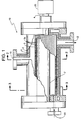
- Apparatus 10 comprises a generally cylindrical housing 1 which, as illustrated, includes a heating jacket 2.
- a housing which, as illustrated, includes a heating jacket 2.
- Other shapes for the housing are possible, as, for example, described below.
- Eccentrically positioned within the housing is a rotating drum 3 containing a plurality of perforations 3a and mounted on a drive shaft 4 connected to a drive means 20. In other embodiments, however, as exemplified below, the rotating drum is not eccentrically positioned in the housing.
- the axis of rotation for the rotating drum is shown at 5 and the direction of rotation is shown by arrow 6.
- a non-rotating stator drum 7 Positioned within the rotating perforated drum is a non-rotating stator drum 7, the center 8 of which coincides with the center of the cylindrical housing.
- the surface of the non-rotating stator drum is preferably smooth, although shallow indentations, profilings, or grooves are possible to enhance mixing or affect the movement of the fluid being processed.
- the outer rotating perforated drum 3, in this embodiment, is mounted eccentrically relative to the inner non-rotating stator drum 7, as evidenced by the different axis of rotations 5 and 8, respectively.
- the inner surface of the rotating perforated drum is tangent to the outer surface of the stator drum.
- the outer surface of the perforated drum is tangent to the inner surface of the cylindrical housing 1.
- the stator drum 7 may be heated, as shown in Figure 2, by an internal heating media 9, such as hot oil.
- the apparatus 10 has an inlet 11 where fluid material to be processed is fed to the apparatus and an outlet 12 where fluid material which has been processed may exit the apparatus.
- the apparatus 10 is further equipped with a port 13 through which any volatile constituents removed from the fluid material may exit the apparatus 10.
- a vacuum may be applied to the port.
- a gas under pressure such as nitrogen, may be added to the system through a second port (not shown) to sweep the volatile materials away from the surface of the fluid being processed in order to allow these materials to exit through the port 13.
- fluid material from inlet 11 enters the processor in the space between the inner surface of the perforated drum 3 and the outer surface of the stator drum 7, the entrance point denoted as 14 in Figure 2.
- Alternative or additional entrance points are also contemplated herein.
- the fluid material within the processor due to viscous drag, is carried as a film 15 on the inner surface of the rotating drum into a kind of liquid wedge "B", a first (or inner) nip zone or region, which is formed where the concavely curved inner rotating surface approaches the convexly curved surface of the stator drum.
- the fluid material 16 in the first nip zone is thereby squeezed between the outer surface of the stator drum 7 and the inner surface of the rotating perforated drum 3.
- Hydrodynamic forces drive the fluid through the rotating drum's perforations 3a, located near wedge "B", to the outside of the rotating drum 3, thereby forming a film or layer 18 on the outer surface of the rotating perforated drum.
- Viscous drag again carries the fluid material in film 18 on the outer surface of the rotating perforated drum, this time into a kind of fluid wedge "A", a second or outer nip zone or region.
- the fluid material 17 therein is now squeezed between the outer surface of the rotating perforating drum 3 and the inner curved surface of the cylindrical housing 1 which like the stator drum 7 is stationary. Hydrodynamic forces drive the fluid material through perforations 3a located near wedge "A" of the rotating drum, back into the rotating drum, thereby forming a film on the inner surface of the rotating drum.
- any volatile materials can escape from the fluid material being processed.
- the forcing of a fluid material to and fro through the two nip zones generates large surface areas in the form of thin films on the surfaces of the drums within the apparatus.
- the apparatus of this invention maintains a high fluid surface to volume ratio and regenerates the fluid surface frequently.
- processed fluid material can be conveyed towards outlet 12 by gravity or other means, as shown in Figure 1. Any volatile constituents may exit through the port 13 assisted by vacuum or by gas pressure.
- the apparatus can be operated in many different ways and adjusted within wide limits, depending on the particular application.
- the speed of rotation of the driven parts can be adjusted such that the apparatus can be adapted, in an optimum manner, to the particular material being processed.
- the degree of mixing, reacting, etc., as well as the throughputs can be varied as required.
- the apparatus of this invention can be used to process any fluid material in need of devolatization.
- the apparatus is especially well suited for processing thermoplastic polymeric materials, for example polyesters such as polyethylene terephthalate and copolymers thereof.
- the apparatus can also be used as a finisher in a melt polymerization process in order to raise, in a limited period of time, the degree of polymerization of the melt, merely as an example, from an IV (intrinsic viscosity) of 0.3 to an IV of 0.8.
- a processor according to this invention can also be used as a reactor for many chemical processes, wherein a first fluid reactant is fed through inlet 11 and a second fluid reactant is fed through port 13 or through an additional port (not shown), optionally under pressure in the case of a gaseous reactant.
- the present invention by generating an increased surface area for the contacting of reactants, aids in furthering their chemical reaction.
- Figure 3 illustrates one means of supporting an apparatus, for continuous operation, of indeterminate length. Illustrated are a pair of support rollers 19a, 19b, positioned within the bottom of cylindrical housing 1, juxtaposed to rotating drum 3 to provide support for a drum of some considerable length.
- one or more circular support plates may be intermediately placed along the length of the processor, perpendicularly and surrounding, by means of a bearing, the drive shaft, with a slot near the periphery of the support plate, for the passage of the fluid material being processed.
- FIG 4 shows another embodiment of the present invention.
- Apparatus 21 comprises a housing 22 which, as illustrated, has a square outside shape and a cylindrical interior surface 23. Eccentrically positioned within the housing is a rotating drum 24 containing a plurality of perforations 3a and mounted on a drive shaft (not shown).
- the axis of rotation for the rotating drum is shown at 25, and the direction of rotation is shown by arrow 26.
- a non-rotating stator body 27 Positioned within the rotating perforated drum is a non-rotating stator body 27, the center of which coincides with the center of the rotary perforated drum, which is below the center of the cylindrical inner surface of the housing as shown at 28.
- the non-rotating stator drum is preferably smooth, and has the shape, in cross-section, of an asymmetrically flattened cylinder as shown in the figure.
- the inner surface of the rotating perforated drum 24 is tangent to the outer surface of the stator body 27 in two places, 29 and 30, approximately equally spaced along the circumference of the rotating perforated drum such that the nips are arcuately spaced apart and adjacent the rotating perforated drum.
- the outer surface of the rotating perforated drum is tangent to an outer stator body 38, which is situated within the inner surface of the housing 22.
- the outer stator body may be elongated along a substantial length of the rotating perforated drum or may be divided up into a plurality of sections.
- the apparatus 21 has an inlet 31 where fluid material to be processed may be fed to the apparatus and, for continuous operation, and an outlet (not shown) where fluid material which has been processed may exit the apparatus.
- apparatus 21 may function analogously to apparatus 10 in Figures 1-2, except that two internal nip regions near 29 and 30 are formed and two external nip regions near 33 and 34 are formed (that is, external or internal to the rotating perforated drum).
- the fluid material from inlet 31 enters the apparatus and, due to viscous drag, the fluid material is carried as a film on the inner surface of the rotating drum into each of two (inner) nip zones or regions leading to the tangencies near 29 and 30.
- the fluid material in these nip zones is squeezed between the outer surface of the stator body 27 and the inner surface of the rotating perforated drum 24.
- Hydrodynamic forces drive the fluid through the perforations near each nip region and thereby outside of the rotating drum 24, including the formation of a film on the outside surface of the rotating drum.
- Viscous drag again carries the fluid material as a film on the outer surface of the rotating perforated drum into the two (outer) nip zones or regions near the tangencies 34 and 33.
- Near point 34 the fluid material is now squeezed between the outer surface of the rotating perforating drum 34 and the inner curved surface of the cylindrical housing 23.
- Near point 33 the fluid material is squeezed between the outer surface of the rotating perforating drum 34 and the inner curved surface of the stator body 30.
- Hydrodynamic forces drive the fluid material back through perforations 3a, located near each outer nip zone and back into the rotating drum, including the inner surface of the rotation drum.
- the liquid material being processed until being withdrawn from the apparatus, can repeatedly move, back and forth or to and fro, between an outer nip region and an inner nip region.
- the liquid material being processed also progresses in the axial direction of the rotating perforated drum.
- FIG. 5 shows yet another embodiment of the present invention.
- Apparatus 40 comprises a housing 41 which, as illustrated, has a generally rectangular shape. Centrally positioned within the housing is a rotating drum 42 containing a plurality of perforations and mounted on drive shaft (not shown).
- the axis of rotation for the rotating drum is shown at 43 and the direction of rotation is shown by arrow 44.
- a non-rotating stator body 45 Positioned within the rotating perforated drum is a non-rotating stator body 45, the center of which coincides with the center of the rotary perforated drum 42.
- the non-rotating stator drum has the shape, in cross-section, of a flattened cylinder, as shown in the figure, which forms two convex surfaces in tangential cooperation with the inside concave surface of the rotating perforated drum.
- the inner surface of the rotating perforated drum is tangent to the outer surface of the stator body 27 in two places 46 and 47, approximately equally spaced along the circumference of the rotating perforated drum.
- the outer convexly curved surface of the rotating perforated drum is in tangential relationship to the inside concavely curved surface of the housing at two locations 48 and 49.
- the apparatus 40 has an inlet 50 where fluid material to be processed may be fed to the apparatus and, for continuous operation, an outlet (not shown) where fluid material which has been processed may exit the apparatus.
- apparatus 40 may function analagously to apparatus 21 in Figure 4, wherein two internal nip regions near 46 and 47 are formed and two external nip regions near 48 and 49 are formed.
- the fluid material from inlet 50 enters the apparatus and, due to viscous drag, is carried as a film on the inner surface of the rotating drum into each of two (inner) nip zones or regions leading to the tangencies near 46 and 47.
- the fluid material in these nip zones is squeezed between the outer surface of the stator body 45 and the inner surface of the rotating perforated drum 42. Hydrodynamic forces drive the fluid through the perforations near each nip region and thereby outside of the rotating drum 42, including the outside surface of the rotating drum.
- Viscous drag again carries the fluid material as a film on the outer surface of the rotating perforated drum into two (outer) nip zones or regions near to, and leading to, the tangencies 48 and 49. Near these points, the fluid material is squeezed between the outer surface of the rotating perforating drum 42 and the inner curved surface of the housing 41. Hydrodynamic forces drive the fluid material back through the rotating drum's perforations, located near each outer nip zone, and back into the rotating drum, including the inner surface of the rotation drum.
- stator body 45 in Figure 5 may comprise three or four separately convexly curved surfaces or protruberances, for example, by employing an inner stator, triangular in cross-section, with curved tips or corners.
- the triangular corners may be tangential to the inner surface of the rotating perforated drum and might form, respectively, three inner nip zones.
- the invention may be is clarified by the following Example, which is intended to be purely exemplary of one preferred embodiment of the invention.
- This example illustrates the processing of a prepolymer, namely a low molecular weight oligomeric precursor of polyethylene terephthalate, which is finished in the apparatus of the instant invention.
- finishing herein is meant the raising of the degree of polymerization of a prepolymer material.
- a prepolymer feed material was formed by the esterification of terephthalic acid and ethylene glycol followed by a polycondensation reaction facilitated by the catalyst antimony trioxide (Sb 2 0 3 ).
- the prepolymer had an intrinsic viscosity of 0.285 dl/gm, a degree of polymerization of 25.33, a carboxyl ends content of 27.1 Eq/10 6 gms, an antimony content of 241 to 245 ppm, and a diethylene glycol content of 1.07% to 1.10%.
- the equipment illustrated was run in batch mode at 280°C.
- a feed hopper was placed at the port of an apparatus configured similarly to the apparatus shown in Figure 2.
- the rotating perforated drum had an outer diameter of 3.792 inches, an inner diameter of 3.077 inches, 8 rows of holes with 48 holes per row, for a total number of holes of 384.
- Each hole or perforation is 0.062 (1/16th) inches in diameter.
- the stator has a diameter of 2.312 inches and the distance between the axial centers of the stator body and the rotating drum is 0.375 inches.
- the granular feed material was dried overnight at 120°C in a vacuum. With the rotor drum stopped, a portion of a 42 gram charge of feed material was added through the hopper to the processor, under nitrogen at atmospheric pressure. The feed material introduced into the processor was given time to melt. The rotor was then run at 20 rpm for a short time to confirm, based on the torque read-out, that the feed material was melted. The rotor was then stopped, another portion of the 42 g charge of feed material was added and given time to melt, the rotor again run at 20 ppm, etc., until the full charge of feed material was in the reactor and melted. A vacuum of approximately 0.5 mm Hg (absolute) was then applied to the processor.
- the rotor speed was then set at 30 RPM.
- the processor was allowed to run for 20 minutes, after which time water was circulated through cooling passages in the housing of the processor to quench the molten processed material. Products of condensation (e.g., glycol, diethylene glycol, and water) were collected in a cold trap connected to the evacuated processor.
- condensation e.g., glycol, diethylene glycol, and water
- Polymeric product was collected from the processor and analyzed. The product was white and appeared to be free of color impurities based on visual inspection. The intrinsic viscosity (IV) of the product was determined to be 0.415 dl/gm corresponding to a degree of polymerization of 43.61 units.
- This example provides a further illustration of the processing of a low molecular weight oligomeric precursor of polyethylene terephthalate, which is finished in the apparatus of the instant invention.
- a prepolymer feed material was formed as described in Example 1, with the same IV and initial DP.
- the equipment was run in batch mode at 290°C.
- a feed hopper was placed at the port of an apparatus configured similarly to the apparatus shown in Figure 2.
- the rotating perforated drum had an outer diameter of 3.792 inches, an inner diameter of 3.077 inches, 8 rows of holes with 48 holes per row, for a total number of holes of 384. Each hole or perforation is 0.062 (1/16th) inches in diameter.
- the stator has a diameter of 2.312 inches and the distance between the axial centers of the stator body and the rotating drum is 0.375 inches.
- the granular feed material was dried overnight at 120°C in a vacuum. With the rotor drum stopped, a portion of a 55 gram charge of feed material was added through the hopper to the processor, under nitrogen at atmospheric pressure. The feed material introduced into the processor was given time to melt. The rotor was then run at 20 rpm for a short time to confirm, based on the torque read-out, that the feed material was melted. The rotor was then stopped, another portion of the 55 g charge of feed material was added and given time to melt, the rotor again run at 20 ppm, etc., until the full charge of feed material was in the reactor and melted. A nitrogen (sweep) was introduced at slightly above atmosphere pressure or slightly above 760 mm Hg absolute.
- the rotor speed was then set at 60 RPM.
- the processor was allowed to run for 30 minutes, after which time water was circulated through cooling passages in the housing of the processor to quench the molten processed material. Products of condensation (e.g., glycol, diethylene glycol, and water) were collected in a cold trap connected to the evacuated processor.
- condensation e.g., glycol, diethylene glycol, and water
- Polymeric product was collected from the processor and analyzed. The product was white and appeared to be free of color impurities based on visual inspection. The intrinsic viscosity of the product was determined to be 0.4966 dl/gm corresponding to a degree of polymerization of 56.53 units.
- This example provides yet one further illustration of the processing of a low molecular weight oligomeric precursor of polyethylene terephthalate, which is finished in the apparatus of the instant invention.
- a prepolymer feed material was formed as described in Example 1, with the same IV and initial DP.
- the equipment was run in batch mode at 290°C.
- a feed hopper was placed at the port of an apparatus configured similarly to the apparatus shown in Figure 2.
- the rotating perforated drum had an outer diameter of 3.792 inches, an inner diameter of 3.077 inches, 8 rows of holes with 48 holes per row, for a total number of holes of 384. Each hole or perforation is 0.062 (1/16th) inches in diameter.
- the stator has a diameter of 2.312 inches and the distance between the axial centers of the stator body and the rotating drum is 0.375 inches.
- the granular feed material was dried overnight at 120°C in a vacuum. With the rotor drum stopped, a portion of a 55 gram charge of feed material was added through the hopper to the processor, under nitrogen at atmospheric pressure. The feed material introduced into the processor was given time to melt. The rotor was then run at 20 rpm for a short time to confirm, based on the torque read-out, that the feed material was melted. The rotor was then stopped, another portion of the 55 g charge of feed material was added and given time to melt, the rotor again run at 20 ppm, etc., until the full charge of feed material was in the reactor and melted.
- the pressure was then reduced to 1.3 mm Hg absolute and a nitrogen sweep was introduced by adjusting the nitrogen inlet valve until a pressure of 4 mm Hg was obtained.
- the rotor speed was then set at 60 RPM.
- the processor was allowed to run for 30 minutes, after which time water was circulated through cooling passages in the housing of the processor to quench the molten processed material. Products of condensation (e.g., glycol, diethylene glycol, and water) were collected in a cold trap connected to the evacuated processor.
- Polymeric product was collected from the processor and analyzed. The product was white and appeared to be free of color impurities based on visual inspection. The intrinsic viscosity of the product was determined to be 0.8475 dl/gm corresponding to a degree of polymerization of 122.45 units. The use of nitrogen sweep under vaccuum was, therefore, found to significantly increase the polymerization rate in this example.
Landscapes
- Chemical & Material Sciences (AREA)
- Chemical Kinetics & Catalysis (AREA)
- Organic Chemistry (AREA)
- Health & Medical Sciences (AREA)
- Medicinal Chemistry (AREA)
- Polymers & Plastics (AREA)
- Engineering & Computer Science (AREA)
- Mechanical Engineering (AREA)
- Physical Or Chemical Processes And Apparatus (AREA)
- Vaporization, Distillation, Condensation, Sublimation, And Cold Traps (AREA)
- Polyesters Or Polycarbonates (AREA)
Applications Claiming Priority (3)
| Application Number | Priority Date | Filing Date | Title |
|---|---|---|---|
| US08/399,283 US5538343A (en) | 1995-03-06 | 1995-03-06 | Apparatus and method for liquid mixing employing nip zones |
| US399283 | 1995-03-06 | ||
| EP96909579A EP0814903A1 (de) | 1995-03-06 | 1996-03-05 | Vorrichtung und verfahren zur mischung von flüssigkeiten |
Related Parent Applications (1)
| Application Number | Title | Priority Date | Filing Date |
|---|---|---|---|
| EP96909579A Division EP0814903A1 (de) | 1995-03-06 | 1996-03-05 | Vorrichtung und verfahren zur mischung von flüssigkeiten |
Publications (1)
| Publication Number | Publication Date |
|---|---|
| EP0970982A2 true EP0970982A2 (de) | 2000-01-12 |
Family
ID=23578941
Family Applications (2)
| Application Number | Title | Priority Date | Filing Date |
|---|---|---|---|
| EP96909579A Ceased EP0814903A1 (de) | 1995-03-06 | 1996-03-05 | Vorrichtung und verfahren zur mischung von flüssigkeiten |
| EP99202853A Withdrawn EP0970982A2 (de) | 1995-03-06 | 1996-03-05 | Verfahren zur Erhöhung des Molekulargewichts von Polykondensaten |
Family Applications Before (1)
| Application Number | Title | Priority Date | Filing Date |
|---|---|---|---|
| EP96909579A Ceased EP0814903A1 (de) | 1995-03-06 | 1996-03-05 | Vorrichtung und verfahren zur mischung von flüssigkeiten |
Country Status (4)
| Country | Link |
|---|---|
| US (2) | US5538343A (de) |
| EP (2) | EP0814903A1 (de) |
| CA (1) | CA2214032A1 (de) |
| WO (1) | WO1996027433A1 (de) |
Cited By (1)
| Publication number | Priority date | Publication date | Assignee | Title |
|---|---|---|---|---|
| WO2005084641A1 (en) * | 2004-03-05 | 2005-09-15 | Liverpool John Moores University | Method and apparatus for producing carrier complexes |
Families Citing this family (38)
| Publication number | Priority date | Publication date | Assignee | Title |
|---|---|---|---|---|
| EP0730825A1 (de) * | 1995-03-09 | 1996-09-11 | MAZZONI LB FOOD S.r.l. | Fluidisiereinrichtung für Mischung von in kontinuierlicher lipider Phase dispergierten festen Teilchen, insbesondere Schokolade und Derivaten |
| FI100022B (fi) * | 1996-02-08 | 1997-08-29 | Nextrom Holding Sa | Suulakepuristin |
| FI106004B (fi) * | 1996-04-04 | 2000-11-15 | Nextrom Holding Sa | Suulakepuristusmenetelmä ja suulakepuristin |
| US7128278B2 (en) | 1997-10-24 | 2006-10-31 | Microdiffusion, Inc. | System and method for irritating with aerated water |
| US6702949B2 (en) | 1997-10-24 | 2004-03-09 | Microdiffusion, Inc. | Diffuser/emulsifier for aquaculture applications |
| US7654728B2 (en) | 1997-10-24 | 2010-02-02 | Revalesio Corporation | System and method for therapeutic application of dissolved oxygen |
| US6386751B1 (en) | 1997-10-24 | 2002-05-14 | Diffusion Dynamics, Inc. | Diffuser/emulsifier |
| GB9907502D0 (en) * | 1999-04-01 | 1999-05-26 | Tecexec Limited | Mixing apparatus |
| US6262226B1 (en) | 1999-05-07 | 2001-07-17 | The Dow Chemical Company | Process for producing a high molecular weight condensation polymer |
| US6494055B1 (en) * | 1999-05-20 | 2002-12-17 | Specialty Equipment Companies, Inc. | Beater/dasher for semi-frozen, frozen food dispensing machines |
| JP2003500034A (ja) * | 1999-05-20 | 2003-01-07 | スペシャルティ イクィップメント コンパニーズ,インコーポレイテッド | 半冷凍、冷凍食品ディスペンシング機械の改良されたビータ/ダッシャ |
| DE19923865A1 (de) | 1999-05-25 | 2000-11-30 | Voith Sulzer Papiertech Patent | Verfahren zur Herstellung von Garnituren für das mechanische Bearbeiten von wasserhaltigem Papierfaserstoff |
| US7690833B2 (en) * | 2000-09-08 | 2010-04-06 | Commonwealth Scientific And Industrial Research Organisation | Heat exchange method and apparatus utilizing chaotic advection in a flowing fluid to promote heat exchange |
| US7121714B2 (en) * | 2000-09-08 | 2006-10-17 | Commonwealth Scientific And Industrial Research Organisation | Fluid mixer utilizing viscous drag |
| US7316501B2 (en) * | 2004-05-20 | 2008-01-08 | Christian Thoma | Apparatus and method for mixing dissimilar fluids |
| US7273313B2 (en) * | 2004-06-17 | 2007-09-25 | Halliburton Energy Services, Inc. | Mixing device for mixing bulk and liquid material |
| US20060011656A1 (en) * | 2004-07-16 | 2006-01-19 | Ming-Te Tu | Liquid extruding device |
| US20060140867A1 (en) * | 2004-12-28 | 2006-06-29 | Helfer Jeffrey L | Coated stent assembly and coating materials |
| CN100528315C (zh) * | 2005-10-11 | 2009-08-19 | 鸿富锦精密工业(深圳)有限公司 | 热界面材料混合装置 |
| US8445546B2 (en) | 2006-10-25 | 2013-05-21 | Revalesio Corporation | Electrokinetically-altered fluids comprising charge-stabilized gas-containing nanostructures |
| US8784898B2 (en) | 2006-10-25 | 2014-07-22 | Revalesio Corporation | Methods of wound care and treatment |
| US8784897B2 (en) | 2006-10-25 | 2014-07-22 | Revalesio Corporation | Methods of therapeutic treatment of eyes |
| CA2667791A1 (en) | 2006-10-25 | 2008-05-02 | Revalesio Corporation | Methods of therapeutic treatment of eyes and other human tissues using an oxygen-enriched solution |
| US8609148B2 (en) | 2006-10-25 | 2013-12-17 | Revalesio Corporation | Methods of therapeutic treatment of eyes |
| JP5306214B2 (ja) * | 2006-10-25 | 2013-10-02 | リバルシオ コーポレイション | 混合装置 |
| EP2083876A4 (de) | 2006-10-25 | 2012-09-19 | Revalesio Corp | Verfahren zur wundpflege und -behandlung |
| US9745567B2 (en) | 2008-04-28 | 2017-08-29 | Revalesio Corporation | Compositions and methods for treating multiple sclerosis |
| US10125359B2 (en) | 2007-10-25 | 2018-11-13 | Revalesio Corporation | Compositions and methods for treating inflammation |
| US9523090B2 (en) | 2007-10-25 | 2016-12-20 | Revalesio Corporation | Compositions and methods for treating inflammation |
| CA2723215A1 (en) | 2008-05-01 | 2009-11-05 | Revalesio Corporation | Compositions and methods for treating digestive disorders |
| US8815292B2 (en) | 2009-04-27 | 2014-08-26 | Revalesio Corporation | Compositions and methods for treating insulin resistance and diabetes mellitus |
| CN104983740A (zh) | 2010-05-07 | 2015-10-21 | 利发利希奥公司 | 用于增强生理性能和恢复时间的组合物和方法 |
| JP2013533320A (ja) | 2010-08-12 | 2013-08-22 | レバレジオ コーポレイション | タウオパチーを治療するための組成物および方法 |
| WO2014186836A1 (en) * | 2013-05-24 | 2014-11-27 | Polywaste Intellectual Property Pty Limited | A system and a method for processing plastic, and plastic processed therefrom |
| PL3383937T3 (pl) | 2015-12-02 | 2021-11-29 | Invista Textiles (U.K.) Limited | Ulepszone wytwarzanie polimeru |
| KR20170089053A (ko) * | 2016-01-25 | 2017-08-03 | 삼성전자주식회사 | 수지 도포 장치 및 이를 사용한 발광소자 패키지 제조방법 |
| JP7049793B2 (ja) * | 2017-09-29 | 2022-04-07 | 株式会社明治 | 微粒化装置 |
| US10695769B2 (en) * | 2018-02-16 | 2020-06-30 | Shingle Resource Recycling, LLC | Apparatus, system and method for providing a bitumen-rich stream from bitumen-containing materials |
Family Cites Families (26)
| Publication number | Priority date | Publication date | Assignee | Title |
|---|---|---|---|---|
| DE46692C (de) * | RlCH. HENK-MANN in Berlin C, Petristr. 21 | Flaschen verschluss | ||
| US2973341A (en) * | 1956-01-25 | 1961-02-28 | Glanzstoff Ag | Continuous process for production of a polyethylene terephthalate condensate |
| US3110547A (en) * | 1961-07-26 | 1963-11-12 | Du Pont | Polymerization process |
| US3390135A (en) * | 1962-09-04 | 1968-06-25 | Pittsburgh Plate Glass Co | Continuous polyester process |
| US3279893A (en) * | 1963-07-05 | 1966-10-18 | Monsanto Co | Apparatus for processing liquids |
| SE300759B (de) * | 1964-03-20 | 1968-05-06 | Ekstroems A Maskinaffaer Ab | |
| US3545520A (en) * | 1964-10-30 | 1970-12-08 | Snia Viscosa | Apparatus for removing substances and fractions from polymers |
| US3469618A (en) * | 1964-10-30 | 1969-09-30 | Snia Viscosa | Solvent removal from polymeric materials |
| US3484213A (en) * | 1966-12-21 | 1969-12-16 | Monsanto Co | Polymer handling and conveying apparatus |
| US3594356A (en) * | 1967-04-24 | 1971-07-20 | Phillips Petroleum Co | Polymer recovery process and apparatus |
| DE1770350A1 (de) * | 1968-05-08 | 1971-10-14 | Hoechst Ag | Verfahren zur Herstellung von Polyestern |
| GB1279736A (en) * | 1969-09-09 | 1972-06-28 | Research Corp | Apparatus for effecting interactions of fluids at extended solid surfaces |
| US3634042A (en) * | 1970-02-24 | 1972-01-11 | Monsanto Co | Polymerization vessel having readily removable working parts |
| DE2404813C3 (de) * | 1974-02-01 | 1979-04-26 | Guenther Papenmeier Gmbh & Co Kg Maschinen- Und Apparatebau, 4930 Detmold | Verfahren und Vorrichtungen zur Herstellung von Granulaten aus pulverförmigem, körnigem oder teigigem Gut |
| GB1558910A (en) * | 1977-05-04 | 1980-01-09 | Bayer Ag | Continuous process for the production of polybutylene terephthalates |
| IT1077340B (it) * | 1977-07-18 | 1985-05-04 | Longhi Eligio | Dispositivo e procedimento per il recupero di scarti di materiale termoplastico,anche di forme eterogenee,mediante graduale fusione e compressione attraverso uno o piu' orifizi |
| CH656391A5 (de) * | 1982-04-21 | 1986-06-30 | Inventa Ag | Verfahren zur herstellung von hochmolekularen polyestern. |
| EP0137884B1 (de) * | 1983-10-07 | 1988-08-03 | Karl Fischer Industrieanlagen Gmbh | Verfahren zur kontinuierlichen Entmonomerisierung und Nachpolymerisierung von Polyamid 6 und Vorrichtung zur Durchführung dieses Verfahrens |
| JPH0641513B2 (ja) * | 1984-11-20 | 1994-06-01 | 三菱レイヨン株式会社 | ポリエステルの製造法 |
| US4590259A (en) * | 1984-11-30 | 1986-05-20 | General Electric Company | High molecular weight linear polyesters and method for their preparation |
| US4835293A (en) * | 1987-02-24 | 1989-05-30 | E. I. Du Pont De Nemours And Company | Atmospheric pressure process for preparing pure cyclic esters |
| US4886368A (en) * | 1987-04-06 | 1989-12-12 | Komax Systems, Inc. | Rotary mixer |
| ATE92365T1 (de) * | 1990-09-20 | 1993-08-15 | Berndorf Band Gmbh | Vorrichtung zur portionierten abgabe von fliessfaehigen massen. |
| JPH04363303A (ja) * | 1991-02-05 | 1992-12-16 | Nippon Paint Co Ltd | 連続重合方法および装置 |
| US5205647A (en) * | 1991-10-09 | 1993-04-27 | Acrison, Inc. | Fluid mixing apparatus and method of mixing |
| US5434239A (en) * | 1993-10-18 | 1995-07-18 | E. I. Du Pont De Nemours And Company | Continuous polyester process |
-
1995
- 1995-03-06 US US08/399,283 patent/US5538343A/en not_active Expired - Fee Related
-
1996
- 1996-03-05 CA CA002214032A patent/CA2214032A1/en not_active Abandoned
- 1996-03-05 WO PCT/US1996/002998 patent/WO1996027433A1/en not_active Ceased
- 1996-03-05 EP EP96909579A patent/EP0814903A1/de not_active Ceased
- 1996-03-05 EP EP99202853A patent/EP0970982A2/de not_active Withdrawn
- 1996-05-31 US US08/657,746 patent/US5635589A/en not_active Expired - Fee Related
Cited By (1)
| Publication number | Priority date | Publication date | Assignee | Title |
|---|---|---|---|---|
| WO2005084641A1 (en) * | 2004-03-05 | 2005-09-15 | Liverpool John Moores University | Method and apparatus for producing carrier complexes |
Also Published As
| Publication number | Publication date |
|---|---|
| WO1996027433A1 (en) | 1996-09-12 |
| CA2214032A1 (en) | 1996-09-12 |
| EP0814903A1 (de) | 1998-01-07 |
| US5538343A (en) | 1996-07-23 |
| US5635589A (en) | 1997-06-03 |
Similar Documents
| Publication | Publication Date | Title |
|---|---|---|
| US5538343A (en) | Apparatus and method for liquid mixing employing nip zones | |
| CN100430196C (zh) | 搅拌器和搅拌方法 | |
| US8252888B2 (en) | Process for continuous preparation of high molecular weight polyesters by esterification of dicarboxylic acids and/or transesterification of dicarboxylic acids with diols and/or mixtures thereof and an apparatus therefor | |
| US4776703A (en) | Continuous treatment apparatus for viscous material | |
| US3522214A (en) | Process and apparatus for polymerizing liquids | |
| CN100465208C (zh) | 连续缩聚方法及设备 | |
| CA2029082C (en) | Viscous liquid processor | |
| CN102159306B (zh) | 进行机械、化学和/或热过程的装置 | |
| US5677415A (en) | Apparatus and process for a polycondensation reaction | |
| JPH04271828A (ja) | 高分子量エポキシ樹脂製造用多段反応器 | |
| US20230151181A1 (en) | Process for depolymerizing polyethylene terephthalate (pet) by glycolysis with ethylene glycol, and plant for carrying out the same | |
| EP0889922B1 (de) | Vorrichtung und verfahren für die polycondensationsreaktion | |
| US5230562A (en) | Viscous liquid processor | |
| US3486864A (en) | Apparatus for increasing the viscosity and degree of polymerization of ethylene terephthalate prepolymer | |
| US3484213A (en) | Polymer handling and conveying apparatus | |
| KR20070086441A (ko) | 공업적 연속 증발 장치 | |
| US3820957A (en) | Continuous polymerization reactor | |
| JP4144967B2 (ja) | 横型反応装置 | |
| JP3602958B2 (ja) | 横型反応槽 | |
| WO2016069325A1 (en) | Dynamic mixing assembly with improved baffle design | |
| EP4076883B1 (de) | Vorrichtung und verfahren zur verarbeitung von viskosem material | |
| CN116997450A (zh) | 用于热处理热塑性的塑料熔料的装置和方法 | |
| JP3297274B2 (ja) | 重合反応装置 | |
| JPH0977857A (ja) | 重縮合反応器 | |
| JPH07330910A (ja) | 重縮合系高分子の連続塊状重合方法及び装置 |
Legal Events
| Date | Code | Title | Description |
|---|---|---|---|
| PUAI | Public reference made under article 153(3) epc to a published international application that has entered the european phase |
Free format text: ORIGINAL CODE: 0009012 |
|
| AC | Divisional application: reference to earlier application |
Ref document number: 814903 Country of ref document: EP |
|
| AK | Designated contracting states |
Kind code of ref document: A2 Designated state(s): DE ES GB LU |
|
| RIN1 | Information on inventor provided before grant (corrected) |
Inventor name: TYNAN, DANIEL GREGORY |
|
| STAA | Information on the status of an ep patent application or granted ep patent |
Free format text: STATUS: THE APPLICATION HAS BEEN WITHDRAWN |
|
| 18W | Application withdrawn |
Withdrawal date: 20000106 |