EP0971248A2 - Optische Faser Hülse - Google Patents
Optische Faser Hülse Download PDFInfo
- Publication number
- EP0971248A2 EP0971248A2 EP99112940A EP99112940A EP0971248A2 EP 0971248 A2 EP0971248 A2 EP 0971248A2 EP 99112940 A EP99112940 A EP 99112940A EP 99112940 A EP99112940 A EP 99112940A EP 0971248 A2 EP0971248 A2 EP 0971248A2
- Authority
- EP
- European Patent Office
- Prior art keywords
- sleeve
- bore
- fibers
- optical fibers
- section
- Prior art date
- Legal status (The legal status is an assumption and is not a legal conclusion. Google has not performed a legal analysis and makes no representation as to the accuracy of the status listed.)
- Withdrawn
Links
- 239000013307 optical fiber Substances 0.000 title claims abstract description 119
- 239000000835 fiber Substances 0.000 claims abstract description 57
- 239000000853 adhesive Substances 0.000 claims abstract description 26
- 230000001070 adhesive effect Effects 0.000 claims abstract description 26
- 239000000463 material Substances 0.000 claims description 9
- 230000005540 biological transmission Effects 0.000 claims description 3
- 238000005253 cladding Methods 0.000 claims description 3
- 230000013011 mating Effects 0.000 claims 1
- 238000004017 vitrification Methods 0.000 abstract 1
- 238000009826 distribution Methods 0.000 description 14
- 238000000034 method Methods 0.000 description 11
- 230000003247 decreasing effect Effects 0.000 description 6
- 238000007665 sagging Methods 0.000 description 6
- 230000003287 optical effect Effects 0.000 description 4
- 238000004891 communication Methods 0.000 description 3
- 238000009792 diffusion process Methods 0.000 description 3
- 238000001035 drying Methods 0.000 description 3
- 239000004593 Epoxy Substances 0.000 description 2
- 239000011162 core material Substances 0.000 description 2
- 238000004519 manufacturing process Methods 0.000 description 2
- 239000002184 metal Substances 0.000 description 2
- 229910000679 solder Inorganic materials 0.000 description 2
- 125000006850 spacer group Chemical group 0.000 description 2
- XLYOFNOQVPJJNP-UHFFFAOYSA-N water Substances O XLYOFNOQVPJJNP-UHFFFAOYSA-N 0.000 description 2
- 238000005452 bending Methods 0.000 description 1
- 239000011248 coating agent Substances 0.000 description 1
- 238000000576 coating method Methods 0.000 description 1
- 238000001816 cooling Methods 0.000 description 1
- 230000008878 coupling Effects 0.000 description 1
- 238000010168 coupling process Methods 0.000 description 1
- 238000005859 coupling reaction Methods 0.000 description 1
- 239000006185 dispersion Substances 0.000 description 1
- 238000005516 engineering process Methods 0.000 description 1
- 239000005350 fused silica glass Substances 0.000 description 1
- 239000011521 glass Substances 0.000 description 1
- 239000003365 glass fiber Substances 0.000 description 1
- 239000003292 glue Substances 0.000 description 1
- 238000010438 heat treatment Methods 0.000 description 1
- 238000003780 insertion Methods 0.000 description 1
- 230000037431 insertion Effects 0.000 description 1
- 238000003698 laser cutting Methods 0.000 description 1
- 229920000642 polymer Polymers 0.000 description 1
- 230000001681 protective effect Effects 0.000 description 1
- 239000011347 resin Substances 0.000 description 1
- 229920005989 resin Polymers 0.000 description 1
- 238000006748 scratching Methods 0.000 description 1
- 230000002393 scratching effect Effects 0.000 description 1
- 238000007789 sealing Methods 0.000 description 1
Images



Classifications
-
- G—PHYSICS
- G02—OPTICS
- G02B—OPTICAL ELEMENTS, SYSTEMS OR APPARATUS
- G02B6/00—Light guides; Structural details of arrangements comprising light guides and other optical elements, e.g. couplings
- G02B6/24—Coupling light guides
- G02B6/36—Mechanical coupling means
- G02B6/38—Mechanical coupling means having fibre to fibre mating means
- G02B6/3807—Dismountable connectors, i.e. comprising plugs
- G02B6/3833—Details of mounting fibres in ferrules; Assembly methods; Manufacture
- G02B6/3855—Details of mounting fibres in ferrules; Assembly methods; Manufacture characterised by the method of anchoring or fixing the fibre within the ferrule
- G02B6/3861—Adhesive bonding
-
- G—PHYSICS
- G02—OPTICS
- G02B—OPTICAL ELEMENTS, SYSTEMS OR APPARATUS
- G02B6/00—Light guides; Structural details of arrangements comprising light guides and other optical elements, e.g. couplings
- G02B6/24—Coupling light guides
- G02B6/36—Mechanical coupling means
- G02B6/38—Mechanical coupling means having fibre to fibre mating means
- G02B6/3807—Dismountable connectors, i.e. comprising plugs
- G02B6/3833—Details of mounting fibres in ferrules; Assembly methods; Manufacture
-
- G—PHYSICS
- G02—OPTICS
- G02B—OPTICAL ELEMENTS, SYSTEMS OR APPARATUS
- G02B6/00—Light guides; Structural details of arrangements comprising light guides and other optical elements, e.g. couplings
- G02B6/24—Coupling light guides
- G02B6/26—Optical coupling means
- G02B6/32—Optical coupling means having lens focusing means positioned between opposed fibre ends
-
- G—PHYSICS
- G02—OPTICS
- G02B—OPTICAL ELEMENTS, SYSTEMS OR APPARATUS
- G02B6/00—Light guides; Structural details of arrangements comprising light guides and other optical elements, e.g. couplings
- G02B6/24—Coupling light guides
- G02B6/36—Mechanical coupling means
- G02B6/38—Mechanical coupling means having fibre to fibre mating means
- G02B6/3807—Dismountable connectors, i.e. comprising plugs
- G02B6/3833—Details of mounting fibres in ferrules; Assembly methods; Manufacture
- G02B6/3834—Means for centering or aligning the light guide within the ferrule
- G02B6/3835—Means for centering or aligning the light guide within the ferrule using discs, bushings or the like
- G02B6/3837—Means for centering or aligning the light guide within the ferrule using discs, bushings or the like forwarding or threading methods of light guides into apertures of ferrule centering means
Definitions
- This invention relates to a sleeve for retaining a plurality of optical fibers. More particularly, the invention relates to a sleeve for retaining the plurality of fibers, which minimizes and equalizes stress distribution within the fibers.
- Optical fibers are used in a wide variety of applications ranging from telecommunications to medical technology and optical components. Because of their unique structure, optical fibers are capable of highly accurate transmission of light, which is relatively unaffected by interference, diffusion, and other signal de-enhancing phenomena. However, for optical fibers to function at their optimum potential they must be structurally intact and free of scratches, cracks, leaks, or substantially unequal distributed stress.
- Optical fibers consist of a core material that is surrounded by a cladding.
- the difference between the indexes of refraction of the core and cladding materials allows the optical fiber to function.
- Most commercially available optical fibers in addition, have an external "buffer or jacket".
- the jacket is a thin coating (usually plastic, other polymer, or metal) which is applied to the fiber to protect it from being scratched during handling and to limit the amount of water that can come into contact with the fiber. Scratching or contact with water or moisture can deleteriously affect both the optical properties and the strength of the glass fiber.
- the buffer In addition to shielding the fiber's surface, the buffer also operates to help maintain the high tensile strength and the bending capability of the glass optical fibers.
- a number of fiber optic applications require that one terminus of the fiber be located in an environment isolated from the other terminus. This implies the use of a connector, coupling device, or "feed through" which serves as the point of communication between the distinct environments. Oftentimes, it is necessary or desirable for the point of communication between the environments to be completely sealed except for the presence of the optical fiber. Herein arises the need for a satisfactory method to hermetically seal optical fibers. Further it is desired to provide support for fiber ends to be joined or coupled. Sleeves may also be used to align and support a plurality of fibers.
- a method of making a hermetically sealed fiber optic coupler comprises at least one optical fiber and a tubular sleeve. The fibers are inserted into the tube and the empty space is filled with an adhesive.
- a method of making a fiber optic coupler comprises a plurality of optical fibers and a sleeve having a circular bore. The fibers are inserted into the tube and the sleeve is then collapsed onto the fibers.
- a sleeve having a bore for retaining a plurality of optical fibers, the bore cross section comprising at least two portions each having a circular cross section each circular cross section having a diameter that is less than the combined diameters of two fibers of the plurality of fibers the bore has to accommodate.
- a sleeve having a bore defined by one or more inner walls for retaining a plurality of contacting optical fibers held in place by an adhesive material, such that at least a portion of the bore for containing the adhesive material conforms to an external surface of the plurality of contacting optical fibers when contained within the sleeve.
- a sleeve having a bore defined by one or more inner walls for retaining a plurality of optical fibers, such that a cross-section through the sleeve perpendicular to a longitudinal axis thereof substantially conforms to a cross-section through the plurality of optical fibers when inserted within the sleeve.
- the present invention provides a sleeve with a bore that closely matches the shape of the fibers so that hermetic sealing or vitrifring techniques causes minimal stress within the fibers.
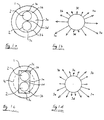
- a sleeve 1 according to the prior art is shown.
- the sleeve has a bore with a circular cross section and retains a pair of optical fibers 2.
- an adhesive such as epoxy, glue, resin, glass solder, metal solder etc. is added, at the location 3a a large amount, at the location 3b a smaller amount and at the location 3c a small amount of adhesive.
- the adhesive can be applied directly to the optical fibers prior to their insertion into the sleeve 1.
- the volume of the adhesive shrinks. The shrinkage of the adhesive is proportional to its volume, i.e.
- Fig. 1b indicate the stress acting on the surface of the upper optical fiber shown in Fig. 1a.
- the direction of the arrows indicates the direction of the stress and the length of the arrows is a measure for the magnitude of the stress.
- the arrow indicates a large tensile stress acting on the surface of the optical fiber. Proceeding through location 3b to location 3c the length of the arrows is decreasing, i. e.
- the magnitude of the tensile stress is decreasing due to the smaller amount of adhesive. Proceeding from location 3a to location 3d, where the surfaces of the two optical fibers are very close to each other, the magnitude of the tensile stress is decreasing and is approximately zero at the location 3d.
- This unequal distribution of stresses acting on the surface of the optical fibers induces substantially unequal distributed stresses within the optical fibers causing interference, dispersion, diffusion and other signal deenhancing phenomena affecting the accurate transmission of light through the optical fibers.
- the large volume at location 3a also allows the optical fibers during the drying process of the adhesive to sag or to cross over.
- Fig. 1c another embodiment according to the prior art is shown.
- the sleeve shown in Fig. 1c comprises a bore with a rectangular cross section.
- the use of a bore with rectangular cross section shows improvement to some extent.
- the large volume of adhesive at location 3a is reduced, but the rectangular cross section increases the volume of adhesive at location 3b.
- Fig. 1d shows the distribution of the stresses acting on the surface of the upper optical fiber shown in Fig. 1c.
- the tensile stress is to some extent smaller due to the smaller amount of adhesive there. Proceeding from location 3a through location 3b to location 3c the magnitude of the tensile stress is first decreasing then at location 3b increasing due to the larger amount of adhesive in the corner of the rectangle and finally decreasing towards location 3c. Proceeding from location 3a to location 3d, where the surfaces of the two optical fibers are very close to each other, the magnitude of the tensile stress is decreasing and is approximately zero at the location 3d.
- the use of a sleeve having a bore with a rectangular cross section as shown in Fig. 1c eliminates the problem of sagging or crossing over of the optical fibers. But examining the distribution of the stresses acting on the surfaces of the optical fibers, as shown in Fig. 1d, clearly indicates that there is still substantially unequally distributed tensile stress acting on the surfaces of the optical fibers.
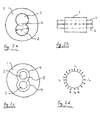
- a sleeve 1 according to the invention for retaining a plurality in the form of two optical fibers 2 is shown.
- the bore of the sleeve 1 has a cross section comprising two portions 2 with a circular cross section as indicated by the dashed lines.
- the diameter 4 of each cross section is less than the combined diameters of the two fibers the bore has to accommodate.
- the two cross sections may overlap as indicated by the area 3.
- Fig. 2b shows a side view of the sleeve 1 retaining two optical fibers 2. The end view in Fig.
- FIG. 2c shows the sleeve 1 retaining these optical fibers 2 and the inner walls 4 of the bore of the sleeve defining a perimeter substantially equally spaced about the external surface of the optical fibers.
- the magnitude of tensile stress acting on the surface of the optical fibers is approximately zero.
- the tensile stress is increasing in this area due to the increasing amount of adhesive material from location 1a of the optical fibers to a constant amount around the surface of the optical fibers at the locations 1c.
- Fig. 2d shows tensile stress of constant magnitude acting on the surface of the optical fiber.
- the smaller empty space 5 between the surface of the optical fibers and the surface of the bore contains less adhesive material, thus reducing the magnitude of tensile stress acting on the surface of the optical fibers.
- the magnitude of the tensile stress is much smaller compared to the magnitude of tensile stress acting on the surface of the optical fibers shown in the embodiments according to the prior art, e.g. in Fig 1b.
- Fig. 3a shows a sleeve retaining a plurality in the form of three optical fibers in a linear arrangement. Alternatively the optical fibers are arranged concentrically.
- Fig. 3b shows a sleeve according to this invention retaining three optical fibers arranged in triangular form and
- Fig. 3c shows a sleeve according to this invention retaining five optical fibers arranged on a circle.
- the embodiment shown in Fig. 3d arranges the optical fibers in a hexagonal form.
- Each of the inner optical fibers 3 is surrounded by six neighboring fibers while the outer fibers 2 are surrounded by three or four neighboring fibers and the inner wall of the bore. This embodiment is the most compact solution for a large plurality of optical fibers.
- FIG. 4 Another embodiment of a sleeve for retaining a plurality of optical fibers according to this invention is shown in Fig. 4.
- the bore of the sleeve 1 comprises a middle portion 2 for conforming to the outer surface of the fibers and second portions having one or more walls 3 sloping outwardly from the middle portion of the bore and forming a broader bore end 4 for inserting the fibers into the sleeve, Alternatively this sloping outwardly portion can be provided on a single end.
- a sleeve according to this invention provides the means for retaining a plurality of optical fibers while meeting all of the above requirements.
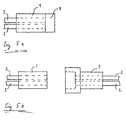
- a sleeve according to this invention is used as a housing to build a coupler for retaining the ends of two optical fibers 2 in optical communication with a lens 3.
- Fig. 5b shows a connector comprising two separate sleeves, each retaining two optical fibers 2.
- One sleeve forms a male connector 1, which cooperates with a female connector 3 for aligning the fiber ends.
- some of the optical fibers can be replaced by spacer fibers, e.g. to separate optical fibers, using a sleeve designed for retaining more fibers than required.
- a sleeve according to this invention is also advantageous when used for the process of heating the sleeve and collapsing it onto the optical fibers.
- the sleeve consists of a material that has essentially the same coefficient of expansion as the optical fibers.
- a sleeve 1 according to the prior art for retaining two optical fibers 2 and having a circular bore is shown.
- this prior art sleeve is heated to collapse and seal the fibers, the subsequent cooling process causes the sleeve 1 to shrink irregularly about the fibers 2 due to the unequal distribution of material within the sleeve 1.
- no stress is acting on the surface of the optical fiber.
- This unequal distribution of stress acting on the surface of the fiber deenhances substantially the signals transmitted through the fiber.
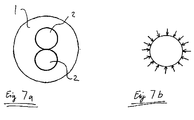
- a sleeve 1 according to the invention for retaining a plurality in the form of two optical fibers 2 is shown.
- the optical fibers fit snugly into the bore, each at its predetermined position. Therefore, the inner surface of the bore retains the fibers in their position during the process of collapsing and prevents them from sagging or crossing over.
- the inner walls of the bore are contacting substantially the complete surface of the fibers, as shown in Fig. 7a. This results in a substantially equal distribution of compressive stress acting on the surface of the optical fibers, as shown in Fig. 7b.
- the sleeve according to this invention is manufactured using methods known in the prior art such as drawing it about a form or laser cutting the inside surface. Numerous other embodiments of the invention may be envisioned without departing from the spirit or scope of the invention.
Landscapes
- Physics & Mathematics (AREA)
- General Physics & Mathematics (AREA)
- Optics & Photonics (AREA)
- Mechanical Coupling Of Light Guides (AREA)
- Optical Couplings Of Light Guides (AREA)
Applications Claiming Priority (2)
| Application Number | Priority Date | Filing Date | Title |
|---|---|---|---|
| US110389 | 1998-07-07 | ||
| US09/110,389 US6134360A (en) | 1998-07-07 | 1998-07-07 | Optical fibre sleeve |
Publications (2)
| Publication Number | Publication Date |
|---|---|
| EP0971248A2 true EP0971248A2 (de) | 2000-01-12 |
| EP0971248A3 EP0971248A3 (de) | 2001-09-05 |
Family
ID=22332744
Family Applications (1)
| Application Number | Title | Priority Date | Filing Date |
|---|---|---|---|
| EP99112940A Withdrawn EP0971248A3 (de) | 1998-07-07 | 1999-07-05 | Optische Faser Hülse |
Country Status (4)
| Country | Link |
|---|---|
| US (1) | US6134360A (de) |
| EP (1) | EP0971248A3 (de) |
| JP (1) | JP2000039535A (de) |
| CA (1) | CA2277425C (de) |
Cited By (2)
| Publication number | Priority date | Publication date | Assignee | Title |
|---|---|---|---|---|
| WO2003021295A3 (en) * | 2001-08-31 | 2003-11-20 | Corning Inc | Methods of making a multiple-port optical package |
| US7187826B2 (en) | 2001-08-31 | 2007-03-06 | Avanex Corporation | Multiple-port optical package and DWDM module |
Families Citing this family (25)
| Publication number | Priority date | Publication date | Assignee | Title |
|---|---|---|---|---|
| US6563990B1 (en) | 1998-06-22 | 2003-05-13 | Corning Cable Systems, Llc | Self-supporting cables and an apparatus and methods for making the same |
| IL128450A (en) * | 1999-02-09 | 2002-05-23 | Elop Electrooptics Ind Ltd | Method of bonding an optical element within an enclosure |
| US6701047B1 (en) | 1999-03-31 | 2004-03-02 | Corning Cable Systems Llc | Fiber optic buffer unit and cables including the same |
| US6764224B2 (en) | 2000-06-22 | 2004-07-20 | Avanex Corporation | Precision fiber ferrules |
| US6767139B2 (en) | 2000-06-22 | 2004-07-27 | Avanex Corporation | Six-port optical package and method of manufacturing |
| US6960026B2 (en) | 2000-06-22 | 2005-11-01 | Avanex Corporation | Precision fiber ferrules |
| US6516114B2 (en) | 2000-06-27 | 2003-02-04 | Oluma, Inc. | Integration of fibers on substrates fabricated with grooves |
| US6621951B1 (en) | 2000-06-27 | 2003-09-16 | Oluma, Inc. | Thin film structures in devices with a fiber on a substrate |
| US6597833B1 (en) | 2000-06-27 | 2003-07-22 | Oluma, Inc. | Wavelength-division multiplexers and demultiplexers based on mach-zehnder interferometers and evanescent coupling |
| US6625349B2 (en) | 2000-06-27 | 2003-09-23 | Oluma, Inc. | Evanescent optical coupling between a waveguide formed on a substrate and a side-polished fiber |
| US6501875B2 (en) | 2000-06-27 | 2002-12-31 | Oluma, Inc. | Mach-Zehnder inteferometers and applications based on evanescent coupling through side-polished fiber coupling ports |
| US6490391B1 (en) | 2000-07-12 | 2002-12-03 | Oluma, Inc. | Devices based on fibers engaged to substrates with grooves |
| US6621952B1 (en) | 2000-08-10 | 2003-09-16 | Oluma, Inc. | In-fiber variable optical attenuators and modulators using index-changing liquid media |
| US6571035B1 (en) | 2000-08-10 | 2003-05-27 | Oluma, Inc. | Fiber optical switches based on optical evanescent coupling between two fibers |
| US6542663B1 (en) | 2000-09-07 | 2003-04-01 | Oluma, Inc. | Coupling control in side-polished fiber devices |
| US6584257B1 (en) | 2000-12-27 | 2003-06-24 | Corning Cable Systems, Llc | Fiber optic assembly and method of making same |
| JP3904398B2 (ja) * | 2001-03-14 | 2007-04-11 | 東京特殊電線株式会社 | 多芯偏波保持ファイバアセンブリの製造方法 |
| US6744948B1 (en) | 2001-06-20 | 2004-06-01 | Oluma, Inc. | Fiber tap monitor based on evanescent coupling |
| US6782146B2 (en) | 2001-09-28 | 2004-08-24 | Corning Incorporated | Multiple polarization combiner-splitter-isolator and method of manufacturing the same |
| WO2003062890A2 (en) * | 2002-01-23 | 2003-07-31 | Tyco Electronics Raychem Nv | Optical fibre tube sealing |
| US6961496B2 (en) * | 2002-03-26 | 2005-11-01 | Avanex Corporation | Optical package with cascaded filtering |
| US20060106374A1 (en) * | 2004-11-18 | 2006-05-18 | Ceramoptec Industries, Inc. | Expendable optical waveguide with use-tracking feature |
| JP2007279194A (ja) * | 2006-04-04 | 2007-10-25 | Wired Japan:Kk | 光ファイバケーブル、光伝送方法、及び分光分析システム |
| JPWO2024142688A1 (de) * | 2022-12-26 | 2024-07-04 | ||
| CN120103540A (zh) * | 2025-03-06 | 2025-06-06 | 武汉锐科光纤激光技术股份有限公司 | 一种特殊形状包层的光纤 |
Family Cites Families (14)
| Publication number | Priority date | Publication date | Assignee | Title |
|---|---|---|---|---|
| US4601541A (en) * | 1980-04-11 | 1986-07-22 | The Board Of Trustees Of Leland Stanford Junior University | Fiber optic directional coupler |
| US4564262A (en) * | 1980-04-11 | 1986-01-14 | Board Of Trustees Of The Leland Stanford Junior University | Fiber optic directional coupler |
| FR2547066A1 (fr) * | 1983-06-03 | 1984-12-07 | Cables De Lyon Geoffroy Delore | Cable sous-marin a fibres optiques et procede de fabrication d'un tel cable |
| EP0157610B1 (de) * | 1984-03-29 | 1989-09-13 | BRITISH TELECOMMUNICATIONS public limited company | Mantel für optische Fasern |
| US4773924A (en) * | 1985-08-15 | 1988-09-27 | Corning Glass Works | Fiber optic coupler and method |
| US4923268A (en) * | 1987-09-14 | 1990-05-08 | Aster Corporation | Fiber optic coupler |
| US5136683A (en) * | 1989-09-14 | 1992-08-04 | Mitsubishi Rayon Company, Ltd. | Flame-retardant cable |
| US5125055A (en) * | 1991-05-16 | 1992-06-23 | Hirose Electric Co., Ltd. | Multiple optical fiber connector terminal and method of making same |
| FR2688318B1 (fr) * | 1992-03-06 | 1997-01-10 | Alcatel Cable | Conducteur optique multiguides. |
| US5408554A (en) * | 1993-12-17 | 1995-04-18 | Porta System Corporation | Fiber optic coupling |
| US5448673A (en) * | 1993-08-12 | 1995-09-05 | Center For Innovative Technology | Controlled dopant diffusion for fiber optic coupler |
| US5748820A (en) * | 1994-03-24 | 1998-05-05 | France Telecom | Component for connection to a multi-core fiber, and a method of manufacture |
| US5594822A (en) * | 1995-12-05 | 1997-01-14 | Corning Incorporated | Fiber optic couplers, preform and method of making same |
| US5734767A (en) * | 1996-07-11 | 1998-03-31 | Belt; Richard W. | Fiber optic coupler |
-
1998
- 1998-07-07 US US09/110,389 patent/US6134360A/en not_active Expired - Fee Related
-
1999
- 1999-07-05 EP EP99112940A patent/EP0971248A3/de not_active Withdrawn
- 1999-07-06 CA CA002277425A patent/CA2277425C/en not_active Expired - Fee Related
- 1999-07-07 JP JP11193166A patent/JP2000039535A/ja active Pending
Cited By (4)
| Publication number | Priority date | Publication date | Assignee | Title |
|---|---|---|---|---|
| US6729770B2 (en) | 2000-06-22 | 2004-05-04 | Avanex Corporation | Methods of making a multiple-port optical package |
| WO2003021295A3 (en) * | 2001-08-31 | 2003-11-20 | Corning Inc | Methods of making a multiple-port optical package |
| US7187826B2 (en) | 2001-08-31 | 2007-03-06 | Avanex Corporation | Multiple-port optical package and DWDM module |
| EP2278368A1 (de) * | 2001-08-31 | 2011-01-26 | Oclaro (North America), Inc. | Mehrfachanschlüsse optisches gehäuse und dwdm modul |
Also Published As
| Publication number | Publication date |
|---|---|
| CA2277425C (en) | 2005-01-25 |
| US6134360A (en) | 2000-10-17 |
| CA2277425A1 (en) | 2000-01-07 |
| JP2000039535A (ja) | 2000-02-08 |
| EP0971248A3 (de) | 2001-09-05 |
Similar Documents
| Publication | Publication Date | Title |
|---|---|---|
| US6134360A (en) | Optical fibre sleeve | |
| US5745626A (en) | Method for and encapsulation of an optical fiber | |
| US5125057A (en) | Optical fiber splicing device | |
| CA1311381C (en) | Connector employing mode field modification | |
| US4711518A (en) | Fiber optic connector | |
| US4691985A (en) | Fiber optic connector | |
| CN112888978B (zh) | 具有用于多路熔接的带化接口的光纤扇出组件及其制造方法 | |
| CA1115568A (en) | Coupling of dielectric optical waveguides | |
| EP0399684B1 (de) | Laser-Modul mit optischer Faser und Methode zu seiner Herstellung | |
| KR940002621A (ko) | 섬유 광 커플러 및 이의 제조방법 | |
| US4930859A (en) | Fiber optic splice assembly | |
| CA2121418A1 (en) | Low loss coupler | |
| WO1990000751A1 (en) | Optical star couplers | |
| US4919509A (en) | Mechanical connection for polarization-maintaining optical fiber and methods of making | |
| US4807959A (en) | Method of splicing fibers | |
| US5148508A (en) | Optical coupler housing | |
| US6097868A (en) | Multi-core optical fiber | |
| US4718746A (en) | Optical fiber graded index connector | |
| EP0506003B1 (de) | Endhülse für Glasfasern | |
| US5263104A (en) | Optical fiber directional coupler housing | |
| US4787697A (en) | Optical fiber connector having magnifying lens | |
| EP0302592A2 (de) | Kapillarspleiss und Methode seiner Herstellung | |
| US6752537B2 (en) | Connector ferrule and method of sealing | |
| US5594822A (en) | Fiber optic couplers, preform and method of making same | |
| US4960316A (en) | Capillary splice |
Legal Events
| Date | Code | Title | Description |
|---|---|---|---|
| PUAI | Public reference made under article 153(3) epc to a published international application that has entered the european phase |
Free format text: ORIGINAL CODE: 0009012 |
|
| AK | Designated contracting states |
Kind code of ref document: A2 Designated state(s): AT BE CH CY DE DK ES FI FR GB GR IE IT LI LU MC NL PT SE |
|
| AX | Request for extension of the european patent |
Free format text: AL;LT;LV;MK;RO;SI |
|
| PUAL | Search report despatched |
Free format text: ORIGINAL CODE: 0009013 |
|
| AK | Designated contracting states |
Kind code of ref document: A3 Designated state(s): AT BE CH CY DE DK ES FI FR GB GR IE IT LI LU MC NL PT SE |
|
| AX | Request for extension of the european patent |
Free format text: AL;LT;LV;MK;RO;SI |
|
| RIC1 | Information provided on ipc code assigned before grant |
Free format text: 7G 02B 6/04 A, 7G 02B 6/38 B, 7G 02B 6/44 B, 7G 02B 6/287 B |
|
| 17P | Request for examination filed |
Effective date: 20020207 |
|
| AKX | Designation fees paid |
Free format text: FR GB |
|
| REG | Reference to a national code |
Ref country code: DE Ref legal event code: 8566 |
|
| 17Q | First examination report despatched |
Effective date: 20020521 |
|
| STAA | Information on the status of an ep patent application or granted ep patent |
Free format text: STATUS: THE APPLICATION IS DEEMED TO BE WITHDRAWN |
|
| 18D | Application deemed to be withdrawn |
Effective date: 20030917 |