EP0971506A1 - Verfahren zur Steuerung einer Netzwerkvorrichtung in einem Netzwerk mit mehreren Vorrichtungen - Google Patents
Verfahren zur Steuerung einer Netzwerkvorrichtung in einem Netzwerk mit mehreren Vorrichtungen Download PDFInfo
- Publication number
- EP0971506A1 EP0971506A1 EP98112499A EP98112499A EP0971506A1 EP 0971506 A1 EP0971506 A1 EP 0971506A1 EP 98112499 A EP98112499 A EP 98112499A EP 98112499 A EP98112499 A EP 98112499A EP 0971506 A1 EP0971506 A1 EP 0971506A1
- Authority
- EP
- European Patent Office
- Prior art keywords
- controller
- control device
- tuner
- control
- network
- Prior art date
- Legal status (The legal status is an assumption and is not a legal conclusion. Google has not performed a legal analysis and makes no representation as to the accuracy of the status listed.)
- Withdrawn
Links
- 230000009471 action Effects 0.000 claims description 6
- 230000001419 dependent effect Effects 0.000 description 3
- 230000008859 change Effects 0.000 description 2
- 230000004044 response Effects 0.000 description 1
- 230000036962 time dependent Effects 0.000 description 1
Images



Classifications
-
- H—ELECTRICITY
- H04—ELECTRIC COMMUNICATION TECHNIQUE
- H04L—TRANSMISSION OF DIGITAL INFORMATION, e.g. TELEGRAPHIC COMMUNICATION
- H04L12/00—Data switching networks
- H04L12/28—Data switching networks characterised by path configuration, e.g. LAN [Local Area Networks] or WAN [Wide Area Networks]
- H04L12/40—Bus networks
- H04L12/40052—High-speed IEEE 1394 serial bus
- H04L12/40065—Bandwidth and channel allocation
-
- H—ELECTRICITY
- H04—ELECTRIC COMMUNICATION TECHNIQUE
- H04J—MULTIPLEX COMMUNICATION
- H04J3/00—Time-division multiplex systems
- H04J3/16—Time-division multiplex systems in which the time allocation to individual channels within a transmission cycle is variable, e.g. to accommodate varying complexity of signals, to vary number of channels transmitted
- H04J3/1682—Allocation of channels according to the instantaneous demands of the users, e.g. concentrated multiplexers, statistical multiplexers
-
- H—ELECTRICITY
- H04—ELECTRIC COMMUNICATION TECHNIQUE
- H04L—TRANSMISSION OF DIGITAL INFORMATION, e.g. TELEGRAPHIC COMMUNICATION
- H04L12/00—Data switching networks
- H04L12/28—Data switching networks characterised by path configuration, e.g. LAN [Local Area Networks] or WAN [Wide Area Networks]
- H04L12/2803—Home automation networks
-
- H—ELECTRICITY
- H04—ELECTRIC COMMUNICATION TECHNIQUE
- H04L—TRANSMISSION OF DIGITAL INFORMATION, e.g. TELEGRAPHIC COMMUNICATION
- H04L12/00—Data switching networks
- H04L12/28—Data switching networks characterised by path configuration, e.g. LAN [Local Area Networks] or WAN [Wide Area Networks]
- H04L12/2803—Home automation networks
- H04L12/2805—Home Audio Video Interoperability [HAVI] networks
-
- H—ELECTRICITY
- H04—ELECTRIC COMMUNICATION TECHNIQUE
- H04L—TRANSMISSION OF DIGITAL INFORMATION, e.g. TELEGRAPHIC COMMUNICATION
- H04L12/00—Data switching networks
- H04L12/28—Data switching networks characterised by path configuration, e.g. LAN [Local Area Networks] or WAN [Wide Area Networks]
- H04L12/2803—Home automation networks
- H04L12/2807—Exchanging configuration information on appliance services in a home automation network
- H04L12/2814—Exchanging control software or macros for controlling appliance services in a home automation network
-
- H—ELECTRICITY
- H04—ELECTRIC COMMUNICATION TECHNIQUE
- H04L—TRANSMISSION OF DIGITAL INFORMATION, e.g. TELEGRAPHIC COMMUNICATION
- H04L12/00—Data switching networks
- H04L12/28—Data switching networks characterised by path configuration, e.g. LAN [Local Area Networks] or WAN [Wide Area Networks]
- H04L12/40—Bus networks
- H04L12/40052—High-speed IEEE 1394 serial bus
- H04L12/40084—Bus arbitration
-
- H—ELECTRICITY
- H04—ELECTRIC COMMUNICATION TECHNIQUE
- H04L—TRANSMISSION OF DIGITAL INFORMATION, e.g. TELEGRAPHIC COMMUNICATION
- H04L12/00—Data switching networks
- H04L12/28—Data switching networks characterised by path configuration, e.g. LAN [Local Area Networks] or WAN [Wide Area Networks]
- H04L12/40—Bus networks
- H04L12/40052—High-speed IEEE 1394 serial bus
- H04L12/40117—Interconnection of audio or video/imaging devices
-
- H—ELECTRICITY
- H04—ELECTRIC COMMUNICATION TECHNIQUE
- H04L—TRANSMISSION OF DIGITAL INFORMATION, e.g. TELEGRAPHIC COMMUNICATION
- H04L12/00—Data switching networks
- H04L12/28—Data switching networks characterised by path configuration, e.g. LAN [Local Area Networks] or WAN [Wide Area Networks]
- H04L12/40—Bus networks
- H04L12/403—Bus networks with centralised control, e.g. polling
-
- H—ELECTRICITY
- H04—ELECTRIC COMMUNICATION TECHNIQUE
- H04L—TRANSMISSION OF DIGITAL INFORMATION, e.g. TELEGRAPHIC COMMUNICATION
- H04L47/00—Traffic control in data switching networks
- H04L47/10—Flow control; Congestion control
- H04L47/11—Identifying congestion
-
- H—ELECTRICITY
- H04—ELECTRIC COMMUNICATION TECHNIQUE
- H04L—TRANSMISSION OF DIGITAL INFORMATION, e.g. TELEGRAPHIC COMMUNICATION
- H04L47/00—Traffic control in data switching networks
- H04L47/10—Flow control; Congestion control
- H04L47/13—Flow control; Congestion control in a LAN segment, e.g. ring or bus
-
- H—ELECTRICITY
- H04—ELECTRIC COMMUNICATION TECHNIQUE
- H04L—TRANSMISSION OF DIGITAL INFORMATION, e.g. TELEGRAPHIC COMMUNICATION
- H04L47/00—Traffic control in data switching networks
- H04L47/10—Flow control; Congestion control
- H04L47/24—Traffic characterised by specific attributes, e.g. priority or QoS
- H04L47/245—Traffic characterised by specific attributes, e.g. priority or QoS using preemption
-
- H—ELECTRICITY
- H04—ELECTRIC COMMUNICATION TECHNIQUE
- H04L—TRANSMISSION OF DIGITAL INFORMATION, e.g. TELEGRAPHIC COMMUNICATION
- H04L12/00—Data switching networks
- H04L12/28—Data switching networks characterised by path configuration, e.g. LAN [Local Area Networks] or WAN [Wide Area Networks]
- H04L12/2803—Home automation networks
- H04L2012/2847—Home automation networks characterised by the type of home appliance used
- H04L2012/285—Generic home appliances, e.g. refrigerators
Definitions
- This invention concerns a method to control a controllable network device with a control device in a network comprising several control devices, in particular it concerns a strategy allowing a purposeful overtaking of the controllability of a controllable device.
- a network such as a home network, comprises several devices.
- a device can be a controller to control other devices or a target device, e.g. a controllable device being controlled by a controller. It is possible that several controllers can control one target device.
- Existing target devices such as e.g. tuners are able to broadcast several programs according to the commands of several controllers into the network. However, it might be possible that not every combination of receivable programs can be broadcasted into the network, since e.g.
- the tuner only has access to one satellite dish that can only be directed to one satellite resulting in a conflict if a first controller sends a command to receive a first broadcasting station transmitted via a first satellite and a second controller commands the tuner to direct its satellite dish to a second satellite and to tune its transponder to a second broadcasting station transmitted via this second satellite.
- conventional home networks first broadcast the program of the first broadcasting station into the network and after the command of the second controller to switch to the second broadcasting station, they follow the commands of the second controller and therefore will switch-off the braodcasting of the first broadcasting station to be able to satisfy the second controller.
- the inventive method is characterized in that a first control device is able to reserve the controllable device as a primary controller so that a second control device or a further control device cannot overrule the controls of the first control device with their control commands.
- a control device it is not possible for a control device to influence a controllable device with its control command after another control device has reserved the controllable device.
- a reservation of a control device can be pre-empted by another control device. Pre-emption in this context means that the reservation of a control device gets cancelled and the pre-empting control device gets the reservation itself.
- Fig. 1 shows a network comprising a first controller 1, a resource manager 2, a tuner 3 that serves as client or target and a second controller 4. These devices are connected e.g. via a 1394 home network based bus system.
- Fig. 1 shows that a free target device can be reserved. Furthon, it is shown that all control commands from another controller than the controller that has reserved the target device will be rejected. After the rejection a user feedback is automatically generated for information purposes.
- a reserve command is sent from the first controller 1 to the resource manager 2 that indicates that the first controller 1 wants to reserve the tuner 3.
- the resource manager 2 directs this reserve command in a second step A2 to the tuner 3 indicating that the first controller 1 wants to have a reservation.
- the tuner 3 is not reserved at the moment, therefore, a free target device.
- the tuner 3 grants its reservation and sends a grant message to the resource manager 2, indicating that the reserve request from the first controller 1 was successiveful in a third step A3.
- the resource manager 2 indicates to the first controller 1 that the first controller 1 is now the primary controller for the tuner 3 in a step A4.
- the first controller 1 as primary controller for the tuner 3 is able to send control commands to the tuner 3 that will be carried out by the tuner 3.
- the first controller 1 sends a select command for a certain service, e.g. service 1, to the tuner 3 in a step A5.
- This select command is directly sent to the tuner 3, since every controller sends all his control commands directly to the target device.
- the target device responds directly to the commanding controller as it is shown in Fig. 1 in step A6, where the tuner 3 sends an accept message directly to the first controller 1.
- Service 1 that is selected by the first controller 1 is distributed via the whole 1394 network. Therefore, other devices can access this service and display the video pictures and/or reproduce the sounds transmitted in service 1. It follows, that it might be possible that another user accessing a second controller 4 might wish to select another service instead of service 1. It is also possible that the second controller 4 tries to replace the service 1 by another service, e.g. service 2, on its own or on basis of a pre-program action. Fig. 1 shows such a replace command from the second controller 4 directly directed to the tuner 3 in a step A7. This replace command indicates that the tuner 3 should switch from service 1 to service 2.
- another service e.g. service 2
- Fig. 1 shows such a replace command from the second controller 4 directly directed to the tuner 3 in a step A7. This replace command indicates that the tuner 3 should switch from service 1 to service 2.
- the tuner 3 Since the tuner 3 is already reserved by the first controller 1 as its primary controller it responds to the replace command of the second controller 4 with a reject message in step A8.
- the second controller 4 generates a user feedback in step A9 that is either displayed directly on the second controller 4 or on any other display device in the network. Therefore, the user accessing the second controller 4 knows that his replace command from service 1 to service 2 has been rejected. It is also possible that it can be seen from the user feedback which other controller is the primary controller of the addressed device, here the first controller 1 for the tuner 3, and/or why the command has been rejected, e.g. because it is not possible for the tuner 3 to broadcast service 1 together with service 2.
- steps A10 and A11 it is shown that the first controller 1 releases the target device, i.e. the tuner 3, from being its primary controller. Therefore, the first controller 1 sends a release command to the resource manager 2 in step A10 indicating that the first controller 1 will release the tuner 3. The resource manager 2 therefore sends a release command to the tuner 3 in step A11.
- Fig. 2 shows how the second controller 4 can take the ownership of the reservation, i.e. how the second controller 4 can pre-empt the first controller 1. It is also shown that the first controller 1 gets an information who got his reservaion after he was pre-empted.
- Fig. 2 does not show the controlled target device, i.e. the tuner 3, since all reservation and pre-emption commands have to be and are performed only via the resource manager 2.
- step B1 the first controller 1 reserves the tuner 3 via the resource manager 2 as in step A1. Therefore, he gets an acknowledgement that he is the primary controller of the tuner 3 in step B2 as in step A4.
- step B3 the second controller 4 also tries to reserve the tuner 3 that is only able to be controlled by one device in this example to become its primary controller. Since the tuner 3 is already reserved by the first controller 1 a warning message is sent from the resource manager 2 to the second controller 4 in a step B4 indicating that the tuner 3 is already reserved by the first controller 1.
- the second controller 4 generates a user feedback in step B5 showing all relevant information to the user accessing the second controller 2, e.g. that the tuner 3 is already reserved by the first controller 1.
- step B6 the second controller 4 gets an instruction to pre-empt either from a user or from another control system. Therefore, the second controller 4 sends a pre-empt command to the resource manager 2 indicating that the second controller 4 pre-empts the tuner 3.
- the resource manager 2 in turn generates a pre-empted message that is sent to the first controller 1 in step B8 and indicates that the tuner 3 was pre-empted by the second controller 4.
- the first controller 1 generates a user feedback showing this message either on its own display or on any display device in the network.
- the resource manager 2 sends a primary message to the second controller 4, indicating that the second controller 4 is now the primary controller of the tuner 3.
- an user B In a consumer electronic home network it follows from this reservation philosophy, that an user B is able to pre-empt an user A who reserved a target device before. On the other hand, the user A can pre-empt again or he can go within the home to the user B and discuss who should have the possibility to control a certain target device. In this way it is not possible that a user can't access a network device. In any case the network device can be pre-empted by the user so that he can send his control demands to the respective target device.
- the application of the second controller 4 is e.g. a fire alarm that pre-empts a display device, the first user will always accept that he was pre-empted. He is then in an informed state and can pre-empt back again, if desired. It is possible that such an automatic pre-emption is restricted to a predeterminded amount of times within a certain time period. In case that one user got pre-empted he knows from the user feedback what kind of application took over his device. So he can stop this application within the home or simply pre-empt back again, if the application is not absolutely necessary, e.g.
- a controller where no user is present, shall pre-empt or not is implementation dependent to the application running on the controller.
- an application sending a fire alarm will pre-empt every time, a non time dependent application shall not pre-empt.
- the manufacturer may implement to a controller that runs without a user a switch, if the controller shall pre-empt or not.
- a VCR may support such a switch for each scheduled action individually. The switch will be set by the user at the time he sets up the scheduled action. If the switch is set to pre-empt the user will be remind that he set up the scheduled action at the time the scheduled action starts.
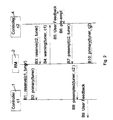
- Fig. 3 that is split into two parts, i.e. Fig. 3a and Fig. 3b, shows an example in which a target device is shareable and can therefore be controlled by several control devices. As mentioned above, depending on the capacity of the target device it is not always possible to satisfy all control devices.
- Fig. 3 shows again the same devices as shown in Fig. 1 except for the tuner 3 that is now shareable in-between several controllers. Steps C1 to C4 directly correspond to steps A1 to A4. Therefore, the first controller 1 is the primary controller of the tuner 3 after his reservation.
- the tuner 3 can offer different services at the same time that are broadcasted in the same transponder. Its limitation is that he can't offer services of different transponders at the same time.
- step C5 the first controller 1 commands to replace the currently offered program with the service 1 of transponder 1.
- the tuner 3 accepts and sends an accept message directly to the first controller 1 in a step C6.
- step C7 the second controller 4 also directs a reserve command to the resource manager 2 indicating that the second controller 4 wants to reserve the tuner 3.
- the resource manager 2 knows that there is already a reservation for the tuner 3. He sends a get-primary-command to the tuner 3 in step C8 to inform itself about the primary controller of the tuner 3.
- the tuner 3 sends a message to the resource manager 3 in step C9 that indicates that the first controller 1 is the primary controller of the tuner 3.
- the resource manager 2 sends a message to the second controller 4 in step C10 indicating that the second controller 4 is the secondary controller of the tuner 3 and that the primary controller of the tuner 3 is the first controller 1.
- the second controller 4 gives a user feedback in step C11 showing the message just received.
- the second controller 4 may have limited control functions depending on the target device so that the secondary controller cannot overrule the primary controller.
- the second controller 4 as secondary controller cannot select another transponder as the first controller 1 as primary controller, since the tuner 3 can only offer the services of one transponder at the same time.
- step C12 the second controller 4 sends an append command to the tuner 3 that service 2 of transponder 1 should also distributed in the network. Since this is no conflict with the possibilities of the tuner 3 in view of the commands of the primary controller, this command is accepted by the tuner 3 that in turn sends an accept message to the second controller 4 in step C13.
- step C14 the second controller 4 sends another append command to the tuner 3 indicating that the tuner 3 shall distribute service 6 of transponder 2 to the network.
- the limitation of a digital tuner is that only services from one transponder can be selected. It is impossible with one tuner to select a second service from another transponder than the first service. Therefore, the tuner 3 rejects the append command of the second controller 4 in step C15.
- the second controller 4 gives an user feedback of this rejection in step C16.
- the second controller C4 gets an input to pre-empt the tuner 3 to be able to control the tuner 3 to distribute service 6 of transponder 2 to the network. Therefore, the second controller 4 sends a pre-empt command to the resource manager 2 in step C18 indicating that the second controller 4 pre-empts the tuner 3.
- the resource manager 2 informs the first controller 1 that he got pre-empted from being the primary controller for the tuner 3 by the second controller 4 with a pre-empted message in step C19. After reception of the pre-empted message in step C19 the first controller 1 gives a user feedback C20 showing all available information of the pre-emption.
- step C21 the resource manager transmits a change primary command to the tuner 3 so that the tuner 3 changes its primary controller from the first controller 1 to the second controller 4. Thereafter, the tuner 3 sends a grant message to the resource manager 2 in step C22 that is indicating that the change primary command of the resource manager was successful. Therefore, in step C23 the resource manager indicates to the second controller 4 that it is the primary controller of the tuner 3.
- the second controller 4 After being the primary controller of the tuner 3 the second controller 4 is now able to select a certain service in a certain transponder like the first controller 1 has done it in step C5.
- Fig. 4 shows the network like it is shown in Fig. 2, but with an additional third controller 5.
- the not shown tuner 3 it is possible for the not shown tuner 3 to have a primary controller and a secondary controller.
- Steps D1 and D2 directly correspond to steps B1 and B2 shown in Fig. 2, i.e. the first controller 1 reserves the tuner 3 via the resource manager 2 in step D1 and receives the message of the tuner 3 via the resource manager 2 that the first tuner 1 is the primary controller of the tuner 3 in step D2.
- Steps D3 to D5 directly correspond to steps C7 to C11 shown in Fig. 3a, i.e. the second controller 4 reserves the tuner 3 via the resource manager 2 in step D3 and gets back the message from the tuner 3 via the resource manager 2 that the second controller 4 is the secondary controller of the tuner 3 and the primary controller of the tuner 3 is the first controller 1, whereafter this message is presented as user feedback in step D5.
- the second controller 4 reserves the tuner 3 via the resource manager 2 in step D3 and gets back the message from the tuner 3 via the resource manager 2 that the second controller 4 is the secondary controller of the tuner 3 and the primary controller of the tuner 3 is the first controller 1, whereafter this message is presented as user feedback in step D5.
- step D6 the third controller 5 sends a reserve command to the tuner 3 to become its first or secondary controller.
- the tuner 3 distributes a warning to the third controller 5 via the resource manager 2 that its primary controller is already the first controller 1 and its secondary controller is already the second controller 4.
- the third controller 5 gives a user feedback showing this message in step D8.
- step D9 the third controller 5 receives a pre-emption instruction and thereafter it sends a pre-empt command to the resource manager 2 in step D10 indicating that third controller 5 will take over the control of the tuner 3.
- the resource manager 2 sends a message to the second controller 4 in step D11 that it got pre-empted by the third controller 5 regarding the secondary control of the tuner 3, whereafter the second controller 4 presents a user feedback in step D12.
- the resource manager 2 also sends a message to the first controller 1 in step D13 that it got pre-empted regarding the primary control of the tuner 3 by the third controller 5, whereafter the first controller 1 presents a user feedback in step D14 indicating this message.
- the resource manager sends a message to the third controller 5 that it is now the primary controller of the tuner 3.
- a first controller having a reservation of a controllable target device can be overruled by a second controller with a pre-emption command, but in this case the overruling is not conducted by accident or unwanted, since a pre-emption is only performed after a reserve command or a command to the target device was unsuccessful, the pre-empting controller knows the its preceding controller and the pre-empted controller will get notified what controller has pre-empted.
- the invention is not limited to the exemplatory above described 1394 based home network and also not to consumer electronic devices as target devices or control devices. It is also thinkable that e.g. computer equipment may be controlled under use of the inventive reservation strategy.
Landscapes
- Engineering & Computer Science (AREA)
- Computer Networks & Wireless Communication (AREA)
- Signal Processing (AREA)
- Automation & Control Theory (AREA)
- Multimedia (AREA)
- Small-Scale Networks (AREA)
Priority Applications (13)
| Application Number | Priority Date | Filing Date | Title |
|---|---|---|---|
| EP98112499A EP0971506A1 (de) | 1998-07-06 | 1998-07-06 | Verfahren zur Steuerung einer Netzwerkvorrichtung in einem Netzwerk mit mehreren Vorrichtungen |
| US09/346,251 US6252886B1 (en) | 1998-07-06 | 1999-07-01 | Bandwidth reservation |
| AU49036/99A AU4903699A (en) | 1998-07-06 | 1999-07-01 | Method to control a network device in a network comprising several devices |
| PCT/US1999/015369 WO2000002337A1 (en) | 1998-07-06 | 1999-07-01 | Bandwidth reservation |
| AU49744/99A AU4974499A (en) | 1998-07-06 | 1999-07-01 | Bandwidth reservation |
| PCT/EP1999/004538 WO2000002351A1 (en) | 1998-07-06 | 1999-07-01 | Method to control a network device in a network comprising several devices |
| JP2000558626A JP2002520903A (ja) | 1998-07-06 | 1999-07-01 | 帯域幅確保方法 |
| PCT/EP1999/004537 WO2000002332A2 (en) | 1998-07-06 | 1999-07-01 | Method to perform a scheduled action of network devices |
| JP2000558622A JP2002520901A (ja) | 1998-07-06 | 1999-07-01 | ネットワーク機器において予定された動作を実行する方法 |
| JP2000558639A JP2002520909A (ja) | 1998-07-06 | 1999-07-01 | 複数の装置を備えるネットワークにおけるネットワーク装置の制御方法 |
| AU51558/99A AU5155899A (en) | 1998-07-06 | 1999-07-01 | Method to perform a scheduled action of network devices |
| US09/754,160 US20010026533A1 (en) | 1998-07-06 | 2001-01-04 | Method to perform a scheduled action of network devices |
| US09/754,152 US7013339B2 (en) | 1998-07-06 | 2001-01-04 | Method to control a network device in a network comprising several devices |
Applications Claiming Priority (1)
| Application Number | Priority Date | Filing Date | Title |
|---|---|---|---|
| EP98112499A EP0971506A1 (de) | 1998-07-06 | 1998-07-06 | Verfahren zur Steuerung einer Netzwerkvorrichtung in einem Netzwerk mit mehreren Vorrichtungen |
Publications (1)
| Publication Number | Publication Date |
|---|---|
| EP0971506A1 true EP0971506A1 (de) | 2000-01-12 |
Family
ID=8232224
Family Applications (1)
| Application Number | Title | Priority Date | Filing Date |
|---|---|---|---|
| EP98112499A Withdrawn EP0971506A1 (de) | 1998-07-06 | 1998-07-06 | Verfahren zur Steuerung einer Netzwerkvorrichtung in einem Netzwerk mit mehreren Vorrichtungen |
Country Status (1)
| Country | Link |
|---|---|
| EP (1) | EP0971506A1 (de) |
Cited By (2)
| Publication number | Priority date | Publication date | Assignee | Title |
|---|---|---|---|---|
| EP1193937A3 (de) * | 2000-07-10 | 2005-01-05 | Hitachi, Ltd. | Fernsteuerungverfahren und Vorrichtung |
| EP1357744B1 (de) * | 2002-04-26 | 2011-11-16 | Microsoft Corporation | Ressourcenverwaltung von Fernsehkontrollen |
Citations (2)
| Publication number | Priority date | Publication date | Assignee | Title |
|---|---|---|---|---|
| EP0457673A2 (de) * | 1990-05-14 | 1991-11-21 | Sony Corporation | Signalübertragungssystem für ein Haus-Netzwerk |
| WO1998017033A1 (en) * | 1996-10-16 | 1998-04-23 | Thomson Consumer Electronics, Inc. | Device interoperability |
-
1998
- 1998-07-06 EP EP98112499A patent/EP0971506A1/de not_active Withdrawn
Patent Citations (2)
| Publication number | Priority date | Publication date | Assignee | Title |
|---|---|---|---|---|
| EP0457673A2 (de) * | 1990-05-14 | 1991-11-21 | Sony Corporation | Signalübertragungssystem für ein Haus-Netzwerk |
| WO1998017033A1 (en) * | 1996-10-16 | 1998-04-23 | Thomson Consumer Electronics, Inc. | Device interoperability |
Non-Patent Citations (1)
| Title |
|---|
| GRUNDING, HITACHI, MATSUSHITA, PHILIPS, SHARP, SONY, THOMPSON AND TOSHIBA: "THE HAVi ARCHITECTURE, VERSION 0.8", RETRIEVED FROM THE INTERNET, 15 May 1998 (1998-05-15), http://ns10.sharp.co.jp/sc/gaiyou/news-e/havi.html, XP002089719 * |
Cited By (2)
| Publication number | Priority date | Publication date | Assignee | Title |
|---|---|---|---|---|
| EP1193937A3 (de) * | 2000-07-10 | 2005-01-05 | Hitachi, Ltd. | Fernsteuerungverfahren und Vorrichtung |
| EP1357744B1 (de) * | 2002-04-26 | 2011-11-16 | Microsoft Corporation | Ressourcenverwaltung von Fernsehkontrollen |
Similar Documents
| Publication | Publication Date | Title |
|---|---|---|
| US7013339B2 (en) | Method to control a network device in a network comprising several devices | |
| US6252886B1 (en) | Bandwidth reservation | |
| US20010026533A1 (en) | Method to perform a scheduled action of network devices | |
| EP1357744B1 (de) | Ressourcenverwaltung von Fernsehkontrollen | |
| US6981044B1 (en) | Domestic system resource access priority management method and device for the implementation thereof | |
| CA2168531C (en) | A video-on-demand system | |
| AU726647B2 (en) | Software download system including a transmitting apparatus and a receiving apparatus | |
| JP2004007592A (ja) | 分配されるチューナ割り振りおよびコンフリクトの解決方法 | |
| JP5583565B2 (ja) | 管理仲介装置、画像形成装置、管理仲介プログラム及び管理仲介プログラムを記録した記録媒体 | |
| US20030163680A1 (en) | Remote boot system for multiple client terminals and method thereof | |
| JPH099245A (ja) | Catvシステム | |
| WO2000002337A1 (en) | Bandwidth reservation | |
| JP2001346276A (ja) | 競合解消装置、機器制御系統、媒体および情報集合体 | |
| US7676825B2 (en) | Method for transmitting audi-visual programs proposed by users, terminal and server | |
| WO2022099856A1 (zh) | 一种资源配置方法、装置和影音播放终端 | |
| US20050246409A1 (en) | Method for establishing a default connection in network, and associated source and sink devices | |
| JP4086259B2 (ja) | 通信システム | |
| EP0851682A1 (de) | Verfahren zur Steuerung eines Nachrichtenflusses in einem interaktiven Netzwerk | |
| JPH1078931A (ja) | 資源管理方法および情報サービスシステム | |
| JP5296528B2 (ja) | ローカルエリアネットワーク内の受信サービスの管理装置および方法 | |
| KR100689115B1 (ko) | 가정용 통신 네트워크에서 자원의 동작을 프로그래밍하기위한 방법 | |
| JP3553678B2 (ja) | 通信回線と複数のtv放送を利用する双方向通信方法 | |
| JPH10289188A (ja) | サーバ・クライアント間通信優先度制御装置 | |
| KR100329948B1 (ko) | Av 장치, av 장치를 이용하는 방법, 및 av 시스템 | |
| US20060095946A1 (en) | System and method for broadcasting a video program |
Legal Events
| Date | Code | Title | Description |
|---|---|---|---|
| PUAI | Public reference made under article 153(3) epc to a published international application that has entered the european phase |
Free format text: ORIGINAL CODE: 0009012 |
|
| AK | Designated contracting states |
Kind code of ref document: A1 Designated state(s): AT |
|
| AX | Request for extension of the european patent |
Free format text: AL;LT;LV;MK;RO;SI |
|
| RAP1 | Party data changed (applicant data changed or rights of an application transferred) |
Owner name: SONY INTERNATIONAL (EUROPE) GMBH |
|
| AKX | Designation fees paid |
Free format text: AT |
|
| STAA | Information on the status of an ep patent application or granted ep patent |
Free format text: STATUS: THE APPLICATION IS DEEMED TO BE WITHDRAWN |
|
| 18D | Application deemed to be withdrawn |
Effective date: 20000713 |