EP0973782B1 - Isocyanates modifies en vue de leur donner une propriete tensioactive, composition en contenant, revetement en resultant - Google Patents
Isocyanates modifies en vue de leur donner une propriete tensioactive, composition en contenant, revetement en resultant Download PDFInfo
- Publication number
- EP0973782B1 EP0973782B1 EP98913808A EP98913808A EP0973782B1 EP 0973782 B1 EP0973782 B1 EP 0973782B1 EP 98913808 A EP98913808 A EP 98913808A EP 98913808 A EP98913808 A EP 98913808A EP 0973782 B1 EP0973782 B1 EP 0973782B1
- Authority
- EP
- European Patent Office
- Prior art keywords
- isocyanate
- advantageously
- functions
- composition
- derived
- Prior art date
- Legal status (The legal status is an assumption and is not a legal conclusion. Google has not performed a legal analysis and makes no representation as to the accuracy of the status listed.)
- Expired - Lifetime
Links
- 239000012948 isocyanate Substances 0.000 title claims abstract description 62
- 150000002513 isocyanates Chemical class 0.000 title claims abstract description 52
- 239000000203 mixture Substances 0.000 title claims description 56
- 238000000576 coating method Methods 0.000 title claims description 17
- 239000004094 surface-active agent Substances 0.000 title claims description 13
- 239000011248 coating agent Substances 0.000 title claims description 10
- 150000001875 compounds Chemical class 0.000 claims abstract description 43
- OKTJSMMVPCPJKN-UHFFFAOYSA-N Carbon Chemical compound [C] OKTJSMMVPCPJKN-UHFFFAOYSA-N 0.000 claims abstract description 17
- 229910052799 carbon Inorganic materials 0.000 claims abstract description 16
- 239000001257 hydrogen Substances 0.000 claims abstract description 14
- 229910052739 hydrogen Inorganic materials 0.000 claims abstract description 14
- 150000002430 hydrocarbons Chemical class 0.000 claims abstract description 12
- UFHFLCQGNIYNRP-UHFFFAOYSA-N Hydrogen Chemical compound [H][H] UFHFLCQGNIYNRP-UHFFFAOYSA-N 0.000 claims abstract description 9
- 125000004429 atom Chemical group 0.000 claims abstract description 9
- 239000004215 Carbon black (E152) Substances 0.000 claims abstract description 7
- 229930195733 hydrocarbon Natural products 0.000 claims abstract description 7
- 125000004432 carbon atom Chemical group C* 0.000 claims abstract description 5
- IQPQWNKOIGAROB-UHFFFAOYSA-N isocyanate group Chemical group [N-]=C=O IQPQWNKOIGAROB-UHFFFAOYSA-N 0.000 claims description 31
- 229920005862 polyol Polymers 0.000 claims description 22
- 150000003077 polyols Chemical class 0.000 claims description 22
- -1 aliphatic isocyanates Chemical class 0.000 claims description 19
- 238000000034 method Methods 0.000 claims description 14
- 125000001931 aliphatic group Chemical group 0.000 claims description 13
- XLYOFNOQVPJJNP-UHFFFAOYSA-N water Substances O XLYOFNOQVPJJNP-UHFFFAOYSA-N 0.000 claims description 13
- 239000008346 aqueous phase Substances 0.000 claims description 11
- OHJMTUPIZMNBFR-UHFFFAOYSA-N biuret Chemical compound NC(=O)NC(N)=O OHJMTUPIZMNBFR-UHFFFAOYSA-N 0.000 claims description 10
- 125000005442 diisocyanate group Chemical group 0.000 claims description 10
- 239000002904 solvent Substances 0.000 claims description 10
- 125000003118 aryl group Chemical group 0.000 claims description 8
- 239000013638 trimer Substances 0.000 claims description 8
- 230000008569 process Effects 0.000 claims description 7
- 239000005057 Hexamethylene diisocyanate Substances 0.000 claims description 6
- RRAMGCGOFNQTLD-UHFFFAOYSA-N hexamethylene diisocyanate Chemical compound O=C=NCCCCCCN=C=O RRAMGCGOFNQTLD-UHFFFAOYSA-N 0.000 claims description 6
- ZFSLODLOARCGLH-UHFFFAOYSA-N isocyanuric acid Chemical compound OC1=NC(O)=NC(O)=N1 ZFSLODLOARCGLH-UHFFFAOYSA-N 0.000 claims description 6
- 239000000539 dimer Substances 0.000 claims description 5
- 125000001971 neopentyl group Chemical group [H]C([*])([H])C(C([H])([H])[H])(C([H])([H])[H])C([H])([H])[H] 0.000 claims description 5
- MFVFDTCSVFBOTL-UHFFFAOYSA-N 1,3-diazetidine Chemical compound C1NCN1 MFVFDTCSVFBOTL-UHFFFAOYSA-N 0.000 claims description 4
- 238000009833 condensation Methods 0.000 claims description 4
- 230000005494 condensation Effects 0.000 claims description 4
- UMRZSTCPUPJPOJ-KNVOCYPGSA-N norbornane Chemical compound C1C[C@H]2CC[C@@H]1C2 UMRZSTCPUPJPOJ-KNVOCYPGSA-N 0.000 claims description 4
- XSTXAVWGXDQKEL-UHFFFAOYSA-N Trichloroethylene Chemical compound ClC=C(Cl)Cl XSTXAVWGXDQKEL-UHFFFAOYSA-N 0.000 claims description 3
- NIMLQBUJDJZYEJ-UHFFFAOYSA-N isophorone diisocyanate Chemical compound CC1(C)CC(N=C=O)CC(C)(CN=C=O)C1 NIMLQBUJDJZYEJ-UHFFFAOYSA-N 0.000 claims description 3
- 125000004122 cyclic group Chemical group 0.000 claims description 2
- 238000005507 spraying Methods 0.000 claims description 2
- 238000010981 drying operation Methods 0.000 claims 2
- 241001484259 Lacuna Species 0.000 claims 1
- 238000004519 manufacturing process Methods 0.000 claims 1
- AVWRKZWQTYIKIY-UHFFFAOYSA-N urea-1-carboxylic acid Chemical group NC(=O)NC(O)=O AVWRKZWQTYIKIY-UHFFFAOYSA-N 0.000 claims 1
- 230000008030 elimination Effects 0.000 abstract description 3
- 238000003379 elimination reaction Methods 0.000 abstract description 3
- 238000003786 synthesis reaction Methods 0.000 abstract description 2
- 239000000839 emulsion Substances 0.000 description 16
- ZMANZCXQSJIPKH-UHFFFAOYSA-N Triethylamine Chemical compound CCN(CC)CC ZMANZCXQSJIPKH-UHFFFAOYSA-N 0.000 description 10
- 239000002245 particle Substances 0.000 description 10
- NBIIXXVUZAFLBC-UHFFFAOYSA-K phosphate Chemical compound [O-]P([O-])([O-])=O NBIIXXVUZAFLBC-UHFFFAOYSA-K 0.000 description 10
- 239000005056 polyisocyanate Substances 0.000 description 10
- 239000006185 dispersion Substances 0.000 description 9
- 239000004816 latex Substances 0.000 description 9
- 229920000126 latex Polymers 0.000 description 9
- 229920001228 polyisocyanate Polymers 0.000 description 9
- 229920000642 polymer Polymers 0.000 description 9
- 238000006243 chemical reaction Methods 0.000 description 8
- 239000003973 paint Substances 0.000 description 8
- 125000000217 alkyl group Chemical group 0.000 description 7
- 150000001768 cations Chemical class 0.000 description 7
- 229920006395 saturated elastomer Polymers 0.000 description 6
- 241000897276 Termes Species 0.000 description 5
- 239000002253 acid Substances 0.000 description 5
- 230000001476 alcoholic effect Effects 0.000 description 5
- 239000003795 chemical substances by application Substances 0.000 description 5
- 238000001035 drying Methods 0.000 description 5
- 230000000694 effects Effects 0.000 description 5
- 238000004945 emulsification Methods 0.000 description 5
- 150000002431 hydrogen Chemical class 0.000 description 5
- 150000008040 ionic compounds Chemical class 0.000 description 5
- 239000012071 phase Substances 0.000 description 5
- 239000000047 product Substances 0.000 description 5
- 239000000243 solution Substances 0.000 description 5
- 125000001424 substituent group Chemical group 0.000 description 5
- AVWRKZWQTYIKIY-UHFFFAOYSA-M urea-1-carboxylate Chemical group NC(=O)NC([O-])=O AVWRKZWQTYIKIY-UHFFFAOYSA-M 0.000 description 5
- LFQSCWFLJHTTHZ-UHFFFAOYSA-N Ethanol Chemical compound CCO LFQSCWFLJHTTHZ-UHFFFAOYSA-N 0.000 description 4
- LYCAIKOWRPUZTN-UHFFFAOYSA-N Ethylene glycol Chemical group OCCO LYCAIKOWRPUZTN-UHFFFAOYSA-N 0.000 description 4
- 239000002202 Polyethylene glycol Substances 0.000 description 4
- GWEVSGVZZGPLCZ-UHFFFAOYSA-N Titan oxide Chemical compound O=[Ti]=O GWEVSGVZZGPLCZ-UHFFFAOYSA-N 0.000 description 4
- QGZKDVFQNNGYKY-UHFFFAOYSA-O ammonium group Chemical group [NH4+] QGZKDVFQNNGYKY-UHFFFAOYSA-O 0.000 description 4
- 125000003710 aryl alkyl group Chemical group 0.000 description 4
- 239000012634 fragment Substances 0.000 description 4
- 125000003827 glycol group Chemical group 0.000 description 4
- 125000004435 hydrogen atom Chemical group [H]* 0.000 description 4
- 239000000178 monomer Substances 0.000 description 4
- 239000000049 pigment Substances 0.000 description 4
- 229920001223 polyethylene glycol Polymers 0.000 description 4
- 238000002360 preparation method Methods 0.000 description 4
- 238000012360 testing method Methods 0.000 description 4
- SJRJJKPEHAURKC-UHFFFAOYSA-N N-Methylmorpholine Chemical compound CN1CCOCC1 SJRJJKPEHAURKC-UHFFFAOYSA-N 0.000 description 3
- 229910019142 PO4 Inorganic materials 0.000 description 3
- 125000002877 alkyl aryl group Chemical group 0.000 description 3
- 150000001412 amines Chemical class 0.000 description 3
- 238000004458 analytical method Methods 0.000 description 3
- 239000011230 binding agent Substances 0.000 description 3
- 150000001721 carbon Chemical class 0.000 description 3
- 150000007942 carboxylates Chemical class 0.000 description 3
- 150000002009 diols Chemical class 0.000 description 3
- 229940082150 encore Drugs 0.000 description 3
- 150000002148 esters Chemical class 0.000 description 3
- 238000009396 hybridization Methods 0.000 description 3
- 125000002887 hydroxy group Chemical group [H]O* 0.000 description 3
- 229910052500 inorganic mineral Inorganic materials 0.000 description 3
- 239000011707 mineral Substances 0.000 description 3
- 235000021317 phosphate Nutrition 0.000 description 3
- 239000012429 reaction media Substances 0.000 description 3
- 150000003839 salts Chemical class 0.000 description 3
- 239000007787 solid Substances 0.000 description 3
- 239000002966 varnish Substances 0.000 description 3
- RTZKZFJDLAIYFH-UHFFFAOYSA-N Diethyl ether Chemical compound CCOCC RTZKZFJDLAIYFH-UHFFFAOYSA-N 0.000 description 2
- ISWSIDIOOBJBQZ-UHFFFAOYSA-N Phenol Chemical compound OC1=CC=CC=C1 ISWSIDIOOBJBQZ-UHFFFAOYSA-N 0.000 description 2
- NBIIXXVUZAFLBC-UHFFFAOYSA-N Phosphoric acid Chemical compound OP(O)(O)=O NBIIXXVUZAFLBC-UHFFFAOYSA-N 0.000 description 2
- 229910000831 Steel Inorganic materials 0.000 description 2
- NIXOWILDQLNWCW-UHFFFAOYSA-N acrylic acid group Chemical group C(C=C)(=O)O NIXOWILDQLNWCW-UHFFFAOYSA-N 0.000 description 2
- 238000013019 agitation Methods 0.000 description 2
- 125000005600 alkyl phosphonate group Chemical group 0.000 description 2
- 150000001449 anionic compounds Chemical class 0.000 description 2
- 125000000129 anionic group Chemical group 0.000 description 2
- WERYXYBDKMZEQL-UHFFFAOYSA-N butane-1,4-diol Chemical compound OCCCCO WERYXYBDKMZEQL-UHFFFAOYSA-N 0.000 description 2
- 239000000470 constituent Substances 0.000 description 2
- 238000004132 cross linking Methods 0.000 description 2
- 235000014113 dietary fatty acids Nutrition 0.000 description 2
- 239000000194 fatty acid Substances 0.000 description 2
- 229930195729 fatty acid Natural products 0.000 description 2
- 230000002349 favourable effect Effects 0.000 description 2
- 238000009472 formulation Methods 0.000 description 2
- 238000005227 gel permeation chromatography Methods 0.000 description 2
- 125000003010 ionic group Chemical group 0.000 description 2
- 239000002609 medium Substances 0.000 description 2
- 238000002156 mixing Methods 0.000 description 2
- 239000003960 organic solvent Substances 0.000 description 2
- 238000010422 painting Methods 0.000 description 2
- 239000010452 phosphate Substances 0.000 description 2
- 230000036633 rest Effects 0.000 description 2
- 239000010959 steel Substances 0.000 description 2
- 238000003756 stirring Methods 0.000 description 2
- 239000000126 substance Substances 0.000 description 2
- BDHFUVZGWQCTTF-UHFFFAOYSA-M sulfonate Chemical compound [O-]S(=O)=O BDHFUVZGWQCTTF-UHFFFAOYSA-M 0.000 description 2
- 150000003512 tertiary amines Chemical class 0.000 description 2
- 239000004408 titanium dioxide Substances 0.000 description 2
- 231100000331 toxic Toxicity 0.000 description 2
- 230000002588 toxic effect Effects 0.000 description 2
- DNIAPMSPPWPWGF-VKHMYHEASA-N (+)-propylene glycol Chemical compound C[C@H](O)CO DNIAPMSPPWPWGF-VKHMYHEASA-N 0.000 description 1
- YPFDHNVEDLHUCE-UHFFFAOYSA-N 1,3-propanediol Substances OCCCO YPFDHNVEDLHUCE-UHFFFAOYSA-N 0.000 description 1
- 229940035437 1,3-propanediol Drugs 0.000 description 1
- SMZOUWXMTYCWNB-UHFFFAOYSA-N 2-(2-methoxy-5-methylphenyl)ethanamine Chemical compound COC1=CC=C(C)C=C1CCN SMZOUWXMTYCWNB-UHFFFAOYSA-N 0.000 description 1
- NGNBDVOYPDDBFK-UHFFFAOYSA-N 2-[2,4-di(pentan-2-yl)phenoxy]acetyl chloride Chemical compound CCCC(C)C1=CC=C(OCC(Cl)=O)C(C(C)CCC)=C1 NGNBDVOYPDDBFK-UHFFFAOYSA-N 0.000 description 1
- GRHBODILPPXVKN-UHFFFAOYSA-N 2-[2-(3-butoxyphenyl)ethylamino]-n,n-dimethylacetamide Chemical compound CCCCOC1=CC=CC(CCNCC(=O)N(C)C)=C1 GRHBODILPPXVKN-UHFFFAOYSA-N 0.000 description 1
- GJCOSYZMQJWQCA-UHFFFAOYSA-N 9H-xanthene Chemical compound C1=CC=C2CC3=CC=CC=C3OC2=C1 GJCOSYZMQJWQCA-UHFFFAOYSA-N 0.000 description 1
- 0 COP(**)*CN Chemical compound COP(**)*CN 0.000 description 1
- 240000008886 Ceratonia siliqua Species 0.000 description 1
- 235000013912 Ceratonia siliqua Nutrition 0.000 description 1
- 241000921896 Charybdis <crab> Species 0.000 description 1
- 244000007835 Cyamopsis tetragonoloba Species 0.000 description 1
- VGGSQFUCUMXWEO-UHFFFAOYSA-N Ethene Chemical group C=C VGGSQFUCUMXWEO-UHFFFAOYSA-N 0.000 description 1
- 239000005977 Ethylene Substances 0.000 description 1
- CWYNVVGOOAEACU-UHFFFAOYSA-N Fe2+ Chemical compound [Fe+2] CWYNVVGOOAEACU-UHFFFAOYSA-N 0.000 description 1
- 241000238102 Scylla Species 0.000 description 1
- 229920002472 Starch Polymers 0.000 description 1
- QAOWNCQODCNURD-UHFFFAOYSA-L Sulfate Chemical compound [O-]S([O-])(=O)=O QAOWNCQODCNURD-UHFFFAOYSA-L 0.000 description 1
- ZJCCRDAZUWHFQH-UHFFFAOYSA-N Trimethylolpropane Chemical compound CCC(CO)(CO)CO ZJCCRDAZUWHFQH-UHFFFAOYSA-N 0.000 description 1
- XSQUKJJJFZCRTK-UHFFFAOYSA-N Urea Chemical compound NC(N)=O XSQUKJJJFZCRTK-UHFFFAOYSA-N 0.000 description 1
- VYGUBTIWNBFFMQ-UHFFFAOYSA-N [N+](#[C-])N1C(=O)NC=2NC(=O)NC2C1=O Chemical compound [N+](#[C-])N1C(=O)NC=2NC(=O)NC2C1=O VYGUBTIWNBFFMQ-UHFFFAOYSA-N 0.000 description 1
- 230000002378 acidificating effect Effects 0.000 description 1
- 230000002053 acidogenic effect Effects 0.000 description 1
- 230000009471 action Effects 0.000 description 1
- 125000003158 alcohol group Chemical group 0.000 description 1
- 229920000180 alkyd Polymers 0.000 description 1
- PNEYBMLMFCGWSK-UHFFFAOYSA-N aluminium oxide Inorganic materials [O-2].[O-2].[O-2].[Al+3].[Al+3] PNEYBMLMFCGWSK-UHFFFAOYSA-N 0.000 description 1
- 229910000147 aluminium phosphate Inorganic materials 0.000 description 1
- 150000001408 amides Chemical class 0.000 description 1
- 150000001413 amino acids Chemical group 0.000 description 1
- 150000008064 anhydrides Chemical class 0.000 description 1
- 239000012736 aqueous medium Substances 0.000 description 1
- 239000007864 aqueous solution Substances 0.000 description 1
- QVGXLLKOCUKJST-UHFFFAOYSA-N atomic oxygen Chemical compound [O] QVGXLLKOCUKJST-UHFFFAOYSA-N 0.000 description 1
- 230000015572 biosynthetic process Effects 0.000 description 1
- RFAZFSACZIVZDV-UHFFFAOYSA-N butan-2-one Chemical compound CCC(C)=O.CCC(C)=O RFAZFSACZIVZDV-UHFFFAOYSA-N 0.000 description 1
- 239000004202 carbamide Substances 0.000 description 1
- 150000001735 carboxylic acids Chemical class 0.000 description 1
- 239000003054 catalyst Substances 0.000 description 1
- 239000001913 cellulose Substances 0.000 description 1
- 229920002678 cellulose Polymers 0.000 description 1
- 239000007795 chemical reaction product Substances 0.000 description 1
- 238000004532 chromating Methods 0.000 description 1
- 238000007796 conventional method Methods 0.000 description 1
- 150000003983 crown ethers Chemical class 0.000 description 1
- 238000002425 crystallisation Methods 0.000 description 1
- 230000008025 crystallization Effects 0.000 description 1
- 150000004292 cyclic ethers Chemical group 0.000 description 1
- 238000006114 decarboxylation reaction Methods 0.000 description 1
- JXCHMDATRWUOAP-UHFFFAOYSA-N diisocyanatomethylbenzene Chemical compound O=C=NC(N=C=O)C1=CC=CC=C1 JXCHMDATRWUOAP-UHFFFAOYSA-N 0.000 description 1
- 238000004090 dissolution Methods 0.000 description 1
- 238000009826 distribution Methods 0.000 description 1
- 239000003995 emulsifying agent Substances 0.000 description 1
- 238000005516 engineering process Methods 0.000 description 1
- 229950006448 evenamide Drugs 0.000 description 1
- 230000001747 exhibiting effect Effects 0.000 description 1
- 150000004665 fatty acids Chemical class 0.000 description 1
- 238000005189 flocculation Methods 0.000 description 1
- 230000016615 flocculation Effects 0.000 description 1
- 230000009477 glass transition Effects 0.000 description 1
- 150000004676 glycans Chemical class 0.000 description 1
- 150000004820 halides Chemical class 0.000 description 1
- 230000007062 hydrolysis Effects 0.000 description 1
- 238000006460 hydrolysis reaction Methods 0.000 description 1
- 230000002209 hydrophobic effect Effects 0.000 description 1
- WGCNASOHLSPBMP-UHFFFAOYSA-N hydroxyacetaldehyde Natural products OCC=O WGCNASOHLSPBMP-UHFFFAOYSA-N 0.000 description 1
- 238000010348 incorporation Methods 0.000 description 1
- 238000009434 installation Methods 0.000 description 1
- 238000006386 neutralization reaction Methods 0.000 description 1
- 150000002825 nitriles Chemical class 0.000 description 1
- 230000000269 nucleophilic effect Effects 0.000 description 1
- 239000007764 o/w emulsion Substances 0.000 description 1
- 230000003606 oligomerizing effect Effects 0.000 description 1
- 150000002892 organic cations Chemical class 0.000 description 1
- 239000001301 oxygen Substances 0.000 description 1
- 229910052760 oxygen Inorganic materials 0.000 description 1
- CTYRPMDGLDAWRQ-UHFFFAOYSA-N phenyl hydrogen sulfate Chemical compound OS(=O)(=O)OC1=CC=CC=C1 CTYRPMDGLDAWRQ-UHFFFAOYSA-N 0.000 description 1
- XYFCBTPGUUZFHI-UHFFFAOYSA-O phosphonium Chemical compound [PH4+] XYFCBTPGUUZFHI-UHFFFAOYSA-O 0.000 description 1
- 150000003013 phosphoric acid derivatives Chemical class 0.000 description 1
- 229920000728 polyester Polymers 0.000 description 1
- 238000006116 polymerization reaction Methods 0.000 description 1
- 229920001282 polysaccharide Polymers 0.000 description 1
- 239000005017 polysaccharide Substances 0.000 description 1
- 229920000166 polytrimethylene carbonate Polymers 0.000 description 1
- 239000004814 polyurethane Substances 0.000 description 1
- 229920002635 polyurethane Polymers 0.000 description 1
- 150000003138 primary alcohols Chemical group 0.000 description 1
- 238000012545 processing Methods 0.000 description 1
- 230000005855 radiation Effects 0.000 description 1
- 239000000376 reactant Substances 0.000 description 1
- 230000009257 reactivity Effects 0.000 description 1
- 230000011514 reflex Effects 0.000 description 1
- 239000011347 resin Substances 0.000 description 1
- 229920005989 resin Polymers 0.000 description 1
- 238000005070 sampling Methods 0.000 description 1
- 239000008107 starch Substances 0.000 description 1
- 235000019698 starch Nutrition 0.000 description 1
- 125000000547 substituted alkyl group Chemical group 0.000 description 1
- RWSOTUBLDIXVET-UHFFFAOYSA-O sulfonium Chemical compound [SH3+] RWSOTUBLDIXVET-UHFFFAOYSA-O 0.000 description 1
- 238000012546 transfer Methods 0.000 description 1
- 238000005829 trimerization reaction Methods 0.000 description 1
- 229920001285 xanthan gum Polymers 0.000 description 1
Classifications
-
- C—CHEMISTRY; METALLURGY
- C07—ORGANIC CHEMISTRY
- C07F—ACYCLIC, CARBOCYCLIC OR HETEROCYCLIC COMPOUNDS CONTAINING ELEMENTS OTHER THAN CARBON, HYDROGEN, HALOGEN, OXYGEN, NITROGEN, SULFUR, SELENIUM OR TELLURIUM
- C07F9/00—Compounds containing elements of Groups 5 or 15 of the Periodic Table
- C07F9/02—Phosphorus compounds
- C07F9/28—Phosphorus compounds with one or more P—C bonds
- C07F9/38—Phosphonic acids [RP(=O)(OH)2]; Thiophosphonic acids ; [RP(=X1)(X2H)2(X1, X2 are each independently O, S or Se)]
- C07F9/3804—Phosphonic acids [RP(=O)(OH)2]; Thiophosphonic acids ; [RP(=X1)(X2H)2(X1, X2 are each independently O, S or Se)] not used, see subgroups
- C07F9/3886—Acids containing the structure -C(=X)-P(=X)(XH)2 or NC-P(=X)(XH)2, (X = O, S, Se)
- C07F9/3891—Acids containing the structure -C(=X)-P(=X)(XH)2, (X = O, S, Se)
-
- C—CHEMISTRY; METALLURGY
- C07—ORGANIC CHEMISTRY
- C07F—ACYCLIC, CARBOCYCLIC OR HETEROCYCLIC COMPOUNDS CONTAINING ELEMENTS OTHER THAN CARBON, HYDROGEN, HALOGEN, OXYGEN, NITROGEN, SULFUR, SELENIUM OR TELLURIUM
- C07F9/00—Compounds containing elements of Groups 5 or 15 of the Periodic Table
- C07F9/02—Phosphorus compounds
- C07F9/06—Phosphorus compounds without P—C bonds
- C07F9/08—Esters of oxyacids of phosphorus
- C07F9/09—Esters of phosphoric acids
- C07F9/095—Compounds containing the structure P(=O)-O-acyl, P(=O)-O-heteroatom, P(=O)-O-CN
- C07F9/096—Compounds containing the structure P(=O)-O-C(=X)- (X = O, S, Se)
-
- C—CHEMISTRY; METALLURGY
- C07—ORGANIC CHEMISTRY
- C07F—ACYCLIC, CARBOCYCLIC OR HETEROCYCLIC COMPOUNDS CONTAINING ELEMENTS OTHER THAN CARBON, HYDROGEN, HALOGEN, OXYGEN, NITROGEN, SULFUR, SELENIUM OR TELLURIUM
- C07F9/00—Compounds containing elements of Groups 5 or 15 of the Periodic Table
- C07F9/02—Phosphorus compounds
- C07F9/28—Phosphorus compounds with one or more P—C bonds
- C07F9/38—Phosphonic acids [RP(=O)(OH)2]; Thiophosphonic acids ; [RP(=X1)(X2H)2(X1, X2 are each independently O, S or Se)]
- C07F9/40—Esters thereof
- C07F9/4003—Esters thereof the acid moiety containing a substituent or a structure which is considered as characteristic
- C07F9/4062—Esters of acids containing the structure -C(=X)-P(=X)(XR)2 or NC-P(=X)(XR)2, (X = O, S, Se)
- C07F9/4065—Esters of acids containing the structure -C(=X)-P(=X)(XR)2, (X = O, S, Se)
-
- C—CHEMISTRY; METALLURGY
- C08—ORGANIC MACROMOLECULAR COMPOUNDS; THEIR PREPARATION OR CHEMICAL WORKING-UP; COMPOSITIONS BASED THEREON
- C08G—MACROMOLECULAR COMPOUNDS OBTAINED OTHERWISE THAN BY REACTIONS ONLY INVOLVING UNSATURATED CARBON-TO-CARBON BONDS
- C08G18/00—Polymeric products of isocyanates or isothiocyanates
- C08G18/06—Polymeric products of isocyanates or isothiocyanates with compounds having active hydrogen
- C08G18/70—Polymeric products of isocyanates or isothiocyanates with compounds having active hydrogen characterised by the isocyanates or isothiocyanates used
- C08G18/703—Isocyanates or isothiocyanates transformed in a latent form by physical means
- C08G18/705—Dispersions of isocyanates or isothiocyanates in a liquid medium
- C08G18/706—Dispersions of isocyanates or isothiocyanates in a liquid medium the liquid medium being water
-
- C—CHEMISTRY; METALLURGY
- C08—ORGANIC MACROMOLECULAR COMPOUNDS; THEIR PREPARATION OR CHEMICAL WORKING-UP; COMPOSITIONS BASED THEREON
- C08G—MACROMOLECULAR COMPOUNDS OBTAINED OTHERWISE THAN BY REACTIONS ONLY INVOLVING UNSATURATED CARBON-TO-CARBON BONDS
- C08G18/00—Polymeric products of isocyanates or isothiocyanates
- C08G18/06—Polymeric products of isocyanates or isothiocyanates with compounds having active hydrogen
- C08G18/70—Polymeric products of isocyanates or isothiocyanates with compounds having active hydrogen characterised by the isocyanates or isothiocyanates used
- C08G18/72—Polyisocyanates or polyisothiocyanates
- C08G18/80—Masked polyisocyanates
- C08G18/8061—Masked polyisocyanates masked with compounds having only one group containing active hydrogen
- C08G18/8083—Masked polyisocyanates masked with compounds having only one group containing active hydrogen with compounds containing at least one heteroatom other than oxygen or nitrogen
Definitions
- the subject of the present invention is a family of isocyanates modified for to give them a surfactant property.
- the present invention relates to compounds and compositions with isocyanate base (which can be partially masked, but this is not preferred implementation). It also relates to their method of use, their use for producing coatings and coatings thus obtained. She relates more particularly to (self) phase dispersible compositions aqueous.
- the particle size characteristics often refer to notations of the type d n where n is a number from 1 to 99, this notation is well known in many technical fields, but is a little more rare in chemistry, also may it be useful to recall its meaning.
- This notation represents the particle size such that n% (by weight, or more exactly by mass, since the weight is not an amount of matter but a force) of the particles is less than or equal to said size.
- the polydispersity index (d 90 -d 10 ) / d 50
- diisocyanates especially alkylene diisocyanates (for example those sold under the brand Tolonate) and their biuret derivatives or their trimers.
- the mixture of dispersions may also contain pigments, and especially titanium dioxide, the dispersion of which is improved hereby invention, and charges are then deposited on a support in the form of a film with using conventional techniques for using industrial paints.
- the preparation contains blocked isocyanates
- the whole film plus support is cooked at a temperature sufficient to ensure the release of isocyanate functions and the condensation of these with groups polyols of polyol particles. It should however be recalled that the masked or blocked products have a significantly higher cost price higher than that of unmasked products.
- isocyanates which are not or partially masked When isocyanates which are not or partially masked are used, the duration for which they can be used remains less than a few hours, in generally one or two hours.
- one of the aims of the present invention is to provide a compound and a composition which allows by mixing in water or more precisely in an aqueous phase, to obtain an emulsion without it being it is necessary to use specific techniques and / or installations.
- Another object of the present invention is to provide a compound and a composition of the previous type which does not disturb the coating operations.
- Another object of the present invention is to provide a compound and a composition of the above type whose solvent content is less than 1/5, advantageously 1/10, by mass of said composition. Of course it is better that there is as little as possible, and not even at all.
- At least one of the organic substituents comprises a polyethylene glycol moiety Chain preferably at least 5, preferably at least 7 units ethylenyloxyl.
- at least one of the organic substituents to correspond to the same formula as the substituents of E in the general formula I.
- At least one of the organic substituents (R 10; R 11 ; R '10 ) meets the formula where R 5 represents an arm comprising at most two carbon chains where n is an integer chosen between 0 and 30 advantageously between 5 and 25, preferably between 9 and 20 (closed intervals, ie including the limits); where R 1 represents a hydrocarbon radical, advantageously chosen from aryls and optionally substituted alkyls.
- Said lipophilic part R 1 is generally chosen from alkyl groups [in the present description ALCO-yl is taken in its etymological sense as the hydrocarbon residue of an ALCO-ol after ignorance of the alcohol (or ol) function]; and aryles.
- the simple alkyls are advantageously branched, advantageously from C 8 to C 12 , the aralkyls C 12 to C 16 , the alkyl aryls from C 10 to C 14 and the simple aryls are from C 10 to C 16 Otherwise the lipophilic part can vary widely especially when the number of ethylene glycol units is above 10, it can thus constitute a hydrocarbon radical of at least 1, advantageously at least 3 and comprising at most Advantageously at most 20 carbon atoms.
- Iso radical it is advantageous for the Iso radical to provide a majority or all of a aliphatic link with the same preferences as those set out above at About isocyanates.
- R 10 and R 11 can take the above values but also when m is 1, to be a negative charge due to the fact that in certain batches there may be significant amounts of residual phosphoric acid.
- R 10 can also be worth:
- the radical Iso may or may not be the same as that of the front last formula.
- Iso represents the remainder of a polyisocyanate, advantageously a reaction product of a diisocyanate monomer to form biuret or isocyanurates (trimer), or with a di- or poly-ol, advantageously a triol or a tetra-ol.
- Iso radical it is advantageous for the Iso radical to provide a majority or all of a aliphatic link with the same preferences as those set out above at About isocyanates.
- Iso carries, in addition to the function shown on the formula at at least one, preferably at least two isocyanate functions, of which preferably, at least one is not masked, and of which, more preferably, at minus two are not hidden.
- the preferred isocyanates for the above complete reaction are isocyanate with low viscosities, in particular aliphatic. in particular we can cite the simple monomer preferably of polymethylenediisocyanates and advantageously hexamethylene diisocyanate. and the derivatives of the reaction of "trimerization which gives di-, tri-, tetra-, penta-, hexa-, or heptafunctional in isocyanate, advantageously trifunctional.
- the present invention also relates to compositions comprising at least minus a compound of formula (I).
- said compound can be used alone, or in mixture with one or more surfactants.
- surfactants can be agents also corresponding to formula (I).
- surfactants can also be chosen from other ionic compounds [in particular aryl sulfate or phosphate (s) and / or alkyl (s) (of course aryl includes especially alkylaryl and alkyl includes in particular aralkyls), aryl- or alkylphosphonate, -phosphinate, sulfonate, salt of fatty acid and / or zwitterionic] and among the non-ionic compounds those blocked at the end of the chain or not.
- aryl sulfate or phosphate (s) and / or alkyl (s) of course aryl includes especially alkylaryl and alkyl includes in particular aralkyls
- aryl- or alkylphosphonate, -phosphinate, sulfonate, salt of fatty acid and / or zwitterionic and among the non-ionic compounds those blocked at the end of the chain or not.
- the non-ionic compounds having alcoholic functions on at least one chains seem to have a slightly unfavorable effect on the (auto) emulsion even if they have a favorable effect on other aspects of the composition for painting ; in view of this it is preferable that the content of this type of compound represents at most a third, advantageously at most a fifth, of preferably at most one tenth by mass of said anionic compounds according to the invention)
- the counter-cation is advantageously monovalent and is chosen from among the mineral cations and advantageously non-nucleophilic organic cations and consequently of a quaternary or tertiary nature (in particular oniums from column V such as phosphonium, ammoniums, or even from column VI such as sulfonium, ...) and their mixtures, most often ammoniums, generally from an amine, advantageously tertiary.
- the cation organic presents a reactive hydrogen with the isocyanate function.
- Mineral cations can be sequestered by transfer agents phases like crown ethers.
- the pKa of cations is advantageously between 8 and 12.
- the cations and in particular the amines corresponding to the ammoniums do not advantageously have no surfactant property but it is desirable that they have good solubility in any case sufficient to ensure that said compounds of formula (I) anionically and advantageously a fragment of polyethylene glycol chain, in aqueous phase and at the concentration of use.
- Tertiary amines having at most 12 atoms, advantageously at most 10 atoms, preferably at most 8 carbon atoms per "onium" function (remember that it is preferred that there is only one per molecule) are preferred.
- the amines can have other functions and in particular the functions corresponding to the amino acid functions and cyclic ether functions like N-methylmorpholine, or not. These other functions are advantageously in a form which does not react with the functions isocyanates and do not significantly alter the solubility in the aqueous phase.
- anionic compounds according to the present invention are in a neutralized form such as the pH it induces during of dissolution or contact in water is understood to be at least equal to 3, advantageously to 4, preferably to 5 and at most equal to 12, advantageously at 11, preferably at 10.
- the mass ratio between the surfactant compounds (including said compound of formula (I)) and isocyanates is most preferably understood between 4 and about 10%. the recommended zones will be explained later.
- composition may also advantageously comprise a catalyst latent (releasable by action of external agents, for example radiation visible or U.V., oxygen).
- a catalyst latent releasable by action of external agents, for example radiation visible or U.V., oxygen.
- the isocyanate composition according to the invention can comprise, after setting dispersion or emulsion in an aqueous phase, a water content of 10 at 70%.
- the emulsion is an oil-in-water emulsion.
- the emulsions obtained have, for the isocyanate part, d 50 at least equal to 0.1 micrometer, more often than 0.5 micrometer and they have a d 50 , preferably d 80 , advantageously ⁇ (at most equal to) 5 micrometers, preferably 3 microns.
- the aqueous phase of the emulsion generally serves as a vector for the co-reactants polycondensable with isocyanate functions and then comprises compounds having functions (advantageously at most 4, preferably at most 3 functions cf. which is explained below for polyol which general mutatis mutandis to all functionality of this type) with reactive hydrogen, in generally one or more polyols.
- This polyol is a polymer which contains at least 2 hydroxyl groups (phenol or alcohol) advantageously having a hydroxyl level between 0.5 and 5, advantageously between 1 and 3% (by mass). Except in the case of latex which will be recalled below, it advantageously comprises at most 4, preferably at most 3 primary alcohol functions (but most often two because crosslinking proper [caused by functionality statistically superior to two (possible fractional value)] is generally generated by polyisocyanates). But it can also contain alcoholic functions secondary or tertiary (generally at most about 10, preferably at most 5, more often at most two) which, in general, do not react or do not react only after the primary, and this in the primary, secondary and tertiary order.
- Polyoses or polysaccharides starch, cellulose, gums (guar, carob, xanthan, .%) various .7) especially in solid form are to be avoided. Under the form texturing agent, and as long as it does not interfere with the emulsification and the stability of the latter, they can however be used to give specific properties (eg thyxotropy, etc.).
- the polymer backbone can be of various chemical nature, in particular acrylic, polyester, alkyd, polyurethane, even amide, including urea.
- the polyol may contain anionic groups, in particular carboxylic or sulfonic or not contain an ionic group.
- anionic carboxylate function (-CO 2 - ) significantly increases the drying kinetics which is particularly advantageous for obtaining a rapid "dust-free", in particular when operates outside.
- a significant effect can be noted for a ratio of at least one carboxylic function for approximately 20 reactive hydrogen functions [alcohol or phenol function], advantageously for a ratio of one for approximately 10, preferably for a ratio of one for about 5; it is however desirable that this ratio is at most equal to one function for one function, preferably one carboxylic function for two ol functions.
- the counter cations of the carboxylates advantageously correspond to the same preferences as those expressed for the counter cations of the compound according to the present invention.
- the polyol can already be in an aqueous or water-soluble medium or dispersible.
- It can be an aqueous solution (which can in particular be obtained after neutralization of the ionic groups) or of an emulsion of the polymer in water or a latex-type dispersion.
- latexes in particular nanolatexes (that is to say latex whose particle size is nanometric [more precisely whose d 50 is at most equal to approximately 100 nanometers]).
- latexes especially when their glass transition point is lower at 0 ° C, advantageously at -10 ° C, preferably at -20 ° C, allow obtaining even with good quality aromatic isocyanates of resistance to bad weather and in particular to temperature variations.
- the molar ratio between the free isocyanate functions and the functions hydroxyl is between 0.5 and 2.5, advantageously between 0.8 and 1.6, advantageously between 1 and 1.4.
- Latexes (not functionalized in isocyanate possibly masked) described in the French patent application filed April 28, 1995 N ° 95/05123 and in the European patent reflex application N ° EP 0.739.961 give strong good results.
- the latex particles have a content of acid function (advantageously carboxylic), accessible between 0.2 and 1.2 milliequivatent / gram of solid matter and that they have a content of accessible alcoholic function of between 0.3 and 1.5 milliequivalents / gram.
- the latexes made up of particles carrying function (s) according to the invention are preferred, are hydrophobic and advantageously have a size (d 90 ) generally between 0.01 micrometer and 10 micrometers and preferably with more equal to 5 micrometers, even to 2 micrometers. They are calibrated, monodispersed and present in the latex in an amount varying between 0.2 to 65% by weight of the total weight of the latex.
- the weight average molecular mass (M w preferably determined by gel permeation chromatography, known by the acronym "GPC") of the polymers constituting the particles of population A (latex with ol function playing the role of polyol) is advantageously between 5.10 4 and 5.10 6 , preferably 1.1 10 5 and 2.10 6 .
- Alcoholic or acidic functions preferably carboxylic can also be obtained by hydrolysis of functions alcoholics (ester, ether, halide %) or acidogenic functions (ester, anhydride, acid chloride, amide, nitrile ).
- the distribution between the different types of patterns advantageously meets to the following rules:
- the content of motif derived from the monomer constituted by said free alcohol having an activated ethylenic function, and related to all of the units of all kinds, is advantageously between 3 and 15%, preferably between 4 and 10% (mole, or equivalent).
- the pattern is derived from a ester, of an alpha ethylenic acid, with a diol of which one of the alcohol functions remains unesterified.
- Said diol is advantageously an omega / omega prime diol, advantageously chosen from 1,4-butanediol, 1,3-propane diol and glycol.
- said alpha ethylenic acid is an acrylic acid possibly substituted.
- the content of motif derived of a free carboxylic acid (or in the form of one of its salts), and related to the all of the patterns of any kind is between 2 and 10% (mole).
- said acid free either an optionally monosubstituted acrylic acid or one of its salts.
- the particles resulting from the present invention can consist of two distinct polymers, the first constituting the core and the second constituting the suburbs.
- This type of particle can be obtained by epipolymerization [where a latex seed is covered by surface polymerization (epipolymerization, sometimes referred to as overpolymerization)] of a polymer separate.
- the heart is sometimes called germ by analogy to the phenomenon of crystallization.
- the second polymer that is to say the surface polymer, meets the concentration constraints for different functions according to the present invention.
- aryl includes in particular the alkylaryl and alkyl include in particular aralkyl
- aryl- or alkyl - phosphonate, -phosphinate, sulfonate, fatty acid salt and / or zwitterionic are examples of nonionic compounds that blocked at the end or not.
- the content of this type of compound represent at most a third, advantageously at most a fifth, of preferably at most one tenth by mass of said compounds of formula (I) according to the invention
- the sum of the constituents of the binder i.e. mass contents of, or isocyanates, emulsifiers and polyols
- the sum of the constituents of the binder i.e. mass contents of, or isocyanates, emulsifiers and polyols
- the sum of the constituents of the binder i.e. mass contents of, or isocyanates, emulsifiers and polyols
- the isocyanates targeted by the invention notably comprise the compounds detailed below.
- These compounds can advantageously contain the common structures in this area for example the prepolymers resulting from the condensation of polyol (For example trimethylol propane) in general triol (advantageously primary or even further on the definition of polyols) and especially the most common, namely those of the isocyanurate type, also called trimer, of the structures uretidine dione, also called dimer, biuret or allophanate structures or a combination of these types of structures on a single molecule or in mixed.
- polyol for example trimethylol propane
- triol advantageously primary or even further on the definition of polyols
- trimer the most common, namely those of the isocyanurate type, also called trimer, of the structures uretidine dione, also called dimer, biuret or allophanate structures or a combination of these types of structures on a single molecule or in mixed.
- the compounds exhibiting this property are above all the derivatives (isocyanurate type, also called trimer, of uretidine dione structures, also called dimer, biuret or allophanate structures or a combination of this type of structures on a single molecule or as a mixture) in part and / or all of the aliphatic isocyanates whose isocyanate functions are linked to the skeleton via ethylene fragments (for example polymethylenediisocyanates, in particular hexamethylenediisocyanate and those of arylenedialcoylenedediisocyanates whose isocyanate function is distant from the aromatic nuclei of at least two carbons such as (OCN- [CH 2 ] t - ⁇ - [CH 2 ] u -NCO)
- isocyanates concerned can be mono-, di- or even poly-isocyanates.
- these derivatives can contain structures of the type isocyanurate, also called trimer, of uretidine dione structures, again called a dimer, biuret or allophanate structures or a combination of this type of structures on a single molecule or in a mixture.
- the surfactant can be either in the aqueous phase or preferably in the isocyanate phase.
- the reactions between isocyanate and said compound comprising an anionic function and advantageously a fragment of polyethylene glycol chain are much less important.
- This agitation is preferably manual or mechanical.
- This emulsification is advantageously carried out at a temperature below 50 ° C, preferably at room temperature.
- the pigments (and especially titanium dioxide) are dispersed in the polyol (s) before the addition of isocyanate.
- Another object of the present invention is to provide an application method of the isocyanate composition to form a coating.
- a preparation layer i.e. composition according to the invention comprising the aqueous phase and the constituents of the layer
- a thickness before drying is between 10 and 400 micrometers advantageously between 50 and 200 corresponding after drying at a thickness between 5 and 150 micrometers, advantageously between 20 and 80 micrometers.
- this method comprises drying from 20 ° C to 60 ° C for a period ranging from 1/4 to 24 hours.
- this drying takes place in the presence of a solvent to help elimination of water.
- the application is carried out by spraying.
- coatings in particular paints or varnishes
- Adhesion test din 53151 GT-1 GT-5 Impact resistance test ISO no. 6272 direct 10 cm > 100 cm reverse 5 cm > 100 cm Resistance to methyl ethyl ketone (butanone) (Double pass) 20 > 200 Outdoor behavior
- Example 1 synthesis of the HDT isocyanate, the functions of which are completely transformed into the compound according to the invention (reference CMI 972).
- RHODAFAC RE 610 114 g of RHODAFAC RE 610 are loaded into a three-necked flask. Then added with stirring, 26.3 g of triethylamine. The temperature of the reaction medium then goes from 21.8 ° C to 39.6 ° C. 30 g of TOLONATE are then added at 31.5 ° C. HDT with NCO titer equal to 0.521. The temperature of the reaction medium rises to 37 ° C.
- the product is then stored in a 250 ml bottle and is used in polyisocyanate aqueous emulsion tests.
- Example 2 emulsification of the product referenced CMI 972 with a composition such as:
- HDT / CMI 972 is self-emulsifiable (0.96 ⁇ m Sympatec).
- the coatings obtained from this emulsion are of good quality.
Landscapes
- Chemical & Material Sciences (AREA)
- Organic Chemistry (AREA)
- Crystallography & Structural Chemistry (AREA)
- Health & Medical Sciences (AREA)
- Life Sciences & Earth Sciences (AREA)
- Biochemistry (AREA)
- General Health & Medical Sciences (AREA)
- Molecular Biology (AREA)
- Chemical Kinetics & Catalysis (AREA)
- Medicinal Chemistry (AREA)
- Polymers & Plastics (AREA)
- Dispersion Chemistry (AREA)
- Polyurethanes Or Polyureas (AREA)
- Paints Or Removers (AREA)
- Organic Low-Molecular-Weight Compounds And Preparation Thereof (AREA)
- Emulsifying, Dispersing, Foam-Producing Or Wetting Agents (AREA)
Description
- l'utilisation de solvant organique, dont la présence est réputée toxique et néfaste pour l'environnement ;
- la nécessité de mettre sur le marché des produits non volatils qui a conduit à alourdir les molécules et ce en oligomérisant les diisocyanates ; cette solution n'est pas entièrement satisfaisante car elle utilise une fonction élaborée, donc chère, pour résoudre le problème.


- une charge négative ;
- un reste hydrocarboné (c'est-à-dire contenant des atomes d'hydrogène et de carbone) dont le point d'attache [c'est-à-dire l'atome porteur de la liaison ouverte] est un carbone
- une charge négative ;
- un groupe de formule II :
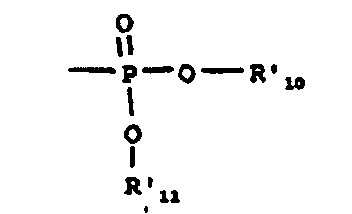
dans laquelle le(s) R'11 est (sont) choisi(s) parmi les restes hydrocarbonés dont le point d'attache [c'est-à-dire l'atome porteur de la liaison ouverte] est un carbone (semblables ou différents de R10 et de R'11) et une charge négative.

où R1 représente un radical hydrocarboné, avantageusement choisi parmi les aryles et les alcoyles éventuellement substitués.
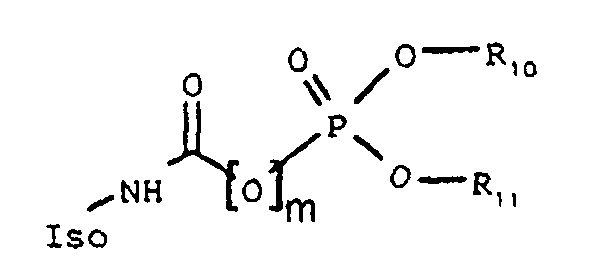
Bien sur alors R10 peut aussi valoir :

- une sous composition vecteur de fonctions isocyanate dont les caractéristiques préférées seront précisée ultérieurement et
- un agent tensioactif contenant au moins un composé de formule (I) ;
- optionnellement une phase aqueuse.

- d50 compris entre 15 et 60 nm, avantageusement entre 20 et 40 nm
- fonction carboxylate de 0,5 à 5% en masse
- fonction ol : entre 1 et 4% avantageusement entre 2 et 3%
- taux de solide : entre 25 et 40%
- un d80 inférieur à 1 micromètre.
- comme aliphatique simples, les polyméthylènediisocyanates et notamment l'hexaméthylène diisocyanate ;
- comme aliphatique partiellement "néopentylique" partiellement cyclique (cycloaliphatique) l'isophorone diisocyanate (IPDI) ;
- comme aliphatique cyclique (cycloaliphatique) diisocyanate ceux dérivés du norbornane ;
- les arylènedialcoylènediisocyanates (tel que OCN-CH2-Φ-CH2-NCO dont une partie ne présente pas de différence essentielle d'avec les aliphatiques à savoir ceux dont la fonction isocyanate est distante des noyaux aromatique d'au moins deux carbones tels que (OCN-[CH2]t-Φ-[CH2]u-NCO) avec t et u supérieur à 1 ;
- Au moins une, avantageusement au moins deux, des fonctions NCO sont
reliées à un squelette hydrocarboné, par l'intermédiaire d'un carbone
saturé (sp3), de préférence avec au moins une, plus préférentiellement au
moins deux des sous conditions ci- après :
- Au moins un, avantageusement deux, desdits carbones saturés (sp3) est porteur d'au moins un, avantageusement deux, hydrogène(s),(en d'autre terme il a été trouvé que l'on obtenait de meilleurs résultats lorsque le carbone porteur de la fonction isocyanate était porteur d'un hydrogène, de préférence de deux hydrogènes) ;
- au moins un, avantageusement deux, desdits carbones saturés (sp3) sont
eux-mêmes portés par un carbone, avantageusement aliphatique (c'est-à-dire
d'hybridation sp3), lui-même porteur d'au moins un, avantageusement deux,
hydrogène(s) ; en d'autre terme, il a été trouvé que l'on obtenait de meilleurs
résultats lorsque le carbone porteur de la fonction isocyanate n'était en
position dite "néopentylique" ;
- Tous les carbones par l'intermédiaire desquels les fonctions isocyanates sont reliées au squelette hydrocarboné, sont des carbones saturés (sp3), lesquels sont avantageusement en partie, de préférence en totalité, porteurs d'un hydrogène, de préférence de deux hydrogènes ; en outre il est avantageux que lesdits carbones saturés (sp3) soient au moins en partie (avantageusement un tiers, de préférence deux tiers), préférablement en totalité, eux-mêmes portés par un carbone, avantageusement aliphatique (c'est-à-dire d'hybridation sp3), lui-même porteur d'au moins un, avantageusement deux, hydrogène(s) ; en d'autre terme, il a été trouvé que l'on obtenait de meilleurs résultats lorsque le carbone porteur de la fonction isocyanate n'était en position dite "néopentylique" ;
- Sont en particulier bien adaptés ceux qui présentent au moins en partie un squelette isocyanurique ou biuret (que ce squelette soit issu d'un seul ou de plusieurs monomères, voir ci-dessous) et plus précisément des structures de type isocyanurate, encore appelée trimère, des structures urétidinedione, encore appelée dimère, des structures biuret ou allophanate ou une combinaison de ce type de structures sur une seule molécule ou en mélange.
- Au moins un tiers, avantageusement deux tiers, des fonctions NCO sont
reliées à un squelette hydrocarboné, par l'intermédiaire d'un carbone saturé
(sp3) ;
- Au moins un tiers, avantageusement deux tiers, desdits carbones saturés (sp3) est porteur d'au moins un, avantageusement deux, hydrogène(s),(en d'autre terme il a été trouvé que l'on obtenait de meilleurs résultats lorsque le carbone porteur de la fonction isocyanate était porteur d'un hydrogène, de préférence de deux hydrogènes. ; En outre il est avantageux que lesdits carbones saturés (sp3) soient au moins en partie (avantageusement un tiers, de préférence deux tiers), préférablement en totalité, eux-mêmes portés par un carbone, avantageusement aliphatique (c'est-à-dire d'hybridation sp3), lui-même porteur d'au moins un, avantageusement deux, hydrogène(s) ; en d'autre terme, il a été trouvé que l'on obtenait de meilleurs résultats lorsque le carbone porteur de la fonction isocyanate n'était en position dite "néopentylique" ; Un autre but de la présente invention est de fournir un procédé du type précédent qui permette de réaliser la mise en émulsion de la composition visée ci dessus lorsqu'elle ne contient pas d'eau.Ce but et d'autres qui apparaítront par la suite sont atteints au moyen d'un procédé de mise en émulsion qui comporte au moins l'étape suivante :
- ajout, avantageusement sous agitation très modérée, des ou de l'isocyanate dans le mélange polyol + eau.
| mise en oeuvre et caractéristiques du revêtement | ||
| épaisseur sèche Iso2178: 45 µm | ||
| support et traitement de celui-ci :acier traité par phosphatation : plaques R461 du fournisseur Q Pannel | ||
| propriétés minimales obtenues | usuelle | |
| test din 67530 (ces valeurs n'ont d'intérêt que lorsque l'on désire une peinture brillante mais non lorsque l'on veut de la peinture mat ou satinée) | ||
| Brillance 20° | 0,5 | 80 |
| 60° | 0,5 | 90 |
| dureté König Iso 1522 | 10s | 150s |
| Adhérence test din 53151 | GT-1 | GT-5 |
| Résistance au chocs test N°iso 6272 direct | 10 cm | >100 cm |
| inverse | 5 cm | >100 cm |
| Résistance à la méthyléthylcétone (butanone) (Double passage) | 20 | >200 |
| Tenue en extérieur QUV Din 53384 | 50 h | 800 h |
- RE 610 neutralisé par TEA au préalable
- ratio HDT/ RE 610 = 1/1 molaire
(30 g HDT + 114 g RE610 + 26 g TEA)
Claims (23)
- Composé caractérisé par le fait qu'il répond à la formule (I)
 dans laquelle R'10 est choisi parmi les restes hydrocarbonés (semblables ou différents de R10) et une charge négative dont le point d'attache [c'est-à-dire l'atome porteur de la liaison ouverte] est un carbone dans laquelle le(s) R'11 est (sont) choisi(s) parmi les restes hydrocarbonés dont le point d'attache [c'est-à-dire l'atome porteur de la liaison ouverte] est un carbone (semblables ou différents de R10 et de R'11) et une charge négative.où m est égal à 0 ou 1,où Iso est le reste d'un polyisocyanate après élimination d'une fonction isocyanateoù R10 est choisi parmi :une charge négative ;un reste hydrocarboné (c'est-à-dire contenant des atomes d'hydrogène et de carbone) dont le point d'attache [c'est-à-dire l'atome porteur de la liaison ouverte] est un carboneoù R11 est choisi parmi :une charge négative ;un groupe de formule II :
- Composé selon la revendication 1, caractérisé par le fait que Iso porte au moins une autre fonction semblable ou différente

- Composé selon les revendications 1 et 2, caractérisé par le fait que Iso porte au moins deux autres fonctions, semblables ou différentes.

- Composé selon les revendications 1 à 3, caractérisé par le fait qu'il dérive d'un isocyanate dont la totalité des fonctions isocyanates sont transformées en fonctions, semblables ou différentes.

- Composé selon les revendications 1 à 4, caractérisé par le fait qu'il dérive d'un isocyanate dont la totalité des fonctions isocyanates sont transformées en fonctions, semblables ou différenteset par le fait que l'isocyanate dont il dérive est di-, tri-, tetra-, penta-, hexa-, ou heptafonctionnel en isocyanate, avantageusement trifonctionnel.

- Composé selon les revendications 1 à 5, caractérisé par le fait qu'il dérive des isocyanates aliphatiques.
- Composé selon les revendications 1 à 6, caractérisé par le fait qu'il dérive des prépolymères, des isocyanates aliphatiques difonctionnels.
- Composé selon la revendication 7, caractérisé par le fait que les oligocondensats (ou prépolymères) sont choisis parmi ceux issus de la condensation de polyol en général triol et ceux portant des structures de type isocyanurate, encore appelée trimère, ceux portant des structures urétidine dione, encore appelée dimère, ceux portant des structures biuret ou allophanate et ceux portant une combinaison de ce type de structures sur une seule molécule ou en mélange.
- Composé selon les revendications 6 à 8, caractérisé par le fait qu'il dérive d'isocyanate(s) aliphatique(s) difonctionnel(s) choisi(s) parmi :les aliphatiques simples, notamment les polyméthylènediisocyanates et notamment l'hexaméthylène diisocyanate ;les aliphatiques partiellement "néopentylique" partiellement cycliques (cycloaliphatiques), notamment l'isophorone diisocyanate (IPDI) ;les aliphatiques cycliques (cycloaliphatiques) diisocyanates, notamment ceux dérivés du norbornane (NBDI) ;les arylènedialcoylènediisocyanates (tels que OCN-CH2-□-CH2-NCO dont une partie ne présente pas de différence essentielle d'avec les aliphatiques, à savoir ceux dont la fonction isocyanate est distante des noyaux aromatiques d'au moins deux carbones tels que (OCN-[CH2]t-□-[CH2]u-NCO) avec t et u supérieur à 1.
- Composé selon les revendications 6 à 9, caractérisé par le fait qu'il dérive d'isocyanate(s) aliphatique(s) difonctionnel(s) choisi(s). parmi les polyméthylènediisocyanates et avantageusement l'hexaméthylène diisocyanate.
- Composé selon les revendications 6 à 10, caractérisé par le fait qu'il dérive des biurets et des trimères des polyméthylènediisocyanates et avantageusement de l'hexaméthylène diisocyanate par remplacement des fonctions isocyanates par les fonctions, semblables ou différentes.
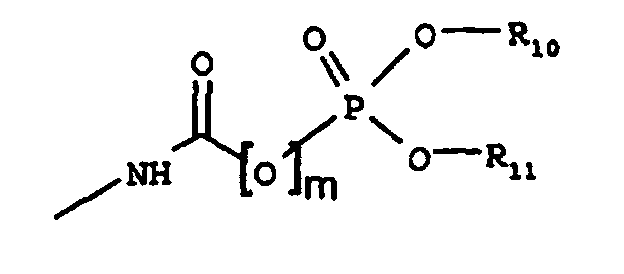
- Composition comportant notamment :une sous-composition vecteur de fonctions isocyanates.un agent tensioactif contenant au moins un composé de formule (I) selon l'une des revendications 1 à 11 ;optionnellement une phase aqueuse.
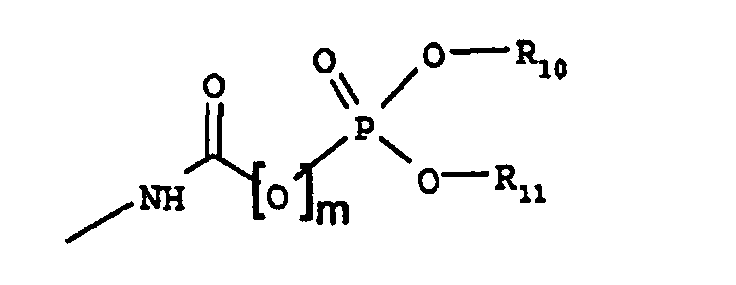
- Composition utile pour réaliser un revêtement selon la revendication 12, caractérisée par le fait qu'elle présente par rapport à un volume d'un litre d'isocyanate(s), de 0,01 à 1, avantageusement de 0,05 à 0,5, de préférence de 0,05 à 0,3 équivalent de fonction :
- Composition selon les revendications 12 et 13, caractérisée par le fait que ladite sous composition vecteur de fonctions isocyanate comporte en masse au moins 5%, avantageusement 10% (un chiffre significatif, avantageusement deux), de préférence 15%.de fonction isocyanate.
- Composition selon les revendications 12 à 14, caractérisée par le fait que ladite sous composition vecteur de fonctions isocyanate comporte en masse au plus environ 50%, avantageusement au plus environ 40%, de préférence au plus 30% (un chiffre significatif, avantageusement deux) de fonction isocyanate.
- Composition selon les revendications 12 à 15, caractérisée par le fait que ladite sous composition vecteur de fonctions isocyanate est formée d'isocyanates aliphatiques.
- Composition selon les revendications 12 à 16, caractérisée par le fait que ladite sous composition vecteur de fonctions isocyanate est formée.
- Composition selon les revendications 12 à 17, caractérisée par le fait qu'elle comporte en outre une phase aqueuse.
- Procédé de préparation d'un revêtement, caractérisé par le fait qu'il comporte l'application d'une couche d'une composition selon les revendications 12 à 18.
- Procédé selon la revendication 19, caractérisé par le fait qu'il comporte un séchage à une température de 20°C à 50°C pendant 1/4 et 3 heures.
- Procédé selon les revendications 19 et 20, caractérisé par le fait qu'il comporte un séchage en présence d'un solvant pour aider à l'élimination de l'eau.
- Procédé selon les revendications 19 à 21, caractérisé par le fait que la couche est appliquée par pulvérisation, ou au moyen d'applicateur à tige filetée.
- Revêtement susceptible d'être obtenu par un procédé selon l'une des revendications 19 à 22.
Applications Claiming Priority (5)
| Application Number | Priority Date | Filing Date | Title |
|---|---|---|---|
| PCT/FR1997/000359 WO1997031960A1 (fr) | 1996-02-29 | 1997-02-28 | Compositions a base d'isocyanate, leur procede d'utilisation, leur utilisation pour realiser des revetements et revetements ainsi obtenus |
| WOPCT/FR97/00359 | 1997-02-28 | ||
| FR9702406 | 1997-02-28 | ||
| FR9702406 | 1997-02-28 | ||
| PCT/FR1998/000405 WO1998038196A1 (fr) | 1997-02-28 | 1998-03-02 | Isocyanates modifies en vue de leur donner une propriete tensiocative, composition en contenant, revetement en resultant |
Publications (2)
| Publication Number | Publication Date |
|---|---|
| EP0973782A1 EP0973782A1 (fr) | 2000-01-26 |
| EP0973782B1 true EP0973782B1 (fr) | 2002-11-27 |
Family
ID=9504286
Family Applications (1)
| Application Number | Title | Priority Date | Filing Date |
|---|---|---|---|
| EP98913808A Expired - Lifetime EP0973782B1 (fr) | 1997-02-28 | 1998-03-02 | Isocyanates modifies en vue de leur donner une propriete tensioactive, composition en contenant, revetement en resultant |
Country Status (9)
| Country | Link |
|---|---|
| US (2) | US6217941B1 (fr) |
| EP (1) | EP0973782B1 (fr) |
| JP (1) | JP4414001B2 (fr) |
| AT (1) | ATE228524T1 (fr) |
| AU (1) | AU6837298A (fr) |
| DE (1) | DE69809727T2 (fr) |
| DK (1) | DK0973782T3 (fr) |
| ES (1) | ES2189151T3 (fr) |
| WO (1) | WO1998038196A1 (fr) |
Families Citing this family (13)
| Publication number | Priority date | Publication date | Assignee | Title |
|---|---|---|---|---|
| ES2189151T3 (es) * | 1997-02-28 | 2003-07-01 | Rhodia Chimie Sa | Isocianatos modificados con miras a proporcionarles una propiedad tensioactiva, composicion que los contiene, revestimiento resultante. |
| DE10043433A1 (de) | 2000-09-04 | 2002-03-21 | Bayer Ag | Wäßrige 2-K-PUR-Systeme |
| US7225262B2 (en) * | 2002-06-28 | 2007-05-29 | Pitney Bowes Inc. | System and method for selecting an external user interface using spatial information |
| US20070043152A1 (en) * | 2003-05-21 | 2007-02-22 | Jean-Marie Bernard | Isocyanate-based compositions, process for using them, use thereof for making direct-to-metal coatings and coatings thus obtained |
| US20060111166A1 (en) * | 2004-11-03 | 2006-05-25 | Peter Maclver | Gaming system |
| DE102004056849A1 (de) * | 2004-11-25 | 2006-06-08 | Bayer Materialscience Ag | Neue Polyisocyanatgemische, ein Verfahren zu ihrer Herstellung und ihre Verwendung als Härterkomponente in Polyurethanlacken |
| FR2879616B1 (fr) * | 2004-12-21 | 2007-05-25 | Rhodia Chimie Sa | Composition polyisacyanate a proprietes anti-chocs ameliorees |
| DE102005053678A1 (de) * | 2005-11-10 | 2007-05-16 | Bayer Materialscience Ag | Hydrophile Polyisocyanatgemische |
| FR2898905B1 (fr) * | 2006-03-24 | 2008-05-09 | Rhodia Recherches & Tech | Composition polyisocyanate a proprietes anti-chocs ameliorees |
| CN101454368B (zh) | 2006-03-29 | 2012-01-11 | 罗地亚管理公司 | 基于多异氰酸酯和缩醛型溶剂的混合物、由该混合物获得的水乳液以及这种乳液用于生产涂层和粘合剂的用途 |
| US20080081871A1 (en) * | 2006-09-29 | 2008-04-03 | Amit Sehgal | Water dispersible polyisocyanates |
| CN101528872B (zh) * | 2006-10-23 | 2012-07-25 | 关西涂料株式会社 | 水性双组分型透明涂料组合物和形成多层面漆膜的方法 |
| US20210277168A1 (en) * | 2017-03-02 | 2021-09-09 | Covestro Deutschland Ag | Reaction mixtures of isocyanates and polyols with extended pot life |
Family Cites Families (5)
| Publication number | Priority date | Publication date | Assignee | Title |
|---|---|---|---|---|
| FR1278286A (fr) * | 1959-12-17 | 1961-12-08 | Hoechst Ag | Nouveaux carbamylphosphates et leur préparation |
| US3639294A (en) * | 1968-12-09 | 1972-02-01 | Atlas Chem Ind | Flame-retardant, polyurethane coating compositions |
| US4257995A (en) * | 1979-05-03 | 1981-03-24 | The Upjohn Company | Process for preparing particle board and polyisocyanate-phosphorus compound release agent composition therefor |
| JPH09302309A (ja) * | 1996-05-08 | 1997-11-25 | Nippon Paint Co Ltd | 水性被覆組成物 |
| ES2189151T3 (es) * | 1997-02-28 | 2003-07-01 | Rhodia Chimie Sa | Isocianatos modificados con miras a proporcionarles una propiedad tensioactiva, composicion que los contiene, revestimiento resultante. |
-
1998
- 1998-03-02 ES ES98913808T patent/ES2189151T3/es not_active Expired - Lifetime
- 1998-03-02 DK DK98913808T patent/DK0973782T3/da active
- 1998-03-02 WO PCT/FR1998/000405 patent/WO1998038196A1/fr not_active Ceased
- 1998-03-02 EP EP98913808A patent/EP0973782B1/fr not_active Expired - Lifetime
- 1998-03-02 JP JP53739598A patent/JP4414001B2/ja not_active Expired - Fee Related
- 1998-03-02 US US09/380,111 patent/US6217941B1/en not_active Expired - Lifetime
- 1998-03-02 DE DE69809727T patent/DE69809727T2/de not_active Expired - Lifetime
- 1998-03-02 AU AU68372/98A patent/AU6837298A/en not_active Abandoned
- 1998-03-02 AT AT98913808T patent/ATE228524T1/de active
-
2001
- 2001-02-09 US US09/780,786 patent/US6482914B2/en not_active Expired - Lifetime
Also Published As
| Publication number | Publication date |
|---|---|
| AU6837298A (en) | 1998-09-18 |
| WO1998038196A1 (fr) | 1998-09-03 |
| JP2001514621A (ja) | 2001-09-11 |
| EP0973782A1 (fr) | 2000-01-26 |
| ES2189151T3 (es) | 2003-07-01 |
| DE69809727D1 (de) | 2003-01-09 |
| US6482914B2 (en) | 2002-11-19 |
| US20010018537A1 (en) | 2001-08-30 |
| DK0973782T3 (da) | 2003-03-24 |
| US6217941B1 (en) | 2001-04-17 |
| DE69809727T2 (de) | 2003-08-21 |
| ATE228524T1 (de) | 2002-12-15 |
| JP4414001B2 (ja) | 2010-02-10 |
Similar Documents
| Publication | Publication Date | Title |
|---|---|---|
| EP0815153B1 (fr) | Compositions a base d'isocyanate, leur procede d'utilisation, leur utilisation pour realiser des revetements et revetements ainsi obtenus | |
| EP2064258B1 (fr) | Utilisation de compositions polyisocyanates pour revetements a brillance elevee | |
| EP0973782A1 (fr) | Isocyanates modifies en vue de leur donner une propriete tensiocative, composition en contenant, revetement en resultant | |
| EP0691993B1 (fr) | Procede de preparation d'emulsions aqueuses d'huiles et/ou de gommes et/ou de resines (poly)isocyanates avantageusement masques et emulsions obtenues | |
| EP1003802B1 (fr) | Procede de preparation de compositions (poly)isocyanates de viscosite reduite | |
| CA2281643A1 (fr) | Revetement pour exterieur, composition utile pour ces revetements et procede d'obtention de ces revetements | |
| WO2009071793A1 (fr) | Nouvelles compositions polyisocyanates hydrodispersibles | |
| FR2923835A1 (fr) | Nouvelles compositions polyisocyanates hydrophiles a base d'esters de phosphate. | |
| EP1319035B1 (fr) | Procede pour conferer a des substrats en bois une resistance elevee a l'attaque des produits chimiques | |
| WO2009156683A1 (fr) | Nouveaux melanges de compositions de polyisocyanates | |
| FR2760242A1 (fr) | Revetement pour exterieur, composition utile pour ces revetements et procede d'obtention de ces revetements | |
| EP1611179B1 (fr) | Compositions a base d'isocyanate, leur utilisation pour realiser des revêtements notamment des adhesifs et joints de colle aliphatique ainsi obtenus | |
| EP1028988B1 (fr) | Composition polyuréthane pour application simultanée ou successive | |
| EP1627004A2 (fr) | Compositions a base d'isocyanate, leur procede d'utilisation, leur utilisation pour realiser des revetements a adherence directe et revetements ainsi obtenus | |
| CA2169897C (fr) | Composition utile pour les revetements, a base de melange d'emulsion(s) et de dispersion(s) de polymere polyol et revetement(s) qui en sont issus | |
| FR2855768A1 (fr) | Compositions a base d'isocyanate, leur procede d'utilisation pour realiser des vetements et revetements ainsi obtenus | |
| WO2004092242A1 (fr) | Compositions a base d'isocyanate, leur procede d'utilisation pour realiser des adhesifs et joints de colle aromatique ainsi obtenus | |
| FR2767836A1 (fr) | Utilisation de tensioactif anionique pour la synthese en emulsion de(poly)isocyanates masques, emulsion ainsi obtenue, utilisation des emulsions dans des compositions pour revetement et revetement ainsi obtenu | |
| EP1370598A1 (fr) | Procede de realisation d'un revetement et composition pour revetements reticulables |
Legal Events
| Date | Code | Title | Description |
|---|---|---|---|
| PUAI | Public reference made under article 153(3) epc to a published international application that has entered the european phase |
Free format text: ORIGINAL CODE: 0009012 |
|
| 17P | Request for examination filed |
Effective date: 19990922 |
|
| AK | Designated contracting states |
Kind code of ref document: A1 Designated state(s): AT BE CH DE DK ES FI FR GB GR IE IT LI LU MC NL PT SE |
|
| 17Q | First examination report despatched |
Effective date: 20001024 |
|
| GRAG | Despatch of communication of intention to grant |
Free format text: ORIGINAL CODE: EPIDOS AGRA |
|
| GRAG | Despatch of communication of intention to grant |
Free format text: ORIGINAL CODE: EPIDOS AGRA |
|
| GRAH | Despatch of communication of intention to grant a patent |
Free format text: ORIGINAL CODE: EPIDOS IGRA |
|
| GRAH | Despatch of communication of intention to grant a patent |
Free format text: ORIGINAL CODE: EPIDOS IGRA |
|
| GRAA | (expected) grant |
Free format text: ORIGINAL CODE: 0009210 |
|
| AK | Designated contracting states |
Kind code of ref document: B1 Designated state(s): AT BE CH DE DK ES FI FR GB GR IE IT LI LU MC NL PT SE |
|
| PG25 | Lapsed in a contracting state [announced via postgrant information from national office to epo] |
Ref country code: GR Free format text: LAPSE BECAUSE OF FAILURE TO SUBMIT A TRANSLATION OF THE DESCRIPTION OR TO PAY THE FEE WITHIN THE PRESCRIBED TIME-LIMIT Effective date: 20021127 |
|
| REF | Corresponds to: |
Ref document number: 228524 Country of ref document: AT Date of ref document: 20021215 Kind code of ref document: T |
|
| REG | Reference to a national code |
Ref country code: GB Ref legal event code: FG4D Free format text: NOT ENGLISH |
|
| REG | Reference to a national code |
Ref country code: CH Ref legal event code: EP |
|
| REG | Reference to a national code |
Ref country code: IE Ref legal event code: FG4D Free format text: FRENCH |
|
| REF | Corresponds to: |
Ref document number: 69809727 Country of ref document: DE Date of ref document: 20030109 |
|
| PG25 | Lapsed in a contracting state [announced via postgrant information from national office to epo] |
Ref country code: PT Free format text: LAPSE BECAUSE OF FAILURE TO SUBMIT A TRANSLATION OF THE DESCRIPTION OR TO PAY THE FEE WITHIN THE PRESCRIBED TIME-LIMIT Effective date: 20030227 |
|
| PG25 | Lapsed in a contracting state [announced via postgrant information from national office to epo] |
Ref country code: LU Free format text: LAPSE BECAUSE OF NON-PAYMENT OF DUE FEES Effective date: 20030302 |
|
| REG | Reference to a national code |
Ref country code: CH Ref legal event code: NV Representative=s name: KIRKER & CIE SA |
|
| REG | Reference to a national code |
Ref country code: DK Ref legal event code: T3 |
|
| GBT | Gb: translation of ep patent filed (gb section 77(6)(a)/1977) |
Effective date: 20030329 |
|
| REG | Reference to a national code |
Ref country code: ES Ref legal event code: FG2A Ref document number: 2189151 Country of ref document: ES Kind code of ref document: T3 |
|
| PLBE | No opposition filed within time limit |
Free format text: ORIGINAL CODE: 0009261 |
|
| STAA | Information on the status of an ep patent application or granted ep patent |
Free format text: STATUS: NO OPPOSITION FILED WITHIN TIME LIMIT |
|
| 26N | No opposition filed |
Effective date: 20030828 |
|
| PGFP | Annual fee paid to national office [announced via postgrant information from national office to epo] |
Ref country code: DK Payment date: 20040123 Year of fee payment: 7 |
|
| PGFP | Annual fee paid to national office [announced via postgrant information from national office to epo] |
Ref country code: MC Payment date: 20040226 Year of fee payment: 7 |
|
| PGFP | Annual fee paid to national office [announced via postgrant information from national office to epo] |
Ref country code: SE Payment date: 20040304 Year of fee payment: 7 |
|
| PGFP | Annual fee paid to national office [announced via postgrant information from national office to epo] |
Ref country code: IE Payment date: 20040312 Year of fee payment: 7 Ref country code: FI Payment date: 20040312 Year of fee payment: 7 |
|
| PG25 | Lapsed in a contracting state [announced via postgrant information from national office to epo] |
Ref country code: IE Free format text: LAPSE BECAUSE OF NON-PAYMENT OF DUE FEES Effective date: 20050302 Ref country code: FI Free format text: LAPSE BECAUSE OF NON-PAYMENT OF DUE FEES Effective date: 20050302 |
|
| PG25 | Lapsed in a contracting state [announced via postgrant information from national office to epo] |
Ref country code: SE Free format text: LAPSE BECAUSE OF NON-PAYMENT OF DUE FEES Effective date: 20050303 |
|
| PG25 | Lapsed in a contracting state [announced via postgrant information from national office to epo] |
Ref country code: MC Free format text: LAPSE BECAUSE OF NON-PAYMENT OF DUE FEES Effective date: 20050331 Ref country code: DK Free format text: LAPSE BECAUSE OF NON-PAYMENT OF DUE FEES Effective date: 20050331 |
|
| EUG | Se: european patent has lapsed | ||
| REG | Reference to a national code |
Ref country code: DK Ref legal event code: EBP |
|
| REG | Reference to a national code |
Ref country code: IE Ref legal event code: MM4A |
|
| REG | Reference to a national code |
Ref country code: CH Ref legal event code: PUE Owner name: PERSTORP FRANCE Free format text: RHODIA CHIMIE#25, QUAI PAUL DOUMER#92408 COURBEVOIE CEDEX (FR) -TRANSFER TO- PERSTORP FRANCE#196 ALLEE ALEXANDRE BORODINE#69800 SAINT-PRIEST (FR) |
|
| REG | Reference to a national code |
Ref country code: FR Ref legal event code: TP Owner name: PERSTORP FRANCE, FR Effective date: 20120103 Ref country code: FR Ref legal event code: CD Owner name: PERSTORP FRANCE, FR Effective date: 20120103 Ref country code: FR Ref legal event code: CA Effective date: 20120103 |
|
| BECA | Be: change of holder's address |
Owner name: PERSTORP FRANCE196 ALLEE ALEXANDRE BORODINE,F-6980 Effective date: 20120221 |
|
| BECH | Be: change of holder |
Owner name: PERSTORP FRANCE196 ALLEE ALEXANDRE BORODINE,F-6980 Effective date: 20120221 |
|
| BECN | Be: change of holder's name |
Owner name: PERSTORP FRANCE196 ALLEE ALEXANDRE BORODINE,F-6980 Effective date: 20120221 |
|
| REG | Reference to a national code |
Ref country code: GB Ref legal event code: 732E Free format text: REGISTERED BETWEEN 20120830 AND 20120905 |
|
| REG | Reference to a national code |
Ref country code: NL Ref legal event code: SD Effective date: 20120927 |
|
| REG | Reference to a national code |
Ref country code: DE Ref legal event code: R082 Ref document number: 69809727 Country of ref document: DE Representative=s name: MAIWALD PATENTANWALTSGESELLSCHAFT MBH, DE Effective date: 20121220 Ref country code: DE Ref legal event code: R081 Ref document number: 69809727 Country of ref document: DE Owner name: PERSTORP FRANCE, FR Free format text: FORMER OWNER: RHODIA CHIMIE, COURBEVOIE, FR Effective date: 20121220 Ref country code: DE Ref legal event code: R081 Ref document number: 69809727 Country of ref document: DE Owner name: VENCOREX FRANCE, FR Free format text: FORMER OWNER: RHODIA CHIMIE, COURBEVOIE, FR Effective date: 20121220 |
|
| REG | Reference to a national code |
Ref country code: ES Ref legal event code: PC2A Owner name: PERSTORP FRANCE Effective date: 20130527 |
|
| REG | Reference to a national code |
Ref country code: AT Ref legal event code: PC Ref document number: 228524 Country of ref document: AT Kind code of ref document: T Owner name: PERSTORP FRANCE, FR Effective date: 20130502 |
|
| REG | Reference to a national code |
Ref country code: CH Ref legal event code: PFA Owner name: VENCOREX FRANCE, FR Free format text: FORMER OWNER: PERSTORP FRANCE, FR |
|
| REG | Reference to a national code |
Ref country code: DE Ref legal event code: R082 Ref document number: 69809727 Country of ref document: DE Representative=s name: MAIWALD PATENTANWALTSGESELLSCHAFT MBH, DE Ref country code: FR Ref legal event code: CD Owner name: VENCOREX FRANCE, FR Effective date: 20130603 |
|
| REG | Reference to a national code |
Ref country code: NL Ref legal event code: TD Effective date: 20130729 |
|
| REG | Reference to a national code |
Ref country code: DE Ref legal event code: R082 Ref document number: 69809727 Country of ref document: DE Representative=s name: MAIWALD PATENTANWALTSGESELLSCHAFT MBH, DE Effective date: 20130705 Ref country code: DE Ref legal event code: R081 Ref document number: 69809727 Country of ref document: DE Owner name: VENCOREX FRANCE, FR Free format text: FORMER OWNER: PERSTORP FRANCE, SAINT-PRIEST, FR Effective date: 20130705 |
|
| REG | Reference to a national code |
Ref country code: ES Ref legal event code: PC2A Owner name: VENCOREX FRANCE Effective date: 20131107 |
|
| REG | Reference to a national code |
Ref country code: AT Ref legal event code: HC Ref document number: 228524 Country of ref document: AT Kind code of ref document: T Owner name: VENCOREX FRANCE, FR Effective date: 20131107 |
|
| REG | Reference to a national code |
Ref country code: FR Ref legal event code: PLFP Year of fee payment: 19 |
|
| PGFP | Annual fee paid to national office [announced via postgrant information from national office to epo] |
Ref country code: CH Payment date: 20160315 Year of fee payment: 19 Ref country code: ES Payment date: 20160322 Year of fee payment: 19 Ref country code: NL Payment date: 20160318 Year of fee payment: 19 Ref country code: DE Payment date: 20160324 Year of fee payment: 19 |
|
| PGFP | Annual fee paid to national office [announced via postgrant information from national office to epo] |
Ref country code: GB Payment date: 20160322 Year of fee payment: 19 Ref country code: AT Payment date: 20160323 Year of fee payment: 19 Ref country code: BE Payment date: 20160318 Year of fee payment: 19 |
|
| PGFP | Annual fee paid to national office [announced via postgrant information from national office to epo] |
Ref country code: IT Payment date: 20160322 Year of fee payment: 19 Ref country code: FR Payment date: 20160331 Year of fee payment: 19 |
|
| REG | Reference to a national code |
Ref country code: DE Ref legal event code: R119 Ref document number: 69809727 Country of ref document: DE |
|
| REG | Reference to a national code |
Ref country code: CH Ref legal event code: PL |
|
| REG | Reference to a national code |
Ref country code: NL Ref legal event code: MM Effective date: 20170401 |
|
| REG | Reference to a national code |
Ref country code: AT Ref legal event code: MM01 Ref document number: 228524 Country of ref document: AT Kind code of ref document: T Effective date: 20170302 |
|
| GBPC | Gb: european patent ceased through non-payment of renewal fee |
Effective date: 20170302 |
|
| REG | Reference to a national code |
Ref country code: FR Ref legal event code: ST Effective date: 20171130 |
|
| PG25 | Lapsed in a contracting state [announced via postgrant information from national office to epo] |
Ref country code: AT Free format text: LAPSE BECAUSE OF NON-PAYMENT OF DUE FEES Effective date: 20170302 Ref country code: FR Free format text: LAPSE BECAUSE OF NON-PAYMENT OF DUE FEES Effective date: 20170331 Ref country code: NL Free format text: LAPSE BECAUSE OF NON-PAYMENT OF DUE FEES Effective date: 20170401 Ref country code: DE Free format text: LAPSE BECAUSE OF NON-PAYMENT OF DUE FEES Effective date: 20171003 |
|
| PG25 | Lapsed in a contracting state [announced via postgrant information from national office to epo] |
Ref country code: GB Free format text: LAPSE BECAUSE OF NON-PAYMENT OF DUE FEES Effective date: 20170302 Ref country code: IT Free format text: LAPSE BECAUSE OF NON-PAYMENT OF DUE FEES Effective date: 20170302 Ref country code: CH Free format text: LAPSE BECAUSE OF NON-PAYMENT OF DUE FEES Effective date: 20170331 Ref country code: LI Free format text: LAPSE BECAUSE OF NON-PAYMENT OF DUE FEES Effective date: 20170331 |
|
| REG | Reference to a national code |
Ref country code: BE Ref legal event code: MM Effective date: 20170331 |
|
| REG | Reference to a national code |
Ref country code: ES Ref legal event code: FD2A Effective date: 20180507 |
|
| PG25 | Lapsed in a contracting state [announced via postgrant information from national office to epo] |
Ref country code: BE Free format text: LAPSE BECAUSE OF NON-PAYMENT OF DUE FEES Effective date: 20170331 |
|
| PG25 | Lapsed in a contracting state [announced via postgrant information from national office to epo] |
Ref country code: ES Free format text: LAPSE BECAUSE OF NON-PAYMENT OF DUE FEES Effective date: 20170303 |