EP0973921B1 - 2-desoxyglucose-6-phosphat (2-dog-6-p) phosphatase dna-sequenzen als selektionsmarker in pflanzen - Google Patents
2-desoxyglucose-6-phosphat (2-dog-6-p) phosphatase dna-sequenzen als selektionsmarker in pflanzen Download PDFInfo
- Publication number
- EP0973921B1 EP0973921B1 EP98919245A EP98919245A EP0973921B1 EP 0973921 B1 EP0973921 B1 EP 0973921B1 EP 98919245 A EP98919245 A EP 98919245A EP 98919245 A EP98919245 A EP 98919245A EP 0973921 B1 EP0973921 B1 EP 0973921B1
- Authority
- EP
- European Patent Office
- Prior art keywords
- dog
- plants
- plant
- recombinant dna
- dna molecule
- Prior art date
- Legal status (The legal status is an assumption and is not a legal conclusion. Google has not performed a legal analysis and makes no representation as to the accuracy of the status listed.)
- Expired - Lifetime
Links
Images


Classifications
-
- C—CHEMISTRY; METALLURGY
- C12—BIOCHEMISTRY; BEER; SPIRITS; WINE; VINEGAR; MICROBIOLOGY; ENZYMOLOGY; MUTATION OR GENETIC ENGINEERING
- C12N—MICROORGANISMS OR ENZYMES; COMPOSITIONS THEREOF; PROPAGATING, PRESERVING, OR MAINTAINING MICROORGANISMS; MUTATION OR GENETIC ENGINEERING; CULTURE MEDIA
- C12N9/00—Enzymes; Proenzymes; Compositions thereof; Processes for preparing, activating, inhibiting, separating or purifying enzymes
- C12N9/14—Hydrolases (3)
- C12N9/16—Hydrolases (3) acting on ester bonds (3.1)
-
- C—CHEMISTRY; METALLURGY
- C12—BIOCHEMISTRY; BEER; SPIRITS; WINE; VINEGAR; MICROBIOLOGY; ENZYMOLOGY; MUTATION OR GENETIC ENGINEERING
- C12N—MICROORGANISMS OR ENZYMES; COMPOSITIONS THEREOF; PROPAGATING, PRESERVING, OR MAINTAINING MICROORGANISMS; MUTATION OR GENETIC ENGINEERING; CULTURE MEDIA
- C12N15/00—Mutation or genetic engineering; DNA or RNA concerning genetic engineering, vectors, e.g. plasmids, or their isolation, preparation or purification; Use of hosts therefor
- C12N15/09—Recombinant DNA-technology
- C12N15/63—Introduction of foreign genetic material using vectors; Vectors; Use of hosts therefor; Regulation of expression
- C12N15/79—Vectors or expression systems specially adapted for eukaryotic hosts
- C12N15/82—Vectors or expression systems specially adapted for eukaryotic hosts for plant cells, e.g. plant artificial chromosomes (PACs)
- C12N15/8201—Methods for introducing genetic material into plant cells, e.g. DNA, RNA, stable or transient incorporation, tissue culture methods adapted for transformation
- C12N15/8209—Selection, visualisation of transformants, reporter constructs, e.g. antibiotic resistance markers
Definitions
- the present invention relates to the use of DNA sequences that a Protein with the biological activity of a 2-deoxyglucose-6-phosphate (2-DOG-6-P) Coding phosphatase as a selection marker in plant cells for selection transformed plants. Furthermore, this invention relates to recombinant DNA molecules which contain such DNA sequences, these with regulatory Sequences of a promoter active in plants and transcription termination and / or polyadenylation signals are operatively linked. Furthermore Vectors, host cells and kits described such recombinant DNA molecules contain, as well as transformed with the recombinant DNA molecules Plant cells and plants.
- the present invention also relates to methods for the production of transgenic plants, due to the introduction of the above described recombinant DNA molecules on 2-deoxyglucose containing Media can be selected.
- the present invention relates transgenic plants, plant cells and tissues which contain the DNA molecule according to the invention included or obtained by the method described above be, as well as crop products and propagation material of the described transgenic plants.
- transgenic Using genetic engineering, it is possible to target foreign genes into the to transmit plant genome. This process is called transformation and the resulting plants referred to as transgenic.
- the primary goals are to one of crop protection and the other an increase in quality of Harvest products.
- crop protection measures are: (i) herbicide tolerant Plants (DE-A-3701623; Stalker (1988) Science 242, 419), (ii) insect-resistant Plants (Vaek (1987) Plant Cell 5, 159-169), (iii) virus-resistant plants (Powell (1986) Science 232, 738-743) and (vi) ozone-resistant plants (Van Camp (1994) BioTech. 12, 165-168).
- transgenic plants The basic prerequisite for the generation of transgenic plants is the availability of suitable transformation systems and the presence of selectable markers that enable the identification of successfully transformed plant cells.
- Several methods are currently available for transformation.
- the most commonly used method for transforming dicotyledonous plants is Agrobacterium-mediated gene transfer.
- Agrobacterium-mediated gene transfer the natural ability of the soil bacteria to exploit genetic material in the plant genome is used.
- Other suitable methods are, for example, protoplast transformation by polyethylene glycol-induced DNA uptake, electroporation, sonication or microinjection, and the transformation of intact cells or tissue by micro- or macroinjection into tissue or embryos, tissue electroporation, incubation of dry embryos in DNA-containing solution, vacuum infiltration of seeds and biolistic gene transfer.
- a selectable marker is integrated into the plant genome in a conventional manner, which enables the identification of transgenic cells.
- Genes that mediate herbicide or antibiotic tolerance are currently used to select transformed plant cells. Suitable resistance genes are, for example, the bar gene from Streptomyces hygroscopicus, which mediates resistance to the total herbicide phosphinothricin (De Block (1987) EMBO J. 6, 2513-2518) or the nptll gene from the transposon Tn5 from Escherichia coli, resistance to the antibiotic kanamycin effects (Herrera-Estrella (1983) EMBO J. 2, 987-995).
- the present invention is therefore based on the object of making available recombinant DNA molecules which contain a DNA sequence which can be used for the selection of transformed plant cells or plants. This object is achieved by the provision of the embodiments characterized in the patent claims.
- a protein with the biological activity of a 2-DOG-6-P phosphatase a protein understood in is able to metabolize non-metabolizable glucose analogs such as 2-DOG implement non-toxic products.
- the toxic effects of 2-DOG arise after Phosphorylation to 2-DOG-6-P, i.e. the phosphatase increases the action of 2-DOG-6-P by dephosphorylation.
- An alternative resistance mechanism which can also be used for the purposes of the present invention in preventing phosphorylation or uptake of 2-DOG.
- Corresponding mutants have been described in yeast, e.g. a transport mutant (Novak (1990) FEBS Lett. 269, 202-204) and a mutant phosphorylation (Lobo (1977) Mol. Gen. Genet. 157, 297-300).
- Nicotiana tabacum cells and Picea excelsa (spruce) cells in tissue culture is strongly inhibited by 2-DOG (Zemek (1975) Z.
- 2-DOG-6-P, UDP-2-DOG and 2-DOG-containing di- and oligosaccharides were identified as reaction products of 2-DOG in higher plants (Kocourek (1963) Biochem. Biophys Acta 71, 497; Zemek (1975) Z. Plant Physiol. 76, 114).
- the formation of these metabolic products is held responsible for the inhibitory effects of 2-DOG.
- the DNA sequence encoding a protein with the biological activity of a 2-DOG-6-P phosphatase can be isolated from natural sources, preferably yeast, or can be synthesized by known methods. Using common molecular biological techniques, it is possible (see, for example, Sambrook, 1989, Molecular Cloning, A Laboratory Manual, 2nd ed. Cold Spring Harbor Laboratory Press, Cold Spring Harbor, NY) to make various types of mutations in the DNA sequence that a protein contains the biological activity of a 2-DOG-6-P phosphatase, to be introduced into the recombinant DNA molecules according to the invention, which leads to the synthesis of proteins with possibly changed biological properties.
- deletion mutants in which the synthesis of correspondingly shortened proteins can be achieved by progressive deletions from the 5 'or from the 3' end of the coding DNA sequence.
- enzymes that are localized in certain compartments of the plant cell by adding corresponding signal sequences.
- Such sequences are known (see, for example, Braun, EMBO J. 11 (1992), 3219-3227; Wolter, Proc. Natl. Acad. Sci. USA 85 (1988), 846-850; Sonnewald, Plant J. 1 (1991) , 95-106).
- mutants can be produced which have a changed K m value or are no longer subject to the regulatory mechanisms normally present in the cell via allosteric regulation or covalent modification.
- mutants can be produced which have an altered substrate or product specificity.
- mutants can be produced which have a changed activity-temperature profile.
- the recombinant DNA molecules according to the invention or parts of these molecules can be introduced into plasmids which permit mutagenesis or a sequence change by recombining DNA sequences. With the help of standard methods (cf.
- hybridization means hybridization under conventional hybridization conditions, preferably under stringent conditions, as described, for example, in Sambrook (Molecular Cloning, A Laboratory Manual, 2nd ed. (1989) Cold Spring Harbor Laboratory Press, Cold Spring Harbor , NY).
- DNA sequences which hybridize with the DNA sequences which encode a protein with the biological activity of a 2-DOG-6-P phosphatase can, for example, be isolated from genomic or from cDNA libraries which have been prepared from yeast. Such DNA sequences can be identified and isolated, for example by means of hybridization using standard methods (see, for example, Sambrook, 1989, Molecular Cloning, A Laboratory Manual, 2nd ed.
- DNA sequences are carried out which are exactly or essentially those under SEQ ID NO. 1 indicated nucleotide sequence or parts of these sequences or have the reverse complement of these DNA sequences.
- the fragments used as the hybridization sample can also be synthetic fragments which were produced with the aid of customary synthesis techniques and whose sequence essentially corresponds to that in SEQ ID NO. 2 matches shown.
- the DNA sequences encoding a protein with the biological activity of a 2-DOG-6-P phosphatase also include DNA sequences whose nucleotide sequences are degenerate to that of one of the DNA sequences described above.
- the degeneration of the genetic code offers the person skilled in the art the possibility, inter alia, of adapting the nucleotide sequence of the DNA sequence to the codon preference of the respective host, preferably plants.
- the DNA sequences described above also include fragments, derivatives and allelic variants of the DNA sequences described above, which encode a protein with the biological activity of a 2-DOG-6-P phosphatase. “Fragments” mean parts of the DNA sequence that are long enough to encode one of the proteins described.
- derivative in this context means that the sequences differ from the DNA sequences described above at one or more positions but have a high degree of homology to these sequences.
- Homology means a sequence identity of at least 40%, in particular an identity of at least 60%, preferably over 80% and particularly preferably over 90%.
- the proteins encoded by these DNA sequences have a sequence identity to that in SEQ ID NO. 2 indicated amino acid sequence of at least 80%, preferably 85% and particularly preferably over 90%, 95%, 97% and 99%.
- the deviations from the DNA sequences described above may have arisen, for example, through deletion, substitution, insertion or recombination.
- the DNA sequences which are homologous to the sequences described above and which are derivatives of these sequences are generally variations of these sequences which are modifications which have the same biological function.
- allelic variants can be both naturally occurring variants and also synthetically produced variants or those produced by recombinant DNA techniques.
- That of the different variants in the recombinant DNA molecules contained DNA sequences encoded proteins that the biological activity of a 2-DOG-6-P Having phosphatase have certain common characteristics on how enzyme activity, molecular weight, immunological reactivity or Conformation or physical properties, such as running behavior in Gel electrophoresis, chromatographic behavior, sedimentation coefficients, Solubility, spectroscopic properties, stability; pH optimum, temperature optimum.
- the DNA sequence described originates from yeast.
- the DNA sequence contained in the recombinant DNA molecules according to the invention in plant cells is linked to regulatory sequences which ensure transcription in plant cells.
- regulatory sequences which ensure transcription in plant cells.
- These include promoters in particular.
- any promoter active in plant cells can be used for the expression.
- the promoter can be selected so that the expression takes place constitutively or only in a certain tissue, at a certain time in plant development or at a time determined by external influences.
- the promoter can be homologous or heterologous to the plant.
- Useful promoters are, for example, the promoter of the 35S RNA of the Cauliflower Mosaic Virus and the ubiquitin promoter from maize for constitutive expression, particularly preferably a promoter which ensures expression only in photosynthetically active tissues, for example the ST-LS1 promoter (Stockhaus, Proc. Natl. Acad. Sci. USA 84 (1987), 7943-7947; Stockhaus, EMBO J. 8 (1989), 2445-2451) or a promoter that is active during plant transformation, plant regeneration or certain stages of these processes , for example cell division-specific promoters such as the histone H-3 promoter (Kapros (1993), In Vitro Cell Dev. Biol.
- Inducible or cell-specific promoters are also preferred.
- Such elements for example the terminator of the octopine synthase gene from agrobacteria, have been described in the literature (cf. Gielen, EMBO J. 8 (1989), 23-29) and can be exchanged as desired.
- the promoter is the 35S CAMV promoter.
- the invention further relates to vectors, the recombinant DNA molecules according to the invention contain.
- vectors the recombinant DNA molecules according to the invention contain.
- These are preferably plasmids, cosmids, Viruses, bacteriophages and other vectors common in genetic engineering.
- plasmids preferably plasmids, cosmids, Viruses, bacteriophages and other vectors common in genetic engineering.
- plasmids preferably plasmids, cosmids, Viruses, bacteriophages and other vectors common in genetic engineering.
- For Preparing for the introduction of foreign genes into higher plants is a major challenge Number of cloning vectors available that provide a replication signal for E. coli and contain a marker gene for the selection of transformed bacterial cells. Examples for such vectors are pBR322, pUC series, M13mp series, pACYC184 etc.
- the desired sequence can be inserted at a suitable restriction site
- Transformed E.coli cells are in a suitable Medium grown, then harvested and lysed.
- the plasmid will recovered.
- As an analysis method to characterize the obtained Plasmid DNA are generally used for restriction analysis, gel electrophoresis and other biochemical-molecular biological methods used. After every manipulation can cleave the plasmid DNA and recover DNA fragments with other DNA sequences. Each plasmid DNA sequence can be in the same or different plasmids can be cloned.
- the vector according to the invention contains at least one further recombinant DNA molecule.
- the DNA molecules and vectors according to the invention can contain any information, contained in another recombinant DNA molecule, on plants or
- Plant cells are transferred and then with medium selection on 2-DOG containing media can be selected for the desired information.
- the recombinant DNA molecule which is the additional Contains information, not necessarily in the vector that carries the selection marker, must be present, but can also be co-transformed with it (Lyznik (1989) Plant Mol. Biol. 13, 151-161; Peng (1995) Plant Mol. Biol. 27, 91-104). This This is an option, for example, if there is no physical coupling of the Marker gene and the information to be transmitted is desired. In this case after selection of the primary transgenic plant, the marker gene and the desired information in subsequent crossings independently of each other segregate.
- the further recombinant DNA molecule contains a DNA sequence which encodes a peptide, protein, antisense, sense RNA, viral RNA or ribozyme.
- Herbers & Sonnewald (1996) TIBTECH 14, 198-205 summarizes some examples of heterologous (over) expression and antisense inhibition with the aim of manipulating metabolic flows in transgenic plants.
- An example of ribozymes has been published by Feyter (1996) Mol. Gen. Genet. 250, 329-338. By expressing a "hammerhead" ribozyme, the authors succeeded in generating TMV resistance in transgenic tobacco plants.
- transgenic plants which can be generated with the aid of the recombinant DNA molecules and vectors according to the invention are also described in TIPTEC Plant Product & Crop Biotechnology, 13 (1995), 312-397.
- the vectors according to the invention can have further functional units which bring about a stabilization of the vector in the host organism, such as a bacterial origin of replication or the 2-micron DNA for stabilization in Saccharomyces cerevisiae.
- "left border” and "right border” sequences of agrobacterial T-DNA can be contained, which enables a stable integration into the genome of plants.
- Another strategy to generate marker-free transgenic plants is the use of sequence-specific recombinases.
- two strategies can be used, for example: (i) re-transforming a starting line expressing recombinase and crossing out the recombinase after removal of the selection marker which was associated with the desired gene. (ii) Co-transformation followed by outcrossing. Prerequisites for this recombinase strategy are (i) flanking the selection marker with recognition sequences for the recombinase and (ii) a recombinase that is active in plants and does not use any plant-specific sequences for recombination.
- RecA Reiss (1996) Proc. Natl. Acad. Sci.
- the invention relates to host cells which contain the recombinant DNA molecules or vectors according to the invention transiently or stably.
- a host cell is understood to mean an organism which is capable of taking up recombinant DNA in vitro and, if appropriate, of expressing the DNA sequence contained in the recombinant DNA molecules according to the invention. These are preferably prokaryotic or eukaryotic cells.
- the invention relates to plant cells which contain the vector systems or derivatives according to the invention or parts thereof. Because of the inclusion of the vector systems, derivatives or parts of the vector systems according to the invention, these are preferably capable of synthesizing enzymes which have the biological activity of a 2-DOG-6-P phosphatase.
- the cells according to the invention are preferably characterized in that the introduced recombinant DNA molecule according to the invention is either heterologous with respect to the transformed cell, ie does not naturally occur in these cells, or is located at a different location in the genome than the corresponding naturally occurring sequence.
- kits comprising a recombinant DNA molecule according to the invention or one according to the invention Contain vector and optionally 2-DOG or an equivalent to 2-DOG chemical compound.
- a recombinant DNA molecule according to the invention or one according to the invention Contain vector and optionally 2-DOG or an equivalent to 2-DOG chemical compound.
- a variety of techniques are available for introducing DNA into a plant host cell. These techniques include the transformation of plant cells with T-DNA using Agrobacterium tumefaciens or Agrobacterium rhizogenes as the transformation agent, the fusion of protoplasts, the injection, the electroporation of DNA, the introduction of DNA using the biolistic method and other possibilities.
- Agrobacterium tumefaciens or Agrobacterium rhizogenes as the transformation agent
- the fusion of protoplasts the injection
- the electroporation of DNA the introduction of DNA using the biolistic method and other possibilities.
- Simple plasmids such as pUC derivatives can be used.
- a selectable marker should be present.
- additional DNA sequences may be required.
- the Ti or Ri plasmid is used for the transformation of the plant cell, then at least the right boundary, but often the right and left boundary of the Ti and Ri plasmid T-DNA as the flank region, must be linked to the genes to be introduced.
- the DNA to be introduced must be cloned into special plasmids, either in an intermediate vector or in a binary vector.
- the intermediate vectors can be integrated into the Ti or Ri plasmid of the agrobacteria on the basis of sequences which are homologous to sequences in the T-DNA by homologous recombination. This also contains the vir region necessary for the transfer of the T-DNA. Intermediate vectors cannot replicate in agrobacteria. Using a helper plasmid, the intermediate vector can be transferred to Agrobacterium tumefaciens (conjugation). Binary vectors can replicate in both E. coli and agrobacteria.
- the agrobacterium serving as the host cell is said to contain a plasmid which carries a vir region. The vir region is necessary for the transfer of the T-DNA into the plant cell. Additional T-DNA may be present.
- the agrobacterium transformed in this way is used to transform plant cells.
- the vector according to the invention is transferred in the method according to the invention by means of Agrobacterium tumefaciens in plant cells.
- Plant explants can be used to transfer the DNA into the plant cell expediently with Agrobacterium tumefaciens or Agrobacterium rhizogenes be co-cultivated.
- Agrobacterium tumefaciens or Agrobacterium rhizogenes be co-cultivated.
- From the infected plant material e.g. pieces of leaf, Stem segments, roots, but also protoplasts or suspension cultivated Plant cells
- a suitable medium which is 2-DOG or contains a functionally equivalent chemical for the selection of transformed cells
- whole plants are regenerated again.
- the plants thus obtained can then be examined for the presence of the introduced DNA.
- Other options the introduction of foreign DNA using the biolistic method or through protoplast transformation are known (see e.g. Christou (1996) Trends in Plant Science 1, 423-431; Willmitzer, L., 1993 Transgenic plants.
- the invention recombinant DNA molecule or the vector according to the invention in the Method according to the invention by means of particle bombardment (biolistic method) transfer.
- the present invention also relates to transgenic plant cells which are a recombinant DNA molecule according to the invention or one according to the invention Contain vector or were obtained by the inventive method as well as transgenic plant cells, which are transformed by plant cells transformed in this way descended.
- Such cells can be found in naturally occurring cells Distinguish plant cells in that they have at least one of the invention recombinant DNA molecule that does not naturally exist in these cells occurs or by the fact that such a molecule at one location in the genome of the cell is integrated in which it does not occur naturally, i.e. in another genomic environment.
- the plant cell according to the invention contains at least one other foreign gene.
- the plant cell according to the invention contains at least one other foreign gene.
- the transgenic plant cells can be regenerated into whole plants using techniques known to those skilled in the art.
- the plants obtainable by regeneration of the transgenic plant cells according to the invention are also the subject of the present invention.
- the invention furthermore relates to plants and plant tissues which contain the transgenic plant cells described above.
- the chosen promoter eg 35S CaMV
- the adult plants are also resistant to 2-DOG and can be selected by administering this compound.
- tissue-specific promoters this possibility is eliminated and the person skilled in the art can use molecular biological methods such as PCR, for example, to identify these plants.
- the transgenic plants can in principle be plants of any plant species, ie both monocot and dicot plants. It is preferably useful plants such as wheat, barley, rice, rapeseed, pea, corn, sugar beet, sugar cane or potato.
- the invention also relates to propagation material and harvest products of the plants according to the invention, for example fruits, seeds, tubers, rhizomes, seedlings, cuttings etc.
- the present invention provides recombinant DNA molecules and vectors are available that act as selection markers in plant cells are suitable for the selection of transformed plant cells and also derived therefrom transgenic plants, plant cells and / or tissues. So this concerns Invention also the use of a recombinant DNA molecule according to the invention or a vector according to the invention for the production of transgenic Plants, plant cells and / or tissues and their use as selectable Markers in plant cell and tissue culture and / or plant breeding.
- TOB Nicotiana tabacum Var. Samsun NN
- POT Solanum tuberosum var. Solara
- A, E control MS medium without addition of 2-deoxyglucose
- B, F MS medium with 0.05% 2-DOG
- C, G MS medium with 0.1% 2-DOG
- D H. MS medium with 0.5% 2-DOG.
- Herbal expression cassette for overexpression of the DOG R 1 gene from yeast contains the 35S promoter of the Cauliflower Mosaic Virus (CaMV). It contains a fragment which comprises the nucleotides 6909 to 7437 of the CaMV.
- Fragment B DOG R 1 Go from yeast, which was isolated as a BamHI / SaII fragment from the plasmid pGEMT-DOG R 1 (see Figure 3).
- Fragment C (192 bp): Contains the polyadenylation signal of gene 3 of the T-DNA of the Ti plasmid pTiACH5. Fragments A to C were cloned into the binary vector BIN19 (Bevan (1984) Nucl. Acid Res, 12, 8711) via EcoRI / HindIII.
- DOG R 1 Detection of the DOG R 1 gene by means of PCR amplification in genomic DNA of the transgenic tobacco plants.
- Lanes 1 and 14 DNA length standard; Lanes 2-10, independent transformants; Lane 11, untransformed control plant; Lane 12, positive control (plasmid pGEMT-DOG R 1); Lane 13, water control.
- RNA analysis Detection of the expression of the chimeric DOG R 1 gene in 2-DOG resistant tobacco plants by means of RNA analysis.
- Total RNA was isolated from tobacco leaves, separated by gel electrophoresis and transferred to a nylon membrane.
- the hybridization was carried out with the radio-labeled coding region of the DOG R 1 gene. 20 ⁇ g of RNA are applied to each lane. Lanes 1-9, independently transformed plants of line 35S-DOG; Lane 10, untransformed control.
- Fragment A (529 bp): Contains the 35S promoter of the Cauliflower Mosaic Virus (CaMV). It contains a fragment which comprises the nucleotides 6909 to 7437 of the CaMV Fragment B (73 bp): untranslated translation enhancer from the tobacco mosaic virus U1 (Gallie (1987) Nucl. Acids Res.
- Fragment C DOG R 1 gene from yeast Fragment D (192 bp): Contains the polyadenylation signal of gene 3 of the T-DNA of the Ti plasmid pTiACH5 Fragments A to D were cloned into the binary vector pGPTV (Becker (1992) PMB 20, 1195) via EcoRI / HindIII
- Cloning procedures such as: restriction cleavage, DNA isolation, agarose gel electrophoresis, Purification of DNA fragments, transfer of nucleic acids on nitrocellulose and nylon membranes, linking of DNA fragments, Transformation of E.coli cells, cultivation of bacteria, sequence analysis recombinant DNA was obtained according to Sambrook (Cold Spring Harbor Laboratory Press (1989); ISBN 0-87969-309-6).
- the transformation of Agrobacterium tumefaciens was developed according to the method of Höfgen and Willmitzer (Nucl. Acid Res. (1988) 16, 9877).
- the cultivation of the Agrobacteria occurred in YEB medium (Vervliet, Gen. Virol. (1975) 26, 33).
- E. coli (XL-1 Biue) bacteria were purchased from Stratagene. The for Plant transformation used Agrobacterium strain (C58C1 with the plasmid pGV 3850kan) was described by Deblaere (1985, Nucl. Acid Res. 13, 4777).
- hybridization buffer 500 mM sodium phosphate (pH 7.2), 7% SDS, 1% bovine serum albumin, 200 ⁇ g herring sperm DNA, 1 mM EDTA
- the DOG R 1 coding region was isolated from the plasmid pGEMT as a probe and radioactively labeled using a High Prime Kit (Boehringer) in the presence of ⁇ - 32 P-dCTP. The filters were then washed under the following conditions: 20 minutes at 55 ° C in 6 x SSC, 0.1% SDS and 20 minutes at 55 ° C in 4 x SSC, 0.1% SDS.
- Example 2 PCR amplification of the 2-DOG-6-F Fhospliatase from Saccharomyces cerevisiae strain S288C
- DOG R 1 coding region was carried out using the polymerase chain reaction (P Polymerase C hain R eAction, PCR).
- Genomic yeast DNA which was isolated from Saccharomyces cerevisiae strain S288C according to the standard protocol, served as template material.
- the amplification was carried out using the specific primers DOG R 1-1 (5'-ATGGATCCCCATGGCAGAATTTTCAGCTGATCTATG-3 '; SEQ ID NO: 3) and DOG R 1-2 (5' ATGTCGACTACTCAGGCCCTTGTCAAAGGGTTG-3 '; SEQ ID NO: 4) derived from a published sequence (Sanz (1994) Yeast 10, 1195-1202).
- Primer 1 comprises bases 1 to 26 and primer 2 bases 720 to 741 of the coding region of the DOG R 1 gene.
- the primers additionally carry the following restriction sites: primer 1, BamHI and Ncol; Primer 2, Sall.
- the cloning strategy is shown in Figure 3.
- the PCR reaction mixture (50 ⁇ l) contained chromosomal yeast DNA (1 ⁇ g), primers 1 and 2 (1 ⁇ g each), 10mM Tris-HCl (pH 8.8 at 25 ° C), 3.5mM MgCl 2 , 50mM KCI, 0.1% Triton X.
- the fragment obtained was cloned into the vector pGEMT (Promega Corp., 2800 Woods Hollow Road, Madison, Wl 53711-5399, USA), whereby the plasmid pGEMT-DOG R 1 was obtained.
- the identity of the amplified DNA was verified by sequence analysis.
- a DNA sequence coding for a 2-DOG-6-P phosphatase was isolated from the plasmid pGEMT-DOG R 1 and with the 35S promoter of the Cauliflower mosaic virus, which causes constitutive expression in transgenic plants, and a plant transcription termination signal.
- the plant transcription termination signal includes the 3 'end of the polyadenylation site of the octopine synthase gene.
- the plasmid p35S-DOG R 1 contains three fragments A, B and C, which were cloned into the sites for restriction enzymes of the polylinker of pUC 18 (see Figure 4).
- Fragment A contains the 35S promoter of the Cauliflower Mosaic Virus (CaMV).
- Fragment B contains the DOG R 1 coding region, which was isolated as a BamHI-SaII fragment from the plasmid pGEMT-DOG R 1 (see FIG. 3) and cloned between the BamHI-SaII sites of the polylinker of pUC18.
- Fragment C contains the polyadenylation signal of gene 3 of the T-DNA of the Ti plasmid pTiACH5 (Gielen (1984) EMBO J. 3, 835), nucleotides 11749-11939, which as a PvuII-HindIII fragment from the plasmid pAGV 40 (Herrera- Estrella (1983) Nature 303, 209) and after addition of Sphl linkers to the Pvull interface between SphI-HindIII interfaces of the polylinker of pUC 18 was cloned. The chimeric gene was then cloned as an EcoRI-HindIII fragment between the EcoRI-HindIII sites of the plasmid pBIN19 (Bevan (1984) Nucleic. Acid Res. 12, 8711).
- Example 4 Selection of DOG R 1 transformed plant cells and plant regeneration on 2-DOG containing medium
- MS medium which contains 0.05% 2-DOG, 400 mg / l ⁇ -bactyl, 1 mg / l benzaminopurine (BAP), 0.2 mg / l naphthylacetic acid (NAA), Contained 1.6% glucose and 0.8% Bacto agar.
- MS medium which contained 0.02% 2-DOG, 400 mg / l ⁇ -bactyl, 1 mg / l benzaminopurine (BAP), 0.2 mg / l naphthylacetic acid (NAA), 1.6% glucose and contained 0.8% Bacto Agar.
- Growing shoots were transferred to hormone-free MS medium with 200 mg / l ⁇ -bactyl and 2% sucrose for root formation. Then rooted shoots were transferred to earth culture and cultivated in the greenhouse.
- Example 5 Detection of the chimeric DOG R 1 gene in the transformed plants by means of PCR
- genomic DNA of the transgenic tobacco plants was isolated by the method of Rogers and Bendich (Plant Mol. Biol. (1985) 5, 69) and the chimeric DOG R 1 gene was detected by means of PCR amplification.
- the PCR reaction mixture (50 ⁇ l) contained genomic tobacco DNA (1 ⁇ g), primers 1 and 2 (1 ⁇ g each), 10mM Tris-HCl (pH 8.8 at 25 ° C), 3.5mM MgCl 2 , 50mM KCl, 0.1% Triton X. -100, 200 ⁇ M dNTPs (dATP, dCTP, dGTP, dTTP) and 2 units of PrimeZyme DNA Polymerase (Biometra).
- Example 6 Detection of the expression of the chimeric DOG R 1 gene in 2-DOG-resistant tobacco plants by means of RNA analysis
- the expression of the 2-DOG-6-P phosphatase in the regenerated plants was verified by means of RNA analyzes. For this purpose, leaf samples of the plants transferred to the greenhouse were harvested, total RNA extracted, electrophoretically separated, transferred to nylon membranes and hybridized with the coding region of the DOG R 1 gene. As shown in Figure 6, the 2-DOG-6-P phosphatase mRNA could be detected in the tobacco plants regenerated on 2-DOG. A cross reaction with untransformed tobacco plants could not be observed.
- Example 7 In vivo detection of 2-DOG-6-P phosphatase activity
- the detection of the in vivo functionality of the 2-DOG-6-P phosphatase was carried out as follows: 0.78 cm 2 leaf disks from untransformed tobacco plants and the transformants 35S-DOG-3, 4, 8, 9 and 11 were used 24 hours in a 300 mM 2-DOG solution incubated in the dark. To detect the 2-DOG-6-P formed, the phosphorylated intermediates were isolated and separated by means of HPLC. As shown in Table 1, expression of 2-DOG-6-P phosphatase leads to a decrease in 2-DOG-6-P accumulation.
- 2-DOG-6-P Detection of 2-DOG-6-P in leaf disks of transgenic and untransformed tobacco plants genotype [ ⁇ mol m -2 ] 2-DOG-6-P [% of control] 2-DOG-6-P control 576 ⁇ 40 100 355-DOG-3 170 ⁇ 26 31 ⁇ 6.0 35S-DOG-4 223 ⁇ 18 40 ⁇ 6.0 35S-DOG-8 103 ⁇ 11 18 ⁇ 3.0 35S-DOG-9 250 ⁇ 24 45 ⁇ 7.0 35S-DOG-11 283 ⁇ 12 50 ⁇ 5.0
- Example 8 Detection of the resistance mediated by the DOG R 1 gene in the progeny of transgenic tobacco plants
- Example 9 Detection of the resistance mediated by the DOG R 1 gene in sprouts of potato plants
- Example 3 In potato plants Solanum tuberosum var. Solara, the construct described in Example 3 was transferred by agrobacteria-mediated transformation. The regenerated shoots were grown on selection-free medium. The shoot tips were transferred to MS medium containing 0.05% 2-DOG after six weeks. As shown in Figure 8, the shoot of an untransformed plant did not grow after five weeks, whereas the shoot that expresses the DOG R 1 gene under the control of the 35S promoter shows root and stem growth.
- pUC18 contains the 35S promoter from Cauliflower Mosaik Virus, an untranslated transcription enhancer of the tobacco mosaic virus U1 (Sonnewald (1992) Plant Journal 2 (4) 571), the DOG R 1 gene and contains a transcription terminator OCS.
- This construct was introduced as an EcoRI / HindIII fragment in the binary vector pGPTV (Becker (1992) PMB 20, 1195).
- Example 11 Selection of DOG R 1 transformed pea cells and plant regeneration on medium containing 2-DOG
- Example 12 Detection of the resistance mediated by the DOG R 1 gene in leaves of pea plants
- Example 10 The construct described in Example 10 was transferred to pea plants Pisum sativurn by Agrobacterium-mediated transformation. Callus of transformed and untransformed plants were placed on medium containing 0.075% 2-DOG. As shown in Figure 10, the callus of untransformed plants does not develop shoots, whereas the Kalius shoot developed after transformation with the DOG R 1 gene under the control of the 35S promoter.
Landscapes
- Health & Medical Sciences (AREA)
- Life Sciences & Earth Sciences (AREA)
- Genetics & Genomics (AREA)
- Engineering & Computer Science (AREA)
- Chemical & Material Sciences (AREA)
- Bioinformatics & Cheminformatics (AREA)
- Biotechnology (AREA)
- Organic Chemistry (AREA)
- Biomedical Technology (AREA)
- Zoology (AREA)
- Wood Science & Technology (AREA)
- General Engineering & Computer Science (AREA)
- Molecular Biology (AREA)
- Microbiology (AREA)
- Biochemistry (AREA)
- General Health & Medical Sciences (AREA)
- Plant Pathology (AREA)
- Cell Biology (AREA)
- Biophysics (AREA)
- Physics & Mathematics (AREA)
- Medicinal Chemistry (AREA)
- Breeding Of Plants And Reproduction By Means Of Culturing (AREA)
- Micro-Organisms Or Cultivation Processes Thereof (AREA)
- Enzymes And Modification Thereof (AREA)
Abstract
Description
Zur Transformation stehen derzeit mehrere Verfahren zur Verfügung. Die am häufigsten eingesetzte Methode zur Tranformation dikotyledoner Pflanzen ist der Agrobacterium-vermittelte Gentransfer. Hierbei wird die natürliche Fähigkeit des Bodenbakteriums ausgenutzt, genetisches Material in das pflanzliche Genom zu integrieren. Weitere geeignete Verfahren sind beispielsweise ProtoplastenTransformation durch Polyethylenglykol-induzierte DNA-Aufnahme, Elektroporation, Sonikation oder Mikroinjektion sowie die Transformation intakter Zellen oder Gewebe durch Mikro- oder Makroinjektion in Gewebe oder Embryonen, Gewebeelektroporation, Inkubation trockener Embryonen in DNA-haltiger Lösung, Vakuuminfiltration von Samen und biolistischer Gentransfer.
Da unabhängig vom Transformationsverfahren nur wenige Zellen die gewünschten Eigenschaften tragen, wird in herkömmlicher Weise neben dem Zielgen ein selektionierbarer Marker in das pflanzliche Genom integriert, der die Identifizierung transgener Zellen ermöglicht. Derzeit werden zur Selektion transformierter Pflanzenzellen vornehmlich Gene eingesetzt, die eine Herbizid- oder Antibiotikatoleranz vermitteln. Geeignete Resistenzgene sind beispielsweise das bar-Gen aus Streptomyces hygroscopicus, das Resistenz gegen das Totalherbizid Phosphinothricin vermittelt (De Block (1987) EMBO J. 6, 2513-2518) oder das nptll-Gen aus dem Transposon Tn5 von Escherichia coli, das Resistenz gegen das Antibiotikum Kanamycin bewirkt (Herrera-Estrella (1983) EMBO J. 2, 987-995). Je nach Pflanzenart, sind die genannten Verfahren nicht immer effektiv und beeinflussen häufig die Pflanzenregeneration negativ. Darüber hinaus ist der Einsatz von Genen, die Antibiotikaresistenzen vermitteln, im Lebensmittelbereich unerwünscht. Desweiteren ist zur Steuerung komplexer Stoffwechselprozesse die Manipulation mehrerer enzymatischer Schritte notwendig. D.h. die Möglichkeit transgene Pflanzen mehrfach zu transformieren ist im Bereich des "Metabolic Engineering" essentiell. Die genannten Gründe haben dazu geführt, daß die Suche nach weiteren selektionierbaren Markern verstärkt vorangetrieben wird. Trotz intensiver Bemühungen sind nur wenige neue Marker zur Selektion transformierter Pflanzenzellen erfolgreich eingesetzt worden. Durch Expression einer Mannose-6-Phosphat Isomerase konnte eine positive Selektion auf Mannose-haltigen Nährmedien für transformierte Pflanzenzellen etabliert werden (WO 94/20627). Ein weiteres Verfahren nutzt die Fähigkeit einer Deaminase aus Aspergillus terreus aus, das Insektizid Blasticidin S zu detoxifizieren (Tamura (1995) Biosci. Biotechnol. Biochem. 59, 2336-2338).
Diese Aufgabe wird durch die Bereitstellung der in den Patentansprüchen gekennzeichneten Ausführungsformen gelöst.
Acta 86, 216). In Hefezellen korreliert die Wachstumsinhibierung mit einer verminderten Synthese struktureller Polysaccharide (Kratky (1975) Eur. J. Biochem. 54, 459) und einer Blockierung der Proteinglykosylierung (Datema & Schwarz (1978) Eur. J. Biochem. 90, 505), die vermutlich durch Veränderungen der Zuckernucleotidkonzentrationen hervorgerufen werden. Über die biochemischen Änderungen hinaus führt die Zugabe von 2-DOG zu einer Reprimierung einer Vielzahl von Genen (zusammengefaßt in Gancedo (1992) Eur. J. Biochem. 206, 297). Analog zur Wirkungsweise metabolisierbarer Zucker (wie z.B. Glucose), wird dieser Prozeß als Katabolitrepression bezeichnet.
Untersuchungen an Hefezellen haben gezeigt, daß der 2-DOG Wirkmechanismus von der intrazellulären 2-DOG-6-P Konzentration abhängig ist. Molekulare Charakterisierung von Hefemutanten, die resistent gegenüber 2-DOG sind, ergab, daß die erworbene Resistenz auf der Überexpression einer spezifischen 2-DOG-6-P Phosphatase beruht (Sanz (1994) Yeast 10, 1195). Die hypothetische Wirkungsweise sowie der Wirkmechanismus der 2-DOG-6-P Phosphatase ist in Abbildung 1 dargestellt.
Im Gegensatz zu den zahlreichen Arbeiten über die Wirkungsweise von 2-DOG in tierischen Geweben, in Hefen und Bakterien gibt es allerdings nur wenige analoge Studien, die sich mit dem Stoffwechsel dieser Zucker in Pflanzen befassen. Bisher konnte in einigen Untersuchungen lediglich gezeigt werden, daß Zugabe von 2-DOG das Wurzelwachstum einer Vielzahl von Pflanzen hemmt (u.a. Flachs, Wicke, Klee, Roggen, Gerste, Mais und Hafer (Stenlid (1959) Pnysioi. Plant. 12, 218; Farrar (1995) J. Exp. Bot. 46, 1859)). Darüber hinaus wird das Wachstum von Nicotiana tabacum-Zellen und Picea excelsa (Fichte)-Zellen in Gewebekultur durch 2-DOG stark gehemmt (Zemek (1975) Z. Pflanzenphysiol. 76, 114; Zemek (1976) Z. Pflanzenphysiol. 77, 95). Als Umsetzungsprodukte von 2-DOG in höheren Pflanzen konnte 2-DOG-1-P, 2-DOG-6-P, UDP-2-DOG sowie 2-DOG enthaltende Di- und Oligosaccharide nachgewiesen werden (Kocourek (1963) Biochem. Biophys. Acta 71, 497; Zemek (1975) Z. Pflanzenphysiol. 76, 114). Die Bildung dieser Stoffwechselprodukte wird für die inhibitorische Wirkung der 2-DOG verantwortlich gemacht. Für andere toxische Verbindungen, die als Selektionsmarker in der Pflanzentransformation eingesetzt werden, sind ebenfalls vielfältige Wirkungen auf den Metabolismus der Pflanze beschrieben. So führt z. B. die Zugabe von manchen Antibiotika oftmals zur Regeneration von transgenen Pflanzen, die physiologische und morphologische Veränderungen gegenüber dem Phänotyp des Wildtyps aufweisen und/oder steril sind.
Obwohl wie vorstehend erläutert auch 2-DOG eine Vielzahl von teilweise noch unbekannten biochemischen Änderungen in Zellen hervorruft, werden bei der Verwendung der erfindungsgemäßen rekombinanten DNA-Moleküle in Verbindung mit der Selektion auf 2-DOG enthaltenden Medien phänotypisch normale und fertile transgene Pflanzen regeneriert.
Mittels gängiger molekularbiologischer Techniken ist es möglich (siehe z.B. Sambrook, 1989, Molecular Cloning, A Laboratory Manual, 2. Aufl. Cold Spring Harbor Laboratory Press, Cold Spring Harbor, NY), verschiedenartige Mutationen in die DNA-Sequenz, die ein Protein mit der biologischen Aktivität einer 2-DOG-6-P Phosphatase codiert, in den erfindungsgemäßen rekombinanten DNA-Molekülen einzuführen, wodurch es zur Synthese von Proteinen mit eventuell veränderten biologischen Eigenschaften kommt. Hierbei ist zum einen die Erzeugung von Deletionsmutanten möglich, bei denen durch fortschreitende Deletionen vom 5'- oder vom 3'- Ende der codierenden DNA-Sequenz die Synthese entsprechend verkürzter Proteine erreicht werden kann. Ferner ist es möglich, gezielt Enzyme herzustellen, die durch Addition entsprechender Signalsequenzen in bestimmten Kompartimenten der Pflanzenzelle lokalisiert sind. Derartige Sequenzen sind bekannt (siehe beispielsweise Braun, EMBO J. 11 (1992), 3219-3227; Wolter, Proc. Natl. Acad. Sci. USA 85 (1988), 846-850; Sonnewald, Plant J. 1 (1991), 95-106).
Andererseits ist auch die Einführung von Punktmutationen denkbar an Positionen, bei denen eine Veränderung der Aminosäuresequenz einen Einfluß beispielsweise auf die Enzymaktivität oder die Regulierung des Enzyms hat. Auf diese Weise können z.B. Mutanten hergestellt werden, die einen veränderten Km-Wert besitzen oder nicht mehr den normalerweise in der Zelle vorliegenden Regulationsmechanismen über allosterische Regulation oder kovalente Modifizierung unterliegen.
Des weiteren können Mutanten hergestellt werden, die eine veränderte Substrat- oder Produktspezifität aufweisen. Weiterhin können Mutanten hergestellt werden, die ein verändertes Aktivitäts-Temperatur-Profil aufweisen.
Für die gentechnische Manipulation in prokaryontischen Zellen können die erfindungsgemäßen rekombinanten DNA-Moleküle oder Teile dieser Moleküle in Plasmide eingebracht werden, die eine Mutagenese oder eine Sequenzveränderung durch Rekombination von DNA-Sequenzen erlauben. Mit Hilfe von Standardverfahren (vgl. Sambrook, 1989, Molecular Cloning: A Laboratory Manual, 2. Aufl., Cold Spring Harbor Laboratory Press, NY, USA) können Basenaustausche vorgenommen oder natürliche oder synthetische Sequenzen hinzugefügt werden. Für die Verbindung der DNA-Fragmente untereinander können an die Fragmente Adaptoren oder Linker angesetzt werden. Ferner können Manipulationen, die passende Restriktionsschnittstellen zur Verfügung stellen oder die überflüssige DNA oder Restriktionsschnittstellen entfernen, eingesetzt werden. Wo Insertionen, Deletionen oder Substitutionen in Frage kommen, können in vitro-Mutagenese, "primer repair", Restriktion oder Ligation verwendet werden. Als Analysemethode werden im allgemeinen eine Sequenzanalyse, eine Restriktionsanalyse und weitere biochemisch-molekularbiologische Methoden durchgeführt.
DNA-Sequenzen, die mit den DNA-Sequenzen, die ein Protein mit der biologischen Aktivität einer 2-DOG-6-P Phosphatase codieren, hybridisieren, können z.B. aus genomischen oder aus cDNA-Bibliotheken isoliert werden, die aus Hefe hergestellt wurden. Die Identifizierung und Isolierung derartiger DNA-Sequenzen kann dabei, z.B. mittels Hybridisierung nach Standardverfahren (siehe z.B. Sambrook, 1989, Molecular Cloning, A Laboratory Manual, 2. Aufl. Cold Spring Harbor Laboratory Press, Cold Spring Harbor, NY), z.B. unter Verwendung der DNA-Sequenzen erfolgen, die exakt oder im wesentlichen die unter SEQ ID NO. 1 angegebene Nucleotidsequenz oder Teile dieser Sequenzen aufweisen bzw. die reversen Komplemente dieser DNA-Sequenzen aufweisen. Bei den als Hybridisierungsprobe verwendeten Fragmenten kann es sich auch um synthetische Fragmente handeln, die mit Hilfe üblicher Synthesetechniken hergestellt wurden und deren Sequenz im wesentlichen mit der in SEQ ID NO. 2 dargestellten übereinstimmt. Die DNA-Sequenzen, die ein Protein mit der biologischen Aktivität einer 2-DOG-6-P Phosphatase codieren, umfassen auch DNA-Sequenzen, deren Nucleotidsequenzen zu der einer der vorstehend beschriebenen DNA-Sequenzen degeneriert ist. Die Degeneration des genetischen Codes bietet dem Fachmann u.a. die Möglichkeit, die Nucleotidsequenz der DNA-Sequenz an die Codon-Präferenz des jeweiligen Wirts, vorzugsweise Pflanzen, anzupassen.
Die oben beschriebenen DNA-Sequenzen umfassen auch Fragmente, Derivate und allelische Varianten der oben beschriebenen DNA-Sequenzen, die ein Protein mit der biologischen Aktivität einer 2-DOG-6-P Phosphatase codieren. Unter "Fragmenten" werden dabei Teile der DNA-Sequenz verstanden, die lang genug sind, um eines der beschriebenen Proteine zu codieren. Der Ausdruck "Derivat" bedeutet in diesem Zusammenhang, daß die Sequenzen sich von den oben beschriebenen DNA-Sequenzen an einer oder mehreren Positionen unterscheiden aber einen hohen Grad an Homologie zu diesen Sequenzen aufweisen. Homologie bedeutet dabei eine Sequenzidentität von mindestens 40 %, insbesondere eine Identität von mindestens 60 %, vorzugsweise über 80 % und besonders bevorzugt über 90 %. Dabei weisen die durch diese DNA-Sequenzen codierten Proteine eine Sequenzidentität zu der in SEQ ID NO. 2 angegebenen Aminosäuresequenz von mindestens 80%, vorzugsweise 85% und besonders bevorzugt über 90%, 95%, 97% und 99% auf. Die Abweichungen zu den oben beschriebenen DNA-Sequenzen können dabei beispielsweise durch Deletion, Substitution, Insertion oder Rekombination entstanden sein.
Bei den DNA-Sequenzen, die homolog zu den oben beschriebenen Sequenzen sind und Derivate dieser Sequenzen darstellen, handelt es sich in der Regel um Variationen dieser Sequenzen, die Modifikationen darstellen, die dieselbe biologische Funktion ausüben. Es kann sich dabei sowohl um natürlicherweise auftretende Variationen handeln, beispielsweise um Sequenzen aus anderen Organismen, oder um Mutationen, wobei diese Mutationen auf natürliche Weise aufgetreten sein können oder durch gezielte Mutagenese eingeführt wurden. Ferner kann es sich bei den Variationen um synthetisch hergestellte Sequenzen handeln. Bei den allelischen Varianten kann es sich sowohl um natürlich auftretende Varianten handeln, als auch um synthetisch hergestellte oder durch rekombinante DNA-Techniken erzeugte Varianten.
Der Promotor kann dabei so gewählt sein, daß die Expression konstitutiv erfolgt oder nur in einem bestimmten Gewebe, zu einem bestimmten Zeitpunkt der Pflanzenentwicklung oder zu einem durch äußere Einflüsse determinierten Zeitpunkt. In Bezug auf die Pflanze kann der Promotor homolog oder heterolog sein. Sinnvolle Promotoren sind z.B. der Promotor der 35S RNA des Cauliflower Mosaic Virus und der Ubiquitin-Promotor aus Mais für eine konstitutive Expression, besonders bevorzugt ein Promotor, der eine Expression lediglich in photosynthetisch aktiven Geweben sicherstellt, z.B. der ST-LS1-Promotor (Stockhaus, Proc. Natl. Acad. Sci. USA 84 (1987), 7943-7947; Stockhaus, EMBO J. 8 (1989), 2445-2451) oder ein Promotor, der während der Pflanzentransformation, der Pflanzenregeneration oder bestimmten Stadien dieser Prozesse aktiv ist, z.B. zellteilungsspezifische Promotoren wie der Histon H-3 Promotor (Kapros (1993), In Vitro Cell Dev. Biol. Plant 29, 27-32) oder das chemisch-induzierbare Tet-System (Gatz (1991), Mol. Gen. Genet. 227, 229-237). Eine Übersicht weiterer in Frage kommender Promotoren ist z.B. in Ward (1993) Plant Mol. Biol. 22, 361-366 gegeben.
Ferner ist eine Transkriptions-Terminationssequenz vorhanden, die der korrekten Beendigung der Transkription dient sowie der Addition eines Poly-A-Schwanzes an das Transkript dienen kann, dem eine Funktion bei der Stabilisierung der Transkripte beigemessen wird. Derartige Elemente, z.B. der Terminator des Octopinsynthasegens aus Agrobakterien, sind in der Literatur beschrieben (vgl. Gielen, EMBO J. 8 (1989), 23-29) und sind beliebig austauschbar.
Die erfindungsgemäßen Vektoren können weitere Funktionseinheiten besitzen, die eine Stabilisierung des Vektors im Wirtsorganismus bewirken, wie einen bakteriellen Replikationsursprung oder die 2-Mikron-DNA zur Stabilisation in Saccharomyces cerevisiae. Ferner können "left border"- und "right border"-Sequenzen agrobakterieller T-DNA enthalten sein, wodurch eine stabile Integration in das Erbgut von Pflanzen ermöglicht wird. Eine weitere Strategie, Markerfreie transgene Pflanzen zu erzeugen, ist die Verwendung von Sequenz-spezifischen Rekombinasen. Zu diesem Zweck sind z.B. zwei Strategien einsetzbar: (i) Re-Transformation einer Rekombinase exprimierenden Ausgangslinie und Auskreuzung der Rekombinase nach erfolgter Entfernung des Selektionsmarkers, welches mit dem gewünschten Gen assoziiert war. (ii) Co-Transformation mit anschließender Auskreuzung. Voraussetzung für diese Rekombinase-Strategie sind (i) Flankierung des Selektionsmarkers mit Erkennungssequenzen für die Rekombinase und (ii) eine Rekombinase, die in Pflanzen aktiv ist und keine Pflanzen-eigenen Sequenzen zur Rekombination nutzt. Derartige Verfahren kann der Fachmann dem Stand der Technik entnehmen, z.B. RecA (Reiss (1996) Proc. Natl. Acad. Sci. USA 93, 3094-3098), Cre/lox (Bayley (1992) Plant Mol. Biol. 18, 353-361), FLP/FRT (Lloyd (1994) Mol. Gen. Genet. 242, 653-657), Gin (Maeser (1991) Mol. Gen. Genet. 230, 170-176) und R/RS (Onouchi (1991) Nucl. Acids Res. 19, 6373-6378).
Vorzugsweise sind dies prokaryontische oder eukaryontische Zellen. Insbesondere betrifft die Erfindung Pflanzenzellen, die die erfindungsgemäßen Vektorsysteme oder Derivate oder Teile davon enthalten. Diese sind vorzugsweise aufgrund der Aufnahme der erfindungsgemäßen Vektorsysteme, Derivate oder Teile der Vektorsysteme zu einer Synthese von Enzymen befähigt, die die biologische Aktivität einer 2-DOG-6-P Phosphatase besitzen. Vorzugsweise sind die erfindungsgemäßen Zellen dadurch gekennzeichnet, daß das eingeführte erfindungsgemäße rekombinante DNA-Molekül entweder heterolog in Bezug auf die transformierte Zelle ist, d.h. natürlicherweise nicht in diesen Zellen vorkommt, oder an einem anderen Ort im Genom lokalisiert ist als die entsprechende natürlicherweise auftretende Sequenz.
Die vorliegende Erfindung betrifft somit auch ein Verfahren zur Selektion transformierter Pflanzenzellen, das die folgenden Schritte umfaßt:
Bei der Injektion und Elektroporation von DNA in Pflanzenzellen werden an sich keine speziellen Anforderungen an die verwendeten Plasmide gestellt. Es können einfache Plasmide wie z.B. pUC-Derivate verwendet werden. Sollen aber aus derartig transformierten Zellen ganze Pflanzen regeneriert werden, sollte ein selektierbarer Marker vorhanden sein.
Je nach Einführungsmethode gewünschter Gene in die Pflanzenzelle können weitere DNA-Sequenzen erforderlich sein. Werden z.B. für die Transformation der Pflanzenzelle das Ti- oder Ri-Plasmid verwendet, so muß mindestens die rechte Begrenzung, häufig jedoch die rechte und linke Begrenzung der Ti- und Ri-Plasmid T-DNA als Flankenbereich mit den einzuführenden Genen verbunden werden.
In einer bevorzugten Ausführungsform wird der erfindungsgemäße Vektor in dem erfindungsgemäßen Verfahren mittels Agrobacterium tumefaciens in Pflanzenzellen übertragen.
Während die Transformation dikotyler Pflanzen über Ti-Plasmid-Vektorsysteme mit Hilfe von Agrobacterium tumefaciens wohl etabliert ist, weisen neuere Arbeiten darauf hin, daß auch monokotyle Pflanzen der Transformation mittels Agrobacterium basierender Vektoren sehr wohl zugänglich sind (Chan, Plant Mol. Biol. 22 (1993), 491-506; Hiei, Plant J. 6 (1994), 271-282; Bytebier, Proc. Natl. Acad. Sci. USA 84 (1987), 5345 - 5349; Raineri, Bio/Technology 8 (1990), 33 - 38; Gould, Plant Physiol. 95 (1991), 426 - 434; Mooney, Plant, Cell Tiss. & Org. Cult. 25 (1991), 209 - 218; Li, Plant Mol. Biol. 20 (1992), 1037 - 1048).
Drei der oben genannten Transformationssysteme konnten in der Vergangenheit für verschiedene Getreide etabliert werden: die Elektroporation von Gewebe, die Transformation von Protoplasten und der DNA-Transfer durch Partikel-Beschuß in regenerierbare Gewebe und Zellen (zur Übersicht: Jähne, Euphytica 85 (1995), 35-44). Die Transformation von Weizen wird in der Literatur verschiedentlich beschrieben (zur Übersicht: Maheshwari, Critical Reviews in Plant Science 14 (2) (1995), 149 - 178).
Die Erfindung betrifft ebenfalls Vermehrungsmaterial und Ernteprodukte der erfindungsgemäßen Pflanzen, beispielsweise Früchte, Samen, Knollen, Wurzelstöcke, Sämlinge, Stecklinge etc.
Fragment B: DOGR1 Geh aus Hefe, welches als BamHI/SaII Fragment aus dem Plasmid pGEMT-DOGR1 isoliert wurde (s. Abbildung 3).
Fragment C (192 bp): Enthält das Polyadenylierungssignal des Gens 3 der T-DNA des Ti-Plasmids pTiACH5. Die Fragmente A bis C wurden über EcoRI/HindIII in den binären Vektor BIN19 (Bevan (1984) Nucl. Acid Res, 12, 8711) cloniert.
Northern-Analyse transgener Tabakpflanzen der Linie 35S-DOG. Gesamt RNA wurde aus Tabakblättern isoliert, gelelektrophoretisch aufgetrennt und auf eine Nylonmembran übertragen. Die Hybridisierung erfolgte mit der radioaktiv markierten Kodierregion des DOGR1 Gens. Pro Spur sind 20 µg RNA aufgetragen. Spuren 1-9, unabhängig transformierte Pflanzen der Linie 35S-DOG; Spur 10, untransformierte Kontrolle.
Samen von Nicotiana tabaccum Var. Samsun NN wurden sterilisiert und auf MS-Medium mit 0,05% 2-DOG ausgelegt. A: vier Wochen alte Keimlinge einer untransformierten Pflanze; B: vier Wochen alte Keimlinge einer das DOGR 1-Gen unter der Kontrolle des 35S Promotors exprimierenden Pflanze
Sprosse von Kartoffelpflanzen Solanurn tuberosum var. Solara wurden auf 0,05% 2-DOG enthaltendes MS-Medium gesetzt. A: fünf Wochen alter Spross einer untransformierten Pflanze; B: fünf Wochen alter Spross einer das DOGR1-Gen unter der Kontrolle des 35S Promotors exprimierenden Pflanze
Fragment A (529 bp): Beinhaltet den 35S Promotor des Cauliflower-Mosaik-Virus (CaMV). Es enthält ein Fragment, welches die Nukleotide 6909 bis 7437 des CaMV umfaßt
Fragment B (73 bp): untranslatierter Translationsenhancer aus dem Tabak Mosaik Virus U1 (Gallie (1987) Nucl. Acids Res. 15, 8693)
Fragment C: DOGR1-Gen aus Hefe
Fragment D (192 bp): Enthält das Polyadenylierungssignal des Gens 3 der T-DNA des Ti-Plasmids pTiACH5
Die Fragmente A bis D wurden über EcoRI/HindIII in den binären Vektor pGPTV (Becker (1992) PMB 20, 1195) kloniert
Das Fragment B enthält die DOGR1 Codierregion, die als BamHI-SaII Fragment aus dem Plasmid pGEMT-DOGR1 (s. Abb. 3) isoliert und zwischen die BamHI-SaII Schnittstellen des Polylinkers von pUC18 cloniert wurde.
Das Fragment C enthält das Polyadenylierungssignal des Gens 3 der T-DNA des Ti-Plasmids pTiACH5 (Gielen (1984) EMBO J. 3, 835), Nukleotide 11749 - 11939, welches als PvuII-HindIII Fragment aus dem Plasmid pAGV 40 (Herrera-Estrella (1983) Nature 303, 209) isoliert worden ist und nach Addition von Sphl-Linkern an die Pvull-Schnittstelle zwischen SphI-HindIII Schnittstellen des Polylinkers von pUC 18 cloniert war.
Das chimäre Gen wurde anschließend als EcoRI-HindIII Fragment zwischen die EcoRI-HindIII Schnittstellen des Plasmids pBIN19 (Bevan (1984) Nucleic. Acid Res. 12, 8711) cloniert.
| Nachweis von 2-DOG-6-P in Blattscheiben von transgenen und untransformierten Tabakpflanzen | ||
| Genotyp | [µmol m-2] 2-DOG-6-P | [% der Kontrolle] 2-DOG-6-P |
| Kontrolle | 576 ± 40 | 100 |
| 355-DOG-3 | 170 ± 26 | 31 ± 6.0 |
| 35S-DOG-4 | 223 ± 18 | 40 ± 6.0 |
| 35S-DOG-8 | 103 ± 11 | 18 ± 3.0 |
| 35S-DOG-9 | 250 ± 24 | 45 ± 7.0 |
| 35S-DOG-11 | 283 ± 12 | 50 ± 5.0 |
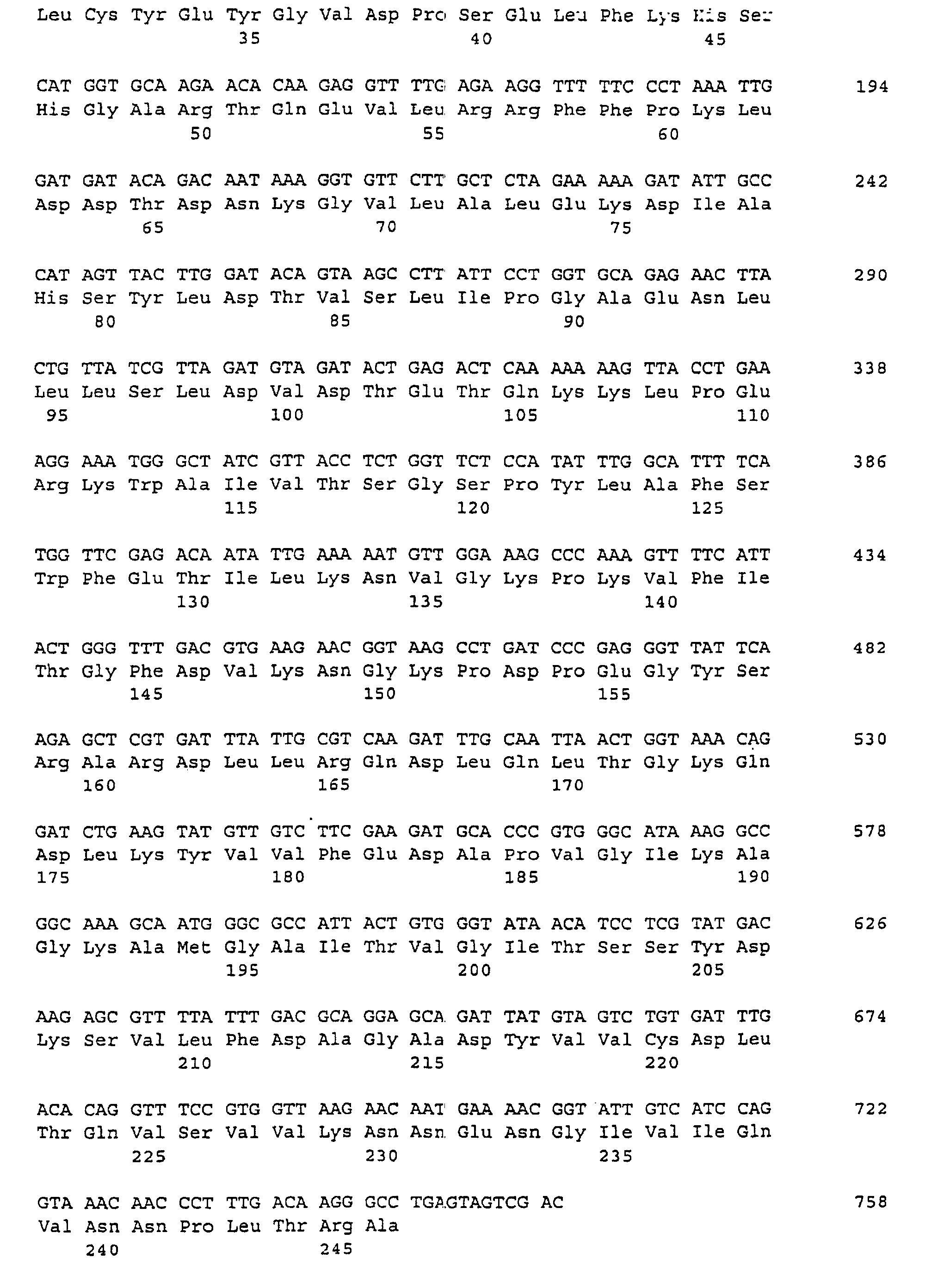
(A) ORGANISMUS: Saccharomyces cerevisiae



Claims (20)
- Rekombinantes DNA-Molekül umfassend(a) regulatorische Sequenzen eines in Pflanzen aktiven Promotors;(b) operativ daran gebunden eine DNA-Sequenz, die ein Protein mit der biologischen Aktivität einer 2-Desoxyglucose-6-Phosphat (2-DOG-6-P) Phosphatase codiert; und(c) operativ daran gebunden regulatorische Sequenzen, die als Transkriptions-Terminations und/oder Polyadenylierungssignale in Pflanzen dienen.
- Rekombinantes DNA-Molekül nach Anspruch 1, wobei die DNA-Sequenz, die ein Protein mit der biologischen Aktivität einer 2-DOG-6-P Phosphatase codiert, ausgewählt ist aus der Gruppe bestehend aus(a) DNA-Sequenzen, die eine Nucleotid-Sequenz umfassen, die die in SEQ ID NO. 2 angegebene Aminosäuresequenz codiert;(b) DNA-Sequenzen, die die in SEQ ID NO. 1 angegebene Nucleotidsequenz umfassen;(c) DNA-Sequenzen umfassend eine Nucleotidsequenz, die mit einem komplementären Strang der Nucleotid-Sequenz von (a) oder (b) hybridisiert;(d) DNA-Sequenzen umfassend eine Nucleotidsequenz, die zu einer Nucleotidsequenz von (c) degeneriert ist, und(e) DNA-Sequenzen, die ein Derivat, Analog oder Fragment einer Nucleotidsequenz von (a), (b), (c) oder (d) ist und für ein Protein codiert, das 2-DOG-6-P Phosphatase Aktivität besitzt.
- Rekombinantes DNA-Molekül nach Anspruch 1 oder 2, wobei die DNA-Sequenz aus Hefe stammt.
- Rekombinantes DNA-Molekül nach einem der Ansprüche 1 bis 3, wobei der Promotor der 35S CaMV Promotor ist.
- Vektor umfassend ein rekombinantes DNA-Molekül nach einem der Ansprüche 1 bis 4.
- Vektor nach Anspruch 5, der mindestens ein weiteres rekombinantes DNA-Molekül enthält.
- Vektor nach Anspruch 6, wobei das weitere rekombinante DNA-Molekül eine DNA-Sequenz enthält, die ein Peptid, Protein, Antisense-, Sense-RNA, virale RNA oder Ribozym codiert.
- Wirtszelle, enthaltend ein rekombinantes DNA-Molekül nach einem der Ansprüche 1 bis 4 oder einen Vektor nach einem der Ansprüche 5 bis 7.
- Kit umfassend ein rekombinantes DNA-Molekül nach einem der Ansprüche 1 bis 4 oder einen Vektor nach einem der Ansprüche 5 bis 7 und gegebenenfalls 2-Desoxyglucose oder eine zu 2-Desoxyglucose funktionell äquivalente chemische Verbindung.
- Verfahren zur Selektion transformierter Pflanzenzellen, das die folgenden Schritte umfaßt:(a) Gewinnung von Pflanzenzellen;(b) Einführung eines rekombinanten DNA-Moleküls nach einem der Ansprüche 1 bis 4 oder eines Vektors nach einem der Ansprüche 5 bis 7 in diese Pflanzenzellen; und(c) Selektion der erfolgreich transformierten Pflanzenzellen auf 2-Desoxyglucose-enthaltenden Medien oder auf Medien, die eine zu 2-Desoxyglucose funktionell äquivalente chemische Verbindung enthalten.
- Verfahren nach Anspruch 10, wobei der Vektor nach einem der Ansprüche 5 bis 7 mittels Agrobacterium tumefaciens in Pflanzenzellen übertragen wird.
- Verfahren nach Anspruch 10, wobei das rekombinante DNA-Molekül nach einem der Ansprüche 1 bis 4 oder der Vektor nach einem der Ansprüche 5 bis 7 mittels Partikel-Bombardment in Pflanzenzellen übertragen wird.
- Transgene Pflanzenzelle enthaltend ein rekombinantes DNA-Molekül nach einem der Ansprüche 1 bis 4 oder einen Vektor nach einem der Ansprüche 5 bis 7 oder hergestellt nach dem Verfahren nach einem der Ansprüche 10 bis 12.
- Pflanzenzelle nach Anspuch 13, die mindestens ein weiteres Fremdgen enthält.
- Pflanzengewebe umfassend Pflanzenzellen nach Anspruch 13 oder 14 oder hergestellt nach dem Verfahren nach einem der Ansprüche 10 bis 12.
- Transgene Pflanze enthaltend eine Pflanzenzelle nach Anspruch 13 oder 14 oder hergestellt nach dem Verfahren nach einem der Ansprüche 10 bis 12.
- Ernteprodukte der Pflanze nach Anspruch 16 umfassend Pflanzenzellen nach Anspruch 13 oder 14.
- Vermehrungsmaterial der Pflanzen nach Anspruch 16, umfassend Pflanzenzellen nach Anspruch 13 oder 14.
- Verwendung eines DNA-Moleküls, das eine DNA-Sequenz umfaßt wie sie in einem der Ansprüche 1 bis 3 definiert ist, eines rekombinanten DNA-Moleküls nach einem der Ansprüche 1 bis 4 oder eines Vektors nach einem der Ansprüche 5 bis 7 zur Herstellung von transgenen Pflanzen, Pflanzenzellen und/oder Gewebe.
- Verwendung eines DNA-Moleküls, das eine DNA-Sequenz umfaßt wie sie in einem der Ansprüche 1 bis 3 definiert ist, eines rekombinanten DNA-Moleküls nach einem der Ansprüche 1 bis 4 oder eines Vektors nach einem der Ansprüche 5 bis 7 als selektierbarer Marker in pflanzlicher Zell- und Gewebekultur und/oder Pflanzenzüchtung.
Priority Applications (1)
| Application Number | Priority Date | Filing Date | Title |
|---|---|---|---|
| EP98919245A EP0973921B1 (de) | 1997-04-09 | 1998-04-09 | 2-desoxyglucose-6-phosphat (2-dog-6-p) phosphatase dna-sequenzen als selektionsmarker in pflanzen |
Applications Claiming Priority (4)
| Application Number | Priority Date | Filing Date | Title |
|---|---|---|---|
| EP97105855A EP0870836A1 (de) | 1997-04-09 | 1997-04-09 | 2-Desoxyglucose-6-Phosphat (2-DOG-6-P) Phosphatase DNA-Sequenzen als Selektionsmarker in Pflanzen |
| EP97105855 | 1997-04-09 | ||
| EP98919245A EP0973921B1 (de) | 1997-04-09 | 1998-04-09 | 2-desoxyglucose-6-phosphat (2-dog-6-p) phosphatase dna-sequenzen als selektionsmarker in pflanzen |
| PCT/EP1998/002069 WO1998045456A1 (de) | 1997-04-09 | 1998-04-09 | 2-desoxyglucose-6-phosphat (2-dog-6-p) phosphatase dna-sequenzen als selektionsmarker in pflanzen |
Publications (2)
| Publication Number | Publication Date |
|---|---|
| EP0973921A1 EP0973921A1 (de) | 2000-01-26 |
| EP0973921B1 true EP0973921B1 (de) | 2001-09-05 |
Family
ID=8226678
Family Applications (2)
| Application Number | Title | Priority Date | Filing Date |
|---|---|---|---|
| EP97105855A Withdrawn EP0870836A1 (de) | 1997-04-09 | 1997-04-09 | 2-Desoxyglucose-6-Phosphat (2-DOG-6-P) Phosphatase DNA-Sequenzen als Selektionsmarker in Pflanzen |
| EP98919245A Expired - Lifetime EP0973921B1 (de) | 1997-04-09 | 1998-04-09 | 2-desoxyglucose-6-phosphat (2-dog-6-p) phosphatase dna-sequenzen als selektionsmarker in pflanzen |
Family Applications Before (1)
| Application Number | Title | Priority Date | Filing Date |
|---|---|---|---|
| EP97105855A Withdrawn EP0870836A1 (de) | 1997-04-09 | 1997-04-09 | 2-Desoxyglucose-6-Phosphat (2-DOG-6-P) Phosphatase DNA-Sequenzen als Selektionsmarker in Pflanzen |
Country Status (14)
| Country | Link |
|---|---|
| US (1) | US6806085B1 (de) |
| EP (2) | EP0870836A1 (de) |
| AR (1) | AR010144A1 (de) |
| AT (1) | ATE205258T1 (de) |
| AU (1) | AU748489B2 (de) |
| CA (1) | CA2307174A1 (de) |
| DE (1) | DE59801391D1 (de) |
| DK (1) | DK0973921T3 (de) |
| ES (1) | ES2163864T3 (de) |
| HU (1) | HUP0004028A3 (de) |
| IL (1) | IL134885A0 (de) |
| NZ (1) | NZ503100A (de) |
| PT (1) | PT973921E (de) |
| WO (1) | WO1998045456A1 (de) |
Families Citing this family (44)
| Publication number | Priority date | Publication date | Assignee | Title |
|---|---|---|---|---|
| US8022272B2 (en) | 2001-07-13 | 2011-09-20 | Sungene Gmbh & Co. Kgaa | Expression cassettes for transgenic expression of nucleic acids |
| US7456335B2 (en) * | 2001-09-03 | 2008-11-25 | Basf Plant Science Gmbh | Nucleic acid sequences and their use in methods for achieving pathogen resistance in plants |
| NL1019308C2 (nl) * | 2001-11-06 | 2003-05-07 | Stichting Tech Wetenschapp | Werkwijze voor het selecteren van genetisch getransformeerde cellen. |
| DE10212892A1 (de) | 2002-03-20 | 2003-10-09 | Basf Plant Science Gmbh | Konstrukte und Verfahren zur Regulation der Genexpression |
| CA2484001A1 (en) | 2002-05-08 | 2003-11-20 | Basf Plant Science Gmbh | Methods for increasing oil content in plants |
| ATE405658T1 (de) | 2002-07-26 | 2008-09-15 | Basf Plant Science Gmbh | Neue selektionsverfahren |
| AU2003267417A1 (en) * | 2002-09-26 | 2004-04-23 | Sungene Gmbh And Co. Kgaa | Protein made of penicillium olsonii, providing resistance against 2-deoxyglucose |
| MXPA06001622A (es) | 2003-08-11 | 2006-07-03 | Kweek En Researchbed Agrico Bv | Plantas resistentes a hongos y sus usos. |
| ATE440947T1 (de) | 2003-12-02 | 2009-09-15 | Basf Se | 2-methyl-6-solanylbenzochinon-methyltransferase als ziel für herbizide |
| JP2008507960A (ja) * | 2004-07-31 | 2008-03-21 | メタノミクス ゲーエムベーハー | より成長が早いかつ/又はより収量が高い生物の作製 |
| CN101001951B (zh) | 2004-08-02 | 2011-06-15 | 巴斯福植物科学有限公司 | 分离转录终止序列的方法 |
| EP2163632A1 (de) | 2004-10-05 | 2010-03-17 | SunGene GmbH | Konstitutive Expressionskassetten zur Regulation der Pflanzenexpression |
| EP1655364A3 (de) | 2004-11-05 | 2006-08-02 | BASF Plant Science GmbH | Expressionskassetten zur bevorzugten Expression in Pflanzensamen |
| EP1662000B1 (de) | 2004-11-25 | 2011-03-30 | SunGene GmbH | Expressionskassetten zur bevorzugten Expression in pflanzlichen Schliesszellen |
| EP1666599A3 (de) | 2004-12-04 | 2006-07-12 | SunGene GmbH | Expressionskassetten zur bevorzugten Expression in Mesophyll- und/oder Epidermiszellen in Pflanzen |
| EP1669455B1 (de) | 2004-12-08 | 2009-10-28 | SunGene GmbH | Expressionskassetten für preferentiell vaskuläre Expression in Pflanzen |
| EP1669456A3 (de) | 2004-12-11 | 2006-07-12 | SunGene GmbH | Expressionskasseten für meristembevorzugte Expression in Pflanzen |
| EP2147977A1 (de) | 2005-02-09 | 2010-01-27 | BASF Plant Science GmbH | Expressionskassetten zur Regulation der Expression in einkeimblättrigen Pflanzen |
| CN101128591B (zh) | 2005-02-26 | 2013-02-13 | 巴斯福植物科学有限公司 | 用于植物中种子偏好性表达的表达盒 |
| CN101137752B (zh) | 2005-03-08 | 2013-04-03 | 巴斯福植物科学有限公司 | 增强表达的内含子序列 |
| ATE552343T1 (de) | 2005-04-19 | 2012-04-15 | Basf Plant Science Gmbh | Endosperm-spezifische expression und/oder expression in keimenden embryos monokotyledoner pflanzen |
| EP1874936B1 (de) | 2005-04-19 | 2013-10-30 | BASF Plant Science GmbH | Verbesserte verfahren zur kontrolle der genexpression |
| AU2006245701B2 (en) | 2005-05-10 | 2011-04-28 | Basf Plant Science Gmbh | Expression cassettes for seed-preferential expression in plants |
| BRPI0612671A2 (pt) | 2005-06-23 | 2010-11-30 | Basf Plant Science Gmbh | métodos melhorados para a produção de plantas férteis zea mays (milho) estavelmente transformadas |
| EP2980220A1 (de) | 2005-09-20 | 2016-02-03 | BASF Plant Science GmbH | Verbesserte verfahren zur steuerung der genexpression |
| CA2628505A1 (en) | 2005-11-08 | 2007-05-18 | Basf Plant Science Gmbh | Use of armadillo repeat (arm1) polynucleotides for obtaining resistance to pathogens in plants |
| EP1979484B1 (de) | 2006-01-12 | 2014-03-19 | BASF Plant Science GmbH | Verwendung von stomatin (stm1)-polynukleotiden zur erreichung einer resistenz gegen krankheitserreger von pflanzen |
| EP2333078A3 (de) * | 2006-03-24 | 2012-01-04 | BASF Plant Science GmbH | Mit der abiotischen Stressreaktion assoziierte Proteine und Homologe |
| CA2669812A1 (en) | 2006-08-30 | 2008-03-06 | Basf Plant Science Gmbh | Method for increasing resistance to pathogens in transgenic plants |
| AU2007306345B2 (en) | 2006-10-12 | 2013-05-23 | Basf Plant Science Gmbh | Method for increasing pathogen resistance in transgenic plants |
| US8344205B2 (en) | 2006-10-13 | 2013-01-01 | Basf Plant Science Gmbh | Plants with increased yield |
| US8373022B2 (en) | 2006-10-24 | 2013-02-12 | Basf Plant Science Gmbh | Methods for increasing the resistance in plants to biotropic fungi |
| US8592652B2 (en) | 2007-01-15 | 2013-11-26 | Basf Plant Science Gmbh | Use of subtilisin-like RNR9 polynucleotide for achieving pathogen resistance in plants |
| CA2675926A1 (en) | 2007-02-16 | 2008-08-21 | Basf Plant Science Gmbh | Nucleic acid sequences for regulation of embryo-specific expression in monocotyledonous plants |
| ES2385451T3 (es) | 2009-07-10 | 2012-07-25 | Freie Universität Berlin | Rock2 y Rock3, dos nuevas variantes de ganancia de función de los receptores de citoquinina AHK2 y AHK3 |
| AU2010270309A1 (en) | 2009-07-10 | 2012-02-02 | Basf Plant Science Company Gmbh | Expression cassettes for endosperm-specific expression in plants |
| EP2275564A1 (de) | 2009-07-17 | 2011-01-19 | Freie Universität Berlin | Mittel und Verfahren zur Produktion von transgenen Pflanzen, die gegenüber Kohlhernie resistent sind |
| WO2011064751A1 (en) | 2009-11-27 | 2011-06-03 | Basf Plant Science Company Gmbh | Chimeric endonucleases and uses thereof |
| US10316304B2 (en) | 2009-11-27 | 2019-06-11 | Basf Plant Science Company Gmbh | Chimeric endonucleases and uses thereof |
| EP2504439B1 (de) | 2009-11-27 | 2016-03-02 | BASF Plant Science Company GmbH | Optimierte endonukleasen und ihre verwendung |
| CN102782141A (zh) | 2009-12-03 | 2012-11-14 | 巴斯夫植物科学有限公司 | 用于在植物中胚-特异性表达的表达盒 |
| EP2612918A1 (de) | 2012-01-06 | 2013-07-10 | BASF Plant Science Company GmbH | In planta-Rekombination |
| KR20220116485A (ko) | 2019-12-16 | 2022-08-23 | 바스프 아그리컬쳐럴 솔루션즈 시드 유에스 엘엘씨 | 쌍을 형성한 닉카제를 이용하는 개선된 게놈 편집 |
| EP4077683A1 (de) | 2019-12-16 | 2022-10-26 | BASF Agricultural Solutions Seed US LLC | Genaue insertion von dna oder mutationen in das genom von weizen |
Family Cites Families (4)
| Publication number | Priority date | Publication date | Assignee | Title |
|---|---|---|---|---|
| JPS527423A (en) * | 1975-07-09 | 1977-01-20 | Meiji Seika Kaisha Ltd | Herbicide |
| EP0289478A3 (de) * | 1987-04-27 | 1990-10-24 | Monsanto Company | Für die Pflanzentransformation geeignete Gentamicin-Markierungsgene |
| GB9304200D0 (en) * | 1993-03-02 | 1993-04-21 | Sandoz Ltd | Improvements in or relating to organic compounds |
| ES2256856T3 (es) * | 1995-04-06 | 2006-07-16 | Seminis Vegetable Seeds, Inc. | Proceso de seccion de celulas transgenicas. |
-
1997
- 1997-04-09 EP EP97105855A patent/EP0870836A1/de not_active Withdrawn
-
1998
- 1998-04-08 AR ARP980101646A patent/AR010144A1/es not_active Application Discontinuation
- 1998-04-09 IL IL13488598A patent/IL134885A0/xx unknown
- 1998-04-09 NZ NZ503100A patent/NZ503100A/xx unknown
- 1998-04-09 AT AT98919245T patent/ATE205258T1/de not_active IP Right Cessation
- 1998-04-09 ES ES98919245T patent/ES2163864T3/es not_active Expired - Lifetime
- 1998-04-09 WO PCT/EP1998/002069 patent/WO1998045456A1/de not_active Ceased
- 1998-04-09 PT PT98919245T patent/PT973921E/pt unknown
- 1998-04-09 CA CA002307174A patent/CA2307174A1/en not_active Abandoned
- 1998-04-09 AU AU72154/98A patent/AU748489B2/en not_active Ceased
- 1998-04-09 EP EP98919245A patent/EP0973921B1/de not_active Expired - Lifetime
- 1998-04-09 HU HU0004028A patent/HUP0004028A3/hu unknown
- 1998-04-09 DE DE59801391T patent/DE59801391D1/de not_active Expired - Fee Related
- 1998-04-09 DK DK98919245T patent/DK0973921T3/da active
-
2000
- 2000-04-25 US US09/558,284 patent/US6806085B1/en not_active Expired - Fee Related
Also Published As
| Publication number | Publication date |
|---|---|
| US6806085B1 (en) | 2004-10-19 |
| ATE205258T1 (de) | 2001-09-15 |
| AU748489B2 (en) | 2002-06-06 |
| WO1998045456A8 (de) | 2000-02-17 |
| PT973921E (pt) | 2002-01-30 |
| NZ503100A (en) | 2002-10-25 |
| ES2163864T3 (es) | 2002-02-01 |
| DK0973921T3 (da) | 2001-12-03 |
| EP0973921A1 (de) | 2000-01-26 |
| AR010144A1 (es) | 2000-05-17 |
| IL134885A0 (en) | 2001-05-20 |
| DE59801391D1 (de) | 2001-10-11 |
| HUP0004028A2 (en) | 2001-03-28 |
| CA2307174A1 (en) | 1998-10-15 |
| AU7215498A (en) | 1998-10-30 |
| HUP0004028A3 (en) | 2002-11-28 |
| EP0870836A1 (de) | 1998-10-14 |
| WO1998045456A1 (de) | 1998-10-15 |
Similar Documents
| Publication | Publication Date | Title |
|---|---|---|
| EP0973921B1 (de) | 2-desoxyglucose-6-phosphat (2-dog-6-p) phosphatase dna-sequenzen als selektionsmarker in pflanzen | |
| DE69836267T2 (de) | Nukleinsäuren aus der artischocke (cynara scolymus), welche für ein enzym mit fruktosylpolymerase-aktivität kodieren | |
| US9756871B2 (en) | TAL-mediated transfer DNA insertion | |
| DE4447387A1 (de) | Debranching-Enzyme aus Pflanzen und DNA-Sequenzen kodierend diese Enzyme | |
| DE69132758T2 (de) | Plasmide zur Herstellung von transgenen Pflanzen welche in Habitus und Ertrag verändert sind | |
| DE69835672T2 (de) | Methoden zur pflanzentransformation | |
| DE4444460A1 (de) | Verfahren zur Steigerung des Ertrags sowie zur Veränderung des Blühverhaltens bei Pflanzen | |
| DE19752647C1 (de) | Reduktiion des Chlorophyllgehaltes in Ölpflanzensamen | |
| EP1272645B1 (de) | Produktion nicht-kariogener zucker in transgenen pflanzen | |
| AU8487898A (en) | Method of genetically transforming banana plants | |
| DE10047286B4 (de) | Isomalt produzierende transgene Pflanze | |
| EP1263971A1 (de) | Verfahren zur beeinflussung der pollenentwicklung durch veränderung des saccharosestoffwechsels | |
| AU727951B2 (en) | Method of changing the composition of the phospholipid produced by the living body and recombinant vector therefor | |
| WO2000060101A1 (de) | Metabolische selektionsmarker für pflanzen | |
| EP1025248A1 (de) | Reduktion des chlorophyllgehaltes in ölpflanzensamen | |
| DE10045182A1 (de) | Verwendung von Palatinase- und Trehalulase-Sequenzen als nutritive Marker in transformierten Zellen | |
| WO1999011805A1 (de) | Rekombinante dna-moleküle und verfahren zur steigerung des ölgehaltes in pflanzen | |
| WO2001059131A2 (de) | Verwendung von palatinase- und trehalulase-sequenzen als nutritive marker in transformierten zellen | |
| DE10026845A1 (de) | Triacylglycerol-Lipasen | |
| DE19732926C2 (de) | DNA-Sequenzen, kodierend einen Glukose-6-phosphat-Phosphat-Translokator, sowie Plasmide, Bakterien, Hefen und Pflanzen, enthaltend diesen Transporter | |
| DE10063879B4 (de) | Nucleinsäuren, die vacuoläre Invertasen codieren, Pflanzenzellen und Pflanzen, die diese enthalten sowie ihre Verwendung | |
| WO2003014364A1 (de) | Verfahren zur beeinflussung der mineralstoffaufnahme in transgenen pflanzen | |
| DE60028751T2 (de) | Herbizidresistente pflanzen | |
| DE10045113A1 (de) | Verfahren zur Beeinflussung der Pollenentwicklung durch Veränderung des Saccharosestoffwechsels | |
| WO2002014363A2 (de) | Beeinflussung der verteilung von metallen in transgenen pflanzen |
Legal Events
| Date | Code | Title | Description |
|---|---|---|---|
| PUAI | Public reference made under article 153(3) epc to a published international application that has entered the european phase |
Free format text: ORIGINAL CODE: 0009012 |
|
| 17P | Request for examination filed |
Effective date: 19990701 |
|
| AK | Designated contracting states |
Kind code of ref document: A1 Designated state(s): AT BE CH DE DK ES FI FR GB GR IE IT LI LU NL PT SE |
|
| GRAG | Despatch of communication of intention to grant |
Free format text: ORIGINAL CODE: EPIDOS AGRA |
|
| 17Q | First examination report despatched |
Effective date: 20001103 |
|
| GRAG | Despatch of communication of intention to grant |
Free format text: ORIGINAL CODE: EPIDOS AGRA |
|
| GRAH | Despatch of communication of intention to grant a patent |
Free format text: ORIGINAL CODE: EPIDOS IGRA |
|
| GRAH | Despatch of communication of intention to grant a patent |
Free format text: ORIGINAL CODE: EPIDOS IGRA |
|
| GRAA | (expected) grant |
Free format text: ORIGINAL CODE: 0009210 |
|
| AK | Designated contracting states |
Kind code of ref document: B1 Designated state(s): AT BE CH DE DK ES FI FR GB GR IE IT LI LU NL PT SE |
|
| REF | Corresponds to: |
Ref document number: 205258 Country of ref document: AT Date of ref document: 20010915 Kind code of ref document: T |
|
| REG | Reference to a national code |
Ref country code: CH Ref legal event code: EP |
|
| REG | Reference to a national code |
Ref country code: CH Ref legal event code: NV Representative=s name: A. BRAUN, BRAUN, HERITIER, ESCHMANN AG PATENTANWAE |
|
| REF | Corresponds to: |
Ref document number: 59801391 Country of ref document: DE Date of ref document: 20011011 |
|
| REG | Reference to a national code |
Ref country code: IE Ref legal event code: FG4D Free format text: GERMAN |
|
| REG | Reference to a national code |
Ref country code: DK Ref legal event code: T3 |
|
| ET | Fr: translation filed | ||
| PG25 | Lapsed in a contracting state [announced via postgrant information from national office to epo] |
Ref country code: GR Free format text: LAPSE BECAUSE OF FAILURE TO SUBMIT A TRANSLATION OF THE DESCRIPTION OR TO PAY THE FEE WITHIN THE PRESCRIBED TIME-LIMIT Effective date: 20011207 |
|
| GBT | Gb: translation of ep patent filed (gb section 77(6)(a)/1977) |
Effective date: 20011117 |
|
| REG | Reference to a national code |
Ref country code: GB Ref legal event code: IF02 |
|
| REG | Reference to a national code |
Ref country code: PT Ref legal event code: SC4A Free format text: AVAILABILITY OF NATIONAL TRANSLATION Effective date: 20011105 |
|
| REG | Reference to a national code |
Ref country code: ES Ref legal event code: FG2A Ref document number: 2163864 Country of ref document: ES Kind code of ref document: T3 |
|
| PGFP | Annual fee paid to national office [announced via postgrant information from national office to epo] |
Ref country code: PT Payment date: 20020401 Year of fee payment: 5 |
|
| PG25 | Lapsed in a contracting state [announced via postgrant information from national office to epo] |
Ref country code: LU Free format text: LAPSE BECAUSE OF NON-PAYMENT OF DUE FEES Effective date: 20020409 |
|
| PGFP | Annual fee paid to national office [announced via postgrant information from national office to epo] |
Ref country code: AT Payment date: 20020419 Year of fee payment: 5 |
|
| PGFP | Annual fee paid to national office [announced via postgrant information from national office to epo] |
Ref country code: FI Payment date: 20020422 Year of fee payment: 5 |
|
| PGFP | Annual fee paid to national office [announced via postgrant information from national office to epo] |
Ref country code: IE Payment date: 20020429 Year of fee payment: 5 |
|
| PLBE | No opposition filed within time limit |
Free format text: ORIGINAL CODE: 0009261 |
|
| STAA | Information on the status of an ep patent application or granted ep patent |
Free format text: STATUS: NO OPPOSITION FILED WITHIN TIME LIMIT |
|
| 26N | No opposition filed | ||
| PG25 | Lapsed in a contracting state [announced via postgrant information from national office to epo] |
Ref country code: IE Free format text: LAPSE BECAUSE OF NON-PAYMENT OF DUE FEES Effective date: 20030409 Ref country code: FI Free format text: LAPSE BECAUSE OF NON-PAYMENT OF DUE FEES Effective date: 20030409 Ref country code: AT Free format text: LAPSE BECAUSE OF NON-PAYMENT OF DUE FEES Effective date: 20030409 |
|
| PGFP | Annual fee paid to national office [announced via postgrant information from national office to epo] |
Ref country code: DK Payment date: 20030425 Year of fee payment: 6 |
|
| PG25 | Lapsed in a contracting state [announced via postgrant information from national office to epo] |
Ref country code: PT Free format text: LAPSE BECAUSE OF NON-PAYMENT OF DUE FEES Effective date: 20031031 |
|
| REG | Reference to a national code |
Ref country code: PT Ref legal event code: MM4A Free format text: LAPSE DUE TO NON-PAYMENT OF FEES Effective date: 20031031 |
|
| REG | Reference to a national code |
Ref country code: IE Ref legal event code: MM4A |
|
| PGFP | Annual fee paid to national office [announced via postgrant information from national office to epo] |
Ref country code: GB Payment date: 20040329 Year of fee payment: 7 |
|
| PGFP | Annual fee paid to national office [announced via postgrant information from national office to epo] |
Ref country code: NL Payment date: 20040419 Year of fee payment: 7 |
|
| PGFP | Annual fee paid to national office [announced via postgrant information from national office to epo] |
Ref country code: FR Payment date: 20040421 Year of fee payment: 7 |
|
| PGFP | Annual fee paid to national office [announced via postgrant information from national office to epo] |
Ref country code: SE Payment date: 20040426 Year of fee payment: 7 Ref country code: CH Payment date: 20040426 Year of fee payment: 7 Ref country code: BE Payment date: 20040426 Year of fee payment: 7 |
|
| PGFP | Annual fee paid to national office [announced via postgrant information from national office to epo] |
Ref country code: ES Payment date: 20040427 Year of fee payment: 7 |
|
| PG25 | Lapsed in a contracting state [announced via postgrant information from national office to epo] |
Ref country code: DK Free format text: LAPSE BECAUSE OF NON-PAYMENT OF DUE FEES Effective date: 20040430 |
|
| PGFP | Annual fee paid to national office [announced via postgrant information from national office to epo] |
Ref country code: DE Payment date: 20040430 Year of fee payment: 7 |
|
| PG25 | Lapsed in a contracting state [announced via postgrant information from national office to epo] |
Ref country code: IT Free format text: LAPSE BECAUSE OF NON-PAYMENT OF DUE FEES Effective date: 20050409 Ref country code: GB Free format text: LAPSE BECAUSE OF NON-PAYMENT OF DUE FEES Effective date: 20050409 |
|
| PG25 | Lapsed in a contracting state [announced via postgrant information from national office to epo] |
Ref country code: SE Free format text: LAPSE BECAUSE OF NON-PAYMENT OF DUE FEES Effective date: 20050410 |
|
| PG25 | Lapsed in a contracting state [announced via postgrant information from national office to epo] |
Ref country code: ES Free format text: LAPSE BECAUSE OF NON-PAYMENT OF DUE FEES Effective date: 20050411 |
|
| PG25 | Lapsed in a contracting state [announced via postgrant information from national office to epo] |
Ref country code: LI Free format text: LAPSE BECAUSE OF NON-PAYMENT OF DUE FEES Effective date: 20050430 Ref country code: CH Free format text: LAPSE BECAUSE OF NON-PAYMENT OF DUE FEES Effective date: 20050430 Ref country code: BE Free format text: LAPSE BECAUSE OF NON-PAYMENT OF DUE FEES Effective date: 20050430 |
|
| BERE | Be: lapsed |
Owner name: *IPK GATERSLEBEN Effective date: 20050430 |
|
| PG25 | Lapsed in a contracting state [announced via postgrant information from national office to epo] |
Ref country code: NL Free format text: LAPSE BECAUSE OF NON-PAYMENT OF DUE FEES Effective date: 20051101 Ref country code: DE Free format text: LAPSE BECAUSE OF NON-PAYMENT OF DUE FEES Effective date: 20051101 |
|
| EUG | Se: european patent has lapsed | ||
| REG | Reference to a national code |
Ref country code: CH Ref legal event code: PL |
|
| GBPC | Gb: european patent ceased through non-payment of renewal fee |
Effective date: 20050409 |
|
| PG25 | Lapsed in a contracting state [announced via postgrant information from national office to epo] |
Ref country code: FR Free format text: LAPSE BECAUSE OF NON-PAYMENT OF DUE FEES Effective date: 20051230 |
|
| NLV4 | Nl: lapsed or anulled due to non-payment of the annual fee |
Effective date: 20051101 |
|
| REG | Reference to a national code |
Ref country code: FR Ref legal event code: ST Effective date: 20051230 |
|
| REG | Reference to a national code |
Ref country code: ES Ref legal event code: FD2A Effective date: 20050411 |
|
| BERE | Be: lapsed |
Owner name: *IPK GATERSLEBEN Effective date: 20050430 |