EP0974445A2 - Verfahren zur Herstellung von dünnen, rohrförmigen, an einem Ende geschlossenen Gegenständen aus thermoplastischen Elastomeren - Google Patents
Verfahren zur Herstellung von dünnen, rohrförmigen, an einem Ende geschlossenen Gegenständen aus thermoplastischen Elastomeren Download PDFInfo
- Publication number
- EP0974445A2 EP0974445A2 EP99203462A EP99203462A EP0974445A2 EP 0974445 A2 EP0974445 A2 EP 0974445A2 EP 99203462 A EP99203462 A EP 99203462A EP 99203462 A EP99203462 A EP 99203462A EP 0974445 A2 EP0974445 A2 EP 0974445A2
- Authority
- EP
- European Patent Office
- Prior art keywords
- preform
- plug
- mold
- thermoplastic elastomer
- drawn
- Prior art date
- Legal status (The legal status is an assumption and is not a legal conclusion. Google has not performed a legal analysis and makes no representation as to the accuracy of the status listed.)
- Granted
Links
Images


Classifications
-
- B—PERFORMING OPERATIONS; TRANSPORTING
- B29—WORKING OF PLASTICS; WORKING OF SUBSTANCES IN A PLASTIC STATE IN GENERAL
- B29C—SHAPING OR JOINING OF PLASTICS; SHAPING OF MATERIAL IN A PLASTIC STATE, NOT OTHERWISE PROVIDED FOR; AFTER-TREATMENT OF THE SHAPED PRODUCTS, e.g. REPAIRING
- B29C71/00—After-treatment of articles without altering their shape; Apparatus therefor
- B29C71/0063—After-treatment of articles without altering their shape; Apparatus therefor for changing crystallisation
-
- A—HUMAN NECESSITIES
- A61—MEDICAL OR VETERINARY SCIENCE; HYGIENE
- A61F—FILTERS IMPLANTABLE INTO BLOOD VESSELS; PROSTHESES; DEVICES PROVIDING PATENCY TO, OR PREVENTING COLLAPSING OF, TUBULAR STRUCTURES OF THE BODY, e.g. STENTS; ORTHOPAEDIC, NURSING OR CONTRACEPTIVE DEVICES; FOMENTATION; TREATMENT OR PROTECTION OF EYES OR EARS; BANDAGES, DRESSINGS OR ABSORBENT PADS; FIRST-AID KITS
- A61F6/00—Contraceptive devices; Pessaries; Applicators therefor
- A61F6/02—Contraceptive devices; Pessaries; Applicators therefor for use by males
- A61F6/04—Condoms, sheaths or the like, e.g. combined with devices protecting against contagion
-
- B—PERFORMING OPERATIONS; TRANSPORTING
- B29—WORKING OF PLASTICS; WORKING OF SUBSTANCES IN A PLASTIC STATE IN GENERAL
- B29B—PREPARATION OR PRETREATMENT OF THE MATERIAL TO BE SHAPED; MAKING GRANULES OR PREFORMS; RECOVERY OF PLASTICS OR OTHER CONSTITUENTS OF WASTE MATERIAL CONTAINING PLASTICS
- B29B11/00—Making preforms
- B29B11/06—Making preforms by moulding the material
-
- B—PERFORMING OPERATIONS; TRANSPORTING
- B29—WORKING OF PLASTICS; WORKING OF SUBSTANCES IN A PLASTIC STATE IN GENERAL
- B29B—PREPARATION OR PRETREATMENT OF THE MATERIAL TO BE SHAPED; MAKING GRANULES OR PREFORMS; RECOVERY OF PLASTICS OR OTHER CONSTITUENTS OF WASTE MATERIAL CONTAINING PLASTICS
- B29B13/00—Conditioning or physical treatment of the material to be shaped
- B29B13/02—Conditioning or physical treatment of the material to be shaped by heating
- B29B13/023—Half-products, e.g. films, plates
-
- B—PERFORMING OPERATIONS; TRANSPORTING
- B29—WORKING OF PLASTICS; WORKING OF SUBSTANCES IN A PLASTIC STATE IN GENERAL
- B29C—SHAPING OR JOINING OF PLASTICS; SHAPING OF MATERIAL IN A PLASTIC STATE, NOT OTHERWISE PROVIDED FOR; AFTER-TREATMENT OF THE SHAPED PRODUCTS, e.g. REPAIRING
- B29C43/00—Compression moulding, i.e. applying external pressure to flow the moulding material; Apparatus therefor
- B29C43/006—Pressing and sintering powders, granules or fibres
-
- B—PERFORMING OPERATIONS; TRANSPORTING
- B29—WORKING OF PLASTICS; WORKING OF SUBSTANCES IN A PLASTIC STATE IN GENERAL
- B29C—SHAPING OR JOINING OF PLASTICS; SHAPING OF MATERIAL IN A PLASTIC STATE, NOT OTHERWISE PROVIDED FOR; AFTER-TREATMENT OF THE SHAPED PRODUCTS, e.g. REPAIRING
- B29C51/00—Shaping by thermoforming, i.e. shaping sheets or sheet like preforms after heating, e.g. shaping sheets in matched moulds or by deep-drawing; Apparatus therefor
- B29C51/04—Combined thermoforming and prestretching, e.g. biaxial stretching
-
- B—PERFORMING OPERATIONS; TRANSPORTING
- B29—WORKING OF PLASTICS; WORKING OF SUBSTANCES IN A PLASTIC STATE IN GENERAL
- B29C—SHAPING OR JOINING OF PLASTICS; SHAPING OF MATERIAL IN A PLASTIC STATE, NOT OTHERWISE PROVIDED FOR; AFTER-TREATMENT OF THE SHAPED PRODUCTS, e.g. REPAIRING
- B29C51/00—Shaping by thermoforming, i.e. shaping sheets or sheet like preforms after heating, e.g. shaping sheets in matched moulds or by deep-drawing; Apparatus therefor
- B29C51/08—Deep drawing or matched-mould forming, i.e. using mechanical means only
-
- B—PERFORMING OPERATIONS; TRANSPORTING
- B29—WORKING OF PLASTICS; WORKING OF SUBSTANCES IN A PLASTIC STATE IN GENERAL
- B29C—SHAPING OR JOINING OF PLASTICS; SHAPING OF MATERIAL IN A PLASTIC STATE, NOT OTHERWISE PROVIDED FOR; AFTER-TREATMENT OF THE SHAPED PRODUCTS, e.g. REPAIRING
- B29C51/00—Shaping by thermoforming, i.e. shaping sheets or sheet like preforms after heating, e.g. shaping sheets in matched moulds or by deep-drawing; Apparatus therefor
- B29C51/10—Forming by pressure difference, e.g. vacuum
-
- B—PERFORMING OPERATIONS; TRANSPORTING
- B29—WORKING OF PLASTICS; WORKING OF SUBSTANCES IN A PLASTIC STATE IN GENERAL
- B29C—SHAPING OR JOINING OF PLASTICS; SHAPING OF MATERIAL IN A PLASTIC STATE, NOT OTHERWISE PROVIDED FOR; AFTER-TREATMENT OF THE SHAPED PRODUCTS, e.g. REPAIRING
- B29C67/00—Shaping techniques not covered by groups B29C39/00 - B29C65/00, B29C70/00 or B29C73/00
- B29C67/0003—Moulding articles between moving mould surfaces, e.g. turning surfaces
-
- B—PERFORMING OPERATIONS; TRANSPORTING
- B29—WORKING OF PLASTICS; WORKING OF SUBSTANCES IN A PLASTIC STATE IN GENERAL
- B29C—SHAPING OR JOINING OF PLASTICS; SHAPING OF MATERIAL IN A PLASTIC STATE, NOT OTHERWISE PROVIDED FOR; AFTER-TREATMENT OF THE SHAPED PRODUCTS, e.g. REPAIRING
- B29C71/00—After-treatment of articles without altering their shape; Apparatus therefor
- B29C71/02—Thermal after-treatment
-
- C—CHEMISTRY; METALLURGY
- C08—ORGANIC MACROMOLECULAR COMPOUNDS; THEIR PREPARATION OR CHEMICAL WORKING-UP; COMPOSITIONS BASED THEREON
- C08J—WORKING-UP; GENERAL PROCESSES OF COMPOUNDING; AFTER-TREATMENT NOT COVERED BY SUBCLASSES C08B, C08C, C08F, C08G or C08H
- C08J5/00—Manufacture of articles or shaped materials containing macromolecular substances
- C08J5/18—Manufacture of films or sheets
-
- B—PERFORMING OPERATIONS; TRANSPORTING
- B29—WORKING OF PLASTICS; WORKING OF SUBSTANCES IN A PLASTIC STATE IN GENERAL
- B29C—SHAPING OR JOINING OF PLASTICS; SHAPING OF MATERIAL IN A PLASTIC STATE, NOT OTHERWISE PROVIDED FOR; AFTER-TREATMENT OF THE SHAPED PRODUCTS, e.g. REPAIRING
- B29C35/00—Heating, cooling or curing, e.g. crosslinking or vulcanising; Apparatus therefor
- B29C35/02—Heating or curing, e.g. crosslinking or vulcanizing during moulding, e.g. in a mould
- B29C2035/0283—Thermal pretreatment of the plastics material
-
- B—PERFORMING OPERATIONS; TRANSPORTING
- B29—WORKING OF PLASTICS; WORKING OF SUBSTANCES IN A PLASTIC STATE IN GENERAL
- B29C—SHAPING OR JOINING OF PLASTICS; SHAPING OF MATERIAL IN A PLASTIC STATE, NOT OTHERWISE PROVIDED FOR; AFTER-TREATMENT OF THE SHAPED PRODUCTS, e.g. REPAIRING
- B29C43/00—Compression moulding, i.e. applying external pressure to flow the moulding material; Apparatus therefor
- B29C43/02—Compression moulding, i.e. applying external pressure to flow the moulding material; Apparatus therefor of articles of definite length, i.e. discrete articles
- B29C43/04—Compression moulding, i.e. applying external pressure to flow the moulding material; Apparatus therefor of articles of definite length, i.e. discrete articles using movable moulds
- B29C2043/043—Compression moulding, i.e. applying external pressure to flow the moulding material; Apparatus therefor of articles of definite length, i.e. discrete articles using movable moulds rotating on their own axis without linear displacement
-
- B—PERFORMING OPERATIONS; TRANSPORTING
- B29—WORKING OF PLASTICS; WORKING OF SUBSTANCES IN A PLASTIC STATE IN GENERAL
- B29C—SHAPING OR JOINING OF PLASTICS; SHAPING OF MATERIAL IN A PLASTIC STATE, NOT OTHERWISE PROVIDED FOR; AFTER-TREATMENT OF THE SHAPED PRODUCTS, e.g. REPAIRING
- B29C71/00—After-treatment of articles without altering their shape; Apparatus therefor
- B29C71/02—Thermal after-treatment
- B29C2071/022—Annealing
-
- B—PERFORMING OPERATIONS; TRANSPORTING
- B29—WORKING OF PLASTICS; WORKING OF SUBSTANCES IN A PLASTIC STATE IN GENERAL
- B29C—SHAPING OR JOINING OF PLASTICS; SHAPING OF MATERIAL IN A PLASTIC STATE, NOT OTHERWISE PROVIDED FOR; AFTER-TREATMENT OF THE SHAPED PRODUCTS, e.g. REPAIRING
- B29C2949/00—Indexing scheme relating to blow-moulding
- B29C2949/07—Preforms or parisons characterised by their configuration
- B29C2949/081—Specified dimensions, e.g. values or ranges
- B29C2949/0811—Wall thickness
-
- B—PERFORMING OPERATIONS; TRANSPORTING
- B29—WORKING OF PLASTICS; WORKING OF SUBSTANCES IN A PLASTIC STATE IN GENERAL
- B29C—SHAPING OR JOINING OF PLASTICS; SHAPING OF MATERIAL IN A PLASTIC STATE, NOT OTHERWISE PROVIDED FOR; AFTER-TREATMENT OF THE SHAPED PRODUCTS, e.g. REPAIRING
- B29C2949/00—Indexing scheme relating to blow-moulding
- B29C2949/07—Preforms or parisons characterised by their configuration
- B29C2949/0861—Other specified values, e.g. values or ranges
- B29C2949/0862—Crystallinity
-
- B—PERFORMING OPERATIONS; TRANSPORTING
- B29—WORKING OF PLASTICS; WORKING OF SUBSTANCES IN A PLASTIC STATE IN GENERAL
- B29C—SHAPING OR JOINING OF PLASTICS; SHAPING OF MATERIAL IN A PLASTIC STATE, NOT OTHERWISE PROVIDED FOR; AFTER-TREATMENT OF THE SHAPED PRODUCTS, e.g. REPAIRING
- B29C43/00—Compression moulding, i.e. applying external pressure to flow the moulding material; Apparatus therefor
- B29C43/02—Compression moulding, i.e. applying external pressure to flow the moulding material; Apparatus therefor of articles of definite length, i.e. discrete articles
- B29C43/021—Compression moulding, i.e. applying external pressure to flow the moulding material; Apparatus therefor of articles of definite length, i.e. discrete articles characterised by the shape of the surface
-
- B—PERFORMING OPERATIONS; TRANSPORTING
- B29—WORKING OF PLASTICS; WORKING OF SUBSTANCES IN A PLASTIC STATE IN GENERAL
- B29C—SHAPING OR JOINING OF PLASTICS; SHAPING OF MATERIAL IN A PLASTIC STATE, NOT OTHERWISE PROVIDED FOR; AFTER-TREATMENT OF THE SHAPED PRODUCTS, e.g. REPAIRING
- B29C43/00—Compression moulding, i.e. applying external pressure to flow the moulding material; Apparatus therefor
- B29C43/22—Compression moulding, i.e. applying external pressure to flow the moulding material; Apparatus therefor of articles of indefinite length
- B29C43/24—Calendering
-
- B—PERFORMING OPERATIONS; TRANSPORTING
- B29—WORKING OF PLASTICS; WORKING OF SUBSTANCES IN A PLASTIC STATE IN GENERAL
- B29C—SHAPING OR JOINING OF PLASTICS; SHAPING OF MATERIAL IN A PLASTIC STATE, NOT OTHERWISE PROVIDED FOR; AFTER-TREATMENT OF THE SHAPED PRODUCTS, e.g. REPAIRING
- B29C67/00—Shaping techniques not covered by groups B29C39/00 - B29C65/00, B29C70/00 or B29C73/00
- B29C67/02—Moulding by agglomerating
- B29C67/04—Sintering
-
- B—PERFORMING OPERATIONS; TRANSPORTING
- B29—WORKING OF PLASTICS; WORKING OF SUBSTANCES IN A PLASTIC STATE IN GENERAL
- B29K—INDEXING SCHEME ASSOCIATED WITH SUBCLASSES B29B, B29C OR B29D, RELATING TO MOULDING MATERIALS OR TO MATERIALS FOR MOULDS, REINFORCEMENTS, FILLERS OR PREFORMED PARTS, e.g. INSERTS
- B29K2019/00—Use of rubber not provided for in a single one of main groups B29K2007/00 - B29K2011/00, as moulding material
-
- B—PERFORMING OPERATIONS; TRANSPORTING
- B29—WORKING OF PLASTICS; WORKING OF SUBSTANCES IN A PLASTIC STATE IN GENERAL
- B29K—INDEXING SCHEME ASSOCIATED WITH SUBCLASSES B29B, B29C OR B29D, RELATING TO MOULDING MATERIALS OR TO MATERIALS FOR MOULDS, REINFORCEMENTS, FILLERS OR PREFORMED PARTS, e.g. INSERTS
- B29K2075/00—Use of PU, i.e. polyureas or polyurethanes or derivatives thereof, as moulding material
-
- B—PERFORMING OPERATIONS; TRANSPORTING
- B29—WORKING OF PLASTICS; WORKING OF SUBSTANCES IN A PLASTIC STATE IN GENERAL
- B29K—INDEXING SCHEME ASSOCIATED WITH SUBCLASSES B29B, B29C OR B29D, RELATING TO MOULDING MATERIALS OR TO MATERIALS FOR MOULDS, REINFORCEMENTS, FILLERS OR PREFORMED PARTS, e.g. INSERTS
- B29K2105/00—Condition, form or state of moulded material or of the material to be shaped
- B29K2105/25—Solid
- B29K2105/251—Particles, powder or granules
-
- B—PERFORMING OPERATIONS; TRANSPORTING
- B29—WORKING OF PLASTICS; WORKING OF SUBSTANCES IN A PLASTIC STATE IN GENERAL
- B29K—INDEXING SCHEME ASSOCIATED WITH SUBCLASSES B29B, B29C OR B29D, RELATING TO MOULDING MATERIALS OR TO MATERIALS FOR MOULDS, REINFORCEMENTS, FILLERS OR PREFORMED PARTS, e.g. INSERTS
- B29K2105/00—Condition, form or state of moulded material or of the material to be shaped
- B29K2105/25—Solid
- B29K2105/253—Preform
-
- B—PERFORMING OPERATIONS; TRANSPORTING
- B29—WORKING OF PLASTICS; WORKING OF SUBSTANCES IN A PLASTIC STATE IN GENERAL
- B29K—INDEXING SCHEME ASSOCIATED WITH SUBCLASSES B29B, B29C OR B29D, RELATING TO MOULDING MATERIALS OR TO MATERIALS FOR MOULDS, REINFORCEMENTS, FILLERS OR PREFORMED PARTS, e.g. INSERTS
- B29K2995/00—Properties of moulding materials, reinforcements, fillers, preformed parts or moulds
- B29K2995/0037—Other properties
- B29K2995/0041—Crystalline
-
- B—PERFORMING OPERATIONS; TRANSPORTING
- B29—WORKING OF PLASTICS; WORKING OF SUBSTANCES IN A PLASTIC STATE IN GENERAL
- B29L—INDEXING SCHEME ASSOCIATED WITH SUBCLASS B29C, RELATING TO PARTICULAR ARTICLES
- B29L2023/00—Tubular articles
-
- B—PERFORMING OPERATIONS; TRANSPORTING
- B29—WORKING OF PLASTICS; WORKING OF SUBSTANCES IN A PLASTIC STATE IN GENERAL
- B29L—INDEXING SCHEME ASSOCIATED WITH SUBCLASS B29C, RELATING TO PARTICULAR ARTICLES
- B29L2023/00—Tubular articles
- B29L2023/22—Tubes or pipes, i.e. rigid
-
- B—PERFORMING OPERATIONS; TRANSPORTING
- B29—WORKING OF PLASTICS; WORKING OF SUBSTANCES IN A PLASTIC STATE IN GENERAL
- B29L—INDEXING SCHEME ASSOCIATED WITH SUBCLASS B29C, RELATING TO PARTICULAR ARTICLES
- B29L2031/00—Other particular articles
- B29L2031/753—Medical equipment; Accessories therefor
- B29L2031/7538—Condoms
-
- C—CHEMISTRY; METALLURGY
- C08—ORGANIC MACROMOLECULAR COMPOUNDS; THEIR PREPARATION OR CHEMICAL WORKING-UP; COMPOSITIONS BASED THEREON
- C08J—WORKING-UP; GENERAL PROCESSES OF COMPOUNDING; AFTER-TREATMENT NOT COVERED BY SUBCLASSES C08B, C08C, C08F, C08G or C08H
- C08J2327/00—Characterised by the use of homopolymers or copolymers of compounds having one or more unsaturated aliphatic radicals, each having only one carbon-to-carbon double bond, and at least one being terminated by a halogen; Derivatives of such polymers
- C08J2327/02—Characterised by the use of homopolymers or copolymers of compounds having one or more unsaturated aliphatic radicals, each having only one carbon-to-carbon double bond, and at least one being terminated by a halogen; Derivatives of such polymers not modified by chemical after-treatment
- C08J2327/12—Characterised by the use of homopolymers or copolymers of compounds having one or more unsaturated aliphatic radicals, each having only one carbon-to-carbon double bond, and at least one being terminated by a halogen; Derivatives of such polymers not modified by chemical after-treatment containing fluorine atoms
- C08J2327/18—Homopolymers or copolymers of tetrafluoroethylene
-
- Y—GENERAL TAGGING OF NEW TECHNOLOGICAL DEVELOPMENTS; GENERAL TAGGING OF CROSS-SECTIONAL TECHNOLOGIES SPANNING OVER SEVERAL SECTIONS OF THE IPC; TECHNICAL SUBJECTS COVERED BY FORMER USPC CROSS-REFERENCE ART COLLECTIONS [XRACs] AND DIGESTS
- Y10—TECHNICAL SUBJECTS COVERED BY FORMER USPC
- Y10S—TECHNICAL SUBJECTS COVERED BY FORMER USPC CROSS-REFERENCE ART COLLECTIONS [XRACs] AND DIGESTS
- Y10S128/00—Surgery
- Y10S128/917—Body fluid, devices for protection therefrom, e.g. aids, hepatitus
- Y10S128/918—Condoms and shields
Definitions
- Thin walled tubular articles of thermoplastic elastomer are known in the art to provide strong, thin, flexible protective barriers.
- Protective barriers having these characteristics are particularly useful to protect skin surfaces from unwanted contact or contamination and, yet, to preserve sensitivity of touch, as with condoms or finger cots used in medical examination.
- U.S. Pat. No. 4,684,490 Taller, et al . describes a condom manufactured from certain polyurethane thermoplastic elastomers.
- a mandrel is coated with an emulsion of elastomeric material prepolymer and the coating is cured at elevated temperature.
- thermoplastic elastomers Additional methods to manufacture condoms from thermoplastic elastomers are generally known.
- the thermoplastic elastomer is blown into very thin film, the film is cut into appropriate preforms and the segments are heat sealed to form a condom.
- heating to substantially eliminate the crystalline regions is to a temperature of from about 190 to 210°C.
- Preferably said cooling whereby viscosity and elasticity are recovered within a range that the preform can be drawn is to a viscosity between about 75,000 and 150,000 Poise and an elastic modulus of between about 600,000 and 1,200,000 dyne/cm 2 .
- the present method includes forming or drawing the prepared preform into a thin-walled, closed-ended, tubular article having a wall thickness of between about 0.005mm and 0.25mm.
- the method can comprise:
- a plug assembly for use in plug assisted drawing of thin walled, closed-ended, tubular articles of thermoplastic elastomer can alternatively comprise an axially centered rod, said rod attached to a first face of an axially centered, disc shaped plug, said plug having a second face opposite said first face and extending from said second face, an axially centered contact projection.
- the present preform can be used to prepare a condom formed from a polyesterurethane thermoplastic elastomer, said elastomer characterized by a melt index, measured at 210°C under a 3800 g load, in the range of from 24-36 g/10 min; 10 - 25% by weight MDI; 0.1 - 5% by weight 1,4-butanediol; 70 - 89.9% by weight polybutylene/hexylene adipate having an average molecular weight of 1000 - 3000 Daltons; and 0-5% by weight lubricant.
- a melt index measured at 210°C under a 3800 g load
- Thermoplastic elastomers are block copolymers having hard and soft blocks, or domains, in the polymer molecule, or compound.
- the soft domains provide the rubber like elastomeric properties while the hard or crystalline domains act as mechanical crosslinks, tying down the rubbery domains.
- the hard domains of the thermoplastic elastomer become amorphous or soften to yield a melt that can be easily processed by injection molding, extrusion, vacuum molding, etc.
- thermoplastic elastomers herein include polyurethanes, polyetherurethaneureas, polyetherurethanes, polyesterurethanes, polyester/polyether block copolymers, styrene/diene/styrene block copolymers, etc.
- the present invention may be applied to a broad range of thermoplastic elastomers, as the suitability of any given thermoplastic elastomer is more appropriately judged based on its physical properties than on its particular type. Controlling the physical properties of any thermoplastic elastomer is an art specific to that thermoplastic elastomer.
- thermoplastic elastomer the physical properties of any thermoplastic elastomer are dependent upon hard block type, soft block type, block arrangement in the polymer, average polymer molecular weight, average hard block content with average number of repeating units, average soft block content with average number of repeating units and the use of additives, particularly, waxes, to improve processability, and, possibly, impact modifiers, to improve tear strength.
- a thermoplastic elastomer should have a Shore A hardness between about 60 and 80, and preferably, between about 60 and 75.
- the tensile stress of the thermoplastic elastomer at 100% elongation should be between about 50 and 600 psi, and preferably, between about 100 and 500 psi.
- the equivalent 300% modulus should be between about 450 and 1100 psi, and preferably, between about 500 and 900 psi.
- the ultimate elongation should vary in the range of from about 400% to 800% and the compression set, 24 hrs at 23°C, should be no more than 25%.
- the thermoplastic elastomer should have excellent resistance to organic solvents. All of the above ranges, unless otherwise stated, are measured at 23°C.
- thermoplastic elastomer it should not have a distinct melting point.
- an indistinct melting point is one factor in having a melt which is formable, yet will retain a shape that it has been given. Within the range of an indistinct melting point, a melt will exhibit a "green strength".
- An indistinct melting point is a characteristic of a melt containing a range of molecular weight polymers.
- thermoplastic elastomer is a block copolymer of polyurethane hard blocks with polyester soft blocks. These thermoplastic elastomers have been found to have excellent physical strength, superior abrasion and tear resistance, and excellent tensile strength. In addition these thermoplastic elastomers show excellent resistance to organic solvents.
- Low modulus and low set are achieved in the preferred polyesterurethane by selecting, as the soft block, a long chain diol or combination of diols, which tend to crystallize little at ambient temperature; and hard block content of no more than 25%.
- the rigid hard block is achieved by reaction of a polyisocyanate and a short chain diol.
- Suitable chain extenders are lower aliphatic or short chain glycols having from about 2 to about 6 carbon atoms.
- suitable chain extenders include, for instance, diethylene glycol, propylene glycol, dipropylene glycol, 1,4-butane diol, 1,6-hexane diol, 1,3-butane diol, 1,5-pentane diol, 1,4-cyclohexane-dimethanol, hydroquinone di(hydroxyethyl)ether, and the like, as well as combinations thereof, with 1,4-butane diol being preferred.
- the dicarboxylic acids can be aliphatic, cycloaliphatic, aromatic, or combinations thereof. Suitable dicarboxylic acids which may be used alone or in mixtures usually have a total of from 4 to 15 carbon atoms and include: succinic, glutaric, adipic, pimelic, suberic, azelaic, sebacic, dodecanoic, isophthalic, terephthalic cyclohexane dicarboxylic, and the like. Anhydrides of the above dicarboxylic acids, such as phthalic anhydride, or the like, can also be utilized, with adipic acid being preferred.
- the ester-forming glycols can be aliphatic, aromatic, or combinations thereof; have a total of from 2 to 12 carbon atoms; and include; ethylene glycol, 1,2-propylene glycol, 1,3-propanediol, 1,3-butylene glycol, 1,4-butanediol, 1,5-pentanediol, 1,6-hexanediol, 2,2-dimethylpropane-1,3-diol, 1,4-cyclohexanedimethanol, decamethylene glycol, dodecamethylene glycol, and combinations thereof.
- the combination of 1,4-butanediol with 1,6-hexanediol being the preferred glycol.
- the preferred polyesters of the preferred polyesterurethane are mixed esters such as polybutylene/hexylene adipate, polybutylene adipate/azelate.
- the most preferred polyester is a polybutylene hexylene adipate.
- polyester intermediates In addition to the above polyester intermediates, numerous other types of polyester intermediates known to the art and to the literature can be utilized, including those having different molecular weights and/or contain branch polyesters therein.
- polycaprolactone diols can be used.
- These are known polyester reaction products of lactones and bifunctional compounds having two reactive sites capable of opening the lactone ring.
- These bifunctional materials may be represented by the formula HX-R-XH wherein R is an organic radical which can be aliphatic, cycloaliphatic aromatic or hetercyclic and X is O, NH and NR where R is a hydrocarbon radical which can be alkyl, aryl, aralkyl and cycloalkyl.
- the intermediate such as hydroxyl terminated polyester
- the equivalent amount of diisocyanates to the total amount of hydroxyl containing components, that is, the hydroxyl terminated polyester, and the chain extender is from about 0.95 to about 1.13, and desirably from about 0.98 to about 1.06.
- the urethane can be made in a conventional two-step process wherein initially a prepolymer is made from the polyisocyanate and the intermediate, with the prepolymer subsequently being reacted with the chain extender.
- the equivalent ratio of the one or more polyisocyanates to the hydroxyl terminated intermediate is generally a sufficient amount such that, upon subsequent chain extension with a suitable chain extender, the overall equivalent ratio of the hydroxyl terminated compound to one or more polyisocyanates is approximately 0.95 to about 1.065 and the like.
- the polyurethane can be blended with various additives such as, for example, antioxidants, stabilizers, lubricants, process aids. Most preferably, the polyurethane is blended with 0 to about 5 weight percent of a lubricant composition. Any compatible or appropriate lubricant composition giving the desired characteristics can be used. Suitable examples include fatty bisamide or fatty esters.
- the preferred polyesterurethane thermoplastic elastomer may be produced in a two step process.
- polyester blocks are produced by reacting the diol and the diacid to produce diol polyester blocks.
- the diol polyester blocks are reacted with a mix of diisocyanate and at least one diol monomer, the latter two in appropriate ratio to the polyester block and to each other to produce the desired molecular weight for the polymer and the hard blocks.
- the most preferred process for making the thermoplastic polyesterurethane is a "one shot" polymerization process.
- the diols, diisocyanate and chain extenders are reacted at a temperature above 100 °C and desirably above 120 °C. The reaction is exothermic and results in the preferred polyesterurethane.
- a specific polyesterurethane thermoplastic elastomer has a molecular weight in the range of from 145,000 to 190,000 Daltons, corresponding to a melt index, measured at 210°C under a 3800 g test load, in the range of from 24-36 g/10 min; 10 - 25% by weight MDI; 0.1 - 5% by weight 1,4-butanediol; 70 - 89.9% by weight polybutylene/hexylene adipate having an average molecular weight of 1000 - 3000 Daltons; and 0 - 5% by weight lubricant.
- This specific polyesterurethane has the properties of Table I.
- the articles are formed from the thermoplastic elastomer, firstly, in a preform operation and, secondly, in a plug assisted drawing operation.
- the thermoplastic elastomer is made into an appropriate preform and heated to a suitable temperature for plug assisted drawing.
- the plug assisted drawing operation the preform is drawn with a plug assist into the thin walled tubular articles herein.
- the articles may be annealed to remove residual stress.
- thermoplastic elastomer is heated to eliminate the crystalline phase and thereby, substantially, the elasticity; that the thermoplastic elastomer is shaped into a preform having essentially two opposing substantially coplanar faces; that the preform is cooled, recovering viscosity and elasticity within a range that the preform can be drawn; and that the preform is positioned over the mold cavity for drawing with plug assist.
- the preform may take a variety of shapes with the functional requirement being that the preform is useful in a plug assisted drawing apparatus of the type disclosed herein.
- the preform should have essentially two opposing substantially coplanar faces which, when restated, is intended to mean that the preform is a thin flat piece of thermoplastic elastomer.
- the preform might be a square panel or a round disc which is cut and/or stamped from a larger extruded sheet or the preform might be a ribbon or sheet from which the article is cut at the time of plug assisted drawing.
- the extrusion, molding or stamping of the preform might be performed at the site of the plug assisted drawing operation and it may even be advantageous to integrate the two operations.
- the preform may simply have planar faces or the face of the preform may be profiled to obtain some advantage in thermoplastic elastomer melt distribution in the mold during the plug assisted drawing operation.
- FIGS 1a and 1b and figures 2a and 2b there are shown possible disc-shaped preforms having a profiled surface which might be advantageously employed herein. Although it is well within the ability of a person skilled in the art to choose an appropriate shape and size for a preform given a particular product, it is recommended that preforms herein have a thickness no greater than about 5 mm and no less than about 0.5 mm, and preferably between 1 and 2.5 mm.
- the heating was carried out to a temperature between 190 and 210°C and the melt was cooled for drawing to a temperature between 145 and 185°C and preferably between 150 and 170°C.
- This temperature range for drawing corresponds roughly to a melt viscosity (i.e. complex viscosity), as measured with a Rheometrics Mechanical Spectrometer at the forming temperature, in the range of 75,000 to 150,000 Poise and an elastic modulus, at the forming temperature, in the range of from 600,000 to 1,200,000 dyne/cm 2 .
- the elastomeric character of the thermoplastic elastomer be minimized for the plug assisted drawing operation. That is, the principal resistance to the initial deformation of the preform in the plug assisted drawing operation should be viscous resistance. This can be accomplished by substantially eliminating the crystalline domains through a controlled heat history of the thermoplastic elastomer. Simply, the thermoplastic elastomer should be first heated to a sufficient temperature to substantially eliminate the crystalline domains and, subsequently, cooled to the temperature of drawing. As crystalline domains do not immediately reform, there is some time period in which the thermoplastic elastomer may be deformed without substantial elastic resistance to deformation.
- thermoplastic elastomer be immediately cooled and drawn with plug assist, since the reformation of the crystalline domains begins with cooling and proceeds until a crystalline domain content consistent with temperature is regained.
- a preform at room temperature is heated to a sufficient temperature to substantially eliminate the crystalline domains. In the short time period for which the preform is held at this temperature, the standing deformation of the preform is insignificant.
- the preform is allowed to cool to the temperature of plug assisted drawing and drawn.
- thermoplastic elastomer is heated to a sufficient temperature to substantially eliminate the crystalline domains and extruded into a ribbon preform. The preform is cooled to the temperature of plug assisted drawing and successive segments drawn.
- Additional and possibly more advantageous methods of heating the preform are contemplated.
- One possible method of heating the preform might utilize microwave radiation. In this case, an appropriately designed oven would be required, as well as dopants in the thermoplastic elastomer to convert the radiative energy to heat.
- the plug assisted drawing might be performed on a preform off an extruder where the preform has cooled to an appropriate temperature for drawing. In this case, there would be no need for a heat source other than the extruder.
- a first feature of the plug assisted drawing operation is the use of a plug assist, or mandrel, complementing the application of an air pressure differential across the faces of the preform to both urge and draw the heated preform into the mold.
- a second feature of the plug assisted drawing operation is the dynamic relationship of air pressure differential across the faces of the preform to plug extension into the mold.
- the purpose of the plug assembly is to urge the deforming preform into the mold cavity and, in doing so, to bias the flow of the deforming thermoplastic elastomer preform axially along the mold cavity, avoiding contact with the mold walls until the point at which it is nearly fully drawn.
- the plug assembly comprises the plug itself attached at its base to a rod.
- the purpose of the plug is to provide a surface to contact the deforming preform.
- the rod provides a support on which to mount the plug and by which the plug may be extended into the mold cavity.
- the materials of manufacture and the shape of the plug may vary widely.
- any choice of materials and any plug design should have as objectives, that the material not stick to the hot preform, that surface area of contact be minimized at the same time that sufficient surface is presented to prevent inappropriate stress or punctures in the material, that contact with the plug minimize heat loss to the plug, etc. It is not an objective of the plug design to provide an appropriate surface against which to compressively shape the preform.
- the plug might be manufactured of non-stick polyolefins, such as, poly(perfluoro-olefins), e.g. teflon, or aluminum, optionally having a textured surface.
- the mold is aligned along a vertical axis with the rim defining an opening centered about the axis on one end and the vacuum port located at the opposite, terminal end at a point where the terminal end intersects the vertical axis.
- the plug assembly is mounted along the vertical axis and the plug is extensible into the mold cavity along the vertical axis for substantially the length of the mold. It should be made clear that the plug is not a compressive member and, thus, should clear the rim, the mold walls and the terminal end of the mold by distances greater than the thickness of any thermoplastic elastomer with which it is in contact at that point.
- the plug should only be capable of extending substantially the length of the mold clearing the terminal end, at least, not only by the distance just stated, but also by a sufficient distance that the drawn end of the preform is not prematurely entrained in flowing air as it exits the mold port in the final drawing step as described below.
- the second feature of the plug assisted drawing operation is the dynamic relationship of air pressure differential across the faces of the preform in the mold to plug extension into the mold.
- This relationship of pressure differential as a function of plug extension can be divided into three separable stages over the length of plug extension.
- Plug contact should therefor be made with the preform prior to a point at which the shape of the deforming preform is substantially tubular. Specifically as to the rate of plug extension in the first stage, it must clearly be axially greater than or equal to the axial draw rate of the deforming preform resulting from the pressure differential. However, the rate of plug extension should not be so great that upon contact with the preform, the preform is punctured.
- the pressure differential in the first stage should range from 0 to 500 mm-Hg, and preferably from 5 to 200 mm-Hg. These pressures are not absolute pressures, but relative pressures where 0 mm-Hg is no pressure across the preform.
- the second stage is the relationship of air pressure differential across the faces of the preform to plug extension from at or about the time of contact between the extending plug and the deforming preform to about the point at which the plug is fully extended.
- the air flow rate from the pressure or vacuum source is such that when combined with the extension of the plug into the mold, there results a pressure differential at or about 0 mm-Hg. It is desired in this second stage that the deforming preform be fully extended into the mold cavity with mold wall contact only in the area of the mold rim assembly.
- the plug is employed to urge the deforming preform into the mold cavity, biasing the flow of the deforming thermoplastic elastomer preform axially into the mold cavity, and the pressure differential is used to prevent contact between the drawn thermoplastic elastomer and the mold walls until about the point at which the plug is fully extended.
- the pressure differential By reducing the pressure differential to about 0 mm-Hg, the pressure which would otherwise urge the preform into the mold and, conmitantly, into the mold wall is equalized, with the result that thin walls of the drawn article are not pressed into the wall.
- the drawing action of the plug the thin walls of the drawn article are pulled nearly to a line extending from the trailing point of contact with the plug to the rim assembly.
- a pressure differential of up to 25 mm-Hg and preferably up to 5 mm-Hg might be tolerated in the second stage depending on draw rates, thermoplastic elastomer, preform temperature, and so on.
- a negative pressure differential might be advantageous in the second stage, with the pressure differential running from 0 to -25 mm-Hg and preferably from 0 to -5 mm-Hg. A negative pressure differential would tend to hold the thin walls of the drawn article radially inward and away from the mold wall.
- the negative pressure differential should not be so great that the thin walls of the drawn preform contact the rod of the plug assembly.
- the volumetric displacement within the mold resulting from the axial extension of the plug and the drawn preform into the mold must be roughly balanced by the air flow rate from the vacuum or pressure source.
- the third stage defines the relationship of air pressure differential across the faces of the preform to plug extension from at or about the point at which the plug is fully extended to the point at which the mold is fully evacuated and the preform is drawn into full contact with the mold walls. It is the purpose of the actions in the third stage to finally shape the thin walled tubular article.
- the plug is fully extended in the third stage. Air pressure differential is raised as necessary to evacuate the mold and bring the walls of the tubular article into deforming contact with the mold walls.
- the action of raising the air pressure differential lifts the expanded preform from contact with the plug which permits an unentangled retraction of the plug.
- Contact of the expanded preform with the mold walls cools the resultant thin walled tubular article sufficiently that it may be removed from the mold.
- the present preform can be employed in a method for making a thin walled tubular article of a thermoplastic elastomer, said method comprising:
- thermoplastic elastomer This type of process for a thermoplastic elastomer is described by Nallichi, R. A. and Rubner, M. F., Macromolecules, 190, 23, 1005-1016.
- the article is annealed by heating it at a moderate temperature for an extended period of time and, optionally, shaping it during heating by stretching it over a mandrel.
- the annealing process might be carried out by simply heating, in a convection oven at 130°C for 4 hours.
- an annealing process might be carried out at a temperature of from 100°C to 140°C for a time period ranging from 1 to 24 hours.
- a molded article herein will have a length of from about 125 to about 225 mm and a diameter of from about 30 to about 50 mm.
- the relatively low elastic modulus of natural rubber at 30% extension in the range of from 30 to 50 psi allows a very wide range of the population to comfortably utilize a single product of uniform shape.
- suitable thermoplastic elastomers now available have a higher elastic modulus than natural rubber at 30% extension, i.e., in the range of from 80 to 150 psi.
- the tapered condom in one embodiment contemplated herein.
- the tapered condom herein has an axially centered tubular body, an open end and an opposite closed end, with the tubular body having a maximum diameter at a point along said axis adjacent to said closed end and with the tubular body having a minimum diameter at a point along said axis between said point of maximum diameter to and including the open end.
- the ratio of maximum diameter to minimum diameter should fall within the range of 1.05/1 to 1.4/1 and preferably between 1.1/1 to 1.25/1.
- the location of the point of maximum diameter is preferably immediately adjacent to the closed end of the condom.
- the location of the point of minimum diameter might be anywhere along the tubular body but preferably is closer to the open end of the condom than to the closed end. There may be multiple points of minimum diameter as where the condom tapers to a ribbed tubular body or the point of minimum diameter might comprise a segment of the tubular body with a constant diameter.
- the most advantageous dimensions for a condom having utility for the widest range of the population are 37 - 40 mm diameter at the minimum tapered to 40 - 45 mm diameter at the maximum.
- the tapered condom may be produced utilizing a tapered mold in the drawing of the condom and/or by annealing the condom on a tapered mandrel.
- a bead may be incorporated onto the condom at its open end in order to insure its retention in use and to facilitate handling and rolling of the condom.
- the bead may be installed by two methods. In the first method, the condom is placed on a mandrel former, the excess material trimmed, the film rolled down to form a bead and the bead fused into a solid ring. In the second method, a ring bead is prepared in a separate operation and fastened at the rim of the condom by a thermal fusion or adhesion process. This second method is referred to as "importing the bead".
- the equipment herein is divided into two major components, a preheating oven and a plug assisted vacuum forming unit.
- the oven was an insulated metal box with temperature controlled heating elements and exhaust fan to provide the desired ambient temperature conditions within the oven. Also located with the oven, were two (2) temperature controlled Mid-Infrared (Mid-IR) heaters with fused quartz emitter plates and a radiant energy of 40 W/cm 2 and each having a radiating surface area of 100 cm 2 .
- a track with a servo/computer controlled shuttle system was provided in the lower part of the oven where the preforms, mounted in holders, could be horizontally transported into the oven for heating, and subsequently horizontally transported through the oven and mounted onto the vacuum forming unit.
- the vacuum forming unit was a female glass mold in the shape of a condom mounted about a vertical axis with the terminal end of the mold downward.
- the mold had a tapered geometry with the diameter increasing from the open end towards the terminal end.
- the mold had a total length of 260 mm, a diameter of 38.5 mm at the open end and reach a maximum diameter of 42 mm.
- the approximate volume of the mold was 311 cm 3 .
- a single-stage, single-action vacuum pump was connected to the mold through a vacuum port mounted on the terminal end at the point where the mold intersects the vertical axis.
- the vacuum pump had a single-action volume of 590 ml, and could thus evacuate the mold in a single draw of the piston.
- the contact element was made of Teflon with a roughened surface (50 grit) and was axially aligned with the base upward and the crown face downward.
- the heights of the frustum was 10 mm, base diameter 31.33 mm and crown diameter 35 mm.
- Axially extending from the crown face was a contacting projection having a length of 6 mm.
- the metal holder was such that the preform disc would sit on a 6.3 mm ledge with a 45 mm diameter opening such that the bulk of the preform was exposed on both the top and bottom face to allow rapid and uniform heating.
- the preform was then immediately exposed to the two (2) Mid-IR heaters with a peak wave length of 28 ⁇ m at a temperature of 750°C.
- One heater was located 35 mm above the preform and the other heater was located 35 mm below the preform.
- the heaters were in continuous operation, thus the duration of the IR exposure was controlled by the transport system.
- the preform was heated in this manner to a point where it began to soften and "sag" under its own weight. This occurred with a radiant heater exposure time of about 19 seconds.
- the temperature of the preform was approximately 230°C.
- the preform was horizontally transported along the track through the preheated 110°C oven, in a time of approximately 8 seconds, and into the vacuum drawing apparatus which was at about room temperature, and sealingly clamped into position at the mold opening.
- FIG. 5 is a representative plot of mold pressure and plug extension as a function of time during the vacuum forming. At about, or immediately before, the moment the plug contacted the hot preform, the vacuum was applied to act concurrently with the pushing action of the plug. The vacuum drawn condom was subsequently removed from the mold and annealed at 130°C for 4 hours.
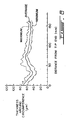
- Figure 7 is a representative plot of thickness as a function of surface distance from the tip end for a condom as made above.
- Figure 8 is a similar plot for a natural rubber condom produced from latex by a dipping process.
Landscapes
- Engineering & Computer Science (AREA)
- Mechanical Engineering (AREA)
- Health & Medical Sciences (AREA)
- Chemical & Material Sciences (AREA)
- Manufacturing & Machinery (AREA)
- Thermal Sciences (AREA)
- Physics & Mathematics (AREA)
- Animal Behavior & Ethology (AREA)
- Life Sciences & Earth Sciences (AREA)
- General Health & Medical Sciences (AREA)
- Public Health (AREA)
- Veterinary Medicine (AREA)
- Reproductive Health (AREA)
- Biomedical Technology (AREA)
- Heart & Thoracic Surgery (AREA)
- Vascular Medicine (AREA)
- Polymers & Plastics (AREA)
- Medicinal Chemistry (AREA)
- Chemical Kinetics & Catalysis (AREA)
- Materials Engineering (AREA)
- Crystallography & Structural Chemistry (AREA)
- Organic Chemistry (AREA)
- Blow-Moulding Or Thermoforming Of Plastics Or The Like (AREA)
- Shaping By String And By Release Of Stress In Plastics And The Like (AREA)
- Shaping Of Tube Ends By Bending Or Straightening (AREA)
- Casting Or Compression Moulding Of Plastics Or The Like (AREA)
- Orthopedics, Nursing, And Contraception (AREA)
- Processing And Handling Of Plastics And Other Materials For Molding In General (AREA)
- Laminated Bodies (AREA)
- Moulding By Coating Moulds (AREA)
Applications Claiming Priority (3)
| Application Number | Priority Date | Filing Date | Title |
|---|---|---|---|
| US15900293A | 1993-11-29 | 1993-11-29 | |
| US159002 | 1993-11-29 | ||
| EP95901303A EP0731748B1 (de) | 1993-11-29 | 1994-11-25 | Verfahren zur herstellung von dünnen, rohrförmigen, an einem ende geschlossenen gegenständen aus thermoplastischen elastomeren |
Related Parent Applications (1)
| Application Number | Title | Priority Date | Filing Date |
|---|---|---|---|
| EP95901303A Division EP0731748B1 (de) | 1993-11-29 | 1994-11-25 | Verfahren zur herstellung von dünnen, rohrförmigen, an einem ende geschlossenen gegenständen aus thermoplastischen elastomeren |
Publications (3)
| Publication Number | Publication Date |
|---|---|
| EP0974445A2 true EP0974445A2 (de) | 2000-01-26 |
| EP0974445A3 EP0974445A3 (de) | 2002-05-22 |
| EP0974445B1 EP0974445B1 (de) | 2005-05-04 |
Family
ID=22570653
Family Applications (2)
| Application Number | Title | Priority Date | Filing Date |
|---|---|---|---|
| EP99203462A Expired - Lifetime EP0974445B1 (de) | 1993-11-29 | 1994-11-25 | Verfahren zur Herstellung von dünnen, rohrförmigen, an einem Ende geschlossenen Gegenständen aus thermoplastischen Elastomeren |
| EP95901303A Expired - Lifetime EP0731748B1 (de) | 1993-11-29 | 1994-11-25 | Verfahren zur herstellung von dünnen, rohrförmigen, an einem ende geschlossenen gegenständen aus thermoplastischen elastomeren |
Family Applications After (1)
| Application Number | Title | Priority Date | Filing Date |
|---|---|---|---|
| EP95901303A Expired - Lifetime EP0731748B1 (de) | 1993-11-29 | 1994-11-25 | Verfahren zur herstellung von dünnen, rohrförmigen, an einem ende geschlossenen gegenständen aus thermoplastischen elastomeren |
Country Status (18)
| Country | Link |
|---|---|
| US (3) | US6213123B1 (de) |
| EP (2) | EP0974445B1 (de) |
| JP (2) | JPH09505246A (de) |
| KR (2) | KR100361014B1 (de) |
| CN (3) | CN1193868C (de) |
| AT (2) | ATE294694T1 (de) |
| AU (1) | AU1061095A (de) |
| BR (1) | BR9408189A (de) |
| CA (1) | CA2177473A1 (de) |
| DE (2) | DE69424439T2 (de) |
| DK (1) | DK0731748T3 (de) |
| ES (1) | ES2147834T3 (de) |
| GR (1) | GR3034047T3 (de) |
| IL (1) | IL111746A (de) |
| NO (1) | NO962135D0 (de) |
| PT (1) | PT731748E (de) |
| WO (1) | WO1995014565A2 (de) |
| ZA (1) | ZA949408B (de) |
Families Citing this family (26)
| Publication number | Priority date | Publication date | Assignee | Title |
|---|---|---|---|---|
| US6203751B1 (en) | 1996-02-07 | 2001-03-20 | Convenience Food Systems B.V. Of The Netherlands | Method and apparatus for producing open containers from foam sheeting |
| US5885205A (en) | 1996-10-03 | 1999-03-23 | Kassman; Leon B. | Condom exerting lateral pressure on the penis |
| US6321751B1 (en) * | 1999-10-08 | 2001-11-27 | Carter-Wallace, Inc. | Condom with spiral crisscross ribbing |
| US6715492B1 (en) * | 2001-05-25 | 2004-04-06 | Rory P. Blake | Manufacturing method for anatomically accurate abbreviated condoms |
| ITUD20020222A1 (it) * | 2002-10-25 | 2004-04-26 | G M P Spa | Procedimento per la produzione di manufatti poliuretanici e relativo dispositivo |
| US7455863B2 (en) * | 2002-11-07 | 2008-11-25 | Smarthealth, Inc. | Flexible elastomer articles and methods of manufacturing |
| US7585526B2 (en) | 2002-11-07 | 2009-09-08 | Smarthealth, Inc. | Flexible elastomer articles and methods of manufacturing |
| CA2547298C (en) * | 2003-04-23 | 2007-03-27 | Ame M. Amer | Method of using condom |
| US7776368B2 (en) * | 2003-08-13 | 2010-08-17 | Smarthealth, Inc. | Gloves containing dry powdered aloe and method of manufacturing |
| CN1559365A (zh) * | 2004-03-04 | 2005-01-05 | 博 冷 | 避孕套 |
| USD558872S1 (en) * | 2006-10-20 | 2008-01-01 | Brian Osterberg | Condom |
| USD558871S1 (en) * | 2006-10-20 | 2008-01-01 | Brian Osterberg | Condom |
| USD558873S1 (en) * | 2006-11-02 | 2008-01-01 | Brian Osterberg | Condom |
| DE102007003480B4 (de) * | 2007-01-24 | 2008-11-13 | Jakob Maier | Verfahren und Vorrichtung zur Bearbeitung eines Zitzengummis während der Herstellung |
| US20080269914A1 (en) * | 2007-03-19 | 2008-10-30 | Qfix Systems, Llc | Direct contact moldable low temperature thermoplastic prosthetic devices |
| USD583926S1 (en) * | 2007-04-06 | 2008-12-30 | Isael Borrego Lopez | Condom |
| USD591846S1 (en) * | 2007-05-30 | 2009-05-05 | Brian Osterberg | Condom in the shape of a dolphin |
| US7654265B2 (en) * | 2007-10-05 | 2010-02-02 | Mady Attila | Condom valve |
| US7963285B2 (en) * | 2007-10-05 | 2011-06-21 | Mady Attila | Adhesive condom and deployment |
| US8066008B2 (en) * | 2008-02-08 | 2011-11-29 | Andre Glenn | Condom with anti-rupture means and securing means |
| USD591853S1 (en) * | 2008-08-01 | 2009-05-05 | Brian Osterberg | Condom |
| US20110198777A1 (en) * | 2010-02-17 | 2011-08-18 | Der-Lin Liou | Method for manufacturing seamless thin-walled articles with thermoplastic materials |
| US20120073580A1 (en) * | 2010-09-23 | 2012-03-29 | Ansell Limited | Stimulating condom |
| US9433468B2 (en) | 2013-10-04 | 2016-09-06 | Tidi Products, Llc | Sheath for a medical or dental instrument |
| USD731652S1 (en) | 2014-02-19 | 2015-06-09 | Tidi Products, Llc | Dental curing light sleeve |
| CN106890768A (zh) * | 2017-04-24 | 2017-06-27 | 桂林紫竹乳胶制品有限公司 | 一种避孕套润滑剂滴加装置 |
Family Cites Families (23)
| Publication number | Priority date | Publication date | Assignee | Title |
|---|---|---|---|---|
| US2577345A (en) * | 1950-08-25 | 1951-12-04 | Frank Barnes | Mechanical prophylactic |
| GB938465A (en) * | 1961-08-02 | 1963-10-02 | Tadao Okamoto | Improved condom |
| DE1766519A1 (de) * | 1968-06-07 | 1972-03-23 | Kadel Fritz | Praeservativ |
| GB1250553A (de) * | 1969-04-18 | 1971-10-20 | ||
| USD246118S (en) | 1975-07-24 | 1977-10-18 | Circle Rubber Corporation | Prophylactic device |
| US4576156A (en) * | 1978-04-17 | 1986-03-18 | Ortho Pharmaceutical Corporation | Prophylactic device and method |
| US4239727A (en) * | 1978-09-15 | 1980-12-16 | Mobil Oil Corporation | Method and apparatus for thermoforming thermoplastic foam articles |
| US4399160A (en) * | 1981-08-07 | 1983-08-16 | Stauffer Chemical Company | Thickening composition from fermented whey |
| US4552717A (en) * | 1984-06-26 | 1985-11-12 | Cosden Technology, Inc. | Process for making a thin walled container from a plastic resin |
| US5338565A (en) * | 1987-07-17 | 1994-08-16 | Robin R. T. Shlenker | Method of forming a membrane, especially a latex membrane, having a biocide barrier |
| US4869723A (en) * | 1987-08-10 | 1989-09-26 | Microbionics Inc | Natural feeling condom and method |
| US4877856A (en) * | 1987-08-31 | 1989-10-31 | The Bf Goodrich Company | Soft thermoplastic polyurethane for blown film application |
| WO1989002256A1 (en) * | 1987-09-10 | 1989-03-23 | Sapoty Brook | An improved condom |
| GB8811864D0 (en) * | 1988-05-19 | 1988-06-22 | Medicor International Ltd | Contraceptive sheath manufacture |
| US4964416A (en) * | 1988-11-15 | 1990-10-23 | Foldesy Robin G | Condom articles, and apparatus and method for making and using the same |
| US5335675A (en) * | 1988-11-15 | 1994-08-09 | Family Health International | Stress-softened elastomeric films, articles, and method and apparatus for making such films and articles |
| US5199444A (en) * | 1988-11-15 | 1993-04-06 | Family Health International | Condom having enhanced grippability structure and annular sealing element |
| US5351698A (en) * | 1988-11-15 | 1994-10-04 | Family Health International | Bidirectionally donnable generally tubular sheath articles, and apparatus and method for making and using same |
| US5165422A (en) * | 1989-01-23 | 1992-11-24 | Broad Jr Robert L | Apparatus for assembling a contraceptive device |
| US5176152A (en) * | 1990-10-31 | 1993-01-05 | Family Health International | Method of providing convolutable areas on thermoplastic elastomeric films, and films and film products having such areas |
| US5098755A (en) * | 1990-11-21 | 1992-03-24 | Tanquary Albert C | Textured thermoplastic elastomeric film, articles comprising same, and method of making such textured thermoplastic elastomeric film and articles |
| DE4042307A1 (de) * | 1990-12-31 | 1992-07-02 | Tavana Mohammad Sadegh | Durchmessermaessig polarisierte kondome (polardome) |
| GB9222865D0 (en) * | 1992-10-31 | 1992-12-16 | Smith & Nephew | Medical apparatus |
-
1994
- 1994-11-23 IL IL11174694A patent/IL111746A/xx not_active IP Right Cessation
- 1994-11-25 KR KR1019960702792A patent/KR100361014B1/ko not_active Expired - Fee Related
- 1994-11-25 DE DE69424439T patent/DE69424439T2/de not_active Expired - Fee Related
- 1994-11-25 KR KR10-2002-7003756A patent/KR100368360B1/ko not_active Expired - Fee Related
- 1994-11-25 DE DE69434361T patent/DE69434361T2/de not_active Expired - Fee Related
- 1994-11-25 BR BR9408189A patent/BR9408189A/pt not_active IP Right Cessation
- 1994-11-25 DK DK95901303T patent/DK0731748T3/da active
- 1994-11-25 AT AT99203462T patent/ATE294694T1/de not_active IP Right Cessation
- 1994-11-25 WO PCT/CA1994/000656 patent/WO1995014565A2/en not_active Ceased
- 1994-11-25 AT AT95901303T patent/ATE192689T1/de not_active IP Right Cessation
- 1994-11-25 CN CNB021403023A patent/CN1193868C/zh not_active Expired - Fee Related
- 1994-11-25 JP JP7514724A patent/JPH09505246A/ja not_active Ceased
- 1994-11-25 ES ES95901303T patent/ES2147834T3/es not_active Expired - Lifetime
- 1994-11-25 EP EP99203462A patent/EP0974445B1/de not_active Expired - Lifetime
- 1994-11-25 EP EP95901303A patent/EP0731748B1/de not_active Expired - Lifetime
- 1994-11-25 PT PT95901303T patent/PT731748E/pt unknown
- 1994-11-25 AU AU10610/95A patent/AU1061095A/en not_active Abandoned
- 1994-11-25 CN CN94194855A patent/CN1090080C/zh not_active Expired - Fee Related
- 1994-11-25 CA CA002177473A patent/CA2177473A1/en not_active Abandoned
- 1994-11-28 ZA ZA949408A patent/ZA949408B/xx unknown
-
1995
- 1995-05-31 US US08/455,764 patent/US6213123B1/en not_active Expired - Lifetime
- 1995-05-31 US US08/455,784 patent/US5601092A/en not_active Expired - Lifetime
- 1995-05-31 US US08/455,791 patent/US5598850A/en not_active Expired - Lifetime
-
1996
- 1996-05-24 NO NO962135A patent/NO962135D0/no not_active Application Discontinuation
-
2000
- 2000-07-11 CN CN00120291A patent/CN1103676C/zh not_active Expired - Fee Related
- 2000-07-28 GR GR20000401739T patent/GR3034047T3/el not_active IP Right Cessation
-
2005
- 2005-04-25 JP JP2005126896A patent/JP2005313641A/ja active Pending
Also Published As
Similar Documents
| Publication | Publication Date | Title |
|---|---|---|
| EP0974445B1 (de) | Verfahren zur Herstellung von dünnen, rohrförmigen, an einem Ende geschlossenen Gegenständen aus thermoplastischen Elastomeren | |
| US5458936A (en) | Polyesterurethane condom | |
| EP2075279A1 (de) | Herstellung von Formspeicherpolymerartikeln mittels Formvorgängen | |
| CA2177474C (en) | Polyesterurethane condom | |
| AU701634C (en) | Polyesterurethane condom | |
| AU741397B2 (en) | Method for making thin-walled, closed-ended, tubular articles of thermoplastic elastomers | |
| US5169464A (en) | Method of making a condom by blow extrusion | |
| EP1122053B1 (de) | Aus polytetrafluorethylen geformtes erzeugnis in blockform und verfahren zu dessen herstellung | |
| JP2611415B2 (ja) | 成形用二軸延伸ポリエステルフィルム、成形転写用フィルムおよび成形容器用フィルム | |
| CA1240115A (en) | Element formed from a blank of amorphous pet having a crystallinity of less than 10 percent | |
| EP0417139A1 (de) | Empfängnisverhütungsmittel und verfahren zur herstellung | |
| CA1052965A (en) | Blow molded, oriented plastic bottle and method for making same | |
| JPH09239801A (ja) | バルーン用チューブの製法 |
Legal Events
| Date | Code | Title | Description |
|---|---|---|---|
| PUAI | Public reference made under article 153(3) epc to a published international application that has entered the european phase |
Free format text: ORIGINAL CODE: 0009012 |
|
| AC | Divisional application: reference to earlier application |
Ref document number: 731748 Country of ref document: EP |
|
| AK | Designated contracting states |
Kind code of ref document: A2 Designated state(s): AT BE CH DE DK ES FR GB GR IE IT LI LU MC NL PT SE |
|
| AX | Request for extension of the european patent |
Free format text: AL;LT;LV;MK;RO;SI |
|
| K1C1 | Correction of patent application (title page) published |
Effective date: 20000126 |
|
| RAP1 | Party data changed (applicant data changed or rights of an application transferred) |
Owner name: JANSSEN-ORTHO INC. |
|
| PUAL | Search report despatched |
Free format text: ORIGINAL CODE: 0009013 |
|
| 17P | Request for examination filed |
Effective date: 20021108 |
|
| AKX | Designation fees paid |
Designated state(s): AT BE CH DE DK ES FR GB GR IE IT LI LU MC NL PT SE |
|
| 17Q | First examination report despatched |
Effective date: 20030714 |
|
| GRAP | Despatch of communication of intention to grant a patent |
Free format text: ORIGINAL CODE: EPIDOSNIGR1 |
|
| RIN1 | Information on inventor provided before grant (corrected) |
Inventor name: TANKOVITZ, OSKAR T. Inventor name: MILLER, WILLIAM C. Inventor name: MILLER, ROBERT G. |
|
| GRAS | Grant fee paid |
Free format text: ORIGINAL CODE: EPIDOSNIGR3 |
|
| GRAA | (expected) grant |
Free format text: ORIGINAL CODE: 0009210 |
|
| AC | Divisional application: reference to earlier application |
Ref document number: 0731748 Country of ref document: EP Kind code of ref document: P |
|
| AK | Designated contracting states |
Kind code of ref document: B1 Designated state(s): AT BE CH DE DK ES FR GB GR IE IT LI LU MC NL PT SE |
|
| PG25 | Lapsed in a contracting state [announced via postgrant information from national office to epo] |
Ref country code: NL Free format text: LAPSE BECAUSE OF FAILURE TO SUBMIT A TRANSLATION OF THE DESCRIPTION OR TO PAY THE FEE WITHIN THE PRESCRIBED TIME-LIMIT Effective date: 20050504 Ref country code: LI Free format text: LAPSE BECAUSE OF FAILURE TO SUBMIT A TRANSLATION OF THE DESCRIPTION OR TO PAY THE FEE WITHIN THE PRESCRIBED TIME-LIMIT Effective date: 20050504 Ref country code: CH Free format text: LAPSE BECAUSE OF FAILURE TO SUBMIT A TRANSLATION OF THE DESCRIPTION OR TO PAY THE FEE WITHIN THE PRESCRIBED TIME-LIMIT Effective date: 20050504 Ref country code: BE Free format text: LAPSE BECAUSE OF FAILURE TO SUBMIT A TRANSLATION OF THE DESCRIPTION OR TO PAY THE FEE WITHIN THE PRESCRIBED TIME-LIMIT Effective date: 20050504 Ref country code: AT Free format text: LAPSE BECAUSE OF FAILURE TO SUBMIT A TRANSLATION OF THE DESCRIPTION OR TO PAY THE FEE WITHIN THE PRESCRIBED TIME-LIMIT Effective date: 20050504 |
|
| REG | Reference to a national code |
Ref country code: GB Ref legal event code: FG4D |
|
| REG | Reference to a national code |
Ref country code: CH Ref legal event code: EP |
|
| REG | Reference to a national code |
Ref country code: IE Ref legal event code: FG4D |
|
| REF | Corresponds to: |
Ref document number: 69434361 Country of ref document: DE Date of ref document: 20050609 Kind code of ref document: P |
|
| PG25 | Lapsed in a contracting state [announced via postgrant information from national office to epo] |
Ref country code: SE Free format text: LAPSE BECAUSE OF FAILURE TO SUBMIT A TRANSLATION OF THE DESCRIPTION OR TO PAY THE FEE WITHIN THE PRESCRIBED TIME-LIMIT Effective date: 20050804 Ref country code: GR Free format text: LAPSE BECAUSE OF FAILURE TO SUBMIT A TRANSLATION OF THE DESCRIPTION OR TO PAY THE FEE WITHIN THE PRESCRIBED TIME-LIMIT Effective date: 20050804 Ref country code: DK Free format text: LAPSE BECAUSE OF FAILURE TO SUBMIT A TRANSLATION OF THE DESCRIPTION OR TO PAY THE FEE WITHIN THE PRESCRIBED TIME-LIMIT Effective date: 20050804 |
|
| PG25 | Lapsed in a contracting state [announced via postgrant information from national office to epo] |
Ref country code: ES Free format text: LAPSE BECAUSE OF FAILURE TO SUBMIT A TRANSLATION OF THE DESCRIPTION OR TO PAY THE FEE WITHIN THE PRESCRIBED TIME-LIMIT Effective date: 20050815 |
|
| PG25 | Lapsed in a contracting state [announced via postgrant information from national office to epo] |
Ref country code: PT Free format text: LAPSE BECAUSE OF FAILURE TO SUBMIT A TRANSLATION OF THE DESCRIPTION OR TO PAY THE FEE WITHIN THE PRESCRIBED TIME-LIMIT Effective date: 20051017 |
|
| NLV1 | Nl: lapsed or annulled due to failure to fulfill the requirements of art. 29p and 29m of the patents act | ||
| REG | Reference to a national code |
Ref country code: CH Ref legal event code: PL |
|
| PG25 | Lapsed in a contracting state [announced via postgrant information from national office to epo] |
Ref country code: IT Free format text: LAPSE BECAUSE OF NON-PAYMENT OF DUE FEES Effective date: 20051125 Ref country code: GB Free format text: LAPSE BECAUSE OF NON-PAYMENT OF DUE FEES Effective date: 20051125 |
|
| PG25 | Lapsed in a contracting state [announced via postgrant information from national office to epo] |
Ref country code: MC Free format text: LAPSE BECAUSE OF NON-PAYMENT OF DUE FEES Effective date: 20051130 Ref country code: LU Free format text: LAPSE BECAUSE OF NON-PAYMENT OF DUE FEES Effective date: 20051130 |
|
| PLBE | No opposition filed within time limit |
Free format text: ORIGINAL CODE: 0009261 |
|
| STAA | Information on the status of an ep patent application or granted ep patent |
Free format text: STATUS: NO OPPOSITION FILED WITHIN TIME LIMIT |
|
| ET | Fr: translation filed | ||
| 26N | No opposition filed |
Effective date: 20060207 |
|
| PG25 | Lapsed in a contracting state [announced via postgrant information from national office to epo] |
Ref country code: DE Free format text: LAPSE BECAUSE OF NON-PAYMENT OF DUE FEES Effective date: 20060601 |
|
| GBPC | Gb: european patent ceased through non-payment of renewal fee |
Effective date: 20051125 |
|
| REG | Reference to a national code |
Ref country code: IE Ref legal event code: MM4A |
|
| REG | Reference to a national code |
Ref country code: FR Ref legal event code: ST Effective date: 20080229 |
|
| PG25 | Lapsed in a contracting state [announced via postgrant information from national office to epo] |
Ref country code: FR Free format text: LAPSE BECAUSE OF NON-PAYMENT OF DUE FEES Effective date: 20051130 |