EP0974726A2 - Verfahren und Vorrichtung zum Herstellen von mit Schaumkunststoff gefüllten Türen - Google Patents
Verfahren und Vorrichtung zum Herstellen von mit Schaumkunststoff gefüllten Türen Download PDFInfo
- Publication number
- EP0974726A2 EP0974726A2 EP99305455A EP99305455A EP0974726A2 EP 0974726 A2 EP0974726 A2 EP 0974726A2 EP 99305455 A EP99305455 A EP 99305455A EP 99305455 A EP99305455 A EP 99305455A EP 0974726 A2 EP0974726 A2 EP 0974726A2
- Authority
- EP
- European Patent Office
- Prior art keywords
- door
- skins
- cavity
- assembly
- skin
- Prior art date
- Legal status (The legal status is an assumption and is not a legal conclusion. Google has not performed a legal analysis and makes no representation as to the accuracy of the status listed.)
- Withdrawn
Links
- 238000000034 method Methods 0.000 title claims abstract description 39
- 239000006260 foam Substances 0.000 title description 11
- 229920005989 resin Polymers 0.000 claims abstract description 39
- 239000011347 resin Substances 0.000 claims abstract description 39
- 239000000203 mixture Substances 0.000 claims abstract description 26
- 229920003002 synthetic resin Polymers 0.000 claims abstract description 25
- 239000000057 synthetic resin Substances 0.000 claims abstract description 25
- 238000009472 formulation Methods 0.000 claims abstract description 24
- 230000002093 peripheral effect Effects 0.000 claims abstract description 19
- 238000010438 heat treatment Methods 0.000 claims abstract description 15
- 230000001413 cellular effect Effects 0.000 claims abstract description 7
- 238000004519 manufacturing process Methods 0.000 claims description 8
- 238000005452 bending Methods 0.000 claims description 5
- 230000004888 barrier function Effects 0.000 claims description 4
- 239000002184 metal Substances 0.000 description 10
- 229910052751 metal Inorganic materials 0.000 description 10
- 238000009434 installation Methods 0.000 description 8
- 238000003825 pressing Methods 0.000 description 6
- RGSFGYAAUTVSQA-UHFFFAOYSA-N Cyclopentane Chemical compound C1CCCC1 RGSFGYAAUTVSQA-UHFFFAOYSA-N 0.000 description 2
- 230000007547 defect Effects 0.000 description 2
- 239000000463 material Substances 0.000 description 2
- 239000004033 plastic Substances 0.000 description 2
- 229920003023 plastic Polymers 0.000 description 2
- 229920002635 polyurethane Polymers 0.000 description 2
- 239000004814 polyurethane Substances 0.000 description 2
- 239000002699 waste material Substances 0.000 description 2
- 239000002023 wood Substances 0.000 description 2
- 239000004604 Blowing Agent Substances 0.000 description 1
- 230000000712 assembly Effects 0.000 description 1
- 238000000429 assembly Methods 0.000 description 1
- 239000002131 composite material Substances 0.000 description 1
- 238000010276 construction Methods 0.000 description 1
- 238000005034 decoration Methods 0.000 description 1
- 230000000694 effects Effects 0.000 description 1
- 238000005187 foaming Methods 0.000 description 1
- 238000009432 framing Methods 0.000 description 1
- DMEGYFMYUHOHGS-UHFFFAOYSA-N heptamethylene Natural products C1CCCCCC1 DMEGYFMYUHOHGS-UHFFFAOYSA-N 0.000 description 1
- 230000013011 mating Effects 0.000 description 1
- 239000003960 organic solvent Substances 0.000 description 1
- 238000004806 packaging method and process Methods 0.000 description 1
- 239000011541 reaction mixture Substances 0.000 description 1
- 239000011342 resin composition Substances 0.000 description 1
- 238000009827 uniform distribution Methods 0.000 description 1
Images




Classifications
-
- E—FIXED CONSTRUCTIONS
- E06—DOORS, WINDOWS, SHUTTERS, OR ROLLER BLINDS IN GENERAL; LADDERS
- E06B—FIXED OR MOVABLE CLOSURES FOR OPENINGS IN BUILDINGS, VEHICLES, FENCES OR LIKE ENCLOSURES IN GENERAL, e.g. DOORS, WINDOWS, BLINDS, GATES
- E06B3/00—Window sashes, door leaves, or like elements for closing wall or like openings; Layout of fixed or moving closures, e.g. windows in wall or like openings; Features of rigidly-mounted outer frames relating to the mounting of wing frames
- E06B3/54—Fixing of glass panes or like plates
- E06B3/58—Fixing of glass panes or like plates by means of borders, cleats, or the like
- E06B3/5892—Fixing of window panes in openings in door leaves
-
- B—PERFORMING OPERATIONS; TRANSPORTING
- B29—WORKING OF PLASTICS; WORKING OF SUBSTANCES IN A PLASTIC STATE IN GENERAL
- B29C—SHAPING OR JOINING OF PLASTICS; SHAPING OF MATERIAL IN A PLASTIC STATE, NOT OTHERWISE PROVIDED FOR; AFTER-TREATMENT OF THE SHAPED PRODUCTS, e.g. REPAIRING
- B29C44/00—Shaping by internal pressure generated in the material, e.g. swelling or foaming ; Producing porous or cellular expanded plastics articles
- B29C44/02—Shaping by internal pressure generated in the material, e.g. swelling or foaming ; Producing porous or cellular expanded plastics articles for articles of definite length, i.e. discrete articles
- B29C44/12—Incorporating or moulding on preformed parts, e.g. inserts or reinforcements
- B29C44/1228—Joining preformed parts by the expanding material
- B29C44/1233—Joining preformed parts by the expanding material the preformed parts being supported during expanding
-
- E—FIXED CONSTRUCTIONS
- E06—DOORS, WINDOWS, SHUTTERS, OR ROLLER BLINDS IN GENERAL; LADDERS
- E06B—FIXED OR MOVABLE CLOSURES FOR OPENINGS IN BUILDINGS, VEHICLES, FENCES OR LIKE ENCLOSURES IN GENERAL, e.g. DOORS, WINDOWS, BLINDS, GATES
- E06B3/00—Window sashes, door leaves, or like elements for closing wall or like openings; Layout of fixed or moving closures, e.g. windows in wall or like openings; Features of rigidly-mounted outer frames relating to the mounting of wing frames
- E06B3/70—Door leaves
- E06B3/82—Flush doors, i.e. with completely flat surface
- E06B3/822—Flush doors, i.e. with completely flat surface with an internal foursided frame
-
- E—FIXED CONSTRUCTIONS
- E06—DOORS, WINDOWS, SHUTTERS, OR ROLLER BLINDS IN GENERAL; LADDERS
- E06B—FIXED OR MOVABLE CLOSURES FOR OPENINGS IN BUILDINGS, VEHICLES, FENCES OR LIKE ENCLOSURES IN GENERAL, e.g. DOORS, WINDOWS, BLINDS, GATES
- E06B3/00—Window sashes, door leaves, or like elements for closing wall or like openings; Layout of fixed or moving closures, e.g. windows in wall or like openings; Features of rigidly-mounted outer frames relating to the mounting of wing frames
- E06B3/70—Door leaves
- E06B3/7015—Door leaves characterised by the filling between two external panels
- E06B2003/7023—Door leaves characterised by the filling between two external panels of foam type
Definitions
- the present invention relates to doors having a pair of skins and an insulating resin core and, more particularly, to the method of making such foam-filled doors.
- Doors with metal or plastic skins and insulating foam cores are widely employed at the present time as entry doors because of their insulating characteristics. They are also utilized in interior applications where some sound reducing and heat transfer benefits are sought to be obtained. Doors with metallic skins are also utilized in interior applications where fire resistance is a consideration.
- such foam-filled doors employ not only the skins but also elements forming a peripheral rectangular frame to support the skins. These framing elements comprise stiles and rails, and they may be formed from metal or wood depending upon the characteristics desired.
- Illustrative of such doors are Multer, U. S. Patent No. 3 512 305, granted May 19, 1970 (metal skins), and Bies et al, U. S. Patent No. 5 239 799, granted August 31, 1993 (synthetic resin skins).
- doors in which the skins are formed with opposing flanges which are joined to provide the peripheral frame and a preformed foam core is inserted therebetween are described in Thorn,U. S. Patent No. 4 922 674, granted May 8, 1990.
- the prevalent practice has been to assemble the door skins to the peripheral frame and then to inject a foamable synthetic resin composition into the cavity through one or more inlet apertures. This structure is then subjected to heat and pressure in a platen press and the resin expands and cures.
- Another object is to provide such a method which is relatively economical and requires minimal labor content.
- a further object is to provide an installation in which such a method may be practised efficiently and economically.
- the door element is preheated prior to introduction of the resin formulations, and the second skin prior is preheated to assembly with the first door element.
- the several steps are conducted seriatim at stations along a conveyor assembly.
- a preferred embodiment includes an initial step of forming the first and second skins with flanges along edges thereof, and the door element forming step includes assembling on the upper surface of the first skin a rectangular frame comprising a pair of rails and a pair of stiles and providing the peripheral wall.
- the flanges of the first skin are engaged with the frame, and, in the assembling step, the flanges of the second skin are engaged with the frame.
- the door element forming step preferably includes providing channels along and adjacent the side margins of at least the stile portions of the frame, and the forming and assembling steps include engaging the flanges in the channels.
- the frame is metallic, and there is included a step of bending a continuous length of metallic strip into a rectangular frame which is disposed on the upper surface of the first skin.
- the door element forming step utilizes wooden elements to provide the stiles and rails.
- the method includes the step of placing preformed elements in the cavity adjacent the stiles prior to the step of introducing the resin formulation, after which the elements are then embedded in the insulating core.
- the skin forming step may include providing aligned door lite apertures in the skins, and there is included an additional step of placing a barrier member in the cavity extending about the aperture of the first skin.
- the step of introducing resin into the cavity is limited to the area between the barrier member and the peripheral wall.
- the passing step places the door assembly between a pair of heated endless belts spaced apart a predetermined distance.
- the door skins are moved automatically to stations at which the forming, resin introduction and passing steps take place. In such an automatic process, the second skin is inverted prior to the assembling step.
- This method is conveniently carried out for doors with metal skins and a metal frame in a manufacturing facility which includes a frame bending station, a conveyor assembly for movement of the door elements, an assembling station for assembling the frame with a first skin to provide an upwardly opening cavity providing the first door element, a resin introducing station for introducing a foamable synthetic resin formulation into the cavity, a second skin assembly station for assembling the second skin on the first door element over the cavity to form the door assembly, and a curing station in which the door assembly is passed through an elongated heating zone while controlling the thickness dimension of the door assembly to expand and cure the resin formulation in the cavity into a cellular resin insulating core and to bond the skins and core.
- the method of the present invention is adaptable for use with metallic or synthetic resin skins, and with metallic or wooden frames, or with skins with mating flanges which provide a peripheral wall without a separate frame element. It is also adapted for use to produce doors with lites. Illustrative of such doors are those illustrated in Figures 1-9.
- FIG. 1 and 2 therein illustrated is a metallic skin door of the type which may be fabricated in accordance with the present invention.
- this door has metallic skins generally designated by the numerals 10, 12 which have opposed flanges 14, 16, and a wooden frame generally designated by the numeral 18 which has stiles 20 and rails 22.
- a core 24 of synthetic resin fills the cavity defined by the skins 10, 12 and frame 18, and a hinge leaf 26 is shown in Figure 2 seated in a cutout in the skin 10.
- Figure 3 illustrates an alternate and preferred construction in which the stiles 20a are provided with channels 28 extending along the length thereof adjacent the side margins and the flanges 14a, 16a snap into the channels 28 to provide mechanical engagement.
- the illustrated hinge stile 20a has a protruding center portion in which the hinge may be mortised and which can be trimmed for the door opening.
- FIG. 4 therein illustrated is a door with metallic skins 110, 112 and a continuous metallic frame 118 providing the stiles and rails 120, 122.
- Opposed flanges 114, 116 on the skins 110, 112 seat in channels 128 formed adjacent the side margins of the stiles 120.
- the cavity is filled with a resin core 124, and a latch block 132 is provided on the stile 120a.
- Such a structure is more fully illustrated and described in the aforementioned Berghorn et al., U.S. Patent No. 5 839 252.
- FIG. 6 therein illustrated is a door with synthetic resin skins 210, 212 with opposed flanges 214, 216, and a frame generally designated by the numeral 218 provided by wooden stiles 220 and wooden top rail 222.
- the bottom edges of the skins 210, 212 have overlapping flanges to provide a relatively rigid closed bottom wall 230.
- a core 224 of synthetic resin fills the cavity.
- the stiles 220 have recesses or channels 228 extending along their side margins in which are seated the flanges 214, 216.
- a wooden or plastic lock block 232 is preassembled to the latch stile 220a.
- Such a door is illustrated and described more fully in the aforementioned Bies et al, U. S. Patent No. 5 239 799.
- FIG. 8 and 9 therein illustrated is a door with metallic skins generally designated by the numerals 310, 312 and having lite apertures 334 therein in which is seated a lite assembly generally designated by the numeral 336.
- the frame generally designated by the numeral 318 provides stiles and rails 320, 322.
- the skins 310, 312 have opposed flanges or lips 338 about the apertures 334 formed therein and the lite assembly 336 has a peripheral frame 340 which extends between the skins 310, 312 to provide a dam for resin introduced into the cavity to provide the core 324.
- the frame 340 also provide a portion upon which the lite mounting elements 342, 344 are mounted.
- the lite structure is more fully illustrated and described in the U.S.
- the method of the present invention involves a series of steps in which the skins are first formed with the desired configuration which will most usually include flanges which are preferred for effecting the assembly with the frame.
- the skins may be embossed to provide the desired surface appearance. If a door lite is to be provided in the door assembly, cutouts for the door lite are also formed.
- a separate frame is provided, and one of the skins is assembled with the frame elements disposed thereon so as to provide a door element comprised of the bottom skin and a peripheral wall defining the cavity.
- Any additional inserts such as a latch block or a lite dam are also assembled therewith at this time.
- This door element and the top skin are separately passed into a heating chamber to preheat the door element and the second skin which will provide the top skin.
- a foamable resin composition is introduced into the cavity defined between the skin and frame elements. After the desired amount of synthetic resin material has been introduced into the cavity, the preheated top skin is then assembled thereover.
- the resultant door assembly is immediately passed into an elongated heating and pressing zone in which the thickness dimension of the assembly is maintained as it is moved along a path in which the door is maintained at the desired temperature for a period of time sufficient to ensure complete expansion and curing of the resin formulation.
- the door assembly Upon exiting from this heating and pressing zone, the door assembly is now a unitary structure of the desired dimensions.
- the door assembly may then be subjected to further processing steps such as the mounting of a door lite, the mortising of recesses to receive hinges, surface decoration and the like.
- the door may be packaged for shipment to vendors and customers.
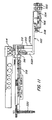
- FIG 11 diagrammatically illustrates an installation for the assembly of the doors of Figures 1 and 3.
- Sheet metal skins which have been precut to size are removed by a vacuum transfer apparatus from the stacks 500 and placed upon a conveyor installation generally designated by the numeral 502 and on which they move through a first station 504 in which the corners are notched.
- a roll forming station 506 immediately thereafter, flanges are formed along the stile edges thereof.
- a frame assembly station 510 the frame is assembled on the lower skin to provide a cavity.
- the door assembly is now introduced into the elongated heating unit 518 wherein it is maintained at the desired temperature and thickness dimension.
- the doors are moved onto an exit conveyor 520 to packaging or secondary operations.
- the frame assembly station can be varied.
- a continuous metallic frame such as that illustrated in the aforementioned Berghorn et al application
- a continuous strip of metal is formed with channels, punched and bent into a rectangular frame with overlapping ends as it travels along a secondary conveyor.
- This frame can be transferred onto the lower skin by a suitable transfer apparatus, and is pressed against the margins of lower skin to seat the flanges in its lower channel.
- two stiles and a rail can be preassembled into a U-shaped assembly. This is moved onto the lower skin, initially in a somewhat skewed position, from a secondary conveyor by a transfer apparatus which presses it against the flanges of the skin to seat them in the channels or recesses of the stiles. The other rail is inserted between the other ends of the stiles to complete and rigidify the frame.
- this step of inserting the frame elements can be effected manually if so desired.
- FIG 12 therein diagrammatically illustrated are the paths of movement of a pair of nozzles which introduce the resin formulation over the entire cavity. As seen, the two nozzles each traverse half the cavity and can do so as the door is moving along the conveyor.
- FIG. 13 therein schematically illustrated is the elongated heating and pressing apparatus. It has a pair of endless belts 600 extending about rollers 602 and at least the end rollers are driven. The spacing between the opposed rollers and belts is adjustable to accommodate doors of different thicknesses.
- the belts 600 are spaced apart the desired thickness for the doors and are perforate so that heated air introduced through ducts 604 and distributed by plenum chambers 606 will flow therethrough to heat both the belts 600 and the doors 608 therebetween.
- the door skins and assemblies are moved through the installation generally continuously with short stops at various stations for the operations to take place thereat. Labor and handling are thereby reduced to a minimum.
- the elongated heating and pressing unit provides a relatively long period for controlled expansion and curing of the resin to take place.
- the interior surfaces of the skins may be molded with stops to position and retain the frame elements in cooperation with the flanges along the edges.
- lips formed about the openings will generally position the peripheral frame. If a lite is included, the nozzle paths for injecting the resin are programmed to avoid the lite opening.
- Metallic skins and metallic or wooden frames can be prepainted because the automatic operations performed thereon may utilize equipment which will not mar the finish.
- a desirable density for the foam core is about 27-35 kg/m 3 (1.7-2.2 pounds per cubic foot).
- the foaming of the resin can be accelerated to reduce process time which would otherwise be required to bring the skins and frame to temperature.
- Illustrative of a suitable procedure for a door of 2030 mm (6 feet 8 inches) length and 910 mm (3 feet) width and a thickness of 44 mm (1 3/4 inches) using metal skins of about 0.4-0.8 mm (0.016-0.032 inch) thickness and a wood frame is the following:
- the door Upon exiting, the door has the desired thickness dimension without any bowing of the skins and the resin core is fully cured and bonds the skins and frame into a rugged door assembly.
- the method of the present invention reduces labor, time and waste in the manufacture of foam filled doors using metallic and synthetic resin skins. Because the various operations are automated, manufacturing deviations and defects can be substantially eliminated.
- the foam core is relative uniform and the resultant door is free from bowing.
Landscapes
- Engineering & Computer Science (AREA)
- Civil Engineering (AREA)
- Structural Engineering (AREA)
- Wing Frames And Configurations (AREA)
- Securing Of Glass Panes Or The Like (AREA)
- Casting Or Compression Moulding Of Plastics Or The Like (AREA)
Applications Claiming Priority (2)
| Application Number | Priority Date | Filing Date | Title |
|---|---|---|---|
| US09/122,356 US6068802A (en) | 1998-07-24 | 1998-07-24 | Method for making foam filled doors and apparatus therefor |
| US122356 | 1998-07-24 |
Publications (2)
| Publication Number | Publication Date |
|---|---|
| EP0974726A2 true EP0974726A2 (de) | 2000-01-26 |
| EP0974726A3 EP0974726A3 (de) | 2000-10-25 |
Family
ID=22402221
Family Applications (1)
| Application Number | Title | Priority Date | Filing Date |
|---|---|---|---|
| EP99305455A Withdrawn EP0974726A3 (de) | 1998-07-24 | 1999-07-08 | Verfahren und Vorrichtung zum Herstellen von mit Schaumkunststoff gefüllten Türen |
Country Status (3)
| Country | Link |
|---|---|
| US (1) | US6068802A (de) |
| EP (1) | EP0974726A3 (de) |
| CA (1) | CA2277445C (de) |
Cited By (6)
| Publication number | Priority date | Publication date | Assignee | Title |
|---|---|---|---|---|
| EP1143215A1 (de) * | 2000-04-01 | 2001-10-10 | Seven-Air Gebr. Meyer AG | Wärmeisolierende Doppelwandung |
| EP1145817A1 (de) * | 2000-04-11 | 2001-10-17 | Siempelkamp Handling Systeme GmbH & Co. | Herstellung schaumgefüllter Sandwichelemente mit Schaumauftrag in Kassetten |
| EP1145816A1 (de) * | 2000-04-11 | 2001-10-17 | Siempelkamp Handling Systeme GmbH & Co. | Maschinelles Verklipsen von Sandwichelementen |
| EP1753326A4 (de) * | 2005-04-27 | 2009-06-03 | Carrier Corp | Kühlgehäusewandstruktur |
| EP1772584A3 (de) * | 2005-10-04 | 2015-03-18 | Zilten | Herstellungsverfahren eines Paneels als Endprodukt, wie z.B. eines Türflügels, zum Abschliessen einer Gebäudeöffnung, und das gefertigte Paneel |
| GB2535254A (en) * | 2015-06-05 | 2016-08-17 | Nanya Plastics Corp | Closure assembly with a window and a method of making the same |
Families Citing this family (26)
| Publication number | Priority date | Publication date | Assignee | Title |
|---|---|---|---|---|
| US6311454B1 (en) * | 1999-02-18 | 2001-11-06 | Globe Door, L.L.C. | Door construction |
| USH1976H1 (en) * | 1999-07-30 | 2001-08-07 | The United States Of America As Represented By The Secretary Of The Navy | Corrosion control in hollow frame structures |
| US6618998B1 (en) * | 2001-08-07 | 2003-09-16 | Larson Manufacturing Company | Door with variable length screen |
| US6939491B2 (en) * | 2002-02-18 | 2005-09-06 | Lear Corporation | Foam in place urethane for structural headliners |
| US6619005B1 (en) * | 2002-04-16 | 2003-09-16 | Kuei Yung Wang Chen | Molded doors with large glass insert |
| US20040003559A1 (en) * | 2002-04-24 | 2004-01-08 | Minke Ronald C. | Doors and methods of producing same |
| US20030200714A1 (en) * | 2002-04-24 | 2003-10-30 | Minke Ronald C. | High performance door |
| US6887552B2 (en) * | 2002-12-19 | 2005-05-03 | Lear Corporation | Structural headliner assembly |
| US20040119184A1 (en) * | 2002-12-23 | 2004-06-24 | Lear Corporation | Method for foaming in place headliner structures |
| AU2004254629B2 (en) * | 2003-07-01 | 2010-04-01 | Jeld-Wen, Inc | Methods and systems for the automated manufacture of composite doors |
| US20050081463A1 (en) * | 2003-10-17 | 2005-04-21 | Richard Allen | Retractable screen system providing a positioning force for a movable sash |
| EP1529919A1 (de) * | 2003-11-06 | 2005-05-11 | Masonite Corporation | Verfahren zur Herstellung von einer Glastür, und Glastür |
| WO2014062561A1 (en) * | 2012-10-16 | 2014-04-24 | Corley Scott E | Door with flush-mounted glazing |
| US9593222B2 (en) | 2013-05-14 | 2017-03-14 | Icp Adhesives And Sealants, Inc. | Method and composition for filling elongated channels with expanding foam insulation |
| EP2826611A1 (de) * | 2013-07-18 | 2015-01-21 | HILTI Aktiengesellschaft | Verfahren zur Herstellung von Schaumformteilen in einer Verpackungshülle und Verkaufseinheit |
| US9016030B1 (en) * | 2014-06-10 | 2015-04-28 | Ryan D. Steele | Metal door |
| US9175508B1 (en) * | 2014-06-10 | 2015-11-03 | Ryan D. Steele | Metal door |
| US9458660B2 (en) * | 2014-07-11 | 2016-10-04 | Masonite Corporation | Door with frameless glazed unit, and related kit and methods |
| US11480009B2 (en) | 2014-07-11 | 2022-10-25 | Masonite Corporation | Door with frameless glazed unit, and related kit and methods |
| US10711513B2 (en) * | 2018-01-05 | 2020-07-14 | Nan Ya Plastics Corporation | Door panel and a stile thereof |
| US11643864B2 (en) | 2018-01-23 | 2023-05-09 | Pella Corporation | Screen edge retention and screen rethreading features for a hidden screen assembly and a fenestration assembly |
| CA3107553C (en) | 2020-01-31 | 2023-08-22 | Pella Corporation | Integrated pleated screen assembly |
| ES2988379T3 (es) * | 2021-12-20 | 2024-11-20 | Meo | Procedimiento de fabricación de un panel batiente de puerta que comprende un marco periférico, un núcleo central aislante y dos paramentos de recubrimiento |
| CN114876334B (zh) * | 2022-04-28 | 2024-02-20 | 安必安控股(北京)有限公司 | 一种防火门门扇的制备方法 |
| KR102433247B1 (ko) * | 2022-05-25 | 2022-08-17 | 주식회사 성일 | Grp 도어제작 시스템 |
| US20250230703A1 (en) * | 2024-01-16 | 2025-07-17 | Isostruc Llc | Architectural interior door construction |
Citations (5)
| Publication number | Priority date | Publication date | Assignee | Title |
|---|---|---|---|---|
| US3512305A (en) | 1968-02-20 | 1970-05-19 | Stanley Works | Metal clad door |
| US4327535A (en) | 1980-02-21 | 1982-05-04 | Peachtree Doors, Inc. | Door with glass panel |
| US4922674A (en) | 1988-06-15 | 1990-05-08 | Therma-Tru Corp. | Compression molded door assembly |
| US5239799A (en) | 1991-08-28 | 1993-08-31 | The Stanley Works | Insulated door with synthetic resin skins |
| US5839252A (en) | 1997-04-04 | 1998-11-24 | The Stanley Works | Metal door with continuous frame and method |
Family Cites Families (3)
| Publication number | Priority date | Publication date | Assignee | Title |
|---|---|---|---|---|
| US3402520A (en) * | 1966-12-23 | 1968-09-24 | Home Comfort Products Co | Panel with foamed-in-place core |
| US4602466A (en) * | 1982-12-17 | 1986-07-29 | Larson Roger E | Foam building panels |
| JP2912530B2 (ja) * | 1993-09-17 | 1999-06-28 | ナショナル住宅産業株式会社 | 断熱性建築用パネルの製造方法及びそれに用いる製造装置 |
-
1998
- 1998-07-24 US US09/122,356 patent/US6068802A/en not_active Expired - Lifetime
-
1999
- 1999-07-08 EP EP99305455A patent/EP0974726A3/de not_active Withdrawn
- 1999-07-09 CA CA002277445A patent/CA2277445C/en not_active Expired - Lifetime
Patent Citations (5)
| Publication number | Priority date | Publication date | Assignee | Title |
|---|---|---|---|---|
| US3512305A (en) | 1968-02-20 | 1970-05-19 | Stanley Works | Metal clad door |
| US4327535A (en) | 1980-02-21 | 1982-05-04 | Peachtree Doors, Inc. | Door with glass panel |
| US4922674A (en) | 1988-06-15 | 1990-05-08 | Therma-Tru Corp. | Compression molded door assembly |
| US5239799A (en) | 1991-08-28 | 1993-08-31 | The Stanley Works | Insulated door with synthetic resin skins |
| US5839252A (en) | 1997-04-04 | 1998-11-24 | The Stanley Works | Metal door with continuous frame and method |
Cited By (9)
| Publication number | Priority date | Publication date | Assignee | Title |
|---|---|---|---|---|
| EP1143215A1 (de) * | 2000-04-01 | 2001-10-10 | Seven-Air Gebr. Meyer AG | Wärmeisolierende Doppelwandung |
| EP1145817A1 (de) * | 2000-04-11 | 2001-10-17 | Siempelkamp Handling Systeme GmbH & Co. | Herstellung schaumgefüllter Sandwichelemente mit Schaumauftrag in Kassetten |
| EP1145816A1 (de) * | 2000-04-11 | 2001-10-17 | Siempelkamp Handling Systeme GmbH & Co. | Maschinelles Verklipsen von Sandwichelementen |
| EP1753326A4 (de) * | 2005-04-27 | 2009-06-03 | Carrier Corp | Kühlgehäusewandstruktur |
| EP1772584A3 (de) * | 2005-10-04 | 2015-03-18 | Zilten | Herstellungsverfahren eines Paneels als Endprodukt, wie z.B. eines Türflügels, zum Abschliessen einer Gebäudeöffnung, und das gefertigte Paneel |
| GB2535254A (en) * | 2015-06-05 | 2016-08-17 | Nanya Plastics Corp | Closure assembly with a window and a method of making the same |
| GB2539282A (en) * | 2015-06-05 | 2016-12-14 | Nanya Plastics Corp | Closure assembly with a window and a method of making the same |
| US9683403B2 (en) | 2015-06-05 | 2017-06-20 | Nan Ya Plastics Corporation | Closure assembly with a window and a method of making the same |
| GB2535254B (en) * | 2015-06-05 | 2017-11-22 | Nanya Plastics Corp | Closure assembly with a window and a method of making the same |
Also Published As
| Publication number | Publication date |
|---|---|
| CA2277445C (en) | 2002-04-16 |
| US6068802A (en) | 2000-05-30 |
| EP0974726A3 (de) | 2000-10-25 |
| CA2277445A1 (en) | 2000-01-24 |
Similar Documents
| Publication | Publication Date | Title |
|---|---|---|
| US6068802A (en) | Method for making foam filled doors and apparatus therefor | |
| US4327535A (en) | Door with glass panel | |
| US8220519B2 (en) | Movable barriers having transverse stiffeners and methods of making the same | |
| EP1100660B1 (de) | Verfahren zur herstellung von formgepressten türverkleidungen aus flächigem holzverbundwerkstoff, sowie die so erhaltene türverkleidung und tür | |
| CA2286260C (en) | Metal door with continuous frame and method | |
| CA2202046C (en) | Joint structure and method of manufacture | |
| DE60208552T2 (de) | Plattenförmiges verglastes formteil | |
| US5177868A (en) | Process of making an insulated door | |
| JP2007534865A (ja) | 繊維強化複合体、及び繊維強化複合体を含む建築用構造物 | |
| WO2016007828A1 (en) | Door with frameless glazed unit, and related kit and methods | |
| US20140053489A1 (en) | Frame reinforcement to prevent warping | |
| US20020091218A1 (en) | Thermoplastic door skins and method of manufacture thereof | |
| US20090107623A1 (en) | Continuous venting of a covering sheet for an in-situ lamination process | |
| WO2008060346A1 (en) | Continuous lamination of door panels | |
| CN110612185B (zh) | 用于制造框架构件的方法、框架构件、框架结构以及框架构件的使用 | |
| EP2111962B1 (de) | Verfahren zur Herstellung einer Wärmedämmplatte | |
| CA2823868A1 (en) | Frame reinforcement to prevent warping | |
| WO2005113924A1 (en) | Window and door manufacturing method of plastics for inserted single body | |
| EP1499480A4 (de) | Thermoplastische türverkleidungen und herstellungsverfahren dafür |
Legal Events
| Date | Code | Title | Description |
|---|---|---|---|
| PUAI | Public reference made under article 153(3) epc to a published international application that has entered the european phase |
Free format text: ORIGINAL CODE: 0009012 |
|
| AK | Designated contracting states |
Kind code of ref document: A2 Designated state(s): FR GB |
|
| AX | Request for extension of the european patent |
Free format text: AL;LT;LV;MK;RO;SI |
|
| 17P | Request for examination filed |
Effective date: 20000323 |
|
| PUAL | Search report despatched |
Free format text: ORIGINAL CODE: 0009013 |
|
| AK | Designated contracting states |
Kind code of ref document: A3 Designated state(s): AT BE CH CY DE DK ES FI FR GB GR IE IT LI LU MC NL PT SE |
|
| AX | Request for extension of the european patent |
Free format text: AL;LT;LV;MK;RO;SI |
|
| AKX | Designation fees paid |
Free format text: FR GB |
|
| 17Q | First examination report despatched |
Effective date: 20030813 |
|
| REG | Reference to a national code |
Ref country code: DE Ref legal event code: 8566 |
|
| STAA | Information on the status of an ep patent application or granted ep patent |
Free format text: STATUS: THE APPLICATION IS DEEMED TO BE WITHDRAWN |
|
| 18D | Application deemed to be withdrawn |
Effective date: 20040224 |