EP0974901A2 - Verfahren zur Ermittlung einer einheitlichen globalen Sicht vom Systemzustand eines verteilten Rechnernetzwerkes - Google Patents
Verfahren zur Ermittlung einer einheitlichen globalen Sicht vom Systemzustand eines verteilten Rechnernetzwerkes Download PDFInfo
- Publication number
- EP0974901A2 EP0974901A2 EP99440197A EP99440197A EP0974901A2 EP 0974901 A2 EP0974901 A2 EP 0974901A2 EP 99440197 A EP99440197 A EP 99440197A EP 99440197 A EP99440197 A EP 99440197A EP 0974901 A2 EP0974901 A2 EP 0974901A2
- Authority
- EP
- European Patent Office
- Prior art keywords
- computer
- computers
- round
- transmission
- message
- Prior art date
- Legal status (The legal status is an assumption and is not a legal conclusion. Google has not performed a legal analysis and makes no representation as to the accuracy of the status listed.)
- Granted
Links
Images




Classifications
-
- G—PHYSICS
- G06—COMPUTING OR CALCULATING; COUNTING
- G06F—ELECTRIC DIGITAL DATA PROCESSING
- G06F11/00—Error detection; Error correction; Monitoring
- G06F11/30—Monitoring
- G06F11/3055—Monitoring arrangements for monitoring the status of the computing system or of the computing system component, e.g. monitoring if the computing system is on, off, available, not available
-
- G—PHYSICS
- G06—COMPUTING OR CALCULATING; COUNTING
- G06F—ELECTRIC DIGITAL DATA PROCESSING
- G06F11/00—Error detection; Error correction; Monitoring
- G06F11/07—Responding to the occurrence of a fault, e.g. fault tolerance
- G06F11/14—Error detection or correction of the data by redundancy in operations
- G06F11/1402—Saving, restoring, recovering or retrying
- G06F11/1415—Saving, restoring, recovering or retrying at system level
- G06F11/142—Reconfiguring to eliminate the error
- G06F11/1425—Reconfiguring to eliminate the error by reconfiguration of node membership
-
- G—PHYSICS
- G06—COMPUTING OR CALCULATING; COUNTING
- G06F—ELECTRIC DIGITAL DATA PROCESSING
- G06F11/00—Error detection; Error correction; Monitoring
- G06F11/30—Monitoring
- G06F11/3003—Monitoring arrangements specially adapted to the computing system or computing system component being monitored
- G06F11/3006—Monitoring arrangements specially adapted to the computing system or computing system component being monitored where the computing system is distributed, e.g. networked systems, clusters, multiprocessor systems
-
- H—ELECTRICITY
- H04—ELECTRIC COMMUNICATION TECHNIQUE
- H04L—TRANSMISSION OF DIGITAL INFORMATION, e.g. TELEGRAPHIC COMMUNICATION
- H04L41/00—Arrangements for maintenance, administration or management of data switching networks, e.g. of packet switching networks
- H04L41/12—Discovery or management of network topologies
-
- H—ELECTRICITY
- H04—ELECTRIC COMMUNICATION TECHNIQUE
- H04L—TRANSMISSION OF DIGITAL INFORMATION, e.g. TELEGRAPHIC COMMUNICATION
- H04L41/00—Arrangements for maintenance, administration or management of data switching networks, e.g. of packet switching networks
- H04L41/14—Network analysis or design
-
- G—PHYSICS
- G06—COMPUTING OR CALCULATING; COUNTING
- G06F—ELECTRIC DIGITAL DATA PROCESSING
- G06F11/00—Error detection; Error correction; Monitoring
- G06F11/07—Responding to the occurrence of a fault, e.g. fault tolerance
- G06F11/14—Error detection or correction of the data by redundancy in operations
- G06F11/1402—Saving, restoring, recovering or retrying
- G06F11/1415—Saving, restoring, recovering or retrying at system level
- G06F11/142—Reconfiguring to eliminate the error
- G06F11/1428—Reconfiguring to eliminate the error with loss of hardware functionality
-
- G—PHYSICS
- G06—COMPUTING OR CALCULATING; COUNTING
- G06F—ELECTRIC DIGITAL DATA PROCESSING
- G06F2213/00—Indexing scheme relating to interconnection of, or transfer of information or other signals between, memories, input/output devices or central processing units
- G06F2213/0038—System on Chip
Definitions
- the invention relates to a method for determining a uniform global view the system state of a distributed computer network comprising at least three computers.
- the invention further relates to a distributed computer network for execution of the procedure.
- This membership problem is particularly important in distributed computer networks, those for monitoring and controlling safety-critical processes, such as in railway signaling technology or power plant technology.
- the individual computers compare their results with each other from. Results are only output to the process if they are from a Majority of the computers have been determined independently of one another. For example, falls in such a computer network of three existing computers one calculator, the other two calculators can continue to send results to the Issue process. Dics however presupposes that these two computers become one global view from the system state, d. H. there must be agreement on this exist, which computer has failed and which computers are error-free.
- the communication between the computers is carried out in the form of rounds of transmission.
- This is a round of transmission characterizes that in the error-free case in a round of transmission everyone Computer receives a message from every other computer. Every computer evaluates the messages received from the other computers and arranges depending from the result of the evaluation each of the other computers one of at least three differently defined computer states. Every computer determines in this way a separate local view of the system status. These local views exchange the computers with each other. Each computer then determines the received local views a global view of the system state. This can happen, for example, by giving local views a majority vote submits. Since all computers have the same local views, come all computers with the same global view of the system status.
- This method does not place high demands on the synchronicity of the message transmission. It only requires that within a period of time that is not firm, but finite and limited, every computer from every other computer has received at least one message.
- the method is therefore applicable for communication protocols, in which computers are only assigned to them while they are permanently assigned Allowed to send time slots, but also with some communication protocols, where there is no such fixed allocation.
- FIG. 1 shows a distributed computer network VRNW, which has three computers R1, R2 and R3.
- the computers R1 ... R3 are thus via communication links KV12, KV13 and KV23 connected to each other that each computer with each other Computer can communicate in the computer network.
- these are communication links represented as physical point-to-point connections.
- it will often be cheaper to use computers R1 ... R3 via a data bus to let each other communicate.
- the communication protocol on which the communication between computers R1 ... R3 is based is packet-oriented and enables message packets - in in the following briefly called messages - to be addressed specifically to individual computers.
- the addressee is able to identify the sender based on the message.
- the communication protocol is designed so that messages in the form of Transmission rounds can be exchanged with each other.
- Fig. 2 shows schematically the course of a transmission round in the distributed Computer network VRNW from Fig. 1. It is assumed that the computer R1 Sends messages A and A 'to the other two computers R2 and R3. This sending process is shown by the dashed arrows. The news A and A 'can be different or identical. The computers R2 and R3 react on the receipt of messages A and A ', in turn, messages B and Send out B 'or C and C'. This leads to a state in which every computer of has received a message from any other computer.
- 3a schematically shows the course of transmission rounds in a strictly coupled, synchronous, distributed computer network.
- the time axis is divided into several cycles Z i , the limits of which are marked by a gray bar in FIG. 3a.
- each computer In each cycle, each computer is assigned a time slot during which it can send messages over the communication links. In order for the computers to adhere to the time slots assigned to them, all computers must have a common time base.
- cycle Z i the first time slot is assigned to the computer R1. It therefore begins to send messages to the other two computers R2 and R3. Because of possibly different transit times, the messages are not received simultaneously by the other computers R2 and R3, but nevertheless within the time slot assigned to the computer R1.
- the next time slot in cycle Z i is assigned to computer R2, which in turn now sends messages to the other computers, that is to say computer R1 and computer R3.
- the computer R3 then proceeds in the same way.
- each computer received a message from every other computer in the computer network.
- the following cycles Z i + 1 and Z i + 2 follow the same pattern.
- the sequence of transmission rounds shown below in FIG. 3b is a virtual one synchronous, loosely coupled distributed computer network, in which no common time base is required.
- the first round of transmission i is initiated by the computer R1 by sending messages sends to the other two computers R2 and R3.
- the other two Computers R2 and R3 have received the messages, they in turn send messages to the other computers R1 and R3 or R1 and R2.
- a coupling between the Computers are therefore only available to the extent that computers R2 and R3 receive them the message sent by the computer R1 with the sending of own messages react.
- the next round of transmission i + 1 can therefore for example, as shown in Fig. 2b, initiated by the computer R2.
- the computer R1 first determines the end of this transmission round i + 1. He can therefore already initiate the next round of transmission n + 2, although the round of transmission n + 1 for the other two computers has not yet ended.
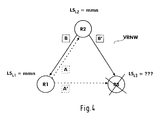
- the computer R1 has a transmission round i started, which is indicated by the dashed arrows.
- the computer R3 is defective, which is why it is neither connected to computer R1 nor to computer R2 Sends message.
- the computers R1 and R2 interpret this as "zero messages” and consequently assign the defective computer R3 the status "non-member" (n). Since the computers R1 and R2 member messages A and B successful with each other have exchanged, they classify each other as “members” (m). In addition computers R1 and R2 see themselves as members.
- the computer states compile these computer states to form a local view of the distributed computer network.
- the computers R1 and R2 are members (m), while the computer R3 is a non-member (s).
- LS i, 1 mmn.
- the local view of the computer R2 in the transmission round i (abbreviated: LS i, 2 ) is also mmn.
- the computer R3 has received a member message from all other computers and could view itself and the other computers as members. However, the computer R3 could just as well be so severely defective that it can no longer determine a local view of the system status at all. For this reason, the local view of the computer R3 by the expression "???" featured.
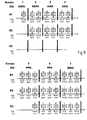
- transmission round i only computers R1 and R2 send messages, but not defective computer R3.
- the computers R1 and R2 send messages from which a receiver can see the respective local view of the transmitter for the previous transmission round i.
- both computers R1 and R2 have their own and local views of the other computer. Since the computer R3 also does not send a message in the transmission round i + 1, it cannot communicate its local view of the system status to the other computers - if such has been determined.
- the method according to the invention ensures that at the end of the transmission round i + 1 at least every non-defective computer has the same local views. If all computers determine a global view of the system status from the local views according to the same rule, it is reliably ensured that these global views match and are therefore uniform. Therefore, in the following we will only speak of a global view GS i for the transmission round i.
- a possible rule for determining a global view from the individual local views is to subject the local views to a simple majority decision. This means that a computer in the global view is assigned the computer state that the computer has in the local view for the most part. In the example mentioned with only two local views that also match, the result is, of course:
- the procedure according to the invention preferably extends to all transmission rounds, d. H.
- every round of transmission there are local views between the computers exchanged.
- the determination local views and their subsequent exchange with each other only in a special way Kick off or at (larger) fixed intervals (e.g. every tenth round of transmission) is carried out.
- the exchange of local views is also regardless of the exchange of other messages.
- ND also contains useful data in the messages. If - such as shown in Fig. 4 - one computer in a round of transmission to all others Computer sends messages A and A ', these messages A and A' may only differ in their user data ND.
- the HEAD message header must be identical in both messages, otherwise there is no uniform global View of the system state can be determined.
- the method according to the invention can be used particularly advantageously with one Communication protocol, which ensures that one of any Data packet sent to the other computers by these other computers is forwarded that each of the other computers this data packet in error-free Case receives at least twice.
- the computer R1 sends identical ones Messages A to the computer R2 and to the computer R3.
- the calculator R2 receives the message A and sends it to the computer R3 unchanged.
- the Computer R3 does the same with the message received from computer R1.
- computers R2 and R3 each receive message A twice, namely once directly from computer R1 and once indirectly via computer R3 or R2.
- the inventive method can be used The procedure then also determines a uniform global view of the system status if the defect of a computer is assigned to a third error class can. With this error class, the defective computer sends as with the one above 2nd error class mentioned incorrect messages. However, the mistake can be for reveal the other computers in different ways (so-called Byzantine Error).
- FIG. 8 Such an error scenario is outlined in FIG. 8.
- the computer R1 is defective and generated instead of identical messages, different messages A and A '. Both messages are provided with "correct" check codes, so that the two other computers R2 and R3 can not find any errors.
- the computer R2 will determine that the direct Message A received by the computer R1 is not identical to that via the computer R3 received message A '.
- a corresponding statement will also be made Make calculator R3.
- computer R1 and R2 are regarded as non-members become. It is only assumed that when forwarding Messages no adulterations occur. Otherwise, for example no longer differentiate for computer R2 whether computer R1 is different Has sent messages or whether computer R3 has received one from computer R1 Message A has falsified to a message A '.
- Fig. 9 shows in a schematic representation how using the four computer states a uniform one at all times, even when booting the distributed computer network global view of the system state can be determined.
- the first round of transmission 1 therefore begins with a boot message (boot), which the computer R1 sends to the other computers.
- boot the message category NK and the respective local view LS of the individual computers.
- the data determined by the computers is also given global view.
- both computer R1 and computer R2 are now contenders in the global view, they can now send 4 integration messages (bind) in the following transmission round.
- computer R3 now also sends a boot message for the first time, so that at the end of the following transmission round 6 it is already viewed globally as candidate (A).
- the two computers R1 and R2 can send member messages for the first time since they were previously considered provisional members globally in the transmission round.
- both computers R1 and R2 are finally members in the global view.
- the distributed computer network now has a majority of members.
- a computer If a computer is identified as defective, it is preferably agreed that that in the local views of the other computers it immediately switches to the lowest computer state, So non-member (s) descends, but a gradual one is also conceivable Descent. In which hierarchy level the computer has to descend, for example depending on the type of error that occurred, if this can be determined.
- the (re) incorporation of a single computer into the distributed computer network is basically analogous to the procedure just described. Do it 9 with reference to how the last booting computer R3 into the computer network is recorded. In the broadcasting round 8 (no longer shown) The computer R3 again sends integration messages (bind). At the end of the broadcast round in the global view it is already considered a provisional member (p). In Transmission round 9, the computer sends 3 member messages (mb) and is in the following broadcast round 10 also seen globally as a member (m).
Landscapes
- Engineering & Computer Science (AREA)
- Theoretical Computer Science (AREA)
- Physics & Mathematics (AREA)
- General Physics & Mathematics (AREA)
- Quality & Reliability (AREA)
- General Engineering & Computer Science (AREA)
- Computing Systems (AREA)
- Signal Processing (AREA)
- Computer Networks & Wireless Communication (AREA)
- Mathematical Physics (AREA)
- Computer And Data Communications (AREA)
- Multi Processors (AREA)
- Hardware Redundancy (AREA)
Abstract
Description
- Fig. 1:
- Verteiltes Rechnernetzwerk mit drei Rechnern R1, R2 und R3;
- Fig. 2:
- Skizze zur Erläuterung des Begriffs der Übertragungsrunde;
- Fig. 3a:
- Skizze zur Erläuterung des Begriffs der Übertragungsrunde bei Verwendung eines streng synchronen Kommunikationsprotokolls;
- Fig. 3b:
- Skizze zur Erläuterung des Begriffs der Übertragungsrunde bei Verwendung eines virtuell synchronen Kommunikationsprotokolls;
- Fig. 4:
- Verteiltes Rechnernetzwerk mit einem defekten Rechner zur Erläuterung des erfindungsgemäßen Verfahrens;
- Fig. 5:
- Erfindungsgemäßer Ablauf von Übertragungsrunden für ein verteiltes Rechnernetzwerk nach Fig. 4;
- Fig. 6:
- Struktur einer erfindungsgemäßen Nachricht nach Anspruch 2;
- Fig. 7:
- Verteiltes Rechnernetzwerk zur Erläuterung eines Ausführungsbeispiels nach Anspruch 5;
- Fig. 8:
- Verteiltes Rechnernetzwerk, in dem ein byzantinischer Fehler aufgetreten ist;
- Fig. 9:
- Erfindungsgemäßer Ablauf von Übertragungsrunden beim Booten eines verteilten Rechnernetzwerks, in dem vier Rechnerzustände definiert sind.


Claims (12)
- Verfahren zur Ermittlung einer einheitlichen globalen Sicht (GS) vom Systemzustand eines wenigstens drei Rechner (R1, R2, R3) umfassenden verteilten Rechnernetzwerks (VRNW),
dadurch gekennzeichnet, daßa) die Rechner über Kommunikationsverbindungen (KV12, KV13, KV32) untereinander Nachrichten in aufeinanderfolgenden Übertragungsrunden austauschen, wobei im fehlerfreien Fall in einer Übertragungsrunde jeder Rechner von jedem anderen Rechner eine Nachricht empfängt, daßb) jeder Rechner in einer Übertragungsrunde von den anderen Rechnern empfangene Nachrichten auswertet und in Abhängigkeit vom Ergebnis der Auswertung jedem der anderen Rechner einen von wenigstens drei unterschiedlich definierten Rechnerzuständen zuordnet und daraus eine lokale Sicht (LSi,j) vom Systemzustand ermittelt, und daßc) die Rechner die von ihnen ermittelten lokalen Sichten vom Systemzustand untereinander austauschen und jeder Rechner aus den ausgetauschten lokalen Sichten eine einheitliche globale Sicht vom Systemzustand ermittelt. - Verfahren nach Anspruch 1, bei dem die Nachrichten wenigstens die nachfolgenden Angaben enthalten:a) Angabe einer Nachrichtenkategorie (NK),b) Nummer der Übertragungsrunde (i), in der die Nachricht gesendet wird,c) Eine lokale Sicht (LSi,j) des sendenden Rechners vom Systemzustand.
- Verfahren nach einem der vorhergehenden Ansprüche, bei dem bei der Ermittlung der globalen Sicht vom Systemzustand auch die globale Sicht einer vorausgegangenen Übertragungsrunde berücksichtigt wird.
- Verfahren nach einem der vorhergehenden Ansprüche, bei dem bei der Ermittlung der globalen Sicht vom Systemzustand ein Mehrheitsentscheid über die einzelnen lokalen Sichten durchgeführt wird.
- Verfahren nach einem der vorhergehenden Ansprüche, bei dem eine von einem beliebigen Rechner an die anderen Rechner gesendete Nachricht so von diesen anderen Rechnern weitergeleitet wird, daß jeder der anderen Rechner diese Nachricht im fehlerfreien Fall wenigstens zweimal empfängt.
- Verfahren nach einem der vorhergehenden Ansprüche, bei dem eine Übertragungsrunde folgende Schritte umfaßt:a) ein beliebiger Rechner (R1 in Fig. 2) sendet auf eigene Initiative an jeden anderen Rechner (R2, R3) im verteilten Rechnernetzwerk ein Datenpaket (A, A'),b) jeder der anderen Rechner (R2, R3) reagiert auf den Empfang des Datenpakets (A, A') innerhalb einer vorgebbaren Zeitspanne mit dem Aussenden jeweils eines eigenen Datenpakets (B, B'; C, C') an jeweils alle anderen Rechner im Rechnernetzwerk.
- Wenigstens drei Rechner (R1, R2, R3) umfassendes verteiltes Rechnernetzwerk (VRNW) mit Mitteln zur Ermittlung einer einheitlichen globalen Sicht (GS) vom Systemzustand des Rechnernetzwerks,
dadurch gekennzeichnet, daßa) Kommunikationsverbindungen (KV12, KV13, KV32) vorgesehen sind, über die die Rechner untereinander Nachrichten in aufeinanderfolgenden Übertragungsrunden austauschen, wobei im fehlerfreien Fall in einer Übertragungsrunde jeder Rechner von jedem anderen Rechner eine Nachricht empfängt, daßb) jeder Rechner einen Prozessor hat, der die in einer Übertragungsrunde von den anderen Rechnern empfangenen Nachrichten auswertet und in Abhängigkeit vom Ergebnis der Auswertung jedem der anderen Rechner einen von wenigstens drei unterschiedlich definierten Rechnerzuständen zuordnet und daraus eine lokale Sicht (LSi,j) vom Systemzustand ermittelt, und daßc) der jeweilige Prozessor veranlaßt, daß die Rechner die von ihnen ermittelten lokalen Sichten vom Systemzustand untereinander austauschen, und daß der jeweilige Prozessor aus den ausgetauschten lokalen Sichten eine einheitliche globale Sicht vom Systemzustand ermittelt. - Verteiltes Rechnernetzwerk nach Anspruch 7, bei dem die Nachrichten wenigstens die nachfolgenden Angaben enthalten:a) Angabe einer Nachrichtenkategorie (NK),b) Nummer der Übertragungsrunde (i), in der die Nachricht gesendet wird,c) Eine lokale Sicht (LSi,j) des sendenden Rechners vom Systemzustand.
- Verteiltes Rechnernetzwerk nach einem der Ansprüche 7 oder 8, bei dem der Prozessor bei der Ermittlung der globalen Sicht vom Systemzustand auch die globale Sicht einer vorausgegangenen Übertragungsrunde berücksichtigt.
- Verteiltes Rechnernetzwerk nach einem der Ansprüche 7 bis 9, bei dem der Prozessor bei der Ermittlung der globalen Sicht vom Systemzustand ein Mehrheitsentscheid durchgeführt.
- Verteiltes Rechnernetzwerk nach einem der Ansprüche 7 bis 10, bei dem ein von einem beliebigen Rechner an die anderen Rechner gesendetes Datenpaket so von diesen anderen Rechnern weitergeleitet wird, daß jeder der anderen Rechner dieses Datenpaket im fehlerfreien Fall wenigstens zweimal empfängt.
- Verteiltes Rechnernetzwerk nach einem der Ansprüche 7 bis 11, bei dem eine Übertragungsrunde folgende Schritte umfaßt:a) ein beliebiger Rechner (R1) sendet auf eigene Initiative an jeden anderen Rechner (R2, R3) des verteilten Rechnernetzwerks ein Datenpaket (A, A'),b) jeder der anderen Rechner (R2, R3) reagiert auf den Empfang des Datenpakets (A, A') innerhalb einer vorgebbaren Zeitspanne mit dem Aussenden jeweils eines eigenen Datenpakets (B, B'; C, C') an jeweils alle anderen Rechner im Rechnernetzwerk.
Applications Claiming Priority (2)
| Application Number | Priority Date | Filing Date | Title |
|---|---|---|---|
| DE19831720 | 1998-07-15 | ||
| DE19831720A DE19831720A1 (de) | 1998-07-15 | 1998-07-15 | Verfahren zur Ermittlung einer einheitlichen globalen Sicht vom Systemzustand eines verteilten Rechnernetzwerks |
Publications (3)
| Publication Number | Publication Date |
|---|---|
| EP0974901A2 true EP0974901A2 (de) | 2000-01-26 |
| EP0974901A3 EP0974901A3 (de) | 2004-12-15 |
| EP0974901B1 EP0974901B1 (de) | 2009-12-09 |
Family
ID=7874114
Family Applications (1)
| Application Number | Title | Priority Date | Filing Date |
|---|---|---|---|
| EP99440197A Expired - Lifetime EP0974901B1 (de) | 1998-07-15 | 1999-07-13 | Verfahren zur Ermittlung einer einheitlichen globalen Sicht vom Systemzustand eines verteilten Rechnernetzwerkes |
Country Status (6)
| Country | Link |
|---|---|
| US (1) | US6574744B1 (de) |
| EP (1) | EP0974901B1 (de) |
| CN (1) | CN1252614C (de) |
| AT (1) | ATE451648T1 (de) |
| CA (1) | CA2277560A1 (de) |
| DE (2) | DE19831720A1 (de) |
Families Citing this family (18)
| Publication number | Priority date | Publication date | Assignee | Title |
|---|---|---|---|---|
| AU2003228512A1 (en) | 2002-04-10 | 2003-10-27 | Instasolv, Inc. | Method and system for managing computer systems |
| US7840856B2 (en) * | 2002-11-07 | 2010-11-23 | International Business Machines Corporation | Object introspection for first failure data capture |
| US20040254984A1 (en) * | 2003-06-12 | 2004-12-16 | Sun Microsystems, Inc | System and method for coordinating cluster serviceability updates over distributed consensus within a distributed data system cluster |
| EP1652048A4 (de) | 2003-07-21 | 2009-04-15 | Fusionone Inc | Einrichtungs-nachrichten-verwaltungssystem |
| US20050149809A1 (en) * | 2003-12-10 | 2005-07-07 | International Business Machines Corporation | Real time determination of application problems, using a lightweight diagnostic tracer |
| US7260743B2 (en) | 2004-01-13 | 2007-08-21 | International Business Machines Corporation | System and method for achieving autonomic computing self-healing, utilizing meta level reflection and reasoning |
| US7218708B2 (en) * | 2004-03-12 | 2007-05-15 | Honeywell International, Inc. | Internet facilitated emergency and general paging system |
| US9542076B1 (en) * | 2004-05-12 | 2017-01-10 | Synchronoss Technologies, Inc. | System for and method of updating a personal profile |
| GB2417868A (en) * | 2004-09-04 | 2006-03-08 | Hewlett Packard Development Co | An asynchronous distributed system with a synchronous communication subsystem which facilitates the generation of global data |
| WO2008094508A2 (en) | 2007-01-26 | 2008-08-07 | Fusionone, Inc. | System for and method of backing up content for use on a mobile device |
| US9374242B2 (en) * | 2007-11-08 | 2016-06-21 | Invention Science Fund I, Llc | Using evaluations of tentative message content |
| US8984133B2 (en) | 2007-06-19 | 2015-03-17 | The Invention Science Fund I, Llc | Providing treatment-indicative feedback dependent on putative content treatment |
| US8682982B2 (en) | 2007-06-19 | 2014-03-25 | The Invention Science Fund I, Llc | Preliminary destination-dependent evaluation of message content |
| US8065404B2 (en) * | 2007-08-31 | 2011-11-22 | The Invention Science Fund I, Llc | Layering destination-dependent content handling guidance |
| US8082225B2 (en) * | 2007-08-31 | 2011-12-20 | The Invention Science Fund I, Llc | Using destination-dependent criteria to guide data transmission decisions |
| US7930389B2 (en) * | 2007-11-20 | 2011-04-19 | The Invention Science Fund I, Llc | Adaptive filtering of annotated messages or the like |
| CN101686141B (zh) * | 2008-09-28 | 2012-01-04 | 华为技术有限公司 | 一种实现已读状态同步的方法及设备 |
| CN102122254A (zh) * | 2011-02-25 | 2011-07-13 | 南京大学 | 一种基于逻辑时钟的智能空间感知方法 |
Family Cites Families (35)
| Publication number | Priority date | Publication date | Assignee | Title |
|---|---|---|---|---|
| DE246218C (de) * | ||||
| DE674601C (de) * | 1936-12-29 | 1939-04-18 | Siemens & Halske Akt Ges | Gas- oder dampfgefuelltes Entladungsgefaess |
| DE2202231A1 (de) * | 1972-01-18 | 1973-07-26 | Siemens Ag | Verarbeitungssystem mit verdreifachten systemeinheiten |
| CH556576A (de) * | 1973-03-28 | 1974-11-29 | Hasler Ag | Einrichtung zur synchronisierung dreier rechner. |
| US4375683A (en) * | 1980-11-12 | 1983-03-01 | August Systems | Fault tolerant computational system and voter circuit |
| AU549343B2 (en) * | 1981-06-08 | 1986-01-23 | British Telecommunications Public Limited Company | Phase locking |
| JPS5985153A (ja) * | 1982-11-08 | 1984-05-17 | Hitachi Ltd | 冗長化制御装置 |
| JPS6171750A (ja) * | 1984-09-17 | 1986-04-12 | Kokusai Denshin Denwa Co Ltd <Kdd> | プロトコル検証回路 |
| US4967347A (en) * | 1986-04-03 | 1990-10-30 | Bh-F (Triplex) Inc. | Multiple-redundant fault detection system and related method for its use |
| DE3787045D1 (de) * | 1986-05-14 | 1993-09-23 | Alcatel Austria Ag | Fehlertolerantes datenverarbeitungssystem. |
| US4756019A (en) * | 1986-08-27 | 1988-07-05 | Edmund Szybicki | Traffic routing and automatic network management system for telecommunication networks |
| NL8602636A (nl) * | 1986-10-21 | 1988-05-16 | H C S Technology B V | Logische stem-schakeling. |
| US4907232A (en) * | 1988-04-28 | 1990-03-06 | The Charles Stark Draper Laboratory, Inc. | Fault-tolerant parallel processing system |
| US5438680A (en) * | 1988-04-29 | 1995-08-01 | Intellectual Properties And Technology, Inc. | Method and apparatus for enhancing concurrency in a parallel digital computer |
| JPH0234059A (ja) * | 1988-07-25 | 1990-02-05 | Mitsubishi Electric Corp | ノード装置の処理方式 |
| US5327553A (en) * | 1989-12-22 | 1994-07-05 | Tandem Computers Incorporated | Fault-tolerant computer system with /CONFIG filesystem |
| US5157667A (en) * | 1990-04-30 | 1992-10-20 | International Business Machines Corporation | Methods and apparatus for performing fault isolation and failure analysis in link-connected systems |
| CA2068048A1 (en) * | 1991-05-06 | 1992-11-07 | Douglas D. Cheung | Fault tolerant processing section with dynamically reconfigurable voting |
| US5339404A (en) * | 1991-05-28 | 1994-08-16 | International Business Machines Corporation | Asynchronous TMR processing system |
| US5535217A (en) * | 1994-12-20 | 1996-07-09 | International Business Machines Corporation | Method and apparatus for probabilistic clock synchronization with interval arithmetic |
| US5761439A (en) * | 1995-09-25 | 1998-06-02 | Intel Corporation | Method and apparatus for synchronizing communications between networked computers |
| US5864657A (en) * | 1995-11-29 | 1999-01-26 | Texas Micro, Inc. | Main memory system and checkpointing protocol for fault-tolerant computer system |
| DE19620622A1 (de) * | 1996-05-22 | 1997-11-27 | Siemens Ag | Verfahren zur Synchronisation von Programmen auf unterschiedlichen Computern eines Verbundes |
| US6370571B1 (en) * | 1997-03-05 | 2002-04-09 | At Home Corporation | System and method for delivering high-performance online multimedia services |
| US5903717A (en) * | 1997-04-02 | 1999-05-11 | General Dynamics Information Systems, Inc. | Fault tolerant computer system |
| US6134673A (en) * | 1997-05-13 | 2000-10-17 | Micron Electronics, Inc. | Method for clustering software applications |
| DE19740136A1 (de) | 1997-09-12 | 1999-03-18 | Alsthom Cge Alcatel | Verfahren zur Isolation eines defekten Rechners in einem fehlertoleranten Mehrrechnersystem |
| DE19742918A1 (de) | 1997-09-29 | 1999-04-01 | Cit Alcatel | Verfahren zum Austausch von Datenpaketen innerhalb eines sicheren Mehrrechnersystems |
| DE19745438A1 (de) | 1997-10-15 | 1999-04-22 | Cit Alcatel | Verfahren zur Fehlerprüfung von echtzeitfähiger Systemsoftware |
| US6035416A (en) * | 1997-10-15 | 2000-03-07 | International Business Machines Corp. | Method and apparatus for interface dual modular redundancy |
| DE19745963A1 (de) | 1997-10-17 | 1999-04-22 | Cit Alcatel | Rechnerknotennetzwerk für den Datenaustausch zwischen Rechnerknoten in sicherheitskritischen Anwendungen sowie Verfahren hierfür |
| DE19745994A1 (de) | 1997-10-20 | 1999-04-22 | Cit Alcatel | Verfahren zum Austausch von Daten zwischen Applikationsprozessen in einem sicheren Mehrrechnersystem |
| US6295541B1 (en) * | 1997-12-16 | 2001-09-25 | Starfish Software, Inc. | System and methods for synchronizing two or more datasets |
| US6442694B1 (en) * | 1998-02-27 | 2002-08-27 | Massachusetts Institute Of Technology | Fault isolation for communication networks for isolating the source of faults comprising attacks, failures, and other network propagating errors |
| US6223304B1 (en) * | 1998-06-18 | 2001-04-24 | Telefonaktiebolaget Lm Ericsson (Publ) | Synchronization of processors in a fault tolerant multi-processor system |
-
1998
- 1998-07-15 DE DE19831720A patent/DE19831720A1/de not_active Withdrawn
-
1999
- 1999-07-13 EP EP99440197A patent/EP0974901B1/de not_active Expired - Lifetime
- 1999-07-13 AT AT99440197T patent/ATE451648T1/de active
- 1999-07-13 DE DE59915108T patent/DE59915108D1/de not_active Expired - Lifetime
- 1999-07-14 CA CA002277560A patent/CA2277560A1/en not_active Abandoned
- 1999-07-15 CN CN99110368.8A patent/CN1252614C/zh not_active Expired - Lifetime
- 1999-07-19 US US09/356,520 patent/US6574744B1/en not_active Expired - Lifetime
Non-Patent Citations (3)
| Title |
|---|
| CRISTIAN F: "Agreeing on who is present and who is absent in a synchronous distributed system" FAULT-TOLERANT COMPUTING, 1988. FTCS-18, DIGEST OF PAPERS., EIGHTEENTH INTERNATIONAL SYMPOSIUM ON TOKYO, JAPAN 27-30 JUNE 1988, WASHINGTON, DC, USA,IEEE COMPUT. SOC. PR, US, 27. Juni 1988 (1988-06-27), Seiten 206-211, XP010013193 ISBN: 0-8186-0867-6 * |
| EZHILCHELVAN P D ET AL: "A robust group membership algorithm for distributed real-time systems" PROCEEDINGS OF THE REAL TIME SYSTEMS SYMPOSIUM. LAKE BUENA VISTA, DEC. 5 - 7, 1990, WASHINGTON, IEEE. COMP. SOC. PRESS, US, Bd. SYMP. 11, 5. Dezember 1990 (1990-12-05), Seiten 173-179, XP010022048 ISBN: 0-8186-2112-5 * |
| MOSER L E ET AL: "Membership algorithms for asynchronous distributed systems" INTERNATIONAL CONFERENCE ON DISTRIBUTED COMPUTING SYSTEMS. ARLINGTON, TEXAS, MAY 20 - 24, 1991, PROCEEDINGS OF THE INTERNATIONAL CONFERENCE ON DISTRIBUTED COMPUTING SYSTEMS, LOS ALAMITOS, IEEE COMP. SOC. PRESS, US, Bd. CONF. 11, 20. Mai 1991 (1991-05-20), Seiten 480-488, XP010023088 ISBN: 0-8186-2144-3 * |
Also Published As
| Publication number | Publication date |
|---|---|
| EP0974901A3 (de) | 2004-12-15 |
| DE19831720A1 (de) | 2000-01-20 |
| US6574744B1 (en) | 2003-06-03 |
| CN1252614C (zh) | 2006-04-19 |
| EP0974901B1 (de) | 2009-12-09 |
| CA2277560A1 (en) | 2000-01-15 |
| ATE451648T1 (de) | 2009-12-15 |
| DE59915108D1 (de) | 2010-01-21 |
| CN1245314A (zh) | 2000-02-23 |
Similar Documents
| Publication | Publication Date | Title |
|---|---|---|
| EP0974901B1 (de) | Verfahren zur Ermittlung einer einheitlichen globalen Sicht vom Systemzustand eines verteilten Rechnernetzwerkes | |
| DE3689052T2 (de) | System und Verfahren zur Busübertragungssteuerung für eng gekoppelte Nachrichten zwischen verteilten programmierbaren Steuergeräten. | |
| DE69715510T2 (de) | Verfahren und Vorrichtung für ein Avionicssystem, das sowohl ARINC 429- als auch ARINC 629-Systeme benutzt | |
| EP0039036B1 (de) | Datenübertragungssystem | |
| EP0115609A2 (de) | Schaltungsanordnung zur Adressierung der Speicher mehrerer datenverarbeitender Einrichtungen in einem Mehrprozesssorsystem | |
| DE69232686T2 (de) | Multiplex-Übertragungssystem | |
| DE2943149C2 (de) | Ringnetzwerk mit mehreren an eine Daten-Ringleitung angeschlossenen Prozessoren | |
| DE2908316A1 (de) | Multikonfigurierbares modulares verarbeitungssystem, das mit einem vorverarbeitungssystem integriert ist | |
| DE102014105207B4 (de) | Verfahren zum Betreiben eines Kommunikationsnetzwerks und Kommunikationsnetzwerk | |
| BE1025127B1 (de) | Kommunikationssystem zur seriellen Kommunikation zwischen Kommunikationsgeräten | |
| EP1283468B1 (de) | Zentraleinheit für ein redundantes Automatisierungssystem | |
| EP0862827B1 (de) | Verfahren zum überprüfen eines gemäss einem kommunikationsprotokoll durchgeführten datenaustausches | |
| DE10211517A1 (de) | Verfahren und Vorrichtung zur Erstellung eines Zeitplans der Übermittlung von Nachrichten auf einem Bussystem | |
| EP1357707B1 (de) | Verfahren zur Übertragung von Nachrichten auf einem Bussystem | |
| DE19547000A1 (de) | Kommunikationssteuerverfahren und Kommunikationsvorrichtung | |
| EP0009600B1 (de) | Verfahren und Schnittstellenadapter zum Durchführen von Wartungsoperationen über eine Schnittstelle zwischen einem Wartungsprozessor und einer Mehrzahl einzeln zu prüfender Funktionseinheiten eines datenverarbeitenden Systems | |
| EP1064590A1 (de) | Verkürztes datentelegramm eines automatisierungssystems | |
| WO2002071223A1 (de) | Fehlertolerante rechneranordnung und verfahren zum betrieb einer derartigen anordnung | |
| DE102015218890A1 (de) | Verfahren und Vorrichtung zum Generieren eines Ausgangsdatenstroms | |
| DE102021127310A1 (de) | System und Verfahren zur Datenübertragung | |
| EP4232905A1 (de) | Datenverarbeitungsnetzwerk zur datenverarbeitung | |
| WO2023066625A1 (de) | Datenverarbeitungsnetzwerk zur datenverarbeitung | |
| DE10216920A1 (de) | Verfahren und Vorrichtung zur Überprüfung einer Überwachungsfunktion eines Bussystems und Bussystem | |
| DE10252109B4 (de) | Verfahren zur Parametrierung | |
| DE3333847A1 (de) | Einchip-rechner als lokaler netzwerk-kontroller und rechner |
Legal Events
| Date | Code | Title | Description |
|---|---|---|---|
| PUAI | Public reference made under article 153(3) epc to a published international application that has entered the european phase |
Free format text: ORIGINAL CODE: 0009012 |
|
| AK | Designated contracting states |
Kind code of ref document: A2 Designated state(s): AT BE CH CY DE DK ES FI FR GB GR IE IT LI LU MC NL PT SE |
|
| AX | Request for extension of the european patent |
Free format text: AL;LT;LV;MK;RO;SI |
|
| 17P | Request for examination filed |
Effective date: 20040810 |
|
| PUAL | Search report despatched |
Free format text: ORIGINAL CODE: 0009013 |
|
| AK | Designated contracting states |
Kind code of ref document: A3 Designated state(s): AT BE CH CY DE DK ES FI FR GB GR IE IT LI LU MC NL PT SE |
|
| AX | Request for extension of the european patent |
Extension state: AL LT LV MK RO SI |
|
| 17Q | First examination report despatched |
Effective date: 20050513 |
|
| AKX | Designation fees paid |
Designated state(s): AT BE CH CY DE DK ES FI FR GB GR IE IT LI LU MC NL PT SE |
|
| 17Q | First examination report despatched |
Effective date: 20050513 |
|
| RAP1 | Party data changed (applicant data changed or rights of an application transferred) |
Owner name: ALCATEL LUCENT |
|
| GRAP | Despatch of communication of intention to grant a patent |
Free format text: ORIGINAL CODE: EPIDOSNIGR1 |
|
| GRAS | Grant fee paid |
Free format text: ORIGINAL CODE: EPIDOSNIGR3 |
|
| GRAA | (expected) grant |
Free format text: ORIGINAL CODE: 0009210 |
|
| AK | Designated contracting states |
Kind code of ref document: B1 Designated state(s): AT BE CH CY DE DK ES FI FR GB GR IE IT LI LU MC NL PT SE |
|
| REG | Reference to a national code |
Ref country code: GB Ref legal event code: FG4D Free format text: NOT ENGLISH |
|
| REG | Reference to a national code |
Ref country code: CH Ref legal event code: EP |
|
| REG | Reference to a national code |
Ref country code: IE Ref legal event code: FG4D |
|
| REF | Corresponds to: |
Ref document number: 59915108 Country of ref document: DE Date of ref document: 20100121 Kind code of ref document: P |
|
| REG | Reference to a national code |
Ref country code: NL Ref legal event code: VDEP Effective date: 20091209 |
|
| PG25 | Lapsed in a contracting state [announced via postgrant information from national office to epo] |
Ref country code: SE Free format text: LAPSE BECAUSE OF FAILURE TO SUBMIT A TRANSLATION OF THE DESCRIPTION OR TO PAY THE FEE WITHIN THE PRESCRIBED TIME-LIMIT Effective date: 20091209 Ref country code: FI Free format text: LAPSE BECAUSE OF FAILURE TO SUBMIT A TRANSLATION OF THE DESCRIPTION OR TO PAY THE FEE WITHIN THE PRESCRIBED TIME-LIMIT Effective date: 20091209 |
|
| REG | Reference to a national code |
Ref country code: IE Ref legal event code: FD4D |
|
| PG25 | Lapsed in a contracting state [announced via postgrant information from national office to epo] |
Ref country code: PT Free format text: LAPSE BECAUSE OF FAILURE TO SUBMIT A TRANSLATION OF THE DESCRIPTION OR TO PAY THE FEE WITHIN THE PRESCRIBED TIME-LIMIT Effective date: 20100409 Ref country code: NL Free format text: LAPSE BECAUSE OF FAILURE TO SUBMIT A TRANSLATION OF THE DESCRIPTION OR TO PAY THE FEE WITHIN THE PRESCRIBED TIME-LIMIT Effective date: 20091209 Ref country code: IE Free format text: LAPSE BECAUSE OF FAILURE TO SUBMIT A TRANSLATION OF THE DESCRIPTION OR TO PAY THE FEE WITHIN THE PRESCRIBED TIME-LIMIT Effective date: 20091209 Ref country code: ES Free format text: LAPSE BECAUSE OF FAILURE TO SUBMIT A TRANSLATION OF THE DESCRIPTION OR TO PAY THE FEE WITHIN THE PRESCRIBED TIME-LIMIT Effective date: 20100320 |
|
| PLBE | No opposition filed within time limit |
Free format text: ORIGINAL CODE: 0009261 |
|
| STAA | Information on the status of an ep patent application or granted ep patent |
Free format text: STATUS: NO OPPOSITION FILED WITHIN TIME LIMIT |
|
| PG25 | Lapsed in a contracting state [announced via postgrant information from national office to epo] |
Ref country code: GR Free format text: LAPSE BECAUSE OF FAILURE TO SUBMIT A TRANSLATION OF THE DESCRIPTION OR TO PAY THE FEE WITHIN THE PRESCRIBED TIME-LIMIT Effective date: 20100310 Ref country code: CY Free format text: LAPSE BECAUSE OF FAILURE TO SUBMIT A TRANSLATION OF THE DESCRIPTION OR TO PAY THE FEE WITHIN THE PRESCRIBED TIME-LIMIT Effective date: 20091209 |
|
| 26N | No opposition filed |
Effective date: 20100910 |
|
| BERE | Be: lapsed |
Owner name: ALCATEL LUCENT Effective date: 20100731 |
|
| PG25 | Lapsed in a contracting state [announced via postgrant information from national office to epo] |
Ref country code: DK Free format text: LAPSE BECAUSE OF FAILURE TO SUBMIT A TRANSLATION OF THE DESCRIPTION OR TO PAY THE FEE WITHIN THE PRESCRIBED TIME-LIMIT Effective date: 20091209 |
|
| PG25 | Lapsed in a contracting state [announced via postgrant information from national office to epo] |
Ref country code: MC Free format text: LAPSE BECAUSE OF NON-PAYMENT OF DUE FEES Effective date: 20100731 |
|
| REG | Reference to a national code |
Ref country code: CH Ref legal event code: PL |
|
| PG25 | Lapsed in a contracting state [announced via postgrant information from national office to epo] |
Ref country code: LI Free format text: LAPSE BECAUSE OF NON-PAYMENT OF DUE FEES Effective date: 20100731 Ref country code: CH Free format text: LAPSE BECAUSE OF NON-PAYMENT OF DUE FEES Effective date: 20100731 |
|
| PG25 | Lapsed in a contracting state [announced via postgrant information from national office to epo] |
Ref country code: BE Free format text: LAPSE BECAUSE OF NON-PAYMENT OF DUE FEES Effective date: 20100731 |
|
| PG25 | Lapsed in a contracting state [announced via postgrant information from national office to epo] |
Ref country code: LU Free format text: LAPSE BECAUSE OF NON-PAYMENT OF DUE FEES Effective date: 20100713 |
|
| PGFP | Annual fee paid to national office [announced via postgrant information from national office to epo] |
Ref country code: IT Payment date: 20120713 Year of fee payment: 14 |
|
| PG25 | Lapsed in a contracting state [announced via postgrant information from national office to epo] |
Ref country code: IT Free format text: LAPSE BECAUSE OF NON-PAYMENT OF DUE FEES Effective date: 20130713 |
|
| REG | Reference to a national code |
Ref country code: FR Ref legal event code: PLFP Year of fee payment: 17 |
|
| REG | Reference to a national code |
Ref country code: FR Ref legal event code: CA Effective date: 20150521 |
|
| REG | Reference to a national code |
Ref country code: FR Ref legal event code: CA Effective date: 20150521 |
|
| REG | Reference to a national code |
Ref country code: FR Ref legal event code: PLFP Year of fee payment: 18 |
|
| REG | Reference to a national code |
Ref country code: FR Ref legal event code: PLFP Year of fee payment: 19 |
|
| REG | Reference to a national code |
Ref country code: FR Ref legal event code: PLFP Year of fee payment: 20 |
|
| PGFP | Annual fee paid to national office [announced via postgrant information from national office to epo] |
Ref country code: DE Payment date: 20180703 Year of fee payment: 20 Ref country code: FR Payment date: 20180712 Year of fee payment: 20 Ref country code: GB Payment date: 20180628 Year of fee payment: 20 |
|
| PGFP | Annual fee paid to national office [announced via postgrant information from national office to epo] |
Ref country code: AT Payment date: 20180710 Year of fee payment: 20 |
|
| REG | Reference to a national code |
Ref country code: DE Ref legal event code: R071 Ref document number: 59915108 Country of ref document: DE |
|
| REG | Reference to a national code |
Ref country code: GB Ref legal event code: PE20 Expiry date: 20190712 |
|
| REG | Reference to a national code |
Ref country code: AT Ref legal event code: MK07 Ref document number: 451648 Country of ref document: AT Kind code of ref document: T Effective date: 20190713 |
|
| PG25 | Lapsed in a contracting state [announced via postgrant information from national office to epo] |
Ref country code: GB Free format text: LAPSE BECAUSE OF EXPIRATION OF PROTECTION Effective date: 20190712 |