EP0974903A2 - Verfahren und Vorrichtung zur Fehlererkennung und Wiederherstellung mit vorbestimmtem Replikationsgrad für verteilte Anwendungen in einem Netzwerk - Google Patents
Verfahren und Vorrichtung zur Fehlererkennung und Wiederherstellung mit vorbestimmtem Replikationsgrad für verteilte Anwendungen in einem Netzwerk Download PDFInfo
- Publication number
- EP0974903A2 EP0974903A2 EP99305515A EP99305515A EP0974903A2 EP 0974903 A2 EP0974903 A2 EP 0974903A2 EP 99305515 A EP99305515 A EP 99305515A EP 99305515 A EP99305515 A EP 99305515A EP 0974903 A2 EP0974903 A2 EP 0974903A2
- Authority
- EP
- European Patent Office
- Prior art keywords
- copy
- application module
- failure
- host computer
- replication
- Prior art date
- Legal status (The legal status is an assumption and is not a legal conclusion. Google has not performed a legal analysis and makes no representation as to the accuracy of the status listed.)
- Granted
Links
Images

Classifications
-
- G—PHYSICS
- G06—COMPUTING OR CALCULATING; COUNTING
- G06F—ELECTRIC DIGITAL DATA PROCESSING
- G06F11/00—Error detection; Error correction; Monitoring
- G06F11/30—Monitoring
-
- G—PHYSICS
- G06—COMPUTING OR CALCULATING; COUNTING
- G06F—ELECTRIC DIGITAL DATA PROCESSING
- G06F11/00—Error detection; Error correction; Monitoring
- G06F11/07—Responding to the occurrence of a fault, e.g. fault tolerance
- G06F11/16—Error detection or correction of the data by redundancy in hardware
- G06F11/20—Error detection or correction of the data by redundancy in hardware using active fault-masking, e.g. by switching out faulty elements or by switching in spare elements
- G06F11/2097—Error detection or correction of the data by redundancy in hardware using active fault-masking, e.g. by switching out faulty elements or by switching in spare elements maintaining the standby controller/processing unit updated
-
- G—PHYSICS
- G06—COMPUTING OR CALCULATING; COUNTING
- G06F—ELECTRIC DIGITAL DATA PROCESSING
- G06F11/00—Error detection; Error correction; Monitoring
- G06F11/07—Responding to the occurrence of a fault, e.g. fault tolerance
- G06F11/14—Error detection or correction of the data by redundancy in operations
- G06F11/1402—Saving, restoring, recovering or retrying
- G06F11/1415—Saving, restoring, recovering or retrying at system level
- G06F11/1438—Restarting or rejuvenating
-
- G—PHYSICS
- G06—COMPUTING OR CALCULATING; COUNTING
- G06F—ELECTRIC DIGITAL DATA PROCESSING
- G06F11/00—Error detection; Error correction; Monitoring
- G06F11/07—Responding to the occurrence of a fault, e.g. fault tolerance
- G06F11/16—Error detection or correction of the data by redundancy in hardware
- G06F11/20—Error detection or correction of the data by redundancy in hardware using active fault-masking, e.g. by switching out faulty elements or by switching in spare elements
- G06F11/202—Error detection or correction of the data by redundancy in hardware using active fault-masking, e.g. by switching out faulty elements or by switching in spare elements where processing functionality is redundant
- G06F11/2023—Failover techniques
-
- G—PHYSICS
- G06—COMPUTING OR CALCULATING; COUNTING
- G06F—ELECTRIC DIGITAL DATA PROCESSING
- G06F11/00—Error detection; Error correction; Monitoring
- G06F11/07—Responding to the occurrence of a fault, e.g. fault tolerance
- G06F11/0703—Error or fault processing not based on redundancy, i.e. by taking additional measures to deal with the error or fault not making use of redundancy in operation, in hardware, or in data representation
- G06F11/0751—Error or fault detection not based on redundancy
- G06F11/0754—Error or fault detection not based on redundancy by exceeding limits
- G06F11/0757—Error or fault detection not based on redundancy by exceeding limits by exceeding a time limit, i.e. time-out, e.g. watchdogs
-
- G—PHYSICS
- G06—COMPUTING OR CALCULATING; COUNTING
- G06F—ELECTRIC DIGITAL DATA PROCESSING
- G06F11/00—Error detection; Error correction; Monitoring
- G06F11/07—Responding to the occurrence of a fault, e.g. fault tolerance
- G06F11/16—Error detection or correction of the data by redundancy in hardware
- G06F11/20—Error detection or correction of the data by redundancy in hardware using active fault-masking, e.g. by switching out faulty elements or by switching in spare elements
- G06F11/202—Error detection or correction of the data by redundancy in hardware using active fault-masking, e.g. by switching out faulty elements or by switching in spare elements where processing functionality is redundant
- G06F11/2038—Error detection or correction of the data by redundancy in hardware using active fault-masking, e.g. by switching out faulty elements or by switching in spare elements where processing functionality is redundant with a single idle spare processing component
Definitions
- This invention relates to detection of a failure of an application module running on a host computer on a network and recovery from that failure.
- the application module In order for an application module running on a host computer in a network to provide acceptable performance to the clients accessing it, the application module must be both reliable and available. In order to provide acceptable performance, schemes are required for detecting the failure of an application module or the entire host computer running it, and for then quickly recovering from such a detected failure. Replication of the application module on other host computers in the network is a well known technique that can be used to improve reliability and availability of the application module.
- the checkpoint data of the last such stored state of the failed primary application module is supplied to the backup application module to enable it to assume the job as the primary application module and continue processing from such last stored state of the failed primary application module.
- the second strategy is known as a "warm backup" style. Unlike the cold backup style in which no backup of an application module is running at the same time the primary application module is running, in the warm backup style one or more backup application modules run simultaneously with the primary application module.
- the backup application modules do not receive and respond to any client requests, but periodically receive state updates from the primary application module. Once a failure of the primary application module is detected, one of the backup application modules is quickly activated to take over the responsibility of the primary application module without the need for initialization or restart, which increases the time required for the backup to assume the processing functions of the failed primary.
- the third strategy is known as a "hot backup" style.
- two or more copies of an application module are active at run time.
- Each running copy can process client requests and states are synchronized among the multiple copies. Once a failure in one of the running application modules is detected, any one of the other running copies is able to immediately take over the load of the failed copy and continue operations.
- both the warm backup and hot backup strategies advantageously can tolerate the coincident failure of more than one copy of a particular application module running in the network, since multiple copies of that application module type are simultaneously running on the network.
- Each of the three replication strategies incur different run-time overheads and have different recovery times.
- One application module running on a network may need a different replication strategy based on its availability requirements and its run time environment than another application module running on the same host computer or a different host computer within the network. Since distributed applications often run on heterogeneous hardware and operating system platforms, the techniques to enhance an application module's reliability and availability must be able to accommodate all the possible replication schemes.
- the watchdog daemon that is watching the failed host computer restarts the registered processes or applications that were running on the failed watched node on its own node.
- the replication strategy for restarting the failed process or application is the cold backup style, i.e., a new replica process or application is started only upon the failure of the primary process or application.
- prior art fault-tolerant methodologies have not considered and are not adaptable to handle multiple different replication strategies, such as the cold, warm and hot backup styles described above, that might best be associated with each individual application among a plurality of different applications that may be running on one or more machines in a network.
- an application module running on a host computer is made reliable by first registering itself for its own failure and recovery processes.
- a ReplicaManager daemon process running on the same host computer on which the application module is running or on another host computer connected to the network to which the application module's machine is connected, receives a registration message from the application module.
- This registration message in addition to identifying the registering application module and the host machine on which it is running, includes the particular replication strategy (cold, warm or hot backup style) and the degree of replication to be associated with the registered application module, which registered replication strategy is used by the ReplicaManager to set the operating state of each backup copy of the application module as well as to maintain the number of backup copies in accordance with the degree of replication.
- a Watchdog daemon process running on the same host computer as the registered application module then periodically monitors the registered application module to detect failures.
- the Watchdog daemon detects a crash or a hangup of the monitored application module, it reports the failure to the ReplicaManager, which in turn effects a fail-over process. Accordingly, if the replication style is warm or hot and the failed application module cannot be restarted on its own host computer, one of the running backup copies of the primary application module is designated as the new primary application module and a host computer on which an idle copy of the application module resides is signaled over the network to execute that idle application. The degree of replication is thus maintained thereby assuring protection against multiple failures of that application module.
- a host computer on which an idle copy of the application module resides is signaled over the network to execute the idle copy.
- a SuperWatchDog daemon process running on the same host computer as the ReplicaManager, detects inputs from each host computer.
- the ReplicaManager is accessed to determine the application modules that were running on that host computer. Those application modules are then individually failure-protected in the manner established and stored in the ReplicaManager.
- a network 100 is shown, to which is connected a plurality of host computers.
- the network 100 can be an Ethernet, an ATM network, or any other type of data network.
- host computers H1, H2, H3, H4, H5 and H6, numerically referenced as101, 102, 103, 104, 105, and 106, respectively, are connected to the network 100.
- Each host computer has a plurality of different application modules residing in its memory. These application modules, being designated in FIG. 1 as being of a type A, B and C, each has a primary copy executed and running on at least one of these six host computers.
- a primary copy of the type A application module, application module A 1 is running of host computer H1
- a primary copy of the type B application module, application module B 1 is running on host computer H4
- a primary copy of the type C application module, application module C 1 is running on host computer H3.
- Other copies of each type of application module are either stored and available from memory on at least one of the other host computers in an idle state awaiting later execution, or are running as a backup copies or second primary copies of application modules.
- an application module running on a host computer is fault-protected by one or more backup copies of the application module that are operated in a state of preparedness defined by one of three known replication styles.
- Each replication style has its own method of providing backup to an application module which fails by means of crashing or hanging up, or to all those application modules residing on a host computer that itself fails.
- each application module type is fault-protected with the specific replication style, (cold backup, warm backup, hot backup) that is best suited to its own processing requirements.
- each application module type is fault-protected with a degree of replication specified for that application module, thereby maintaining a constant number of copies of that application module in a running state for protection against multiple failures of that type of application module.
- an application module is made reliable by registering itself for its own failure detection and recovery.
- a centralized ReplicaManager daemon process 112 running on one of the host computers (host computer H2 in FIG. 1) in the network, receives a registration request from each failure-protected application module.
- the registration request includes for the particular application module the style of replication (i.e., hot, warm, and cold), the degree of replication, a list of the host computers on which the application module resides and where on each such host computer the executable program can be found, and a switching style.
- the degree of replication specifies the total number of copies of an application module.
- the degree of replication defines the total number of running copies of an application module that are to be maintained in the network.
- the degree of replication specifies the number of host computers in the network from which the application module can be run.
- the switching style specifies a fail-over strategy that determines when an application module should be migrated from one host computer to another host computer. With respect to the latter, when a failure of a application module is detected, it can either be restarted on the same host computer on which the failure took place, or it can be migrated to another host computer on which an idle or running backup copy resides. Two fail-over strategies can be specified upon registration of the application module with the ReplicaManager.
- OnOverThreshold an application module is migrated to another host computer after the number of times that the application module has failed on a given host computer exceeds a given threshold.
- the failed application module is restarted on its own host computer until the number of times the application module fails reaches the threshold number. Thereafter, the failed application module is migrated to another host computer.
- OnEachFailure a failed application module is migrated to another host computer each time a failure occurs.
- the ReplicaManager daemon process 112 has consolidated in its memory the replication information for all registered application modules in the network. For each type of application module running in the network, the ReplicaManager stores the information necessary to effect recovery of a running application module or an entire host computer running several different application modules.
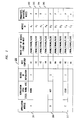
- FIG. 2 illustrates in a table format 200 the type of stored information for the three types of application modules running on the six host computers in FIG. 1.
- application module of type A is registered in entry 201 with a warm backup style with a replication degree of three.
- one primary application module is always running together with two backup copies, with any one of the backup copies being capable of taking over functioning as a primary upon the failure of the primary copy.
- An additional copy of application module type A, A 4 is shown residing in memory on H4 in an idle state (designated "I" in block 205).
- the pathname location of each copy of the application module on the host computer is illustratively shown.
- Application module type B is registered and stored by the ReplicaManager in entry 206 with a hot backup style having a degree of two.
- the first primary copy, B 1 is illustratively shown as residing on H4 and the second primary copy, B 2 , is shown residing on H1.
- An idle copy, B 3 resides on H5.
- the third application module, type C is registered in entry 207 with a cold backup style with a degree of two.
- a primary copy, C 1 is illustratively shown running on H3, and a single idle copy is illustratively shown residing on H6.
- a backup application module upon detecting a failure of a primary application module having an OnEachFailure switching style or an OnOverThreshold switching style in which the threshold has been reached, a backup application module is designated as a new primary application module in table 200. If the failed application module has a warm or hot backup style, an idle copy of that application module type is executed on its hosting computer to maintain the same level of replication in the network. Similarly, if a running backup copy of an application module is detected as having failed, an idle copy of that application module is started on another host computer to maintain the same number of running copies in the network as specified by the registered degree of replication.
- table 200 is accessed to determine the identities of the application modules running on that computer as either primary copies or backup copies. Each such primary or backup copy on the failed host computer is then failure-protected in the same manner as if each failed individually.
- WatchDog daemon 113-1 monitors the registered application modules A 1 and B 2 running on host computer H1;
- WatchDog daemon 113-2 monitors the registered application module A 2 running on host computer H2;
- WatchDog daemon 113-3 monitors the registered application modules A 3 and C 1 running on host computer H3;
- WatchDog daemon 113-4 monitors the application module B 1 running on host computer H4.
- WatchDog daemon 113-4 Since application module A 4 in memory in host computer H4 is idle, WatchDog daemon 113-4 does not monitor it until it may later be made active. Similarly, idle application module B 3 on host computer H5 and idle application module C 2 on host computer H6 are not monitored by WatchDog daemons 113-5 and 113-6, respectively, until they are executed.
- the Watchdog daemons 113 running on each host computer support two failure detection mechanisms: polling and heartbeat.
- polling the Watchdog daemon periodically sends a ping message to the application module it is monitoring. If the ping fails, its assumes that the application module has crashed.
- the polling can also be used to provide a sanity check for an application module calling a sanity-checking method inside the application module.
- heartbeat mechanism an application module actively sends heartbeats to the Watchdog daemon either on a periodic basis or on a per request basis. If the Watchdog daemon does not receive a heartbeat within a certain duration, the application module is considered to be hung up.
- the heartbeat mechanism is capable of detecting both crash and hang failures of an application module or a host computer, whereas the polling mechanism is only capable of detecting crash failures. An application module may select one of these two approaches based on its reliability needs.
- a WatchDog daemon When a WatchDog daemon detects a crash or a hang of an application module that it is "watching", it reports the failure to the ReplicaManager 112 for fail-over action. As previously noted, if the failed application module has registered with an OnEachFailure fail-over strategy, the failed application module is migrated to another host. Thus, if the failed application module is a primary copy, one of the backup application modules is designated as the new primary and an idle application module is executed to maintain the same degree of replication for which that application module type has registered. Upon promotion of an application module from backup status to primary status, its designation in table 200 is modified, as is the idle application that is executed. If the failed application module is a backup copy, then an idle copy is executed and its designation in table 200 is modified to reflect that change.
- ReplicaManager 112 is centralized, i.e., there is only one copy of ReplicaManager running in the network.
- the replication information for each application module running in the network is consolidated in table 200 maintained in the memory of ReplicaManager 112. To prevent loss of this information in case of failures, this ReplicaManager table is checkpointed with Checkpoint Server 110.
- a centralized SuperWatchDog daemon process115-1 is used to detect and recover from host crashes. All WatchDog daemons register with the SuperWatchDog daemon for such detection of host failures. Failure protection is effected through a heartbeat detection strategy. Thus, each of the WatchDog daemons 113 periodically sends a heartbeat to the SuperWatchDog daemon 115-1. If the SuperWatchDog daemon 115-1 does not receive a heartbeat from any of the WatchDogs 113, it assumes that that WatchDog and the host computer on which it is running have failed. It then initiates failure recover by informing the ReplicaManager 112 of that host computer's failure.
- SuperWatchDog backup copies 115-2 and 115-3 of SuperWatchDog 115-1 are shown residing on host computers H5 and H6, respectively.
- the three SuperWatchDog daemons form a logical ring structure.
- Each SuperWatchDog daemon periodically sends heartbeats to a neighbor SuperWatchDog.
- the primary SuperWatchDog 115-1 periodically sends a heartbeat to SuperWatchDog 115-2, which, in turn, periodically sends a heartbeat to SuperWatchDog 115-3, which, in turn, periodically sends a heartbeat back to SuperWatchDog 115-1. If a SuperWatchDog does not receive a heartbeat from its neighbor on the ring, it assumes that a failure has occurred. A fail-over procedure for a failed SuperWatchDog is described hereinafter.
- application module A As an example of recovery from a crashed or hung application module, reference will be made to application module A, which is registered with ReplicaManager 112 with a warm replication style with a degree of three and with a switching style of OnEachFailure.
- application module A 1 is running on host computer H1 with backups A 2 and A 3 running on host computers H2 and H3, respectively.
- Application module A 1 is registered with its local WatchDog 113-1 with the detection style of polling, so that WatchDog 113-1 periodically polls application module A 1 .
- application module A 1 on host computer H1 crashes, which failure is detected by WatchDog 113-1.
- WatchDog 113-1 reports that failure to ReplicaManager 112, which looks up its internal table 200 and decides that a primary application module of type A has failed and that backup applications are running on host computers H2 and H3. It promotes one of these backups (A 2 , for example) to primary status and changes the status of A 2 from backup to primary in table 200. It then notes that an idle copy, A 4 , is resident on host computer H4 at pathname location /home/chung/A.exe , and starts that new backup by informing the WatchDog 113-4 on host computer H4 to execute that copy.
- the WatchDog running on each host computer sends heartbeats to the primary SuperWatchDog in the network.
- WatchDogs 113-1 - 113-6 send heartbeats to SuperWatchDog 115-1.
- the WatchDog running on it crashes and SuperWatchDog 115-1 stops receiving heartbeats from that WatchDog.
- SuperWatchDog 115-1 stops receiving heartbeats from WatchDog 113-1. It then declares host computer H1 dead and reports that failure to ReplicaManager 112.
- ReplicaManager 112 accesses table 200 to determine that application modules A 1 and B 2 were running of host computer H1. Recovery for A 1 is initiated as previously described.
- Application module B 2 is noted to be a primary copy.
- the idle copy B 3 residing on host computer H5 is then executed, thereby maintaining two running primary copies of application module type B in the network.
- the status of B 3 is then updated in table 200 from idle to primary.
- the failure of a WatchDog daemon running on a host computer is treated in the same manner as a host crash.
- SuperWatchDog 115-2 on host computer H5 detects the failure and determines that the primary SuperWatchDog has failed.
- Backup SuperWatchDog 115-2 then takes over the role of the primary and starts the ReplicaManager daemon on host computer H5.
- each WatchDog daemon discovers the new primary SuperWatchDog 115-2, and the ReplicaManager 112 registers itself with the new primary SuperWatchDog 115-2 and starts sending it periodic heartbeats.
- the state of the ReplicaManager is made persistent by storing the table 200 in the Checkpoint Server 110.
- the ReplicaManager is migrated to host computer H5 with the new primary SuperWatchDog 115-2, the ReplicaManager started on that host loads its state from the Checkpoint Server 110 and reinitializes its internal table from its stored state.
- the ReplicaManager 112 fails, then its failure is detected by SuperWatchDog 115-1 from the absence of heartbeats. SuperWatchDog 115-1 then restarts ReplicaManager 112 on the same host computer, loading its state from the Checkpoint Server 110, and reinitializing its internal table 200 from its stored state.
Landscapes
- Engineering & Computer Science (AREA)
- Theoretical Computer Science (AREA)
- Quality & Reliability (AREA)
- Physics & Mathematics (AREA)
- General Engineering & Computer Science (AREA)
- General Physics & Mathematics (AREA)
- Hardware Redundancy (AREA)
- Multi Processors (AREA)
Applications Claiming Priority (2)
| Application Number | Priority Date | Filing Date | Title |
|---|---|---|---|
| US119139 | 1998-07-20 | ||
| US09/119,139 US6266781B1 (en) | 1998-07-20 | 1998-07-20 | Method and apparatus for providing failure detection and recovery with predetermined replication style for distributed applications in a network |
Publications (3)
| Publication Number | Publication Date |
|---|---|
| EP0974903A2 true EP0974903A2 (de) | 2000-01-26 |
| EP0974903A3 EP0974903A3 (de) | 2001-06-13 |
| EP0974903B1 EP0974903B1 (de) | 2003-05-14 |
Family
ID=22382753
Family Applications (1)
| Application Number | Title | Priority Date | Filing Date |
|---|---|---|---|
| EP99305515A Expired - Lifetime EP0974903B1 (de) | 1998-07-20 | 1999-07-12 | Verfahren und Vorrichtung zur Fehlererkennung und Wiederherstellung mit vorbestimmter Replikationsart für verteilte Anwendungen in einem Netzwerk |
Country Status (7)
| Country | Link |
|---|---|
| US (1) | US6266781B1 (de) |
| EP (1) | EP0974903B1 (de) |
| JP (1) | JP2000105754A (de) |
| KR (1) | KR20000011835A (de) |
| AU (1) | AU752844B2 (de) |
| CA (1) | CA2273523C (de) |
| DE (1) | DE69907818T2 (de) |
Cited By (16)
| Publication number | Priority date | Publication date | Assignee | Title |
|---|---|---|---|---|
| EP1223510A2 (de) | 2001-01-16 | 2002-07-17 | Siemens Aktiengesellschaft | Verfahren zur automatischen Wiederherstellung von Daten in einer Datenbasis |
| WO2003017104A1 (en) * | 2001-08-15 | 2003-02-27 | Spx Corporation | Method and system for implementing redundant servers |
| EP1323040A4 (de) * | 2000-09-08 | 2005-08-03 | Goahead Software Inc | System und verfahren zur verwaltung von clustern mit mehreren knoten |
| WO2006042775A2 (de) | 2004-10-15 | 2006-04-27 | Siemens Aktiengesellschaft | Verfahren und vorrichtung zur redundanzkontrolle von elektrischen einrichtungen |
| WO2006127363A3 (en) * | 2005-05-20 | 2007-02-15 | Unisys Corp | Usage metering system |
| EP1485723A4 (de) * | 2002-02-19 | 2007-12-26 | Qualcomm Inc | Verfahren und vorrichtung zur zweiphasigen übergabe bei der datenverteilung an eine web-farm |
| WO2008057026A3 (en) * | 2006-11-10 | 2008-07-10 | Densitech Ab | Providing safety in relation to mobile stations |
| US7558986B2 (en) * | 2005-05-26 | 2009-07-07 | United Parcel Service Of America, Inc. | Software process monitor |
| US7823021B2 (en) | 2005-05-26 | 2010-10-26 | United Parcel Service Of America, Inc. | Software process monitor |
| WO2012134799A2 (en) | 2011-03-31 | 2012-10-04 | Microsoft Corporation | Fault detection and recovery as a service |
| US8332826B2 (en) | 2005-05-26 | 2012-12-11 | United Parcel Service Of America, Inc. | Software process monitor |
| EP3037970A1 (de) * | 2008-08-08 | 2016-06-29 | Amazon Technologies, Inc. | Bereitstellung von ausführenden programmen mit zuverlässigem zugriff auf nichtlokalen blockdatenspeicher |
| EP1665672B1 (de) * | 2003-09-18 | 2018-08-01 | Cisco Technology, Inc. | Virtueller switch mit hoher verfügbarkeit |
| CN108432219A (zh) * | 2016-10-25 | 2018-08-21 | 华为技术有限公司 | 终端设备开机失败的恢复方法和终端设备 |
| US10824343B2 (en) | 2008-08-08 | 2020-11-03 | Amazon Technologies, Inc. | Managing access of multiple executing programs to non-local block data storage |
| CN115113591A (zh) * | 2021-03-23 | 2022-09-27 | Abb瑞士股份有限公司 | 使用控制软件的虚拟化实例控制工业过程 |
Families Citing this family (102)
| Publication number | Priority date | Publication date | Assignee | Title |
|---|---|---|---|---|
| US6477663B1 (en) | 1998-04-09 | 2002-11-05 | Compaq Computer Corporation | Method and apparatus for providing process pair protection for complex applications |
| US6401216B1 (en) | 1998-10-29 | 2002-06-04 | International Business Machines Corporation | System of performing checkpoint/restart of a parallel program |
| US6393583B1 (en) * | 1998-10-29 | 2002-05-21 | International Business Machines Corporation | Method of performing checkpoint/restart of a parallel program |
| US6928469B1 (en) | 1998-12-29 | 2005-08-09 | Citrix Systems, Inc. | Apparatus and method for determining a program neighborhood for a client node in a client-server network using markup language techniques |
| US6643690B2 (en) * | 1998-12-29 | 2003-11-04 | Citrix Systems, Inc. | Apparatus and method for determining a program neighborhood for a client node in a client-server network |
| US6654801B2 (en) * | 1999-01-04 | 2003-11-25 | Cisco Technology, Inc. | Remote system administration and seamless service integration of a data communication network management system |
| US6523130B1 (en) * | 1999-03-11 | 2003-02-18 | Microsoft Corporation | Storage system having error detection and recovery |
| US6687847B1 (en) * | 1999-04-21 | 2004-02-03 | Cornell Research Foundation, Inc. | Failure detector with consensus protocol |
| KR100324275B1 (ko) * | 1999-07-14 | 2002-02-25 | 서평원 | 이중화된 프로세서의 이중화 상태 제어 방법 |
| US6718486B1 (en) * | 2000-01-26 | 2004-04-06 | David E. Lovejoy | Fault monitor for restarting failed instances of the fault monitor |
| US20020198996A1 (en) * | 2000-03-16 | 2002-12-26 | Padmanabhan Sreenivasan | Flexible failover policies in high availability computing systems |
| US7627694B2 (en) * | 2000-03-16 | 2009-12-01 | Silicon Graphics, Inc. | Maintaining process group membership for node clusters in high availability computing systems |
| US6742134B1 (en) * | 2000-05-20 | 2004-05-25 | Equipe Communications Corporation | Maintaining a local backup for data plane processes |
| US20020026385A1 (en) * | 2000-08-31 | 2002-02-28 | Mccloskey John M. | System and methods for generating an electronic purchase order for a part using a display of computer-aided design (CAD) drawing and related article and media |
| US20020073409A1 (en) * | 2000-12-13 | 2002-06-13 | Arne Lundback | Telecommunications platform with processor cluster and method of operation thereof |
| DK1360796T3 (da) * | 2001-01-26 | 2010-05-10 | American Power Conv Corp | Fremgangsmåde og system til at indstille et sæt netværksapparater som kan forbindes for at tilvejebringe forbedret samarbejde, skalerbarhed og pålidelighed |
| KR100423701B1 (ko) * | 2001-02-08 | 2004-03-18 | 주식회사 클래러스 | 가상적으로 통합된 분산파일그룹에 데이터를 백업하기위한 방법 및 시스템 |
| US20060162639A1 (en) * | 2001-03-23 | 2006-07-27 | Costello James M | Touch tunnel |
| US20020143914A1 (en) * | 2001-03-29 | 2002-10-03 | Cihula Joseph F. | Network-aware policy deployment |
| US20020152425A1 (en) * | 2001-04-12 | 2002-10-17 | David Chaiken | Distributed restart in a multiple processor system |
| US6957251B2 (en) * | 2001-05-07 | 2005-10-18 | Genworth Financial, Inc. | System and method for providing network services using redundant resources |
| US7000100B2 (en) * | 2001-05-31 | 2006-02-14 | Hewlett-Packard Development Company, L.P. | Application-level software watchdog timer |
| US6954884B2 (en) * | 2001-06-01 | 2005-10-11 | Lucent Technologies Inc. | System and method for effecting recovery of a network |
| US7003775B2 (en) * | 2001-08-17 | 2006-02-21 | Hewlett-Packard Development Company, L.P. | Hardware implementation of an application-level watchdog timer |
| US6766482B1 (en) | 2001-10-31 | 2004-07-20 | Extreme Networks | Ethernet automatic protection switching |
| US7392421B1 (en) * | 2002-03-18 | 2008-06-24 | Symantec Operating Corporation | Framework for managing clustering and replication |
| US7689875B2 (en) * | 2002-04-25 | 2010-03-30 | Microsoft Corporation | Watchdog timer using a high precision event timer |
| US7124320B1 (en) * | 2002-08-06 | 2006-10-17 | Novell, Inc. | Cluster failover via distributed configuration repository |
| JP2004086721A (ja) * | 2002-08-28 | 2004-03-18 | Nec Corp | データ複製システム、中継装置、データ送受信方法およびストレージ内のデータを複製するためのプログラム |
| US20040153700A1 (en) * | 2003-01-02 | 2004-08-05 | Nixon Mark J. | Redundant application stations for process control systems |
| JP4321705B2 (ja) * | 2003-07-29 | 2009-08-26 | 株式会社日立製作所 | スナップショットの取得を制御するための装置及び記憶システム |
| WO2005036418A1 (en) * | 2003-10-13 | 2005-04-21 | Illuminator (Israel) Ltd. | Apparatus and method for information recovery quality assessment in a computer system |
| US9213609B2 (en) * | 2003-12-16 | 2015-12-15 | Hewlett-Packard Development Company, L.P. | Persistent memory device for backup process checkpoint states |
| US7890798B1 (en) * | 2004-03-22 | 2011-02-15 | Hewlett-Packard Development Company, L.P. | Computer cluster with second-node instance of application having access to state snapshot of first-node instance of application |
| US20050216552A1 (en) * | 2004-03-24 | 2005-09-29 | Samuel Fineberg | Communication-link-attached persistent memory system |
| US7680904B2 (en) * | 2004-08-06 | 2010-03-16 | Logic Controls, Inc. | Diagnostic method and apparatus for detecting and locating computer network discontinuities |
| JP4170364B2 (ja) * | 2004-09-17 | 2008-10-22 | 松下電器産業株式会社 | プロセッサ |
| US7630336B2 (en) * | 2004-10-27 | 2009-12-08 | Honeywell International Inc. | Event-based formalism for data management in a wireless sensor network |
| US8027280B2 (en) * | 2004-10-27 | 2011-09-27 | Honeywell International Inc. | Layered architecture for data management in a wireless sensor network |
| US7590098B2 (en) * | 2004-10-27 | 2009-09-15 | Honeywell International Inc. | Publish/subscribe model in a wireless sensor network |
| US7664080B2 (en) * | 2004-10-27 | 2010-02-16 | Honeywell International Inc. | Discreet event operators for event management in a wireless sensor network |
| US7561544B2 (en) * | 2004-10-27 | 2009-07-14 | Honeywell International Inc. | Machine architecture for event management in a wireless sensor network |
| US20060106761A1 (en) * | 2004-10-29 | 2006-05-18 | Parthasarathy Sarangam | Remote detection of a fault condition of a management application using a networked device |
| US7715308B2 (en) * | 2004-12-09 | 2010-05-11 | Honeywell International Inc. | Fault tolerance in a wireless network |
| US7478278B2 (en) * | 2005-04-14 | 2009-01-13 | International Business Machines Corporation | Template based parallel checkpointing in a massively parallel computer system |
| KR100589437B1 (ko) * | 2005-06-22 | 2006-06-14 | 엔에이치엔(주) | 동적 서버 초기화 방법 및 시스템 |
| US9043640B1 (en) * | 2005-08-26 | 2015-05-26 | Open Invention Network, LLP | System and method for event-driven live migration of multi-process applications |
| US8281184B1 (en) | 2010-08-06 | 2012-10-02 | Open Invention Network Llc | System and method for reliable non-blocking messaging for multi-process application replication |
| US9141481B1 (en) | 2010-08-06 | 2015-09-22 | Open Invention Network, Llc | System and method for reliable non-blocking messaging for multi-process application replication |
| US8589953B1 (en) | 2010-08-06 | 2013-11-19 | Open Invention Network, Llc | System and method for transparent consistent application-replication of multi-process multi-threaded applications |
| US8584145B1 (en) | 2010-08-06 | 2013-11-12 | Open Invention Network, Llc | System and method for dynamic transparent consistent application-replication of multi-process multi-threaded applications |
| US8301700B1 (en) | 2010-08-06 | 2012-10-30 | Open Invention Network Llc | System and method for event-driven live migration of multi-process applications |
| US8621275B1 (en) | 2010-08-06 | 2013-12-31 | Open Invention Network, Llc | System and method for event-driven live migration of multi-process applications |
| US7849369B2 (en) * | 2005-10-25 | 2010-12-07 | Waratek Pty Ltd. | Failure resistant multiple computer system and method |
| US7979460B2 (en) | 2006-02-15 | 2011-07-12 | Sony Computer Entainment America Inc. | Systems and methods for server management |
| US8676959B2 (en) * | 2006-03-27 | 2014-03-18 | Sap Ag | Integrated heartbeat monitoring and failover handling for high availability |
| US20080133692A1 (en) * | 2006-10-05 | 2008-06-05 | Holt John M | Multiple computer system with redundancy architecture |
| US7757117B2 (en) * | 2007-04-17 | 2010-07-13 | International Business Machines Corporation | Method and apparatus for testing of enterprise systems |
| TW200915062A (en) * | 2007-09-20 | 2009-04-01 | Promos Technologies Inc | Method for managing application programs by utilizing redundancy and load balance |
| US8447940B2 (en) * | 2008-05-02 | 2013-05-21 | International Business Machines Corporation | Backup copy enhancements to reduce primary version access |
| US8626954B2 (en) * | 2008-08-28 | 2014-01-07 | Alcatel Lucent | Application-aware M:N hot redundancy for DPI-based application engines |
| US8880473B1 (en) | 2008-12-15 | 2014-11-04 | Open Invention Network, Llc | Method and system for providing storage checkpointing to a group of independent computer applications |
| KR20110052289A (ko) * | 2009-11-12 | 2011-05-18 | 삼성전자주식회사 | 소프트웨어 구조에서 커먼모듈 운용 장치 및 방법 |
| US9135127B1 (en) | 2010-08-06 | 2015-09-15 | Open Invention Network, Llc | System and method for dynamic transparent consistent application-replication of multi-process multi-threaded applications |
| US9002946B2 (en) * | 2010-08-25 | 2015-04-07 | Autodesk, Inc. | Dual modeling environment in which commands are executed concurrently and independently on both a light weight version of a proxy module on a client and a precise version of the proxy module on a server |
| US8621274B1 (en) * | 2011-05-18 | 2013-12-31 | Netapp Inc. | Virtual machine fault tolerance |
| US9047182B2 (en) | 2012-12-27 | 2015-06-02 | Microsoft Technology Licensing, Llc | Message service downtime |
| US10223156B2 (en) | 2013-06-09 | 2019-03-05 | Apple Inc. | Initiating background updates based on user activity |
| US9110864B2 (en) * | 2013-06-25 | 2015-08-18 | International Business Machines Corporation | Fault tolerance solution for stateful applications |
| US9424294B2 (en) | 2013-12-02 | 2016-08-23 | Qbase, LLC | Method for facet searching and search suggestions |
| US9223875B2 (en) | 2013-12-02 | 2015-12-29 | Qbase, LLC | Real-time distributed in memory search architecture |
| WO2015084726A1 (en) | 2013-12-02 | 2015-06-11 | Qbase, LLC | Event detection through text analysis template models |
| US9619571B2 (en) | 2013-12-02 | 2017-04-11 | Qbase, LLC | Method for searching related entities through entity co-occurrence |
| US9348573B2 (en) | 2013-12-02 | 2016-05-24 | Qbase, LLC | Installation and fault handling in a distributed system utilizing supervisor and dependency manager nodes |
| US9984427B2 (en) | 2013-12-02 | 2018-05-29 | Qbase, LLC | Data ingestion module for event detection and increased situational awareness |
| US9424524B2 (en) | 2013-12-02 | 2016-08-23 | Qbase, LLC | Extracting facts from unstructured text |
| US9659108B2 (en) | 2013-12-02 | 2017-05-23 | Qbase, LLC | Pluggable architecture for embedding analytics in clustered in-memory databases |
| US9201744B2 (en) * | 2013-12-02 | 2015-12-01 | Qbase, LLC | Fault tolerant architecture for distributed computing systems |
| US9355152B2 (en) | 2013-12-02 | 2016-05-31 | Qbase, LLC | Non-exclusionary search within in-memory databases |
| US9430547B2 (en) | 2013-12-02 | 2016-08-30 | Qbase, LLC | Implementation of clustered in-memory database |
| US9230041B2 (en) | 2013-12-02 | 2016-01-05 | Qbase, LLC | Search suggestions of related entities based on co-occurrence and/or fuzzy-score matching |
| US9544361B2 (en) | 2013-12-02 | 2017-01-10 | Qbase, LLC | Event detection through text analysis using dynamic self evolving/learning module |
| WO2015084724A1 (en) | 2013-12-02 | 2015-06-11 | Qbase, LLC | Method for disambiguating features in unstructured text |
| US9208204B2 (en) | 2013-12-02 | 2015-12-08 | Qbase, LLC | Search suggestions using fuzzy-score matching and entity co-occurrence |
| US9922032B2 (en) | 2013-12-02 | 2018-03-20 | Qbase, LLC | Featured co-occurrence knowledge base from a corpus of documents |
| US9177262B2 (en) | 2013-12-02 | 2015-11-03 | Qbase, LLC | Method of automated discovery of new topics |
| US9223833B2 (en) | 2013-12-02 | 2015-12-29 | Qbase, LLC | Method for in-loop human validation of disambiguated features |
| US9336280B2 (en) | 2013-12-02 | 2016-05-10 | Qbase, LLC | Method for entity-driven alerts based on disambiguated features |
| US9547701B2 (en) | 2013-12-02 | 2017-01-17 | Qbase, LLC | Method of discovering and exploring feature knowledge |
| US9317565B2 (en) | 2013-12-02 | 2016-04-19 | Qbase, LLC | Alerting system based on newly disambiguated features |
| US9542477B2 (en) | 2013-12-02 | 2017-01-10 | Qbase, LLC | Method of automated discovery of topics relatedness |
| US9025892B1 (en) | 2013-12-02 | 2015-05-05 | Qbase, LLC | Data record compression with progressive and/or selective decomposition |
| US9361317B2 (en) | 2014-03-04 | 2016-06-07 | Qbase, LLC | Method for entity enrichment of digital content to enable advanced search functionality in content management systems |
| WO2015147860A1 (en) * | 2014-03-28 | 2015-10-01 | Hewlett-Packard Development Company, L.P. | Rescheduling a service on a node |
| US9652336B2 (en) * | 2015-03-13 | 2017-05-16 | International Business Machines Corporation | Resilient programming frameworks for handling failures in parallel programs |
| US10594835B2 (en) | 2015-06-05 | 2020-03-17 | Apple Inc. | Efficient context monitoring |
| TWI635722B (zh) * | 2018-01-02 | 2018-09-11 | 中華電信股份有限公司 | 應用網路功能虛擬化叢集技術之備援系統及其方法 |
| US10140184B1 (en) * | 2018-03-14 | 2018-11-27 | Capital One Services, Llc | Node recovery in static distributed networks |
| EP3779699B1 (de) * | 2019-08-16 | 2024-06-05 | Aptiv Technologies AG | Verfahren zur kontrolle der programmausführung eines mikrosteuergeräts, externe vorrichtung, system und nichttransitorisches computerlesbares medium |
| EP4028877A4 (de) * | 2019-09-12 | 2023-06-07 | Hewlett-Packard Development Company, L.P. | Anwendungsanwesenheitsüberwachung und neuinstallation |
| CN113986682A (zh) * | 2021-11-10 | 2022-01-28 | 大连市共进科技有限公司 | 一种分布式系统的防灾方法、装置及计算机设备 |
| US12001878B2 (en) | 2022-06-03 | 2024-06-04 | Snap Inc. | Auto-recovery for AR wearable devices |
Family Cites Families (18)
| Publication number | Priority date | Publication date | Assignee | Title |
|---|---|---|---|---|
| US5271013A (en) * | 1990-05-09 | 1993-12-14 | Unisys Corporation | Fault tolerant computer system |
| CA2106280C (en) | 1992-09-30 | 2000-01-18 | Yennun Huang | Apparatus and methods for fault-tolerant computing employing a daemon monitoring process and fault-tolerant library to provide varying degrees of fault tolerance |
| US5408649A (en) * | 1993-04-30 | 1995-04-18 | Quotron Systems, Inc. | Distributed data access system including a plurality of database access processors with one-for-N redundancy |
| US5572709A (en) * | 1993-06-18 | 1996-11-05 | Lucent Technologies Inc. | Using dynamically-linked libraries to add side effects to operations |
| US5812748A (en) * | 1993-06-23 | 1998-09-22 | Vinca Corporation | Method for improving recovery performance from hardware and software errors in a fault-tolerant computer system |
| US5978565A (en) * | 1993-07-20 | 1999-11-02 | Vinca Corporation | Method for rapid recovery from a network file server failure including method for operating co-standby servers |
| US5440726A (en) * | 1994-06-22 | 1995-08-08 | At&T Corp. | Progressive retry method and apparatus having reusable software modules for software failure recovery in multi-process message-passing applications |
| US5621885A (en) * | 1995-06-07 | 1997-04-15 | Tandem Computers, Incorporated | System and method for providing a fault tolerant computer program runtime support environment |
| US5819020A (en) * | 1995-10-16 | 1998-10-06 | Network Specialists, Inc. | Real time backup system |
| US5815649A (en) * | 1995-10-20 | 1998-09-29 | Stratus Computer, Inc. | Distributed fault tolerant digital data storage subsystem for fault tolerant computer system |
| US5737514A (en) * | 1995-11-29 | 1998-04-07 | Texas Micro, Inc. | Remote checkpoint memory system and protocol for fault-tolerant computer system |
| GB9601584D0 (en) * | 1996-01-26 | 1996-03-27 | Hewlett Packard Co | Fault-tolerant processing method |
| GB9601585D0 (en) * | 1996-01-26 | 1996-03-27 | Hewlett Packard Co | Fault-tolerant processing method |
| GB2311391A (en) * | 1996-03-19 | 1997-09-24 | Ibm | Restart and recovery of OMG compliant transaction systems |
| US5822531A (en) * | 1996-07-22 | 1998-10-13 | International Business Machines Corporation | Method and system for dynamically reconfiguring a cluster of computer systems |
| KR19980024086A (ko) * | 1996-09-03 | 1998-07-06 | 니시무로 타이조 | 컴퓨터 시스템 및 화일 관리 방법 |
| JPH10187638A (ja) * | 1996-10-28 | 1998-07-21 | Mitsubishi Electric Corp | クラスタ制御システム |
| US5941999A (en) * | 1997-03-31 | 1999-08-24 | Sun Microsystems | Method and system for achieving high availability in networked computer systems |
-
1998
- 1998-07-20 US US09/119,139 patent/US6266781B1/en not_active Expired - Lifetime
-
1999
- 1999-06-03 CA CA002273523A patent/CA2273523C/en not_active Expired - Fee Related
- 1999-07-12 EP EP99305515A patent/EP0974903B1/de not_active Expired - Lifetime
- 1999-07-12 DE DE69907818T patent/DE69907818T2/de not_active Expired - Lifetime
- 1999-07-19 AU AU40202/99A patent/AU752844B2/en not_active Ceased
- 1999-07-19 JP JP11204121A patent/JP2000105754A/ja active Pending
- 1999-07-20 KR KR1019990029264A patent/KR20000011835A/ko not_active Ceased
Cited By (26)
| Publication number | Priority date | Publication date | Assignee | Title |
|---|---|---|---|---|
| EP1323040A4 (de) * | 2000-09-08 | 2005-08-03 | Goahead Software Inc | System und verfahren zur verwaltung von clustern mit mehreren knoten |
| EP1223510A2 (de) | 2001-01-16 | 2002-07-17 | Siemens Aktiengesellschaft | Verfahren zur automatischen Wiederherstellung von Daten in einer Datenbasis |
| WO2003017104A1 (en) * | 2001-08-15 | 2003-02-27 | Spx Corporation | Method and system for implementing redundant servers |
| EP1485723A4 (de) * | 2002-02-19 | 2007-12-26 | Qualcomm Inc | Verfahren und vorrichtung zur zweiphasigen übergabe bei der datenverteilung an eine web-farm |
| EP1665672B1 (de) * | 2003-09-18 | 2018-08-01 | Cisco Technology, Inc. | Virtueller switch mit hoher verfügbarkeit |
| CN101040264B (zh) * | 2004-10-15 | 2011-09-14 | 诺基亚西门子通信有限责任两合公司 | 用于电设备的冗余控制的方法和装置 |
| WO2006042775A2 (de) | 2004-10-15 | 2006-04-27 | Siemens Aktiengesellschaft | Verfahren und vorrichtung zur redundanzkontrolle von elektrischen einrichtungen |
| WO2006042775A3 (de) * | 2004-10-15 | 2007-02-08 | Siemens Ag | Verfahren und vorrichtung zur redundanzkontrolle von elektrischen einrichtungen |
| WO2006127363A3 (en) * | 2005-05-20 | 2007-02-15 | Unisys Corp | Usage metering system |
| US8332826B2 (en) | 2005-05-26 | 2012-12-11 | United Parcel Service Of America, Inc. | Software process monitor |
| US7823021B2 (en) | 2005-05-26 | 2010-10-26 | United Parcel Service Of America, Inc. | Software process monitor |
| US7558986B2 (en) * | 2005-05-26 | 2009-07-07 | United Parcel Service Of America, Inc. | Software process monitor |
| WO2008057026A3 (en) * | 2006-11-10 | 2008-07-10 | Densitech Ab | Providing safety in relation to mobile stations |
| US11768609B2 (en) | 2008-08-08 | 2023-09-26 | Amazon Technologies, Inc. | Managing access of multiple executing programs to nonlocal block data storage |
| EP3037970A1 (de) * | 2008-08-08 | 2016-06-29 | Amazon Technologies, Inc. | Bereitstellung von ausführenden programmen mit zuverlässigem zugriff auf nichtlokalen blockdatenspeicher |
| US10824343B2 (en) | 2008-08-08 | 2020-11-03 | Amazon Technologies, Inc. | Managing access of multiple executing programs to non-local block data storage |
| US12223182B2 (en) | 2008-08-08 | 2025-02-11 | Amazon Technologies, Inc. | Managing access of multiple executing programs to non-local block data storage |
| US9240937B2 (en) | 2011-03-31 | 2016-01-19 | Microsoft Technology Licensing, Llc | Fault detection and recovery as a service |
| EP2691859A4 (de) * | 2011-03-31 | 2015-04-22 | Microsoft Technology Licensing Llc | Fehlererkennung und -korrektur als dienstleistung |
| WO2012134799A2 (en) | 2011-03-31 | 2012-10-04 | Microsoft Corporation | Fault detection and recovery as a service |
| CN108432219A (zh) * | 2016-10-25 | 2018-08-21 | 华为技术有限公司 | 终端设备开机失败的恢复方法和终端设备 |
| US11119844B2 (en) | 2016-10-25 | 2021-09-14 | Huawei Technologies Co., Ltd. | Recovery method for terminal device startup failure and terminal device |
| US11886282B2 (en) | 2016-10-25 | 2024-01-30 | Huawei Technologies Co., Ltd. | Recovery method for terminal device startup failure and terminal device |
| CN115113591A (zh) * | 2021-03-23 | 2022-09-27 | Abb瑞士股份有限公司 | 使用控制软件的虚拟化实例控制工业过程 |
| EP4063974A1 (de) * | 2021-03-23 | 2022-09-28 | ABB Schweiz AG | Steuerung eines industriellen prozesses unter verwendung virtualisierter instanzen einer steuerungssoftware |
| US12197192B2 (en) | 2021-03-23 | 2025-01-14 | Abb Schweiz Ag | Controlling an industrial process using virtualized instances of control software |
Also Published As
| Publication number | Publication date |
|---|---|
| CA2273523A1 (en) | 2000-01-20 |
| AU752844B2 (en) | 2002-10-03 |
| US6266781B1 (en) | 2001-07-24 |
| JP2000105754A (ja) | 2000-04-11 |
| EP0974903A3 (de) | 2001-06-13 |
| AU4020299A (en) | 2000-02-10 |
| CA2273523C (en) | 2003-03-18 |
| DE69907818D1 (de) | 2003-06-18 |
| KR20000011835A (ko) | 2000-02-25 |
| EP0974903B1 (de) | 2003-05-14 |
| DE69907818T2 (de) | 2004-03-04 |
Similar Documents
| Publication | Publication Date | Title |
|---|---|---|
| CA2273523C (en) | Method and apparatus for providing failure detection and recovery with predetermined replication style for distributed applications in a network | |
| US6195760B1 (en) | Method and apparatus for providing failure detection and recovery with predetermined degree of replication for distributed applications in a network | |
| US6477663B1 (en) | Method and apparatus for providing process pair protection for complex applications | |
| EP0590866B1 (de) | Gerät zur fehlertoleranten Rechnung | |
| US7237140B2 (en) | Fault tolerant multi-node computing system for parallel-running a program under different environments | |
| US6332200B1 (en) | Capturing and identifying a complete and consistent set of checkpoint files | |
| US6954877B2 (en) | Fault tolerance using logical checkpointing in computing systems | |
| JP4307673B2 (ja) | マルチクラスタ化コンピュータ・システムを構成及び管理する方法及び装置 | |
| US5715386A (en) | Apparatus and methods for software rejuvenation | |
| US20010056554A1 (en) | System for clustering software applications | |
| EP2434729A2 (de) | Verfahren zur Bereitstellung des Zugriffs auf Datenelemente aus einem verteilten Speichersystem | |
| Ronstrom et al. | MySQL cluster architecture overview | |
| EP2049995A2 (de) | Fehlertoleranz und ausfallsicherung mit aktivem nachahmer | |
| EP2049997A2 (de) | Match-server für währungswechsel mit fehlertolerantem betrieb | |
| CN102360324A (zh) | 故障恢复方法和用于故障恢复的设备 | |
| EP2524302B1 (de) | Aktivierung einer persistenten anwendung und timer-benachrichtigungen | |
| EP0701209B1 (de) | Gerät und Verfahren zur Verjüngung von Software | |
| JPH10133963A (ja) | 計算機の故障検出・回復方式 | |
| Bowen et al. | Restart services for highly available systems | |
| WO2003073281A1 (en) | Highly available transaction recovery for transaction processing systems | |
| CN111563010A (zh) | 一种基于双机冗余系统的数据同步方法、系统及存储介质 | |
| Clusterware | RAC Concepts |
Legal Events
| Date | Code | Title | Description |
|---|---|---|---|
| PUAI | Public reference made under article 153(3) epc to a published international application that has entered the european phase |
Free format text: ORIGINAL CODE: 0009012 |
|
| AK | Designated contracting states |
Kind code of ref document: A2 Designated state(s): DE ES FR GB IT NL |
|
| AX | Request for extension of the european patent |
Free format text: AL;LT;LV;MK;RO;SI |
|
| PUAL | Search report despatched |
Free format text: ORIGINAL CODE: 0009013 |
|
| AK | Designated contracting states |
Kind code of ref document: A3 Designated state(s): AT BE CH CY DE DK ES FI FR GB GR IE IT LI LU MC NL PT SE |
|
| AX | Request for extension of the european patent |
Free format text: AL;LT;LV;MK;RO;SI |
|
| 17P | Request for examination filed |
Effective date: 20011129 |
|
| AKX | Designation fees paid |
Free format text: DE ES FR GB IT NL |
|
| 17Q | First examination report despatched |
Effective date: 20020522 |
|
| GRAH | Despatch of communication of intention to grant a patent |
Free format text: ORIGINAL CODE: EPIDOS IGRA |
|
| GRAH | Despatch of communication of intention to grant a patent |
Free format text: ORIGINAL CODE: EPIDOS IGRA |
|
| GRAA | (expected) grant |
Free format text: ORIGINAL CODE: 0009210 |
|
| RIN1 | Information on inventor provided before grant (corrected) |
Inventor name: YAJNIK, SHALINI Inventor name: SHIH, CHIA-YEN Inventor name: LIANG, DERON Inventor name: HUANG, YENNUN Inventor name: CHUNG, PI-YU |
|
| AK | Designated contracting states |
Designated state(s): DE ES FR GB IT NL |
|
| PG25 | Lapsed in a contracting state [announced via postgrant information from national office to epo] |
Ref country code: NL Free format text: LAPSE BECAUSE OF FAILURE TO SUBMIT A TRANSLATION OF THE DESCRIPTION OR TO PAY THE FEE WITHIN THE PRESCRIBED TIME-LIMIT Effective date: 20030514 Ref country code: IT Free format text: LAPSE BECAUSE OF FAILURE TO SUBMIT A TRANSLATION OF THE DESCRIPTION OR TO PAY THE FEE WITHIN THE PRESCRIBED TIME-LIMIT;WARNING: LAPSES OF ITALIAN PATENTS WITH EFFECTIVE DATE BEFORE 2007 MAY HAVE OCCURRED AT ANY TIME BEFORE 2007. THE CORRECT EFFECTIVE DATE MAY BE DIFFERENT FROM THE ONE RECORDED. Effective date: 20030514 |
|
| REG | Reference to a national code |
Ref country code: GB Ref legal event code: FG4D |
|
| REF | Corresponds to: |
Ref document number: 69907818 Country of ref document: DE Date of ref document: 20030618 Kind code of ref document: P |
|
| PG25 | Lapsed in a contracting state [announced via postgrant information from national office to epo] |
Ref country code: ES Free format text: LAPSE BECAUSE OF FAILURE TO SUBMIT A TRANSLATION OF THE DESCRIPTION OR TO PAY THE FEE WITHIN THE PRESCRIBED TIME-LIMIT Effective date: 20030825 |
|
| NLV1 | Nl: lapsed or annulled due to failure to fulfill the requirements of art. 29p and 29m of the patents act | ||
| ET | Fr: translation filed | ||
| PLBE | No opposition filed within time limit |
Free format text: ORIGINAL CODE: 0009261 |
|
| STAA | Information on the status of an ep patent application or granted ep patent |
Free format text: STATUS: NO OPPOSITION FILED WITHIN TIME LIMIT |
|
| 26N | No opposition filed |
Effective date: 20040217 |
|
| REG | Reference to a national code |
Ref country code: FR Ref legal event code: CD Owner name: ALCATEL-LUCENT USA INC. Effective date: 20131122 |
|
| REG | Reference to a national code |
Ref country code: FR Ref legal event code: GC Effective date: 20140410 |
|
| REG | Reference to a national code |
Ref country code: FR Ref legal event code: RG Effective date: 20141015 |
|
| REG | Reference to a national code |
Ref country code: FR Ref legal event code: PLFP Year of fee payment: 17 |
|
| REG | Reference to a national code |
Ref country code: FR Ref legal event code: PLFP Year of fee payment: 18 |
|
| REG | Reference to a national code |
Ref country code: FR Ref legal event code: PLFP Year of fee payment: 19 |
|
| PGFP | Annual fee paid to national office [announced via postgrant information from national office to epo] |
Ref country code: DE Payment date: 20170724 Year of fee payment: 19 Ref country code: FR Payment date: 20170724 Year of fee payment: 19 Ref country code: GB Payment date: 20170719 Year of fee payment: 19 |
|
| REG | Reference to a national code |
Ref country code: DE Ref legal event code: R119 Ref document number: 69907818 Country of ref document: DE |
|
| GBPC | Gb: european patent ceased through non-payment of renewal fee |
Effective date: 20180712 |
|
| PG25 | Lapsed in a contracting state [announced via postgrant information from national office to epo] |
Ref country code: DE Free format text: LAPSE BECAUSE OF NON-PAYMENT OF DUE FEES Effective date: 20190201 Ref country code: GB Free format text: LAPSE BECAUSE OF NON-PAYMENT OF DUE FEES Effective date: 20180712 Ref country code: FR Free format text: LAPSE BECAUSE OF NON-PAYMENT OF DUE FEES Effective date: 20180731 |