EP0974933B1 - Adaptive Videokompromierung mit variabler Quantisierung - Google Patents
Adaptive Videokompromierung mit variabler Quantisierung Download PDFInfo
- Publication number
- EP0974933B1 EP0974933B1 EP99304722A EP99304722A EP0974933B1 EP 0974933 B1 EP0974933 B1 EP 0974933B1 EP 99304722 A EP99304722 A EP 99304722A EP 99304722 A EP99304722 A EP 99304722A EP 0974933 B1 EP0974933 B1 EP 0974933B1
- Authority
- EP
- European Patent Office
- Prior art keywords
- quantization
- data
- blocks
- image
- variable
- Prior art date
- Legal status (The legal status is an assumption and is not a legal conclusion. Google has not performed a legal analysis and makes no representation as to the accuracy of the status listed.)
- Expired - Lifetime
Links
Images
Classifications
-
- G—PHYSICS
- G06—COMPUTING OR CALCULATING; COUNTING
- G06T—IMAGE DATA PROCESSING OR GENERATION, IN GENERAL
- G06T9/00—Image coding
- G06T9/005—Statistical coding, e.g. Huffman, run length coding
Definitions
- the present invention relates generally to a system for variable quantization in JPEG for compound documents and more specifically to JPEG data compression for compound images having pictures and text.
- JPEG is the name of both a committee and a standard. JPEG stands for joint Photographic Experts Group, the original name of the committee that wrote the JPEG standard.
- the JPEG standard is an international standard which applies to the lossy and lossless compression of either full-color or gray-scale images of natural, real-world scenes.
- Lossy image compression compresses by striving to discard as much of the image data as possible without significantly affecting the appearance of the image to the human eye. Lossless compression is compression achieved without discarding any of the image data.
- JPEG JPEG standard works well on still photographs, naturalistic artwork, and similar material (which are generally referred to herein as “pictures”), but not so well on lettering simple cartoons, or line drawings (which are generally referred to herein as "text”).
- Compound images are those which contain both pictures and text (which are collectively referred to herein as “images”). In some cases, compound images contain pictures which also contain text within the picture itself.
- Compression is important for two main reasons.
- the first is storage space. If there will be a large number of images on a hard drive, the hard drive will fill up very quickly unless the data can be greatly compressed.
- Computers have fixed size buffers and limited memory, and an image has to fit in them otherwise, the image cannot be stored in them.
- the second is bandwidth. If data is being sent through a browser or through electronic mail, the more bits that need to be transmitted, the more time is required. For example, with a 28.8K modem it may take half an hour of waiting for a picture to be completely transmitted. If a 50 to 1 compression can be achieved, the same picture can be transmitted completely in about thirty seconds. and if compressed properly, the recipient will not notice the difference between the original and the compressed version.
- the uncompressed data is normally 24 bits per pixel.
- JPEG can typically achieve 10:1 to 20: 1 compression on pictures without visible loss, bringing the effective storage requirement down to 1 to 2 bits per pixel. This is due to the fact that small color changes are perceived less accurately than small changes in brightness. Even 30:1 to 50:1 compression is possible with small to moderate defects, while for very low quality purposes such as previews or archive indexes. 100:1 compression is quite feasible.
- a gray-scale JPEG file is generally only about 10%-25% smaller than a full-color JPEG file of similar visual quality with the uncompressed gray-scale data at only 8 bits/pixel, or one-third the size of the color data.
- the threshold of visible loss is often around 5:1 compression for gray-scale images.
- the quality factor is adjusted regularly in JPEG on an image-by-image basis with one setting for an active image.
- the quality factor is a single number in an arbitrary, relative scale.
- a high quality factor will provide a relatively high quality decompressed image, but will require a relatively large file.
- the lower the quality the rougher the approximation of the image and the more compression with a correspondingly smaller file size, but also, the more visible defects, or artifacts, will be in the decompressed final image. Text generally shows significant compression artifacts at higher quality factors than pictures. Further, the quality factor will only give an approximate end file size.
- Soon Hie Tan discloses a technique of variable quantization based on adaptively classifying the scene content of an image block to minimize file size while maintaining high perceptual quality. This classification is based on energy and is calculated as a function of the ac coefficients of the image block. Soon Hie Tan et al, "Classified Perceptual Coding with Adaptive Quantization", IEEE Transaction on Circuits and Systems for Video Technology, Vol. 6, No. 4, August 1996, pp.375-388.
- the present invention provides a simple metric for picture/text segmentation of compound documents in the discrete cosine transform domain according to claim 1. This allows areas of high frequency content such as text to be compressed at a better quality than pictures, thus improving the overall perceptual quality while minimizing the file size.
- the metric is computed using the quantized output of the discrete cosine transform. No other information is needed from any other part of the JPEG coder.
- An image compression system is also disclosed which can be used to apply different, appropriate quantization factors to small blocks of pictures and text to provide significant image compression.
- An image compression system is further disclosed capable of distinguishing between text and pictures in compound images.
- Still further disclosed is an apparatus for preserving the text quality without sacrificing bandwidth while at the same time being JPEG compliant.
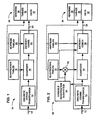
- FIG. 1 PRIOR ART, therein is shown a baseline JPEG encoder system 10 for digital cameras, scanners, printers, imaging servers, etc.
- the JPEG encoder system 10 is for an image with a single color component.
- the system 10 receives image pixels, or input digital image data. at an input 12 which is connected to a discrete cosine transformer 14.
- the discrete cosine transformer 14 first divides the input digital image data 12 into non-overlapping, fixed length image blocks. generally 8 by 8. After a normalization step, the discrete cosine transformer 14 reduces data redundancy and transforms each fixed length image block by applying a discrete cosine transform to a corresponding block of discrete cosine transform coefficients. This transform converts each fixed length image block into the frequency domain as a new frequency domain image block.
- the first coefficient in the block, the lowest frequency coefficient, is the DC coefficient and the other coefficients are the AC coefficients (e.g., for an 8 by 8 block, there will be one DC coefficient and 63 AC coefficients).
- Quantization tables 16 are operatively connected to the discrete cosine transformer 14.
- the quantization tables 16 contain lossy quantization factors (scaled according to the factor) to be applied to each block of discrete cosine transform coefficients.
- lossy quantization factors scaled according to the factor
- One set of sample tables is given in Annex K of the JPEG standard (ISO/IEC JTC1 CD 10918:ISO, 1993). These tables and the user-defined quality factors do not actually provide compression ratios per se, but provide factors indicating how much the image quality can be reduced on a given frequency domain coefficient before the image deterioration is perceptible.
- a quantizer 18 is connected to the discrete cosine transformer 14 and the quantization tables 16 to divide each frequency domain image block by the corresponding element from the quantization table 16 to output the quantized discrete cosine transform output.
- An entropy coder 20 is connected to the quantizer 18 and to Huffman tables 22.
- the entropy coder 20 receives the output from the quantizer 18 and rearranges it in zigzag order.
- the zigzag output is then compressed using run-length encoding in the entropy encoder 20 which is a lossless entropy coding of each block of quantized discrete cosine transform output.
- the entropy encoder 20 of the present invention uses Huffman codes from the Huffman tables 22 although arithmetic coding can also be used.
- the Huffman codes exploit similarities across the quantized discrete cosine transform coefficients.
- JPEG contains two sets of typical Huffman tables, one for the luminance or grayscale components and one for the chrominance or color components. Each set has two separate tables, one for the DC components and the other for the AC.
- the bitstream out of the entropy coder 20 at output 24 is a JPEG file 26 which contains headers 28, tables 30, and data 32.
- the tables 30 contain information from the quantization tables 16 and the Huffman tables 22 of the appropriate information used in the processing of each block of data so the data can be properly decompressed.
- the data 32 contains the output from the entropy coder 20 in a form of a compressed block such that a sequence of all of the compressed blocks forms the compressed digital image data.
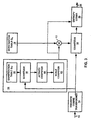
- FIG. 2 therein is shown a JPEG encoder system 50 that supports the variable quantization of the present invention.
- the system 50 is compliant with the JPEG Part 3 standard.
- the same elements as in FIG. 1 are given the same numbers in FIG. 2.
- the system 50 receives input digital image data 12 into the discrete cosine transformer 14 which is connected to the quantizer 18.
- the quantization tables 16 are connected to a multiplying junction 52 which is connected to the quantizer 18. Also connected to the multiplying junction 52 is a variable quantization subsystem 54 which is also connected to the entropy coder 20.
- the entropy coder 20 is connected to the quantizer 18 and to the Huffman tables 22.
- the bitstream out of the entropy coder 20 at output 24 is a JPEG file 26 that contains headers 28, tables 30, and data 32.
- the tables 30 contain compression-related information from the quantization tables 16 and the Huffman tables 22 which can be used by a JPEG decompresser system (not shown) to decompress the data 32 from the entropy coder 20.
- the quantization scale factor from the variable quantization subsystem 54 are incorporated into the data 32 by the entropy encoder20.
- variable quantization subsystem 54 which is operatively connected to the discrete cosine transformer 14.
- the discrete cosine transformer 14 is connected to a quantizer 58 in the variable quantization subsystem 54.
- the quantizer 58 has quantization tables 56 connected to it which are the factors relating to the activity metrics.
- the quantizer 58 is the same as the quantizer 18.
- the quantization tables 56 for the activity metrics are the same as the quantization tables 16 for the encoding, but this is not necessary.
- the quantizer 58 is further connected to an activity computer 60 for computing an activity metric, M i , as will later be described.
- the activity computer 60 is connected to a scale computer 62 for computing qscale as will also later be described.
- the scale computer 62 is connected to the multiplying junction 52 to which the quantization table 16 is connected.
- the discrete cosine transformer 14 as well as the multiplying junction 52 are connected to the quantizer 18 as also shown in FIG. 2.
- image pixels are divided into non-overlapping 8 x 8 blocks where y i denotes the i-th input block. This division applies to all images including text, pictures, and compound images as well as pictures containing text.
- each block is transformed into the frequency domain using the discrete cosine transform.
- JPEG uses the discrete cosine transform in its processing.
- a discrete cosine transform in the frequency domain is based on the assumption that an image mirrors itself on both boundaries. This assures a smooth transition without high frequency spikes, because those are very hard to compress. And the higher frequencies are very close to zero if there is a smoothly varying function.
- each element of Y i is divided by the corresponding element of the encoding quantization table Q e .
- a single set of quantization tables 16 is used for the whole image.
- the whole image would be 512 pixels by 513 pixels.
- the quantized discrete cosine transformer 14 output is rearranged in raster, or zigzag, order and is compressed using run-length encoding which is a lossless, entropy coding using the Huffman tables 22 in the entropy coder 20.
- the quantization tables for each color component can be defined in the header tables 30 of the JPEG file 26.
- the output of the entropy coder 20 is a sequence of compressed blocks which form the compressed image which can be decompressed by a standard JPEG decompression system.
- variable quantization JPEG encoder system 50 of the present invention shown in FIG. 2 uses the JPEG adjunct standard (ISO IEC JTC1 CD 10918:.ISO. 1993) which has been extended to support variable quantization.
- JPEG adjunct standard ISO IEC JTC1 CD 10918:.ISO. 1993
- the values of the original quantization matrix can be rescaled on small blocks of pixels as small as 8 pixels by 8 pixels.
- the adjunct standard allows these changes on a block by block basis. This change was designed primarily for a rate control problem of getting the proper number of bits at the output. If a block is changed, the information can be put into the bitstream so that a decoder on the receiving end can undo it later.
- the various scaling factors are also encoded as part of the data bitstream.
- variable quantization allows for better rate control or more efficient coding which is the original purpose for the JPEG extension.
- the present invention allows for the variable quantization of compound images.
- the JPEG encoder system 50 of FIG. 2 automatically detects the text-part and the image-part of a document by measuring how quickly pixels are changing in the incoming data. Black text on a white background changes very quickly from black to white and back again even within a very small block of pixels. Picture pixels, for example the image of a human face, change much more slowly through gradations of color.
- the quantization is being done in a transformed domain, not on the pixels directly.
- the pixels are transformed through a linear matrix transform (the discrete cosine transform) into a frequency domain representation, and the quantization is performed in the frequency domain. It is also in the frequency domain that the frequency components can be determined to find how active a particular block is.
- the mathematical equation used is what provides an "activity metric". The larger this activity metric turns out to be, the more things are changing within the 8 by 8 block.
- the discrete cosine transform has the advantage that it takes real numbers and transforms them into real numbers which can be quantized. In this domain, it is possible to predict, roughly, how many bits it takes to represent the data that is actually in the block.
- the log base 2 of this provides the number of bits required. In this case it would be 4 because with 4 bits every number between 1 and 15 can be represented.
- quantization scaling factors are derived that automatically adjust the quantization so that text blocks are compressed at higher quality than image blocks.
- text is more sensitive to JPEG compression because of its sharp edges which, if compressed too greatly, would blur or have ringing artifacts (ripples around the edges).
- images can be compressed greatly without drastically affecting human-eye perceived differences in quality of the image.
- Y i [j, k] denote the elements of the i-th output block of the discrete cosine transform so Y i [0, 0] denotes the DC component of the i-th block.
- the activity computer 60 uses the following activity metric: where the summation is performed over all elements of the Y i [j, k] matrix, except Y i [0, 0]. (The above formulation assumes that arguments in the log 2 function are always greater than zero.)
- the next step is to define the relationship between the activity measure and the quantization scale.
- the cmpnd 1 ISO test image is used as the standard compound image with computer generated text, a photographic-type color image, and computer generated text within the image.
- the top half is text and the bottom half the color image.
- This is a 512 x 513 pixels total image, with 1,056 macroblocks (16 x 16 pixel blocks).
- the color image part starts at approximately the 508-th macroblock.
- the values of the activity metric, M i , calculated in the activity computer 60 for each of the luminance macroblocks in the ISO test image is higher in the text regions of the image. However, discrimination between image and text areas is even better if M i is computed using quantized values of Y i ; that is, Y QM.i .
- the quantization matrices Q M and Q e in quantization tables 56 and 16, respectively are both the same as the one given in Annex K of the JPEG standard, activity values larger than 1.2 correspond to text areas in the image. It should be understood that the two quantization tables 56 and 16 could be different. Experiments show that the range of values for M i for the ISO test image is consistent with the range of values obtained from other test images.
- quantization varies inversely with the metric. If a higher metric means a higher activity, thus scale by less to quantize more finely or compress less. And then with a very small metric, scale the quantization very coarsely or compress more because the image is such a smooth block, that it does not matter how much quantization since it will not be perceptible.
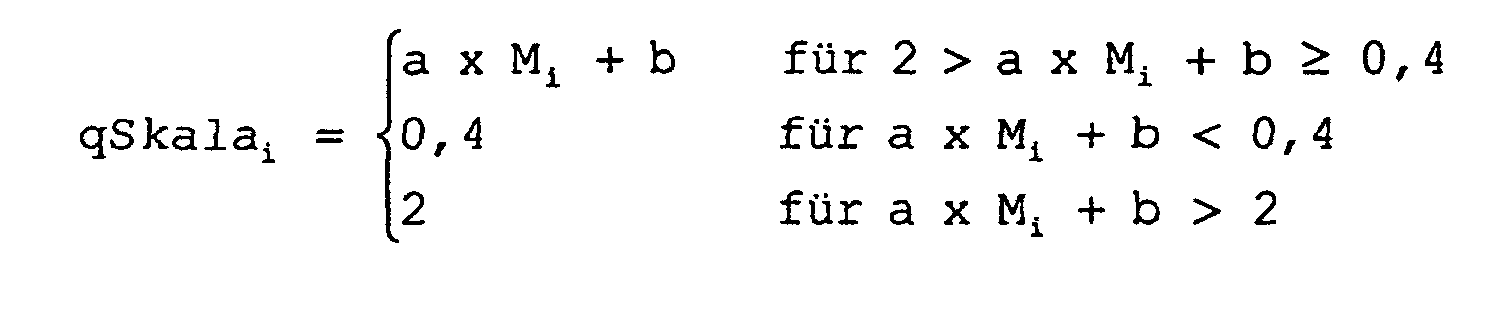
- a linear, but bounded, relationship between qscale and the activity metric ( M i ) is superior, such as where a and b are constants to be defined based on desired ounmt quality and compression ratios.
- the Q M quantization matrix is the same as Q e , but this may not be always the case.
- Q M may be the same as Appendix K of the JPEG standard, but Q e , may be a custom quantization table.
- the upper text areas in the ISO test image were identified as areas of high frequency activity, but also the text inside the color picture at the bottom half.
- the qscale is provided to the multiplying junction 52 to control Q e from the quantization table 16 to the quantizer 18.
- JPEG itself, as a standard doesn't specify what to do about color. But what is commonly done, is to convert a color image into a luminance and chrominance representation so that it shows the brightness of the image with two other components that show the colorfulness. And it turns out that the human eye is much more sensitive to the luminance. A slow transition from a red to an orange versus a sharp one will not even be noticeable, but a slow transition in luminosity versus a sharp one will be noticeable as a blur.
- the activity metric is computed only for the luminance component to save on computation and then the chrominance is scaled the same way. That turns out to work reasonably well on the chrominance as well, because compound documents usually have black text on a white background and errors in the color are particularly noticeable. A little red fringe around each letter will be seen immediately but it is iess likely to be seen in an image.
Landscapes
- Engineering & Computer Science (AREA)
- Multimedia (AREA)
- Physics & Mathematics (AREA)
- General Physics & Mathematics (AREA)
- Theoretical Computer Science (AREA)
- Compression Or Coding Systems Of Tv Signals (AREA)
- Compression Of Band Width Or Redundancy In Fax (AREA)
- Compression, Expansion, Code Conversion, And Decoders (AREA)
- Image Analysis (AREA)
Claims (6)
- Variable Quantisierungsvorrichtung (50) für ein Bildcodiersystem, das eine Transformationseinrichtung (14), einen Quantisierer (18) und einen Entropiecodierer (20), die miteinander verbunden sind, aufweist, mit folgenden Merkmalen:wobei Yi[j,k] die Elemente des i-ten Blocks, der durch die Transformationseinrichtung ausgegeben wird, bezeichnen; und Yi[0,0] die transformierte Gleichsignalkomponente des i-ten Blocks bezeichnet.einer variablen Quantisierungseinrichtung (54), die mit der Transformationseinrichtung (14) und dem Quantisierer (18) wirksam verbunden ist, um ansprechend auf eine Mehrzahl von Datenblöcken von der Transformationseinrichtung (14) die Charakteristika einer Mehrzahl von Blöcken von digitalen Pixeldaten, die in die Transformationseinrichtung (14) eingegeben werden, zu bestimmen, indem sie eine bildbezogene Metrik für jeden der Mehrzahl von Datenblöcken berechnet;einer mit der variablen Quantisierungseinrichtung (54); verbundenen Quantisierungsfaktorisierungseinrichtung (16) zum Liefern eines vorbestimmten Faktors einer verlustbehafteten Quantisierung für jede Metrik; undwobei die variable Quantisierungseinrichtung (54) eine Einrichtung (58) zum Veranlassen des Quantisierers (18) aufweist, einen Faktor einer verlustbehafteten Quantisierung an jeden der Mehrzahl von Datenblöcken auf der Basis der Metrik für den Datenblock anzulegen, um dem Entropiecodierer (20) eine Mehrzahl von Blöcken von quantisierten Daten bereitzustellen, wobei:die variable Quantisierungseinrichtung (54) die Metrik als eine Bildaktivitätsmetrik gemäß der folgenden Gleichung berechnet:

- Die variable Quantisierungsvorrichtung (50) gemäß Anspruch 1, bei der:die variable Quantisierungseinrichtung (54) eine Skalierungseinrichtung (62) zum Skalieren der Metrik als eine Aktivitätsmatrix für jeden der Mehrzahl von Datenblöcken, die durch die Transformationseinrichtung (14) als Frequenzdaten bereitgestellt werden, um proportional einen niedrigeren Faktor einer verlustarmen Quantisierung für eine höhere Aktivitätsmetrik als einen höheren Faktor einer verlustbehafteten Quantisierung für eine geringere Aktivitätsmetrik zu liefern, umfaßt, wodurch ein Bildtyp gemäß den folgenden Gleichungen bei einer höheren Qualität komprimiert wird, während ein anderer Bildtyp bei einer geringeren Qualität komprimiert wird:
- Die variable Quantisierungsvorrichtung (50) gemäß Anspruch 1 oder 2, bei der:die variable Quantisierungseinrichtung (54) eine Skalierungseinrichtung (62) zum Skalieren der Metrik für jeden der Mehrzahl von Datenblöcken, um einen niedrigeren Faktor einer verlustbehafteten Quantisierung für Metriken für vorbestimmte Bildtypen und einen höheren Faktor einer verlustbehafteten Quantisierung für Metriken für andere vorbestimmte Bildtypen zu liefern, umfaßt.
- Die variable Quantisierungsvorrichtung (50) gemäß Anspruch 1 oder 2, bei der:die variable Quantisierungseinrichtung (54) folgende Merkmale umfaßt:Quantisierungstabellen (56) zum Liefern eines vorbestimmten Faktors einer verlustbehafteten Quantisierung für vorbestimmte Datenblöcke;einen mit der Transformationseinrichtung (14) und den Quantisierungstabellen (56) verbundenen Quantisierer (58) zum Anlegen eines Faktors einer verlustbehafteten Quantisierung an jeden der Mehrzahl von Datenblöcken, um die Metrik für jeden der Mehrzahl von Datenblöcken zu berechnen.
- Die variable Quantisierungsvorrichtung (50) gemäß Anspruch 1 oder 2, die folgendes Merkmal umfaßt:eine Multiplizierereinrichtung (52), die mit den Quantisierungstabellen (16), der variablen Quantisierungseinrichtung (54) und dem Quantisierer (18) verbunden ist, zum Anwenden eines Faktors einer verlustbehafteten Quantisierung, der eine Funktion der Metrik und Daten ist, auf jeden der Mehrzahl von Datenblöcken.
- Die variable Quantisierungsvorrichtung (50) gemäß Anspruch 1 oder 2, bei der die Blöcke von digitalen Pixeldaten 8 mal 8 Pixel sind.
Applications Claiming Priority (2)
| Application Number | Priority Date | Filing Date | Title |
|---|---|---|---|
| US09/120,072 US6314208B1 (en) | 1998-07-21 | 1998-07-21 | System for variable quantization in JPEG for compound documents |
| US120072 | 2002-04-10 |
Publications (3)
| Publication Number | Publication Date |
|---|---|
| EP0974933A2 EP0974933A2 (de) | 2000-01-26 |
| EP0974933A3 EP0974933A3 (de) | 2001-01-03 |
| EP0974933B1 true EP0974933B1 (de) | 2004-08-25 |
Family
ID=22388103
Family Applications (1)
| Application Number | Title | Priority Date | Filing Date |
|---|---|---|---|
| EP99304722A Expired - Lifetime EP0974933B1 (de) | 1998-07-21 | 1999-06-16 | Adaptive Videokompromierung mit variabler Quantisierung |
Country Status (4)
| Country | Link |
|---|---|
| US (2) | US6314208B1 (de) |
| EP (1) | EP0974933B1 (de) |
| JP (1) | JP2000059634A (de) |
| DE (1) | DE69919641T2 (de) |
Families Citing this family (69)
| Publication number | Priority date | Publication date | Assignee | Title |
|---|---|---|---|---|
| US7254824B1 (en) * | 1999-04-15 | 2007-08-07 | Sedna Patent Services, Llc | Encoding optimization techniques for encoding program grid section of server-centric interactive programming guide |
| US7050639B1 (en) * | 1999-11-24 | 2006-05-23 | General Electric Company | Image data compression employing multiple compression code tables |
| US7430330B2 (en) * | 2001-01-16 | 2008-09-30 | Hamilton Chris H | Method and apparatus for optimizing a JPEG image using regionally variable compression levels |
| US20020131645A1 (en) * | 2001-01-16 | 2002-09-19 | Packeteer Incorporated | Method and apparatus for optimizing a JPEG image using regionally variable compression levels |
| US6701020B2 (en) * | 2001-03-15 | 2004-03-02 | Hewlett-Packard Development Company, L.P. | JADE-JPEG based adaptive document compression engine |
| US6853755B2 (en) * | 2001-03-28 | 2005-02-08 | Sharp Laboratories Of America, Inc. | Method and apparatus for adaptive compression of scanned documents |
| US6744919B2 (en) * | 2001-07-24 | 2004-06-01 | Hewlett Packard Development Company, L.P. | Classification of blocks for compression based on number of distinct colors |
| US7397953B2 (en) * | 2001-07-24 | 2008-07-08 | Hewlett-Packard Development Company, L.P. | Image block classification based on entropy of differences |
| US6987889B1 (en) | 2001-08-10 | 2006-01-17 | Polycom, Inc. | System and method for dynamic perceptual coding of macroblocks in a video frame |
| JP2003199019A (ja) * | 2001-12-26 | 2003-07-11 | Sony Corp | 撮像装置および方法、記録媒体、並びにプログラム |
| US7039247B2 (en) * | 2003-01-31 | 2006-05-02 | Sony Corporation | Graphic codec for network transmission |
| JP3625211B2 (ja) * | 2003-03-13 | 2005-03-02 | 三菱電機株式会社 | Jpeg圧縮ファイルの生成方法およびjpeg圧縮ファイルの生成装置および画像処理装置 |
| BR0306999A (pt) * | 2003-05-17 | 2005-02-09 | Microsoft Corp | Mecanismo para a aplicação de transformadas a arquivos de múltiplas partes |
| US7302107B2 (en) * | 2003-12-23 | 2007-11-27 | Lexmark International, Inc. | JPEG encoding for document images using pixel classification |
| JP2005191956A (ja) | 2003-12-25 | 2005-07-14 | Yamaha Corp | 表示用データ圧縮/伸張方法 |
| US7519714B2 (en) * | 2004-03-18 | 2009-04-14 | The Johns Hopkins University | Adaptive image format translation in an ad-hoc network |
| US7801383B2 (en) | 2004-05-15 | 2010-09-21 | Microsoft Corporation | Embedded scalar quantizers with arbitrary dead-zone ratios |
| FR2872317A1 (fr) * | 2004-06-08 | 2005-12-30 | Do Labs Sa | Procede pour ameliorer la qualite d'utilisation d'un service relatif a au moins une donnee multimedia |
| US7574055B2 (en) * | 2004-09-07 | 2009-08-11 | Lexmark International, Inc. | Encoding documents using pixel classification-based preprocessing and JPEG encoding |
| US7676107B2 (en) * | 2005-05-16 | 2010-03-09 | Broadcom Corporation | Method and system for video classification |
| US8422546B2 (en) | 2005-05-25 | 2013-04-16 | Microsoft Corporation | Adaptive video encoding using a perceptual model |
| US7474770B2 (en) * | 2005-06-28 | 2009-01-06 | Beigi Homayoon S M | Method and apparatus for aggressive compression, storage and verification of the dynamics of handwritten signature signals |
| US8705617B2 (en) * | 2005-09-27 | 2014-04-22 | Qualcomm Incorporated | Multiple layer video encoding |
| US7262719B2 (en) * | 2006-01-30 | 2007-08-28 | International Business Machines Corporation | Fast data stream decoding using apriori information |
| US7974340B2 (en) | 2006-04-07 | 2011-07-05 | Microsoft Corporation | Adaptive B-picture quantization control |
| US7995649B2 (en) | 2006-04-07 | 2011-08-09 | Microsoft Corporation | Quantization adjustment based on texture level |
| US8503536B2 (en) | 2006-04-07 | 2013-08-06 | Microsoft Corporation | Quantization adjustments for DC shift artifacts |
| US8059721B2 (en) | 2006-04-07 | 2011-11-15 | Microsoft Corporation | Estimating sample-domain distortion in the transform domain with rounding compensation |
| US8130828B2 (en) | 2006-04-07 | 2012-03-06 | Microsoft Corporation | Adjusting quantization to preserve non-zero AC coefficients |
| US8711925B2 (en) | 2006-05-05 | 2014-04-29 | Microsoft Corporation | Flexible quantization |
| US7925086B2 (en) | 2007-01-18 | 2011-04-12 | Samsung Electronics Co, Ltd. | Method and system for adaptive quantization layer reduction in image processing applications |
| US8238424B2 (en) | 2007-02-09 | 2012-08-07 | Microsoft Corporation | Complexity-based adaptive preprocessing for multiple-pass video compression |
| US8498335B2 (en) | 2007-03-26 | 2013-07-30 | Microsoft Corporation | Adaptive deadzone size adjustment in quantization |
| US8243797B2 (en) | 2007-03-30 | 2012-08-14 | Microsoft Corporation | Regions of interest for quality adjustments |
| US8442337B2 (en) | 2007-04-18 | 2013-05-14 | Microsoft Corporation | Encoding adjustments for animation content |
| US8331438B2 (en) | 2007-06-05 | 2012-12-11 | Microsoft Corporation | Adaptive selection of picture-level quantization parameters for predicted video pictures |
| US7903873B2 (en) * | 2007-09-13 | 2011-03-08 | Microsoft Corporation | Textual image coding |
| US8189933B2 (en) | 2008-03-31 | 2012-05-29 | Microsoft Corporation | Classifying and controlling encoding quality for textured, dark smooth and smooth video content |
| US8116580B2 (en) * | 2008-05-12 | 2012-02-14 | Lexmark International, Inc. | Embedded high frequency image details |
| US8897359B2 (en) | 2008-06-03 | 2014-11-25 | Microsoft Corporation | Adaptive quantization for enhancement layer video coding |
| US8600181B2 (en) | 2008-07-08 | 2013-12-03 | Mobile Imaging In Sweden Ab | Method for compressing images and a format for compressed images |
| US9106933B1 (en) | 2010-05-18 | 2015-08-11 | Google Inc. | Apparatus and method for encoding video using different second-stage transform |
| MX2013003557A (es) | 2010-10-05 | 2013-05-01 | Gen Instrument Corp | Codificacion y decodificacion utilizando seleccion de modelo adaptativo al contexto con escaneo en zigzag. |
| US8938001B1 (en) | 2011-04-05 | 2015-01-20 | Google Inc. | Apparatus and method for coding using combinations |
| US8767817B1 (en) | 2011-04-07 | 2014-07-01 | Google Inc. | Apparatus and method for coding using parameterized equation |
| US9247257B1 (en) | 2011-11-30 | 2016-01-26 | Google Inc. | Segmentation based entropy encoding and decoding |
| US11039138B1 (en) | 2012-03-08 | 2021-06-15 | Google Llc | Adaptive coding of prediction modes using probability distributions |
| US9781447B1 (en) | 2012-06-21 | 2017-10-03 | Google Inc. | Correlation based inter-plane prediction encoding and decoding |
| US9774856B1 (en) | 2012-07-02 | 2017-09-26 | Google Inc. | Adaptive stochastic entropy coding |
| US9167268B1 (en) | 2012-08-09 | 2015-10-20 | Google Inc. | Second-order orthogonal spatial intra prediction |
| US9380298B1 (en) | 2012-08-10 | 2016-06-28 | Google Inc. | Object-based intra-prediction |
| US9344742B2 (en) | 2012-08-10 | 2016-05-17 | Google Inc. | Transform-domain intra prediction |
| US9407915B2 (en) | 2012-10-08 | 2016-08-02 | Google Inc. | Lossless video coding with sub-frame level optimal quantization values |
| US9756346B2 (en) | 2012-10-08 | 2017-09-05 | Google Inc. | Edge-selective intra coding |
| US9210432B2 (en) | 2012-10-08 | 2015-12-08 | Google Inc. | Lossless inter-frame video coding |
| US9369732B2 (en) | 2012-10-08 | 2016-06-14 | Google Inc. | Lossless intra-prediction video coding |
| US9628790B1 (en) | 2013-01-03 | 2017-04-18 | Google Inc. | Adaptive composite intra prediction for image and video compression |
| JP6184115B2 (ja) * | 2013-02-01 | 2017-08-23 | キヤノン株式会社 | 画像処理方法及び画像処理装置 |
| US9509998B1 (en) | 2013-04-04 | 2016-11-29 | Google Inc. | Conditional predictive multi-symbol run-length coding |
| US20140327737A1 (en) | 2013-05-01 | 2014-11-06 | Raymond John Westwater | Method and Apparatus to Perform Optimal Visually-Weighed Quantization of Time-Varying Visual Sequences in Transform Space |
| US9247251B1 (en) | 2013-07-26 | 2016-01-26 | Google Inc. | Right-edge extension for quad-tree intra-prediction |
| US9392288B2 (en) | 2013-10-17 | 2016-07-12 | Google Inc. | Video coding using scatter-based scan tables |
| US9179151B2 (en) | 2013-10-18 | 2015-11-03 | Google Inc. | Spatial proximity context entropy coding |
| US9326000B2 (en) * | 2014-07-02 | 2016-04-26 | Omnivision Technologies (Shanghai) Co., Ltd. | Method and system for still image encoding and random access decoding |
| US10057601B2 (en) * | 2015-06-22 | 2018-08-21 | Integrated Device Technology, Inc. | Methods and apparatuses for filtering of ringing artifacts post decoding |
| CN110446041B (zh) * | 2018-05-02 | 2021-11-19 | 中兴通讯股份有限公司 | 一种视频编解码方法、装置、系统及存储介质 |
| US10687062B1 (en) | 2019-02-22 | 2020-06-16 | Google Llc | Compression across multiple images |
| FR3104360B1 (fr) * | 2019-12-10 | 2021-12-03 | Zodiac Data Systems | Procédé de compression d’une séquence d’images montrant des éléments graphiques synthétiques d’origine non photographique |
| CN114884925B (zh) * | 2022-04-18 | 2023-04-18 | 深圳市绿联科技股份有限公司 | 一种传输复合照片数据的方法、装置、系统以及电子设备 |
Family Cites Families (12)
| Publication number | Priority date | Publication date | Assignee | Title |
|---|---|---|---|---|
| US5121216A (en) * | 1989-07-19 | 1992-06-09 | Bell Communications Research | Adaptive transform coding of still images |
| US5128757A (en) | 1990-06-18 | 1992-07-07 | Zenith Electronics Corporation | Video transmission system using adaptive sub-band coding |
| US5333212A (en) | 1991-03-04 | 1994-07-26 | Storm Technology | Image compression technique with regionally selective compression ratio |
| JPH0583696A (ja) * | 1991-06-07 | 1993-04-02 | Sony Corp | 画像符号化装置 |
| WO1993019434A1 (en) * | 1992-03-17 | 1993-09-30 | Zoran Corporation | Image compression coder having improved bit rate control and block allocation |
| JP3245977B2 (ja) * | 1992-06-30 | 2002-01-15 | ソニー株式会社 | ディジタル画像信号の伝送装置 |
| JPH07154798A (ja) * | 1993-05-31 | 1995-06-16 | Canon Inc | 画像符号化装置および画像符号化方法 |
| US5517327A (en) * | 1993-06-30 | 1996-05-14 | Minolta Camera Kabushiki Kaisha | Data processor for image data using orthogonal transformation |
| JP3115199B2 (ja) * | 1994-12-16 | 2000-12-04 | 松下電器産業株式会社 | 画像圧縮符号化装置 |
| US5724453A (en) | 1995-07-10 | 1998-03-03 | Wisconsin Alumni Research Foundation | Image compression system and method having optimized quantization tables |
| JP3067628B2 (ja) * | 1996-01-19 | 2000-07-17 | 日本電気株式会社 | 画像符号化装置 |
| US6014467A (en) * | 1996-09-18 | 2000-01-11 | Fuji Photo Film Co., Ltd. | High speed, high precision image compression |
-
1998
- 1998-07-21 US US09/120,072 patent/US6314208B1/en not_active Expired - Fee Related
- 1998-07-21 US US09/120,072 patent/US20020001412A1/en active Granted
-
1999
- 1999-06-16 DE DE69919641T patent/DE69919641T2/de not_active Expired - Fee Related
- 1999-06-16 EP EP99304722A patent/EP0974933B1/de not_active Expired - Lifetime
- 1999-07-09 JP JP11195517A patent/JP2000059634A/ja active Pending
Also Published As
| Publication number | Publication date |
|---|---|
| DE69919641D1 (de) | 2004-09-30 |
| JP2000059634A (ja) | 2000-02-25 |
| US6314208B1 (en) | 2001-11-06 |
| EP0974933A3 (de) | 2001-01-03 |
| EP0974933A2 (de) | 2000-01-26 |
| US20020001412A1 (en) | 2002-01-03 |
| DE69919641T2 (de) | 2005-07-14 |
Similar Documents
| Publication | Publication Date | Title |
|---|---|---|
| EP0974933B1 (de) | Adaptive Videokompromierung mit variabler Quantisierung | |
| US5850484A (en) | Text and image sharpening of JPEG compressed images in the frequency domain | |
| KR101356548B1 (ko) | 하이 다이나믹 레인지 코덱들 | |
| US5883979A (en) | Method for selecting JPEG quantization tables for low bandwidth applications | |
| EP2130380B1 (de) | Steuerung der menge komprimierter daten | |
| US8213498B2 (en) | Bitrate reduction techniques for image transcoding | |
| US6459816B2 (en) | Image processing system for compressing image data including binary image data and continuous tone image data by a sub-band transform method with a high-compression rate | |
| US6947600B1 (en) | Information processing method, apparatus and storage medium for receiving and decoding a code sequence obtained by encoding an image | |
| US6697534B1 (en) | Method and apparatus for adaptively sharpening local image content of an image | |
| US6714685B2 (en) | Image processing system for compressing image data including binary image data and continuous tone image data by a sub-band transform method with a high-compression rate | |
| US6330369B1 (en) | Method and apparatus for limiting data rate and image quality loss in lossy compression of sequences of digital images | |
| US7106908B2 (en) | Method and apparatus for selecting a format in which to re-encode a quantized image | |
| WO2008030434A2 (en) | Method for controlling compressed data | |
| EP0555095B1 (de) | Verfahren zur Komprimierung und Erweiterung eines Bildes durch Orthogonaltransformation und Kodierung des Bildes | |
| EP1324618A2 (de) | Kodierungsverfahren und -anordnung | |
| US20060039619A1 (en) | Image compression using a color visual model | |
| US20040264787A1 (en) | Image processing decompression apparatus and method of using same different scaling algorithms simultaneously | |
| US20040136600A1 (en) | Visually lossless still image compression for RGB, YUV, YIQ, YCrCb, K1K2K3 formats | |
| JP2000307879A (ja) | カラー画像通信方法およびカラー画像通信装置 | |
| JP2002247373A (ja) | 画像読取・出力方法並びに装置 | |
| Beretta | Compressing images for the internet | |
| Beretta | Compressing images for the internet | |
| Dwivedi | Design of JPEG Compressor | |
| Mantiuk | HDR Image and Video Compression | |
| Bhaskaran et al. | The JPEG Standard |
Legal Events
| Date | Code | Title | Description |
|---|---|---|---|
| PUAI | Public reference made under article 153(3) epc to a published international application that has entered the european phase |
Free format text: ORIGINAL CODE: 0009012 |
|
| AK | Designated contracting states |
Kind code of ref document: A2 Designated state(s): DE FR GB |
|
| AX | Request for extension of the european patent |
Free format text: AL;LT;LV;MK;RO;SI |
|
| PUAL | Search report despatched |
Free format text: ORIGINAL CODE: 0009013 |
|
| AK | Designated contracting states |
Kind code of ref document: A3 Designated state(s): AT BE CH CY DE DK ES FI FR GB GR IE IT LI LU MC NL PT SE |
|
| AX | Request for extension of the european patent |
Free format text: AL;LT;LV;MK;RO;SI |
|
| RAP1 | Party data changed (applicant data changed or rights of an application transferred) |
Owner name: HEWLETT-PACKARD COMPANY, A DELAWARE CORPORATION |
|
| 17P | Request for examination filed |
Effective date: 20010702 |
|
| AKX | Designation fees paid |
Free format text: DE FR GB |
|
| GRAP | Despatch of communication of intention to grant a patent |
Free format text: ORIGINAL CODE: EPIDOSNIGR1 |
|
| GRAS | Grant fee paid |
Free format text: ORIGINAL CODE: EPIDOSNIGR3 |
|
| GRAA | (expected) grant |
Free format text: ORIGINAL CODE: 0009210 |
|
| AK | Designated contracting states |
Kind code of ref document: B1 Designated state(s): DE FR GB |
|
| REG | Reference to a national code |
Ref country code: GB Ref legal event code: FG4D |
|
| REF | Corresponds to: |
Ref document number: 69919641 Country of ref document: DE Date of ref document: 20040930 Kind code of ref document: P |
|
| ET | Fr: translation filed | ||
| PLBE | No opposition filed within time limit |
Free format text: ORIGINAL CODE: 0009261 |
|
| STAA | Information on the status of an ep patent application or granted ep patent |
Free format text: STATUS: NO OPPOSITION FILED WITHIN TIME LIMIT |
|
| 26N | No opposition filed |
Effective date: 20050526 |
|
| PGFP | Annual fee paid to national office [announced via postgrant information from national office to epo] |
Ref country code: DE Payment date: 20070731 Year of fee payment: 9 |
|
| PGFP | Annual fee paid to national office [announced via postgrant information from national office to epo] |
Ref country code: GB Payment date: 20070628 Year of fee payment: 9 |
|
| PGFP | Annual fee paid to national office [announced via postgrant information from national office to epo] |
Ref country code: FR Payment date: 20070618 Year of fee payment: 9 |
|
| GBPC | Gb: european patent ceased through non-payment of renewal fee |
Effective date: 20080616 |
|
| REG | Reference to a national code |
Ref country code: FR Ref legal event code: ST Effective date: 20090228 |
|
| PG25 | Lapsed in a contracting state [announced via postgrant information from national office to epo] |
Ref country code: DE Free format text: LAPSE BECAUSE OF NON-PAYMENT OF DUE FEES Effective date: 20090101 |
|
| PG25 | Lapsed in a contracting state [announced via postgrant information from national office to epo] |
Ref country code: GB Free format text: LAPSE BECAUSE OF NON-PAYMENT OF DUE FEES Effective date: 20080616 |
|
| PG25 | Lapsed in a contracting state [announced via postgrant information from national office to epo] |
Ref country code: FR Free format text: LAPSE BECAUSE OF NON-PAYMENT OF DUE FEES Effective date: 20080630 |