EP0975005A2 - Verfahren zur Steuerung der Plasma erzeugende Hochfrequenz-Leistung und Gerät zur Plasma-Erzeugung - Google Patents
Verfahren zur Steuerung der Plasma erzeugende Hochfrequenz-Leistung und Gerät zur Plasma-Erzeugung Download PDFInfo
- Publication number
- EP0975005A2 EP0975005A2 EP99114077A EP99114077A EP0975005A2 EP 0975005 A2 EP0975005 A2 EP 0975005A2 EP 99114077 A EP99114077 A EP 99114077A EP 99114077 A EP99114077 A EP 99114077A EP 0975005 A2 EP0975005 A2 EP 0975005A2
- Authority
- EP
- European Patent Office
- Prior art keywords
- plasma
- frequency power
- high frequency
- plasma density
- density information
- Prior art date
- Legal status (The legal status is an assumption and is not a legal conclusion. Google has not performed a legal analysis and makes no representation as to the accuracy of the status listed.)
- Withdrawn
Links
Images







Classifications
-
- H—ELECTRICITY
- H01—ELECTRIC ELEMENTS
- H01J—ELECTRIC DISCHARGE TUBES OR DISCHARGE LAMPS
- H01J37/00—Discharge tubes with provision for introducing objects or material to be exposed to the discharge, e.g. for the purpose of examination or processing thereof
- H01J37/32—Gas-filled discharge tubes
- H01J37/32917—Plasma diagnostics
- H01J37/32935—Monitoring and controlling tubes by information coming from the object and/or discharge
-
- H—ELECTRICITY
- H01—ELECTRIC ELEMENTS
- H01J—ELECTRIC DISCHARGE TUBES OR DISCHARGE LAMPS
- H01J37/00—Discharge tubes with provision for introducing objects or material to be exposed to the discharge, e.g. for the purpose of examination or processing thereof
- H01J37/32—Gas-filled discharge tubes
- H01J37/32009—Arrangements for generation of plasma specially adapted for examination or treatment of objects, e.g. plasma sources
- H01J37/32082—Radio frequency generated discharge
-
- H—ELECTRICITY
- H01—ELECTRIC ELEMENTS
- H01J—ELECTRIC DISCHARGE TUBES OR DISCHARGE LAMPS
- H01J37/00—Discharge tubes with provision for introducing objects or material to be exposed to the discharge, e.g. for the purpose of examination or processing thereof
- H01J37/32—Gas-filled discharge tubes
- H01J37/32917—Plasma diagnostics
- H01J37/3299—Feedback systems
Definitions
- the present invention relates to a plasma generating apparatus and a method for controlling plasma-generating high frequency power to be supplied to plasma, for use in a producing process of a thin film component, a particle beam source or an analysis apparatus, and more particularly, to a technique for appropriately and easily control the plasma density.
- the plasma density in a conventional plasma generating apparatus is controlled by controlling plasma-generating high frequency power in the following manner.
- the plasma-generating high frequency power is supplied from a high frequency electric source to plasma through an impedance matching device.
- a portion of the high frequency power that was not absorbed by the plasma and reflected and returned to the high frequency electric source side, i.e., reflected power is detected.
- the matching state of the impedance between the electric source side and the plasma is adjusted by always automatically controlling the impedance matching device such that the reflected power becomes minimum, thereby stabilizing the plasma density to keep the processing condition constant.
- the plasma density is substantially proportional to net electric power applied to plasma, but even if the impedance matching device is automatically adjusted such that the reflected power of the high frequency power becomes minimum, only high frequency power including loss between the impedance matching device and an ignition electrode (discharge antenna) becomes constant, net electric power applied to the plasma does not always become constant. Therefore, there is an unavoidable limit in the conventional control method of the plasma density in which the plasma-generating high frequency power is controlled based on the reflection amount of high frequency power that is not absorbed by plasma and reflected and returned.
- the plasma density is controlled based on the actually measured plasma density.
- the electron density is generally called as plasma density. That is, the electron density in the plasma is substantially equal to the plasma density.
- Conventionally, as a method for measuring the electron density in plasma there is an electron beam irradiation type plasma vibration probe which was developed relatively recently, in addition to a Langmuir/probe method and a microwave interference measuring method. It can be considered that electron density in plasma is measured by these method, the plasma-generating high frequency power is controlled based on the measured electron density.
- the Langmuir/probe method is a method in which a metal probe is directly exposed in plasma an in this state, direct current bias voltage, or direct current bias voltage on which high-frequency voltage is superposed is applied to the metal probe, and based on the current value flowing through at that time, electron density is measured.
- the microwave interference measuring method is a method in which a chamber for generating plasma is provided with windows which are opposed to each other with plasma positioned therebetween, microwave (e.g., single color laser light) is radiated to the plasma through one of the windows, and the microwave ejected from the other window is detected, and electron density is obtained based on phase contrast between the radiated microwave and ejected microwave.
- the electron beam irradiation type plasma vibration method is a method in which a hot filament is placed in a chamber, and based on frequency of plasma oscillations generated when electron beam is irradiated to the plasma from the hot filament, electron density is obtained.
- the Langmuir/probe method has a problem that the measuring can not be continued for a long time. This is because that stains comprising insulative films are adhered on a measured metal probe within a short time, the current value flowing through the metal probe is varied, and accurate measurement can not be continued soon.
- a method in which negative bias voltage is applied to the metal probe to carry out sputter-removing method using ion, and a method in which the metal probe is allow to glow to evaporate and remove the stains have been attempted, but the effect is poor, and the problem is not solved by these methods.
- the microwave interference measuring method has a problem that the measurement can not be conducted easily. This is because a large-scale and expensive apparatus and adjustment of microwave transmission path are necessary, the phase contrast between the radiated microwave and ejected microwave is small and thus, it is difficult to measure precisely.
- an object of the present invention provide a plasma generating apparatus and a control method of plasma-generating high frequency power capable of appropriately and easily controlling plasma density over the long term.
- a method for controlling plasma-generating high frequency power of the present invention comprises the steps of:
- the plasma-generating high frequency power is controlled.
- the plasma-generating high frequency power is controlled in accordance with the plasma density information obtained by a measuring system that is quite different from the supply system of the plasma-generating high frequency power.
- the high frequency power is supplied to the plasma to obtain the plasma density information in the present invention, even if stains comprising insulative films are adhered to the antenna which supplies the high frequency power, its influence is small, and it is possible to control the plasma-generating high frequency power based on the precise plasma density information. Further, for measuring the plasma density information, all that is necessary is only to supply the high frequency power to the plasma, and to measure the physical amount (e.g., to measure reflection amount of high frequency power or the impedance value of the plasma load) indicating the reflection or the absorption state of the high frequency power by the plasma load, the information is measured easily without using hot filament, and the plasma density can easily be controlled.
- the physical amount e.g., to measure reflection amount of high frequency power or the impedance value of the plasma load
- the high frequency power for measuring the plasma density information to the plasma through a dielectric division wall.
- the dielectric division wall exists between the plasma side to be controlled and the supply side of the plasma density information measuring high frequency power, no foreign object enters to the plasma from the supply side of the high frequency power, the plasma can be maintained clean. Further, the high frequency power supply side is prevented from being damaged by the plasma. Even if the stains comprising insulative films are adhered to the surface of the dielectric division wall, since the insulative films are dielectric, the thickness of the dielectric division wall may be slightly varied, and no substantial variation is not caused in the measuring system, and measuring interference due to the stains of insulative films can be avoided.
- the physical amount indicative of reflection or absorption state of the high-frequency power by plasma load is measured by measuring an electric current amount of a high-frequency amplifier for supplying high-frequency power.
- the physical amount is measured by measuring the electric current amount of a high frequency power supplying high frequency amplifier. Since electric current in accordance with a degree of reflection or absorption of the high frequency power by the plasma load flows through the high frequency power supplying high frequency amplifier, it is possible to easily measure the physical amount indicative of the reflection or the absorption state of the high frequency power by measuring the electric current amount.
- plasma absorption frequency at which strong absorption of high frequency power is caused due to the plasma density is obtained from the measured result of the physical amount for example.
- the plasma absorption frequency is a frequency at a location where a resonant and outstanding absorption is caused as the measured result of the physical amount, the plasma density information correctly corresponding to the actual plasma density is easily obtained.
- the plasma-generating high frequency power is supplied to plasma from a high frequency electric source through an impedance matching system, and the impedance matching system is controlled based on the plasma density information, thereby adjusting the impedance matching state between the electric source side and the plasma side.
- the adjustment of the impedance matching system provides a strong high frequency power control effect (control effect appears easily), the plasma-generating high frequency power can smoothly be controlled.
- a plasma generating apparatus of the present invention comprises:
- the plasma-generating high frequency power in accordance with the actual plasma density is controlled, and the plasma density is appropriately and easily controlled over the long term.
- the plasma density information obtaining means supplies the plasma density information measuring high frequency power to the plasma in the chamber through a dielectric division wall.
- said plasma density information obtaining means obtains, as the plasma density information, plasma absorption frequency at which strong absorption of high frequency power is caused due to the plasma density from the measured result of the physical amount. According to this example, the plasma-generating high frequency power in accordance with the actual plasma density is correctly controlled, and the plasma density is appropriately and easily controlled over the long term.
- the high frequency power control means is provided an impedance matching device, the impedance matching device is controlled based on the plasma density information, thereby adjusting the impedance matching state between the electric source side and the plasma side.
- the plasma-generating high frequency power in accordance with the actual plasma density is smoothly controlled, and the plasma density is appropriately and extremely easily controlled over the long term.
- the apparatus further comprises a dielectric tube inserted into the plasma generating chamber and having a closed tip end, an antenna accommodated in the tube at its tip end side for radiating high-frequency power, and a cable accommodated in the tube at its rear side and connected to the antenna for transmitting the high-frequency power, wherein the plasma density information measuring high frequency power is supplied from an antenna in the tube to plasma through a tube wall of the dielectric tube as a dielectric division wall.
- the plasma density information measuring high frequency power is supplied to the plasma from the antenna through the tube wall (division wall) of the dielectric tube via the cable of the plasma density information measuring probe, and the reflected power received by the antenna is taken out through the cable. Further, since the range where the high-frequency power from the antenna influences the plasma is not so wide, it is also possible to obtain a local plasma density information if the amount of the high-frequency power is adjusted. That is, by the plasma density information measuring probe, it is possible to easily prepare necessary state for measuring the plasma density information so that the measurement can easily be carried out, and it is possible to allow the spatial resolution to appear.
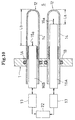
- the plasma density information obtaining means obtains plasma absorption frequencies at which strong absorption of high frequency power are caused due to plasma density from the measured result of the physical amount obtained in each of the antennas, and among the plasma absorption frequencies, one having the common frequency is obtained as the plasma surface wave resonance frequency.
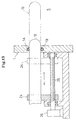
- a plasma density information measuring probe is inserted in a chamber which generates plasma for forward and backward movement, and the probe is moved such that a tip end of the probe is pulled backward from a measuring position in the chamber to a retreat position in the vicinity of a wall surface of the chamber when measurement is not carried out.
- protecting means for blocking excessive plasma generating high-frequency power which enters the antenna in the probe is provided behind the plasma density information measuring probe.
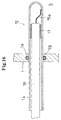
- the cable for transmitting high-frequency power comprises a conductor tube for a core wire and a shield, and an insulative ceramics material for filling a gap between the core wire and the conductor tube.
- the gap between the core wire and the conductor tube is filled with the heat-resistant insulative ceramics material, the heat-resistance of the cable is enhanced.
- a surface of the dielectric tube is coated with metal such that a measuring area of the dielectric tube is not coated. According to this structure, since the surface of the dielectric tube is coated with metal such that the measuring area of the dielectric tube is not coated, the local state of the measuring area that is not coated with metal is strongly reflected to the measured result, and the spatial resolution is enhanced.
- the antenna is extended closely along an inner surface of the dielectric tube.
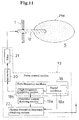
- Fig. 1 is a block diagram showing a plasma processing system for carrying out one example of a control method of plasma-generating high frequency power of the present invention in which one example of a plasma generating apparatus of the invention is incorporated.
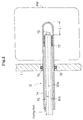
- Fig. 2 is a vertical sectional view showing structure of the plasma density information measuring probe (which will be omitted as "measuring probe” hereinafter) used in the embodiment.
- Fig. 3 is a transverse sectional view showing a structure of the measuring probe used in the embodiment.
- the plasma processing system of the embodiment comprises a stainless steel chamber 1 of about 10 cm diameter having a space S in which reactive plasma (which will be omitted as "plasma” hereinafter) PM is generated, an ignition electrode (ignition antenna) 2 disposed in the chamber 1 for generating plasma, a vacuum discharge pump 4 which is in communication with the space S of the chamber 1 through a discharge pipe 3, and a gas source 7 which is in communication with the space S of the chamber 1 through a gas supply pipe 6 provided therein with a flow rate adjusting valve 5.
- a board (not shown) of a work (object to be processed) W, and a transfer-in/transfer-out mechanism of the work W are also disposed in the chamber 1 of the system of the present embodiment.
- Air in the space S of the chamber 1 is exhausted by the vacuum discharge pump 4 and the space S is kept at appropriate pressure.
- Atmospheric pressure in the space S when plasma PM is generated is in a range from some mTorr to some tens mTorr for example.
- Gas is supplied from the gas source 7 at appropriate flow rate. Examples of the gas to be supplied are argon, nitrogen, oxygen gas, fluorine gas, and chlorine gas.
- the gas flow rate set by the flow rate adjusting valve 5 is in a range from 10 to 100 cc/minute for example.
- an induction coil is used as the ignition electrode 2
- a flat electrode is used as the ignition electrode 2.
- microwave discharge plasma in which frequency of high-frequency power is frequency of microwave band, a horn antenna, a slot antenna or an opened waveguide is used as the ignition electrode 2.
- a high-frequency electric source 8 for supplying plasma-generating high-frequency power
- a high frequency power control section 9 for controlling the plasma-generating high frequency power (which will be omitted to as “generating high frequency power” hereinafter) to be supplied to the ignition electrode 2.
- the magnitude of the high-frequency power output from the high-frequency electric source 8 is in a range from about 1 to about 3 kW for example.
- the frequency of the high-frequency power should not be limited to particular frequency, but the frequency of the high-frequency power is usually in a range from RF band which is typically 13.56 MHz to a microwave band of about 900 MHz to 2.45 GHz.
- the high frequency power control section 9 comprises an impedance matching device 10a for adjusting the impedance matching state between the high frequency electric source side and the plasma side, a plasma density setting section 10b for setting a target plasma density of plasma to be generated in the chamber 1, and a matching device control section 10c for controlling the impedance matching device 10a in accordance with a difference between the set target plasma density and an actually measured plasma density.
- a matching circuit in which inductance and capacitance are combined is used as the impedance matching device 10a.
- frequency of high-frequency power is microwave band frequency
- an EH tuner or a stub tuner is used as the impedance matching device 10a.
- an output power monitor mechanism for detecting the output amount of high frequency power output from the high frequency electric source 8
- a reflected power monitor for detected the reflection amount of high frequency power that is not absorbed by the plasma load side and returned to the electric source side.
- the work W is subjected to etching process or the CVD (chemical-vapor deposition) by plasma PM generated in this manner.
- the system of the embodiment is provided with a plasma density information obtaining section 11 for obtaining the plasma density information from moment to moment.
- the plasma density information measuring apparatus 11 of the embodiment comprises a measuring probe 12 mounted to a wall of the chamber 1, and a probe control section 13 disposed outside the chamber 1. A specific structure of the measuring probe 12 will be explained first.
- the measuring probe 12 comprises a dielectric tube 14 whose tip end is closed and rear end is opened into atmosphere (outside air), a loop antenna 15 for radiating high-frequency power, a coaxial cable 16 connected to the loop antenna 15 for transmitting the high-frequency power to the loop antenna 15, and an aluminum conductor piece 17 for preventing leakage of radiated electromagnetic wave.
- the dielectric material forming the tube 14 is not particularly limited, but appropriate examples thereof are reinforced heat-resistant glass, quartz, and ceramic.
- the loop antenna 15 and the coaxial cable 16 are accommodated in the tube 14 such that the loop antenna 15 comes first.
- the conductor piece 17 is disposed at a position slightly rearward of the loop antenna 15 such that a gap between the coaxial cable 16 and an inner surface of the tube 14. As a result, measuring error due to leakage of high-frequency power is avoided.
- the measuring probe 12 is inserted and mounted from a through hole 1A provided in the wall of the chamber such that a tip end of the measuring probe 12 is located in the chamber 1.
- the plasma density at arbitrary position in plasma PM can be measured by appropriately setting the insertion amount of the measuring probe 12 into the chamber 1 (shown with symbol M in Fig. 1).
- An O-ring 1B is interposed between an outer peripheral surface of the probe 12 and the through hole 1A of the chamber 1 so that vacuum leakage is not caused by placement of the measuring probe 12.
- the coaxial cable 16 is of a general coaxial structure in which the fluoroplastic insulative material 16c is interposed between a core wire 16a and a shield wire 16b continuously surrounding the core wire 16a from its outside along the longitudinal direction.
- Cooling fluid such as air or nitrogen gas is forcibly sent into a gap between the tube 14 and the coaxial cable 16.
- measuring error which may be caused due to temperature rise of the tube 14 or the coaxial cable 16.
- the following structure can be employed as sending means of the cooling fluid.
- a thin tube (not shown) is inserted into the gap between the tube 14 and the coaxial cable 16, and a tip end of the thin tube is positioned near the conductor piece 17.
- the cooling fluid is sent to a deep portion of the tube 14 through the thin tube to cool the measuring probe 12.
- the cooling fluid is not limited to gas such as air, and may be liquid such as water.
- the loop antenna 15, the coaxial cable 16 and the conductor piece 17 are moved forward and backward as one unit by pulling or pushing the coaxial cable 16 in the longitudinal direction of the tube 14, so that the position of the loop antenna 15 is varied along the longitudinal direction of the tube 14. That is, with this measuring probe 12, the length L between the tip end of the tube 14 and a tip end of the conductor piece 17 including the loop antenna 15 can easily be varied.
- the probe control section 13 comprises a swept-frequency high-frequency oscillator 18, a directional coupler 19, an attenuator 20, and a filter 21. These elements are connected to the measuring probe 12 in the order shown in Fig. 1.
- the high-frequency oscillator 18 outputs high-frequency power for measuring plasma density information of about 10 mW at frequency of 100 kHz to 3 GHz while automatically conducting swept-frequency.
- the high-frequency power output from the high-frequency oscillator 18 is transmitted to the measuring probe 12 through the directional coupler 19, the attenuator 20, and the filter 21 in this order.
- the high-frequency power for measuring the plasma density information (which will be omitted as “measuring high frequency power” hereinafter) is not always emitted from the loop antenna 15 and absorbed by the plasma load, and some of the high-frequency power is not absorbed by the plasma load and reflected and returned.
- the reflection amount of the high-frequency power which is not absorbed by the plasma load and returned is detected by the directional coupler 19, and sent to a power reflection coefficient frequency characteristic obtaining section 22.
- High-frequency power frequency which is output from the high-frequency oscillator 18 is also sent to the power reflection coefficient frequency characteristic obtaining section 22.
- the filter 21 removes high-frequency power for exciting plasma which is mixed into the probe control section 13 through the antenna 15.
- the attenuator 20 adjusts the amount of the measuring high-frequency power to be sent to the measuring probe 12.
- the directional coupler 19 is of a coaxial structure comprising a core wire 19a and a shield wire 19b continuously surrounding the core wire 19a from its outside along the longitudinal direction.
- a short coupling line 19c is provided along the core wire 19a inside of the shield wire 19b.
- a side of the coupling line 19c closer to the high-frequency oscillator is grounded through a resistor 19d so that the high-frequency power reflection amount can be detected at the non-grounded side of the coupling line 19c.
- the plasma absorption frequency obtaining section 22 obtains counter frequency variation of the measuring high-frequency power reflection coefficient based on the high-frequency power and the detected reflection amount thereof, and based on the obtained result, plasma absorption frequency at which strong absorption of the high frequency power is caused due to the plasma density. That is, in the plasma absorption frequency obtaining section 22, expression [detected reflection amount of high-frequency power / total output amount of high-frequency power (constant amount in this embodiment)] is calculated, and the measuring high-frequency reflection coefficient is obtained, and the obtained reflection coefficient is plotted in correspondence with frequency which is varied from moment to moment, so that the counter frequency variation of the measuring high-frequency power reflection coefficient is obtained.
- this point is the absorption peak where strong high-frequency power absorption is caused due to the plasma density, and this absorption peak is plasma absorption frequency.
- the plasma absorption frequency obtaining section 22 detects this absorption peak automatically, and certifies the corresponding frequency as the plasma absorption frequency.
- the plasma absorption frequency obtained by the plasma absorption frequency obtaining section 22 is constant correlation with the plasma density, this is effective plasma density information.
- the plasma absorption frequency is surface wave resonance frequency f.
- the surface wave resonance frequency f directly corresponds to electron density n e in plasma which is substantially equivalent to plasma density, and this is more effective plasma density information.
- Atmosphere of the space S in the chamber 1 was adjusted to be argon 10m Torr. Then, high-frequency power of 13.56 MHz was applied to the ignition electrode 2 from the high-frequency electric source 8 at the output amount of 1.2 kW, thereby generating reactive plasma PM in the space S.
- the tube 14 of the measuring probe 12 is a Pyrex glass tube having outer diameter of 6 mm and dielectric constant of 4.
- the coaxial cable 16 is a semi-rigid cable of 50 ⁇ , and the conductor piece 17 is made of aluminum foil.
- the measuring probe 12 was set such that the length L from the base end of the loop antenna 15 and the tip end of the tube 14 became 3.5 mm. Then, high-frequency power of 10 mW to 3 GHz was output from 100 kHZ the high-frequency oscillator 18 while conducting swept-frequency. The reflection amount of the high-frequency power at that time was detected by the directional coupler 19, and the counter frequency variation of a reflection coefficient of high-frequency power shown with the uppermost curved line Ra in Fig. 6 is obtained.
- the set position of the measuring probe 12 was changed such that the length L from the base end of the loop antenna 15 and the tip end of the tube 14 became 5.5 mm, 7.5 mm, 9.5 mm, 11.5 mm and 13.5 mm.
- the counter frequency variation of a reflection coefficient of high-frequency power is obtained in the same manner as that described above.
- the results are as shown with curved lines Rb to Rf in Fig. 6.
- the curved lines Ra to Rf show some absorption peaks Pa to Pd indicative of strong absorption of the high-frequency plasma density information at the plasma load side.
- the frequency in the absorption peaks Pa to Pd is plasma absorption frequency. It is possible to grasp the characteristics of the generated plasma PM from the plasma absorption frequency. However, only the absorption peak Pa of the lowest frequency appears in a position of substantially constant frequency (1.5 GHz) even if the tip end length L is varied as shown in Fig. 7, and the same plasma absorption frequency is measured always.
- the plasma absorption frequency obtaining section 22 may further convert the plasma surface wave resonance frequency f into electron plasma angle frequency ⁇ p or electron density n e , and may send the same to the matching device control section 10c.
- the electron density n e of plasma PM is 1.4 x 10 11 /cm 3 .
- the system of the embodiment it is effective to provide a monitor for showing the plasma surface wave resonance frequency f, the electron plasma angle frequency ⁇ p and electron density n e .
- the plasma density information can easily be seen visually in real time.
- the tube interposed between the plasma PM and the loop antenna 15 as well as the coaxial cable 16 prevents the loop antenna 15 and the coaxial cable 16 from being damaged by plasma PM. Furthermore, during the measurement, even if stains comprising insulative films are thinly adhered on the surface of the tube 14, since the insulative film is dielectric, the measuring system is not changed substantially, and variation is not caused in the measured result due to the stains of insulative film. Therefore, it is possible to continuously monitor the plasma density information over the long term.
- this method is carried out only by supplying the high-frequency power from the loop antenna 15 through the tube 14 to grasp the absorption phenomenon of the resonance high-frequency power which is easily measured. Therefore, plasma density information can be measured extremely easily. Furthermore, hot filament is not used, there is no need to be worry about atmosphere contamination by evaporated tungsten, and it is unnecessary to exchange the hot filament.
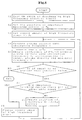
- the matching device control section 10c of the high frequency power control section 9 which received the plasma density information from the plasma absorption frequency obtaining section 22 compares the target plasma density held in the plasma density setting section 10b and the plasma density information. If the difference therebetween is equal to or greater than a previously set range, the matching device control section 10c applies a variation corresponding to the magnitude of the difference to the impedance matching device 10a, thereby adjusting the impedance matching state between the high frequency electric source 8 side and the plasma PM side. That is, in the case of the present invention, the plasma-generating high frequency power is feedback controlled such that the difference between the target plasma density and the actually measured plasma density is eliminated.
- the target plasma density is set and held in the same data type as that of the plasma density information sent from the plasma absorption frequency obtaining section 22. That is, if the plasma density information is the plasma surface wave resonance frequency f, the target plasma density is also of the same data type as the plasma surface wave resonance frequency f. If the plasma density information is the electron plasma angle frequency ⁇ p , the target plasma density is also of the same data type as the electron plasma angle frequency ⁇ p . If the plasma density information is the electron density n e , the target plasma density is also of the same data type as the electron density ne.
- the measurement of the plasma density information, the adjustment of the impedance matching device 10a and the change of the output amount of the generating high frequency power are continued such that the actually measured plasma density is converged into the target plasma density.
- the plasma-generating high frequency power is controlled in accordance with the plasma surface wave resonance frequency f obtained by the measuring system which is quite different from a supply system of the plasma-generating high frequency power.
- plasma density in the generated plasma excellently reflects the control of the high frequency power, the plasma density is controlled appropriately, and the work W is appropriately subjected to the plasma process.
- a plasma generating apparatus and a method for controlling plasma-generating high frequency power capable of appropriately and easily controlling plasma density over the long term are disclosed.
- Measuring high frequency power is supplied to plasma through a dielectric tube.
- a plasma density information obtaining section having long lifetime no hot filament.
- the plasma density information obtaining section obtains the plasma density information by measuring a physical amount related to reflection or absorption of the high frequency power.
- An actually measured plasma density monitored by the plasma density information obtaining section from moment to moment and a target plasma density held in a plasma density setting section are compared. Based on this compared result, an impedance matching device is changed, and an impedance matching state between the electric source side and the plasma side, thereby appropriately controlling the generating high frequency power output from the high frequency electric source.
Landscapes
- Physics & Mathematics (AREA)
- Engineering & Computer Science (AREA)
- Plasma & Fusion (AREA)
- Chemical & Material Sciences (AREA)
- Analytical Chemistry (AREA)
- Plasma Technology (AREA)
- Chemical Vapour Deposition (AREA)
- Drying Of Semiconductors (AREA)
Applications Claiming Priority (4)
| Application Number | Priority Date | Filing Date | Title |
|---|---|---|---|
| JP20812898 | 1998-07-23 | ||
| JP20812898 | 1998-07-23 | ||
| JP05863599A JP3497091B2 (ja) | 1998-07-23 | 1999-03-05 | プラズマ生成用高周波パワーの制御方法、およびプラズマ発生装置 |
| JP5863599 | 1999-03-05 |
Publications (2)
| Publication Number | Publication Date |
|---|---|
| EP0975005A2 true EP0975005A2 (de) | 2000-01-26 |
| EP0975005A3 EP0975005A3 (de) | 2001-03-07 |
Family
ID=26399663
Family Applications (1)
| Application Number | Title | Priority Date | Filing Date |
|---|---|---|---|
| EP99114077A Withdrawn EP0975005A3 (de) | 1998-07-23 | 1999-07-20 | Verfahren zur Steuerung der Plasma erzeugende Hochfrequenz-Leistung und Gerät zur Plasma-Erzeugung |
Country Status (4)
| Country | Link |
|---|---|
| US (1) | US6184623B1 (de) |
| EP (1) | EP0975005A3 (de) |
| JP (1) | JP3497091B2 (de) |
| KR (1) | KR100702974B1 (de) |
Cited By (3)
| Publication number | Priority date | Publication date | Assignee | Title |
|---|---|---|---|---|
| EP0975006A3 (de) * | 1998-07-23 | 2001-03-07 | The President of Nagoya University | Verfahren zur Messung der Plasmadichte, Sensor zur Messung der Plasmadichte und Gerät zur Messung der Plasmadichte |
| EP1531490A4 (de) * | 2002-04-24 | 2009-07-15 | Japan Science & Tech Agency | Sonde des fenstertyps, plasmaüberwachungseinrichtung und plasmaverarbeitungseinrichtung |
| KR101027192B1 (ko) | 2008-10-31 | 2011-04-06 | 한국원자력연구원 | 수냉식 정전 프로브 어셈블리 및 그 제조방법 |
Families Citing this family (46)
| Publication number | Priority date | Publication date | Assignee | Title |
|---|---|---|---|---|
| JP4619468B2 (ja) * | 1999-03-25 | 2011-01-26 | 株式会社東芝 | プラズマ処理方法、プラズマ処理装置およびプラズマモニタリング装置 |
| US6729922B2 (en) * | 2000-06-05 | 2004-05-04 | Semiconductor Energy Laboratory Co., Ltd. | Device for inspecting element substrates and method of inspection using this device |
| JP3640609B2 (ja) * | 2000-10-16 | 2005-04-20 | アルプス電気株式会社 | プラズマ処理装置,プラズマ処理システムおよびこれらの性能確認システム,検査方法 |
| JP3670206B2 (ja) * | 2000-11-06 | 2005-07-13 | アルプス電気株式会社 | プラズマ処理装置又はプラズマ処理システムの性能評価方法、保守方法、性能管理システム、及び性能確認システム、並びにプラズマ処理装置 |
| JP3665265B2 (ja) * | 2000-12-28 | 2005-06-29 | 株式会社日立製作所 | プラズマ処理装置 |
| JP4270872B2 (ja) * | 2001-03-16 | 2009-06-03 | 東京エレクトロン株式会社 | インピーダンスをモニターするシステム並びに方法 |
| US6677711B2 (en) * | 2001-06-07 | 2004-01-13 | Lam Research Corporation | Plasma processor method and apparatus |
| JP4178775B2 (ja) * | 2001-08-31 | 2008-11-12 | 株式会社日立国際電気 | プラズマリアクター |
| CN1249401C (zh) * | 2001-10-24 | 2006-04-05 | 东京电子株式会社 | 用于壁膜监测的方法与设备 |
| KR20030069705A (ko) * | 2002-02-22 | 2003-08-27 | 주식회사 아토 | 임피던스를 이용한 웨이퍼의 식각 종료점, 공정챔버의화학 기상증착 및 아킹 검출 장치 |
| US6894474B2 (en) * | 2002-06-07 | 2005-05-17 | Applied Materials, Inc. | Non-intrusive plasma probe |
| US20040060660A1 (en) * | 2002-09-26 | 2004-04-01 | Lam Research Inc., A Delaware Corporation | Control of plasma density with broadband RF sensor |
| JP5404984B2 (ja) * | 2003-04-24 | 2014-02-05 | 東京エレクトロン株式会社 | プラズマモニタリング方法、プラズマモニタリング装置及びプラズマ処理装置 |
| KR100728086B1 (ko) * | 2003-09-16 | 2007-06-14 | 한국과학기술연구원 | 진공관과 반도체 스위칭 소자의 cascode 방식회로를 이용한 대출력 펄스 RF 전력 발생 장치 |
| KR101001743B1 (ko) * | 2003-11-17 | 2010-12-15 | 삼성전자주식회사 | 헬리컬 자기-공진 코일을 이용한 이온화 물리적 기상 증착장치 |
| JP2006128380A (ja) * | 2004-10-28 | 2006-05-18 | Toshiba Corp | 半導体装置の製造方法および製造装置 |
| US7851368B2 (en) * | 2005-06-28 | 2010-12-14 | Lam Research Corporation | Methods and apparatus for igniting a low pressure plasma |
| US7319316B2 (en) * | 2005-06-29 | 2008-01-15 | Lam Research Corporation | Apparatus for measuring a set of electrical characteristics in a plasma |
| JP4955966B2 (ja) * | 2005-09-05 | 2012-06-20 | キヤノン株式会社 | 導波路、それを用いた装置及び検出方法 |
| US20070074812A1 (en) * | 2005-09-30 | 2007-04-05 | Andrej Mitrovic | Temperature control of plasma density probe |
| US20070075036A1 (en) * | 2005-09-30 | 2007-04-05 | Paul Moroz | Method and apparatus for measuring plasma density in processing reactors using a short dielectric cap |
| JP4703371B2 (ja) * | 2005-11-04 | 2011-06-15 | 国立大学法人東北大学 | プラズマ処理装置 |
| GB0523947D0 (en) * | 2005-11-24 | 2006-01-04 | Boc Group Plc | Microwave plasma system |
| US7829468B2 (en) * | 2006-06-07 | 2010-11-09 | Lam Research Corporation | Method and apparatus to detect fault conditions of plasma processing reactor |
| US7498592B2 (en) * | 2006-06-28 | 2009-03-03 | Wisconsin Alumni Research Foundation | Non-ambipolar radio-frequency plasma electron source and systems and methods for generating electron beams |
| US20080084650A1 (en) * | 2006-10-04 | 2008-04-10 | Applied Materials, Inc. | Apparatus and method for substrate clamping in a plasma chamber |
| JP4882824B2 (ja) | 2007-03-27 | 2012-02-22 | 東京エレクトロン株式会社 | プラズマ処理装置、プラズマ処理方法及び記憶媒体 |
| KR100920187B1 (ko) * | 2007-12-31 | 2009-10-06 | 네스트 주식회사 | 플라즈마 챔버내의 플라즈마 밀도 분포 제어 방법 |
| JP5198299B2 (ja) | 2008-04-01 | 2013-05-15 | 株式会社日立国際電気 | 基板処理装置、半導体装置の製造方法及び基板処理方法 |
| US7982187B2 (en) * | 2008-10-14 | 2011-07-19 | De Gorordo Alvaro Garcia | Method and apparatus for photon-assisted evaluation of a plasma |
| JP5546757B2 (ja) * | 2008-11-20 | 2014-07-09 | 芝浦メカトロニクス株式会社 | プラズマ密度測定子、プラズマ密度測定装置、プラズマ処理装置、およびプラズマ密度測定方法 |
| KR101142308B1 (ko) * | 2009-09-10 | 2012-05-17 | 한국표준과학연구원 | 플라즈마 모니터링 장치, 플라즈마 모니터링 방법, 및 플라즈마 장치 |
| KR101170786B1 (ko) | 2011-03-17 | 2012-08-02 | 주식회사 메디플 | 고주파 공진기를 이용한 저전력 대면적 대기압 플라즈마 발생기 |
| JP6446627B2 (ja) * | 2012-08-28 | 2019-01-09 | イマジニアリング株式会社 | プラズマ発生装置 |
| JP6214906B2 (ja) * | 2013-04-12 | 2017-10-18 | 株式会社東芝 | レーザイオン源、イオン加速器及び重粒子線治療装置 |
| JP2015022940A (ja) * | 2013-07-19 | 2015-02-02 | 東京エレクトロン株式会社 | プラズマ処理装置、異常発振判断方法及び高周波発生器 |
| JP6388491B2 (ja) | 2014-05-02 | 2018-09-12 | 三菱重工業株式会社 | 計測装置を備えたプラズマ発生装置及びプラズマ推進器 |
| WO2016104098A1 (ja) * | 2014-12-25 | 2016-06-30 | 東京エレクトロン株式会社 | プラズマ処理装置およびプラズマ処理方法 |
| KR101788962B1 (ko) * | 2016-03-11 | 2017-10-20 | 한양대학교 산학협력단 | 플라즈마 진단장치 및 이를 포함하는 플라스마 처리장치 |
| KR101817210B1 (ko) * | 2016-08-01 | 2018-01-15 | 세메스 주식회사 | 플라즈마 발생 장치, 그를 포함하는 기판 처리 장치, 및 그 제어 방법 |
| KR101999692B1 (ko) * | 2017-10-27 | 2019-07-12 | 광운대학교 산학협력단 | 플라즈마 모니터링이 가능한 플라즈마 발생 장치 및 플라즈마 모니터링 방법 |
| US11032012B2 (en) * | 2018-06-05 | 2021-06-08 | Rohde & Schwarz Gmbh & Co. Kg | Radio frequency channel emulator system |
| JP2020071912A (ja) * | 2018-10-29 | 2020-05-07 | 東京エレクトロン株式会社 | プラズマ処理装置およびプラズマ処理方法 |
| JP2020194676A (ja) * | 2019-05-27 | 2020-12-03 | 東京エレクトロン株式会社 | プラズマ密度モニタ、プラズマ処理装置、およびプラズマ処理方法 |
| JP2020202052A (ja) * | 2019-06-07 | 2020-12-17 | 東京エレクトロン株式会社 | プラズマ電界モニタ、プラズマ処理装置、およびプラズマ処理方法 |
| CN114501764B (zh) * | 2022-01-26 | 2024-02-09 | 江苏神州半导体科技有限公司 | 基于多线圈耦合的气体解离电路控制装置及系统 |
Family Cites Families (9)
| Publication number | Priority date | Publication date | Assignee | Title |
|---|---|---|---|---|
| US3614606A (en) * | 1969-04-04 | 1971-10-19 | John A Schmidt | Capacitive-coupled probe for measuring potentials in a plasma |
| US5325019A (en) * | 1992-08-21 | 1994-06-28 | Sematech, Inc. | Control of plasma process by use of harmonic frequency components of voltage and current |
| JPH07169590A (ja) * | 1993-09-16 | 1995-07-04 | Fujitsu Ltd | 電子密度の測定方法及びその装置及び電子密度の制御装置及びプラズマ処理装置 |
| KR100276736B1 (ko) * | 1993-10-20 | 2001-03-02 | 히가시 데쓰로 | 플라즈마 처리장치 |
| DE4445762A1 (de) * | 1994-12-21 | 1996-06-27 | Adolf Slaby Inst Forschungsges | Verfahren und Vorrichtung zum Bestimmen absoluter Plasmaparameter |
| JPH08255696A (ja) * | 1995-03-17 | 1996-10-01 | Mitsubishi Heavy Ind Ltd | プラズマ診断装置 |
| JPH0992491A (ja) * | 1995-09-28 | 1997-04-04 | Toshiba Corp | プラズマ処理装置及びプラズマ処理方法 |
| KR0159203B1 (ko) * | 1995-12-13 | 1999-05-01 | 양승택 | 마이크로파 공진검침기 및 다이나믹 플라스마의 밀도 측정방법 |
| US6252354B1 (en) * | 1996-11-04 | 2001-06-26 | Applied Materials, Inc. | RF tuning method for an RF plasma reactor using frequency servoing and power, voltage, current or DI/DT control |
-
1999
- 1999-03-05 JP JP05863599A patent/JP3497091B2/ja not_active Expired - Lifetime
- 1999-07-19 KR KR1019990029080A patent/KR100702974B1/ko not_active Expired - Fee Related
- 1999-07-20 EP EP99114077A patent/EP0975005A3/de not_active Withdrawn
- 1999-07-21 US US09/357,849 patent/US6184623B1/en not_active Expired - Fee Related
Cited By (5)
| Publication number | Priority date | Publication date | Assignee | Title |
|---|---|---|---|---|
| EP0975006A3 (de) * | 1998-07-23 | 2001-03-07 | The President of Nagoya University | Verfahren zur Messung der Plasmadichte, Sensor zur Messung der Plasmadichte und Gerät zur Messung der Plasmadichte |
| US6339297B1 (en) | 1998-07-23 | 2002-01-15 | Nissin Inc. | Plasma density information measuring method, probe used for measuring plasma density information, and plasma density information measuring apparatus |
| US6744211B2 (en) | 1998-07-23 | 2004-06-01 | Nissin Inc. | Plasma density information measuring method, probe used for measuring plasma density information, and plasma density information measuring apparatus |
| EP1531490A4 (de) * | 2002-04-24 | 2009-07-15 | Japan Science & Tech Agency | Sonde des fenstertyps, plasmaüberwachungseinrichtung und plasmaverarbeitungseinrichtung |
| KR101027192B1 (ko) | 2008-10-31 | 2011-04-06 | 한국원자력연구원 | 수냉식 정전 프로브 어셈블리 및 그 제조방법 |
Also Published As
| Publication number | Publication date |
|---|---|
| US6184623B1 (en) | 2001-02-06 |
| JP3497091B2 (ja) | 2004-02-16 |
| JP2000100598A (ja) | 2000-04-07 |
| KR20000011806A (ko) | 2000-02-25 |
| KR100702974B1 (ko) | 2007-04-04 |
| EP0975005A3 (de) | 2001-03-07 |
Similar Documents
| Publication | Publication Date | Title |
|---|---|---|
| US6184623B1 (en) | Method for controlling plasma-generating high frequency power, and plasma generating apparatus | |
| US6744211B2 (en) | Plasma density information measuring method, probe used for measuring plasma density information, and plasma density information measuring apparatus | |
| US5273610A (en) | Apparatus and method for determining power in plasma processing | |
| JP5404984B2 (ja) | プラズマモニタリング方法、プラズマモニタリング装置及びプラズマ処理装置 | |
| JP3157605B2 (ja) | プラズマ処理装置 | |
| US5082517A (en) | Plasma density controller for semiconductor device processing equipment | |
| KR100473794B1 (ko) | 플라즈마 전자밀도 측정 및 모니터링 장치 | |
| WO2018101065A1 (ja) | プラズマ処理装置 | |
| Karkari et al. | A floating hairpin resonance probe technique for measuring time-resolved electron density in pulse discharge | |
| US6447691B1 (en) | Method for detecting end point of plasma etching, and plasma etching apparatus | |
| JP2020194676A (ja) | プラズマ密度モニタ、プラズマ処理装置、およびプラズマ処理方法 | |
| WO2002080632A1 (en) | Device and control method for micro wave plasma processing | |
| Hebner et al. | Characterization of electron and negative ion densities in fluorocarbon containing inductively driven plasmas | |
| US10109463B2 (en) | Microwave automatic matcher and plasma processing apparatus | |
| KR20210113949A (ko) | 검사 방법 및 플라즈마 처리 장치 | |
| JP3838481B2 (ja) | プラズマ密度情報測定方法及びその装置並びにプラズマ密度情報測定用プローブ、プラズマ発生方法及びその装置、プラズマ処理方法及びその装置 | |
| JP4619468B2 (ja) | プラズマ処理方法、プラズマ処理装置およびプラズマモニタリング装置 | |
| JP4022902B2 (ja) | プラズマモニタリング方法、プラズマモニタリング装置及びプラズマ処理装置 | |
| US20080000585A1 (en) | Apparatus for monitoring electron density and electron temperature of plasma and method thereof | |
| JP2001196199A (ja) | プラズマ密度情報測定用プローブ | |
| JP2004055324A (ja) | プラズマ密度情報測定方法およびその装置、並びにプラズマ密度情報監視方法およびその装置、並びにプラズマ処理方法およびその装置 | |
| JP2002216998A (ja) | プラズマ密度情報測定方法及びその装置並びにプラズマ密度情報測定用プローブ、プラズマ処理方法及びその装置 | |
| Baker et al. | Spatially resolved measurement of the electrical properties of the rf discharge in a fast-axial-flow laser with a rectangular cross section | |
| JP2001068457A (ja) | ドライエッチング方法 |
Legal Events
| Date | Code | Title | Description |
|---|---|---|---|
| PUAI | Public reference made under article 153(3) epc to a published international application that has entered the european phase |
Free format text: ORIGINAL CODE: 0009012 |
|
| AK | Designated contracting states |
Kind code of ref document: A2 Designated state(s): DE FR GB |
|
| AX | Request for extension of the european patent |
Free format text: AL;LT;LV;MK;RO;SI |
|
| PUAL | Search report despatched |
Free format text: ORIGINAL CODE: 0009013 |
|
| AK | Designated contracting states |
Kind code of ref document: A3 Designated state(s): AT BE CH CY DE DK ES FI FR GB GR IE IT LI LU MC NL PT SE |
|
| AX | Request for extension of the european patent |
Free format text: AL;LT;LV;MK;RO;SI |
|
| RIC1 | Information provided on ipc code assigned before grant |
Free format text: 7H 01J 37/32 A, 7H 05H 1/00 B |
|
| 17P | Request for examination filed |
Effective date: 20010508 |
|
| AKX | Designation fees paid |
Free format text: DE FR GB |
|
| 17Q | First examination report despatched |
Effective date: 20031229 |
|
| 17Q | First examination report despatched |
Effective date: 20031229 |
|
| STAA | Information on the status of an ep patent application or granted ep patent |
Free format text: STATUS: THE APPLICATION IS DEEMED TO BE WITHDRAWN |
|
| 18D | Application deemed to be withdrawn |
Effective date: 20090203 |