EP0975108B1 - Méthode et dispositif pour enrégistrer en mémoire les noms des programmes d'émission d'émetteurs qui transmettent des signaux RDS - Google Patents
Méthode et dispositif pour enrégistrer en mémoire les noms des programmes d'émission d'émetteurs qui transmettent des signaux RDS Download PDFInfo
- Publication number
- EP0975108B1 EP0975108B1 EP99108792A EP99108792A EP0975108B1 EP 0975108 B1 EP0975108 B1 EP 0975108B1 EP 99108792 A EP99108792 A EP 99108792A EP 99108792 A EP99108792 A EP 99108792A EP 0975108 B1 EP0975108 B1 EP 0975108B1
- Authority
- EP
- European Patent Office
- Prior art keywords
- rds
- station
- broadcast radio
- station name
- radio receiver
- Prior art date
- Legal status (The legal status is an assumption and is not a legal conclusion. Google has not performed a legal analysis and makes no representation as to the accuracy of the status listed.)
- Expired - Lifetime
Links
- 238000000034 method Methods 0.000 title claims description 14
- 230000015654 memory Effects 0.000 claims description 48
- 238000012937 correction Methods 0.000 claims description 26
- 238000012806 monitoring device Methods 0.000 claims description 13
- 230000006870 function Effects 0.000 claims description 7
- 238000010586 diagram Methods 0.000 description 5
- 230000005540 biological transmission Effects 0.000 description 3
- 230000001629 suppression Effects 0.000 description 2
- 101000979748 Homo sapiens Protein NDRG1 Proteins 0.000 description 1
- 101000701401 Homo sapiens Serine/threonine-protein kinase 38 Proteins 0.000 description 1
- 101000697608 Homo sapiens Serine/threonine-protein kinase 38-like Proteins 0.000 description 1
- 102100030514 Serine/threonine-protein kinase 38 Human genes 0.000 description 1
- 102100027898 Serine/threonine-protein kinase 38-like Human genes 0.000 description 1
- 238000011161 development Methods 0.000 description 1
- 230000018109 developmental process Effects 0.000 description 1
- 238000012544 monitoring process Methods 0.000 description 1
- 101150037779 ndrg3 gene Proteins 0.000 description 1
- 238000012545 processing Methods 0.000 description 1
- 230000007261 regionalization Effects 0.000 description 1
- 230000003068 static effect Effects 0.000 description 1
- 238000012546 transfer Methods 0.000 description 1
Images

Classifications
-
- H—ELECTRICITY
- H04—ELECTRIC COMMUNICATION TECHNIQUE
- H04H—BROADCAST COMMUNICATION
- H04H40/00—Arrangements specially adapted for receiving broadcast information
- H04H40/18—Arrangements characterised by circuits or components specially adapted for receiving
-
- H—ELECTRICITY
- H04—ELECTRIC COMMUNICATION TECHNIQUE
- H04B—TRANSMISSION
- H04B1/00—Details of transmission systems, not covered by a single one of groups H04B3/00 - H04B13/00; Details of transmission systems not characterised by the medium used for transmission
- H04B1/06—Receivers
- H04B1/16—Circuits
-
- H—ELECTRICITY
- H04—ELECTRIC COMMUNICATION TECHNIQUE
- H04H—BROADCAST COMMUNICATION
- H04H60/00—Arrangements for broadcast applications with a direct linking to broadcast information or broadcast space-time; Broadcast-related systems
- H04H60/27—Arrangements for recording or accumulating broadcast information or broadcast-related information
-
- H—ELECTRICITY
- H04—ELECTRIC COMMUNICATION TECHNIQUE
- H04H—BROADCAST COMMUNICATION
- H04H2201/00—Aspects of broadcast communication
- H04H2201/10—Aspects of broadcast communication characterised by the type of broadcast system
- H04H2201/13—Aspects of broadcast communication characterised by the type of broadcast system radio data system/radio broadcast data system [RDS/RBDS]
Definitions
- the invention relates to a method for storing and displaying a station name of a currently in an RDS radio receiver, in particular an RDS car radio in a motor vehicle, set radio station, according to the preamble of claim 1.
- the invention further relates to a RDS radio receiver, according to the respective Preamble of claim 7.
- a signal of an R adio- D aten- S ystems (RDS), a so-called RDS-signal, is used when the program broadcasts, such as radio programs for travelers in a vehicle which is equipped with a corresponding RDS car radio, for transmitting various important information, with which the RDS car radio independently and automatically executes a variety of, especially for undisturbed reception operations without, for example, a driver to turn his attention away from traffic and perform manual inputs to the RDS car radio. Furthermore, this RDS signal contains information that may be communicated to the driver or a user on a display of the RDS car radio.
- the RDS signal is specified in an EBU specification DIN EN50067 and contains or transmits with the transmitter signal on a currently set frequency of a currently set on the RDS car radio radio station to differentiate the various broadcasters with correspondingly different transmitter chains a program identification code, hereafter PI Code or PI for short.
- the RDS signal contains a program name, for example, "NDR1", “NDR2” or “NDR3”, which is hereinafter referred to as PS ( P rogram S ervice Name) or Sending Name.
- RDS devices display the station name (PS) in a display or display. It has a length of eight characters and is static by definition. Increasingly, this transfer of information is used for the purpose of depicting running texts, for information or advertising. This distracts the attention of the driver from the traffic in car radios, and it is also often no meaningful station name stored, as such texts constantly go through and change. In, for riders and RDS radio receivers, foreign areas, the unknown program name of a newly tuned broadcasting station in the display dwarve is often not visible.
- PS station name
- T raffic I nformation Me mory system (TIM) realized, which on receipt of a traffic message (traffic information or TP for short) stores them and on call by the driver, for example, after this has entered his car at the beginning of his journey, plays.
- This stored traffic message is usually assigned the station name (PS).
- PS station name
- a confusion arises because the stored traffic message is randomly assigned to a text section or word part of the station name of the RDS code used as a scrolling text, since such running texts also occur during a traffic announcement.
- TIM playback or station tuning such as station keystroke or "travelstore,” ie, automatically storing the strongest traffic information station, the user is distracted and confused by any text. It is becoming increasingly difficult to assign and save a program the correct, meaningful name.
- EP-A-0 762 683 describes a method in which for each transmitter the PS code, frequency data, a receive level, and the PI code are written into a table.
- EP-A-0 305 172 describes a method for managing transmitted PI codes and lists of alternative frequencies.
- EP-A-0 495 136 describes a read-write memory in the received station name information can be written.
- This task is accomplished by a method of o.g. Art having the features characterized in claim 1 and by a RDS radio receiver having the features characterized in claim 7.
- a suppression of annoying scrolling texts and a corresponding reassurance of the display of the RDS radio receiver is achieved by the information transmitted from the table transmitter name is permanently displayed in the display of the RDS radio receiver instead of the information transmitted as the station name in the RDS signal of the currently set radio station ,
- the table is expediently stored in the RDS radio receiver.
- the display of the assigned station name is switched on or off via a DSC function ( D irect S oftware C ontrol) or switch of the RDS radio receiver.
- DSC function D irect S oftware C ontrol
- this change of a sender name becomes a specific program identification code or the new sender name with a new program identification code stored in an additional correction memory, in particular an EEPROM.
- the transmitted as a station name in an RDS signal of the currently set radio station information is checked at predetermined intervals in the RDS radio receiver and stored a constant or regularly recurring part of this information as the station name of the currently set radio station and / or displayed. This is particularly advantageous if the program identification code of the currently set station is not present in the table stored in the RDS radio receiver.
- a memory which contains a table with a unique assignment of program identification codes to station names, and a selection unit which receives a decoded by the RDS decoder program identification code of a currently set radio station and this program identification code in the memory assigned station name selects and saves and / or displays.
- the table stored in the RDS radio receiver contains all assignments of program identification codes to corresponding station names for all European stations, which requires only about 2 kbytes of memory.
- a suppression of annoying running texts and a corresponding reassurance of the display of the RDS radio receiver is achieved in that the selection unit instead of transmitted as a station name in the RDS signal of the currently set radio station information permanently assigned to the station name in the display of the RDS radio receiver displays.
- the memory is formed as a residual memory in the RDS radio receiver.
- a DSC function D irect S oftware C ontrol
- switch in the RDS radio receiver is provided, which optionally activates or deactivates the display of the assigned station name.
- an additional correction memory preferably an EEPROM, is provided for storing a change of a station name to a specific program identification code and / or additional station names with a new program identification code.
- the memory has a size of 2 kbytes or more.
- a monitoring device connected to the RDS decoder which checks the information transmitted as a station name in an RDS signal of the currently set radio station at predetermined intervals in the RDS radio receiver and a constant or regularly recurring part of this information Station name of the currently set radio station stores and / or displays. This is particularly advantageous if the program identification code of the currently set station is not present in the table stored in the RDS radio receiver.
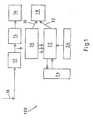
- the first preferred embodiment of an inventive RDS radio receiver 100 illustrated as a simplified block diagram in FIG. 1 includes an antenna 10 which directs an RF signal into an RF stage 12 for further processing. There, the RF signal is filtered, rectified and the AF signal filtered out. This AF signal is fed via a low-frequency stage 14 to a loudspeaker 16. Furthermore, a display 18 is provided, which in particular displays data from an RDS decoder 20, such as station name. The display 18 also displays, for example, the currently set receive frequency, the currently set memory location or the like, which are fed from not shown devices of the RDS radio receiver to the display 18.
- RDS signal portions are derived from the RDS decoder 20, which in particular contain station names and / or program identification code.
- the program identification code is forwarded to a control unit 22 which has access to a read-only memory (ROM) 24 in which the associated station name is stored for each program identification code.
- ROM read-only memory
- the selection unit 24 displays this station name taken from the table instead of the station name transmitted by the RDS signal in the display 18. As a result, any running texts transmitted as station names via the RDS signal are hidden.
- the user can, for example, by means of a DSC function (D irect S oftware C ontrol) or switch determine whether the station name from the selection unit 24 (arrow 32) or the station name from the RDS decoder 20 (arrow 30), which may actually is a scrolling text to be displayed on the display 18.
- a DSC function Rec S oftware C ontrol
- switch determine whether the station name from the selection unit 24 (arrow 32) or the station name from the RDS decoder 20 (arrow 30), which may actually is a scrolling text to be displayed on the display 18.
- a correction memory 26 is additionally provided, which is expediently designed as a non-volatile read and write memory (preferably EEPROM). Changes to a sender name for a particular program identification code can be taken into account, ie stored, in this correction memory.
- additional station names that are not yet contained in the ROM 24, can be stored.
- the control unit 22 after finding a currently received program identification code in the memory 24 expediently additionally from the correction memory 26 from to check whether the this program identification code assigned station name may have changed in the meantime. If the control unit 22 also finds in the correction memory 26, ie the currently received program identification code is also stored in the correction memory 26, then the control unit 22 uses instead of the stored in memory 24 transmitter name the stored in the correction memory 26 transmitter name.
- control unit 22 If the control unit 22 does not find the currently received program identification code in the memory 24, it also queries the correction memory 26 to determine whether it is a new transmitter which may have been stored only in the correction memory 26. Only when the user-activated control unit 22 is not found here, it passes the control of the display 18 to the RDS decoder, so that the actually transmitted via the RDS signal station name, which is possibly a scrolling text, on the display 18th is pictured.
- control unit 22 then retrieves and stores a uniquely identified sender name of the currently tuned broadcast station whose program identification code was neither found in the memory 24 nor in the correction memory 26, it being understood that it is not a fraction of a scrolling text is.
- This is possible, for example, in that the information transmitted as the station name via the RDS signal must not change over a predetermined time.
- the data error rate must preferably be observed in order to determine whether possible differences due to interference / reception problems or due to intentional, changed transmissions of a scrolling text have arisen. This storage action is possible in a particularly advantageous manner with the embodiment of FIG. 3 explained below.
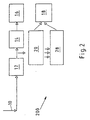
- the second preferred embodiment of an inventive RDS radio receiver 200 shown in simplified form in Figure 2 corresponds substantially to the first embodiment of FIG. 1, but instead of the control unit 22 and the memory 24 and 26, a monitoring device 28 is provided, which for reassurance Display 18 is a fixed text, expediently the station name of the currently set on the RDS radio receiver broadcaster represents. Monitored for this the monitoring device 28 at regular intervals transmitted by the currently set radio station via the RDS signal station name by the decoded by the RDS decoder 20 station name is passed to the monitoring device 28. This checks whether the information transmitted as a station name in the RDS signal has remained constant over a longer period of time and thus identifies an actual station name, since a running text transmitted via the RDS signal as the station name constantly changes. (Data error rate)
- the monitoring device 28 receives from the RDS decoder 20 the respective decoded program identification code, so that the monitoring device 28 can determine that a sudden change of the information of the station name results not by a scrolling text but by a new set in the RDS radio receiver broadcaster.
- This change to another radio station for example, manually initiated by the user or automatically by the RDS radio receiver due to leaving a transmission range of the previously set radio station.
- it may also be a change of the station name during the broadcast of a regional program, (regionalization), which is accompanied by a change of the 2nd Nibbles de PI code.
- the following name change can occur both in the "monitoring mode" and in the name or correction memory.
- the third preferred embodiment of an inventive RDS radio receiver 300 shown as a simplified block diagram in FIG. 3 is a combination of the first and second embodiments 100 and 200, ie this RDS radio receiver 300 comprises both the control unit 22 with memory 24 and correction memory 26 and the monitoring device 28. Whether the control unit 22 or the monitoring device 28 has control over the display 18 depends on whether or not the broadcasting station currently set on the RDS broadcasting receiver is already registered in at least one of the memories 24 or 26. Is this transmitter already recorded, then has the Control unit 22, the control of the display 18. However, if this radio station is still detected in any of the memory 24 or 26, the control unit 22 passes control of the display 18 to the monitoring device 28.
- the control unit 22 finds in the correction memory 26 and retains control of the display 18.
- the control unit 22 and / or Monitoring device 28 can be activated and deactivated, in the latter case, only the RDS decoder 20 has control of the display 18 with respect to the transmitter name shown in the display 18.
- TIM devices T raffic I nformation M emory
- PI program identification code
- PS station name
- SAW station text
- a station text such as advertising text, weather, news is used as station name etc. transmitted in conventional RDS radio receivers when storing the traffic message as the station name of the currently transmitted fraction of the scrolling text stored with. This is particularly important if a vehicle has been parked in a receiving hole and no reception of the traffic information on the tuned, known station is possible.
- the search starts automatically and tunes to a station that carries a traffic information. If it comes to a TIM recording, it is important to know which transmitter is behind it.
- the present invention ensures that the correct station name, namely "SAW", is always stored or displayed.
- the inventive storage of the actual station name instead of a possibly just transmitted scrolling text to take place regardless of whether the representation of the actual station name on the display 18 is currently activated or not.
Landscapes
- Engineering & Computer Science (AREA)
- Signal Processing (AREA)
- Computer Networks & Wireless Communication (AREA)
- Circuits Of Receivers In General (AREA)
Claims (12)
- Procédé d'affichage d'un nom d'un émetteur radio momentanément réglé dans un récepteur RDS (radio) transmettant des données (radio), selon lequel
on vérifie si un code d'identification de programme transmis dans un signal RDS (de données radio) de l'émetteur radio momentanément réglé est présent dans un tableau archivé dans le récepteur radio en tant que résident dans une ROM et qui contient une association claire du code d'identification de programme au nom de l'émetteur, ou est présent dans une mémoire de correction réinscriptible,
ensuite, si le code d'identification de programme est présent dans la mémoire de correction, on lit ou on affiche un nom d'émetteur associé au code d'identification de programme dans la mémoire de correction, tandis que si le code d'identification de programme n'est pas présent dans la mémoire de correction, mais est présent dans le tableau, on lit on affiche un nom d'émetteur associé au code d'identification de programme dans ce tableau. - Procédé selon la revendication 1,
caractérisé en ce que
toutes les associations de codes d'identification de programmes aux noms d'émetteurs correspondants, pour tous les émetteurs européens, sont déposées dans le tableau enregistré dans le récepteur RDS. - Procédé selon la revendication 1 ou 2,
caractérisé en ce qu'
au lieu de l'information transmise comme nom d'émetteur dans le signal RDS de l'émetteur radio momentanément réglé on affiche, le nom d'émetteur associé dans le tableau en permanence dans l'affichage du récepteur RDS. - Procédé selon l'une des revendications précédentes 1 à 3,
caractérisé en ce qu'
on active ou on coupe l'affichage du nom d'émetteur associé par une fonction de commande directe du logiciel ou par un commutateur du récepteur RDS. - Procédé selon l'une des revendications précédentes 1 à 4,
caractérisé en ce qu'
un changement d'un nom d'émetteur pour un code d'identification de programme déterminé et/ou un nouveau nom d'émetteur avec nouveau code d'identification de programme sont déposés dans une mémoire de correction supplémentaire, en particulier une mémoire EEPROM. - Procédé d'enregistrement et d'affichage d'un nom d'émetteur d'un émetteur radio momentanément réglé dans un récepteur RDS, en particulier un autoradio RDS dans un véhicule automobile, selon l'une des revendications précédentes 1 à 5,
caractérisé en ce que
dans le récepteur RDS l'information transmise comme nom d'émetteur dans le signal RDS de l'émetteur radio momentanément réglé est vérifiée à intervalles de temps prédéterminés, et une partie constante ou régulièrement récurrente de cette information est enregistrée et/ou affichée en tant que nom d'émetteur de l'émetteur radio momentanément réglé. - Récepteur RDS (200, 300) comportant un décodeur RDS (20), qui décode au moins un code d'identification de programme contenu dans un signal de données radio, comprenant :- une mémoire (24) qui contient un tableau enregistré en tant que résident dans une mémoire ROM, comprenant une association claire de codes d'identification de programmes à des noms d'émetteurs,- une mémoire de correction supplémentaire (26) pour enregistrer un changement d'un nom d'émetteur pour un code d'identification de programme déterminé et/ou un nom d'émetteur supplémentaire avec un nouveau code d'identification de programme,- une unité de commande (22) qui reçoit un code d'identification de programme d'un émetteur radio momentanément réglé, décodé par le décodeur RDS (20), et qui choisit et affiche un nom d'émetteur associé à ce code d'identification de programme dans le tableau, si ce code d'identification de programme n'est pas présent dans la mémoire de correction supplémentaire (26), ou choisit et affiche un nom d'émetteur associé à ce code d'identification de programme dans la mémoire de correction supplémentaire (26) si ce code d'identification de programme est présent dans cette mémoire de correction supplémentaire (26).
- Récepteur RDS (100, 300) selon la revendication 7,
caractérisé en ce que
le tableau enregistré dans le récepteur RDS (100, 300) contient toutes les associations de codes d'identification de programme aux noms d'émetteurs correspondants pour tous les émetteurs européens. - Récepteur RDS (100, 300) selon la revendication 7 ou 8,
caractérisé en ce que
l'unité de commande (22), au lieu de l'information transmise comme nom d'émetteur dans le signal RDS de l'émetteur radio momentanément réglé, affiche le nom d'émetteur associé dans le tableau en permanence dans un affichage (18) du récepteur RDS (100, 300). - Récepteur RDS (100, 300) selon l'une des revendications 7 à 9,
caractérisé en ce qu'
une fonction de commande directe de logiciel (DSC) ou un commutateur dans le récepteur RDS (100, 300), active ou désactive au choix l'affichage du nom d'émetteur associé. - Récepteur RDS (100, 300) selon l'une des revendications 7 à 10,
caractérisé en ce que
la mémoire (24) et/ou la mémoire de correction (26) présente une taille de 2 kilo-octets ou plus. - Récepteur RDS (200, 300) comportant un décodeur RDS (20), qui décode au moins une information contenue comme nom d'émetteur dans un signal RDS, selon l'une des revendications 7 à 11,
caractérisé en ce qu'
un dispositif de surveillance (28) lié au décodeur RDS (20) vérifie dans le récepteur RDS (200, 300), à intervalles de temps prédéterminés, l'information transmise comme nom d'émetteur dans un signal RDS de l'émetteur radio momentanément réglé, et une partie constante ou régulièrement récurrente de cette information est enregistrée et/ou affichée comme nom d'émetteur de l'émetteur radio momentanément réglé.
Applications Claiming Priority (2)
| Application Number | Priority Date | Filing Date | Title |
|---|---|---|---|
| DE19832471 | 1998-07-20 | ||
| DE19832471A DE19832471A1 (de) | 1998-07-20 | 1998-07-20 | Verfahren und Vorrichtung zum Abspeichern von Sendernamen von RDS-Rundfunksendern |
Publications (3)
| Publication Number | Publication Date |
|---|---|
| EP0975108A2 EP0975108A2 (fr) | 2000-01-26 |
| EP0975108A3 EP0975108A3 (fr) | 2001-12-19 |
| EP0975108B1 true EP0975108B1 (fr) | 2007-08-15 |
Family
ID=7874609
Family Applications (1)
| Application Number | Title | Priority Date | Filing Date |
|---|---|---|---|
| EP99108792A Expired - Lifetime EP0975108B1 (fr) | 1998-07-20 | 1999-05-03 | Méthode et dispositif pour enrégistrer en mémoire les noms des programmes d'émission d'émetteurs qui transmettent des signaux RDS |
Country Status (3)
| Country | Link |
|---|---|
| EP (1) | EP0975108B1 (fr) |
| KR (1) | KR20000011827A (fr) |
| DE (2) | DE19832471A1 (fr) |
Cited By (1)
| Publication number | Priority date | Publication date | Assignee | Title |
|---|---|---|---|---|
| DE102012210313A1 (de) | 2012-06-19 | 2013-12-19 | Robert Bosch Gmbh | Verfahren zum Erkennen, Speichern und/oder Anzeigen eines Sendernamens einesRundfunksenders |
Families Citing this family (4)
| Publication number | Priority date | Publication date | Assignee | Title |
|---|---|---|---|---|
| DE10113463A1 (de) * | 2001-03-19 | 2002-10-02 | Harman Becker Automotive Sys | Rundfunksystem, Verfahren und Rundfunkempfänger zum Empfang von Sender-oder Programmdaten |
| DE102007042974A1 (de) * | 2007-09-10 | 2009-03-26 | Continental Automotive Gmbh | Verfahren und Vorrichtung zur Darstellung von anzeigbaren RDS-Informationen |
| DE102010049395A1 (de) | 2010-10-26 | 2012-04-26 | Peiker Acustic Gmbh & Co. Kg | Verfahren zur Darstellung von Sendern auf einer Anzeigeeinrichtung sowie Vorrichtung hierzu |
| FR2977417B1 (fr) * | 2011-06-29 | 2015-08-07 | Continental Automotive France | Procede d'identification d'une chaine de caracteres recue sur un recepteur radio fm. |
Family Cites Families (4)
| Publication number | Priority date | Publication date | Assignee | Title |
|---|---|---|---|---|
| GB8719944D0 (en) * | 1987-08-24 | 1987-09-30 | British Broadcasting Corp | Radio data system receivers |
| EP0495136A3 (en) * | 1991-01-15 | 1993-03-17 | Pioneer Electronic Corporation | Method of transmitting data in rds broadcasting |
| JPH0951251A (ja) * | 1995-08-08 | 1997-02-18 | Sony Corp | 受信機 |
| KR19980014875A (ko) * | 1996-08-17 | 1998-05-25 | 구자홍 | 무선데이타 시스템(rds)의 선택수신 및 이를 이용한 차량항법용 최적경로 산출방법 |
-
1998
- 1998-07-20 DE DE19832471A patent/DE19832471A1/de not_active Withdrawn
-
1999
- 1999-05-03 EP EP99108792A patent/EP0975108B1/fr not_active Expired - Lifetime
- 1999-05-03 DE DE59914454T patent/DE59914454D1/de not_active Expired - Lifetime
- 1999-07-20 KR KR1019990029229A patent/KR20000011827A/ko not_active Ceased
Non-Patent Citations (1)
| Title |
|---|
| None * |
Cited By (1)
| Publication number | Priority date | Publication date | Assignee | Title |
|---|---|---|---|---|
| DE102012210313A1 (de) | 2012-06-19 | 2013-12-19 | Robert Bosch Gmbh | Verfahren zum Erkennen, Speichern und/oder Anzeigen eines Sendernamens einesRundfunksenders |
Also Published As
| Publication number | Publication date |
|---|---|
| DE19832471A1 (de) | 2000-01-27 |
| EP0975108A2 (fr) | 2000-01-26 |
| KR20000011827A (ko) | 2000-02-25 |
| DE59914454D1 (de) | 2007-09-27 |
| EP0975108A3 (fr) | 2001-12-19 |
Similar Documents
| Publication | Publication Date | Title |
|---|---|---|
| EP0499608B1 (fr) | Recepteur radio, en particulier autoradio | |
| WO1990013882A1 (fr) | Recepteur radio, et plus particulierement recepteur pour vehicules | |
| EP0753223A1 (fr) | Procede permettant de regler un recepteur radio mobile sur des programmes radio diffusant des informations relatives a la circulation | |
| EP0975108B1 (fr) | Méthode et dispositif pour enrégistrer en mémoire les noms des programmes d'émission d'émetteurs qui transmettent des signaux RDS | |
| EP0878906B1 (fr) | Récepteur de radio | |
| EP0403744B1 (fr) | Récepteur de radiodiffusion équipé du RDS avec augmentation empirique du contenu de ses mémoires de programme | |
| EP1118068A1 (fr) | Procede et dispositif de selection de services d'informations sur la circulation routiere pouvant etre re us a l'aide d'au moins un recepteur mobile | |
| EP0579955A1 (fr) | Système de transmission et de réception | |
| EP1148641B1 (fr) | Dispositif et procédé pour la sélection automatique d'émetteurs | |
| EP0725503B2 (fr) | Méthode pour la réception et la présentation d'un programme de radiodiffusion avec des informations numériques supplémentaires et récepteur pour l'affichage d'informations numériques d'autres programmes | |
| EP0352764A2 (fr) | Récepteur pour haute fréquence avec un dispositif d'indication de programme d'émetteurs | |
| EP0539708B1 (fr) | Récepteur de radiodiffusion, en particulier récepteur pour véhicules | |
| DE4230600C2 (de) | Rundfunkempfänger | |
| DE19743645A1 (de) | RDS-Rundfunkempfänger mit Alternativfrequenzspeicher und Verfahren zur Speicherorganisation | |
| DE4422235B4 (de) | Rundfunkempfänger | |
| EP0912002B1 (fr) | Méthode pour stocker des données de fréquences d'émission dans une mémoire d'un récepteur de radiodiffusion | |
| DE60209166T2 (de) | Mehrband-RDS-Radioempfänger | |
| DE19905430A1 (de) | Verfahren und Rundfunkempfänger zum Auswerten von DAB-Durchsagen | |
| EP0844753B1 (fr) | Méthode et dispositif pour l' analyse de signaux numériques supplémentaires dans un programme de radiodiffusion | |
| WO2002075988A2 (fr) | Systeme de radiodiffusion, procede et recepteur radio pour la reception de donnees d'emetteur ou de programme | |
| DE102005031339A1 (de) | Vorrichtung zum Empfang und zur Wiedergabe von Signalen | |
| DE19533008C5 (de) | Rundfunkempfänger | |
| DE4245045B4 (de) | Audiosystem mit FM-Rundfunkempfänger | |
| DE9218025U1 (de) | Anordnung zur Begrenzung des Umschaltverhaltens eines RDS-Rundfunkempfängers im EON-Betrieb | |
| DE2750071A1 (de) | Nachrichten-sende- und empfangssystem fuer ein gebiet mit einer vielzahl von empfangbaren sendern |
Legal Events
| Date | Code | Title | Description |
|---|---|---|---|
| PUAI | Public reference made under article 153(3) epc to a published international application that has entered the european phase |
Free format text: ORIGINAL CODE: 0009012 |
|
| AK | Designated contracting states |
Kind code of ref document: A2 Designated state(s): AT BE CH CY DE DK ES FI FR GB GR IE IT LI LU MC NL PT SE Kind code of ref document: A2 Designated state(s): DE FR GB IT |
|
| AX | Request for extension of the european patent |
Free format text: AL;LT;LV;MK;RO;SI |
|
| PUAL | Search report despatched |
Free format text: ORIGINAL CODE: 0009013 |
|
| AK | Designated contracting states |
Kind code of ref document: A3 Designated state(s): AT BE CH CY DE DK ES FI FR GB GR IE IT LI LU MC NL PT SE |
|
| AX | Request for extension of the european patent |
Free format text: AL;LT;LV;MK;RO;SI |
|
| 17P | Request for examination filed |
Effective date: 20020619 |
|
| AKX | Designation fees paid |
Free format text: DE FR GB IT |
|
| 17Q | First examination report despatched |
Effective date: 20040308 |
|
| GRAP | Despatch of communication of intention to grant a patent |
Free format text: ORIGINAL CODE: EPIDOSNIGR1 |
|
| GRAS | Grant fee paid |
Free format text: ORIGINAL CODE: EPIDOSNIGR3 |
|
| GRAA | (expected) grant |
Free format text: ORIGINAL CODE: 0009210 |
|
| AK | Designated contracting states |
Kind code of ref document: B1 Designated state(s): DE FR GB IT |
|
| REG | Reference to a national code |
Ref country code: GB Ref legal event code: FG4D Free format text: NOT ENGLISH |
|
| REF | Corresponds to: |
Ref document number: 59914454 Country of ref document: DE Date of ref document: 20070927 Kind code of ref document: P |
|
| GBT | Gb: translation of ep patent filed (gb section 77(6)(a)/1977) |
Effective date: 20071122 |
|
| ET | Fr: translation filed | ||
| PLBE | No opposition filed within time limit |
Free format text: ORIGINAL CODE: 0009261 |
|
| STAA | Information on the status of an ep patent application or granted ep patent |
Free format text: STATUS: NO OPPOSITION FILED WITHIN TIME LIMIT |
|
| 26N | No opposition filed |
Effective date: 20080516 |
|
| PGFP | Annual fee paid to national office [announced via postgrant information from national office to epo] |
Ref country code: GB Payment date: 20130522 Year of fee payment: 15 |
|
| PGFP | Annual fee paid to national office [announced via postgrant information from national office to epo] |
Ref country code: FR Payment date: 20130604 Year of fee payment: 15 Ref country code: IT Payment date: 20130525 Year of fee payment: 15 |
|
| GBPC | Gb: european patent ceased through non-payment of renewal fee |
Effective date: 20140503 |
|
| REG | Reference to a national code |
Ref country code: FR Ref legal event code: ST Effective date: 20150130 |
|
| PG25 | Lapsed in a contracting state [announced via postgrant information from national office to epo] |
Ref country code: IT Free format text: LAPSE BECAUSE OF NON-PAYMENT OF DUE FEES Effective date: 20140503 |
|
| PG25 | Lapsed in a contracting state [announced via postgrant information from national office to epo] |
Ref country code: GB Free format text: LAPSE BECAUSE OF NON-PAYMENT OF DUE FEES Effective date: 20140503 Ref country code: FR Free format text: LAPSE BECAUSE OF NON-PAYMENT OF DUE FEES Effective date: 20140602 |
|
| PGFP | Annual fee paid to national office [announced via postgrant information from national office to epo] |
Ref country code: DE Payment date: 20160726 Year of fee payment: 18 |
|
| REG | Reference to a national code |
Ref country code: DE Ref legal event code: R119 Ref document number: 59914454 Country of ref document: DE |
|
| PG25 | Lapsed in a contracting state [announced via postgrant information from national office to epo] |
Ref country code: DE Free format text: LAPSE BECAUSE OF NON-PAYMENT OF DUE FEES Effective date: 20171201 |