EP0976199B1 - Verfahren und vorrichtung zur verlustfreien datenkompression - Google Patents
Verfahren und vorrichtung zur verlustfreien datenkompression Download PDFInfo
- Publication number
- EP0976199B1 EP0976199B1 EP98914629A EP98914629A EP0976199B1 EP 0976199 B1 EP0976199 B1 EP 0976199B1 EP 98914629 A EP98914629 A EP 98914629A EP 98914629 A EP98914629 A EP 98914629A EP 0976199 B1 EP0976199 B1 EP 0976199B1
- Authority
- EP
- European Patent Office
- Prior art keywords
- data
- code
- compressed
- compression
- input
- Prior art date
- Legal status (The legal status is an assumption and is not a legal conclusion. Google has not performed a legal analysis and makes no representation as to the accuracy of the status listed.)
- Expired - Lifetime
Links
- 238000000034 method Methods 0.000 title claims abstract description 95
- 238000013144 data compression Methods 0.000 title description 16
- 238000007906 compression Methods 0.000 claims abstract description 81
- 230000006835 compression Effects 0.000 claims abstract description 81
- 230000006837 decompression Effects 0.000 abstract description 9
- 239000000872 buffer Substances 0.000 description 29
- 230000008901 benefit Effects 0.000 description 5
- 230000006870 function Effects 0.000 description 5
- 230000005540 biological transmission Effects 0.000 description 2
- 238000010586 diagram Methods 0.000 description 2
- 208000003174 Brain Neoplasms Diseases 0.000 description 1
- 238000010420 art technique Methods 0.000 description 1
- 230000000694 effects Effects 0.000 description 1
- 238000011084 recovery Methods 0.000 description 1
- 230000003252 repetitive effect Effects 0.000 description 1
- 230000000717 retained effect Effects 0.000 description 1
- 239000004065 semiconductor Substances 0.000 description 1
- 238000000926 separation method Methods 0.000 description 1
- 238000011144 upstream manufacturing Methods 0.000 description 1
Images

Classifications
-
- H—ELECTRICITY
- H03—ELECTRONIC CIRCUITRY
- H03M—CODING; DECODING; CODE CONVERSION IN GENERAL
- H03M7/00—Conversion of a code where information is represented by a given sequence or number of digits to a code where the same, similar or subset of information is represented by a different sequence or number of digits
- H03M7/30—Compression; Expansion; Suppression of unnecessary data, e.g. redundancy reduction
Definitions
- the present invention relates generally to digital data compression and, more particularly, to methods and apparatus for performing lossless digital data compression and decompression.
- digital data in contrast to analog data, is represented by a series of 1s and 0s (known as binary digits or "bits") formed into groups of "bytes" and "words.”
- bits binary digits
- both text and images can be expressed as groups of digital data for storage or transmission.
- Some types of information constitute staggering quantities of digital data. For example, a detailed image such as an X ray of a brain tumor can easily require millions of bytes of digital data. To reduce storage and transmission costs of this data, methods have been developed for "compressing" digital data such that the original information is transformed into a new set of digital data having fewer numbers of bits. The compressed data can then undergo a reverse process of "decompression" to recover to the original information.
- Lossy data compression allows the decompressed data to differ from the original data so long as the decompressed data satisfies some fidelity criteria. For example, when images are transformed to digital data and then compressed, it may suffice to obtain an image from the decompressed data that appears to the human eye to be identical to the original image, even though varying degree of difference exists. As a result, lossy compression methods can be used only for certain types of data such as video and audio. The advantage of lossy compression is that higher degrees of compression may be obtainable than with lossless compression.
- the degree of compression is typically expressed as a ratio. For example, a compression method for which the original data is twice the size of the compressed data is said to have a 2:1 compression ratio.
- lossless data compression provides data that, when compressed and subsequently decompressed, is exactly identical to the original data.
- a benefit of lossless compression is that it can be used with all types of information where full recovery of the original data is required.
- Lossless data compression became well known in the early 1950s through the work of David Huffman, then at Bell Laboratories. Huffman's methods have formed the basis of virtually all work done in the area of lossless compression. In spite of more than forty years of work, however, current methods and apparatus for lossless data compression still only achieve average compression ratios of about 2:1. Although some types of highly repetitive data may be compressed to a degree somewhat greater than this, the average is still generally about 2:1.
- the present invention is directed to lossless digital compression/decompression methods and apparatus in which all data encoded can be recovered byte-by-byte with no loss of the original information.
- the present invention provides methods and apparatus for lossless compression in which very large compression ratios are achieved.
- the present invention provides methods and apparatus for lossless digital data compression.
- the present invention in a first aspect, comprises a method for compressing digital data.
- the method includes the steps of receiving digital data to be compressed, separating the digital data into groups having predetermined sequences of ones and zeros, processing a sequence according to a predetermined procedure to obtain a compressed sequence value of variable length by removing bits, and storing the compressed sequence value in a temporary storage area.
- the method comprises the further steps of generating a removal code representative of the number of bits removed, generating a separator code according to predetermined criteria, storing the removal code and separator code in a predetermined relationship with the compressed sequence value in the temporary storage area, and performing the preceding steps for each of the sequences to obtain an intermediate data set.
- the method further includes separating the intermediate data set into sequences and repeatedly performing the preceding steps a plurality of iterations according to predetermined criteria.
- the final step is supplying the intermediate data set of the final iteration as a compressed version of the received digital data.
- the present invention comprises apparatus for lossless digital data compression comprising an input terminal receiving digital data to be compressed, an output terminal supplying compressed digital data, and first, second, and third compression circuits.
- Each of the compression circuits comprises an input circuit for received input data, a processor circuit separating the received input data into sequences according to predetermined criteria, a binary search processor for processing the sequences using a binary search procedure to obtain compressed sequence values corresponding to the sequences with lower order bits removed, a code generator for generating removal codes representative of the number of bits removed and separator codes according to the characteristics of the compressed sequence values and removal codes, and an output circuit for supplying the compressed sequence values, removal codes, and separator codes as output data.
- the input circuit of the first compression circuit is connected to the input terminal
- the output circuit of the first compression circuit is connected to the input circuit of the second compression circuit
- the output circuit of the second compression circuit is coupled to the input circuit of the third compression circuit
- the output circuit of the third compression circuit is connected to the output terminal.
- the present invention employs iterative techniques in which a search procedure is used to achieve a nominal compression ratio on one pass and to achieve a much greater compression after a series of passes, or iterations.
- a binary search procedure is employed. Using this procedure, all eight-bit integers, for example, can be compressed to seven bits or less in a simple iteration. In particular, all odd integers are compressed to seven bits and all even integers are compressed to six bits or less.
- the average compression achieved for all eight-bit integers taken together is two bits per integer, yielding an average compressed code length of six bits for an original eight-bit integer after a single iteration. This corresponds to a gross compression of 25 per cent per integer.
- the word "gross" is used because some of this compression is used up by overhead so that the net compression per integer per iteration is significantly less.
- the present invention employs successive iterations to ultimately achieve very significant compression ratios.
- the numerical midpoint for all eight-bit integers is selected. Since the largest integer that can be accommodated in eight-bits is 255, the midpoint is 128, or 2 7 .
- the next step is to select the next lower power of 2, which in this case is 2 6 , or 64.
- This value is added to the previous midpoint if the input value was higher than the previous midpoint or it is subtracted from the previous midpoint if the input value was lower. This step yields either 192 or 64.
- the input value is then compared to this new midpoint and, once again, if the input value is lower than this midpoint, a 0 is output and if it is higher than this midpoint a 1-bit is output. If the input value is equal to the midpoint, the process terminates. While proceeding in this manner, the number of output bits being produced is retained. The above-described process continues until the current value being encoded is correctly located.
- the compressed output for successive input values consists of a series of binary search codes comprising bit sequences of various lengths.
- the preferred embodiment of the present invention provides additional codes, called “removal codes” and “separator codes” associated with the binary search codes. It is these additional codes that constitute the overhead referred to above.
- sequences are defined as a string of bits starting with one or more one-bits and ending with one or more zero-bits (i.e., prior to the next one-bit)
- the average sequence length is four (4) bits.
- the most important characteristic of sequences defined in this manner is that they all end with zero. The value of this will be apparent in the process of compressing the sequences, described below, which yields a net compression sufficient to make the preferred embodiment of present invention a viable process, given its iterative nature. That is, a relatively small amount of compression achieved at each iteration, or cycle, accumulates over the course of many cycles to yield the extremely large compression ratios that are characteristic of the present invention.
- each sequence is processed by the binary search technique to generate a compressed sequence value, that is, a code consisting of the input sequence with certain bits removed, specifically, the low-order (i.e., right-most) zero bits, up to and including the first low-order one-bit.
- the preferred embodiment precedes each compressed sequence value with a removal code indicative of the number of bits which were removed from the original sequence by the binary search technique.
- the removal codes are shown in Table I, below. Number of Bits Removed Actual Bits Removed Removal Code 2 10 0 3 100 10 4 1000 110 5 10000 1110 etc.
- the removal code is one bit less than the number of bits removed. This explains the fact that, including the removal code, compressed sequences realize one bit of compression.
- Compressed sequence values come in four (4) types (designated as “classes") based on their characteristics. Examples of the four classes of compressed sequences are set forth in Table II, followed by a discussion of each.
- class H can have more than one hanging bit
- class R can have more than one removal one-bit
- Class B can have multiples of each. However, this does not alter the class designation.
- the input is first separated into sequences as shown in the left hand column of Table III above.
- the sequences are then compressed with the binary search technique to obtain the compressed sequence values shown in the middle column of Table III, with removal codes indicated in parentheses.
- the class code for each of these sequences is then shown in the right hand column of Table III.
- removal codes are indicated in parentheses. Separator codes are underlined. It can be seen that application of the technique described above results in a compressed bit stream of 29 bits, from the original input bit stream of 32 bits. This represents a compression of 9.35% for this particular example.
- One embodiment of the invention is implemented in a VLSI chip using an architecture known as a "systolic pipe.”
- a systolic pipe In this design, identical circuits are connected in series in a sequential chain constituting a systolic pipe processor. Input data enters the first circuit in the pipeline. As compressed output data is produced from the first circuit (corresponding to a first "cycle"), it is received by the second circuit in the sequential chain. This process continues down the entire chain until output bits constituting compressed data are supplied by the final circuit in the sequence.
- the effect of this is to overlap much of the processing time. That is, while new data is entering the first circuit, data that has entered previously is being simultaneously processed by other circuits downstream in the chain.
- the delay exhibited by the system known as "latency" time, is that time that elapses between when data first enters the top of the pipe, that is, the input circuit, and the time when output is first produced from the bottom, the last circuit in the sequence.
- this total latency time can be very small indeed, even for a very lengthy pipe.
- the present invention can keep up with even the most demanding real-time applications having very high bit rates.
- the length of the pipe that is the number of sequential circuits in the chain, determines the amount of compression that will be produced by the total pipeline. Therefore, different chips each incorporating different degrees of compression can be produced to provide hardware appropriate for specific applications.
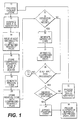
- a logic flowchart is shown of a method constituting a first embodiment of the present invention.
- the method receives digital data to be compressed and stores it into an input buffer.
- the method separates the data into sequences.
- the stored data is processed according to a predetermined procedure to obtain a compressed data value of variable length.
- a binary search procedure is employed, as described above.
- the compressed data value is stored at step 16 into a temporary storage area and, at step 18, the method generates a removal code representative of the number of bits removed from the sequence in the compression step.
- the removal code is then stored in a predetermined relationship with the compressed word value in the temporary storage area, at step 20.
- the method determines whether the desired degree of data compression has been achieved, according to a predetermined criteria. In the preferred embodiment, the predetermined criteria constitutes a time limit. Other criteria may be employed, such as, for example, a predetermined number of iterations, a predetermined desired compression ratio, or other equivalent criteria.
- step 32 the method advances to step 32, and the intermediate data set is stored in the input buffer.
- the method returns to step 12, and the data of the input buffer is separated into sequences.
- the method then performs steps 14 through 28 until all data of the input buffer have been processed and then advances to step 30 where, once again, a determination is made as to whether the desired degree of data compression has been achieved. If the desired degree of compression has been achieved, an iteration count, representing the number of compression loops executed, is appended at step 34 to the intermediate data set stored in the temporary storage area. This data is provided at step 36 as output of the encoder and constitutes a compressed version of the digital data received at step 10.
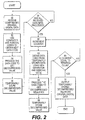
- a logic flowchart is shown of a method for decompressing compressed original digital data that constitutes a first embodiment of another aspect of the invention.
- the method begins at step 50 by receiving compressed original digital data of the type generated by the method illustrated in Fig. 1.
- This received data includes compressed data codes of various lengths, including removal codes and separated by separator values and further includes an iteration count.
- the method uses the separator values to obtain the next data code from the received data. The method for identifying separator codes is described in more detail below.
- the next compressed sequence value is then processed at step 54 to obtain a decompressed value.
- this processing is based upon the binary search technique, using the removal code and one-bits to obtain a decompressed sequence.
- the method temporarily stores the decompressed sequence.
- a determination is made at step 58 of whether all input data has been processed. If not, the method loops back and repeats steps 52 through 56. If all data has been processed, the method proceeds to step 60 where a counter is incremented.
- the method obtains a data code at step 62 from the temporarily stored decompressed values, recognizing a separator from the temporarily stored data in the manner to be described below.
- the method then processes the data code at step 64 to get a decompressed sequence.
- the method temporarily stores the decompressed sequence and determines at step 68 whether the value of the counter is equal to the iteration count. If not, the method loops back and repeats steps 60, 62, 64, and 66. If the counter value equals the iteration count, then decompression is complete. The method then supplies as output the temporarily stored decompressed values. This output data constitutes the original digital data.
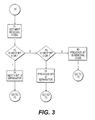
- step 70 the next removal code in the bit stream is identified. This consists of identifying the highest order 0 bit in the bit stream. All high order bits up to and including this 0 constitute the removal code.
- step 72 a determination is made of whether the next bit after the removal code is a 0 or a 1. If it is a 1, this bit and all successive 1 bits constitute hanging bits associated with the previous removal code. The next successive 0 bit thus is unambiguously identified as a separator code, as indicated at step 74, The method then loops back to step 70.
- step 72 determines whether the next bit is a 0 bit, such 0 bit could either be a separator code or a removal code.
- This ambiguity is resolved at step 76 by determining if the next bit (the second bit after the removal code identified in step 70) is a 1 or a 0. If this bit is a 1, the previous bit (the first bit after the removal code identified in step 70) is unambiguously identified as a separator code at step 78, and the program loops back to step 70.
- step 80 identifies the zero bit from step 72 as a removal code. In this manner, separator bits can be unambiguously identified in the compressed bit stream, thereby facilitating the method of Fig. 1.
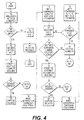
- Fig. 4 shows a more detailed logic flowchart of a method for compressing data that constitutes a second embodiment of one aspect of the present invention, implemented as an application program on a programmable digital computer.
- the program fills a plurality of cycle buffers, each corresponding to an additional degree of compression.
- a determination is made by a user as to the degree of compression that will be required, thereby determining the number of cycles that the program will execute.
- a first time period consists of reading in input data and filling all of the buffers of the program. This can be thought of conceptually as "filling the pipe.” During this period, the program is accepting input data but produces no output.
- the program continues to receive input data and also produces compressed data as output. This second period continues until all input data are exhausted.
- the program begins execution. Initialization is performed at step 102, during which the program communicates with the user to determine specifications for the current run. This includes such information as the name of the file to be compressed, the name of the output file where the compressed data will be stored, and the maximum number of cycles to be executed, that is, the desired level of compression to be achieved.
- the program then proceeds to open the files specified by the user for input and output and store the desired input data in the zero-cycle input buffer.
- the cycle number is initially set to zero.
- step 104 The program checks at step 104 to see if there are additional bytes of input to be compressed, as stored in the zero-cycle input buffer. If so, the program proceeds to step 106 to obtain this input and form it into a sequence at step 108. If insufficient input is left to form a sequence, step 110, the program loops back to step 104.
- the sequence is compressed by removing low-order zero-bits and the first low-order one-bit and adding a removal code.
- a separator code is added, if necessary.
- step 116 the compressed sequence code, its removal code, and separator code are stored in the input buffer for the next cycle.
- a "cycle number" counter tracking the number of the currently executing compression cycle, is incremented by one at step 118.
- the program checks to determine if the current cycle input buffer has any remaining input. If so, the program attempts, at step 122, to form a complete sequence. If the sequence is complete (step 124), a new compressed sequence code is formed, with removal code, at step 126, and a separator code added at step 128. The new compressed sequence code is stored in the next-cycle input buffer at step 130.
- step 132 A check is made at step 132 to determine whether the predetermined maximum cycle number has been reached. If so, the first data supplied to the program has been compressed to the maximum degree for this particular program, and compression for this sequence terminates.
- the cycle number counter is reset to zero, and the program, returns to step 104 to acquire new input data from the zero cycle input buffer. The program continues to loop through the steps described above until no data remain in the input file. The program then passes to step 140.
- the program executes in a corresponding manner to "empty the pipe,” that is, to process all data in the various cycle input buffers, until no bits are available to form a sequence.
- the program then executes step 144 to store the remaining bits, in uncompressed form, at the end of the maximum cycle buffer.
- the contents of the maximum cycle buffer are then written to the designated output file.
- the program also writes the maximum cycle number to the front of the output file, and terminates at step 146.
- a logic flowchart is shown of a method decompressing compressed digital data, which comprises a preferred embodiment of another aspect of the invention.
- the method is embodied in the form of a program for execution on a personal computer.
- the program begins execution.
- the program communicates with the user to determine specifications for the current run This includes such information as the name of the compressed date file and the name of the decompressed output file (i. e., the restored source file).
- the name of the compressed file may be embedded in the compressed file itself.
- the program then proceeds to open the files specified by the user for compressed input and decoded output.
- the program After having opened the compressed input file, the program extracts from the front of this file the maximum cycle number reached during the encode run. It then uses this number to initialize a cycle counter at step 202. At this point we are at the bottom (i.e., lowest) cycle in an iteration.
- the program checks at step 204 to see if there are additional bytes of compressed input to be decoded. If so, the program proceeds to step 206 to obtain this compressed input and process it. If not, the program proceeds to step 236 to decompress the remaining data already input, to be described below, and conclude the current run.
- the program retrieves the next removal code.
- next removal and separator codes are identified, as set forth in Fig. 2A.
- the decompressed sequence is obtained, using the removal code and any hanging bits.
- step 214 the decoded sequence is written into the next lower cycle's input buffer.
- the program decrements the cycle number by one, and processing for a new cycle begins.
- the first step in processing a new cycle is to determine if one complete sequence is waiting to be processed in the current cycle input buffer. If so, the program retrieves this information and proceeds to step 220 for processing. If insufficient bits are available, the program proceeds to step 232. The program determines that it has a complete sequence by retrieving bits up to the start of the next removal code. This may include a separation code, which is discarded.
- the program identifies removal codes and separator codes in the current cycle exactly as in step 208.
- the program determines in the same manner whether a complete compressed sequence is waiting in the current cycle input buffer. If so, the program proceeds to step 224. Otherwise, the program proceeds to step 223.
- the program obtains and decodes the next compressed sequence input bits in the same manner as at step 210.
- the decoded sequence is then written to the next lower cycle input buffer in the same manner as at step 214.
- the program determines at step 230 whether the current cycle is cycle 0. If so, the end of decompression for this data has been reached, and the data sitting in the output buffer for this cycle is identical to the original source data. This is now written to the specified output file and the program proceeds to step 232. If the program is not at cycle 0, the program proceeds to step 216 and begins processing of the next cycle.
- step 232 the system resets the cycle number to the maximum cycle that was specified in the header information located at the start of the current compressed input file. This returns the program to the bottom of the pipe to continue processing as previously described, and the program returns by step 234.
- Step 204 determines if there is additional compressed input from the current file to be decoded.
- step 238 Various "housekeeping" tasks are performed at step 238 to set up for termination, and the decoding program terminates at step 240.
- the digital data contained in the specified output file is an exact replica of the original data input to the decoder.
- Figs. 4 and 5 may be executed in an IBM-compatible personal computer having a 80486 processor running under MS-DOS operating system.
- a more powerful processor would achieve faster compression and decompression times.
- a preferred embodiment is shown of another aspect of the invention implemented in a VLSI custom integrated circuit ("IC") 300.
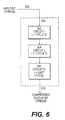
- the circuit 300 performs the encoding functions described in connection with the program of Fig. 3, using first, second, and third compression circuits.
- a first compression circuit 302 performs the functions for cycle 0 described in steps 106, 108, 110, 112, 114, and 116. Instead of writing the output to a "next cycle input buffer" as set forth in step 116, however, circuit 302 of IC 300 provides output to the input of the second circuit 304.
- a second compression circuit 304 performs the functions indicated in steps 122, 124, 126, 128, and 130. Instead of writing compressed output to a next cycle input buffer as set forth in step 130, however, circuit 304 provides its compressed output as input to the next circuit of the sequence contained in IC 300.
- IC 300 may contain different numbers of circuits 302-306. Approximately seventy-five circuits are required for each power of 10 of the overall compression ratio. For example, seventy-five circuits in IC 300 will yield a compression ratio of approximately 10:1, one hundred and fifty circuits will yield a compression ratio of about 100:1, two hundred and twenty-five circuits will yield a compression ratio of approximately 1000:1, etc.
- Third compression circuit 306 performs the functions of steps 122, 124, 126, 128, and 130. However, instead of writing data to an input buffer of the next cycle as set forth in step 130, circuit 306 provides an output signal consisting of a bit stream representing a compressed version of input supplied to circuit 302. Also, when circuit 306 determines that there are insufficient bits of additional data to form a sequence, the circuit supplies the remaining bits as an uncompressed "footer," terminating the output data stream.
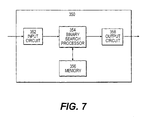
- Fig. 7 is a block diagram of a common compression circuit 350 that forms circuits 302, 304, and 306.
- these circuits 302, 304, and 306 are identical, facilitating the implementation of a large number of such circuits in a VLSI chip.
- Circuit 350 includes an input circuit 352 that receives data from either the input terminal 308 (for circuit 302) or the immediately preceding upstream compression circuit (for circuits 304 and 306).
- Input circuit 352 is coupled to a binary search processor 354 that performs digital data compression according to the method shown in Fig. 3.
- Temporary storage by processor 354 is performed by a memory circuit 356.
- Separator values are generated by processor 354 and supplied to an output circuit 358, which in turn, supplies these signals to either the output terminal 310 (circuit 306) or the input circuit of the immediate succeeding downstream compression circuit (circuits 302 and 304).
- a VLSI integrated circuit containing a plurality of identical decoding circuits performs the functions of the program of Fig. 5, in the manner similar to that discussed above with respect to the hardware version of the encoder, shown in Fig. 6.
Landscapes
- Engineering & Computer Science (AREA)
- Theoretical Computer Science (AREA)
- Compression, Expansion, Code Conversion, And Decoders (AREA)
- Reduction Or Emphasis Of Bandwidth Of Signals (AREA)
- Auxiliary Devices For And Details Of Packaging Control (AREA)
Claims (8)
- Verfahren für die Kompression von digitalen Daten, das die Schritte umfasst:(a) Empfangen der zu komprimierenden, digitalen Daten;(b) Aufteilen der digitalen Daten in Gruppen mit einer vorbestimmten Folge von Einsen und Nullen;(c) Verarbeiten einer Sequenz nach einer vorbestimmten Prozedur, um durch Entfernen von Bits einen komprimierten Sequenzwert variabler Länge zu ermitteln;(d) Speichern des komprimierten Sequenzwerts in einem Zwischenspeicherbereich;(e) Erzeugen eines Entferncodes, der repräsentativ für die Anzahl der entfernten Bits ist;(f) Erzeugen eines Trenncodes nach einem vorbestimmten Kriterium;(g) Speichern des Entferncodes und des Trenncodes in einer vorbestimmten Beziehung zu dem komprimierten Sequenzwert in dem Zwischenspeicher;(h) Durchführen der Schritte (c) bis (g) für jede der Gruppen, um einen Zwischendatensatz zu ermitteln;(i) Aufteilen des Zwischendatensatzes in Sequenzen;(j) wiederholte Durchführung der Schritte (c) bis (i) eine Vielzahl von Iterationen mal nach einem vorbestimmten Kriterium;(k) Ausgeben des Zwischendatensatzes der abschließenden Iteration als komprimierte Version der empfangenen, digitalen Daten.
- Verfahren nach Anspruch 1, wobei der Schritt der Verarbeitung einer Sequenz das Ermitteln eines binären Suchcodes unter Verwendung einer binären Suchprozedur einschließt.
- Verfahren nach Anspruch 1, wobei der Schritt der Erzeugung eines Trenncodes das Erzeugen eines Trenncodes nach den Charakteristiken des komprimierten Sequenzwerts und des Entferncodes einschließt.
- Verfahren nach Anspruch 1, wobei der Schritt der Erzeugung eines Entferncodes die Erzeugung eines Codes mit einem Bit weniger als die Anzahl der entfernten Bits einschließt.
- Verfahren nach Anspruch 4, wobei der Schritt der Erzeugung eines Entferncodes die Erzeugung eines Codes mit einer niederwertigen Null und einer Vielzahl von höherwertigen Eins-Bits gleich zwei weniger als die Anzahl der aus der Sequenz entfernten Bits einschließt, um den komprimierten Sequenzwert zu bilden.
- Verfahren für die Dekompression von komprimierten, digitalen Originaldaten, das die Schritte umfasst:(a) Empfangen von eingegebenen Daten, die komprimierte, digitale Originaldaten einschließlich komprimierter Datencodes unterschiedlicher Länge enthalten, die durch Trenncodes und Entferncodes getrennt sind und ferner einen Iterationszähler enthalten;(b) Ermitteln eines Datencodes aus den eingegebenen Daten unter Verwendung des Trennwerts;(c) Verarbeiten des Datencodes, um einen dekomprimierten Wert zu ermitteln;(d) Zwischenspeichern des dekomprimierten Werts;(e) Wiederholen der Schritte (b), (c) und (d), bis alle eingegebenen Daten verarbeitet worden sind;(f) Erhöhen eines Zählers;(g) Ermitteln eines Datencodes aus den zwischengespeicherten, dekomprimierten Werten unter Verwendung eines Trennwerts;(h) Verarbeiten des Datencodes, um einen dekomprimierten Wert zu ermitteln;(i) Zwischenspeichern des dekomprimierten Werts;(j) Wiederholung der Schritte (f), (g), (h) und (i), bis der Zähler gleich dem Iterationszähler ist;(k) Ausgeben der gespeicherten, dekomprimierten Werte als eine Darstellung der digitalen Originaldaten.
- Apparat für die Kompression digitaler Daten, der enthält:einen Eingangsanschluß, der zu komprimierende, digitale Daten aufnimmt;einen Ausgangsanschluß, der komprimierte, digitale Daten abgibt; undeinen ersten, einen zweiten und einen dritten Kompressionsschaltkreis, wobei jeder der Kompressionsschaltkreise enthält:einen Eingangsschaltkreis für die Aufnahme von eingegebenen Daten;einen Verarbeitungsschaltkreis, der die aufgenommenen Daten in Sequenzen nach vorbestimmten Kriterien aufteilt;einen binären Suchprozessor für die Verarbeitung der Sequenzen unter Verwendung einer binären Suchprozedur, um komprimierte Sequenzwerte zu ermitteln, die mit den Sequenzen mit entfernten niederwertigen Bits korrespondieren;einen Codegenerator für die Generierung von Entferncodes, die repräsentativ für die Anzahl der entfernten Bits und Entfemcodes nach den Charakteristiken der komprimierten Sequenzwerte und Entferncodes sind; undeinen Ausgangsschaltkreis für die Ausgabe der komprimierten Sequenzwerte, Entferncodes und Trenncodes als Ausgabedaten,wobei der Eingangsschaltkreis des ersten Kompressionsschaltkreises mit dem Eingangsanschluß verbunden ist, der Ausgangsschaltkreis des ersten Kompressionsschaltkreises mit dem Eingangsschaltkreis des zweiten Kompressionsschaltkreises verbunden ist, der Ausgangsschaltkreis des zweiten Kompressionsschaltkreises mit dem Eingangsschaltkreis des dritten Kompressionsschaltkreises verbunden ist, und der Ausgangsschaltkreis des dritten Kompressionsschaltkreises mit dem Ausgangsanschluß verbunden ist.
- Apparat nach Anspruch 7, der auch eine Vielzahl von zweiten Kompressionsschaltkreisen enthält, die in Serie zwischen dem ersten und dem dritten Kompressionsschaltkreis geschaltet sind.
Applications Claiming Priority (3)
| Application Number | Priority Date | Filing Date | Title |
|---|---|---|---|
| US08/837,481 US5818368A (en) | 1997-04-18 | 1997-04-18 | Method and apparatus for lossless digital data compression |
| PCT/US1998/007074 WO1998048516A1 (en) | 1997-04-18 | 1998-04-10 | Method and apparatus for lossless digital data compression |
| US837481 | 2001-04-19 |
Publications (2)
| Publication Number | Publication Date |
|---|---|
| EP0976199A1 EP0976199A1 (de) | 2000-02-02 |
| EP0976199B1 true EP0976199B1 (de) | 2001-11-14 |
Family
ID=25274574
Family Applications (1)
| Application Number | Title | Priority Date | Filing Date |
|---|---|---|---|
| EP98914629A Expired - Lifetime EP0976199B1 (de) | 1997-04-18 | 1998-04-10 | Verfahren und vorrichtung zur verlustfreien datenkompression |
Country Status (14)
| Country | Link |
|---|---|
| US (1) | US5818368A (de) |
| EP (1) | EP0976199B1 (de) |
| JP (1) | JP2001522548A (de) |
| KR (1) | KR20010006554A (de) |
| CN (1) | CN1257621A (de) |
| AT (1) | ATE208971T1 (de) |
| AU (1) | AU744107B2 (de) |
| CA (1) | CA2285598A1 (de) |
| DE (1) | DE69802520T2 (de) |
| DK (1) | DK0976199T3 (de) |
| ES (1) | ES2167883T3 (de) |
| IL (1) | IL132423A0 (de) |
| PT (1) | PT976199E (de) |
| WO (1) | WO1998048516A1 (de) |
Families Citing this family (27)
| Publication number | Priority date | Publication date | Assignee | Title |
|---|---|---|---|---|
| US6624761B2 (en) | 1998-12-11 | 2003-09-23 | Realtime Data, Llc | Content independent data compression method and system |
| US6195024B1 (en) | 1998-12-11 | 2001-02-27 | Realtime Data, Llc | Content independent data compression method and system |
| US6604158B1 (en) | 1999-03-11 | 2003-08-05 | Realtime Data, Llc | System and methods for accelerated data storage and retrieval |
| US6601104B1 (en) | 1999-03-11 | 2003-07-29 | Realtime Data Llc | System and methods for accelerated data storage and retrieval |
| WO2001029972A1 (en) * | 1999-10-19 | 2001-04-26 | Pulsar Dna, Inc. | Data file processing method |
| US20010047473A1 (en) | 2000-02-03 | 2001-11-29 | Realtime Data, Llc | Systems and methods for computer initialization |
| US20030191876A1 (en) | 2000-02-03 | 2003-10-09 | Fallon James J. | Data storewidth accelerator |
| US9143546B2 (en) | 2000-10-03 | 2015-09-22 | Realtime Data Llc | System and method for data feed acceleration and encryption |
| US7417568B2 (en) | 2000-10-03 | 2008-08-26 | Realtime Data Llc | System and method for data feed acceleration and encryption |
| US8692695B2 (en) | 2000-10-03 | 2014-04-08 | Realtime Data, Llc | Methods for encoding and decoding data |
| US7386046B2 (en) | 2001-02-13 | 2008-06-10 | Realtime Data Llc | Bandwidth sensitive data compression and decompression |
| US7039106B2 (en) | 2002-03-25 | 2006-05-02 | Intel Corporation | Processing digital data prior to compression |
| US6801141B2 (en) * | 2002-07-12 | 2004-10-05 | Slipstream Data, Inc. | Method for lossless data compression using greedy sequential context-dependent grammar transform |
| EP1676368A4 (de) * | 2003-10-17 | 2008-10-08 | Pacbyte Software Pty Ltd | Datenkomprimierungssytem und -methode |
| CN1331088C (zh) * | 2004-05-28 | 2007-08-08 | 凌阳科技股份有限公司 | 压缩打印资料的方法 |
| US7061405B2 (en) * | 2004-10-15 | 2006-06-13 | Yazaki North America, Inc. | Device and method for interfacing video devices over a fiber optic link |
| US7769730B2 (en) * | 2005-10-24 | 2010-08-03 | Softjin Technologies Private Limited | Method and system for data compression and decompression |
| CN103262424B (zh) * | 2010-11-02 | 2016-10-19 | 简·克劳德·科林 | 用于压缩图像、音频和/或视频文件的数字值的方法 |
| US8847798B2 (en) * | 2012-12-17 | 2014-09-30 | Maxeler Technologies, Ltd. | Systems and methods for data compression and parallel, pipelined decompression |
| CN103546161A (zh) * | 2013-10-31 | 2014-01-29 | 江苏引跑网络科技有限公司 | 基于二进制位处理的无损压缩方法 |
| US9647684B2 (en) * | 2014-10-21 | 2017-05-09 | Huawei Technologies Co., Ltd. | Memory-based history search |
| KR102389035B1 (ko) | 2017-12-06 | 2022-04-22 | 한국전자통신연구원 | 압축 데이터 송수신 방법 및 이를 위한 장치 |
| CN108235024B (zh) * | 2018-02-05 | 2020-02-07 | 杭州视为科技有限公司 | 一种压缩图像的方法和装置 |
| KR102694572B1 (ko) | 2018-02-20 | 2024-08-13 | 삼성전자주식회사 | 완전 연결 네트워크의 데이터 입력 및 출력을 제어하는 방법 및 장치 |
| CN111384968B (zh) * | 2018-12-28 | 2022-08-09 | 上海寒武纪信息科技有限公司 | 数据压缩解压装置和数据解压方法 |
| KR102138892B1 (ko) * | 2019-09-24 | 2020-07-28 | 심인보 | 데이터 무손실 압축 장치 및 그 방법 |
| US20240388309A1 (en) * | 2022-10-26 | 2024-11-21 | Radu Mircea Secareanu | Binary Data Compression / Decompression Method |
Family Cites Families (20)
| Publication number | Priority date | Publication date | Assignee | Title |
|---|---|---|---|---|
| US3914586A (en) * | 1973-10-25 | 1975-10-21 | Gen Motors Corp | Data compression method and apparatus |
| US4021782A (en) * | 1974-01-07 | 1977-05-03 | Hoerning John S | Data compaction system and apparatus |
| US3976844A (en) * | 1975-04-04 | 1976-08-24 | Honeywell Information Systems, Inc. | Data communication system for transmitting data in compressed form |
| US4054951A (en) * | 1976-06-30 | 1977-10-18 | International Business Machines Corporation | Data expansion apparatus |
| US4087788A (en) * | 1977-01-14 | 1978-05-02 | Ncr Canada Ltd - Ncr Canada Ltee | Data compression system |
| US4122440A (en) * | 1977-03-04 | 1978-10-24 | International Business Machines Corporation | Method and means for arithmetic string coding |
| US4366551A (en) * | 1977-06-24 | 1982-12-28 | Holtz Klaus E | Associative memory search system |
| US4463342A (en) * | 1979-06-14 | 1984-07-31 | International Business Machines Corporation | Method and means for carry-over control in the high order to low order pairwise combining of digits of a decodable set of relatively shifted finite number strings |
| US4286256A (en) * | 1979-11-28 | 1981-08-25 | International Business Machines Corporation | Method and means for arithmetic coding utilizing a reduced number of operations |
| US4295125A (en) * | 1980-04-28 | 1981-10-13 | International Business Machines Corporation | Method and means for pipeline decoding of the high to low order pairwise combined digits of a decodable set of relatively shifted finite number of strings |
| US4467317A (en) * | 1981-03-30 | 1984-08-21 | International Business Machines Corporation | High-speed arithmetic compression coding using concurrent value updating |
| US4412306A (en) * | 1981-05-14 | 1983-10-25 | Moll Edward W | System for minimizing space requirements for storage and transmission of digital signals |
| US4464650A (en) * | 1981-08-10 | 1984-08-07 | Sperry Corporation | Apparatus and method for compressing data signals and restoring the compressed data signals |
| US4560976A (en) * | 1981-10-15 | 1985-12-24 | Codex Corporation | Data compression |
| US4494108A (en) * | 1981-11-09 | 1985-01-15 | International Business Machines Corporation | Adaptive source modeling for data file compression within bounded memory |
| US4491934A (en) * | 1982-05-12 | 1985-01-01 | Heinz Karl E | Data compression process |
| US4558302A (en) * | 1983-06-20 | 1985-12-10 | Sperry Corporation | High speed data compression and decompression apparatus and method |
| US4630030A (en) * | 1984-06-28 | 1986-12-16 | Wang Laboratories, Inc. | Compression of data for storage |
| KR930003416B1 (ko) * | 1988-03-29 | 1993-04-29 | 주식회사 금성사 | 폰트의 함축방법 |
| US5533051A (en) * | 1993-03-12 | 1996-07-02 | The James Group | Method for data compression |
-
1997
- 1997-04-18 US US08/837,481 patent/US5818368A/en not_active Expired - Fee Related
-
1998
- 1998-04-10 KR KR1019997009644A patent/KR20010006554A/ko not_active Withdrawn
- 1998-04-10 DK DK98914629T patent/DK0976199T3/da active
- 1998-04-10 CN CN98805358A patent/CN1257621A/zh active Pending
- 1998-04-10 CA CA002285598A patent/CA2285598A1/en not_active Abandoned
- 1998-04-10 JP JP54610098A patent/JP2001522548A/ja active Pending
- 1998-04-10 EP EP98914629A patent/EP0976199B1/de not_active Expired - Lifetime
- 1998-04-10 AU AU68940/98A patent/AU744107B2/en not_active Ceased
- 1998-04-10 WO PCT/US1998/007074 patent/WO1998048516A1/en not_active Ceased
- 1998-04-10 IL IL13242398A patent/IL132423A0/xx unknown
- 1998-04-10 ES ES98914629T patent/ES2167883T3/es not_active Expired - Lifetime
- 1998-04-10 PT PT98914629T patent/PT976199E/pt unknown
- 1998-04-10 DE DE69802520T patent/DE69802520T2/de not_active Expired - Fee Related
- 1998-04-10 AT AT98914629T patent/ATE208971T1/de not_active IP Right Cessation
Also Published As
| Publication number | Publication date |
|---|---|
| DE69802520D1 (de) | 2001-12-20 |
| EP0976199A1 (de) | 2000-02-02 |
| AU744107B2 (en) | 2002-02-14 |
| AU6894098A (en) | 1998-11-13 |
| IL132423A0 (en) | 2001-03-19 |
| JP2001522548A (ja) | 2001-11-13 |
| KR20010006554A (ko) | 2001-01-26 |
| US5818368A (en) | 1998-10-06 |
| DK0976199T3 (da) | 2002-03-11 |
| ES2167883T3 (es) | 2002-05-16 |
| CN1257621A (zh) | 2000-06-21 |
| PT976199E (pt) | 2002-04-29 |
| DE69802520T2 (de) | 2002-05-29 |
| WO1998048516A1 (en) | 1998-10-29 |
| CA2285598A1 (en) | 1998-10-29 |
| ATE208971T1 (de) | 2001-11-15 |
Similar Documents
| Publication | Publication Date | Title |
|---|---|---|
| EP0976199B1 (de) | Verfahren und vorrichtung zur verlustfreien datenkompression | |
| US6309424B1 (en) | Content independent data compression method and system | |
| EP0443255B1 (de) | Verfahren und Gerät zur Kontrolle des Übertrags in einer arithmetischen Entropie-Kodierung | |
| US10033405B2 (en) | Data compression systems and method | |
| AU637826B2 (en) | Improved data compression apparatus | |
| US5561690A (en) | High speed variable length code decoding apparatus | |
| EP0582907A2 (de) | Verfahren und Vorrichtung zur Datenkomprimierung unter Verwendung von Zeichenkettenanpassung-Suche und Huffmankodierung | |
| JP2006211621A (ja) | データ圧縮装置、及びデータ復元装置 | |
| US7375660B1 (en) | Huffman decoding method | |
| US6225922B1 (en) | System and method for compressing data using adaptive field encoding | |
| JP2003524983A (ja) | 複数コーダを用いる最適化ロスレス圧縮のための方法及び装置 | |
| JPH0669813A (ja) | 可変長コードデコーディング装置 | |
| WO2002039591A1 (en) | Content independent data compression method and system | |
| JPH08223055A (ja) | 可変長コードデコーダ | |
| CN100581258C (zh) | 霍夫曼解码方法和霍夫曼解码装置 | |
| JP2537551B2 (ja) | 可変長符号復号回路 | |
| Jeong et al. | A new construction algorithm for symmetrical reversible variable-length codes from the Huffman code | |
| KR100275267B1 (ko) | 고속 가변길이부호 복호화 장치 | |
| Mitkovets et al. | JBE. Concept and application | |
| WO1991006153A1 (en) | Huffman data string decompression apparatus and method |
Legal Events
| Date | Code | Title | Description |
|---|---|---|---|
| PUAI | Public reference made under article 153(3) epc to a published international application that has entered the european phase |
Free format text: ORIGINAL CODE: 0009012 |
|
| 17P | Request for examination filed |
Effective date: 19991111 |
|
| AK | Designated contracting states |
Kind code of ref document: A1 Designated state(s): AT BE CH CY DE DK ES FI FR GB GR IE IT LI LU MC NL PT SE |
|
| GRAG | Despatch of communication of intention to grant |
Free format text: ORIGINAL CODE: EPIDOS AGRA |
|
| 17Q | First examination report despatched |
Effective date: 20001116 |
|
| GRAG | Despatch of communication of intention to grant |
Free format text: ORIGINAL CODE: EPIDOS AGRA |
|
| GRAH | Despatch of communication of intention to grant a patent |
Free format text: ORIGINAL CODE: EPIDOS IGRA |
|
| GRAH | Despatch of communication of intention to grant a patent |
Free format text: ORIGINAL CODE: EPIDOS IGRA |
|
| GRAA | (expected) grant |
Free format text: ORIGINAL CODE: 0009210 |
|
| AK | Designated contracting states |
Kind code of ref document: B1 Designated state(s): AT BE CH CY DE DK ES FI FR GB GR IE IT LI LU MC NL PT SE |
|
| PG25 | Lapsed in a contracting state [announced via postgrant information from national office to epo] |
Ref country code: GR Free format text: LAPSE BECAUSE OF FAILURE TO SUBMIT A TRANSLATION OF THE DESCRIPTION OR TO PAY THE FEE WITHIN THE PRESCRIBED TIME-LIMIT Effective date: 20011114 |
|
| REF | Corresponds to: |
Ref document number: 208971 Country of ref document: AT Date of ref document: 20011115 Kind code of ref document: T |
|
| REG | Reference to a national code |
Ref country code: CH Ref legal event code: EP |
|
| REG | Reference to a national code |
Ref country code: IE Ref legal event code: FG4D |
|
| REF | Corresponds to: |
Ref document number: 69802520 Country of ref document: DE Date of ref document: 20011220 |
|
| REG | Reference to a national code |
Ref country code: GB Ref legal event code: IF02 |
|
| REG | Reference to a national code |
Ref country code: CH Ref legal event code: NV Representative=s name: KIRKER & CIE SA |
|
| REG | Reference to a national code |
Ref country code: DK Ref legal event code: T3 |
|
| PGFP | Annual fee paid to national office [announced via postgrant information from national office to epo] |
Ref country code: FR Payment date: 20020417 Year of fee payment: 5 |
|
| PGFP | Annual fee paid to national office [announced via postgrant information from national office to epo] |
Ref country code: SE Payment date: 20020418 Year of fee payment: 5 Ref country code: NL Payment date: 20020418 Year of fee payment: 5 Ref country code: DE Payment date: 20020418 Year of fee payment: 5 Ref country code: AT Payment date: 20020418 Year of fee payment: 5 |
|
| PGFP | Annual fee paid to national office [announced via postgrant information from national office to epo] |
Ref country code: FI Payment date: 20020419 Year of fee payment: 5 Ref country code: DK Payment date: 20020419 Year of fee payment: 5 Ref country code: CH Payment date: 20020419 Year of fee payment: 5 |
|
| PGFP | Annual fee paid to national office [announced via postgrant information from national office to epo] |
Ref country code: MC Payment date: 20020422 Year of fee payment: 5 |
|
| PGFP | Annual fee paid to national office [announced via postgrant information from national office to epo] |
Ref country code: GB Payment date: 20020424 Year of fee payment: 5 |
|
| PGFP | Annual fee paid to national office [announced via postgrant information from national office to epo] |
Ref country code: GR Payment date: 20020426 Year of fee payment: 5 |
|
| PGFP | Annual fee paid to national office [announced via postgrant information from national office to epo] |
Ref country code: IE Payment date: 20020429 Year of fee payment: 5 Ref country code: PT Payment date: 20020429 Year of fee payment: 5 |
|
| REG | Reference to a national code |
Ref country code: PT Ref legal event code: SC4A Free format text: AVAILABILITY OF NATIONAL TRANSLATION Effective date: 20020130 |
|
| PGFP | Annual fee paid to national office [announced via postgrant information from national office to epo] |
Ref country code: CY Payment date: 20020430 Year of fee payment: 5 |
|
| PGFP | Annual fee paid to national office [announced via postgrant information from national office to epo] |
Ref country code: LU Payment date: 20020508 Year of fee payment: 5 |
|
| PGFP | Annual fee paid to national office [announced via postgrant information from national office to epo] |
Ref country code: ES Payment date: 20020509 Year of fee payment: 5 |
|
| REG | Reference to a national code |
Ref country code: ES Ref legal event code: FG2A Ref document number: 2167883 Country of ref document: ES Kind code of ref document: T3 |
|
| REG | Reference to a national code |
Ref country code: GR Ref legal event code: EP Ref document number: 20020400568 Country of ref document: GR |
|
| PGFP | Annual fee paid to national office [announced via postgrant information from national office to epo] |
Ref country code: BE Payment date: 20020527 Year of fee payment: 5 |
|
| PLBE | No opposition filed within time limit |
Free format text: ORIGINAL CODE: 0009261 |
|
| STAA | Information on the status of an ep patent application or granted ep patent |
Free format text: STATUS: NO OPPOSITION FILED WITHIN TIME LIMIT |
|
| 26N | No opposition filed | ||
| PG25 | Lapsed in a contracting state [announced via postgrant information from national office to epo] |
Ref country code: LU Free format text: LAPSE BECAUSE OF NON-PAYMENT OF DUE FEES Effective date: 20030410 Ref country code: IE Free format text: LAPSE BECAUSE OF NON-PAYMENT OF DUE FEES Effective date: 20030410 Ref country code: GB Free format text: LAPSE BECAUSE OF NON-PAYMENT OF DUE FEES Effective date: 20030410 Ref country code: FI Free format text: LAPSE BECAUSE OF NON-PAYMENT OF DUE FEES Effective date: 20030410 Ref country code: AT Free format text: LAPSE BECAUSE OF NON-PAYMENT OF DUE FEES Effective date: 20030410 |
|
| PG25 | Lapsed in a contracting state [announced via postgrant information from national office to epo] |
Ref country code: SE Free format text: LAPSE BECAUSE OF NON-PAYMENT OF DUE FEES Effective date: 20030411 Ref country code: ES Free format text: LAPSE BECAUSE OF NON-PAYMENT OF DUE FEES Effective date: 20030411 |
|
| PG25 | Lapsed in a contracting state [announced via postgrant information from national office to epo] |
Ref country code: MC Free format text: LAPSE BECAUSE OF NON-PAYMENT OF DUE FEES Effective date: 20030430 Ref country code: LI Free format text: LAPSE BECAUSE OF NON-PAYMENT OF DUE FEES Effective date: 20030430 Ref country code: DK Free format text: LAPSE BECAUSE OF NON-PAYMENT OF DUE FEES Effective date: 20030430 Ref country code: CY Free format text: LAPSE BECAUSE OF NON-PAYMENT OF DUE FEES Effective date: 20030430 Ref country code: CH Free format text: LAPSE BECAUSE OF NON-PAYMENT OF DUE FEES Effective date: 20030430 Ref country code: BE Free format text: LAPSE BECAUSE OF NON-PAYMENT OF DUE FEES Effective date: 20030430 |
|
| BERE | Be: lapsed |
Owner name: *PREMIER RESEARCH LLC Effective date: 20030430 |
|
| PG25 | Lapsed in a contracting state [announced via postgrant information from national office to epo] |
Ref country code: PT Free format text: LAPSE BECAUSE OF NON-PAYMENT OF DUE FEES Effective date: 20031031 |
|
| PG25 | Lapsed in a contracting state [announced via postgrant information from national office to epo] |
Ref country code: NL Free format text: LAPSE BECAUSE OF NON-PAYMENT OF DUE FEES Effective date: 20031101 Ref country code: DE Free format text: LAPSE BECAUSE OF NON-PAYMENT OF DUE FEES Effective date: 20031101 |
|
| NLV4 | Nl: lapsed or anulled due to non-payment of the annual fee |
Effective date: 20031101 |
|
| EUG | Se: european patent has lapsed | ||
| GBPC | Gb: european patent ceased through non-payment of renewal fee |
Effective date: 20030410 |
|
| REG | Reference to a national code |
Ref country code: DK Ref legal event code: EBP |
|
| REG | Reference to a national code |
Ref country code: CH Ref legal event code: PL |
|
| PG25 | Lapsed in a contracting state [announced via postgrant information from national office to epo] |
Ref country code: FR Free format text: LAPSE BECAUSE OF NON-PAYMENT OF DUE FEES Effective date: 20031231 |
|
| REG | Reference to a national code |
Ref country code: FR Ref legal event code: ST Ref country code: PT Ref legal event code: MM4A Free format text: LAPSE DUE TO NON-PAYMENT OF FEES Effective date: 20031031 |
|
| REG | Reference to a national code |
Ref country code: IE Ref legal event code: MM4A |
|
| REG | Reference to a national code |
Ref country code: ES Ref legal event code: FD2A Effective date: 20030411 |
|
| PG25 | Lapsed in a contracting state [announced via postgrant information from national office to epo] |
Ref country code: IT Free format text: LAPSE BECAUSE OF NON-PAYMENT OF DUE FEES Effective date: 20050410 |