EP0976251B1 - Verfahren und vorrichtung zur videokodierung - Google Patents
Verfahren und vorrichtung zur videokodierung Download PDFInfo
- Publication number
- EP0976251B1 EP0976251B1 EP99900596A EP99900596A EP0976251B1 EP 0976251 B1 EP0976251 B1 EP 0976251B1 EP 99900596 A EP99900596 A EP 99900596A EP 99900596 A EP99900596 A EP 99900596A EP 0976251 B1 EP0976251 B1 EP 0976251B1
- Authority
- EP
- European Patent Office
- Prior art keywords
- block
- prediction block
- coefficients
- candidate
- candidate prediction
- Prior art date
- Legal status (The legal status is an assumption and is not a legal conclusion. Google has not performed a legal analysis and makes no representation as to the accuracy of the status listed.)
- Expired - Lifetime
Links
Images


Classifications
-
- H—ELECTRICITY
- H04—ELECTRIC COMMUNICATION TECHNIQUE
- H04N—PICTORIAL COMMUNICATION, e.g. TELEVISION
- H04N19/00—Methods or arrangements for coding, decoding, compressing or decompressing digital video signals
- H04N19/60—Methods or arrangements for coding, decoding, compressing or decompressing digital video signals using transform coding
- H04N19/61—Methods or arrangements for coding, decoding, compressing or decompressing digital video signals using transform coding in combination with predictive coding
-
- H—ELECTRICITY
- H04—ELECTRIC COMMUNICATION TECHNIQUE
- H04N—PICTORIAL COMMUNICATION, e.g. TELEVISION
- H04N19/00—Methods or arrangements for coding, decoding, compressing or decompressing digital video signals
- H04N19/50—Methods or arrangements for coding, decoding, compressing or decompressing digital video signals using predictive coding
- H04N19/503—Methods or arrangements for coding, decoding, compressing or decompressing digital video signals using predictive coding involving temporal prediction
- H04N19/51—Motion estimation or motion compensation
Definitions
- the invention relates to a method of coding video pictures, comprising the steps of transforming picture blocks of a video picture into transform coefficients, and encoding the difference between the transform coefficients of each transformed picture block and corresponding transform coefficients of a prediction block which is obtained by applying motion estimation to a previously encoded picture.
- the invention also relates to an arrangement for carrying out the method.
- Video encoders operating in accordance with international coding standards such as MPEG and H.261 are hybrid encoders, in which transform coding and predictive coding are combined.
- the predictive coding which includes motion estimation and compensation, is usually carried out in the pixel domain, and the transform coding (DCT) is applied to the predictively coded signal.
- DCT transform coding
- an inverse DCT is required in the prediction loop.
- Motion estimation and compensation in the transform domain are more complex than in the pixel domain because the calculation of a prediction block involves a large number of matrix multiplications.
- motion estimation is a severe problem.
- Motion estimation comprises the steps of calculating a plurality of candidate prediction blocks, comparing each candidate prediction block with the transformed picture block, and selecting one of the candidate prediction blocks to be the prediction block. With each plurality of candidate prediction blocks, said large number of calculations is involved.
- the invention is based on the recognition that the majority of bits for encoding a picture block is usually spent on a few transform coefficients and that it is beneficial to restrict the search for the most-resembling prediction block to these coefficients.
- the coefficients are chosen in dependence upon the represented by the candidate prediction block and expressed by its associated candidate motion vector.
- a submatrix is chosen which substantially extends in the horizontal direction if the candidate motion vector represents horizontal motion. If the candidate motion vector represents vertical motion, the submatrix chosen substantially extends in the vertical direction.
- the number of multiplications is considerably reduced thereby, in particular in coding standards such as MPEG where motion compensation is applied to 16*16 macroblocks comprising four 8*8 luminance blocks. The number of multiplications is even further reduced when only coefficients of a single row or single column are calculated. Note that the eventually selected prediction block for the motion compensation will still be calculated completely. Picture quality is thus not affected.
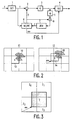
- Fig. 1 shows a hybrid encoder carrying out motion estimation in the transform domain in accordance with the invention.
- the encoder receives a video picture signal in the form of picture blocks X of 8*8 pixels. Each pixel block is transformed by a discrete cosine transform circuit 1 into a block Y of 8*8 DCT coefficients.
- a subtracter 2 the coefficients of a prediction block Y and are subtracted from the corresponding coefficients of block Y to obtain a block of 8*8 difference coefficients.
- the difference coefficients are quantized in a quantizer 3 and the quantized difference coefficients are then encoded into variable-length code words by a variable-length encoder 4.
- the variable-length code words constitute the digital output bitstream of the hybrid encoder. This bitstream is applied to a transmission channel or stored on a storage medium (not shown).
- the quantized difference coefficients are subjected to inverse quantization in an inverse quantizer 5, added to the current prediction block by an adder 6, and written into in a frame memory 7 to update the previously encoded picture stored therein.
- the picture blocks stored in frame memory 6 are denoted Z. Note that they are stored in the transform domain.
- a motion estimator and motion compensator circuit 8 receives the current picture block and searches in the frame memory 7 the prediction block Y and which most resembles said picture block. The position of the prediction block thus found is identified by a motion vector mv which defines the position of the prediction block with respect to the current block position.
- the motion vector mv is applied to the variable-length encoder 4 and is part of the output bitstream.
- FIG. 2 shows two phases of a moving object 10 in the pixel domain.
- a picture segment 11 comprising twelve 8*8 pixel blocks of the picture to be coded and a corresponding picture segment 12 of the previously encoded picture stored in a frame memory are shown.
- Reference numeral 13 denotes an 8*8 pixel block X to be coded and reference numeral 14 denotes the most-resembling prediction block X and in the frame memory.
- the motion vector mv associated with the prediction block X and . Once this motion vector has been found by motion estimation, the prediction block can easily be obtained by reading the relevant pixels of prediction block X and from the frame memory.
- the hybrid decoder shown in Fig. 1 stores the previously encoded picture in the transform domain.
- the prediction block follows from the equation: where H i and W i are transform matrices representing the relative position of the block Y and with respect to the underlying blocks. H i and W i have one of the formats and where I is an identity matrix and 0 is a matrix of zeroes.
- I is an identity matrix
- 0 is a matrix of zeroes.
- motion estimation in the transform domain requires equation (1) to be calculated several times. This requires a large number of multiplications.
- the calculation of each candidate prediction block in accordance with equation (1) is carried out for a restricted number of coefficients only. This reduces the number of multiplications so dramatically that a one-chip MPEG2 encoder operating in the transform domain becomes feasible. Needless to say that this a great step in the field of digital video processing.
- the coefficients to be calculated for the purpose of motion estimation can be fixedly chosen. Preferably, they include the DC coefficient and a few AC coefficients representing lower spatial frequencies. That is because these coefficients are responsible for the majority of bits in the output signal and are thus most worthwhile to be minimized in the difference block (output of subtracter 2 in Fig. 1).
- Figs. 4A-4C show examples of preferred choices. In each example, the upper-left coefficient is the DC coefficient. In Fig. 4A, the coefficients constitute a 3*3 (or any other size) submatrix. In Fig. 4B, the selected coefficients are the first coefficients of a zigzag scanned series. This choice is advantageous in view of already available circuits for zigzag scanning coefficient blocks. In Fig. 4C, the submatrix extends in the horizontal direction. The latter choice benefits from the property that most of the motion found in plain video scenes is horizontal motion.
- the coefficients to be calculated for the purpose of motion estimation are adaptively chosen in dependence upon the candidate motion vectors which are being evaluated. If the candidate motion vectors represent horizontal motion (which in the 3DRS algorithm is the case if substantially horizontal motion has been found previously), a submatrix is chosen which extends in the horizontal direction. Examples thereof are shown in Figs. 5A and 5B. If the candidate motion vectors represent vertical motion, the submatrix extends in the vertical direction as shown in Figs. 5C and 5D. The examples shown in Figs.
- 5B and 5D are particularly advantageous because the calculation on of the coefficients of a single row or column drastically contributes to saving the number of multiplications (8 coefficients constituting a single row can more economically be computed than 8 coefficients constituting a 2*4 submatrix). It is further noted that the AC coefficients chosen are not necessarily contiguous to the DC coefficient. Because small amounts of motion become manifest as higher spatial frequencies in the difference block (output of subtracter 2 in Fig. 1), it may also be advantageous to evaluate AC coefficients representing higher spatial frequencies for small amounts of motion.
- the motion estimation and motion compensation circuit 8 (Fig. 1) will now be described. Because it has to successively carry out a plurality of identical operations each involving a number of calculations, the circuit is preferably implemented as a microprocessor-controlled arithmetic unit.
- the architecture of such a unit is well-known to those skilled in the art and therefore not shown in more detail.
- the processor determines which subset of DCT coefficients are taken into account for the motion estimation process.
- the set may be fixedly chosen (cf. Figs. 4A-4C) or adaptively selected in dependence upon the candidate motion vectors (cf. Figs. 5A-5D).
- the microprocessor selects one of the candidate motion vectors mv k . Then, in a step 22, the processor retrieves the four coefficient blocks underlying the candidate prediction block associated with this motion vector from the frame memory. In accordance with equation (1), said four blocks are denoted Z 1 ..Z 4 .
- a step 23 the relevant coefficients of the candidate prediction block are calculated in accordance with equation (1).
- the coefficients are denoted y and u,v . Note that only the coefficients y and u,v are calculated having an index (u,v) to be taken into account as has been determined in the step 20.
- the microprocessor compares the set of coefficients y and u,v with the corresponding coefficients y u,v of the current input block.
- the result thereof is stored as a resemblance indicator R k for the current candidate motion vector mv k .
- the resemblance indicator is indicative of the mean absolute difference between input block and candidate prediction block in the transform domain: where w u,v is a weighting factor indicating the relative relevance of the respective coefficient.
- the quantizer matrix provides appropriate weighting factors. In a simple embodiment, all weighting factors w u,v may be set to one.
- the motion vector mv k of the best-matching prediction block just found is again selected in a step 30.
- the four underlying blocks Z 1 ..Z 4 are re-read from the frame memory.
- all the coefficients are calculated whereas the step 23 applies to a few coefficients only.
- the candidate prediction blocks have the same size as the underlying previously encoded blocks.
- Some coding standards such as H.263 provide an option ("advanced motion estimation") to transmit a motion vector for each 8*8 block.
- the described embodiment can advantageously be implemented in a hybrid encoder in accordance with such a standard.
- Other coding standards such as MPEG, transmit one motion vector for each macroblock which includes four 8*8 blocks.
- the process of motion estimation and compensation is slightly different, as will now be explained with reference to Fig. 7.
- Fig. 7 shows a (candidate) prediction macroblock 40 comprising four 8*8 blocks Y and 1 - Y and 4 .
- the macroblock now covers nine previously encoded coefficient blocks Z 1 -Z 9 .
- To calculate the coefficients of the macroblock each 8*8 block is individually calculated from its four underlying blocks in accordance with equation (1).
- the motion estimation and compensation process further proceeds as described above with reference to Fig. 6.
- For the purpose of motion compensation all the coefficients (a total of 4*64 in total) are calculated (step 32 ).
- For the purpose of motion estimation only the selected coefficients are calculated (step 23 ), and the corresponding coefficients are taken from the input macroblock for determining the resemblance indicator (step 25 ).
- a hybrid video encoder which carries out motion estimation and compensation (8) in the transform domain.
- the calculation of a prediction block ( Y and ) from previously encoded blocks (Z) stored in the transform-domain frame memory (7) requires a large number of multiplications. This applies particularly to the motion estimation algorithm.
- only a few DCT coefficients of candidate prediction blocks are calculated, for example, the DC coefficient and some AC coefficients.
- the AC coefficients are adaptively selected in dependence upon the motion vector which is being considered. The calculated coefficients of the candidate prediction blocks and the corresponding coefficients of the current input picture block (Y) are then compared to identify the best-matching prediction block.
Landscapes
- Engineering & Computer Science (AREA)
- Multimedia (AREA)
- Signal Processing (AREA)
- Compression Or Coding Systems Of Tv Signals (AREA)
- Compression, Expansion, Code Conversion, And Decoders (AREA)
Claims (7)
- Verfahren zum Codieren von Videobildern, wobei dieses Verfahren die nachfolgenden Verfahrensschritte umfasst: das Umformen (1) von Bildblöcken eines Videobildes zu Transformationskoeffizienten und das Codieren (2 - 8) der Differenz (2) zwischen den Transformationskoeffizienten jedes transformierten Bildblocks (Y) und den entsprechenden Transformationskoeffizienten eines Prädiktionsblocks (Y and1), was dadurch erhalten wird, dass einem vorher codierten Bild Bewegungsschätzung (8) zugeführt wird, wobei die Bewegungsschätzung die nachfolgenden Verfahrensschritte umfasst:das Berechnen (23) einer Anzahl Kandidat-Prädiktionsblöcke,das Vergleichen (24) jedes Kandidat-Prädiktionsblocks mit dem transformierten Bildblock, unddas Selektieren (26) eines der Kandidat-Prädiktionsblöcke als Prädiktionsblock, wobei die Schritte der Berechnung (23) eines Kandidat-Prädiktionsblocks und der Vergleichung (24) des Kandidat-Prädiktionsblocks mit dem transformierten Bildblock für einen Teilsatz der Transformationskoeffizienten des genannten Kandidat-Prädiktiönsblocks und des transformierten Bildblocks durchgeführt wird, dadurch gekennzeichnet, dass der Teilsatz von Transformationskoeffizienten adaptiv gewählt worden ist, und zwar in Abhängigkeit von einem Kandidat-Bewegungsvektor, der mit dem Kandidat-Prädiktionsblock assoziiert ist.
- Verfahren nach Anspruch 1, wobei der Teilsatz von Transformationskoeffizienten den DC-Koeffizienten und eine vorbestimmte Anzahl AC-Koeffizienten umfasst.
- Verfahren nach Anspruch 1, wobei der Teilsatz von Transformationskoeffizienten die ersten N Koeffizienten der ersten M Reihen des Kandidat-Prädiktionsblocks enthalten, wobei N und M in Abhängigkeit von dem horizontalen bzw. vertikalen Anteil des Kandidat-Bewegungsvektors gewählt werden.
- Verfahren nach Anspruch 3, wobei N = 1 ist für Kandidat-Bewegungsvektoren mit einem im Wesentlichen vertikalen Anteil und wobei M = 1 ist für Kandidat-Bewegungsvektoren mit einem im Wesentlichen horizontalen Anteil.
- Verfahren nach Anspruch 1, wobei der genannte Schritt des Vergleichens (24) jedes Kandidat-Prädiktionsblocks mit dem transformierten Prädiktionsblock das Vergleichen räumlich entsprechender Koeffizienten umfasst, wobei vorbestimmte Gewichtungsfaktoren (wu,v) zu den genannten räumlich entsprechenden Koeffizienten hinzugefügt werden.
- Verfahren nach Anspruch 1, wobei die Kandidat-Prädiktionsblöcke entsprechend dem 3-dimensionalen rekursiven Blockdeckungsalgorithmus gewählt werden.
- Hybrides Video-Codierer auf Blockbasis mit einer Transformations-Codierschaltung (1) zum Transformieren von Bildblöcken eines Video-Bildes in Transformationskoeffizienten und mit einem prädiktiven Codierer (2-8) zum Codieren der Differenz (2) zwischen jedem transformierten Bildblock (Y) und einem Prädiktionsblock (Y and2 ), der dadurch erhalten wird, dass einem vorher codierten Bild (Z) Bewegungsschätzung (8) zugefügt wird, wobei der prädiktive Codierer einen Bewegungsschätzer (8) umfasst, der zu den nachfolgenden Zwecken vorgesehen ist:das Berechnen (23) einer Anzahl Kandidat-Prädiktionsblöcke,das Vergleichen (24) jedes Kandidat-Prädiktionsblocks mit dem transformierten Bildblock, unddas Selektieren (26) eines der Kandidat-Prädiktionsblöcke als Prädiktionsblock, wobei der Bewegungsschätzer vorgesehen ist zum Durchführen der genannten Berechnung (23) des Kandidat-Prädiktionsblocks und zum Vergleichen (24) des Kandidat-Prädiktionsblocks mit dem transformierten Bildblock für einen Teilsatz von Transformationskoeffizienten des genannten Kandidat-Prädiktionsblocks und des transformierten Bildblocks, dadurch gekennzeichnet, dass der Bewegungsschätzer weiterhin vorgesehen ist zum adaptiven Wählen des Teilsatzes von Transformationskoeffizienten in Abhängigkeit von einem Kandidat-Bewegungsvektor, der mit dem Kandidat-Prädiktionsblock assoziiert ist.
Priority Applications (1)
| Application Number | Priority Date | Filing Date | Title |
|---|---|---|---|
| EP99900596A EP0976251B1 (de) | 1998-02-13 | 1999-01-28 | Verfahren und vorrichtung zur videokodierung |
Applications Claiming Priority (4)
| Application Number | Priority Date | Filing Date | Title |
|---|---|---|---|
| EP98200449 | 1998-02-13 | ||
| EP98200449 | 1998-02-13 | ||
| EP99900596A EP0976251B1 (de) | 1998-02-13 | 1999-01-28 | Verfahren und vorrichtung zur videokodierung |
| PCT/IB1999/000151 WO1999041912A2 (en) | 1998-02-13 | 1999-01-28 | Method and arrangement for video coding |
Publications (2)
| Publication Number | Publication Date |
|---|---|
| EP0976251A2 EP0976251A2 (de) | 2000-02-02 |
| EP0976251B1 true EP0976251B1 (de) | 2002-05-22 |
Family
ID=8233387
Family Applications (1)
| Application Number | Title | Priority Date | Filing Date |
|---|---|---|---|
| EP99900596A Expired - Lifetime EP0976251B1 (de) | 1998-02-13 | 1999-01-28 | Verfahren und vorrichtung zur videokodierung |
Country Status (7)
| Country | Link |
|---|---|
| US (1) | US6498815B2 (de) |
| EP (1) | EP0976251B1 (de) |
| JP (1) | JP2001520846A (de) |
| KR (1) | KR100584495B1 (de) |
| CN (1) | CN1166215C (de) |
| DE (1) | DE69901525T2 (de) |
| WO (1) | WO1999041912A2 (de) |
Families Citing this family (36)
| Publication number | Priority date | Publication date | Assignee | Title |
|---|---|---|---|---|
| US6128047A (en) * | 1998-05-20 | 2000-10-03 | Sony Corporation | Motion estimation process and system using sparse search block-matching and integral projection |
| US6697427B1 (en) * | 1998-11-03 | 2004-02-24 | Pts Corporation | Methods and apparatus for improved motion estimation for video encoding |
| WO2000034920A1 (en) * | 1998-12-07 | 2000-06-15 | Koninklijke Philips Electronics N.V. | Motion vector estimation |
| US6741648B2 (en) * | 2000-11-10 | 2004-05-25 | Nokia Corporation | Apparatus, and associated method, for selecting an encoding rate by which to encode video frames of a video sequence |
| FI109634B (fi) * | 2001-02-16 | 2002-09-13 | Hantro Products Oy | Menetelmä ja laite videokuvan koodaamiseksi |
| KR100490395B1 (ko) * | 2001-10-29 | 2005-05-17 | 삼성전자주식회사 | 움직임 벡터 추정 방법 및 이에 적합한 장치 |
| FI110745B (fi) * | 2001-11-13 | 2003-03-14 | Hantro Products Oy | Menetelmä ja laite peräkkäisten kuvien koodaamiseksi |
| US7742525B1 (en) * | 2002-07-14 | 2010-06-22 | Apple Inc. | Adaptive motion estimation |
| EP1480170A1 (de) * | 2003-05-20 | 2004-11-24 | Mitsubishi Electric Information Technology Centre Europe B.V. | Verfahren und Gerät zur Bildverarbeitung |
| US8111752B2 (en) | 2004-06-27 | 2012-02-07 | Apple Inc. | Encoding mode pruning during video encoding |
| US7792188B2 (en) | 2004-06-27 | 2010-09-07 | Apple Inc. | Selecting encoding types and predictive modes for encoding video data |
| US20050286777A1 (en) * | 2004-06-27 | 2005-12-29 | Roger Kumar | Encoding and decoding images |
| US7593465B2 (en) * | 2004-09-27 | 2009-09-22 | Lsi Corporation | Method for video coding artifacts concealment |
| KR100694093B1 (ko) * | 2005-02-18 | 2007-03-12 | 삼성전자주식회사 | 영상 블럭의 계수 예측 장치 및 그 방법 |
| US7924316B2 (en) | 2007-03-14 | 2011-04-12 | Aptina Imaging Corporation | Image feature identification and motion compensation apparatus, systems, and methods |
| US7920746B2 (en) | 2007-04-23 | 2011-04-05 | Aptina Imaging Corporation | Compressed domain image summation apparatus, systems, and methods |
| US8488684B2 (en) * | 2008-09-17 | 2013-07-16 | Qualcomm Incorporated | Methods and systems for hybrid MIMO decoding |
| KR101675116B1 (ko) | 2009-08-06 | 2016-11-10 | 삼성전자 주식회사 | 영상의 부호화 방법 및 장치, 그 복호화 방법 및 장치 |
| US9078009B2 (en) | 2010-02-19 | 2015-07-07 | Skype | Data compression for video utilizing non-translational motion information |
| US9819358B2 (en) | 2010-02-19 | 2017-11-14 | Skype | Entropy encoding based on observed frequency |
| US9609342B2 (en) | 2010-02-19 | 2017-03-28 | Skype | Compression for frames of a video signal using selected candidate blocks |
| US8913661B2 (en) * | 2010-02-19 | 2014-12-16 | Skype | Motion estimation using block matching indexing |
| US9313526B2 (en) | 2010-02-19 | 2016-04-12 | Skype | Data compression for video |
| GB2487200A (en) | 2011-01-12 | 2012-07-18 | Canon Kk | Video encoding and decoding with improved error resilience |
| US8891626B1 (en) | 2011-04-05 | 2014-11-18 | Google Inc. | Center of motion for encoding motion fields |
| GB2491589B (en) | 2011-06-06 | 2015-12-16 | Canon Kk | Method and device for encoding a sequence of images and method and device for decoding a sequence of image |
| CN106686378B (zh) * | 2011-06-14 | 2019-10-08 | 三星电子株式会社 | 对图像进行解码的方法和设备 |
| WO2013006386A1 (en) | 2011-07-01 | 2013-01-10 | General Instrument Corporation | Motion vector prediction design simplification |
| US9185428B2 (en) | 2011-11-04 | 2015-11-10 | Google Technology Holdings LLC | Motion vector scaling for non-uniform motion vector grid |
| US10284851B2 (en) * | 2012-01-21 | 2019-05-07 | Google Technology Holdings LLC | Method of determining binary codewords for transform coefficients |
| US8908767B1 (en) | 2012-02-09 | 2014-12-09 | Google Inc. | Temporal motion vector prediction |
| US9172970B1 (en) | 2012-05-29 | 2015-10-27 | Google Inc. | Inter frame candidate selection for a video encoder |
| US11317101B2 (en) | 2012-06-12 | 2022-04-26 | Google Inc. | Inter frame candidate selection for a video encoder |
| US9503746B2 (en) | 2012-10-08 | 2016-11-22 | Google Inc. | Determine reference motion vectors |
| US9485515B2 (en) | 2013-08-23 | 2016-11-01 | Google Inc. | Video coding using reference motion vectors |
| US9313493B1 (en) | 2013-06-27 | 2016-04-12 | Google Inc. | Advanced motion estimation |
Family Cites Families (10)
| Publication number | Priority date | Publication date | Assignee | Title |
|---|---|---|---|---|
| US4245248A (en) * | 1979-04-04 | 1981-01-13 | Bell Telephone Laboratories, Incorporated | Motion estimation and encoding of video signals in the transform domain |
| US4704628A (en) * | 1986-07-16 | 1987-11-03 | Compression Labs, Inc. | Combined intraframe and interframe transform coding system |
| SE457402B (sv) * | 1987-02-20 | 1988-12-19 | Harald Brusewitz | Foerfarande och anordning foer kodning och avkodning av bildinformation |
| US5072293A (en) | 1989-08-29 | 1991-12-10 | U.S. Philips Corporation | Method of estimating motion in a picture signal |
| DE4118571A1 (de) * | 1991-06-06 | 1992-12-10 | Philips Patentverwaltung | Vorrichtung zur steuerung des quantisierers eines hybrid-kodierers |
| US5408274A (en) * | 1993-03-11 | 1995-04-18 | The Regents Of The University Of California | Method and apparatus for compositing compressed video data |
| US5712809A (en) * | 1994-10-31 | 1998-01-27 | Vivo Software, Inc. | Method and apparatus for performing fast reduced coefficient discrete cosine transforms |
| PL181416B1 (pl) * | 1995-09-12 | 2001-07-31 | Philips Electronics Nv | i modelowego kodowania sygnalów obrazu oraz sposób i urzadzenie do mieszanego, konturowego i modelowego dekodowania sygnalów obrazu PL |
| US5790686A (en) * | 1995-09-19 | 1998-08-04 | University Of Maryland At College Park | DCT-based motion estimation method |
| CN1190084C (zh) * | 1997-11-14 | 2005-02-16 | 安特昂公司 | 压缩视频信息的装置及其方法 |
-
1999
- 1999-01-28 EP EP99900596A patent/EP0976251B1/de not_active Expired - Lifetime
- 1999-01-28 JP JP54124199A patent/JP2001520846A/ja not_active Ceased
- 1999-01-28 CN CNB998001287A patent/CN1166215C/zh not_active Expired - Fee Related
- 1999-01-28 WO PCT/IB1999/000151 patent/WO1999041912A2/en not_active Ceased
- 1999-01-28 KR KR1019997009376A patent/KR100584495B1/ko not_active Expired - Fee Related
- 1999-01-28 DE DE69901525T patent/DE69901525T2/de not_active Expired - Fee Related
- 1999-02-05 US US09/246,663 patent/US6498815B2/en not_active Expired - Fee Related
Also Published As
| Publication number | Publication date |
|---|---|
| DE69901525T2 (de) | 2003-01-09 |
| EP0976251A2 (de) | 2000-02-02 |
| WO1999041912A3 (en) | 1999-11-11 |
| US20020085630A1 (en) | 2002-07-04 |
| DE69901525D1 (de) | 2002-06-27 |
| CN1166215C (zh) | 2004-09-08 |
| KR20010006292A (ko) | 2001-01-26 |
| KR100584495B1 (ko) | 2006-06-02 |
| WO1999041912A2 (en) | 1999-08-19 |
| CN1256049A (zh) | 2000-06-07 |
| US6498815B2 (en) | 2002-12-24 |
| JP2001520846A (ja) | 2001-10-30 |
Similar Documents
| Publication | Publication Date | Title |
|---|---|---|
| EP0976251B1 (de) | Verfahren und vorrichtung zur videokodierung | |
| US6289049B1 (en) | Method for coding motion vector in moving picture | |
| US8023562B2 (en) | Real-time video coding/decoding | |
| EP0637894B1 (de) | Vorrichtung und Verfahren zur Detektion von Bewegungsvektoren mit Halbpixelgenauigkeit | |
| KR950009699B1 (ko) | 움직임벡터 검출방법 및 장치 | |
| JP2636622B2 (ja) | ビデオ信号の符号化方法及び復号化方法ならびにビデオ信号の符号化装置及び復号化装置 | |
| US5786856A (en) | Method for adaptive quantization by multiplication of luminance pixel blocks by a modified, frequency ordered hadamard matrix | |
| US20030156646A1 (en) | Multi-resolution motion estimation and compensation | |
| US5532747A (en) | Method for effectuating half-pixel motion compensation in decoding an image signal | |
| KR100643819B1 (ko) | 페이딩 보정을 위한 파라미터화 | |
| JPH0955945A (ja) | 動きベクトル特定方法及び装置 | |
| US20060008008A1 (en) | Method of multi-resolution based motion estimation and recording medium storing program to implement the method | |
| US20030206593A1 (en) | Fading estimation/compensation | |
| CN101779463A (zh) | 用于处理图像的方法以及相应的电子设备 | |
| US5689312A (en) | Block matching motion estimation method | |
| KR100878536B1 (ko) | 영상 보간 방법 및 장치 | |
| US20070076964A1 (en) | Method of and an apparatus for predicting DC coefficient in transform domain | |
| US20040179604A1 (en) | Motion vector selection based on a preferred point | |
| US6038345A (en) | Apparatus for encoding/decoding image data | |
| JPH05308662A (ja) | 高能率符号化装置 | |
| KR100617177B1 (ko) | 움직임 추정 방법 | |
| JP2000513914A (ja) | ディジタル画像を符号化および復号化する方法および装置 | |
| CN120202672A (zh) | 视频编码和解码装置及方法 | |
| WO2005006767A1 (en) | Simplified motion estimation method | |
| HK1060243B (en) | Video encoding method with fading compensation |
Legal Events
| Date | Code | Title | Description |
|---|---|---|---|
| PUAI | Public reference made under article 153(3) epc to a published international application that has entered the european phase |
Free format text: ORIGINAL CODE: 0009012 |
|
| 17P | Request for examination filed |
Effective date: 19991115 |
|
| AK | Designated contracting states |
Kind code of ref document: A2 Designated state(s): DE FR GB |
|
| 17Q | First examination report despatched |
Effective date: 20000626 |
|
| GRAG | Despatch of communication of intention to grant |
Free format text: ORIGINAL CODE: EPIDOS AGRA |
|
| GRAG | Despatch of communication of intention to grant |
Free format text: ORIGINAL CODE: EPIDOS AGRA |
|
| GRAH | Despatch of communication of intention to grant a patent |
Free format text: ORIGINAL CODE: EPIDOS IGRA |
|
| GRAH | Despatch of communication of intention to grant a patent |
Free format text: ORIGINAL CODE: EPIDOS IGRA |
|
| GRAA | (expected) grant |
Free format text: ORIGINAL CODE: 0009210 |
|
| REG | Reference to a national code |
Ref country code: GB Ref legal event code: FG4D |
|
| REF | Corresponds to: |
Ref document number: 69901525 Country of ref document: DE Date of ref document: 20020627 |
|
| ET | Fr: translation filed | ||
| PLBE | No opposition filed within time limit |
Free format text: ORIGINAL CODE: 0009261 |
|
| 26N | No opposition filed |
Effective date: 20030225 |
|
| PGFP | Annual fee paid to national office [announced via postgrant information from national office to epo] |
Ref country code: DE Payment date: 20080312 Year of fee payment: 10 |
|
| PGFP | Annual fee paid to national office [announced via postgrant information from national office to epo] |
Ref country code: FR Payment date: 20080418 Year of fee payment: 10 |
|
| PGFP | Annual fee paid to national office [announced via postgrant information from national office to epo] |
Ref country code: GB Payment date: 20080425 Year of fee payment: 10 |
|
| GBPC | Gb: european patent ceased through non-payment of renewal fee |
Effective date: 20090128 |
|
| PG25 | Lapsed in a contracting state [announced via postgrant information from national office to epo] |
Ref country code: DE Free format text: LAPSE BECAUSE OF NON-PAYMENT OF DUE FEES Effective date: 20090801 |
|
| REG | Reference to a national code |
Ref country code: FR Ref legal event code: ST Effective date: 20091030 |
|
| PG25 | Lapsed in a contracting state [announced via postgrant information from national office to epo] |
Ref country code: GB Free format text: LAPSE BECAUSE OF NON-PAYMENT OF DUE FEES Effective date: 20090128 |
|
| PG25 | Lapsed in a contracting state [announced via postgrant information from national office to epo] |
Ref country code: FR Free format text: LAPSE BECAUSE OF NON-PAYMENT OF DUE FEES Effective date: 20090202 |