EP0976768B1 - Polyméres hyperramifiés avec des groupes oxazolines, procédé de leur préparation et leur usage - Google Patents
Polyméres hyperramifiés avec des groupes oxazolines, procédé de leur préparation et leur usage Download PDFInfo
- Publication number
- EP0976768B1 EP0976768B1 EP99113904A EP99113904A EP0976768B1 EP 0976768 B1 EP0976768 B1 EP 0976768B1 EP 99113904 A EP99113904 A EP 99113904A EP 99113904 A EP99113904 A EP 99113904A EP 0976768 B1 EP0976768 B1 EP 0976768B1
- Authority
- EP
- European Patent Office
- Prior art keywords
- formula
- sum
- polymers
- oxazoline
- highly branched
- Prior art date
- Legal status (The legal status is an assumption and is not a legal conclusion. Google has not performed a legal analysis and makes no representation as to the accuracy of the status listed.)
- Expired - Lifetime
Links
- 125000003504 2-oxazolinyl group Chemical group O1C(=NCC1)* 0.000 title claims abstract description 26
- 238000000034 method Methods 0.000 title claims description 8
- 230000008569 process Effects 0.000 title claims description 8
- 238000002360 preparation method Methods 0.000 title abstract description 3
- 229920000587 hyperbranched polymer Polymers 0.000 title 1
- 229920000642 polymer Polymers 0.000 claims abstract description 58
- 239000000178 monomer Substances 0.000 claims abstract description 20
- 125000003118 aryl group Chemical group 0.000 claims abstract description 8
- IMSODMZESSGVBE-UHFFFAOYSA-N 2-Oxazoline Chemical group C1CN=CO1 IMSODMZESSGVBE-UHFFFAOYSA-N 0.000 claims abstract description 7
- 229910052799 carbon Inorganic materials 0.000 claims abstract description 7
- 125000004432 carbon atom Chemical group C* 0.000 claims abstract description 7
- 125000003710 aryl alkyl group Chemical group 0.000 claims abstract description 3
- 125000005842 heteroatom Chemical group 0.000 claims abstract description 3
- 239000012442 inert solvent Substances 0.000 claims abstract description 3
- 239000000126 substance Substances 0.000 claims abstract description 3
- IJGRMHOSHXDMSA-UHFFFAOYSA-N Atomic nitrogen Chemical compound N#N IJGRMHOSHXDMSA-UHFFFAOYSA-N 0.000 claims description 27
- 238000006243 chemical reaction Methods 0.000 claims description 27
- 229910052757 nitrogen Inorganic materials 0.000 claims description 14
- 125000002843 carboxylic acid group Chemical group 0.000 claims description 6
- 238000004519 manufacturing process Methods 0.000 claims description 6
- 125000004430 oxygen atom Chemical group O* 0.000 claims description 6
- 229920002959 polymer blend Polymers 0.000 claims description 6
- 239000002904 solvent Substances 0.000 claims description 6
- 125000003277 amino group Chemical group 0.000 claims description 4
- 239000000203 mixture Substances 0.000 claims description 4
- 125000002887 hydroxy group Chemical group [H]O* 0.000 claims description 3
- 239000000654 additive Substances 0.000 claims description 2
- 239000003054 catalyst Substances 0.000 claims description 2
- 239000003431 cross linking reagent Substances 0.000 claims description 2
- 239000011261 inert gas Substances 0.000 claims description 2
- 125000001424 substituent group Chemical group 0.000 claims description 2
- NINIDFKCEFEMDL-UHFFFAOYSA-N Sulfur Chemical group [S] NINIDFKCEFEMDL-UHFFFAOYSA-N 0.000 claims 2
- 239000005864 Sulphur Substances 0.000 claims 1
- 230000000996 additive effect Effects 0.000 claims 1
- 238000009835 boiling Methods 0.000 claims 1
- 125000003396 thiol group Chemical group [H]S* 0.000 claims 1
- 150000003573 thiols Chemical class 0.000 abstract description 6
- 150000001732 carboxylic acid derivatives Chemical group 0.000 abstract description 5
- 239000007787 solid Substances 0.000 abstract description 4
- 150000001408 amides Chemical group 0.000 abstract description 2
- 150000002148 esters Chemical group 0.000 abstract description 2
- 229910052717 sulfur Inorganic materials 0.000 abstract description 2
- 238000010438 heat treatment Methods 0.000 abstract 1
- 125000004433 nitrogen atom Chemical group N* 0.000 abstract 1
- 229910052760 oxygen Inorganic materials 0.000 abstract 1
- 125000002924 primary amino group Chemical group [H]N([H])* 0.000 abstract 1
- IAZDPXIOMUYVGZ-UHFFFAOYSA-N Dimethylsulphoxide Chemical compound CS(C)=O IAZDPXIOMUYVGZ-UHFFFAOYSA-N 0.000 description 14
- 229920002614 Polyether block amide Polymers 0.000 description 12
- 238000005481 NMR spectroscopy Methods 0.000 description 10
- 229920002521 macromolecule Polymers 0.000 description 10
- 229920006149 polyester-amide block copolymer Polymers 0.000 description 10
- OKKJLVBELUTLKV-UHFFFAOYSA-N Methanol Chemical compound OC OKKJLVBELUTLKV-UHFFFAOYSA-N 0.000 description 9
- 150000001875 compounds Chemical class 0.000 description 9
- KWGKDLIKAYFUFQ-UHFFFAOYSA-M lithium chloride Chemical compound [Li+].[Cl-] KWGKDLIKAYFUFQ-UHFFFAOYSA-M 0.000 description 8
- 239000002253 acid Substances 0.000 description 7
- ZMANZCXQSJIPKH-UHFFFAOYSA-N Triethylamine Chemical compound CCN(CC)CC ZMANZCXQSJIPKH-UHFFFAOYSA-N 0.000 description 6
- 230000015572 biosynthetic process Effects 0.000 description 6
- 230000009477 glass transition Effects 0.000 description 6
- 150000000376 2-oxazolines Chemical class 0.000 description 5
- 238000006068 polycondensation reaction Methods 0.000 description 5
- 238000003786 synthesis reaction Methods 0.000 description 5
- ZWXPDGCFMMFNRW-UHFFFAOYSA-N N-methylcaprolactam Chemical compound CN1CCCCCC1=O ZWXPDGCFMMFNRW-UHFFFAOYSA-N 0.000 description 4
- YWEUIGNSBFLMFL-UHFFFAOYSA-N diphosphonate Chemical compound O=P(=O)OP(=O)=O YWEUIGNSBFLMFL-UHFFFAOYSA-N 0.000 description 4
- DLYUQMMRRRQYAE-UHFFFAOYSA-N phosphorus pentoxide Inorganic materials O1P(O2)(=O)OP3(=O)OP1(=O)OP2(=O)O3 DLYUQMMRRRQYAE-UHFFFAOYSA-N 0.000 description 4
- -1 polyesteramides Chemical class 0.000 description 4
- 239000002244 precipitate Substances 0.000 description 4
- FYSNRJHAOHDILO-UHFFFAOYSA-N thionyl chloride Chemical compound ClS(Cl)=O FYSNRJHAOHDILO-UHFFFAOYSA-N 0.000 description 4
- XLYOFNOQVPJJNP-UHFFFAOYSA-N water Substances O XLYOFNOQVPJJNP-UHFFFAOYSA-N 0.000 description 4
- VHUUJNOGGSRIEV-UHFFFAOYSA-N 5-(4,5-dihydro-1,3-oxazol-2-yl)benzene-1,3-diol Chemical compound OC1=CC(O)=CC(C=2OCCN=2)=C1 VHUUJNOGGSRIEV-UHFFFAOYSA-N 0.000 description 3
- ISWSIDIOOBJBQZ-UHFFFAOYSA-N Phenol Chemical compound OC1=CC=CC=C1 ISWSIDIOOBJBQZ-UHFFFAOYSA-N 0.000 description 3
- 150000007513 acids Chemical class 0.000 description 3
- 238000007259 addition reaction Methods 0.000 description 3
- 239000006227 byproduct Substances 0.000 description 3
- 125000003178 carboxy group Chemical group [H]OC(*)=O 0.000 description 3
- 238000002474 experimental method Methods 0.000 description 3
- 238000003919 heteronuclear multiple bond coherence Methods 0.000 description 3
- 238000003929 heteronuclear multiple quantum coherence Methods 0.000 description 3
- 239000000047 product Substances 0.000 description 3
- HXJUTPCZVOIRIF-UHFFFAOYSA-N sulfolane Chemical compound O=S1(=O)CCCC1 HXJUTPCZVOIRIF-UHFFFAOYSA-N 0.000 description 3
- 230000004580 weight loss Effects 0.000 description 3
- HZAXFHJVJLSVMW-UHFFFAOYSA-N 2-Aminoethan-1-ol Chemical compound NCCO HZAXFHJVJLSVMW-UHFFFAOYSA-N 0.000 description 2
- ONRREFWJTRBDRA-UHFFFAOYSA-N 2-chloroethanamine;hydron;chloride Chemical compound [Cl-].[NH3+]CCCl ONRREFWJTRBDRA-UHFFFAOYSA-N 0.000 description 2
- GLCRQDNELKROCZ-UHFFFAOYSA-N 5-(4,5-dihydro-1,3-oxazol-2-yl)benzene-1,3-dicarboxylic acid Chemical compound OC(=O)C1=CC(C(O)=O)=CC(C=2OCCN=2)=C1 GLCRQDNELKROCZ-UHFFFAOYSA-N 0.000 description 2
- 238000005033 Fourier transform infrared spectroscopy Methods 0.000 description 2
- 239000004952 Polyamide Substances 0.000 description 2
- 238000001210 attenuated total reflectance infrared spectroscopy Methods 0.000 description 2
- 230000008901 benefit Effects 0.000 description 2
- 244000309464 bull Species 0.000 description 2
- 238000010538 cationic polymerization reaction Methods 0.000 description 2
- 238000009833 condensation Methods 0.000 description 2
- 230000005494 condensation Effects 0.000 description 2
- 229920006037 cross link polymer Polymers 0.000 description 2
- 238000004132 cross linking Methods 0.000 description 2
- 125000004185 ester group Chemical group 0.000 description 2
- 125000000524 functional group Chemical group 0.000 description 2
- 238000011835 investigation Methods 0.000 description 2
- 238000002844 melting Methods 0.000 description 2
- 230000008018 melting Effects 0.000 description 2
- 150000002989 phenols Chemical class 0.000 description 2
- 229920002647 polyamide Polymers 0.000 description 2
- 229920000728 polyester Polymers 0.000 description 2
- 238000006116 polymerization reaction Methods 0.000 description 2
- 239000002516 radical scavenger Substances 0.000 description 2
- 238000007363 ring formation reaction Methods 0.000 description 2
- 238000007127 saponification reaction Methods 0.000 description 2
- 238000007086 side reaction Methods 0.000 description 2
- 238000012360 testing method Methods 0.000 description 2
- KQXQANAJPYJWBQ-UHFFFAOYSA-N CC1=C(C(=C(C=C1C(=O)Cl)C(=O)Cl)C)C(=O)Cl Chemical compound CC1=C(C(=C(C=C1C(=O)Cl)C(=O)Cl)C)C(=O)Cl KQXQANAJPYJWBQ-UHFFFAOYSA-N 0.000 description 1
- KXDHJXZQYSOELW-UHFFFAOYSA-N Carbamic acid Chemical class NC(O)=O KXDHJXZQYSOELW-UHFFFAOYSA-N 0.000 description 1
- 239000004970 Chain extender Substances 0.000 description 1
- 239000004971 Cross linker Substances 0.000 description 1
- OAKJQQAXSVQMHS-UHFFFAOYSA-N Hydrazine Chemical class NN OAKJQQAXSVQMHS-UHFFFAOYSA-N 0.000 description 1
- 125000005907 alkyl ester group Chemical group 0.000 description 1
- 150000001412 amines Chemical class 0.000 description 1
- BVKZGUZCCUSVTD-UHFFFAOYSA-N carbonic acid Chemical class OC(O)=O BVKZGUZCCUSVTD-UHFFFAOYSA-N 0.000 description 1
- 125000006297 carbonyl amino group Chemical group [H]N([*:2])C([*:1])=O 0.000 description 1
- 150000001735 carboxylic acids Chemical class 0.000 description 1
- 125000002091 cationic group Chemical group 0.000 description 1
- 150000001805 chlorine compounds Chemical class 0.000 description 1
- 239000008199 coating composition Substances 0.000 description 1
- 238000010276 construction Methods 0.000 description 1
- 238000007334 copolymerization reaction Methods 0.000 description 1
- DOSDTCPDBPRFHQ-UHFFFAOYSA-N dimethyl 5-hydroxybenzene-1,3-dicarboxylate Chemical compound COC(=O)C1=CC(O)=CC(C(=O)OC)=C1 DOSDTCPDBPRFHQ-UHFFFAOYSA-N 0.000 description 1
- 238000004821 distillation Methods 0.000 description 1
- 239000012039 electrophile Substances 0.000 description 1
- RTZKZFJDLAIYFH-UHFFFAOYSA-N ether Substances CCOCC RTZKZFJDLAIYFH-UHFFFAOYSA-N 0.000 description 1
- 239000000835 fiber Substances 0.000 description 1
- 239000011521 glass Substances 0.000 description 1
- 239000000463 material Substances 0.000 description 1
- 229910052751 metal Inorganic materials 0.000 description 1
- 239000002184 metal Substances 0.000 description 1
- RNVFYQUEEMZKLR-UHFFFAOYSA-N methyl 3,5-dihydroxybenzoate Chemical compound COC(=O)C1=CC(O)=CC(O)=C1 RNVFYQUEEMZKLR-UHFFFAOYSA-N 0.000 description 1
- 125000002496 methyl group Chemical group [H]C([H])([H])* 0.000 description 1
- 230000004048 modification Effects 0.000 description 1
- 238000012986 modification Methods 0.000 description 1
- 238000006011 modification reaction Methods 0.000 description 1
- QJGQUHMNIGDVPM-UHFFFAOYSA-N nitrogen group Chemical group [N] QJGQUHMNIGDVPM-UHFFFAOYSA-N 0.000 description 1
- 239000012038 nucleophile Substances 0.000 description 1
- 230000000269 nucleophilic effect Effects 0.000 description 1
- 150000002918 oxazolines Chemical class 0.000 description 1
- 239000005011 phenolic resin Substances 0.000 description 1
- 229920001568 phenolic resin Polymers 0.000 description 1
- 229920000570 polyether Polymers 0.000 description 1
- 229920002635 polyurethane Polymers 0.000 description 1
- 239000004814 polyurethane Substances 0.000 description 1
- 239000000843 powder Substances 0.000 description 1
- 238000001556 precipitation Methods 0.000 description 1
- 238000010526 radical polymerization reaction Methods 0.000 description 1
- 230000009467 reduction Effects 0.000 description 1
- 229920005989 resin Polymers 0.000 description 1
- 239000011347 resin Substances 0.000 description 1
- 238000007151 ring opening polymerisation reaction Methods 0.000 description 1
- 238000007142 ring opening reaction Methods 0.000 description 1
- 239000007858 starting material Substances 0.000 description 1
- PXQLVRUNWNTZOS-UHFFFAOYSA-N sulfanyl Chemical class [SH] PXQLVRUNWNTZOS-UHFFFAOYSA-N 0.000 description 1
- 125000004434 sulfur atom Chemical group 0.000 description 1
- 238000012719 thermal polymerization Methods 0.000 description 1
Classifications
-
- C—CHEMISTRY; METALLURGY
- C08—ORGANIC MACROMOLECULAR COMPOUNDS; THEIR PREPARATION OR CHEMICAL WORKING-UP; COMPOSITIONS BASED THEREON
- C08G—MACROMOLECULAR COMPOUNDS OBTAINED OTHERWISE THAN BY REACTIONS ONLY INVOLVING UNSATURATED CARBON-TO-CARBON BONDS
- C08G83/00—Macromolecular compounds not provided for in groups C08G2/00 - C08G81/00
- C08G83/002—Dendritic macromolecules
- C08G83/003—Dendrimers
-
- C—CHEMISTRY; METALLURGY
- C08—ORGANIC MACROMOLECULAR COMPOUNDS; THEIR PREPARATION OR CHEMICAL WORKING-UP; COMPOSITIONS BASED THEREON
- C08F—MACROMOLECULAR COMPOUNDS OBTAINED BY REACTIONS ONLY INVOLVING CARBON-TO-CARBON UNSATURATED BONDS
- C08F20/00—Homopolymers and copolymers of compounds having one or more unsaturated aliphatic radicals, each having only one carbon-to-carbon double bond, and only one being terminated by only one carboxyl radical or a salt, anhydride, ester, amide, imide or nitrile thereof
- C08F20/02—Monocarboxylic acids having less than ten carbon atoms, Derivatives thereof
- C08F20/10—Esters
- C08F20/34—Esters containing nitrogen, e.g. N,N-dimethylaminoethyl (meth)acrylate
- C08F20/36—Esters containing nitrogen, e.g. N,N-dimethylaminoethyl (meth)acrylate containing oxygen in addition to the carboxy oxygen, e.g. 2-N-morpholinoethyl (meth)acrylate or 2-isocyanatoethyl (meth)acrylate
-
- C—CHEMISTRY; METALLURGY
- C08—ORGANIC MACROMOLECULAR COMPOUNDS; THEIR PREPARATION OR CHEMICAL WORKING-UP; COMPOSITIONS BASED THEREON
- C08G—MACROMOLECULAR COMPOUNDS OBTAINED OTHERWISE THAN BY REACTIONS ONLY INVOLVING UNSATURATED CARBON-TO-CARBON BONDS
- C08G69/00—Macromolecular compounds obtained by reactions forming a carboxylic amide link in the main chain of the macromolecule
- C08G69/40—Polyamides containing oxygen in the form of ether groups
Definitions
- the invention relates to the field of chemistry, in particular Polymer chemistry and relates to highly branched polymers bearing oxazoline groups for example as blend components, as a compatibilizer in polymer blends or as Crosslinkers can be used in polymers or polymer blends.
- Highly branched polymers also called “hyperbranched” polymers, can be produced by different reactions. Polycondensation reactions have become very important (DA Tomalia, HD Durst, Top. Curr. Chem. 165 , 194 (1993); A. Kumar, S. Ramakrishnan, J. Chem. Soc. Commun . 1453 (1993); F. Chu , CJ Hawker, Polym. Bull . 30 , 265 (1993); YH Kim, J. Am. Soc . 114 , 4947 (1992); BI Voit, Acta Polym . 46 , 87 (1995); K.
- polyester amides as described by Kricheldorf et. al.
- the ester linkage has been described as the polymer-forming step and not the amide linkage. Under these reaction conditions, ester-amide exchange reactions are observed which bring about a reduction in the degree of branching (HR Kricheldorf, O. Bolender, T. Stukenbrock, Makromol . Chem. Phys. 198 (9), 2651 (1997)).
- the synthesis of highly branched polymers via polyaddition reactions using oxazolines has hitherto been neither known nor described.
- 2-oxazolines The 1, 3-oxazolines substituted in the 2-position, hereinafter referred to as 2-oxazolines, offer diverse reaction options with regard to the synthesis and modification of linear polymers (W. Seeliger, E. Aufderhaar, W. Dieppers, R. Feinauer, R Nehring, W. Thier, H. Hellmann, Angew. Chem. Int. Ed . 5 , 875 (1966); JA Frump, Chem. Rev. 71 , 483 (1971); TG Gant, AI Meyers, Tetrahedron 50 , 2297 (1994); S. Kobayashi, T. Saegusa, Ring Opening Polymerization Vol. 2, Eds.KJ Ivin, T.
- bis-2-oxazolines are used as chain extenders in carboxyl-terminated polyesters in order to increase the molecular weight (H. Inata, S. Matsamura. J. Appl. Polym. Sci. 30 , 3325 (1985), J. Appl. Polym . Sci . 32 , 5193 (1986) and J. Appl. Polym. Sci . 33 , 3069 (1987)).
- difunctional and polyfunctional 2-oxazolines are used in the curing of phenolic resins, bis-2-oxazolines in the crosslinking of polymers containing carboxylic acid groups. Crosslinking of polymers containing 2-oxazoline and carboxylic acid groups is also known.
- linear or crosslinked polymers which are used as coating compositions, thermally curable resins, as blend components or as fibers, via a polyaddition reaction with bis-2-oxazolines and di- or polyfunctional polycarboxylic acids, phenols and thiols has also already been described (DE 10 50,540 ; S. Kobayashi, Prog. Polym . Sci . 15 , 751 (1990); US 4,644,052; EP 097, 937; US 4,430,491; US 4,746,719; T. Nishikubo, T. lizawa, M. Watanabe, J. Polym. Sci ., Part C: Polym. Lett . 18 , 761 (1980)).
- a major advantage of polyaddition is that no low-molecular-weight by-products are formed during the reaction that have to be removed from the reaction equilibrium.
- the excess of one of the reactive groups present in the monomer gives, after the reaction, on the one hand highly branched polymers and on the other hand a large number of functional groups which are advantageous for further reactions.
- the thermal polymerization of 2-oxazolines with phenol, thiol or carboxylic acid groups in the same molecule has hitherto only been known for linear polymers.
- the authors report on structurally non-uniform products which are caused by the occurrence of side reactions such as the cationic polymerization of the oxazoline group (PA Gunatillake, G.
- the object of the present invention is to provide a method for producing Specify highly branched polymers carrying oxazoline groups, through which it becomes possible to obtain highly branched polymers with a high functionality, which can be used for further modification reactions.
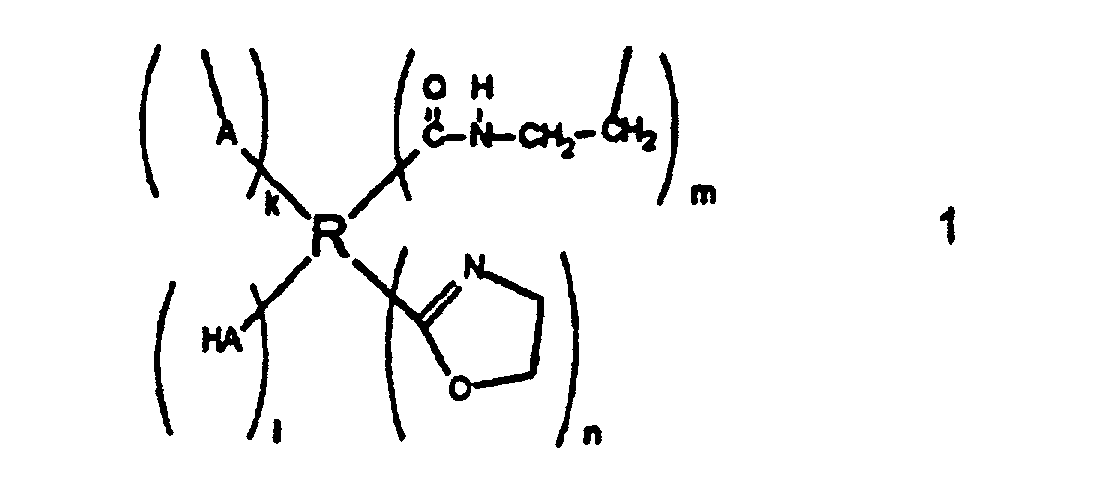
- the object is achieved by highly branched polymers carrying oxazoline groups, which are composed of units which are derived from the structure of the general formula 1, and in which the individual units are connected via a simple chemical bond between the free valence of the structural element A and the free valence of the structural element CO-NH-CH 2 -CH 2 -, where R is an aryl, aralkyl or aralkylene radical with 0 to 6 represents heteroatoms, A represents an aromatically bonded oxygen atom, a bonded sulfur atom, an NH group bonded to the nitrogen to R or a C (O) O group bonded to the carbon atom to R and k, l, m and n are integers are from 0 to 2, which indicates the number of the respective substituents (-A-, -AH, -CO-NH-CH 2 -CH 2 - and 2-oxazoline) with direct binding to R, and the sum of k, l , m and n is 3 and for each unit in a
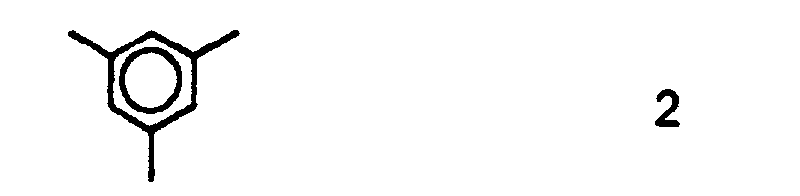
- a special embodiment of the invention is a highly branched polyether amide in which, in the structure according to formula 1 R, a structure according to formula 2, A is an oxygen atom and the sum of k and l is 2.
- This polyether amide is predominantly composed of units of the structure according to formula 3, 4 and 5 and contains a maximum of one of the focal 2-oxazoline groups 6 or 7 per macromolecule.
- Another special embodiment of the invention is a highly branched polyether amide in which, in the structure according to formula 1, R is a structure according to formula 2, A is an oxygen atom and the sum of m and n is the same. 2 are.
- This polyether amide is predominantly composed of units of the structure according to formula 8, 9 and 10 and contains a maximum of one of the focal aromatic hydroxyl groups 11 or 12 per macromolecule.
- Another particular embodiment of the invention is a highly branched polyester amide in which in the structure according to formula 1 R is a structure according to formula 2, A is a C (O) O group bonded to the carbon atom on R and the sum of k and l is 2 ,
- This polyester amide is predominantly composed of units of the structure according to formula 13, 14 and 15 and contains a maximum of one of the focal 2-oxazoline groups 16 or 17 per macromolecule.
- a further particular embodiment of the invention is a highly branched polyester amide in which, in the structure according to formula 1 R, a structure according to formula 2, A is a C (O) O group bonded to the carbon atom on R and the sum of m and n is 2 ,
- This polyester amide is predominantly made up of units of the structure according to formula 18, 19 and 20 and contains at most one of the focal carboxyl groups 21 or 22 per macromolecule.
- the focal groups of the highly branched polyesteramides and polyetheramides after Embodiments A, B, C and D can be bound by internal reactions Form.
- the highly branched polymers bearing oxazoline groups according to the invention are prepared by known addition reactions of the 2-oxazoline group with aromatic hydroxyl groups, carboxylic acid, thiol or amino groups.
- the highly branched polymers according to the invention are made from a multivalent monomer of the general structure 23 (S1) m -R- (S2) n where R is identical to R in structure 1, S1 is a 2-oxazoline group bonded to R in its 2-position, S2 represents an aromatic hydroxyl, a carboxylic acid, thiol or amino group, n and m is 1 or 2 and the sum of m and n is 3.
- the polymerization of the monomers takes place thermally in bulk or in the presence of an inert solvent, preferably N-methylcaprolactam or tetramethylene sulfone (sulfolane), with or without the addition of a catalyst such as lithium chloride, at temperatures from 150 to 300 ° C. under inert gas within 2 minutes to 30 h.
- an inert solvent preferably N-methylcaprolactam or tetramethylene sulfone (sulfolane)
- a catalyst such as lithium chloride
- the monomers according to general structure 23 can be derived from derivatives corresponding hydroxycarboxylic acids, polycarboxylic acids, thiolcarboxylic acids or Aminocarboxylic acids (alkyl esters or acid chlorides) according to known Processes for the synthesis of 2-oxazolines are prepared.
- the monomer for the production of highly branched polyetheramides according to the invention according to the special embodiment A is the compound according to structure 24,
- the monomer 24 is synthesized by reacting methyl 3,5-hydroxybenzoate with 2-ethanolamine and subsequent cyclization in the presence of thionyl chloride at a temperature of 0 ° C.
- the monomer for the production of highly branched polyetheramides according to the invention according to the particular embodiment B is the compound according to structure 25.
- the monomer 25 is synthesized by reacting dimethyl 5-hydroxyisophthalate with 2-ethanolamine and subsequent Cyclization in the presence of thionyl chloride at a temperature of 0 ° C.
- the monomer for the production of highly branched polyesteramides according to the invention according to the special embodiment C is the compound according to structure 26.
- the monomer 26 is synthesized by reacting dimethyl 1,3,5-benzenetricarboxylic acid chloride with 2-chloroethylammonium chloride in the presence of a Acid scavenger, e.g. Triethylamine, and subsequent reaction with methanolic KOH with simultaneous saponification of the ester groups Carboxylic acid groups
- the monomer for the preparation of highly branched polyesteramides according to the invention according to the particular embodiment D is the compound according to structure 27.
- the monomer 27 is synthesized by reacting monomethyl 1,3,5-henzenetricarboxylic acid dichloride with 2-chloroethylammonium chloride in the presence an acid scavenger such as Triethylamine and subsequent reaction with methanolic KOH with simultaneous saponification of the ester group Carboxylic acid group.
- an acid scavenger such as Triethylamine
- the excess groups S1 or S2 present in the monomer Due to the excess of one of the groups S1 or S2 present in the monomer, the excess groups remain in the polymer formed after the reaction and form their high functionality.
- the advantage of the addition reaction used is that, in contrast to polycondensation reactions, no by-products are formed, which simplifies the production of such highly branched, non-crosslinked polymers.
- Particularly valuable are the highly branched polymers, which have a high functionality on 2-oxazoline groups, which can undergo numerous reactions with nucleophilic compounds and thus open up a wide range of applications.
- the highly branched polymers bearing oxazoline groups according to the invention can be added as additives to different polymers, as a result of which melt viscosities, polarity and other properties can be influenced in a targeted manner.
- the compounds according to the invention can furthermore be used as blend components, as a compatibilizer in polymer blends or as crosslinking agents in polymers or polymer blends.
- Examples 1 to 3 relate to the synthesis of highly branched Polyetheramides with phenolic end groups according to structure 24, examples 4 and 5 on the synthesis of highly branched polyetheramides with Oxazoline end groups according to structure 25.
- the structure of the highly branched polyetheramide carrying oxazoline groups was verified by means of 2D 1 H- 1 H-COZY, 1 H- 13 C-HMQC and 1 H- 13 C-HMBC experiments and the structural units 3, 4, 5, 6 and 7 were clearly demonstrated.
- Thermogravimetric investigations showed a temperature stability up to 346 ° C (13.3% by weight loss).
- the polymer has a glass transition temperature at 172 ° C.
- the inherent viscosity was 0.104 dL / g.
- the structure of the highly branched polyetheramide carrying oxazoline groups was verified by means of 2D 1 H- 1 H-COZY, 1 H- 13 C-HMQC and 1 H- 13 C-HMBC experiments and the structural units 3, 4, 5, 6 and 7 were clearly demonstrated.
- a solution of 1.0 g (5.58 mmol) of 2- (3,5 dihydroxyphenyl) -1,3 oxazoline is dissolved under nitrogen in 3.71 ml of dry N-methylcaprolactam and mixed with 3% by weight of lithium chloride.
- the reaction solution is then stirred at 190 ° C. for 25 h.
- the solution is cooled to room temperature under a gentle stream of nitrogen.
- the solid is dissolved in a little dimethyl sulfoxide and the polymer is precipitated from methanol.
- the precipitate is filtered off and dried at 50 ° C. under phosphorus pentoxide in vacuo. 0.55 g of a yellowish polymer is obtained which dissolves well in amidic solvents and dimethyl sulfoxide.
- the structure of the highly branched polyetheramide bearing oxazoline groups was checked by means of 2D 1 H- 1 H-COZY, 1 H- 13 C-HMQC and 1 H- 13 C-HMBC experiments and the structural units 3, 4, 5, 6 and 7 were clearly demonstrated.
- Thermogravimetric studies showed a temperature stability up to 346 ° C.
- the polymer has a glass transition temperature at 172 ° C.
- the inherent viscosity was 0.305 dL / g.
- a solution of 1.0 g (4.3 mmol) of bis-1,3 - (1,3 oxazolin-2-yl) -5-hydroxyphenol is dissolved under nitrogen in 2.58 ml of dry N-methylcaprolactam and mixed with 3% by weight. Lithium chloride added. The reaction solution is then stirred at 190 ° C. for 21 h. The polymer obtained can no longer be dissolved. The high number of functional oxazoline groups could be detected by FTIR and ATR spectroscopy through oxazoline bands at 1637 cm -1 . Thermogravimetric studies showed a temperature stability up to 375 ° C (9.3% by weight loss). The polymer has two glass transition temperatures at 120 ° C and 185 ° C.
Landscapes
- Chemical & Material Sciences (AREA)
- Health & Medical Sciences (AREA)
- Chemical Kinetics & Catalysis (AREA)
- Medicinal Chemistry (AREA)
- Polymers & Plastics (AREA)
- Organic Chemistry (AREA)
- Macromolecular Compounds Obtained By Forming Nitrogen-Containing Linkages In General (AREA)
- Polyamides (AREA)
- Polymers With Sulfur, Phosphorus Or Metals In The Main Chain (AREA)
- Heterocyclic Carbon Compounds Containing A Hetero Ring Having Nitrogen And Oxygen As The Only Ring Hetero Atoms (AREA)
Claims (12)
- Polymères hautement ramifiés portant des groupes oxazoline, élaborés à partir d'unités qui sont dérivées de la structure de formule générale 1et dans lesquels les différentes unités sont liées via une liaison chimique simple de la valence libre de l'élément de structure A- et de la valence libre de l'élément de structure CO-NH-CH2-CH2-, où R représente un radical aryle, aralkyle ou aralkylène comprenant 0 à 6 hétéroatomes, A représente un atome d'oxygène lié aromatiquement, un atome de soufre lié, un groupe NH lié avec l'azote à R ou un groupe C(O)O lié avec l'atome de carbone à R et k, l, m et n sont des nombres entiers de 0 à 2, qui indiquent le nombre des différents substituants (-A-, -AH, -CO-NH-CH2-CH2- et 2-oxazoline) avec une liaison directe à R et la somme de k, l, m et n est égale à 3 et, pour chaque unité se trouvant dans un polymère, dérivée de la structure selon la formule générale 1, la somme de k et l ou la somme de n et m est égale à 2.
- Polymères selon la revendication 1, dans lesquels, dans la structure selon la formule 1, R représente une structure selon la formule 2,A représente un atome d'oxygène et la somme de k et 1 est égale à 2.
- Polymères selon la revendication 1, dans lesquels, dans la structure selon la formule 1, R représente une structure selon la formule 2,A représente un atome d'oxygène et la somme de m et n est égale à 2.
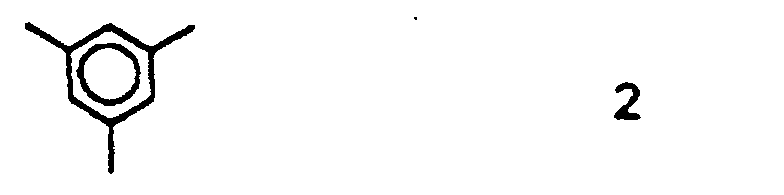
- Polymères selon la revendication 1, dans lesquels, dans la structure selon la formule 1, R représente une structure selon la formule 2,A représente un groupe C(O)O lié avec l'atome de carbone à R et la somme de k et 1 est égale à 2.

- Polymères selon la revendication 1, dans lesquels, dans la structure selon la formule 1, R représente une structure selon la formule 2,A représente un groupe C(O)O lié avec l'atome de carbone à R et la somme de m et n est égale à 2.

- Procédé pour la préparation de polymères hautement ramifiés portant des groupes oxazoline selon l'une quelconque des revendications 1 à 5, dans lequel on fait réagir des monomères multivalents de structure générale 23
- Procédé selon la revendication 6, dans lequel la réaction est réalisée en présence d'un catalyseur.
- Procédé selon la revendication 6, dans lequel on utilise des monomères multivalents de structure 23, dans lesquels n ou m = 1 et la somme de n+m > 3.
- Procédé selon la revendication 6, dans lequel on utilise des solvants amide ou contenant du soufre présentant un point d'ébullition élevé.
- Procédé selon la revendication 6, dans lequel la réaction est réalisée à des températures de 190 à 220°C.
- Procédé selon la revendication 6, dans lequel la réaction est réalisée en 5 minutes jusqu'à 25 heures.
- Utilisation des polymères hautement ramifiés portant des groupes oxazoline selon l'une quelconque des revendications 1 à 5 et préparés selon l'une quelconque des revendications 6 à 11 comme additif dans différents polymères, comme composants de mélange ou comme agent de compatibilité dans des mélanges de polymères ou comme réticulants dans des polymères ou des mélanges de polymères.
Applications Claiming Priority (2)
| Application Number | Priority Date | Filing Date | Title |
|---|---|---|---|
| DE19833626 | 1998-07-25 | ||
| DE19833626A DE19833626A1 (de) | 1998-07-25 | 1998-07-25 | Oxazolingruppen tragende hochverzweigte Polymere, Verfahren zu ihrer Herstellung und Verwendung |
Publications (3)
| Publication Number | Publication Date |
|---|---|
| EP0976768A2 EP0976768A2 (fr) | 2000-02-02 |
| EP0976768A3 EP0976768A3 (fr) | 2000-10-18 |
| EP0976768B1 true EP0976768B1 (fr) | 2004-09-22 |
Family
ID=7875364
Family Applications (1)
| Application Number | Title | Priority Date | Filing Date |
|---|---|---|---|
| EP99113904A Expired - Lifetime EP0976768B1 (fr) | 1998-07-25 | 1999-07-16 | Polyméres hyperramifiés avec des groupes oxazolines, procédé de leur préparation et leur usage |
Country Status (3)
| Country | Link |
|---|---|
| EP (1) | EP0976768B1 (fr) |
| AT (1) | ATE277094T1 (fr) |
| DE (2) | DE19833626A1 (fr) |
Families Citing this family (3)
| Publication number | Priority date | Publication date | Assignee | Title |
|---|---|---|---|---|
| DE19953950A1 (de) * | 1999-11-09 | 2001-05-10 | Basf Ag | Fließfähige Polyamide |
| AU2002358106A1 (en) * | 2001-12-21 | 2003-07-09 | Akzo Nobel N.V. | Hyperbranched esteroxazoline polymers |
| DE102008043863A1 (de) | 2007-11-19 | 2009-05-20 | Basf Se | Teilaromatische Polyamide mit hyperverzweigten Polyoxazolinen |
Family Cites Families (3)
| Publication number | Priority date | Publication date | Assignee | Title |
|---|---|---|---|---|
| JPH0413671A (ja) * | 1990-05-02 | 1992-01-17 | Teijin Ltd | 新規芳香族ジヒドロキシ化合物 |
| JP2515421B2 (ja) * | 1990-07-19 | 1996-07-10 | 帝人株式会社 | 新規芳香族ポリエ―テルおよびその製造方法 |
| DE19812409C1 (de) * | 1998-03-20 | 1999-04-15 | Inst Polymerforschung Dresden | Kopplungsagenzien mit zyklischen Iminoester- und Iminoethergruppen, Verfahren zu deren Herstellung und Verwendung |
-
1998
- 1998-07-25 DE DE19833626A patent/DE19833626A1/de not_active Ceased
-
1999
- 1999-07-16 DE DE59910565T patent/DE59910565D1/de not_active Expired - Lifetime
- 1999-07-16 EP EP99113904A patent/EP0976768B1/fr not_active Expired - Lifetime
- 1999-07-16 AT AT99113904T patent/ATE277094T1/de not_active IP Right Cessation
Also Published As
| Publication number | Publication date |
|---|---|
| EP0976768A2 (fr) | 2000-02-02 |
| DE19833626A1 (de) | 2000-02-03 |
| DE59910565D1 (de) | 2004-10-28 |
| ATE277094T1 (de) | 2004-10-15 |
| EP0976768A3 (fr) | 2000-10-18 |
Similar Documents
| Publication | Publication Date | Title |
|---|---|---|
| DE3855085T2 (de) | Querverbindung von Imidophenylaminen | |
| DE3856218T2 (de) | Lösliche Polyimidsiloxane und Verfahren zu ihrer Herstellung und Verwendung | |
| Rao et al. | A new thermo set system based on cardanol benzoxazine and hydroxy benzoxazoline with lower cure temperature | |
| US20030023007A1 (en) | Enhancement of thermal properties of benzoxazine polymers by use of aromatic polyamines to incorporate internal benzoxazine groups within the monomer | |
| EP0379468A2 (fr) | Composition de résine époxyde durcissable contenant un thermoplastique ayant des groupes phénoliques terminaux | |
| US5760142A (en) | Epoxide-amine dendrimers and the preparation and use thereof | |
| DE69516313T2 (de) | Vernetzte polyasparginsäure und salze | |
| EP0976768B1 (fr) | Polyméres hyperramifiés avec des groupes oxazolines, procédé de leur préparation et leur usage | |
| US5321162A (en) | Hyperbranched aramids | |
| DE69033132T2 (de) | Mesogene Polycyanate und Polycyanamide und ihre hitzegehärteten Gegenstände | |
| US5189160A (en) | Cyclic aromatic amide oligomers | |
| DE69010036T2 (de) | Blockcopolymer und Verfahren zu seiner Herstellung. | |
| JPH01256531A (ja) | 成形材料 | |
| DE1520643B2 (de) | Verfahren zur herstellung eines kondensationspolymeren der aus polyestern und polyamiden einschliesslich x polycarbamiden bestehenden klasse | |
| DE69200511T2 (de) | Mit Keton- oder Ätherketon-Gruppenhaltigen Verbindungen modifizierte Konsensationspolymere. | |
| EP0409115B1 (fr) | Polymères greffés thermoplastiques transformables | |
| DE69229694T2 (de) | Verbundwerkstoff | |
| DE69123906T2 (de) | Verfahren zur Herstellung eines molekularen Verbundmaterials | |
| DE69431649T2 (de) | Verfahren zur Herstellung von molekularen Verbundmaterialien, die ein steifes aromatisches Polymer enthalten | |
| DE19812408C2 (de) | Polyadditionsfähige Oxazolin- oder Oxazincarbonsäuren, Verfahren zu ihrer Herstellung und Verwendung | |
| US5082920A (en) | Thermosetting bis(isoimide) resin compositions | |
| DE69128090T2 (de) | Polyester gepfropftes polyamid, herstellung, und thermoplastische harzzusammensetzung | |
| DE69528463T2 (de) | Polyphenylencopolymere | |
| DE3788523T2 (de) | Kristallines aromatisches Copolymer und Verfahren zu seiner Herstellung. | |
| DE1570886C3 (de) | Verfahren zur Herstellung von stickstoffhaltigen Polymerisaten |
Legal Events
| Date | Code | Title | Description |
|---|---|---|---|
| PUAI | Public reference made under article 153(3) epc to a published international application that has entered the european phase |
Free format text: ORIGINAL CODE: 0009012 |
|
| AK | Designated contracting states |
Kind code of ref document: A2 Designated state(s): AT BE CH CY DE DK ES FI FR GB GR IE IT LI LU MC NL PT SE |
|
| AX | Request for extension of the european patent |
Free format text: AL;LT;LV;MK;RO;SI |
|
| PUAL | Search report despatched |
Free format text: ORIGINAL CODE: 0009013 |
|
| RIC1 | Information provided on ipc code assigned before grant |
Free format text: 7C 08F 20/36 A, 7C 08L 33/14 B, 7C 08G 69/40 B, 7C 08G 69/44 B |
|
| AK | Designated contracting states |
Kind code of ref document: A3 Designated state(s): AT BE CH CY DE DK ES FI FR GB GR IE IT LI LU MC NL PT SE |
|
| AX | Request for extension of the european patent |
Free format text: AL;LT;LV;MK;RO;SI |
|
| 17P | Request for examination filed |
Effective date: 20001204 |
|
| AKX | Designation fees paid |
Free format text: AT BE CH CY DE DK ES FI FR GB GR IE IT LI LU MC NL PT SE |
|
| 17Q | First examination report despatched |
Effective date: 20030402 |
|
| RTI1 | Title (correction) |
Free format text: OXAZOLINE GROUPS CONTAINING HYPERBRANCHED POLYMERS, PROCESS FOR THEIR PREPARATION AND THEIR USE |
|
| GRAP | Despatch of communication of intention to grant a patent |
Free format text: ORIGINAL CODE: EPIDOSNIGR1 |
|
| GRAS | Grant fee paid |
Free format text: ORIGINAL CODE: EPIDOSNIGR3 |
|
| GRAA | (expected) grant |
Free format text: ORIGINAL CODE: 0009210 |
|
| AK | Designated contracting states |
Kind code of ref document: B1 Designated state(s): AT BE CH CY DE DK ES FI FR GB GR IE IT LI LU MC NL PT SE |
|
| PG25 | Lapsed in a contracting state [announced via postgrant information from national office to epo] |
Ref country code: NL Free format text: LAPSE BECAUSE OF FAILURE TO SUBMIT A TRANSLATION OF THE DESCRIPTION OR TO PAY THE FEE WITHIN THE PRESCRIBED TIME-LIMIT Effective date: 20040922 Ref country code: IT Free format text: LAPSE BECAUSE OF FAILURE TO SUBMIT A TRANSLATION OF THE DESCRIPTION OR TO PAY THE FEE WITHIN THE PRESCRIBED TIME-LIMIT;WARNING: LAPSES OF ITALIAN PATENTS WITH EFFECTIVE DATE BEFORE 2007 MAY HAVE OCCURRED AT ANY TIME BEFORE 2007. THE CORRECT EFFECTIVE DATE MAY BE DIFFERENT FROM THE ONE RECORDED. Effective date: 20040922 Ref country code: IE Free format text: LAPSE BECAUSE OF FAILURE TO SUBMIT A TRANSLATION OF THE DESCRIPTION OR TO PAY THE FEE WITHIN THE PRESCRIBED TIME-LIMIT Effective date: 20040922 Ref country code: GB Free format text: LAPSE BECAUSE OF FAILURE TO SUBMIT A TRANSLATION OF THE DESCRIPTION OR TO PAY THE FEE WITHIN THE PRESCRIBED TIME-LIMIT Effective date: 20040922 Ref country code: FR Free format text: LAPSE BECAUSE OF FAILURE TO SUBMIT A TRANSLATION OF THE DESCRIPTION OR TO PAY THE FEE WITHIN THE PRESCRIBED TIME-LIMIT Effective date: 20040922 Ref country code: FI Free format text: LAPSE BECAUSE OF FAILURE TO SUBMIT A TRANSLATION OF THE DESCRIPTION OR TO PAY THE FEE WITHIN THE PRESCRIBED TIME-LIMIT Effective date: 20040922 |
|
| REG | Reference to a national code |
Ref country code: GB Ref legal event code: FG4D Free format text: NOT ENGLISH |
|
| REG | Reference to a national code |
Ref country code: CH Ref legal event code: EP |
|
| REG | Reference to a national code |
Ref country code: IE Ref legal event code: FG4D Free format text: GERMAN |
|
| REF | Corresponds to: |
Ref document number: 59910565 Country of ref document: DE Date of ref document: 20041028 Kind code of ref document: P |
|
| PG25 | Lapsed in a contracting state [announced via postgrant information from national office to epo] |
Ref country code: SE Free format text: LAPSE BECAUSE OF FAILURE TO SUBMIT A TRANSLATION OF THE DESCRIPTION OR TO PAY THE FEE WITHIN THE PRESCRIBED TIME-LIMIT Effective date: 20041222 Ref country code: GR Free format text: LAPSE BECAUSE OF FAILURE TO SUBMIT A TRANSLATION OF THE DESCRIPTION OR TO PAY THE FEE WITHIN THE PRESCRIBED TIME-LIMIT Effective date: 20041222 Ref country code: DK Free format text: LAPSE BECAUSE OF FAILURE TO SUBMIT A TRANSLATION OF THE DESCRIPTION OR TO PAY THE FEE WITHIN THE PRESCRIBED TIME-LIMIT Effective date: 20041222 |
|
| PG25 | Lapsed in a contracting state [announced via postgrant information from national office to epo] |
Ref country code: ES Free format text: LAPSE BECAUSE OF FAILURE TO SUBMIT A TRANSLATION OF THE DESCRIPTION OR TO PAY THE FEE WITHIN THE PRESCRIBED TIME-LIMIT Effective date: 20050102 |
|
| RAP2 | Party data changed (patent owner data changed or rights of a patent transferred) |
Owner name: LEIBNIZ-INSTITUT FUER POLYMERFORSCHUNG DRESDEN E.V |
|
| NLV1 | Nl: lapsed or annulled due to failure to fulfill the requirements of art. 29p and 29m of the patents act | ||
| GBV | Gb: ep patent (uk) treated as always having been void in accordance with gb section 77(7)/1977 [no translation filed] |
Effective date: 20040922 |
|
| REG | Reference to a national code |
Ref country code: IE Ref legal event code: FD4D |
|
| PG25 | Lapsed in a contracting state [announced via postgrant information from national office to epo] |
Ref country code: LU Free format text: LAPSE BECAUSE OF NON-PAYMENT OF DUE FEES Effective date: 20050716 Ref country code: CY Free format text: LAPSE BECAUSE OF FAILURE TO SUBMIT A TRANSLATION OF THE DESCRIPTION OR TO PAY THE FEE WITHIN THE PRESCRIBED TIME-LIMIT Effective date: 20050716 Ref country code: AT Free format text: LAPSE BECAUSE OF NON-PAYMENT OF DUE FEES Effective date: 20050716 |
|
| PLBE | No opposition filed within time limit |
Free format text: ORIGINAL CODE: 0009261 |
|
| STAA | Information on the status of an ep patent application or granted ep patent |
Free format text: STATUS: NO OPPOSITION FILED WITHIN TIME LIMIT |
|
| PG25 | Lapsed in a contracting state [announced via postgrant information from national office to epo] |
Ref country code: MC Free format text: LAPSE BECAUSE OF NON-PAYMENT OF DUE FEES Effective date: 20050731 Ref country code: LI Free format text: LAPSE BECAUSE OF NON-PAYMENT OF DUE FEES Effective date: 20050731 Ref country code: CH Free format text: LAPSE BECAUSE OF NON-PAYMENT OF DUE FEES Effective date: 20050731 Ref country code: BE Free format text: LAPSE BECAUSE OF NON-PAYMENT OF DUE FEES Effective date: 20050731 |
|
| 26N | No opposition filed |
Effective date: 20050623 |
|
| EN | Fr: translation not filed | ||
| REG | Reference to a national code |
Ref country code: CH Ref legal event code: PL |
|
| BERE | Be: lapsed |
Owner name: *INSTITUT FUR POLYMERFORSCHUNG DRESDEN E.V. Effective date: 20050731 |
|
| PG25 | Lapsed in a contracting state [announced via postgrant information from national office to epo] |
Ref country code: PT Free format text: LAPSE BECAUSE OF NON-PAYMENT OF DUE FEES Effective date: 20050222 |
|
| PGFP | Annual fee paid to national office [announced via postgrant information from national office to epo] |
Ref country code: DE Payment date: 20100730 Year of fee payment: 12 |
|
| PG25 | Lapsed in a contracting state [announced via postgrant information from national office to epo] |
Ref country code: DE Free format text: LAPSE BECAUSE OF NON-PAYMENT OF DUE FEES Effective date: 20120201 |
|
| REG | Reference to a national code |
Ref country code: DE Ref legal event code: R119 Ref document number: 59910565 Country of ref document: DE Effective date: 20120201 |