EP0977059A2 - Méthode de fabrication d'une lentille plane catadioptrique et lentille plane fabriquée selon cette méthode - Google Patents
Méthode de fabrication d'une lentille plane catadioptrique et lentille plane fabriquée selon cette méthode Download PDFInfo
- Publication number
- EP0977059A2 EP0977059A2 EP99112693A EP99112693A EP0977059A2 EP 0977059 A2 EP0977059 A2 EP 0977059A2 EP 99112693 A EP99112693 A EP 99112693A EP 99112693 A EP99112693 A EP 99112693A EP 0977059 A2 EP0977059 A2 EP 0977059A2
- Authority
- EP
- European Patent Office
- Prior art keywords
- stage
- lens
- determined
- flx
- fly
- Prior art date
- Legal status (The legal status is an assumption and is not a legal conclusion. Google has not performed a legal analysis and makes no representation as to the accuracy of the status listed.)
- Granted
Links
Images


Classifications
-
- G—PHYSICS
- G02—OPTICS
- G02B—OPTICAL ELEMENTS, SYSTEMS OR APPARATUS
- G02B17/00—Systems with reflecting surfaces, with or without refracting elements
- G02B17/006—Systems in which light light is reflected on a plurality of parallel surfaces, e.g. louvre mirrors, total internal reflection [TIR] lenses
-
- G—PHYSICS
- G02—OPTICS
- G02B—OPTICAL ELEMENTS, SYSTEMS OR APPARATUS
- G02B19/00—Condensers, e.g. light collectors or similar non-imaging optics
- G02B19/0004—Condensers, e.g. light collectors or similar non-imaging optics characterised by the optical means employed
- G02B19/0028—Condensers, e.g. light collectors or similar non-imaging optics characterised by the optical means employed refractive and reflective surfaces, e.g. non-imaging catadioptric systems
-
- G—PHYSICS
- G02—OPTICS
- G02B—OPTICAL ELEMENTS, SYSTEMS OR APPARATUS
- G02B19/00—Condensers, e.g. light collectors or similar non-imaging optics
- G02B19/0033—Condensers, e.g. light collectors or similar non-imaging optics characterised by the use
- G02B19/0047—Condensers, e.g. light collectors or similar non-imaging optics characterised by the use for use with a light source
- G02B19/0061—Condensers, e.g. light collectors or similar non-imaging optics characterised by the use for use with a light source the light source comprising a LED
-
- G—PHYSICS
- G02—OPTICS
- G02B—OPTICAL ELEMENTS, SYSTEMS OR APPARATUS
- G02B3/00—Simple or compound lenses
- G02B3/02—Simple or compound lenses with non-spherical faces
- G02B3/08—Simple or compound lenses with non-spherical faces with discontinuous faces, e.g. Fresnel lens
-
- Y—GENERAL TAGGING OF NEW TECHNOLOGICAL DEVELOPMENTS; GENERAL TAGGING OF CROSS-SECTIONAL TECHNOLOGIES SPANNING OVER SEVERAL SECTIONS OF THE IPC; TECHNICAL SUBJECTS COVERED BY FORMER USPC CROSS-REFERENCE ART COLLECTIONS [XRACs] AND DIGESTS
- Y10—TECHNICAL SUBJECTS COVERED BY FORMER USPC
- Y10T—TECHNICAL SUBJECTS COVERED BY FORMER US CLASSIFICATION
- Y10T428/00—Stock material or miscellaneous articles
- Y10T428/24—Structurally defined web or sheet [e.g., overall dimension, etc.]
- Y10T428/24802—Discontinuous or differential coating, impregnation or bond [e.g., artwork, printing, retouched photograph, etc.]
Definitions
- the invention relates to a method for producing a Flat catadioptric lens with step-shaped Entry surface, reflection surfaces and at least partially curved exit surface.
- the invention further relates to a flat lens.
- a flat lens is known from US Pat. No. 5,404,869 with which the Light rays from a point light source by suitable Beam guidance can be parallelized.
- the special advantage of Lens consists in the low height, the large diameter and the short distance between lens and light source. Possible this is due to a step-like structure of the surface lens. In a central area, the lens has a curved one Entry surface and a likewise curved exit surface on, see Fig. 23 of the document. Outside the middle Concentric steps are arranged in the area, for example 11 levels. Each step can be used as a prismatic element (or Ring prism) are considered and has an entry surface (Top) a reflection surface (bottom) and one Exit surface on. The top and bottom are each even, while the exit surface is curved.
- the Light rays are guided exactly.
- The is accordingly To calculate the geometry of the individual stages precisely. Being aware of the optimal shape of the individual stages and the Machine tools can be manufactured in the center area a corresponding flat lens or a mold for this program. Because of the rotationally symmetrical design the flat lens is sufficient for a clear description of the Form the determination of the data of a radial cross section and from the center of the lens to the outer edge (or vice versa).
- a procedure for the one is particularly advantageous Angle of the reflective surface to the entrance surface in each step is chosen so that a ray section iii of the outer Edge ray a in this area the smallest possible angle forms with the entrance surface. Dark zones after the exit of light from the lens are largely avoided.
- the quantities ⁇ , flx 1 , fly 1 interact to determine the data of the first stage. Either ⁇ 1 and flx 1 or flx 1 and fly 1 are specified and the other value is determined.
- ⁇ 1 and flx 1 results in 1 through fly section of the reflected beam on the reflection surface as a portion of the inner edge beam b of the first stage with the plane defined by flx 1 level.
- the term "inner" marginal ray refers to the arrangement before the rays enter the lens.
- the edge rays closest to the central axis of the lens are referred to as inner edge rays, and the edge rays closest to the periphery of the lens are referred to as outer edge rays.
- the marginal rays intersect within the lens, so that the inner marginal ray b of the first, outer stage marks the outermost edge on the exit side.
- flx 1 should be significantly larger than the x coordinate for the corner point of the first step, and fly 1 should also be significantly larger than the y coordinate of the corner point of the first step.
- Flx 1 largely determines the thickness of the lens, while fly 1 relates to the diameter of the lens. It is important to comply with the eiconal condition within each level. That is, the sums of the optical path lengths of the beams match within each stage. As is known, the optical path length of a light beam results from the geometric path length multiplied by the refractive index.
- the geometric path length ends at a reference plane, which can be assumed somewhere behind the exit side of the lens and which naturally runs perpendicular to the central axis of the lens or to the optical axis.
- the beam guidance is calculated so that the individual light beams hit the reference plane parallel to one another and perpendicularly. With such a lens, there is a maximum of light output with a uniform distribution of light. Widening or focusing the light beam is also conceivable.
- the reference plane must then be assumed to be a concave or convex surface when viewed from the light source.
- a special feature is the determination of the data of the second stage after the first stage has been determined. For this purpose, two iteration steps are carried out nested in one another. First, an estimated value for the x coordinate of the corner point A 2 of the second stage, namely accepted. Since the angular ranges in which the steps absorb light are known, so are the angles the top of the levels i, the y coordinate of the corner point A 2 and thus the point can be calculated.
- the angle ⁇ 2 of the reflection surface of the second stage is determined iteratively until a ray section y iii for an inner marginal ray b of the second stage lies on the point with the coordinates (flx 2 , fly 2 ), where (flx 2 , fly 2 ) the closest coordinate (flx 1 , fly 1 ) of the first stage corresponds to the marginal ray a there.
- the angle between the inner marginal ray b of the second stage and the outer marginal ray a of the first stage is checked before it emerges from the lens and minimized by variation of and subsequent iteration of ⁇ 2 .
- all further coordinates (flx 2 , fly 2 ) can be determined taking into account the eiconal condition (within the second stage).
- the lens according to the invention is according to the above described method produced. According to the determination the geometrical shape to be carried out Manufacturing steps can be different. Important in this context is the material used for the lens. Pressed glass, polycarbonate or PMMA (acrylic) is preferred. used. Due to the determined shape of the lens, a Mold for the same can be made. So they can determined data immediately a corresponding Control the machine tool. Manufacturing is also conceivable as a turned part with consideration of the determined data turning and polishing processes to be carried out. So can for example by cutting the surfaces on the front and Back of the lens up to an excess of 1/100 Millimeters or less edited and then one or more Polishing operations performed to achieve the final shape become.
- a radiation-guiding surface lens 10 is to be constructed be the total light from a point light source 11 an open half space and as parallel light forwards.
- the lens 10 consists of a step arranged entrance surface 12 and an aspherically curved Exit area 13.
- the calculations are based on the Basics of geometric optics taking into account the Eiconal condition (same optical path lengths).
- Based on predetermined output parameters will be the ones required to manufacture the lens Design data determined.
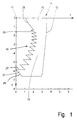
- Fig. 1 is a half cross section 14 of the constructed Flat lens 10 shown.
- the Point light source 11 in the point (0,0) of an x, y coordinate system accepted. That of the light source 11 facing side (entrance surface 12) of the lens 10 consists of an aspherical middle section 15 and eleven outwards their dimension increasing levels, being the outermost level is referred to as level 1.
- the curvature of the outside (Exit surface 13) of the lens 10 is based on the eiconal theory calculated so that the emerging rays behind the Lens 10 run parallel to the x-axis.
- the x-axis at the same time the central axis of the lens 10.
- Fig. 1 The scale used in Fig. 1 is in arbitrary units specified, so that the proportions, but not the real dimensions of the lens 10 are shown. These can be by choosing the diameter of the lens 10.
- Rotation of the outline around the x-axis gives the Complete three-dimensional shape of the lens 10, as in Fig. 2 shown in plan view.
- the outside 19 of the lens 10 incident rays 20, 21 are first when entering a top 22 of the corresponding step 23 broken, then total at a bottom 24 of the step reflected and leave as parallel rays 25, 26 after refraction on the curved in this area Exit surface 13, the lens 10, see Figs. 1 and 3, in which the geometric-optical course described is shown.
- Those drawn in this case for the fourth stage 23 Radiation profiles are here as borderline cases (marginal rays) within the angular range delimited by these rays to consider incident rays.
- One on an edge 27 (Corner point) of a zone or step leads light beam in practice too stray light.
- the sizes refer to the cross section of the rotationally symmetrical zone lens 10 along a Diameter. Some of the angle sizes and coordinates at the construction of the steps in the outer region 19 of the lens 10 4 are not used to scale shown.
- the exit surface 13 of the lens 10 runs in this region perpendicular to the x-axis.
- the x coordinate of this part of the The exit surface is increased to the 11th level 29 (for a total of 11 steps) belonging section of the exit surface 13 certainly.
- the top 22 of the respective stage is designated I, the bottom 24, on which the total reflection takes place, II, these interfaces being flat, while the associated section of the curved exit surface 13 is designated III and is to be calculated from the eiconal condition, see FIG. 4.
- a data vector with the entries (flx i , fly i ) describes the interface III of the i-th stage. indicate the coordinates of the corner points of the i-th stage in cross-section, while specify the corner points in cross-section when moving from the previous to level i.
- the top 22 of the i-th stage closes an angle with a parallel to the x direction a, the bottom 24 with a parallel to the x-axis an angle ⁇ i .
- Marginal rays a i , b i which are just being captured by the i th stage, meet at the angle respectively. on the interface I of the i-th stage.
- the index i denotes the i th stage
- the index i give the coordinates of the intersection of the beam sections with interface I i and accordingly the coordinates of the intersections of the beam sections with interface II i .
- the indices characterizing the step in the angle sizes and coordinates have been omitted in FIG. 4.
- the information i, ii, iii in FIG. 4 designate the three different sections of the beam path from the light source to the interface III (exit surface 13).
- the refractive index can be varied in the calculation.
- the shape of the lens is calculated from the outside in.
- the angular range in which the individual steps receive light and coordinates (flx 1 , fly 1 ) of the outermost point of the section of the exit surface 13 which belongs to the first step must alternatively also be ⁇ 1 and flx 1 . This value practically determines the thickness of the lens.
- the number of levels can be varied within certain limits (see below under the heading C. II. Middle section).
- each step receives light from a 5 ° angle range.
- Equations (1) to (31) are cited below. These are on separate sheets at the end of the description reproduced.
- ⁇ is the angle between the underside of a step and a parallel to the x-axis (see FIG. 4).
- the angles ⁇ and ⁇ A together give the inside angle of a step.
- the calculation of ⁇ is carried out numerically and is carried out using the data from the previous stage. The determination of ⁇ is explained below under the heading "Successive construction of the step-shaped area".
- the end point of line segment iii is marked with (flx, fly) designated and is to be determined from the eiconal condition.
- This Beam path Parallel to the x-axis.
- This Beam section runs between (flx, fly) and (r, fly), where r is the x coordinate of an arbitrarily chosen one Reference plane is.
- the position of the reference plane r can be determined arbitrarily and has no influence on the shape of the prism element to be calculated. The only restriction is that r ⁇ flx must apply, i.e. the reference plane lies outside the lens.
- flx b and fly b can be taken from the input parameters or calculated for the first stage. For each additional level, these variables result from the data from the previous level. The exact procedure for determining flx b and fly b is described in the next section.
- the ray path of the marginal ray b is predetermined and it can be according to Eq. (17) the value of the eiconal can be calculated for level 1.
- Eq. (19) and Eq. (18) determines the coordinates (flx 1 , fly 1 ) for each angle ⁇ , which are written into a data vector, which thus describes the first section of the curved outer surface.
- the first entry in this data vector is the value (flx 1a , fly 1a ) which is calculated for the lower incident edge ray a of the first stage.
- the last entry is the value (flx 1b , fly 1b ).
- Edge ray a (rays 21, 26 in FIG. 3) emerges from the lens as a parallel ray which, after the lens has passed, lies above the edge ray b emerging in parallel (rays 20, 25 in FIG. 3).
- edge ray b and ⁇ i varied until the edge ray b of this step passes through the upper edge point (flx (i-1) a , fly (i-1) a ) of the section of the curved outer surface intended for the previous step, ie whose coordinates correspond to the first entry of the data vector for interface III of the previous stage.
- edge ray a of the previous stage and edge ray b of stage i intersect at a point on the outer surface before they are both broken into parallel rays.
- edge ray a of the previous stage and edge ray b level i not at a point on the outer surface, but would cut within the lens, then closely adjacent would Blasting of edge ray b of stage i on a curvature of Outside surface hit for rays of the previous level was calculated and therefore not to parallel beams at Exit from the lens will be broken.
- condition described above also ensures that the for the individual stages calculated sections of the Together, the outer surface of the lens forms a continuous surface.
- the total reflection condition is checked in relation to the marginal ray a i .
- the associated y coordinate fly M can be found in Eq. (29) can be calculated.
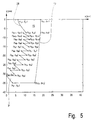
- Figure 5 in connection with the following table reveals real data of a lens to be produced by the method according to the invention.
- FIGS. 1 and 3 half the cross section of the lens is shown in FIG. 5.
- the lens is obtained by rotating around the x axis.
- the total diameter of the lens is 70 mm.
- the outer boundary surface runs perpendicular to the x axis.
- the coordinates of the curved outer surface (exit surface 13) and the aspherically curved central part 15 of the lens are not specified, but can be calculated as indicated above.
Landscapes
- Physics & Mathematics (AREA)
- General Physics & Mathematics (AREA)
- Optics & Photonics (AREA)
- Exposure And Positioning Against Photoresist Photosensitive Materials (AREA)
- Lenses (AREA)
Applications Claiming Priority (2)
| Application Number | Priority Date | Filing Date | Title |
|---|---|---|---|
| DE19834521A DE19834521A1 (de) | 1998-07-31 | 1998-07-31 | Verfahren zur Herstellung einer Flächenlinse auf katadioptrischer Basis sowie nach diesem Verfahren hergestellte Flächenlinse |
| DE19834521 | 1998-07-31 |
Publications (3)
| Publication Number | Publication Date |
|---|---|
| EP0977059A2 true EP0977059A2 (fr) | 2000-02-02 |
| EP0977059A3 EP0977059A3 (fr) | 2001-01-17 |
| EP0977059B1 EP0977059B1 (fr) | 2004-12-15 |
Family
ID=7875952
Family Applications (1)
| Application Number | Title | Priority Date | Filing Date |
|---|---|---|---|
| EP99112693A Expired - Lifetime EP0977059B1 (fr) | 1998-07-31 | 1999-07-02 | Méthode de fabrication d'une lentille plane catadioptrique et lentille plane fabriquée selon cette méthode |
Country Status (3)
| Country | Link |
|---|---|
| US (1) | US6252724B1 (fr) |
| EP (1) | EP0977059B1 (fr) |
| DE (2) | DE19834521A1 (fr) |
Cited By (1)
| Publication number | Priority date | Publication date | Assignee | Title |
|---|---|---|---|---|
| WO2002033449A3 (fr) * | 2000-10-17 | 2002-11-07 | Osram Opto Semiconductors Gmbh | Dispositif optique |
Families Citing this family (9)
| Publication number | Priority date | Publication date | Assignee | Title |
|---|---|---|---|---|
| CN100359342C (zh) * | 2000-12-06 | 2008-01-02 | 大日本印刷株式会社 | 菲涅尔透镜及其模具 |
| JP2002311377A (ja) * | 2001-04-10 | 2002-10-23 | Olympus Optical Co Ltd | 表示装置 |
| JP4212902B2 (ja) * | 2003-01-07 | 2009-01-21 | 大日本印刷株式会社 | フレネルレンズ、フレネルレンズ成形型、フレネルレンズ製造方法及びフレネルレンズを用いた透過型スクリーン |
| US7188984B2 (en) * | 2003-04-17 | 2007-03-13 | Visteon Global Technologies, Inc. | LED headlamp array |
| CN102645686B (zh) * | 2012-05-18 | 2014-04-02 | 哈尔滨工业大学 | 一种均匀会聚菲涅尔透镜的设计方法 |
| US10807329B2 (en) * | 2013-05-10 | 2020-10-20 | Abl Ip Holding Llc | Silicone optics |
| CN105605497A (zh) * | 2015-12-25 | 2016-05-25 | 惠州市路森光电科技有限公司 | 一种取消副光斑的led灯具 |
| US11269168B2 (en) * | 2018-07-24 | 2022-03-08 | King Abdullah University Of Science And Technology | Printed catadioptric high numerical aperture lens and method |
| CN209782513U (zh) * | 2019-06-19 | 2019-12-13 | 苏州欧普照明有限公司 | 透镜和灯具 |
Family Cites Families (9)
| Publication number | Priority date | Publication date | Assignee | Title |
|---|---|---|---|---|
| DE603666C (de) * | 1931-06-17 | 1934-10-05 | Sendlinger Optische Glaswerke | Abschlussscheibe fuer scheinwerferartige Vorrichtungen |
| DE1233792B (de) * | 1961-08-08 | 1967-02-09 | Elastic Stop Nut Corp | Lichtverteilungsscheibe |
| US3744882A (en) * | 1971-08-20 | 1973-07-10 | Holograph Corp | Composite lens for an optical communication system providing directly viewed real images |
| US4178066A (en) * | 1976-05-10 | 1979-12-11 | Cselt Centro Studi E Laboratori Telecomunicazioni S.P.A. | Ray-path equalizer for signal-transmission system using multimode light guides |
| DE3317519A1 (de) * | 1983-05-13 | 1984-11-15 | Robert Bosch Gmbh, 7000 Stuttgart | Lichtsammelplatte |
| US5613769A (en) * | 1992-04-16 | 1997-03-25 | Tir Technologies, Inc. | Tir lens apparatus having non-circular configuration about an optical axis |
| US5404869A (en) * | 1992-04-16 | 1995-04-11 | Tir Technologies, Inc. | Faceted totally internally reflecting lens with individually curved faces on facets |
| US6107000A (en) * | 1996-12-17 | 2000-08-22 | Board Of Regents - University Of California - San Diego | Method for producing micro-optic elements with gray scale mask |
| US5815327A (en) * | 1997-03-14 | 1998-09-29 | Xerox Corporation | Photolithographic method of fabricating fresnel lenses |
-
1998
- 1998-07-31 DE DE19834521A patent/DE19834521A1/de not_active Ceased
-
1999
- 1999-07-02 EP EP99112693A patent/EP0977059B1/fr not_active Expired - Lifetime
- 1999-07-02 DE DE59911264T patent/DE59911264D1/de not_active Expired - Fee Related
- 1999-07-20 US US09/357,472 patent/US6252724B1/en not_active Expired - Fee Related
Cited By (2)
| Publication number | Priority date | Publication date | Assignee | Title |
|---|---|---|---|---|
| WO2002033449A3 (fr) * | 2000-10-17 | 2002-11-07 | Osram Opto Semiconductors Gmbh | Dispositif optique |
| US6940660B2 (en) | 2000-10-17 | 2005-09-06 | Osram Gmbh | Optical device |
Also Published As
| Publication number | Publication date |
|---|---|
| EP0977059A3 (fr) | 2001-01-17 |
| DE59911264D1 (de) | 2005-01-20 |
| EP0977059B1 (fr) | 2004-12-15 |
| US6252724B1 (en) | 2001-06-26 |
| DE19834521A1 (de) | 2000-02-03 |
Similar Documents
| Publication | Publication Date | Title |
|---|---|---|
| DE112017001892B4 (de) | Lasersystem mit optischen Faserstrukturen und Verfahren zum Variieren von Laserstrahlprofilen | |
| DE10327733C5 (de) | Vorrichtung zur Formung eines Lichtstrahls | |
| DE69606056T2 (de) | Prismatischer lichtwellenleiter mit konfokal-parabelförmigem querschnitt und hohem wirkungsgrad | |
| DE3507407C2 (fr) | ||
| DE112016002870T5 (de) | Optische Elementanordnungen zum Verändern des Strahlparameterprodukts in Laserabgabesystemen | |
| EP3575674B1 (fr) | Guide de lumière pour un dispositif d'éclairage de véhicule automobile | |
| DE102010063938A1 (de) | Optisches System zur Strahlformung eines Laserstrahls sowie Lasersystem mit einem solchen optischen System | |
| EP2469325B1 (fr) | Système optique pour la formation d'un rayonnement laser ainsi que système laser doté d'un tel système optique | |
| DE3704239A1 (de) | Streifwinkel-mikroskop | |
| DE3418188C2 (fr) | ||
| EP0977059A2 (fr) | Méthode de fabrication d'une lentille plane catadioptrique et lentille plane fabriquée selon cette méthode | |
| DE69809880T2 (de) | Objektiv mit konstanter brennweite im sichtbaren- und im ir-bereich | |
| EP1062540B1 (fr) | Dispositif et procede de transformation optique de rayons | |
| DE102007061358B4 (de) | Vorrichtung zur Formung von Laserstrahlung | |
| DE3143137C2 (de) | Reflexions-ausblendende, fokussierende optische Vorrichtung | |
| EP1126257A2 (fr) | Dispositif de sélection et de détection d'au moins un domaine spectral d'un faisceau lumineux spectralement décomposé | |
| DE69518990T2 (de) | Linsenstruktur ohne sphärische aberration und stereoskopische kamera mit einer solchen linsenstruktur | |
| DE102020126716A1 (de) | Projektionsvorrichtung für ein Mikroprojektionslichtmodul für einen Kraftfahrzeugscheinwerfer | |
| EP1064573B1 (fr) | Spectrometre a couche mince avec reseau de transmission | |
| EP4127667B1 (fr) | Procédé de détermination du profil d'indice de réfraction d'un objet optique cylindrique | |
| EP0903823B1 (fr) | Elément laser comprenant un réseau de lasers et méthode de fabrication | |
| DE102015108422A1 (de) | Strahlenoptisches System | |
| DE69509074T2 (de) | Fresnellinse mit stufen auf beiden seiten fuer overheadprojektion | |
| DE202023105334U1 (de) | Optische Pfadanordnung mit variabler Länge | |
| DE19820154A1 (de) | Vorrichtung und Verfahren zur optischen Strahltransformation |
Legal Events
| Date | Code | Title | Description |
|---|---|---|---|
| PUAI | Public reference made under article 153(3) epc to a published international application that has entered the european phase |
Free format text: ORIGINAL CODE: 0009012 |
|
| AK | Designated contracting states |
Kind code of ref document: A2 Designated state(s): AT BE CH CY DE DK ES FI FR GB GR IE IT LI LU MC NL PT SE |
|
| AX | Request for extension of the european patent |
Free format text: AL;LT;LV;MK;RO;SI |
|
| PUAL | Search report despatched |
Free format text: ORIGINAL CODE: 0009013 |
|
| AK | Designated contracting states |
Kind code of ref document: A3 Designated state(s): AT BE CH CY DE DK ES FI FR GB GR IE IT LI LU MC NL PT SE |
|
| AX | Request for extension of the european patent |
Free format text: AL;LT;LV;MK;RO;SI |
|
| AKX | Designation fees paid | ||
| 17P | Request for examination filed |
Effective date: 20010503 |
|
| RBV | Designated contracting states (corrected) |
Designated state(s): DE FR GB IT |
|
| REG | Reference to a national code |
Ref country code: DE Ref legal event code: 8566 |
|
| 17Q | First examination report despatched |
Effective date: 20020606 |
|
| GRAP | Despatch of communication of intention to grant a patent |
Free format text: ORIGINAL CODE: EPIDOSNIGR1 |
|
| GRAS | Grant fee paid |
Free format text: ORIGINAL CODE: EPIDOSNIGR3 |
|
| GRAA | (expected) grant |
Free format text: ORIGINAL CODE: 0009210 |
|
| AK | Designated contracting states |
Kind code of ref document: B1 Designated state(s): DE FR GB IT |
|
| REG | Reference to a national code |
Ref country code: GB Ref legal event code: FG4D Free format text: NOT ENGLISH |
|
| REF | Corresponds to: |
Ref document number: 59911264 Country of ref document: DE Date of ref document: 20050120 Kind code of ref document: P |
|
| GBT | Gb: translation of ep patent filed (gb section 77(6)(a)/1977) |
Effective date: 20050404 |
|
| PLBE | No opposition filed within time limit |
Free format text: ORIGINAL CODE: 0009261 |
|
| STAA | Information on the status of an ep patent application or granted ep patent |
Free format text: STATUS: NO OPPOSITION FILED WITHIN TIME LIMIT |
|
| 26N | No opposition filed |
Effective date: 20050916 |
|
| ET | Fr: translation filed | ||
| PGFP | Annual fee paid to national office [announced via postgrant information from national office to epo] |
Ref country code: DE Payment date: 20070719 Year of fee payment: 9 |
|
| PGFP | Annual fee paid to national office [announced via postgrant information from national office to epo] |
Ref country code: GB Payment date: 20070627 Year of fee payment: 9 |
|
| PGFP | Annual fee paid to national office [announced via postgrant information from national office to epo] |
Ref country code: IT Payment date: 20070730 Year of fee payment: 9 |
|
| PGFP | Annual fee paid to national office [announced via postgrant information from national office to epo] |
Ref country code: FR Payment date: 20070710 Year of fee payment: 9 |
|
| GBPC | Gb: european patent ceased through non-payment of renewal fee |
Effective date: 20080702 |
|
| PG25 | Lapsed in a contracting state [announced via postgrant information from national office to epo] |
Ref country code: DE Free format text: LAPSE BECAUSE OF NON-PAYMENT OF DUE FEES Effective date: 20090203 |
|
| REG | Reference to a national code |
Ref country code: FR Ref legal event code: ST Effective date: 20090331 |
|
| PG25 | Lapsed in a contracting state [announced via postgrant information from national office to epo] |
Ref country code: GB Free format text: LAPSE BECAUSE OF NON-PAYMENT OF DUE FEES Effective date: 20080702 |
|
| PG25 | Lapsed in a contracting state [announced via postgrant information from national office to epo] |
Ref country code: IT Free format text: LAPSE BECAUSE OF NON-PAYMENT OF DUE FEES Effective date: 20080702 Ref country code: FR Free format text: LAPSE BECAUSE OF NON-PAYMENT OF DUE FEES Effective date: 20080731 |