EP0977116A2 - Datenverarbeitungsgerät und -Verfahren - Google Patents
Datenverarbeitungsgerät und -Verfahren Download PDFInfo
- Publication number
- EP0977116A2 EP0977116A2 EP99304002A EP99304002A EP0977116A2 EP 0977116 A2 EP0977116 A2 EP 0977116A2 EP 99304002 A EP99304002 A EP 99304002A EP 99304002 A EP99304002 A EP 99304002A EP 0977116 A2 EP0977116 A2 EP 0977116A2
- Authority
- EP
- European Patent Office
- Prior art keywords
- data
- value
- operand
- operands
- result
- Prior art date
- Legal status (The legal status is an assumption and is not a legal conclusion. Google has not performed a legal analysis and makes no representation as to the accuracy of the status listed.)
- Withdrawn
Links
Images

Classifications
-
- G—PHYSICS
- G06—COMPUTING OR CALCULATING; COUNTING
- G06F—ELECTRIC DIGITAL DATA PROCESSING
- G06F8/00—Arrangements for software engineering
- G06F8/30—Creation or generation of source code
- G06F8/31—Programming languages or programming paradigms
- G06F8/311—Functional or applicative languages; Rewrite languages
-
- G—PHYSICS
- G06—COMPUTING OR CALCULATING; COUNTING
- G06F—ELECTRIC DIGITAL DATA PROCESSING
- G06F9/00—Arrangements for program control, e.g. control units
- G06F9/06—Arrangements for program control, e.g. control units using stored programs, i.e. using an internal store of processing equipment to receive or retain programs
- G06F9/44—Arrangements for executing specific programs
- G06F9/448—Execution paradigms, e.g. implementations of programming paradigms
- G06F9/4494—Execution paradigms, e.g. implementations of programming paradigms data driven
-
- Y—GENERAL TAGGING OF NEW TECHNOLOGICAL DEVELOPMENTS; GENERAL TAGGING OF CROSS-SECTIONAL TECHNOLOGIES SPANNING OVER SEVERAL SECTIONS OF THE IPC; TECHNICAL SUBJECTS COVERED BY FORMER USPC CROSS-REFERENCE ART COLLECTIONS [XRACs] AND DIGESTS
- Y10—TECHNICAL SUBJECTS COVERED BY FORMER USPC
- Y10S—TECHNICAL SUBJECTS COVERED BY FORMER USPC CROSS-REFERENCE ART COLLECTIONS [XRACs] AND DIGESTS
- Y10S707/00—Data processing: database and file management or data structures
- Y10S707/99931—Database or file accessing
- Y10S707/99932—Access augmentation or optimizing
Definitions
- This invention relates to an apparatus and method for processing data.
- the invention also includes data processing apparatus for performing this method.
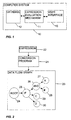
- this shows a computer system 10, including an expression evaluation mechanism 11, a database 12, and a user interface 13.
- the mechanism 11 may be a special-purpose hardware unit, but in this example it comprises conventional computer processing hardware running special-purpose software to evaluate expressions.
- the evaluation mechanism 11 receives one or more operand values, either from literals in the expression, or from the database, or from the user interface, and produces one or more result values. The result values may then be entered into the database, and/or presented to the user by way of the user interface.
- each of the operand values is temporally scoped: that is, it contains a history of the values of the thing that it represents.
- the expression evaluation mechanism takes account of the time variation of the operands, and produces a result value which is also temporally scoped.
- the length of time taken to acquire an operand value cannot be predicted.
- a value may be available in milliseconds (for example where it is already held in cache memory) while in other cases it may take weeks (for example, where information from a customer has to be obtained by post).
- the present system adopts an eager but non-strict evaluation approach. By this is meant that an expression is evaluated in an eager way (e.g. both arguments of an "and" operator are evaluated in parallel), and as soon as sufficient information is available to determine whether any part of the evaluation is not required (e.g. one of the arguments of the "and” operator is found to be false), the unwanted activity is aborted.
- Each operand or result value is represented by a sequence of one or more value instances.
- Each value instance consists of a tuple:
- the time_end field indicates the end of the time span for which the data item is valid.
- the tuple may also contain further information (not shown), such as a field indicating the source of the information in the tuple, or the degree of confidence in the reliability of the information.
- time_start and time_end are defined in a simple date format (dd/mm/yyyy).
- the time spans are inclusive of the start and end dates.
- Special date values "top” and “bottom” are reserved to denote hypothetical maximum and minimum dates.
- a person's salary might be represented by the following sequence of tuples:
- a value may be undefined in a particular time span, for one of the following reasons:
- the value of the salary is undefined for the period up to and including the 1st January 1990.
- a value may contain one or more error value instances.
- the operator if the operand contains an error value instance, the operator returns an error for the relevant time span.
- the evaluation mechanism also implements a number of functions for manipulating value instances. For example, the functions "duration” and "sum” are provided.
- the “duration” function computes the duration of each value instance in an expression.
- the "sum” function calculates the sum of all individual value instances in an expression.
- the evaluation mechanism comprises a conversion program 21, which takes an expression 22 and converts it into a data flow graph 23.
- the root node of the data flow graph represents the evaluated expression.
- the leaf nodes represent the operand values for the expression, either as literal constants or as processes to acquire the operand values.
- the other nodes represent operators.
- Figure 2 shows a data flow graph generated from the expression:
- This consists of a root node 24, a node 25 representing the "if" operator, a node 26 representing the "and” operator, and leaf nodes 27 - 30 representing the respective operands A - D. It will be appreciated that, in the case of more complex expressions, the data flow graph will be correspondingly more complex.
- Control messages Two types of message are passed between nodes in the graph, Control messages and Data messages. Control messages travel away from the root node while Data messages travel towards it.
- a Data message has the form V[T S ,T E ], where V is a data value and [T S ,T E ] is the time span to which the data value applies.
- the data value may be an actual data value, or may be an "error” marker or a "no more data” marker. "Undefined” values are indicated by gaps between successive Data message time spans.
- the evaluation process is initiated by the root node sending a Require message to its child node.
- the parameters [T S ,T E ] in the Require message indicate the time span for which the evaluation is to be performed.
- the process ends when the root node receives one or more Data messages containing the required result.
- a node representing an operator receives a Require or Cancel message from its parent node, it generally passes the message on unchanged to all its child nodes. However, some operators (not described herein) may modify the message, according to their semantics.
- a leaf node When a leaf node receives a Require message, it initiates a process to acquire the operand in question. If the node does not represent a literal constant, this may involve performing a database access, to obtain the value of the operand for the specified time span. Alternatively, it may involve prompting the user, by way of the user interface, to enter the value of the operand for the specified time span. In both cases the operand discovery process can be incremental with value instances being returned in time span order. For example, if a person's address is required over span [1/1/1990, 1/1/1998] the current address, say London[1/1/1996,1/1/1998], could be returned as the first value instance, followed by the previous address etc.
- a benefit of this is that computation performed on the initial value instance may result in the rest not being required.
- a node representing an operator waits until it has received sufficient Data messages from its child nodes to enable it to return a Data message to its parent node. That is, it performs an incremental operation over time. When sufficient operands have been received, it performs the required operation, and then returns a Data message containing the result to its parent node. For example, the "+" operator waits until it has received a Data message from both operands that contain value instances that have some overlap in their time spans. However, as explained above, in certain cases a node may determine that a particular operand is no longer required for a particular time span [T S ,T E ]. In this case the node sends a Cancel message to the appropriate child node, the message containing this time span as a parameter.
- node When a node has completed all activity for the required time span, it returns a Data message containing the "no more data" marker to its parent.
- a leaf node When a leaf node receives a Cancel message, it aborts any process it has previously initiated to acquire the operand for the specified time span. This may involve aborting all or part of a database access request. Alternatively, it may involve displaying a message to the user, informing the user that a specified data value is no longer required, or is now required only in respect of a more limited time period.
- the node 26 receives a Require message from its parent node 25, and receives Data messages from its child nodes 27,28.
- the node 26 simply passes Require messages unchanged to both its child nodes. Cancel messages are handled in a similar way.
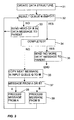
- Step 31 The process first creates a data structure as follows:
- Step 32 The process then enters a loop (Steps 32-39).
- the first action in this loop is to check whether the result queue R is empty.
- Step 33 If the result queue R is not empty, the process removes the head item from this queue, sends it in a Data message to the parent node and returns to step 32.
- Step 34 The process then checks whether Completed is true.
- Step 35 If Completed is true, the process sends a Data message containing a "no more data" marker to the parent node. It then breaks out of the loop, and terminates.
- Step 36 If, on the other hand, Completed is false, the process continues as follows. First, it copies the next Data message in the input queue Q to a current message M.
- Step 37 The process then checks whether this message was from child node A or B, and goes to Step 38 or 39 according to the result. It then returns to Step 32 above, to continue with the loop.
- Step 38 shows Step 38 above in more detail.
- Step 39 is similar, except that it is the mirror image of step 38 with regard to the operands A and B, variables La and Lb, and vectors Va and Vb.
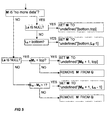
- Step 41 The process looks for gaps between the time spans of the messages received from node A. If it finds such a gap, it replaces the current message M with an "undefined" message, with start end times equal to the start and end times of the gap.
- Figure 5 shows Step 41 in more detail.
- M S and M E represent the start and end times of the current message M
- L S and L E represent the start and end times of the previous message La received from node A.
- Step 42 Referring again to Figure 4, if the message M is a "no more data” message then Completed is set depending on whether a "no more data” message has previously been received from B. This indicates whether or not all the required operand data has now been received from both A and B. Step 32 is then returned to.
- Step 43 The process then replaces the variable La with the message M, and adds the message M to the vector Va.
- Step 44 The process then checks whether the value M V of M is "false”. If so, it sends a Cancel message with parameters [M S ,M E ] to node B. In other words, if the returned value of operand A is "false" for a particular time span, the acquisition of operand B is cancelled in respect of that time span.
- Step 45 The process next finds the subset S of the vector Vb received from node B, which overlaps with the time span [M S ,M E ] of the current message M.
- This subset S will consist of a set of zero or more value instances E.
- Step 46 The process then performs a loop in which it does the following for each value instance E of the subset S in turn.
- E V and [E S ,E E ] represent the value and time span of the value instance E, and M V represents the value of the current message M).
- the operation is similar in the case of a message received from node B.
- the "and" node examines each of the operands to find value instances in the respective operands whose time spans overlap, and then generates an output data message in respect of each overlap period. If the returned value of either operand is "false” for a particular time span, the acquisition of the other operand is cancelled in respect of that time span.
Landscapes
- Engineering & Computer Science (AREA)
- Software Systems (AREA)
- Theoretical Computer Science (AREA)
- General Engineering & Computer Science (AREA)
- Physics & Mathematics (AREA)
- General Physics & Mathematics (AREA)
- Computing Systems (AREA)
- Executing Machine-Instructions (AREA)
- Complex Calculations (AREA)
- Debugging And Monitoring (AREA)
- Test And Diagnosis Of Digital Computers (AREA)
Applications Claiming Priority (2)
| Application Number | Priority Date | Filing Date | Title |
|---|---|---|---|
| GBGB9816301.7A GB9816301D0 (en) | 1998-07-28 | 1998-07-28 | Data processing apparatus and method |
| GB9816301 | 1998-07-28 |
Publications (2)
| Publication Number | Publication Date |
|---|---|
| EP0977116A2 true EP0977116A2 (de) | 2000-02-02 |
| EP0977116A3 EP0977116A3 (de) | 2003-07-16 |
Family
ID=10836221
Family Applications (1)
| Application Number | Title | Priority Date | Filing Date |
|---|---|---|---|
| EP99304002A Withdrawn EP0977116A3 (de) | 1998-07-28 | 1999-05-24 | Datenverarbeitungsgerät und -Verfahren |
Country Status (5)
| Country | Link |
|---|---|
| US (1) | US6466930B1 (de) |
| EP (1) | EP0977116A3 (de) |
| JP (1) | JP2000090071A (de) |
| CA (1) | CA2273710A1 (de) |
| GB (1) | GB9816301D0 (de) |
Cited By (1)
| Publication number | Priority date | Publication date | Assignee | Title |
|---|---|---|---|---|
| WO2010108469A1 (de) * | 2009-03-24 | 2010-09-30 | Hansa-Datenservice, Gowarsch & Co. | Vorrichtung und verfahren zur automatischen verarbeitung von daten |
Families Citing this family (1)
| Publication number | Priority date | Publication date | Assignee | Title |
|---|---|---|---|---|
| US8549464B2 (en) * | 2010-11-22 | 2013-10-01 | Microsoft Corporation | Reusing expression graphs in computer programming languages |
Family Cites Families (8)
| Publication number | Priority date | Publication date | Assignee | Title |
|---|---|---|---|---|
| US5239663A (en) * | 1987-06-15 | 1993-08-24 | Centre National De La Recherche Scientifique | Self-adapting and multifunctional process and structure for the automated evaluation of logical or arithmetic expressions, particularly for extended database consultation |
| US5345587A (en) * | 1988-09-14 | 1994-09-06 | Digital Equipment Corporation | Extensible entity management system including a dispatching kernel and modules which independently interpret and execute commands |
| JP3047998B2 (ja) * | 1991-02-13 | 2000-06-05 | 株式会社日立製作所 | 並列計算機におけるプロセッサ割り当て方法、及び装置 |
| US5283856A (en) * | 1991-10-04 | 1994-02-01 | Beyond, Inc. | Event-driven rule-based messaging system |
| US5761511A (en) * | 1994-01-28 | 1998-06-02 | Sun Microsystems, Inc. | Method and apparatus for a type-safe framework for dynamically extensible objects |
| US5924103A (en) * | 1997-03-12 | 1999-07-13 | Hewlett-Packard Company | Works-in-progress in an information management system |
| US6163839A (en) * | 1998-09-30 | 2000-12-19 | Intel Corporation | Non-stalling circular counterflow pipeline processor with reorder buffer |
| US6205441B1 (en) * | 1999-03-31 | 2001-03-20 | Compaq Computer Corporation | System and method for reducing compile time in a top down rule based system using rule heuristics based upon the predicted resulting data flow |
-
1998
- 1998-07-28 GB GBGB9816301.7A patent/GB9816301D0/en not_active Ceased
-
1999
- 1999-05-24 EP EP99304002A patent/EP0977116A3/de not_active Withdrawn
- 1999-06-02 US US09/324,214 patent/US6466930B1/en not_active Expired - Lifetime
- 1999-06-03 CA CA002273710A patent/CA2273710A1/en not_active Abandoned
- 1999-07-27 JP JP11211555A patent/JP2000090071A/ja active Pending
Cited By (1)
| Publication number | Priority date | Publication date | Assignee | Title |
|---|---|---|---|---|
| WO2010108469A1 (de) * | 2009-03-24 | 2010-09-30 | Hansa-Datenservice, Gowarsch & Co. | Vorrichtung und verfahren zur automatischen verarbeitung von daten |
Also Published As
| Publication number | Publication date |
|---|---|
| EP0977116A3 (de) | 2003-07-16 |
| CA2273710A1 (en) | 2000-01-28 |
| JP2000090071A (ja) | 2000-03-31 |
| US6466930B1 (en) | 2002-10-15 |
| GB9816301D0 (en) | 1998-09-23 |
Similar Documents
| Publication | Publication Date | Title |
|---|---|---|
| CN107644323B (zh) | 一种面向业务流的智能审核系统 | |
| US5428525A (en) | Computer system and method for signal control prioritizing and scheduling | |
| US8996442B2 (en) | Processing data using vector fields | |
| US6182024B1 (en) | Modeling behaviors of objects associated with finite state machines and expressing a sequence without introducing an intermediate state with the arc language | |
| US7895187B2 (en) | Hybrid evaluation of expressions in DBMS | |
| KR20010072019A (ko) | 데이터 웨어하우스에 대한 애그리깃 레벨 및 크로스프로덕트 레벨을 선택하는 방법 및 장치 | |
| US6643638B1 (en) | System and method for storing and computing data and functions | |
| US6466930B1 (en) | Method and apparatus for evaluating expressions including time-scoped operands | |
| US6374233B1 (en) | Method and apparatus for evaluating expressions with cancellation of requests for operands that are no longer required | |
| Mester et al. | Composition and refinement mapping based construction of distributed applications | |
| Xing et al. | Engineering commitment-based multiagent systems: a temporal logic approach | |
| EP0743607A2 (de) | Verfahren und Vorrichtung zur Abfrage einer disjunktive Information enthaltenden Datenbank | |
| Huang et al. | A computer-aided protocol design by production systems approach | |
| Dodier | A revision of the Bayesian network interchange format | |
| US20250363138A1 (en) | Generation of formula from natural language description | |
| Larchevêque | Interprocedural type propagation for object-oriented languages | |
| JPH0784773A (ja) | 集計プログラム自動生成装置 | |
| Petrović et al. | Frame-based blackboard expert system for signal processing | |
| EP0587089A2 (de) | Datenverarbeitungssystem zum Ausführen eines modifizierten Programms | |
| CN112363832A (zh) | 基于Ignite的分布式数据处理方法、装置及计算机设备 | |
| Stut Jr et al. | First experiences with a semantic modeling method to guide simulation-based PACS development | |
| Shaw | Time-stamped event histories: a real-time programming object | |
| US20030154209A1 (en) | Systems and methods for solving nogood databases | |
| Prokopenko et al. | A RULE PROCESSING SYSTEM FOR KNOWLEDGE-BASED MANPOWER PLANNING AND SCHEDULING | |
| Vlachantonis | A case study for an open CASE system: The TROLL light development environment |
Legal Events
| Date | Code | Title | Description |
|---|---|---|---|
| PUAI | Public reference made under article 153(3) epc to a published international application that has entered the european phase |
Free format text: ORIGINAL CODE: 0009012 |
|
| AK | Designated contracting states |
Kind code of ref document: A2 Designated state(s): AT BE CH CY DE DK ES FI FR GB GR IE IT LI LU MC NL PT SE |
|
| AX | Request for extension of the european patent |
Free format text: AL;LT;LV;MK;RO;SI |
|
| RAP1 | Party data changed (applicant data changed or rights of an application transferred) |
Owner name: FUJITSU SERVICES LIMITED |
|
| PUAL | Search report despatched |
Free format text: ORIGINAL CODE: 0009013 |
|
| AK | Designated contracting states |
Designated state(s): AT BE CH CY DE DK ES FI FR GB GR IE IT LI LU MC NL PT SE |
|
| AX | Request for extension of the european patent |
Extension state: AL LT LV MK RO SI |
|
| RIC1 | Information provided on ipc code assigned before grant |
Ipc: 7G 06F 17/30 B Ipc: 7G 06F 9/45 B Ipc: 7G 06F 9/44 A |
|
| 17P | Request for examination filed |
Effective date: 20031124 |
|
| AKX | Designation fees paid |
Designated state(s): DE FR GB IE |
|
| 17Q | First examination report despatched |
Effective date: 20040429 |
|
| STAA | Information on the status of an ep patent application or granted ep patent |
Free format text: STATUS: THE APPLICATION IS DEEMED TO BE WITHDRAWN |
|
| 18D | Application deemed to be withdrawn |
Effective date: 20040910 |