EP0977190A1 - Behälter für optische abtastvorrichtung - Google Patents
Behälter für optische abtastvorrichtung Download PDFInfo
- Publication number
- EP0977190A1 EP0977190A1 EP98914080A EP98914080A EP0977190A1 EP 0977190 A1 EP0977190 A1 EP 0977190A1 EP 98914080 A EP98914080 A EP 98914080A EP 98914080 A EP98914080 A EP 98914080A EP 0977190 A1 EP0977190 A1 EP 0977190A1
- Authority
- EP
- European Patent Office
- Prior art keywords
- holding container
- pickup device
- optical pickup
- resin composition
- poly
- Prior art date
- Legal status (The legal status is an assumption and is not a legal conclusion. Google has not performed a legal analysis and makes no representation as to the accuracy of the status listed.)
- Withdrawn
Links
Images
Classifications
-
- G—PHYSICS
- G11—INFORMATION STORAGE
- G11B—INFORMATION STORAGE BASED ON RELATIVE MOVEMENT BETWEEN RECORD CARRIER AND TRANSDUCER
- G11B7/00—Recording or reproducing by optical means, e.g. recording using a thermal beam of optical radiation by modifying optical properties or the physical structure, reproducing using an optical beam at lower power by sensing optical properties; Record carriers therefor
- G11B7/08—Disposition or mounting of heads or light sources relatively to record carriers
-
- G—PHYSICS
- G11—INFORMATION STORAGE
- G11B—INFORMATION STORAGE BASED ON RELATIVE MOVEMENT BETWEEN RECORD CARRIER AND TRANSDUCER
- G11B33/00—Constructional parts, details or accessories not provided for in the other groups of this subclass
- G11B33/02—Cabinets; Cases; Stands; Disposition of apparatus therein or thereon
-
- C—CHEMISTRY; METALLURGY
- C08—ORGANIC MACROMOLECULAR COMPOUNDS; THEIR PREPARATION OR CHEMICAL WORKING-UP; COMPOSITIONS BASED THEREON
- C08K—Use of inorganic or non-macromolecular organic substances as compounding ingredients
- C08K3/00—Use of inorganic substances as compounding ingredients
- C08K3/18—Oxygen-containing compounds, e.g. metal carbonyls
- C08K3/20—Oxides; Hydroxides
- C08K3/22—Oxides; Hydroxides of metals
-
- C—CHEMISTRY; METALLURGY
- C08—ORGANIC MACROMOLECULAR COMPOUNDS; THEIR PREPARATION OR CHEMICAL WORKING-UP; COMPOSITIONS BASED THEREON
- C08K—Use of inorganic or non-macromolecular organic substances as compounding ingredients
- C08K7/00—Use of ingredients characterised by shape
- C08K7/02—Fibres or whiskers
- C08K7/04—Fibres or whiskers inorganic
- C08K7/08—Oxygen-containing compounds
-
- G—PHYSICS
- G11—INFORMATION STORAGE
- G11B—INFORMATION STORAGE BASED ON RELATIVE MOVEMENT BETWEEN RECORD CARRIER AND TRANSDUCER
- G11B7/00—Recording or reproducing by optical means, e.g. recording using a thermal beam of optical radiation by modifying optical properties or the physical structure, reproducing using an optical beam at lower power by sensing optical properties; Record carriers therefor
- G11B7/12—Heads, e.g. forming of the optical beam spot or modulation of the optical beam
-
- Y—GENERAL TAGGING OF NEW TECHNOLOGICAL DEVELOPMENTS; GENERAL TAGGING OF CROSS-SECTIONAL TECHNOLOGIES SPANNING OVER SEVERAL SECTIONS OF THE IPC; TECHNICAL SUBJECTS COVERED BY FORMER USPC CROSS-REFERENCE ART COLLECTIONS [XRACs] AND DIGESTS
- Y10—TECHNICAL SUBJECTS COVERED BY FORMER USPC
- Y10T—TECHNICAL SUBJECTS COVERED BY FORMER US CLASSIFICATION
- Y10T428/00—Stock material or miscellaneous articles
- Y10T428/13—Hollow or container type article [e.g., tube, vase, etc.]
-
- Y—GENERAL TAGGING OF NEW TECHNOLOGICAL DEVELOPMENTS; GENERAL TAGGING OF CROSS-SECTIONAL TECHNOLOGIES SPANNING OVER SEVERAL SECTIONS OF THE IPC; TECHNICAL SUBJECTS COVERED BY FORMER USPC CROSS-REFERENCE ART COLLECTIONS [XRACs] AND DIGESTS
- Y10—TECHNICAL SUBJECTS COVERED BY FORMER USPC
- Y10T—TECHNICAL SUBJECTS COVERED BY FORMER US CLASSIFICATION
- Y10T428/00—Stock material or miscellaneous articles
- Y10T428/13—Hollow or container type article [e.g., tube, vase, etc.]
- Y10T428/131—Glass, ceramic, or sintered, fused, fired, or calcined metal oxide or metal carbide containing [e.g., porcelain, brick, cement, etc.]
-
- Y—GENERAL TAGGING OF NEW TECHNOLOGICAL DEVELOPMENTS; GENERAL TAGGING OF CROSS-SECTIONAL TECHNOLOGIES SPANNING OVER SEVERAL SECTIONS OF THE IPC; TECHNICAL SUBJECTS COVERED BY FORMER USPC CROSS-REFERENCE ART COLLECTIONS [XRACs] AND DIGESTS
- Y10—TECHNICAL SUBJECTS COVERED BY FORMER USPC
- Y10T—TECHNICAL SUBJECTS COVERED BY FORMER US CLASSIFICATION
- Y10T428/00—Stock material or miscellaneous articles
- Y10T428/13—Hollow or container type article [e.g., tube, vase, etc.]
- Y10T428/1352—Polymer or resin containing [i.e., natural or synthetic]
Definitions
- the present invention relates to an optical pickup device-holding container, and more particularly to a holding container used for an optical pickup device adapted to irradiate an optical recording medium such as a compact disk with a light beam, receive reflected light from a recording surface to give an optical signal corresponding to a change in the reflected state of the light beam on the recording surface, and convert the optical signal into an electrical signal to conduct recording or reproduction.
- the present invention also relates to an optical pickup device in which components such as a light source, an objective lens and a light-receiving part are held in the holding container.
- optical recording mediums such as compact disks (CD), digital video disks (DVD), laser disks (LD) and mini disks (MD) have been widely used as various recording mediums, since they have a high memory density and a great memory capacity and are easy to random access.
- the recording and/or reproduction of information is conducted by irradiating a surface (recording surface) of an optical recording medium with a light beam.
- An optical pickup device is used to irradiate the recording surface of the optical recording medium with the light beam for recording/reproduction.
- the optical pickup device is generally equipped with at least a light source, an objective lens and a light-receiving part, and those of various systems and types have been known (for example, Japanese Patent Application Laid-Open Nos. 315402/1996, 315406/1996, 321067/1996 and 321068/1996).
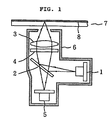
- FIG. 1 An example of the optical pickup device is illustrated in Fig. 1.
- a laser beam outputted from a semiconductor laser (light source) 1 is focused on a recording surface 8 of an optical disk 7 by an objective lens 3 through a plane half mirror (beam splitting part) 2 and a collimator lens 4.
- Reflected light (return light) from the recording surface is struck on a four-split photo diode (light-receiving part) 5 through the objective lens 3, the collimator lens 4 and the plane half mirror 2 to give data signals and error signals (focus error signals and tracking error signals).
- the objective lens 3 is moved vertically and laterally according to the error signals to conduct focus control and tracking control.
- Such components as described above in the optical pickup device are generally held in a holding container 6.
- a metal-made holding container has heretofore been used in the optical pickup device.
- the holding container is in an extremely complicated form, since the components must be installed therein. Therefore, extremely difficult processing has been required in order to produce a metal-made holding container.
- a holding container When a synthetic resin is used in place of a metal, a holding container can be easily produced by, for example, injection molding even when it has a complicated form.
- the holding container made of the synthetic resin is poor in thermal conductibility and hence involves a problem that it tends to be deformed by heat generated from the semiconductor laser and temperature rise at the light-receiving part of signal light.
- the holding container is deformed even a little, there arises a problem that positions of the individual components held therein vary to cause the slippage of an optical axis.
- the form of a spot of the light beam on the recording surface of the recording medium is distorted by the temperature rise, and moreover the form of a light spot at the light-receiving part is also distorted, so that stable recording and reproduction become difficult.
- a particular object of the present invention is to provide an optical pickup device-holding container suitable for digital video disks.
- Another object of the present invention is to provide an optical pickup device in which components such as a light source, an objective lens and a light-receiving part are held in a holding container made of a synthetic resin, which is excellent in heat resistance, dimensional stability, heat distortion resistance and thermal conductibility.
- the present inventors have carried out an extensive investigation with a view toward overcoming the above-described problems involved in the prior art. As a result, it has been found that when a resin composition comprising a poly(arylene sulfide) and an inorganic filler and having a thermal conductivity of at least 1 W/mK is used to produce an optical pickup device-holding container, a holding container excellent in heat resistance, dimensional stability, heat distortion resistance and thermal conductibility can be provided, and stable recording and reproduction can be conducted by an optical pickup device obtained by installing the components thereof in this holding container.
- the present invention has been led to completion on the basis of these findings.
- an optical pickup device-holding container which is formed from a resin composition comprising a poly(arylene sulfide) (A) and an inorganic filler (B) and having a thermal conductivity of at least 1 W/mK.
- an optical pickup device in which at least a light source, an objective lens and a light-receiving part are held in a holding container, wherein the holding container is formed from the above-described resin composition.
- the poly(arylene sulfide) (hereinafter abbreviated as "PAS") useful in the practice of the present invention is an aromatic polymer having predominant repeating units of arylene sulfide represented by the formula [-Ar-S-] in which Ar means an arylene group.
- the PAS used in the present invention is a homopolymer or copolymer containing the repeating unit of [-Ar-S-] in a proportion of generally at least 50 wt.%, preferably at least 70 wt.%, more preferably at least 90 wt.%.
- the arylene group may be mentioned a p-phenylene group, a m-phenylene group, substituted phenylene groups (the substituent being preferably an alkyl group having 1 to 6 carbon atoms or a phenyl group), a p,p'-diphenylene sulfone group, a p,p'-biphenylene group, a p,p'-diphenylenecarbonyl group and a naphthylene group.
- a polymer predominantly having only the same arylene groups may preferably be used. However, a copolymer having two or more different arylene groups may be used from the viewpoints of processability and heat resistance.
- the PAS used in the present invention is preferably a linear polymer.
- a polymer partially containing a branched and/or crosslinked structure, or a crosslinked polymer subjected to a treatment (cure) for increasing its melt viscosity by oxidative crosslinking may also be used so far as it can satisfy mechanical properties.
- poly(phenylene sulfide) (hereinafter abbreviated as "PPS") having predominant repeating units of p-phenylene sulfide is particularly preferred because it is excellent in processability, heat resistance and dimensional stability and industrially available with ease.
- poly(arylene ketone sulfides), poly(arylene ketone ketone sulfides) and the like may also be used.
- copolymers may be mentioned random or block copolymers having repeating units of p-phenylene sulfide and repeating units of m-phenylene sulfide, random or block copolymers having repeating units of phenylene sulfide and repeating units of arylene ketone sulfide, random or block copolymers having repeating units of phenylene sulfide and repeating units of arylene ketone ketone sulfide, and random or block copolymers having repeating units of phenylene sulfide and repeating units of arylene sulfone sulfide.
- These PASS are preferably crystalline polymers from the viewpoints of heat resistance, dimensional stability and the like.
- Such a PAS can be obtained in accordance with the publicly known process (for example, Japanese Patent Publication No. 33775/1988) in which an alkali metal sulfide and a dihalogen-substituted aromatic compound are subjected to a polymerization reaction in a polar solvent.
- the alkali metal sulfide may be mentioned lithium sulfide, sodium sulfide, potassium sulfide, rubidium sulfide and cesium sulfide.
- Sodium sulfide formed by the reaction of NaSH and NaOH in the reaction system may also be used.
- dihalogen-substituted aromatic compound examples may be mentioned p-dichlorobenzene, m-dichlorobenzene, 2,5-dichlorotoluene, p-dibromobenzene, 2,6-dichloronaphthalene, 1-methoxy-2,5-dichlorobenzene, 4,4'-dichlorobiphenyl, 3,5-dichlorobenzoic acid, p,p'-dichlorodiphenyl ether and 4,4'-dichlorodiphenyl ketone. These compounds may be used either singly or in any combination thereof.
- a small amount of a polyhalogen-substituted aromatic compound having at least 3 halogen substituents per molecule may be used in combination.
- the polyhalogen-substituted aromatic compounds may be mentioned trihalogen-substituted aromatic compounds such as 1,2,3-trichlorobenzene, 1,2,3-tribromobenzene, 1,2,4-trichlorobenzene, 1,2,4-tribromobenzene, 1,3,5-trichlorobenzene, 1,3,5-tribromobenzene and 1,3-dichloro-5-bromobenzene, and alkyl-substituted derivatives thereof.
- aprotic organic amide solvents typified by N-alkylpyrrolidones such as N-methyl-2-pyrrolidone (hereinafter abbreviated as "NMP"), 1,3-dialkyl-2-imidazolidinone, tetraalkylureas, and hexaalkylphosphoric triamides are preferred because they have high stability in the reaction system and are easy to provide a high-molecular weight polymer.
- NMP N-methyl-2-pyrrolidone
- 1,3-dialkyl-2-imidazolidinone 1,3-dialkyl-2-imidazolidinone
- tetraalkylureas tetraalkylureas
- hexaalkylphosphoric triamides are preferred because they have high stability in the reaction system and are easy to provide a high-molecular weight polymer.
- melt viscosity of the PAS used in the present invention is desirably within a range of preferably 1 to 200 Pa ⁇ s, more preferably 3 to 140 Pa ⁇ s from the viewpoint of the application to melt processing techniques such as injection molding and extrusion.
- a resin composition comprising PAS and an inorganic filler and having a thermal conductivity of at least 1 W/mK is used as a material of the holding container.
- a resin composition having a too low thermal conductivity is used to produce a holding container, heat dissipation out of the optical pickup device becomes difficult, so that the temperature within the optical pickup device is raised by heat generated from the semiconductor laser and heat derived from light energy received in the light-receiving part.
- the thermal conductivity of the resin composition is preferably about 1 to 3 W/mK.
- the inorganic filler used in the present invention is preferred that having a relatively high thermal conductivity. That combining a high thermal conductivity with excellent dimensional stability is more preferred.
- powdered inorganic fillers include powders of gold, silver, copper, aluminum, iron, zinc, silicon, germanium, molybdenum, brass, bronze, alumina (aluminum oxide), iron oxide, magnesium oxide, silicon oxide, graphite, non-graphitizable carbon, etc. These inorganic fillers may be used either singly or in any combination thereof.
- metal oxide powders are preferred from the viewpoint of stability in the air, with alumina and iron oxide being particularly preferred.
- Spherical alumina is particularly preferred. Since the hardness of alumina is very high, the spherical alumina is preferred from the viewpoint of preventing extruders, injection molding machines, molds and the like from being worn.
- the average particle size of the alumina is generally within a range of 3 to 100 ⁇ m, preferably 5 to 80 ⁇ m, more preferably 8 to 50 ⁇ m from the viewpoint of flowability.
- iron oxide are particularly preferred ferrite compounds typified by spinel type ferrites such as Ni-Zn ferrite, Mn-Zn ferrite, Mg-Zn ferrite and Cu ferrite; magnetoplumbite type ferrites such as Ba ferrite and Sr ferrite; and ⁇ -iron oxide.
- the average particle size of the iron oxide is generally within a range of 1 to 100 ⁇ m, preferably 2 to 80 ⁇ m, more preferably 2 to 50 ⁇ m from the viewpoint of flowability. The average particle size can be measured by means of, for example, a scanning electron microscope (SEM).
- a fibrous filler may be used as the inorganic filler.
- the fibrous filler include glass fibers, carbon fibers, alumina fibers, stainless steel fibers, aluminum fibers, copper fibers, brass fibers, potassium titanate fibers, slag fibers, wollastonite fibers, zonorite fibers, phosphate fibers, calcium sulfate fibers, asbestos fibers, magnesium hydroxide fibers, silicon carbide fibers, silicon nitride fibers, boron fibers and aluminum borate.
- These fibrous fillers may be used either singly or in any combination thereof.
- at least one selected from the group consisting of glass fibers, carbon fibers, wollastonite, potassium titanate and aluminum borate is particularly preferred from the viewpoints of stability in the air and easy industrial availability.
- the powdered inorganic fillers and fibrous fillers may be those subjected to a surface treatment with a coupling agent such as a silane coupling agent, titanate coupling agent or aluminum coupling agent.
- a coupling agent such as a silane coupling agent, titanate coupling agent or aluminum coupling agent.
- the inorganic filler are preferably used in combination the powdered inorganic filler mainly contributing to the improvement of thermal conductibility and the fibrous filler mainly contributing to strength and dimensional stability.
- the powdered inorganic filler is generally compounded in a proportion of 50 to 300 parts by weight, preferably 70 to 200 parts by weight, more preferably 80 to 150 parts by weigh per 100 parts by weight of the PAS. If the compounding proportion of the inorganic filler is too low, it is difficult to provide a resin composition having high thermal conductibility. If the proportion is too high, the resulting resin composition has a possibility that its melt moldability and mechanical strength may be deteriorated.
- the fibrous filler is generally compounded in a proportion of 20 to 300 parts by weight, preferably 30 to 200 parts by weight, more preferably 50 to 150 parts by weigh per 100 parts by weight of the PAS. If the compounding proportion of the fibrous filler is too low, its improving effect on mechanical strength and dimensional stability becomes little. If the proportion is too high, the resulting resin composition has a possibility that its melt moldability may be deteriorated.
- Resin composition :
- the resin composition used in the present invention is a resin composition comprising a poly(arylene sulfide) and an inorganic filler and having a thermal conductivity of at least 1 W/mK.
- To the resin composition according to the present invention may be added an antioxidant, lubricant, parting agent, nucleating agent, flame retardant, colorant, impact modifier, thermosetting resin, any other thermoplastic resin, etc. so far as no detrimental influence is thereby imposed on the objects of the present invention.
- the resin composition according to the present invention can be prepared by equipment and methods generally used in the preparation of thermoplastic resin compositions. More specifically, necessary components can be mixed and kneaded in a single-screw or twin-screw extruder and extruded into pellets for molding.
- Holding container and optical pickup device
- the resin composition can be molded into a holding container by injecting it into a mold. According to the injection molding of the resin composition, there is no need for complicated and difficult processing that is required of the metal-made holding containers. Necessary parts may also be formed by means of extrusion and press molding other than injection molding.
- the form of the holding container may be suitably determined according to the kinds and arranged state of components held therein.
- An optical pickup device generally has a structure that at least a light source, an objective lens and a light-receiving part are held in the holding container. In many cases, the pickup device is also equipped with a beam splitting part, a collimator lens, etc. An example of the optical pickup device is illustrated in Fig. 1. However, the holding container and optical pickup device according to the present invention are not limited thereto.
- the thermal conductivity of each resin composition sample is measured in accordance with ASTM C 201.
- Poly(phenylene sulfide) (W203, product of Kureha Kagaku Kogyo K.K.; melt viscosity measured at 310°C and a shear rate of 1200/sec: 30 Pa ⁇ s; 8 kg) and alumina (AS-50, product of Showa Denko K.K.; spherical particles of ⁇ -alumina having an average particle size of 10 ⁇ m; 8 kg) were charged into a 20-liter Henschel mixer and mixed for about 3 minutes. Glass fibers (GLK, product of Nippon Electric Glass Co., Ltd.; 4 kg) were then added thereto, and the contents were stirred for 30 seconds to obtain a mixture.
- GLK product of Nippon Electric Glass Co., Ltd.; 4 kg
- the resultant mixture was fed to a twin-screw extruder controlled to a temperature of 280 to 320°C, and melted and kneaded, thereby obtaining a resin composition in the form of pellets.
- the thermal conductivity of the resin composition thus obtained was 1.5 W/mK.
- the pellet-like resin composition obtained above was fed to an injection molding machine the cylinder temperature of which was controlled to from 280°C to 320°C, and injected into a mold controlled to from 150°C to 160°C to mold it into an optical pickup device-holding container.
- a semiconductor laser, a beam splitting part and a light-receiving part were installed in the thus-obtained optical pickup device-holding container to conduct reproduction of optical disks. As a result, the reproduction was certainly feasible over a long period of time without any problem.
- Poly(phenylene sulfide) (W203, product of Kureha Kagaku Kogyo K.K.; melt viscosity measured at 310°C and a shear rate of 1200/sec: 30 Pa ⁇ s; 8 kg) and powder (average particle size: 3 ⁇ m; 8 kg) of Mn-Zn ferrite were charged into a 20-liter Henschel mixer and mixed for about 3 minutes. Glass fibers (GLK, product of Nippon Electric Glass Co., Ltd.; 4 kg) were then added thereto, and the contents were stirred for 30 seconds to obtain a mixture.
- GLK product of Nippon Electric Glass Co., Ltd.; 4 kg
- the resultant mixture was fed to a twin-screw extruder controlled to a temperature of 280 to 320°C and melted and kneaded, thereby obtaining a resin composition in the form of pellets.
- the thermal conductivity of the resin composition thus obtained was 1.2 W/mK.
- the pellet-like resin composition obtained above was fed to an injection molding machine the cylinder temperature of which was controlled to from 280°C to 320°C, and injected into a molded controlled to from 150°C to 160°C to mold it into an optical pickup device-holding container.
- a semiconductor laser, a beam splitting part and a light-receiving part were installed in the thus-obtained optical pickup device-holding container to conduct reproduction of optical disks. As a result, the reproduction was certainly feasible over a long period of time without any problem.
- Poly(phenylene sulfide) (W203, product of Kureha Kagaku Kogyo K.K.; melt viscosity measured at 310°C and a shear rate of 1200/sec: 30 Pa ⁇ s; 7 kg) and calcium carbonate (MAMAKARUSO, product of Nitto Funka Kogyo K.K.; 6 kg) were charged into a 20-liter Henschel mixer and mixed for about 3 minutes. Glass fibers (product of Nippon Electric Glass Co., Ltd.; diameter: 13 ⁇ m; 7 kg) were then added thereto, and the contents were stirred for 30 seconds to obtain a mixture.
- MAMAKARUSO product of Nitto Funka Kogyo K.K.
- the resultant mixture was fed to a twin-screw extruder controlled to a temperature of 280 to 320°C and melted and kneaded, thereby obtaining a resin composition in the form of pellets.
- the thermal conductivity of the resin composition thus obtained was 0.5 W/mK.
- the pellet-like resin composition obtained above was fed to an injection molding machine the cylinder temperature of which was controlled to from 280°C to 320°C, and injected into a molded controlled to from 150°C to 160°C to mold it into an optical pickup device-holding container.
- a semiconductor laser, a beam splitting part and a light-receiving part were installed in the thus-obtained optical pickup device-holding container to conduct reproduction of optical disks.
- slippage of the optical axis occurred when the time went on, so that reproduced signals became unstable.
- optical pickup device-holding containers made of a synthetic resin, which are excellent in heat resistance, dimensional stability, heat distortion resistance and thermal conductibility.
- the holding containers according to the present invention are particularly suitable for recording/reproduction in digital video disks.
- optical pickup devices in which components such as a light source, an objective lens and a light-receiving part are held in the holding container made of a synthetic resin, which is excellent in heat resistance, dimensional stability, heat distortion resistance and thermal conductibility. Since the holding containers according to the present invention are obtained by melt molding the resin composition, the degree of freedom of shape is extremely high compared with those made of a metal, and moreover productivity thereof is also extremely high.
Landscapes
- Chemical & Material Sciences (AREA)
- Health & Medical Sciences (AREA)
- Chemical Kinetics & Catalysis (AREA)
- Medicinal Chemistry (AREA)
- Polymers & Plastics (AREA)
- Organic Chemistry (AREA)
- Physics & Mathematics (AREA)
- Optics & Photonics (AREA)
- Optical Head (AREA)
- Compositions Of Macromolecular Compounds (AREA)
Applications Claiming Priority (3)
| Application Number | Priority Date | Filing Date | Title |
|---|---|---|---|
| JP11624197 | 1997-04-18 | ||
| JP9116241A JPH10293940A (ja) | 1997-04-18 | 1997-04-18 | 光ピックアップ装置用保持容器 |
| PCT/JP1998/001780 WO1998048414A1 (en) | 1997-04-18 | 1998-04-17 | Optical pickup device holding container |
Publications (2)
| Publication Number | Publication Date |
|---|---|
| EP0977190A1 true EP0977190A1 (de) | 2000-02-02 |
| EP0977190A4 EP0977190A4 (de) | 2000-03-01 |
Family
ID=14682299
Family Applications (1)
| Application Number | Title | Priority Date | Filing Date |
|---|---|---|---|
| EP98914080A Withdrawn EP0977190A4 (de) | 1997-04-18 | 1998-04-17 | Behälter für optische abtastvorrichtung |
Country Status (7)
| Country | Link |
|---|---|
| US (1) | US6641878B2 (de) |
| EP (1) | EP0977190A4 (de) |
| JP (1) | JPH10293940A (de) |
| KR (1) | KR20010006272A (de) |
| CN (1) | CN1117357C (de) |
| TW (1) | TW369650B (de) |
| WO (1) | WO1998048414A1 (de) |
Cited By (4)
| Publication number | Priority date | Publication date | Assignee | Title |
|---|---|---|---|---|
| US6492448B1 (en) | 1999-12-28 | 2002-12-10 | Dainippon Ink And Chemicals, Incorporated | Polyarylenesulfide resin composition |
| EP1400570A4 (de) * | 2001-05-29 | 2005-01-26 | Idemitsu Petrochemical Co | Harzzusammensetzung für optische teile und optische teile |
| EP1270926A4 (de) * | 2000-03-08 | 2005-03-16 | Hitachi Ltd | Elektromagnetisch betriebenes brennstoffeinspritzventil |
| CN101629018B (zh) * | 2008-06-09 | 2013-07-31 | 信越化学工业株式会社 | 白色热固性硅树脂组合物和光电子部件壳体 |
Families Citing this family (21)
| Publication number | Priority date | Publication date | Assignee | Title |
|---|---|---|---|---|
| JP2001117041A (ja) * | 1999-10-19 | 2001-04-27 | Ricoh Co Ltd | 光走査装置及び画像形成装置 |
| JP5207261B2 (ja) * | 2000-03-07 | 2013-06-12 | 東レ株式会社 | 樹脂組成物 |
| JP4775609B2 (ja) * | 2000-10-25 | 2011-09-21 | Dic株式会社 | ポリアリーレンスルフィド樹脂組成物および光学式ピックアップ用パーツ |
| JP2002146187A (ja) * | 2000-11-08 | 2002-05-22 | Toray Ind Inc | ポリフェニレンスルフィド樹脂組成物 |
| JP2002188005A (ja) * | 2000-12-20 | 2002-07-05 | Sumitomo Bakelite Co Ltd | ポリフェニレンサルファイド樹脂組成物 |
| US8119176B2 (en) * | 2002-07-26 | 2012-02-21 | E. I. Du Pont De Nemours And Company | Thermoplastic polymeric ovenware |
| US20060237451A1 (en) * | 2002-07-26 | 2006-10-26 | Sameuls Michael R | Ovenware for microwave oven |
| CN100361208C (zh) * | 2003-07-16 | 2008-01-09 | 出光兴产株式会社 | 光学阅读装置 |
| JP4691931B2 (ja) * | 2004-09-14 | 2011-06-01 | 東レ株式会社 | 色光合成光学系部品 |
| JP4973114B2 (ja) * | 2005-11-07 | 2012-07-11 | 東レ株式会社 | 樹脂組成物、それからなる錠剤の製造方法、および成形品 |
| US7433585B2 (en) * | 2005-11-15 | 2008-10-07 | Micron Technology, Inc. | System and method of lens placement |
| US8430239B2 (en) * | 2008-04-01 | 2013-04-30 | Steven B. Shpiner | Protective carrying case for photographic equipment |
| JP5177089B2 (ja) * | 2008-07-30 | 2013-04-03 | 東レ株式会社 | ポリアリーレンスルフィド樹脂組成物、ポリアリーレンスルフィド樹脂組成物錠剤およびそれらから得られる成形品 |
| JP5458246B2 (ja) * | 2009-06-11 | 2014-04-02 | 富士フイルム株式会社 | 光学部品保持部材およびその作製方法 |
| TW201113316A (en) * | 2009-06-15 | 2011-04-16 | Sumitomo Chemical Co | Resin forming body and production method thereof |
| KR20120051713A (ko) | 2009-07-24 | 2012-05-22 | 티코나 엘엘씨 | 열전도성 열가소성 수지 조성물 및 관련 용도 |
| WO2011010291A1 (en) | 2009-07-24 | 2011-01-27 | Ticona Llc | Thermally conductive polymer compositions and articles made therefrom |
| JP5679175B2 (ja) * | 2010-03-24 | 2015-03-04 | 株式会社リコー | 光走査装置及び画像形成装置 |
| CN102286269A (zh) * | 2011-08-17 | 2011-12-21 | 周贤和 | Led灯散热材料、散热器及led灯 |
| JP5834725B2 (ja) * | 2011-09-30 | 2015-12-24 | Dic株式会社 | 高放熱性ポリアリーレンスルフィド樹脂組成物および成形体 |
| CN106832930A (zh) * | 2017-01-26 | 2017-06-13 | 潮州三环(集团)股份有限公司 | Mt插芯原材料及其制备方法 |
Family Cites Families (17)
| Publication number | Priority date | Publication date | Assignee | Title |
|---|---|---|---|---|
| US4645826A (en) * | 1984-06-20 | 1987-02-24 | Kureha Kagaku Kogyo Kabushiki Kaisha | Process for production of high to ultra-high molecular weight linear polyarylenesulfides |
| JPS6310660A (ja) * | 1986-06-23 | 1988-01-18 | Kureha Chem Ind Co Ltd | ポリアリ−レンスルフイド樹脂組成物およびその製造法 |
| JPS6333775A (ja) | 1986-07-28 | 1988-02-13 | シャープ株式会社 | ライトボックス |
| DE3831425C2 (de) * | 1987-09-16 | 1998-01-22 | Sankyo Seiki Seisakusho Kk | Optische Abnehmervorrichtung |
| JPH01236270A (ja) * | 1988-03-17 | 1989-09-21 | Showa Denko Kk | 樹脂組成物 |
| US5028461A (en) * | 1988-10-03 | 1991-07-02 | Idemitsu Petrochemical Company Limited | Injection molded container for food |
| JP2772342B2 (ja) * | 1989-08-07 | 1998-07-02 | 出光石油化学株式会社 | 光学式ピックアップのパーツ用樹脂組成物および光学式ピックアップのパーツ |
| JPH03138808A (ja) * | 1989-10-23 | 1991-06-13 | Toshiba Chem Corp | 導電性樹脂組成物及びその成形品 |
| JPH03198231A (ja) * | 1989-12-26 | 1991-08-29 | Canon Inc | 光学的情報記録再生装置並びに該装置に用いられる光ヘッド |
| JPH066647A (ja) * | 1992-03-04 | 1994-01-14 | Moritetsukusu:Kk | 高圧下で使用する撮像装置 |
| JP3287109B2 (ja) | 1994-04-06 | 2002-05-27 | 新日本理化株式会社 | ポリアリーレンスルフィド樹脂組成物の成形方法 |
| CN1082982C (zh) * | 1993-10-01 | 2002-04-17 | 株式会社三协精机制作所 | 聚芳硫醚树脂组合物及使用该树脂组合物的光学式拾音器件 |
| JPH08302190A (ja) | 1995-04-28 | 1996-11-19 | Idemitsu Petrochem Co Ltd | ポリアリーレンスルフィド樹脂組成物 |
| JPH08315406A (ja) | 1995-05-12 | 1996-11-29 | Fuji Photo Optical Co Ltd | 光ピックアップ装置 |
| JPH08315402A (ja) | 1995-05-15 | 1996-11-29 | Fuji Photo Optical Co Ltd | 光ピックアップ装置 |
| JPH08321067A (ja) | 1995-05-22 | 1996-12-03 | Sanyo Electric Co Ltd | 光ピックアップ装置 |
| JP3223074B2 (ja) | 1995-05-23 | 2001-10-29 | 三洋電機株式会社 | 光ピックアップ装置 |
-
1997
- 1997-04-18 JP JP9116241A patent/JPH10293940A/ja active Pending
-
1998
- 1998-04-17 KR KR1019997009356A patent/KR20010006272A/ko not_active Ceased
- 1998-04-17 US US09/403,129 patent/US6641878B2/en not_active Expired - Fee Related
- 1998-04-17 CN CN98804196A patent/CN1117357C/zh not_active Expired - Fee Related
- 1998-04-17 EP EP98914080A patent/EP0977190A4/de not_active Withdrawn
- 1998-04-17 WO PCT/JP1998/001780 patent/WO1998048414A1/ja not_active Ceased
- 1998-04-18 TW TW087105958A patent/TW369650B/zh active
Cited By (4)
| Publication number | Priority date | Publication date | Assignee | Title |
|---|---|---|---|---|
| US6492448B1 (en) | 1999-12-28 | 2002-12-10 | Dainippon Ink And Chemicals, Incorporated | Polyarylenesulfide resin composition |
| EP1270926A4 (de) * | 2000-03-08 | 2005-03-16 | Hitachi Ltd | Elektromagnetisch betriebenes brennstoffeinspritzventil |
| EP1400570A4 (de) * | 2001-05-29 | 2005-01-26 | Idemitsu Petrochemical Co | Harzzusammensetzung für optische teile und optische teile |
| CN101629018B (zh) * | 2008-06-09 | 2013-07-31 | 信越化学工业株式会社 | 白色热固性硅树脂组合物和光电子部件壳体 |
Also Published As
| Publication number | Publication date |
|---|---|
| US6641878B2 (en) | 2003-11-04 |
| WO1998048414A1 (en) | 1998-10-29 |
| KR20010006272A (ko) | 2001-01-26 |
| EP0977190A4 (de) | 2000-03-01 |
| JPH10293940A (ja) | 1998-11-04 |
| CN1252882A (zh) | 2000-05-10 |
| CN1117357C (zh) | 2003-08-06 |
| US20030129333A1 (en) | 2003-07-10 |
| TW369650B (en) | 1999-09-11 |
Similar Documents
| Publication | Publication Date | Title |
|---|---|---|
| US6641878B2 (en) | Optical pickup device holding container | |
| EP0336557A1 (de) | Polyarylensulfidharz Zusammensetzung | |
| JP3831174B2 (ja) | ポリアリーレンスルフィド樹脂組成物及び用途 | |
| JP2772342B2 (ja) | 光学式ピックアップのパーツ用樹脂組成物および光学式ピックアップのパーツ | |
| JP2004176062A (ja) | 光ピックアップ部品用錠剤、それから得られる光ピックアップ部品およびその製造方法 | |
| JP4919542B2 (ja) | 光学部品用樹脂組成物および光学部品 | |
| JPH08302190A (ja) | ポリアリーレンスルフィド樹脂組成物 | |
| JP3958415B2 (ja) | ポリアリーレンスルフィド成形体の製造方法 | |
| JP3133203B2 (ja) | ポリアリーレンサルファイド樹脂組成物及びこれを用いた光学式ピックアップ部品 | |
| JP2002129015A (ja) | ポリアリーレンスルフィド樹脂組成物および光学式ピックアップ用パーツ | |
| JP3151823B2 (ja) | ポリアリーレンサルファイド樹脂組成物 | |
| JP3863249B2 (ja) | ポリアリーレンスルフィド成形体とその製造方法 | |
| KR100878104B1 (ko) | 광학 부품용 수지 조성물 및 광학 부품 | |
| EP1384756A1 (de) | Polyarylsulfidharzzusammensetzung für teile für die optische nachrichtentechnik | |
| JP2004137401A (ja) | 熱放散性に優れた精密成形用ポリフェニレンサルファイド樹脂組成物 | |
| JPH04159369A (ja) | ポリアリーレンサルファイド組成物 | |
| US5985974A (en) | Slide member for parts to be in contact with magnetic tape | |
| JP2004075881A (ja) | 光学部品 | |
| JP2005162918A (ja) | 精密成形用ポリフェニレンサルファイド樹脂組成物及びその成形品 | |
| JPH10182968A (ja) | ポリアリーレンスルフィド樹脂組成物及び摺動部材 | |
| JP2007106970A (ja) | 光学部品用樹脂組成物及び光学部品 | |
| JPH10168315A (ja) | 光学式アクチュエーター用ポリアリーレンサルファイド樹脂組成物 | |
| JP2005048157A (ja) | 光ピックアップスライドベース精密成形用樹脂組成物 | |
| JPH05262982A (ja) | 光学式ピックアップ用樹脂組成物 | |
| JPH0748511A (ja) | 低温成形用ポリアリーレンスルフィド樹脂組成物および自動車用ヘッドランプリフレクター |
Legal Events
| Date | Code | Title | Description |
|---|---|---|---|
| PUAI | Public reference made under article 153(3) epc to a published international application that has entered the european phase |
Free format text: ORIGINAL CODE: 0009012 |
|
| 17P | Request for examination filed |
Effective date: 19991110 |
|
| AK | Designated contracting states |
Kind code of ref document: A1 Designated state(s): DE FR GB |
|
| A4 | Supplementary search report drawn up and despatched |
Effective date: 20000119 |
|
| AK | Designated contracting states |
Kind code of ref document: A4 Designated state(s): DE FR GB |
|
| RIC1 | Information provided on ipc code assigned before grant |
Free format text: 7G 11B 7/12 A, 7G 11B 33/02 B |
|
| STAA | Information on the status of an ep patent application or granted ep patent |
Free format text: STATUS: THE APPLICATION IS DEEMED TO BE WITHDRAWN |
|
| 18D | Application deemed to be withdrawn |
Effective date: 20041101 |