EP0978518A1 - Crystallisierung von Alpha-L-aspartyl-L-phenylalaninethylester durch Verdampfung von Abschlämmungströpfchen durch eine Schicht von kaltem Luft - Google Patents
Crystallisierung von Alpha-L-aspartyl-L-phenylalaninethylester durch Verdampfung von Abschlämmungströpfchen durch eine Schicht von kaltem Luft Download PDFInfo
- Publication number
- EP0978518A1 EP0978518A1 EP98309953A EP98309953A EP0978518A1 EP 0978518 A1 EP0978518 A1 EP 0978518A1 EP 98309953 A EP98309953 A EP 98309953A EP 98309953 A EP98309953 A EP 98309953A EP 0978518 A1 EP0978518 A1 EP 0978518A1
- Authority
- EP
- European Patent Office
- Prior art keywords
- solution
- crystallizer
- droplets
- cold air
- chamber
- Prior art date
- Legal status (The legal status is an assumption and is not a legal conclusion. Google has not performed a legal analysis and makes no representation as to the accuracy of the status listed.)
- Withdrawn
Links
Images

Classifications
-
- C—CHEMISTRY; METALLURGY
- C30—CRYSTAL GROWTH
- C30B—SINGLE-CRYSTAL GROWTH; UNIDIRECTIONAL SOLIDIFICATION OF EUTECTIC MATERIAL OR UNIDIRECTIONAL DEMIXING OF EUTECTOID MATERIAL; REFINING BY ZONE-MELTING OF MATERIAL; PRODUCTION OF A HOMOGENEOUS POLYCRYSTALLINE MATERIAL WITH DEFINED STRUCTURE; SINGLE CRYSTALS OR HOMOGENEOUS POLYCRYSTALLINE MATERIAL WITH DEFINED STRUCTURE; AFTER-TREATMENT OF SINGLE CRYSTALS OR A HOMOGENEOUS POLYCRYSTALLINE MATERIAL WITH DEFINED STRUCTURE; APPARATUS THEREFOR
- C30B35/00—Apparatus not otherwise provided for, specially adapted for the growth, production or after-treatment of single crystals or of a homogeneous polycrystalline material with defined structure
-
- C—CHEMISTRY; METALLURGY
- C07—ORGANIC CHEMISTRY
- C07K—PEPTIDES
- C07K5/00—Peptides containing up to four amino acids in a fully defined sequence; Derivatives thereof
- C07K5/04—Peptides containing up to four amino acids in a fully defined sequence; Derivatives thereof containing only normal peptide links
- C07K5/06—Dipeptides
- C07K5/06104—Dipeptides with the first amino acid being acidic
- C07K5/06113—Asp- or Asn-amino acid
- C07K5/06121—Asp- or Asn-amino acid the second amino acid being aromatic or cycloaliphatic
- C07K5/0613—Aspartame
-
- C—CHEMISTRY; METALLURGY
- C30—CRYSTAL GROWTH
- C30B—SINGLE-CRYSTAL GROWTH; UNIDIRECTIONAL SOLIDIFICATION OF EUTECTIC MATERIAL OR UNIDIRECTIONAL DEMIXING OF EUTECTOID MATERIAL; REFINING BY ZONE-MELTING OF MATERIAL; PRODUCTION OF A HOMOGENEOUS POLYCRYSTALLINE MATERIAL WITH DEFINED STRUCTURE; SINGLE CRYSTALS OR HOMOGENEOUS POLYCRYSTALLINE MATERIAL WITH DEFINED STRUCTURE; AFTER-TREATMENT OF SINGLE CRYSTALS OR A HOMOGENEOUS POLYCRYSTALLINE MATERIAL WITH DEFINED STRUCTURE; APPARATUS THEREFOR
- C30B29/00—Single crystals or homogeneous polycrystalline material with defined structure characterised by the material or by their shape
- C30B29/54—Organic compounds
-
- C—CHEMISTRY; METALLURGY
- C30—CRYSTAL GROWTH
- C30B—SINGLE-CRYSTAL GROWTH; UNIDIRECTIONAL SOLIDIFICATION OF EUTECTIC MATERIAL OR UNIDIRECTIONAL DEMIXING OF EUTECTOID MATERIAL; REFINING BY ZONE-MELTING OF MATERIAL; PRODUCTION OF A HOMOGENEOUS POLYCRYSTALLINE MATERIAL WITH DEFINED STRUCTURE; SINGLE CRYSTALS OR HOMOGENEOUS POLYCRYSTALLINE MATERIAL WITH DEFINED STRUCTURE; AFTER-TREATMENT OF SINGLE CRYSTALS OR A HOMOGENEOUS POLYCRYSTALLINE MATERIAL WITH DEFINED STRUCTURE; APPARATUS THEREFOR
- C30B7/00—Single-crystal growth from solutions using solvents which are liquid at normal temperature, e.g. aqueous solutions
Definitions
- the present invention relates to producing a low-calorie sweetening substance, more particularly, to crystallization of the ⁇ -L-aspartyl-L-phenylalanine methyl ester.
- ⁇ -L-aspartyl-L-phenylalanine methyl ester hereinafter referred to aspartame
- aspartame is a low-calorie sugar substitute and is industrially synthesized by several different processes.
- the synthesized aspartame is isolated most commonly by crystallization, which is followed by dewatering and drying processes. Further treatments or processes can be applied to the aspartame to provide various consumer products.
- Crystallization occurs by cooling a solution or by evaporating the solvent thereof.
- cooling crystallization as the solution is cooled, the solute is supersaturated, which causes formation and growth of crystals.
- obtaining coarse and uniform crystals is the goal. In theory, this can be accomplished by cooling the solution with an infinitesimal amount of heat transfer.
- an aspartame solution is directly contacting with ice to cool and crystallize the aspartame.
- the process can reduce the time required in the cooling crystallization.
- the aspartame solution is diluted and the final yield of the aspartame crystals decreases.
- One aspect of the present invention provides a method of crystallizing a solute dissolved in a solution.
- an aqueous solution is prepared, and cold air is blown to form a layer of cold airflow.
- the solution is atomized to droplets, which pass through the layer of cold air flow, thereby crystallizing the solute dissolved in the droplets.
- the slurry including the solute crystals and remaining solution is accordingly obtained.
- the crystallizer comprises a crystallization chamber and an atomizer installed within the crystallizer.
- the crystallization chamber comprises a solution inlet port for introducing the solution into the chamber, an air inlet opening for introducing a cold airflow into the chamber, an air outlet opening, and a slurry outlet port.
- the atomizer is connected to the solution inlet port and atomizes the solution to droplets of the atomized solution and disperses the droplets over the cold airflow.
- the droplets heat-exchange with the cold airflow to crystallize the solute dissolved in the droplets and form slurry comprising crystals and remaining solution while they pass through the airflow introduced into the chamber.
- the slurry is discharged through the slurry outlet port, and the airflow after the heat-exchange is discharged through the air outlet opening.
- the inventors of this application researched alternative ways of crystallization of the aspartame.
- the research showed the possibility of cooling crystallizing by contacting cold air to an aspartame solution. It is also discovered that providing the aspartame solution in an atomized form, i.e., dispersing droplets of the solution, facilitates the cooling crystallization of the aspartame with the cold air.
- the present invention to be further discussed herein in detail is based on these research results.
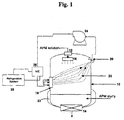
- a cooling crystallizer in accordance with the present invention is illustrated in Figure 1.
- a crystallization chamber 10 including an inlet 12 for introducing aspartame solution into the chamber 10 and an outlet 14 for discharging aspartame slurry.
- the slurry means the result of the crystallization of the aspartame solution and includes aspartame crystals and remaining solution with a lower aspartame concentration than the initial aspartame solution supplied through the inlet 12.
- the aspartame solution, passing through the inlet 12, is supplied to an atomizer 16 for spraying the solution.
- the inlet 12 is advantageously located on a top wall of the chamber 10 to facilitate the supply of the solution to the atomizer 16.
- the aspartame slurry outlet 14 is advantageously formed on a bottom wall of the chamber, such as on the bottom wall to facilitate the discharge of the slurry.
- the chamber 10 further has an air inlet opening 18 and an air outlet opening 20.
- the air inlet opening 18 is formed on a sidewall of the chamber 10 to introduce cold air into the chamber 10.
- the air inlet opening 18 is advantageously located at a little lower level than the atomizer 16.
- the air outlet opening 20 is formed on the sidewall of the chamber 10 to discharge the air which has passed through the chamber 10.
- the air outlet opening 20 is advantageously located on the opposite side of the air inlet opening 18 and at a higher level than the air inlet opening 18.
- Aqueous aspartame solution supplied to the atomizer 16 is sprayed or dispersed to droplets of the aspartame solution, which fall down within the chamber 10. Meanwhile, cold air, which is cooled outside the chamber 10, is introduced into the chamber 10 to cool the falling aspartame solution droplets. The cold air is blown from the air inlet opening 18 and flows toward the air outlet opening so that a layer 22 of cold air flow is formed under the atomizer 16 within the crystallization chamber 10.
- the aspartame slurry can be additionally cooled to further crystallize the aspartame, which still remains dissolved in the slurry, before it is discharged from the chamber 10.
- a lower portion of the chamber 10 is advantageously equipped with cooling jacket 23, within which a coolant is circulating.
- the aspartame slurry may be further cooled outside the chamber 10 with forced flow or agitation, which can facilitate the separation of solid crystals from the remaining solution in the slurry in the following process of dewatering.
- the aspartame slurry is first discharged and further cooled outside the chamber 10, where a forced flow or agitation may be applied.
- the cold air introduced into the chamber 10 becomes warm as it heat-exchanges with the aspartame droplets while it flows toward the air outlet opening 20, which is opposingly located to the air inlet opening 18.
- a fan 24 is advantageously provided next to the air outlet opening 20 to suck and expel the heat-exchanged air from the chamber 10.
- the expelled air is in turn cooled in a heat exchanger 26 connected to an outside refrigeration system 28 and returns to the crystallization chamber 10 to cool the aspartame droplets.
- the aspartame crystals obtained in accordance with the present invention are generally coarser than those obtained by cooling the aspartame solution itself. Further, the structure of the crystals is such that water retained in the structure is easily removed by centrifugation or pressurized filtration in the following process.
- Solvent used in the aspartame aqueous solution supplied to the crystallizer includes water or a mixture of water and a water-miscible organic solvent.
- the mixed solvent advantageously dissolves the aspartame more than water itself.
- Lower alcohol, such as methanol, ethanol, isopropanol, or t-butanol are advantageously used as the water miscible organic solvent when the solvent is removed after the crystallization by evaporation under vacuum condition.
- the aspartame aqueous solution is heated to adjust the concentration high enough to obtain a decent amount of aspartame crystals during the cooling crystallization.
- the aspartame solution is heated until aspartame begins to break down and form benzyl-3,6-dioxo-2-piperazine acetic acid or ⁇ -L-aspartyl-L-phenylalanine, which is at about 70°C.
- the initial temperature of the aspartame solution supplied to atomizer 16 is advantageously from about 40°C to about 70°C. Desirably, the solution is supplied to the atomizer 16 at from about 50°C to about 60°C.
- the aspartame concentration is advantageously higher than about 90% of the saturated concentration at the temperature.
- any nozzle or spray to disperse liquid can be used as an atomizer in accordance with the present invention.
- a pressure nozzle, rotatory nozzle, spray nozzle, etc. can be used.
- the atomizer is advantageously located right above the top of the cold airflow layer 22.
- the size of the atomized droplets in diameter is advantageously from about 0.01 mm to about 2 mm, desirably from about 0.02 mm to about 1 mm, preferably from about 0.02 mm to about 0.5 mm.
- the aspartame solution is atomized and sprayed at a constant rate.
- the sprayed aspartame solution passes the layer 22 of cold airflow advantageously within about 1 min., preferably, from about 2 sec. to about 30 sec.
- atmospheric air, nitrogen gas, or inert gases are used.
- the cold air is blown into the chamber at a temperature from about -5°C to about 50°C, advantageously from about 0°C to about 20°C.
- the temperature of the cold air is preferably adjusted so that it is a little cooler than that of the droplets sprayed in the atomizer.
- the layer 22 of the cold airflow is thick enough the aspartame droplets to heat-exchange with the cold air while they are passing through the layer 22.
- the layer 22 of the cold airflow is thicker than about 0.5 m.
- the thickness of the cold airflow layer 22 is desirably from about 1 m to about 4 m, and preferably from about 1 m to about 2.5 m thick.
- the cold air is blown through the chamber advantageously at a constant speed. The speed of the cold air is adjusted so that the cold airflow does not agitate the falling aspartame solution droplets.
- the cold airflow is not faster than the falling droplets.
- FIG. 2 illustrates a crystallization chamber 10 in accordance with another embodiment of the present invention.
- Like elements are referred by like numerals, and the foregoing description of like components between the embodiments should be understood to apply to the present embodiment unless indicated otherwise.
- a plurality of atomizers 16a, 16b are installed at different levels within the chamber 10.
- An air inlet opening 18 advantageously is formed on a sidewall of the chamber 10 at a level lower than the lowest atomizer 16b.
- An air outlet opening 20 is advantageously provided on a sidewall or top wall of the chamber 10 at a level higher than the highest atomizer.
- a partition 30 is provided under each atomizer 16a, 16b such that each partition 30 covers at least the below-located atomizer 16b.
- the partition 30 is slanted toward any direction with a substantially flat top surface to facilitate the flow of the slurry thereon.
- the top surface of the partition 30 is radially outwardly slanted down.
- an above-located partition is advantageously broader than a below-located partition.
- Aspartame solution is atomized and sprayed downward at each atomizer 16a, 16b.
- Cold air is blown upward from the air inlet opening 18 and cools aspartame droplets falling between each atomizer 16a, 16b and partition 30.
- the air thereafter is discharged from the chamber 10 through the air outlet opening 20.
- Aspartame is crystallized while the droplets are heat exchanging with the cold air, and aspartame slurry falls on each partition 30, which avoids the slurry attacking the below-located atomizer 16b and the sprayed droplets therefrom.
- the aspartame slurry slides down on the slanted top surface of the partition 30 and fails to the bottom portion of the chamber 10, where a slurry discharge outlet 38 is formed.
- the plurality of atomizers can be arranged horizontally rather than vertically as described above. With the horizontally arranged plurality of atomizers, the partitions 30 can be removed from the crystallization chamber 10.
- the aspartame slurry then was stirred to further crystallize as well as to facilitate the separation of solid phase aspartame crystals from liquid in the following centrifugation.
- the aspartame slurry thereafter was dewatered by centrifugation with 600 G-Force.
- aspartame crystals contained 38 wt.% of moisture.
- Example 2 The same experiment as in Example 1 was repeated except that the diameter of the sprayed droplets are from about 0.2 mm to about 0.3 mm.
- Example 2 The same experiment as in Example 1 was repeated except that the solvent included 25wt% of methanol and 5.4wt% of aspartame solution was used.
- Example 3 The same experiment as in Example 3 was repeated except that the diameter of the sprayed droplets are from about 0.4 mm to about 0.5 mm.
- Example 2 The same experiment as in Example 1 was repeated except that the cold air temperature was maintained at 10°C and the aspartame slurry was further cooled at 15 to 20°C.
Landscapes
- Chemical & Material Sciences (AREA)
- Organic Chemistry (AREA)
- Engineering & Computer Science (AREA)
- Crystallography & Structural Chemistry (AREA)
- Materials Engineering (AREA)
- Metallurgy (AREA)
- Biochemistry (AREA)
- Life Sciences & Earth Sciences (AREA)
- Health & Medical Sciences (AREA)
- Biophysics (AREA)
- General Health & Medical Sciences (AREA)
- Genetics & Genomics (AREA)
- Medicinal Chemistry (AREA)
- Molecular Biology (AREA)
- Proteomics, Peptides & Aminoacids (AREA)
- Peptides Or Proteins (AREA)
- Seasonings (AREA)
Applications Claiming Priority (4)
| Application Number | Priority Date | Filing Date | Title |
|---|---|---|---|
| KR9830675 | 1998-07-29 | ||
| KR1019980030675A KR20000009984A (ko) | 1998-07-29 | 1998-07-29 | 알파-엘-아스파틸-엘-페닐알라닌 메틸 에스테르의 결정화 방법 |
| US09/183,436 US6127569A (en) | 1998-07-29 | 1998-10-30 | Crystallization of α-L-aspartyl-L-phenylalanine methyl ester |
| US183436 | 1998-10-30 |
Publications (1)
| Publication Number | Publication Date |
|---|---|
| EP0978518A1 true EP0978518A1 (de) | 2000-02-09 |
Family
ID=26633984
Family Applications (1)
| Application Number | Title | Priority Date | Filing Date |
|---|---|---|---|
| EP98309953A Withdrawn EP0978518A1 (de) | 1998-07-29 | 1998-12-04 | Crystallisierung von Alpha-L-aspartyl-L-phenylalaninethylester durch Verdampfung von Abschlämmungströpfchen durch eine Schicht von kaltem Luft |
Country Status (1)
| Country | Link |
|---|---|
| EP (1) | EP0978518A1 (de) |
Cited By (1)
| Publication number | Priority date | Publication date | Assignee | Title |
|---|---|---|---|---|
| EP1314360A1 (de) * | 2001-11-22 | 2003-05-28 | Ajinomoto Co., Inc. | Prozess zur Herstellung eines stabilen Aspartam-Breies und Testmethode zur Beurteilung dessen Stabilität |
Citations (1)
| Publication number | Priority date | Publication date | Assignee | Title |
|---|---|---|---|---|
| EP0718306A1 (de) * | 1994-12-22 | 1996-06-26 | Holland Sweetener Company V.O.F. | Crystallisierung vom Alpha-L-Aspartyl-L-phenylalanylmethylester aus wässrigen Lösungen |
-
1998
- 1998-12-04 EP EP98309953A patent/EP0978518A1/de not_active Withdrawn
Patent Citations (1)
| Publication number | Priority date | Publication date | Assignee | Title |
|---|---|---|---|---|
| EP0718306A1 (de) * | 1994-12-22 | 1996-06-26 | Holland Sweetener Company V.O.F. | Crystallisierung vom Alpha-L-Aspartyl-L-phenylalanylmethylester aus wässrigen Lösungen |
Cited By (2)
| Publication number | Priority date | Publication date | Assignee | Title |
|---|---|---|---|---|
| EP1314360A1 (de) * | 2001-11-22 | 2003-05-28 | Ajinomoto Co., Inc. | Prozess zur Herstellung eines stabilen Aspartam-Breies und Testmethode zur Beurteilung dessen Stabilität |
| US7026003B2 (en) | 2001-11-22 | 2006-04-11 | Ajinomoto Co., Inc. | Processes for preparing an aspartame slurry |
Similar Documents
| Publication | Publication Date | Title |
|---|---|---|
| CA2481023A1 (en) | Process for drying high-lactose aqueous fluids | |
| US20110166352A1 (en) | Process for making sterile aripiprazole of desired mean particle size | |
| IE912044A1 (en) | A crystallization method to improve crystal structure and size | |
| CN108084005B (zh) | 用于纯化天然香草醛的方法 | |
| US6241954B1 (en) | Crystallization method and installation | |
| US6127569A (en) | Crystallization of α-L-aspartyl-L-phenylalanine methyl ester | |
| EP0978518A1 (de) | Crystallisierung von Alpha-L-aspartyl-L-phenylalaninethylester durch Verdampfung von Abschlämmungströpfchen durch eine Schicht von kaltem Luft | |
| EP0362706B1 (de) | Verfahren zur Herstellung von trockenen IB Kristallen des alpha-L-Aspartyl-L-phenylalaninmethylesters, die eine verbesserte Löslichkeit besitzen | |
| JP3598692B2 (ja) | 晶析方法及び晶析装置 | |
| CN1247853A (zh) | 通过真空蒸发结晶纯化丙烯酸 | |
| EP0533222B1 (de) | Verfahren zur Kristallisation von Alpha-L-Aspartyl-L-Phenylalaninmethylester | |
| RU2155635C2 (ru) | СПОСОБ КРИСТАЛЛИЗАЦИИ α-L-АСПАРТИЛ-L-ФЕНИЛАЛАНИН МЕТИЛОВОГО ЭФИРА ИЗ ВОДНОГО РАСТВОРА И УСТРОЙСТВО | |
| EP0718306B1 (de) | Crystallisierung vom Alpha-L-Aspartyl-L-phenylalanylmethylester aus wässrigen Lösungen | |
| US3977936A (en) | Method for the continuous crystallization of a solid component with a centrifugal film evaporator | |
| EP0976762A1 (de) | Kristalliserung von Alpha-L-aspartyl-L-phenylalaninmethylester | |
| JPS6132301B2 (de) | ||
| US7361217B2 (en) | Method for crystallising a melamine melt | |
| EP0330510A2 (de) | Azetatprodukt und dessen Herstellung | |
| CA1190790A (en) | Method for the continuous production of aerated confections | |
| US4788286A (en) | Process for obtaining solid cyanuric chloride | |
| EP0826781A3 (de) | Zusammensetzung eines nichtzentrifugierten Zuckers und Verfahren zur Herstellung eines Zuckerproduktes | |
| JP2002540187A (ja) | 粒状のn−アルキルアンモニウムアセトニトリル塩の製造方法 | |
| HU206397B (en) | Crystallizing equipment and process | |
| HK1086198A (en) | Process for making sterile aripiprazole of desired mean particle size | |
| HK1086198B (en) | Process for making sterile aripiprazole of desired mean particle size |
Legal Events
| Date | Code | Title | Description |
|---|---|---|---|
| PUAI | Public reference made under article 153(3) epc to a published international application that has entered the european phase |
Free format text: ORIGINAL CODE: 0009012 |
|
| AK | Designated contracting states |
Kind code of ref document: A1 Designated state(s): AT BE CH CY DE DK ES FI FR GB GR IE IT LI LU MC NL PT SE |
|
| AX | Request for extension of the european patent |
Free format text: AL;LT;LV;MK;RO;SI |
|
| AKX | Designation fees paid | ||
| STAA | Information on the status of an ep patent application or granted ep patent |
Free format text: STATUS: THE APPLICATION IS DEEMED TO BE WITHDRAWN |
|
| 18D | Application deemed to be withdrawn |
Effective date: 20000810 |