EP0978546B1 - Compositions d'encres contenant un sel de type carboxylate d'ammonium - Google Patents
Compositions d'encres contenant un sel de type carboxylate d'ammonium Download PDFInfo
- Publication number
- EP0978546B1 EP0978546B1 EP19980305632 EP98305632A EP0978546B1 EP 0978546 B1 EP0978546 B1 EP 0978546B1 EP 19980305632 EP19980305632 EP 19980305632 EP 98305632 A EP98305632 A EP 98305632A EP 0978546 B1 EP0978546 B1 EP 0978546B1
- Authority
- EP
- European Patent Office
- Prior art keywords
- ammonium
- ink composition
- percent
- ink
- mixtures
- Prior art date
- Legal status (The legal status is an assumption and is not a legal conclusion. Google has not performed a legal analysis and makes no representation as to the accuracy of the status listed.)
- Expired - Lifetime
Links
- 239000000203 mixture Substances 0.000 title claims description 210
- -1 ammonium carboxylate salt Chemical class 0.000 title claims description 30
- 239000004094 surface-active agent Substances 0.000 claims description 67
- 239000000975 dye Substances 0.000 claims description 38
- QGZKDVFQNNGYKY-UHFFFAOYSA-O Ammonium Chemical compound [NH4+] QGZKDVFQNNGYKY-UHFFFAOYSA-O 0.000 claims description 15
- 150000001875 compounds Chemical class 0.000 claims description 14
- YXVFQADLFFNVDS-UHFFFAOYSA-N diammonium citrate Chemical compound [NH4+].[NH4+].[O-]C(=O)CC(O)(C(=O)O)CC([O-])=O YXVFQADLFFNVDS-UHFFFAOYSA-N 0.000 claims description 14
- 150000003839 salts Chemical class 0.000 claims description 14
- 125000004432 carbon atom Chemical group C* 0.000 claims description 9
- 150000003333 secondary alcohols Chemical group 0.000 claims description 9
- 229920003171 Poly (ethylene oxide) Polymers 0.000 claims description 8
- 238000002145 thermally induced phase separation Methods 0.000 claims description 7
- 150000001335 aliphatic alkanes Chemical group 0.000 claims description 6
- 125000001931 aliphatic group Chemical group 0.000 claims description 6
- 150000001336 alkenes Chemical group 0.000 claims description 6
- 150000001345 alkine derivatives Chemical group 0.000 claims description 6
- 125000003545 alkoxy group Chemical group 0.000 claims description 6
- USFZMSVCRYTOJT-UHFFFAOYSA-N Ammonium acetate Chemical compound N.CC(O)=O USFZMSVCRYTOJT-UHFFFAOYSA-N 0.000 claims description 5
- 239000005695 Ammonium acetate Substances 0.000 claims description 5
- 239000004251 Ammonium lactate Substances 0.000 claims description 5
- 229940043376 ammonium acetate Drugs 0.000 claims description 5
- 235000019257 ammonium acetate Nutrition 0.000 claims description 5
- VZTDIZULWFCMLS-UHFFFAOYSA-N ammonium formate Chemical compound [NH4+].[O-]C=O VZTDIZULWFCMLS-UHFFFAOYSA-N 0.000 claims description 5
- 229940059265 ammonium lactate Drugs 0.000 claims description 5
- 235000019286 ammonium lactate Nutrition 0.000 claims description 5
- RZOBLYBZQXQGFY-HSHFZTNMSA-N azanium;(2r)-2-hydroxypropanoate Chemical compound [NH4+].C[C@@H](O)C([O-])=O RZOBLYBZQXQGFY-HSHFZTNMSA-N 0.000 claims description 5
- 150000007942 carboxylates Chemical group 0.000 claims description 5
- 229910052739 hydrogen Inorganic materials 0.000 claims description 4
- 239000001257 hydrogen Substances 0.000 claims description 4
- 238000007641 inkjet printing Methods 0.000 claims description 4
- 239000001729 Ammonium fumarate Substances 0.000 claims description 3
- 239000001715 Ammonium malate Substances 0.000 claims description 3
- 150000001412 amines Chemical class 0.000 claims description 3
- 235000019297 ammonium fumarate Nutrition 0.000 claims description 3
- 229940056585 ammonium laurate Drugs 0.000 claims description 3
- KGECWXXIGSTYSQ-UHFFFAOYSA-N ammonium malate Chemical compound [NH4+].[NH4+].[O-]C(=O)C(O)CC([O-])=O KGECWXXIGSTYSQ-UHFFFAOYSA-N 0.000 claims description 3
- 235000019292 ammonium malate Nutrition 0.000 claims description 3
- CKKXWJDFFQPBQL-SEPHDYHBSA-N azane;(e)-but-2-enedioic acid Chemical compound N.N.OC(=O)\C=C\C(O)=O CKKXWJDFFQPBQL-SEPHDYHBSA-N 0.000 claims description 3
- NHJPVZLSLOHJDM-UHFFFAOYSA-N azane;butanedioic acid Chemical compound [NH4+].[NH4+].[O-]C(=O)CCC([O-])=O NHJPVZLSLOHJDM-UHFFFAOYSA-N 0.000 claims description 3
- SATJMZAWJRWBRX-UHFFFAOYSA-N azane;decanedioic acid Chemical compound [NH4+].[NH4+].[O-]C(=O)CCCCCCCCC([O-])=O SATJMZAWJRWBRX-UHFFFAOYSA-N 0.000 claims description 3
- VJCJAQSLASCYAW-UHFFFAOYSA-N azane;dodecanoic acid Chemical compound [NH4+].CCCCCCCCCCCC([O-])=O VJCJAQSLASCYAW-UHFFFAOYSA-N 0.000 claims description 3
- NGPGDYLVALNKEG-UHFFFAOYSA-N azanium;azane;2,3,4-trihydroxy-4-oxobutanoate Chemical compound [NH4+].[NH4+].[O-]C(=O)C(O)C(O)C([O-])=O NGPGDYLVALNKEG-UHFFFAOYSA-N 0.000 claims description 3
- XKGUZGHMWUIYDR-UHFFFAOYSA-N benzyl n-(3-fluoro-4-morpholin-4-ylphenyl)carbamate Chemical compound C=1C=C(N2CCOCC2)C(F)=CC=1NC(=O)OCC1=CC=CC=C1 XKGUZGHMWUIYDR-UHFFFAOYSA-N 0.000 claims description 3
- 125000002915 carbonyl group Chemical group [*:2]C([*:1])=O 0.000 claims description 3
- 125000003178 carboxy group Chemical group [H]OC(*)=O 0.000 claims description 3
- OKUGAOMPLZNWRT-UHFFFAOYSA-N diazanium;pentanedioate Chemical compound [NH4+].[NH4+].[O-]C(=O)CCCC([O-])=O OKUGAOMPLZNWRT-UHFFFAOYSA-N 0.000 claims description 3
- FRRMMWJCHSFNSG-UHFFFAOYSA-N diazanium;propanedioate Chemical compound [NH4+].[NH4+].[O-]C(=O)CC([O-])=O FRRMMWJCHSFNSG-UHFFFAOYSA-N 0.000 claims description 3
- 229910052736 halogen Inorganic materials 0.000 claims description 3
- 150000002367 halogens Chemical class 0.000 claims description 3
- 125000002887 hydroxy group Chemical group [H]O* 0.000 claims description 3
- 125000003396 thiol group Chemical group [H]S* 0.000 claims description 3
- 125000004435 hydrogen atom Chemical group [H]* 0.000 claims 2
- 239000000976 ink Substances 0.000 description 178
- VYPSYNLAJGMNEJ-UHFFFAOYSA-N Silicium dioxide Chemical compound O=[Si]=O VYPSYNLAJGMNEJ-UHFFFAOYSA-N 0.000 description 22
- 238000005191 phase separation Methods 0.000 description 15
- HNJBEVLQSNELDL-UHFFFAOYSA-N pyrrolidin-2-one Chemical compound O=C1CCCN1 HNJBEVLQSNELDL-UHFFFAOYSA-N 0.000 description 12
- ALQSHHUCVQOPAS-UHFFFAOYSA-N Pentane-1,5-diol Chemical compound OCCCCCO ALQSHHUCVQOPAS-UHFFFAOYSA-N 0.000 description 11
- 229920002472 Starch Polymers 0.000 description 11
- QAOWNCQODCNURD-UHFFFAOYSA-N Sulfuric acid Chemical compound OS(O)(=O)=O QAOWNCQODCNURD-UHFFFAOYSA-N 0.000 description 11
- 239000004927 clay Substances 0.000 description 11
- 239000000377 silicon dioxide Substances 0.000 description 11
- 239000008107 starch Substances 0.000 description 11
- 235000019698 starch Nutrition 0.000 description 11
- XLYOFNOQVPJJNP-UHFFFAOYSA-N water Substances O XLYOFNOQVPJJNP-UHFFFAOYSA-N 0.000 description 11
- 229940043375 1,5-pentanediol Drugs 0.000 description 10
- SYJGKVOENHZYMQ-UHFFFAOYSA-N Penoxsulam Chemical compound N1=C2C(OC)=CN=C(OC)N2N=C1NS(=O)(=O)C1=C(OCC(F)F)C=CC=C1C(F)(F)F SYJGKVOENHZYMQ-UHFFFAOYSA-N 0.000 description 9
- 241000271897 Viperidae Species 0.000 description 9
- 239000003960 organic solvent Substances 0.000 description 9
- HMEKVHWROSNWPD-UHFFFAOYSA-N Erioglaucine A Chemical compound [NH4+].[NH4+].C=1C=C(C(=C2C=CC(C=C2)=[N+](CC)CC=2C=C(C=CC=2)S([O-])(=O)=O)C=2C(=CC=CC=2)S([O-])(=O)=O)C=CC=1N(CC)CC1=CC=CC(S([O-])(=O)=O)=C1 HMEKVHWROSNWPD-UHFFFAOYSA-N 0.000 description 8
- 235000012745 brilliant blue FCF Nutrition 0.000 description 8
- 239000004161 brilliant blue FCF Substances 0.000 description 8
- LYCAIKOWRPUZTN-UHFFFAOYSA-N Ethylene glycol Chemical compound OCCO LYCAIKOWRPUZTN-UHFFFAOYSA-N 0.000 description 7
- 239000000463 material Substances 0.000 description 7
- MTHSVFCYNBDYFN-UHFFFAOYSA-N diethylene glycol Chemical compound OCCOCCO MTHSVFCYNBDYFN-UHFFFAOYSA-N 0.000 description 6
- 238000007639 printing Methods 0.000 description 6
- UJMBCXLDXJUMFB-GLCFPVLVSA-K tartrazine Chemical compound [Na+].[Na+].[Na+].[O-]C(=O)C1=NN(C=2C=CC(=CC=2)S([O-])(=O)=O)C(=O)C1\N=N\C1=CC=C(S([O-])(=O)=O)C=C1 UJMBCXLDXJUMFB-GLCFPVLVSA-K 0.000 description 6
- 235000012756 tartrazine Nutrition 0.000 description 6
- 239000004149 tartrazine Substances 0.000 description 6
- 239000003139 biocide Substances 0.000 description 5
- 239000003086 colorant Substances 0.000 description 5
- 239000006174 pH buffer Substances 0.000 description 5
- 239000000243 solution Substances 0.000 description 5
- 239000002904 solvent Substances 0.000 description 5
- 239000000126 substance Substances 0.000 description 5
- LFQSCWFLJHTTHZ-UHFFFAOYSA-N Ethanol Chemical compound CCO LFQSCWFLJHTTHZ-UHFFFAOYSA-N 0.000 description 4
- SXQCTESRRZBPHJ-UHFFFAOYSA-M lissamine rhodamine Chemical compound [Na+].C=12C=CC(=[N+](CC)CC)C=C2OC2=CC(N(CC)CC)=CC=C2C=1C1=CC=C(S([O-])(=O)=O)C=C1S([O-])(=O)=O SXQCTESRRZBPHJ-UHFFFAOYSA-M 0.000 description 4
- 239000002736 nonionic surfactant Substances 0.000 description 4
- PEDCQBHIVMGVHV-UHFFFAOYSA-N Glycerine Chemical compound OCC(O)CO PEDCQBHIVMGVHV-UHFFFAOYSA-N 0.000 description 3
- OKKJLVBELUTLKV-UHFFFAOYSA-N Methanol Chemical compound OC OKKJLVBELUTLKV-UHFFFAOYSA-N 0.000 description 3
- DNIAPMSPPWPWGF-UHFFFAOYSA-N Propylene glycol Chemical compound CC(O)CO DNIAPMSPPWPWGF-UHFFFAOYSA-N 0.000 description 3
- 238000002835 absorbance Methods 0.000 description 3
- 239000002253 acid Substances 0.000 description 3
- 239000003945 anionic surfactant Substances 0.000 description 3
- 238000013459 approach Methods 0.000 description 3
- 239000000872 buffer Substances 0.000 description 3
- SWXVUIWOUIDPGS-UHFFFAOYSA-N diacetone alcohol Natural products CC(=O)CC(C)(C)O SWXVUIWOUIDPGS-UHFFFAOYSA-N 0.000 description 3
- 238000009792 diffusion process Methods 0.000 description 3
- 238000010438 heat treatment Methods 0.000 description 3
- 150000003014 phosphoric acid esters Chemical class 0.000 description 3
- 239000000758 substrate Substances 0.000 description 3
- CYSGHNMQYZDMIA-UHFFFAOYSA-N 1,3-Dimethyl-2-imidazolidinon Chemical compound CN1CCN(C)C1=O CYSGHNMQYZDMIA-UHFFFAOYSA-N 0.000 description 2
- ATVNKCYHJUDXDZ-UHFFFAOYSA-N 2,2-diethoxy-2-methoxyethanol Chemical compound CCOC(CO)(OC)OCC ATVNKCYHJUDXDZ-UHFFFAOYSA-N 0.000 description 2
- QAMCXJOYXRSXDU-UHFFFAOYSA-N 2,4-dimethoxy-n-[2-(1,3,3-trimethylindol-1-ium-2-yl)ethenyl]aniline;chloride Chemical compound [Cl-].COC1=CC(OC)=CC=C1NC=CC1=[N+](C)C2=CC=CC=C2C1(C)C QAMCXJOYXRSXDU-UHFFFAOYSA-N 0.000 description 2
- SBASXUCJHJRPEV-UHFFFAOYSA-N 2-(2-methoxyethoxy)ethanol Chemical compound COCCOCCO SBASXUCJHJRPEV-UHFFFAOYSA-N 0.000 description 2
- SVTBMSDMJJWYQN-UHFFFAOYSA-N 2-methylpentane-2,4-diol Chemical compound CC(O)CC(C)(C)O SVTBMSDMJJWYQN-UHFFFAOYSA-N 0.000 description 2
- QPQKUYVSJWQSDY-UHFFFAOYSA-N 4-phenyldiazenylaniline Chemical compound C1=CC(N)=CC=C1N=NC1=CC=CC=C1 QPQKUYVSJWQSDY-UHFFFAOYSA-N 0.000 description 2
- CSCPPACGZOOCGX-UHFFFAOYSA-N Acetone Chemical compound CC(C)=O CSCPPACGZOOCGX-UHFFFAOYSA-N 0.000 description 2
- WLDHEUZGFKACJH-ZRUFZDNISA-K Amaranth Chemical compound [Na+].[Na+].[Na+].C12=CC=C(S([O-])(=O)=O)C=C2C=C(S([O-])(=O)=O)C(O)=C1\N=N\C1=CC=C(S([O-])(=O)=O)C2=CC=CC=C12 WLDHEUZGFKACJH-ZRUFZDNISA-K 0.000 description 2
- IAYPIBMASNFSPL-UHFFFAOYSA-N Ethylene oxide Chemical compound C1CO1 IAYPIBMASNFSPL-UHFFFAOYSA-N 0.000 description 2
- ZHNUHDYFZUAESO-UHFFFAOYSA-N Formamide Chemical compound NC=O ZHNUHDYFZUAESO-UHFFFAOYSA-N 0.000 description 2
- VEXZGXHMUGYJMC-UHFFFAOYSA-N Hydrochloric acid Chemical compound Cl VEXZGXHMUGYJMC-UHFFFAOYSA-N 0.000 description 2
- KFZMGEQAYNKOFK-UHFFFAOYSA-N Isopropanol Chemical compound CC(C)O KFZMGEQAYNKOFK-UHFFFAOYSA-N 0.000 description 2
- FSVCELGFZIQNCK-UHFFFAOYSA-N N,N-bis(2-hydroxyethyl)glycine Chemical compound OCCN(CCO)CC(O)=O FSVCELGFZIQNCK-UHFFFAOYSA-N 0.000 description 2
- LRHPLDYGYMQRHN-UHFFFAOYSA-N N-Butanol Chemical compound CCCCO LRHPLDYGYMQRHN-UHFFFAOYSA-N 0.000 description 2
- SECXISVLQFMRJM-UHFFFAOYSA-N N-Methylpyrrolidone Chemical compound CN1CCCC1=O SECXISVLQFMRJM-UHFFFAOYSA-N 0.000 description 2
- JOCBASBOOFNAJA-UHFFFAOYSA-N N-tris(hydroxymethyl)methyl-2-aminoethanesulfonic acid Chemical compound OCC(CO)(CO)NCCS(O)(=O)=O JOCBASBOOFNAJA-UHFFFAOYSA-N 0.000 description 2
- NBIIXXVUZAFLBC-UHFFFAOYSA-N Phosphoric acid Chemical compound OP(O)(O)=O NBIIXXVUZAFLBC-UHFFFAOYSA-N 0.000 description 2
- DKGAVHZHDRPRBM-UHFFFAOYSA-N Tert-Butanol Chemical compound CC(C)(C)O DKGAVHZHDRPRBM-UHFFFAOYSA-N 0.000 description 2
- WYURNTSHIVDZCO-UHFFFAOYSA-N Tetrahydrofuran Chemical compound C1CCOC1 WYURNTSHIVDZCO-UHFFFAOYSA-N 0.000 description 2
- GSEJCLTVZPLZKY-UHFFFAOYSA-N Triethanolamine Chemical compound OCCN(CCO)CCO GSEJCLTVZPLZKY-UHFFFAOYSA-N 0.000 description 2
- 235000012735 amaranth Nutrition 0.000 description 2
- DMSMPAJRVJJAGA-UHFFFAOYSA-N benzo[d]isothiazol-3-one Chemical compound C1=CC=C2C(=O)NSC2=C1 DMSMPAJRVJJAGA-UHFFFAOYSA-N 0.000 description 2
- BTANRVKWQNVYAZ-UHFFFAOYSA-N butan-2-ol Chemical compound CCC(C)O BTANRVKWQNVYAZ-UHFFFAOYSA-N 0.000 description 2
- 125000002091 cationic group Chemical group 0.000 description 2
- 239000002131 composite material Substances 0.000 description 2
- 238000010304 firing Methods 0.000 description 2
- 229910052500 inorganic mineral Inorganic materials 0.000 description 2
- ZXEKIIBDNHEJCQ-UHFFFAOYSA-N isobutanol Chemical compound CC(C)CO ZXEKIIBDNHEJCQ-UHFFFAOYSA-N 0.000 description 2
- 238000000034 method Methods 0.000 description 2
- 239000011707 mineral Substances 0.000 description 2
- 239000000983 mordant dye Substances 0.000 description 2
- 231100000252 nontoxic Toxicity 0.000 description 2
- 230000003000 nontoxic effect Effects 0.000 description 2
- 230000035515 penetration Effects 0.000 description 2
- 229920001223 polyethylene glycol Polymers 0.000 description 2
- BDERNNFJNOPAEC-UHFFFAOYSA-N propan-1-ol Chemical compound CCCO BDERNNFJNOPAEC-UHFFFAOYSA-N 0.000 description 2
- 239000011734 sodium Substances 0.000 description 2
- ZIBGPFATKBEMQZ-UHFFFAOYSA-N triethylene glycol Chemical compound OCCOCCOCCO ZIBGPFATKBEMQZ-UHFFFAOYSA-N 0.000 description 2
- 239000000984 vat dye Substances 0.000 description 2
- PUPZLCDOIYMWBV-UHFFFAOYSA-N (+/-)-1,3-Butanediol Chemical compound CC(O)CCO PUPZLCDOIYMWBV-UHFFFAOYSA-N 0.000 description 1
- JYEUMXHLPRZUAT-UHFFFAOYSA-N 1,2,3-triazine Chemical group C1=CN=NN=C1 JYEUMXHLPRZUAT-UHFFFAOYSA-N 0.000 description 1
- ZWVMLYRJXORSEP-UHFFFAOYSA-N 1,2,6-Hexanetriol Chemical compound OCCCCC(O)CO ZWVMLYRJXORSEP-UHFFFAOYSA-N 0.000 description 1
- BFHKYHMIVDBCPC-UHFFFAOYSA-N 1,3,5,7-tetrahydro-[1,3]oxazolo[3,4-c][1,3]oxazol-7a-ylmethanol Chemical compound C1OCN2COCC21CO BFHKYHMIVDBCPC-UHFFFAOYSA-N 0.000 description 1
- RYHBNJHYFVUHQT-UHFFFAOYSA-N 1,4-Dioxane Chemical compound C1COCCO1 RYHBNJHYFVUHQT-UHFFFAOYSA-N 0.000 description 1
- JUUJTYPMICHIEM-UHFFFAOYSA-N 1,4-bis(ethylamino)anthracene-9,10-dione Chemical compound O=C1C2=CC=CC=C2C(=O)C2=C1C(NCC)=CC=C2NCC JUUJTYPMICHIEM-UHFFFAOYSA-N 0.000 description 1
- WDQFELCEOPFLCZ-UHFFFAOYSA-N 1-(2-hydroxyethyl)pyrrolidin-2-one Chemical compound OCCN1CCCC1=O WDQFELCEOPFLCZ-UHFFFAOYSA-N 0.000 description 1
- NOFPXGWBWIPSHI-UHFFFAOYSA-N 2,7,9-trimethylacridine-3,6-diamine;hydrochloride Chemical compound Cl.CC1=C(N)C=C2N=C(C=C(C(C)=C3)N)C3=C(C)C2=C1 NOFPXGWBWIPSHI-UHFFFAOYSA-N 0.000 description 1
- RHEVAQGXLUQWBM-UHFFFAOYSA-N 2-(1-amino-9,10-dioxoanthracen-2-yl)naphtho[2,3-f][1,3]benzoxazole-5,10-dione Chemical compound O=C1C2=CC=CC=C2C(=O)C(C=C2O3)=C1C=C2N=C3C1=C(N)C(C(=O)C2=CC=CC=C2C2=O)=C2C=C1 RHEVAQGXLUQWBM-UHFFFAOYSA-N 0.000 description 1
- XNWFRZJHXBZDAG-UHFFFAOYSA-N 2-METHOXYETHANOL Chemical compound COCCO XNWFRZJHXBZDAG-UHFFFAOYSA-N 0.000 description 1
- WFSMVVDJSNMRAR-UHFFFAOYSA-N 2-[2-(2-ethoxyethoxy)ethoxy]ethanol Chemical compound CCOCCOCCOCCO WFSMVVDJSNMRAR-UHFFFAOYSA-N 0.000 description 1
- NMZURKQNORVXSV-UHFFFAOYSA-N 6-methyl-2-phenylquinoline Chemical compound C1=CC2=CC(C)=CC=C2N=C1C1=CC=CC=C1 NMZURKQNORVXSV-UHFFFAOYSA-N 0.000 description 1
- RZVAJINKPMORJF-UHFFFAOYSA-N Acetaminophen Chemical compound CC(=O)NC1=CC=C(O)C=C1 RZVAJINKPMORJF-UHFFFAOYSA-N 0.000 description 1
- 239000004254 Ammonium phosphate Substances 0.000 description 1
- UFHFLCQGNIYNRP-UHFFFAOYSA-N Hydrogen Chemical compound [H][H] UFHFLCQGNIYNRP-UHFFFAOYSA-N 0.000 description 1
- DGAQECJNVWCQMB-PUAWFVPOSA-M Ilexoside XXIX Chemical compound C[C@@H]1CC[C@@]2(CC[C@@]3(C(=CC[C@H]4[C@]3(CC[C@@H]5[C@@]4(CC[C@@H](C5(C)C)OS(=O)(=O)[O-])C)C)[C@@H]2[C@]1(C)O)C)C(=O)O[C@H]6[C@@H]([C@H]([C@@H]([C@H](O6)CO)O)O)O.[Na+] DGAQECJNVWCQMB-PUAWFVPOSA-M 0.000 description 1
- QQILFGKZUJYXGS-UHFFFAOYSA-N Indigo dye Chemical compound C1=CC=C2C(=O)C(C3=C(C4=CC=CC=C4N3)O)=NC2=C1 QQILFGKZUJYXGS-UHFFFAOYSA-N 0.000 description 1
- WHXSMMKQMYFTQS-UHFFFAOYSA-N Lithium Chemical compound [Li] WHXSMMKQMYFTQS-UHFFFAOYSA-N 0.000 description 1
- FXHOOIRPVKKKFG-UHFFFAOYSA-N N,N-Dimethylacetamide Chemical compound CN(C)C(C)=O FXHOOIRPVKKKFG-UHFFFAOYSA-N 0.000 description 1
- GRYLNZFGIOXLOG-UHFFFAOYSA-N Nitric acid Chemical compound O[N+]([O-])=O GRYLNZFGIOXLOG-UHFFFAOYSA-N 0.000 description 1
- IGFHQQFPSIBGKE-UHFFFAOYSA-N Nonylphenol Natural products CCCCCCCCCC1=CC=C(O)C=C1 IGFHQQFPSIBGKE-UHFFFAOYSA-N 0.000 description 1
- 239000004698 Polyethylene Substances 0.000 description 1
- 239000002202 Polyethylene glycol Substances 0.000 description 1
- 239000007983 Tris buffer Substances 0.000 description 1
- ZTWQZJLUUZHJGS-UHFFFAOYSA-N Vat Yellow 4 Chemical compound C12=CC=CC=C2C(=O)C2=CC=C3C4=CC=CC=C4C(=O)C4=C3C2=C1C=C4 ZTWQZJLUUZHJGS-UHFFFAOYSA-N 0.000 description 1
- 150000007513 acids Chemical class 0.000 description 1
- 239000000654 additive Substances 0.000 description 1
- 150000005215 alkyl ethers Chemical class 0.000 description 1
- 125000005037 alkyl phenyl group Chemical group 0.000 description 1
- 125000002947 alkylene group Chemical group 0.000 description 1
- 229910000147 aluminium phosphate Inorganic materials 0.000 description 1
- 150000001408 amides Chemical class 0.000 description 1
- 229910000148 ammonium phosphate Inorganic materials 0.000 description 1
- 235000019289 ammonium phosphates Nutrition 0.000 description 1
- 150000003863 ammonium salts Chemical class 0.000 description 1
- 229940088990 ammonium stearate Drugs 0.000 description 1
- BFNBIHQBYMNNAN-UHFFFAOYSA-N ammonium sulfate Chemical compound N.N.OS(O)(=O)=O BFNBIHQBYMNNAN-UHFFFAOYSA-N 0.000 description 1
- 229910052921 ammonium sulfate Inorganic materials 0.000 description 1
- 235000011130 ammonium sulphate Nutrition 0.000 description 1
- 125000000129 anionic group Chemical group 0.000 description 1
- JPNZKPRONVOMLL-UHFFFAOYSA-N azane;octadecanoic acid Chemical compound [NH4+].CCCCCCCCCCCCCCCCCC([O-])=O JPNZKPRONVOMLL-UHFFFAOYSA-N 0.000 description 1
- BWKOZPVPARTQIV-UHFFFAOYSA-N azanium;hydron;2-hydroxypropane-1,2,3-tricarboxylate Chemical compound [NH4+].OC(=O)CC(O)(C(O)=O)CC([O-])=O BWKOZPVPARTQIV-UHFFFAOYSA-N 0.000 description 1
- 239000000987 azo dye Substances 0.000 description 1
- 239000007998 bicine buffer Substances 0.000 description 1
- 229910021538 borax Inorganic materials 0.000 description 1
- 239000006227 byproduct Substances 0.000 description 1
- 229910052799 carbon Inorganic materials 0.000 description 1
- 150000001721 carbon Chemical group 0.000 description 1
- 235000019241 carbon black Nutrition 0.000 description 1
- 230000015556 catabolic process Effects 0.000 description 1
- 239000001913 cellulose Substances 0.000 description 1
- 229920002678 cellulose Polymers 0.000 description 1
- ALLOLPOYFRLCCX-UHFFFAOYSA-N chembl1986529 Chemical compound COC1=CC=CC=C1N=NC1=C(O)C=CC2=CC=CC=C12 ALLOLPOYFRLCCX-UHFFFAOYSA-N 0.000 description 1
- PZTQVMXMKVTIRC-UHFFFAOYSA-L chembl2028348 Chemical compound [Ca+2].[O-]S(=O)(=O)C1=CC(C)=CC=C1N=NC1=C(O)C(C([O-])=O)=CC2=CC=CC=C12 PZTQVMXMKVTIRC-UHFFFAOYSA-L 0.000 description 1
- 238000006243 chemical reaction Methods 0.000 description 1
- 239000003795 chemical substances by application Substances 0.000 description 1
- 238000006731 degradation reaction Methods 0.000 description 1
- MNNHAPBLZZVQHP-UHFFFAOYSA-N diammonium hydrogen phosphate Chemical compound [NH4+].[NH4+].OP([O-])([O-])=O MNNHAPBLZZVQHP-UHFFFAOYSA-N 0.000 description 1
- 239000012954 diazonium Substances 0.000 description 1
- 150000001989 diazonium salts Chemical class 0.000 description 1
- XXJWXESWEXIICW-UHFFFAOYSA-N diethylene glycol monoethyl ether Chemical compound CCOCCOCCO XXJWXESWEXIICW-UHFFFAOYSA-N 0.000 description 1
- 238000010790 dilution Methods 0.000 description 1
- 239000012895 dilution Substances 0.000 description 1
- UZZFFIUHUDOYPS-UHFFFAOYSA-L disodium 4-amino-3,6-bis[[4-[(2,4-diaminophenyl)diazenyl]phenyl]diazenyl]-5-oxido-7-sulfonaphthalene-2-sulfonate Chemical compound [Na+].[Na+].Nc1ccc(N=Nc2ccc(cc2)N=Nc2c(N)c3c(O)c(N=Nc4ccc(cc4)N=Nc4ccc(N)cc4N)c(cc3cc2S([O-])(=O)=O)S([O-])(=O)=O)c(N)c1 UZZFFIUHUDOYPS-UHFFFAOYSA-L 0.000 description 1
- CDMADVZSLOHIFP-UHFFFAOYSA-N disodium;3,7-dioxido-2,4,6,8,9-pentaoxa-1,3,5,7-tetraborabicyclo[3.3.1]nonane;decahydrate Chemical compound O.O.O.O.O.O.O.O.O.O.[Na+].[Na+].O1B([O-])OB2OB([O-])OB1O2 CDMADVZSLOHIFP-UHFFFAOYSA-N 0.000 description 1
- JROAZQFKSSYEBL-YWABOPJLSA-L disodium;5-[(e)-(3-carboxylato-5-methyl-4-oxocyclohexa-2,5-dien-1-ylidene)-(2,6-dichlorophenyl)methyl]-2-hydroxy-3-methylbenzoate Chemical compound [Na+].[Na+].C1=C(C([O-])=O)C(=O)C(C)=C\C1=C(C=1C(=CC=CC=1Cl)Cl)\C1=CC(C)=C(O)C(C([O-])=O)=C1 JROAZQFKSSYEBL-YWABOPJLSA-L 0.000 description 1
- 238000004090 dissolution Methods 0.000 description 1
- 238000001035 drying Methods 0.000 description 1
- 238000004043 dyeing Methods 0.000 description 1
- 150000002170 ethers Chemical class 0.000 description 1
- 238000001704 evaporation Methods 0.000 description 1
- 230000008020 evaporation Effects 0.000 description 1
- 239000000835 fiber Substances 0.000 description 1
- 239000012530 fluid Substances 0.000 description 1
- 238000009472 formulation Methods 0.000 description 1
- 239000000417 fungicide Substances 0.000 description 1
- 150000002334 glycols Chemical class 0.000 description 1
- 229940051250 hexylene glycol Drugs 0.000 description 1
- 150000002431 hydrogen Chemical class 0.000 description 1
- WGCNASOHLSPBMP-UHFFFAOYSA-N hydroxyacetaldehyde Natural products OCC=O WGCNASOHLSPBMP-UHFFFAOYSA-N 0.000 description 1
- 150000002576 ketones Chemical class 0.000 description 1
- 229910052747 lanthanoid Inorganic materials 0.000 description 1
- 150000002602 lanthanoids Chemical class 0.000 description 1
- 229910052744 lithium Inorganic materials 0.000 description 1
- 231100000053 low toxicity Toxicity 0.000 description 1
- 238000004519 manufacturing process Methods 0.000 description 1
- CXKWCBBOMKCUKX-UHFFFAOYSA-M methylene blue Chemical compound [Cl-].C1=CC(N(C)C)=CC2=[S+]C3=CC(N(C)C)=CC=C3N=C21 CXKWCBBOMKCUKX-UHFFFAOYSA-M 0.000 description 1
- 229910017604 nitric acid Inorganic materials 0.000 description 1
- SNQQPOLDUKLAAF-UHFFFAOYSA-N nonylphenol Chemical compound CCCCCCCCCC1=CC=CC=C1O SNQQPOLDUKLAAF-UHFFFAOYSA-N 0.000 description 1
- 230000003287 optical effect Effects 0.000 description 1
- 150000007524 organic acids Chemical class 0.000 description 1
- 239000007800 oxidant agent Substances 0.000 description 1
- 125000000963 oxybis(methylene) group Chemical group [H]C([H])(*)OC([H])([H])* 0.000 description 1
- 229920001515 polyalkylene glycol Polymers 0.000 description 1
- 229920006267 polyester film Polymers 0.000 description 1
- 229920000573 polyethylene Polymers 0.000 description 1
- 229920001470 polyketone Polymers 0.000 description 1
- 229920005862 polyol Polymers 0.000 description 1
- 150000003077 polyols Chemical class 0.000 description 1
- 229920001451 polypropylene glycol Polymers 0.000 description 1
- 239000000047 product Substances 0.000 description 1
- 150000003242 quaternary ammonium salts Chemical class 0.000 description 1
- RCTGMCJBQGBLKT-PAMTUDGESA-N scarlet red Chemical compound CC1=CC=CC=C1\N=N\C(C=C1C)=CC=C1\N=N\C1=C(O)C=CC2=CC=CC=C12 RCTGMCJBQGBLKT-PAMTUDGESA-N 0.000 description 1
- 229910052708 sodium Inorganic materials 0.000 description 1
- 235000010339 sodium tetraborate Nutrition 0.000 description 1
- 239000004328 sodium tetraborate Substances 0.000 description 1
- 239000007787 solid Substances 0.000 description 1
- 239000000992 solvent dye Substances 0.000 description 1
- 150000005846 sugar alcohols Polymers 0.000 description 1
- YLQBMQCUIZJEEH-UHFFFAOYSA-N tetrahydrofuran Natural products C=1C=COC=1 YLQBMQCUIZJEEH-UHFFFAOYSA-N 0.000 description 1
- QEMXHQIAXOOASZ-UHFFFAOYSA-N tetramethylammonium Chemical compound C[N+](C)(C)C QEMXHQIAXOOASZ-UHFFFAOYSA-N 0.000 description 1
- ICNXOXCTOLGHIJ-UHFFFAOYSA-J tetrasodium 5-[[4-[4-[(3-carboxylato-4-oxidophenyl)diazenyl]-2-sulfophenyl]-3-sulfophenyl]diazenyl]-2-oxidobenzoate Chemical compound [Na+].[Na+].[Na+].[Na+].Oc1ccc(cc1C([O-])=O)N=Nc1ccc(-c2ccc(cc2S([O-])(=O)=O)N=Nc2ccc(O)c(c2)C([O-])=O)c(c1)S([O-])(=O)=O ICNXOXCTOLGHIJ-UHFFFAOYSA-J 0.000 description 1
- YODZTKMDCQEPHD-UHFFFAOYSA-N thiodiglycol Chemical compound OCCSCCO YODZTKMDCQEPHD-UHFFFAOYSA-N 0.000 description 1
- 229950006389 thiodiglycol Drugs 0.000 description 1
- 150000003568 thioethers Chemical class 0.000 description 1
- 231100000331 toxic Toxicity 0.000 description 1
- 230000002588 toxic effect Effects 0.000 description 1
- 231100000419 toxicity Toxicity 0.000 description 1
- 230000001988 toxicity Effects 0.000 description 1
- 229910052723 transition metal Inorganic materials 0.000 description 1
- 150000003624 transition metals Chemical class 0.000 description 1
- JLGLQAWTXXGVEM-UHFFFAOYSA-N triethylene glycol monomethyl ether Chemical compound COCCOCCOCCO JLGLQAWTXXGVEM-UHFFFAOYSA-N 0.000 description 1
- JSPLKZUTYZBBKA-UHFFFAOYSA-N trioxidane Chemical class OOO JSPLKZUTYZBBKA-UHFFFAOYSA-N 0.000 description 1
- LENZDBCJOHFCAS-UHFFFAOYSA-N tris Chemical compound OCC(N)(CO)CO LENZDBCJOHFCAS-UHFFFAOYSA-N 0.000 description 1
- RBKBGHZMNFTKRE-UHFFFAOYSA-K trisodium 2-[(2-oxido-3-sulfo-6-sulfonatonaphthalen-1-yl)diazenyl]benzoate Chemical compound C1=CC=C(C(=C1)C(=O)[O-])N=NC2=C3C=CC(=CC3=CC(=C2[O-])S(=O)(=O)O)S(=O)(=O)[O-].[Na+].[Na+].[Na+] RBKBGHZMNFTKRE-UHFFFAOYSA-K 0.000 description 1
- 238000009834 vaporization Methods 0.000 description 1
- 230000008016 vaporization Effects 0.000 description 1
- UGCDBQWJXSAYIL-UHFFFAOYSA-N vat blue 6 Chemical compound O=C1C2=CC=CC=C2C(=O)C(C=C2Cl)=C1C1=C2NC2=C(C(=O)C=3C(=CC=CC=3)C3=O)C3=CC(Cl)=C2N1 UGCDBQWJXSAYIL-UHFFFAOYSA-N 0.000 description 1
- 239000003799 water insoluble solvent Substances 0.000 description 1
Classifications
-
- C—CHEMISTRY; METALLURGY
- C09—DYES; PAINTS; POLISHES; NATURAL RESINS; ADHESIVES; COMPOSITIONS NOT OTHERWISE PROVIDED FOR; APPLICATIONS OF MATERIALS NOT OTHERWISE PROVIDED FOR
- C09D—COATING COMPOSITIONS, e.g. PAINTS, VARNISHES OR LACQUERS; FILLING PASTES; CHEMICAL PAINT OR INK REMOVERS; INKS; CORRECTING FLUIDS; WOODSTAINS; PASTES OR SOLIDS FOR COLOURING OR PRINTING; USE OF MATERIALS THEREFOR
- C09D11/00—Inks
- C09D11/30—Inkjet printing inks
- C09D11/38—Inkjet printing inks characterised by non-macromolecular additives other than solvents, pigments or dyes
Definitions
- the present invention relates to non-toxic, salt-based ink compositions resistant to thermally-induced phase separation.
- Ink-jet printers have become established as reliable and efficient devices.
- an ink-jet printer utilizes a pen mounted on a carriage which is moved relative to a printing surface. Small droplets of ink are formed and ejected from the pen and toward a printing medium.
- Such pens include print heads with orifice plates having very small nozzles through which ink droplets are ejected by quickly heating a volume of ink within an ink chamber adjacent the nozzle. Ink in the chamber may be heated, for example, using a resistor. This process causes ink within the chamber to super heat and form a vapor bubble. The rapidly expanding ink vapor forces a drop of ink through the orifice.
- ink compositions that provide improved text print quality may have increased amounts of bleed. More specifically, when inks of two different colors are printed next to each other, they may diffuse into each other, resulting in a ragged border therebetween. Bleed occurs as colors mix both on the surface of the print media as well as within the print media.
- Prior approaches to reducing the amount of bleed have included the use of heat sources, such as heated platens, and/or special paper formulations. Heat sources add to the cost and complexity of the printers while inks that require special papers limit the applications for which the printer is useful.
- Prior approaches to reducing the amount of color-to-color bleed also include adding surfactants to the ink compositions. Surfactants reduce color-to-color bleed typically by increasing the rate inks penetrate the print media. Increasing the ink-composition penetration rate, however, reduces edge acuity.
- a suitable surfactant modifies the surface energy of the print media so as to increase the ink compositions vertical penetration rate (i.e., the rate at which the ink enters the print media) and reduces the extent of lateral diffusion on the surface of the print media, thereby reducing bleed.
- the surfactant must, however, possess the appropriate hydrophile lipophile balance (HLB balance).
- HLB balance hydrophile lipophile balance
- a surfactant having a higher HLB balance value tends to be relatively water soluble and, thus, does not have many of the disadvantages of typical surfactants.
- Such surfactants also tend to be relatively thermally stable. However, such surfactants also tend to cause more lateral diffusion of ink along the surface of the print media, thereby causing more undesirable bleed.
- a surfactant having a lower HLB balance value generally, is less soluble in water and, therefore, causes less lateral diffusion of ink along the surface of the print media. Less soluble surfactants, thus, cause less bleed. Unfortunately, less soluble surfactants are also less thermally stable.
- ink compositions typically cause ink compositions to be more susceptible to thermally-induced phase separation, which lowers the cloud point of the ink composition.
- cloud point refers to the temperature at which phase separation of the ink composition occurs (i.e., the temperature at which the surfactant is no longer soluble in the ink composition). Most ink compositions typically have a cloud point of about 45°C or lower.
- the ink composition When the cloud point is reached the ink composition has a "cloudy" appearance and multiple phases.
- An ink composition susceptible to thermally-induced phase separation limits the temperature range over which the composition may be used and stored. Ink compositions having high cloud points (i.e., at least about 60°C and preferably about 70°C) are desirable when the ink composition must be stored and/or used in warm environments or climates.
- Prior approaches to reducing the amount of black-to-color bleed include, for example, adding one or more salts to the ink composition.
- Such salts typically include cationic counterions from Group IIA, Group IIIA, transition metals of Group IIIB, and lanthanides, and therefore are relatively toxic. Additionally, such salts tend to cause the ink composition droplets to "decel," which refers to a phenomena that occurs in a nozzle of an ink-jet pen. At rapid droplet ejection frequency the vaporization and ejection of ink droplets of a particular ink composition can suddenly slow or stop completely, i.e., decel. It appears that the reduction in droplet ejection frequency due to decel is a result of a reaction of the salt in the ink composition with the nozzle surface.
- ink compositions are print quality and stability of images printed on "special media," such as starch-coated substrates, silica-coated substrates, clay-coated substrates, and polymeric media, such as transparencies.
- special media such as starch-coated substrates, silica-coated substrates, clay-coated substrates, and polymeric media, such as transparencies.
- light fastness refers to the degree the printed image deteriorates due to light and oxidants present in the environment.
- Many presently available ink compositions do not provide suitable image-quality printing on such media.
- JP-A-59115363 describes washing- and touch-fast compositions for dyeing cellulose. fibers.
- the compositions comprise mixtures of stabilized diazonium salts, a coupler component, and one or more of ammonium sulfate, ammonium phosphate and ammonium formate.
- US patent 5,108,503 describes smear-resistant inks for ink-jet printers comprising a dye, from 2.5 to 25% of 2-pyrollidone or N-(2-hydroxyethyl)-2-pyrrolidone, optionally a surfactant, and optionally a pH buffer which may be ammonium acetate.
- ink compositions that are resistant to thermally induced phase separation, do not bleed, and possess other desirable properties, such as a low toxicity level, a relatively long shelf-life, decel resistance, and superior light fastness on special media.
- Ink compositions are known that possess one or more of the foregoing properties. Few ink compositions possess all of the foregoing properties, as improvement in one property often results in degradation of another property, or other properties, of the composition.
- the present invention provides an ink-jet printing ink composition comprising, by weight, from 0.5 percent to 15 percent dye or dyes, from 0.25 percent to 10 percent surfactant or surfactants, and from 2 percent to 15 percent of an ammonium carboxylate salt or salts.
- the surfactants are preferably ethoxylated surfactants, or hydroxylated or alkoxylated acetylenic polyethylene oxide surfactants.
- the ink compositions substantially prevent thermally-induced phase separation up to about 60°C and, more preferably, up to about 70°C.
- the ink compositions of the present invention also are relatively non-toxic, resist the tendency to decel at high frequency print rates, and are particularly suitable for color ink-jet printing on a wide range of print media. Additionally, the present ink compositions provide superior light fastness, edge acuity, and water fastness when printed on conventional or special media.
- a preferred embodiment of the ink composition of the present invention comprises, by weight, from 1 percent to 7 percent dye, from 0.25 percent to 5 percent non-ionic ethoxylated surfactant or surfactants, from 0 percent to 40 percent water-miscible organic solvent, from 2 percent to 12 percent ammonium carboxylate salt or salts, with the balance being mostly water.
- Other adjuncts commonly found in ink-jet ink compositions such as pH buffers and biocides or fungicides, also may be added to the present ink compositions.
- the present invention concerns ink compositions for use with thermal ink-jet printers.
- the specially formulated ink compositions substantially prevent phase separation of the composition components at elevated temperatures, reduce bleed, improve light fastness, and limit ink composition toxicity levels.
- the ink compositions of the present invention may be used to print images on a wide variety of materials.
- materials which are referred to herein as "media” or “print media”
- media include without limitation, ordinary cellulosic paper and “special media,” such as starch coated media and media coated with silica and/or clay, film materials, non-porous transparent polyester films, and similar materials.
- Such media may also include special additives such as mordents, including without limitation, polyhydroxy quaternary ammonium salts.
- the ink compositions of the present invention are especially well-suited for storage and/or printing in relatively warm environments or climates.
- Working embodiments of the ink compositions comprise, by weight (all percents stated herein are by weight unless indicated otherwise), from 0.5 to 15 percent dye or dyes, from 0.25 to 10 percent surfactant or surfactants, and from 2 percent to 15 percent of an ammonium carboxylate salt or salts.
- a currently preferred salt is ammonium hydrogen citrate, ammonium lactate, ammonium di-hydrogen citrate and mixtures thereof
- a currently preferred surfactant is a non-ionic, secondary alcohol ethoxylate having an aliphatic chain of from 12 to 18 carbon atoms, and from 4 to 8 ethoxylate groups and a Hydrophile Lipophile Balance (HLB balance) of from 10 to 13, according to the Imperial Chemical Industry (ICI) standard, as known to those skilled in the art.
- the ICI standard for surfactant characteristics ranges from a value of 1 to 20. The lowest value of 1 represents a surfactant having primarily lipophilic characteristics and the high value of 20 represents a surfactant having primarily hydrophilic characteristics.
- ink compositions are mostly water; however, other components commonly found in ink compositions, such as biocides, organic solvents, pH buffers, and any other compounds now known or hereafter discovered that are useful in similar ink compositions, also may be used to form the ink compositions of the present invention.
- the ink compositions include from about 1 percent to about 5 percent dye(s), from about 0.5 percent to about 5 percent surfactant(s) and the ammonium carboxylate salt(s) is present in the ink composition in a range of from about 4 percent to about 10 percent. Best results currently appear to be achieved when the composition comprises about 1.5 percent surfactant and about 8 percent ammonium carboxylate salt.
- good results can be obtained by providing an amount of dye that results in an absorbance within a desired range.
- good results are obtained when the following dyes in the ink compositions provide the results listed in Table I.
- Dye NMax Abs ( ⁇ 0.005) TMA Acid Yellow 23 428 0.13 Direct Yellow 132 402 0.12 Na Acid Blue 9 628 0.16 TMA Direct Blue 199 618 0.09 Reactive Red 180 514 0.09 Lithium Acid Red 52 562 0.14 Direct Yellow 132 and 410 0.09 Acid Yellow 23 Combination 426 0.09 Magenta M377 and 518 0.09 Acid Red 52 (Li) Combination 562 0.138
- the purity of all components used in the present ink compositions is that employed in normal commercial practice for forming ink compositions, particularly those ink compositions developed for thermal ink-jet printers.
- one or more dyes is first selected.
- the dye may be water-soluble, water-insoluble, black or colored.
- water-soluble refers to dyes whose solubility limit in water is sufficiently high so as to produce desired color saturation of printed images. Generally, a solubility limit in water exceeding 2 percent by weight will meet most desired color saturation goals.
- water-insoluble refers to dyes which evidence no appreciable dissolution of the dye in water at room temperature.
- Water-soluble dyes are the preferred class of dyes for forming the ink compositions of the present invention. Suitable water-soluble dyes include, but are not limited to, the following dyes: Acid Red 52, Acid Red 289, Acid Red 27, Reactive Red 180, Direct Red 227, Basic Red 3, Acid Yellow 23, Direct Yellow 86, Direct Yellow 132, Basic Yellow 9, Basic Yellow 11, Acid Blue 9, Basic Blue 9, Direct Blue 199, Process Reactive Black 31, Food Black 2, Direct Black 19, Magentas M377 (an azo dye having a tri-azine ring, available from Ilford AG, RueDel'Industrie, CH-1700 Fri Kunststoff, Switzerland), and mixtures thereof.
- Water-insoluble dyes may be suitable for use with the present ink compositions.
- Such dyes include, without limitation, solvent dyes, vat dyes and certain mordant dyes. These dyes are available in a variety of blacks and colors.
- water-insoluble solvent dyes include Solvent Black (SB) 3 SB5, SB46, SB48, Solvent Blue 36, Solvent Blue 59, Solvent Red 1, Solvent Red 24, Solvent Red 68, Solvent Yellow (SY) 13, SY14, SY33, and SY93.
- suitable vat dyes include Vat Black 9, Vat Black 25, Vat Blue 1, Vat Blue 6, Vat Red 10, Vat Yellow 4, and mixtures thereof.
- water-insoluble mordant dyes include, without limitation, Mordant Blue 1, Mordant Red 7, Mordant Red 9, Mordant Yellow 26, and mixtures thereof.
- the dyes discussed above often include counter-ions for charge balance.
- Anionic water-soluble dyes such as Acid Red 27, typically have sodium counter-ions. However, the counter-ion also may be K + , Li + and NH + 4 .
- tetramethyl ammonium [(CH 3 ) 4 N + , TMA] counter-ion is preferred because this counter-ion apparently further reduces nozzle crusting.
- Cationic water-soluble dyes, such as Basic Yellow 11 typically include counter-ions such as, Cl - , Br - , ZnCl 4 2- , and NO 3 - .
- Suitable characteristics include good hue, high chroma, acceptable photofade characteristics, sufficiently high optical densities, sufficient solubilities in the fluid acting as the ink vehicle (preferably water for the present invention), good saturation and crusting performance, and compatibility with other ink-composition components.
- suitable dyes do not detract from the use of the ink composition for the production of thermal ink-jet printed images.
- At least one surfactant is added to the ink compositions of the present invention to provide color-to-color bleed control, promote uniform ink coverage and leveling of ink on the print media, produce a higher image quality, and retard ink evaporation.
- Surfactants may also shorten ink-image drying time by causing the ink to penetrate into the print media.
- Preferred surfactants for use in the ink compositions of the present invention include non-ionic ethoxylate surfactants (e.g., secondary alcohol ethoxylate surfactants and alkylphenyl ester surfactants), hydroxylated or alkoxylated acetylenic polyethylene oxides surfactants, and anionic surfactants, such as phosphate esters.
- non-ionic ethoxylate surfactants e.g., secondary alcohol ethoxylate surfactants and alkylphenyl ester surfactants
- hydroxylated or alkoxylated acetylenic polyethylene oxides surfactants hydroxylated or alkoxylated acetylenic polyethylene oxides surfactants
- anionic surfactants such as phosphate esters.
- Non-ionic secondary alcohol ethoxylate surfactants are available from, for example, Union Carbide (Houston, Texas) as the TERGITOLTM series, such as TERGITOLTM 15-S-5 and TERGITOLTM 15-S-7.
- the secondary alcohol ethoxylates contain (a) an aliphatic chain having a prescribed number of carbon atoms in the chain and (b) a prescribed number of ethoxylate groups.
- These surfactants may be provided as mixtures of ethoxylates and so are described in terms of the predominate compound in the mixture.
- the secondary alcohol ethoxylates suitably employed in the practice of the invention predominately have from about 12 to about 18 carbon atoms in the aliphatic chain.
- the number of ethoxylate groups is predominately in the range of 4 to 8 units and, preferably, in the range of 5 to 7 units.
- "TERGITOLTM 15-S-5" represents a secondary alcohol ethoxylate surfactant predominantly having 15 carbons in its aliphatic chain and 5 ethoxylate groups. It currently appears that the mixture of secondary alcohol ethoxylates in which the predominate number of ethoxylate groups is less than 4 is not sufficiently soluble in the ink, while if the predominate number of ethoxylate groups is greater than 8 the surfactant loses effectiveness in preventing color bleed.
- ethoxylated non-ionic surfactant is available from Aldrich Chemical Company - Fluka Chemical (Milwaukee, Wisconsin) under the GENAPOL® series.
- ethoxylated non-ionic surfactants are available from Rhone-Poulenc Company (Cranbury, New Jersey) under the name IGEPAL® CO. These materials are all produced from reacting nonylphenol (C 9 H 19 C 5 H 4 OH) with ethylene oxide (C 2 H 4 O).
- alkylphenyl ethoxylated non-ionic surfactants are available under the IGEPAL® CO brand (listed by product number followed by the percentage of ethylene oxide therein): CO-210 (23%), CO-430 (44%), CO-520 (50%), CO-530 (54%), CO-610 (60%), CO-620 (63%), CO-630 (65%), CO-660 (66%) CO-710 (68%), CO-720 (71%), CO-730 (75%), CO-850 (80%) CO-880 (86%), CO-887 (86%), CO-890 (89%), CO-897 (89%) CO-970 (91%), CO-977 (91%), CO-987 (93%), CO-997 (95%).
- surfactants are listed under CAS# 9016-45-9.
- non-ionic surfactants are available from Shell Chemical Company (Houston, Texas) under the name NEODOL®.
- Other non-ionic alcohol ethoxylate surfactants may be used in the present invention, such as polyethylene thioethers available from Rhone Poulenc Company under the name ALCODETTM - 260 or MIRAPONTM - E825.
- Hydroxylated or alkoxylated acetylenic polyethylene oxide surfactants are available from, for example, Air Products and Chemicals (Lehigh Valley, Pennsylvania) as the SURFYNOLTM series, such as SURFYNOLTM 104, SURFYNOLTM CT-111, SURFYNOLTM CT-121, and SURFYNOLTM 465.
- Anionic surfactants useful in the present invention such as phosphate esters, are available from Rhone-Poulenc Company under the name RHODAFACTM RS-610.
- the ink composition will include 0.25 to 10 percent by weight total surfactant (e.g., one of the surfactants listed above, mixtures of the foregoing surfactants, or other non-ionic ethoxylate surfactants, hydroxylated or alkoxylated acetylenic polyethylene oxide surfactants, or anionic surfactants, such as phosphate esters, used alone or in combination). Good results are achieved when the total surfactant concentration in the ink composition is from 0.5 to 5 percent by weight.
- total surfactant e.g., one of the surfactants listed above, mixtures of the foregoing surfactants, or other non-ionic ethoxylate surfactants, hydroxylated or alkoxylated acetylenic polyethylene oxide surfactants, or anionic surfactants, such as phosphate esters, used alone or in combination.
- the surfactant(s) is a secondary alcohol ethoxylate having an aliphatic chain of from 12 to 18 carbon atoms, preferably about 15 carbon atoms, and from 4 to 8 ethoxylate groups, preferably 5 to 7 ethoxylate groups, preferably having an HLB balance of from 10 to 13, and with about 1.5 percent by weight of the surfactant(s) being present in the ink composition.
- One or more ammonium carboxylate salts is added to the ink compositions of the present invention.
- Such salts provide black-to-color bleed control and reduce the occurrence of phase separation of the ink compositions at higher temperatures (i.e., raise the cloud point of the ink compositions to at least about 60°C and, typically, to about 70°C).
- the reduction of phase separation of the ink composition at elevated temperatures is a result of the ammonium carboxylate's affect on the surfactant equilibrium. As a result, the ink composition is less temperature sensitive, thereby avoiding phase separation during firing and improving stability in warmer climates.
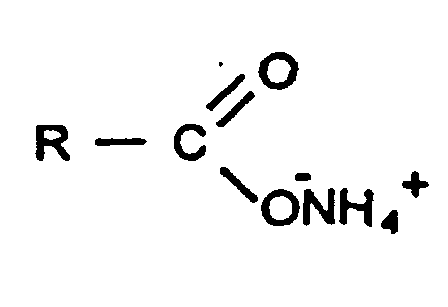
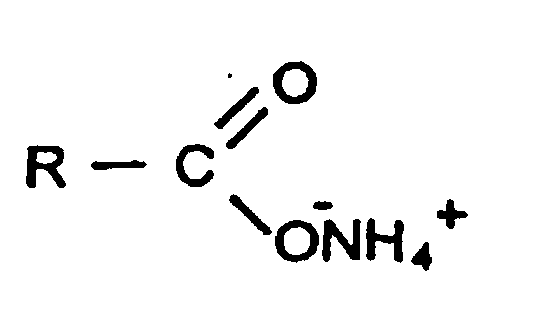
- ammonium carboxylate salts of the present invention comprise compounds represented by Formula 3: wherein R may be hydrogen (e.g., ammonium formate) or R may include from about 1 carbon atom (e.g., ammonium acetate) to about 40 carbon atoms (e.g., ammonium stearate with 36 carbon atoms) and can be selected from the following: hydrogen, alkanes, alkenes, alkynes, alkoxys, carboxylates, ammonium carboxylates, and mixtures thereof, including both straight-chained and branched-chained structures and, further, including all stereoisomers.
- the alkanes, alkenes, alkynes, and alkoxys may also include hydroxyl groups, sulfhydryl groups, amines, carbonyls, carboxyl groups, halogens and mixtures thereof.
- ammonium carboxylates that are at least partially soluble in water, such as, ammonium hydrogen citrate, ammonium lactate, ammonium formate, ammonium gluconate, ammonium tartrate, ammonium succinate, ammonium malonate, ammonium fumarate, ammonium malate, ammonium sebacate, ammonium laurate, ammonium glutarate, ammonium acetate, ammonium oxylate, ammonium adipicate, ammonium pimelicate, ammonium subericate, ammonium azelaicate, and mixtures thereof. Best results currently have been achieved when the ammonium carboxylate is selected fom the group consisting of ammonium hydrogen citrate, ammonium lactate, and mixtures thereof.
- One or more organic solvents may be used to prepare the ink compositions of the present invention.
- a suitable solvent typically is used to form a mixture comprising the selected dye materials.
- the ink compositions include from 0 to 40 percent by weight water-soluble organic solvent.
- Exemplary water-soluble organic solvents suitable for this purpose include, but are not limited to, C 1 to C 4 aliphatic alcohols (e.g., methanol, ethanol, n-propanol, isopropanol, n-butanol, sec-butanol, tert-butanol, or isobutanol), amides (e.g., formamide or dimethylacetamide), ketones, polyketones or ketoalcohols (e.g., acetone or diacetone alcohol), ethers (e.g., tetrahydrofuran or dioxane), nitrogen-containing heterocyclic ketones (2-pyrrolidone, N-methyl-pyrrolid-2-one, or 1, 3 dimethylimidazolid-2-one), polyalkylene glycols (e.g., polyethylene glycol or polypropylene glycol), alkylene glycols and thioglycols containing C 2 to C 6 alkylene groups (e
- the preferred solvents include glycols and glycol ethers (e.g., ethylene glycol, diethylene glycol, triethylene glycol, or 2-methoxy-2-ethoxy-2-ethoxyethanol), polyethylene glycols with molecular weights of up to 500, and heterocyclic ketones (e.g., 2-pyrrolidone, N-methylpyrrolid-2-one or 1,3-dimethylimidazolid-2-one).
- glycols and glycol ethers e.g., ethylene glycol, diethylene glycol, triethylene glycol, or 2-methoxy-2-ethoxy-2-ethoxyethanol
- polyethylene glycols with molecular weights of up to 500 e.g., 2-pyrrolidone, N-methylpyrrolid-2-one or 1,3-dimethylimidazolid-2-one.
- the ink compositions of the present invention preferably have pH values of from 3.5 to 7.5, and more preferably having a pH value of about 4.5.
- the pH of the ink composition may be adjusted through the addition of any mineral acid, organic acid, and mixtures thereof.
- suitable mineral acids may be dilute nitric acid, phosphoric acid, hydrochloric acid, sulfuric acid, and mixtures thereof.
- pH ranges from 7 to 9.5 at least one pH buffer at a concentration of from 0.1 percent to 7 percent by weight also is suitable.
- the buffers preferably have pKa's ranging from 6.5 to 10.
- Buffers such as TES (N-tris[hydroxymethyl]-methyl-2-aminoethanesulfonic acid), BICINE (N,N-bis[2-hydroxyethyl]glycine), TEA (triethanolamine), TRIS (tris[hydroxymethyl]-aminomethane), and BORAX (sodium borate decahydrate) may be used alone, in combination with each other or in combination with other buffers. (We do not need to mention that. Our pH range is from 4.5 to 7).
- Biocides in amounts ranging from 0.1 percent to 0.5 percent by weight also may be used in formulating the ink compositions of the present invention.
- suitable biocides include, but are not limited to, PROXEL CRL and PROXEL GXL available from ICI (Great Britain) and NUOSEPT C and NUOSEPT 95 available from Nuodex, Inc. (Piscataway, New Jersey).
- the salt-based ink compositions of the present invention were prepared by placing the appropriate weight percent of the desired organic solvent(s) in an ink composition mixing bottle. The appropriate weight percent of the desired surfactant or combination of surfactants was then added to the organic solvent(s). Next, the appropriate weight percent of one or more ammonium salts was added to the organic solvent(s)/surfactant(s) mixture. From 10 percent to 20 weight percent of water was then added to the solution and the ink composition mixing bottle was temporarily sealed. The solution in the ink composition mixing bottle was mixed at ambient temperature, on a parallel roller mixer for a time period of about 5 to 6 hours (or for a sufficient time period to ensure all solid components of the solution were substantially dissolved).
- the desired dyes were added to the solution in amounts sufficient to reflect the desired absorbance values.
- the solution was then pH adjusted and mixed on the parallel roller mixer for a time period of about 1 hour (or for a time period sufficient to ensure substantial homogeneity of the resulting ink composition).
- the cloud point of the ink composition of this example was measured by first heating the ink composition for about 6 to about 7 hours at the following temperatures ranges: between 45°C to 55°C; 55°C to 60°C; 65°C to 70°C; and at about 75°C. Periodically during the heating process, the ink composition was visually checked to detect phase separation of the ink composition components or a cloudy appearance of the composition. The ink composition of this example showed no signs of phase separation or cloudiness at any of the above tested temperatures. Additionally, the ink composition of this example showed excellent black-to-color and color-to-color bleed characteristics on cellulosic paper and special media and good edge acuity print characteristics. The ink composition of this example was not susceptible to decel at high ejection frequency.
- Light fastness of the ink composition of this example was determined by simulating office light conditions and exposing the printed images to conditions equivalent to 1 year of typical office light exposure. The color of the exposed printed image was then compared to the color of the original and unexposed printed image. The ink composition of this example was found to have superior light fastness on both cellulosic paper and special media.
- the total organics of the ink composition listed in Table II was estimated to be from 15 percent to 40 percent, surface tension of the ink composition was determined to be 0.025-0.035 N/m (25 to 35 dynes/cm), and the viscosity of the ink composition was from 2.5 to 5 mPa.s (2.5 to 5 c.p).
- cellulosic media and special media including starch-coated media, clay-coated and/or silica-coated media, such as Hewlett-Packard's VIPER PLUSTM, WEASALTM, were printed using a Hewlett-Packard thermal ink-jet pen.
- the ink composition used had the aqueous composition listed in Table III: COMPOUND PERCENT BY WEIGHT 1, 5 Pentanediol 8 2-Pyrrolidone 7.5 EHPD 7.5 Tergitol 15-S-5 1 Ammonium Hydrogen Citrate 8 Dilute Nitric, Phosphoric, Hydrochloric and/or Sulfuric Acids As required to adjust the pH to about 4.5 Reactive Red 180 (TMA) 0.12 Acid Red 52 (Li) 0.18
- the cloud point of the ink composition of this example was measured as described above in Example I.
- the ink composition of this example showed no signs of phase separation or cloudiness at any of the tested temperatures, up to 70° C. Additionally, the ink composition of this example showed excellent black-to-color and color-to-color bleed characteristics on cellulosic paper and special media and good edge acuity print characteristics.
- the ink composition of this example was not susceptible to decel at high ejection frequency.
- Light fastness of the ink composition of this example was measured as described above in Example I.
- the ink composition of this example was found to have superior light fastness on both cellulosic paper and special media.
- the total organics of the ink composition listed in Table III was estimated to be from 15 percent to 40 percent, surface tension of the ink composition was determined to be 0.025-0.035 N/m (25 to 35 dynes/cm), and the viscosity of the ink composition was from 2.5 to 5 mPa.s (2.5 to 5 c.p).
- cellulosic media and special media including starch-coated media, clay-coated and/or silica-coated media, such as Hewlett-Packard's VIPER PLUSTM, WEASALTM, were printed using a Hewlett-Packard thermal ink-jet pen.
- the ink composition used had the aqueous composition listed in Table IV: COMPOUND PERCENT BY WEIGHT 1,5 Pentanediol 8 2-Pyrrolidone 7.5 EHPD 7.5 Tergitol 15-S-5 1 Ammonium Hydrogen Citrate 8 Dilute Nitric, Phosphoric, Hydrochloric As required to adjust and/or Sulfuric Acids the pH to about 4.5 Direct Blue 199 0.12 Acid Blue 9 0.16
- the cloud point of the ink composition of this example was measured as described above in Example I.
- the ink composition of this example showed no signs of phase separation or cloudiness at any of the tested temperatures, up to 70° C. Additionally, the ink composition of this example showed excellent black-to-color and color-to-color bleed characteristics on cellulosic paper and special media and good edge acuity print characteristics.
- the ink composition of this example was not susceptible to decel at high ejection frequency.
- Light fastness of the ink composition of this example was determined as described above in Example I.
- the ink composition of this example was found to have superior light fastness on both cellulosic paper and special media.
- the total organics of the ink composition listed in Table IV was estimated to be from 15 percent to 40 percent, surface tension of the ink composition was determined to be 0.025-0.035 N/m (25 to 35 dynes/cm), and the viscosity of the ink 2.5 to 5 mPa.s composition was from 2.5 to 5 mPa.s (2.5 to 5 c.p).
- cellulosic media and special media including starch-coated media, clay-coated and/or silica-coated media, such as Hewlett-Packard's VIPER PLUSTM, WEASALTM, were printed using a Hewlett-Packard thermal ink-jet pen.
- the ink composition used had the aqueous composition listed in Table V: COMPOUND PERCENT BY WEIGHT 1, 5 Pentanediol 8 2-Pyrrolidone 7.5 EHPD 7.5 IGEPAL® CO-620 1.5 Ammonium Hydrogen Citrate 8 Dilute Nitric, Phosphoric, Hydrochloric and/or Sulfuric Acids As required to adjust the pH to about 4.5 Direct Blue 199 0.12 Acid Blue 9 0.16
- the cloud point of the ink composition of this example was measured as described above in Example I.
- the ink composition of this example showed no signs of phase separation or cloudiness at any of the tested temperatures, up to 70° C. Additionally, the ink composition of this example showed excellent black-to-color and color-to-color bleed characteristics on cellulosic paper and special media and good edge acuity print characteristics.
- the ink composition of this example was not susceptible to decel at high ejection frequency.
- Light fastness of the ink composition of this example was determined as described above in Example I.
- the ink composition of this example was found to have superior light fastness on both cellulosic paper and special media.
- cellulosic media and special media including starch-coated media, clay-coated and/or silica-coated media, such as Hewlett-Packard's VIPER PLUSTM, WEASALTM, were printed using a Hewlett-Packard thermal ink-jet pen.
- the ink composition used had the aqueous composition listed in Table VI: COMPOUND PERCENT BY WEIGHT 1, 5 Pentanediol 8 2-Pyrrolidone 7.5 EHPD 7.5 IGEPAL® CO630 1.5 Ammonium Hydrogen Citrate 8 Dilute Nitric, Phosporic, Hydrochloric and/or Sulfuric Acids As required to adjust the pH to about 4.5 Direct Blue 199 0.12 Acid Blue 9 0.16
- the cloud point of the ink composition of this example was measured as described above in Example I.
- the ink composition of this example showed no signs of phase separation or cloudiness at any of the tested temperatures, up to 70° C. Additionally, the ink composition of this example showed excellent black-to-color and color-to-color bleed characteristics on cellulosic paper and special media and good edge acuity print characteristics.
- the ink composition of this example was not susceptible to decel at high ejection frequency.
- Light fastness of the ink composition of this example was determined as described above in Example I.
- the ink composition of this example was found to have superior light fastness on both cellulosic paper and special media.
- cellulosic media and special media including starch-coated media, clay-coated and/or silica-coated media, such as Hewlett-Packard's VIPER PLUSTM, WEASALTM, were printed using a Hewlett-Packard thermal ink-jet pen.
- the ink composition used had the aqueous composition listed in Table VII: COMPOUND PERCENT BY WEIGHT 1, 5 Pentanediol 8 2-Pyrrolidone 7.5 EHPD 7.5 IGEPAL® CO630 1.5 Ammonium Hydrogen Citrate 8 Dilute Nitric, Phosporic,Hydrochloric and/or Sulfuric Acids As required to adjust the pH to about 4.5 Direct Blue 199 0.12 Acid Blue 9 0.16
- the cloud point of the ink composition of this example was measured as described above in Example I.
- the ink composition of this example showed no signs of phase separation or cloudiness at any of the tested temperatures, up to 70° C. Additionally, the ink composition of this example showed excellent black-to-color and color-to-color bleed characteristics on cellulosic paper and special media and good edge acuity print characteristics.
- the ink composition of this example was not susceptible to decel at high ejection frequency.
- Light fastness of the ink composition of this example was determined as described above in Example I.
- the ink composition of this example was found to have superior light fastness on both cellulosic paper and special media.
- cellulosic media and special media including starch-coated media, clay-coated and/or silica-coated media, such as Hewlett-Packard's VIPER PLUSTM, WEASALTM, were printed using a Hewlett-Packard thermal ink-jet pen.
- the ink composition used had the aqueous composition listed in Table VIII: COMPOUND PERCENT BY WEIGHT 1, 5 Pentanediol 8 2-Pyrrolidone 7.5 EHPD 7.5 ALCODETTM - 260 1.5 Ammonium Hydrogen Citrate 8 Dilute Nitric, Phosphoric, Hydrochloric and/or Sulfuric Acids As required to adjust the pH to about 4.5 Direct Blue 199 0.12 Acid Blue 9 0.16
- the cloud point of the ink composition of this example was measured as described above in Example I.
- the ink composition of this example showed no signs of phase separation or cloudiness at any of the tested temperatures, up to 70° C. Additionally, the ink composition of this example showed excellent black-to-color and color-to-color bleed characteristics on cellulosic paper and special media and good edge acuity print characteristics.
- the ink composition of this example was not susceptible to decel at high ejection frequency.
- Light fastness of the ink composition of this example was determined as described above in Example I.
- the ink composition of this example was found to have superior light fastness on both cellulosic paper and special media.
- cellulosic media and special media including starch-coated media, clay-coated and/or silica-coated media, such as Hewlett-Packard's VIPER PLUSTM, WEASALTM, were printed using a Hewlett-Packard thermal ink-jet pen.
- the ink composition used had the aqueous composition listed in Table IX: COMPOUND PERCENT BY WEIGHT 1, 5 Pentanediol 8 2-Pyrrolidone 7.5 EHPD 7.5 MYRAPON - E825TM 1.5 Ammonium Hydrogen Citrate 8 Dilute Nitric, Phosphoric, Hydrochloric and/or Sulfuric Acids As required to adjust the pH to about 4.5 Direct Blue 199 0.12 Acid Blue 9 0.16
- the cloud point of the ink composition of this example was measured as described above in Example I.
- the ink composition of this example showed no signs of phase separation or cloudiness at any of the tested temperatures, up to 70° C. Additionally, the ink composition of this example showed excellent black-to-color and color-to-color bleed characteristics on cellulosic paper and special media and good edge acuity print characteristics.
- the ink composition of this example was not susceptible to decel at high ejection frequency.
- Light fastness of the ink composition of this example was determined as described above in Example I.
- the ink composition of this example was found to have superior light fastness on both cellulosic paper and special media.
- cellulosic media and special media including starch-coated media, clay-coated and/or silica-coated media, such as Hewlett-Packard's VIPER PLUSTM, WEASALTM, were printed using a Hewlett-Packard thermal ink-jet pen.
- the ink composition used had the aqueous composition listed in Table X: COMPOUND PERCENT BY WEIGHT 1, 5 Pentanediol 8 2-Pyrrolidone 7.5 EHPD 7.5 MYRAPON - E825TM 1.5 Ammonium Hydrogen Citrate 8 Dilute Nitric, Phosphoric, Hydrochloric and/or Sulfuric Acids As required to adjust the pH to about 4.5 Direct Yellow 132 and 0.16 Acid Yellow 23 Combination 0.16 * absorbance units at 1:10,000 dilutions, measured utilizing a Hewlett-Packard UV/VIS II 8452A spectrometer.
- the cloud point of the ink composition of this example was measured as described above in Example I.
- the ink composition of this example showed no signs of phase separation or cloudiness at any of the tested temperatures, up to 70° C. Additionally, the ink composition of this example showed excellent black-to-color and color-to-color bleed characteristics on cellulosic paper and special media and good edge acuity print characteristics.
- the ink composition of this example was not susceptible to decel at high ejection frequency.
- Light fastness of the ink composition of this example was determined as described above in Example I.
- the ink composition of this example was found to have superior light fastness on both cellulosic paper and special media.
Landscapes
- Chemical & Material Sciences (AREA)
- Life Sciences & Earth Sciences (AREA)
- Engineering & Computer Science (AREA)
- Materials Engineering (AREA)
- Wood Science & Technology (AREA)
- Organic Chemistry (AREA)
- Inks, Pencil-Leads, Or Crayons (AREA)
- Ink Jet Recording Methods And Recording Media Thereof (AREA)
Claims (10)
- Composition d'encre pour l'impression par jet d'encre comprenant, en poids, de 0,5 % à 15 % d'un colorant ou de plusieurs colorants, de 0,25 % à 10 % d'un tensioactif ou de plusieurs tensioactifs et de 2 % à 15 % d'un sel ou de plusieurs sels de type carboxylate d'ammonium.
- Composition d'encre selon la revendication 1, dans laquelle la composition d'encre comprend, en poids, de 1 % à 5 % d'un colorant ou de plusieurs colorants, de 0,5 % à 5 % d'un tensioactif ou de plusieurs tensioactifs et de 4 % à 10 % d'un sel ou de plusieurs sels de type carboxylate d'ammonium.
- Composition d'encre selon la revendication 1, dans laquelle le carboxylate d'ammonium satisfait à la formule suivante :dans laquelle R est sélectionné à partir du groupe constitué de l'hydrogène, des alcanes, des alkènes, des alkynes, des alkoxys, des carboxylates, des carboxylates d'ammonium et des mélanges de ceux-ci, dans lesquels les alcanes, les alkènes, les alkynes, les alkoxys, les carboxylates, les carboxylates d'ammonium incluent des structures en chaíne droite, des structures en chaíne ramifiée, des stéréo-isomères, des groupes hydroxyles, des amines, des carbonyles, des groupes carboxyles et des mélanges de ceux-ci.
- Composition d'encre selon la revendication 1, dans laquelle le carboxylate d'ammonium est sélectionné à partir du groupe constitué de l'hydrogène citrate d'ammonium, du lactate d'ammonium, du formate d'ammonium, du gluconate d'ammonium, du tartrate d'ammonium, du succinate d'ammonium, du malonate d'ammonium, du fumarate d'ammonium, du malate d'ammonium, du sébacate d'ammonium, du laurate d'ammonium, du glutarate d'ammonium, de l'acétate d'ammonium, de l'oxylate d'ammonium, de l'adipicate d'ammonium, du pimélicate d'ammonium, du subéricate d'ammonium, de l'azélaicate d'ammonium et des mélanges de ceux-ci.
- Composition d'encre selon la revendication 1, dans laquelle le tensioactif est sélectionné à partir du groupe constitué des éthoxylates non ioniques, des oxydes de polyéthylène acétyléniques hydroxylés, des oxydes de polyéthylène acétyléniques alkoxylés, des esters de phosphates anioniques et des mélanges de ceux-ci.
- Composition d'encre selon la revendication 5, dans laquelle le tensioactif est un tensioactif éthoxylé.
- Composition d'encre selon la revendication 6, dans laquelle le tensioactif éthoxylé es un éthoxylate d'alcool secondaire ayant une chaíne aliphatique avec environ 15 atomes de carbone et ayant environ 5 groupes d'éthoxylate.
- Composition d'encre selon la revendication 5, dans laquelle le tensioactif est sélectionné à partir du groupe constitué des oxydes de polyéthylène acétyléniques hydroxylés, des oxydes de polyéthylène acétyléniques alkoxylés et des mélanges de ceux-ci.
- Composition d'encre selon la revendication 1, qui prévient substantiellement la séparation de phase induite par la chaleur jusqu'à 70°C, dans laquelle le carboxylate d'ammonium satisfait à la formule suivante :dans laquelle R est sélectionné à partir du groupe constitué de l'hydrogène, des alcanes, des alkènes, des alkynes, des alkoxys, des carboxylates, des carboxylates d'ammonium et des mélanges de ceux-ci, dans lesquels les alcanes, les alkènes, des alkyles, les alkoxys, les carboxylates et les carboxylates d'ammonium incluent des structures en chaíne droite, des structures en chaíne ramifiée, des stéréo-isomères, des groupes hydroxyles, des groupes sulfhydryles, des amines, des carbonyles, des groupes carboxyles, des halogènes et des mélanges de ceux-ci ;
dans laquelle le tensioactif est sélectionné à partir du groupe constitué de :dans laquelle n + m = 0 à 50, et des mélanges de ceux-ci.(a) les composés satisfaisant à la formule suivante :(b) les composés qui satisfont à la formule suivante :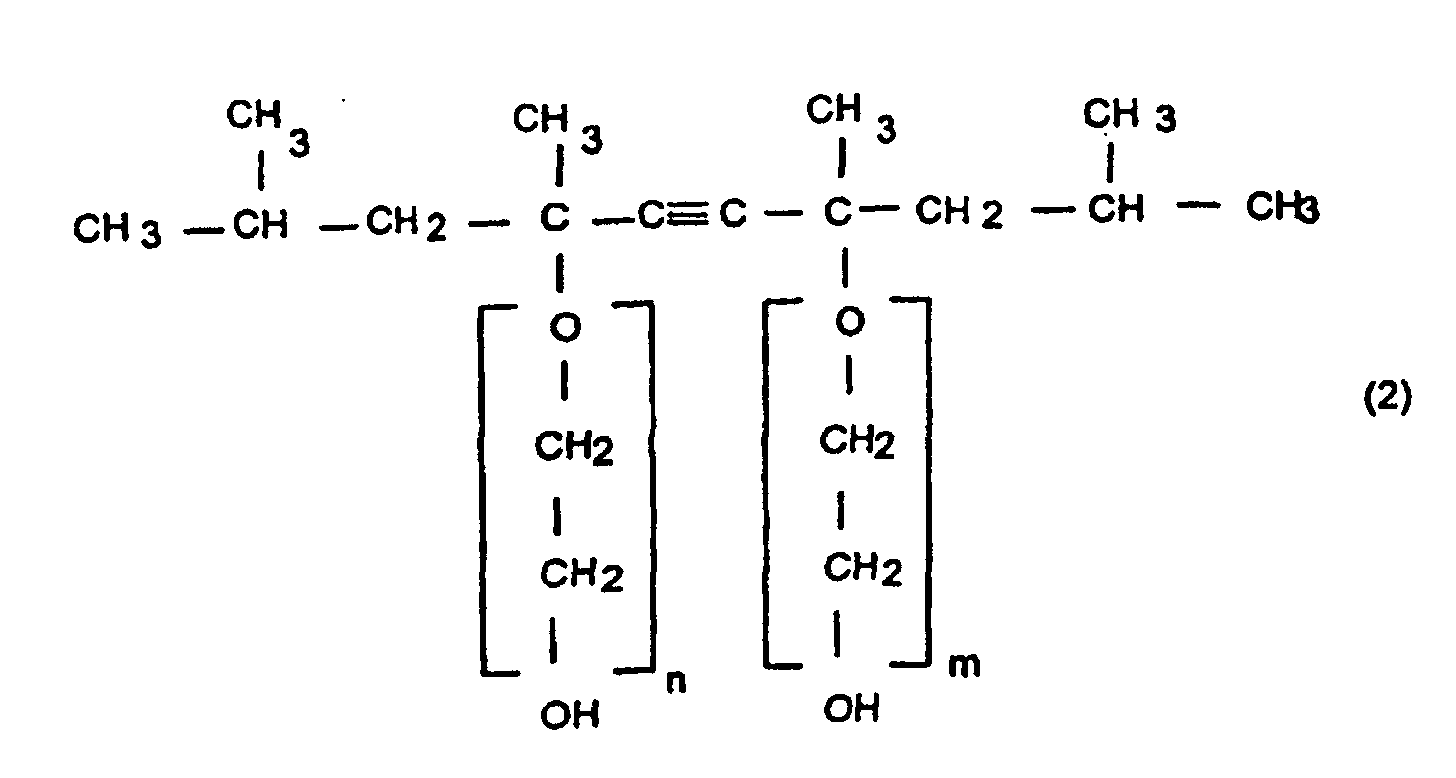
- Composition d'encre selon la revendication 9, dans laquelle le carboxylate d'ammonium est présent dans une quantité allant de 4 % à 10 % et est sélectionné à partir du groupe constitué de l'hydrogène citrate d'ammonium, du lactate d'ammonium, du formate d'ammonium, du gluconate d'ammonium, du tartrate d'ammonium, du succinate d'ammonium, du malonate d'ammonium, du fumarate d'ammonium, du malate d'ammonium, du sébacate d'ammonium, du laurate d'ammonium, du glutarate d'ammonium, de l'acétate d'ammonium, de l'oxylate d'ammonium, de l'adipicate d'ammonium, du pimélicate d'ammonium, du subéricate d'ammonium et de l'azélaicate d'ammonium, et des mélanges de ceux-ci.
Priority Applications (2)
| Application Number | Priority Date | Filing Date | Title |
|---|---|---|---|
| EP19980305632 EP0978546B1 (fr) | 1998-07-15 | 1998-07-15 | Compositions d'encres contenant un sel de type carboxylate d'ammonium |
| DE1998622620 DE69822620T2 (de) | 1998-07-15 | 1998-07-15 | Ammoniumcarboxylatsalz enthaltende Tintenzusammensetzungen |
Applications Claiming Priority (1)
| Application Number | Priority Date | Filing Date | Title |
|---|---|---|---|
| EP19980305632 EP0978546B1 (fr) | 1998-07-15 | 1998-07-15 | Compositions d'encres contenant un sel de type carboxylate d'ammonium |
Publications (2)
| Publication Number | Publication Date |
|---|---|
| EP0978546A1 EP0978546A1 (fr) | 2000-02-09 |
| EP0978546B1 true EP0978546B1 (fr) | 2004-03-24 |
Family
ID=8234947
Family Applications (1)
| Application Number | Title | Priority Date | Filing Date |
|---|---|---|---|
| EP19980305632 Expired - Lifetime EP0978546B1 (fr) | 1998-07-15 | 1998-07-15 | Compositions d'encres contenant un sel de type carboxylate d'ammonium |
Country Status (2)
| Country | Link |
|---|---|
| EP (1) | EP0978546B1 (fr) |
| DE (1) | DE69822620T2 (fr) |
Families Citing this family (2)
| Publication number | Priority date | Publication date | Assignee | Title |
|---|---|---|---|---|
| DE60307031T2 (de) | 2002-12-23 | 2007-02-08 | Rohm & Haas Company | Tintenstrahltintenzusammensetzungen |
| DE102004060968B4 (de) * | 2004-12-17 | 2008-12-04 | Dystar Textilfarben Gmbh & Co. Deutschland Kg | Marineblau- und Schwarzmischungen, Verfahren zu ihrer Herstellung und ihre Verwendung zum Färben von Hydroxygruppen-haltigen Material |
Family Cites Families (5)
| Publication number | Priority date | Publication date | Assignee | Title |
|---|---|---|---|---|
| JPS59115363A (ja) * | 1982-12-22 | 1984-07-03 | Pentel Kk | 染色用組成物 |
| US5108503A (en) * | 1991-04-16 | 1992-04-28 | Hewlett-Packard Company | Smear resistant inks for ink-jet printers |
| US5395434A (en) * | 1992-07-10 | 1995-03-07 | Canon Kabushiki Kaisha | Ink, ink-jet recording method, and ink-jet recording apparatus |
| JPH08333533A (ja) * | 1995-06-06 | 1996-12-17 | Canon Inc | 水性インク、これを用いたインクジェット記録方法及びかかるインクを用いた機器 |
| US5626655A (en) * | 1995-07-11 | 1997-05-06 | Hewlett-Packard Company | Use of co-surfactants to adjust properties of ink-jet inks |
-
1998
- 1998-07-15 EP EP19980305632 patent/EP0978546B1/fr not_active Expired - Lifetime
- 1998-07-15 DE DE1998622620 patent/DE69822620T2/de not_active Expired - Lifetime
Also Published As
| Publication number | Publication date |
|---|---|
| DE69822620D1 (de) | 2004-04-29 |
| EP0978546A1 (fr) | 2000-02-09 |
| DE69822620T2 (de) | 2005-02-03 |
Similar Documents
| Publication | Publication Date | Title |
|---|---|---|
| US5925176A (en) | Salt-based ink compositions | |
| US5062893A (en) | Ink formulations by mixing anionic waterfast dyes containing two or more carboxyl groups | |
| EP1056808B1 (fr) | Colorants monoazo, composition et encre d'impression a jet d'encre contenant lesdits colorants | |
| JP4275203B2 (ja) | インク組成物 | |
| US6264730B1 (en) | Water resistant ink composition | |
| US7150783B2 (en) | Disazo dyes and ink jet inks containing them | |
| US5100469A (en) | Ink compositions having decreased drying times | |
| JPH06212105A (ja) | インク組成物およびその調製方法 | |
| EP1084201B1 (fr) | Emploi de sels de lithium de colorants anioniques pour renforcer leur tenue a la lumiere | |
| JP4554086B2 (ja) | 耐光堅牢度の高い黄色組成物 | |
| US6183549B1 (en) | Ink compositions containing monoazo dyes | |
| WO2010041065A1 (fr) | Composés diazoïques et leur utilisation en impression par jet d'encre | |
| EP2344589A2 (fr) | Composés diazo et leur application à l'impression jet d'encre | |
| EP0978546A1 (fr) | Compositions d'encres contenant un sel de type carboxylate d'ammonium | |
| EP1117743B1 (fr) | Composition contenant deux colorants diazo pour impression par jets d'encre | |
| KR100553785B1 (ko) | 염계잉크조성물 | |
| EP2158273B1 (fr) | Composition de colorant, encre, procede d'impression | |
| JP2004027139A (ja) | インクジェット用インク組成物 | |
| EP1228148B1 (fr) | Colorants disazo pour impression a jet d'encre | |
| US20060173093A1 (en) | Ink composition, ink jet printing apparatus, and printing process | |
| EP1631632A1 (fr) | Encres contenant des colorants de perylene hydrosolubles et leur utilisation dans l'impression a jet d'encre | |
| JPS61247770A (ja) | 水性インク組成物 | |
| JPH02233776A (ja) | インクジェット記録液及びインクジェット記録方法 | |
| WO2013083962A1 (fr) | Mélanges de colorants et d'encres magenta pour une utilisation dans l'impression à jet d'encre |
Legal Events
| Date | Code | Title | Description |
|---|---|---|---|
| PUAI | Public reference made under article 153(3) epc to a published international application that has entered the european phase |
Free format text: ORIGINAL CODE: 0009012 |
|
| AK | Designated contracting states |
Kind code of ref document: A1 Designated state(s): DE FR GB IT |
|
| AX | Request for extension of the european patent |
Free format text: AL;LT;LV;MK;RO;SI |
|
| 17P | Request for examination filed |
Effective date: 20000522 |
|
| AKX | Designation fees paid |
Free format text: DE FR GB IT |
|
| RAP1 | Party data changed (applicant data changed or rights of an application transferred) |
Owner name: HEWLETT-PACKARD COMPANY, A DELAWARE CORPORATION |
|
| 17Q | First examination report despatched |
Effective date: 20010720 |
|
| GRAP | Despatch of communication of intention to grant a patent |
Free format text: ORIGINAL CODE: EPIDOSNIGR1 |
|
| GRAS | Grant fee paid |
Free format text: ORIGINAL CODE: EPIDOSNIGR3 |
|
| GRAA | (expected) grant |
Free format text: ORIGINAL CODE: 0009210 |
|
| AK | Designated contracting states |
Kind code of ref document: B1 Designated state(s): DE FR GB IT |
|
| REG | Reference to a national code |
Ref country code: GB Ref legal event code: FG4D |
|
| REF | Corresponds to: |
Ref document number: 69822620 Country of ref document: DE Date of ref document: 20040429 Kind code of ref document: P |
|
| ET | Fr: translation filed | ||
| PLBE | No opposition filed within time limit |
Free format text: ORIGINAL CODE: 0009261 |
|
| STAA | Information on the status of an ep patent application or granted ep patent |
Free format text: STATUS: NO OPPOSITION FILED WITHIN TIME LIMIT |
|
| 26N | No opposition filed |
Effective date: 20041228 |
|
| REG | Reference to a national code |
Ref country code: GB Ref legal event code: 732E Free format text: REGISTERED BETWEEN 20120329 AND 20120404 |
|
| REG | Reference to a national code |
Ref country code: FR Ref legal event code: PLFP Year of fee payment: 18 |
|
| PGFP | Annual fee paid to national office [announced via postgrant information from national office to epo] |
Ref country code: GB Payment date: 20150626 Year of fee payment: 18 |
|
| PGFP | Annual fee paid to national office [announced via postgrant information from national office to epo] |
Ref country code: FR Payment date: 20150625 Year of fee payment: 18 |
|
| PGFP | Annual fee paid to national office [announced via postgrant information from national office to epo] |
Ref country code: DE Payment date: 20150623 Year of fee payment: 18 |
|
| PGFP | Annual fee paid to national office [announced via postgrant information from national office to epo] |
Ref country code: IT Payment date: 20150626 Year of fee payment: 18 |
|
| REG | Reference to a national code |
Ref country code: DE Ref legal event code: R119 Ref document number: 69822620 Country of ref document: DE |
|
| GBPC | Gb: european patent ceased through non-payment of renewal fee |
Effective date: 20160715 |
|
| PG25 | Lapsed in a contracting state [announced via postgrant information from national office to epo] |
Ref country code: DE Free format text: LAPSE BECAUSE OF NON-PAYMENT OF DUE FEES Effective date: 20170201 Ref country code: FR Free format text: LAPSE BECAUSE OF NON-PAYMENT OF DUE FEES Effective date: 20160801 |
|
| REG | Reference to a national code |
Ref country code: FR Ref legal event code: ST Effective date: 20170331 |
|
| PG25 | Lapsed in a contracting state [announced via postgrant information from national office to epo] |
Ref country code: GB Free format text: LAPSE BECAUSE OF NON-PAYMENT OF DUE FEES Effective date: 20160715 |
|
| PG25 | Lapsed in a contracting state [announced via postgrant information from national office to epo] |
Ref country code: IT Free format text: LAPSE BECAUSE OF NON-PAYMENT OF DUE FEES Effective date: 20160715 |