EP0978569A1 - Procede de sequencage de l'adn - Google Patents
Procede de sequencage de l'adn Download PDFInfo
- Publication number
- EP0978569A1 EP0978569A1 EP98929853A EP98929853A EP0978569A1 EP 0978569 A1 EP0978569 A1 EP 0978569A1 EP 98929853 A EP98929853 A EP 98929853A EP 98929853 A EP98929853 A EP 98929853A EP 0978569 A1 EP0978569 A1 EP 0978569A1
- Authority
- EP
- European Patent Office
- Prior art keywords
- rna polymerase
- amino acid
- wild type
- mutant
- compound
- Prior art date
- Legal status (The legal status is an assumption and is not a legal conclusion. Google has not performed a legal analysis and makes no representation as to the accuracy of the status listed.)
- Granted
Links
- 0 C[C@]1C(CC=CC#CCC#CC=NC)*1 Chemical compound C[C@]1C(CC=CC#CCC#CC=NC)*1 0.000 description 4
Images























Classifications
-
- C—CHEMISTRY; METALLURGY
- C12—BIOCHEMISTRY; BEER; SPIRITS; WINE; VINEGAR; MICROBIOLOGY; ENZYMOLOGY; MUTATION OR GENETIC ENGINEERING
- C12Q—MEASURING OR TESTING PROCESSES INVOLVING ENZYMES, NUCLEIC ACIDS OR MICROORGANISMS; COMPOSITIONS OR TEST PAPERS THEREFOR; PROCESSES OF PREPARING SUCH COMPOSITIONS; CONDITION-RESPONSIVE CONTROL IN MICROBIOLOGICAL OR ENZYMOLOGICAL PROCESSES
- C12Q1/00—Measuring or testing processes involving enzymes, nucleic acids or microorganisms; Compositions therefor; Processes of preparing such compositions
- C12Q1/68—Measuring or testing processes involving enzymes, nucleic acids or microorganisms; Compositions therefor; Processes of preparing such compositions involving nucleic acids
- C12Q1/6869—Methods for sequencing
-
- C—CHEMISTRY; METALLURGY
- C12—BIOCHEMISTRY; BEER; SPIRITS; WINE; VINEGAR; MICROBIOLOGY; ENZYMOLOGY; MUTATION OR GENETIC ENGINEERING
- C12Q—MEASURING OR TESTING PROCESSES INVOLVING ENZYMES, NUCLEIC ACIDS OR MICROORGANISMS; COMPOSITIONS OR TEST PAPERS THEREFOR; PROCESSES OF PREPARING SUCH COMPOSITIONS; CONDITION-RESPONSIVE CONTROL IN MICROBIOLOGICAL OR ENZYMOLOGICAL PROCESSES
- C12Q1/00—Measuring or testing processes involving enzymes, nucleic acids or microorganisms; Compositions therefor; Processes of preparing such compositions
- C12Q1/68—Measuring or testing processes involving enzymes, nucleic acids or microorganisms; Compositions therefor; Processes of preparing such compositions involving nucleic acids
Definitions
- the present invention relates to methods for determining DNA sequences.
- the present invention relates to methods for determining DNA sequence utilizing mutant RNA polymerases.
- the present invention further relates to methods for determining DNA sequences utilizing novel 3'-deoxyribonucleotide derivatives as fluorescence-labeled terminators.
- the present invention still further relates to methods for determining DNA sequences wherein nucleic acid transcription reaction is performed in the presence of inorganic pyrophosphatase.
- the polymerase chain reaction (PCR) method is an excellent method, and its utilization has expanded year by year [Randall K. Saiki et al. (1988) Science 239, 487-491]. In the PCR method, even one molecule of DNA fragment can be amplified.
- the method for sequencing PCR amplified products without cloning them is also a useful method [Corinne Wong et al. (1988) Nature, 330, 384-386]. This technique does not require construction of libraries and screening of such libraries, and is a quick method capable of simultaneously obtaining sequence information of many samples.
- primers and 2'-deoxyribonucleoside 5'-triphosphates (2'-dNTPs) not incorporated remain in a reaction system, and the remained substances inhibit sequencing reactions. Therefore, in conventional methods, such primers and 2'-dNTPs must be removed from PCR products before sequencing.
- purification of PCR products include purification by electrophoresis, ethanol precipitation, gel filtration and HPLC purification [see, for example, Dorit R.L et al. (1991) Current Protocols in Molecular Biology, Vol. 11, John Wiley and Sons, New York, 15.2.1-15.2.11]. However, these methods are complicated without exception.
- the second problem is quick renaturation of PCR products.
- the PCR products are renatured into a double-stranded DNA, they are no longer single-stranded templates, and annealing between primers and single-stranded templates is inhibited.
- methods for minimizing the renaturation quenching after denaturation, biotilation of one primer and absorption of PCR products onto streptavidin-coated articles, use of exonuclease, asymmetric PCR and the like have been reported. See, for example, Barbara Bachmann et al., 1990, Nucleic Acid Res., 18, 1309-. However, most of these methods are time-consuming and very laborious.
- the present inventors proposed an absolutely novel method for determining nucleotide sequence of DNA for solving these problems. Which does not require removal of unreacted primers and 2'-deoxyribonucleoside 5'-triphosphates (2'-dNTPs) remaining in the PCR reaction system, and does not require denaturation at all.
- This method enables to eliminate the problem of quick renaturation of PCR reaction products [WO96/14434].
- This method is a direct transcriptional sequencing method utilizing an RNA polymerase such as T7 RNA polymerase and a terminator for RNA transcription reaction (for example, 3'-deoxyribonucleoside 5'-triphosphates, 3'-dNTPs).
- nucleotide sequences of DNA products amplified by the polymerase chain reaction can be used as they are for sequencing without removing primers and 2'-deoxyribonucleoside 5'-triphosphates (2'-dNTPs).
- 2'-dNTPs 2'-deoxyribonucleoside 5'-triphosphates
- amino acid residues are represented by the conventionally used one-letter codes. For clarification, they are specifically mentioned for only those amino acids appeared in this text as follows: phenylalanine (F), tyrosine (Y), proline (P), leucine (L), and histidine (H).
- a numeral accompanied by the codes is a number counted from N-terminus of polymerase. For example, “F667” means that the 667th amino acid residue of this polymerase is F, and "F667Y” means that Y was substituted for F of the 667th residue.
- DNA polymerases are also known to show biased incorporation resulting from difference in a base group each nucleotide has, and mutant DNA polymerases free from such biased incorporation have also been known [Japanese Patent Unexamined Publication (KOKAI) No. (Hei) 8-205874/1996; and Proc. Natl. Acid. Sci. USA, 92:6339-6345, (1995)].
- coli DNA polymerase I and F (phenylalanine) 667 of Thermus aquaticus DNA polymerase are the amino acid residues corresponding to Y526 of T7 DNA polymerase and the bias of these polymerases may be reduced by substituting F762Y (tyrosine) and F667Y (tyrosine) respectively for these residues.
- RNA polymerases have not been used for sequencing methods so far, and therefore the different efficiency of ribonucleotide incorporation itself has not become a problem. Under such circumstances, any mutant RNA polymerases free from the biased incorporation have of course not been known. In fact, the aforementioned Japanese Patent Unexamined Publication (KOKAI) No. (Hei) 8-205874/1996 does not mention any specific examples of modification of T7 RNA polymerase.
- T7 RNA polymerase The region of T7 RNA polymerase mentioned above is considered to correspond to the region consisting of 9-10 amino acid residues between amino acids K and YG in the motif B mentioned in Protein Engineering, 3:461-467, 1990, which region is particularly conserved in DNA polymerase ⁇ and I, and DNA-dependent RNA polymerases (T7 RNA polymerase is classified in these polymerases).
- T7 RNA polymerase does not have F (phenylalanine) in the residues 631-640 corresponding to the aforementioned region, though T7 RNA polymerase is highly homologous to DNA polymerases. Therefore, the teachings of the aforementioned literatures could not be realized as described.
- the present inventors attempted modification of amino acids of T7 RNA polymerase in the region corresponding to the helix O of the finger subdomain of E. coli DNA polymerase I, in which F762 of E. coli DNA polymerase I presents.
- F phenylalanine
- F (phenylalanine) was not found also in the helix Z in T7 RNA polymerase, which is indicated in the steric structure reported in the literature of Sousa et al. (Nature, 364:593-599, 1993) and corresponds to the helix O of E. coli DNA polymerase I.
- the present inventors originally searched for a novel RNA polymerase in order to provide an RNA polymerase which exhibits little or no bias for the incorporating ability due to the kind of ribonucleotides and 3'-deoxyribonucleotides.
- the method for determining DNA sequences of the present invention was completed based on the finding that an RNA polymerase having an increased ability of incorporating 3'-deoxyribonucleotides and derivatives thereof can be obtained by partially modifying amino acids in a wild type RNA polymerase.
- RNA polymerase of the present invention or in particular the location of the amino acid modification thereof is not suggested nor taught at all in Japanese Patent Unexamined Publication (KOKAI) No. (Hei) 8-205874/1996, and it was absolutely originally found by the present inventors.
- a further object of the present invention is, from the viewpoint of obtaining a more practically useful method, to provide a method capable of eliminating the bias of the incorporation and more accurately determining nucleotide sequences even when a fluorescence-labeled 3'-deoxyribonucleotide is used.
- the present invention relates to a method for determining DNA nucleotide sequences comprising reacting ribonucleoside 5'-triphosphates including ATP, GTP, CTP and UTP or derivatives thereof, and one or more kinds of 3'-deoxyribonucleoside 5'-triphosphates including 3'-dATP, 3'-dGTP, 3'-dCTP, 3'-dUTP and derivatives thereof (referred to as 3'-dNTP derivatives hereinafter) in the presence of an RNA polymerase and a DNA fragment containing a promoter sequence for the RNA polymerase to obtain a nucleic acid transcription product, separating the resulting transcription product, and determining a nucleic acid sequence from the resulting separated fraction, wherein the RNA polymerase is a mutant RNA polymerase consisting of a wild type RNA polymerase provided that at least one of amino acids in the wild type RNA polymerase was modified so as to enhance its ability for incorporating the 3'-dNT
- the present invention further relates to the aforementioned method for determining DNA nucleotide sequences wherein the 3'-dNTP derivatives are 3'-deoxyribonucleotide derivatives represented by the following general formula [I]: Q-V-(CH 2 ) n -NH-R
- Q represents a 3'-deoxyribonucleotide residue
- n represents an integer not less than 1, preferably not less than 4
- R represents a fluorescent group.
- the present invention further relates to the aforementioned method for determining DNA nucleotide sequences wherein the nucleic acid transcription reaction is performed in the presence of an inorganic pyrophosphatase.
- the method for determining DNA sequences of the present invention comprises reacting ribonucleotides (NTPs) and 3'-deoxyribonucleotide (3'-dNTP) derivatives, in particular, 3'-dNTP derivatives wherein a linker is inserted between a fluorescent substance and 3'-deoxyribonucleotide, in the presence of an RNA polymerase and a DNA fragment containing a promoter sequence for the RNA polymerase, and determining a nucleic acid sequence from patterns of the resulting separated fraction of transcription product, characterized in that it utilizes a mutant RNA polymerase as an RNA polymerase.
- NTPs ribonucleotides
- 3'-dNTP 3'-deoxyribonucleotide
- the mutant RNA polymerase used for the present invention consists of a wild type RNA polymerase, wherein at least one of amino acids of the polymerase is modified so that its ability for incorporating 3'dNTP derivatives should be enhanced compared with the corresponding wild type RNA polymerase.
- the "wild type RNA polymerase” include any naturally occurring RNA polymerases.
- the "wild type RNA polymerase” may be a wild type RNA polymerase having substitution, insertion and/or deletion of amino acids which are not the modification for obtaining increased ability for incorporating 3'-deoxyribonucleotide and derivatives thereof in comparison with the corresponding wild type RNA polymerase. That is, wild type RNA polymerases artificially modified with a purpose other than that described above are included in the above "wild type RNA polymerase". However, it is suitable to make such substitution, insertion and/or deletion of amino acids to the extent that the activity of RNA polymerase is maintained.
- RNA polymerases derived from T7 phage, T3 phage, SP6 phage, K11 phage and the like. However, it is not limited to these RNA polymerases.
- the "wild type RNA polymerase” include naturally occurring thermostable RNA polymerases, and naturally occurring RNA polymerases artificially modified (i.e. having substitution, insertion and/or deletion of amino acids) in order to impart thermostablity. However, it is suitable to make the modification for imparting thermostablity to the extent that the activity of RNA polymerase is maintained.
- the mutant RNA polymerase of the present invention prepared by using a thermostable RNA polymerase as the "wild type RNA polymerase” shall be thermostable. As a result, for example, it can be used in PCR to synthesize RNA fragments for sequencing in situ, i.e., during PCR, by using the PCR product as a template.
- T7 RNA polymerase has been known to be a promoter specific RNA polymerase with an extremely high specificity.
- the nucleotide sequence and production method of T7 RNA polymerase are reported in Davanloo et al., Proc. Natl. Acad. Sci. USA., 81:2035-2039 (1984). Its large scale production has been already described in Zawadzki et al., Nucl. Acids Res., 19:1948 (1991).
- This phage-derived RNA polymerase can pursue the transcription reaction with a single polypeptide, unlike RNA polymerases of E. coli and higher organisms (Chamberlin et al., Nature, 228:227-231,1970). Therefore, it is a particularly excellent material for analyzing the mechanism of transcription, and many mutants have been isolated and reported. Further, the results of its crystallographic analysis are mentioned in Sousa et al., Nature, 364:593-599, 1993.
- RNA polymerases of high specificity 3 kinds of RNA polymerases derived from T3 phage which infects E. coli, SP6 phage which infects Salmonella, and K11 phage which infects Klebsiella pneumoniae have been well known.
- RNA polymerases mentioned above are quite resemble to one another in their primary structure of amino acids, sequence of promoter and the like as described hereinafter.
- the RNA polymerase of the present invention has an increased ability of incorporating 3'-deoxyribonucleotides and derivatives thereof in comparison with the ability of a corresponding wild type RNA polymerase.
- wild type RNA polymerases poorly incorporate 3'-deoxyribonucleotides in comparison with ribonucleotides, which has obstructed their use in nucleotide sequencing.
- the RNA polymerase of the present invention is modified so as to have the ability of incorporating 3'-deoxyribonucleotides and derivatives thereof at least twice higher than that of wild type.
- RNA polymerase of the present invention can also improve incorporation of such 3'-deoxyribonucleotide derivatives.
- ribonucleotide herein used means ribonucleoside 5'-triphosphates including ATP, GTP, CTP, UTP and derivative thereof, and 3'-deoxyribonucleotide means 3'-dATP, 3'-dGTP, 3'-dCTP and 3'-dUTP, and the derivative thereof means, for example, compounds composed of these 3'-deoxyribonucleotides which have a fluorescent label.
- RNA polymerase of the present invention is that at least one of amino acids in a corresponding wild type RNA polymerase is modified. This will be explained in detail hereinafter.
- RNA polymerase On the basis of the aforementioned various reports about T7 RNA polymerase, the present inventors tried to construct a mutant RNA polymerase which has little or no bias for incorporation efficiency valuable depending on the kind of ribonucleotides observed for T7 RNA polymerase.
- Various mutants were actually prepared to determine, in particular, which amino acids on wild type RNA polymerases should be mutated, and what kind of amino acids should be used for substitution when substitution is used as mutation. Then, it was found that the ability of incorporating 3'-deoxyribonucleotides and derivatives thereof can be improved by modifying at least one amino acid of wild type RNA polymerases, and completed the mutant RNA polymerase of the present invention.
- the present inventors first constructed an expression plasmid pT7R inserted with the T7 RNA polymerase gene, and then mutants of T7 RNA polymerase were constructed based on the expression plasmid pT7R. That is, mutant T7 RNA polymerases, F644Y, F646Y, F667Y, F733Y, F782Y, and F882Y were constructed in which F (phenylalanine) residue of T7 RNA polymerase was replaced with Y (tyrosine) residue, and the ability of incorporation of these mutants was compared.
- Y639F mutant of the T7 RNA polymerase which is a mutant at a location corresponding to Y526 of T7 DNA polymerase, are described in the literature (Sousa., EMBO J., 14:4609-4621 (1995)).
- Y639F mutant was also constructed, which has a mutation within the residue 631-640, those suggested to change their specificity for dNTP in Japanese Patent Unexamined Publication (KOKAI) No. (Hei) 8-205874/1996.
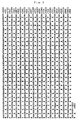
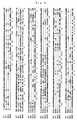
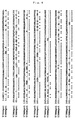
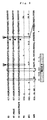
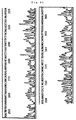
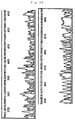
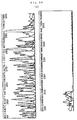
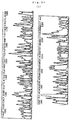
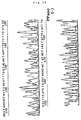
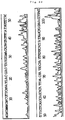
- the amino acid sequence of wild type T7 RNA polymerase mentioned in this specification is based on the sequence encoded by nucleotides 3171-5822 of the T7 phage RNA sequence from the gene sequence database GeneBank, accession No. V01148 J02518 X00411 (39,937 base pairs) (cf. Figures 1 and 2).
- the upper sequences represented in Figures 1 and 2 are nucleotide sequences, and the lower sequences are amino acid sequences corresponding to the nucleotide sequences.
- the numerals at the right ends are numbers of T7 phage genome registered at GeneBank (Locus T7CG, 39,937 base pairs), and the numerals at the right ends for the amino acids are appended from the first M (methionine) of T7 RNA polymerase starting with 1 and indicate that the full length consists of 883 amino acid residues.
- the amino acid sequence and the numerals appended to each of the amino acids of wild type T7 RNA polymerase gene in this specification are basically the sequence and numbers represented in Figures 1 and 2.
- the aforementioned wild type T7 RNA polymerase may contain substitution, insertion and/or deletion which is not the modification intended by the present invention. Therefore, in the case that the wild type RNA polymerase, to which mutation should be introduced for the purpose of the present invention, is a wild type T7 RNA polymerase with other mutation, especially that such mutation is insertion or deletion of amino acids, numbers appended to amino acids are changed due to such insertion and deletion.
- a wild type T7 RNA polymerase having such insertion and deletion is a member of the wild type T7 RNA polymerase, to which a mutation intended by the present invention should be introduced, so long as it maintains T7 RNA polymerase activity even though its amino acid numbers are different from the numbers represented in Figures 1 and 2.
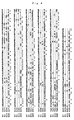
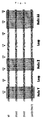
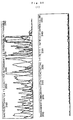
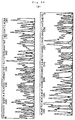
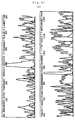
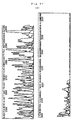
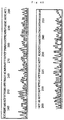
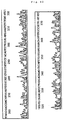
- the amino acid numbers in sequences of RNA polymerases other than T7 RNA polymerase are decided as shown in the sequences listed in Figures 3 and 4. Those may also have substitution, insertion and/or deletion other than the modification intended by the present invention. Accordingly, like the amino acid sequence and the numbers appended to T7 RNA polymerase, when they have such a mutation by insertion or deletion of amino acids, the amino acid numbers are changed due to such insertion and deletion, and a wild type T7 RNA polymerase having such insertion and deletion is a member of the wild type T7 RNA polymerase to which a mutation intended by the present invention should be introduced.
- the T7 RNA polymerase gene is prepared as follows: T7 phage DNA is purified. Separately, a printer specific for upstream of N-terminus amino acid region of the T7 RNA polymerase gene (T7Rpol-N: 5'-ATA TTT TAG CCA TGG AGG ATT GAT ATA TGA ACA CGA TTA ACA TCG CTA AG-3') and a primer specific for downstream of C-terminus amino acid region of the same (T7Rpol-C: 5'-ATA TTT TAG CCA TGG TAT AGT GAG TCG TAT TGA TTT GGC G-3') are synthesized.
- T7Rpol-N 5'-ATA TTT TAG CCA TGG AGG ATT GAT ATA TGA ACA CGA TTA ACA TCG CTA AG-3'
- T7Rpol-C 5'-ATA TTT TAG CCA TGG TAT AGT GAG TCG TAT TGA TTT GGC G-3'
- the phage DNA is used as a template for PCR, and thus an expression vector pT7R can be constructed (cf. Reference Example 1).
- This expression vector can be transformed into E. coli DH5 ⁇ , and the transformed cells express a large amount of T7 RNA polymerase protein when isopropyl- ⁇ -D-thiogalactopyranoside (IPTG) is added.
- wild type RNA polymerases which are the basis of the mutant RNA polymerase of the present invention, may contain substitution, insertion, and/or deletion of amino acids with respect to the sequence shown in Figures 1 and 2, which is not the modification intended by the present invention, and the amino acid sequence reported by Grachev et al. where the 623rd and the 665th residues are H and P respectively is included in a member of the wild type RNA polymerases to be a basis of the mutant RNA polymerase of the present invention.
- the T7 RNA polymerase purified from E. coli harboring the expression vector pT7R exhibited sufficient RNA synthesis activity in vitro in the presence of DNA containing T7 promoter. Based on this expression plasmid pT7R, the above-mentioned Y639F, F644Y, F646Y, F667Y, F733Y, F782Y, and F882Y were constructed as mutant T7 RNA polymerases, and incorporation ability of these mutants was compared.
- mutant T7 RNA polymerase having F644Y mutation another mutation for replacing L665, which is adjacent to F664, with P was introduced in addition to the mutation of F644 according to the report of Grachev et al. mentioned above. That is, mutations of F644Y/L665P were introduced to examine the influence of L665P. Also for the mutant T7 RNA polymerase having F667Y mutation, another mutation for replacing L665, which is adjacent to F667, with P was introduced in addition to the mutation of F667 according to the report of Grachev et al. mentioned above. That is, mutations of F665P/F667Y were introduced.
- a mutant T7 RNA polymerase which is introduced with F644Y/L665P/F667Y mutations was also constructed. Comparison of incorporation ability of these mutants was also performed.
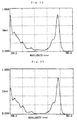
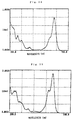
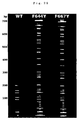
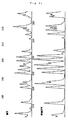
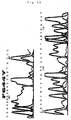
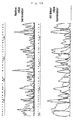
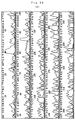
- T7 RNA polymerases introduced with mutations were purified, and their abilities of promoter sequence specific RNA synthesis and incorporation of ribonucleoside 5'-triphosphates including ATP, GTP, CTP, UTP and derivatives thereof, as well as 3'-dATP, 3'-dGTP, 3'-dCTP, 3'-dUTP and derivatives thereof were compared with those of wild type T7 RNA polymerase. The results are shown in Table 1 hereinafter.
- F644Y, F644Y/L665P, L665P/F667Y and F644Y/L665P/F667Y maintained sufficient RNA synthesis activity, and showed marked improvement of incorporation of 3'-dATP, 3'-dGTP, 3'-dCTP, 3'-dUTP and derivatives thereof.
- the incorporation ability of the F644Y/L665P mutant was comparable to that of the F644Y mutant. From these results, it can be seen that the substitution of proline for leucine at 665 do not affect on the incorporation of 3'-dATP, 3'-dGTP, 3'-dCTP, 3'-dUTP and derivatives thereof.
- the F667Y mutant also showed the incorporation ability comparable to that of the L665P/F667Y mutant.
- the incorporation ability of the F644Y/L665P/F667Y mutant was the highest. While not shown in Table 1, the incorporation ability of the F644Y/F667Y mutant was almost equal to that of the F644Y/L665P/F667Y mutant.
- the F782Y mutant maintained RNA synthesis activity, and showed slightly improved ability for incorporating 3'-dATP, 3'-dGTP, 3'-dCTP, 3'-dUTP and derivatives thereof.
- the F733Y mutant showed slightly decreased RNA synthesis activity, but showed slightly improved ability for incorporating 3'-dATP, 3'-dGTP, 3'-dCTP, 3'-dUTP and derivatives thereof.
- the F646Y mutant maintained RNA synthesis activity, but showed no improvement of ability for incorporating 3'-dATP, 3'-dGTP, 3'-dCTP, 3'-dUTP and derivatives thereof.
- the F882Y mutant is not mentioned in Table 1, because it showed markedly decreased RNA synthesis activity.
- the Y639F mutant of the T7 RNA polymerase which has the mutation at a location corresponding to Y526 of T7 DNA polymerase, maintained RNA synthesis activity, but showed no improvement of ability for incorporating 3'-dATP, 3'-dGTP, 3'-dCTP, 3'-dUTP and derivatives thereof.
- RNA polymerase of the present invention is particularly an RNA polymerase having modification of at least one of amino acids present in the "nucleotide binding site" of the polymerase and that such a modification can enhance the ability for incorporating 3'-deoxyribonucleotides and other ribonucleotide analogues in comparison with the ability for corresponding ribonucleotides.
- amino acids present in the above "nucleotide binding site” can be, for example, amino acids in a loop between the helix Y and the helix Z and/or amino acids in a loop between the helix Z and the helix AA of wild type RNA polymerase.
- the loop (corresponding to amino acid residues 635 to 647 of T7 RNA polymerase) between the helix Y (corresponding to amino acid residues 625 to 634 of the same) and the helix Z (corresponding to amino acid residues 649 to 658 of the same) and/or the loop (corresponding to amino acid residues 659 to 684 of the same) between the helix Z and the helix AA (corresponding to amino acid residues 685 to 699 of the same), which face the inside of the crafts in the polymerase molecule enclosing template DNA, are considered to constitute a part of the ribonucleotide binding site, which locates quite near the nucleotides.
- the F residues present at 644, 646 and 667 in a region corresponding to the loops were actually replaced with Y residues (see Figure 5).
- the F residues of 733, 782 and 882 are present in a region other than that corresponding to the loop, and considered to face the inside of the crafts in the polymerase molecule. These F residues were also actually replaced with Y residues.
- the present invention further relates to an RNA polymerase which has modification at an amino acid selected from those in a region corresponding to the amino acid residues 641-667 of the RNA polymerase derived from T7 phage.
- the region corresponding to the amino acid residues 641-667 of the RNA polymerase derived from T7 phage correspond to the above-mentioned "nucleotide binding site".
- RNA polymerases extremely resemble one another in their primary structures of amino acids, sequence of promoter and the like.
- Figures 3 and 4 alignment of amino acid sequences of the aforementioned four RNA polymerases derived from the phages is represented. From this alignment, it can be seen that the RNA polymerases derived from T7, T3, and K11 highly resemble one another.
- the amino acid sequences of RNA polymerases derived from T7 and T3 phages show extremely high similarity as shown in Figures 6 and 7. It is conformable to the fact that both of T7 and T3 phages are those infecting E. coli, and they are also resemble each other in their properties.
- promoter sequences recognizing these two RNA polymerases also resemble each other, and they have known to have extremely high recognition specificity.
- results obtained in T7 RNA polymerase are relatively readily applied to other RNA polymerases having similar amino acid sequences.
- RNA polymerase derived from T7 phage in RNA polymerases other than the RNA polymerase derived from T7 phage is the amino acid residues 642-668 for the RNA polymerase derived from T3 phage, the amino acid residues 664-690 for the RNA polymerase derived from K11 phage, and the amino acid residues 633-670 for the RNA polymerase derived from SP6 phage.
- RNA polymerases derived from T7, T3, and K11 phages extremely resemble one another as described above, and the results obtained for T7 RNA polymerase can be applied for other RNA polymerases having a similar amino acid sequence (see Figure 8).
- RNA polymerase derived from K11 phage having tyrosine at the amino acid residue 644 or 667 can be mentioned.
- RNA polymerase derived from T3 phage having tyrosine at the amino acid residue 645 or 668 can also be exemplified.
- RNA polymerase derived from K11 phage having tyrosine at one or more of the amino acid residues 664-669 and 690 can further be exemplified.
- RNA polymerase derived from SP6 phage having tyrosine at one or more of the amino acid residues 633-638 and 670 can still further be exemplified.
- the modification of such an amino acid may be not only substitution of amino acid but also insertion or deletion of amino acid.
- the mutation of amino acid is, for example, substitution of tyrosine for at least one amino acid residue in a naturally occurring amino acid sequence.
- the amino acid to be replaced may be, for example, phenylalanine.
- the amino acid to be replaced is not limited to phenylalanine, and any amino acid may be replaced so long as it can enhance the ability for incorporating 3'-deoxyribonucleotides and other ribonucleotide analogues relative to ability for the corresponding ribonucleotides.
- the mutant T7 RNA polymerases F644Y, L665P/F667Y and F644Y/L665P/F667Y maintained sufficient RNA synthesis activity, and showed markedly improved ability for incorporating 3'-dNTPs, and the strong bias observed in the wild type is markedly reduced in these polymerases.
- Use of T7 RNA polymerase F644Y, L665P/F667Y or F644Y/L665P/F667Y having such characteristics enables a nucleotide sequence determination method utilizing transcription products, which is of more excellent practical applicability in comparison with a nucleotide sequence determination method utilizing a DNA polymerase.
- E. coli strains pT7RF644Y (DH5 ⁇ ) and pT7RL665P/F667Y (DH5 ⁇ ), which produce the mutant T7 RNA polymerases F644Y and L665P/F667Y respectively, were already deposited at the National Institute of Bioscience and Human-Technology (Higashi 1-1-3 Tsukuba-shi Ibaraki-ken, Japan, 305-0046) with international deposition numbers of 5998 (FERM-BP-5998) and 5999 (FERM-BP-5999) respectively on July 2, 1997.
- the aforementioned mutant RNA polymerases can be produced by preparing a nucleic acid molecule encoding an RNA polymerase, introducing a mutation into the nucleic acid molecule so that one or more nucleotides in one or more regions should be mutated, and collecting a modified RNA polymerase expressed by the mutated nucleic acid molecule.
- the preparation of the nucleic acid molecule encoding RNA polymerase, introduction of mutation into the nucleic acid molecule, and collection of the modified RNA polymerase can be performed by using conventional methods.
- a mutant T7 RNA polymerase can be constructed by the following method.
- an expression plasmid comprising a region between the HpaI, and NcoI restriction sites in the C-terminus side of T7 RNA polymerase gene which is introduced with a mutation by PCR is constructed.
- this expression plasmid can be transformed into E. coli DH5 ⁇ , which can then produce a large amount of a mutant T7 RNA polymerase protein upon addition of isopropyl- ⁇ -D-thiogalactopyranoside (IPTG).
- IPTG isopropyl- ⁇ -D-thiogalactopyranoside
- the method for enzymatically synthesizing a nucleic acid transcription product using an RNA polymerase and a DNA fragment containing a promoter sequence for the RNA polymerase as a template, the method for separating nucleic acid transcription products, and the method for determining nucleic acid sequences from separated fractions have already been known. Therefore, concerning these methods, any known techniques, conditions, apparatuses and the like can be suitably used.
- the DNA fragment to be a template is not particularly limited except that it should contain a promoter sequence for RNA polymerase.
- the DNA fragment containing a promoter sequence may be a DNA product amplified by polymerase chain reaction.
- the nucleic acid transcription reaction in the method of the present invention can be performed with an amplified DNA product without removing the primers and/or 2'-deoxyribonucleoside 5'-triphosphate and/or derivatives thereof used for the polymerase chain reaction.
- any methods widely used as PCR can be used as they are.
- the DNA fragment containing a promoter sequence can be a DNA fragment obtained by ligating the promoter sequence and a DNA fragment to be amplified, and cloning the ligated fragment using a suitable host. That is, in the present invention, DNA sequences to be amplified, primers, conditions for amplification and the like are not particularly limited.
- the polymerase chain reaction for the amplification of DNA fragment containing a promoter sequence can be performed, for example, in a reaction system of 20 ⁇ l volume containing 10-50 ng of genomic DNA or 1 pg of cloned DNA, 10 ⁇ M each of primers, and 200 ⁇ M each of 2'-deoxyribonucleoside 5'-triphosphate (dATP, dGTP, dCTP, dTTP) by using Taq polymerase as the DNA polymerase.
- dATP 2'-deoxyribonucleoside 5'-triphosphate
- either one of the primers for the polymerase chain reaction or an amplified inserted DNA should contain a promoter sequence for RNA polymerase, which will be explained hereinafter.
- the direct transcriptional sequencing method by using two kinds of primers one of which contains a phage promoter sequence, or an amplified inserted DNA containing a phage promoter sequence for PCR, the resulting PCR product can undergo in vitro transcription using an RNA polymerase driven by the promoter.
- the promoter sequence for the RNA polymerase can be suitably selected depending on the kind of RNA polymerase to be used.
- nucleic acid transcripts such as RNA transcripts are synthesized from a DNA fragment containing a promoter sequence. Because the DNA fragment contains a promoter sequence for the RNA polymerase, the above-mentioned mutant RNA polymerase is promoted by this promoter sequence, and thus nucleic acid transcripts such as RNA transcripts are synthesized.
- ribonucleoside 5'-triphosphates including ATP, GTP, CTP and UTP or derivatives thereof and one or more kinds of the 3'-dNTP derivatives are reacted in the presence of the mutant RNA polymerase mentioned above.
- NTPs ribonucleoside 5'-triphosphates
- 3'-dNTP derivatives is used in this specification as a generic term for collectively referring to 3'-dATP, 3'-dGTP, 3'-dCTP, 3'-dUTP and derivative thereof.
- NTPs ribonucleoside 5'-triphosphates
- at least four kinds of compounds different in their bases are necessary for the synthesis of transcripts including a case where a part of them is consisting of their derivatives such as ATP derivatives.
- two or more kinds of compounds carrying the same base may be used.
- RNA or nucleic acid The 3'-hydroxy group at the 3' end of the transcription product, RNA or nucleic acid, is eliminated when a 3'-dNTP derivative is incorporated, and thus the synthesis of the RNA or nucleic acid is inhibited. As a result, RNA or nucleic acid fragments having a 3'-dNTP derivative at the 3' end with various sizes can be obtained.
- Such ribonucleoside analogues are obtained for each of the four kinds of 3'-dNTP derivatives different in their bases. These provided four kinds of ribonucleoside analogues can be used for the determination of RNA or nucleic acid sequence [Vladimir D. Axelred et al. (1985) Biochemistry Vol. 24, 5716-5723].
- the 3'-dNTP derivatives one or more kinds of them can be used for one transcription reaction.
- the four kinds of transcription products with different 3'-dNTP derivatives at the 3' ends can be obtained by performing nucleic acid transcription reaction four times.
- One nucleic acid transcription reaction affords a transcription product which is a mixture of various RNA or nucleic acid fragments having the same 3'-dNTP derivative at the 3' ends with various molecular weights.
- the obtained four kinds of transcription products can independently subjected to separation and sequence determination explained hereinafter. Two or more of the four kinds of transcription products can also be mixed and subjected to the separation and sequence determination.
- nucleic acid such as RNA
- the transcription of nucleic acid such as RNA is achieved by an RNA polymerase in the presence of four kinds of ribonucleoside 5'-triphosphates different in their bases, and terminated by 3'-dNTP derivatives.
- an RNA or nucleic acid ladder for sequencing is formed.
- the nucleic acid transcription is preferably performed in the presence of, in particular, different four kinds of ribonucleoside 5'-triphosphates, of which products are then separated to determine nucleotide sequences for the four kinds of bases at one time (simultaneously).
- the RNA or nucleic acid transcription products are separated.
- This separation can appropriately be performed by a method capable of separating a plurality of kinds of molecules with different molecular weights contained in the transcription product according to the molecular weights.
- electrophoresis can be mentioned.
- the HPLC can also be used.
- conditions and the like are not particularly limited, and it can be performed by conventional manner. From bands (RNA or nucleic acid ladder) obtained by subjecting the transcription products to electrophoresis, sequences of RNA or nucleic acid can be determined.
- the reading of the RNA or nucleic acid ladder can be performed by labeling the terminators for the transcription reaction, i.e., the ribonucleoside 5'-triphosphates (NTPs).
- NTPs ribonucleoside 5'-triphosphates
- the reading of the RNA or nucleic acid ladder also becomes possible by labeling the 3'-dNTP derivatives used for the transcription reaction. Examples of the label are radioactive or stable isotopes, fluorescent labels and the like.
- the sequences of the transcription products can also be determined by measuring mass of each transcription reaction product separated by electrophoresis by means of a mass spectrometer without using a label such as those mentioned above.
- the sequences of transcription products can be determined by, for example, using 3'-dNTP derivatives, more specifically, labeled 3'-dATP, 3'-dGTP, 3'-dCTP and 3'-dUTP, and detecting radioactive or stable isotopes, fluorescent labels and the like of the bands obtained by electrophoresis of the transcription products.
- the labeling of the 3'-dNTP derivatives reduces the fluctuation of radioactivity intensity or fluorescence intensity among the bands obtained, and makes the measurement easy.
- the detection of radioactive or stable isotopes or ladders emitting fluorescence can be performed by suitably using, for example, an apparatus used for DNA sequencing.
- sequences of transcription products can also be determined by using ATP, GTP, CTP and UTP labeled with radioactive or stable isotopes or fluorescence, and detecting the radioactive or stable isotopes or fluorescence of the band obtained by electrophoresis of the products.
- sequences of RNA or nucleic acid can also be determined by using differently fluorescence-labeled 3'-dATP, 3'-dGTP, 3'-dCTP and 3'-dUTP, and detecting four kinds of fluorescence of the bands obtained by electrophoresis of a mixture of various transcription product fragments having 3'-dATP, 3'-dGTP, 3'-dCTP or 3'-dUTP at their ends and differently labeled.
- the four kinds of 3'-dNTPs are labeled with different kinds of fluorescence. This makes it possible to afford bands emitting fluorescence corresponding to each of the four kinds of 3'-dNTPs different at their 3' ends by subjecting a mixture of four kinds of transcription products different in their 3' ends, and thereby it becomes possible to simultaneously determine four kinds of RNA or nucleic acid sequences by differentiating the different kinds of fluorescence.
- 3'-dNTP derivatives used for the method of determining DNA sequence of the present invention 3'-deoxyribonucleotide derivatives represented by the following general formula [I] are preferably used, because the 3'-deoxyribonucleotide derivatives represented by the general formula [I] are easily incorporated into a sequence in a polymerase chain reaction by an RNA polymerase.
- n in the general formula [I] preferably represents an integer of 4-10.
- R in the general formula [I] is preferably represented by the following general formula [VII]:
- the 3'-deoxyribonucleotide derivatives represented by the general formula [I] of the present invention are composed of three structural components:
- R 3 represents -PO 3 H 2 , -P 2 O 6 H 3 , -P 3 O 9 H 4 or a salt thereof.
- the salt include alkali metal salts such as sodium salts, potassium salts and lithium salts, alkaline earth metal salts such as barium salts, ammonium salts such as triethylammonium salts, organic amine salts such as pyridine salts and the like.
- the linker represented by the above general formula [VI] is a linker for binding the 3'-deoxyribonucleotide residue represented by Q and the fluorescent group.
- one of the carbon atoms forming double bond or triple bond in the linker is bonded to any of the 3'-deoxyribonucleotide residues represented by Q at 5-position for the pyrimidine nucleotide residues, or at 7-position for the 7-deazapurine nucleotide residues, respectively, and the -NH- group of the linker is bonded to a carboxyl group of the fluorescent dye group, so that a compound which have the 3'-deoxyribonucleotide residue and the fluorescent dye group is formed.
- examples of the methylene chain where n is not less than 4 include the methylene chain where n is 4-15, more specifically, a tetramethylene group, a pentamethylene group, a hexamethylene group, a heptamethylene group, an octamethylene group, a nonamethylene group, a decamethylene group and the like.
- n should be an integer not less than 4, preferably n is an integer of 4-10, more preferably n is an integer of 4-8, particularly preferably n is 4 or 6.
- the fluorescent group represented by R may be directly bound to the -NH- group, or bound to the -NH- group through a linker.
- the fluorescent group is not particularly limited, and may be suitably selected in view of fluorescence intensity, wavelength of fluorescence, easiness of incorporation by RNA polymerases and the like.
- the fluorescent group is preferably a fluorescent dye generating detectable luminescence emission subsequent to stimulation by energy absorption from a suitable energy source such as argon laser.
- Examples of the fluorescent group R include groups represented by the following general formula [VII].
- the fluorescent groups represented by the general formula [VII] are fluorescent dye groups generating detectable luminescence emission subsequent to stimulation by energy absorption from a suitable energy source such as argon laser.
- W represents carboxyl group
- X represents -O-, -S-, -NR'- where R' represents hydrogen atom, a lower alkyl group, an aralkyl group or an aryl group, or -CH 2 -
- Y represents OH or -NR 1 R 2 where R 1 and R 2 each independently represent hydrogen atom or a lower alkyl group, or both of R 1 and R 2 represent a trimethylene group (i.e., R 1 and R 2 represent two trimethylene groups, of which other end is bonded to either one of the carbon atoms next to the nitrogen atom to which the trimethylene group is bonded), the broken line ------ in the ring C: represents a bond present at a position decided by the structures of the ring A and the ring B, and the rings A, B and C and the benzene ring having W may optionally have one or
- the lower alkyl group represented by R' in -NR'- for X in the general formula [VII] may be linear, branched or cyclic, and examples thereof include alkyl groups having 1-6 carbon atoms such as, specifically, a methyl group, an ethyl group, an n-propyl group, an isopropyl group, an n-butyl group, an isobutyl group, a sec-butyl group, a pentyl group, an isopentyl group, a tert-pentyl group, a 1-methylpentyl group, an n-hexyl group, an isohexyl group, a cyclopropyl group, a cyclopentyl group, a cyclohexyl group and the like.
- Examples of the aralkyl group represented by R' include aralkyl groups having 7-20 carbon atoms such as, specifically, a benzyl group, a phenethyl group, a phenylpropyl group, a methylbenzyl group, a methylphenethyl group, an ethylbenzyl group, a naphthylmethyl group, a naphthylethyl group and the like, and examples of the aryl group represented by the same include a phenyl group, a tolyl group, a xylyl group, a naphthyl group and the like.
- the portion of the fluorescent dye group in the 3'-deoxyribonucleotide derivatives of the present invention can take either of the following structures:
- the carboxyl group may form a salt, for example, an alkali metal salt such as a sodium salt, a potassium salt and a lithium salt, an alkaline earth metal salt such as a barium salt, an ammonium salt such as a triethylammonium salt, an organic amine salt such as a pyridine salt or the like.
- a salt for example, an alkali metal salt such as a sodium salt, a potassium salt and a lithium salt, an alkaline earth metal salt such as a barium salt, an ammonium salt such as a triethylammonium salt, an organic amine salt such as a pyridine salt or the like.
- the broken line ------ in the ring C represents a bond present at a position decided by the structures of the ring A and the ring B. More specifically, it can be exemplified as follows.
- the ring A (or the ring B) and the ring C can take either of the following configurations:
- the rings A, B and C and the benzene ring having W may optionally have one or more additional substituents, and examples of such substituents include alkyl groups, alkoxy groups, halogen atoms and the like.
- the alkyl groups may be linear, branched or cyclic, and may have a double bond, and examples thereof include alkyl groups having 1-20 carbon atoms, preferably alkyl groups having 1-6 carbon atoms. Specific examples thereof include a methyl group, an ethyl group, an n-propyl group, an isopropyl group, an n-butyl group, an isobutyl group, a sec-butyl group, a pentyl group, an isopentyl group, a tert-pentyl group, a 1-methylpentyl group, an n-hexyl group, an isohexyl group, a cyclopropyl group, a cyclopentyl group, a cyclohexyl group and the like.
- the alkoxy groups are preferably, for example, lower alkoxy groups having 1-6 carbon atoms. Specific examples thereof are, for example, a methoxy group, an ethoxy group, an n-propoxy group, an isopropoxy group, an n-butoxy group, a pentyloxy group, an isopentyloxy group, a tert-pentyloxy group, a 1-methylpentyloxy group, an n-hexyloxy group, an isohexyloxy group and the like.
- the halogen atoms include fluorine, chlorine, bromine, iodine and the like.
- Preferred specific examples of the fluorescent dye group represented by the above general formula [VII] include those derived from fluorescent dyes such as 5- or 6-carboxytetramethylrhodamine (abbreviated as TMR hereinafter), 5- or 6-carboxyrhodamine-X (abbreviated as XR hereinafter), 5- or 6-carboxyrhodamine-6G (abbreviated as R6G hereinafter), 5- or 6-carboxyrhodamine-110 (abbreviated as R110 hereinafter), 5- or 6-carboxyfluorescein, 5- or 6-carboxy-2',7'-dichlorofluorescein, 5- or 6-carboxy-2',4',5',7'-tetrachlorofluorescein, 5- or 6-carboxy-4,7-dichloro-2',7'-dimethoxyfluorescein, 5- or 6-carboxy-4,7,4',5'-tetrachloro-2',7'-dimeth
- 3'-deoxyribonucleotide derivatives of the present invention represented by general formula [I] can be synthesized easily, for example, according to the following synthesis schemes.
- R 4 represents a fluorescent dye group such as those mentioned above.
- Authorized nomenclatures for the abbreviations used in the following synthesis schemes are as follows.
- the 3'-deoxyribonucleotide derivatives of the present invention are extremely effective as RNA extension terminators for the DNA sequencing methods utilizing RNA polymerases, and nucleotide sequences of DNA can be more surely determined by using them.
- a template DNA to be sequenced can be ligated to downstream of a promoter of an RNA polymerase, extension and termination reaction can be performed with the DNA in the presence of four ribonucleotides of adenine (A), guanine (G), cytosine (C), and uracil (U), and four 3'-deoxyribonucleotide derivatives modified with fluorescent dyes of the present invention, which correspond to the ribonucleotides, then the reaction products can be mixed and subjected to electrophoresis in one lane, and the fluorescence wavelength exited by laser can be spectrophotometrically detected to sequentially determine the DNA sequence.
- A adenine
- G guanine
- C cytosine
- U uracil
- the combination of a fluorescent dye and the four kinds of 3'-deoxyribonucleotide should be suitably selected, particularly when four kinds of sequences are determined in parallel in one lane, by considering difference of luminescence intensity of fluorescent dyes and difference of incorporation rate by an RNA polymerase due to the difference of the kind of bases of 3'-deoxyribonucleotides. That is, it is preferred to select such a combination that uniform intensity of fluorescence signals from each transcription product should be obtained for stable reading and highly accurate DNA sequencing.
- the fluorescence intensities of the four kinds of fluorescent dyes used in the examples of the present invention are in the order of R110, R6G > TMR > XR.
- the detection sensitivity is about 40 amol for R110 and R6G, about 400 amol for TMR, and about 800 amol for XR.
- incorporation rate of 3'-deoxyribonucleotides is different depending on the kind of RNA polymerase, and this should be considered for the selection of the combination.
- the incorporation rate of 3'-dNTP by T7 RNA polymerase was measured by using radioactive [ ⁇ - 32 P]3'-dNTPs. As a result, it was in the order of 3'-dGTP > 3'-dATP, 3'-dUTP > 3'-dCTP.
- R6G-3'-dATP, R110-3'-dCTP, XR-3'-dGTP, and TMR-3'-dUTP affords uniform peak outputs.
- the nucleic acid transcription reaction is performed in the presence of inorganic pyrophosphatase, because, by doing so, the difference of peak altitudes (intensities of signals) corresponding to each labeled ribonucleotide is reduced, thereby precision of sequence determination is improved and it becomes possible to obtain more accurate sequence data.
- Pyrophosphorolysis occurs due to increase of pyrophosphate produced by DNA synthesis, and it acts to promote the reaction so that the resulting DNA product should be decomposed. As a consequence, the pyrophosphorolysis inhibits the sequencing in the dideoxy sequencing method utilizing a DNA polymerase. As for this fact, it has been known that, when an inorganic pyrophosphatase is used in the dideoxy sequencing method utilizing a DNA polymerase, it inhibits the pyrophosphorolysis and thus affords stable sequencing data [Japanese Patent Unexamined Publication (KOKAI) No. Hei 4-506002/1992].
- Inorganic pyrophosphatase (EC.3.6.1.1) is commercially available, and for example, it is sold by Sigma as INORGANIC PYROPHOSPHATASE and by Boehringer as Pyrophosphatase. While the amount of inorganic pyrophosphatase to be used may depends on the degrees of activities of inorganic pyrophosphatase and RNA polymerase, it is suitably in the range of 10 -6 to 10 -2 units for 1 unit of RNA polymerase.
- a DNA sequence used as a template of the transcription can be determined from an RNA or nucleic acid sequence determined as described above.
- RNA or nucleic acid sequence information provided from four kinds of ladders can be integrated to determine the DNA sequence used as a template of transcription.
- ladders are simultaneously formed for two or more kinds of nucleotides (when bands for two or more kinds of nucleotides are present in the same ladder)
- RNA or nucleic acid sequence information provided from the ladders can be integrated to determine the DNA sequence used as a template of transcription.
- the DNA sequence used as a template of transcription can be determined from RNA or nucleic acid sequence information provided from one ladder.
- the sequencing method of the present invention can be utilized in various kits.
- the bias of incorporation abilities for ribonucleotides and the like for example, the fact that 3'-deoxyribonucleotides are more unlikely to be incorporated into a polyribonucleotide sequence compared with corresponding ribonucleotides, and the fact that incorporation is fluctuated among ribonucleotides and among 3'-deoxyribonucleotides depending on the kind of the base groups, can be eliminated and thereby a method for determining DNA nucleotide sequences capable of affording more stable sequence data can be provided.
- sequence determination method of the present invention would allow nucleotide sequence determination superior to that obtained by a nucleotide sequence determination method utilizing a DNA polymerase.
- a DNA sequence of PCR product as it is can be determined without purifying the PCR product. This can be realized by the characteristic of RNA polymerases that remaining 2'-dNTPs in a reaction mixture is not consumed as a reactant in the presence of 3'-dNTP for sequencing.
- the method of the present invention utilizes transcription reaction of RNA, it does not require use of a single-stranded template DNA nor primers as usual DNA sequencing methods, and it also does not require any denaturation step for hybridization of sequencing primers. Therefore, it is not affected by the renaturation of the PCR product, and DNA sequences can be easily determined.
- thermostable mutant RNA polymerase as RNA polymerase, the method for determining DNA sequence of the present invention can be used for a step utilizing PCR, and as a result, it makes it possible to more rapidly determine DNA sequences.
- T7 phage harbored in E. coli was prepared as follows.
- E. coli strain C600 was inoculated in 200 ml of LB culture medium (culture medium prepared by dissolving Bacto tryptone 10g, Bacto yeast extract 5g, and NaCl 5g in 1 liter of water, which was adjusted to pH 7.5, and sterilized in an autoclave).
- OD (600 nm) 1.0
- the cells were infected with the phage at a multiplicity of infection of about 2. The OD was determined periodically, and when the OD was sharply decreased, the cell residue was removed by centrifugation.
- the medium was added with NaCl and polyethylene glycol 6000 to final concentrations of 0.5 M and 10% respectively, stirred sufficiently, and left stand overnight to form precipitates.
- the precipitates were collected by centrifugation, and suspended in SM buffer (10 mM Tris-HCl, pH 7.5, 10 mM MgSO 4 , 50 mM NaCl, 0.01% gelatin).
- SM buffer 10 mM Tris-HCl, pH 7.5, 10 mM MgSO 4 , 50 mM NaCl, 0.01% gelatin.
- This T7 phage concentrate was overlaid on CsCl solution layers carefully overlaid in a centrifugation tube (CsCl solutions having concentrations of 1.267 g/ml, 0.817 g/ml, and 0.705 g/ml from the bottom layer), and centrifuged at 22,000 rpm for 2 hours to form a phage layer.
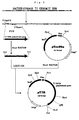
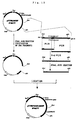
- the T7 RNA polymerase gene corresponds to the 3171st-5822nd base pairs in the 39,937 base pairs of the genome DNA [the total nucleotide sequence of T7 genomic gene had already been reported by Dunn et al. (1983, J. Mol. Biol., 166(4):477-535), but it was slightly corrected (see T7 phage DNA sequence of GeneBank, accession No. V01148 J02518 X00411)]. This genomic DNA was used for PCR as a template, and cloned into an expression vector as follows (see Figure 9).
- the gene encoding the enzyme was amplified by PCR by using a primer specific for upstream of the N-terminus amino acid region of T7 RNA polymerase gene (T7Rpol-N 5'-ATA TTT TAG CCA TGG AGG ATT GAT ATA TGA ACA CGA TTA ACA TCG CTA AG-3') and a primer specific for downstream of the C-terminus amino acid region of T7 RNA polymerase gene (T7Rpol-C 5'-ATA TTT TAG CCA TGG TAT AGT GAG TCG TAT TGA TTT GCG-3'), each containing NcoI restriction site at the 5'-end.
- T7Rpol-N 5'-ATA TTT TAG CCA TGG AGG ATT GAT ATA TGA ACA CGA TTA ACA TCG CTA AG-3' a primer specific for downstream of the C-terminus amino acid region of T7 RNA polymerase gene (T7Rpol-C 5'-ATA TTT TAG CCA TGG TAT
- This DNA fragment was digested with NcoI, and separated by electrophoresis on 1% agarose gel, and the band of the objective DNA fragment was cut out from the agarose, and purified by using Gene Pure Kit (Nippon Gene).
- the DNA fragment was ligated to an expression vector pTrc99a (Pharmacia Biotech) which had been digested with NcoI and dephosphorylated to construct pT7R which expressed T7 RNA polymerase at high level.
- the plasmid pT7R expressing wild type T7 RNA polymerase was transformed into E. coli DH5 ⁇ , and the cells resistant to antibiotic ampicillin was cultured.
- the Trc promoter contained in the expression vector pT7R was driven by adding IPTG to the culture medium.
- Acids Res., 19:1948 (details may be substantially the same as those of the method for purifying mutant T7 RNA polymerase exemplified in Reference Example 3), and found to have RNA polymerase activity which was exerted in a T7 promoter specific manner.
- the region was divided into two fragments on the left side and right side of the nucleotide to be mutated, and these DNA fragments were amplified by PCR using primers F646Y(+) (5'-GTT GAC GGA AGC CGT ACT CTT TGG AC-3') introduced with a mutation and F646Y(-) (5'-GTC CAA AGA GTA CGG CTT CCG TCA AC-3'), and primers T7RNAP-HpaI-N (5'-CGC GCG GTT AAC TTG CTT CCT AG-3') and pTrc99a-PstI-C (5'-GCA TGC CTG CAG GTC GAC TCT AG-3'), each containing a restriction cleavage site at the 5'-end.
- primers F646Y(+) 5'-GTT GAC GGA AGC CGT ACT CTT TGG AC-3'
- F646Y(-) 5'-GTC CAA AGA GTA CGG C
- DNA fragments had complementary regions, and denaturation, annealing and extension reactions of the regions were repeated to prepare a DNA fragment introduced with the desired mutation.
- This DNA fragment was purified by collecting only a DNA fragment of a desired size through agarose gel electrophoresis, and this was re-amplified by using it as a template together with the primers T7RNAP-HpaI-N and pTrc99a-PstI-C, and cleaved with restriction endonuclease HpaI and PstI.
- This DNA fragment was separated by 1% agarose gel electrophoresis, and the band of the desired DNA fragment was cut out, and purified.
- the HpaI-PstI DNA fragment of pT7R was replaced with this DNA fragment to introduce a mutation.
- the resulting pT7R was transformed into E. coli DH5 ⁇ , and cells harboring the plasmid introduced with the mutation were selected. Finally, the nucleotide sequence was determined to confirm whether the mutation was introduced into the desired site.
- the expression plasmid pT7RF644Y for producing mutant T7 RNA polymerase F644Y was obtained.
- expression could be induced by adding IPTG to the cultured E. coli cells harboring the plasmid, like the production of wild type T7 RNA polymerase.
- mutant T7 RNA polymerase L665P/F667Y was performed as follows based on PCR technique as in the construction of the F644Y mentioned above.
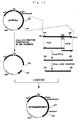
- a XhoI restriction site (CTCGAG) was introduced into the T7 RNA polymerase gene region of the expression vector pT7R having the wild type T7 RNA polymerase gene to facilitate the introduction of mutation. More specifically, the expression vector pT7R used as template was amplified by using a primer pair of primer ApaF1 (5'-CAT CTG GTC GCA TTG GGT CAC-3') and primer Xho-R (5'-CCA AGT GTT CTC GAG TGG AGA-3'), and a primer pair of a primer Xho-F (5'-CTA AGT CTC CAC TCG AGA ACA CTT GG-3') and a primer AflII-R (5'-CAG CCA GCA GCT TAG CAG CAG-3'), respectively.
- primer ApaF1 5'-CAT CTG GTC GCA TTG GGT CAC-3'
- primer Xho-R (5'-CCA AGT GTT CTC GAG TGG A
- the former amplified DNA fragment was digested with restriction endonucleases ApaI and XhoI, and the latter amplified DNA fragment with restriction endonucleases AflII and XhoI, and they were ligated to the expression vector pT7R preliminarily treated with ApaI and AflII by using T4 DNA ligase.
- This reaction product was transformed into E. coli DH5 ⁇ , and several colonies grown on an agar plate containing antibiotic ampicillin were obtained.
- Plasmid DNA was extracted from the cultured cells to obtain plasmid pT7R-Xho in which a XhoI restriction site was introduced in the T7 RNA polymerase gene region (see Figure 11). Presence of this XhoI site can be confirmed by cleavage by a treatment with the restriction endonuclease XhoI, and nucleotide sequencing of the DNA.
- PCR was performed with a primer pair of primer Xho-R and primer 667R (5'-GCT GAG TGT ACA TCG GAC CCT-3'), and a primer pair of a primer 667F (5' of -GCT GAG TGT ACA TCG GAC CCT-3') and a primer AflIIR.
- the PCR products were directly used as templates for the nucleotide sequencing of the DNA to determine the sequences of the primers 667R and 667F.
- the fragment was digested with restriction endonucleases XhoI and AflII, and the resulting fragment was ligated to the plasmid pT7R-Xho preliminarily treated with restriction endonucleases XhoI and AflII by using T4 DNA ligase.
- This reaction product was transformed into E. coli DH5 ⁇ , and several colonies of the cells grown on an agar plate containing antibiotic ampicillin were obtained. Some of these colonies were selected and cultured, and plasmid DNA was extracted from the cultured cells.
- the plasmid DNA was confirmed if it was introduced with the desired mutation by DNA sequencing to finally construct an expression plasmid pT7RL665P/F667Y for producing the mutant T7 RNA polymerase L665P/F667Y (see Figure 12).
- expression could be induced by adding IPTG to the cultured E. coli cells harboring the plasmid, like the production of wild type T7 RNA polymerase.
- mutant T7 RNA polymerases can be purified by principally the same method.
- the difference of mutation site may cause some difference in the expression level, and behavior in column chromatography.
- the purification method of mutant T7 RNA polymerase F644Y is exemplified hereinafter.
- the expression vector pT7RF644Y for F644Y was introduced into E. coli DH5 ⁇ , and the cells were cultured in a test tube containing LB culture medium containing antibiotic ampicillin. When the OD (600 nm) of the medium reached 0.4-0.6, isopropyl- ⁇ -thiogalactopyranoside (IPTG) was added to the culture to a final concentration of 0.4 mM, and the cultivation was further continued for additional 8 hours.
- IPTG isopropyl- ⁇ -thiogalactopyranoside
- E. coli cells were collected by centrifugation. Typically, 2 liters of culture medium affords 10 g of E. coli cells in wet weight. If the E. coli cells are not used immediately, they can be stored in a refrigerator at -20°C or lower.
- Subsequent steps for purification of enzyme should be performed at a temperature lower than room temperature, preferably 0-5°C unless otherwise indicated.
- the E. coli cells were washed with 10 times relative to the cell weight of a washing buffer (20 mM Tris-HCl, pH 8.1, 130 mM NaCl, 2 mM EDTANa 2 at 25°C), centrifuged again (5,000 x g, 4°C, 10 minutes), suspended in 10 times in volume of a sonication buffer [50 mM Tris-HCl, pH 8.1, 100 mM NaCl, 0.1mM EDTANa 2 , 5 mM dithiothreitol (DTT), 0.1 mM benzamidine, 30 ⁇ g/ml phenylmethylsulfonyl fluoride (PMSF), 10 ⁇ g/ml bacitracin], and sonicated by using Sonifier 450 (Branson) at 80W for more than 15 minutes to destroy the cells
- the cell suspension is centrifuged at 12,000 x g and 4°C for ten minutes to remove the cell debris.
- 10% streptomycin sulfate was slowly added dropwise to the resulting supernatant to a final concentration of 2.0% with stirring, and stirring was further continued for 30 minutes.
- the supernatant was centrifuged at 12,000 x g and 4°C for ten minutes to remove precipitates, and slowly added with ammonium sulfate powder with stirring to form precipitates.
- precipitates were first collected by 30% saturation of ammonium sulfate (30% ammonium sulfate precipitation), and the resulting supernatant was further added with ammonium sulfate to 60% saturation with stirring to form precipitates again (30-60% ammonium sulfate precipitation). The supernatant was added again with ammonium sulfate powder to 90% ammonium sulfate saturation, and stirred at 4°C for 1 hour, and the precipitates were collected by centrifugation.
- the dialysate was applied on a heparin-Sepharose column of 5 ml volume (Pharmacia Biotech). Subsequently, the column was washed with the same buffer until any material absorbing ultraviolet ray at 280 nm disappeared, and eluted with a linear gradient of 0.1 M to 0.64 M NaCl in the same buffer of about 40 times volume of the column volume.
- the eluent was collected in test tubes as fractions of a suitable volume, and immediately subjected to SDS-acrylamide gel electrophoresis for protein analysis to identify fractions containing proteins around a molecular weight considered to be of the objective T7 RNA polymerase. In typical examples, it should be found around 0.4 M NaCl.
- the fractions containing the protein were collected, and desalted by dialysis against about 1 liter of the column buffer (20 mM KPO 4 , pH 7.7, 100 mM NaCl, 1 mM DTT, 30 ⁇ g/ml PMSF) for 16 hours.
- the fractions desalted by dialysis were applied to a Q-Sepharose column (Pharmacia Biotech) of 5 ml volume that preliminarily equilibrated with the saute buffer, and the column was washed with the same buffer until any material absorbing ultraviolet ray at 280 nm disappeared, and eluted with a linear gradient of 0.1 M to 0.64 M NaCl in the same buffer of about 40 times volume of the column volume.
- the eluent was collected in test tubes as fractions of a suitable volume, and immediately subjected to SDS-acrylamide gel electrophoresis for protein analysis to identify fractions containing proteins around a molecular weight considered to be of the objective T7 RNA polymerase. In typical examples, it should be found around 0.24 M NaCl.
- the fractions containing the protein were collected, dialyzed against 500 ml of storage buffer (50% glycerol, 20 mM KPO 4 , pH7.7, 100 mM NaCl, 1 mM DTT, 30 ⁇ g/ml PMSF) for 16 hours, and stored at -20°C until use.
- RNA synthesis activity and activity of the contaminated ribonuclease of this sample were examined.
- the in vitro RNA synthesis activity was examined by, for example, performing RNA synthesis reaction according to the enzyme dilution method by using the plasmid containing T7 promoter as a template and a commercially available wild type T7 RNA polymerase (BRL, Gibco) as a standard, and subjecting the synthesized RNA to agarose gel electrophoresis to estimate approximate titer.
- BTL wild type T7 RNA polymerase
- simple assay for contaminated ribonuclease can simultaneously be performed.
- 2,500,000 units of the mutant T7 RNA polymerase F644Y protein was purified from 1 liter of culture medium using the above-described steps, and this preparation was substantially free from RNase contamination.
- PCR was performed by using the expression plasmid producing the mutant T7 RNA polymerase L665P/F667Y as template together with a primer pair of the primer Xho-F and the primer T7-DOUBLE-R (21-mer: 5'-CTCTTTGGACCCGTAAGCCAG-3') or a primer pair of the primer T7-DOUBLE-F (29-mer: 5'-TTACGGGTCCAAAGAGTACGGCTTCCGTC-3') and the primer AflII-R.
- the PCR products were directly used as templates and determined for DNA sequences to confirm the sequences of the primers T7-DOUBLE-R and T7-DOUBLE-F.
- Each of the products was subjected to electrophoresis on 2% agarose gel to purify DNA fragment of the intended size.
- the purified two kinds of DNA fragments were mixed, and used as template for PCR using the primers XhoF and AflIIR.
- the fragment was digested with restriction endonucleases XhoI and AflII, and the resulting fragment was ligated to the plasmid pT7RL665P/F667Y preliminarily treated with restriction endonucleases XhoI and AflII by using T4 DNA ligase.
- This reaction product was transformed into E.
- the mutant T7 RNA polymerase F644Y/L665P/F667Y could be purified by the same method as in Reference Example 3.
- 1,000,000 units of the mutant T7 RNA polymerase F644Y/L665P/F667Y protein was purified from 1 liter of culture medium.
- the obtained RNA polymerase was detected substantially as a single band, and RNase was not detected in this specimen by SDS-polyacrylamide gel electrophoresis.
- 3'-Deoxycytidine (Compound 5, 3.0 g, 13.2 mmol) was suspended in a mixed solution of 1,4-dioxane (300 ml) and ethanol (30 ml), cooled to 10°C, added with silver trifluoroacetate (7.0 g, 31.7 mmol) and iodine (8.04 g, 31.7 mmol), and stirred at room temperature for two hours. After the reaction was completed, the precipitates were removed by filtration through celite, and washed with 1,4-dioxane, and the filtrate and the wash were combined, and concentrated to afford 3.84 g of 3'-deoxy-5-iodocytidine (Compound 6, yield; 82.4%).
- reaction mixture was diluted with a methylene chloride-methanol mixture (20 ml), added with ion exchange resin AG1X8 (BIO-RAD, HCO 3 - type, 2.02 g), and stirred for 30 minutes. After filtration of the reaction mixture, the filtrate was concentrated, and the residue was purified by silica gel column chromatography (eluent; chloroform-methanol mixed solution), and crystallized from a methanol-ether mixture to afford 409 mg of a novel substance, 3'-deoxy-5-(5''-trifluoroacetamido-1''-pentynyl)cytidine (yield; 46.0%). Melting point: 191-193°C
- Tetrasodium pyrophosphate decahydrate (2.23 g) was dissolved in water (50 ml), and loaded on an ion exchange resin column Dowex 50WX8 (Dowex, H + type, 45 ml). The column was eluted with water, and the eluent was collected until its pH became substantially neutral. The eluent was added with tri-n-butylamine (3.55 ml) and stirred sufficiently. The mixture was concentrated under reduced pressure, and the residue was further concentrated to dryness by azeotropy with ethanol, pyridine, and DMF. The resulting residue was dissolved in dry DMF to a total volume of 10 ml to afford 0.5 M concentration of tris(tri-n-butylammonium) pyrophosphate.
- 3'-Deoxy-5-(5''-trifluoroacetamido-1''-pentynyl)cytidine (121mg, 0.3 mmol) was dissolved in triethyl phosphate (1.21 ml), cooled to -20°C, then added with phosphorus oxychioride (25 ⁇ l), and stirred at -20°C. After 30 minutes, the reaction mixture was added with further phosphorus oxychloride (22 ⁇ l), and stirred for further 5 hours.
- the reaction mixture was added to 0.5 M solution of the tris(tri-n-butylammonium) pyrophosphate obtained in Synthesis Example 4 in DMF (3.6 ml) cooled to -20°C, and stirred at room temperature for two hours. After the reaction was completed, the reaction mixture was added with a triethylamine-water mixture (5 ml), left stand overnight, then added with 25% aqueous ammonia (20 ml), and left stand for 4 hours.
- reaction mixture was diluted with a methylene chloride-methanol mixture (20 ml), added with ion exchange resin AG1X8 (HCO 3 - type, 2.02 g), and stirred for 30 minutes. After filtration of the reaction mixture, the filtrate was concentrated, and the resulting residue was purified by silica gel column chromatography (eluent, chloroform-methanol mixed solution), crystallized from a methanol-ether mixture to afford 399 mg of a novel substance, 3'-deoxy-5-(6''-trifluoroacetamido-1''-hexynyl)cytidine (Compound 7, yield; 42.1%).
- ion exchange resin AG1X8 HCO 3 - type, 2.02 g
- This reaction mixture was added to 0.5 M solution of tris(tri-n-butylammonium) pyrophosphate in DMF (3.6 ml) cooled to -20°C, and stirred at room temperature for two hours. After the reaction was completed, the reaction mixture was added with a triethylamine-water mixture (4 ml), left stand overnight, added with 25% aqueous ammonia (20 ml), and left stand for four hours.
- reaction mixture was diluted with a methylene chloride-methanol mixture (12 ml), added with ion exchange resin AG1X8 (HCO 3 - type, 1.17 g), and stirred for 30 minutes. After filtration of the reaction mixture, the filtrate was concentrated, and the resulting residue was purified by silica gel column chromatography (eluent; chloroform-methanol mixed solution), and crystallized from a methanol-ether mixture to afford 219 mg of a novel substance, 3'-deoxy-5-(8''-trifluoroacetamido-1''-octynyl)cytidine (Compound 9, yield; 38.5%).
- ion exchange resin AG1X8 HCO 3 - type, 1.17 g
- This reaction mixture was added to 0.5 M solution of tris(tri-n-butylammonium) pyrophosphate in DMF (3.6 ml) cooled to -20°C, and stirred at room temperature for two hours. After the reaction was completed, the reaction mixture was added with a triethylamine-water mixture (5 ml), left stand overnight, then added with 25% aqueous ammonia (20 ml), and left stand for four hours.
- 6-Chloro-9-( ⁇ -D-ribofuranosyl)-7-deazapurine (Compound 11, 3.58 g, 12.5 mmol) was dissolved in THF (160 ml), added with pyridine (5.1 ml, 62.7 mmol), silver nitrate (4.68 g, 27.6 mmol) and tert-butyldimethylsilyl chloride (4.16 g, 27.6 mmol), and stirred at room temperature overnight. After the reaction was completed, the precipitates were removed by filtration through celite, and the filtrate was concentrated, dissolved in chloroform, and washed with 0.2 N hydrochloric acid and saturated saline.
- 6-Chloro-9-(3'-deoxy- ⁇ -D-ribofuranosyl)-7-deazapurine (Compound 15, 1.47 g, 5.45 mmol) was dissolved in pyridine (15 ml), added with acetic anhydride (5 ml), and stirred at room temperature overnight. After the reaction was completed, the reaction mixture was cooled to 0°C, added with methanol (5 ml), and concentrated under reduced pressure. The residue was dissolved in chloroform, and washed with 0.5 N hydrochloric acid and saturated saline.
- reaction mixture was diluted with a methylene chloride-methanol mixture (6 ml), added with ion exchange resin AG1X8 (HCO 3 - type, 0.55 g), and stirred for 30 minutes. After filtration of the reaction mixture, the filtrate was concentrated, and the resulting residue was purified by silica gel column chromatography (eluent; chloroform-methanol mixed solution) to afford 210 mg of a novel substance, 7-deaza-7-(6''-trifluoroacetamido-1''-hexynyl)-3'-deoxyadenosine (Compound 19, yield; 81.6%).
- ion exchange resin AG1X8 HCO 3 - type, 0.55 g
- This reaction mixture was added to 0.5 M solution of tris(tri-n-butylammonium) pyrophosphate in DMF (4.9 ml) cooled to -20°C, and stirred at room temperature for three hours. After the reaction was completed, the reaction mixture was added with a triethylamine-water mixture (5 ml), left stand overnight, added with 25% aqueous ammonia (20 ml), and left stand for four hours.
- Et represents an ethyl group
- Me represents a methyl group
- reaction mixture was diluted with a methylene chloride-methanol mixture (6 ml), added with ion exchange resin AG1X8 (HCO 3 - type, 0.55 g), and stirred for 30 minutes. After filtration of the reaction mixture, the filtrate was concentrated, and the resulting residue was purified by silica gel column chromatography (eluent; chloroform-methanol mixed solution) to afford 216 mg of a novel substance, 7-deaza-7-(8''-trifluoroacetamido-1''-octynyl)-3'-deoxyadenosine (Compound 21, yield; 78.7%).
- ion exchange resin AG1X8 HCO 3 - type, 0.55 g
- This reaction mixture was added to 0.5 M solution of tris(tri-n-butylammonium) pyrophosphate in DMF (4.8 ml) cooled to -20°C, and stirred at room temperature for three hours. After the reaction was completed, the reaction mixture was added with a triethylamine-water mixture (15 ml), left stand overnight, added with 25% aqueous ammonia (20 ml), and left stand for four hours.
- Et represents an ethyl group
- Me represents a methyl group
- reaction mixture was added with a triethylamine-water mixture (5 ml), left stand overnight, added with 25% aqueous ammonia (20 ml), and left stand for four hours.
- the reaction mixture was washed with ether, and concentrated to dryness, and the resulting residue was purified by DEAE-Toyopearl ion exchange column chromatography (Tosoh Corporation, 1.2 x 30 cm, eluent; triethylammonium hydrogencarbonate buffer (pH 7.5), 0 M ⁇ 0.3 M linear gradient (total volume; 1 L)) to afford 172 mg of a novel substance, 5-(6''-amino-1''-hexynyl)-3'-deoxyuridine-5'-triphosphate (Compound 4, yield; 60.0%).
- Me represents a methyl group.
- reaction mixture was cooled to 0°C, and added with ethyl acetate and water, and the organic layer was washed with 5% sodium thiosulfate solution, saturated sodium hydrogencarbonate solution, and saturated saline.
- the ethyl acetate layer was dried over anhydrous magnesium sulfate, and the ethyl acetate was evaporated.
- reaction mixture was diluted with methylene chloride-methanol mixture (20 ml), added with ion exchange resin AG1X8 (HCO 3 - type, 2.0 g), and stirred for 30 minutes. After filtration of the reaction mixture, the filtrate was concentrated, and the resulting residue was purified by silica gel column chromatography (eluent; chloroform-methanol mixed solution) to afford 616 mg of a novel substance, 3'-deoxy-7-(6''-trifluoroacetamido-1''-hexynyl)-7-deazaguanosine (Compound 31, yield; 69.5%).
- ion exchange resin AG1X8 HCO 3 - type, 2.0 g
- This reaction mixture was added to 0.5 M solution of tris(tri-n-butylammonium) pyrophosphate in DMF (3.6 ml) cooled to -20°C, and stirred at room temperature for three hours. After the reaction was completed, the reaction mixture was added with a triethylamine-water mixture (4 ml), washed with ether, and purified by DEAE-Toyopearl ion exchange column chromatography (1.7 x 30 cm, eluent; triethylammonium hydrogencarbonate buffer (pH 7.5), 0 M ⁇ 0.6 M linear gradient (total volume; 2 L)).
- the purified product was added with 25% aqueous ammonia (20 ml), left stand for one hour, and then concentrated under reduced pressure, and the obtained residue was purified again by DEAE-Toyopearl ion exchange column chromatography (1.7 x 30 cm, eluent; triethylammonium hydrogencarbonate buffer (pH 7.5), 0 M ⁇ 0.3 M linear gradient (total volume; 1 L)) to afford 108 mg of a novel substance, 7-deaza-7-(6''-amino-1''-hexynyl)-3'-deoxyguanosine-5'-triphosphate (Compound 32, yield; 36.4%).
- Propargylamine (Aldrich, 25 g, 0.45 mol) was added dropwise to methyl trifluoroacetate (Tokyo Chemical Industry Co., Ltd., 69.2 g, 0.54 mol) cooled to 0°C. They were allowed to react at 0°C for two hours to afford 43.8 g (86.0%) of N-propargyltrifluoroacetanide after purification by vacuum distillation (23 mmHg, boiling point; 77°C).
- reaction mixture was concentrated under reduced pressure, and the resulting residue was dissolved in a methylene chloride-methanol mixture (40 ml), added with ion exchange resin AG1X8 (BIO-RAD, HCO 3 - type, 4 g), and stirred for 30 minutes. After filtration of the reaction mixture, the filtrate was concentrated, and the resulting residue was purified by silica gel column chromatography (eluent; methylene chloride-methanol mixed solution) to afford 918 mg of 3'-deoxy-5-(3''-trifluoroacetamido-1''-propynyl)uridine (yield; 55.3%).
- 3'-Deoxy-5-(3''-trifluoroacetamido-1''-propynyl)uridine (42 mg, 0.11 mmol) was dissolved in triethyl phosphate (1.13 ml), cooled to -20°C, then added with phosphorus oxychloride (25 ⁇ l), and stirred at -20°C. After 30 minutes, the reaction mixture was added with further phosphorus oxychloride (22 ⁇ l), and stirred for further five hours.
- This reaction mixture was added to 0.5 M solution of the tris(tri-n-butylammonium) pyrophosphate obtained in Synthesis Example 4 in DMF (3.6 ml) cooled to -20°C, and stirred at room temperature for two hours. After the reaction was completed, the reaction mixture was added with a triethylamine-water mixture (4 ml), left stand overnight, added with 25% aqueous ammonia (20 ml), and left stand for four hours.
- reaction mixture was diluted with a methylene chloride-methanol mixture (25 ml), added with ion exchange resin AG1X8 (HCO 3 - type, 2.6 g), and stirred for 30 minutes. After filtration of the reaction mixture, the filtrate was concentrated, and the resulting residue was purified by silica gel column chromatography (eluent; methylene chloride-methanol mixed solution) to afford 879 mg of 3'-deoxy-5-(3''-trifluoroacetamido-1''-propynyl)cytidine (yield; 82.5%).
- 3'-Deoxy-5-(3''-trifluoroacetamido-1''-propynyl)cytidine (113mg, 0.3 mmol) was dissolved in triethyl phosphate (1.13 ml), cooled to -20°C, added with phosphorus oxychloride (25 ⁇ l), and stirred at -20°C. After 30 minutes, the reaction mixture was added with further phosphorus oxychloride (22 ⁇ l), and stirred for further five hours.
- This reaction mixture was added to 0.5 M solution of the tris(tri-n-butylammonium) pyrophosphate obtained in Synthesis Example 4 in DMF (3.6 ml) cooled to -20°C, and stirred at room temperature for two hours. After the reaction was completed, the reaction mixture was added with a triethylamine-water mixture (4 ml), left overnight, then added with 25% aqueous ammonia (20 ml), and left stand for four hours.
- reaction mixture was diluted with a methylene chloride-methanol mixture (12 ml), added with ion exchange resin AG1X8 (HCO 3 - type, 1.22 g), and stirred for 30 minutes. After filtration of the reaction mixture, the filtrate was concentrated, and the resulting residue was purified by silica gel column chromatography (eluent; methylene chloride-methanol mixed solution) to afford 436 mg of 7-deaza-7-(3''-trifluoroacetamido-1''-propynyl)-3'-deoxyadenosine (yield; 82.3%).
- This reaction mixture was added to 0.5 M solution of the tris(tri-n-butylammonium) pyrophosphate obtained in Synthesis Example 4 in DMF (3.6 ml) cooled to -20°C, and stirred at room temperature for three hours. After the reaction was completed, the reaction mixture was added with a triethylamine-water mixture (4 ml), left stand overnight, added with 25% aqueous ammonia (20 ml), and left stand for four hours.
- reaction mixture was diluted with a methylene chloride-methanol mixture (16 ml), added with ion exchange resin AG1X8 (HCO 3 - type, 1.6 g), and stirred for 30 minutes. After filtration of the reaction mixture, the filtrate was concentrated, and the resulting residue was purified by silica gel column chromatography (eluent; chloroform-methanol mixed solution) to afford 485 mg of 3'-deoxy-7-(3''-trifluoroacetamido-1''-propynyl)-7-deazaguanosine (yield; 70.5%).
- 3'-Deoxy-7-(3''-trifluoroacetamido-1''-propynyl)-7-deazaguanosine (125 mg, 0.3 mmol) was dissolved in triethyl phosphate (1.25 ml), cooled to -20°C, added with phosphorus oxychloride (25 ⁇ l), and stirred at -20°C. After 30 minutes, the reaction mixture was added with further phosphorus oxychloride (22 ⁇ l), and further stirred overnight.
- This reaction mixture was added to 0.5 M solution of the tris(tri-n-butylammonium) pyrophosphate obtained in Synthesis Example 4 in DMF (3.6 ml) cooled to -20°C, and stirred at room temperature for three hours. After the reaction was completed, the reaction mixture was added with a triethylamine-water mixture (4 ml), washed with ether, and purified by DEAE-Toyopearl ion exchange column chromatography (1.2 x 30 cm, eluent; triethylammonium hydrogencarbonate buffer (pH 7.5), 0 M ⁇ 0.6 M linear gradient (total volume; 2 L)).
- the purified product was added with 25% aqueous ammonia (15 ml), and left stand for one hour, and then concentrated under reduced pressure, and the obtained residue was purified again by DEAE-Toyopearl ion exchange column chromatography (1.2 x 30 cm, eluent; triethylammonium hydrogencarbonate buffer (pH 7.5), 0 M ⁇ 0.3 M linear gradient (total volume; 1 L)) to afford 75 mg of 7-deaza-7-(3''-amino-1''-propynyl)-3'-deoxyguanosine-5'-triphosphate (yield; 25.9%).
- Et represents an ethyl group
- Me represents a methyl group
- the reaction mixture was concentrated under reduced pressure, and the residue was suspended in anhydrous methanol (55 ml), add with the 0.1 M solution of lithium tetrachloropalladate prepared above (55 ml) and the 6-trifluoroacetamido-1-hexene obtained in Synthesis Example 57 (3.42 g, 17.5 mmol), and allowed to react under reflux for 16 hours.
- the reaction mixture was saturated with hydrogen sulfide gas, then the precipitates were removed by filtration through celite, and the filtrate was concentrated.
- the reaction mixture was diluted with a methylene chloride-methanol mixture (9.3 ml), added with ion exchange resin AG1X8 (BIO-RAD, HCO 3 - type, 0.68 g), and stirred for 30 minutes. After filtration of the reaction mixture, the filtrate was concentrated, and the resulting residue was purified by silica gel column chromatography (eluent; methylene chloride-methanol mixed solution), and HPLC (column; Wakosil II 5C18 RS Prep, 20.0 x 250 mm, eluent; acetonitrile-water mixed solution) to afford 127 mg of a novel substance, 3'-deoxy-5-(6''-trifluoroacetamido-1''-hexenyl) uridine (Compound 33, yield; 35.5%).
- ion exchange resin AG1X8 BIO-RAD, HCO 3 - type, 0.68 g
- reaction mixture was added with a triethylamine-water mixture (15 ml), and left stand overnight.
- the reaction mixture was washed with ether, and purified by DEAE-Toyopearl ion exchange column chromatography (1.7 x 40 cm, eluent; triethylammonium hydrogencarbonate buffer (pH 7.5), 0 M ⁇ 0.3 M linear gradient (total volume; 1 L)).
- the purified product was added with 17% aqueous ammonia (60 ml), and left stand at 5°C for 17 hours, and then concentrated under reduced pressure, and the obtained residue was purified again by DEAE-Toyopearl ion exchange column chromatography (1.7 x 40 cm, eluent; triethylammonium hydrogencarbonate buffer (pH 7.5), 0 M ⁇ 0.3 M linear gradient (total volume; 1 L)) to afford 65.3 mg of a novel substance, 5-(6''-amino-1''-hexenyl)-3'-deoxyuridine-5'-triphosphate (Compound 34, yield; 22.4%).
- Me represents a methyl group.
- the reaction mixture was diluted with a methylene chloride-methanol mixture (20 ml), added with ion exchange resin AG1X8 (BIO-RAD, HCO 3 - type, 1.36 g), and stirred for 30 minutes. After filtration of the reaction mixture, the filtrate was concentrated, and the resulting residue was purified by silica gel column chromatography (eluent; methylene chloride-methanol mixed solution), and HPLC (column; Wakosil II 5C18 RS Prep, 20.0 x 250 mm, eluent; acetonitrile-water mixed solution) to afford 187 mg of a novel substance, 3'-deoxy-5-(6''-trifluoroacetamido-1''-hexenyl)cytidine (Compound 35, yield; 26.2%).
- ion exchange resin AG1X8 BIO-RAD, HCO 3 - type, 1.36 g
- reaction mixture was added with a triethylamine-water mixture (5 ml), and left stand overnight.
- the reaction mixture was washed with ether, and purified by DEAE-Toyopearl ion exchange column chromatography (1.7 x 40 cm, eluent; triethylammonium hydrogencarbonate buffer (pH 7.5), 0 M ⁇ 0.3 M linear gradient (total volume; 1 L).
- the purified product was added with 17% aqueous ammonia (60 ml), and left stand at 5°C for 15 hours, and then concentrated under reduced pressure, and the obtained residue was purified again by DEAE-Toyopearl ion exchange column chromatography (1.7 x 40 cm, eluent; triethylammonium hydrogencarbonate buffer (pH 7.5), 0 M ⁇ 0.3 M linear gradient (total volume; 1 L)) to afford 175 mg of a novel substance, 5-(6''-amino-1''-hexenyl)-3' - deoxycytidine -5'-triphosphate (Compound 36, yield; 60.2%).
- the reaction mixture was diluted with a methylene chloride-methanol mixture (16 ml), added with ion exchange resin AG1X8 (BIO-RAD, HCO 3 - type, 1.50 g), and stirred for 30 minutes. After filtration of the reaction mixture, the filtrate was concentrated, and the resulting residue was purified by silica gel column chromatography (eluent; methylene chloride-methanol mixed solution), and HPLC (column; Wakosil II 5C18 RS Prep, 20.0 x 250 mm, eluent; acetonitrile-water mixed solution) to afford 175 mg of a novel substance, 7-(6''-trifluoroacetamido-1''-hexenyl)-3'-deoxy-7-deazaadenosine (Compound 37, yield; 24.8%).
- ion exchange resin AG1X8 BIO-RAD, HCO 3 - type, 1.50 g
- This reaction mixture was added to 0.5 M solution of tris(tri-n-butylammonium) pyrophosphate in DMF (3.6 ml) cooled to -20°C, and stirred at room temperature for three hours. After the reaction was completed, the reaction mixture was added with a triethylamine-water mixture (5 ml), and left stand overnight. The reaction mixture was washed with ether, and purified by DEAE-Toyopearl ion exchange column chromatography (1.7 x 40 cm, eluent; triethylammonium hydrogencarbonate buffer (pH 7.5), 0 M ⁇ 0.3 M linear gradient (total volume; 1 L)).
- the purified product was added with 17% aqueous ammonia (60 ml), and left stand at 5°C for 15 hours, and then concentrated under reduced pressure, and the obtained residue was purified again by DEAE-Toyopearl ion exchange column chromatography (1.7 x 40 cm, eluent; triethylammonium hydrogencarbonate buffer (pH 7.5), 0 M ⁇ 0.3 M linear gradient (total volume; 1 L)) to afford 126 mg of a novel substance, 7-(6''-amino-1''-hexenyl)-3'-deoxy-7-deazaadenosine-5'-triphosphate (Compound 38, yield; 42.2%).
- Et represents an ethyl group
- Me represents a methyl group
- the reaction mixture was diluted with a methylene chloride-methanol mixture (40 ml), added with ion exchange resin AG1X8 (BIO-RAD, HCO 3 - type, 2.96 g), and stirred for 30 minutes. After filtration of the reaction mixture, the filtrate was concentrated, and the resulting residue was purified by silica gel column chromatography (eluent; methylene chloride-methanol mixed solution), and HPLC (column; Wakosil II 5C18 RS Prep, 20.0 x 250 mm, eluent; acetonitrile-water mixed solution) to afford 439 mg of a novel substance, 3'-deoxy-7-(6''-trifluoroacetamido-1''-hexenyl)-7-deazaguanosine (Compound 39, yield; 28.7%).
- ion exchange resin AG1X8 BIO-RAD, HCO 3 - type, 2.96 g
- This reaction mixture was added to 0.5 M solution of tris(tri-n-butylammonium) pyrophosphate in DMF (3.6 ml) cooled to -20°C, and stirred at room temperature for three hours. After the reaction was completed, the reaction mixture was added with a triethylamine-water mixture (5 ml), and left stand overnight. The reaction mixture was washed with ether, and purified by DEAE-Toyopearl ion exchange column chromatography (1.7 x 40 cm, eluent; triethylammonium hydrogencarbonate buffer (pH 7.5), 0 M ⁇ 0.3 M linear gradient (total volume; 1 L)).
- the purified product was added with 17% aqueous ammonia (60 ml), left stand at 5°C for 16 hours, and then concentrated under reduced pressure, and the obtained residue was purified again by DEAE-Toyopearl ion exchange column chromatography (1.7 x 40 cm, eluent; triethylammonium hydrogencarbonate buffer (pH 7.5), 0 M ⁇ 0.3 M linear gradient (total volume; 1 L)) to afford 122 mg of a novel substance, 7-(6''-amino-1''-hexenyl)-3'-deoxy-7-deazaguanosine-5'-triphosphate (Compound 40, yield; 40.4%).
- the transcription product was purified by gel filtration using a Sephadex G-50 column (Pharmacia Biotech), and the purification product was evaporated to dryness using a centrifugal evaporator.
- the dried reaction product was dissolved in 6 ⁇ l of formamide/EDTA/Blue dextran loading buffer according to the instruction manual Ver.1.0 of ABI PRISM 377 DNA Sequencing System available from Perkin-Elmer Japan, and 2 ⁇ l of the solution was analyzed by ABI 377 DNA Sequencer and an analysis program using denatured gel for sequencing analysis which contained 6M urea/4% Long RangerTM acrylamide solution (FMC).
- FMC Long RangerTM acrylamide solution
- the peak intensities of the sequence ladder obtained by using the mutant T7 RNA polymerase F644Y are shown in Figure 30 with the peak intensities obtained by using wild type T7 RNA polymerase for comparison.
- the peak intensities of the sequence ladder obtained by using the mutant T7 RNA polymerase L665P/F667Y are shown in Figure 31 with the peak intensities obtained by using wild type T7 RNA polymerase for comparison. From these comparisons, it was confirmed that altitude of the peaks for the mutant enzymes showed less fluctuation in comparison with the wild type, and the peak showed stronger signals.
- Sequencing reaction by the dye terminator method was performed utilizing the purified mutant T7 RNA polymerases F644Y and L665P/F667Y, and the wild type T7 RNA polymerase as follows for comparison.
- the transcription product was purified by gel filtration using a Sephadex G-50 column (Pharmacia Biotech), and the purification product was evaporated to dryness using a centrifugal evaporator.
- the dried reaction product was dissolved in 6 ⁇ l of formamide/EDTA/Blue dextran loading buffer according to the instruction manual Ver.1.0 of ABI PRISM 377 DNA Sequencing System available from Perkin-Elmer Japan, and 2 ⁇ l of the solution was analyzed by ABI 377 DNA Sequencer and an analysis program using denatured gel for sequencing analysis which contained 6M urea/4% Long RangerTM acrylamide solution (FMC).
- FMC Long RangerTM acrylamide solution
- the transcription product was purified by gel filtration using a Sephadex G-50 column (Pharmacia Biotech), and the purification product was evaporated to dryness using a centrifugal evaporator.
- the dried reaction product was dissolved in 6 ⁇ l of formamide/EDTA/Blue dextran loading buffer according to the instruction manual Ver.1.0 of ABI PRISM 377 DNA Sequencing System available from Perkin-Elmer Japan, and 2 ⁇ l of the solution was analyzed by ABI 377 DNA Sequencer and an analysis program using denatured gel for sequencing analysis which contained 6 M urea/4% Long RangerTM acrylamide solution (FMC).
- a plasmid vector pBluescriptKS(+) having T7 promoter (Stratagene) linearized by the reaction with a restriction endonuclease PvuII was used as a template.
- the transcription product was purified by gel filtration using a Sephadex G-50 column (Pharmacia Biotech), and the purification product was evaporated to dryness using a centrifugal evaporator.
- the dried reaction product was dissolved in 6 ⁇ l of formamide/EDTA/Blue dextran loading buffer according to the instruction manual Ver.1.0 of ABI PRISM 377 DNA Sequencing System available from Perkin-Elmer Japan, and 2 ⁇ l of the solution was analyzed by ABI 377 DNA Sequencer and an analysis program (Sequencing Analysis Ver. 3.0) using denatured gel for sequencing analysis which contained 6 M urea/4% Long RangerTM acrylamide solution (FMC). The results were shown in Figure 34. As a result, a sequence electrogram which can be sufficiently used at a practical level was obtained, though a few sections difficult to be determined were still remained.
- hTSH- ⁇ human thyroid-stimulating hormone
- KS(+) EcoRI site of pBluescript KS(+) (Stratagene)
- T7 RNA polymerase a subject of nucleotide sequencing, sequencing becomes possible as in this example.
- the PCR reaction was performed by using 100 fg of a plasmid having the hTSH- ⁇ cDNA, and primers present on the both sides of the cloning site, L220 primer (5'-TAA CAA TTT CAC ACA GGA AAC A-3') and 1211 primer (5'-ACG TTG TAA AAC GAC GGC CAG T-3') in a reaction volume of 20 ⁇ l with the following profile; 94°C for 2 minutes for one cycle, 94°C for 1 minute, 55°C for 1 minute, and 72°C for 1.5 minute for 30 cycles, and 72°C for 5 minutes.
- the T7 promoter was present in the downstream of the 1211 primer.
- 1 ⁇ l (about 10 ng) of the above PCR product was used for the sequencing reaction.
- the transcription product was purified by gel filtration using a Sephadex G-50 column (Pharmacia Biotech), and the purification product was evaporated to dryness using a centrifugal evaporator.
- the dried reaction product was dissolved in 6 ⁇ l of formamide/EDTA/Blue dextran loading buffer according to the instruction manual Ver.1.0 of ABI PRISM 377 DNA Sequencing System available from Perkin-Elmer Japan, and 2 ⁇ l of the solution was analyzed by ABI 377 DNA Sequencer and an analysis program (Sequencing Analysis Ver. 3.0) using denatured gel for sequencing analysis which contained 6 M urea/4% Long RangerTM acrylamide solution (FMC). The results are shown in Figure 35. From these results, a sequence electrogram sufficiently used at a practical level could be obtained, though a few sections difficult to be determined were still remained.
- Inorganic pyrophosphatase (PPase) free from RNase was produced as follows, but its production method is not limited to the method described below.
- inorganic pyrophosphatase As a starting material of the purification of inorganic pyrophosphatase, a roughly purified product derived from yeast, which was available from Sigma (Sigma I-1643, EC.3.6.1.1), was used, and 4 mg (680 units) of the product was suspended in a buffer (20 mM Tris-HCl, 1 mM EDTA, pH 7.9, 1 ml), and dialyzed against the same buffer for two hours for desalting, and the dialyzed product was subjected to column chromatography in an SP Sepharose column having a column volume of 1 ml (Pharmacia Biotech).
- the column was sufficiently washed with the same buffer until any material absorbing ultraviolet ray at 280 nm disappeared, and eluted with a linear gradient of 0 to 0.1 M NaCl in the same buffer of about 20 times volume of the column volume.
- the eluent was collected in test tubes as fractions of a suitable volume, and immediately subjected to SDS-12.5% polyacrylamide gel electrophoresis for protein analysis to identify fractions containing a protein of about 32 kDa.
- the PPase fractions should be found in the unabsorbed portion.
- the fractions containing the protein were collected, absorbed by Q-Sepharose column (Pharmacia Biotech) having a column volume of 1 ml, and eluted with a linear gradient of 0 to 0.1 M NaCl in the same buffer of about 20 times volume of the column volume.
- the eluent was collected in test tubes as fractions of a suitable volume, and immediately subjected to SDS-12.5% polyacrylamide gel electrophoresis to identify fractions containing a protein of about 32 kDa. In typical examples, it should be found around 0.35 M Nacl.
- fractions containing the protein of 32 kDa were collected, dialyzed against 500 ml of storage buffer (20 mM Tris-HCl, 1 mM EDTA, 50% glycerol, pH 7.9) for 16 hours, and stored at -20°C until use.
- storage buffer 20 mM Tris-HCl, 1 mM EDTA, 50% glycerol, pH 7.9
- a specimen containing 425 units of the PPase protein i.e., 0.425 units/ ⁇ l, could be obtained with a collection yield of 62.5%.
- RNase contamination degree of the above specimen was examined by using 8 ⁇ g of E. coli rRNA (16S and 23S) as substrates. More specifically, the PPase in an amount corresponding to 0.17 units was added to the E. coli rRNA in a buffer containing 8 mM MgCl 2 , 2 mM spermidine-(HCl) 3 , 5 mM DTT, 40 mM Tris/HCl, pH 8.0, and allowed to react at 37°C for four hours.
- the above reaction was performed with no addition of the enzyme, or addition of the enzyme in an amount corresponding to 0.425 units, 0.0425 units, or 0.00425 units. Then, to remove the unreacted dye terminators remained in the reaction product, the transcription product was purified by gel filtration using a Sephadex G-50 column (Pharmacia Biotech), and the purification product was evaporated to dryness using a centrifugal evaporator.
- the dried reaction product was dissolved in 6 ⁇ l of formamide/EDTA/Blue dextran loading buffer according to the instruction manual Ver.1.0 of ABI PRISM 377 DNA Sequencing System available from Perkin-Elmer Japan, and 2 ⁇ l of the solution was analyzed by ABI 377 DNA Sequencer and an analysis program (Sequencing Analysis Ver. 3.0) using denatured gel for sequencing analysis which contained 6 M urea/4% Long RangerTM acrylamide solution (FMC).
- FMC Long RangerTM acrylamide solution
- the sequencing reaction was performed as follows.
- a human thyroid-stimulating hormone (hTSH- ⁇ ) cDNA subcloned into the EcoRI site of pBluescript KS(+) (Stratagene) was used as a template of PCR reaction, but the template is not limited to the hTSH- ⁇ cDNA, and any genes may be used.
- the PCR reaction was performed by using 100 fg of a plasmid having the hTSH- ⁇ cDNA, and primers present on the both sides of the cloning site, L220 primer (5'-TAA CAA TTT CAC ACA GGA AAC A-3') and 1211 primer (5'-ACG TTG TAA AAC GAC GGC CAG T-3') in a reaction volume of 20 ⁇ l with the following profile; 94°C for 2 minutes for one cycle, 94°C for 1 minute, 55°C for 1 minute, and 72°C for 1.5 minute for 30 cycles, and 72°C for 5 minutes. 1 ⁇ l (about 10 ng) of the above PCR product was used for the sequencing reaction.
- the PPase When the PPase was added, it was added in an amount corresponding to 0.00425 units. Then, to remove the unreacted dye terminators remained in the reaction product, the transcription product was purified by gel filtration using a Sephadex G-50 column (Pharmacia Biotech), and the purification product was evaporated to dryness using a centrifugal evaporator.
- the dried reaction product was dissolved in 6 ⁇ l of formamide/EDTA/Blue dextran loading buffer according to the instruction manual Ver.1.0 of ABI PRISM 377 DNA Sequencing System available from Perkin-Elmer Japan, and 2 ⁇ l of the solution was analyzed by ABI 377 DNA Sequencer and an analysis program (Sequencing Analysis Ver. 3.0) using denatured gel for sequencing analysis which contained 6 M urea/4% Long RangerTM acrylamide solution (FMC). A part of the results are shown in Figure 38. As seen from these results, when the PPase was added, the separation of the peaks was improved, and uniformity of the peak altitudes was also increased. Thus, the same results were obtained as the case where the above plasmid was used as a template for sequencing. This suggests that the use of PPase increases the sequence reading precision.
- the sequencing reaction was performed with the same conditions as the case of Example 6 where the PCR product was used as a template with addition of inorganic pyrophosphatase, and the obtained sequencing precision was used for comparison.
- Figure 39 shows the results obtained with no addition of inorganic pyrophosphatase
- Figure 40 shows the results obtained from the reaction with addition of inorganic pyrophosphatase.
- nucleotide sequences can be determined with a precision equivalent to, or higher than that obtainable by the methods for determining nucleotide sequences of current mainstream, i.e., the methods utilizing DNA polymerases.
- NTP Ribonucleotide
- 3'-deoxynucleotide (3'-dNTP) incorporation rates of the mutant T7 RNA polymerase purified in Reference Example 5 were measured as follows.
- pBluescript(KS+) plasmid (Stratagene) linearized by reaction with a restriction endonuclease, PvuII, was used as a template for the transcription reaction, and 250 ⁇ M each of ATP, CTP, GTP, and UTP, 2 mM of spermidine-(HCl) 3 , 5 mM of DTT, 40 mM Tris/HCl pH 8.0, 0.1 ⁇ l of [ ⁇ - 32 P]UTP (3000 Ci/mmole), and 25 units of the mutant T7 RNA polymerase F644Y/L665P/F667Y were also used for the reaction.
- reaction mixture For two kinds of reaction mixture (with or without 3'-dATP, final concentration was 100 ⁇ M), the reaction was performed at 37°C for 60 minutes. The whole reaction mixture was spotted on DE81 paper (Whatman), washed three times with phosphate buffer, and dried. The DE81 paper was placed into a scintillation vial, and radioactivity was measured using a scintillation counter (Beckman) for each reaction. Degree of inhibition of the [ ⁇ - 32 P]UTP incorporation was calculated by comparing the values obtained with and without 3'-dATP based on the measured radioactivity. The relative activity obtained from calculated inhibition degree and defined as a relative value to the inhibition degree of the wild type T7 RNA polymerase normalized to 1.000 was shown in Table 1.
- the inhibition degree was calculated by using the wild type T7 RNA polymerase, T7 RNA polymerase F644Y, L665P/F667Y obtained in Reference Example 3, mutant T7 RNA polymerase F644Y/L665P, F782Y, F733Y, F646Y or Y639F constructed and purified in the same manner as in Examples 2 and 3 for the reaction instead of the above F644Y/L665P/F667Y mutant, and results concerning inhibition were obtained.
- the relative activities are shown in Table 1.
- a larger value indicates that the corresponding mutant enzyme has a mutation making 3'-dATP incorporation easier in a higher degree.
- the mutant T7 RNA polymerase F644Y/L665P/F667Y is 5.58 times more likely to incorporate 3'-dATP in comparison with the wild type enzyme. It has been demonstrate that the F644Y/L665P/F667Y mutant was the mutant enzyme exhibiting the least bias for the 3'-dATP incorporation among the mutant enzymes prepared.
- a template used as a template for sequencing reaction was prepared by PCR as follows.
- hTSH- ⁇ human thyroid-stimulating hormone cDNA subcloned into a plasmid derived from BS750 having T7 promoter was used.
- L220 primer 5'-TAA CAA TTT CAC ACA GGA AAC A-3'
- 1211 primer 5'-ACG TTG TAA AAC GAC GGC CAG T-3'
- PCR reaction was performed in a reaction volume of 20 ⁇ l (1 cycle of 94°C for 2 minutes, 30 cycles of 94°C for 1 minute, 55°C for 1 minute, and 72°C for 1.5 minutes, followed by 72°C for 5 minutes).
- the T7 promoter existed in the downstream of 1211 primer of the PCR product obtained from the above PCR reaction.
- the transcription product was purified by gel filtration using a Sephadex G-50 column (Pharmacia Biotech), and the purification product was evaporated to dryness using a centrifugal evaporator.
- the dried reaction product was dissolved in 6 ⁇ l of formamide/EDTA/Blue dextran loading buffer according to the instruction manual Ver.1.0 of ABI PRISM 377 DNA Sequencing System available from Perkin-Elmer Japan, and 2 ⁇ l of the solution was analyzed by ABI 377 DNA Sequencer and an analysis program (Sequencing Analysis Ver. 3.0) using denatured gel for sequencing analysis which contained 6M urea/4% Long RangerTM acrylamide solution (FMC) to afford an electropherogram. The results are shown in Figure 41. Excellent sequencing analysis was possible as demonstrated.
- PCR was performed by using the following materials (96°C for one minute, 55°C for 30 seconds, and 72°C for one minute for one cycle, and 96°C for 30 seconds, 55°C for 30 seconds, 72°C for one minute for 24 cycles), and the resulting PCR product (amplified DNA fragment of human thyroid stimulating hormone (TSH) ⁇ -subunit) was used as a template DNA.
- TSH human thyroid stimulating hormone
- Each material in a predetermined amount was added to a sample tube, filled up to a total volume of 10 ⁇ l with EXTaq buffer (Takara Shuzo), and used as a PCR mixture.
- the template DNA (10 ng) was added to a sample tube containing each of the terminators, guanosine-5'-triphosphate (rGTP), uridine-5'-triphosphate (rUTP), adenosine-5'-triphosphate (rATP), and cytidine-5'-triphosphate (rCTP), MgCl 2 , spermidine-(HCl) 3 , dithiothreitol (DTT), Tris/HCl (pH 7.5), yeast inorganic pyrophosphatase (PPase) and T7 RNA polymerase in such amounts as their final concentrations should be as follows, filled up to a total amount of 10 ⁇ l with distilled water, and used as a sample.
- Terminater 10 ⁇ M • rGTP 500 ⁇ M • rUTP 500 ⁇ M • rATP 250 ⁇ M • rCTP 250 ⁇ M • MgCl 2 8 mM •spermidine-(HCl) 3 2 mM • DTT 5 mM • Tris/HCl (pH 7.5) 40 mM • Yeast PPase 10 units • T7 RNA polymerase (Gibco BRL) 25 units
- the terminators not incorporated were removed by gel filtration using a Sephadex G25 column (Pharmacia), and the precipitates were collected by centrifugal separation. Subsequently, the precipitates were dissolved in 4 ⁇ l of formamide dye (10 mM EDTA containing 95% formamide), and heated to 90°C for two minutes. After cooling, 2 ⁇ l of the solution was applied to 4% sequencing gel, and electrophoresed on ABI377 fluorescence automatic sequencer (ABI).
- formamide dye (10 mM EDTA containing 95% formamide
- the matrix-converted gel image (termination pattern) obtained in the sequencer with TMR-3'dUTP(n4) is shown in Figure 42A
- the similarly matrix-converted gel image (termination pattern) obtained in the sequencer with TMR-Allyl-3'dUTP(n4) is shown in Figure 42B.
Landscapes
- Chemical & Material Sciences (AREA)
- Life Sciences & Earth Sciences (AREA)
- Organic Chemistry (AREA)
- Proteomics, Peptides & Aminoacids (AREA)
- Zoology (AREA)
- Wood Science & Technology (AREA)
- Health & Medical Sciences (AREA)
- Engineering & Computer Science (AREA)
- Microbiology (AREA)
- Biochemistry (AREA)
- Biotechnology (AREA)
- Molecular Biology (AREA)
- Biophysics (AREA)
- Analytical Chemistry (AREA)
- Physics & Mathematics (AREA)
- Immunology (AREA)
- Bioinformatics & Cheminformatics (AREA)
- General Engineering & Computer Science (AREA)
- General Health & Medical Sciences (AREA)
- Genetics & Genomics (AREA)
- Measuring Or Testing Involving Enzymes Or Micro-Organisms (AREA)
- Enzymes And Modification Thereof (AREA)
- Preparation Of Compounds By Using Micro-Organisms (AREA)
Applications Claiming Priority (5)
| Application Number | Priority Date | Filing Date | Title |
|---|---|---|---|
| JP19647897 | 1997-07-07 | ||
| JP19647897 | 1997-07-07 | ||
| JP15584798 | 1998-06-04 | ||
| JP15584798A JP3318579B2 (ja) | 1997-07-07 | 1998-06-04 | Dnaの塩基配列決定方法 |
| PCT/JP1998/003039 WO1999002729A1 (fr) | 1997-07-07 | 1998-07-06 | Procede de sequençage de l'adn |
Publications (3)
| Publication Number | Publication Date |
|---|---|
| EP0978569A1 true EP0978569A1 (fr) | 2000-02-09 |
| EP0978569A4 EP0978569A4 (fr) | 2002-09-04 |
| EP0978569B1 EP0978569B1 (fr) | 2004-09-22 |
Family
ID=26483751
Family Applications (1)
| Application Number | Title | Priority Date | Filing Date |
|---|---|---|---|
| EP98929853A Expired - Lifetime EP0978569B1 (fr) | 1997-07-07 | 1998-07-06 | Procede de sequencage de l'adn |
Country Status (7)
| Country | Link |
|---|---|
| US (1) | US6365350B1 (fr) |
| EP (1) | EP0978569B1 (fr) |
| JP (1) | JP3318579B2 (fr) |
| KR (1) | KR100551344B1 (fr) |
| CA (1) | CA2264967C (fr) |
| DE (1) | DE69826458T2 (fr) |
| WO (1) | WO1999002729A1 (fr) |
Cited By (2)
| Publication number | Priority date | Publication date | Assignee | Title |
|---|---|---|---|---|
| EP1046648A4 (fr) * | 1997-07-07 | 2002-09-11 | Rikagaku Kenkyusho | Derives de 3'-desoxyribonucleotide |
| WO2022263489A1 (fr) * | 2021-06-17 | 2022-12-22 | F. Hoffmann-La Roche Ag | Nucléoside-5'-oligophosphates ayant une nucléobase modifiée cationiquement |
Families Citing this family (14)
| Publication number | Priority date | Publication date | Assignee | Title |
|---|---|---|---|---|
| JP3480795B2 (ja) | 1997-07-07 | 2003-12-22 | 理化学研究所 | Dnaの塩基配列決定方法 |
| JP3172710B2 (ja) * | 1997-07-07 | 2001-06-04 | 理化学研究所 | Rnaポリメラーゼ |
| JP2002360256A (ja) * | 2001-06-04 | 2002-12-17 | Inst Of Physical & Chemical Res | Rnaプローブ作成方法、標的核酸の検出方法及びrnaプローブ作成用キット |
| JP2003061684A (ja) * | 2001-06-11 | 2003-03-04 | Nippon Genetech Co Ltd | Dnaの塩基配列決定法 |
| US20040067492A1 (en) * | 2002-10-04 | 2004-04-08 | Allan Peng | Reverse transcription on microarrays |
| US20060084799A1 (en) * | 2003-09-24 | 2006-04-20 | Williams Lewis T | Human cDNA clones comprising polynucleotides encoding polypeptides and methods of their use |
| US20050075543A1 (en) * | 2003-10-03 | 2005-04-07 | Calabrese Charles A. | Method of anonymous medical testing and providing the patient with the test results |
| WO2005035569A2 (fr) * | 2003-10-10 | 2005-04-21 | Five Prime Therapeutics, Inc. | Kiaa0779, ses variantes epissees et procede de leur utilisation |
| US7378260B2 (en) * | 2005-04-01 | 2008-05-27 | Applera Corporation | Products and methods for reducing dye artifacts |
| JP4621921B2 (ja) * | 2005-07-27 | 2011-02-02 | 国立大学法人群馬大学 | 新規核酸誘導体及びそれを用いたポリヌクレオチドの製造方法 |
| US20080206850A1 (en) * | 2007-02-28 | 2008-08-28 | Dellinger Douglas J | Methods and compositions for DNA synthesis |
| PT2231689T (pt) * | 2008-01-18 | 2016-10-07 | Inst Of Organic Chemistry And Biochemistry Of The Acad Of Sciences Of The Czech Republic | Novos nucleósidos 7-deazapurina citostáticos |
| US20090203086A1 (en) * | 2008-02-06 | 2009-08-13 | 454 Life Sciences Corporation | System and method for improved signal detection in nucleic acid sequencing |
| US9045740B2 (en) * | 2012-02-24 | 2015-06-02 | University Of Massachusetts | Modified T7-related RNA polymerases and methods of use thereof |
Family Cites Families (9)
| Publication number | Priority date | Publication date | Assignee | Title |
|---|---|---|---|---|
| JPS6061594A (ja) | 1983-09-05 | 1985-04-09 | ジヨエル ブレスラ | 固定化rνa |
| FI87360C (fi) | 1990-01-18 | 1992-12-28 | Neste Oy | Foerfarande foer framstaellning av eten-propen-kopolymerer i partikelform |
| US6027877A (en) | 1993-11-04 | 2000-02-22 | Gene Check, Inc. | Use of immobilized mismatch binding protein for detection of mutations and polymorphisms, purification of amplified DNA samples and allele identification |
| JPH07327698A (ja) | 1994-04-13 | 1995-12-19 | S R L:Kk | Dnaの変異の検出方法 |
| GB9408344D0 (en) | 1994-04-27 | 1994-06-15 | St James S University Hospital | Nucleic acid assays |
| ATE143057T1 (de) | 1994-10-17 | 1996-10-15 | Harvard College | Dns polymerase mit veränderter nukleotid- bindungstelle |
| US5614365A (en) * | 1994-10-17 | 1997-03-25 | President & Fellow Of Harvard College | DNA polymerase having modified nucleotide binding site for DNA sequencing |
| JP3155279B2 (ja) | 1994-11-07 | 2001-04-09 | 理化学研究所 | Dnaの塩基配列決定方法 |
| SE9602062D0 (sv) | 1996-05-29 | 1996-05-29 | Pharmacia Biotech Ab | Method for detection of mutations |
-
1998
- 1998-06-04 JP JP15584798A patent/JP3318579B2/ja not_active Expired - Fee Related
- 1998-07-06 KR KR1019997001916A patent/KR100551344B1/ko not_active Expired - Fee Related
- 1998-07-06 WO PCT/JP1998/003039 patent/WO1999002729A1/fr not_active Ceased
- 1998-07-06 CA CA002264967A patent/CA2264967C/fr not_active Expired - Fee Related
- 1998-07-06 EP EP98929853A patent/EP0978569B1/fr not_active Expired - Lifetime
- 1998-07-06 US US09/254,352 patent/US6365350B1/en not_active Expired - Fee Related
- 1998-07-06 DE DE69826458T patent/DE69826458T2/de not_active Expired - Fee Related
Non-Patent Citations (2)
| Title |
|---|
| See also references of WO9902729A1 * |
| SOUSA R: "Structural and mechanistic relationships between nucleic acid polymerases" TIBS TRENDS IN BIOCHEMICAL SCIENCES, ELSEVIER PUBLICATION, CAMBRIDGE, EN, vol. 21, no. 5, 1 May 1996 (1996-05-01), pages 186-190, XP004050909 ISSN: 0968-0004 * |
Cited By (2)
| Publication number | Priority date | Publication date | Assignee | Title |
|---|---|---|---|---|
| EP1046648A4 (fr) * | 1997-07-07 | 2002-09-11 | Rikagaku Kenkyusho | Derives de 3'-desoxyribonucleotide |
| WO2022263489A1 (fr) * | 2021-06-17 | 2022-12-22 | F. Hoffmann-La Roche Ag | Nucléoside-5'-oligophosphates ayant une nucléobase modifiée cationiquement |
Also Published As
| Publication number | Publication date |
|---|---|
| US6365350B1 (en) | 2002-04-02 |
| CA2264967C (fr) | 2008-09-23 |
| DE69826458T2 (de) | 2006-02-23 |
| EP0978569A4 (fr) | 2002-09-04 |
| KR20000068502A (ko) | 2000-11-25 |
| WO1999002729A1 (fr) | 1999-01-21 |
| CA2264967A1 (fr) | 1999-01-21 |
| EP0978569B1 (fr) | 2004-09-22 |
| JPH1175898A (ja) | 1999-03-23 |
| DE69826458D1 (de) | 2004-10-28 |
| KR100551344B1 (ko) | 2006-02-09 |
| JP3318579B2 (ja) | 2002-08-26 |
Similar Documents
| Publication | Publication Date | Title |
|---|---|---|
| EP0978569B1 (fr) | Procede de sequencage de l'adn | |
| US12006536B2 (en) | Chemically-enhanced primer compositions, methods and kits | |
| US20080044836A1 (en) | Nucleic Acid Analysis Using Non-templated Nucleotide Addition | |
| US6063571A (en) | Process for amplifying nucleic acids using DNA/PNA primers | |
| US6482938B1 (en) | Compounds having energy transfer function and method for DNA base sequencing by using the same | |
| US6265569B1 (en) | 3'-Deoxyribonucleotide derivatives | |
| EP0939130B1 (fr) | Arn polymerase | |
| CA2305811A1 (fr) | Nouveaux conjugues fluorescents de nucleosides ou de nucleotides, leur procede de preparation et leurs utilisations | |
| JP2003502013A (ja) | モルホリノ−ヌクレオチドの製造方法、並びに核酸配列の分析およびラベリングのためのその使用 | |
| JP3480795B2 (ja) | Dnaの塩基配列決定方法 | |
| WO2000037633A1 (fr) | Promoteurs de la transcription d'arn polymerase et procede de determination de la sequence de bases | |
| JP3656075B2 (ja) | エネルギートランスファー機能を有する化合物を利用したdnaの塩基配列決定方法 | |
| JP4072794B2 (ja) | Dnaの塩基配列決定方法 | |
| JPH10158293A (ja) | 3’−デオキシリボヌクレオチド誘導体 | |
| JP2004329218A (ja) | エネルギートランスファー機能を有する化合物を利用したdnaの塩基配列決定方法 | |
| CA2266031A1 (fr) | Derives de 3'-desoxyribonucleotide | |
| JPWO1999002544A1 (ja) | エネルギートランスファー機能を有する化合物及びそれを利用したdnaの塩基配列決定方法 | |
| JPH11155599A (ja) | Dnaの塩基配列決定方法 |
Legal Events
| Date | Code | Title | Description |
|---|---|---|---|
| PUAI | Public reference made under article 153(3) epc to a published international application that has entered the european phase |
Free format text: ORIGINAL CODE: 0009012 |
|
| 17P | Request for examination filed |
Effective date: 19990713 |
|
| AK | Designated contracting states |
Kind code of ref document: A1 Designated state(s): CH DE DK ES FR GB IT LI NL SE |
|
| RBV | Designated contracting states (corrected) |
Designated state(s): CH DE DK ES FR GB IT LI NL SE |
|
| A4 | Supplementary search report drawn up and despatched |
Effective date: 20020718 |
|
| AK | Designated contracting states |
Kind code of ref document: A4 Designated state(s): CH DE DK ES FR GB IT LI NL SE |
|
| RAP1 | Party data changed (applicant data changed or rights of an application transferred) |
Owner name: NIPPON GENETECH CO. LTD. Owner name: THE INSTITUTE OF PHYSICAL & CHEMICAL RESEARCH |
|
| 17Q | First examination report despatched |
Effective date: 20030311 |
|
| GRAP | Despatch of communication of intention to grant a patent |
Free format text: ORIGINAL CODE: EPIDOSNIGR1 |
|
| GRAS | Grant fee paid |
Free format text: ORIGINAL CODE: EPIDOSNIGR3 |
|
| GRAA | (expected) grant |
Free format text: ORIGINAL CODE: 0009210 |
|
| AK | Designated contracting states |
Kind code of ref document: B1 Designated state(s): CH DE DK ES FR GB IT LI NL SE |
|
| PG25 | Lapsed in a contracting state [announced via postgrant information from national office to epo] |
Ref country code: NL Free format text: LAPSE BECAUSE OF FAILURE TO SUBMIT A TRANSLATION OF THE DESCRIPTION OR TO PAY THE FEE WITHIN THE PRESCRIBED TIME-LIMIT Effective date: 20040922 Ref country code: LI Free format text: LAPSE BECAUSE OF FAILURE TO SUBMIT A TRANSLATION OF THE DESCRIPTION OR TO PAY THE FEE WITHIN THE PRESCRIBED TIME-LIMIT Effective date: 20040922 Ref country code: IT Free format text: LAPSE BECAUSE OF FAILURE TO SUBMIT A TRANSLATION OF THE DESCRIPTION OR TO PAY THE FEE WITHIN THE PRE;WARNING: LAPSES OF ITALIAN PATENTS WITH EFFECTIVE DATE BEFORE 2007 MAY HAVE OCCURRED AT ANY TIME BEFORE 2007. THE CORRECT EFFECTIVE DATE MAY BE DIFFERENT FROM THE ONE RECORDED.SCRIBED TIME-LIMIT Effective date: 20040922 Ref country code: CH Free format text: LAPSE BECAUSE OF FAILURE TO SUBMIT A TRANSLATION OF THE DESCRIPTION OR TO PAY THE FEE WITHIN THE PRESCRIBED TIME-LIMIT Effective date: 20040922 |
|
| REG | Reference to a national code |
Ref country code: GB Ref legal event code: FG4D |
|
| REG | Reference to a national code |
Ref country code: CH Ref legal event code: EP |
|
| REF | Corresponds to: |
Ref document number: 69826458 Country of ref document: DE Date of ref document: 20041028 Kind code of ref document: P |
|
| PG25 | Lapsed in a contracting state [announced via postgrant information from national office to epo] |
Ref country code: SE Free format text: LAPSE BECAUSE OF FAILURE TO SUBMIT A TRANSLATION OF THE DESCRIPTION OR TO PAY THE FEE WITHIN THE PRESCRIBED TIME-LIMIT Effective date: 20041222 Ref country code: DK Free format text: LAPSE BECAUSE OF FAILURE TO SUBMIT A TRANSLATION OF THE DESCRIPTION OR TO PAY THE FEE WITHIN THE PRESCRIBED TIME-LIMIT Effective date: 20041222 |
|
| PG25 | Lapsed in a contracting state [announced via postgrant information from national office to epo] |
Ref country code: ES Free format text: LAPSE BECAUSE OF FAILURE TO SUBMIT A TRANSLATION OF THE DESCRIPTION OR TO PAY THE FEE WITHIN THE PRESCRIBED TIME-LIMIT Effective date: 20050102 |
|
| REG | Reference to a national code |
Ref country code: CH Ref legal event code: PL |
|
| NLV1 | Nl: lapsed or annulled due to failure to fulfill the requirements of art. 29p and 29m of the patents act | ||
| PLBE | No opposition filed within time limit |
Free format text: ORIGINAL CODE: 0009261 |
|
| STAA | Information on the status of an ep patent application or granted ep patent |
Free format text: STATUS: NO OPPOSITION FILED WITHIN TIME LIMIT |
|
| ET | Fr: translation filed | ||
| 26N | No opposition filed |
Effective date: 20050623 |
|
| PGFP | Annual fee paid to national office [announced via postgrant information from national office to epo] |
Ref country code: FR Payment date: 20090710 Year of fee payment: 12 |
|
| PGFP | Annual fee paid to national office [announced via postgrant information from national office to epo] |
Ref country code: GB Payment date: 20090701 Year of fee payment: 12 Ref country code: DE Payment date: 20090702 Year of fee payment: 12 |
|
| GBPC | Gb: european patent ceased through non-payment of renewal fee |
Effective date: 20100706 |
|
| REG | Reference to a national code |
Ref country code: FR Ref legal event code: ST Effective date: 20110331 |
|
| PG25 | Lapsed in a contracting state [announced via postgrant information from national office to epo] |
Ref country code: DE Free format text: LAPSE BECAUSE OF NON-PAYMENT OF DUE FEES Effective date: 20110201 |
|
| REG | Reference to a national code |
Ref country code: DE Ref legal event code: R119 Ref document number: 69826458 Country of ref document: DE Effective date: 20110201 |
|
| PG25 | Lapsed in a contracting state [announced via postgrant information from national office to epo] |
Ref country code: FR Free format text: LAPSE BECAUSE OF NON-PAYMENT OF DUE FEES Effective date: 20100802 |
|
| PG25 | Lapsed in a contracting state [announced via postgrant information from national office to epo] |
Ref country code: GB Free format text: LAPSE BECAUSE OF NON-PAYMENT OF DUE FEES Effective date: 20100706 |