EP0978801B1 - Bildverarbeitungsgerät, Bildverarbeitungsverfahren und Herstellungsmedia - Google Patents
Bildverarbeitungsgerät, Bildverarbeitungsverfahren und Herstellungsmedia Download PDFInfo
- Publication number
- EP0978801B1 EP0978801B1 EP99306094A EP99306094A EP0978801B1 EP 0978801 B1 EP0978801 B1 EP 0978801B1 EP 99306094 A EP99306094 A EP 99306094A EP 99306094 A EP99306094 A EP 99306094A EP 0978801 B1 EP0978801 B1 EP 0978801B1
- Authority
- EP
- European Patent Office
- Prior art keywords
- pixel
- image
- information
- processing
- correlation
- Prior art date
- Legal status (The legal status is an assumption and is not a legal conclusion. Google has not performed a legal analysis and makes no representation as to the accuracy of the status listed.)
- Expired - Lifetime
Links
Images





Classifications
-
- G—PHYSICS
- G06—COMPUTING OR CALCULATING; COUNTING
- G06T—IMAGE DATA PROCESSING OR GENERATION, IN GENERAL
- G06T1/00—General purpose image data processing
-
- G—PHYSICS
- G06—COMPUTING OR CALCULATING; COUNTING
- G06T—IMAGE DATA PROCESSING OR GENERATION, IN GENERAL
- G06T1/00—General purpose image data processing
- G06T1/0021—Image watermarking
- G06T1/0028—Adaptive watermarking, e.g. Human Visual System [HVS]-based watermarking
- G06T1/0035—Output size adaptive watermarking
-
- G—PHYSICS
- G06—COMPUTING OR CALCULATING; COUNTING
- G06T—IMAGE DATA PROCESSING OR GENERATION, IN GENERAL
- G06T1/00—General purpose image data processing
- G06T1/0021—Image watermarking
- G06T1/0028—Adaptive watermarking, e.g. Human Visual System [HVS]-based watermarking
-
- H—ELECTRICITY
- H04—ELECTRIC COMMUNICATION TECHNIQUE
- H04N—PICTORIAL COMMUNICATION, e.g. TELEVISION
- H04N1/00—Scanning, transmission or reproduction of documents or the like, e.g. facsimile transmission; Details thereof
- H04N1/32—Circuits or arrangements for control or supervision between transmitter and receiver or between image input and image output device, e.g. between a still-image camera and its memory or between a still-image camera and a printer device
- H04N1/32101—Display, printing, storage or transmission of additional information, e.g. ID code, date and time or title
- H04N1/32144—Display, printing, storage or transmission of additional information, e.g. ID code, date and time or title embedded in the image data, i.e. enclosed or integrated in the image, e.g. watermark, super-imposed logo or stamp
- H04N1/32149—Methods relating to embedding, encoding, decoding, detection or retrieval operations
- H04N1/32203—Spatial or amplitude domain methods
-
- H—ELECTRICITY
- H04—ELECTRIC COMMUNICATION TECHNIQUE
- H04N—PICTORIAL COMMUNICATION, e.g. TELEVISION
- H04N1/00—Scanning, transmission or reproduction of documents or the like, e.g. facsimile transmission; Details thereof
- H04N1/32—Circuits or arrangements for control or supervision between transmitter and receiver or between image input and image output device, e.g. between a still-image camera and its memory or between a still-image camera and a printer device
- H04N1/32101—Display, printing, storage or transmission of additional information, e.g. ID code, date and time or title
- H04N1/32144—Display, printing, storage or transmission of additional information, e.g. ID code, date and time or title embedded in the image data, i.e. enclosed or integrated in the image, e.g. watermark, super-imposed logo or stamp
- H04N1/32149—Methods relating to embedding, encoding, decoding, detection or retrieval operations
- H04N1/32203—Spatial or amplitude domain methods
- H04N1/32208—Spatial or amplitude domain methods involving changing the magnitude of selected pixels, e.g. overlay of information or super-imposition
-
- H—ELECTRICITY
- H04—ELECTRIC COMMUNICATION TECHNIQUE
- H04N—PICTORIAL COMMUNICATION, e.g. TELEVISION
- H04N1/00—Scanning, transmission or reproduction of documents or the like, e.g. facsimile transmission; Details thereof
- H04N1/32—Circuits or arrangements for control or supervision between transmitter and receiver or between image input and image output device, e.g. between a still-image camera and its memory or between a still-image camera and a printer device
- H04N1/32101—Display, printing, storage or transmission of additional information, e.g. ID code, date and time or title
- H04N1/32144—Display, printing, storage or transmission of additional information, e.g. ID code, date and time or title embedded in the image data, i.e. enclosed or integrated in the image, e.g. watermark, super-imposed logo or stamp
- H04N1/32149—Methods relating to embedding, encoding, decoding, detection or retrieval operations
- H04N1/32203—Spatial or amplitude domain methods
- H04N1/32229—Spatial or amplitude domain methods with selective or adaptive application of the additional information, e.g. in selected regions of the image
-
- H—ELECTRICITY
- H04—ELECTRIC COMMUNICATION TECHNIQUE
- H04N—PICTORIAL COMMUNICATION, e.g. TELEVISION
- H04N1/00—Scanning, transmission or reproduction of documents or the like, e.g. facsimile transmission; Details thereof
- H04N1/32—Circuits or arrangements for control or supervision between transmitter and receiver or between image input and image output device, e.g. between a still-image camera and its memory or between a still-image camera and a printer device
- H04N1/32101—Display, printing, storage or transmission of additional information, e.g. ID code, date and time or title
- H04N1/32144—Display, printing, storage or transmission of additional information, e.g. ID code, date and time or title embedded in the image data, i.e. enclosed or integrated in the image, e.g. watermark, super-imposed logo or stamp
- H04N1/32149—Methods relating to embedding, encoding, decoding, detection or retrieval operations
- H04N1/32203—Spatial or amplitude domain methods
- H04N1/32251—Spatial or amplitude domain methods in multilevel data, e.g. greyscale or continuous tone data
-
- H—ELECTRICITY
- H04—ELECTRIC COMMUNICATION TECHNIQUE
- H04N—PICTORIAL COMMUNICATION, e.g. TELEVISION
- H04N1/00—Scanning, transmission or reproduction of documents or the like, e.g. facsimile transmission; Details thereof
- H04N1/32—Circuits or arrangements for control or supervision between transmitter and receiver or between image input and image output device, e.g. between a still-image camera and its memory or between a still-image camera and a printer device
- H04N1/32101—Display, printing, storage or transmission of additional information, e.g. ID code, date and time or title
- H04N1/32144—Display, printing, storage or transmission of additional information, e.g. ID code, date and time or title embedded in the image data, i.e. enclosed or integrated in the image, e.g. watermark, super-imposed logo or stamp
- H04N1/32149—Methods relating to embedding, encoding, decoding, detection or retrieval operations
- H04N1/32267—Methods relating to embedding, encoding, decoding, detection or retrieval operations combined with processing of the image
-
- H—ELECTRICITY
- H04—ELECTRIC COMMUNICATION TECHNIQUE
- H04N—PICTORIAL COMMUNICATION, e.g. TELEVISION
- H04N1/00—Scanning, transmission or reproduction of documents or the like, e.g. facsimile transmission; Details thereof
- H04N1/32—Circuits or arrangements for control or supervision between transmitter and receiver or between image input and image output device, e.g. between a still-image camera and its memory or between a still-image camera and a printer device
- H04N1/32101—Display, printing, storage or transmission of additional information, e.g. ID code, date and time or title
- H04N1/32144—Display, printing, storage or transmission of additional information, e.g. ID code, date and time or title embedded in the image data, i.e. enclosed or integrated in the image, e.g. watermark, super-imposed logo or stamp
- H04N1/32149—Methods relating to embedding, encoding, decoding, detection or retrieval operations
- H04N1/32347—Reversible embedding, i.e. lossless, invertible, erasable, removable or distorsion-free embedding
-
- G—PHYSICS
- G06—COMPUTING OR CALCULATING; COUNTING
- G06T—IMAGE DATA PROCESSING OR GENERATION, IN GENERAL
- G06T2201/00—General purpose image data processing
- G06T2201/005—Image watermarking
- G06T2201/0051—Embedding of the watermark in the spatial domain
-
- G—PHYSICS
- G06—COMPUTING OR CALCULATING; COUNTING
- G06T—IMAGE DATA PROCESSING OR GENERATION, IN GENERAL
- G06T2201/00—General purpose image data processing
- G06T2201/005—Image watermarking
- G06T2201/0083—Image watermarking whereby only watermarked image required at decoder, e.g. source-based, blind, oblivious
-
- G—PHYSICS
- G06—COMPUTING OR CALCULATING; COUNTING
- G06T—IMAGE DATA PROCESSING OR GENERATION, IN GENERAL
- G06T2201/00—General purpose image data processing
- G06T2201/005—Image watermarking
- G06T2201/0203—Image watermarking whereby the image with embedded watermark is reverted to the original condition before embedding, e.g. lossless, distortion-free or invertible watermarking
-
- H—ELECTRICITY
- H04—ELECTRIC COMMUNICATION TECHNIQUE
- H04N—PICTORIAL COMMUNICATION, e.g. TELEVISION
- H04N2201/00—Indexing scheme relating to scanning, transmission or reproduction of documents or the like, and to details thereof
- H04N2201/32—Circuits or arrangements for control or supervision between transmitter and receiver or between image input and image output device, e.g. between a still-image camera and its memory or between a still-image camera and a printer device
- H04N2201/3201—Display, printing, storage or transmission of additional information, e.g. ID code, date and time or title
- H04N2201/3225—Display, printing, storage or transmission of additional information, e.g. ID code, date and time or title of data relating to an image, a page or a document
- H04N2201/3233—Display, printing, storage or transmission of additional information, e.g. ID code, date and time or title of data relating to an image, a page or a document of authentication information, e.g. digital signature, watermark
-
- H—ELECTRICITY
- H04—ELECTRIC COMMUNICATION TECHNIQUE
- H04N—PICTORIAL COMMUNICATION, e.g. TELEVISION
- H04N2201/00—Indexing scheme relating to scanning, transmission or reproduction of documents or the like, and to details thereof
- H04N2201/32—Circuits or arrangements for control or supervision between transmitter and receiver or between image input and image output device, e.g. between a still-image camera and its memory or between a still-image camera and a printer device
- H04N2201/3201—Display, printing, storage or transmission of additional information, e.g. ID code, date and time or title
- H04N2201/3269—Display, printing, storage or transmission of additional information, e.g. ID code, date and time or title of machine readable codes or marks, e.g. bar codes or glyphs
- H04N2201/327—Display, printing, storage or transmission of additional information, e.g. ID code, date and time or title of machine readable codes or marks, e.g. bar codes or glyphs which are undetectable to the naked eye, e.g. embedded codes
Definitions
- the present invention generally relates to image processing apparatuses, image processing methods, and recording media. More particularly, the invention relates to an image processing apparatus and an image processing method in which information can be embedded in an image with a minimal level of degradation of the quality of reproduced images and without increasing the amount of data.
- One of the techniques of embedding information without increasing the amount of data is to convert the least significant bit (LSB) or the lower two bits of, for example, digital audio data into information to be embedded.
- the lower bits of digital audio data which do not significantly influence the sound quality, are simply substituted for the information to be embedded. Accordingly, when the digital audio data is reproduced, it is output as it is without restoring the lower bits into the original state. More specifically, since it is difficult to restore the lower bits embedded with information into the original state, and also, since the lower bits do not significantly influence the sound quality, the digital audio data is output while containing information embedded therein.
- a signal different from the original signal is disadvantageously output, which, to some degree, affects the sound quality if the signal is audio data, or influences the image quality if the signal is video data.
- an image processing apparatus for performing processing for embedding information in an image.
- the apparatus includes selection means for selecting a pixel of the image.
- Processing means performs processing on the pixel selected by the selection means according to the information so that the pixel is reproducible by utilizing a correlation of the image, thereby embedding the information in the pixel.
- an image processing method for performing processing for embedding information in an image includes a selection step of selecting a pixel of the image, and a processing step of performing processing on the pixel selected in the selection step according to the information so that the pixel is reproducible by utilizing a correlation of the image, thereby embedding the information in the pixel.
- a providing medium for providing a computer program for enabling a computer to perform processing for embedding information in an image.
- the computer program includes a selection step of selecting a pixel of the image, and a processing step of performing processing on the pixel selected in the selection step according to the information so that the pixel is reproducible by utilizing a correlation of the image, thereby embedding the information in the pixel.
- a providing medium for providing an information-embedded image in which information is embedded.
- the information-embedded image is obtained by embedding the information in the image by selecting a pixel of the image, and by performing processing on the selected pixel according to the information so that the pixel is reproducible by utilizing a correlation of the image.
- an image processing apparatus including a transmitter for transmitting an information-embedded image obtained by embedding information and a receiver for receiving the information-embedded image from the transmitter and for decoding the image.
- the transmitter includes first selection means for selecting a pixel of the image.
- First processing means performs processing on the pixel selected by the first selection means according to the information.so that the pixel is reproducible by utilizing a correlation of the image, thereby embedding the information in the pixel and outputting the information-embedded image.
- the receiver includes second selection means for selecting a pixel of the information-embedded image. Second processing means performs predetermined processing on the pixel selected by the second selection means.
- Correlation calculation means calculates a first correlation between the pixel selected by the second selection means and a peripheral pixel around the selected pixel and calculates a second correlation between the pixel selected by the second selection means and processed by the second processing means and the peripheral pixel around the pixel.
- Comparison means compares the first correlation and the second correlation.
- Decoding means decodes the pixel selected by the second selection means and the information embedded in the pixel based on a result obtained by the comparison means.
- an image processing method for use in an image processing apparatus including a transmitter for transmitting an information-embedded image obtained by embedding information and a receiver for receiving the information-embedded image from the transmitter and for decoding the image.
- the method includes the steps of selecting a pixel of the image by the transmitter, performing processing by the transmitter on the selected pixel according to the information so that the pixel is reproducible by utilizing a correlation of the image, thereby embedding the information in the pixel and outputting the information-embedded image, selecting the pixel of the information-embedded image by the receiver, performing predetermined processing by the receiver on the selected pixel, calculating by the receiver a first correlation between the pixel selected from the information-embedded image and a peripheral pixel around the selected pixel and calculating a second correlation between the pixel selected from the information-embedded image and undergone the predetermined processing and the peripheral pixel around the pixel, comparing the first correlation and the second correlation by the receiver, and decoding the pixel selected from the information-embedded image and the information embedded in the pixel by the receiver based on a result of comparison.
- An image processing apparatus set forth in claim 1 performs processing for embedding information in an image.
- the image processing apparatus includes selection means for selecting a pixel of the image (for example, a program processing step S1 of Fig. 7).
- Processing means for example, a program processing step S3 of Fig. 7) performs processing on the pixel selected by the selection means according to the information so that the pixel is reproducible by utilizing a correlation of the image, thereby embedding the information in the pixel.
- An image processing apparatus set forth in claim 20 performs processing for decoding an information-embedded image into an original image and original information.
- the apparatus includes selection means for selecting a pixel of the image-embedded information (for example, a program processing step S11 of Fig. 11).
- Processing means for example, a program processing step S12 of Fig. 11
- Correlation calculation means calculates a first correlation between the pixel selected by the selection means and a peripheral pixel around the selected pixel, and calculates a second correlation between the pixel selected by the selection means and processed by the processing means and the peripheral pixel around the pixel.
- Comparison means compares the first correlation and the second correlation.
- Decoding means decodes the pixel selected by the selection means and the information embedded in the pixel based on a result obtained by the comparison means.
- An image processing apparatus set forth in claim 33 includes a transmitter for transmitting an information-embedded image obtained by embedding information and a receiver for receiving the information-embedded image from the transmitter and for decoding the image.
- the transmitter includes first selection means for selecting a pixel of the image (for example, a program processing step S1 of Fig. 7).
- First processing means (for example, a program processing step S3 of Fig. 7) performs processing on the pixel selected by the first selection means according to the information so that the pixel is reproducible by utilizing a correlation of the image, thereby embedding the information in the pixel and outputting the information-embedded image.
- the receiver includes second selection means for selecting a pixel of the information-embedded image (for example, a program processing step S11 of Fig. 11).
- Second processing means for example, a program processing step S12 of Fig. 11 performs predetermined processing on the pixel selected by the second selection means.
- Correlation calculation means for example, a program processing step S15 of Fig. 11 calculates a first correlation between the pixel selected by the second selection means and a peripheral pixel around the selected pixel, and calculates a second correlation between the pixel selected by the second selection means and processed by second processing means and the peripheral pixel around the pixel.
- Comparison means for example, a program processing step S16 of Fig. 11 compares the first correlation and the second correlation.
- Decoding means for example, program processing steps S17 through S19 of Fig. 11 decodes the pixel selected by the second selection means and the information embedded in the pixel based on a result obtained by the comparison means.
- Fig. 1 is a schematic diagram illustrating an image transmission system incorporating the present invention.
- a “system” may be a unit logically formed of a plurality of apparatuses, and it is not necessary that the apparatuses be contained in the same housing.
- the image transmission system is formed of a coding unit 10 and a decoding unit 20.
- the coding unit 10 codes, for example, an image (first information), and outputs the coded data.
- the decoding unit 20 reproduces the coded data into the original image.
- an image database 1 stores images to be coded (for example, digital images), and an image is read from the image database 1 and is supplied to an embedding coder 3.
- An additional-information database 2 stores additional information (digital data) as information to be embedded in the image to be coded. The additional information is read from the additional-information database 2 and is supplied to the embedding coder 3.
- the embedding coder 3 Upon receiving the image from the image database 1 and the additional information from the additional-information database 2, the embedding coder 3 codes the image in accordance with the additional information supplied from the additional-information database 2 so that the coded image can be decoded by utilizing the energy distribution of the image supplied from the image database 1. That is, the embedding coder 3 codes the image by embedding the additional information in the image so that the coded image can be decoded by utilizing the energy distribution of the image, and outputs the coded data.
- the coded data may then be recorded in a recording medium 4, such as a magneto-optical disk, a magnetic disk, an optical disc, a magnetic tape, or a PD disk.
- the coded data may be transmitted to the decoding unit 20 via a transmission medium 5, such as a terrestrial broadcast signal, a satellite broadcast signal, a cable television (CATV) network, the Internet, or a public network.
- a transmission medium 5 such as a terrestrial broadcast signal, a satellite broadcast signal,
- the decoding unit 20 is formed of an embedding decoder 6 in which the coded data provided via the recording medium 4 or the transmission medium 5 is received.
- the embedding decoder 6 further decodes the coded data into the original image and into the additional information by utilizing the energy distribution of the image.
- the decoded image is then supplied to a monitor (not shown) and is displayed.
- the decoded additional information is used for performing predetermined processing.
- information possesses an energy (entropy) distribution, which is identified as information (useful information). More specifically, for example, an image obtained by photographing a landscape can be identified as an image of the landscape. This is because the image (the values of the pixels forming the image) possesses an energy distribution corresponding to the landscape. An image without an energy distribution is merely noise, and is useless as information.
- the original information can be reproduced by restoring the destroyed energy distribution to the original state. That is, the coded data obtained by coding the information can be decoded into the original information by utilizing the energy distribution inherent in the information.
- the energy distribution of information can be represented by, for example, correlation, continuity, and similarity.
- the correlation of information is the correlation between the elements of the information (for example, if the information is an image, the pixels or the lines forming the image), i.e., the self-correlation or the distance between the elements forming the information.
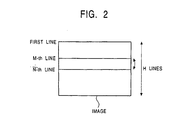
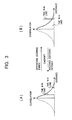
- An image formed of H lines is taken as an example. Concerning the correlation between the first line and another line, as illustrated in Fig. 3A, the correlation of the first line to a line located closer to the first line (an upper line of the image shown in Fig. 2) is greater. Conversely, the correlation of the first line to a line positioned farther from the first line (a lower line of the image shown in Fig. 2) is smaller. In other words, the image shown in Fig. 2 has a correlation distribution in which a line closer to the first line has a greater level of correlation, and a line farther from the first line has a smaller level of correlation.
- the M-th line closer to the first line and the N-th line farther from the first line are swapped (1 ⁇ M ⁇ N ⁇ H), and after calculating the correlation between the first line and each of the M-th line and the N-th line, the resultant image may be indicated, as shown in Fig. 3B. That is, in the image in which the M-th line and the N-th line have been swapped, the correlation of the first line to the M-th line closer to the first line (corresponding to the N-th line before being swapped) becomes smaller, while the correlation of the first line to the N-th line farther from the first line (corresponding to the M-th line before being swapped) becomes greater.
- the original correlation distribution is destroyed in the correlation shown in Fig. 3B.
- the destroyed correlation distribution can be restored to the original state by utilizing the original correlation distribution. That is, the correlation distribution shown in Fig. 3B is unnatural (incorrect) in terms of the original correlation distribution possessed by the image, and the M-th line and the N-th line should be swapped.
- the unnatural distribution can be restored to the correct distribution shown in Fig 3A, so that the original image can be decoded.
- the image is coded by exchanging the lines.
- the embedding coder 3 determines which lines should be moved and swapped according to the additional information.
- the embedding decoder 6 returns the swapped lines to the original positions by utilizing the correlation, i.e., replaces the coded image by the original image, thereby decoding the coded image.
- the embedding decoder 6 detects which lines have been moved and swapped so as to decode the additional information embedded in the image.
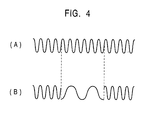
- one line of an image can be represented by, as shown in Fig. 4A, a signal waveform indicating the continuity of a frequency change (a smooth frequency change).
- a signal waveform indicating the continuity of a frequency change (a smooth frequency change).
- the frequency of one line of an image is continuously changed.
- the continuity of a frequency change is destroyed.
- the destroyed continuity of the signal waveform can be restored to the original state by utilizing the characteristics in which the frequency change is continuous. That is, in Fig. 4B, it is unnatural that part of the frequency of the signal waveform is much lower than that of the remaining portion of the waveform, and thus, it should be corrected to a portion similar to the remaining portion. Then, the signal waveform illustrated in Fig. 4B can be decoded into the signal waveform shown in Fig. 4A, i.e., the original signal waveform.
- the image is coded by significantly changing part of the signal waveform (replacing it by a lower frequency).
- the embedding coder 3 determines from the additional information which part of the frequency is to be significantly changed and to what degree the frequency is to be changed.
- the embedding decoder 6 reproduces the original signal waveform from the coded signal, part of which is greatly different from the remaining portions, by utilizing the continuity characteristics of the signal, thereby decoding the coded signal into the original signal.
- the embedding decoder 6 detects which part of the frequency has been significantly changed and to which degree the frequency has been changed, thereby decoding the embedded additional information.
- the similarity which is another element representing the energy distribution, is as follows. For example, it is now assumed that an image has been obtained by photographing a landscape. An enlarged image of the original landscape image can be generated by employing a fractal (self-similarity). More specifically, for example, an image obtained by photographing a sea, as shown in Fig. 5A, is enlarged by employing a fractal, resulting in an image (enlarged image) having characteristics similar to those of the original image. Accordingly, the original image has similarity.
- the similarity is destroyed in the portion of the image of the sea which has been substituted by part of the image of the forest.
- the destroyed similarity can be restored by utilizing the following similarity characteristics. That is, whichever portion of the image of the sea is enlarged, the enlarged portion has characteristics similar to those of the original image. More specifically, it is unnatural in terms of the similarity possessed by the image of the sea that part of the image is replaced by part of the image of the forest.
- the portion of the forest should be replaced by an image having characteristics similar to those of the surrounding portion of the sea. Then, the complete image of the sea shown in Fig. 5A, i.e., the original image, can be decoded from the image illustrated in Fig. 5B.
- the image can be coded by replacing part of the image of the sea by the image of the forest.
- the embedding coder 3 determines from the additional information which portion of the image of the sea is to be substituted by an image of the forest.
- the embedding decoder 6 reproduces the complete image of the sea from the coded signal, i.e., from the image having a portion of the forest, by utilizing the similarity characteristics, thereby decoding the coded image into the original image.
- the embedding decoder 6 detects which portion of the image of the sea has been replaced by the image of the forest, thereby decoding the embedded additional information.
- the embedding coder 3 codes the image according to the additional information so that the coded image can be decoded by utilizing the energy distribution possessed by the image.
- the embedding decoder 6 decodes the coded data into the original image and into the additional information by employing the energy distribution possessed by the image without requiring the overhead for decoding.
- the state of the coded image having embedded information therein is different from that of the original image, thereby achieving encryption of the image without requiring the overhead.
- the embedded information can be extracted by decoding the image from the coded data, thereby enabling the provision of side information while obtaining the coded image without requiring the overhead.
- the additional information can be embedded without needing the overhead for extracting the added information
- the resultant coded data with the embedded information has been compressed by an amount equal to the added information (embed-compression). Accordingly, for example, if one half of the image is coded, and the remaining half is used as additional information, half of the whole image can be embedded in the other half, thus compressing the whole image into one half.
- the coded data is decoded by utilizing the energy distribution possessed by the original image, i.e., by using statistics, the decoded data is resistant to errors. That is, robust coding (statistical coding) having highly robust characteristics can be implemented.
- the coded data is decoded by employing the energy distribution inherent in the original image, a greater amount of additional information can be embedded in the image whose energy distribution has more distinctive characteristics, for example, an image having a higher level of activity and a lower level of redundancy.
- the additional information is embedded in the original image, the coded data has been compressed by an amount equal to the additional information.
- the compression ratio becomes higher as the image has a higher level of activity and a lower level of redundancy.
- the embed-coding technique significantly differs from conventional coding techniques in which the compression ratio becomes lower as the image has a higher level of activity and a lower level of redundancy.
- the image can be provided by using the sound as a key. More specifically, in the coding unit 10, the sound "Open sesame! issued by a contractor is embedded in the image as additional information. In the decoding unit 20, the user is obliged to issue the sound "Open sesame!, which is compared with the sound embedded in the image, thereby performing speaker identification. Upon the execution of the speaker identification, the image is automatically provided only when it is determined that the user is a contractor. In this case, as the sound used as additional information, a sound waveform itself can be used instead of what is called a feature parameter.
- the sound can be provided by using the image as a key, i.e., face-recognition sound response can be implemented.
- the coding unit 10 for example, an image of a user's face is embedded in sound as a response to the user.
- the decoding unit 20 a user's face is photographed to obtain an image, and the face image embedded in the sound matching the above image is searched, thereby outputting the corresponding sound. It is thus possible to implement a sound response system for responding to the users by issuing the different types of sound according to the users.
- a contractor's voice and face image may be embedded in an original image. Then, only when a user's voice and face image coincide with those embedded in the image, the original image is provided, thereby achieving the implementation of what is called a dual key system.
- one of the two media is embedded in the other, in which case, different media information can be integrated, i.e., integrated coding can be implemented.
- a greater amount of additional information can be embedded in information whose energy distribution exhibits more distinctive characteristics. Accordingly, for example, between two items of information, the information whose energy distribution has more distinctive characteristics is adaptively selected, and the other information is embedded in the selected information, thereby making it possible to control the entire amount of data. That is, between two items of information, the amount of one item of information can be absorbed in the other item of information. As a result, since the entire amount of data can be controlled, it is possible to transmit information having the quantity of data which is compatible with the data band and the traffic of the transmission channel, and other transmission environments. That is, environment-compatible network transmission can be implemented.
- a reduced image is embedded in the original image (or decimated sound is embedded in the original sound), thereby achieving the implementation of hierarchical coding without increasing the amount of data.
- an image used as a key for retrieving the original image is embedded.
- Fig. 6 illustrates an example of the configuration of the embedding coder 3 shown in Fig. 1 that performs embed-coding by embedding additional information in an image so that the coded image can be decoded into the original image by utilizing the correlation of the image.
- Images output from the image database 1 are supplied to a frame memory 31 in which the images are temporarily stored in units of frames.
- a central processing unit (CPU) 32 performs embed-coding processing, which will be described below, by executing a program stored in a program memory 33. That is, the CPU 32 receives each bit of additional information from the additional-information database 2 and embeds the one-bit additional information in the image stored in the frame memory 31. More specifically, the CPU 32 selects part of the pixels forming the image stored in the frame memory 31 and performs predetermined processing on the selected pixels according to the additional information so that the original image can be reproduced by utilizing the correlation of the image. As a result, the additional information can be embedded in the selected pixels.
- the program memory 33 is formed of, for example, a read only memory (ROM) or a random access memory (RAM), and stores a computer program for enabling the CPU 32 to execute the embed-coding processing.
- An output interface (I/F) 34 reads an image having embedded additional information therein from the frame memory 31 and outputs it as coded data.
- the frame memory 31 is formed of a plurality of banks so that a plurality of frames can be stored. By switching the banks, the frame memory 31 simultaneously stores the image supplied from the image database 1 and the pixels of the image to be processed by the CPU 32. Concurrently, the frame memory 31 also outputs the image having the embedded information therein (coded data). With this arrangement, the coded data can be output in real time even if the image supplied from the image database 1 is a moving picture.
- Images are read from the image database 1 and are supplied to the frame memory 31 and stored therein in units of frames. Meanwhile, the CPU 32 receives each bit of additional information from the additional-information database 2. In step S1, upon receiving one-bit additional information, the CPU 32 selects from the frame memory 31 the pixels in which the added information is to be embedded (pixels to be processed).
- pixels are alternately selected from the image stored in the frame memory 31 according to a checkerboard pattern, as shown in Fig. 8. That is, every time the processing of step S1 is executed, the CPU 32 sequentially selects a pixel without a hatched portion in Fig. 8, one-by-one, as a pixel to be processed according to, for example, line scanning.
- p(x, y) indicates the pixel positioned at the x-th column from the left and the y-th row from the top (the same applies to the pixels shown in Fig. 12).
- step S2 the CPU 32 determines whether the additional information received from the additional-information database 2 is 1 or 0. If it is found in step S2 that the additional information is 0, the process returns to step S1. That is, if the additional information is 0, the CPU 32 does not perform any processing on the selected pixel (adds 0 as a predetermined constant), and returns to step S1. In step S1, the CPU 32 waits for subsequent one-bit additional information supplied from the additional-information database 2 and selects a pixel to be processed. Thereafter, processing similar to that discussed above is repeated.
- step S3 the CPU 32 performs predetermined processing on the selected pixel, more specifically, the CPU 32 adds a predetermined constant to the value of the selected pixel, such as two to the power of the value obtained by subtracting one from the number of bits assigned to the pixel. For example, if eight bits are assigned to the pixel of the image, 2 7 is added to the value of the pixel to be processed in step S3.
- the above-described addition may be made on any one of the components Y, U, and V. If the pixel value is indicated by components R, G, and B, the above-described addition may be performed on any one of the components R, G, and B.
- step S4 it is determined whether the value obtained in step S3 causes an overflow. If the outcome of step S4 is no, the process proceeds to step S6 in which the CPU 32 writes (overwrites) the added value into the frame memory 31 as the value of the pixel to be processed. The process then returns to step S1.
- step S4 If it is found in step S4 that the added value causes an overflow, i.e., that the value is 2 8 or greater, the process proceeds to step S5 in which the added value is corrected. That is, in step S5, the overflowed value is corrected, for example, by an amount equal to the value overflowed (to the value obtained by subtracting 2 8 from the overflowed added value). The process then proceeds to step S6 in which the CPU 32 writes the corrected value into the frame memory 31 as the value of the pixel to be processed, and waits for a subsequent one-bit additional information supplied from the additional-information database 2.
- the output I/F 34 reads the one-frame image (having the additional information embedded therein) as coded data, and the CPU 32 continues to execute processing on a subsequent one-frame image stored in the frame memory 31.
- part of the pixels forming the image stored in the frame memory 31 is selected, and the processing corresponding to the additional information is performed on the selected pixels so that the original image can be decoded by utilizing the correlation of the image, thereby embedding the additional information in the selected pixels.
- the additional information can be embedded in the image with minimal loss of the image quality without increasing the amount of data.
- the pixels having the embedded additional information therein can be decoded (restored) into the original pixels and into the additional information without requiring the overhead by utilizing the correlation of the image, i.e., the correlation between the pixels with the additional information and the pixels without the additional information. Accordingly, the resulting decoded image (reproduced image) is basically free from the degradation of the image quality caused by embedding the additional information.
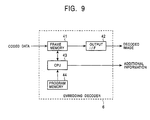
- Fig. 9 illustrates an example of the configuration of the embedding decoder 6 shown in Fig. 1 that decodes the coded data output from the embedding coder 3 shown in Fig. 6 into the original image and into the additional information by utilizing the correlation of the image.
- the coded data i.e., the image having the embedded additional information (hereinafter sometimes referred to as an "embed image")
- the frame memory 41 temporarily stores therein the embedded images in units of frames.
- the frame memory 41 is constructed similarly to the frame memory 31 shown in Fig. 6, and by changing the banks, the embed images can be processed in real time even if the images are moving pictures.
- An output interface (I/F) 42 reads an image (decoded image) obtained by performing embed-decoding processing by a CPU 43, which will be discussed later, and outputs the decoded image.
- the CPU 43 performs embed-decoding processing by executing a program stored in a program memory 44. That is, the CPU 43 decodes the embed image stored in the frame memory 41 into the original image and into the additional information by utilizing the correlation of the image. More specifically, the CPU 43 selects part of the pixels forming the embed image as pixels to be processed, and performs processing opposite to the processing executed by the CPU 32 shown in Fig. 6, as illustrated in Fig. 10, on the selected pixel, thereby changing the pixel value. The CPU 32 then calculates a correlation value R 1 (first correlation) between the pixel to be processed before the pixel value is changed and the peripheral pixels (which are horizontally adjacent to the pixel to be processed in the embodiment shown in Fig.
- R 1 first correlation
- the CPU 32 compares the correlation value R 1 with the correlation value R 2 . Based on the comparison result, the CPU 43 selects one of the pixel values before being changed and after being changed and determines the selected value as the decoded value, and also decodes the additional information embedded in the decoded image (1 or 0).
- the program memory 43 is constructed similarly to the program memory 33 shown in Fig. 6 and stores therein a computer program for enabling the CPU 43 to perform embed-decoding processing.
- Embed images are sequentially stored in units of frames in the frame memory 41.
- the CPU 43 selects the pixel to be decoded (pixel to be processed) from an embed image stored in the frame memory 41.
- the CPU 43 alternately selects pixels from the embed image stored in the frame memory 41 according to a checkerboard pattern, as illustrated in Fig. 8. That is, every time the processing of step S11 is executed, the CPU 43 sequentially selects a pixel without a hatched portion in Fig. 8, one-by-one, as a pixel to be processed, according to, for example, line scanning.
- step S12 the CPU 43 executes processing, on the pixel opposite to the processing performed by the CPU 32 shown in Fig. 6. That is, the CPU 43 subtracts a predetermined constant from the pixel value, i.e., two to the power of the value obtained by subtracting one from the number of bits assigned to the pixel of the image. For example, if eight bits are assigned to the pixel value, as stated above, 2 7 is subtracted from the value of the pixel to be processed in step S12.
- the above-described subtraction may be made on any one of the components Y, U, and V. If the pixel value is indicated by components R, G, and B, the above-described subtraction may be performed on any one of the components R, G, and B. It is necessary, however, that the subtraction in step S12 should be made on the same type of component as that on which the addition in step S3 of Fig. 7 has been performed. More specifically, if the pixel value is represented by, for example, Y, U, and V, and the addition in step S3 of Fig. 7 has been performed on, for example, the Y component, the subtraction should also be made on the Y component in step S12.
- step S13 After subtracting 2 7 from the pixel value in step S12, the process proceeds to step S13 in which it is determined whether the subtracted value causes an underflow. If the outcome of step S13 is no, the process skips step S14 and proceeds to step S15.
- step S13 if it is found in step S13 that the subtracted value causes an underflow, i.e., the subtracted value is less than zero, the process proceeds to step S14 in which the subtracted value is corrected. That is, in step S14, the underflowed subtracted value is corrected to, for example, the value obtained by adding 2 8 to the subtracted value. The process then proceeds to step S15.
- step S15 the CPU 43 calculates a correlation value R 1 between the pixel value P 1 (the value from which 2 7 is not subtracted in step S12, hereinafter sometimes referred to as the "first pixel value”) and peripheral pixels, for example, pixels horizontally adjacent to the pixel P 1 .
- the CPU 43 also calculates a correlation value R 2 between the subtracted pixel value P 2 (which has been corrected in step S14, hereinafter sometimes referred to as the "second pixel value”) and peripheral pixels, for example, pixels horizontally adjacent to the pixel P 2 .
- step S15 an absolute value of the difference between the first pixel value P 1 and each of the adjacent pixel values is calculated, and the two absolute values are added. The resulting value is then determined to be the correlation value R 1 with respect to the first pixel value P 1 .
- step S15 an absolute value of the difference between the second pixel value P 2 and each of the adjacent pixel values is also calculated, and the two absolute values are added. The resulting value is then determined to be the correlation value R 2 with respect to the second pixel value P 2 .
- the pixels used for obtaining the correlation values R 1 and R 2 are not restricted to the pixels horizontally adjacent to the pixel P 1 or P 2 , and may be pixels vertically adjacent to the pixel P 1 or P 2 or may be pixels temporally adjacent to the pixel P 1 or P 2 . It is not necessary that the pixels for obtaining the correlation values R 1 and R 2 be spatially or temporally adjacent. Yet, it is desirable that the pixels indicated by hatched portions in Fig. 8, i.e., the pixels without embedded additional information, be used for determining the correlation values R 1 and R 2 with respect to the pixels P 1 and P 2 , respectively. The reason for this is as follows.
- the correlation value between the pixel P 1 or P 2 and the pixels having embedded information therein is obtained, the correlation of the pixel P 1 or P 2 to the original image cannot be acquired, which makes it impossible to utilize the principle of the correlation of the image. It is thus difficult to correctly decode the original pixel values and the additional information from the pixels having the embedded additional information therein. Additionally, since the pixel P 1 or P 2 is decoded by utilizing the correlation of the image, it is preferable that the pixels used for obtaining the correlation values R 1 and R 2 be positioned spatially or temporally adjacent to the pixel P 1 or P 2 .
- step S16 the CPU 43 compares the correlation values R 1 and R 2 .
- step S16 If it is determined in step S16 that the correlation value R 1 is greater than the correlation value R 2 , the process proceeds to step S17.
- step S17 the CPU 43 outputs 0 as the decoded additional information, and returns to step S11. In this case, the value stored in the frame memory 41 is not overwritten, and thus, the decoded pixel value remains the same as the pixel value P 1 .
- step S16 it has been determined in step S16 that the correlation value R 1 concerning the first pixel value P 1 is greater than the correlation value R 2 concerning the second pixel value P 2 . It is thus demonstrated that the pixel to be decoded may be more precisely represented by the pixel value P 1 than the pixel value P 2 , and the pixel value P 1 is then determined to be the decoded pixel value. Since 2 7 is not subtracted from the pixel value P 1 in step S12, it can be considered that 2 7 has not been added in step S3 of Fig. 7. In the embed-coding processing shown in Fig. 7, it is determined that 2 7 is not added when the additional information indicates 0.
- the additional information embedded in the corresponding pixel is 0.
- step S16 If it is determined in step S16 that the correlation value R 2 is equal to or greater than the correlation value R 1 , the process proceeds to step S18.
- step S18 the CPU 43 overwrites the pixel value stored in the frame memory 41 by the value obtained by subtracting 2 7 from the pixel value, i.e., by the second pixel value P 2 . In this case, therefore, the pixel value P 2 is determined to be the decoded pixel value.
- step S19 in which the CPU 43 outputs 1 as the decoded additional information.
- the process then returns to step S11.
- step S16 it has been determined in step S16 that the correlation value R 2 concerning the second pixel value P 2 is equal to or greater than the correlation value R 1 concerning the first pixel value P 1 . It is thus revealed that the pixel to be decoded can be represented more precisely by the pixel value P 2 than the pixel value P 1 . Accordingly, the pixel value P 2 is determined to be the decoded pixel value. Since 2' is subtracted from the pixel value P 2 in step S12, it can be considered that 2 7 has been added in step S3 of Fig. 7. In the embed-coding processing shown in Fig. 7, it is determined that 2' is added when the additional information indicates 1.
- the additional information embedded in the corresponding pixel is 1.
- the difference between the correlation values R 1 and R 2 obtained as described above is small, it is not possible to unambiguously determine which correlation value R 1 or R 2 can be used more precisely as the pixel value to be decoded. Accordingly, in this case, not only horizontally adjacent pixels, but also other pixels, may be used for obtaining the correlation values R 1 and R 2 with respect to the pixel values P 1 and P 2 , respectively. The correlation values R 1 and R 2 may be then compared, thereby determining which correlation value R 1 or R 2 can be more precisely used as the decoded pixel.
- the coded data representing an image having embedded additional information therein is decoded into the original image and into the additional information by utilizing the correlation of the image, thereby achieving the decoding operation without requiring the overhead for decoding. Accordingly, the decoded image (reproduced image) is basically free from the degradation of the image quality caused by embedding the information into the original image.
- the correlation value is not limited to the absolute value obtained as described above.
- pixels are alternately selected from the image according to a checkerboard pattern, as shown in Fig. 8, and additional information is embedded in the selected pixels.
- the pixels may be selected in a pattern different from the above.
- pixels without embedded additional information are desirably selected for obtaining the correlation.
- the correlation between the pixels becomes smaller as the pixels are spatially or temporally farther away from each other. Accordingly, with a view to achieving precise decoding, the pixels in which additional information are to be embedded should be spatially or temporally selected sparsely.
- the number of pixels to be selected should be increased to some degree in order to embed the additional information therein.
- one-bit additional information is embedded in one pixel selected as a pixel to be processed.
- additional information having two bits or greater may be embedded in one pixel. If, for example, two-bit additional information, is embedded in one pixel, one of 0, 2 6 , 2 7 , and 2 6 +2 7 may be added to the pixel value according to the two-bit additional information.
- the additional information is embedded by adding 0 or 2 7 to the pixel value (in other words, by adding 2 7 or not adding 2 7 ).
- the value to be added to the pixel value is not limited to 2 7 . If, however, a value which may produce an influence on only the lower bits of the pixel value is added, the resulting added pixel value does not become substantially different from the original pixel value. Accordingly, no substantial difference be observed between the correlation values R 1 and R 2 obtained in step S15 of Fig. 11. This decreases the precision of the decoded pixel and the decoded additional information. It is therefore desirable that the value to be added to the pixel value according to the additional information be a value which may produce an influence on the upper bits of the original pixel value.
- the additional information is embedded by adding a predetermined value to the pixel value.
- the additional information may be embedded by performing an operation on the pixel value other than the addition (for example, bit inversion).
- the operation should be determined so that a significant difference can be produced between the correlation value concerning the original pixel value and the correlation value concerning the pixel value obtained after performing the corresponding operation.
- one-bit additional information is embedded in one pixel.
- one-bit additional information may be embedded in a plurality of pixels, e.g., in four bits indicated by the circled pixels shown in Fig. 12.
- one-bit additional information is embedded in the four pixels p(1, 4), p(5, 4), p(1, 8), and p(5, 8), as illustrated in Fig. 12.
- the same operation is conducted on each of the pixels p(1, 4), p(5, 4), p(1, 8), and p(5, 8) according to the additional information, thereby embedding the one-bit additional information in the four pixels.
- the aforementioned correlation value R 1 concerning the first pixel value P 1 and the correlation value R 2 concerning the second pixel value P 2 are calculated with respect to each of the pixels p(1, 4), p(5, 4), p(1, 8), and p(5, 8).
- the correlation value R 1 and the correlation value R 2 are compared.
- the greater pixel values are determined to be the decoded pixel values p(1, 4), p(5, 4), p(1, 8), and p(5, 8) and the decoded additional information.
- the sum of the correlation values R 1 concerning the first pixel values P 1 and the sum of the correlation values R 2 concerning the second pixel values P 2 with respect to all the pixel values p(1, 4), p(5, 4), p(1, 8), and p(5, 8) may be obtained, and upon comparing the two sums, the greater sum may be determined to be the decoded pixel values p(1, 4), p(5, 4), p(1, 8), p(5, 8) and the decoded additional information.
- pixels are alternately selected from the image according to a checkerboard pattern, as shown in Fig. 8, and one-bit additional information is embedded in each of the selected pixels, additional information having the number of bits about one-half the number of pixels of the image can be embedded.
- one-bit additional information is embedded in four bits, as discussed above, the number of bits of the additional information to be embedded in the selected pixels is reduced to one-eighth the number of pixels of the image.
- the type of information used as additional information is not particularly restricted, and may be an image, sound, text, a computer program, or other types of data.
- the image database 1 may contain images to be supplied to the frame memory 31 and additional information. With this arrangement, the additional information can be embedded in the image, thereby achieving the compression of the image.
- the embed-coding processing and the embed-decoding processing are performed by executing the computer programs by the CPUs 32 and 43, respectively.
- the embed-coding processing or the embed-decoding processing may be executed by using hardware exclusively used for the corresponding processing.
- the computer programs executed by the CPUs 32 and 43 are stored in the program memory 33 and the program memory 44, respectively.
- the computer program may be provided via a recording medium, such as, a magnetic tape, a magnetic disk, an optical disc, a magneto-optical disk, or a PD disk, or a transmission medium, such as the Internet, a terrestrial broadcast signal, a satellite broadcast signal, a public network, or a CATV network.
Landscapes
- Engineering & Computer Science (AREA)
- Multimedia (AREA)
- Signal Processing (AREA)
- Physics & Mathematics (AREA)
- General Physics & Mathematics (AREA)
- Theoretical Computer Science (AREA)
- Editing Of Facsimile Originals (AREA)
- Image Processing (AREA)
- Television Systems (AREA)
- Television Signal Processing For Recording (AREA)
- Color Television Systems (AREA)
Claims (21)
- Bildverarbeitungsvorrichtung zum Durchführen einer Verarbeitung zum Einbetten von Information in ein Bild, wobei die Vorrichtung aufweist:eine Auswahleinrichtung zum Auswählen eines Pixels des Bilds; undeine Verarbeitungseinrichtung zum Durchführen von Verarbeitung in bezug auf das Pixel, welches durch die Auswahleinrichtung ausgewählt wurde, gemäß der Information, so dass das Pixel unter Verwendung einer Korrelation des Bilds reproduzierbar ist, wobei dadurch die Information in das Pixel eingebettet wird.
- Bildverarbeitungsvorrichtung nach Anspruch 1, wobei die Verarbeitungseinrichtung die Verarbeitung in bezug auf eines von einer Luminanzkomponente und einer Farbkomponente des Pixels durchführt.
- Bildverarbeitungsvorrichtung nach Anspruch 1, wobei die Verarbeitungseinrichtung einen vorher festgelegten Wert entsprechend der Information einem Wert des Pixels hinzufügt.
- Bildverarbeitungsvorrichtung nach Anspruch 1, wobei die Verarbeitungseinrichtung die Information, welche ein Bit hat, in das Pixel einbettet.
- Bildverarbeitungsvorrichtung nach Anspruch 1, wobei die Verarbeitungseinrichtung die Information, die ein Bit aufweist, in mehrere Pixel einbettet.
- Bildverarbeitungsvorrichtung nach Anspruch 1, wobei die Auswahleinrichtung abwechselnd die Pixel von dem Bild gemäß einem Schachbrettmuster auswählt.
- Bildverarbeitungsverfahren zum Durchführen von Verarbeitung zum Einbetten von Information in ein Bild, wobei das Verfahren aufweist:einen Auswahlschritt zum Auswählen eines Pixels des Bilds; undeinen Verarbeitungsschritt zum Durchführen von Verarbeitung in bezug auf das Pixel, welches im Auswahlschritt ausgewählt wurde, gemäß der Information, so dass das Pixel unter Verwendung einer Korrelation des Bilds reproduzierbar ist, wobei dadurch die Information in das Pixel eingebettet wird.
- Bereitstellungsmedium zum Bereitstellen eines Computerprogramms, um einen Computer in die Lage zu versetzen, Verarbeitung zum Einbetten von Information in ein Bild durchzuführen, wobei das Computerprogramm aufweist:einen Auswahlschritt zum Auswählen eines Pixels des Bilds; undeinen Verarbeitungsschritt zum Durchführen von Verarbeitung in bezug auf das Pixel, welches im Auswahlschritt ausgewählt wurde, gemäß der Information, so dass das Pixel unter Verwendung einer Korrelation des Bilds reproduzierbar ist, wobei dadurch die Information in das Pixel eingebettet wird.
- Bereitstellungsmedium nach Anspruch 8, wobei der Verarbeitungsschritt die Verarbeitung bezüglich eines von einer Luminanzkomponente und einer Farbkomponente des Pixels durchführt.
- Bereitstellungsmedium nach Anspruch 8, wobei der Verarbeitungsschritt einen vorher festgelegten Wert entsprechend der Information einem Wert des Pixels hinzufügt.
- Bereitstellungsmedium nach Anspruch 8, wobei der Verarbeitungsschritt die Information, welche ein Bit aufweist, in das Pixel einbettet.
- Bereitstellungsmedium nach Anspruch 8, wobei der Verarbeitungsschritt die Information, die ein Bit aufweist, in mehrere Pixel einbettet.
- Bereitstellungsmedium nach Anspruch 8, wobei der Auswahlschritt anwechselnd die Pixel von dem Bild gemäß einem Schachbrettmuster auswählt.
- Bereitstellungsmedium zum Bereitstellen eines Informations-Einbettungs-Bilds, in welchem Information eingebettet ist, wobei das Informations-Einbettungs-Bild durch Einbetten der Information in das Bild durch Auswählen eines Pixels des Bilds und durch Durchführen von Verarbeitung in bezug auf das ausgewählte Pixel gemäß der Information erhalten wird, so dass das Pixel unter Verwendung einer Korrelation des Bilds reproduzierbar ist.
- Bereitstellungsmedium nach Anspruch 14, wobei die Verarbeitung in bezug auf eines von der Luminanzkomponente und von der Farbkomponente des Pixels durchgeführt wird.
- Bereitstellungsmedium nach Anspruch 14, wobei ein vorher festgelegter Wert entsprechend der Information einem Wert des Pixels hinzugefügt ist.
- Bereitstellungsmedium nach Anspruch 14, wobei die Information, die ein Bit aufweist, in das Pixel eingebettet ist.
- Bereitstellungsmedium nach Anspruch 14, wobei die Information, welche ein Bit aufweist, in mehrere Pixel eingebettet ist.
- Bereitstellungsmedium nach Anspruch 14, wobei die Pixel abwechselnd von dem Bild gemäß einem Schachbrettmuster ausgewählt werden.
- Bildverarbeitungsvorrichtung, welche einen Übertrager zum Übertragen eines Informations-Einbettungs-Bilds, welches durch Einbetten von Information erhalten wird, und einen Empfänger aufweist, um das Informations-Einbettungs-Bild vom Übertrager zu empfangen und um das Bild zu decodieren,
wobei der Übertrager eine Vorrichtung nach Anspruch 1 aufweist; und
der Empfänger aufweist:eine zweite Auswahleinrichtung, um ein Pixel des Informations-Einbettungs-Bilds auszuwählen;eine zweite Verarbeitungseinrichtung, um eine vorher festgelegte Verarbeitung in bezug auf das Pixel, welches durch die zweite Auswahleinrichtung ausgewählt wurde, durchzuführen;eine Korrelationsberechnungseinrichtung, um eine erste Korrelation zwischen dem Pixel, welches durch die zweite Auswahleinrichtung ausgewählt wurde, und einem peripheren Pixel rundum das ausgewählte Pixel zu berechnen, und um eine zweite Korrelation zwischen dem Pixel, welches durch die zweite Auswahleinrichtung ausgewählt wurde und durch die zweite Verarbeitungseinrichtung verarbeitet wurde, und dem peripheren Pixel rundum das Pixel zu berechnen;eine Vergleichseinrichtung, um die erste Korrelation und die zweite Korrelation zu vergleichen; undeine Decodiereinrichtung, um das Pixel, welches durch die zweite Auswahleinrichtung ausgewählt wurde, und die Information, die in das Pixel eingebettet wurde, auf der Basis eines Ergebnisses, welches durch die Vergleichseinrichtung erhalten wird, zu decodieren. - Bildverarbeitungsverfahren zur Verwendung bei einer Bildverarbeitungsvorrichtung, die einen Übertrager, um ein Informations-Einbettungs-Bild zu übertragen, welches durch Einbetten von Information erhalten wird, und einen Empfänger aufweist, um das Informations-Einbettungs-Bild vom Übertrager zu empfangen und um das Bild zu decodieren, wobei das Verfahren folgende Schritte aufweist:Ausführen eines Verfahrens nach Anspruch 7, wobei der Auswahlschritt und der Verarbeitungsschritt durch den Übertrager ausgeführt werden;Auswählen des Pixels des Informations-Einbettungs-Bilds durch den Empfänger;Durchführen vorher festgelegter Verarbeitung durch den Empfänger in bezug auf das ausgewählte Pixel;Berechnen - durch den Empfänger - einer ersten Korrelation zwischen dem Pixel, welches vom Informations-Einbettungs-Bild ausgewählt wurde, und einem peripheren Pixel rundum das ausgewählte Pixel, und Berechnen einer zweiten Korrelation zwischen dem Pixel, welches vom Informations-Einbettungs-Bild ausgewählt wurde und der vorher festgelegten Verarbeitung unterzogen wurde, und dem peripheren Pixel rundum das Pixel;Vergleichen der ersten Korrelation und der zweiten Korrelation durch den Empfänger; undDecodieren des Pixels, welches vom Informations-Einbettungs-Bild ausgewählt wurde, und der Information, welche in das Pixel durch den Empfänger eingebettet wurde, auf der Basis eines Vergleichsergebnisses.
Priority Applications (1)
| Application Number | Priority Date | Filing Date | Title |
|---|---|---|---|
| EP02080256A EP1304649A3 (de) | 1998-08-06 | 1999-07-30 | Bildverarbeitungsgerät, Bildverarbeitungsverfahren und Herstellungsmedium |
Applications Claiming Priority (2)
| Application Number | Priority Date | Filing Date | Title |
|---|---|---|---|
| JP22295198 | 1998-08-06 | ||
| JP22295198A JP4822304B2 (ja) | 1998-08-06 | 1998-08-06 | 画像処理装置および画像処理方法、並びに記録媒体 |
Related Child Applications (1)
| Application Number | Title | Priority Date | Filing Date |
|---|---|---|---|
| EP02080256A Division EP1304649A3 (de) | 1998-08-06 | 1999-07-30 | Bildverarbeitungsgerät, Bildverarbeitungsverfahren und Herstellungsmedium |
Publications (2)
| Publication Number | Publication Date |
|---|---|
| EP0978801A1 EP0978801A1 (de) | 2000-02-09 |
| EP0978801B1 true EP0978801B1 (de) | 2004-12-08 |
Family
ID=16790442
Family Applications (2)
| Application Number | Title | Priority Date | Filing Date |
|---|---|---|---|
| EP99306094A Expired - Lifetime EP0978801B1 (de) | 1998-08-06 | 1999-07-30 | Bildverarbeitungsgerät, Bildverarbeitungsverfahren und Herstellungsmedia |
| EP02080256A Withdrawn EP1304649A3 (de) | 1998-08-06 | 1999-07-30 | Bildverarbeitungsgerät, Bildverarbeitungsverfahren und Herstellungsmedium |
Family Applications After (1)
| Application Number | Title | Priority Date | Filing Date |
|---|---|---|---|
| EP02080256A Withdrawn EP1304649A3 (de) | 1998-08-06 | 1999-07-30 | Bildverarbeitungsgerät, Bildverarbeitungsverfahren und Herstellungsmedium |
Country Status (6)
| Country | Link |
|---|---|
| US (1) | US6567531B1 (de) |
| EP (2) | EP0978801B1 (de) |
| JP (1) | JP4822304B2 (de) |
| KR (1) | KR100636606B1 (de) |
| CN (2) | CN100346351C (de) |
| DE (1) | DE69922453T2 (de) |
Families Citing this family (42)
| Publication number | Priority date | Publication date | Assignee | Title |
|---|---|---|---|---|
| US6965697B1 (en) | 1998-07-15 | 2005-11-15 | Sony Corporation | Coding apparatus and method, decoding apparatus and method, data processing system, storage medium, and signal |
| EP0993200B1 (de) * | 1998-10-07 | 2010-12-08 | Sony Corporation | Verfahren und Vorrichtung zur Bilddatenkodierung mit Zusatzdateneinfügung |
| US6870944B1 (en) * | 1999-06-08 | 2005-03-22 | Sony Corporation | Image processing apparatus, image processing method, and storage medium |
| JP3651319B2 (ja) * | 1999-07-16 | 2005-05-25 | 日本ビクター株式会社 | 電子透かし情報記録方法、再生方法、及び電子透かし情報記録装置、再生装置 |
| US6963363B1 (en) * | 1999-09-10 | 2005-11-08 | Nikon Corporation | Digital camera capable of embedding an electronic watermark into image data |
| JP4626784B2 (ja) * | 2000-05-19 | 2011-02-09 | ソニー株式会社 | 通信装置および通信方法、並びに記録媒体 |
| JP4214440B2 (ja) * | 2000-10-19 | 2009-01-28 | ソニー株式会社 | データ処理装置およびデータ処理方法、並びに記録媒体 |
| US7379069B2 (en) * | 2001-02-15 | 2008-05-27 | Sony Corporation | Checkerboard buffer using two-dimensional buffer pages |
| US6831651B2 (en) * | 2001-02-15 | 2004-12-14 | Sony Corporation | Checkerboard buffer |
| US6992674B2 (en) * | 2001-02-15 | 2006-01-31 | Sony Corporation | Checkerboard buffer using two-dimensional buffer pages and using state addressing |
| US6850241B2 (en) * | 2001-02-15 | 2005-02-01 | Sony Corporation | Swapped pixel pages |
| US7088369B2 (en) * | 2001-02-15 | 2006-08-08 | Sony Corporation | Checkerboard buffer using two-dimensional buffer pages and using bit-field addressing |
| US6795079B2 (en) * | 2001-02-15 | 2004-09-21 | Sony Corporation | Two-dimensional buffer pages |
| US6765579B2 (en) * | 2001-02-15 | 2004-07-20 | Sony Corporation | Pixel pages using combined addressing |
| US6765580B2 (en) * | 2001-02-15 | 2004-07-20 | Sony Corporation | Pixel pages optimized for GLV |
| US6803917B2 (en) * | 2001-02-15 | 2004-10-12 | Sony Corporation | Checkerboard buffer using memory bank alternation |
| US6831650B2 (en) * | 2001-02-15 | 2004-12-14 | Sony Corporation | Checkerboard buffer using sequential memory locations |
| US6828977B2 (en) * | 2001-02-15 | 2004-12-07 | Sony Corporation | Dynamic buffer pages |
| US6801204B2 (en) * | 2001-02-15 | 2004-10-05 | Sony Corporation, A Japanese Corporation | Checkerboard buffer using memory blocks |
| US7038691B2 (en) * | 2001-02-15 | 2006-05-02 | Sony Corporation | Two-dimensional buffer pages using memory bank alternation |
| US7205993B2 (en) * | 2001-02-15 | 2007-04-17 | Sony Corporation | Checkerboard buffer using two-dimensional buffer pages and using memory bank alternation |
| US6831649B2 (en) * | 2001-02-15 | 2004-12-14 | Sony Corporation | Two-dimensional buffer pages using state addressing |
| US6768490B2 (en) * | 2001-02-15 | 2004-07-27 | Sony Corporation | Checkerboard buffer using more than two memory devices |
| US6791557B2 (en) * | 2001-02-15 | 2004-09-14 | Sony Corporation | Two-dimensional buffer pages using bit-field addressing |
| JP4556087B2 (ja) * | 2001-03-22 | 2010-10-06 | ソニー株式会社 | データ処理装置およびデータ処理方法、並びにプログラムおよびプログラム記録媒体 |
| JP2002304185A (ja) * | 2001-04-04 | 2002-10-18 | Video Research:Kk | 著作権管理システム、著作権管理方法及びプログラム |
| US20030058368A1 (en) * | 2001-09-24 | 2003-03-27 | Mark Champion | Image warping using pixel pages |
| JP4216561B2 (ja) * | 2002-02-07 | 2009-01-28 | 富士フイルム株式会社 | サーバ装置 |
| US6965980B2 (en) * | 2002-02-14 | 2005-11-15 | Sony Corporation | Multi-sequence burst accessing for SDRAM |
| JP2004221712A (ja) * | 2003-01-10 | 2004-08-05 | Sony Corp | 情報処理装置および情報処理方法、プログラム、並びにデータ構造および記録媒体 |
| JP3784781B2 (ja) | 2003-05-20 | 2006-06-14 | 富士通株式会社 | 画像データ処理装置、画像データ処理方法、画像データ処理プログラムおよび画像データ処理システム |
| EP1692637A4 (de) * | 2003-12-05 | 2009-11-04 | New Jersey Tech Inst | System und verfahren für robuste reversible datenverbergung und datenwiederherstellung in der räumlichen domäne |
| JP4622762B2 (ja) * | 2005-09-14 | 2011-02-02 | パナソニック電工株式会社 | 画像データ圧縮・復元方法 |
| WO2007073010A1 (en) * | 2005-10-10 | 2007-06-28 | Jae-Yeon Moon | Media making method and storage medium |
| JP4626824B2 (ja) * | 2007-03-15 | 2011-02-09 | ソニー株式会社 | 通信装置および通信方法、並びに記録媒体 |
| JP4548434B2 (ja) * | 2007-03-15 | 2010-09-22 | ソニー株式会社 | データ処理装置およびデータ処理方法、並びに記録媒体 |
| JP5007681B2 (ja) * | 2008-02-14 | 2012-08-22 | ソニー株式会社 | 放送システム |
| KR100967725B1 (ko) * | 2008-04-29 | 2010-07-05 | 전북대학교산학협력단 | 정지영상의 저작권 보호를 위한 보호저작권정보 생성 및 복원방법 |
| EP2234400A1 (de) * | 2009-03-23 | 2010-09-29 | Sony Corporation | Verfahren und Vorrichtung zur Bereitstellung eines Multimedia-Inhaltstroms mit Einbettung von Verarbeitungsinformationen des Inhaltstroms |
| US9759554B2 (en) | 2013-08-02 | 2017-09-12 | Omnivision Technologies, Inc. | Application specific, dual mode projection system and method |
| CN104202294B (zh) * | 2014-07-23 | 2017-08-29 | 西安空间无线电技术研究所 | 一种在格式数据流中无损信息嵌入与恢复方法 |
| CN104581120A (zh) * | 2015-01-23 | 2015-04-29 | 深圳超多维光电子有限公司 | 图像信息保存方法、保存装置、立体图像生成方法和装置 |
Family Cites Families (15)
| Publication number | Priority date | Publication date | Assignee | Title |
|---|---|---|---|---|
| JPS6268366A (ja) | 1985-09-20 | 1987-03-28 | Matsushita Electric Ind Co Ltd | 画素内插方式 |
| JP2824910B2 (ja) * | 1989-04-07 | 1998-11-18 | 甲子雄 松井 | 画像へのデータ合成方法 |
| JP2807293B2 (ja) * | 1989-11-20 | 1998-10-08 | 興和紡績株式会社 | 画像データの符号化・復号化方法およびファクシミリ装置 |
| JPH04310057A (ja) * | 1991-04-08 | 1992-11-02 | Nippon Telegr & Teleph Corp <Ntt> | イメージ情報への第2情報埋め込み方法及びその復号方法 |
| JPH05236424A (ja) * | 1992-02-25 | 1993-09-10 | Matsushita Electric Ind Co Ltd | 情報埋め込み方法およびその装置 |
| US5721788A (en) * | 1992-07-31 | 1998-02-24 | Corbis Corporation | Method and system for digital image signatures |
| US5530759A (en) * | 1995-02-01 | 1996-06-25 | International Business Machines Corporation | Color correct digital watermarking of images |
| US5815572A (en) * | 1995-08-31 | 1998-09-29 | Lucent Technologies Inc. | Video scrambling |
| AU2435297A (en) * | 1996-04-02 | 1997-11-07 | Theodore G Handel | Data embedding |
| WO1997049235A1 (en) * | 1996-06-20 | 1997-12-24 | Ibm Japan Ltd. | Data hiding method and data extracting method |
| US5734752A (en) * | 1996-09-24 | 1998-03-31 | Xerox Corporation | Digital watermarking using stochastic screen patterns |
| JP3154325B2 (ja) * | 1996-11-28 | 2001-04-09 | 日本アイ・ビー・エム株式会社 | 認証情報を画像に隠し込むシステム及び画像認証システム |
| JP3172475B2 (ja) * | 1996-12-26 | 2001-06-04 | 日本アイ・ビー・エム株式会社 | 統計検定を用いたデータ・ハイディング方法及びデータ抽出方法 |
| US5875249A (en) * | 1997-01-08 | 1999-02-23 | International Business Machines Corporation | Invisible image watermark for image verification |
| US6148333A (en) * | 1998-05-13 | 2000-11-14 | Mgi Software Corporation | Method and system for server access control and tracking |
-
1998
- 1998-08-06 JP JP22295198A patent/JP4822304B2/ja not_active Expired - Fee Related
-
1999
- 1999-07-30 DE DE69922453T patent/DE69922453T2/de not_active Expired - Lifetime
- 1999-07-30 EP EP99306094A patent/EP0978801B1/de not_active Expired - Lifetime
- 1999-07-30 EP EP02080256A patent/EP1304649A3/de not_active Withdrawn
- 1999-08-04 US US09/366,872 patent/US6567531B1/en not_active Expired - Lifetime
- 1999-08-05 KR KR1019990032126A patent/KR100636606B1/ko not_active Expired - Fee Related
- 1999-08-06 CN CNB2004100328915A patent/CN100346351C/zh not_active Expired - Fee Related
- 1999-08-06 CN CNB991175158A patent/CN1155253C/zh not_active Expired - Fee Related
Also Published As
| Publication number | Publication date |
|---|---|
| DE69922453T2 (de) | 2005-12-15 |
| DE69922453D1 (de) | 2005-01-13 |
| JP4822304B2 (ja) | 2011-11-24 |
| US6567531B1 (en) | 2003-05-20 |
| KR20000017106A (ko) | 2000-03-25 |
| EP1304649A3 (de) | 2006-04-26 |
| CN1248132A (zh) | 2000-03-22 |
| JP2000059743A (ja) | 2000-02-25 |
| CN100346351C (zh) | 2007-10-31 |
| EP0978801A1 (de) | 2000-02-09 |
| EP1304649A2 (de) | 2003-04-23 |
| CN1532774A (zh) | 2004-09-29 |
| KR100636606B1 (ko) | 2006-10-20 |
| CN1155253C (zh) | 2004-06-23 |
Similar Documents
| Publication | Publication Date | Title |
|---|---|---|
| US6567531B1 (en) | Image processing apparatus, image processing method, and providing medium | |
| US5960081A (en) | Embedding a digital signature in a video sequence | |
| US6215421B1 (en) | Coding apparatus and method, decoding apparatus and method, data processing system, and storage medium | |
| US6278792B1 (en) | Robust digital watermarking | |
| US8538886B1 (en) | Watermarking system and methodology for digital multimedia content | |
| US6810131B2 (en) | Information processing method and apparatus | |
| US6546139B1 (en) | Coding apparatus and method, decoding apparatus and method, data processing system, storage medium, and signal | |
| US7738711B2 (en) | Coding apparatus and method, decoding apparatus and method, data processing system, storage medium, and signal | |
| KR100647022B1 (ko) | 부호화 장치 및 부호화 방법, 복호 장치 및 복호 방법, 정보 처리 장치 및 정보 처리 방법 및 제공 매체 | |
| US7606431B2 (en) | Image processing apparatus, image processing method, and storage medium | |
| US6738492B1 (en) | Coding apparatus and method, decoding apparatus and method, data processing system, storage medium, and signal | |
| GB2408873A (en) | Generating marked material by introducing code words | |
| KR100711012B1 (ko) | 코딩 장치 및 방법, 디코딩 장치 및 방법, 데이터 처리 시스템, 기억 매체 및 신호 | |
| US11308572B1 (en) | Method and system for invisible watermarking of images and video | |
| EP0993200B1 (de) | Verfahren und Vorrichtung zur Bilddatenkodierung mit Zusatzdateneinfügung | |
| KR100777144B1 (ko) | 코딩 장치와 방법, 디코딩 장치와 방법, 데이터 처리 시스템, 저장 매체, 및 기록 매체 | |
| JP3546720B2 (ja) | 符号化装置及び方法、復号装置及び方法並びに記録媒体 | |
| Darmstaedter et al. | Low cost watermarking technique optimized by tests in real conditions and simulations |
Legal Events
| Date | Code | Title | Description |
|---|---|---|---|
| PUAI | Public reference made under article 153(3) epc to a published international application that has entered the european phase |
Free format text: ORIGINAL CODE: 0009012 |
|
| AK | Designated contracting states |
Kind code of ref document: A1 Designated state(s): DE FR GB NL |
|
| AX | Request for extension of the european patent |
Free format text: AL;LT;LV;MK;RO;SI |
|
| 17P | Request for examination filed |
Effective date: 20000713 |
|
| AKX | Designation fees paid |
Free format text: DE FR GB NL |
|
| 17Q | First examination report despatched |
Effective date: 20020812 |
|
| RTI1 | Title (correction) |
Free format text: IMAGE PROCESSING APPARATUS, IMAGE PROCESSING METHOD, AND PROVIDING MEDIA |
|
| RTI1 | Title (correction) |
Free format text: IMAGE PROCESSING APPARATUS, IMAGE PROCESSING METHOD, AND PROVIDING MEDIA |
|
| RTI1 | Title (correction) |
Free format text: IMAGE PROCESSING APPARATUS, IMAGE PROCESSING METHOD, AND PROVIDING MEDIA |
|
| GRAP | Despatch of communication of intention to grant a patent |
Free format text: ORIGINAL CODE: EPIDOSNIGR1 |
|
| GRAS | Grant fee paid |
Free format text: ORIGINAL CODE: EPIDOSNIGR3 |
|
| GRAA | (expected) grant |
Free format text: ORIGINAL CODE: 0009210 |
|
| AK | Designated contracting states |
Kind code of ref document: B1 Designated state(s): DE FR GB NL |
|
| REG | Reference to a national code |
Ref country code: GB Ref legal event code: FG4D |
|
| REF | Corresponds to: |
Ref document number: 69922453 Country of ref document: DE Date of ref document: 20050113 Kind code of ref document: P |
|
| PLBE | No opposition filed within time limit |
Free format text: ORIGINAL CODE: 0009261 |
|
| STAA | Information on the status of an ep patent application or granted ep patent |
Free format text: STATUS: NO OPPOSITION FILED WITHIN TIME LIMIT |
|
| ET | Fr: translation filed | ||
| 26N | No opposition filed |
Effective date: 20050909 |
|
| REG | Reference to a national code |
Ref country code: GB Ref legal event code: 746 Effective date: 20091130 |
|
| PGFP | Annual fee paid to national office [announced via postgrant information from national office to epo] |
Ref country code: DE Payment date: 20140721 Year of fee payment: 16 Ref country code: NL Payment date: 20140721 Year of fee payment: 16 |
|
| PGFP | Annual fee paid to national office [announced via postgrant information from national office to epo] |
Ref country code: GB Payment date: 20140721 Year of fee payment: 16 Ref country code: FR Payment date: 20140721 Year of fee payment: 16 |
|
| REG | Reference to a national code |
Ref country code: DE Ref legal event code: R119 Ref document number: 69922453 Country of ref document: DE |
|
| GBPC | Gb: european patent ceased through non-payment of renewal fee |
Effective date: 20150730 |
|
| REG | Reference to a national code |
Ref country code: NL Ref legal event code: MM Effective date: 20150801 |
|
| PG25 | Lapsed in a contracting state [announced via postgrant information from national office to epo] |
Ref country code: GB Free format text: LAPSE BECAUSE OF NON-PAYMENT OF DUE FEES Effective date: 20150730 Ref country code: DE Free format text: LAPSE BECAUSE OF NON-PAYMENT OF DUE FEES Effective date: 20160202 |
|
| REG | Reference to a national code |
Ref country code: FR Ref legal event code: ST Effective date: 20160331 |
|
| PG25 | Lapsed in a contracting state [announced via postgrant information from national office to epo] |
Ref country code: NL Free format text: LAPSE BECAUSE OF NON-PAYMENT OF DUE FEES Effective date: 20150801 Ref country code: FR Free format text: LAPSE BECAUSE OF NON-PAYMENT OF DUE FEES Effective date: 20150731 |