EP0979408B1 - Cluster verstärkter optischer sensor - Google Patents
Cluster verstärkter optischer sensor Download PDFInfo
- Publication number
- EP0979408B1 EP0979408B1 EP98916612A EP98916612A EP0979408B1 EP 0979408 B1 EP0979408 B1 EP 0979408B1 EP 98916612 A EP98916612 A EP 98916612A EP 98916612 A EP98916612 A EP 98916612A EP 0979408 B1 EP0979408 B1 EP 0979408B1
- Authority
- EP
- European Patent Office
- Prior art keywords
- optical sensor
- sensor according
- linkers
- clusters
- analyte
- Prior art date
- Legal status (The legal status is an assumption and is not a legal conclusion. Google has not performed a legal analysis and makes no representation as to the accuracy of the status listed.)
- Expired - Lifetime
Links
- 230000003287 optical effect Effects 0.000 title claims description 34
- 239000012491 analyte Substances 0.000 claims description 15
- 229910052751 metal Inorganic materials 0.000 claims description 14
- 239000002184 metal Substances 0.000 claims description 14
- 239000002245 particle Substances 0.000 claims description 9
- 108091008146 restriction endonucleases Proteins 0.000 claims description 9
- 102000004169 proteins and genes Human genes 0.000 claims description 7
- 230000008859 change Effects 0.000 claims description 6
- 108090000623 proteins and genes Proteins 0.000 claims description 6
- 108091032973 (ribonucleotides)n+m Proteins 0.000 claims description 5
- 239000003446 ligand Substances 0.000 claims description 5
- 239000000126 substance Substances 0.000 claims description 5
- 229910052737 gold Inorganic materials 0.000 claims description 4
- 239000010931 gold Substances 0.000 claims description 4
- 108090000765 processed proteins & peptides Proteins 0.000 claims description 4
- 229910052709 silver Inorganic materials 0.000 claims description 4
- BQCADISMDOOEFD-UHFFFAOYSA-N Silver Chemical compound [Ag] BQCADISMDOOEFD-UHFFFAOYSA-N 0.000 claims description 3
- 229910052782 aluminium Inorganic materials 0.000 claims description 3
- XAGFODPZIPBFFR-UHFFFAOYSA-N aluminium Chemical compound [Al] XAGFODPZIPBFFR-UHFFFAOYSA-N 0.000 claims description 3
- PCHJSUWPFVWCPO-UHFFFAOYSA-N gold Chemical compound [Au] PCHJSUWPFVWCPO-UHFFFAOYSA-N 0.000 claims description 3
- 239000004332 silver Substances 0.000 claims description 3
- 238000012360 testing method Methods 0.000 claims description 3
- 239000000427 antigen Substances 0.000 claims description 2
- 230000003993 interaction Effects 0.000 claims description 2
- 102000004196 processed proteins & peptides Human genes 0.000 claims 3
- 241000894006 Bacteria Species 0.000 claims 1
- RYGMFSIKBFXOCR-UHFFFAOYSA-N Copper Chemical compound [Cu] RYGMFSIKBFXOCR-UHFFFAOYSA-N 0.000 claims 1
- 108020004414 DNA Proteins 0.000 claims 1
- 102000035195 Peptidases Human genes 0.000 claims 1
- 108091005804 Peptidases Proteins 0.000 claims 1
- 241000700605 Viruses Species 0.000 claims 1
- 229910045601 alloy Inorganic materials 0.000 claims 1
- 239000000956 alloy Substances 0.000 claims 1
- 239000004411 aluminium Substances 0.000 claims 1
- 239000010949 copper Substances 0.000 claims 1
- 229910052802 copper Inorganic materials 0.000 claims 1
- 229940088597 hormone Drugs 0.000 claims 1
- 239000005556 hormone Substances 0.000 claims 1
- 229910052738 indium Inorganic materials 0.000 claims 1
- APFVFJFRJDLVQX-UHFFFAOYSA-N indium atom Chemical compound [In] APFVFJFRJDLVQX-UHFFFAOYSA-N 0.000 claims 1
- 230000002452 interceptive effect Effects 0.000 claims 1
- 150000002739 metals Chemical class 0.000 claims 1
- 239000000575 pesticide Substances 0.000 claims 1
- 231100000614 poison Toxicity 0.000 claims 1
- 229940024999 proteolytic enzymes for treatment of wounds and ulcers Drugs 0.000 claims 1
- 238000003786 synthesis reaction Methods 0.000 claims 1
- 239000003440 toxic substance Substances 0.000 claims 1
- 230000007704 transition Effects 0.000 claims 1
- 239000010410 layer Substances 0.000 description 22
- 238000009739 binding Methods 0.000 description 7
- 125000006850 spacer group Chemical group 0.000 description 7
- 238000010521 absorption reaction Methods 0.000 description 6
- 238000005259 measurement Methods 0.000 description 6
- 238000000034 method Methods 0.000 description 6
- 230000035945 sensitivity Effects 0.000 description 6
- 239000004793 Polystyrene Substances 0.000 description 5
- 238000005516 engineering process Methods 0.000 description 5
- 229920002223 polystyrene Polymers 0.000 description 5
- 230000003595 spectral effect Effects 0.000 description 5
- 230000000694 effects Effects 0.000 description 4
- 239000010408 film Substances 0.000 description 4
- 230000008569 process Effects 0.000 description 4
- 239000010409 thin film Substances 0.000 description 4
- FPQQSJJWHUJYPU-UHFFFAOYSA-N 3-(dimethylamino)propyliminomethylidene-ethylazanium;chloride Chemical compound Cl.CCN=C=NCCCN(C)C FPQQSJJWHUJYPU-UHFFFAOYSA-N 0.000 description 3
- 108091034117 Oligonucleotide Proteins 0.000 description 3
- JLCPHMBAVCMARE-UHFFFAOYSA-N [3-[[3-[[3-[[3-[[3-[[3-[[3-[[3-[[3-[[3-[[3-[[5-(2-amino-6-oxo-1H-purin-9-yl)-3-[[3-[[3-[[3-[[3-[[3-[[5-(2-amino-6-oxo-1H-purin-9-yl)-3-[[5-(2-amino-6-oxo-1H-purin-9-yl)-3-hydroxyoxolan-2-yl]methoxy-hydroxyphosphoryl]oxyoxolan-2-yl]methoxy-hydroxyphosphoryl]oxy-5-(5-methyl-2,4-dioxopyrimidin-1-yl)oxolan-2-yl]methoxy-hydroxyphosphoryl]oxy-5-(6-aminopurin-9-yl)oxolan-2-yl]methoxy-hydroxyphosphoryl]oxy-5-(6-aminopurin-9-yl)oxolan-2-yl]methoxy-hydroxyphosphoryl]oxy-5-(6-aminopurin-9-yl)oxolan-2-yl]methoxy-hydroxyphosphoryl]oxy-5-(6-aminopurin-9-yl)oxolan-2-yl]methoxy-hydroxyphosphoryl]oxyoxolan-2-yl]methoxy-hydroxyphosphoryl]oxy-5-(5-methyl-2,4-dioxopyrimidin-1-yl)oxolan-2-yl]methoxy-hydroxyphosphoryl]oxy-5-(4-amino-2-oxopyrimidin-1-yl)oxolan-2-yl]methoxy-hydroxyphosphoryl]oxy-5-(5-methyl-2,4-dioxopyrimidin-1-yl)oxolan-2-yl]methoxy-hydroxyphosphoryl]oxy-5-(5-methyl-2,4-dioxopyrimidin-1-yl)oxolan-2-yl]methoxy-hydroxyphosphoryl]oxy-5-(6-aminopurin-9-yl)oxolan-2-yl]methoxy-hydroxyphosphoryl]oxy-5-(6-aminopurin-9-yl)oxolan-2-yl]methoxy-hydroxyphosphoryl]oxy-5-(4-amino-2-oxopyrimidin-1-yl)oxolan-2-yl]methoxy-hydroxyphosphoryl]oxy-5-(4-amino-2-oxopyrimidin-1-yl)oxolan-2-yl]methoxy-hydroxyphosphoryl]oxy-5-(4-amino-2-oxopyrimidin-1-yl)oxolan-2-yl]methoxy-hydroxyphosphoryl]oxy-5-(6-aminopurin-9-yl)oxolan-2-yl]methoxy-hydroxyphosphoryl]oxy-5-(4-amino-2-oxopyrimidin-1-yl)oxolan-2-yl]methyl [5-(6-aminopurin-9-yl)-2-(hydroxymethyl)oxolan-3-yl] hydrogen phosphate Polymers Cc1cn(C2CC(OP(O)(=O)OCC3OC(CC3OP(O)(=O)OCC3OC(CC3O)n3cnc4c3nc(N)[nH]c4=O)n3cnc4c3nc(N)[nH]c4=O)C(COP(O)(=O)OC3CC(OC3COP(O)(=O)OC3CC(OC3COP(O)(=O)OC3CC(OC3COP(O)(=O)OC3CC(OC3COP(O)(=O)OC3CC(OC3COP(O)(=O)OC3CC(OC3COP(O)(=O)OC3CC(OC3COP(O)(=O)OC3CC(OC3COP(O)(=O)OC3CC(OC3COP(O)(=O)OC3CC(OC3COP(O)(=O)OC3CC(OC3COP(O)(=O)OC3CC(OC3COP(O)(=O)OC3CC(OC3COP(O)(=O)OC3CC(OC3COP(O)(=O)OC3CC(OC3COP(O)(=O)OC3CC(OC3COP(O)(=O)OC3CC(OC3CO)n3cnc4c(N)ncnc34)n3ccc(N)nc3=O)n3cnc4c(N)ncnc34)n3ccc(N)nc3=O)n3ccc(N)nc3=O)n3ccc(N)nc3=O)n3cnc4c(N)ncnc34)n3cnc4c(N)ncnc34)n3cc(C)c(=O)[nH]c3=O)n3cc(C)c(=O)[nH]c3=O)n3ccc(N)nc3=O)n3cc(C)c(=O)[nH]c3=O)n3cnc4c3nc(N)[nH]c4=O)n3cnc4c(N)ncnc34)n3cnc4c(N)ncnc34)n3cnc4c(N)ncnc34)n3cnc4c(N)ncnc34)O2)c(=O)[nH]c1=O JLCPHMBAVCMARE-UHFFFAOYSA-N 0.000 description 3
- 230000001580 bacterial effect Effects 0.000 description 3
- 235000013305 food Nutrition 0.000 description 3
- RAXXELZNTBOGNW-UHFFFAOYSA-N imidazole Natural products C1=CNC=N1 RAXXELZNTBOGNW-UHFFFAOYSA-N 0.000 description 3
- 229920002120 photoresistant polymer Polymers 0.000 description 3
- 208000019206 urinary tract infection Diseases 0.000 description 3
- 239000004971 Cross linker Substances 0.000 description 2
- XEEYBQQBJWHFJM-UHFFFAOYSA-N Iron Chemical compound [Fe] XEEYBQQBJWHFJM-UHFFFAOYSA-N 0.000 description 2
- 230000002159 abnormal effect Effects 0.000 description 2
- 125000003277 amino group Chemical group 0.000 description 2
- 238000004458 analytical method Methods 0.000 description 2
- 230000003197 catalytic effect Effects 0.000 description 2
- 238000006555 catalytic reaction Methods 0.000 description 2
- 239000000084 colloidal system Substances 0.000 description 2
- 238000010276 construction Methods 0.000 description 2
- 238000011109 contamination Methods 0.000 description 2
- 238000001514 detection method Methods 0.000 description 2
- 102000035122 glycosylated proteins Human genes 0.000 description 2
- 108091005608 glycosylated proteins Proteins 0.000 description 2
- 230000004807 localization Effects 0.000 description 2
- 239000011159 matrix material Substances 0.000 description 2
- -1 polyethylene terephthalate Polymers 0.000 description 2
- 229920000642 polymer Polymers 0.000 description 2
- 125000002924 primary amino group Chemical group [H]N([H])* 0.000 description 2
- 230000009467 reduction Effects 0.000 description 2
- 238000012216 screening Methods 0.000 description 2
- 238000000926 separation method Methods 0.000 description 2
- 238000001179 sorption measurement Methods 0.000 description 2
- 108010062580 Concanavalin A Proteins 0.000 description 1
- 241000588724 Escherichia coli Species 0.000 description 1
- WQZGKKKJIJFFOK-GASJEMHNSA-N Glucose Natural products OC[C@H]1OC(O)[C@H](O)[C@@H](O)[C@@H]1O WQZGKKKJIJFFOK-GASJEMHNSA-N 0.000 description 1
- 108010010369 HIV Protease Proteins 0.000 description 1
- 108091005461 Nucleic proteins Proteins 0.000 description 1
- 102000003992 Peroxidases Human genes 0.000 description 1
- 229920001213 Polysorbate 20 Polymers 0.000 description 1
- 229910000831 Steel Inorganic materials 0.000 description 1
- WGLPBDUCMAPZCE-UHFFFAOYSA-N Trioxochromium Chemical compound O=[Cr](=O)=O WGLPBDUCMAPZCE-UHFFFAOYSA-N 0.000 description 1
- 230000004913 activation Effects 0.000 description 1
- 230000002776 aggregation Effects 0.000 description 1
- 238000004220 aggregation Methods 0.000 description 1
- 239000013566 allergen Substances 0.000 description 1
- 230000003321 amplification Effects 0.000 description 1
- 102000036639 antigens Human genes 0.000 description 1
- 108091007433 antigens Proteins 0.000 description 1
- QVGXLLKOCUKJST-UHFFFAOYSA-N atomic oxygen Chemical compound [O] QVGXLLKOCUKJST-UHFFFAOYSA-N 0.000 description 1
- 230000004888 barrier function Effects 0.000 description 1
- 230000001588 bifunctional effect Effects 0.000 description 1
- 230000008033 biological extinction Effects 0.000 description 1
- 239000008280 blood Substances 0.000 description 1
- 210000004369 blood Anatomy 0.000 description 1
- 150000001718 carbodiimides Chemical class 0.000 description 1
- 239000012876 carrier material Substances 0.000 description 1
- 238000006243 chemical reaction Methods 0.000 description 1
- 239000003638 chemical reducing agent Substances 0.000 description 1
- 229910000423 chromium oxide Inorganic materials 0.000 description 1
- 238000003776 cleavage reaction Methods 0.000 description 1
- 230000002860 competitive effect Effects 0.000 description 1
- 239000002322 conducting polymer Substances 0.000 description 1
- 229920001940 conductive polymer Polymers 0.000 description 1
- 230000008878 coupling Effects 0.000 description 1
- 238000010168 coupling process Methods 0.000 description 1
- 238000005859 coupling reaction Methods 0.000 description 1
- OOTFVKOQINZBBF-UHFFFAOYSA-N cystamine Chemical compound CCSSCCN OOTFVKOQINZBBF-UHFFFAOYSA-N 0.000 description 1
- 229940099500 cystamine Drugs 0.000 description 1
- 238000003745 diagnosis Methods 0.000 description 1
- 238000003748 differential diagnosis Methods 0.000 description 1
- 238000009792 diffusion process Methods 0.000 description 1
- 230000005684 electric field Effects 0.000 description 1
- 230000008030 elimination Effects 0.000 description 1
- 238000003379 elimination reaction Methods 0.000 description 1
- 230000007613 environmental effect Effects 0.000 description 1
- 230000002255 enzymatic effect Effects 0.000 description 1
- 238000001704 evaporation Methods 0.000 description 1
- 230000008020 evaporation Effects 0.000 description 1
- 230000005284 excitation Effects 0.000 description 1
- 230000008713 feedback mechanism Effects 0.000 description 1
- 239000007789 gas Substances 0.000 description 1
- 239000008103 glucose Substances 0.000 description 1
- 238000009396 hybridization Methods 0.000 description 1
- 238000011534 incubation Methods 0.000 description 1
- AMGQUBHHOARCQH-UHFFFAOYSA-N indium;oxotin Chemical compound [In].[Sn]=O AMGQUBHHOARCQH-UHFFFAOYSA-N 0.000 description 1
- UQSXHKLRYXJYBZ-UHFFFAOYSA-N iron oxide Inorganic materials [Fe]=O UQSXHKLRYXJYBZ-UHFFFAOYSA-N 0.000 description 1
- 239000007788 liquid Substances 0.000 description 1
- 238000004519 manufacturing process Methods 0.000 description 1
- 239000000463 material Substances 0.000 description 1
- 229910044991 metal oxide Inorganic materials 0.000 description 1
- 244000000010 microbial pathogen Species 0.000 description 1
- 244000005700 microbiome Species 0.000 description 1
- 230000005405 multipole Effects 0.000 description 1
- 238000003199 nucleic acid amplification method Methods 0.000 description 1
- 108020004707 nucleic acids Proteins 0.000 description 1
- 102000039446 nucleic acids Human genes 0.000 description 1
- 150000007523 nucleic acids Chemical class 0.000 description 1
- 239000001301 oxygen Substances 0.000 description 1
- 229910052760 oxygen Inorganic materials 0.000 description 1
- 229910052763 palladium Inorganic materials 0.000 description 1
- KDLHZDBZIXYQEI-UHFFFAOYSA-N palladium Substances [Pd] KDLHZDBZIXYQEI-UHFFFAOYSA-N 0.000 description 1
- 244000052769 pathogen Species 0.000 description 1
- 230000001717 pathogenic effect Effects 0.000 description 1
- 108040007629 peroxidase activity proteins Proteins 0.000 description 1
- 239000004033 plastic Substances 0.000 description 1
- 229920003023 plastic Polymers 0.000 description 1
- 229910052697 platinum Inorganic materials 0.000 description 1
- BASFCYQUMIYNBI-UHFFFAOYSA-N platinum Substances [Pt] BASFCYQUMIYNBI-UHFFFAOYSA-N 0.000 description 1
- 229920000139 polyethylene terephthalate Polymers 0.000 description 1
- 239000005020 polyethylene terephthalate Substances 0.000 description 1
- 229920000129 polyhexylmethacrylate Polymers 0.000 description 1
- 229920000193 polymethacrylate Polymers 0.000 description 1
- 235000010486 polyoxyethylene sorbitan monolaurate Nutrition 0.000 description 1
- 239000000256 polyoxyethylene sorbitan monolaurate Substances 0.000 description 1
- 238000011002 quantification Methods 0.000 description 1
- 229920013730 reactive polymer Polymers 0.000 description 1
- 230000009257 reactivity Effects 0.000 description 1
- 238000011160 research Methods 0.000 description 1
- 230000007017 scission Effects 0.000 description 1
- 239000002094 self assembled monolayer Substances 0.000 description 1
- 239000010944 silver (metal) Substances 0.000 description 1
- 238000004557 single molecule detection Methods 0.000 description 1
- 238000001228 spectrum Methods 0.000 description 1
- 239000012798 spherical particle Substances 0.000 description 1
- 238000010186 staining Methods 0.000 description 1
- 239000010959 steel Substances 0.000 description 1
- 239000000758 substrate Substances 0.000 description 1
- 238000010998 test method Methods 0.000 description 1
- 238000000411 transmission spectrum Methods 0.000 description 1
- 238000007740 vapor deposition Methods 0.000 description 1
- 238000005406 washing Methods 0.000 description 1
Images


Classifications
-
- G—PHYSICS
- G01—MEASURING; TESTING
- G01N—INVESTIGATING OR ANALYSING MATERIALS BY DETERMINING THEIR CHEMICAL OR PHYSICAL PROPERTIES
- G01N33/00—Investigating or analysing materials by specific methods not covered by groups G01N1/00 - G01N31/00
- G01N33/48—Biological material, e.g. blood, urine; Haemocytometers
- G01N33/50—Chemical analysis of biological material, e.g. blood, urine; Testing involving biospecific ligand binding methods; Immunological testing
- G01N33/53—Immunoassay; Biospecific binding assay; Materials therefor
- G01N33/543—Immunoassay; Biospecific binding assay; Materials therefor with an insoluble carrier for immobilising immunochemicals
- G01N33/54366—Apparatus specially adapted for solid-phase testing
- G01N33/54373—Apparatus specially adapted for solid-phase testing involving physiochemical end-point determination, e.g. wave-guides, FETS, gratings
Definitions
- the invention relates to a novel measuring principle for the construction of sensors and Use in bioinformatics.
- the technology is based on a new kind plasmon-optical measuring system using clusters, with which in particular nucleic acids, proteins and their ligands can be detected.
- the the analytes mentioned induce the binding or separation of metallic clusters, those at a certain distance from a reflective, preferably electron-conducting Surface, are bound or have been.
- the binding or separation is done by the Resonance amplification of the clusters, in which the clusters interact with their mirror dipoles, converted into an easily measurable optical signal.
- the invention aims to fundamentally through a novel measurement setup remove technical limitations of established analytical methods. Building on this Technology can implement rapid and safe rapid tests for clinics and laboratories become. As primary areas of application e.g. the diagnosis of urinary tract infections, Allergen screening, quantification of bacterial contamination in food or the measurement of blood glucose.
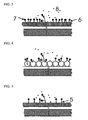
- 1 substrate
- 2 reflective layer (preferably electron-conductive Metal or cluster layer)
- 3 0-500 nm spacer layer
- 4 nanometric, non-conductive Particles
- 5 chemically reactive surface anchor
- 6 linkers e.g. DNA, proteins, ...)
- 7 Cluster
- 8 analyte
- 9 cleaved linker (e.g.
- the sensor consists of a metal layer on a carrier material, an inert one Spacer layer, e.g. applied by means of a photoresist or evaporation, on which linker molecules coupled with clusters are bound.
- the diameter of the Cluster is preferably chosen to be smaller than 40 nm. If the analyte with the linker interacts, it induces a change in the occupancy density of the cluster layer in the molecular scale, or changes in the spatial arrangement of the bound Cluster on the sensor. This leads to the characteristic changes in the optical Appearance of the sensor surface.
- the one colored by the abnormal optical effect The surface is determined by the catalytic or biorecognitive effect of the analyte or changed by adding an enzymatic active component.
- Metallic cluster films with an average cluster diameter of less than 500 nm (preferably less than 40 nm, to suppress multipole peaks in the spectrum) have strong narrow-band Reflection minima, whose spectral layers are extremely sensitive to the spatial The arrangement depends in particular on the distance to the electron-conducting surface.
- the sensor structure can even make the slightest changes to the surface coverage with clusters convert a clearly recognizable optical signal, either into a strong one Extinction change at a certain wavelength, or in a spectral shift of the absorption maximum.
- the sensitivity of the measurement setup can be calculated as follows: 25 nm in size Clusters are arranged in a grid of 100 nanometers. With an optical resolution of 1/10 mm, corresponds to a change in the signal strength of 10% 2x10e5 molecules. This Sensitivity was demonstrated experimentally with an antibody - antigen structure. The use of catalytically active analytes increases the sensitivity by a few more Powers of ten and thus allows single-molecule detection.
- Nanoclusters (preferably silver, aluminum or gold clusters) can be used via so-called "Biochemical linker” bound at a defined distance from the metallized surface become. Are these linkers intersected by biochemical recognition or catalysis or changes their spatial arrangement, this leads to a detectable signal.
- Oligonucleotides used as a linker which by the Analytes are cut (e.g. restriction enzymes from microorganisms) (see Fig. 1 and 2).
- Many pathogenic microorganisms express specific restriction endonucleases and can therefore quickly, with the help of the new disposable measuring system elaborate equipment, in the doctor's office or in the laboratory. This enables e.g. the differential diagnosis of urinary tract infections by direct E. coli Detection (pathogen of 60% of all urinary tract infections). Likewise, a quick and reliable screening method for bacterial contamination in food become.
- the new technology is based on amplified cluster plasmons, which are in a very simple and reproducible way the activity of chemically reactive species in one convert optical signal.
- Metallic clusters can thus e.g. on the surface of an inert (non-reactive) Polymers are attached and can be biochemical on the polymer surface
- Linkers can be arranged at a defined distance from the metal surface. The linkers can either be cut, or their spatial arrangement can be determined by biochemical Recognition or catalysis can be changed, which then becomes an optical one detectable signal leads.
- oligonucleotides can be used as Linkers are used, which are then cut by restriction enzymes.
- the present invention differs from the subject matter of the patent application "Optochemical sensor and method for its production", EP-A-0 677 738 by Basic Structural features:
- the structure registered here does not contain a reactive matrix preferably make volume changes.
- the new structure is based on one Changes in the cluster occupancy density, where chemical analytes interact Linker molecules bound at a defined distance from a reflective layer.
- abnormal property of a metal film refers to a strong one Absorption maximum, mostly in the visible spectral range, which is due to the spatial Localization of the conduction band electrons within the limits of the nanometric particle is effected. This spatial localization contrasts with the free mobility of the Electrons in a macroscopic piece of metal (which is free mobility of the electrons responsible for the strong reflection, generally called metallic gloss).
- a metallic cluster at a defined distance from a metallic surface interacts electrodynamically with the neighboring metal layer.
- a defined Distance of the absorbing cluster layer from the metal surface can be the electrical Field that is thrown back from the metal surface in the same phase as that incident electromagnetic wave come to rest.
- the resulting one Feedback mechanism increases the effective absorption coefficient of the Cluster layer. Since the optimal for a given layer thickness of the spacer layer Phase gain depends only on the frequency of the incident light, that can be Define system by narrow and strong reflection minima.
- the intensity of the Absorption band is directly proportional to that in a wide area with clusters Number of clusters. Any reduction in the number of clusters due to chemical elimination therefore results in a reduction in the absorption of the resonant system.
- At high Surface assignments are additionally caused by cluster-cluster interactions spectral shift observed (see Fig. 2).
- the optical behavior of the sensor can be determined by the so-called stratified medium theory or the CPS theory (which was first proposed by Chance, Prock and Silbey) to be discribed. These theories are based either on the behavior of an optical one Thin film or on the behavior of a polarizable particle near one Metal surface.
- the stratified medium theory can be used to calculate any type of optical Thin films can be used. It is based on the solution of the Maxwell equations among the Boundary conditions. that phase boundaries and phase thickness of different materials are specified. To be able to apply the stratified medium theory, everyone must optical constants of the four layers (surface, spacer layer, left layer and Cluster layer). The optical constants of an island film depend very much on chemical and physical parameters and must therefore be determined experimentally become.
- the analyte concentration can be viewed with high sensitivity by looking at the sensor surface can be determined without the aid of technical aids.
- reducing the background due to the self-staining of the sample can take two angles Measurement can be used.
- the background can be obtained by simply subtracting both signals can be easily eliminated by matrix effects.
- a sensor for measuring specific DNA and RNA sequences in the way that after hybridization of the analyte DNA / RNA with the Linker nucleotide forms a new restriction site. After incubation with a Restriction enzyme can therefore cut DNA / RNA with the bound Clusters can be removed from the surface by a simple washing step. Through the Temperature stability of all components can be combined directly with PCR.
- Restriction enzymes the double-stranded, can also be detected in an analogous manner Cut linker, or an HIV protease, which is an HIV specific peptide linker cuts.
- the detection of bacterial restriction enzymes in particular requires this Disruption of cells as part of the measurement process, the cells can be broken open or permeated, which is of fundamental importance for sensitivity.
- a This sensor is used in the field of molecular biological research Determination of activity or purity of restriction enzymes.
- nanometric particles in particular made of polystyrene, as a spacer layer. This The structure enables homogeneous layer thicknesses on uneven and curved surfaces.
- the technology uses an improved version of microstructuring
- This technology uses electrophoretic movement of clusters.
- Example 1 On polyethylene terephthalate which is metallized with aluminum (resistance 2 ⁇ ) is a 6% solution of polyhexyl methacrylate with the photoresist applied (4000 rpm, 60 s). The surface of the thin film is covered with oxygen plasma chemically hydroxylated, carboxylated and carbonylated. With unspecific adsorption or with a water-soluble carbodiimide is then a glycosylated protein or Sugar derivative bound. The tetravalent concanavalin A is then applied to this layer bound, creating a chemically reactive, sugar-binding surface.
- Gold colloids with a diameter of 14 nm are made with a glycosylated protein stabilized (e.g. peroxidase). Aggregation and the unspecific adsorption is through Addition of 0.1% Tween 20 suppressed. After adding the analyte, the Binding process with competitive reaction on the chip surface. The bound clusters show the desired optical effect because they are at a defined distance held by the reflective surface.
- a glycosylated protein stabilized e.g. peroxidase
- Nanometric particles on polystyrene are also suitable as a spacer layer.
- a silver surface produced by vapor deposition is treated with a 2% solution of Cystamine (30 minutes) reacted with a "self-assembling monolayer" with free amino groups.
- Carboxylated polystyrene balls (diameter e.g. 50 nm) can then in a two-step protocol with water-soluble carbodiimide to the Amino groups are bound.
- carboxylated polystyrene balls can also be bound to aminosilanized metal surfaces. If the binding reaction a dense, chemically reactive, two-dimensional grid of forms spherical particles.
- Oligonucleotides can then be on the plastic balls an artificially introduced amino terminus with e.g. water soluble carbodiimide be bound.
- the addition of imidazole is necessary to ensure the reactivity of the Selectively reduce carbodiimide to the terminal amino function.
- Example 3 Carboxylated balls of polystyrene are described in Example 1 Polymethacrylate layer bound with the help of bifunctional but cleavable crosslinkers.
- the Excess reactive groups of the polymer are inactivated via an ester bond.
- the Spheres also form a two-dimensionally ordered grid pattern, which after splitting the crosslinker (e.g. splitting SS bridges with the help of a reducing agent) one leaves two-dimensional impression of reactive SH groups on the surface.
- the reactive SH groups can then serve as anchor points for the orderly immobilization of the Serve linkers (e.g. via iodoacetyl activation).
- Example 4 This sensor is constructed in the same way as in Example 1, in addition however, at least two electrodes (mostly made of Pt, Au, Ag, Pd or steel) on the chip attached to enable microelectrophoresis.
- the spacer itself electrically or ionically conductive and as Electrode.
- Vaporized indium tin oxide from plasma, or an ion-conducting polymer can be used.
- the application of an electrophoretic Signals induce the movement of the electrically conductive clusters. To do this, either local concentration can be increased or unbound clusters can be removed. In order to the analysis time can be significantly reduced.
- too nanomagnetic particles e.g. Metal-metal oxide (mostly iron or chromium oxide) (Electro-) magnetic forces are moved.
Landscapes
- Health & Medical Sciences (AREA)
- Immunology (AREA)
- Life Sciences & Earth Sciences (AREA)
- Engineering & Computer Science (AREA)
- Molecular Biology (AREA)
- Biomedical Technology (AREA)
- Chemical & Material Sciences (AREA)
- Hematology (AREA)
- Urology & Nephrology (AREA)
- Biotechnology (AREA)
- Microbiology (AREA)
- Cell Biology (AREA)
- Food Science & Technology (AREA)
- Medicinal Chemistry (AREA)
- Physics & Mathematics (AREA)
- Analytical Chemistry (AREA)
- Biochemistry (AREA)
- General Health & Medical Sciences (AREA)
- General Physics & Mathematics (AREA)
- Pathology (AREA)
- Measuring Or Testing Involving Enzymes Or Micro-Organisms (AREA)
- Investigating Or Analysing Materials By Optical Means (AREA)
Description
Claims (19)
- Optischer Sensor mit einer elektromagnetische Wellen reflektierenden Schicht (2), wobei im Abstand von weniger als 1 µm zur reflektierenden Schicht (2) mit einem Analyten (8) wechselwirkende Linker (6) immobilisiert sind, an welche elektrisch leitende Cluster (7) mit einem Durchmesser von weniger als 500 nm gebunden sind, wobei die Zahl der gebundenen Cluster (7) durch eine Interaktion mit dem Analyten (8) veränderbar ist.
- Optischer Sensor nach Anspruch 1, dadurch gekennzeichnet, dass als Linker (6) DNA, RNA, Proteine, Peptide oder ihre Liganden verwendet werden.
- Optischer Sensor nach Anspruch 1, dadurch gekennzeichnet, dass Linker (6) verwendet werden, welche durch den Analyten (8) spaltbar sind.
- Optischer Sensor nach Anspruch 1, dadurch gekennzeichnet, dass die Linker (6) an die Oberfläche einer inerten Abstandsschicht (3) gebunden sind, wobei die Distanz zur reflektierenden Schicht (2) weniger als 500 nm beträgt.
- Optischer Sensor nach Anspruch 1, dadurch gekennzeichnet, dass die reflektierende Schicht (2) aus Metall, einer Metalloberfläche oder aus einer Schicht von Metallclustern besteht.
- Optischer Sensor nach Anspruch 1, dadurch gekennzeichnet, dass als Linker (6) ds-DNA, ds-RNA oder ds-synthetische Analoga verwendet werden, welche durch Restriktionsenzyme spaltbar sind.
- Optischer Sensor nach Anspruch 1, dadurch gekennzeichnet, dass als Linker (6) ss-DNA, ss-RNA oder ss-synthetische Analoga verwendet werden, welche mit dem Analyten (8) hybridisieren.
- Optischer Sensor nach Anspruch 7, dadurch gekennzeichnet, dass der gebildete Doppelstrang durch ein Restriktionsenzym spaltbar ist, das die Einzelstränge nicht spaltet.
- Optischer Sensor nach Anspruch 1, dadurch gekennzeichnet, dass die Cluster durch chemische Synthese erzeugt werden.
- Optischer Sensor nach Anspruch 1, dadurch gekennzeichnet, dass die Cluster (7) aus der Gruppe der Metalle Silber, Gold, Aluminium, Kupfer, Indium bestehen oder aus Metallen und Legierungen welche keine störenden Interbandübergänge besitzen.
- Optischer Sensor nach Anspruch 1, dadurch gekennzeichnet, dass der Abstand zwischen reflektierenden Schicht (2) und den Linkem (6) durch die Anlagerung von nanometrischen Partikeln geeigneter Größe erzeugt wird.
- Optischer Sensor nach Anspruch 1, dadurch gekennzeichnet, dass eine regelmäßige Anordnung von Linkern (6) durch Anlagerung nanometrischer Partikel an die reflektierende Schicht (2) erzeugt wird.
- Optischer Sensor nach Anspruch 1, dadurch gekennzeichnet, dass eine regelmäßige Anordnung von Linkern (6) durch chemische Abdrücke nach Anlagerung nanometrischer Partikel erzeugt wird.
- Optischer Sensor nach Anspruch 1, dadurch gekennzeichnet, dass als Linker (6) Proteine oder Peptide verwendet werden, die durch proteolytische Enzyme spaltbar sind.
- Optischer Sensor nach Anspruch 1, dadurch gekennzeichnet, dass als Linker (6) Antigen-Antikörper oder Rezeptor-Ligand-Konjugate verwendet werden, wobei der Analyt (8) eine der beiden Komponente verdrängt.
- Optischer Sensor nach Anspruch 1, dadurch gekennzeichnet, dass das Sensorsignal durch eine zweite Population von Clustern verstärkt wird.
- Optischer Sensor nach Anspruch 1, dadurch gekennzeichnet, dass der Sensor zusätzlich Elektroden (15) zur elektrophoretischen Bewegung oder Magnete zur magnetischen Bewegung der Cluster (7)aufweist.
- Verwendung des optischen Sensors nach einem der Ansprüche 1 bis 17 zur Messung von Hormonen, Viren, Bakterien, Proteinen, Peptiden, natürliche und synthetische toxische Substanzen, Pestiziden, DNA und RNA.
- Verwendung des optischen Sensors nach einem der Ansprüche 1 bis 17 um ein einmal chemisch erzeugtes zweidimensionales Muster wiederholt ablesen zu können.
Priority Applications (1)
| Application Number | Priority Date | Filing Date | Title |
|---|---|---|---|
| AT98916612T ATE278959T1 (de) | 1997-04-22 | 1998-04-20 | Cluster verstärkter optischer sensor |
Applications Claiming Priority (7)
| Application Number | Priority Date | Filing Date | Title |
|---|---|---|---|
| AT68097 | 1997-04-22 | ||
| AT68097A ATA68097A (de) | 1997-04-22 | 1997-04-22 | Cluster-plasmon-verstärkte einwegmesssysteme |
| AT165597 | 1997-09-30 | ||
| AT165697 | 1997-09-30 | ||
| AT165597 | 1997-09-30 | ||
| AT165697 | 1997-09-30 | ||
| PCT/AT1998/000101 WO1998048275A1 (de) | 1997-04-22 | 1998-04-20 | Cluster verstärkter optischer sensor |
Publications (2)
| Publication Number | Publication Date |
|---|---|
| EP0979408A1 EP0979408A1 (de) | 2000-02-16 |
| EP0979408B1 true EP0979408B1 (de) | 2004-10-06 |
Family
ID=27146608
Family Applications (1)
| Application Number | Title | Priority Date | Filing Date |
|---|---|---|---|
| EP98916612A Expired - Lifetime EP0979408B1 (de) | 1997-04-22 | 1998-04-20 | Cluster verstärkter optischer sensor |
Country Status (5)
| Country | Link |
|---|---|
| US (1) | US6669906B1 (de) |
| EP (1) | EP0979408B1 (de) |
| AU (1) | AU7011898A (de) |
| DE (1) | DE59812086D1 (de) |
| WO (1) | WO1998048275A1 (de) |
Cited By (1)
| Publication number | Priority date | Publication date | Assignee | Title |
|---|---|---|---|---|
| US8268265B2 (en) | 2006-09-25 | 2012-09-18 | Roland Kilper | Apparatus and method for picking up, transporting, and depositing microscopic samples |
Families Citing this family (17)
| Publication number | Priority date | Publication date | Assignee | Title |
|---|---|---|---|---|
| DE19927051C2 (de) * | 1999-06-14 | 2002-11-07 | November Ag Molekulare Medizin | Verfahren und Vorrichtung zur Identifizierung einer Nukleotidsequenz |
| DE19938138C2 (de) * | 1999-08-16 | 2003-02-13 | November Ag Molekulare Medizin | Verfahren und Vorrichtung zur Identifikation einer Biopolymersequenz auf Festkörperoberflächen |
| DE19950969A1 (de) * | 1999-10-22 | 2001-05-10 | Aventis Res & Tech Gmbh & Co | Doppelstrang-Nukleinsäure-Sonden und deren Verwendung |
| DE10007715A1 (de) * | 2000-02-19 | 2001-08-23 | Biotronik Mess & Therapieg | Medizinisches Therapiegerät und Sensor zum Erlangen von molekulargenetischer Information für das Gerät |
| DE10035451C2 (de) * | 2000-07-19 | 2002-12-05 | November Ag Molekulare Medizin | Verfahren und Vorrichtung zur Identifizierung einer Polymersequenz |
| DE10042461C2 (de) * | 2000-08-29 | 2002-11-07 | November Ag Molekulare Medizin | Verfahren zur fälschungssicheren Markierung von Gegenständen und fälschungssichere Markierung |
| DE10128321A1 (de) * | 2001-06-12 | 2003-01-02 | Biotechnolog Forschung Gmbh | Verfahren zur Identifizierung von Wechselwirkungen zwischen Proteinen und DNA-Fragmenten eines Genoms |
| US7322530B2 (en) * | 2001-08-16 | 2008-01-29 | November Aktiengesellschaft Gesellschaft Fur Molekulare Medizin | Forgery-proof marking for objects and method for identifying such a marking |
| WO2003016073A1 (de) | 2001-08-16 | 2003-02-27 | november Aktiengesellschaft Gesellschaft für Molekulare Medizin | Fälschungssichere markierung für gegenstände und verfahren zur identifizierung einer solchen markierung |
| AT413360B (de) | 2002-08-06 | 2006-02-15 | Hueck Folien Gmbh | Verfahren zur herstellung von fälschungssicheren identifikationsmerkmalen |
| DE10246563A1 (de) | 2002-10-05 | 2004-04-15 | november Aktiengesellschaft Gesellschaft für Molekulare Medizin | Vorrichtung und Verfahren zur Bestimmung der Farbe/n auf einer Oberfläche |
| AT413058B (de) * | 2003-12-02 | 2005-10-15 | Schalkhammer Thomas | Optischer sensor mit nanopartikel transfer sowie verfahren zur identifizierung von molekülen und objekten |
| US20050203681A1 (en) * | 2004-03-11 | 2005-09-15 | Minor John S.Jr. | Internet-enabled, auto-networking, wireless, sensor-capable, specific geographic location marker based communications network system |
| US7906223B2 (en) * | 2006-09-11 | 2011-03-15 | 3M Innovative Properties Company | Permeable nanoparticle reflector |
| AT508710B1 (de) * | 2009-08-13 | 2011-06-15 | Thomas Dr Schalkhammer | Sensor |
| KR101055450B1 (ko) | 2009-09-21 | 2011-08-08 | 숭실대학교산학협력단 | 표면 변형된 금 나노파티클을 활용한 아미노산 탐지 가능한 색깔변화 센서 및 상기 금 나노파티클의 색깔 변화를 이용한 아미노산 또는 펩티드의 탐지방법 |
| DE102021121347A1 (de) | 2021-08-17 | 2023-02-23 | Carl Freudenberg Kg | Optischer Sensor mit resonanten Nanopartikeln |
Family Cites Families (9)
| Publication number | Priority date | Publication date | Assignee | Title |
|---|---|---|---|---|
| US4299916A (en) * | 1979-12-26 | 1981-11-10 | Syva Company | Preferential signal production on a surface in immunoassays |
| US5017009A (en) * | 1986-06-26 | 1991-05-21 | Ortho Diagnostic Systems, Inc. | Scattered total internal reflectance immunoassay system |
| AT388248B (de) | 1987-07-20 | 1989-05-26 | Avl Verbrennungskraft Messtech | Deckschicht, vorzugsweise zur probenseitigen anbringung an optischen ionensensoren |
| SE462408B (sv) | 1988-11-10 | 1990-06-18 | Pharmacia Ab | Optiskt biosensorsystem utnyttjande ytplasmonresonans foer detektering av en specific biomolekyl, saett att kalibrera sensoranordningen samt saett att korrigera foer baslinjedrift i systemet |
| US5632957A (en) * | 1993-11-01 | 1997-05-27 | Nanogen | Molecular biological diagnostic systems including electrodes |
| ATE127226T1 (de) * | 1992-06-09 | 1995-09-15 | Avl Medical Instr Ag | Körper für die bildung mindestens einer elektrode und/oder eines sensors. |
| TW371714B (en) | 1993-12-01 | 1999-10-11 | Fiberchem Inc | Ultrasensitive competitive immunoassays using optical waveguides |
| AT403746B (de) | 1994-04-12 | 1998-05-25 | Avl Verbrennungskraft Messtech | Optochemischer sensor sowie verfahren zu seiner herstellung |
| AT402452B (de) | 1994-09-14 | 1997-05-26 | Avl Verbrennungskraft Messtech | Planarer sensor zum erfassen eines chemischen parameters einer probe |
-
1998
- 1998-04-20 AU AU70118/98A patent/AU7011898A/en not_active Abandoned
- 1998-04-20 DE DE59812086T patent/DE59812086D1/de not_active Expired - Lifetime
- 1998-04-20 WO PCT/AT1998/000101 patent/WO1998048275A1/de not_active Ceased
- 1998-04-20 EP EP98916612A patent/EP0979408B1/de not_active Expired - Lifetime
- 1998-04-20 US US09/403,488 patent/US6669906B1/en not_active Expired - Lifetime
Cited By (1)
| Publication number | Priority date | Publication date | Assignee | Title |
|---|---|---|---|---|
| US8268265B2 (en) | 2006-09-25 | 2012-09-18 | Roland Kilper | Apparatus and method for picking up, transporting, and depositing microscopic samples |
Also Published As
| Publication number | Publication date |
|---|---|
| DE59812086D1 (de) | 2004-11-11 |
| EP0979408A1 (de) | 2000-02-16 |
| US6669906B1 (en) | 2003-12-30 |
| AU7011898A (en) | 1998-11-13 |
| WO1998048275A1 (de) | 1998-10-29 |
Similar Documents
| Publication | Publication Date | Title |
|---|---|---|
| EP0979408A1 (de) | Cluster verstärkter optischer sensor | |
| DE60119170T2 (de) | Nachweismethode mittels verstärkter silberfärbung | |
| DE69808591T2 (de) | Homogene bindungstestverfahren | |
| DE3855814T2 (de) | Chemische sensoren mit katalytischen antikörpern | |
| Lin et al. | A new protein A assay based on Raman reporter labeled immunogold nanoparticles | |
| DE60033653T2 (de) | Nachweisverfahren unter verwendung eines mikromechanischen antikörpersensors | |
| DE69526747T2 (de) | Elektrobiochemisches Verfahren, System und Elektroden zur Bestimmung eines Mitgliedes eines Bindungspaares | |
| DE69737818T2 (de) | Ein für die Messung einer Änderung der Dicke oder Masse an seiner Oberfläche geeignetes Affinitätsprobenarray | |
| Choi et al. | Core–satellites assembly of silver nanoparticles on a single gold nanoparticle via metal ion-mediated complex | |
| EP1141378B1 (de) | Affinitätssensor für den nachweis spezifischer molekularer bindungsereignisse und dessen verwendung | |
| EP0732583A2 (de) | Optochemischer Fluoreszenzsensor sowie ein Verfahren zur Messung der Konzentration zumindest eines Analyten in einer Probe | |
| JP2010230679A (ja) | 生体感知用途のための金属微細シェル | |
| AU2001276870A1 (en) | Method of detection by enhancement of silver staining | |
| Schalkhammer | Metal nano clusters as transducers for bioaffinity interactions | |
| Masson et al. | Plasmonic nanopipette biosensor | |
| WO2002097405A2 (de) | Ortsaufgelöstes ellipsometrie-verfahren zur quantitativen und/oder qualitativen bestimmung von probenänderungen, biochip und messanordnung | |
| DE10049901C2 (de) | Vorrichtung und Verfahren zur elektrisch beschleunigten Immobilisierung und zur Detektion von Molekülen | |
| EP1376128A1 (de) | Methode und Vorrichtung zum impedimetrischen Nachweis eines oder meherer Analyten in einer Probe | |
| Anwar et al. | Gold nanocubes based optical detection of HIV-1 DNA via surface enhanced Raman spectroscopy | |
| EP1952128B1 (de) | Verteilte mess- und referenzspots, insbesondere für chemo- und biosensoren | |
| EP1343012A1 (de) | Nachweis von Analyten mit Signalverstärkung durch Polymerisation | |
| EP1145009B1 (de) | Verfahren zum nachweis von analyten in einer messprobe sowie messträger hierfür | |
| DE19938839A1 (de) | Verfahren zum Nachweis von Analyten in einer Meßprobe sowie Meßträger hierfür | |
| WO2002031482A2 (de) | Vorrichtung und verfahren zur elektrisch beschleunigten immobilisierung von molekülen | |
| DE19745668A1 (de) | Definierte Kopplung von biotechnologischen Funktionseinheiten |
Legal Events
| Date | Code | Title | Description |
|---|---|---|---|
| PUAI | Public reference made under article 153(3) epc to a published international application that has entered the european phase |
Free format text: ORIGINAL CODE: 0009012 |
|
| 17P | Request for examination filed |
Effective date: 19991019 |
|
| AK | Designated contracting states |
Kind code of ref document: A1 Designated state(s): AT DE FR GB NL |
|
| 17Q | First examination report despatched |
Effective date: 20020806 |
|
| GRAP | Despatch of communication of intention to grant a patent |
Free format text: ORIGINAL CODE: EPIDOSNIGR1 |
|
| GRAS | Grant fee paid |
Free format text: ORIGINAL CODE: EPIDOSNIGR3 |
|
| GRAA | (expected) grant |
Free format text: ORIGINAL CODE: 0009210 |
|
| RAP1 | Party data changed (applicant data changed or rights of an application transferred) |
Owner name: BAUER, GEORG Owner name: PITTNER, FRITZ Owner name: SCHALKHAMMER, THOMAS |
|
| AK | Designated contracting states |
Kind code of ref document: B1 Designated state(s): AT DE FR GB NL |
|
| REG | Reference to a national code |
Ref country code: GB Ref legal event code: FG4D Free format text: NOT ENGLISH |
|
| GBT | Gb: translation of ep patent filed (gb section 77(6)(a)/1977) | ||
| REF | Corresponds to: |
Ref document number: 59812086 Country of ref document: DE Date of ref document: 20041111 Kind code of ref document: P |
|
| ET | Fr: translation filed | ||
| PLBE | No opposition filed within time limit |
Free format text: ORIGINAL CODE: 0009261 |
|
| STAA | Information on the status of an ep patent application or granted ep patent |
Free format text: STATUS: NO OPPOSITION FILED WITHIN TIME LIMIT |
|
| 26N | No opposition filed |
Effective date: 20050707 |
|
| PGFP | Annual fee paid to national office [announced via postgrant information from national office to epo] |
Ref country code: NL Payment date: 20100427 Year of fee payment: 13 |
|
| REG | Reference to a national code |
Ref country code: NL Ref legal event code: V1 Effective date: 20111101 |
|
| PG25 | Lapsed in a contracting state [announced via postgrant information from national office to epo] |
Ref country code: NL Free format text: LAPSE BECAUSE OF NON-PAYMENT OF DUE FEES Effective date: 20111101 |
|
| REG | Reference to a national code |
Ref country code: FR Ref legal event code: PLFP Year of fee payment: 19 |
|
| PGFP | Annual fee paid to national office [announced via postgrant information from national office to epo] |
Ref country code: DE Payment date: 20160426 Year of fee payment: 19 |
|
| REG | Reference to a national code |
Ref country code: FR Ref legal event code: PLFP Year of fee payment: 20 |
|
| PGFP | Annual fee paid to national office [announced via postgrant information from national office to epo] |
Ref country code: GB Payment date: 20170427 Year of fee payment: 20 Ref country code: FR Payment date: 20170428 Year of fee payment: 20 |
|
| PGFP | Annual fee paid to national office [announced via postgrant information from national office to epo] |
Ref country code: AT Payment date: 20170427 Year of fee payment: 20 |
|
| REG | Reference to a national code |
Ref country code: DE Ref legal event code: R119 Ref document number: 59812086 Country of ref document: DE |
|
| PG25 | Lapsed in a contracting state [announced via postgrant information from national office to epo] |
Ref country code: DE Free format text: LAPSE BECAUSE OF NON-PAYMENT OF DUE FEES Effective date: 20171103 |
|
| REG | Reference to a national code |
Ref country code: GB Ref legal event code: PE20 Expiry date: 20180419 |
|
| REG | Reference to a national code |
Ref country code: AT Ref legal event code: MK07 Ref document number: 278959 Country of ref document: AT Kind code of ref document: T Effective date: 20180420 |
|
| PG25 | Lapsed in a contracting state [announced via postgrant information from national office to epo] |
Ref country code: GB Free format text: LAPSE BECAUSE OF EXPIRATION OF PROTECTION Effective date: 20180419 |