EP0979603A1 - Process and apparatus for the culture of algae - Google Patents
Process and apparatus for the culture of algae Download PDFInfo
- Publication number
- EP0979603A1 EP0979603A1 EP99115258A EP99115258A EP0979603A1 EP 0979603 A1 EP0979603 A1 EP 0979603A1 EP 99115258 A EP99115258 A EP 99115258A EP 99115258 A EP99115258 A EP 99115258A EP 0979603 A1 EP0979603 A1 EP 0979603A1
- Authority
- EP
- European Patent Office
- Prior art keywords
- algae
- cultivation
- growth
- liquid
- fluid
- Prior art date
- Legal status (The legal status is an assumption and is not a legal conclusion. Google has not performed a legal analysis and makes no representation as to the accuracy of the status listed.)
- Withdrawn
Links
- 238000009434 installation Methods 0.000 title 1
- 241000195493 Cryptophyta Species 0.000 claims abstract description 94
- 230000012010 growth Effects 0.000 claims abstract description 37
- 239000000203 mixture Substances 0.000 claims abstract description 12
- 150000003839 salts Chemical class 0.000 claims abstract description 8
- XLYOFNOQVPJJNP-UHFFFAOYSA-N water Substances O XLYOFNOQVPJJNP-UHFFFAOYSA-N 0.000 claims abstract description 7
- 230000005791 algae growth Effects 0.000 claims abstract description 6
- 210000000056 organ Anatomy 0.000 claims abstract description 6
- 239000007921 spray Substances 0.000 claims abstract description 4
- 239000000654 additive Substances 0.000 claims abstract description 3
- 239000000443 aerosol Substances 0.000 claims abstract description 3
- 230000002015 leaf growth Effects 0.000 claims abstract 2
- 239000007788 liquid Substances 0.000 claims description 76
- 238000000034 method Methods 0.000 claims description 21
- 241000199919 Phaeophyceae Species 0.000 claims description 14
- 238000004873 anchoring Methods 0.000 claims description 14
- 238000003860 storage Methods 0.000 claims description 9
- 239000000853 adhesive Substances 0.000 claims description 7
- 230000001070 adhesive effect Effects 0.000 claims description 7
- 238000009736 wetting Methods 0.000 claims description 6
- 230000008569 process Effects 0.000 claims description 4
- 230000027870 phototropism Effects 0.000 claims description 2
- 238000005507 spraying Methods 0.000 claims description 2
- 239000006196 drop Substances 0.000 claims 1
- 230000007363 regulatory process Effects 0.000 claims 1
- 239000012530 fluid Substances 0.000 abstract description 10
- 239000013535 sea water Substances 0.000 abstract description 2
- 230000027227 positive phototaxis Effects 0.000 abstract 1
- 235000010443 alginic acid Nutrition 0.000 description 16
- 229920000615 alginic acid Polymers 0.000 description 16
- 241000196324 Embryophyta Species 0.000 description 13
- FHVDTGUDJYJELY-UHFFFAOYSA-N 6-{[2-carboxy-4,5-dihydroxy-6-(phosphanyloxy)oxan-3-yl]oxy}-4,5-dihydroxy-3-phosphanyloxane-2-carboxylic acid Chemical compound O1C(C(O)=O)C(P)C(O)C(O)C1OC1C(C(O)=O)OC(OP)C(O)C1O FHVDTGUDJYJELY-UHFFFAOYSA-N 0.000 description 10
- 229940072056 alginate Drugs 0.000 description 10
- 239000002028 Biomass Substances 0.000 description 9
- 238000004519 manufacturing process Methods 0.000 description 8
- 230000008901 benefit Effects 0.000 description 7
- 230000008929 regeneration Effects 0.000 description 6
- 238000011069 regeneration method Methods 0.000 description 6
- 239000004576 sand Substances 0.000 description 6
- 241000894007 species Species 0.000 description 6
- AEMOLEFTQBMNLQ-BZINKQHNSA-N D-Guluronic Acid Chemical compound OC1O[C@H](C(O)=O)[C@H](O)[C@@H](O)[C@H]1O AEMOLEFTQBMNLQ-BZINKQHNSA-N 0.000 description 5
- 239000000463 material Substances 0.000 description 5
- 235000015097 nutrients Nutrition 0.000 description 5
- 239000000126 substance Substances 0.000 description 5
- AEMOLEFTQBMNLQ-VANFPWTGSA-N D-mannopyranuronic acid Chemical compound OC1O[C@H](C(O)=O)[C@@H](O)[C@H](O)[C@@H]1O AEMOLEFTQBMNLQ-VANFPWTGSA-N 0.000 description 4
- AEMOLEFTQBMNLQ-UHFFFAOYSA-N beta-D-galactopyranuronic acid Natural products OC1OC(C(O)=O)C(O)C(O)C1O AEMOLEFTQBMNLQ-UHFFFAOYSA-N 0.000 description 4
- 238000013461 design Methods 0.000 description 4
- 230000007613 environmental effect Effects 0.000 description 4
- 238000003306 harvesting Methods 0.000 description 4
- 241001474374 Blennius Species 0.000 description 3
- IAJILQKETJEXLJ-UHFFFAOYSA-N Galacturonsaeure Natural products O=CC(O)C(O)C(O)C(O)C(O)=O IAJILQKETJEXLJ-UHFFFAOYSA-N 0.000 description 3
- 238000009360 aquaculture Methods 0.000 description 3
- 244000144974 aquaculture Species 0.000 description 3
- 230000001419 dependent effect Effects 0.000 description 3
- 238000000605 extraction Methods 0.000 description 3
- 235000013305 food Nutrition 0.000 description 3
- JLIDBLDQVAYHNE-YKALOCIXSA-N (+)-Abscisic acid Chemical compound OC(=O)/C=C(/C)\C=C\[C@@]1(O)C(C)=CC(=O)CC1(C)C JLIDBLDQVAYHNE-YKALOCIXSA-N 0.000 description 2
- IJGRMHOSHXDMSA-UHFFFAOYSA-N Atomic nitrogen Chemical compound N#N IJGRMHOSHXDMSA-UHFFFAOYSA-N 0.000 description 2
- 241000195628 Chlorophyta Species 0.000 description 2
- 241000689515 Laminaria pallida Species 0.000 description 2
- 241000199900 Laminariales Species 0.000 description 2
- 241000206572 Rhodophyta Species 0.000 description 2
- FAPWRFPIFSIZLT-UHFFFAOYSA-M Sodium chloride Chemical compound [Na+].[Cl-] FAPWRFPIFSIZLT-UHFFFAOYSA-M 0.000 description 2
- 238000004140 cleaning Methods 0.000 description 2
- 238000010276 construction Methods 0.000 description 2
- 238000001816 cooling Methods 0.000 description 2
- 244000038559 crop plants Species 0.000 description 2
- 230000004069 differentiation Effects 0.000 description 2
- 230000000694 effects Effects 0.000 description 2
- 239000003102 growth factor Substances 0.000 description 2
- 239000000122 growth hormone Substances 0.000 description 2
- 239000003630 growth substance Substances 0.000 description 2
- 230000036571 hydration Effects 0.000 description 2
- 238000006703 hydration reaction Methods 0.000 description 2
- 230000006872 improvement Effects 0.000 description 2
- 244000005700 microbiome Species 0.000 description 2
- 235000021049 nutrient content Nutrition 0.000 description 2
- 239000003016 pheromone Substances 0.000 description 2
- 229920003023 plastic Polymers 0.000 description 2
- 239000004033 plastic Substances 0.000 description 2
- 239000002994 raw material Substances 0.000 description 2
- 230000001932 seasonal effect Effects 0.000 description 2
- 229920001817 Agar Polymers 0.000 description 1
- 235000001674 Agaricus brunnescens Nutrition 0.000 description 1
- 241000512259 Ascophyllum nodosum Species 0.000 description 1
- 229930192334 Auxin Natural products 0.000 description 1
- 241000894006 Bacteria Species 0.000 description 1
- UXVMQQNJUSDDNG-UHFFFAOYSA-L Calcium chloride Chemical compound [Cl-].[Cl-].[Ca+2] UXVMQQNJUSDDNG-UHFFFAOYSA-L 0.000 description 1
- 239000004097 EU approved flavor enhancer Substances 0.000 description 1
- 241000195522 Fucales Species 0.000 description 1
- 241000233866 Fungi Species 0.000 description 1
- 241001466453 Laminaria Species 0.000 description 1
- 241001598113 Laminaria digitata Species 0.000 description 1
- 241000296380 Laminaria hyperborea Species 0.000 description 1
- 241001491705 Macrocystis pyrifera Species 0.000 description 1
- 241001465754 Metazoa Species 0.000 description 1
- VVQNEPGJFQJSBK-UHFFFAOYSA-N Methyl methacrylate Chemical compound COC(=O)C(C)=C VVQNEPGJFQJSBK-UHFFFAOYSA-N 0.000 description 1
- 241000237536 Mytilus edulis Species 0.000 description 1
- 241001596291 Namibia Species 0.000 description 1
- 229920005372 Plexiglas® Polymers 0.000 description 1
- 241000015177 Saccharina japonica Species 0.000 description 1
- 241001274985 Zebrasoma scopas Species 0.000 description 1
- 238000009825 accumulation Methods 0.000 description 1
- 239000008272 agar Substances 0.000 description 1
- 239000000783 alginic acid Substances 0.000 description 1
- 229960001126 alginic acid Drugs 0.000 description 1
- 150000004781 alginic acids Chemical class 0.000 description 1
- QVGXLLKOCUKJST-UHFFFAOYSA-N atomic oxygen Chemical compound [O] QVGXLLKOCUKJST-UHFFFAOYSA-N 0.000 description 1
- 239000002363 auxin Substances 0.000 description 1
- 230000015572 biosynthetic process Effects 0.000 description 1
- 239000001110 calcium chloride Substances 0.000 description 1
- 229910001628 calcium chloride Inorganic materials 0.000 description 1
- 239000012876 carrier material Substances 0.000 description 1
- 239000003653 coastal water Substances 0.000 description 1
- FDJOLVPMNUYSCM-UVKKECPRSA-L cobalt(3+);[(2r,3s,4r,5s)-5-(5,6-dimethylbenzimidazol-1-yl)-4-hydroxy-2-(hydroxymethyl)oxolan-3-yl] [(2r)-1-[3-[(2r,3r,4z,7s,9z,12s,13s,14z,17s,18s,19r)-2,13,18-tris(2-amino-2-oxoethyl)-7,12,17-tris(3-amino-3-oxopropyl)-3,5,8,8,13,15,18,19-octamethyl-2,7, Chemical compound [Co+3].N#[C-].C1([C@H](CC(N)=O)[C@@]2(C)CCC(=O)NC[C@@H](C)OP([O-])(=O)O[C@H]3[C@H]([C@H](O[C@@H]3CO)N3C4=CC(C)=C(C)C=C4N=C3)O)[N-]\C2=C(C)/C([C@H](C\2(C)C)CCC(N)=O)=N/C/2=C\C([C@H]([C@@]/2(CC(N)=O)C)CCC(N)=O)=N\C\2=C(C)/C2=N[C@]1(C)[C@@](C)(CC(N)=O)[C@@H]2CCC(N)=O FDJOLVPMNUYSCM-UVKKECPRSA-L 0.000 description 1
- 239000002131 composite material Substances 0.000 description 1
- 238000011109 contamination Methods 0.000 description 1
- 238000012937 correction Methods 0.000 description 1
- 238000005260 corrosion Methods 0.000 description 1
- 238000012364 cultivation method Methods 0.000 description 1
- 238000005520 cutting process Methods 0.000 description 1
- 238000000354 decomposition reaction Methods 0.000 description 1
- FCRACOPGPMPSHN-UHFFFAOYSA-N desoxyabscisic acid Natural products OC(=O)C=C(C)C=CC1C(C)=CC(=O)CC1(C)C FCRACOPGPMPSHN-UHFFFAOYSA-N 0.000 description 1
- 238000011161 development Methods 0.000 description 1
- 230000018109 developmental process Effects 0.000 description 1
- 238000009826 distribution Methods 0.000 description 1
- 230000005611 electricity Effects 0.000 description 1
- 238000005516 engineering process Methods 0.000 description 1
- 238000003912 environmental pollution Methods 0.000 description 1
- 239000003337 fertilizer Substances 0.000 description 1
- 235000019264 food flavour enhancer Nutrition 0.000 description 1
- 239000007789 gas Substances 0.000 description 1
- 239000011521 glass Substances 0.000 description 1
- 239000001963 growth medium Substances 0.000 description 1
- 229910052736 halogen Inorganic materials 0.000 description 1
- 150000002367 halogens Chemical class 0.000 description 1
- 239000005556 hormone Substances 0.000 description 1
- 229940088597 hormone Drugs 0.000 description 1
- SEOVTRFCIGRIMH-UHFFFAOYSA-N indole-3-acetic acid Chemical compound C1=CC=C2C(CC(=O)O)=CNC2=C1 SEOVTRFCIGRIMH-UHFFFAOYSA-N 0.000 description 1
- 239000004615 ingredient Substances 0.000 description 1
- 150000002632 lipids Chemical class 0.000 description 1
- 230000007246 mechanism Effects 0.000 description 1
- 229910052751 metal Inorganic materials 0.000 description 1
- 239000002184 metal Substances 0.000 description 1
- 230000004048 modification Effects 0.000 description 1
- 238000012986 modification Methods 0.000 description 1
- 235000020638 mussel Nutrition 0.000 description 1
- 239000005445 natural material Substances 0.000 description 1
- 229930014626 natural product Natural products 0.000 description 1
- 239000006199 nebulizer Substances 0.000 description 1
- 229910052757 nitrogen Inorganic materials 0.000 description 1
- 235000015816 nutrient absorption Nutrition 0.000 description 1
- 239000003305 oil spill Substances 0.000 description 1
- 230000003204 osmotic effect Effects 0.000 description 1
- 239000001301 oxygen Substances 0.000 description 1
- 229910052760 oxygen Inorganic materials 0.000 description 1
- 230000008635 plant growth Effects 0.000 description 1
- 231100000614 poison Toxicity 0.000 description 1
- 229920000642 polymer Polymers 0.000 description 1
- 238000012545 processing Methods 0.000 description 1
- 230000009467 reduction Effects 0.000 description 1
- 229920006395 saturated elastomer Polymers 0.000 description 1
- 239000011780 sodium chloride Substances 0.000 description 1
- 230000003595 spectral effect Effects 0.000 description 1
- 238000001228 spectrum Methods 0.000 description 1
- 230000006641 stabilisation Effects 0.000 description 1
- 238000011105 stabilization Methods 0.000 description 1
- 229910001220 stainless steel Inorganic materials 0.000 description 1
- 239000010935 stainless steel Substances 0.000 description 1
- 239000003440 toxic substance Substances 0.000 description 1
- 238000009423 ventilation Methods 0.000 description 1
- 229930003231 vitamin Natural products 0.000 description 1
- 235000013343 vitamin Nutrition 0.000 description 1
- 239000011782 vitamin Substances 0.000 description 1
- 229940088594 vitamin Drugs 0.000 description 1
Images


Classifications
-
- A—HUMAN NECESSITIES
- A01—AGRICULTURE; FORESTRY; ANIMAL HUSBANDRY; HUNTING; TRAPPING; FISHING
- A01G—HORTICULTURE; CULTIVATION OF VEGETABLES, FLOWERS, RICE, FRUIT, VINES, HOPS OR SEAWEED; FORESTRY; WATERING
- A01G33/00—Cultivation of seaweed or algae
-
- Y—GENERAL TAGGING OF NEW TECHNOLOGICAL DEVELOPMENTS; GENERAL TAGGING OF CROSS-SECTIONAL TECHNOLOGIES SPANNING OVER SEVERAL SECTIONS OF THE IPC; TECHNICAL SUBJECTS COVERED BY FORMER USPC CROSS-REFERENCE ART COLLECTIONS [XRACs] AND DIGESTS
- Y02—TECHNOLOGIES OR APPLICATIONS FOR MITIGATION OR ADAPTATION AGAINST CLIMATE CHANGE
- Y02A—TECHNOLOGIES FOR ADAPTATION TO CLIMATE CHANGE
- Y02A40/00—Adaptation technologies in agriculture, forestry, livestock or agroalimentary production
- Y02A40/80—Adaptation technologies in agriculture, forestry, livestock or agroalimentary production in fisheries management
Definitions
- the invention relates to a method for cultivating multicellular algae, e.g. Brown, red or green algae, at to which the algae are exposed to a liquid treatment, and an apparatus for implementing the cultivation method.
- multicellular algae e.g. Brown, red or green algae
- Algae include lower plant organisms that are useful and Crop plants are used to make food or to win certain natural products.
- An overview of the Algae species used for biomass production and their utilization is described by Gunter O. Kirst et al. in "Spectrum of Science” (April 1983). It is generally between unicellular or low-cell microalgae and the multicellular macroalgae distinguished, the macroalgae (or: Tang) because of the large biomass production of particular interest Find.
- the utilization of the macroalgae is supported by the The following problems are explained using the example of brown algae algae cultivation and harvest is restricted.
- Brown algae Phaeophyta
- Phaeophyta are the biotechnologically most important saltwater plants worldwide. For centuries they have been collected and processed on European, Japanese, South and North American or African coasts. In China and Japan they are part of the food because they contain valuable ingredients such as vitamin B 12 .
- brown algae are mainly used as a raw material source for the extraction of various natural substances, especially the alginates.
- An overview of the manufacture, properties and use of alginates in the food industry is given by A. Askar in "Alimenta” (Volume 21, 1982, pp. 165 ff.).
- Commercially available alginate comes from species of the Laminariales (or: kelps, brown tang) species, whose biomass is usually harvested from wild populations.
- the representatives of the Laminariales occur worldwide in cold temperate regions, with a smaller number of species also in warm temperate regions.
- the main sources of alginate are, for example, the giant kelp Macroycystis pyrifera in California, various types of Laminaria in Japan, and North Africa, the Laminaria japonica in China, the Laminaria hyperborea in Norway and the Laminaria digitata in France.
- Alginates are salts of alginic acid, which are made up of polymers Blocks of mannuronic acid (M-blocks), guluronic acid (G-blocks) and mixed blocks (MG blocks). Rich in guluronic acid Alginate is more viscous than alginate rich in mannuronic acid.
- M-blocks Blocks of mannuronic acid
- G-blocks guluronic acid
- MG blocks mixed blocks
- Rich in guluronic acid Alginate is more viscous than alginate rich in mannuronic acid.
- the actual composition of the alginates varies within the algae plant in particular such that the stiff Stem contains more guluronic acid than the flexible phylloid. In addition to this variable composition within the algae plant additional variations occur for the following reasons on.
- the brown algae that usually grow in coastal waters are Pollution from environmental pollution and foreign organisms (such as microorganisms, mussels). Moreover are seasonal (climate influence) and geographical (local Nutrient sources or the like.) Different growth conditions given, whereby not only the alginate composition in the Brown algae is changeable, but also produces additives can be annoying when used later are.
- the brown algae harvest brought in from the wild population is particularly affected by epibionts, such as bacteria, Contaminated mushrooms or benthic animals. Add to that Contamination from changing environmental influences (e.g. storms, El Ni ⁇ o appearance etc.) or pollution (oil spill or the like).
- the cultivated biomass obtained from wild brown algae is therefore of low purity and strong variability in terms of chemical composition. This is however for medical or biotechnological applications unacceptable.
- the object of the invention is a method for the cultivation of algae to create with the disadvantages of previous algae cultivation and harvest are overcome and algae growth in particular under controlled conditions in such a way that defined algae species during cultivation regardless of influences from the free environment and under minimized external conditions can be developed. It is also an object of the invention, an implementation device of the procedure.
- the invention is based on the idea, different from the previous ones Cultivations in large volumes of salt water, algae in a cultivation room with a humid atmosphere free to be arranged and wetted with a cultivation liquid. It is intended to attach the algae to an anchoring device attached and if necessary with an additional mounting device exposed or free-hanging in the cultivation room to arrange.
- the wetting is preferably carried out through a continuous supply of the cultivation liquid the algae surface. This fluid supply takes place in such a way that the surface of the algae is continuously covered by a film of liquid is covered.
- the fluid intake can be a splash, Sprinkling, dropping, spraying or similar application the cultivation liquid in aerosol or drop form or include as a jet of liquid.
- a device according to the invention is through a cultivation room created with an anchoring device for fastening the algae, if necessary an additional support device and a feeder for the cultivation liquid is provided.
- an additional support device and a feeder for the cultivation liquid is provided.
- a liquid collection device and a Circulation device with a drive and a regeneration device intended.
- the liquid collection device is a cultivation liquid dripping from the algae collected and fed to the circulatory device.
- the Regeneration device is set up to the composition the cultivation liquid in a predetermined manner with regard to the nutrient content and, if necessary, to be added Discontinue growth substances.
- the invention has the following advantages. For the first time fresh algae material under controlled conditions without the variabilities explained above due to variable Breed environmental influences. This will be a significant improvement the product quality, especially a reduction accumulation of toxic substances.
- the cultivated Algae are the raw material for the extraction of high-purity alginate for medical purposes. Because according to the invention just a liquid film on the rest in one Algae arranged in gaseous or vaporous atmosphere is formed, there is a considerable saving in liquid of at least 10 to 20% compared to the previous ones Aquaculture. By adjusting the composition of the Cultivation liquid can be used to plant growth in control in a predetermined manner.
- the inventive cultivation on land makes it possible to produce various types of high-purity algal biomass in a reproducible manner in a reproducible manner, regardless of seasonal or environmental influences, which are of particular interest for the production of very high molecular weight guluronate or mannuronate-rich for medical or biotechnological applications are.
- the algae surface wetting according to the invention has the Advantage of a rapid liquid and gas exchange the plant surface. This enables less cleaning effort for the cultivation liquid and a more efficient one Light supply to the algae.
- the harvest of the cultivated algae is considerably simplified and improved.
- the usual addition of wild populations Chemicals to prevent rotting or decomposition on the harvested algae is completely unnecessary.
- the algae can be cultivated on site for further processing or be bred.
- An additional transportation is not mandatory. It is particularly possible to cultivate to be carried out largely free of disruptive microorganisms, so that a continuous sterile chain from the Cultivation up to use in the respective medical or biotechnological application.
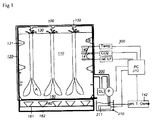
- a cultivation device or algae growing system according to the invention 1 comprises a section shown, closed chamber 100 containing a cultivation room 110 forms and with an anchoring device 120, liquid supply devices 130, sensor devices 140, one Liquid collecting device 150 and a lighting device 160 is provided, a circuit device 200, the with the liquid supply devices 130 and the liquid collecting device 150 is connected, and a control device 300.
- the chamber 100 is constructed as a liquid- and gas-tight bioreactor from a material that is inert to the cultivation liquid used in each case.
- the chamber 100 is preferably made of corrosion-free metal such as stainless steel or at least partially of glass or translucent plastic.
- the dimensions of the chamber shown in section in the upright operating position can be, for example, 2 ⁇ 2 m 2 for the floor area and 2.5 m 2 for the chamber height. Depending on the application, these dimensions can be adapted to the size of the algae to be cultivated.
- the modular Construction has the advantage of simplified control of local growth conditions and a simple one Interchangeability if a chamber is contaminated or e.g. is infested with a fungus.
- With the modular structure of a cultivation system from a plurality of chambers 100 with one Variety of circulatory devices 200 can be one for all Chambers and circulatory systems control acting together 300 may be provided.
- the anchoring device 120 is for receiving the as Adhesive structure-acting tissue parts of the algae to be cultivated intended.
- the anchoring device 120 can, for example be formed by a bed of sand or gravel, with which the adhesive structure has grown together.
- the bed of sand or gravel is located on a carrier shell, which depends on the application to the desired arrangement of the algae in the Chamber is adjusted.
- the carrier shell of the anchoring device 120 for example Openings through which the algae A from the adhesive structure growing free hanging downwards.
- the algae A can also go down over the edge of the carrier shell to grow.
- the hanging growth according to Fig. 1 has the advantage of a small footprint.
- the liquid supply devices 130 become dependent on the application Desired type of hydration designed. 1, nebulizer nozzles 131 and Drip nozzles 132 shown. One takes place at the atomizing nozzles 131 Nebulizing the cultivation liquid using a compressed air source DL in the circuit 200. Die Drip nozzles 132 are preferably used to drain the cultivation liquid, here specifically on those in the upper part of the Chamber 100 arranged adhesive structures in the anchoring device 120, furnished.
- Alternative liquid supply devices are liquid jet or spray devices or devices for dropping a rotating surface, of which the cultivation liquid in the form of smaller Drop splashes into the chamber 100.
- the hydration is used to maintain a high level or saturated humidity in the chamber atmosphere and the Wetting of the algae surface. Cultivation liquid, the runs down the alga and drips from the lower end, is collected by the liquid collection device.
- the liquid collection device from a tub 150. This preferably consists made of a translucent material, if lighting the chamber is provided from the bottom side. An outflow from the tub 150 opens into a storage vessel 210 the circulation device 200.
- the lighting device 160 is in the bottom region of the chamber 100 provided. It includes in the illustrated embodiment a watertight and vapor-tight lighting chamber 161 made of a translucent material (e.g. plexiglass) and a plurality of lamps 162.
- the lamps 162 are application dependent to achieve a certain spectral Luminance distribution selected (e.g. halogen lamps).
- the Lamps 162 are preferably with brightness control (e.g. dimmer).
- the lighting device 160 can height adjustable (adjusting device H), coolable and / or with a heat protection filter.
- the chamber 100 can also with daylight be illuminated either directly from above or from at least one side through a translucent chamber wall and / or via deflecting mirror from below through the translucent tub 150 occurs.
- the sensor devices 140 comprise atmosphere sensors 141 and cultivation liquid sensors 142, which are preferably each arranged in the chamber 100 or are connected to the storage vessel 210. With the atmosphere sensors 141, development-determining parameters in the interior of the chamber 100 or in the cultivation atmosphere are measured. 1 shows temperature, CO 2 and air humidity sensors as examples. In addition, light or pressure sensors (not shown in each case) can be provided, for example.
- the sensors are connected to a control unit 310 of the controller 300.
- the cultivation liquid sensors 142 are provided for measuring physical and / or chemical parameters of the cultivation liquid. For example, they can include a further temperature sensor, a pH sensor and sensors for detecting the osmotic concentration of the cultivation liquid.
- the cultivating liquid sensors 142 are connected to the cultivating liquid in the storage vessel 210 for recording the measured values and to the control unit 310 for forwarding the measured values.
- the circuit device 200 is fixed in the form of lines installed pipes or hoses with the liquid supply devices 130 or the liquid collection device 150 connected and contains the storage vessel 210, a drive device 220 and a regeneration device (not shown).
- the storage vessel 210 with the Liquid collecting device 150 collected cultivation liquid collected and in terms of temperature and composition measured.
- the storage vessel 210 is with a Temperature control device 211 provided with a temperature sensor 142 and the control unit 310 part of a temperature control is.
- Each liquid delivery device is a drive device 220 from the storage vessel 210 to the liquid supply devices 130 suitable.
- Are exemplary 1 shows a compressed air device DL and a pump P.
- the drive devices 220 are with the control unit 310 connected.
- a manually or automatically operated regeneration device (not shown) is intended to respond to a reduced nutrient content in the cultivation liquid e.g. depending on a signal from the sensor 142 or a predetermined timing nutrients for To supply cultivation liquid in the storage vessel 210.
- the controller 300 includes the control unit 310, its function in detail below with reference to the invention Procedure is explained, and their connections with the sensors 141, 142 and the circuit device 200.
- the cultivation liquid is an aqueous nutrient solution with a composition that essentially corresponds to the composition of sea water from the oceans, Mediterranean or marginal seas. Accordingly, the cultivation liquid contains a salt content in the range of 0.1 to 4%.
- the salts contained include in particular sodium chloride and calcium chloride.
- higher salt concentrations or other nutrients or growth substances can be provided.
- a predetermined amount of growth hormones can be added to the cultivation liquid in order to promote the growth of certain algae organs with a specific alginate composition. Examples of growth hormones that can be used are pheromones, auxin or abscisic acid.
- the procedure according to the invention comprises arranging the algae to be cultivated in the chamber 100 corresponding to one of the designs discussed below and ongoing wetting the algae with the cultivation liquid. Details of this Processes are explained below by way of example.
- Young algae plants or gametophytes which are preferably grown in laboratory cultures (bioreactor), are arranged in chamber 100, the earliest time for the arrangement of the algae plants being the formation of tissue differentiations in the young algae.
- already cultivated algae with pronounced differentiations or pronounced organs can also be used in the chamber.
- algae of the type Laminaria pallida with a length of approximately 1 m are spread side by side on the sand or gravel bed of the anchoring device 120 and aligned in such a way that (in the example shown according to FIG. 1) growth from the carrier shell is made possible downwards.
- the algae A hang down from the upper region of the chamber 100 and are dripped from above with the liquid supply device 130 and, on the other hand, are sprayed laterally.
- the liquid delivery rate of the liquid supply devices 130 can be, for example, in the range from 100 ml to 10 l per m 2 and hour. This rate is selected to continuously form a film of the culture liquid on the surface of the algae. After draining from the algae and collecting them with the liquid collecting device 150, the culture liquid is continuously circulated, tempered, cleaned and, if necessary, regenerated with nutrients.
- the artificial or daylight lighting is set depending on the application and is, for example, 20 to 500 ⁇ mol / m 2 s (photons per m 2 leaf area and second).
- the growth parameters in the chamber 100 and the properties of the cultivation liquid are continuously monitored and, if necessary, adjusted using conventional control technology or fuzzy control logic.
- the sensors, the temperature control device, the regeneration device and the control unit form a control loop.
- the measured values of the sensors are continuously compared in the control unit with predetermined reference values, and if the measured values deviate from the reference values, the respective corrections are carried out by operating the temperature control or regeneration devices.
- Predefined program sequences for controlling the temperature, lighting, material growth control and mechanical growth stabilization can also be stored in the control unit 310.
- cleaning steps can be provided in which the liquid supply devices with non-salty Rinsed with water.
- Fig. 2 shows only detail representations of an inventive Device, which is otherwise analogous to the structure 1 can be composed.
- the cultivation alternatives consist in the upright growth according to FIG. 2a in horizontal growth according to FIG. 2b or horizontally hanging growth according to FIG. 2c.
- FIG. 2a With upright growth (Fig. 2a) is the anchoring device 120 for the adhesive structures of algae A in the lower one Part of the chamber 100 attached.
- Support devices 170 in the form of a holding wire 171, from Retaining clips 172 and / or a retaining ring 173 are provided are each connected to an upper bracket 174 to form a vertical alignment of the plant during the cultivation process to ensure.
- the support device 170, the generally intended for vertical alignment of algae is, horizontal support elements (not shown) in chamber 100.
- the embodiment according to FIG. 2a is the lighting device 160 attached to the top of the chamber 10.
- the algae are spread out on a flat bed of sand or gravel 120, that simultaneously as anchoring device and support device serves.
- the algae are preferred by the exposed side of the plants forth. It can be provided be that to ensure sufficient lighting the sand or gravel beds 120 are suitable in the chamber are staggered. It can also in addition Chamber a turning mechanism (not shown) for turning or moving the algae to be cultivated.
- a support 170 is in shape in chamber 100 provided by hooks 171 hanging from support 174.
- the anchoring device 120 is narrow shell running along the chamber wall with a sand or Gravel bed or a similar carrier material for inclusion the adhesive structure of the algae provided.
- a particular advantage of the invention is the targeted Manipulability of algae cultivation.
- various mechanical manipulation measures are provided, which in addition to chemical growth influences with growth factors (hormones, pheromones) or defined composite culture media (fertilizers) or can be realized independently of these.
- Under mechanical Manipulation measures are all precautions here understood that with mechanical means the effect of external or influence internal growth factors in algae cultivation. 3
- a shield 180 Fig. 3b
- the shielding device 180 darkens the Stems (cauloids) of plants during growth of Light off, so that the algae to an increased length growth be forced (positive phototropism). So that can as a result of the cultivation primarily the cauloids with one increased proportion of guluronic acid (see above) can be harvested.
- the shielding device 180 can be in the form of a tube or Hose are pushed over the algae stem.
- a telescope construction with mutually displaceable shielding parts 181 is used to set a variable shielding length preferred during length growth. With vertically erect or horizontal growth can the shielding device 180 is also provided as a support device according to FIG. 2 his.
- the pulling devices according to the invention 190 include all types of mechanical traction in Longitudinal growth direction e.g. through continuous tensile forces, that are exercised by weight or by spring force (not shown) with suitable spring devices be exercised.
- 3c includes hanging growth the pulling device 190 fastening clips 191, with which a Draw weight 192 is attached to the leaves of the algae.
- e mounting clips 191 are also provided, which with the Weight 192 connected via traction ropes 193, which with pulleys 194 are performed.
- the pulling device 190 promotes the stretching or length growth of the algae in that the mechanical stress in the surf zone in the wild populations is simulated. Accordingly, the weights 192 depending on the type of algae, preferably with a mass in Range from 100 to 1,000 g selected.
- Fig. 3f shows a possibility of a mechanical Influencing growth by removing certain plant organs during the growth process. Periodically the algae leaves are manually or with a cutting device removed and recycled so that Here biomass with an increased mannuronic acid content is obtained becomes.
- the invention is not limited to the illustrated embodiments limited. Rather, the cultivation space that Circulation device and the control modified depending on the application become. It can be provided, for example, that the liquid supply devices 130 not on the chamber wall, but also via pipe connections inside the chamber are arranged. Furthermore, different from the one-sided Lighting provided that the lamps of the lighting device are distributed inside the chamber. Further Modification options relate to the chamber or Reactor shape, the operation of the circulation system and the selection and attachment of the sensors.
Landscapes
- Life Sciences & Earth Sciences (AREA)
- Marine Sciences & Fisheries (AREA)
- Environmental Sciences (AREA)
- Micro-Organisms Or Cultivation Processes Thereof (AREA)
- Hydroponics (AREA)
Applications Claiming Priority (2)
| Application Number | Priority Date | Filing Date | Title |
|---|---|---|---|
| DE19835656A DE19835656A1 (de) | 1998-08-06 | 1998-08-06 | Verfahren und Vorrichtung zur Algenkultivierung |
| DE19835656 | 1998-08-06 |
Publications (1)
| Publication Number | Publication Date |
|---|---|
| EP0979603A1 true EP0979603A1 (fr) | 2000-02-16 |
Family
ID=7876735
Family Applications (1)
| Application Number | Title | Priority Date | Filing Date |
|---|---|---|---|
| EP99115258A Withdrawn EP0979603A1 (fr) | 1998-08-06 | 1999-08-02 | Process and apparatus for the culture of algae |
Country Status (2)
| Country | Link |
|---|---|
| EP (1) | EP0979603A1 (fr) |
| DE (1) | DE19835656A1 (fr) |
Families Citing this family (5)
| Publication number | Priority date | Publication date | Assignee | Title |
|---|---|---|---|---|
| CN105941125B (zh) * | 2016-05-09 | 2022-02-08 | 广东海洋大学 | 一种全缘马尾藻的人工育苗方法 |
| CN106124696B (zh) * | 2016-06-03 | 2018-03-09 | 蒋子源 | 一种植物趋光性检测装置及检测方法 |
| CN107980610B (zh) * | 2018-01-05 | 2024-01-23 | 宁波大学 | 一种刺激大型藻类孢子放散的可控循环装置 |
| EP4403617A1 (fr) | 2023-01-18 | 2024-07-24 | On-Yee Yan | Dispositif et procédé d'élevage d'algues dans une masse d'eau |
| EP4610342A1 (fr) | 2024-02-29 | 2025-09-03 | Alexander Lempp | Dispositif et installation pour la culture et le traitement ultérieur d'algues dans une masse d'eau ainsi que pour la filtration d'eau |
Citations (5)
| Publication number | Priority date | Publication date | Assignee | Title |
|---|---|---|---|---|
| JPS61249382A (ja) * | 1985-04-30 | 1986-11-06 | Yoshimi Akasaka | 硅藻噴霧培養装置 |
| JPS63196215A (ja) * | 1987-02-10 | 1988-08-15 | 縄巻 昇 | 海藻の空中栽培方法 |
| JPH04130079A (ja) * | 1990-09-19 | 1992-05-01 | Hitachi Ltd | 植物及び好気性微生物を利用した炭酸ガスの固定化方法 |
| JPH1042731A (ja) * | 1996-08-02 | 1998-02-17 | Okabe Co Ltd | 藻場の造成方法及び造成用海藻種苗の備蓄方法 |
| JPH10178947A (ja) * | 1996-12-26 | 1998-07-07 | Sanyo Electric Co Ltd | 海藻類の養殖装置および養殖方法 |
-
1998
- 1998-08-06 DE DE19835656A patent/DE19835656A1/de not_active Withdrawn
-
1999
- 1999-08-02 EP EP99115258A patent/EP0979603A1/fr not_active Withdrawn
Patent Citations (5)
| Publication number | Priority date | Publication date | Assignee | Title |
|---|---|---|---|---|
| JPS61249382A (ja) * | 1985-04-30 | 1986-11-06 | Yoshimi Akasaka | 硅藻噴霧培養装置 |
| JPS63196215A (ja) * | 1987-02-10 | 1988-08-15 | 縄巻 昇 | 海藻の空中栽培方法 |
| JPH04130079A (ja) * | 1990-09-19 | 1992-05-01 | Hitachi Ltd | 植物及び好気性微生物を利用した炭酸ガスの固定化方法 |
| JPH1042731A (ja) * | 1996-08-02 | 1998-02-17 | Okabe Co Ltd | 藻場の造成方法及び造成用海藻種苗の備蓄方法 |
| JPH10178947A (ja) * | 1996-12-26 | 1998-07-07 | Sanyo Electric Co Ltd | 海藻類の養殖装置および養殖方法 |
Non-Patent Citations (5)
| Title |
|---|
| DATABASE WPI Section Ch Week 1988, Derwent World Patents Index; Class A97, AN 1988-268149, XP002121430 * |
| PATENT ABSTRACTS OF JAPAN vol. 011, no. 096 (C - 412) 26 March 1987 (1987-03-26) * |
| PATENT ABSTRACTS OF JAPAN vol. 016, no. 394 (C - 0976) 21 August 1992 (1992-08-21) * |
| PATENT ABSTRACTS OF JAPAN vol. 1998, no. 12 31 October 1998 (1998-10-31) * |
| PATENT ABSTRACTS OF JAPAN vol. 1998, no. 6 30 April 1998 (1998-04-30) * |
Also Published As
| Publication number | Publication date |
|---|---|
| DE19835656A1 (de) | 2000-02-10 |
Similar Documents
| Publication | Publication Date | Title |
|---|---|---|
| DE60102404T2 (de) | Setzlingszuchteinrichtung und diese Einrichtung anwendendes Setzlingszuchtverfahren | |
| EP0605749B1 (fr) | Procédé pour la culture hydroponique de plantes et procédé pour sa mise en oeuvre | |
| DE60010502T2 (de) | Verfahren zum erzeugen von metaboliten aus pflanzen in erdloser kultur | |
| DE2047820A1 (de) | Vorrichtung und Verfahren zur hydroponi sehen Kultivation von Pflanzen | |
| CN103081791A (zh) | 红豆杉的营养液栽培方法 | |
| CN104686142A (zh) | 气雾栽培马铃薯脱毒种薯繁育方法及配套设备 | |
| CN211558351U (zh) | 一种搭载有人工智能的菊科植物的水培系统 | |
| WO2005079560A1 (fr) | Dispositif pour cultiver et produire des algues en masse | |
| DE69921297T2 (de) | Pflanzenwachstumsmedium mit hydrophilem Membrane und Verwendung der Membrane zur Kontrolle der Feuchtigkeit | |
| DE102018123378A1 (de) | Torfmooswand | |
| CN1290404C (zh) | 水培花木根系驯化与植株培养方法 | |
| EP0979603A1 (fr) | Process and apparatus for the culture of algae | |
| DE69116044T2 (de) | Verfahren zur produktion von knollen | |
| EP0215811A1 (fr) | PROCEDE ET DISPOSITIF POUR LA CULTURE -i(IN VITRO) DE CELLULES OU D'ORGANES VEGETAUX, AINSI QUE POUR LA MICROPROPAGATION ET LA REGENERATION DE VEGETAUX ENTIERS. | |
| EP4023055A2 (fr) | Système de détection automatique des paramètres de croissance des plantes et module d'irrigation aéroponique passive des plantes dans le sens vertical, ainsi qu'installation de culture | |
| CN108513860A (zh) | 一种立体种植食用菌的装置 | |
| JP2014131517A5 (fr) | ||
| JP2006067999A (ja) | 噴霧水耕栽培法 | |
| DE202014101488U1 (de) | Vorrichtung zur hydroponischen Kultivierung | |
| DE69925509T2 (de) | Verfahren zum ex vitro säen und keimen von somatischen pflanzenembryonen | |
| CN104221629A (zh) | 一种指天椒无性繁殖育苗方法 | |
| KR20190099972A (ko) | 노지재배, 수경재배, 분경재배와 수산물의 양식이 가능한 생산시스템 | |
| AT312983B (de) | Verfahren und Anlage zur Erzeugung natürlicher Rohstoffe mittels Pflanzen, die nach hydroponischen Kulturmethoden gewonnen werden | |
| CN205727471U (zh) | 铁皮石斛桶式气雾化栽培装置 | |
| EP1609363A1 (fr) | Utilisation d'un extrait d'ail pour le traitement systémique de cultures de plantes |
Legal Events
| Date | Code | Title | Description |
|---|---|---|---|
| PUAI | Public reference made under article 153(3) epc to a published international application that has entered the european phase |
Free format text: ORIGINAL CODE: 0009012 |
|
| AK | Designated contracting states |
Kind code of ref document: A1 Designated state(s): AT BE CH CY DE DK ES FI FR GB GR IE IT LI LU MC NL PT SE |
|
| AX | Request for extension of the european patent |
Free format text: AL;LT;LV;MK;RO;SI |
|
| AKX | Designation fees paid | ||
| STAA | Information on the status of an ep patent application or granted ep patent |
Free format text: STATUS: THE APPLICATION IS DEEMED TO BE WITHDRAWN |
|
| 18D | Application deemed to be withdrawn |
Effective date: 20000817 |
|
| REG | Reference to a national code |
Ref country code: DE Ref legal event code: 8566 |