EP0979666A1 - Materiau pour partie centrale d'un sac de golf et sac de golf constitue de ce materiau - Google Patents
Materiau pour partie centrale d'un sac de golf et sac de golf constitue de ce materiau Download PDFInfo
- Publication number
- EP0979666A1 EP0979666A1 EP99901189A EP99901189A EP0979666A1 EP 0979666 A1 EP0979666 A1 EP 0979666A1 EP 99901189 A EP99901189 A EP 99901189A EP 99901189 A EP99901189 A EP 99901189A EP 0979666 A1 EP0979666 A1 EP 0979666A1
- Authority
- EP
- European Patent Office
- Prior art keywords
- core
- caddie bag
- pccp
- caddie
- pccp structure
- Prior art date
- Legal status (The legal status is an assumption and is not a legal conclusion. Google has not performed a legal analysis and makes no representation as to the accuracy of the status listed.)
- Withdrawn
Links
- 239000011162 core material Substances 0.000 title abstract 4
- 239000000463 material Substances 0.000 description 14
- 230000006835 compression Effects 0.000 description 10
- 238000007906 compression Methods 0.000 description 10
- -1 polypropylene Polymers 0.000 description 9
- 239000004743 Polypropylene Substances 0.000 description 7
- 229920001155 polypropylene Polymers 0.000 description 7
- 229920003002 synthetic resin Polymers 0.000 description 7
- 239000000057 synthetic resin Substances 0.000 description 7
- 238000000465 moulding Methods 0.000 description 6
- 238000000034 method Methods 0.000 description 4
- 230000002787 reinforcement Effects 0.000 description 3
- 239000013585 weight reducing agent Substances 0.000 description 3
- XEEYBQQBJWHFJM-UHFFFAOYSA-N Iron Chemical compound [Fe] XEEYBQQBJWHFJM-UHFFFAOYSA-N 0.000 description 2
- 239000004952 Polyamide Substances 0.000 description 2
- 239000004698 Polyethylene Substances 0.000 description 2
- 239000004676 acrylonitrile butadiene styrene Substances 0.000 description 2
- XAGFODPZIPBFFR-UHFFFAOYSA-N aluminium Chemical compound [Al] XAGFODPZIPBFFR-UHFFFAOYSA-N 0.000 description 2
- 229910052782 aluminium Inorganic materials 0.000 description 2
- 238000000071 blow moulding Methods 0.000 description 2
- 229910003460 diamond Inorganic materials 0.000 description 2
- 239000010432 diamond Substances 0.000 description 2
- 238000006073 displacement reaction Methods 0.000 description 2
- 230000005484 gravity Effects 0.000 description 2
- 239000010985 leather Substances 0.000 description 2
- 229920002647 polyamide Polymers 0.000 description 2
- 229920000515 polycarbonate Polymers 0.000 description 2
- 239000004417 polycarbonate Substances 0.000 description 2
- 229920000573 polyethylene Polymers 0.000 description 2
- 229920000915 polyvinyl chloride Polymers 0.000 description 2
- 239000004800 polyvinyl chloride Substances 0.000 description 2
- 239000002994 raw material Substances 0.000 description 2
- PZHFCAIXAVDQAK-STQWGSIPSA-N 1-n-[(2s,3s,5r)-3-amino-6-(4-fluoroanilino)-5-methyl-6-oxo-1-phenylhexan-2-yl]-3-n,3-n-dipropylbenzene-1,3-dicarboxamide Chemical compound CCCN(CCC)C(=O)C1=CC=CC(C(=O)N[C@@H](CC=2C=CC=CC=2)[C@@H](N)C[C@@H](C)C(=O)NC=2C=CC(F)=CC=2)=C1 PZHFCAIXAVDQAK-STQWGSIPSA-N 0.000 description 1
- XECAHXYUAAWDEL-UHFFFAOYSA-N acrylonitrile butadiene styrene Chemical compound C=CC=C.C=CC#N.C=CC1=CC=CC=C1 XECAHXYUAAWDEL-UHFFFAOYSA-N 0.000 description 1
- 229920000122 acrylonitrile butadiene styrene Polymers 0.000 description 1
- 230000015572 biosynthetic process Effects 0.000 description 1
- 238000010276 construction Methods 0.000 description 1
- 230000000593 degrading effect Effects 0.000 description 1
- 238000010586 diagram Methods 0.000 description 1
- 238000002474 experimental method Methods 0.000 description 1
- 238000002347 injection Methods 0.000 description 1
- 239000007924 injection Substances 0.000 description 1
- 229910052742 iron Inorganic materials 0.000 description 1
- 238000011084 recovery Methods 0.000 description 1
- 239000007779 soft material Substances 0.000 description 1
- 238000003466 welding Methods 0.000 description 1
Images




Classifications
-
- A—HUMAN NECESSITIES
- A63—SPORTS; GAMES; AMUSEMENTS
- A63B—APPARATUS FOR PHYSICAL TRAINING, GYMNASTICS, SWIMMING, CLIMBING, OR FENCING; BALL GAMES; TRAINING EQUIPMENT
- A63B55/00—Bags for golf clubs; Stands for golf clubs for use on the course; Wheeled carriers specially adapted for golf bags
-
- Y—GENERAL TAGGING OF NEW TECHNOLOGICAL DEVELOPMENTS; GENERAL TAGGING OF CROSS-SECTIONAL TECHNOLOGIES SPANNING OVER SEVERAL SECTIONS OF THE IPC; TECHNICAL SUBJECTS COVERED BY FORMER USPC CROSS-REFERENCE ART COLLECTIONS [XRACs] AND DIGESTS
- Y10—TECHNICAL SUBJECTS COVERED BY FORMER USPC
- Y10T—TECHNICAL SUBJECTS COVERED BY FORMER US CLASSIFICATION
- Y10T29/00—Metal working
- Y10T29/49—Method of mechanical manufacture
- Y10T29/49789—Obtaining plural product pieces from unitary workpiece
- Y10T29/49796—Coacting pieces
Definitions
- the present invention relates to a core for a caddie bag and a caddie bag using the core. More particularly, the present invention relates to a core structure for a caddie bag that is improved in rigidity while preventing or limiting to the utmost, an increase in the weight, and to a caddie bag using that core structure.
- caddie bags According to the recent spread-out view in door-to-door delivery services, caddie bags have often been delivered to and from golf courses using the delivery systems. When players drive to the golf course, a plurality of caddie bags are loaded up in the trunk. Under these circumstances, caddie bags maybe roughly handled by the delivery service, or left inside the trunk in which the temperature may exceed 60°C in summer and go under -10°C in winter, which will result in deformation and breaks of the caddie bags during transportation.
- a soft material that may suffer deformation can be used as a core structure of the caddie bag as long as the deformation can be restored.
- any rigid material will be unsuitable for the core structure if it does not recover once it is deformed.
- a core structure that permits no deformation is ideal.
- empirically 0.9 thick polypropylene has conventionally been used, as it is light in weight and exhibits good recovery from deformation.
- a core structure with a size of 720mm (height) ⁇ 690mm (circumference) ⁇ 0.9mm (thickness) is needed, including a 30mm seam allowance for overlapping portions.
- the core structure When it is made of a sheet of polypropylene, the core structure weighs 407g. When this core structure is actually sewn into a cylindrical form, and if it is compressed toward the central axis of the cylinder, a load by the compression when it is displaced by 20mm is 0.66kgf. It can be said that this compressive load value should be as large as possible to address the above problem of the caddie bag.
- a caddie bag largely consists of a core structure, a surface material, and accessories including a belt.
- a normal caddie bag of a diameter of 8.5 inches (i.e., a bottom diameter of 210mm) with the surface material and the accessories weighs approximately 3.0kg, in which the weight of the core structure accounts for 13% of the total weight of the caddie bag.
- a so-called lightweight caddie bag weighs about 2.0kg including its surface material and the accessories, where the core structure comprises 20% of the total weight.
- a main object of the present invention is to provide a caddie bag free from deformation and breaks, by considering a core structure that is improved in rigidity without increasing its weight and by considering the structure of the core.
- One aspect of the present invention is directed to a core structure for a caddie bag, which includes a PCCP (Pseudo-Cylindrical Concave Polyhedral) structure.
- the core structure according to embodiments of the present invention can be constructed entirely or partially of the PCCP structure, with a smooth second material without the PCCP structure superposed on either one or both of the outer surface and the inner surface of the core structure.
- Another aspect of the present invention is directed to a core structure of a caddie bag, which includes a plurality of arc portions having the PCCP structure, and a hinge portion without the PCCP structure for connecting the plurality of arc portions together.
- the hinge portion is bent to shape the core structure into a cylindrical form.
- a smooth, second core structure without the PCCP structure can be superposed on either one or both of the outer and the inner surfaces of the core structure.
- Yet another aspect of the present invention is directed to a caddie bag that has a core structure configured to have the PCCP structure.
- the caddie bag is formed into a cylindrical form, with one end having an opening provided with a collar, and the other end closed by a bottom member, and the collar and the bottom member are connected to each other by a frame member.
- the core structure of the caddie bag is fabricated entirely or partially of the PCCP structure.
- the core structure includes a plurality of arc portions having the PCCP structure, and a hinge portion without the PCCP structure that connects the plurality of arc portions together.
- the hinge portion is bent to shape the core into a cylindrical form.
- the frame member is detachable, and made, for example, of a pipe frame, with a portion formed into a handle.
- PCCP is an abbreviation of "Pseudo-Cylindrical Concave Polyhedral" structure.
- the PCCP structure is described in detail in “INSTITUTE OF SPACE AND AERONAUTICAL SCIENCE UNIVERSITY OF TOKYO" REPORT No. 442 (1969).
- Fig. 11 is a diagram of a cylindrical form having the PCCP structure
- Figs. 12A to 12D are spread-out views of the cylindrical form having the PCCP structure.
- the PCCP structure is generally cylindrical in a macroscopic sense, but it is actually formed of pairs of triangles arranged into diamond patterns, or pairs of trapezoids arranged into hexagonal patterns (not shown).
- solid lines except for the outlines represent "ridges," whereas dotted lines represent “valleys.”
- the cylindrical form is constructed with bases 81 of the triangles as the valleys and hypotenuses 82 thereof as the ridges, as shown in Fig. 12A or 12C.
- the lower bases 91 of the trapezoids serve as the valleys and the upper bases 92 and hypotenuses 93 serve as the ridges to constitute the cylindrical form, as shown in Fig. 12B or 12D.
- a cylindrical form having such a PCCP structure characteristically increases its rigidity towards the central axis of the cylinder, compared with that of a cylindrical form made of a smooth core structure of the same thickness. Therefore, the PCCP structure is uniquely suited for construction of the caddie bag core shaped into the cylindrical form. This core having the PCCP structure makes it possible to design the caddie bag to have improved rigidity towards the central axis of the cylinder, while minimally increasing the weight of the bag.
- Figs. 12A to 12D Although the vertexes of ridges and valleys have obtuse angles in Figs. 12A to 12D, these portions may be configured as convex and concave arcs.
- Table 1 compares conventional cylindrical cores having smooth surfaces with those having the PCCP structure. All the cores are of 210mm in diameter, 720mm in height and 0.9mm in thickness, and each formed of a polypropylene sheet.
- the cylindrical core PCCP1 having the PCCP structure used in the experiment has a form as shown in Fig. 11, and consists of identical isosceles triangles each with a base of 64.9mm and a height (h) of 30.4mm.
- This cylindrical core PCCP1 weighs 406g, which is almost equal to the weight, 407g, of the conventional cylindrical core "a".
- this smooth cylindrical core "b" can be calculated as follows.
- the smooth cylindrical core "b" having the same rigidity as the PCCP1 has a thickness of 1.50mm, and it weighs 678g.
- the 0.9mm thick PCCP1 weighs 406g. Their difference in weight is 272g, which brings about 40% weight reduction.
- Another cylindrical core PCCP2 having the PCCP structure consists of identical isosceles triangles each having a base of 80.4mm and a height (h) of 31.0mm. It can be seen from Table 1 that this PCCP2 has compressive strength per unit weight about 8.7 times that of the normal smooth cylindrical core "a". Now, a cylindrical core "c" having a smooth surface is made to have the same compressive strength as that of the PCCP2. According to calculations similar to those above, a polypropylene sheet used to make the core "c” has a thickness of 1.85mm, and the core "c” weighs 836g, as shown in Table 1. The PCCP2 with the PCCP structure, on the other hand, weighs only 411g. Their difference in weight is 425g, and thus, 51% weight reduction can be achieved.
- the rigidity towards the central axis of the cylinder varies as the shape of isosceles triangles constituting the PCCP structure changes.
- those having triangles with shorter bases 81 and greater height h i.e., the cylindrical cores having smoother surfaces exhibit greater resistance against compression in the longitudinal direction of the caddie bag.
- the cylindrical cores having triangles with longer bases 81 and smaller height h are more resistant to compression from the side surfaces.
- the cylindrical form As the core of the caddie bag, it is desirable that the cylindrical form have a maximum resistance against compression from the side surfaces. It also needs to have sufficient compressive strength to prevent buckling when it is weighted with a person lengthwise. Therefore, the shape of the isosceles triangles constituting the PCCP structure should be determined by finding a good balance between these two constraints, which in turn will allow a certain degree of freedom in designing.
- Fig. 1 is a partially cut-away view of a caddie bag 1 having a normal diameter of 8.5 inches (a bottom diameter of 210mm), using a core having a PCCP structure 2.
- a sheet of synthetic resin of 720mm (height) ⁇ 690mm (circumference) is prepared, which is fabricated with PCCP structure 2.
- This sheet of synthetic resin with PCCP structure 2 is sewn into a cylindrical form to be used as a core 3 of the caddie bag.
- this core structure is inserted into surface leather with a back bag and a pocket stitched thereto.
- the surface leather and the core structure now in the cylindrical form are provided with a collar portion and a bottom portion stitched thereto, whereby the caddie bag is finished.
- the synthetic resin sheet with PCCP structure 2 has an overlapping portion 4 where no PCCP structure 2 is provided.
- overlapping portion 4 not only allows easier machine-stitching or riveting, but also makes possible adjustment of the portion to be overlapped to correspond to caddie bags in different sizes. Moreover, if weight reduction is required, unnecessary overlapping portion 4 can be cut out. If additional strength is required, overlapping portion 4 can be left longer than what is needed.
- seam allowances for collar portion 5 and bottom portion 6 also have smooth surfaces without PCCP structure 2, the purpose of which is also to ease stitching.
- Fig. 3A is a front view of the above-described synthetic resin sheet that is rolled into a cylindrical form to be used as core 3 of a caddie bag.
- a double-layered structure by superposing a smooth second core 8 without the PCCP structure on the inner surface of core 3 having the PCCP structure.
- Such a double-layered structure can enjoy inconsistent characteristics that, on one hand, the core 3 with the PCCP structure exhibits greater compressive strength against compression from the side surface, and on the other hand, the smooth second core 8 exhibits greater compressive strength lengthwise.
- the outer core 3 with the PCCP structure is pushed in, such deformation is expected to be restored because of the bounce of the second, smooth core 8 on the inner side.
- the double-layered structure is suited for a caddie bag, since it minimizes damages against golf clubs when they are being taken out of the bag. Otherwise, the contact of the clubs with the exposed hard core 3 would cause considerable damages to the clubs.
- a double-layered structure by superposing a second smooth core 9 without the PCCP structure on the outer surface of the core 3 having the PCCP structure, as shown in Fig. 3C.
- This type of double-layered structure improves rigidity against compression in both horizontal and vertical directions, as described above. In addition, it prevents the uneven shape of the PCCP structure 2 from being visible on the surface of the caddie bag as a finished product.
- a triple-layered structure by superposing on the inner and outer surfaces of core 3 having the PCCP structure, a smooth core 8 without the PCCP structure and an identical core 9 without the PCCP structure, respectively, as shown in Fig. 3D.
- the PCCP structure may be provided entirely or partially on the surface of any core of a caddie bag, depending on rigidity required for that caddie bag.
- a core partially provided with the PCCP structure may also be overlaid with a smooth core, on either its inner or outer surface to constitute a double-layered structure, or, on both its surfaces to constitute a triple-layered structure.
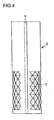
- Fig. 4 is a back view of a cylinder made of core 3 provided with the PCCP structure 2 in approximately half of the structure starting from the bottom.
- overlapping portions 4 are made smooth, without the PCCP structure 2.
- This PCCP structure 2 provided only in approximately half of the structure at the bottom is intended to increase the rigidity in the corresponding portion of the caddie bag, since pockets will be attached to the portion, and thus, especially serious deformation and breaks are expected there.
- Fig. 5 shows an example of core 3 having PCCP structure 2 with isosceles triangles of different shapes in different portions according to structural requirements.
- core 3 has triangles with greater heights in approximately one-third of the core at the top, so as to increase compressive strength lengthwise. Below this one-third portion down to a smooth portion 7, it has a normal PCCP structure, and below the smooth portion 7 to the bottom, the triangles are made to have longer bases to obtain greater resistance to compression from the side surface.
- rigidity of caddie bag core 3 can be designed more meticulously, section by section.
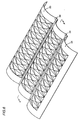
- Fig. 6 shows a developed view of three arc portions with the PCCP structure connected to one another by a hinge portion.
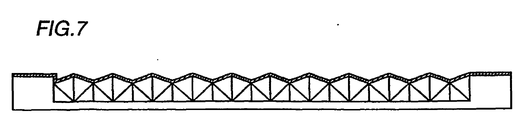
- Fig. 7 is a cross sectional view taken along the line A-A in Fig. 6.
- caddie bag core 3 is divided into three portions, i.e., arc portions 31, 32 and 33, which are connected to one another by a hinge portion 34.
- the PCCP structure has an inherent problem that, when a core having the PCCP structure is formed into a cylindrical form, the lengthwise dimension of the cylindrical form varies as its radius of curvature changes. Accordingly, this embodiment includes hinge portion 34 and enables only this hinge portion 34 to bend, while portions 31, 32 and 33 with the PCCP structure are curved in advance. In this manner, the radius of curvature of arc portions 31, 32 and 33 are prevented from changing, so that distortion between the arc portions and the smooth, hinge portion 34 is eliminated. This solves the problem with lengthwise varying dimension.
- hinge portion 34 can further increase rigidity of the caddie bag lengthwise, since hinge portion 34 serves as a rib. Though an example with three arc portions 31-33 has been described, it should be understood that the core may be divided into any number of sections, e.g., from 2 to 5.
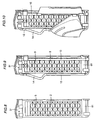
- Fig. 8 is a side view of a caddie bag with a collar attached to the caddie bag core.
- Fig. 9 is a side view of the caddie bag shown in Fig. 8 with a pipe frame connected thereto.
- Fig. 10 is a side view of the caddie bag of Fig. 9 with pockets attached thereto.
- a collar 51 and a bottom 61 are attached to core 3 with the PCCP structure 2, at the top and the bottom, respectively.
- This structure can readily be used as caddie bag 1, since such PCCP structure 2 guarantees large resistance to compression from the side surfaces.
- a pipe frame 12 is connected to caddie bag 1, to protect caddie bag 1 from compression lengthwise. If pipe frame 12 is detachable from the body of caddie bag 1 at a connecting portion employing a hook, zipper, release buckle, or adjustment buckle, it becomes possible to detach pipe frame 12 and to load a cart only with the body of caddie bag 1 when playing on a course.
- a portion of pipe frame 12 may be bent to provide a handle 14.
- this handle 14 made of the highly rigid pipe frame it is possible to carry caddie bag 1 more stably.
- auxiliary frame 13 may be provided. This can further protect caddie bag 1 from compression in both horizontal and vertical directions.
- iron, aluminum, FRP, acrylonitrile butadiene styrene (ABS), polyvinyl chloride, polycarbonate, and polyamide may be used as a material of pipe frame 12, aluminum is preferable for its strength, gravity, workability, and thermostability.
- Pipe frame 12 is made of a plurality of parts, which are assembled by welding, riveting, or using joint parts.
- pockets for storing golf accessories may be attached to pipe frame 12 or auxiliary frame 13, or, although not shown, mounted on the body of the caddie bag.
- polypropylene polyethylene, ABS, polyvinyl chloride, polycarbonate, polyamide, and polyethylene tereftarate may be used.
- polypropylene is most preferable due to its price, fabricating process, gravity, modulus of elasticity, and thermostability.
- vacuum molding As a method of providing the synthetic resin sheet with the PCCP structure, vacuum molding, molding under compressed air, and blow molding are available. Vacuum molding is preferable when taking into consideration ease in transportation and storage after molding, investment for a mold, applicability to different sizes of caddie bags, use of expanded synthetic resin sheet, and moldability in multi-layers by overlaying layers of different materials on inner and outer surfaces of the core. For molding in multi-layers by overlaying layers of different materials on only one side of the core, injection press molding is suitable because of its simplicity of the overlaying process.
- Blow molding is suitable for assuring a uniform cylindrical form without a seam, ease in adjustment of the thickness of the core, and reduction in number of the process steps after formation of the PCCP structure.
- a core structure for a caddie bag with the PCCP structure exhibits higher rigidity towards the central axis of the cylinder compared with a core structure having a smooth surface of the same thickness. Therefore, employing the PCCP structure, it is possible to design a caddie bag with improved rigidity towards the central axis of the cylinder while minimizing the increase in the weight. It is also possible to have a lightweight core structure, and hence, a lightweight caddie bag. Cost reduction can be achieved because there is no need to use an expensive high-strength material or a reinforcement.
Landscapes
- Health & Medical Sciences (AREA)
- General Health & Medical Sciences (AREA)
- Physical Education & Sports Medicine (AREA)
- Purses, Travelling Bags, Baskets, Or Suitcases (AREA)
- Laminated Bodies (AREA)
Applications Claiming Priority (3)
| Application Number | Priority Date | Filing Date | Title |
|---|---|---|---|
| JP3664898 | 1998-02-02 | ||
| JP10036648A JPH11216210A (ja) | 1998-02-02 | 1998-02-02 | キャディバッグ用の芯材 |
| PCT/JP1999/000329 WO1999038577A1 (fr) | 1998-02-02 | 1999-01-27 | Materiau pour partie centrale d'un sac de golf et sac de golf constitue de ce materiau |
Publications (2)
| Publication Number | Publication Date |
|---|---|
| EP0979666A1 true EP0979666A1 (fr) | 2000-02-16 |
| EP0979666A4 EP0979666A4 (fr) | 2004-08-04 |
Family
ID=12475683
Family Applications (1)
| Application Number | Title | Priority Date | Filing Date |
|---|---|---|---|
| EP99901189A Withdrawn EP0979666A4 (fr) | 1998-02-02 | 1999-01-27 | Materiau pour partie centrale d'un sac de golf et sac de golf constitue de ce materiau |
Country Status (5)
| Country | Link |
|---|---|
| US (1) | US6431355B1 (fr) |
| EP (1) | EP0979666A4 (fr) |
| JP (2) | JPH11216210A (fr) |
| CA (1) | CA2283171C (fr) |
| WO (1) | WO1999038577A1 (fr) |
Cited By (1)
| Publication number | Priority date | Publication date | Assignee | Title |
|---|---|---|---|---|
| DE102009048962A1 (de) | 2009-10-10 | 2011-04-14 | Hans Kilian Fremmer | Schwamm mit sechseckig beulender Struktur |
Families Citing this family (21)
| Publication number | Priority date | Publication date | Assignee | Title |
|---|---|---|---|---|
| DK2184346T3 (en) | 2001-09-06 | 2017-06-26 | Rapid Micro Biosystems Inc | Rapid detection of replicating cells |
| US8616369B2 (en) * | 2003-11-04 | 2013-12-31 | Nike, Inc. | Golf bag base |
| US20070074982A1 (en) * | 2005-10-04 | 2007-04-05 | Yi-Ming Wu | Golf bag structure |
| JP2008104815A (ja) * | 2006-10-27 | 2008-05-08 | Mizuno Corp | ゴルフバッグおよびその製造方法 |
| US20090178950A1 (en) * | 2008-01-14 | 2009-07-16 | Quartarone Frank A | Golf Club Fitting Bags And Methods Of Manufacture |
| JP4853557B2 (ja) | 2009-08-21 | 2012-01-11 | トヨタ自動車株式会社 | 放射音低減構造 |
| USD626852S1 (en) * | 2010-02-10 | 2010-11-09 | The Procter & Gamble Company | Cosmetic package |
| USD641166S1 (en) * | 2010-08-09 | 2011-07-12 | Travel Caddy, Inc. | Handle assembly for a gun case |
| JP2015193231A (ja) * | 2014-03-17 | 2015-11-05 | 三菱鉛筆株式会社 | 筆記具 |
| WO2016128549A1 (fr) * | 2015-02-13 | 2016-08-18 | INSERM (Institut National de la Santé et de la Recherche Médicale) | Polypeptides pour la modification génétique de protéines chimériques d'intégrase et leur utilisation en thérapie génique |
| USD804252S1 (en) * | 2016-06-06 | 2017-12-05 | Pacific Market International, Llc | Beverage container |
| USD815910S1 (en) * | 2016-06-23 | 2018-04-24 | Anhui Inno-Sign International Co., LTD | Tumbler |
| USD801692S1 (en) * | 2016-09-01 | 2017-11-07 | Acushnet Company | Golf bag hip pad |
| USD840750S1 (en) | 2017-11-07 | 2019-02-19 | Pacific Market International, Llc | Beverage container lid |
| USD841394S1 (en) | 2017-11-07 | 2019-02-26 | Pacific Market International, Llc | Beverage container lid |
| AU201812520S (en) * | 2018-04-30 | 2018-05-21 | Decor Corp Pty Ltd | Container infuser |
| USD875402S1 (en) * | 2018-10-15 | 2020-02-18 | Acushnet Company | Golf bag hip pad |
| USD896523S1 (en) * | 2019-04-24 | 2020-09-22 | Acushnet Company | Golf bag hip pad |
| USD881648S1 (en) * | 2019-11-18 | 2020-04-21 | Maple Leaf Technology (Shenzhen) Co., Ltd. | Cup |
| USD1088527S1 (en) * | 2022-07-01 | 2025-08-19 | Acushnet Company | Golf bag |
| USD1088526S1 (en) * | 2022-07-01 | 2025-08-19 | Acushnet Company | Golf bag |
Family Cites Families (8)
| Publication number | Priority date | Publication date | Assignee | Title |
|---|---|---|---|---|
| CA980734A (en) * | 1974-01-17 | 1975-12-30 | William K. Nevard | Golf club carrier |
| JPS5248540A (en) | 1975-10-16 | 1977-04-18 | Kobe Steel Ltd | Arc welding process |
| JPS54100127A (en) | 1978-01-24 | 1979-08-07 | Kouriyou Miura | Submarine shell structure |
| JPS6069157U (ja) * | 1983-10-18 | 1985-05-16 | 住友ゴム工業株式会社 | キヤデイバツグの内胴体 |
| JPH0678744B2 (ja) | 1985-06-28 | 1994-10-05 | 新電元工業株式会社 | 内燃機関の安全始動装置 |
| US5314063A (en) | 1992-12-29 | 1994-05-24 | Professional Bags, Inc. | Golf bag having external frame |
| US5711244A (en) | 1995-10-06 | 1998-01-27 | Knapp; Ronald H. | Polyhedrally stiffened cylindrical (PC) pressure hull |
| US5860519A (en) * | 1996-03-27 | 1999-01-19 | Stone Legacy Corporation | Sports equipment carrier having high strength to weight ratio rigid outer section |
-
1998
- 1998-02-02 JP JP10036648A patent/JPH11216210A/ja active Pending
-
1999
- 1999-01-27 US US09/380,769 patent/US6431355B1/en not_active Expired - Fee Related
- 1999-01-27 WO PCT/JP1999/000329 patent/WO1999038577A1/fr not_active Ceased
- 1999-01-27 JP JP52374699A patent/JP3267305B2/ja not_active Expired - Fee Related
- 1999-01-27 EP EP99901189A patent/EP0979666A4/fr not_active Withdrawn
- 1999-01-27 CA CA002283171A patent/CA2283171C/fr not_active Expired - Fee Related
Cited By (1)
| Publication number | Priority date | Publication date | Assignee | Title |
|---|---|---|---|---|
| DE102009048962A1 (de) | 2009-10-10 | 2011-04-14 | Hans Kilian Fremmer | Schwamm mit sechseckig beulender Struktur |
Also Published As
| Publication number | Publication date |
|---|---|
| US6431355B1 (en) | 2002-08-13 |
| EP0979666A4 (fr) | 2004-08-04 |
| JP3267305B2 (ja) | 2002-03-18 |
| CA2283171C (fr) | 2001-12-04 |
| JPH11216210A (ja) | 1999-08-10 |
| WO1999038577A1 (fr) | 1999-08-05 |
| CA2283171A1 (fr) | 1999-08-05 |
| US20020038771A1 (en) | 2002-04-04 |
Similar Documents
| Publication | Publication Date | Title |
|---|---|---|
| EP0979666A1 (fr) | Materiau pour partie centrale d'un sac de golf et sac de golf constitue de ce materiau | |
| JPWO1999038577A1 (ja) | キャディバッグ用の芯材およびその芯材を使用したキャディバッグ | |
| KR100242909B1 (ko) | 대칭 구조의 전장 격벽을 구비한 골프 백 | |
| US5501328A (en) | Cover for golf bag throat structure | |
| US8266744B2 (en) | Inflatable pad having reinforcing belts | |
| US4037841A (en) | Lacrosse stick having tubular metallic handle | |
| TWI429470B (zh) | 具有降低球棒恢復係數之一體成型擊球柄特徵的球棒 | |
| JP4949465B2 (ja) | 流体の充満したブラダーを組み込んだストラップ | |
| JP2013508088A (ja) | 軟質面型手荷物ケースのための一体型持運び取っ手付き手荷物ケース・パネル | |
| JP2008515608A (ja) | クラウン部を有するゴルフクラブヘッド | |
| AU2022462839A1 (en) | Rolling collapsible travel luggage | |
| US20030146120A1 (en) | Golf bag with compressive pockets | |
| US7357251B2 (en) | Top cuff with dividers for golf bags | |
| US6629601B1 (en) | Multi-function travel golf bag | |
| JP2005152392A (ja) | キャデイバッグ | |
| WO1995019817A1 (fr) | Sac de golf presentant en coupe transversale plusieurs cercles formant des intersections entre eux | |
| US6047822A (en) | Partitioned golf bag and method of fabricating same | |
| JPH11137752A (ja) | 野球用又はソフトボール用バット | |
| JP2001299978A (ja) | 飛球止めネット装置 | |
| TWI344381B (en) | Composite bat having a multiple tube structure | |
| JPH07255331A (ja) | 釣 竿 | |
| US5813527A (en) | Air bladder golf bag | |
| JP2001198250A (ja) | キャディバッグ用のパイプフレーム | |
| JP2025518934A (ja) | 回動式折り畳み可能旅行荷物入れ | |
| JPH1119258A (ja) | キャディバッグ用の芯材 |
Legal Events
| Date | Code | Title | Description |
|---|---|---|---|
| PUAI | Public reference made under article 153(3) epc to a published international application that has entered the european phase |
Free format text: ORIGINAL CODE: 0009012 |
|
| 17P | Request for examination filed |
Effective date: 19990913 |
|
| AK | Designated contracting states |
Kind code of ref document: A1 Designated state(s): DE FR GB |
|
| A4 | Supplementary search report drawn up and despatched |
Effective date: 20040623 |
|
| RIC1 | Information provided on ipc code assigned before grant |
Ipc: 7A 45C 5/02 B Ipc: 7A 63B 55/00 A |
|
| STAA | Information on the status of an ep patent application or granted ep patent |
Free format text: STATUS: THE APPLICATION IS DEEMED TO BE WITHDRAWN |
|
| 18D | Application deemed to be withdrawn |
Effective date: 20040803 |