EP0980187A1 - Procédé d'interpolation pour obtenir une image digitale en couleur - Google Patents
Procédé d'interpolation pour obtenir une image digitale en couleur Download PDFInfo
- Publication number
- EP0980187A1 EP0980187A1 EP98830493A EP98830493A EP0980187A1 EP 0980187 A1 EP0980187 A1 EP 0980187A1 EP 98830493 A EP98830493 A EP 98830493A EP 98830493 A EP98830493 A EP 98830493A EP 0980187 A1 EP0980187 A1 EP 0980187A1
- Authority
- EP
- European Patent Office
- Prior art keywords
- pix
- incomplete
- colour component
- missing
- colour
- Prior art date
- Legal status (The legal status is an assumption and is not a legal conclusion. Google has not performed a legal analysis and makes no representation as to the accuracy of the status listed.)
- Withdrawn
Links
Images

Classifications
-
- H—ELECTRICITY
- H04—ELECTRIC COMMUNICATION TECHNIQUE
- H04N—PICTORIAL COMMUNICATION, e.g. TELEVISION
- H04N23/00—Cameras or camera modules comprising electronic image sensors; Control thereof
- H04N23/80—Camera processing pipelines; Components thereof
- H04N23/84—Camera processing pipelines; Components thereof for processing colour signals
- H04N23/843—Demosaicing, e.g. interpolating colour pixel values
-
- H—ELECTRICITY
- H04—ELECTRIC COMMUNICATION TECHNIQUE
- H04N—PICTORIAL COMMUNICATION, e.g. TELEVISION
- H04N25/00—Circuitry of solid-state image sensors [SSIS]; Control thereof
- H04N25/10—Circuitry of solid-state image sensors [SSIS]; Control thereof for transforming different wavelengths into image signals
- H04N25/11—Arrangement of colour filter arrays [CFA]; Filter mosaics
- H04N25/13—Arrangement of colour filter arrays [CFA]; Filter mosaics characterised by the spectral characteristics of the filter elements
- H04N25/134—Arrangement of colour filter arrays [CFA]; Filter mosaics characterised by the spectral characteristics of the filter elements based on three different wavelength filter elements
-
- H—ELECTRICITY
- H04—ELECTRIC COMMUNICATION TECHNIQUE
- H04N—PICTORIAL COMMUNICATION, e.g. TELEVISION
- H04N2209/00—Details of colour television systems
- H04N2209/04—Picture signal generators
- H04N2209/041—Picture signal generators using solid-state devices
- H04N2209/042—Picture signal generators using solid-state devices having a single pick-up sensor
- H04N2209/045—Picture signal generators using solid-state devices having a single pick-up sensor using mosaic colour filter
- H04N2209/046—Colour interpolation to calculate the missing colour values
Definitions
- the present invention relates to an interpolation method for obtaining a digital image and, in particular, to an interpolation method according to the preamble to the first claim.
- a digital image is constituted by a matrix of elements each representative of an elemental area of the image (a pixel); each element of the matrix includes one or more colour components (typically red, green and blue, or RGB) associated with the pixel.
- colour components typically red, green and blue, or RGB
- a known interpolation method consists in calculating each missing colour component by means of an arithmetic mean of the corresponding colour components of the adjacent elements; the colour component already present in the incomplete element is generally also averaged with the corresponding colour components of the adjacent elements.
- the method described in this document is extremely complex.
- this method when this method is implemented by means of a physical device (hardware) produced in integrated form in a chip of semiconductor material, it takes up a considerable area on the chip and involves a high power consumption at the execution stage; these disadvantages are noticed particularly in applications in portable apparatus in which it is extremely important to keep the dimensions of the apparatus and its power consumption low (since the apparatus is supplied by means of batteries).
- the complexity of the method slows down the interpolation operation excessively; this drawback may be intolerable in many applications such as, for example, in the case of video sequences, in which it is necessary to perform the interpolation operation on-line.
- the object of the present invention is to overcome the aforementioned drawbacks.
- an interpolation method for obtaining a digital image as described in the first claim is proposed.
- the present invention also proposes a corresponding interpolation device and a digital camera comprising the device.
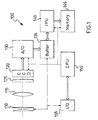
- the digital camera 100 includes an image-acquisition unit comprising a diaphragm 110 and a set of lenses 115 for transmitting the light corresponding to the image of the real scene onto a light sensor 120.
- the light sensor 120 is typically constituted by a charge-coupled device (or CCD); a CCD is an integrated circuit which contains a matrix of light-sensitive cells, each of which generates an electrical signal (for example, a voltage) the intensity of which is proportional to the exposure of the light-sensitive cell.
- the light sensor 120 does not detect all of the RGB colour components in every pixel. Typically, only one light-sensitive cell of the light sensor 120 is provided for each pixel.
- the light sensor 120 is covered by a colour filter 125 constituted by a matrix of filter elements each of which covers a corresponding light-sensitive cell of the light sensor 120; each filter element transmits (absorbing a minimal portion) the luminous radiation belonging solely to the wavelength of red, blue or green light (substantially absorbing the others), so as to obtain an individual value indicative of the R, G or B colour component for each pixel.
- the filter 125 is of the Bayer type as described in US-A-3,971,065, in which, in half of the pixels, in a chessboard-like arrangement, only the G colour components are detected; in the other half of the pixels, the R or B colour components are detected in respective alternate rows, as shown in the following table:
- the diaphragm 110 is always open and the light is focused by the lenses 115 through the filter 125, onto the light sensor 120 which acquires the image continuously.
- the electrical signal generated by each light-sensitive cell is supplied to an analog/digital converter (A/D) 130 which produces a corresponding digital value.
- A/D analog/digital converter
- the incomplete digital image constituted by these values, in which each element comprises a single colour component, is stored in a buffer memory 135.
- the camera 100 also includes an image-processing unit (IPU) 140, preferably produced in integrated form in a chip of semiconductor material.
- the image-processing unit 140 reads the incomplete digital image from the buffer memory 135 and derives the missing colour components for each element by interpolation (as described in detail below) using the buffer memory 135 as a working memory for the intermediate results of the interpolation process.
- the digital image thus obtained is generally subjected to processing to improve image quality; for example, the digital image is processed to correct exposure problems such as back-lighting or excessive front illumination, to correct the shift of the light towards the red colour (reddish) or towards the blue colour (bluish), in dependence on the colour temperature of the light source, to correct a selected colour tone, etc.
- the image processing unit 140 can also enlarge digital images; the enlarged digital image includes all of the elements of the original digital image and the other elements (in which all the colour components are missing) are derived by an interpolation process similar to that used to derive the colour components not detected by the light sensor.
- the digital image is then compressed (for example, reducing the quantity of associated data a few tens times) and supplied to a memory 145.
- the memory 145 is typically constituted by a dynamic memory with a capacity of a few Mbytes which can store several tens of compressed digital images; alternatively, the memory is a flash E2PROM which preserves the data even in the absence of a supply, or additional external memory cards with a capacity of a few hundred Mbytes are used.
- a central processing unit (or CPU) 150 controls the several functions of the various components of the digital camera by means of suitable signals.
- the CPU 150 is connected to an input/output (I/O) device 155, constituted, for example, by a series of push-buttons (for enabling the user to select various functions of the camera) and by a liquid-crystal display (for supplying data on the operative state of the camera).
- I/O input/output
- the present invention may, however, also be used in a digital camera of a different type, for example, with a CMOS light sensor, with another colour filter (not a Bayer filter), with a simplified image-processing unit, etc; alternatively, the interpolation method of the present invention is used in a digital video camera, in a portable scanner, in a processing system (a computer) in which graphic applications are provided, etc.
- an interpolation method 200 used in the digital camera described above starts in box 205 and then goes on to box 210 in which the incomplete digital image (detected by the light sensor through the Bayer filter) is supplied to the image processing unit; similar considerations apply if the incomplete digital image has a different structure, is obtained in the course of an enlargement operation, etc.; in general, an incomplete digital image having at least one incomplete element in which at least one colour component is missing is used, each missing colour component in each incomplete element being present in opposed elements disposed on opposite sides of the incomplete element along at least one direction.
- the interpolation process does not require the availability of the entire incomplete digital image; to obtain the missing colour components of each incomplete element, only the colour components of the adjacent elements are in fact required (as described below) so that the interpolation process can start as soon as a block of the incomplete digital image comprising this data is available.
- Each element Pix i,j is incomplete and includes only the R colour component, Pix i,j (R), only the G colour component Pix i,j (G), or only the B colour component, Pix i,j (B).
- a secondary cycle which is repeated 3 times (once for each colour component R, G and B) is started in box 220, in which a certain colour component is considered; in particular, the R colour component is considered in a first execution of the secondary cycle, the G colour component is considered in a second execution of the cycle, and the B colour component is considered in a third execution.
- the method then checks, in box 225, if the colour component considered is missing in the incomplete element Pix i,j . If so, the method goes on to box 230, in which an interpolation direction is determined for the missing colour component.
- the missing colour component is in fact present in elements disposed on opposite sides of the incomplete element Pix i,j along one or more axes.
- this direction is set as the interpolation direction.
- the gradient along the horizontal direction is equal to
- the gradient along the vertical direction is equal to
- the gradient along the positive diagonal direction is equal to
- the gradient along the negative diagonal direction is equal to
- the interpolation direction is then set as the direction in which this gradient is least, that is, in which a variation of the colour components corresponding to the missing colour component is least. It should be noted that, in the extremely rare event of the gradients having the same value, the interpolation direction selected is a predetermined (default) direction, for example, in order, the horizontal direction, the vertical direction, the positive diagonal direction, and the negative diagonal direction.
- the method then goes on to box 235 in which the missing colour component is set at a value equal to a mean of the corresponding colour components of the elements opposed along the interpolation direction.
- the mean is preferably an arithmetic mean (so as to ensure good quality of the interpolation process whilst using extremely simple operations), although the use of a geometric mean or of a mean of another type is not excluded.
- or, otherwise, so as to be equal to Pix i,j (G) Pix i-1,j (G) + Pix i+1,j (G) 2
- or, Pix i,j (G) Pix i-1,j (G) + Pix i+1,j (G) 2 otherwise, so as to be
- or, otherwise, so as to be equal to Pix i,j (R) Pix i-1,j-1 (R) + Pix i+1,j+1 (R) 2 .
- the method then goes on to box 240 and checks if all of the colour components (R, G and B) have been considered. If not, the method returns to box 220, whereas if all of the components have been considered, the secondary cycle defined by boxes 220-235 is terminated. With further reference to box 225, if the colour component considered is present in the incomplete element Pix i,j , the method goes directly to box 240 so that this colour component remains unchanged.
- the interpolation method is structured in a different manner; for example, if an enlarged digital image (in which only a portion of the elements are incomplete) is considered, all of the missing colour components R, G and B are obtained for each of the incomplete elements.
- the method of the present invention provides steps for determining, for each missing colour component of each incomplete element, an interpolation direction in which a variation of the corresponding colour components of the opposed elements is least and sets the missing colour component at a value equal to a mean of the corresponding colour components of the opposed elements along the interpolation direction.
- the interpolation method according to the present invention is extremely simple whilst producing a good-quality image.
- the device which implements the method occupies a small area on a chip of semiconductor material and involves a low power consumption at the execution stage; this makes the use of this method particularly advantageous in applications in which the corresponding device is included (embedded) in apparatus of various types, particularly portable apparatus.
- the method is very quick and can thus be used to perform the interpolation operation on-line, for example for video sequences.
- the method of the present invention involves an extremely small computational load since it requires only a few elementary operations and can thus even be implemented by a program (software).
Landscapes
- Engineering & Computer Science (AREA)
- Multimedia (AREA)
- Signal Processing (AREA)
- Physics & Mathematics (AREA)
- Spectroscopy & Molecular Physics (AREA)
- Color Television Image Signal Generators (AREA)
Priority Applications (1)
| Application Number | Priority Date | Filing Date | Title |
|---|---|---|---|
| EP98830493A EP0980187A1 (fr) | 1998-08-10 | 1998-08-10 | Procédé d'interpolation pour obtenir une image digitale en couleur |
Applications Claiming Priority (1)
| Application Number | Priority Date | Filing Date | Title |
|---|---|---|---|
| EP98830493A EP0980187A1 (fr) | 1998-08-10 | 1998-08-10 | Procédé d'interpolation pour obtenir une image digitale en couleur |
Publications (1)
| Publication Number | Publication Date |
|---|---|
| EP0980187A1 true EP0980187A1 (fr) | 2000-02-16 |
Family
ID=8236753
Family Applications (1)
| Application Number | Title | Priority Date | Filing Date |
|---|---|---|---|
| EP98830493A Withdrawn EP0980187A1 (fr) | 1998-08-10 | 1998-08-10 | Procédé d'interpolation pour obtenir une image digitale en couleur |
Country Status (1)
| Country | Link |
|---|---|
| EP (1) | EP0980187A1 (fr) |
Citations (3)
| Publication number | Priority date | Publication date | Assignee | Title |
|---|---|---|---|---|
| US5382976A (en) * | 1993-06-30 | 1995-01-17 | Eastman Kodak Company | Apparatus and method for adaptively interpolating a full color image utilizing luminance gradients |
| US5552825A (en) * | 1994-11-08 | 1996-09-03 | Texas Instruments Incorporated | Color resolution enhancement by using color camera and methods |
| EP0732859A2 (fr) * | 1995-03-17 | 1996-09-18 | Eastman Kodak Company | Interpolation adaptive de plan de couleur dans une caméra électronique en couleurs avec un senseur unique |
-
1998
- 1998-08-10 EP EP98830493A patent/EP0980187A1/fr not_active Withdrawn
Patent Citations (3)
| Publication number | Priority date | Publication date | Assignee | Title |
|---|---|---|---|---|
| US5382976A (en) * | 1993-06-30 | 1995-01-17 | Eastman Kodak Company | Apparatus and method for adaptively interpolating a full color image utilizing luminance gradients |
| US5552825A (en) * | 1994-11-08 | 1996-09-03 | Texas Instruments Incorporated | Color resolution enhancement by using color camera and methods |
| EP0732859A2 (fr) * | 1995-03-17 | 1996-09-18 | Eastman Kodak Company | Interpolation adaptive de plan de couleur dans une caméra électronique en couleurs avec un senseur unique |
Similar Documents
| Publication | Publication Date | Title |
|---|---|---|
| KR101446419B1 (ko) | 투명 필터 픽셀을 구비한 이미징 시스템 | |
| US8520097B2 (en) | Image processing device, electronic camera, and image processing program | |
| US8953056B2 (en) | Method, apparatus and system for dynamic range estimation of imaged scenes | |
| US7598990B2 (en) | Image signal processing system and electronic imaging device | |
| US20130242132A1 (en) | Digital camera and storage medium for image signal processing for white balance control | |
| US6487309B1 (en) | Interpolation processing apparatus and recording medium having interpolation processing program recorded therein | |
| US20120127336A1 (en) | Imaging apparatus, imaging method and computer program | |
| CN209345244U (zh) | 成像系统和相机模块 | |
| US6990240B2 (en) | Image processing apparatus | |
| JP2010272996A (ja) | 画像処理装置、及び画像処理プログラム | |
| EP0877524B1 (fr) | Appareil de photographie numérique avec un appareil de traitement d'images | |
| JP3809818B2 (ja) | 画像処理方法、記録媒体および画像処理装置 | |
| EP1308888A1 (fr) | Procédé de traitement d'images numériques | |
| JPWO2002005543A1 (ja) | 画像処理方法、記録媒体および画像処理装置 | |
| JP7630306B2 (ja) | 画像処理装置、撮像装置、制御方法及びプログラム | |
| US7256827B1 (en) | Image reading device with thinned pixel data | |
| JP2005167476A (ja) | ホワイトバランス制御装置 | |
| EP0980187A1 (fr) | Procédé d'interpolation pour obtenir une image digitale en couleur | |
| US7551204B2 (en) | Imaging apparatus having a color image data measuring function | |
| JP2000315784A (ja) | カラー撮像素子及び撮像装置 | |
| US7411619B2 (en) | Signal processing method, a signal processor circuit, and imaging apparatus | |
| JP2009267555A (ja) | 撮像装置、撮像方法 | |
| JP2004328534A (ja) | 画像形成方法、画像処理装置及び画像記録装置 | |
| JP4306687B2 (ja) | 画像処理方法、画像処理プログラムおよび画像処理装置 | |
| US7512266B2 (en) | Method and device for luminance correction |
Legal Events
| Date | Code | Title | Description |
|---|---|---|---|
| PUAI | Public reference made under article 153(3) epc to a published international application that has entered the european phase |
Free format text: ORIGINAL CODE: 0009012 |
|
| AK | Designated contracting states |
Kind code of ref document: A1 Designated state(s): DE FR GB IT |
|
| AX | Request for extension of the european patent |
Free format text: AL;LT;LV;MK;RO;SI |
|
| 17P | Request for examination filed |
Effective date: 20000808 |
|
| AKX | Designation fees paid |
Free format text: DE FR GB IT |
|
| 17Q | First examination report despatched |
Effective date: 20061221 |
|
| STAA | Information on the status of an ep patent application or granted ep patent |
Free format text: STATUS: THE APPLICATION IS DEEMED TO BE WITHDRAWN |
|
| 18D | Application deemed to be withdrawn |
Effective date: 20090303 |