EP0980192A1 - Verfahren zur Datenübertragung über einem Satellitenetz unter Verwendung von Strahlerkennungen zur Datenweglenkung - Google Patents
Verfahren zur Datenübertragung über einem Satellitenetz unter Verwendung von Strahlerkennungen zur Datenweglenkung Download PDFInfo
- Publication number
- EP0980192A1 EP0980192A1 EP99113663A EP99113663A EP0980192A1 EP 0980192 A1 EP0980192 A1 EP 0980192A1 EP 99113663 A EP99113663 A EP 99113663A EP 99113663 A EP99113663 A EP 99113663A EP 0980192 A1 EP0980192 A1 EP 0980192A1
- Authority
- EP
- European Patent Office
- Prior art keywords
- cell
- destination
- cells
- data packet
- terminal
- Prior art date
- Legal status (The legal status is an assumption and is not a legal conclusion. Google has not performed a legal analysis and makes no representation as to the accuracy of the status listed.)
- Withdrawn
Links
- 238000000034 method Methods 0.000 title claims abstract description 53
- 238000004891 communication Methods 0.000 claims abstract description 39
- 238000013507 mapping Methods 0.000 claims abstract description 5
- 238000012546 transfer Methods 0.000 claims description 18
- 230000006727 cell loss Effects 0.000 claims description 6
- 238000012937 correction Methods 0.000 claims description 6
- 210000004027 cell Anatomy 0.000 description 123
- 230000006978 adaptation Effects 0.000 description 18
- 230000005540 biological transmission Effects 0.000 description 4
- 210000005056 cell body Anatomy 0.000 description 4
- 230000011664 signaling Effects 0.000 description 3
- 230000011218 segmentation Effects 0.000 description 2
- 210000001057 smooth muscle myoblast Anatomy 0.000 description 2
- 230000002950 deficient Effects 0.000 description 1
- 230000001934 delay Effects 0.000 description 1
- 238000010586 diagram Methods 0.000 description 1
- 230000009977 dual effect Effects 0.000 description 1
- 238000001914 filtration Methods 0.000 description 1
- 230000007246 mechanism Effects 0.000 description 1
- 230000000717 retained effect Effects 0.000 description 1
Images

Classifications
-
- H—ELECTRICITY
- H04—ELECTRIC COMMUNICATION TECHNIQUE
- H04Q—SELECTING
- H04Q11/00—Selecting arrangements for multiplex systems
- H04Q11/04—Selecting arrangements for multiplex systems for time-division multiplexing
- H04Q11/0428—Integrated services digital network, i.e. systems for transmission of different types of digitised signals, e.g. speech, data, telecentral, television signals
- H04Q11/0478—Provisions for broadband connections
-
- H—ELECTRICITY
- H04—ELECTRIC COMMUNICATION TECHNIQUE
- H04B—TRANSMISSION
- H04B7/00—Radio transmission systems, i.e. using radiation field
- H04B7/14—Relay systems
- H04B7/15—Active relay systems
- H04B7/185—Space-based or airborne stations; Stations for satellite systems
- H04B7/18578—Satellite systems for providing broadband data service to individual earth stations
- H04B7/18584—Arrangements for data networking, i.e. for data packet routing, for congestion control
-
- H—ELECTRICITY
- H04—ELECTRIC COMMUNICATION TECHNIQUE
- H04L—TRANSMISSION OF DIGITAL INFORMATION, e.g. TELEGRAPHIC COMMUNICATION
- H04L12/00—Data switching networks
- H04L12/54—Store-and-forward switching systems
- H04L12/56—Packet switching systems
- H04L12/5601—Transfer mode dependent, e.g. ATM
- H04L2012/5603—Access techniques
- H04L2012/5604—Medium of transmission, e.g. fibre, cable, radio
- H04L2012/5608—Satellite
-
- H—ELECTRICITY
- H04—ELECTRIC COMMUNICATION TECHNIQUE
- H04L—TRANSMISSION OF DIGITAL INFORMATION, e.g. TELEGRAPHIC COMMUNICATION
- H04L12/00—Data switching networks
- H04L12/54—Store-and-forward switching systems
- H04L12/56—Packet switching systems
- H04L12/5601—Transfer mode dependent, e.g. ATM
- H04L2012/5638—Services, e.g. multimedia, GOS, QOS
- H04L2012/564—Connection-oriented
- H04L2012/5642—Multicast/broadcast/point-multipoint, e.g. VOD
-
- H—ELECTRICITY
- H04—ELECTRIC COMMUNICATION TECHNIQUE
- H04L—TRANSMISSION OF DIGITAL INFORMATION, e.g. TELEGRAPHIC COMMUNICATION
- H04L12/00—Data switching networks
- H04L12/54—Store-and-forward switching systems
- H04L12/56—Packet switching systems
- H04L12/5601—Transfer mode dependent, e.g. ATM
- H04L2012/5638—Services, e.g. multimedia, GOS, QOS
- H04L2012/5646—Cell characteristics, e.g. loss, delay, jitter, sequence integrity
- H04L2012/5652—Cell construction, e.g. including header, packetisation, depacketisation, assembly, reassembly
- H04L2012/5653—Cell construction, e.g. including header, packetisation, depacketisation, assembly, reassembly using the ATM adaptation layer [AAL]
- H04L2012/5658—Cell construction, e.g. including header, packetisation, depacketisation, assembly, reassembly using the ATM adaptation layer [AAL] using the AAL5
-
- H—ELECTRICITY
- H04—ELECTRIC COMMUNICATION TECHNIQUE
- H04L—TRANSMISSION OF DIGITAL INFORMATION, e.g. TELEGRAPHIC COMMUNICATION
- H04L12/00—Data switching networks
- H04L12/54—Store-and-forward switching systems
- H04L12/56—Packet switching systems
- H04L12/5601—Transfer mode dependent, e.g. ATM
- H04L2012/5638—Services, e.g. multimedia, GOS, QOS
- H04L2012/5665—Interaction of ATM with other protocols
- H04L2012/5667—IP over ATM
Definitions
- the present invention relates generally to data transfer systems, and more particularly to a method for sending data in a broadcast network.
- Connection-oriented networks are traditionally associated with telephony and other types of communications where an association between a sender and receiver exists for a relatively long period of time (i.e. on the order of minutes). Connection-oriented communications is used when resources need to be nailed down to guarantee that the data is received and processed by the proper destination terminal. Connection-oriented communications is typically used for data which is sensitive to delay and/or delay variation.
- connection-oriented network usually requires some signaling between the source and destination (and possibly a network manager) to negotiate the parameters of the connection before any useful data is exchanged. This is efficient when the delay required for signaling is small relative to the duration of the time spent to exchange information.
- ATM Asynchronous Transfer Mode
- the Asynchronous Transfer Mode (ATM) protocol is typically used for data message transfers in connection-oriented communications because it is a relatively fast, highly reliable switching protocol.
- connectionless networks such as the global Intemet
- connectionless networks are traditionally associated with computer networks and other types of communications where an association between a sender and receiver exists on a per-packet basis (i.e. on the order of milliseconds).
- Connectionless communication networks do not utilize advance signaling before sending data; therefore, there is no opportunity for the network to evaluate whether a given transmission can be guaranteed to reach its destination in a timely manner.
- Connectionless communications is typically used for lower priority data, such as Intemet Protocol (IP) data, where it is not imperative that data will arrive at and be processed by the proper destination terminal.
- IP Intemet Protocol
- the connectionless protocol used by the global Intemet is referred to as a "best effort" protocol.
- connection-oriented communications over a satellite with an on-board cell relay switch to establish a communications link between a source terminal and a destination terminal, the following steps need to be conducted:
- this set-up procedure requires a significant amount of time, it accomplishes many purposes the most significant of which is that a path from a satellite uplink to a satellite downlink is created through the satellite network for the routing of cells with the header CID.
- the source terminal will know that it can use the allocated channel for communication with the desired destination terminal; the desired destination terminal will listen only to the allocated channel and accept only the packets with the proper CID in the header; and, other destination terminals do not use their resources to accept packets not intended for their use freeing up resources for communications with other source terminals.
- the CID is an address identifying the connection between a specific source terminal and destination terminal. It is temporary and used for the single communication. After the communication between the source terminal and the destination terminal is complete, the connection is broken and the channel can be reused for another communication either between the same source and destination terminal or a new source and destination terminal. The CID can also be reused for another communication either between the same source and destination terminal or a new source and destination terminal.
- connectionless communications the message is sent from the source terminal to the destination terminal without first completing the set-up portion of the procedure.
- Sending a message in a connectionless communications networks takes much less set-up time than sending a message in a connection-oriented communications system since the set-up procedure with a NOC or network manager is not required.
- NOC or network manager is not required.
- Delays could be experienced if a connection-oriented system were used to send data in a connectionless manner including a delay in establishing a connection and a delay in receiving messages.
- decisions must constantly be made about whether or not to maintain an idle connection, thereby tying up satellite resources, or terminating the connection and experiencing a delay in re-establishing the connection later.
- U.S. Patent Nos. 5,432,777 and 5,517,497 disclose a method for sending data in a connectionless manner over a connection-oriented network which includes assigning a routing identifier (RI) to each terminal in the network and placing a destination terminal RI in the header of each cell of the message.
- RI routing identifier
- the source terminal consults a global lookup table which correlates each terminal in the system with an RI in a unique mapping.
- the source terminal places the destination terminal RI in the header of each cell.
- the cells are sent to a node in the system. Each node must read the destination terminal RI in the header of each cell and determine the proper routing sequence required for the cells to be transmitted to the proper destination terminal.
- this method requires resources in each satellite to read the destination terminal RI, look up the destination terminal RI in a lookup table and possibly assign a routing tag to the cell to route it through each satellite's cell switches.
- the cells are routed through each satellite to the desired destination terminal.
- the destination terminal only accepts cells having its individual destination terminal RI in the headers.
- the method disclosed in the '777 and '497 patents is not optimal for all communication networks.
- the method disclosed in the '777 and '497 patents does not take advantage of the broadcast capability of a satellite network having multiple downlink antennas where each downlink antenna typically covers many destination terminals. In such a network, a single address can reach many destination terminals such that a unique destination terminal RI in the header of each cell is not required for the cell to arrive at the desired destination terminal.
- the destination terminal After the data is routed to the proper destination terminal, the destination terminal typically must separate, or demultiplex, the cells since cells sent from different source terminals are multiplexed together before arriving at the destination terminal.
- the '777 and '497 patents discloses using a multiplexing identification (MID) field in the cell headers where the value of the MID field allows, at the destination side, to identify the cells which belong to the same connectionless message. This value has to be unique.
- the '777 and '497 patents prefer that the source RI value be used as the MID and either the last ten bits of the RI value are taken as the MID or, the header is extended to allow more bits to be used.
- ATM Adaptation Layer AAL
- AAL3/4 ATM Adaptation Layer 3/4
- AAL5 ATM Adaptation Layer 5
- CCITT "Draft Recommendation 1.363”.
- CCITT Study Group XVIII Geneva, 19- 29 January, 1993.
- the ATM Adaptation Layer 3/4 (AAL3/4) protocol has a MID field, but, the ATM Adaptation Layer 5 (AAL5) protocol does not.
- the method specified in the '777 and '497 patents does not support the newer ATM Adaptation Layer 5 (AAL5) protocol which is typically the adaptation layer protocol of choice for IP data transfers among those skilled in the art.
- AAL5 ATM Adaptation Layer 5
- the scheme defined in the '777 and '497 patents are deficient for various network environments.
- What is needed therefore is a method for sending data in a connectionless manner over a network which supports the ATM and established connections for data message transfers which takes advantage of the broadcast capabilities of a satellite system.
- the method should additionally support the use of higher order adaptation layer protocol, in particular, the adaptation layer 5 protocol.
- the present invention provides, in a first aspect, a method for transferring a data packet between a first source terminal and a first destination terminal, in a communications network having a plurality of source terminals, destination terminals, satellites and downlink antenna beams where one of the downlink antenna beam covers said first destination terminal.
- Each data packet includes a destination address identifying a user for which the data packet is meant with the first destination terminal having the capability to reach the user.
- the method includes assigning a unique downlink beam identifier to each downlink antenna beam in the communications network; mapping the destination address to a downlink beam identifier the corresponding antenna beam of which covers the first destination terminal.
- the data packet is segmented into one or more cells, each cell having a cell header.
- the downlink beam identifier is placed into each cell header and the cells are routed to the downlink antenna beam corresponding to the downlink beam identifier.
- the cells are broadcasted over the downlink antenna beam and received by the destination terminals located within the downlink antenna beam of which one of the destination terminals is the first destination terminal.
- a source terminal identifier is placed into each cell header to be used by the destination terminals to sort cells sent from different source terminals.
- the satellite network uses the Asynchronous Transfer Mode for data message transfers.
- the data packet in an Internet Protocol (IP) packet which includes a destination IP address.
- IP Internet Protocol
- the present invention overcomes the limitations of the prior art by providing a method for transferring a data packet such as IP protocol data, between a source terminal and a first destination terminal, over a network by using a downlink beam identifier to route the data, as contrasted with the use of a destination terminal identifier as described in the prior art.
- a downlink beam identifier to route the data
- the present invention takes advantage of the broadcast capability available in a satellite system.
- One embodiment of the invention provides a method for transferring data in a connectionless manner in a network which supports connection-oriented communications; and, a second embodiment of the invention provides a method for transferring data in a connectionless manner over a network which uses the ATM protocol for data message transfers and additionally supports connection-oriented communications.
- the preferred embodiment of the invention is additionally compatible with the ATM Adaptation Layer 5 (AAL5) protocol.
- ATM Adaptation Layer 5 AAL5
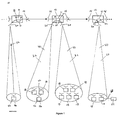
- FIG. 1 shows the configuration of a communications network 10 in which the present invention may be used.
- the network 10 includes several satellites 12 which are interlinked by the use of the crosslink antennas 14.
- a plurality of source 16 and destination 18 & 19 terminals are linked to the satellites 12 by way of the antennas 20. Any source terminal 16 can be a destination terminal 18 & 19 and vice versa.
- Each antenna 20 has a downlink antenna beam 22 which can cover a plurality of destination terminals 18 & 19.
- the antennas 20 can be multiple beam antennas where each antenna 20 provides a multiplicity of antenna beams 22.
- the antennas 20 can also be dual uplink/downlink antennas, dedicated uplink and downlink antennas or the like. In addition, uplink channels may be shared or dedicated to a single source terminal 16.
- Each satellite 12 can have one or more crosslink antennas 14 making a variety of satellite network configurations such as a star network or a ring network possible.
- the network 10 is a network 10 which uses the ATM protocol for data message transfers and additionally supports connection-oriented traffic.
- the data packet 24 is preferably an IP packet 24 which includes an IP message 26 and an IP header 28 where the IP header 28 includes the destination IP address 30.
- the first step of the process relates to placing the data packet 24 into a form which can be sent over the network 10.
- This includes segmenting and repackaging the data packet 24 into one or more cells 32 with each cell 32 being of a format which is compatible with the network 10.
- the network 10 uses the ATM protocol for data message transfers therefore, for this embodiment, ATM AAL protocols must be adhered to in the segmenting and repackaging of the data packet 24.
- ATM protocols can be found in CCITT, "Draft Recommendation I.363". CCITT Study Group XVIII, Geneva, 19 - 29 January, 1993.
- ATM protocols and in particular the ATM Adaptation Layer 5 (AAL5) protocol, requires the data packet 24 to be segmented and repackaged into one or cells 32 with each cell 32 having a length of 53 octets. Of these 53 octets, the ATM protocol specifies that the first 5 octets of each cell 32 be reserved for the cell header 34 and the remaining 48 octets be reserved for the cell body 36 with the information from the data packet 24 (including the destination address 30) being distributed among one or more of the cell bodies 36.
- the cells 32 together form a cell packet 37.
- the next step in the process relates to formatting each cell header 34 with information sufficient to route the cells 32 through the network 10 and to the first destination terminal 19.
- a downlink beam identifier 40 is placed into the cell header 34 of each cell 32 of a cell packet 37.
- additional information is also placed into the cell headers 34 including a source terminal identifier 42, a cell type identifier 46 and cell loss priority information 48.
- a payload type identifier 50 exists in each cell header 34 and is set to a predetermined value for the last cell 32 of a cell packet 37.
- header error correction information 52 is included in each cell header 34.
- each cell header 34 with a source terminal identifier 42 the following steps are conducted:
- each satellite 12 generates a local lookup table.
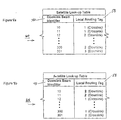
- the local lookup tables are of the form shown in FIGs. 4a and 4b which map downlink beam identifiers 40 to local routing tags 58.
- the cells 32 are sent from the source terminal 16 to a satellite 12 where the satellite electronics (not shown) are programmed to recognize the cell type identifier field 42 in each cell header 34 and realize that the cells 32 are to be sent in a connectionless manner.
- the satellite electronics identify the downlink beam identifier 40 in each cell header 34 and consult a local lookup table 60 (FIG.
- This local routing tag 58 is used to route the cells 32 through the on-board cell switch 61 directly to the correct switch output port 62 on the satellite 12 which may be either a downlink antenna 20 or a crosslink antenna 14.
- Each satellite 12 has a unique lookup table 60 (FIG. 4a) or 64 (FIG. 4b) to accomplish this function, meaning that, the lookup for a downlink beam identifier 40 for one satellite 12 would result in a routing tag 58 which takes the cell 32 to a crosslink antenna 14 while in another satellite 12, the lookup for the same downlink beam identifier 48 would result in a routing tag 58 which takes the cells 32 to a downlink antenna 20.
- each satellite look up table 60 (FIG. 4a) or 64 (FIG. 4b) can be a local table such that a table which is common to the network 10 is not required to route the cells 32.
- the cells 32 are routed through each successive satellite on-board cell switch 61 until the cells 32 arrive at the satellite 12 that contains the downlink antenna beam 22 corresponding to the downlink beam identifier 40.
- This satellite 12 identifies the downlink beam identifier 40 in each cell header 34 and routes the cells 32 to the particular downlink antenna 20 corresponding to the desired downlink antenna beam 22.
- the selected downlink antenna 20 broadcasts all the cells 32 in a packet 37 over the selected downlink antenna beam 22.
- the next step of the process relates to sorting the cells 32. If more than one source terminal 16 is sending cells 32 to the same downlink antenna beam 22 at any given time, the cells 32 from different source terminals 16 can become interleaved together prior to transmission over a downlink antenna beam 22. Then, the destination terminals 18 & 19 must sort or demultiplex the cells 32 sent to correctly reassemble the data packet 24. To do so, the destination terminals 18 & 19 sort the cells 32 by source terminal identifier 42.
- Cells 32 sent from a given source terminal 16 are sent in sequential order such that the cell order for a particular cell packet 37 is retained during transmission, and, cells 32 from different cell packets 37 from the same source terminal 16 are not interleaved before transmission; therefore, to successfully sort the cells 32 it is only necessary to identify all the cells 32 from a cell packet 37.
- the next step in the process relates to filtering out only those cell packets 37 destined for the first destination terminal 19.
- Each destination terminal 18 & 19 covered by the selected downlink antenna beam 22 receives all the cells 32 of all cell packets 37 sent down the beam 22 and must make a decision whether to keep the cells 32 or discard them. Since the cell headers 34 do not contain sufficient information to enable the destination terminals 18 & 19 to make this determination, each destination terminal 18 & 19 must identify the destination address 30 and determine if the destination address 30 matches either the destination terminal's own address or matches a user's address 54 which is reachable from the destination terminal 18 & 19.
- the destination terminal address 30 may be distributed among one or more of the cell bodies 36, therefore, to identify the destination address 30, each destination terminal 18 & 19 can either identify the destination address 30 from the cell bodies 36 or can at least partially reassemble the message header 28 to identify the destination terminal address 30 which will be located within the message header 28 once the message header 28 is reassembled.
- each destination terminal 18 & 19 uses known routing mechanisms to determine if the destination address 30 matches either the destination terminal's own address or is reachable from the destination terminal 18 & 19. If not, the cells 32 are discarded.
- the first destination terminal 19 having the corresponding destination address 30 or which can reach the user 54 which corresponds to the destination address 30 retains all the cells 32 and completely reassembles the data packet 24.
- the first destination terminal 19 will keep the data packet 24 otherwise, the first destination terminal 19 will forward the data packet 24 on to the user 54 which corresponds to the destination address 30 through a separate network 68 such as an ethemet network, another ATM type network, or any other data transfer network known to one skilled in the art.
- a separate network 68 such as an ethemet network, another ATM type network, or any other data transfer network known to one skilled in the art.
- the present invention utilizes the broadcast capability of a satellite network by using a beam identifier 40 to route the cells 32 to the downlink antenna beam 22 covering a desired destination terminal 19, and, determining from the destination address 30 for whom a particular data packet 24 is meant, thereby avoiding placing a destination terminal identifier in the cell header 34 of each cell 32.
- the present invention is compatible with the ATM Adaptation Layer 5 (AAL5) protocol which is the adaptation layer protocol of choice by one skilled in the art.
- ATM Adaptation Layer 5 AAL5
Landscapes
- Engineering & Computer Science (AREA)
- Computer Networks & Wireless Communication (AREA)
- Computing Systems (AREA)
- Physics & Mathematics (AREA)
- Astronomy & Astrophysics (AREA)
- Aviation & Aerospace Engineering (AREA)
- General Physics & Mathematics (AREA)
- Signal Processing (AREA)
- Data Exchanges In Wide-Area Networks (AREA)
- Radio Relay Systems (AREA)
Applications Claiming Priority (2)
| Application Number | Priority Date | Filing Date | Title |
|---|---|---|---|
| US09/128,173 US6430167B1 (en) | 1998-08-03 | 1998-08-03 | Method for transferring data over a satellite network by using unique beam identifiers to route the data |
| US128173 | 1998-08-03 |
Publications (1)
| Publication Number | Publication Date |
|---|---|
| EP0980192A1 true EP0980192A1 (de) | 2000-02-16 |
Family
ID=22434003
Family Applications (1)
| Application Number | Title | Priority Date | Filing Date |
|---|---|---|---|
| EP99113663A Withdrawn EP0980192A1 (de) | 1998-08-03 | 1999-07-15 | Verfahren zur Datenübertragung über einem Satellitenetz unter Verwendung von Strahlerkennungen zur Datenweglenkung |
Country Status (2)
| Country | Link |
|---|---|
| US (1) | US6430167B1 (de) |
| EP (1) | EP0980192A1 (de) |
Cited By (4)
| Publication number | Priority date | Publication date | Assignee | Title |
|---|---|---|---|---|
| WO2003023998A1 (en) * | 2001-09-12 | 2003-03-20 | The Boeing Company | Methods and apparatus for path discovery between a mobile platform and a ground segment |
| WO2004028034A1 (en) * | 2002-09-23 | 2004-04-01 | Inmarsat Ltd | Communication method and apparatus |
| WO2008109860A3 (en) * | 2007-03-08 | 2008-12-31 | Viasat Inc | Satellite reference terminal systems and methods |
| US11973574B1 (en) * | 2017-06-08 | 2024-04-30 | David Hershberg | Systems and methods for private communications networks |
Families Citing this family (10)
| Publication number | Priority date | Publication date | Assignee | Title |
|---|---|---|---|---|
| US6553009B2 (en) * | 1999-07-09 | 2003-04-22 | Satellite-Smart Solutions Ltd. | Direct satellite communication |
| US7161941B1 (en) * | 2000-03-01 | 2007-01-09 | Texas Instruments Incorporated | Wireless packet communications with extended addressing capability |
| US7409548B1 (en) * | 2000-03-27 | 2008-08-05 | International Business Machines Corporation | Maintaining confidentiality of personal information during E-commerce transactions |
| US7113493B1 (en) * | 2000-06-02 | 2006-09-26 | General Electric Company | Active networking in communication satellites |
| US7111163B1 (en) | 2000-07-10 | 2006-09-19 | Alterwan, Inc. | Wide area network using internet with quality of service |
| US20020097780A1 (en) * | 2000-11-30 | 2002-07-25 | Odenwalder Joseph P. | Preamble generation |
| US7215658B2 (en) * | 2001-01-19 | 2007-05-08 | Nokia Corporation | Apparatus, and associated method, for utilizing antenna information determinative of antenna operation in a wireless mesh network |
| US7142809B1 (en) * | 2001-02-27 | 2006-11-28 | The Directv Group, Inc. | Device and method to locally fill gaps in spotbeam satellite systems with frequency re-use |
| CN111181629B (zh) * | 2020-01-15 | 2022-02-18 | 四川安迪科技实业有限公司 | 卫星报文传送方法及系统、发送方法、接收方法及装置 |
| US12341601B2 (en) * | 2022-12-09 | 2025-06-24 | Cisco Technology, Inc. | Communication routing between nodes in a LEO satellite network |
Citations (2)
| Publication number | Priority date | Publication date | Assignee | Title |
|---|---|---|---|---|
| US5600629A (en) * | 1994-07-25 | 1997-02-04 | Motorola, Inc. | Inter-satellite method for routing packets |
| EP0820208A2 (de) * | 1996-07-18 | 1998-01-21 | AT&T Corp. | Paketiertes CDMA/TDM-Satellitkommunikationssystem |
Family Cites Families (7)
| Publication number | Priority date | Publication date | Assignee | Title |
|---|---|---|---|---|
| EP0552385B1 (de) | 1991-08-21 | 2001-02-14 | International Business Machines Corporation | Verbindungslose ATM-Datendienste |
| US5736959A (en) * | 1991-10-28 | 1998-04-07 | Teledesic Corporation | Earth-fixed cell beam management for satellite communication system using dielectic lens-focused scanning beam antennas |
| US5991279A (en) * | 1995-12-07 | 1999-11-23 | Vistar Telecommunications Inc. | Wireless packet data distributed communications system |
| US6205473B1 (en) * | 1997-10-03 | 2001-03-20 | Helius Development Corporation | Method and system for asymmetric satellite communications for local area networks |
| US6215776B1 (en) * | 1997-10-08 | 2001-04-10 | Lockheed Martin Missiles & Space Company | Satellite communication system |
| US6173176B1 (en) * | 1998-03-27 | 2001-01-09 | Motorola, Inc. | Method for sector-based routing |
| US6310893B1 (en) * | 1998-06-17 | 2001-10-30 | Genuity Inc. | Method and system for connectionless communication in a cell relay satellite network |
-
1998
- 1998-08-03 US US09/128,173 patent/US6430167B1/en not_active Expired - Lifetime
-
1999
- 1999-07-15 EP EP99113663A patent/EP0980192A1/de not_active Withdrawn
Patent Citations (2)
| Publication number | Priority date | Publication date | Assignee | Title |
|---|---|---|---|---|
| US5600629A (en) * | 1994-07-25 | 1997-02-04 | Motorola, Inc. | Inter-satellite method for routing packets |
| EP0820208A2 (de) * | 1996-07-18 | 1998-01-21 | AT&T Corp. | Paketiertes CDMA/TDM-Satellitkommunikationssystem |
Non-Patent Citations (1)
| Title |
|---|
| MAUGER R ET AL: "QOS GUARANTEES FOR MULTIMEDIA SERVICES ON A TDMA-BASED SATELLITE NETWORK", IEEE COMMUNICATIONS MAGAZINE,US,IEEE SERVICE CENTER. PISCATAWAY, N.J, vol. 35, no. 7, pages 56-58,63-65, XP000695132, ISSN: 0163-6804 * |
Cited By (7)
| Publication number | Priority date | Publication date | Assignee | Title |
|---|---|---|---|---|
| US7450901B2 (en) | 2000-08-16 | 2008-11-11 | The Boeing Company | Methods and apparatus for path discovery between a mobile platform and a ground segment |
| WO2003023998A1 (en) * | 2001-09-12 | 2003-03-20 | The Boeing Company | Methods and apparatus for path discovery between a mobile platform and a ground segment |
| WO2004028034A1 (en) * | 2002-09-23 | 2004-04-01 | Inmarsat Ltd | Communication method and apparatus |
| WO2008109860A3 (en) * | 2007-03-08 | 2008-12-31 | Viasat Inc | Satellite reference terminal systems and methods |
| US8159992B2 (en) | 2007-03-08 | 2012-04-17 | Viasat, Inc. | Routing paths onboard satellite with reference terminal functionality |
| US8159964B2 (en) | 2007-03-08 | 2012-04-17 | Viasat, Inc. | Distribution of routing tables for satellite with reference terminal functionality |
| US11973574B1 (en) * | 2017-06-08 | 2024-04-30 | David Hershberg | Systems and methods for private communications networks |
Also Published As
| Publication number | Publication date |
|---|---|
| US6430167B1 (en) | 2002-08-06 |
Similar Documents
| Publication | Publication Date | Title |
|---|---|---|
| US6404749B1 (en) | Method for providing connectionless data services over a connection-oriented satellite network | |
| US6295283B1 (en) | Method for providing connectionless data services over a connection-oriented satellite network by associating IP subnets with downlink beam identifiers | |
| EP1032986B1 (de) | Übertragungsverfahren für leitungsvermittelte daten, paket daten und atm zell daten in einem satelliten/funk- tdma- system | |
| US6430167B1 (en) | Method for transferring data over a satellite network by using unique beam identifiers to route the data | |
| US6310893B1 (en) | Method and system for connectionless communication in a cell relay satellite network | |
| US6731639B1 (en) | Multi protocol label switching for multiple access segments | |
| US7257121B2 (en) | System and method for mapping quality of service levels between MPLS and ATM connections in a network element | |
| EP0813346A1 (de) | Dynamische Zuteilung von virtuellen Kontrollkanälen für drahtlose ATM Systeme | |
| EP1168754B1 (de) | Adressierungsschema für ein IP basiertes funkzugriffsnetz | |
| US6212185B1 (en) | Multiple network address resolution | |
| US6826184B1 (en) | Method and system for multi-service cut-through switching through a connection-oriented network | |
| EP0543957A1 (de) | Verbindungsloses vermitteln für eine atm-vermittlung | |
| KR19990072278A (ko) | 개량에이티엠네트워크장치및그에이티엠네트워크장치를동작시키는방법 | |
| Box et al. | Architecture and design of connectionless data service for a public ATM network | |
| US6973055B1 (en) | Network with several network clusters for wireless transmission of packets | |
| US6839332B1 (en) | Method for transmission of circuits, packets, and cells in a satellite/wireless TDMA system | |
| JP3221414B2 (ja) | ワイヤレス非同期通信モード通信システム及び同報通信制御方法 | |
| EP1718000A1 (de) | Paketkommunikationsnetzwerk, routensteuerungsserver, routensteuerungsverfahren, paketübertragungseinrichtung, zulassungsregelserver, lichtwellenlängenwegeinstellverfahren, programm und aufzeichnungsmedium | |
| US6636514B1 (en) | Telecommunications system | |
| US7397820B1 (en) | Voice packets in IP network | |
| US6788706B1 (en) | Frame handling system, and frame handling method | |
| CA2317792C (en) | Virtual path asynchronous transfer mode switching in a processing satellite communications system | |
| Priscoli | Interworking of a satellite system for mobile multimedia applications with the terrestrial networks | |
| FI110151B (fi) | Menetelmä pakettien siirtämiseksi piirikytkentäisen verkon yli | |
| US20040120324A1 (en) | Scheme for merging partially filled atm cells |
Legal Events
| Date | Code | Title | Description |
|---|---|---|---|
| PUAI | Public reference made under article 153(3) epc to a published international application that has entered the european phase |
Free format text: ORIGINAL CODE: 0009012 |
|
| AK | Designated contracting states |
Kind code of ref document: A1 Designated state(s): DE FR GB |
|
| AX | Request for extension of the european patent |
Free format text: AL;LT;LV;MK;RO;SI |
|
| 17P | Request for examination filed |
Effective date: 20000713 |
|
| AKX | Designation fees paid |
Free format text: DE FR GB |
|
| RAP1 | Party data changed (applicant data changed or rights of an application transferred) |
Owner name: NORTHROP GRUMMAN CORPORATION |
|
| RAP1 | Party data changed (applicant data changed or rights of an application transferred) |
Owner name: NORTHROP GRUMMAN CORPORATION |
|
| GRAP | Despatch of communication of intention to grant a patent |
Free format text: ORIGINAL CODE: EPIDOSNIGR1 |
|
| STAA | Information on the status of an ep patent application or granted ep patent |
Free format text: STATUS: THE APPLICATION IS DEEMED TO BE WITHDRAWN |
|
| 18D | Application deemed to be withdrawn |
Effective date: 20060301 |