EP0980210B1 - Sole-mischungen zur vernetzung von extrudierten wurstmassen - Google Patents
Sole-mischungen zur vernetzung von extrudierten wurstmassen Download PDFInfo
- Publication number
- EP0980210B1 EP0980210B1 EP98964727A EP98964727A EP0980210B1 EP 0980210 B1 EP0980210 B1 EP 0980210B1 EP 98964727 A EP98964727 A EP 98964727A EP 98964727 A EP98964727 A EP 98964727A EP 0980210 B1 EP0980210 B1 EP 0980210B1
- Authority
- EP
- European Patent Office
- Prior art keywords
- coagulation
- strand
- range
- process according
- collagen
- Prior art date
- Legal status (The legal status is an assumption and is not a legal conclusion. Google has not performed a legal analysis and makes no representation as to the accuracy of the status listed.)
- Expired - Lifetime
Links
Images

Classifications
-
- A—HUMAN NECESSITIES
- A22—BUTCHERING; MEAT TREATMENT; PROCESSING POULTRY OR FISH
- A22C—PROCESSING MEAT, POULTRY, OR FISH
- A22C13/00—Sausage casings
-
- A—HUMAN NECESSITIES
- A22—BUTCHERING; MEAT TREATMENT; PROCESSING POULTRY OR FISH
- A22C—PROCESSING MEAT, POULTRY, OR FISH
- A22C13/00—Sausage casings
- A22C13/0013—Chemical composition of synthetic sausage casings
- A22C13/0016—Chemical composition of synthetic sausage casings based on proteins, e.g. collagen
-
- A—HUMAN NECESSITIES
- A22—BUTCHERING; MEAT TREATMENT; PROCESSING POULTRY OR FISH
- A22C—PROCESSING MEAT, POULTRY, OR FISH
- A22C13/00—Sausage casings
- A22C2013/002—Sausage casings made by extrusion
- A22C2013/0023—Sausage casings made by extrusion coextruded together with the food product
Definitions
- the present invention relates to the preparation of collagen-coated foodstuffs, especially sausages.
- the first is to take natural or artificial sausage casing and stuff it with sausage meat.
- the outer surface material may consist of a gel with a collagen protein.
- the coagulation normally includes subjecting the extruded strand to a brine (salt) solution. The brine is applied immediately after the strand is extruded to coagulate the proteins in the gel.
- the water content of the gel coating is lowered with the assistance of osmosis by leading the strand of food stuffs through a concentrated salt bath. Thereafter, an air drying step is used to further enhance the strength of the sausage casing. After this treatment, the mechanical properties of the casing are insufficient to allow for conventional twist linking, clipping, or hanging of the foodstuff, i.e. sausage strand.
- this usual method it is habitual to crimp the coextruded strand of foodstuff and cut it into individual elements. These elements are thereafter placed in a hot air dryer for the treatment of individual elements, for example, drying, smoking, etc.
- This known method has a number of disadvantages.
- sausages manufactured with this coextrusion method tend to have inferior qualities, including inferior color, taste, or appearance in comparison to sausages which have been manufactured with a natural or artificial casing. This is due to long dwelling times of the meat in the brine solution which are necessary for sufficient coagulation of the collagen gel. During this time, the brine solution is absorbed into the meat which can cause an off-taste.
- the more effective brine solution comprises using other salts which give a higher osmotic drying while reducing the taste and appearance effects which limit the traditional methods.
- Proposed is the use of Sodium Carbonate. The dissolvability of sodium carbonate and thus osmotic drying strength of the brine is raisec by heating the brine solution.
- this disclosed method also does not adequately resolve the aforementioned problems and disadvantages.
- the sausages manufactured using the method disclosed by Morgan et al. still do not have sufficient casing strength to allow traditional processing i.e. hanging on sticks. For instance, when strands of edible foodstuffs which are thus manufactured are hung, the partly fluid meat mix flows downward, giving the edible foodstuff an undesirable cone shape.
- An additional disadvantage is that, due to the lengthy stay in the coagulation bath, the salt content in the casing and in the meat mix, is high. In spite of the type of salts used in the brine this results in unwanted organoleptical and physical changes of the sausage mix, such as in taste, consistency and firmness of the meat mix. Further, the high solvent temperatures necessary to complete the coagulation process tend to discolor the meat, and weaken the casing by protein denaturation.
- An additional object of the present invention is to create by co-extrusion a substantially uniform layer of a collagen-containing gel, with a dry matter of between 3 and 25%, around an elongated strand of foodstuff wherein the gel is acidified using an inorganic acid which is set in contact with an aqueous solution containing a highly dissolvable salt.
- the present invention provides a process as claimed in claim 1 and the use of a coagulation solution as claimed in claim 11.
- the present invention discloses the use of either potassium carbonate or dipotassium phosphate for coagulating collagen containing gel surrounding an edible foodstuff in a coextrusion process.
- Both potassium carbonate and dipotassium phosphate have a dissolvability at 20°C of at least 8 moles per litre of water.
- Said collagen containing gel has been acidified using an inorganic acid and having a dry matter content of between 3 and 25%.
- the presence of either potassium carbonate or dipotassium phosphate provides for higher osmotic drying of the collagen gel, which in turn shortens the coagulation time to 60 seconds or less. This allows for the lowering of the temperature of the coagulation bath or solution.
- Potassium carbonate and dipotassium phosphate are especially effective in producing a high strength collagen casing within a shorter time than has until hereto been possible when used in combination with a collagen containing gel that has been acidified using an inorganic acid, such being even more effective when used in combination with a gel which has a dry matter content of between 3 and 25%.
- the method also eliminates the need for an air-drying step following coagulation.
- the new coextrusion method offers many advantages over conventional coextrusion methods.
- First, the lowering of the coagulation bath temperature allows the use of ambient temperatures, which do not discolor the meat. Further, the shorter dwelling times reduce the migration of the salt solution into the meat, thus preventing an off-taste.
- the method also provides cost-savings due to the elimination of the air-drying step and coagulation temperature control, as well as savings on the usage of salt and energy.
- the chosen salts are dipotassium phosphate and potassium carbonate are particularly suitable because of their tasteless character and high dissolvability.
- the gel surrounding the foodstuff is a substantially uniform layer of a collagen-containing gel around an elongated strand of foodstuff wherein the gel is acidified at least partially using an inorganic acid, and having a dry matter of between 3 and 25%, which is set in contact with an aqueous solution containing a highly dissolvable salt.
- the present invention provides a process and composition for chemically coagulating the coextruded collagen containing gel surrounding an edible food stuffs, i.e., sausages.
- Coextrusion methods are mainly being used for the coextrusion of sausage or sausage-like materials. While the instant process relates particularly to the production of sausages, it may also be used in the production of other collagen coated food stuffs such as fish or meat products containing vegetable or cheese or both. Thus, while the description of the process will be in terms of the production of strings of sausages, the process is clearly not limited to that particular food stuff.
- the term "sausage” as used herein refers to any type of emulsified meat product that is formed into sausage or frankfurter links or the like.
- coagulation is a term of art in the production of collagen coated sausage material and is not strictly scientific in the sense in which it is used. Coagulation as it is used in this specification refers to the step involving hardening and stabilization of the casing. This is principally achieved in two ways: firstly by removal of water from the collagen gel; and secondly by cross-linking the collagen fibers.
- This invention is the first to use a highly dissoluble salt for coagulation of collagen gel in the coextrusion process in combination with an inorganically acidified collagen casing gel, having a dry matter content of between 3 and 25%.
- the highly dissolvable salt provides higher osmotic drying of the collagen gel, thus shortening the coagulation time of the gel.
- the highly dissolvable salt also allows the temperature of the coagulation to be lowered.
- the highly dissolvable salt therefore offers many advantages over conventional coagulation methods, particularly when being used in combination of a inorganically acidified collagen containing gel having a dry matter of between 3 and 25%.
- the shorter coagulation time shortens the exposure of the meat or other food product to the salt solution.
- the salt solution may be lowered, ambient (meat locker) temperatures may be used in the process, which prevents the meat discoloration often associated with exposure to higher temperatures.
- the shorter coagulation time thereby provides cost savings by removing the need for coagulation temperature control, allowing the use of a smaller coagulation bath (or a shorter transporting belt), and further provides savings on the usage of salt and energy.
- the manufactured casing has sufficient strength to allow mechanical separation of the product into individual food stuff elements which are connected to each other. It is therefore possible to prepare fresh, smoked or cooked edible food stuffs of which the properties are equal to those of known edible food stuffs which have been manufactured in a natural or edible or non edible artificial casing.
- Highly dissolvable salts which may be used in the instant invention have a solubility at 20°C of at least 8 moles per liter water. Highly dissolvable salts which can be used must be food approved. The most preferred salts are potassium phosphate and potassium carbonate, because of their high dissolvability and lack of taste.
- the highly dissolvable salt is used in an aqueous coagulation solution. According to the invention it has to be present in an amount of between about 25 and 200% w/v.
- the preferred concentration of salt is between about 80 and 100% w/v.
- the concentrated salt solution in accordance with the present invention provides for coagulation of the outer surface of a food strand in less than 60 seconds.
- the coagulation bath according to the invention has a pH in the range of 8 to 9 and preferably a temperature of between 0°C and 20°C, more preferably 4 to 7°C.
- the coagulation solution may contain a combination of highly dissolvable salts, or other additives such as salts, crosslinking agents, plasticizers, colorants or other functional ingredients.
- the gel used in this invention contains collagen.
- the collagen is derived from suitable animal sources known in the art of collagen film making such as bovine hides or pork skin or pork serosa.
- the collagen in raw material is extracted in a pure fibrillar form necessary to achieve the desired result.
- suitable fibrillar collagen There are many known methods for obtaining suitable fibrillar collagen, all of which can be used successfully in combination with this invention.
- the fibrillar collagen is brought in suspension with water and acidified such as to allow the collagen to swell i.e. bind the water, and allow the suspension to set as a gel. Virtually any food approved acid is suitable to swell the collagen.
- the inorganizally swollen gel may contain other functional ingredients such as organic acids, colorants crosslinking agents, fillers such as cellulose fibers, plasticisers such as glycerol etc.
- the combined dry matter of the gel i.e. collagen and other functional ingredients, is between 3 and 25%.
- the collagen dry matter content is preferably 2-15%, more preferably 3-8%. Combined dry matter is most preferably between 4 and 10%. In all possibilities the balance of the gel containing water. If a crosslinking agent is added it will comprise about 0.1-5% of the gel.
- the coextruding apparatus will have two separate pumps, one for the meat emulsion and one for the collagen gel.
- the coextruder may be of a design known in the art, such as a conical extruder or a contra-rotating disc extruder.
- liquid smoke or other cross-linking agent will be delivered to the collagen gel prior to coextrusion.
- the liquid smoke is inserted into the gel stream prior to extrusion between the gel pump and extruder apparatus.
- Other functional ingredients such as coloring agents may also be included in the casing, for example, within a crosslinking agent injected into the gel prior to extrusion.
- the functional ingredient may be injected independently into the gel prior to extrusion thereof.
- a strand of meat emulsion or other foodstuff and the collagen are coextruded from their respective pumps such that the collagen gel material is on the outer surface of the emulsion.
- the amount of collagen containing gel coextruded around the edible product is 3 to 10% of the total weight of gel and food product.
- the finished coagulated collagen gel casing has a thickness of about 10 to 50 microns. The thickness is generally in proportion to the diameter of the food strand.
- the materials may be coextruded onto a moving conveyor belt wherein the moving coated sausage can be sprayed with a quantity of coagulation solution or passed through a coagulation treatment bath.
- a highly concentrated salt solution in a treatment bath where the extruded sausage strand is allowed to float in said bath, it may be beneficial to provide means to submerse the entire sausage surface in the coagulation solution.
- uneven coagulation of the sausage surface when due to the high ionic content of the brine, without such means the top of the strand is not coagulated well enough, or at least not equally to the immersed bottom section.
- a bath it will normally comprise a shallow trough having a conveyor therein to enable the coagulation solution to freely contact the coextruded collagen coating.
- a spraying system it will preferably include a means for rotating the sausage strand lengthwise to better permit the coagulation solution to contact all of the outer surface of the food strand.
- Other treatment solutions can be applied to the food strand concurrently or following the initial coagulation step.
- the conveyor belt speed is controlled with a computer or other means so that the food strand will be in contact with the coagulation solution for an amount of time sufficient to coagulate the outer surface. As set forth above, with the highly dissolvable salt solution, this period of time is less than 60 seconds. Once the outer surface of the food strand is sufficiently coagulated, no further air drying step is necessary.
- the food strand is discharged to a suitable collection receptacle where it can then be formed into a plurality of lengths at that location if desired using means well known to those of ordinary skill in the art.
- the excess brine on the food strand after coagulation is preferably removed prior to or after separation into links. The removal can be accomplished for instance by rinsing with water or another fluid such as ethanol. Or might be accomplished my mechanical means such as scraping or forced air blowing.
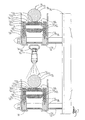
- Figures 1 and 2 generally set forth a coextruding machine which the coagulation solution and the preferred collagen containing gel of the instant invention may be used.
- the numeral 10 designates a coextruding machine and conveyor.
- the numeral 12 is a meat emulsion hopper using a meat pump machine for pumping emulsified meat.
- a collagen gel pump 16 has a hopper 18 for receiving the collagen gel. It is connected by a conduit 19 to inline mixer 20.
- a tube connects the inline mixer 20 to the coextruder 24 which is capable of extruding a cylindrical strand of meat emulsion with a collagen gel material on the outer surface thereof.
- Coextruder 24 is connected by tube 25 to the meat pump 14.
- the conventional coextruded strand of sausage 26 (Fig.
- liquid smoke dispenser 30 has an emulsified meat material core 27 with the collagen gel comprising the outer surface 28 thereof.
- Liquid smoke from liquid smoke dispenser 30 may be used as a coagulation material to coagulate the other surface 28 of sausage strand 26.
- the liquid smoke dispenser 30 can be connected in any convenient way such as by line 32 to the inline mixer 20 (Fig. 1).
- a conveyor 34 is mounted on frame 36 and has a point of beginning 38 adjacent the output end of coextruder 24, and a discharge station 40 which is located outwardly and downwardly from the point of beginning 38.
- Three sprockets 42 are rotatably mounted on frame 36 and are adapted to rotate about a horizontal axis. As best shown in Figure 2, two of the sprockets 42 are vertically disposed with respect to each other below point of beginning 38, and the third sprocket 42 is located on the outer end of a conveyor adjacent discharge station 40.
- Each shaft 42 has five rotatably disposed sprockets 46 thereon which are adapted to rotate on shafts 44 about the vertical axis of the shafts.
- Each set of five sprockets 46 are located in the same parallel plane as one each of the sprockets on the opposite vertical shaft 44.
- An endless conveyor belt 48 is circuitiously mounted on the sprockets 42 and 46.
- An infrared heater 50 is mounted on frame 36 adjacent discharge station 40.
- a drive 51 for the conveyor belt 48 is located adjacent the discharge station 40 as best shown in Figures 1 and 2.
- Belt 48 ( Figure 3) is disposed between a plurality of elongated L-shaped guides 54 which are secured to frame 36.
- Elongated rails 56 mounted on bearings 58 extend longitudinally through the guides.
- a brine circuit system 74 includes a brine pump 76.
- a plurality of miscellaneous control valves 78 are imposed in the brine circuit 74 to selectively control the flow of brine through the system.
- a fluid line 80 extends from pump 76 and includes a plurality of spaced nozzles 82 which are located in a plurality of locations on frame 36 directly above the conveyor belt 48 (see Figure 3) to dispense a spray of coagulation solution on the strand of sausage 36.
- Brine circuit 74 includes a brine tank 84 which is connected to a brine collection tray 86 located below the various tiers of conveyor belt 48.
- the present invention discloses a method and means for using a coagulation solution containing a highly dissoluble salt to produce a coextruded food product with better strength, taste and appearance than food products manufactured with conventional coextrusion processes.
- the use of the highly dissolvable salt results in additional cost savings due to the simpler coextrusion process, i.e. no air drying step or temperature control, as well as savings on the usage of salt and energy consumption.
- Using inorganically acidified collagen-containing gel having a dry matter of between 3 and 25% in combination with high ionic coagulation fluid gives an unprecedented high strength co-extruded casing.
Landscapes
- Life Sciences & Earth Sciences (AREA)
- Engineering & Computer Science (AREA)
- Wood Science & Technology (AREA)
- Zoology (AREA)
- Food Science & Technology (AREA)
- Meat, Egg Or Seafood Products (AREA)
- Processing Of Meat And Fish (AREA)
- Jellies, Jams, And Syrups (AREA)
- General Preparation And Processing Of Foods (AREA)
Claims (13)
- Verfahren zum Koagulieren der Außenoberfläche eines koextrudierten Lebensmittelproduktes mit den Schritten:dadurch gekennzeichnet, dass die Koagulationslösung ein sehr gut lösliches Salz aufweist, das von Kaliumkarbonat oder Dikaliumphosphat mit einer Löslichkeit von wenigstens 8 Mol pro Liter bei Wasser von 20°C, mit einem pH-Bereich von 8 bis 9 und einem Gewichts/Volumen-Bereich von 25 bis 200% für die gewählte Salzkonzentration besitzt, ausgewählt wird.Koextrudieren eines Stranges aus Lebensmittelmaterial, um im Wesentlichen eine gleichförmige Schicht eines Kollagen-haltigen Gels um einen inneren Strang aus Lebensmittelmaterial herum zu erzeugen;Ansäuern des Kollagen-haltigen Gels unter Verwendung einer anorganischen Säure;Beschichten des Strangs mit einer Koagulationslösung, um einen beschichteten Strang zu erzeugen;
undZulassen einer Koagulation des beschichteten Stranges; - Verfahren nach Anspruch 1, wobei der Strang keinem Lufttrocknungsschritt nach dem Beschichtungsschritt unterworfen wird.
- Verfahren nach Anspruch 1 oder 2, wobei das Verfahren bei Umgebungstemperatur durchgeführt wird.
- Verfahren nach einem der Ansprüche 1 bis 3, wobei der Koagulationsschritt in 60 Sekunden oder weniger durchgeführt wird.
- Verfahren nach einem der vorstehenden Ansprüche, wobei die Koagulationslösung aufgebracht wird, indem der Lebensmittelstrang durch ein die Koagulationslösung enthaltendes Bad hindurchgeführt wird.
- Verfahren nach einem der Ansprüche 1 bis 4, wobei die Koagulationslösung auf den Lebensmittelstrang aufgesprüht wird.
- Verfahren nach einem der vorstehenden Ansprüche, wobei die anorganische Säure aus der aus Salzsäure und Schwefelsäure bestehenden Gruppe ausgewählt wird.
- Verfahren nach einem der vorstehenden Ansprüche, wobei das Gel einen Trockenmasseanteil von 3 bis 25 Gewichtsprozent aufweist.
- Verfahren nach Anspruch 1, wobei die Koagulationslösung einen Temperaturbereich von 0 bis 20°C und einen Gewichts/Volumen-Bereich von 80 bis 200% für die ausgewählte Salzkonzentration aufweist.
- Verfahren nach Anspruch 1, wobei die Koagulationslösung einen Temperaturbereich von 4 bis 7°C und einen Gewichts/Volumen-Bereich von 80 bis 100% für die gewählte Salzkonzentration aufweist.
- Verwendung einer Koagulationslösung in der Koagulation der Außenoberfläche eines koextrudierten Lebensmittelproduktes, wobei die Koagulationslösung ein sehr gut lösliches Salz aufweist, das von Kaliumkarbonat oder Dikaliumphosphat mit einer Löslichkeit von wenigstens 8 Mol pro Liter bei Wasser von 20°C, mit einem pH-Bereich von 8 bis 9 und einem Gewichts/Volumen-Bereich von 25 bis 200% für die gewählte Salzkonzentration besitzt, ausgewählt wird.
- Anwendung nach Anspruch 11, mit einem Temperaturbereich von 0 bis 20°C und einem Gewichts/Volumen-Bereich von 80 bis 200% für die ausgewählte Salzkonzentration.
- Anwendung nach Anspruch 11 oder 12, mit einem Temperaturbereich von 4 bis 7°C und einem Gewichts/Volumen-Bereich von 80 bis 100% für die gewählte Salzkonzentration.
Priority Applications (1)
| Application Number | Priority Date | Filing Date | Title |
|---|---|---|---|
| DK98964727T DK0980210T3 (da) | 1997-12-15 | 1998-12-11 | Saltformulering til hærdning af ekstruderet pölsestreng |
Applications Claiming Priority (3)
| Application Number | Priority Date | Filing Date | Title |
|---|---|---|---|
| US990619 | 1997-12-15 | ||
| US08/990,619 US6054155A (en) | 1997-12-15 | 1997-12-15 | Brine formulation for curing extruded sausage strand |
| PCT/US1998/026468 WO1999030568A1 (en) | 1997-12-15 | 1998-12-11 | Brine formulation for curing extruded sausage strand |
Publications (2)
| Publication Number | Publication Date |
|---|---|
| EP0980210A1 EP0980210A1 (de) | 2000-02-23 |
| EP0980210B1 true EP0980210B1 (de) | 2005-06-01 |
Family
ID=25536340
Family Applications (1)
| Application Number | Title | Priority Date | Filing Date |
|---|---|---|---|
| EP98964727A Expired - Lifetime EP0980210B1 (de) | 1997-12-15 | 1998-12-11 | Sole-mischungen zur vernetzung von extrudierten wurstmassen |
Country Status (11)
| Country | Link |
|---|---|
| US (2) | US6054155A (de) |
| EP (1) | EP0980210B1 (de) |
| JP (1) | JP3661037B2 (de) |
| KR (1) | KR100359190B1 (de) |
| AR (2) | AR014941A1 (de) |
| AT (1) | ATE296542T1 (de) |
| AU (1) | AU737847B2 (de) |
| BR (1) | BR9806878A (de) |
| CA (1) | CA2274960C (de) |
| DE (2) | DE69830399D1 (de) |
| WO (1) | WO1999030568A1 (de) |
Families Citing this family (30)
| Publication number | Priority date | Publication date | Assignee | Title |
|---|---|---|---|---|
| US6245369B1 (en) * | 1999-07-14 | 2001-06-12 | Townsend Engineering Company | Method and means for controlling the variations in weight of extruded sausages |
| NL1013817C2 (nl) * | 1999-12-10 | 2001-06-12 | Stork Mps Bv | Coagulatieoplossing voor het laten coaguleren van een collageen. |
| FR2819994B1 (fr) * | 2001-02-01 | 2003-04-25 | Sonjal Sas | Procede et dispositif de fabrication et de conditionnement de produits de type saucisse |
| NL1018871C2 (nl) * | 2001-09-03 | 2003-03-05 | Ktc Beheer B V | Werkwijze voor het bereiden van een geextrudeerd voedselproduct. |
| US20030099758A1 (en) * | 2001-10-15 | 2003-05-29 | Book Sharon L. | Compositions and methods for producing phosphate salt mixtures and brine solutions to coagulate collagen |
| EP1453385A1 (de) * | 2001-11-14 | 2004-09-08 | Townsend Engineering Company | Gel zur herstellung eines überzugs für extrudierte wurst, das aus stärke und einem geniessbaren pflanzlichen material besteht |
| US7001635B2 (en) | 2002-05-06 | 2006-02-21 | Viskase Corporation | Process for improving smoky color of an encased food product |
| US20040091581A1 (en) * | 2002-11-08 | 2004-05-13 | Ghislaine Joly | Starch/collagen casings for co-extruded food products |
| NL1025670C2 (nl) | 2004-03-09 | 2005-09-12 | Townsend Engineering B V | Werkwijze en inrichting voor het dehydreren van gecoextrudeerde voedselproducten. |
| WO2006051278A1 (en) * | 2004-11-09 | 2006-05-18 | Loders Croklaan B.V. | Method of producing a food product |
| KR100614461B1 (ko) | 2004-11-24 | 2006-08-21 | 해강물산 주식회사 | 콜라겐 성분을 함유한 마른 멸치 제조방법과 상기 방법에의해 제조된 마른멸치 |
| PL1738649T3 (pl) * | 2005-06-30 | 2008-04-30 | Handtmann Albert Maschf | Urządzenie i sposób wytwarzania pasma kiełbasy o dowolnym kształcie |
| US20070009648A1 (en) * | 2005-07-08 | 2007-01-11 | Hawkins Patrick H | Systems and methods for meat processing |
| US7883564B2 (en) * | 2005-07-15 | 2011-02-08 | Hawkins, Inc. | Systems and methods for disposing of brine solutions |
| ES2376350T3 (es) * | 2005-07-20 | 2012-03-13 | Tbt Asset Management International Limited | Unidad de iluminación con l�?mpara fluorescente de c�?todo fr�?o de forma serpentina. |
| US20070031542A1 (en) * | 2005-08-09 | 2007-02-08 | Harry Chu | Encased food product and process for producing the same |
| US20070218173A1 (en) * | 2006-03-14 | 2007-09-20 | Shulman Michael N | Coextrusion process for producing a meat product |
| US20080145495A1 (en) | 2006-10-30 | 2008-06-19 | Sara Lee Corporation | System and method for conditioning food product |
| DE102007061710A1 (de) * | 2007-12-19 | 2009-06-25 | Kalle Gmbh | Kollagen-Konzentrat, dessen Verwendung sowie Verfahren zu seiner Herstellung |
| WO2011037902A2 (en) * | 2009-09-22 | 2011-03-31 | Sara Lee Corporation | System and method for forming a food product with a solidified liquid additive |
| CN101699280B (zh) | 2009-10-15 | 2011-08-17 | 北京索瑞特医学技术有限公司 | 超声无损检测粘弹性介质弹性的方法及其装置 |
| AU2013265435B2 (en) * | 2012-05-21 | 2016-10-27 | Société des Produits Nestlé S.A. | Canned food products having a filling |
| FR3002115B1 (fr) * | 2013-02-15 | 2015-03-06 | Marel France | Machine de production de saucisses avec son dispositif de coagulation du boyau |
| JP6442402B2 (ja) * | 2012-07-04 | 2018-12-19 | マレル タウンセンド ファーザー プロセッシング ビー.ヴィー. | 食品を調製する方法および装置、この方法における緩衝液の使用、並びに、この方法に使用するための要素のキット |
| US9723952B2 (en) | 2013-12-06 | 2017-08-08 | J & B Sausage Company, Inc. | Roller conveyor oven for heating while rotating and conveying a multiplicity of cylindrical food items thereon |
| NL2012976B1 (en) * | 2014-06-10 | 2016-06-27 | Marel Townsend Further Proc Bv | Controlled sausage manufacturing process. |
| EP3282854B1 (de) * | 2015-04-16 | 2020-05-06 | Viscofan Collagen USA Inc. | Vorrichtung zum anwenden von aromastoffen auf kollagenhüllen |
| CN105580877B (zh) * | 2015-12-23 | 2018-03-13 | 中盐金坛盐化有限责任公司 | 一种新型肠衣盐及其制备方法与应用 |
| GB2554039B (en) * | 2016-05-06 | 2022-08-31 | Freddy Hirsch Group Ag | Coated Food Products |
| DE102022115961B3 (de) * | 2022-06-27 | 2023-07-13 | Vemag Maschinenbau Gmbh | Fülllinie zum Herstellen von Nahrungsmitteln aus einer pastösen Masse, insbesondere gefüllten Nahrungsmitteln bzw. in Hüllen gefüllten Nahrungsmitteln |
Family Cites Families (21)
| Publication number | Priority date | Publication date | Assignee | Title |
|---|---|---|---|---|
| GB807863A (en) * | 1955-12-22 | 1959-01-21 | Wall & Sons Ltd T | Improvements in or relating to the manufacture of food products |
| US3408916A (en) * | 1965-05-19 | 1968-11-05 | Tee Pak Inc | Edible collagen sausage casing and method of preparing same |
| US3512997A (en) * | 1966-09-29 | 1970-05-19 | Tee Pak Inc | Extrusion of microporous collagen articles |
| GB1232801A (de) * | 1968-06-18 | 1971-05-19 | ||
| GB1288111A (de) * | 1970-06-16 | 1972-09-06 | ||
| US3833746A (en) * | 1973-01-08 | 1974-09-03 | Tee Pak Inc | Process for tanning edible collagen casing |
| US3821439A (en) * | 1973-02-20 | 1974-06-28 | Tee Pak Inc | Coagulating and hardening bath for edible collagen sausage casings |
| US3930036A (en) * | 1974-07-12 | 1975-12-30 | Tee Pak Inc | Edible collagen sausage casing and method of preparing same |
| US4052517A (en) * | 1974-09-16 | 1977-10-04 | The Proctor & Gamble Company | Shaped textured protein food product |
| JPS5838134B2 (ja) * | 1975-11-27 | 1983-08-20 | カブシキガイシヤ ニツピ | カイリヨウサレタコラ−ゲンケ−シング ノ セイゾウホウホウ |
| US3993790A (en) * | 1976-03-22 | 1976-11-23 | Tee-Pak Inc. | Process of making collagen casings using mixed acids |
| JPS58146260A (ja) * | 1982-02-23 | 1983-08-31 | Takeda Chem Ind Ltd | 練製品用組成物 |
| JP2709089B2 (ja) * | 1988-09-01 | 1998-02-04 | ニッピコラーゲン工業株式会社 | コラーゲン分散物で被覆された食品の製造方法 |
| WO1993012260A2 (en) * | 1991-12-09 | 1993-06-24 | Board Of Trustees Of The Leland Stanford Junio | Asymmetric ligands useful for transition metal catalyzed bond forming reactions |
| GB9127463D0 (en) * | 1991-12-28 | 1992-02-19 | Devro Ltd | Co-extruded collagen coated foodstuffs particularly sausages |
| US5271948A (en) * | 1992-03-03 | 1993-12-21 | Teepak, Inc. | Method for preparing collagen encased sausage products |
| EP0619077A1 (de) * | 1993-04-07 | 1994-10-12 | Stork Protecon-Langen B.V. | Verfahren und Vorrichtung zur Beschichtung eines Nahrungsmittel |
| NL9400602A (nl) * | 1994-04-15 | 1995-11-01 | Townsend Engineering Co | Werkwijze voor het vervaardigen van voedselstrengen met een uit eiwit gevormde huls en inrichting voor het uitvoeren van de werkwijze. |
| US5599570A (en) * | 1995-11-03 | 1997-02-04 | Devro Plc | Collagen sausage casing containing encapsulated smoke and method of making |
| JP3274346B2 (ja) * | 1996-03-05 | 2002-04-15 | オルガノ株式会社 | 畜肉加工品の品質改良剤および畜肉加工品の製造方法 |
| US6013295A (en) * | 1998-03-06 | 2000-01-11 | Townsend Engineering Company | Method for linking coextruded foodstuff |
-
1997
- 1997-12-15 US US08/990,619 patent/US6054155A/en not_active Expired - Lifetime
-
1998
- 1998-12-11 KR KR1019997007291A patent/KR100359190B1/ko not_active Expired - Fee Related
- 1998-12-11 AT AT98964727T patent/ATE296542T1/de not_active IP Right Cessation
- 1998-12-11 JP JP53279099A patent/JP3661037B2/ja not_active Expired - Lifetime
- 1998-12-11 CA CA002274960A patent/CA2274960C/en not_active Expired - Fee Related
- 1998-12-11 DE DE69830399T patent/DE69830399D1/de not_active Expired - Lifetime
- 1998-12-11 AU AU19987/99A patent/AU737847B2/en not_active Ceased
- 1998-12-11 EP EP98964727A patent/EP0980210B1/de not_active Expired - Lifetime
- 1998-12-11 DE DE29880122U patent/DE29880122U1/de not_active Expired - Lifetime
- 1998-12-11 WO PCT/US1998/026468 patent/WO1999030568A1/en not_active Ceased
- 1998-12-11 BR BR9806878-4A patent/BR9806878A/pt not_active Application Discontinuation
- 1998-12-16 AR ARP980106397A patent/AR014941A1/es active IP Right Grant
-
1999
- 1999-04-07 US US09/287,719 patent/US6153234A/en not_active Expired - Lifetime
-
2004
- 2004-03-12 AR ARP040100825A patent/AR043589A2/es active IP Right Grant
Also Published As
| Publication number | Publication date |
|---|---|
| US6153234A (en) | 2000-11-28 |
| JP3661037B2 (ja) | 2005-06-15 |
| AR014941A1 (es) | 2001-04-11 |
| DE69830399D1 (de) | 2005-07-07 |
| US6054155A (en) | 2000-04-25 |
| KR20010049165A (ko) | 2001-06-15 |
| CA2274960C (en) | 2003-11-11 |
| CA2274960A1 (en) | 1999-06-24 |
| AU737847B2 (en) | 2001-08-30 |
| DE29880122U1 (de) | 2000-05-25 |
| AR043589A2 (es) | 2005-08-03 |
| ATE296542T1 (de) | 2005-06-15 |
| AU1998799A (en) | 1999-07-05 |
| KR100359190B1 (ko) | 2002-11-01 |
| WO1999030568A1 (en) | 1999-06-24 |
| JP2000510348A (ja) | 2000-08-15 |
| EP0980210A1 (de) | 2000-02-23 |
| BR9806878A (pt) | 2000-04-18 |
Similar Documents
| Publication | Publication Date | Title |
|---|---|---|
| EP0980210B1 (de) | Sole-mischungen zur vernetzung von extrudierten wurstmassen | |
| KR100280573B1 (ko) | 동시 압출 콜라겐 피복 식료품 | |
| US3622353A (en) | Sausage preparation process | |
| EP0720816B1 (de) | Verfahren zur Herstellung eines Nahrungsprodukt | |
| NL9400602A (nl) | Werkwijze voor het vervaardigen van voedselstrengen met een uit eiwit gevormde huls en inrichting voor het uitvoeren van de werkwijze. | |
| EP1834525A1 (de) | Coextrusionsverfahren zur Herstellung eines Fleischprodukts | |
| US4219574A (en) | Food casing | |
| AU746201B2 (en) | Process for producing fresh sausage | |
| US5997919A (en) | Method and apparatus for removing brine from coextruded sausage strands | |
| MXPA99007532A (en) | Brine formulation for curing extruded sausage strand | |
| NL1018871C2 (nl) | Werkwijze voor het bereiden van een geextrudeerd voedselproduct. | |
| AU2016249375B2 (en) | Device for application of flavors to collagen casings | |
| US6224919B1 (en) | Black collagen flat film and foodstuff coated therewith | |
| WO2006051274A1 (en) | Food product and method for its production |
Legal Events
| Date | Code | Title | Description |
|---|---|---|---|
| PUAI | Public reference made under article 153(3) epc to a published international application that has entered the european phase |
Free format text: ORIGINAL CODE: 0009012 |
|
| AK | Designated contracting states |
Kind code of ref document: A1 Designated state(s): AT BE CH CY DE DK ES FI FR GB GR IE IT LI LU MC NL PT SE |
|
| 17P | Request for examination filed |
Effective date: 19990625 |
|
| 17Q | First examination report despatched |
Effective date: 20020708 |
|
| GRAP | Despatch of communication of intention to grant a patent |
Free format text: ORIGINAL CODE: EPIDOSNIGR1 |
|
| GRAS | Grant fee paid |
Free format text: ORIGINAL CODE: EPIDOSNIGR3 |
|
| GRAA | (expected) grant |
Free format text: ORIGINAL CODE: 0009210 |
|
| AK | Designated contracting states |
Kind code of ref document: B1 Designated state(s): AT BE CH CY DE DK ES FI FR GB GR IE IT LI LU MC NL PT SE |
|
| PG25 | Lapsed in a contracting state [announced via postgrant information from national office to epo] |
Ref country code: LI Free format text: LAPSE BECAUSE OF FAILURE TO SUBMIT A TRANSLATION OF THE DESCRIPTION OR TO PAY THE FEE WITHIN THE PRESCRIBED TIME-LIMIT Effective date: 20050601 Ref country code: FI Free format text: LAPSE BECAUSE OF FAILURE TO SUBMIT A TRANSLATION OF THE DESCRIPTION OR TO PAY THE FEE WITHIN THE PRESCRIBED TIME-LIMIT Effective date: 20050601 Ref country code: CH Free format text: LAPSE BECAUSE OF FAILURE TO SUBMIT A TRANSLATION OF THE DESCRIPTION OR TO PAY THE FEE WITHIN THE PRESCRIBED TIME-LIMIT Effective date: 20050601 Ref country code: BE Free format text: LAPSE BECAUSE OF FAILURE TO SUBMIT A TRANSLATION OF THE DESCRIPTION OR TO PAY THE FEE WITHIN THE PRESCRIBED TIME-LIMIT Effective date: 20050601 Ref country code: AT Free format text: LAPSE BECAUSE OF FAILURE TO SUBMIT A TRANSLATION OF THE DESCRIPTION OR TO PAY THE FEE WITHIN THE PRESCRIBED TIME-LIMIT Effective date: 20050601 |
|
| REG | Reference to a national code |
Ref country code: GB Ref legal event code: FG4D |
|
| REG | Reference to a national code |
Ref country code: CH Ref legal event code: EP |
|
| REG | Reference to a national code |
Ref country code: IE Ref legal event code: FG4D |
|
| REF | Corresponds to: |
Ref document number: 69830399 Country of ref document: DE Date of ref document: 20050707 Kind code of ref document: P |
|
| PG25 | Lapsed in a contracting state [announced via postgrant information from national office to epo] |
Ref country code: SE Free format text: LAPSE BECAUSE OF FAILURE TO SUBMIT A TRANSLATION OF THE DESCRIPTION OR TO PAY THE FEE WITHIN THE PRESCRIBED TIME-LIMIT Effective date: 20050901 Ref country code: GR Free format text: LAPSE BECAUSE OF FAILURE TO SUBMIT A TRANSLATION OF THE DESCRIPTION OR TO PAY THE FEE WITHIN THE PRESCRIBED TIME-LIMIT Effective date: 20050901 |
|
| PG25 | Lapsed in a contracting state [announced via postgrant information from national office to epo] |
Ref country code: DE Free format text: LAPSE BECAUSE OF FAILURE TO SUBMIT A TRANSLATION OF THE DESCRIPTION OR TO PAY THE FEE WITHIN THE PRESCRIBED TIME-LIMIT Effective date: 20050902 |
|
| PG25 | Lapsed in a contracting state [announced via postgrant information from national office to epo] |
Ref country code: ES Free format text: LAPSE BECAUSE OF FAILURE TO SUBMIT A TRANSLATION OF THE DESCRIPTION OR TO PAY THE FEE WITHIN THE PRESCRIBED TIME-LIMIT Effective date: 20050912 |
|
| REG | Reference to a national code |
Ref country code: DK Ref legal event code: T3 |
|
| PG25 | Lapsed in a contracting state [announced via postgrant information from national office to epo] |
Ref country code: PT Free format text: LAPSE BECAUSE OF FAILURE TO SUBMIT A TRANSLATION OF THE DESCRIPTION OR TO PAY THE FEE WITHIN THE PRESCRIBED TIME-LIMIT Effective date: 20051103 |
|
| PGFP | Annual fee paid to national office [announced via postgrant information from national office to epo] |
Ref country code: DE Payment date: 20051209 Year of fee payment: 8 |
|
| PG25 | Lapsed in a contracting state [announced via postgrant information from national office to epo] |
Ref country code: CY Free format text: LAPSE BECAUSE OF FAILURE TO SUBMIT A TRANSLATION OF THE DESCRIPTION OR TO PAY THE FEE WITHIN THE PRESCRIBED TIME-LIMIT Effective date: 20051211 |
|
| PG25 | Lapsed in a contracting state [announced via postgrant information from national office to epo] |
Ref country code: IE Free format text: LAPSE BECAUSE OF NON-PAYMENT OF DUE FEES Effective date: 20051212 |
|
| REG | Reference to a national code |
Ref country code: CH Ref legal event code: PL |
|
| PG25 | Lapsed in a contracting state [announced via postgrant information from national office to epo] |
Ref country code: MC Free format text: LAPSE BECAUSE OF NON-PAYMENT OF DUE FEES Effective date: 20051231 Ref country code: LU Free format text: LAPSE BECAUSE OF NON-PAYMENT OF DUE FEES Effective date: 20051231 |
|
| ET | Fr: translation filed | ||
| PLBE | No opposition filed within time limit |
Free format text: ORIGINAL CODE: 0009261 |
|
| STAA | Information on the status of an ep patent application or granted ep patent |
Free format text: STATUS: NO OPPOSITION FILED WITHIN TIME LIMIT |
|
| 26N | No opposition filed |
Effective date: 20060302 |
|
| REG | Reference to a national code |
Ref country code: IE Ref legal event code: MM4A |
|
| REG | Reference to a national code |
Ref country code: GB Ref legal event code: 732E |
|
| NLS | Nl: assignments of ep-patents |
Owner name: STORK TOWNSEND INC. Effective date: 20061218 |
|
| PGFP | Annual fee paid to national office [announced via postgrant information from national office to epo] |
Ref country code: IT Payment date: 20081223 Year of fee payment: 11 |
|
| PG25 | Lapsed in a contracting state [announced via postgrant information from national office to epo] |
Ref country code: IT Free format text: LAPSE BECAUSE OF NON-PAYMENT OF DUE FEES Effective date: 20091211 |
|
| REG | Reference to a national code |
Ref country code: FR Ref legal event code: PLFP Year of fee payment: 18 |
|
| REG | Reference to a national code |
Ref country code: FR Ref legal event code: PLFP Year of fee payment: 19 |
|
| REG | Reference to a national code |
Ref country code: FR Ref legal event code: PLFP Year of fee payment: 20 |
|
| PGFP | Annual fee paid to national office [announced via postgrant information from national office to epo] |
Ref country code: NL Payment date: 20171213 Year of fee payment: 20 Ref country code: FR Payment date: 20171113 Year of fee payment: 20 Ref country code: DK Payment date: 20171212 Year of fee payment: 20 |
|
| PGFP | Annual fee paid to national office [announced via postgrant information from national office to epo] |
Ref country code: GB Payment date: 20171206 Year of fee payment: 20 |
|
| REG | Reference to a national code |
Ref country code: NL Ref legal event code: MK Effective date: 20181210 |
|
| REG | Reference to a national code |
Ref country code: DK Ref legal event code: EUP Effective date: 20181211 |
|
| REG | Reference to a national code |
Ref country code: GB Ref legal event code: PE20 Expiry date: 20181210 |
|
| PG25 | Lapsed in a contracting state [announced via postgrant information from national office to epo] |
Ref country code: GB Free format text: LAPSE BECAUSE OF EXPIRATION OF PROTECTION Effective date: 20181210 |