EP0980720A2 - Verwaltung einer Postgutsortieranlage - Google Patents
Verwaltung einer Postgutsortieranlage Download PDFInfo
- Publication number
- EP0980720A2 EP0980720A2 EP99115923A EP99115923A EP0980720A2 EP 0980720 A2 EP0980720 A2 EP 0980720A2 EP 99115923 A EP99115923 A EP 99115923A EP 99115923 A EP99115923 A EP 99115923A EP 0980720 A2 EP0980720 A2 EP 0980720A2
- Authority
- EP
- European Patent Office
- Prior art keywords
- sorting
- sorting machine
- clearing
- outputs
- Prior art date
- Legal status (The legal status is an assumption and is not a legal conclusion. Google has not performed a legal analysis and makes no representation as to the accuracy of the status listed.)
- Withdrawn
Links
Images



Classifications
-
- B—PERFORMING OPERATIONS; TRANSPORTING
- B07—SEPARATING SOLIDS FROM SOLIDS; SORTING
- B07C—POSTAL SORTING; SORTING INDIVIDUAL ARTICLES, OR BULK MATERIAL FIT TO BE SORTED PIECE-MEAL, e.g. BY PICKING
- B07C3/00—Sorting according to destination
-
- Y—GENERAL TAGGING OF NEW TECHNOLOGICAL DEVELOPMENTS; GENERAL TAGGING OF CROSS-SECTIONAL TECHNOLOGIES SPANNING OVER SEVERAL SECTIONS OF THE IPC; TECHNICAL SUBJECTS COVERED BY FORMER USPC CROSS-REFERENCE ART COLLECTIONS [XRACs] AND DIGESTS
- Y10—TECHNICAL SUBJECTS COVERED BY FORMER USPC
- Y10S—TECHNICAL SUBJECTS COVERED BY FORMER USPC CROSS-REFERENCE ART COLLECTIONS [XRACs] AND DIGESTS
- Y10S209/00—Classifying, separating, and assorting solids
- Y10S209/90—Sorting flat-type mail
Definitions
- the present invention relates to a planning procedure for clearing mail sorting machine outputs concurrently with a mail sorting process.
- Mail sorting machines which receive at the input a stream of randomly arranged mail items, and produce at the output a sequenced stream of mail items, i.e. arranged in a predetermined progressive order enabling sequential distribution by one or more mailmen assigned to a given route.
- known mail sorting machines normally comprise an input (also said induction) receiving a mail batch, i.e. a set of mail items for sorting; a number of outputs, which may be assigned respective containers into which respective groups of mail items are fed; and a sorting device interposed between the input and outputs of the machine and controlled by an electronic processing unit to direct each mail item to a respective output on the basis of a code, normally printed on the mail item, and a table relating the code to a given machine output.
- a mail batch i.e. a set of mail items for sorting
- a number of outputs which may be assigned respective containers into which respective groups of mail items are fed
- a sorting device interposed between the input and outputs of the machine and controlled by an electronic processing unit to direct each mail item to a respective output on the basis of a code, normally printed on the mail item, and a table relating the code to a given machine output.
- the progressive order in which the mail items in each batch are arranged at the machine outputs may be defined, for example, by a sequence of adjacent delivery locations or destinations corresponding to building numbers or groups of building numbers along the delivery route of the mail items in the batch.
- Each mailman responsible for delivering the mail items in the batch is assigned a specific respective group of machine outputs, from which, at the end of the sorting process, the mail items are withdrawn and handed over for delivery.
- the sorting process performed by a mail sorting machine on a given mail batch typically comprises a number of consecutive sorting cycles whereby groups of mail items are fed repeatedly through the machine and directed to outputs associated with containers from which the mail items deposited in the previous sorting cycle have been removed.
- the mail items coming off the machine are arranged in groups in a predetermined progressive order enabling sequential distribution by a mailman assigned to a subsection of a given route.
- Mail sorting machines of the above type are normally capable of different mail processing modes.
- the machine may perform in chronologically consecutive order all the sorting cycles of a sorting process relating to the same mail batch; may perform in chronologically consecutive order a number of same-sequence-position sorting cycles - e.g. a number of second sorting cycles - of sorting processes relating to different mail batches; or may perform a number of different-sequence-position sorting cycles of sorting processes relating to different mail batches.
- a drawback common to all known sorting processes is the possibility of one or more outputs on the machine filling up in the course of a sorting cycle, in which case, the relative sorting process cannot be continued while the output is being cleared.
- a planning procedure for clearing mail sorting machine outputs concurrently with a current sorting cycle of a mail sorting process comprising a first and at least a second logically consecutive sorting cycle; said current sorting cycle being performed by a mail sorting machine receiving a batch of mail items at the input and supplying said mail items, identified and separated according to given sorting rules, at outputs of the mail sorting machine; in one sorting cycle, the mail items being fed to the outputs of the mail sorting machine on the basis of a respective predetermined sorting criterion, and being fed in orderly manner back to the input of the mail sorting machine to perform a successive sorting cycle; each output of the mail sorting machine being assigned, at each sorting cycle, a number of respective delivery locations to which the mail items are to be delivered; the operating state of the outputs of the mail sorting machine in the current sorting cycle and in the logically preceding sorting cycle, and indicating the time intervals in which the outputs are available or unavailable for sorting mail
- Number 1 in Figure 1 indicates as a whole a mail sorting machine comprising an input I for receiving a stream F of mail items 2 (e.g. letters, postcards, enveloped items, or flat, substantially rectangular items in general) arranged in sequence (e.g. stacked) and fed to input I on a known conveying device (e.g. belt conveyor) 4; and a number (N) of separate outputs U1, U2, U3, ..., UN, each of which may conveniently be assigned a pull-out container 6 (shown schematically) in and from which the incoming items 2 are stacked and removed.
- a stream F of mail items 2 e.g. letters, postcards, enveloped items, or flat, substantially rectangular items in general
- a known conveying device e.g. belt conveyor
- N a number of separate outputs U1, U2, U3, ..., UN, each of which may conveniently be assigned a pull-out container 6 (shown schematically) in and from which the incoming items 2 are stacked and removed.
- Stream F of items 2 comprises a number of items 2, each impressed beforehand with a code, e.g. a bar code, indicating the delivery location or destination of item 2.
- Items 2 are arranged in a "disorderly" , i.e. random, sequence bearing no relation to the progressive order in which items 2 are later to be distributed.
- sorting machine 1 comprises a separating device 10 (shown schematically) which receives items 2 from conveying device 4, extracts items 2 from stream F, and spaces each item 2 apart from the others in stream F; a reading device 12 (shown schematically) which receives items 2 from separating device 10 and reads the code on each item 2; a delay module 14 (shown schematically) which receives items 2 from reading device 12; and a sorting device 16 inside sorting machine 1 and interposed between the output of delay module 14 and outputs U1, U2, U3, ..., UN.
- Sorting machine 1 is controlled by a programmable electronic unit 22, by means of which, sorting device 16 directs the incoming stream F at input I to all N outputs of sorting machine 1, i.e. operates in common sorting mode whereby each item 2 fed to input I may be fed to any one of the N outputs.
- the route of each item through sorting device 16, i.e. the path T along which each item 2 travels through sorting device 16 from input I to a generic output Ui, is determined by the code read by reading device 12 on item 2.
- electronic unit 22 comprises an electronic table, which receives, e.g. from reading device 12, the data relating to the code on each item 2, and supplies a set of output data identifying the output Ui to which item 2 is to be directed.
- the output data is then transmitted to sorting machine 1 to generate signals by which to control actuating members, e.g. blade selectors, transmission members, etc. (not shown), for defining the path T along which item 2 is directed through sorting device 16 to the selected output Ui.
- control actuating members e.g. blade selectors, transmission members, etc. (not shown)
- the planning procedure according to the present invention will now be described with reference to a mail sorting machine 1 comprising one input and fifty outputs, though purely by way of example, in that the inventive principle underlying the planning procedure according to the invention may be applied, with no alterations, to a mail sorting machine having more than one input and/or any number of outputs.
- the planning procedure for clearing the outputs of mail sorting machine 1 will also be described with reference to a generic sorting cycle following a first sorting cycle.
- the mail items are fed to input I of sorting machine 1 and then directed to outputs U of sorting machine 1 on the basis of a first given sorting criterion.
- the mail items are then extracted in orderly manner from outputs U and fed back into sorting machine 1 through input I in a predetermined reinsertion order to perform a second sorting cycle, in which the mail items are directed to outputs U on the basis of a second given sorting criterion, are extracted from outputs U, and are then either distributed, for example, for actual delivery, if the sorting process only comprises two sorting cycles, or are fed back into sorting machine 1 through input I to perform a third sorting cycle, and so on.
- the sorting cycle considered in the description is one following a sorting cycle of the same sorting process.
- the sorting cycle considered is performed, in the first case, after a same-sequence-position sorting cycle of a different sorting process, or, in the second case, after any sorting cycle of a different sorting process relating to a different mail batch.
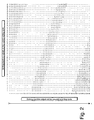
- the Figure 2 matrix nevertheless still shows utilization of outputs U of sorting machine 1 at the end of the sorting cycle considered and the previous sorting cycle of the sorting process relating to the same mail batch, and is in no way related to the sorting cycle performed immediately prior to the sorting cycle considered.
- the generic sorting cycle considered is referred to as the "current sorting cycle”; the sorting cycle preceding the current sorting cycle of a sorting process relating to the same mail batch as the current sorting cycle is referred to as the "logically preceding sorting cycle”; and the sorting cycle performed by sorting machine 1 immediately prior to the current sorting cycle is referred to as the "chronologically preceding sorting cycle”.
- the chronologically preceding sorting cycle therefore coincides with the logically preceding sorting cycle.
- the matrix comprises fifty rows and fifty columns indicated by respective progressive identification numbers.
- the column identification numbers are arranged in ascending order from left to right, and the row identification numbers in ascending order downwards.
- each column in the matrix also indicates the operating state of a respective output U of sorting machine 1 in the current sorting cycle, the term "operating state" being intended to mean the time intervals in which an output is available for sorting mail items, or is unavailable for sorting by reason of being programmed for clearing.
- each row and each column identification number in the Figure 2 matrix also identifies a respective output U of sorting machine 1 at the end of the current sorting cycle and the logically preceding sorting cycle.
- the actual physical position of the outputs of sorting machine 1 does not necessarily correspond to the progressive row and column numbers in the Figure 2 matrix, i.e. the outputs of sorting machine 1 are not necessarily arranged in ascending order corresponding to that of the row and column identification numbers.
- the output of sorting machine 1 represented by column “1” need not actually be the first output of sorting machine 1; and the output represented by column “2" - which, in the matrix, is adjacent to and follows the first column - need not actually be the second output of sorting machine 1 or even be adjacent to or follow the output represented by column "1".
- the progressive numeration of the rows and columns is therefore a "logical" numeration, to which a "physical" numeration (or arrangement) of the outputs corresponds on the basis of a predetermined relationship memorized in electronic control unit 22 and used in the sorting process to direct the mail items to the required output.
- logically adjacent outputs is intended to mean outputs of sorting machine 1 represented by rows or columns with successive identification numbers, even though the outputs may not be physically adjacent, and the positions of the outputs with respect to each other may bear no relationship to the respective row or column numbers.
- each box in the matrix defines a respective virtual matrix location to which a real address of a mail item delivery location may be assigned.
- each virtual location to which a delivery location is assignable may therefore be represented by the pair of numbers indicating the row and column of the respective box.
- each pair of numbers indicating the column and row of a respective virtual location also represents the output of sorting machine 1 which may be occupied, during the current sorting cycle and at the end of the logically preceding sorting cycle, by mail items bearing delivery locations related to that particular virtual location.
- the rules governing the way in which the delivery locations are sorted at the outputs of sorting machine 1 at the end of the current sorting cycle and the logically preceding sorting cycle are derived from the matrix, by respectively assigning to a delivery location related to a given box in the matrix the output of sorting machine 1 corresponding to the row number of the box in the logically preceding sorting cycle, and the output of sorting machine 1 corresponding to the column number of the box in the current sorting cycle.
- the virtual location relating to the code and the pair of row and column numbers defining the virtual location are determined, and the virtual location is used by sorting machine 1 to generate, via said table, control signals for controlling actuating members, such as blade selectors, transmission members, etc. (not shown), by which to define a path T along which to feed mail item 2 through sorting device 16 to the selected output Ui.
- the relationship between all the possible codes on mail items 2 and the corresponding virtual locations defined by said table is such as to define an assignment criterion by which to assign the delivery locations to the respective outputs of sorting machine 1 in conformance with said distribution order of mail items 2.
- the relationship defined by the table assigns the delivery locations to the boxes in the matrix in ascending column and row order as described below.
- the delivery locations are assigned starting with the box in the first row of the first column in the matrix (the top box in the first column) down to the box in the last row of the first column (bottom box in the first column), then starting from the box in the first row of the second column, down to the box in the last row of the second column, and so on for each successive column.
- the way in which the delivery locations are assigned to the virtual locations i.e. to the boxes in the matrix
- the boxes in the matrix contain 0 or 1 values indicating the operating state assumed at the boxes by the outputs of sorting machine 1 in the current sorting cycle and logically preceding sorting cycle.
- a “1" value indicates the box may be assigned a delivery location, and a "0" value that the box may not be assigned a delivery location.
- a box containing a 1 value will be referred to as an "addressable" box, and one containing a 0 value as a “non-addressable box".
- the object of the planning procedure for clearing the outputs of sorting machine 1 according to the present invention is therefore to define the number and locations of the non-addressable matrix boxes to which delivery locations cannot be assigned, so that the current sorting cycle contains time intervals in which no mail items are fed into the sorting machine outputs corresponding to the columns containing the non-addressable boxes, and the outputs may thus be cleared by a clearing resource during said time intervals.
- Each addressable box in the Figure 2 matrix i.e. each box to which a delivery location is assignable, may be assigned a numeric value having a particular meaning relating to mail item traffic.
- each numeric value may be related to the expected number of mail items to be delivered to the delivery location assigned to the addressable box to which the numeric value is assigned.
- the numeric value assigned to a box may indicate the number of mail items in absolute or exact terms or in terms of expected traffic.
- the sum of the numeric values assigned to the boxes in each row and each column is assigned a precise meaning related to the load (i.e. the expected number of mail items) in the output of sorting machine 1 corresponding to that particular row or column. More specifically, the sum of the numeric values assigned to the boxes in each row represents the load present at the output of sorting machine 1 corresponding to that particular row at the end of the sorting cycle logically preceding the current sorting cycle; and the sum of the numeric values assigned to the boxes in each column represents the load present at the output of sorting machine 1 corresponding to that particular column at the end of the current sorting cycle.
- Each row in the matrix may theoretically be assigned a so-called recycle time in which to recycle the mail items in the output corresponding to that particular row at the end of the logically preceding sorting cycle, i.e. to feed back into the sorting machine and again sort into the machine outputs all the mail items in the output corresponding to that row.
- the numeric values increase progressively, and may represent discrete values of a time quantity which progresses as the mail items in each sorting machine output at the end of the sorting cycle logically preceding the current sorting cycle are gradually fed back into the sorting machine to perform the current sorting cycle.
- the time progression in which the mail items are recycled is a parameter governing determination of the number and location of non-addressable boxes in the Figure 2 matrix to enable the sorting machine outputs to be cleared by a clearing resource.
- Non-addressable box pattern is shown by way of example in the Figure 2 matrix, in which the non-addressable boxes define an intermediate disabling band, in which all the sorting machine outputs substantially in the intermediate portion of the current sorting cycle may be cleared; and two lateral - respectively start and end - disabling bands located above and below the intermediate disabling band, and in which only some of the sorting machine outputs can be cleared at the initial and final portion respectively of the current sorting cycle, as explained in detail below.
- the intermediate disabling band is in the form of a sloping elongated strip extending from column 1 to column 50 and located at the intermediate rows in the matrix.
- the thickness and slope of the intermediate disabling band have particular meanings related to the clearing operations.
- the thickness of the intermediate disabling band which may be defined as the number of non-addressable boxes in the same column, is related to the time taken to clear an output of the sorting machine, and to the time which may be lost due to technical problems.
- the intermediate disabling band also slopes towards rows and columns with progressively increasing identification numbers, and the slope of the intermediate disabling band is related to the time progression, defined above, in which the mail items are fed back into the sorting machine and sorted into the machine outputs.
- This progressive shift by the clearing resource from output 1 to output 50 determines the slope of the intermediate disabling band, which slope is related to the time taken to clear an output, and to the time progression in which the mail items are recycled.
- the start disabling band is located in the top-right corner of the Figure 2 matrix, i.e. covers the initial rows (1-11) and substantially the second half of the columns (19-50) in the matrix, and enables a first group of sorting machine outputs corresponding to said columns to be cleared in the initial portion of the current sorting cycle.
- the start disabling band is substantially triangular in shape, the oblique side of which originates at a substantially intermediate column (19) in the matrix, slopes towards rows and columns with progressively increasing identification numbers, and has the same slope as the intermediate disabling band.
- the end disabling band is located in the bottom-left corner of the Figure 2 matrix, i.e. covers the final rows (40-50) and substantially the first half of the columns (1-31) in the matrix, and enables a second group of sorting machine outputs corresponding to said columns to be cleared in the final portion of the current sorting cycle.
- the end disabling band is substantially triangular in shape, the oblique side of which terminates at a substantially intermediate column (31) in the matrix, and has the same slope as the oblique side of the start disabling band and the intermediate disabling band.
- the start and end bands enable overlapping of the current sorting cycle and the chronologically preceding and chronologically next sorting cycle respectively.
- the start disabling band permits clearing, at the initial portion of the current sorting cycle (i.e. rows with low identification numbers), of roughly the second half of the sorting machine outputs still containing the mail items sorted in the chronologically preceding sorting cycle; and the end disabling band permits clearing, at the final portion of the current sorting cycle (i.e. rows with high identification numbers), of the remaining first half of the sorting machine outputs still containing mail items sorted in the chronologically preceding sorting cycle.
- a clearing resource may begin clearing roughly a first half of the sorting machine outputs at the final portion of the current sorting cycle, and continue clearing the remaining second half of the sorting machine outputs at the initial portion of the chronologically next sorting cycle.
- the current sorting cycle and clearing of the outputs relative to the chronologically preceding sorting cycle may be overlapped, with no interruption in the sorting process; and it is no longer necessary to wait for the end of one sorting cycle to clear the sorting machine outputs before commencing the next sorting cycle.
- the substantially triangular shape of the start and end disabling bands is therefore to enable overlapping of the current sorting cycle and the clearing operations required before and after.
- the shape and area of the start and end disabling bands are such that, when two matrixes of the Figure 2 type are brought together vertically, a disabling band is formed which, at the central columns of the matrix, should conveniently be of at least the same thickness as the intermediate disabling band, so as to enable the clearing resource to begin clearing the outputs corresponding to the central columns at the current sorting cycle, and to complete clearing the outputs at the chronologically next sorting cycle.
- the thickness of the start and end bands must not only be such as to enable the outputs to be cleared, bust must also so extend along the columns as to ensure no further mail items are fed into the cleared outputs.
- the thickness of the start and end disabling bands increases away from the central columns in the Figure 2 matrix, so that, once cleared by the clearing resource, the outputs receive no further mail items in the course of the same sorting cycle.
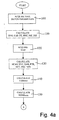
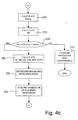
- the object of the clearing planning procedure - described below with reference to the flow chart in Figures 4a-4d - is therefore to determine the parameters by which to define the shape and number of intermediate disabling bands, and the shape of the start and end disabling bands.
- a block 100 acquires a number of parameters relative to the characteristics of the mail batch for processing, the sorting machine used, mail item feed, and the clearing operations.
- block 100 acquires :
- Block 100 is followed by a block 110, which calculates the values of a first series of parameters relating to processing of the mail batch, and by which to define the intermediate disabling band and the start and end disabling bands.
- block 110 calculates:
- Block 110 is followed by a block 120, which acquires the percentage XAD of matrix boxes to be kept free with respect to the number of delivery locations D in the mail batch.
- Block 120 is followed by a block 130, which calculates the values of a second series of parameters relating to processing of the mail batch, and by which to define the disabling bands.
- block 130 calculates:
- Block 150 is followed by a block 160, which determines whether the maximum number of intermediate clearing operations NSWFmax is greater than or equal to 1.
- block 160 goes on to a block 180; conversely, if NSWFmax is less than 1 (NO output of block 160), block 160 goes on to a block 170 in which NSWFmax is made equal to 0, by the feed characteristics indicating no need for intermediate clearing operations.
- Block 170 is followed by block 180 which acquires the maximum number of user-permitted intermediate clearing operations NSWUmax, and the user-selected number of intermediate clearing operations NSW.
- Block 180 is followed by a block 190 which determines whether the user-selected number of intermediate clearing operations NSW falls within an acceptance range defined by NSWFmax and NSWUmax, and in particular whether NSW is less than NSWmin or greater than the lesser of NSWFmax and NSWUmax, i.e. whether : NSWmin ⁇ NSW ⁇ MIN(NSWFmax, NSWUmax)
- block 190 goes on to a block 210; conversely, if NSW is outside said acceptance range (NO output of block 190), block 190 goes on to a block 200 which indicates the planning procedure cannot be performed and why. The planning procedure is then terminated.
- Block 210 calculates:
- Block 250 is followed by a block 260 which determines whether the intermediate disabling band thickness SB and the user-selected number of clearing operations NSW meet the maximum total disabling band thickness SBmax requirement, and in particular whether: SB* (NSW+FSF) ⁇ SBmax
- block 260 goes on to a block 280; conversely, if the maximum total disabling band thickness SBmax requirement is not met (NO output of block 260), block 260 goes on to a block 270 which indicates the planning procedure cannot be performed and why. The planning procedure is then terminated.
- Block 280 calculates the parameters by which to define the intermediate disabling band and the start and end disabling bands, and which are calculated by means of straightforward geometric considerations relative to the matrix.
- block 280 calculates:
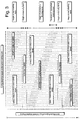
- Figure 3 shows the Figure 2 matrix illustrating the intermediate disabling band, the start and end bands, the feed-only bands, simultaneous feed-and-clear bands, and the respective heights.
- Block 280 is followed by a block 290 which, on the basis of the parameters calculated above, determines the equations of the intermediate disabling band and the lateral disabling bands.
- Block 290 is followed by a block 300 which acquires the number of clearing resources NR available to clear the sorting machine outputs.
- Block 300 is followed by a block 310 which determines whether the number of clearing resources NR is greater than one.
- block 310 goes on to a block 320; conversely, if the number of clearing resources equals one (NO output of block 310), block 310 goes on to a block 350.
- each clearing resource is assigned a respective group of sorting machine outputs; and the outputs in each group are so selected as to provide for efficient clearing by the respective clearing resource.
- Block 320 is followed by a block 330 in which each group of sorting machine outputs is assigned a respective group of matrix columns according to a first assignment criterion.
- each clearing resource being assigned a respective submatrix of the Figure 2 matrix, which submatrix has the same number of rows as the Figure 2 matrix, but a smaller number of columns equal to the number of sorting machine outputs assigned to the clearing resource.
- each submatrix looks" the same as the Figure 2 matrix, i.e. has a start disabling band, an end disabling band, and one or more intermediate disabling bands as shown in Figure 2.
- a first may be assigned a first group of outputs defined by the first half of the sorting machine outputs, and the second may be assigned a second group of outputs defined by the second half of the sorting machine outputs.
- the first group of outputs may be assigned the even-numbered columns in the Figure 2 matrix
- the second group of outputs may be assigned the odd-numbered columns in the Figure 2 matrix.
- Block 330 is followed by a block 340 which, for each group of sorting machine outputs assigned to each clearing resource, defines an output clearing sequence designed to ensure efficient clearing by the respective clearing resource.
- each sorting machine output is assigned a respective matrix column according to an assignment order.
- the physical numbers of the sorting machine outputs may correspond perfectly to the identification numbers of the columns in the matrix.
- the planning procedure Upon completion of the operation in block 340 or 350, the planning procedure is terminated, and is followed by known procedures for assigning delivery locations to the available Figure 2 matrix boxes, and determining tables - one for each sorting cycle - relating each delivery location to a respective sorting machine output into which the mail items relating to that particular delivery location are to be fed in the course of the sorting cycle.
- the clearing planning procedure according to the invention provides for considerable saving in time and resources by dissociating the clearing and sorting operations at the outputs, so that not only may one or more intermediate clearing operations of the sorting machine outputs be performed in the course of a sorting cycle, with no interruption in the sorting process, but clearing of the outputs may also be commenced at the final portion of the sorting cycle and continued at the initial portion of the chronologically next sorting cycle.
- the current sorting cycle and clearing of the outputs relative to the chronologically preceding sorting cycle may be overlapped; and it is no longer necessary to wait for the end of one sorting cycle to clear the sorting machine outputs before commencing the next sorting cycle.
- non-addressable box pattern in the Figure 2 matrix may be other than as shown.
- the start and/or end disabling band may be dispensed with, and only the intermediate disabling band provided to enable clearing of all the sorting machine outputs at the intermediate portion of the current sorting cycle.
- the Figure 2 matrix may comprise two or more spaced, parallel intermediate disabling bands - with or without start and end disabling bands - each enabling all the sorting machine outputs to be cleared in what, in this case, may be considered the intermediate portion of the current sorting cycle.
- the number of boxes in the start and end disabling bands may be other than as shown.
- start and end disabling bands may be larger or smaller in area, with the oblique sides originating or terminating at columns other than those shown.
- the start disabling band is always located at the initial rows and at columns comprising at least the final columns in the matrix; and the end disabling band is always located at the final rows and at columns comprising at least the initial columns in the matrix.
- the areas of the start and end disabling bands should, however, be such that, when two matrixes of the Figure 2 type are brought together vertically, a disabling band is formed which, at any point, should conveniently be of at least the same thickness as the intermediate disabling band, so as to enable the clearing resource to begin clearing the outputs corresponding to the central columns at the current sorting cycle, and to complete clearing the outputs at the chronologically next sorting cycle.
Landscapes
- Sorting Of Articles (AREA)
- Management, Administration, Business Operations System, And Electronic Commerce (AREA)
- Devices For Checking Fares Or Tickets At Control Points (AREA)
- Computer And Data Communications (AREA)
- Information Transfer Between Computers (AREA)
Applications Claiming Priority (2)
| Application Number | Priority Date | Filing Date | Title |
|---|---|---|---|
| ITTO980713 | 1998-08-14 | ||
| IT1998TO000713A IT1309548B1 (it) | 1998-08-14 | 1998-08-14 | Procedura di pianificazione dello svuotamento delle uscite di unamacchina postale durante un processo di sequenziazione di oggetti |
Publications (2)
| Publication Number | Publication Date |
|---|---|
| EP0980720A2 true EP0980720A2 (de) | 2000-02-23 |
| EP0980720A3 EP0980720A3 (de) | 2001-01-17 |
Family
ID=11416999
Family Applications (1)
| Application Number | Title | Priority Date | Filing Date |
|---|---|---|---|
| EP99115923A Withdrawn EP0980720A3 (de) | 1998-08-14 | 1999-08-12 | Verwaltung einer Postgutsortieranlage |
Country Status (4)
| Country | Link |
|---|---|
| US (1) | US6337451B1 (de) |
| EP (1) | EP0980720A3 (de) |
| IT (1) | IT1309548B1 (de) |
| NO (1) | NO319113B1 (de) |
Families Citing this family (9)
| Publication number | Priority date | Publication date | Assignee | Title |
|---|---|---|---|---|
| US6587806B2 (en) * | 2000-12-29 | 2003-07-01 | Pitney Bowes Inc. | Method and system for determining time to sort mailpieces |
| US7528339B2 (en) * | 2003-07-31 | 2009-05-05 | Lockheed Martin Corporation | Sequencing system and method of use |
| US7723633B2 (en) * | 2003-07-31 | 2010-05-25 | Lockheed Martin Corporation | Sequencing system and method of use |
| DE102004035365A1 (de) * | 2004-07-21 | 2006-02-16 | Deutsche Post Ag | Verfahren und Vorrichtung zum Sortieren von Postsendungen |
| KR100734626B1 (ko) * | 2005-07-15 | 2007-07-03 | 한국전자통신연구원 | 등기 우편물 처리 방법 및 시스템 |
| US7860602B2 (en) * | 2006-05-30 | 2010-12-28 | Xerox Corporation | Mail processing system |
| US7937184B2 (en) | 2006-10-06 | 2011-05-03 | Lockheed Martin Corporation | Mail sorter system and method for productivity optimization through precision scheduling |
| US8392135B2 (en) * | 2010-08-12 | 2013-03-05 | Smurfit-Stone Container Enterprises, Inc. | Methods and systems for analyzing performance of a sorting system |
| CN118719581B (zh) * | 2024-08-30 | 2024-11-15 | 启东荻捷工业成套设备有限公司 | 基于数字化仿真的矩阵分拣系统 |
Family Cites Families (6)
| Publication number | Priority date | Publication date | Assignee | Title |
|---|---|---|---|---|
| US5518122A (en) * | 1991-08-09 | 1996-05-21 | Westinghouse Electric Corp. | Modular mail processing method and control system |
| JP3389717B2 (ja) * | 1994-12-22 | 2003-03-24 | 株式会社日立製作所 | 紙葉類区分方法及びその装置 |
| JPH09239325A (ja) * | 1996-03-11 | 1997-09-16 | Hitachi Ltd | 郵便物配達順並べ替え区分方法および装置 |
| NL1003154C2 (nl) * | 1996-05-17 | 1997-11-18 | Nederland Ptt | Werkwijze voor het sorteren op bestelvolgorde van poststukken. |
| DE19629125C2 (de) * | 1996-07-19 | 2000-04-06 | Siemens Ag | Verfahren zum Sortieren von Sendungen |
| DE59706943D1 (de) * | 1996-09-09 | 2002-05-16 | Siemens Ag | Verfahren und Einrichtung zum Steuern einer Vorrichtung zum Verteilen von Sortiergutstücken auf physikalische Zielstellen |
-
1998
- 1998-08-14 IT IT1998TO000713A patent/IT1309548B1/it active
-
1999
- 1999-08-11 NO NO19993879A patent/NO319113B1/no unknown
- 1999-08-12 EP EP99115923A patent/EP0980720A3/de not_active Withdrawn
- 1999-08-16 US US09/373,974 patent/US6337451B1/en not_active Expired - Fee Related
Also Published As
| Publication number | Publication date |
|---|---|
| US6337451B1 (en) | 2002-01-08 |
| NO993879D0 (no) | 1999-08-11 |
| NO993879L (no) | 2000-02-15 |
| NO319113B1 (no) | 2005-06-20 |
| ITTO980713A0 (it) | 1998-08-14 |
| IT1309548B1 (it) | 2002-01-23 |
| ITTO980713A1 (it) | 2000-02-14 |
| EP0980720A3 (de) | 2001-01-17 |
Similar Documents
| Publication | Publication Date | Title |
|---|---|---|
| EP1090692B1 (de) | Verfahren zum Optimieren eines Postgutsortierverfahrens | |
| CA2205166C (en) | Method for sorting items of mail in order of delivery | |
| US5901855A (en) | Method and apparatus for sorting and rearranging mails in sequence sorting | |
| US6946612B2 (en) | Mail sequencing system | |
| EP0916412B1 (de) | Verfahren zum Sortieren von Poststücken | |
| EP0980720A2 (de) | Verwaltung einer Postgutsortieranlage | |
| US3573748A (en) | Postal system | |
| US6365862B1 (en) | Ergonomic method for sorting and sweeping mail pieces | |
| CN110027881A (zh) | 物品重新排列装置 | |
| EP1220721B1 (de) | Einrichtung und verfahren zum ordnen von flachen sendungen | |
| US7060928B2 (en) | Method for sorting in a distribution order | |
| CN106414249A (zh) | 一种离散式物品的分配方法、定量分配方法及其分配装置 | |
| US20130134075A1 (en) | Method and device for sorting objects by means of intermediate storage units | |
| CN106794913B (zh) | 离散式物品的分配方法、补差分配方法及分配装置 | |
| EP2231344B1 (de) | Verfahren zum Sortieren von Postsendungen verschiedener Formate und Sortiermaschine | |
| AU2012321025A1 (en) | Computerised control device and computer-implemented method for controlling a product processing plant, and computer program product | |
| US7493189B2 (en) | Method for sorting mailings according to the distribution sequence | |
| RU2511538C1 (ru) | Способ оптимизации процесса обработки и транспортировки почты в лотках с использованием послойной сортировки | |
| EP0216409A1 (de) | Verfahren und Vorrichtung für die mechanische Entladung von gebackenen Produkten, insbesondere Bäckereierzeugnisse aus einem Backofen | |
| EP4001190B1 (de) | Sortiersystem zum sortieren von artikeln und verfahren zum betreiben des sortiersystems | |
| JP2024543527A (ja) | コンベヤシステムにおける品物の動的仕分け | |
| RU2749385C1 (ru) | Способ определения входящих потоков грузов в один исходящий поток на логистическом складе | |
| CN106697692A (zh) | 一种基于分拣机的货品自动分拣方法及其系统 | |
| EP0947962A2 (de) | Eine Methode zum Ausgleichen der Last in einem Prozess zum Sortieren von Gegenständen | |
| EP1647338A1 (de) | Verfahren und Vorrichtung zum bestellungsabhängigen Sortieren von Produkten |
Legal Events
| Date | Code | Title | Description |
|---|---|---|---|
| PUAI | Public reference made under article 153(3) epc to a published international application that has entered the european phase |
Free format text: ORIGINAL CODE: 0009012 |
|
| AK | Designated contracting states |
Kind code of ref document: A2 Designated state(s): CH DE ES FR GB IT LI |
|
| AX | Request for extension of the european patent |
Free format text: AL;LT;LV;MK;RO;SI |
|
| PUAL | Search report despatched |
Free format text: ORIGINAL CODE: 0009013 |
|
| AK | Designated contracting states |
Kind code of ref document: A3 Designated state(s): AT BE CH CY DE DK ES FI FR GB GR IE IT LI LU MC NL PT SE |
|
| AX | Request for extension of the european patent |
Free format text: AL;LT;LV;MK;RO;SI |
|
| 17P | Request for examination filed |
Effective date: 20010628 |
|
| AKX | Designation fees paid |
Free format text: CH DE ES FR GB IT LI |
|
| GRAH | Despatch of communication of intention to grant a patent |
Free format text: ORIGINAL CODE: EPIDOS IGRA |
|
| STAA | Information on the status of an ep patent application or granted ep patent |
Free format text: STATUS: THE APPLICATION IS DEEMED TO BE WITHDRAWN |
|
| 18D | Application deemed to be withdrawn |
Effective date: 20030207 |