EP0980841A2 - Pile de serviettes humides - Google Patents
Pile de serviettes humides Download PDFInfo
- Publication number
- EP0980841A2 EP0980841A2 EP99306334A EP99306334A EP0980841A2 EP 0980841 A2 EP0980841 A2 EP 0980841A2 EP 99306334 A EP99306334 A EP 99306334A EP 99306334 A EP99306334 A EP 99306334A EP 0980841 A2 EP0980841 A2 EP 0980841A2
- Authority
- EP
- European Patent Office
- Prior art keywords
- wet tissue
- folded
- group
- wet
- tissues
- Prior art date
- Legal status (The legal status is an assumption and is not a legal conclusion. Google has not performed a legal analysis and makes no representation as to the accuracy of the status listed.)
- Granted
Links
Images





Classifications
-
- A—HUMAN NECESSITIES
- A47—FURNITURE; DOMESTIC ARTICLES OR APPLIANCES; COFFEE MILLS; SPICE MILLS; SUCTION CLEANERS IN GENERAL
- A47K—SANITARY EQUIPMENT; ACCESSORIES THEREFOR, e.g. TOILET ACCESSORIES
- A47K10/00—Body-drying implements; Toilet paper; Holders therefor
- A47K10/16—Paper towels; Toilet paper; Holders therefor
- A47K10/18—Holders; Receptacles
- A47K10/20—Holders; Receptacles for piled sheets
-
- A—HUMAN NECESSITIES
- A47—FURNITURE; DOMESTIC ARTICLES OR APPLIANCES; COFFEE MILLS; SPICE MILLS; SUCTION CLEANERS IN GENERAL
- A47K—SANITARY EQUIPMENT; ACCESSORIES THEREFOR, e.g. TOILET ACCESSORIES
- A47K10/00—Body-drying implements; Toilet paper; Holders therefor
- A47K10/24—Towel dispensers; Toilet paper dispensers
- A47K10/32—Dispensers for paper towels or toilet paper
- A47K10/42—Dispensers for paper towels or toilet paper dispensing from a store of single sheets, e.g. stacked
- A47K10/421—Dispensers for paper towels or toilet paper dispensing from a store of single sheets, e.g. stacked dispensing from the top of the dispenser
-
- B—PERFORMING OPERATIONS; TRANSPORTING
- B65—CONVEYING; PACKING; STORING; HANDLING THIN OR FILAMENTARY MATERIAL
- B65H—HANDLING THIN OR FILAMENTARY MATERIAL, e.g. SHEETS, WEBS, CABLES
- B65H45/00—Folding thin material
- B65H45/12—Folding articles or webs with application of pressure to define or form crease lines
- B65H45/24—Interfolding sheets, e.g. cigarette or toilet papers
-
- A—HUMAN NECESSITIES
- A47—FURNITURE; DOMESTIC ARTICLES OR APPLIANCES; COFFEE MILLS; SPICE MILLS; SUCTION CLEANERS IN GENERAL
- A47K—SANITARY EQUIPMENT; ACCESSORIES THEREFOR, e.g. TOILET ACCESSORIES
- A47K10/00—Body-drying implements; Toilet paper; Holders therefor
- A47K10/24—Towel dispensers; Toilet paper dispensers
- A47K10/32—Dispensers for paper towels or toilet paper
- A47K2010/3266—Wet wipes
-
- A—HUMAN NECESSITIES
- A47—FURNITURE; DOMESTIC ARTICLES OR APPLIANCES; COFFEE MILLS; SPICE MILLS; SUCTION CLEANERS IN GENERAL
- A47K—SANITARY EQUIPMENT; ACCESSORIES THEREFOR, e.g. TOILET ACCESSORIES
- A47K10/00—Body-drying implements; Toilet paper; Holders therefor
- A47K10/24—Towel dispensers; Toilet paper dispensers
- A47K10/32—Dispensers for paper towels or toilet paper
- A47K10/42—Dispensers for paper towels or toilet paper dispensing from a store of single sheets, e.g. stacked
- A47K2010/428—Details of the folds or interfolds of the sheets
-
- Y—GENERAL TAGGING OF NEW TECHNOLOGICAL DEVELOPMENTS; GENERAL TAGGING OF CROSS-SECTIONAL TECHNOLOGIES SPANNING OVER SEVERAL SECTIONS OF THE IPC; TECHNICAL SUBJECTS COVERED BY FORMER USPC CROSS-REFERENCE ART COLLECTIONS [XRACs] AND DIGESTS
- Y10—TECHNICAL SUBJECTS COVERED BY FORMER USPC
- Y10S—TECHNICAL SUBJECTS COVERED BY FORMER USPC CROSS-REFERENCE ART COLLECTIONS [XRACs] AND DIGESTS
- Y10S206/00—Special receptacle or package
- Y10S206/812—Packaged towel
Definitions
- the present invention relates to a wet tissue product having a stacked body of folded wet tissues housed in a container or package.
- wet tissues are sealed and housed in a container or package so as to keep their wet state before use or when unused. These wet tissues are folded and sequentially stacked to have combined areas so that they are sequentially pulled out one by one from an outlet provided in the container or package. When the wet tissue at the uppermost position is pulled out, a portion of the succeeding wet tissue protrudes from the outlet of the container. This is generally called the "pop-up type".
- the protrusion of the wet tissue from the outlet is excessively large, it is not confined within the area of a cover which is usually provided with the container or package to close (or cover around) the outlet, so that the protrusion partially extends from the cover and dries up. Further, if the wet tissue thus partially extends from the cover, this cover is not reliably closed to lower the sealability of the container or package so that the wet tissues inside of the container or package are susceptible to drying out.
- Fig. 7 shows another method to form a pop-up type wet tissue stacked body.
- each wet tissue is folded in three into a "Z" shape to form an upper folded portion, a lower folded portion and an intermediate folded portion between them (or with one edge upward and with the other edge downward).
- the three-folded wet tissues are stacked such that the upper folded portion of each wet tissue is sandwiched between the intermediate portion and the lower portion of the overlying wet tissue and the lower folded portion thereof is sandwiched between the upper folded portion and the intermediate portion of the underlying wet tissue.
- the protrusion from the outlet can be made smaller than that shown in Fig. 6 , to one third of the area of the unfolded wet tissue.
- the stacked body has a thickness of 1.5 times as large as that of the stacked body which is formed of an equal number of wet tissues and in which each wet tissue is folded into two (or into the V-shape).
- each wet tissue is folded in two, in the same manner as shown in Fig. 6 , and thereafter a lower half of each wet tissue is further folded downward in two, so as to have an upper half, a small intermediate portion and a small lower portion. That is, each wet tissue is folded into a deformed Z-shape.
- the wet tissues are stacked so that the upper half of each wet tissue is sandwiched between the upper half and the small intermediate portion of the overlying wet tissue.
- the protrusion of the wet tissue from the outlet is proper (at about one quarter of the area of the unfolded wet tissue).
- the stacked body is not as high as compared with that shown in Fig. 6 .
- the upper half of the wet tissue positioned third from the top is making contact, over a wide area with both the wet tissue positioned at the top and the wet tissue positioned second from the top.
- the wet tissue positioned third from the top may also protrude from the outlet.
- the smaller lower portion is dragged on the upper half of the wet tissue positioned third from the top, thereby unfolding the lower half and making the uppermost wet tissue into the V-shape.
- the upper half of the succeeding wet tissue is so wholly protruded from the outlet that its protrusion becomes as large as one half of the area of the unfolded wet tissue.
- the individual wet tissues are combined in a very complicated manner making it difficult to pull them out one by one via the necessary protrusion.
- conventional methods of separating the wet tissues either make the outlet of the container housing them extremely narrow or establish a resistance by a resisting portion provided at the outlet. In this case, however, a considerable amount of hard work is required to pull out the wet tissues one by one.
- the container is also raised together with the wet tissue and must be held with the hands thereby making the pull-out very inconvenient.
- the invention has been conceived to solve the problems of the prior art thus far described, and has an object to provide a wet tissue product whereby when a wet tissue is pulled out, the protrusion of the succeeding wet tissue is small.
- Another object of the invention is to provide a wet tissue product from which a wet tissue can be pulled out always with a constant protrusion.
- the invention provides a wet tissue product comprising a stacked body of folded wet tissues and a container or package housing said stacked body,
- an area of the upper folded portion is equal to that of the lower folded portion.
- the area of the respective upper and lower folded portions is about one quarter of that of the plane wet tissue before folding.
- the plane wet tissue to form the first-group of folded wet tissue and the plane wet tissue to form the second-group of folded wet tissue are identical to each other in shape and size.
- the wet tissue exhibits a lower adhesion at one face and a higher adhesion at the other face to another wet tissue in a face-to-face contacting relationship
- the first-group of folded wet tissues and second-group of folded wet tissues are combined such that the face of a lower adhesion and the other face of a higher adhesion confront each other at a combined area where the half of the first-group of folded wet tissue and the folded portion of the second-group of folded wet tissue overlap with each other.
- the container or package has an outlet which is positioned to confront the central portion of the faces of the folded wet tissues.
- one of the second-group of folded wet tissues is preferably arranged at the uppermost position of the stacked body. More preferably, one of the second-group of folded wet tissues is arranged at the lowermost position of the stacked body as well.
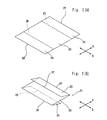
- Figs. 1(A) and 1(B) are perspective views showing a method of folding a wet tissue to form a first-group of folded wet tissue
- Figs. 2(A) and 2(B) are perspective views showing a method of folding a wet tissue to form a second-group of folded wet tissue
- Fig. 3 is a section for explaining a method of combining the folded wet tissues of the first group and the second group
- Fig. 4 is a section showing the wet tissue product of the invention.
- Folded wet tissues of the invention fall into two groups; a first group of folded wet tissues and a second group of folded wet tissues.
- first-group of folded wet tissues are indicated by 11 (including 11a and 11b )
- second-group of folded wet tissues are indicated by 21 (including 21a and 21b ).
- the first-group of folded wet tissue 11 is formed by folding a plane wet tissue in two.
- the plane wet tissue has a rectangular shape (a lateral dimension in the direction X and a longitudinal dimension in the direction Y).
- This plane wet tissue is folded in two along a generally central folding line (or laterally extending centerline) 14 into a shape generally of letter "V", as shown in Fig. 1(B) .
- an upper half 12 and a lower half 13 have substantially equal areas and are symmetric with respect to the folding line 14.
- the second-group of folded wet tissue 21 is formed by folding a plane wet tissue into three portions.
- the plane wet tissue for the second-group of folded wet tissue 21 has the same rectangular shape and size (a lateral dimension in the direction X and a longitudinal dimension in the direction Y) as that shown in Fig. 1(A) .
- This plane wet tissue is folded along folding lines 25 and 26 , with its laterally extending edges 27 and 28 in the opposite directions ( i.e ., upward and downward, respectively).
- the second-group of folded wet tissue 21 thus obtained has a shape generally of the letter "Z", as shown in Fig. 2(B) .
- the second-group of folded wet tissue 21 has an upper folded portion 22 and a lower folded portion 24 while leaving an intermediate portion 23 between them.
- the folding lines 25 and 26 extend in the direction X (i.e., the lateral direction of the unfolded wet tissue), and the folding line 25 is spaced from the edge 27 by about one quarter of the longitudinal dimension of the plane wet tissue ( i.e. , unfolded wet tissue) whereas the folding line 26 is spaced from the edge 28 by about one quarter of the longitudinal dimension of the plane wet tissue ( i.e ., unfolded wet tissue).
- the first-group of folded wet tissues 11 and the second-group of folded wet tissues 21 thus obtained are alternately stacked one by one, as shown in Fig. 3.
- the intermediate portion 23 and the lower folded portion 24 of the second-group of wet tissue 21a is sandwiched between the upper half 12 of the first-group of wet tissue 11a which is located below the second-group of wet tissue 21a .
- the upper half 12 and the lower half 13 of the first-group of wet tissue 11a moreover, is sandwiched between the upper folded portion 22 of the second-group of wet tissue 21b which is located below first-group of wet tissue 11a . That is, the lower half 13 of the first-group of wet tissue 11a is sandwiched between the upper folded portion 22 and the intermediate portion 23 of the second-group of wet tissue 21b .
- the first-group of folded wet tissues 11 and the second-group of folded wet tissues 21 are sequentially combined in the aforementioned manners to provide a stacked body 30 of wet tissues, as shown in Fig. 4 .
- This wet tissue stacked body 30 is constructed by combining a number of wet tissues, e.g. , fifty or one hundred.
- the wet tissue stacked body 30 is housed in a container 31 having an outlet 32 for pulling out the wet tissues, to provide a wet tissue product of the invention.
- the container 31 is sealed up excepting the outlet 32 so that its wet tissues may be prevented from drying up, although its bottom is omitted in Fig. 4.
- the container 31 is generally provided with a cover (or lid) for closing (or covering) the outlet 32, although it is omitted in Fig. 4.
- the uppermost second-group of wet tissue 21a is pinched at its edge 27 through the outlet 32 and is pulled out of the outlet 32.
- about a half of the upper half 12 of the underlying first-group of wet tissue 11a is adhered to and lifted up with the lower folded portion 24 of the wet tissue 21a , and then comes out of the outlet 32.
- the wet tissue 11a is lifted up together with the wet tissue 21a , until a combined area 50 comes out of the outlet 32 .
- combined area means an area where the lower wet tissue is located over the upper wet tissue, i.e., an area where the upper or lower half of the first-group of folded wet tissue 11 and the upper or lower folded portion of the second-group of folded wet tissue 21 overlap with each other. Then, the wet tissue 21a is separated from the wet tissue 11a by the resistance which is established as the wet tissue 11a comes into contact with the outlet 32.
- the first-group of wet tissue 11a is pulled out of the outlet 32 .
- the upper folded portion 22 of the underlying second-group of wet tissue 21b is adhered to and lifted up with about a half of the lower half 13 of the wet tissue 11a , and then comes out of the outlet 32 .
- the wet tissue 21b is lifted up together with the wet tissue 11a , until a combined area 51 comes out of the outlet 32 .
- the wet tissue 11a is separated from the wet tissue 21b by the resistance which is established as the wet tissue 21b comes into contact with the outlet 32 .
- the second-group of wet tissue 21b is pulled out of the outlet 32 .
- the second-group of wet tissue 21a is pulled out, about a half of the upper half 12 of the underlying first-group of wet tissue 11b is adhered to and lifted up with the lower folded portion 24 of the wet tissue 21b, and then comes out of the outlet 32.
- the wet tissue 11b is lifted up together with the wet tissue 21b , until a combined area 52 comes out of the outlet 32.
- the wet tissue 21b is separated from the wet tissue 11b by the resistance which is established as the wet tissue 11b comes into contact with the outlet 32.
- the protrusion of the wet tissue from the outlet 32 is substantially equal to the size of the combined area between the upper and lower wet tissues.
- the size of the combined area is substantially equal to or smaller than the folded portion 22 or 24 .
- the protrusion of the wet tissue from the outlet 32 is one quarter or less than the area of the plane wet tissue (unfolded wet tissue).
- the face-to-face contact between wet tissues may have increased adhesion due to the surface tension of the water which is contained therein. If the face-to-face contact between the wet tissues becomes excessively high, then when an upper wet tissue is pulled out, a succeeding wet tissue may be dragged with its protrusion more than necessary ( e.g., more than one quarter the area of the unfolded wet tissue). This may produce the unwanted result that several wet tissues are pulled out altogether. In this case, therefore, it is preferable to reduce the open area of the outlet 32 sufficiently, as shown in Fig. 5 , or to give the outlet 32 a corrugated shape or provide it with a resistive portion, thereby to give a proper resistance to the wet tissue.
- the adhesion at the combined area (as indicated by 50, 51 or 52 ) between the upper and lower wet tissues overcomes the resistance of the outlet 32 .
- the remaining portion, which underlies the combined area, of the lower wet tissue receives resistance from the outlet 32 so that the upper and lower wet tissues are separated from each other by the peeling force in the shearing direction when the combined area completely leaves the outlet 32 .
- the lower wet tissue is left inside the container 31 except for the portion put on the upper wet tissue.
- the open area of the outlet 32 can be enlarged (such that the major axis of the outlet 32 is slightly smaller than the width of the folded wet tissues).
- the resisting portion which could otherwise exhibit the resistance at the outlet 32 may not be formed. This is explained in detail below.
- the face-to-face contacting wet tissues require a high force for separating them in the shearing direction, but can easily be separated when they arc gradually peeled in the vertical direction from each other at their edges.
- the uppermost second-group of wet tissue 21a is in face-to-face contact at its lower folded portion 24 with the upper folded portion 22 of the second-group of wet tissue 21b positioned third from the top.
- the folding portion 24 of the wet tissue 21a and the folding portion 22 of the wet tissue 21b arc vertically peeled from their individual folding lines (or edges of the folded wet tissues) so that they are easily separated from each other.
- it is prevented that the second-group of wet tissue positioned third from the top is erroneously pulled out of the outlet together with the uppermost second-group of wet tissue.
- the first-group of wet tissue 11a when the first-group of wet tissue 11a appears on the top, this uppermost first-group of wet tissue 11a is in face-to-face contact only with the succeeding second-group of wet tissue 21b . That is, the uppermost first-group of wet tissue 11a is out of contact with the first-group of wet tissue 11b positioned third from the top. As in the aforementioned manner, in the invention, the first-group of wet tissue positioned third is not erroneously pulled out of the outlet together with the uppermost first-group of wet tissue.
- the force pulling out the upper wet tissue can act in a shearing direction at the combined area. Therefore, the lower wet tissue is not separated from the upper wet tissue until the combined area comes out of the outlet. As a result, the lower wet tissue never fails to protrude from the outlet.
- the adhesion (or the engaging force), which is established when the wet tissues contact in a face-to-face relation with each other through a liquid, is influenced by the differences in the roughness of the tissue surfaces and in the hydrophilic nature and water retention of fibers appearing on the tissue surfaces.
- the wet tissue is made of a spun lace nonwoven fabric, for example, it has a relatively smooth and good-sliding face (of a low adhesion (or engaging force)) on the side, which is directly treated by the water jets (or water flow for interlacing the fibers) at the step of making the spun lace nonwoven fabric, and a relatively rough and less-sliding face (of a high adhesion (or engaging force)) on the other side, which is not treated by the water jets and becomes fluffy.
- This result likewise applies to the wet tissue which is manufactured by the wet paper making process, and the side that confronts a cylinder mold in the paper making process becomes a relatively rough and less-sliding face (of a high adhesion (or engaging force)).
- a wet tissue made of a nonwoven fabric having a two-layered structure composed of a layer containing more hydrophobic fibers and a layer containing more hydrophilic fibers.
- the layer containing the hydrophobic fibers cannot easily retain water so that the adhesion by the surface tension of the liquid is lowered thereby providing a face having a relatively low adhesion (or engaging force).
- the other layer containing the hydrophilic fibers more readily retains the water so that the adhesion by the surface tension of the liquid is enhanced thereby providing a face having a relatively high adhesion (or engaging force).
- the upper and lower wet tissues are combined such that the face having a higher adhesion (i.e. , more adhesive face) and the face having a lower adhesion (i.e., less adhesive face) are confronted by each other at the combined area (as indicated by 50, 51 or 52 ). Therefore, the adhesion between the upper and lower wet tissues is not excessive but appropriate, and is homogeneous at all the combined areas.
- the face having a lower adhesion is designated by 40
- the face having a higher adhesion is designated by 41 .
- the second-group of wet tissue 21a positioned at the top and the first-group of wet tissue 11a positioned second from the top contact each other at the lower folded portion 24 of wet tissue 21a and the upper half 12 of wet tissue 11a , via the more adhesive face 41 and the less adhesive face 40 , which confront each other at the combined area 50 .
- the first-group of wet tissue 11a positioned second from the top and the second-group of wet tissue 21b pusitioned third from the top contact each other at the lower half 13 of the wet tissue 11a and the upper folded portion 22 of the wet tissue 21b , via the less adhesive face 40 and the more adhesive face 41 , which confront each other at the combined area 51 .
- the second-group of wet tissue 21a positioned at the top and the second-group of wet tissue 21b positioned third from the top are folded in a Z-shape with their front and back faces being the reverse of each other.
- the second-group of wet tissue 21b positioned third from the top and the first-group of wet tissue 11b positioned fourth from the top contact each other at the lower folded portion 24 of the wet tissue 21b and the upper half 12 of the wet tissue 11b , via the more adhesive face 41 and the less adhesive face 40, which confront each other at the combined area 52 .
- the first-group of wet tissue 11b positioned fourth from the top and the first-group of wet tissue 11a positioned second from the top are folded in a V-shape with their front and back faces being the reverse of each other.
- the first-group of wet tissues 11 having the more adhesive face 41 on the V-shaped valley side (or inner side) and the first-group of wet tissues 11 having the less adhesive face 40 on the V-shaped valley side are alternately arranged with the second-group of wet tissues 21 interposed therebetween.
- the second-group of wet tissues 21 having the more adhesive face 41 facing upward at the upper folded portion 22 and the second-group of wet tissues 21 having the less adhesive face 40 facing upward at the upper folded portion 22 are alternately arranged with the first-group of wet tissue 11 interposed therebetween.
- the resistance applied at the outlet 32 to the wet tissues can be lowered.
- the user can pull out the wet tissues one by one, exerting relatively little force, so that the wet tissue product provides an excellent feeling of use.
- the container 31 is rarely pulled up together with the wet tissue.
- the wet tissue is made of a nonwoven fabric having no difference in adhesion (or engaging force) between the front and back sides, it is unnecessary to consider the aforementioned combination.
- the wet tissue may be made of a nonwoven fabric having a three-layered structure, which is composed of two outer layers containing relatively more hydrophobic fibers and an intermediate layer containing relatively more hydrophilic fibers. If such a nonwoven fabric is employed there will be no difference in adhesion (or engaging force) between the front and back sides of the wet tissue, so that the adhesion between the upper and lower wet tissues is always constant at the combined areas (as indicated by 50, 51 and 52 ).
- the wet tissue may be made of a nonwoven fabric in which both the front and back faces are made uneven (or have recesses). This unevenness of the wet tissue faces makes it possible for the air to enter between the confronting faces of the upper and lower wet tissues, so that the surface tension of water is lowered thereby to lower the adhesion between the wet tissues.
- the degree of protrusion of the succeeding wet tissue from the outlet 32 is as small as about one quarter of the area of the unfolded wet tissue.
- the wet tissue is less dried compared with the prior art.
- the protruded portion is excellent in appearance.
- the protruded portion of the wet tissue from the outlet 32 can be easily confined within the area of the cover when it is closed to cover the outlet 32, so that scaling the container 31 is easily carried out.
- the first-group of wet tissue 11 is formed by folding a plane wet tissue in two, the folding process is easy to carry out, and the upper half 12 and the lower half 13 hardly have a dispersion in their folded areas at the time of mass production.
- the second-group of folded wet tissue 21 shown in Fig. 2(B) has a thickness equal to that of two plane wet tissues. This thickness is equal to that of the first-group folded wet tissue 11 , as shown in Fig. 1(B) . Therefore, the overall height of the wet tissue stacked body 30 does not become much higher than that of the prior art, in which all the wet tissues are doubled and stacked, as shown in Fig. 6 .
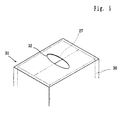
- Fig. 5 is a perspective view partially showing the exterior of the unused wet tissue stacked body 30 which is housed in the container 31 of Fig. 4 .
- the outlet 32 is disposed generally in the central portion of the upper face of the container 31. More specifically, the outlet 32 is located at a position to confront the central portion of the faces of the folded wet tissues which compose the wet tissue stacked body 30 housed in the container 31 .
- the second-group of folded wet tissue 21 exists at the uppermost position of the stacked body 30 so that the edge 27 appears at the center of the outlet 32 .
- the wet tissue 21 can be easily pulled out by pinching the edge 27 . Therefore, in a wet tissue product of the invention before use (or at the production process of the wet tissue product), it is preferred that the wet tissues are combined such that the second-group of folded wet tissue 21 confronts the outlet 32.
- the wet tissues are stacked in the same manner even when it is seen from the bottom side thereof ( i.e., even when it is observed in an upside down state).
- the outlet is located above in Fig. 4 , therefore, the wet tissues could be sequentially pulled out one by one even if the outlet were formed below.
- the wet tissue stacked body can be housed in a container or package regardless of its top and bottom in the stacking direction.
- the second-group of folded wet tissue 21 is arranged at the lowermost position of the stacked body 30 as well as at the uppermost position thereof, as shown in Fig. 4 , so as to facilitate the first pull-out of the wet tissue no matter which of the top or bottom of the stacked body 30 might confront the outlet.
- the wet tissues 11 and 21 are made of a nonwoven fabric or paper composed of natural fibers and/or synthetic fibers.
- a spun lace nonwoven fabric made of polyethylene or polypropylene and having a high wet strength.
- the wet tissues 11 and 21 can be impregnated with water, alcohol, humectants, surface active agents, perfumes, antiseptics, mildewcides, or the like.
- the container 31 is made relatively hard using a synthetic resin such as polyethylene, polypropylene, or the like.
- the container 31 is preferably provided with a cover for closing (covering around) the outlet 32 so as to seal the container 31 and prevent a protruding wet tissue from drying up.
- a package (or envelope) of a liquid-impermeable film may be used to house the wet tissue stacked body 30 .
- the wet tissue product of the invention can also be used as the so-called "refill package", in which the wet tissue stacked body 30 housed in the package is further housed in a hard container 31 .
- the first-group of folded wet tissues 11 and the second-group of folded wet tissues 21 are all formed by folding the plane wet tissues of the same shape and size, as shown in Figs. 1(A) and 2(A) .
- the first-group of folded wet tissues 11 and the second-group of folded wet tissues 21 may be formed by folding plane wet tissues having different dimensions in the longitudinal direction (in the direction Y) from each other.
- the locations of the individual folding lines are suitably adjusted to provide a preferable protrusion from the outlet 32 .
- the wet tissue stacked body can be prepared by forming the first-group of folded wet tissue using a plane wet tissue having a slightly smaller longitudinal dimension than that of a plane wet tissue for the second-group of folded wet tissue, and by stacking upper and lower wet tissues such that the area of the combined area between the upper and lower wet tissues may be about one fifth of the area of the plane wet tissue for the second-group folded wet tissue.
- the first-group of folded wet tissues 11 and the second-group of folded of wet tissues 21 are formed by using guides and are combined.
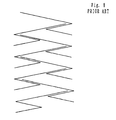
- a three-folded wet tissue is likely to have a deviation in size at its folding step in the production. Therefore, in the wet tissue stacked body of the prior art shown in Fig. 8 , for example, it is difficult to stack them in a secure manner because the stacked body is composed only of the three-folded wet tissues.
- the wet tissue stacked body 30 of the invention about half of the wet tissues are composed of the first-group of folded wet tissues 11.
- the first-group of folded wet tissue 11 can be accurate in size because its folding line 14 for folding a plane of wet tissue into two is identical to a centerline of the plane wet tissue.
- the production method can be made simple and the stacked state of the wet tissues can be made uniform, as compared with the wet tissue stacked body of the prior art which is composed only of the three-folded wet tissues, as shown in Fig. 8 . Further, when the stacked state of the wet tissues is uniform, the combined areas between the tissues can be made generally uniform, thereby making the degree of protrusion uniform.
- the combined areas between the wet tissues 11 and 21 do not have to be set accurately at one quarter of the area of the plane wet tissue, but may be less than or about one quarter of the area of the plane wet tissue.
- the combined areas between the wet tissues 11 and 21 are preferably about one quarter of the area of the plane wet tissue, but may be about one fifth or one sixth thereof.
- the combined areas are adjusted to such a degree that the protrusion of the wet tissue from the outlet can be pinched by fingers.
Landscapes
- Health & Medical Sciences (AREA)
- Public Health (AREA)
- Containers And Packaging Bodies Having A Special Means To Remove Contents (AREA)
- Sanitary Thin Papers (AREA)
Applications Claiming Priority (2)
| Application Number | Priority Date | Filing Date | Title |
|---|---|---|---|
| JP22677898 | 1998-08-11 | ||
| JP22677898A JP3485470B2 (ja) | 1998-08-11 | 1998-08-11 | ウェットティッシュの積層体とこれが収納された製品 |
Publications (3)
| Publication Number | Publication Date |
|---|---|
| EP0980841A2 true EP0980841A2 (fr) | 2000-02-23 |
| EP0980841A3 EP0980841A3 (fr) | 2000-10-11 |
| EP0980841B1 EP0980841B1 (fr) | 2003-10-15 |
Family
ID=16850471
Family Applications (1)
| Application Number | Title | Priority Date | Filing Date |
|---|---|---|---|
| EP99306334A Expired - Lifetime EP0980841B1 (fr) | 1998-08-11 | 1999-08-11 | Pile de serviettes humides |
Country Status (13)
| Country | Link |
|---|---|
| US (1) | US6250495B1 (fr) |
| EP (1) | EP0980841B1 (fr) |
| JP (1) | JP3485470B2 (fr) |
| KR (1) | KR100673358B1 (fr) |
| CN (1) | CN1119113C (fr) |
| AU (1) | AU732812B2 (fr) |
| BR (1) | BR9903644A (fr) |
| CA (1) | CA2279734C (fr) |
| DE (1) | DE69912048T2 (fr) |
| ID (1) | ID23484A (fr) |
| MY (1) | MY133115A (fr) |
| SG (1) | SG79273A1 (fr) |
| TW (1) | TW414069U (fr) |
Cited By (11)
| Publication number | Priority date | Publication date | Assignee | Title |
|---|---|---|---|---|
| EP0970909A3 (fr) * | 1998-07-10 | 2000-10-11 | Paper Converting Machine Company | Pile comprenant des feuilles pliées en V-Z |
| EP1127830A1 (fr) * | 2000-02-25 | 2001-08-29 | Georgia-Pacific France | Empilement et procédé d'empilement de feuilles souples pliées |
| US6604651B2 (en) | 2001-01-24 | 2003-08-12 | Kimberly-Clark Worldwide, Inc. | Storage and dispensing package for wipes |
| US6811638B2 (en) | 2000-12-29 | 2004-11-02 | Kimberly-Clark Worldwide, Inc. | Method for controlling retraction of composite materials |
| WO2004099051A1 (fr) * | 2003-05-05 | 2004-11-18 | Sca Hygiene Products Ab | Pile de feuilles de materiau entrepliees, et procede d'elaboration |
| US6840401B2 (en) | 2002-12-19 | 2005-01-11 | Kimberly-Clark Worldwide, Inc. | Multiple layer baffle structure for dispenser for wipes |
| WO2005102130A1 (fr) * | 2004-03-26 | 2005-11-03 | Kimberly-Clark Worldwide, Inc. | Distributeur |
| US7204390B2 (en) | 2003-05-05 | 2007-04-17 | Sca Hygiene Products Ab | Stack of interfolded material sheets and method for its production |
| US8273443B2 (en) | 2003-09-12 | 2012-09-25 | Sca Tissue North America Llc | Stack of interfolded absorbent sheet products |
| US8573398B2 (en) | 2002-05-28 | 2013-11-05 | Georgia-Pacific Consumer Products Lp | Refillable flexible sheet dispenser |
| US9017790B2 (en) | 2011-03-02 | 2015-04-28 | Cascades Canada Ulc | Absorbent sheet products and method for folding same |
Families Citing this family (49)
| Publication number | Priority date | Publication date | Assignee | Title |
|---|---|---|---|---|
| US6550634B1 (en) * | 1998-11-19 | 2003-04-22 | The Procter & Gamble Company | Single pop-up wet wipe dispensing system |
| JP3730105B2 (ja) * | 2000-10-04 | 2005-12-21 | ユニ・チャーム株式会社 | シート包装体 |
| US20020132543A1 (en) | 2001-01-03 | 2002-09-19 | Baer David J. | Stretchable composite sheet for adding softness and texture |
| NL1017652C2 (nl) * | 2001-03-20 | 2002-09-23 | Ocu Technologies B V | Werkwijze voor het verpakken van een verzameling beeldontvangstmateriaal en een verzameling beeldontvangstmateriaal omsloten door een houder. |
| JP4606662B2 (ja) * | 2001-08-03 | 2011-01-05 | 大王製紙株式会社 | ウェットティッシュ収容容器の取出口構造 |
| US7176150B2 (en) | 2001-10-09 | 2007-02-13 | Kimberly-Clark Worldwide, Inc. | Internally tufted laminates |
| US6685050B2 (en) * | 2001-12-20 | 2004-02-03 | Kimberly-Clark Worldwide, Inc. | Folded sheet product, dispenser and related assembly |
| US7063233B2 (en) * | 2002-06-13 | 2006-06-20 | Oneglove, Llc | Method of folding gloves and dispenser therefor |
| MXPA05004209A (es) * | 2002-11-12 | 2005-06-08 | Procter & Gamble | Proceso y aparato para preparar una trama de tela no tejida moldeada, texturizada e hilada por centrifugacion. |
| US6787209B2 (en) * | 2002-12-23 | 2004-09-07 | Tama Plastic Industry | Wrapping material with a Z-lock system and methods of making and using the same |
| US7541080B2 (en) * | 2002-12-23 | 2009-06-02 | Tama Plastic Industry | Wrapping material with a Z-lock system |
| US20040164085A1 (en) * | 2003-01-24 | 2004-08-26 | The Procter & Gamble Company | Wipe dispensing system |
| US20050011906A1 (en) * | 2003-07-15 | 2005-01-20 | Kimberly-Clark Worldwide, Inc. | Storing and dispensing container for product |
| US7125457B2 (en) * | 2003-12-31 | 2006-10-24 | General Electric Company | Method for removing oxide from cracks in turbine components |
| US7275658B2 (en) * | 2004-03-26 | 2007-10-02 | Kimberly-Clark Worldwide, Inc. | Dispenser capable of dispensing sheet-like articles |
| US7232040B2 (en) | 2004-03-26 | 2007-06-19 | Kimberly-Clark Worldwide, Inc. | Dispenser capable of dispensing sheet-like articles |
| US7322489B2 (en) * | 2005-04-01 | 2008-01-29 | Kimberly-Clark Worldwide, Inc. | Interfolded stack of sheet material |
| US8342360B2 (en) * | 2005-04-22 | 2013-01-01 | Leslie Thomas Long | Stack of interfolded sheets |
| RU2295162C1 (ru) * | 2005-08-24 | 2007-03-10 | Владимир Владимирович Ручкин | Рекламная сборка |
| US7874455B2 (en) * | 2005-12-13 | 2011-01-25 | Oneglove, Llc | Dispenser and gloves |
| US9237815B2 (en) | 2006-11-07 | 2016-01-19 | Dixie Consumer Products Llc | Cutlery dispenser and method of dispensing cutlery |
| US7922035B2 (en) * | 2006-12-07 | 2011-04-12 | Kimberly-Clark Worldwide, Inc. | Tissue stack and dispenser |
| KR100929108B1 (ko) | 2007-08-31 | 2009-11-30 | 우일씨앤텍(주) | 물티슈의 접기와 적층방식 |
| JP5143612B2 (ja) | 2008-03-31 | 2013-02-13 | ユニ・チャーム株式会社 | シート積み重ね体およびシート収容装置 |
| JP5143611B2 (ja) * | 2008-03-31 | 2013-02-13 | ユニ・チャーム株式会社 | シート積み重ね体およびシート収容装置 |
| RU2011111395A (ru) * | 2008-08-28 | 2012-10-10 | ДЖОРДЖИЯ-ПЭСИФИК КОНСЬЮМЕР ПРОДАКТС ЭлПи (US) | Сфальцованный листовой материал и совокупность сфальцованных листовых материалов |
| MX2011010343A (es) * | 2009-03-31 | 2011-10-28 | Kimberly Clark Co | Carga de relleno de un producto de pañuelos doblados. |
| JP5484978B2 (ja) * | 2009-07-03 | 2014-05-07 | ユニ・チャーム株式会社 | ウェットティッシュ包装体、ウェットティッシュ包装体の製造方法、及びウェットティッシュ包装体の製造装置 |
| MX2012014401A (es) | 2010-06-08 | 2013-02-27 | Dixie Consumer Products Llc | Sistema y metodo para sujetar o mantener cuberteria junta. |
| US9439518B2 (en) | 2011-08-19 | 2016-09-13 | Dixie Consumer Products Llc | Cutlery dispenser |
| US9266646B2 (en) | 2012-09-07 | 2016-02-23 | Dixie Consumer Products Llc | Cutlery utensil dispensing package |
| JP6150484B2 (ja) * | 2012-09-28 | 2017-06-21 | 大王製紙株式会社 | ウェットティシュー積層体入り容器 |
| EP2935065B1 (fr) * | 2012-12-19 | 2019-09-11 | Essity Hygiene and Health Aktiebolag | Pile de matériau en bande plié pour produits hygiéniques |
| WO2014100803A1 (fr) | 2012-12-21 | 2014-06-26 | Langston Companies Inc. | Procédé et appareil pour préparer un échantillon de balle à partir d'une balle de matériau fibreux, et échantillon de balle ainsi produit |
| CA2895822A1 (fr) * | 2012-12-24 | 2014-07-03 | Sca Tissue France | Pile de produits en feuilles absorbants plies, utilisation de ceux-ci dans un distributeur et procede et machine de fabrication associes |
| CA2919249C (fr) | 2013-07-25 | 2021-04-13 | Dixie Consumer Products Llc | Presentoir a couverts et procedes associes |
| US10220997B2 (en) | 2013-07-25 | 2019-03-05 | Gpcp Ip Holdings Llc | Cutlery dispenser and related methods |
| EP3030501B1 (fr) | 2013-08-08 | 2018-12-05 | GPCP IP Holdings LLC | Distributeur de couverts à chargement frontal |
| US9332861B2 (en) | 2013-08-19 | 2016-05-10 | Dixie Consumer Products Llc | Cutlery dispenser and methods of use |
| US9199823B2 (en) * | 2013-08-19 | 2015-12-01 | Georgia-Pacific Consumer Products Lp | Stack of folded paper products |
| RU2640989C1 (ru) * | 2013-12-09 | 2018-01-12 | Ска Хайджин Продактс Аб | Выдачное устройство для сложенных салфеток |
| EP3099601A1 (fr) * | 2014-01-27 | 2016-12-07 | The Procter & Gamble Company | Système de distribution pour produits en papier à usage sanitaire |
| US9560920B2 (en) | 2014-04-11 | 2017-02-07 | Dixie Consumer Products Llc | Forward advancing cutlery dispenser |
| KR101740963B1 (ko) | 2015-09-23 | 2017-05-29 | 신정현 | 티슈형 디퓨저 |
| US11412766B2 (en) | 2018-06-22 | 2022-08-16 | Desiccare, Inc. | Humidity control system |
| KR20210020333A (ko) * | 2019-08-14 | 2021-02-24 | 심도형 | 세로배출형 여행용화장지 |
| CN111214157B (zh) * | 2020-01-10 | 2022-04-22 | 竹海堂(湖南)医疗连锁管理有限公司 | 艾草消毒湿巾及其制备方法 |
| US11447313B2 (en) | 2020-12-01 | 2022-09-20 | Desiccare, Inc. | Humidity control system |
| KR102840319B1 (ko) | 2023-08-16 | 2025-07-29 | 이시홍 | 물티슈 적층구조 |
Family Cites Families (11)
| Publication number | Priority date | Publication date | Assignee | Title |
|---|---|---|---|---|
| US3207360A (en) * | 1961-07-28 | 1965-09-21 | Scott Paper Co | Sheet packaging arrangements |
| US3401927A (en) * | 1966-07-25 | 1968-09-17 | Kimberly Clark Co | Longitudinal web folding board |
| US4638921A (en) * | 1985-09-16 | 1987-01-27 | Kimberly-Clark Corporation | Device for dispensing individual sheets from an array of stacked sheets |
| IL78566A (en) * | 1986-04-22 | 1989-07-31 | Porat Amir | Towelette |
| GB9202822D0 (en) * | 1992-02-11 | 1992-03-25 | Wyant And Company Limited | Dispenser for folded paper towels |
| JP2951187B2 (ja) * | 1994-01-26 | 1999-09-20 | 克 米山 | 多重腰折ウェットテシューの連続取出し構造 |
| JP2777871B2 (ja) * | 1994-09-22 | 1998-07-23 | 大王製紙株式会社 | 重畳ウェットティシュの製造方法 |
| US5565258A (en) * | 1995-03-02 | 1996-10-15 | Kimberly-Clark Corporation | Folded absorbent paper product and method |
| JP3183818B2 (ja) | 1996-02-29 | 2001-07-09 | ユニ・チャーム株式会社 | ウェットティッシュ積層体 |
| US5868276A (en) * | 1997-05-14 | 1999-02-09 | Kimberly-Clark Worldwide, Inc. | Folded sheet material web and assembly and method and apparatus therefore |
| US6045002A (en) * | 1998-07-10 | 2000-04-04 | Paper Converting Machine Company | Stack comprising V-Z folded sheets |
-
1998
- 1998-08-11 JP JP22677898A patent/JP3485470B2/ja not_active Expired - Fee Related
-
1999
- 1999-07-30 TW TW088212871U patent/TW414069U/zh not_active IP Right Cessation
- 1999-07-31 MY MYPI99003288A patent/MY133115A/en unknown
- 1999-08-02 SG SG9903725A patent/SG79273A1/en unknown
- 1999-08-04 US US09/368,612 patent/US6250495B1/en not_active Expired - Lifetime
- 1999-08-05 CA CA002279734A patent/CA2279734C/fr not_active Expired - Fee Related
- 1999-08-09 BR BR9903644-4A patent/BR9903644A/pt not_active IP Right Cessation
- 1999-08-10 ID IDP990777D patent/ID23484A/id unknown
- 1999-08-10 AU AU43465/99A patent/AU732812B2/en not_active Ceased
- 1999-08-10 KR KR1019990032694A patent/KR100673358B1/ko not_active Expired - Lifetime
- 1999-08-11 CN CN99111788A patent/CN1119113C/zh not_active Expired - Lifetime
- 1999-08-11 DE DE69912048T patent/DE69912048T2/de not_active Expired - Lifetime
- 1999-08-11 EP EP99306334A patent/EP0980841B1/fr not_active Expired - Lifetime
Cited By (18)
| Publication number | Priority date | Publication date | Assignee | Title |
|---|---|---|---|---|
| EP0970909A3 (fr) * | 1998-07-10 | 2000-10-11 | Paper Converting Machine Company | Pile comprenant des feuilles pliées en V-Z |
| EP1127830A1 (fr) * | 2000-02-25 | 2001-08-29 | Georgia-Pacific France | Empilement et procédé d'empilement de feuilles souples pliées |
| US6602575B2 (en) | 2000-02-25 | 2003-08-05 | Georgia-Pacific France | Stack and method for stacking folded supple sheets |
| US6811638B2 (en) | 2000-12-29 | 2004-11-02 | Kimberly-Clark Worldwide, Inc. | Method for controlling retraction of composite materials |
| US6604651B2 (en) | 2001-01-24 | 2003-08-12 | Kimberly-Clark Worldwide, Inc. | Storage and dispensing package for wipes |
| US8573398B2 (en) | 2002-05-28 | 2013-11-05 | Georgia-Pacific Consumer Products Lp | Refillable flexible sheet dispenser |
| US6840401B2 (en) | 2002-12-19 | 2005-01-11 | Kimberly-Clark Worldwide, Inc. | Multiple layer baffle structure for dispenser for wipes |
| US7204390B2 (en) | 2003-05-05 | 2007-04-17 | Sca Hygiene Products Ab | Stack of interfolded material sheets and method for its production |
| WO2004099051A1 (fr) * | 2003-05-05 | 2004-11-18 | Sca Hygiene Products Ab | Pile de feuilles de materiau entrepliees, et procede d'elaboration |
| US8273443B2 (en) | 2003-09-12 | 2012-09-25 | Sca Tissue North America Llc | Stack of interfolded absorbent sheet products |
| US8399087B2 (en) | 2003-09-12 | 2013-03-19 | Sca Tissue North America Llc | Stack of interfolded absorbent sheet products |
| US8623492B2 (en) | 2003-09-12 | 2014-01-07 | Sca Tissue North America Llc | Stack of interfolded absorbent sheet products |
| US9179809B2 (en) | 2003-09-12 | 2015-11-10 | Sca Tissue North America Llc | Stack of interfolded absorbent sheet products |
| US9307876B2 (en) | 2003-09-12 | 2016-04-12 | Sca Tissue North America Llc | Stack of interfolded absorbent sheet products |
| WO2005102130A1 (fr) * | 2004-03-26 | 2005-11-03 | Kimberly-Clark Worldwide, Inc. | Distributeur |
| US9017790B2 (en) | 2011-03-02 | 2015-04-28 | Cascades Canada Ulc | Absorbent sheet products and method for folding same |
| US9655481B2 (en) | 2011-03-02 | 2017-05-23 | Cascades Canada Ulc | Absorbent sheet products and method for folding same |
| US10172500B2 (en) | 2011-03-02 | 2019-01-08 | Cascades Canada Ulc | Method for folding absorbent sheet products |
Also Published As
| Publication number | Publication date |
|---|---|
| EP0980841A3 (fr) | 2000-10-11 |
| SG79273A1 (en) | 2001-03-20 |
| CA2279734C (fr) | 2004-11-02 |
| AU732812B2 (en) | 2001-05-03 |
| KR20000017210A (ko) | 2000-03-25 |
| KR100673358B1 (ko) | 2007-01-24 |
| CA2279734A1 (fr) | 2000-02-11 |
| ID23484A (id) | 2000-04-27 |
| EP0980841B1 (fr) | 2003-10-15 |
| CN1119113C (zh) | 2003-08-27 |
| CN1247049A (zh) | 2000-03-15 |
| AU4346599A (en) | 2000-03-02 |
| DE69912048D1 (de) | 2003-11-20 |
| TW414069U (en) | 2000-12-01 |
| BR9903644A (pt) | 2000-11-28 |
| JP3485470B2 (ja) | 2004-01-13 |
| JP2000051118A (ja) | 2000-02-22 |
| DE69912048T2 (de) | 2004-04-29 |
| US6250495B1 (en) | 2001-06-26 |
| MY133115A (en) | 2007-10-31 |
Similar Documents
| Publication | Publication Date | Title |
|---|---|---|
| EP0980841B1 (fr) | Pile de serviettes humides | |
| US6109430A (en) | Product housing stacked body of wet tissues | |
| JP3821587B2 (ja) | ウェットティッシュの積層体及びこれが収納された製品 | |
| US6840401B2 (en) | Multiple layer baffle structure for dispenser for wipes | |
| EP1213230B1 (fr) | Paquet de feuilles | |
| EP1208784A1 (fr) | Paquet de feuilles | |
| AU746977B2 (en) | Stacked body of wet sheets | |
| US6745917B2 (en) | Sheet package | |
| JP4606662B2 (ja) | ウェットティッシュ収容容器の取出口構造 | |
| JP2005255213A (ja) | ウエットティッシュ収納容器 | |
| JPH0880981A (ja) | ティシュー包装体 |
Legal Events
| Date | Code | Title | Description |
|---|---|---|---|
| PUAI | Public reference made under article 153(3) epc to a published international application that has entered the european phase |
Free format text: ORIGINAL CODE: 0009012 |
|
| AK | Designated contracting states |
Kind code of ref document: A2 Designated state(s): DE FR GB NL SE |
|
| AX | Request for extension of the european patent |
Free format text: AL;LT;LV;MK;RO;SI |
|
| PUAL | Search report despatched |
Free format text: ORIGINAL CODE: 0009013 |
|
| AK | Designated contracting states |
Kind code of ref document: A3 Designated state(s): AT BE CH CY DE DK ES FI FR GB GR IE IT LI LU MC NL PT SE |
|
| AX | Request for extension of the european patent |
Free format text: AL;LT;LV;MK;RO;SI |
|
| 17P | Request for examination filed |
Effective date: 20010406 |
|
| AKX | Designation fees paid |
Free format text: DE FR GB NL SE |
|
| 17Q | First examination report despatched |
Effective date: 20020923 |
|
| GRAH | Despatch of communication of intention to grant a patent |
Free format text: ORIGINAL CODE: EPIDOS IGRA |
|
| GRAH | Despatch of communication of intention to grant a patent |
Free format text: ORIGINAL CODE: EPIDOS IGRA |
|
| GRAA | (expected) grant |
Free format text: ORIGINAL CODE: 0009210 |
|
| AK | Designated contracting states |
Kind code of ref document: B1 Designated state(s): DE FR GB NL SE |
|
| REG | Reference to a national code |
Ref country code: GB Ref legal event code: FG4D |
|
| REF | Corresponds to: |
Ref document number: 69912048 Country of ref document: DE Date of ref document: 20031120 Kind code of ref document: P |
|
| REG | Reference to a national code |
Ref country code: SE Ref legal event code: TRGR |
|
| ET | Fr: translation filed | ||
| PLBQ | Unpublished change to opponent data |
Free format text: ORIGINAL CODE: EPIDOS OPPO |
|
| PLBI | Opposition filed |
Free format text: ORIGINAL CODE: 0009260 |
|
| PLAX | Notice of opposition and request to file observation + time limit sent |
Free format text: ORIGINAL CODE: EPIDOSNOBS2 |
|
| 26 | Opposition filed |
Opponent name: PAPER CONVERTING MACHINE COMPANY Effective date: 20040714 |
|
| NLR1 | Nl: opposition has been filed with the epo |
Opponent name: PAPER CONVERTING MACHINE COMPANY |
|
| PLBB | Reply of patent proprietor to notice(s) of opposition received |
Free format text: ORIGINAL CODE: EPIDOSNOBS3 |
|
| PLAY | Examination report in opposition despatched + time limit |
Free format text: ORIGINAL CODE: EPIDOSNORE2 |
|
| PLAH | Information related to despatch of examination report in opposition + time limit modified |
Free format text: ORIGINAL CODE: EPIDOSCORE2 |
|
| PLAT | Information related to reply to examination report in opposition deleted |
Free format text: ORIGINAL CODE: EPIDOSDORE3 |
|
| PLBC | Reply to examination report in opposition received |
Free format text: ORIGINAL CODE: EPIDOSNORE3 |
|
| PLBC | Reply to examination report in opposition received |
Free format text: ORIGINAL CODE: EPIDOSNORE3 |
|
| PLCK | Communication despatched that opposition was rejected |
Free format text: ORIGINAL CODE: EPIDOSNREJ1 |
|
| PLBN | Opposition rejected |
Free format text: ORIGINAL CODE: 0009273 |
|
| STAA | Information on the status of an ep patent application or granted ep patent |
Free format text: STATUS: OPPOSITION REJECTED |
|
| 27O | Opposition rejected |
Effective date: 20060325 |
|
| NLR2 | Nl: decision of opposition |
Effective date: 20060325 |
|
| PGFP | Annual fee paid to national office [announced via postgrant information from national office to epo] |
Ref country code: NL Payment date: 20150709 Year of fee payment: 17 |
|
| PGFP | Annual fee paid to national office [announced via postgrant information from national office to epo] |
Ref country code: SE Payment date: 20150811 Year of fee payment: 17 |
|
| REG | Reference to a national code |
Ref country code: FR Ref legal event code: PLFP Year of fee payment: 18 |
|
| PGFP | Annual fee paid to national office [announced via postgrant information from national office to epo] |
Ref country code: GB Payment date: 20160810 Year of fee payment: 18 |
|
| PGFP | Annual fee paid to national office [announced via postgrant information from national office to epo] |
Ref country code: FR Payment date: 20160712 Year of fee payment: 18 |
|
| REG | Reference to a national code |
Ref country code: SE Ref legal event code: EUG |
|
| REG | Reference to a national code |
Ref country code: NL Ref legal event code: MM Effective date: 20160901 |
|
| PG25 | Lapsed in a contracting state [announced via postgrant information from national office to epo] |
Ref country code: SE Free format text: LAPSE BECAUSE OF NON-PAYMENT OF DUE FEES Effective date: 20160812 |
|
| PG25 | Lapsed in a contracting state [announced via postgrant information from national office to epo] |
Ref country code: NL Free format text: LAPSE BECAUSE OF NON-PAYMENT OF DUE FEES Effective date: 20160901 |
|
| GBPC | Gb: european patent ceased through non-payment of renewal fee |
Effective date: 20170811 |
|
| REG | Reference to a national code |
Ref country code: FR Ref legal event code: ST Effective date: 20180430 |
|
| PG25 | Lapsed in a contracting state [announced via postgrant information from national office to epo] |
Ref country code: GB Free format text: LAPSE BECAUSE OF NON-PAYMENT OF DUE FEES Effective date: 20170811 |
|
| PG25 | Lapsed in a contracting state [announced via postgrant information from national office to epo] |
Ref country code: FR Free format text: LAPSE BECAUSE OF NON-PAYMENT OF DUE FEES Effective date: 20170831 |
|
| PGFP | Annual fee paid to national office [announced via postgrant information from national office to epo] |
Ref country code: DE Payment date: 20180731 Year of fee payment: 20 |
|
| REG | Reference to a national code |
Ref country code: DE Ref legal event code: R071 Ref document number: 69912048 Country of ref document: DE |