EP0981209A2 - Verfahren zur berührungslosen Übertragung für Gruppenstrahlerantennen mit erhöhter Wiederstandsfähigkeit gegen Fading - Google Patents
Verfahren zur berührungslosen Übertragung für Gruppenstrahlerantennen mit erhöhter Wiederstandsfähigkeit gegen Fading Download PDFInfo
- Publication number
- EP0981209A2 EP0981209A2 EP99306122A EP99306122A EP0981209A2 EP 0981209 A2 EP0981209 A2 EP 0981209A2 EP 99306122 A EP99306122 A EP 99306122A EP 99306122 A EP99306122 A EP 99306122A EP 0981209 A2 EP0981209 A2 EP 0981209A2
- Authority
- EP
- European Patent Office
- Prior art keywords
- signal
- matrix
- constellation
- array
- baseband signal
- Prior art date
- Legal status (The legal status is an assumption and is not a legal conclusion. Google has not performed a legal analysis and makes no representation as to the accuracy of the status listed.)
- Granted
Links
Images
Classifications
-
- H—ELECTRICITY
- H04—ELECTRIC COMMUNICATION TECHNIQUE
- H04B—TRANSMISSION
- H04B7/00—Radio transmission systems, i.e. using radiation field
- H04B7/02—Diversity systems; Multi-antenna system, i.e. transmission or reception using multiple antennas
- H04B7/04—Diversity systems; Multi-antenna system, i.e. transmission or reception using multiple antennas using two or more spaced independent antennas
- H04B7/06—Diversity systems; Multi-antenna system, i.e. transmission or reception using multiple antennas using two or more spaced independent antennas at the transmitting station
- H04B7/0613—Diversity systems; Multi-antenna system, i.e. transmission or reception using multiple antennas using two or more spaced independent antennas at the transmitting station using simultaneous transmission
- H04B7/0667—Diversity systems; Multi-antenna system, i.e. transmission or reception using multiple antennas using two or more spaced independent antennas at the transmitting station using simultaneous transmission of delayed versions of same signal
- H04B7/0669—Diversity systems; Multi-antenna system, i.e. transmission or reception using multiple antennas using two or more spaced independent antennas at the transmitting station using simultaneous transmission of delayed versions of same signal using different channel coding between antennas
-
- H—ELECTRICITY
- H04—ELECTRIC COMMUNICATION TECHNIQUE
- H04L—TRANSMISSION OF DIGITAL INFORMATION, e.g. TELEGRAPHIC COMMUNICATION
- H04L1/00—Arrangements for detecting or preventing errors in the information received
- H04L1/02—Arrangements for detecting or preventing errors in the information received by diversity reception
- H04L1/06—Arrangements for detecting or preventing errors in the information received by diversity reception using space diversity
- H04L1/0612—Space-time modulation
-
- H—ELECTRICITY
- H04—ELECTRIC COMMUNICATION TECHNIQUE
- H04L—TRANSMISSION OF DIGITAL INFORMATION, e.g. TELEGRAPHIC COMMUNICATION
- H04L1/00—Arrangements for detecting or preventing errors in the information received
- H04L1/02—Arrangements for detecting or preventing errors in the information received by diversity reception
- H04L1/06—Arrangements for detecting or preventing errors in the information received by diversity reception using space diversity
- H04L1/0618—Space-time coding
Definitions
- This invention relates to modulation methods for wireless signal transmission. More particularly, the invention relates to modulation methods that reduce the error rates of received signals in fading environments and that enable data rates to be increased without the need to increase bandwidth or transmitted power. Still more particularly, the invention relates to such methods in conjunction with the use of multiple antenna arrays.
- Fading is one of several physical phenomena that tend to increase error rates, or to reduce channel capacity, in wireless transmission systems. Fading is the result of destructive interference, at the receiver, between correlated signal portions that because of scattering have arrived over different-length paths.
- differential phase modulation In which phase differences carry transmitted information.
- differential phase modulation is a known technique for single-antenna transmission and reception in fading environments, there are no known adaptations of this technique for use with multiple-antenna arrays.
- training intervals cut into the available time during which data may be transmitted.
- the length of this interval increases as the number of transmitter antennas is increased.
- the propagation coefficients can be treated as constant only over an average period of time referred to as the fading coherence interval.
- training should be repeated at least once per such interval.
- fading is very rapid in some environments, such as those in which a mobile station is operating within a rapidly moving vehicle.
- the time between fades may be too short for the communication system to learn the propagation coefficients belonging to even one transmitting antenna, much less those of a multiple antenna array.
- each message that is transmitted is made up of a sequence of signals, each selected from a constellation of L such signals, L a positive integer.
- each transmitted signal embodies a number of bits given by log L. (Herein, "log” denotes the logarithm to the base 2.)
- Each transmitted signal is distributed spatially across the transmitting array, and is also distributed in time. That is, each signal occupies T successive time units, which we refer to as symbol intervals.
- the length (in, e.g., microseconds) of a symbol interval is determined by the bandwidth of the communication system, which is well known to be a matter of system design.
- a respective vector of complex amplitudes defines the baseband voltage to be placed on a carrier and transmitted.
- M the positive integer
- this vector has M entries, each representing the complex baseband voltage amplitude at a respective one of the transmitting antennas.
- each transmitted signal may be regarded as a sequence of T symbols.
- each of the T rows is a respective symbol
- each of the M columns is one of the vectors in time.
- each matrix ⁇ l all of the columns of each matrix ⁇ l are orthonormal.
- the invention involves a method for wireless communication, comprising transmitting at least one signal from one transmitting antenna or from an array of two or more transmitting antennas.
- a method for wireless communication comprising transmitting at least one signal from one transmitting antenna or from an array of two or more transmitting antennas.
- M ⁇ 1 The term “array” will be used herein to collectively designate the transmitting antennas even if there is, in fact, only one transmitting antenna.)
- Each signal to be transmitted is selected from a constellation of known signals. The baseband amplitude of each of these signals is distributed across the antennas of the transmitting array according to the signal matrix S described above.
- the transmitted message may be received by a single receiving antenna, or it may be received by an array of N receiving antennas, in which the integer N may be greater than, equal to, or less than M.
- the received signal may differ in dimensionality from the transmitted signal. Moreover, the received signal will generally show the effects of uncertainty contributed by the propagation coefficients and the additive receiver noise. Therefore, it is advantageous to use a decision process at the receiving end to restore the transmitted signal.
- ML receivers functions by selecting that candidate signal that maximizes the likelihood of observing the signal X actually received.
- a second decision process also known in the art, is a maximum a posteriori probability (MAP) receiver. If all of the candidate signals are equally likely, the ML and MAP receivers are equivalent. If the candidate signals are not equally likely, it is advantageous to employ the MAP receiver, which is readily achieved through a simple and well-known modification to the ML receiver.
- the invention involves a method for wireless communication, comprising receiving at least one signal from an array of one or more transmitting antennas. Each such signal is transmitted as a selection from a constellation of known signals, each representable as a matrix as explained above. For each received signal, a score is computed for each of the known signals, in accordance with a decision process. The received signal is then identified with that one of the known signals that yields the greatest score.
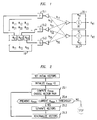
- FIG. 1 is a schematic block diagram of a communication system for transmitting and receiving signals in accordance with the invention.
- FIG. 2 is a flowchart of an illustrative algorithm for constructing signals useful for the practice of the invention in some embodiments.
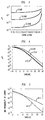
- FIGS. 3-5 are graphs that were generated as the result of theoretical calculations. These graphs describe aspects of the performance of a communication system using the inventive method, under various conditions.
- FIG. 1 shows a baseband signal 10 input to a transmitting array of antennas 15.1-15.3, and transmitted to a receiving array of antennas 20.1, 20.2.
- FIG. 1 shows the t 'th such row being input, with each entry in the row input to a respective one of antennas 15.1-15.3.
- Each entry of the signal matrix represents a complex-valued baseband voltage level which, for transmission, is modulated onto the carrier frequency according to known methods.
- the antenna response is amplified and demodulated to baseband according to known methods.
- Receiver noise which is here assumed to be statistically independent among the N receivers and T symbol periods, is represented in the figure as a component w t 1 added to the output of antenna 20.1 and a component w t 2 added to the output of antenna 20.2 at each time t.
- capacity is, the amount of information that can be reliably transmitted per unit time in a communication channel.
- a channel use as one block of T transmitted symbols (i.e., one transmitted signal matrix).
- the coherence interval is the length of time over which the propagation coefficients can be regarded as approximately constant.
- the symbol ⁇ will represent coherence interval.
- T The number T of symbols per signal should not exceed ⁇ , because if it does, fading effects will tend to corrupt the received signal, and the advantages achievable with our method will be reduced. However, if T is substantially less than ⁇ , the channel will be used inefficiently, which might lead to a greater error rate. Therefore, it will generally be advantageous for T to be equal, or nearly equal, to ⁇ .
- our model predicts two conditions under which the transmission rate obtainable using signals constructed according to our invention can reach the information-theoretic channel capacity.
- T T
- M M
- good performance is predicted under either of these conditions alone.
- a decision process such as a ML receiver to infer, from the received signal X , the particular signal matrix ⁇ l that was transmitted.
- This procedure comprises calculating the conditional probability p ( X
- the ⁇ l that yields the greatest value of this conditional probability is identified as the transmitted signal.
- This "maximum likelihood signal" ⁇ ML is symbolically represented as the argument of a maximization procedure by the expression
- the maximum likelihood signal can be evaluated by maximizing a particularly simple expression, because In the double-sum expression, the quantity within the vertical bars is the vector dot product between the complex conjugate of the m 'th column of ⁇ l , and the n 'th column of X . (The symbol * denotes the conjugate transpose of a vector or matrix. The underscore beneath the factors within the vertical bars denotes that these quantities are column vectors.)
- the relevant computation is readily made by a digital computer under the control of an appropriate program, and, as those skilled in the art will recognize, it is particularly suited for rapid calculation by a parallel processor.
- any matrix can be factored into the product ABC* , in which A and C are unitary matrices, and B (not necessarily a square matrix) has the following properties: all non-diagonal entries are 0, all diagonal entries are real and non-negative, and the diagonal entries occur in decreasing order. The diagonal entries are the singular values of the original matrix.
- the singular values of ⁇ l * ⁇ l' are a measure of the similarity of the sub-spaces spanned by the columns of the respective matrices. That is, linear combinations of the M columns of the unprimed matrix generate an M-subspace of T-dimensional space. Similarly, linear combinations of the M columns of the primed matrix generate a different M-subspace of T-dimensional space.
- these respective subspaces should be, in a certain mathematical sense, as dissimilar as possible. The smaller the singular values, the greater this dissimilarity. Thus, decreasing any given singular value (with, e.g., the others held constant) will tend to decrease the probability of error in decoding the received signal.
- the Chernoff upper bound C.U.B. is expressed by where ⁇ represents the signal-to-noise ratio (in units of power/power), and the other symbols are as defined above. According to our theoretical model, the two-signal error probability will never be greater than this quantity. For a given signal-to-noise ratio and a given set of choices for T and M, this quantity depends upon the singular values d m .
- the C.U.B. and thus the maximum possible error probability, is minimized when all of the singular values are driven as low as possible, preferably to zero. However, it will not generally be possible to drive more than a few, if indeed any, of the singular values to zero, over all pairs of matrices ⁇ l , ⁇ l' . That is, all of the singular values will be zero only if all M columns of each signal matrix of the signal constellation are orthogonal to all M columns of every other matrix in the constellation. This would call for a total of L ⁇ M mutually orthogonal columns. However, because the length of each of these columns is T, the total number of mutually orthogonal columns can never be greater than T.
- T it is desirable for T to be greater than M, it will nevertheless often be the case that T is less than the product L ⁇ M. Therefore, the design of signal constellations will in many cases be aimed at producing a set of singular values that, according to an appropriate measure, are cumulatively as small as possible.
- each of the L signal matrices ⁇ l is a complex unit vector having T components.
- the problem of minimizing the singular values is equivalent to minimizing the magnitudes of the respective inner products between all pairs of these vectors (excluding the pairing of any vector with itself).
- the largest of these magnitudes, here denoted d max is a measure of the maximum pairwise correlation between distinct signals.
- a lower bound for d max is readily derived from the following known mathematical result, in which k is a non-negative, integer-valued, free parameter: L ⁇ 1 - d 2 max k + 1 - (T + k ) d max ⁇ T(T + 1) ⁇ (T + k ) k ! .
- this formula states that d max can be no less than 0.46.
- a minimization procedure would seek to make d max as close as possible to 0.46.
- step 25.1 is to compute d max , and to choose a pair of signal vectors having an inner product whose magnitude is d max .
- step 25.2 is to separate the vectors of this pair by shifting each of them a small amount in opposite directions along their difference vector.
- Step 25.3 is to renormalize the chosen vectors, if necessary. As shown at box 25.4, a test is performed to determine whether d max is still decreasing. (Exemplarily, this test ascertains whether the decrease from the last value to the current value of d max is greater than a threshold.) Steps 25.1 - 25.3 are repeated as long as d max is determined to be decreasing.
- the singular values d 1 , d 2 are assumed to be equal (and are represented in the figure by the symbol d).
Landscapes
- Engineering & Computer Science (AREA)
- Computer Networks & Wireless Communication (AREA)
- Signal Processing (AREA)
- Radio Transmission System (AREA)
- Variable-Direction Aerials And Aerial Arrays (AREA)
- Mobile Radio Communication Systems (AREA)
Applications Claiming Priority (2)
| Application Number | Priority Date | Filing Date | Title |
|---|---|---|---|
| US09/134,297 US6327310B1 (en) | 1998-08-14 | 1998-08-14 | Wireless transmission method for antenna arrays, having improved resistance to fading |
| US134297 | 2002-04-26 |
Publications (3)
| Publication Number | Publication Date |
|---|---|
| EP0981209A2 true EP0981209A2 (de) | 2000-02-23 |
| EP0981209A3 EP0981209A3 (de) | 2000-08-09 |
| EP0981209B1 EP0981209B1 (de) | 2006-05-24 |
Family
ID=22462714
Family Applications (1)
| Application Number | Title | Priority Date | Filing Date |
|---|---|---|---|
| EP99306122A Expired - Lifetime EP0981209B1 (de) | 1998-08-14 | 1999-08-02 | Verfahren zur drahtlosen Übertragung für Gruppenantennen mit erhöhter Widerstandsfestigkeit gegen Fading |
Country Status (5)
| Country | Link |
|---|---|
| US (1) | US6327310B1 (de) |
| EP (1) | EP0981209B1 (de) |
| JP (1) | JP2000091969A (de) |
| CA (1) | CA2275520C (de) |
| DE (1) | DE69931436T2 (de) |
Cited By (1)
| Publication number | Priority date | Publication date | Assignee | Title |
|---|---|---|---|---|
| CN100517999C (zh) * | 1999-04-02 | 2009-07-22 | 株式会社Ntt都科摩 | 衰落频率判定装置和方法 |
Families Citing this family (26)
| Publication number | Priority date | Publication date | Assignee | Title |
|---|---|---|---|---|
| US6128330A (en) | 1998-11-24 | 2000-10-03 | Linex Technology, Inc. | Efficient shadow reduction antenna system for spread spectrum |
| US7864902B1 (en) * | 2003-04-28 | 2011-01-04 | At&T Corp. | Differential transmitter diversity technique for wireless communications |
| US7154970B1 (en) * | 1999-02-10 | 2006-12-26 | At&T Corp. | Differential transmitter diversity technique for wireless communications |
| EP1089451B1 (de) * | 1999-04-02 | 2009-11-25 | NTT DoCoMo, Inc. | Kanalschätzungsgerät und -verfahren |
| US6891903B2 (en) * | 1999-04-22 | 2005-05-10 | At&T Corp. | Multiple transmit antenna differential detection from generalized orthogonal designs |
| US6560295B1 (en) * | 1999-09-15 | 2003-05-06 | Hughes Electronics Corporation | Method of generating space-time codes for generalized layered space-time architectures |
| US6693976B1 (en) * | 2000-03-21 | 2004-02-17 | Lucent Technologies Inc. | Method of wireless communication using structured unitary space-time signal constellations |
| GB0110125D0 (en) | 2001-04-25 | 2001-06-20 | Koninkl Philips Electronics Nv | Radio communication system |
| WO2002087107A1 (en) * | 2001-04-25 | 2002-10-31 | Koninklijke Philips Electronics N.V. | Radio communication system |
| EP1474679B1 (de) * | 2002-01-14 | 2011-07-27 | R. Brooks Associates, Inc. | Einrichtung zur fernuntersuchung von dampfgeneratorröhren oder zur entfernung von material von ausserhalb oder zwischen solchen röhren |
| US6785520B2 (en) * | 2002-03-01 | 2004-08-31 | Cognio, Inc. | System and method for antenna diversity using equal power joint maximal ratio combining |
| US6862456B2 (en) | 2002-03-01 | 2005-03-01 | Cognio, Inc. | Systems and methods for improving range for multicast wireless communication |
| EP1769585A4 (de) | 2002-03-01 | 2009-12-02 | Ipr Licensing Inc | System und verfahren für verbundmaximalverhältniskombinieren unter verwendung von zeitbereichs-signalverarbeitung |
| US6873651B2 (en) * | 2002-03-01 | 2005-03-29 | Cognio, Inc. | System and method for joint maximal ratio combining using time-domain signal processing |
| US6687492B1 (en) | 2002-03-01 | 2004-02-03 | Cognio, Inc. | System and method for antenna diversity using joint maximal ratio combining |
| US6871049B2 (en) | 2002-03-21 | 2005-03-22 | Cognio, Inc. | Improving the efficiency of power amplifiers in devices using transmit beamforming |
| US7181246B2 (en) * | 2002-06-05 | 2007-02-20 | Neocific, Inc. | Adaptive communications system and method |
| DK1540830T3 (da) | 2002-07-30 | 2009-05-04 | Ipr Licensing Inc | System og metode til flerheds input (MIMO) radio kommunikation |
| US6873606B2 (en) * | 2002-10-16 | 2005-03-29 | Qualcomm, Incorporated | Rate adaptive transmission scheme for MIMO systems |
| US7099678B2 (en) | 2003-04-10 | 2006-08-29 | Ipr Licensing, Inc. | System and method for transmit weight computation for vector beamforming radio communication |
| US7079870B2 (en) * | 2003-06-09 | 2006-07-18 | Ipr Licensing, Inc. | Compensation techniques for group delay effects in transmit beamforming radio communication |
| CN1829138B (zh) * | 2006-04-07 | 2010-04-07 | 清华大学 | 自适应多输入多输出发送接收系统及其方法 |
| US9130618B2 (en) * | 2006-10-26 | 2015-09-08 | Alcatel Lucent | MIMO communication system with variable slot structure |
| US7907552B2 (en) | 2008-01-15 | 2011-03-15 | Alcatel-Lucent Usa Inc. | MIMO communication system with user scheduling and modified precoding based on channel vector magnitudes |
| JP5663284B2 (ja) * | 2010-12-06 | 2015-02-04 | 東芝テック株式会社 | アンテナ切替システム |
| CN104539336A (zh) * | 2014-12-26 | 2015-04-22 | 江苏中兴微通信息科技有限公司 | 一种利用发送分集的空间调制方法及装置 |
Family Cites Families (2)
| Publication number | Priority date | Publication date | Assignee | Title |
|---|---|---|---|---|
| US6097771A (en) * | 1996-07-01 | 2000-08-01 | Lucent Technologies Inc. | Wireless communications system having a layered space-time architecture employing multi-element antennas |
| US6088408A (en) * | 1998-11-06 | 2000-07-11 | At & T Corp. | Decoding for generalized orthogonal designs for space-time codes for wireless communication |
-
1998
- 1998-08-14 US US09/134,297 patent/US6327310B1/en not_active Expired - Lifetime
-
1999
- 1999-06-18 CA CA002275520A patent/CA2275520C/en not_active Expired - Fee Related
- 1999-08-02 DE DE69931436T patent/DE69931436T2/de not_active Expired - Lifetime
- 1999-08-02 EP EP99306122A patent/EP0981209B1/de not_active Expired - Lifetime
- 1999-08-13 JP JP11228979A patent/JP2000091969A/ja active Pending
Cited By (1)
| Publication number | Priority date | Publication date | Assignee | Title |
|---|---|---|---|---|
| CN100517999C (zh) * | 1999-04-02 | 2009-07-22 | 株式会社Ntt都科摩 | 衰落频率判定装置和方法 |
Also Published As
| Publication number | Publication date |
|---|---|
| US6327310B1 (en) | 2001-12-04 |
| DE69931436T2 (de) | 2007-05-24 |
| EP0981209A3 (de) | 2000-08-09 |
| JP2000091969A (ja) | 2000-03-31 |
| DE69931436D1 (de) | 2006-06-29 |
| EP0981209B1 (de) | 2006-05-24 |
| CA2275520A1 (en) | 2000-02-14 |
| CA2275520C (en) | 2003-07-08 |
Similar Documents
| Publication | Publication Date | Title |
|---|---|---|
| US6327310B1 (en) | Wireless transmission method for antenna arrays, having improved resistance to fading | |
| US6363121B1 (en) | Wireless transmission method for antenna arrays using unitary space-time signals | |
| US6987819B2 (en) | Method and device for multiple input/multiple output transmit and receive weights for equal-rate data streams | |
| US8000422B2 (en) | Apparatus and method for detecting signal in multiple-input multiple-output (MIMO) wireless communication system | |
| EP1538772A1 (de) | Vorrichtung und Verfahren zur Datenübertragung mittels Eigenvektorauswahl in MIMO-Mobilkommunikationssystemen | |
| US6901122B2 (en) | Method and apparatus for restoring a soft decision component of a signal | |
| US20090196368A1 (en) | Radio transmission control method, radio receiver apparatus, and radio transmitter apparatus | |
| KR100930522B1 (ko) | 다중 입출력 무선통신 시스템에서 수신 장치 및 방법 | |
| US7715863B2 (en) | Throughput maximization using quantized rate control in multiple antenna communication | |
| US8045604B2 (en) | Estimation of log-likelihood using constrained markov-chain monte carlo simulation | |
| US8811215B2 (en) | Apparatus and method for detecting signal in spatial multiplexing system | |
| JP4381901B2 (ja) | 通信路推定及びデータ検出方法 | |
| KR20060047843A (ko) | 무선 통신 시스템에서 채널 상태 정보를 이용한 데이터송수신 장치 및 방법 | |
| Singh et al. | NOMA based generalized precoding aided spatial modulation with multiuser MIMO in downlink | |
| Deotale et al. | Ergodic capacity based antenna selection in MIMO for Rayleigh fading | |
| Kharrat-Kammoun et al. | Antenna selection for MIMO systems based on an accurate approximation of QAM error probability | |
| Apalina et al. | Two-Level Index Modulation for Noncoherent Reception | |
| KR100962266B1 (ko) | 하이브리드 stbc 신호 복조 방법 및 장치 | |
| Arteaga et al. | Index Coding and Signal Detection in Precoded MIMO-OFDM Systems | |
| Diao et al. | Constellation Optimization Based on DDPG for Cayley Differential Unitary Space-Time Code | |
| KR101289938B1 (ko) | 다중 입력 다중 출력 방식을 사용하는 이동 통신시스템에서 신호 수신 장치 및 방법 | |
| MXPA99007365A (es) | Metodo de transmision inalambrica para estructuras de antena que tienen resistencia mejorada a desvanecimiento | |
| Li et al. | Capacity and error probability for maximal ratio combining reception over correlated Nakagami fading channels | |
| Geetha et al. | Analysis and performance enhancement of STBC MIMO in spatially independent Rayleigh fading channel | |
| Li et al. | Capacity of maximal ratio combining reception over correlated Nakagami fading channels |
Legal Events
| Date | Code | Title | Description |
|---|---|---|---|
| PUAI | Public reference made under article 153(3) epc to a published international application that has entered the european phase |
Free format text: ORIGINAL CODE: 0009012 |
|
| AK | Designated contracting states |
Kind code of ref document: A2 Designated state(s): DE FI FR SE |
|
| AX | Request for extension of the european patent |
Free format text: AL;LT;LV;MK;RO;SI |
|
| PUAL | Search report despatched |
Free format text: ORIGINAL CODE: 0009013 |
|
| RIC1 | Information provided on ipc code assigned before grant |
Free format text: 7H 04L 1/06 A, 7H 04B 7/06 B |
|
| AK | Designated contracting states |
Kind code of ref document: A3 Designated state(s): AT BE CH CY DE DK ES FI FR GB GR IE IT LI LU MC NL PT SE |
|
| AX | Request for extension of the european patent |
Free format text: AL;LT;LV;MK;RO;SI |
|
| 17P | Request for examination filed |
Effective date: 20010125 |
|
| AKX | Designation fees paid |
Free format text: DE FI FR SE |
|
| 17Q | First examination report despatched |
Effective date: 20020122 |
|
| APBN | Date of receipt of notice of appeal recorded |
Free format text: ORIGINAL CODE: EPIDOSNNOA2E |
|
| APBR | Date of receipt of statement of grounds of appeal recorded |
Free format text: ORIGINAL CODE: EPIDOSNNOA3E |
|
| APBV | Interlocutory revision of appeal recorded |
Free format text: ORIGINAL CODE: EPIDOSNIRAPE |
|
| GRAP | Despatch of communication of intention to grant a patent |
Free format text: ORIGINAL CODE: EPIDOSNIGR1 |
|
| GRAS | Grant fee paid |
Free format text: ORIGINAL CODE: EPIDOSNIGR3 |
|
| GRAA | (expected) grant |
Free format text: ORIGINAL CODE: 0009210 |
|
| AK | Designated contracting states |
Kind code of ref document: B1 Designated state(s): DE FI FR SE |
|
| RIN1 | Information on inventor provided before grant (corrected) |
Inventor name: MARZETTA, THOMAS LOUIS Inventor name: HOCHWALD, BERTRAND M. |
|
| REF | Corresponds to: |
Ref document number: 69931436 Country of ref document: DE Date of ref document: 20060629 Kind code of ref document: P |
|
| PG25 | Lapsed in a contracting state [announced via postgrant information from national office to epo] |
Ref country code: SE Free format text: LAPSE BECAUSE OF FAILURE TO SUBMIT A TRANSLATION OF THE DESCRIPTION OR TO PAY THE FEE WITHIN THE PRESCRIBED TIME-LIMIT Effective date: 20060824 |
|
| ET | Fr: translation filed | ||
| PLBE | No opposition filed within time limit |
Free format text: ORIGINAL CODE: 0009261 |
|
| STAA | Information on the status of an ep patent application or granted ep patent |
Free format text: STATUS: NO OPPOSITION FILED WITHIN TIME LIMIT |
|
| 26N | No opposition filed |
Effective date: 20070227 |
|
| REG | Reference to a national code |
Ref country code: FR Ref legal event code: CD Owner name: ALCATEL-LUCENT USA INC. Effective date: 20131122 |
|
| REG | Reference to a national code |
Ref country code: FR Ref legal event code: GC Effective date: 20140410 |
|
| REG | Reference to a national code |
Ref country code: FR Ref legal event code: RG Effective date: 20141015 |
|
| REG | Reference to a national code |
Ref country code: FR Ref legal event code: PLFP Year of fee payment: 17 |
|
| REG | Reference to a national code |
Ref country code: FR Ref legal event code: PLFP Year of fee payment: 18 |
|
| PGFP | Annual fee paid to national office [announced via postgrant information from national office to epo] |
Ref country code: FI Payment date: 20160811 Year of fee payment: 18 Ref country code: DE Payment date: 20160822 Year of fee payment: 18 |
|
| PGFP | Annual fee paid to national office [announced via postgrant information from national office to epo] |
Ref country code: FR Payment date: 20160822 Year of fee payment: 18 |
|
| REG | Reference to a national code |
Ref country code: DE Ref legal event code: R119 Ref document number: 69931436 Country of ref document: DE |
|
| PG25 | Lapsed in a contracting state [announced via postgrant information from national office to epo] |
Ref country code: FI Free format text: LAPSE BECAUSE OF NON-PAYMENT OF DUE FEES Effective date: 20170802 |
|
| REG | Reference to a national code |
Ref country code: FR Ref legal event code: ST Effective date: 20180430 |
|
| PG25 | Lapsed in a contracting state [announced via postgrant information from national office to epo] |
Ref country code: DE Free format text: LAPSE BECAUSE OF NON-PAYMENT OF DUE FEES Effective date: 20180301 |
|
| PG25 | Lapsed in a contracting state [announced via postgrant information from national office to epo] |
Ref country code: FR Free format text: LAPSE BECAUSE OF NON-PAYMENT OF DUE FEES Effective date: 20170831 |