EP0981505B1 - Selbstnivellierende zementzusammensetzung - Google Patents
Selbstnivellierende zementzusammensetzung Download PDFInfo
- Publication number
- EP0981505B1 EP0981505B1 EP98924416A EP98924416A EP0981505B1 EP 0981505 B1 EP0981505 B1 EP 0981505B1 EP 98924416 A EP98924416 A EP 98924416A EP 98924416 A EP98924416 A EP 98924416A EP 0981505 B1 EP0981505 B1 EP 0981505B1
- Authority
- EP
- European Patent Office
- Prior art keywords
- self
- leveling composition
- composition
- leveling
- plasticizer
- Prior art date
- Legal status (The legal status is an assumption and is not a legal conclusion. Google has not performed a legal analysis and makes no representation as to the accuracy of the status listed.)
- Expired - Lifetime
Links
- 239000000203 mixture Substances 0.000 title claims abstract description 165
- 239000004568 cement Substances 0.000 title claims abstract description 28
- 239000004014 plasticizer Substances 0.000 claims abstract description 40
- XLYOFNOQVPJJNP-UHFFFAOYSA-N water Substances O XLYOFNOQVPJJNP-UHFFFAOYSA-N 0.000 claims abstract description 39
- 150000001875 compounds Chemical class 0.000 claims abstract description 19
- 239000004576 sand Substances 0.000 claims abstract description 13
- 150000002894 organic compounds Chemical class 0.000 claims abstract description 11
- 239000011398 Portland cement Substances 0.000 claims abstract description 9
- 150000003839 salts Chemical class 0.000 claims abstract description 6
- 125000004432 carbon atom Chemical group C* 0.000 claims description 15
- VGGSQFUCUMXWEO-UHFFFAOYSA-N Ethene Chemical compound C=C VGGSQFUCUMXWEO-UHFFFAOYSA-N 0.000 claims description 14
- 238000004519 manufacturing process Methods 0.000 claims description 13
- 239000002518 antifoaming agent Substances 0.000 claims description 12
- 229910052500 inorganic mineral Inorganic materials 0.000 claims description 11
- 239000011707 mineral Substances 0.000 claims description 11
- QQONPFPTGQHPMA-UHFFFAOYSA-N propylene Natural products CC=C QQONPFPTGQHPMA-UHFFFAOYSA-N 0.000 claims description 11
- 150000002430 hydrocarbons Chemical group 0.000 claims description 10
- 239000005977 Ethylene Substances 0.000 claims description 9
- 239000002562 thickening agent Substances 0.000 claims description 9
- 229910018828 PO3H2 Inorganic materials 0.000 claims description 8
- 239000010419 fine particle Substances 0.000 claims description 8
- 239000000178 monomer Substances 0.000 claims description 8
- 238000003892 spreading Methods 0.000 claims description 8
- 230000007480 spreading Effects 0.000 claims description 8
- 125000005842 heteroatom Chemical group 0.000 claims description 7
- 125000004805 propylene group Chemical group [H]C([H])([H])C([H])([*:1])C([H])([H])[*:2] 0.000 claims description 7
- 125000000391 vinyl group Chemical group [H]C([*])=C([H])[H] 0.000 claims description 7
- 239000004721 Polyphenylene oxide Substances 0.000 claims description 6
- 125000002947 alkylene group Chemical group 0.000 claims description 6
- 229920000570 polyether Polymers 0.000 claims description 6
- PPBRXRYQALVLMV-UHFFFAOYSA-N Styrene Chemical compound C=CC1=CC=CC=C1 PPBRXRYQALVLMV-UHFFFAOYSA-N 0.000 claims description 5
- HGCIXCUEYOPUTN-UHFFFAOYSA-N cyclohexene Chemical compound C1CCC=CC1 HGCIXCUEYOPUTN-UHFFFAOYSA-N 0.000 claims description 5
- 229920006395 saturated elastomer Chemical group 0.000 claims description 5
- 229920002554 vinyl polymer Polymers 0.000 claims description 5
- 125000004435 hydrogen atom Chemical group [H]* 0.000 claims description 4
- 239000002245 particle Substances 0.000 claims description 4
- KWKAKUADMBZCLK-UHFFFAOYSA-N 1-octene Chemical group CCCCCCC=C KWKAKUADMBZCLK-UHFFFAOYSA-N 0.000 claims description 2
- BKOOMYPCSUNDGP-UHFFFAOYSA-N 2-methylbut-2-ene Chemical group CC=C(C)C BKOOMYPCSUNDGP-UHFFFAOYSA-N 0.000 claims description 2
- JLBJTVDPSNHSKJ-UHFFFAOYSA-N 4-Methylstyrene Chemical compound CC1=CC=C(C=C)C=C1 JLBJTVDPSNHSKJ-UHFFFAOYSA-N 0.000 claims description 2
- 125000001118 alkylidene group Chemical group 0.000 claims description 2
- 125000000732 arylene group Chemical group 0.000 claims description 2
- 125000000383 tetramethylene group Chemical group [H]C([H])([*:1])C([H])([H])C([H])([H])C([H])([H])[*:2] 0.000 claims description 2
- 239000002131 composite material Substances 0.000 claims 1
- 101001113857 Naja kaouthia Acidic phospholipase A2 2 Proteins 0.000 abstract 1
- -1 butylène Chemical class 0.000 description 14
- 241000196324 Embryophyta Species 0.000 description 11
- VYPSYNLAJGMNEJ-UHFFFAOYSA-N Silicium dioxide Chemical compound O=[Si]=O VYPSYNLAJGMNEJ-UHFFFAOYSA-N 0.000 description 11
- 238000002360 preparation method Methods 0.000 description 11
- 239000012530 fluid Substances 0.000 description 10
- WMFOQBRAJBCJND-UHFFFAOYSA-M Lithium hydroxide Chemical compound [Li+].[OH-] WMFOQBRAJBCJND-UHFFFAOYSA-M 0.000 description 8
- 125000004429 atom Chemical group 0.000 description 8
- STCOOQWBFONSKY-UHFFFAOYSA-N tributyl phosphate Chemical compound CCCCOP(=O)(OCCCC)OCCCC STCOOQWBFONSKY-UHFFFAOYSA-N 0.000 description 8
- 229940093635 tributyl phosphate Drugs 0.000 description 8
- 239000002253 acid Substances 0.000 description 7
- 150000001412 amines Chemical class 0.000 description 7
- IJGRMHOSHXDMSA-UHFFFAOYSA-N Atomic nitrogen Chemical compound N#N IJGRMHOSHXDMSA-UHFFFAOYSA-N 0.000 description 5
- 241001508691 Martes zibellina Species 0.000 description 5
- 239000002202 Polyethylene glycol Substances 0.000 description 5
- 244000007853 Sarothamnus scoparius Species 0.000 description 5
- 239000004113 Sepiolite Substances 0.000 description 5
- 239000003795 chemical substances by application Substances 0.000 description 5
- 239000010408 film Substances 0.000 description 5
- 239000012764 mineral filler Substances 0.000 description 5
- 229920001223 polyethylene glycol Polymers 0.000 description 5
- 238000005204 segregation Methods 0.000 description 5
- 229910052624 sepiolite Inorganic materials 0.000 description 5
- 235000019355 sepiolite Nutrition 0.000 description 5
- 102100037149 3-oxoacyl-[acyl-carrier-protein] synthase, mitochondrial Human genes 0.000 description 4
- LYCAIKOWRPUZTN-UHFFFAOYSA-N Ethylene glycol Chemical compound OCCO LYCAIKOWRPUZTN-UHFFFAOYSA-N 0.000 description 4
- 101001098439 Homo sapiens 3-oxoacyl-[acyl-carrier-protein] synthase, mitochondrial Proteins 0.000 description 4
- 229920002845 Poly(methacrylic acid) Polymers 0.000 description 4
- 230000001464 adherent effect Effects 0.000 description 4
- 238000005452 bending Methods 0.000 description 4
- 230000000740 bleeding effect Effects 0.000 description 4
- 238000005266 casting Methods 0.000 description 4
- 238000006243 chemical reaction Methods 0.000 description 4
- 230000006835 compression Effects 0.000 description 4
- 238000007906 compression Methods 0.000 description 4
- 229940082150 encore Drugs 0.000 description 4
- 239000000835 fiber Substances 0.000 description 4
- 239000010881 fly ash Substances 0.000 description 4
- 238000010438 heat treatment Methods 0.000 description 4
- 238000009434 installation Methods 0.000 description 4
- 238000012423 maintenance Methods 0.000 description 4
- 229910052751 metal Inorganic materials 0.000 description 4
- 239000002184 metal Substances 0.000 description 4
- 238000000034 method Methods 0.000 description 4
- 239000004570 mortar (masonry) Substances 0.000 description 4
- XNWFRZJHXBZDAG-UHFFFAOYSA-N 2-METHOXYETHANOL Chemical compound COCCO XNWFRZJHXBZDAG-UHFFFAOYSA-N 0.000 description 3
- WECIKJKLCDCIMY-UHFFFAOYSA-N 2-chloro-n-(2-cyanoethyl)acetamide Chemical compound ClCC(=O)NCCC#N WECIKJKLCDCIMY-UHFFFAOYSA-N 0.000 description 3
- 239000004743 Polypropylene Substances 0.000 description 3
- 229920002125 Sokalan® Polymers 0.000 description 3
- 239000000654 additive Substances 0.000 description 3
- 230000000996 additive effect Effects 0.000 description 3
- 244000309464 bull Species 0.000 description 3
- 210000004534 cecum Anatomy 0.000 description 3
- 239000000470 constituent Substances 0.000 description 3
- 238000005336 cracking Methods 0.000 description 3
- ZBCBWPMODOFKDW-UHFFFAOYSA-N diethanolamine Chemical compound OCCNCCO ZBCBWPMODOFKDW-UHFFFAOYSA-N 0.000 description 3
- 230000032050 esterification Effects 0.000 description 3
- 238000005886 esterification reaction Methods 0.000 description 3
- 239000000945 filler Substances 0.000 description 3
- 239000006260 foam Substances 0.000 description 3
- 238000002156 mixing Methods 0.000 description 3
- 125000006353 oxyethylene group Chemical group 0.000 description 3
- 229920001155 polypropylene Polymers 0.000 description 3
- 239000000047 product Substances 0.000 description 3
- 230000000630 rising effect Effects 0.000 description 3
- 241000195940 Bryophyta Species 0.000 description 2
- 101100257127 Caenorhabditis elegans sma-2 gene Proteins 0.000 description 2
- IAYPIBMASNFSPL-UHFFFAOYSA-N Ethylene oxide Chemical compound C1CO1 IAYPIBMASNFSPL-UHFFFAOYSA-N 0.000 description 2
- 229920001732 Lignosulfonate Polymers 0.000 description 2
- 235000019738 Limestone Nutrition 0.000 description 2
- NINIDFKCEFEMDL-UHFFFAOYSA-N Sulfur Chemical compound [S] NINIDFKCEFEMDL-UHFFFAOYSA-N 0.000 description 2
- 241001080024 Telles Species 0.000 description 2
- 241001639412 Verres Species 0.000 description 2
- 240000008042 Zea mays Species 0.000 description 2
- 238000004821 distillation Methods 0.000 description 2
- 239000011521 glass Substances 0.000 description 2
- WGCNASOHLSPBMP-UHFFFAOYSA-N hydroxyacetaldehyde Natural products OCC=O WGCNASOHLSPBMP-UHFFFAOYSA-N 0.000 description 2
- 239000006028 limestone Substances 0.000 description 2
- 230000004048 modification Effects 0.000 description 2
- 238000012986 modification Methods 0.000 description 2
- 235000011929 mousse Nutrition 0.000 description 2
- 229910052757 nitrogen Inorganic materials 0.000 description 2
- 125000005702 oxyalkylene group Chemical group 0.000 description 2
- 239000002985 plastic film Substances 0.000 description 2
- 229920006255 plastic film Polymers 0.000 description 2
- 239000002994 raw material Substances 0.000 description 2
- 230000000717 retained effect Effects 0.000 description 2
- 229920001285 xanthan gum Polymers 0.000 description 2
- 208000031968 Cadaver Diseases 0.000 description 1
- 244000060011 Cocos nucifera Species 0.000 description 1
- 235000013162 Cocos nucifera Nutrition 0.000 description 1
- LCGLNKUTAGEVQW-UHFFFAOYSA-N Dimethyl ether Chemical compound COC LCGLNKUTAGEVQW-UHFFFAOYSA-N 0.000 description 1
- 241000287107 Passer Species 0.000 description 1
- WGVWLKXZBUVUAM-UHFFFAOYSA-N Pentanochlor Chemical compound CCCC(C)C(=O)NC1=CC=C(C)C(Cl)=C1 WGVWLKXZBUVUAM-UHFFFAOYSA-N 0.000 description 1
- 239000004793 Polystyrene Substances 0.000 description 1
- 239000000853 adhesive Substances 0.000 description 1
- 230000001070 adhesive effect Effects 0.000 description 1
- 239000002671 adjuvant Substances 0.000 description 1
- 125000002877 alkyl aryl group Chemical group 0.000 description 1
- 125000000217 alkyl group Chemical group 0.000 description 1
- 125000003277 amino group Chemical group 0.000 description 1
- 238000004458 analytical method Methods 0.000 description 1
- 229910052925 anhydrite Inorganic materials 0.000 description 1
- 239000012736 aqueous medium Substances 0.000 description 1
- QVGXLLKOCUKJST-UHFFFAOYSA-N atomic oxygen Chemical compound [O] QVGXLLKOCUKJST-UHFFFAOYSA-N 0.000 description 1
- OSGAYBCDTDRGGQ-UHFFFAOYSA-L calcium sulfate Chemical compound [Ca+2].[O-]S([O-])(=O)=O OSGAYBCDTDRGGQ-UHFFFAOYSA-L 0.000 description 1
- 239000001913 cellulose Substances 0.000 description 1
- 229920002678 cellulose Polymers 0.000 description 1
- 239000003638 chemical reducing agent Substances 0.000 description 1
- 239000011248 coating agent Substances 0.000 description 1
- 238000000576 coating method Methods 0.000 description 1
- 230000000295 complement effect Effects 0.000 description 1
- 230000001934 delay Effects 0.000 description 1
- 208000037265 diseases, disorders, signs and symptoms Diseases 0.000 description 1
- 208000035475 disorder Diseases 0.000 description 1
- 239000006185 dispersion Substances 0.000 description 1
- 238000011049 filling Methods 0.000 description 1
- 238000007667 floating Methods 0.000 description 1
- IVJISJACKSSFGE-UHFFFAOYSA-N formaldehyde;1,3,5-triazine-2,4,6-triamine Chemical compound O=C.NC1=NC(N)=NC(N)=N1 IVJISJACKSSFGE-UHFFFAOYSA-N 0.000 description 1
- 239000003517 fume Substances 0.000 description 1
- 150000004676 glycans Chemical class 0.000 description 1
- 150000002484 inorganic compounds Chemical class 0.000 description 1
- 229910010272 inorganic material Inorganic materials 0.000 description 1
- NLYAJNPCOHFWQQ-UHFFFAOYSA-N kaolin Chemical compound O.O.O=[Al]O[Si](=O)O[Si](=O)O[Al]=O NLYAJNPCOHFWQQ-UHFFFAOYSA-N 0.000 description 1
- 238000004811 liquid chromatography Methods 0.000 description 1
- 239000012263 liquid product Substances 0.000 description 1
- 239000000463 material Substances 0.000 description 1
- 150000007974 melamines Chemical class 0.000 description 1
- 125000001570 methylene group Chemical group [H]C([H])([*:1])[*:2] 0.000 description 1
- 239000004530 micro-emulsion Substances 0.000 description 1
- 150000002790 naphthalenes Chemical class 0.000 description 1
- 239000007764 o/w emulsion Substances 0.000 description 1
- 229920000620 organic polymer Polymers 0.000 description 1
- 229910052760 oxygen Inorganic materials 0.000 description 1
- 239000001301 oxygen Substances 0.000 description 1
- 229920003023 plastic Polymers 0.000 description 1
- 239000004033 plastic Substances 0.000 description 1
- 239000004584 polyacrylic acid Substances 0.000 description 1
- 229920001282 polysaccharide Polymers 0.000 description 1
- 239000005017 polysaccharide Substances 0.000 description 1
- 229920002223 polystyrene Polymers 0.000 description 1
- 150000003141 primary amines Chemical class 0.000 description 1
- 238000005086 pumping Methods 0.000 description 1
- 239000011541 reaction mixture Substances 0.000 description 1
- 230000002787 reinforcement Effects 0.000 description 1
- 230000002940 repellent Effects 0.000 description 1
- 239000005871 repellent Substances 0.000 description 1
- 238000000518 rheometry Methods 0.000 description 1
- 150000003335 secondary amines Chemical class 0.000 description 1
- 239000000377 silicon dioxide Substances 0.000 description 1
- 239000002893 slag Substances 0.000 description 1
- 238000005507 spraying Methods 0.000 description 1
- 239000003381 stabilizer Substances 0.000 description 1
- 238000003756 stirring Methods 0.000 description 1
- 239000000126 substance Substances 0.000 description 1
- 239000011593 sulfur Substances 0.000 description 1
- 229910052717 sulfur Inorganic materials 0.000 description 1
- 239000003760 tallow Substances 0.000 description 1
- 125000001302 tertiary amino group Chemical group 0.000 description 1
- 239000010409 thin film Substances 0.000 description 1
- 235000013311 vegetables Nutrition 0.000 description 1
- 229920006163 vinyl copolymer Polymers 0.000 description 1
- 239000002699 waste material Substances 0.000 description 1
- 238000009736 wetting Methods 0.000 description 1
- 239000000230 xanthan gum Substances 0.000 description 1
- 229940082509 xanthan gum Drugs 0.000 description 1
- 235000010493 xanthan gum Nutrition 0.000 description 1
Classifications
-
- C—CHEMISTRY; METALLURGY
- C04—CEMENTS; CONCRETE; ARTIFICIAL STONE; CERAMICS; REFRACTORIES
- C04B—LIME, MAGNESIA; SLAG; CEMENTS; COMPOSITIONS THEREOF, e.g. MORTARS, CONCRETE OR LIKE BUILDING MATERIALS; ARTIFICIAL STONE; CERAMICS; REFRACTORIES; TREATMENT OF NATURAL STONE
- C04B28/00—Compositions of mortars, concrete or artificial stone, containing inorganic binders or the reaction product of an inorganic and an organic binder, e.g. polycarboxylate cements
- C04B28/02—Compositions of mortars, concrete or artificial stone, containing inorganic binders or the reaction product of an inorganic and an organic binder, e.g. polycarboxylate cements containing hydraulic cements other than calcium sulfates
- C04B28/04—Portland cements
-
- C—CHEMISTRY; METALLURGY
- C04—CEMENTS; CONCRETE; ARTIFICIAL STONE; CERAMICS; REFRACTORIES
- C04B—LIME, MAGNESIA; SLAG; CEMENTS; COMPOSITIONS THEREOF, e.g. MORTARS, CONCRETE OR LIKE BUILDING MATERIALS; ARTIFICIAL STONE; CERAMICS; REFRACTORIES; TREATMENT OF NATURAL STONE
- C04B24/00—Use of organic materials as active ingredients for mortars, concrete or artificial stone, e.g. plasticisers
- C04B24/24—Macromolecular compounds
- C04B24/243—Phosphorus-containing polymers
-
- C—CHEMISTRY; METALLURGY
- C04—CEMENTS; CONCRETE; ARTIFICIAL STONE; CERAMICS; REFRACTORIES
- C04B—LIME, MAGNESIA; SLAG; CEMENTS; COMPOSITIONS THEREOF, e.g. MORTARS, CONCRETE OR LIKE BUILDING MATERIALS; ARTIFICIAL STONE; CERAMICS; REFRACTORIES; TREATMENT OF NATURAL STONE
- C04B24/00—Use of organic materials as active ingredients for mortars, concrete or artificial stone, e.g. plasticisers
- C04B24/24—Macromolecular compounds
- C04B24/28—Macromolecular compounds obtained otherwise than by reactions only involving carbon-to-carbon unsaturated bonds
- C04B24/32—Polyethers, e.g. alkylphenol polyglycolether
-
- C—CHEMISTRY; METALLURGY
- C04—CEMENTS; CONCRETE; ARTIFICIAL STONE; CERAMICS; REFRACTORIES
- C04B—LIME, MAGNESIA; SLAG; CEMENTS; COMPOSITIONS THEREOF, e.g. MORTARS, CONCRETE OR LIKE BUILDING MATERIALS; ARTIFICIAL STONE; CERAMICS; REFRACTORIES; TREATMENT OF NATURAL STONE
- C04B2111/00—Mortars, concrete or artificial stone or mixtures to prepare them, characterised by specific function, property or use
- C04B2111/00034—Physico-chemical characteristics of the mixtures
- C04B2111/00068—Mortar or concrete mixtures with an unusual water/cement ratio
-
- C—CHEMISTRY; METALLURGY
- C04—CEMENTS; CONCRETE; ARTIFICIAL STONE; CERAMICS; REFRACTORIES
- C04B—LIME, MAGNESIA; SLAG; CEMENTS; COMPOSITIONS THEREOF, e.g. MORTARS, CONCRETE OR LIKE BUILDING MATERIALS; ARTIFICIAL STONE; CERAMICS; REFRACTORIES; TREATMENT OF NATURAL STONE
- C04B2111/00—Mortars, concrete or artificial stone or mixtures to prepare them, characterised by specific function, property or use
- C04B2111/00034—Physico-chemical characteristics of the mixtures
- C04B2111/00146—Sprayable or pumpable mixtures
-
- C—CHEMISTRY; METALLURGY
- C04—CEMENTS; CONCRETE; ARTIFICIAL STONE; CERAMICS; REFRACTORIES
- C04B—LIME, MAGNESIA; SLAG; CEMENTS; COMPOSITIONS THEREOF, e.g. MORTARS, CONCRETE OR LIKE BUILDING MATERIALS; ARTIFICIAL STONE; CERAMICS; REFRACTORIES; TREATMENT OF NATURAL STONE
- C04B2111/00—Mortars, concrete or artificial stone or mixtures to prepare them, characterised by specific function, property or use
- C04B2111/60—Flooring materials
- C04B2111/62—Self-levelling compositions
Definitions
- the present invention relates to the preparation of cement-based self-leveling compositions, as well as their use in the manufacture of floor screeds, such as non-adherent screeds, adherent screeds and screeds coating heating elements.
- the plasticizers based on carboxylated vinyl monomers are currently preferred because they lead to a maintenance of fluidity in the time, but maintain fluency is often achieved at the expense of short-term resistance.
- the quantity of the plasticizer (I) comprising at least one amino-di (alkylene phosphonic) group and at least one polyoxyalkylated chain, in the composition self-leveling is between 0.2 and 2% by weight dry, based on the weight of cement, preferably between 0.3 and 0.8% by dry weight.
- the grain size of the sand used in the composition self-leveling according to the invention can vary between 0 and 10 mm, preferably between 0 and 5 mm.
- the self-leveling composition in addition to the fluidizer (I) corresponding to the above formula (I), there is provided in the self-leveling composition at least one water-soluble or water-dispersible fluidizer (PCP), polycarboxylic acid type and containing polyether chains.
- PCP water-soluble or water-dispersible fluidizer
- plasticizers (PCP) which are based on vinyl carboxylic monomers, and optionally, sulfonated monomers, are well known and are described in particular in American patent US Pat. No. 5,614,017 and European patent EP0612702.
- the weight ratio of the plasticizer (I) to the plasticizer (PCP) is varied from 0.1 to 10.
- plasticizers (I) and (PCP) makes it possible to prepare self-leveling cement compositions with the desired fluidity with reduced water contents.
- plasticizer (I) on the plasticizer (PCP)
- the plasticizer (PCP) provided in the self-leveling composition according to the invention contains polyether chains of different lengths.
- the plasticizer (PCP) provided in the self-leveling composition according to the invention is such that the polyether chains contain, on average, at least 50% of oxyethylene units [percentage expressed on the total of the oxyalkylene units of the plasticizer (PCP) ]. More preferably, the other oxyalkylene units are oxypropylene units.
- the self-leveling composition according to the invention comprises at least one antifoaming agent.
- the chemical nature of the defoaming agent is not critical.
- the amount of antifoaming agent is generally between 0.001% and 0.3% by weight, based on the weight of cement.
- the self-leveling composition according to the invention comprises at least one thickening agent.
- thickening agent which can be used in the self-leveling composition which is the subject of the present invention, mention may be made of inorganic compounds such as sepiolite or ultra-fine silicas, or organic compounds such as derivatives of cellulose or polysaccharides by weight high molecular, such as xanthan gums, or mixtures of two or more of the above thickeners.
- the amount of thickening agent can be between 0.005% and 0.05% by dry weight relative to the weight of cement.
- fine mineral fillers are provided in the self-leveling composition according to the invention, they generally have dimensions not exceeding 200 micrometers.
- fine mineral fillers suitable for the invention there may be mentioned fly ash, limestone fillers, silica fumes, metakaolin, ground slag or a mixture of at least two of them.
- the self-leveling composition according to the invention comprises at least 500 kg per m 3 of fine particles with dimensions preferably not exceeding 100 microns, these particles consisting essentially of fine mineral fillers and cement.
- the self-leveling composition according to the invention once it is put in place, exhibits practically no, if at all, phenomena of segregation of mineral aggregates, and penetrant testing, or the rise of fine particles or bubbles on the surface, subject to respecting the normal conditions of implementation well known to those skilled in the art (such as, in the case of the manufacture of an adherent screed , properly treat the support concrete before placing the composition, either by wetting it with water or by applying an adhesion primer).
- the self-leveling composition according to the invention once hardened, results in a screed having a good surface appearance, smooth and flat, without the need for sanding.
- the self-leveling composition according to the invention may also include at least one of following compounds: an organic polymer, fibers synthetic, mineral or metallic, an accelerator, retarder, shrinkage reducer, trainer air, water repellent, etc.
- the organic compound (O) is preferably chosen from oleic amine, copra amine, tallow amine and derivatives of these amines, in particular derivatives of these amines with an oxyethylene motif or a chain containing maximum of 8 oxyethylene units.
- constituents (e) and (g) and optionally component (f) can be introduced simultaneously, using the premix described above.
- the invention also refers to a floor screed characterized by the fact that it is made from of a self-leveling composition as defined above.
- the self-leveling composition according to the invention can be prepared, either by mixing on site or in a central concrete, either by premixing all or part of its constituents in a premix manufacturing unit, these intermediate compositions or premixes being subsequently mixed with water and, if necessary, with complementary constituents.
- the fluidity of the mixture before the casting operation is such that when a sample of this mixture is poured into a reference cone (small diameter 55 mm, large diameter downwards 95 mm, height 70 mm), when the cone filled with mixture is removed, we obtain a free circular spread of a diameter at least equal to 15 cm, preferably at least equal to 17 cm, even better on the order of 23 cm, more or minus 3 cm.
- composition self-leveling according to the invention leads to a flatness significantly improved under the 2 meter rule (according to D.T.U. 26-2 of September 1982). This flatness is generally less than 1 mm under the 2 meter rule.
- the entire surface of the old concrete is cleaned and then vacuumed to remove any non-adherent part.
- An adhesion primer is then spread in one layer. We use 200g / m 2 .
- This primer consists of an aqueous dispersion of vinyl copolymers. This primer is left to dry for two hours.
- This self-leveling composition is delivered in a standard mixer truck.
- the fluidity, measured in cm spreading, at the reference cone, is equal to 25 cm at the time of pouring and after a waiting time of 2 hours after manufacture of the composition in a concrete batching plant.
- This fluidity is retained during the pouring operation of the screed which lasts approximately 30 minutes, the density of the self-leveling composition is equal to 2.15 and the quantity of occluded air is equal to 1.8% (by volume).
- This self-leveling composition retains sufficient fluidity (23 cm, plus or minus 3 cm at the reference cone) up to 4 hours after mixing with suitable workability allowing, using a conventional mortar pump, to cover, with a team of two or three chapists, an area of 1000 m 2 per day, without excessive fatigue.
- the old yoke has been broken. On the open ground waste of the old broken yoke, we put a film plastic.
- This self-leveling composition is delivered by truck standard mixer.
- a fluid screed 7-8 cm thick is poured under shelter.
- the fluidity, measured in cm spreading, at the reference cone, is equal to 23 cm at the time of pouring and after a waiting time of 1 hour after manufacture of the composition in a concrete batching plant.
- This fluidity is preserved during the pouring operation of the screed which lasts about 20 minutes.
- the conditions at the time of pouring were an ambient temperature of 13 ° C and a humidity close to 80% (the weather was rainy).
- This self-leveling composition has excellent fluidity, very good pumpability and suitable workability allowing, using a conventional mortar pump, to cover, with a team of two or three painters, an area of 1000 m 2 per day, without excessive fatigue.
- the screed surface finish is easy and is executed using a metal bar (i.e. finish) by passing this bar over the surface.
- the passage of the broom in finishing while the composition is still fluid further improves the surface finish.
- the self leveling of this screed looks to that of the fluid anhydrite screed known for this property.
- the low-temperature hot water underfloor heating system consists of tubes embedded in polystyrene plates with joined studs. A 50x50 mm anti-cracking wire mesh is then laid, as well as edge strips making it possible to separate the screed from the vertical walls. The vertical walls are separated from the poured screed by a strip of foam 0.5 cm thick.
- the surface finish of the screed is executed in two crossed passes of a metal bar (i.e. finish) by passing this bar over the surface and passing a broom, while the composition is still fluid.
- a metal bar i.e. finish
- This self-leveling composition also comprises a fluidizing additive containing the diphosphonated and polyoxyethylated compound of formula (II), described above, with a dry extract content equal to 30% and a PCP fluidizer of polycarboxylic acid type and containing polyether chains: 4 , 5 kg wet per m 3 of the self-leveling composition.
- the reactor is placed under partial vacuum (20 to 30 mm Hg) with a nitrogen blanket. Then we heats, around 60 ⁇ 75 ° C: we get the start of distillation of the water supplied with the acid poly (meth) acrylic acid. Then we raise the temperature to 165 ⁇ 175 ° C to esterify. During the reaction esterification, the water formed is removed. After 6 hours at 165 ⁇ 175 ° C, we check the progress of the reaction by an acid number analysis and a control liquid chromatography by gel permeation (GPC) with a polyethylene glycol (PEG) calibration.
- GPC gel permeation
- This self-leveling composition is delivered in a standard mixer truck with a useful volume: 6 m 3 .
- This fluid mortar is poured directly onto the plant site.
- the fluidity, measured in cm spreading, at the reference cone is equal to 21 cm at the time of casting, after a waiting time of 1 hour after manufacture. This fluidity is retained during the screed casting operation which lasts approximately 15 min.
- the conditions at the time of pouring were 15 ° C. and a humidity close to 70%.
- This self-leveling composition has a fluidity excellent and suitable workability allowing easy installation.
- the surface finish is easily executed by passing on the surface of the metal bar.
- the passage of the broom in finishing further improves the condition of the surface.
- the flatness under the 2 meter rule is less than 2 mm. No segregation or bleeding phenomenon has been found.
- the surface of the hardened screed is smooth, flat and hard. The screed is passable the day after pouring and can receive without additional preparation a sealed tile covering.
Landscapes
- Chemical & Material Sciences (AREA)
- Engineering & Computer Science (AREA)
- Ceramic Engineering (AREA)
- Materials Engineering (AREA)
- Structural Engineering (AREA)
- Organic Chemistry (AREA)
- Chemical Kinetics & Catalysis (AREA)
- Inorganic Chemistry (AREA)
- Curing Cements, Concrete, And Artificial Stone (AREA)
- Floor Finish (AREA)
- Soil Conditioners And Soil-Stabilizing Materials (AREA)
Claims (23)
- Selbstausgleichende Zusammensetzung zur Herstellung einer Bodenabdeckung, dadurch gekennzeichnet, dass:in derdie besagte Zusammensetzung Portlandzement (CEM I) oder vermischten Zement (CEM II oder CEM III) umfasst, Sand, wenigstens ein feine mineralische Füllstoff, deren Partikel Abmessungen von höchstens 200 Mikrometern haben, und Wasser,die Menge von feinen Partikeln mit Abmessungen von höchstens 100 Mikrometern an, die aus der feinen mineralischen Füllstoffe und dem Zement stammt, ist gleich oder höher als 500 kg pro m3 der besagten selbstausgleichenden Zusammensetzung,Das Gewichtsverhältnis Wasser zu Zement ist gleich oder höher als 0,6,die besagte Zusammensetzung umfasst außerdem wenigstens einen Verflüssiger, der eine wasserlösliche oder in Wasser dispergierbare organische Komponente (I) mit wenigstens einer Amino-di (alkylenphosphonischer) Gruppierung und wenigstens einer polyoxyalkylierten Kette oder wenigstens ein Salz der organischen Komponente (I) umfasst, wobei die besagte Komponente (I) folgender Formel (I) entspricht:
 dass die Flüssigkeit der selbstausgleichenden Zusammensetzung vor der Gussoperation derart ist, dass, wenn das Muster dieser Zusammensetzung in einen Referenzkegel mit einem kleinen Durchmesser von 55 mm gegossen wird, ein großer, nach unten ausgerichteter Durchmesser von 95 mm und einer Höhe von 70 mm bei abgenommenem gefülltem Kegel, man eine freie kreisförmige Breitenstreuung mit einem Durchmesser von wenigstens 15 cm erhält.R ein Wasserstoffatom oder eine einwertige, gesättigte oder ungesättigte Kohlenwasserstoff Gruppe mit 1 bis 18 (einschließlich) Kohlenstoffatomen und eventuell einem oder mehreren Heteroatomen ist,50 bis 100 % den Ri Gruppen sind Ethylen, 0 bis 50 % des Ri sont Propylen und 0 bis 5 % der eventuellen anderen Ri sind zwischeneinander ähnlich oder unterschiedlich und repräsentieren ein Alkylen, wie zum Beispiel Butylen, Amylen, Oktylen oder Cyclohexen oder ein Arylen wie zum Beispiel Styrol oder Methylstyren die Ri beinhalten eventuell ein oder mehrere Heteroatome,Q ist eine Kohlenwasserstoff Gruppe mit 2 bis 18 (einschließlich) Kohlenstoffatomen und eventuell einem oder mehreren Heteroatomen,A ist eine Alkylidengruppe mit 1 bis 3 (einschließlich) Kohlenstoffatomen,die Rj sind zwischeneinander ähnlich oder unterschiedlich und können ausgewählt sein aus:der Gruppe A-PO3H2, wobei A die vorgenannte Bedeutung hatund der Gruppe
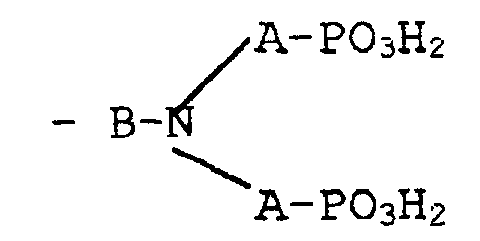 in der B eine Alkylen-Gruppierung mit 2 bis 8 (einschließlich) Kohlenstoffatomen bezeichnet und A die vorgenannte Bedeutung hat,"n" ist eine, zwischen 20 und 250, inbegriffene ganze Zahl,"r" ist die Zahl der von allen Rj getragenen Gruppen [R-O (Ri-O)n]"q" ist die Zahl der von allen Q getragenen Gruppe [R-O (Ri-O)n]die Summe "r+q" ist höchstens gleich 3"y" ist eine ganze Zahl gleich 1 oder 2,
 - Selbstausgleichende Zusammensetzung gemäß Anspruch 1, dadurch gekennzeichnet, dass die Gruppierung R des Verflüssigers (I) ein Wasserstoffatom oder eine gesättigte oder nicht gesättigte einwertige Kohlenwasserstoff Gruppe mit 1 bis 4 Kohlenstoffatomen ist.
- Selbstausgleichende Zusammensetzung gemäß Anspruch 1 oder 2, dadurch gekennzeichnet, dass wenigstens 50 % der Ri des Verflüssigers (I) Ethylen sind und die eventuellen anderen Ri Propylen sind.
- Selbstausgleichende Zusammensetzung gemäß Anspruch 1, 2 oder 3, dadurch gekennzeichnet, dass die Kohlenwasserstoff Gruppe Q des Verflüssigers (I) 2 bis 12 (einschließlich) Kohlenstoffatome beinhaltet.
- Selbstausgleichende Zusammensetzung gemäß Anspruch 4, dadurch gekennzeichnet, dass die Kohlenwasserstoff Gruppe Q des Verflüssigers (I) 2 bis 6 Kohlenstoffatome beinhaltet.
- Selbstausgleichende Zusammensetzung gemäß Anspruch 5, dadurch gekennzeichnet, dass die Kohlenwasserstoff Gruppe Q des Verflüssigers (I) Ethylen oder Propylen ist.
- Selbstausgleichende Zusammensetzung gemäß einem der vorherigen Ansprüche, dadurch gekennzeichnet, dass die Gruppe Rj des Verflüssigers (I) aus den eventuell in Salzform bestehenden Gruppen -CH2-PO3H2, -C2H4N (CH2-PO3H2) und -C3H6N (CH2-PO3H2)2 ausgewählt ist.
- Selbstausgleichende Zusammensetzung gemäß einem der vorhergehenden Ansprüche, dadurch gekennzeichnet, dass die Formel des Verflüssigers (I) derart ist, dass "n" zwischen 30 und 150 (Grenzwerte eingeschlossen) inbegriffen ist.
- Selbstausgleichende Zusammensetzung gemäß Anspruch 8, dadurch gekennzeichnet, dass die Formel des Verflüssigers (I) derart ist, dass "n" zwischen 50 und 100 (Grenzwerte eingeschlossen) inbegriffen ist.
- Selbstausgleichende Zusammensetzung gemäß einem der vorherigen Ansprüche, dadurch gekennzeichnet, dass die Formel des Verflüssigers (I) derart ist, dass die Summe "r+q" gleich 1 ist.
- Selbstausgleichende Zusammensetzung gemäß einem der vorherigen Ansprüche, dadurch gekennzeichnet, dass die Formel des Verflüssigers (I) derart ist, dass "y" gleich 1 ist.
- Selbstausgleichende Zusammensetzung gemäß Anspruch 1, dadurch gekennzeichnet, dass die Formel des Verflüssigers (I) derart ist, dass Ri Ethylen ist, Rj -CH2-PO3H2, n zwischen 30 und 150 (Grenzwerte eingeschlossen) inbegriffen ist, bevorzugt zwischen 50 und 100 (Grenzwerte eingeschlossen), "r+q" gleich 1 ist und "y" gleich 1 ist.
- Selbstausgleichende Zusammensetzung gemäß Anspruch 12, dadurch gekennzeichnet, dass die eventuell in Salzform bestehende Komponente (I) folgende Formel (II) hat:

- Selbstausgleichende Zusammensetzung gemäß einem der vorhergehenden Ansprüche, dadurch gekennzeichnet, dass die Menge der Komponente (I) zwischen 0,2 und 2 an Trockengewichtsprozent im Vergleich zum Zementgewicht, bevorzugt zwischen 0,3 und 0,8 %, inbegriffen ist.
- Selbstausgleichende Zusammensetzung gemäß einem der vorherigen Ansprüche, dadurch gekennzeichnet, dass die selbstausgleichende Zusammensetzung wenigstens ein Verdickungsmittel umfasst.
- Selbstausgleichende Zusammensetzung gemäß einem der vorhergehenden Ansprüche, dadurch gekennzeichnet, dass die selbstausgleichende Zusammensetzung ausserdem wasserlöslichen oder in Wasser dispergierbaren Verflüssiger (PCP) entsteht der auf der Basis von vinylhaltigen, carboxylhaltigen Monomeren und eventuell von vinylhaltigen, sulforierten Monomeren umfasst, darüber hinaus einen Polyetherketten umschließt.
- Selbstausgleichende Zusammensetzung gemäß einem der vorhergehenden Ansprüche, dadurch gekennzeichnet, dass die selbstausgleichende Zusammensetzung wenigstens ein Schaumgegenmittel umfasst.
- Selbstausgleichende Zusammensetzung gemäß einem der vorhergehenden Ansprüche, dadurch gekennzeichnet, dass die selbstausgleichende Zusammensetzung feinen mineralischen Füllstoffe umfasst.
- Selbstausgleichende Zusammensetzung gemäß einem der vorhergehenden Ansprüche, dadurch gekennzeichnet, dass sie Folgendes umfasst:200 bis 400 kg/m3 Portlandzement;100 bis 400 kg/m3 feinen mineralischen Füllstoffe;1100 bis 1600 kg/m3 Sand mit einer maximalen Korngröße von unter 10 mm;Wasser in einem zwischen 0,6 und 1,2 inbegriffenen Verhältnis (W/Z) ;wenigsten ein Schaumgegenmittel;wenigstens ein Eindickungsmittel;wenigstens eine Komponente (I) als Verflüssiger, und zwar 0,2 bis 2 % Trockengewichtsprozent zum Zementgewicht mitgebracht wird, und eventuell wenigstens einen Verflüssiger vom Typ PCP.
- Selbstausgleichende Zusammensetzung gemäß Anspruch 19, dadurch gekennzeichnet, dass der Sand eine maximale Korngröße von unter oder gleich 5 mm hat.
- Selbstausgleichende Zusammensetzung gemäß einem der vorhergehenden Ansprüche, dadurch gekennzeichnet, dass seine Fließfähigkeit vor der Gussoperation derart ist, dass die mit dem Referenzkegel erhaltene freie kreisförmige Breitenstreuung einen Durchmesser von wenigstens 17 cm hat.
- Selbstausgleichende Zusammensetzung gemäß einem der vorhergehenden Ansprüche, dadurch gekennzeichnet, dass seine Fließfähigkeit vor der Gussoperation derart ist, dass die mit dem Referenzkegel erreichte freie kreisförmige Breitenstreuung in der Größenordnung von 23 cm plus oder minus 3 cm liegt.
- Bodenabdeckung, dadurch gekennzeichnet, dass sie aus einer in Anspruch 1 bis 22 definierten selbstausgleichenden Zusanmensetzung hergestellt ist.
Applications Claiming Priority (3)
| Application Number | Priority Date | Filing Date | Title |
|---|---|---|---|
| FR9706010A FR2763065B1 (fr) | 1997-05-12 | 1997-05-12 | Composition autonivelante a base de ciment |
| FR9706010 | 1997-05-12 | ||
| PCT/FR1998/000938 WO1998051637A1 (fr) | 1997-05-12 | 1998-05-11 | Composition autonivelante a base de ciment |
Publications (2)
| Publication Number | Publication Date |
|---|---|
| EP0981505A1 EP0981505A1 (de) | 2000-03-01 |
| EP0981505B1 true EP0981505B1 (de) | 2003-03-26 |
Family
ID=9506950
Family Applications (1)
| Application Number | Title | Priority Date | Filing Date |
|---|---|---|---|
| EP98924416A Expired - Lifetime EP0981505B1 (de) | 1997-05-12 | 1998-05-11 | Selbstnivellierende zementzusammensetzung |
Country Status (8)
| Country | Link |
|---|---|
| US (1) | US6309457B1 (de) |
| EP (1) | EP0981505B1 (de) |
| AT (1) | ATE235440T1 (de) |
| AU (1) | AU7662398A (de) |
| CA (1) | CA2290643C (de) |
| DE (1) | DE69812607D1 (de) |
| FR (1) | FR2763065B1 (de) |
| WO (1) | WO1998051637A1 (de) |
Families Citing this family (24)
| Publication number | Priority date | Publication date | Assignee | Title |
|---|---|---|---|---|
| FR2793242B1 (fr) * | 1999-05-04 | 2001-07-13 | Electricite De France | Beton pour la construction de chapes auto-nivelantes |
| US6908955B2 (en) | 1999-07-09 | 2005-06-21 | Construction Research & Technology Gmbh | Oligomeric dispersant |
| US6861459B2 (en) | 1999-07-09 | 2005-03-01 | Construction Research & Technology Gmbh | Oligomeric dispersant |
| US6133347A (en) | 1999-07-09 | 2000-10-17 | Mbt Holding Ag | Oligomeric dispersant |
| FR2810314B1 (fr) | 2000-06-20 | 2003-09-19 | Lafarge Aluminates | Liant rapide pour beton autocompactant, utilisation et applications d'un tel liant |
| FR2815342B1 (fr) * | 2000-10-13 | 2003-08-01 | Francais Ciments | Composition cimentaire, son utilisation pour la realisation de chape liquide autonivelante et chape ainsi obtenue |
| FR2832402B1 (fr) * | 2001-11-19 | 2004-12-10 | Carrieres Du Boulonnais | Composition cimentaire, procede de fabrication de chapes a retrait et relevement des bords reduits et chapes obtenues |
| ITPN20020033A1 (it) * | 2002-05-20 | 2003-11-20 | Mirella Zampieri | Conglomerato cementizio autolivellante per il riempimento e la sigillatura di scavi di canalette, trincee, fognature e simili e per opere di |
| US6875116B2 (en) | 2002-06-28 | 2005-04-05 | Tessier Recreo-Parc Inc. | Recreational ramp for wheeled vehicles and process for manufacturing same |
| CL2009000372A1 (es) * | 2008-03-03 | 2009-11-13 | United States Gypsum Co | Panel cementicio blindado reforzado con fibra, que comprende un nucleo cementicio de una fase curada constituida de cemento inorganico, mineral inorganico, relleno puzolanico, policarboxilato y agua, y una capa de recubrimiento unida a una superficie de la fase curada. |
| CL2009000371A1 (es) | 2008-03-03 | 2009-10-30 | United States Gypsum Co | Composicion cementicia, que contiene una fase continua que resulta del curado de una mezcla cementicia, en ausencia de harina de silice, y que comprende cemento inorganico, mineral inorganico, relleno puzolanico, policarboxilato y agua; y uso de la composicion en una panel y barrera cementicia. |
| CL2009000373A1 (es) | 2008-03-03 | 2009-10-30 | United States Gypsum Co | Metodo para hacer un panel resistente a explosivos, con las etapas de preparar una mezcla cementicia acuosa de cemento, rellenos inorganicos y puzolanico, agente autonivelante de policarboxilato, y formar la mezcla en un panel con refuerzo de fibra, luego curar, pulir, cortar y curar el panel. |
| CL2009000370A1 (es) | 2008-03-03 | 2009-10-30 | United States Gypsum Co | Sistema de paneles, que comprende un armazon y un panel cementicio, que contiene un nucleo cementicio de una fase curada constituida de cemento inorganico, mineral inorganico, relleno puzolanico, policarboxilato y agua, y una capa de recubrimiento unida a una superficie de la fase curada. |
| US8061257B2 (en) * | 2008-03-03 | 2011-11-22 | United States Gypsum Company | Cement based armor panel system |
| EP2163709B1 (de) * | 2008-09-12 | 2012-10-10 | Flooring Industries Limited, SARL | Verfahren zum Verlegen eines Fussbodenbelags und Mittel zur Behandlung eines Untergrundes für dieses Verfahren |
| PL2411346T3 (pl) * | 2009-03-25 | 2014-05-30 | Siniat Int | Środek upłynniający do spoiwa na bazie siarczanu wapnia |
| FR2943661A1 (fr) * | 2009-03-25 | 2010-10-01 | Lafarge Gypsum Int | Fluidifiant pour liant hydraulique |
| FR2944022B1 (fr) * | 2009-04-02 | 2011-06-10 | Chryso | Fluidifiants pour suspensions aqueuses de particules minerales et pates de liant hydraulique |
| FR2950467B1 (fr) | 2009-09-23 | 2011-10-28 | Baltymore | Procede de traitement de materiaux solides radioactifs |
| EP2504293A1 (de) * | 2009-11-25 | 2012-10-03 | BASF Construction Polymers GmbH | Dispergiermittel |
| FR2993268B1 (fr) * | 2012-07-10 | 2015-02-27 | Saint Gobain Weber | Compositions autonivelantes a base de liants hydrauliques pour chapes ou revetements de sol |
| FR3009553B1 (fr) * | 2013-08-08 | 2015-08-28 | Coatex Sas | Poly(ethylene glycol) gemine ester phosphate, utilisation comme additif dans les compositions hydrauliques et compositions le contenant |
| FR3022240A1 (fr) | 2014-06-13 | 2015-12-18 | Lafarge Sa | Beton revetu d'une couche mince photovoltaique, son procede de fabrication et element de construction comprenant un tel beton |
| US12338621B2 (en) | 2021-09-17 | 2025-06-24 | United States Gypsum Company | Structural load-bearing wall |
Family Cites Families (5)
| Publication number | Priority date | Publication date | Assignee | Title |
|---|---|---|---|---|
| FR2696736B1 (fr) * | 1992-10-12 | 1994-12-30 | Chryso | Fluidifiants pour suspensions aqueuses de particules minérales et pâtes de liant hydraulique. |
| FR2704853B1 (fr) * | 1993-05-07 | 1995-07-28 | Dijon Beton | Béton à propriété autolissante et autonivelante. |
| JPH07215750A (ja) * | 1994-02-04 | 1995-08-15 | Nitto Chem Ind Co Ltd | 自己平滑性セメントモルタル組成物の施工方法 |
| US5403394A (en) * | 1994-02-24 | 1995-04-04 | Burgand; Yves | Self-leveling floor coating material |
| DE29518306U1 (de) * | 1995-11-21 | 1996-07-18 | Bilke, Thomas, 06528 Martinsrieth | Selbstnivellierender Zementfließestrich |
-
1997
- 1997-05-12 FR FR9706010A patent/FR2763065B1/fr not_active Expired - Fee Related
-
1998
- 1998-05-11 WO PCT/FR1998/000938 patent/WO1998051637A1/fr not_active Ceased
- 1998-05-11 DE DE69812607T patent/DE69812607D1/de not_active Expired - Lifetime
- 1998-05-11 US US09/423,604 patent/US6309457B1/en not_active Expired - Fee Related
- 1998-05-11 AT AT98924416T patent/ATE235440T1/de not_active IP Right Cessation
- 1998-05-11 CA CA002290643A patent/CA2290643C/fr not_active Expired - Fee Related
- 1998-05-11 EP EP98924416A patent/EP0981505B1/de not_active Expired - Lifetime
- 1998-05-11 AU AU76623/98A patent/AU7662398A/en not_active Abandoned
Also Published As
| Publication number | Publication date |
|---|---|
| AU7662398A (en) | 1998-12-08 |
| US6309457B1 (en) | 2001-10-30 |
| CA2290643C (fr) | 2007-07-31 |
| EP0981505A1 (de) | 2000-03-01 |
| CA2290643A1 (fr) | 1998-11-19 |
| DE69812607D1 (de) | 2003-04-30 |
| FR2763065B1 (fr) | 1999-07-30 |
| FR2763065A1 (fr) | 1998-11-13 |
| WO1998051637A1 (fr) | 1998-11-19 |
| ATE235440T1 (de) | 2003-04-15 |
Similar Documents
| Publication | Publication Date | Title |
|---|---|---|
| CA2290643C (fr) | Composition autonivelante a base de ciment | |
| EP1102816B1 (de) | Bituminöse emulsionen, verfahren zu ihrer herstellung, und diese enthaltende zusammensetzungen | |
| EP1296908B1 (de) | Schnellbinder für selbst-verdichtenden beton und verwendung eines solchen bindemittels | |
| EP2576478B1 (de) | Hydraulischer binder oder mörtel mit stabilem volumen | |
| EP2655448B1 (de) | Polymer mit einer hydrolysierbaren funktion zur verwendung als verdünner | |
| JPH0216186A (ja) | 撥水性組成物 | |
| EP2601152B1 (de) | Pulverförmige mörtelzusammensetzung mit verbesserter haftung | |
| EP2935144A1 (de) | Leichtgewichtige beton- oder mörtelzusammensetzung mit einem wässrigen schaum | |
| EP2358649A1 (de) | Verwendung von mindestens einem celluloseether zur verringerung des plastischen schrumpfs und/oder der plastischen rissbildung in beton | |
| US6616755B1 (en) | Self-levelling concrete and method for making a structural part | |
| EP3233753B1 (de) | Hydraulische zusammensetzung zum bauen von strassen | |
| EP2462072B1 (de) | Verwendung einer zusammensetzung enthaltend eine fettige komponente und ein antibackmittel als anti-filmbildende additivmischung für oberflächen von hydraulischen bindemitteln | |
| EP1189850B1 (de) | Beton für selbstnivellierende fliessestriche, und verfahren zur verwendung | |
| EP2531462B1 (de) | Verfahren zum sprühen eines schaummaterials und in einem solchen verfahren hergestellte beschichtung | |
| EP3392224A1 (de) | Verwendung eines luftporen bildenden mittels zur verkürzung der trocknungszeit einer abdeckschicht auf der basis von calciumsulfat | |
| FR2963789A1 (fr) | Element en beton dont la surface est a faible porosite ouverte | |
| FR3064000A1 (fr) | Agent de cure pour formulation cimentaire | |
| JP2017114703A (ja) | 水硬性組成物用表面美観向上剤組成物 | |
| FR2893324A1 (fr) | Procede de collage sur chape a base de sulfate de calcium. | |
| RU2466170C1 (ru) | Композиция для формования строительных и отделочных материалов с антиобледенительными свойствами | |
| FR2978693A1 (fr) | Composition de demoulage et procede de fabrication d'un article moule en beton | |
| FR2967688A1 (fr) | Composition de demoulage | |
| FR3065212A1 (fr) | Composition seche pour la preparation de beton drainant, procede de preparation de beton avec la dite composition et beton drainant obtenu avec le procede. |
Legal Events
| Date | Code | Title | Description |
|---|---|---|---|
| PUAI | Public reference made under article 153(3) epc to a published international application that has entered the european phase |
Free format text: ORIGINAL CODE: 0009012 |
|
| 17P | Request for examination filed |
Effective date: 19991112 |
|
| AK | Designated contracting states |
Kind code of ref document: A1 Designated state(s): AT BE CH DE DK ES FR GB IT LI LU NL PT |
|
| RIN1 | Information on inventor provided before grant (corrected) |
Inventor name: CHAPPUIS, JACQUES Inventor name: BOSC, FRANCOIS Inventor name: MOSQUET, MARTIN Inventor name: GUERINET, JEAN-PAUL |
|
| RIN1 | Information on inventor provided before grant (corrected) |
Inventor name: CHAPPUIS, JACQUES Inventor name: BOSC, FRANCOIS Inventor name: MOSQUET, MARTIN Inventor name: GUERINET, JEAN-PAUL |
|
| 17Q | First examination report despatched |
Effective date: 20010130 |
|
| GRAH | Despatch of communication of intention to grant a patent |
Free format text: ORIGINAL CODE: EPIDOS IGRA |
|
| RAP1 | Party data changed (applicant data changed or rights of an application transferred) |
Owner name: LAFARGE SA |
|
| GRAH | Despatch of communication of intention to grant a patent |
Free format text: ORIGINAL CODE: EPIDOS IGRA |
|
| GRAA | (expected) grant |
Free format text: ORIGINAL CODE: 0009210 |
|
| AK | Designated contracting states |
Designated state(s): AT BE CH DE DK ES FR GB IT LI LU NL PT |
|
| PG25 | Lapsed in a contracting state [announced via postgrant information from national office to epo] |
Ref country code: NL Free format text: LAPSE BECAUSE OF FAILURE TO SUBMIT A TRANSLATION OF THE DESCRIPTION OR TO PAY THE FEE WITHIN THE PRESCRIBED TIME-LIMIT Effective date: 20030326 Ref country code: IT Free format text: LAPSE BECAUSE OF FAILURE TO SUBMIT A TRANSLATION OF THE DESCRIPTION OR TO PAY THE FEE WITHIN THE PRE;WARNING: LAPSES OF ITALIAN PATENTS WITH EFFECTIVE DATE BEFORE 2007 MAY HAVE OCCURRED AT ANY TIME BEFORE 2007. THE CORRECT EFFECTIVE DATE MAY BE DIFFERENT FROM THE ONE RECORDED.SCRIBED TIME-LIMIT Effective date: 20030326 Ref country code: AT Free format text: LAPSE BECAUSE OF FAILURE TO SUBMIT A TRANSLATION OF THE DESCRIPTION OR TO PAY THE FEE WITHIN THE PRESCRIBED TIME-LIMIT Effective date: 20030326 |
|
| REG | Reference to a national code |
Ref country code: GB Ref legal event code: FG4D Free format text: NOT ENGLISH |
|
| REG | Reference to a national code |
Ref country code: CH Ref legal event code: EP |
|
| REF | Corresponds to: |
Ref document number: 69812607 Country of ref document: DE Date of ref document: 20030430 Kind code of ref document: P |
|
| PG25 | Lapsed in a contracting state [announced via postgrant information from national office to epo] |
Ref country code: LU Free format text: LAPSE BECAUSE OF NON-PAYMENT OF DUE FEES Effective date: 20030511 |
|
| PG25 | Lapsed in a contracting state [announced via postgrant information from national office to epo] |
Ref country code: LI Free format text: LAPSE BECAUSE OF NON-PAYMENT OF DUE FEES Effective date: 20030531 Ref country code: CH Free format text: LAPSE BECAUSE OF NON-PAYMENT OF DUE FEES Effective date: 20030531 Ref country code: BE Free format text: LAPSE BECAUSE OF NON-PAYMENT OF DUE FEES Effective date: 20030531 |
|
| PG25 | Lapsed in a contracting state [announced via postgrant information from national office to epo] |
Ref country code: PT Free format text: LAPSE BECAUSE OF FAILURE TO SUBMIT A TRANSLATION OF THE DESCRIPTION OR TO PAY THE FEE WITHIN THE PRESCRIBED TIME-LIMIT Effective date: 20030626 Ref country code: DK Free format text: LAPSE BECAUSE OF FAILURE TO SUBMIT A TRANSLATION OF THE DESCRIPTION OR TO PAY THE FEE WITHIN THE PRESCRIBED TIME-LIMIT Effective date: 20030626 |
|
| PG25 | Lapsed in a contracting state [announced via postgrant information from national office to epo] |
Ref country code: DE Free format text: LAPSE BECAUSE OF FAILURE TO SUBMIT A TRANSLATION OF THE DESCRIPTION OR TO PAY THE FEE WITHIN THE PRESCRIBED TIME-LIMIT Effective date: 20030627 |
|
| GBT | Gb: translation of ep patent filed (gb section 77(6)(a)/1977) |
Effective date: 20030728 |
|
| NLV1 | Nl: lapsed or annulled due to failure to fulfill the requirements of art. 29p and 29m of the patents act | ||
| PG25 | Lapsed in a contracting state [announced via postgrant information from national office to epo] |
Ref country code: ES Free format text: LAPSE BECAUSE OF FAILURE TO SUBMIT A TRANSLATION OF THE DESCRIPTION OR TO PAY THE FEE WITHIN THE PRESCRIBED TIME-LIMIT Effective date: 20030930 |
|
| BERE | Be: lapsed |
Owner name: S.A. *LAFARGE Effective date: 20030531 |
|
| REG | Reference to a national code |
Ref country code: CH Ref legal event code: PL |
|
| PLBE | No opposition filed within time limit |
Free format text: ORIGINAL CODE: 0009261 |
|
| STAA | Information on the status of an ep patent application or granted ep patent |
Free format text: STATUS: NO OPPOSITION FILED WITHIN TIME LIMIT |
|
| 26N | No opposition filed |
Effective date: 20031230 |
|
| REG | Reference to a national code |
Ref country code: FR Ref legal event code: PLFP Year of fee payment: 18 |
|
| REG | Reference to a national code |
Ref country code: FR Ref legal event code: PLFP Year of fee payment: 19 |
|
| PGFP | Annual fee paid to national office [announced via postgrant information from national office to epo] |
Ref country code: GB Payment date: 20160518 Year of fee payment: 19 |
|
| PGFP | Annual fee paid to national office [announced via postgrant information from national office to epo] |
Ref country code: FR Payment date: 20160513 Year of fee payment: 19 |
|
| GBPC | Gb: european patent ceased through non-payment of renewal fee |
Effective date: 20170511 |
|
| REG | Reference to a national code |
Ref country code: FR Ref legal event code: ST Effective date: 20180131 |
|
| PG25 | Lapsed in a contracting state [announced via postgrant information from national office to epo] |
Ref country code: GB Free format text: LAPSE BECAUSE OF NON-PAYMENT OF DUE FEES Effective date: 20170511 |
|
| PG25 | Lapsed in a contracting state [announced via postgrant information from national office to epo] |
Ref country code: FR Free format text: LAPSE BECAUSE OF NON-PAYMENT OF DUE FEES Effective date: 20170531 |