EP0982279B1 - Composition aqueuse comprenant un polymère filmifiant et un émulsifiant anionique - Google Patents
Composition aqueuse comprenant un polymère filmifiant et un émulsifiant anionique Download PDFInfo
- Publication number
- EP0982279B1 EP0982279B1 EP99114672A EP99114672A EP0982279B1 EP 0982279 B1 EP0982279 B1 EP 0982279B1 EP 99114672 A EP99114672 A EP 99114672A EP 99114672 A EP99114672 A EP 99114672A EP 0982279 B1 EP0982279 B1 EP 0982279B1
- Authority
- EP
- European Patent Office
- Prior art keywords
- preparation
- weight
- aqueous
- formula
- monomers
- Prior art date
- Legal status (The legal status is an assumption and is not a legal conclusion. Google has not performed a legal analysis and makes no representation as to the accuracy of the status listed.)
- Expired - Lifetime
Links
- 229920000642 polymer Polymers 0.000 title claims description 67
- 239000000203 mixture Substances 0.000 title claims description 24
- 239000012874 anionic emulsifier Substances 0.000 title claims description 13
- 238000002360 preparation method Methods 0.000 claims description 88
- 239000000178 monomer Substances 0.000 claims description 75
- 239000003995 emulsifying agent Substances 0.000 claims description 57
- XLYOFNOQVPJJNP-UHFFFAOYSA-N water Substances O XLYOFNOQVPJJNP-UHFFFAOYSA-N 0.000 claims description 47
- 229910052500 inorganic mineral Inorganic materials 0.000 claims description 39
- 239000011707 mineral Substances 0.000 claims description 39
- 150000003839 salts Chemical class 0.000 claims description 33
- 238000000576 coating method Methods 0.000 claims description 30
- 238000000465 moulding Methods 0.000 claims description 29
- -1 1,2-ethylene Chemical group 0.000 claims description 24
- 230000009477 glass transition Effects 0.000 claims description 24
- 239000011248 coating agent Substances 0.000 claims description 16
- 125000000129 anionic group Chemical group 0.000 claims description 15
- 239000000049 pigment Substances 0.000 claims description 15
- 125000004432 carbon atom Chemical group C* 0.000 claims description 12
- 150000001768 cations Chemical class 0.000 claims description 11
- 239000000945 filler Substances 0.000 claims description 11
- 239000000839 emulsion Substances 0.000 claims description 9
- 150000002148 esters Chemical class 0.000 claims description 9
- 238000007720 emulsion polymerization reaction Methods 0.000 claims description 8
- 229910052739 hydrogen Inorganic materials 0.000 claims description 6
- 239000001257 hydrogen Substances 0.000 claims description 6
- 150000002763 monocarboxylic acids Chemical class 0.000 claims description 6
- 239000008346 aqueous phase Substances 0.000 claims description 5
- UFHFLCQGNIYNRP-UHFFFAOYSA-N Hydrogen Chemical compound [H][H] UFHFLCQGNIYNRP-UHFFFAOYSA-N 0.000 claims description 4
- FKNQFGJONOIPTF-UHFFFAOYSA-N Sodium cation Chemical compound [Na+] FKNQFGJONOIPTF-UHFFFAOYSA-N 0.000 claims description 4
- 125000001931 aliphatic group Chemical group 0.000 claims description 4
- 125000000217 alkyl group Chemical group 0.000 claims description 4
- 239000007870 radical polymerization initiator Substances 0.000 claims description 4
- 229920001567 vinyl ester resin Polymers 0.000 claims description 4
- 125000000391 vinyl group Chemical group [H]C([*])=C([H])[H] 0.000 claims description 4
- 239000000470 constituent Substances 0.000 claims description 3
- 239000004815 dispersion polymer Substances 0.000 claims description 2
- 150000002431 hydrogen Chemical class 0.000 claims description 2
- 239000012875 nonionic emulsifier Substances 0.000 claims description 2
- XSXHWVKGUXMUQE-UHFFFAOYSA-N osmium dioxide Inorganic materials O=[Os]=O XSXHWVKGUXMUQE-UHFFFAOYSA-N 0.000 claims description 2
- 230000000379 polymerizing effect Effects 0.000 claims description 2
- 229910001415 sodium ion Inorganic materials 0.000 claims 1
- 239000006185 dispersion Substances 0.000 description 41
- 235000010755 mineral Nutrition 0.000 description 38
- 239000000243 solution Substances 0.000 description 38
- PPBRXRYQALVLMV-UHFFFAOYSA-N Styrene Chemical compound C=CC1=CC=CC=C1 PPBRXRYQALVLMV-UHFFFAOYSA-N 0.000 description 32
- 239000004567 concrete Substances 0.000 description 21
- 238000006116 polymerization reaction Methods 0.000 description 21
- CQEYYJKEWSMYFG-UHFFFAOYSA-N butyl acrylate Chemical compound CCCCOC(=O)C=C CQEYYJKEWSMYFG-UHFFFAOYSA-N 0.000 description 19
- VVQNEPGJFQJSBK-UHFFFAOYSA-N Methyl methacrylate Chemical compound COC(=O)C(C)=C VVQNEPGJFQJSBK-UHFFFAOYSA-N 0.000 description 18
- 238000000034 method Methods 0.000 description 17
- GOXQRTZXKQZDDN-UHFFFAOYSA-N 2-Ethylhexyl acrylate Chemical compound CCCCC(CC)COC(=O)C=C GOXQRTZXKQZDDN-UHFFFAOYSA-N 0.000 description 16
- 239000004568 cement Substances 0.000 description 15
- CHQMHPLRPQMAMX-UHFFFAOYSA-L sodium persulfate Chemical compound [Na+].[Na+].[O-]S(=O)(=O)OOS([O-])(=O)=O CHQMHPLRPQMAMX-UHFFFAOYSA-L 0.000 description 14
- SOGAXMICEFXMKE-UHFFFAOYSA-N Butylmethacrylate Chemical compound CCCCOC(=O)C(C)=C SOGAXMICEFXMKE-UHFFFAOYSA-N 0.000 description 13
- 238000006253 efflorescence Methods 0.000 description 13
- 206010037844 rash Diseases 0.000 description 13
- 239000008367 deionised water Substances 0.000 description 12
- 229910021641 deionized water Inorganic materials 0.000 description 12
- 238000010521 absorption reaction Methods 0.000 description 11
- 159000000000 sodium salts Chemical class 0.000 description 10
- HEMHJVSKTPXQMS-UHFFFAOYSA-M Sodium hydroxide Chemical compound [OH-].[Na+] HEMHJVSKTPXQMS-UHFFFAOYSA-M 0.000 description 9
- 239000007864 aqueous solution Substances 0.000 description 8
- 239000011230 binding agent Substances 0.000 description 8
- 239000000835 fiber Substances 0.000 description 8
- SMZOUWXMTYCWNB-UHFFFAOYSA-N 2-(2-methoxy-5-methylphenyl)ethanamine Chemical compound COC1=CC=C(C)C=C1CCN SMZOUWXMTYCWNB-UHFFFAOYSA-N 0.000 description 7
- NIXOWILDQLNWCW-UHFFFAOYSA-N 2-Propenoic acid Natural products OC(=O)C=C NIXOWILDQLNWCW-UHFFFAOYSA-N 0.000 description 7
- VYPSYNLAJGMNEJ-UHFFFAOYSA-N Silicium dioxide Chemical compound O=[Si]=O VYPSYNLAJGMNEJ-UHFFFAOYSA-N 0.000 description 7
- 239000002245 particle Substances 0.000 description 7
- 229920000536 2-Acrylamido-2-methylpropane sulfonic acid Polymers 0.000 description 6
- XHZPRMZZQOIPDS-UHFFFAOYSA-N 2-Methyl-2-[(1-oxo-2-propenyl)amino]-1-propanesulfonic acid Chemical compound OS(=O)(=O)CC(C)(C)NC(=O)C=C XHZPRMZZQOIPDS-UHFFFAOYSA-N 0.000 description 6
- HRPVXLWXLXDGHG-UHFFFAOYSA-N Acrylamide Chemical compound NC(=O)C=C HRPVXLWXLXDGHG-UHFFFAOYSA-N 0.000 description 6
- VTYYLEPIZMXCLO-UHFFFAOYSA-L Calcium carbonate Chemical compound [Ca+2].[O-]C([O-])=O VTYYLEPIZMXCLO-UHFFFAOYSA-L 0.000 description 6
- 150000001875 compounds Chemical class 0.000 description 6
- 238000001035 drying Methods 0.000 description 6
- 239000007787 solid Substances 0.000 description 6
- CIHOLLKRGTVIJN-UHFFFAOYSA-N tert‐butyl hydroperoxide Chemical compound CC(C)(C)OO CIHOLLKRGTVIJN-UHFFFAOYSA-N 0.000 description 6
- QGZKDVFQNNGYKY-UHFFFAOYSA-N Ammonia Chemical compound N QGZKDVFQNNGYKY-UHFFFAOYSA-N 0.000 description 5
- LYCAIKOWRPUZTN-UHFFFAOYSA-N Ethylene glycol Chemical compound OCCO LYCAIKOWRPUZTN-UHFFFAOYSA-N 0.000 description 5
- MHAJPDPJQMAIIY-UHFFFAOYSA-N Hydrogen peroxide Chemical compound OO MHAJPDPJQMAIIY-UHFFFAOYSA-N 0.000 description 5
- DNIAPMSPPWPWGF-UHFFFAOYSA-N Propylene glycol Chemical compound CC(O)CO DNIAPMSPPWPWGF-UHFFFAOYSA-N 0.000 description 5
- 229910052783 alkali metal Inorganic materials 0.000 description 5
- 239000003795 chemical substances by application Substances 0.000 description 5
- 229920001577 copolymer Polymers 0.000 description 5
- UQSXHKLRYXJYBZ-UHFFFAOYSA-N iron oxide Inorganic materials [Fe]=O UQSXHKLRYXJYBZ-UHFFFAOYSA-N 0.000 description 5
- 239000004576 sand Substances 0.000 description 5
- 239000004575 stone Substances 0.000 description 5
- 239000000126 substance Substances 0.000 description 5
- VZCYOOQTPOCHFL-OWOJBTEDSA-N Fumaric acid Chemical compound OC(=O)\C=C\C(O)=O VZCYOOQTPOCHFL-OWOJBTEDSA-N 0.000 description 4
- QAOWNCQODCNURD-UHFFFAOYSA-N Sulfuric acid Chemical class OS(O)(=O)=O QAOWNCQODCNURD-UHFFFAOYSA-N 0.000 description 4
- WNLRTRBMVRJNCN-UHFFFAOYSA-N adipic acid Chemical compound OC(=O)CCCCC(O)=O WNLRTRBMVRJNCN-UHFFFAOYSA-N 0.000 description 4
- TZCXTZWJZNENPQ-UHFFFAOYSA-L barium sulfate Chemical compound [Ba+2].[O-]S([O-])(=O)=O TZCXTZWJZNENPQ-UHFFFAOYSA-L 0.000 description 4
- 239000004816 latex Substances 0.000 description 4
- 229920000126 latex Polymers 0.000 description 4
- 238000006386 neutralization reaction Methods 0.000 description 4
- 239000004014 plasticizer Substances 0.000 description 4
- 150000003254 radicals Chemical class 0.000 description 4
- 239000012966 redox initiator Substances 0.000 description 4
- 239000002002 slurry Substances 0.000 description 4
- VZCYOOQTPOCHFL-UHFFFAOYSA-N trans-butenedioic acid Natural products OC(=O)C=CC(O)=O VZCYOOQTPOCHFL-UHFFFAOYSA-N 0.000 description 4
- DURPTKYDGMDSBL-UHFFFAOYSA-N 1-butoxybutane Chemical compound CCCCOCCCC DURPTKYDGMDSBL-UHFFFAOYSA-N 0.000 description 3
- CERQOIWHTDAKMF-UHFFFAOYSA-N Methacrylic acid Chemical compound CC(=C)C(O)=O CERQOIWHTDAKMF-UHFFFAOYSA-N 0.000 description 3
- XUIMIQQOPSSXEZ-UHFFFAOYSA-N Silicon Chemical compound [Si] XUIMIQQOPSSXEZ-UHFFFAOYSA-N 0.000 description 3
- GWEVSGVZZGPLCZ-UHFFFAOYSA-N Titan oxide Chemical compound O=[Ti]=O GWEVSGVZZGPLCZ-UHFFFAOYSA-N 0.000 description 3
- 239000002253 acid Substances 0.000 description 3
- 150000007513 acids Chemical class 0.000 description 3
- 239000002585 base Substances 0.000 description 3
- 239000011575 calcium Substances 0.000 description 3
- 229910000019 calcium carbonate Inorganic materials 0.000 description 3
- 150000001735 carboxylic acids Chemical class 0.000 description 3
- 239000008199 coating composition Substances 0.000 description 3
- 150000001991 dicarboxylic acids Chemical class 0.000 description 3
- MTHSVFCYNBDYFN-UHFFFAOYSA-N diethylene glycol Chemical compound OCCOCCO MTHSVFCYNBDYFN-UHFFFAOYSA-N 0.000 description 3
- 238000005516 engineering process Methods 0.000 description 3
- 238000007046 ethoxylation reaction Methods 0.000 description 3
- 235000013980 iron oxide Nutrition 0.000 description 3
- 238000004519 manufacturing process Methods 0.000 description 3
- 229910052710 silicon Inorganic materials 0.000 description 3
- 239000010703 silicon Substances 0.000 description 3
- RTBFRGCFXZNCOE-UHFFFAOYSA-N 1-methylsulfonylpiperidin-4-one Chemical compound CS(=O)(=O)N1CCC(=O)CC1 RTBFRGCFXZNCOE-UHFFFAOYSA-N 0.000 description 2
- PRAMZQXXPOLCIY-UHFFFAOYSA-N 2-(2-methylprop-2-enoyloxy)ethanesulfonic acid Chemical compound CC(=C)C(=O)OCCS(O)(=O)=O PRAMZQXXPOLCIY-UHFFFAOYSA-N 0.000 description 2
- JAHNSTQSQJOJLO-UHFFFAOYSA-N 2-(3-fluorophenyl)-1h-imidazole Chemical compound FC1=CC=CC(C=2NC=CN=2)=C1 JAHNSTQSQJOJLO-UHFFFAOYSA-N 0.000 description 2
- SVTBMSDMJJWYQN-UHFFFAOYSA-N 2-methylpentane-2,4-diol Chemical compound CC(O)CC(C)(C)O SVTBMSDMJJWYQN-UHFFFAOYSA-N 0.000 description 2
- GQTFHSAAODFMHB-UHFFFAOYSA-N 2-prop-2-enoyloxyethanesulfonic acid Chemical compound OS(=O)(=O)CCOC(=O)C=C GQTFHSAAODFMHB-UHFFFAOYSA-N 0.000 description 2
- KFNGWPXYNSJXOP-UHFFFAOYSA-N 3-(2-methylprop-2-enoyloxy)propane-1-sulfonic acid Chemical compound CC(=C)C(=O)OCCCS(O)(=O)=O KFNGWPXYNSJXOP-UHFFFAOYSA-N 0.000 description 2
- NIXOWILDQLNWCW-UHFFFAOYSA-M Acrylate Chemical compound [O-]C(=O)C=C NIXOWILDQLNWCW-UHFFFAOYSA-M 0.000 description 2
- CIWBSHSKHKDKBQ-JLAZNSOCSA-N Ascorbic acid Chemical compound OC[C@H](O)[C@H]1OC(=O)C(O)=C1O CIWBSHSKHKDKBQ-JLAZNSOCSA-N 0.000 description 2
- CURLTUGMZLYLDI-UHFFFAOYSA-N Carbon dioxide Chemical compound O=C=O CURLTUGMZLYLDI-UHFFFAOYSA-N 0.000 description 2
- 235000008733 Citrus aurantifolia Nutrition 0.000 description 2
- BAPJBEWLBFYGME-UHFFFAOYSA-N Methyl acrylate Chemical compound COC(=O)C=C BAPJBEWLBFYGME-UHFFFAOYSA-N 0.000 description 2
- 239000004793 Polystyrene Substances 0.000 description 2
- OFOBLEOULBTSOW-UHFFFAOYSA-N Propanedioic acid Natural products OC(=O)CC(O)=O OFOBLEOULBTSOW-UHFFFAOYSA-N 0.000 description 2
- 235000011941 Tilia x europaea Nutrition 0.000 description 2
- XTXRWKRVRITETP-UHFFFAOYSA-N Vinyl acetate Chemical compound CC(=O)OC=C XTXRWKRVRITETP-UHFFFAOYSA-N 0.000 description 2
- XLOMVQKBTHCTTD-UHFFFAOYSA-N Zinc monoxide Chemical compound [Zn]=O XLOMVQKBTHCTTD-UHFFFAOYSA-N 0.000 description 2
- OHBRHBQMHLEELN-UHFFFAOYSA-N acetic acid;1-butoxybutane Chemical compound CC(O)=O.CCCCOCCCC OHBRHBQMHLEELN-UHFFFAOYSA-N 0.000 description 2
- 239000013543 active substance Substances 0.000 description 2
- 239000001361 adipic acid Substances 0.000 description 2
- 235000011037 adipic acid Nutrition 0.000 description 2
- 230000002411 adverse Effects 0.000 description 2
- 150000001340 alkali metals Chemical class 0.000 description 2
- 150000001408 amides Chemical class 0.000 description 2
- 229910021529 ammonia Inorganic materials 0.000 description 2
- 150000003863 ammonium salts Chemical class 0.000 description 2
- JFCQEDHGNNZCLN-UHFFFAOYSA-N anhydrous glutaric acid Natural products OC(=O)CCCC(O)=O JFCQEDHGNNZCLN-UHFFFAOYSA-N 0.000 description 2
- 239000007900 aqueous suspension Substances 0.000 description 2
- 239000000378 calcium silicate Substances 0.000 description 2
- 229910052918 calcium silicate Inorganic materials 0.000 description 2
- OSGAYBCDTDRGGQ-UHFFFAOYSA-L calcium sulfate Chemical compound [Ca+2].[O-]S([O-])(=O)=O OSGAYBCDTDRGGQ-UHFFFAOYSA-L 0.000 description 2
- OYACROKNLOSFPA-UHFFFAOYSA-N calcium;dioxido(oxo)silane Chemical compound [Ca+2].[O-][Si]([O-])=O OYACROKNLOSFPA-UHFFFAOYSA-N 0.000 description 2
- 238000006243 chemical reaction Methods 0.000 description 2
- 239000003086 colorant Substances 0.000 description 2
- 239000013530 defoamer Substances 0.000 description 2
- 238000001125 extrusion Methods 0.000 description 2
- 238000009472 formulation Methods 0.000 description 2
- 239000001530 fumaric acid Substances 0.000 description 2
- 229920001519 homopolymer Polymers 0.000 description 2
- SBGKURINHGJRFN-UHFFFAOYSA-N hydroxymethanesulfinic acid Chemical compound OCS(O)=O SBGKURINHGJRFN-UHFFFAOYSA-N 0.000 description 2
- 239000004615 ingredient Substances 0.000 description 2
- 239000003999 initiator Substances 0.000 description 2
- 239000004571 lime Substances 0.000 description 2
- ZLNQQNXFFQJAID-UHFFFAOYSA-L magnesium carbonate Chemical compound [Mg+2].[O-]C([O-])=O ZLNQQNXFFQJAID-UHFFFAOYSA-L 0.000 description 2
- 239000001095 magnesium carbonate Substances 0.000 description 2
- 229910000021 magnesium carbonate Inorganic materials 0.000 description 2
- 235000014380 magnesium carbonate Nutrition 0.000 description 2
- VZCYOOQTPOCHFL-UPHRSURJSA-N maleic acid Chemical compound OC(=O)\C=C/C(O)=O VZCYOOQTPOCHFL-UPHRSURJSA-N 0.000 description 2
- 239000011976 maleic acid Substances 0.000 description 2
- 229910052751 metal Inorganic materials 0.000 description 2
- 239000002184 metal Substances 0.000 description 2
- FQPSGWSUVKBHSU-UHFFFAOYSA-N methacrylamide Chemical compound CC(=C)C(N)=O FQPSGWSUVKBHSU-UHFFFAOYSA-N 0.000 description 2
- LVHBHZANLOWSRM-UHFFFAOYSA-N methylenebutanedioic acid Natural products OC(=O)CC(=C)C(O)=O LVHBHZANLOWSRM-UHFFFAOYSA-N 0.000 description 2
- 229940029985 mineral supplement Drugs 0.000 description 2
- 235000020786 mineral supplement Nutrition 0.000 description 2
- 150000002978 peroxides Chemical class 0.000 description 2
- XNGIFLGASWRNHJ-UHFFFAOYSA-N phthalic acid Chemical compound OC(=O)C1=CC=CC=C1C(O)=O XNGIFLGASWRNHJ-UHFFFAOYSA-N 0.000 description 2
- 229920002223 polystyrene Polymers 0.000 description 2
- 230000002035 prolonged effect Effects 0.000 description 2
- 239000001054 red pigment Substances 0.000 description 2
- 239000011734 sodium Substances 0.000 description 2
- GEHJYWRUCIMESM-UHFFFAOYSA-L sodium sulfite Chemical compound [Na+].[Na+].[O-]S([O-])=O GEHJYWRUCIMESM-UHFFFAOYSA-L 0.000 description 2
- KDYFGRWQOYBRFD-UHFFFAOYSA-N succinic acid Chemical compound OC(=O)CCC(O)=O KDYFGRWQOYBRFD-UHFFFAOYSA-N 0.000 description 2
- 150000003460 sulfonic acids Chemical class 0.000 description 2
- 239000000080 wetting agent Substances 0.000 description 2
- PUPZLCDOIYMWBV-UHFFFAOYSA-N (+/-)-1,3-Butanediol Chemical compound CC(O)CCO PUPZLCDOIYMWBV-UHFFFAOYSA-N 0.000 description 1
- DAFHKNAQFPVRKR-UHFFFAOYSA-N (3-hydroxy-2,2,4-trimethylpentyl) 2-methylpropanoate Chemical compound CC(C)C(O)C(C)(C)COC(=O)C(C)C DAFHKNAQFPVRKR-UHFFFAOYSA-N 0.000 description 1
- IBLKWZIFZMJLFL-UHFFFAOYSA-N 1-phenoxypropan-2-ol Chemical compound CC(O)COC1=CC=CC=C1 IBLKWZIFZMJLFL-UHFFFAOYSA-N 0.000 description 1
- DMFAHCVITRDZQB-UHFFFAOYSA-N 1-propoxypropan-2-yl acetate Chemical compound CCCOCC(C)OC(C)=O DMFAHCVITRDZQB-UHFFFAOYSA-N 0.000 description 1
- OAYXUHPQHDHDDZ-UHFFFAOYSA-N 2-(2-butoxyethoxy)ethanol Chemical compound CCCCOCCOCCO OAYXUHPQHDHDDZ-UHFFFAOYSA-N 0.000 description 1
- JONNRYNDZVEZFH-UHFFFAOYSA-N 2-(2-butoxypropoxy)propyl acetate Chemical compound CCCCOC(C)COC(C)COC(C)=O JONNRYNDZVEZFH-UHFFFAOYSA-N 0.000 description 1
- FPZWZCWUIYYYBU-UHFFFAOYSA-N 2-(2-ethoxyethoxy)ethyl acetate Chemical compound CCOCCOCCOC(C)=O FPZWZCWUIYYYBU-UHFFFAOYSA-N 0.000 description 1
- XYVAYAJYLWYJJN-UHFFFAOYSA-N 2-(2-propoxypropoxy)propan-1-ol Chemical compound CCCOC(C)COC(C)CO XYVAYAJYLWYJJN-UHFFFAOYSA-N 0.000 description 1
- ISRGONDNXBCDBM-UHFFFAOYSA-N 2-chlorostyrene Chemical compound ClC1=CC=CC=C1C=C ISRGONDNXBCDBM-UHFFFAOYSA-N 0.000 description 1
- VMSBGXAJJLPWKV-UHFFFAOYSA-N 2-ethenylbenzenesulfonic acid Chemical compound OS(=O)(=O)C1=CC=CC=C1C=C VMSBGXAJJLPWKV-UHFFFAOYSA-N 0.000 description 1
- WDQMWEYDKDCEHT-UHFFFAOYSA-N 2-ethylhexyl 2-methylprop-2-enoate Chemical compound CCCCC(CC)COC(=O)C(C)=C WDQMWEYDKDCEHT-UHFFFAOYSA-N 0.000 description 1
- BMCSBVHAGWUAQR-UHFFFAOYSA-N 2-hydroxy-2-(2-methylprop-2-enoylamino)acetic acid Chemical compound CC(=C)C(=O)NC(O)C(O)=O BMCSBVHAGWUAQR-UHFFFAOYSA-N 0.000 description 1
- NEYTXADIGVEHQD-UHFFFAOYSA-N 2-hydroxy-2-(prop-2-enoylamino)acetic acid Chemical compound OC(=O)C(O)NC(=O)C=C NEYTXADIGVEHQD-UHFFFAOYSA-N 0.000 description 1
- OMIGHNLMNHATMP-UHFFFAOYSA-N 2-hydroxyethyl prop-2-enoate Chemical compound OCCOC(=O)C=C OMIGHNLMNHATMP-UHFFFAOYSA-N 0.000 description 1
- RUMACXVDVNRZJZ-UHFFFAOYSA-N 2-methylpropyl 2-methylprop-2-enoate Chemical compound CC(C)COC(=O)C(C)=C RUMACXVDVNRZJZ-UHFFFAOYSA-N 0.000 description 1
- CFVWNXQPGQOHRJ-UHFFFAOYSA-N 2-methylpropyl prop-2-enoate Chemical compound CC(C)COC(=O)C=C CFVWNXQPGQOHRJ-UHFFFAOYSA-N 0.000 description 1
- BUJVPKZRXOTBGA-UHFFFAOYSA-N 2-trimethoxysilylethyl prop-2-enoate Chemical compound CO[Si](OC)(OC)CCOC(=O)C=C BUJVPKZRXOTBGA-UHFFFAOYSA-N 0.000 description 1
- QZPSOSOOLFHYRR-UHFFFAOYSA-N 3-hydroxypropyl prop-2-enoate Chemical compound OCCCOC(=O)C=C QZPSOSOOLFHYRR-UHFFFAOYSA-N 0.000 description 1
- LDMRLRNXHLPZJN-UHFFFAOYSA-N 3-propoxypropan-1-ol Chemical compound CCCOCCCO LDMRLRNXHLPZJN-UHFFFAOYSA-N 0.000 description 1
- UUEWCQRISZBELL-UHFFFAOYSA-N 3-trimethoxysilylpropane-1-thiol Chemical compound CO[Si](OC)(OC)CCCS UUEWCQRISZBELL-UHFFFAOYSA-N 0.000 description 1
- NDWUBGAGUCISDV-UHFFFAOYSA-N 4-hydroxybutyl prop-2-enoate Chemical compound OCCCCOC(=O)C=C NDWUBGAGUCISDV-UHFFFAOYSA-N 0.000 description 1
- 239000005995 Aluminium silicate Substances 0.000 description 1
- QGZKDVFQNNGYKY-UHFFFAOYSA-O Ammonium Chemical compound [NH4+] QGZKDVFQNNGYKY-UHFFFAOYSA-O 0.000 description 1
- NLXLAEXVIDQMFP-UHFFFAOYSA-N Ammonium chloride Substances [NH4+].[Cl-] NLXLAEXVIDQMFP-UHFFFAOYSA-N 0.000 description 1
- VHUUQVKOLVNVRT-UHFFFAOYSA-N Ammonium hydroxide Chemical compound [NH4+].[OH-] VHUUQVKOLVNVRT-UHFFFAOYSA-N 0.000 description 1
- 229910021532 Calcite Inorganic materials 0.000 description 1
- OKTJSMMVPCPJKN-UHFFFAOYSA-N Carbon Chemical compound [C] OKTJSMMVPCPJKN-UHFFFAOYSA-N 0.000 description 1
- 239000004593 Epoxy Substances 0.000 description 1
- JIGUQPWFLRLWPJ-UHFFFAOYSA-N Ethyl acrylate Chemical compound CCOC(=O)C=C JIGUQPWFLRLWPJ-UHFFFAOYSA-N 0.000 description 1
- DGAQECJNVWCQMB-PUAWFVPOSA-M Ilexoside XXIX Chemical compound C[C@@H]1CC[C@@]2(CC[C@@]3(C(=CC[C@H]4[C@]3(CC[C@@H]5[C@@]4(CC[C@@H](C5(C)C)OS(=O)(=O)[O-])C)C)[C@@H]2[C@]1(C)O)C)C(=O)O[C@H]6[C@@H]([C@H]([C@@H]([C@H](O6)CO)O)O)O.[Na+] DGAQECJNVWCQMB-PUAWFVPOSA-M 0.000 description 1
- WHNWPMSKXPGLAX-UHFFFAOYSA-N N-Vinyl-2-pyrrolidone Chemical compound C=CN1CCCC1=O WHNWPMSKXPGLAX-UHFFFAOYSA-N 0.000 description 1
- 229920003171 Poly (ethylene oxide) Polymers 0.000 description 1
- 239000004952 Polyamide Substances 0.000 description 1
- LSNNMFCWUKXFEE-UHFFFAOYSA-N Sulfurous acid Chemical compound OS(O)=O LSNNMFCWUKXFEE-UHFFFAOYSA-N 0.000 description 1
- 238000006887 Ullmann reaction Methods 0.000 description 1
- 239000005083 Zinc sulfide Substances 0.000 description 1
- RMKZLFMHXZAGTM-UHFFFAOYSA-N [dimethoxy(propyl)silyl]oxymethyl prop-2-enoate Chemical compound CCC[Si](OC)(OC)OCOC(=O)C=C RMKZLFMHXZAGTM-UHFFFAOYSA-N 0.000 description 1
- 230000002378 acidificating effect Effects 0.000 description 1
- 150000001252 acrylic acid derivatives Chemical class 0.000 description 1
- 239000000654 additive Substances 0.000 description 1
- 230000001464 adherent effect Effects 0.000 description 1
- 150000001299 aldehydes Chemical class 0.000 description 1
- 150000007933 aliphatic carboxylic acids Chemical class 0.000 description 1
- 150000008044 alkali metal hydroxides Chemical class 0.000 description 1
- 229910000272 alkali metal oxide Inorganic materials 0.000 description 1
- 229910001860 alkaline earth metal hydroxide Inorganic materials 0.000 description 1
- 229910000287 alkaline earth metal oxide Inorganic materials 0.000 description 1
- 125000005250 alkyl acrylate group Chemical group 0.000 description 1
- 125000005907 alkyl ester group Chemical group 0.000 description 1
- 150000008051 alkyl sulfates Chemical class 0.000 description 1
- 150000004808 allyl alcohols Chemical class 0.000 description 1
- XYLMUPLGERFSHI-UHFFFAOYSA-N alpha-Methylstyrene Chemical compound CC(=C)C1=CC=CC=C1 XYLMUPLGERFSHI-UHFFFAOYSA-N 0.000 description 1
- 229910000323 aluminium silicate Inorganic materials 0.000 description 1
- 235000012211 aluminium silicate Nutrition 0.000 description 1
- 150000001412 amines Chemical class 0.000 description 1
- 235000011114 ammonium hydroxide Nutrition 0.000 description 1
- ROOXNKNUYICQNP-UHFFFAOYSA-N ammonium persulfate Chemical compound [NH4+].[NH4+].[O-]S(=O)(=O)OOS([O-])(=O)=O ROOXNKNUYICQNP-UHFFFAOYSA-N 0.000 description 1
- 239000012935 ammoniumperoxodisulfate Substances 0.000 description 1
- 238000004458 analytical method Methods 0.000 description 1
- 239000007798 antifreeze agent Substances 0.000 description 1
- 235000010323 ascorbic acid Nutrition 0.000 description 1
- 229960005070 ascorbic acid Drugs 0.000 description 1
- 239000011668 ascorbic acid Substances 0.000 description 1
- 230000015572 biosynthetic process Effects 0.000 description 1
- 229920001400 block copolymer Polymers 0.000 description 1
- 230000000903 blocking effect Effects 0.000 description 1
- 238000009835 boiling Methods 0.000 description 1
- PVEOYINWKBTPIZ-UHFFFAOYSA-N but-3-enoic acid Chemical compound OC(=O)CC=C PVEOYINWKBTPIZ-UHFFFAOYSA-N 0.000 description 1
- UTOVMEACOLCUCK-PLNGDYQASA-N butyl maleate Chemical compound CCCCOC(=O)\C=C/C(O)=O UTOVMEACOLCUCK-PLNGDYQASA-N 0.000 description 1
- 239000001569 carbon dioxide Substances 0.000 description 1
- 229910002092 carbon dioxide Inorganic materials 0.000 description 1
- 150000004649 carbonic acid derivatives Chemical class 0.000 description 1
- 125000002915 carbonyl group Chemical group [*:2]C([*:1])=O 0.000 description 1
- 150000001732 carboxylic acid derivatives Chemical class 0.000 description 1
- 125000002091 cationic group Chemical group 0.000 description 1
- 239000003638 chemical reducing agent Substances 0.000 description 1
- HNEGQIOMVPPMNR-IHWYPQMZSA-N citraconic acid Chemical compound OC(=O)C(/C)=C\C(O)=O HNEGQIOMVPPMNR-IHWYPQMZSA-N 0.000 description 1
- 229940018557 citraconic acid Drugs 0.000 description 1
- 239000004927 clay Substances 0.000 description 1
- 239000000084 colloidal system Substances 0.000 description 1
- 238000004040 coloring Methods 0.000 description 1
- 230000000052 comparative effect Effects 0.000 description 1
- LDHQCZJRKDOVOX-NSCUHMNNSA-N crotonic acid Chemical compound C\C=C\C(O)=O LDHQCZJRKDOVOX-NSCUHMNNSA-N 0.000 description 1
- OIWOHHBRDFKZNC-UHFFFAOYSA-N cyclohexyl 2-methylprop-2-enoate Chemical compound CC(=C)C(=O)OC1CCCCC1 OIWOHHBRDFKZNC-UHFFFAOYSA-N 0.000 description 1
- JBSLOWBPDRZSMB-FPLPWBNLSA-N dibutyl (z)-but-2-enedioate Chemical compound CCCCOC(=O)\C=C/C(=O)OCCCC JBSLOWBPDRZSMB-FPLPWBNLSA-N 0.000 description 1
- XXJWXESWEXIICW-UHFFFAOYSA-N diethylene glycol monoethyl ether Chemical compound CCOCCOCCO XXJWXESWEXIICW-UHFFFAOYSA-N 0.000 description 1
- 229940075557 diethylene glycol monoethyl ether Drugs 0.000 description 1
- 238000004455 differential thermal analysis Methods 0.000 description 1
- LDCRTTXIJACKKU-ONEGZZNKSA-N dimethyl fumarate Chemical compound COC(=O)\C=C\C(=O)OC LDCRTTXIJACKKU-ONEGZZNKSA-N 0.000 description 1
- 229960004419 dimethyl fumarate Drugs 0.000 description 1
- LDCRTTXIJACKKU-ARJAWSKDSA-N dimethyl maleate Chemical compound COC(=O)\C=C/C(=O)OC LDCRTTXIJACKKU-ARJAWSKDSA-N 0.000 description 1
- SZXQTJUDPRGNJN-UHFFFAOYSA-N dipropylene glycol Chemical compound OCCCOCCCO SZXQTJUDPRGNJN-UHFFFAOYSA-N 0.000 description 1
- KPUWHANPEXNPJT-UHFFFAOYSA-N disiloxane Chemical class [SiH3]O[SiH3] KPUWHANPEXNPJT-UHFFFAOYSA-N 0.000 description 1
- 239000002270 dispersing agent Substances 0.000 description 1
- 239000010459 dolomite Substances 0.000 description 1
- 229910000514 dolomite Inorganic materials 0.000 description 1
- 230000000694 effects Effects 0.000 description 1
- YCUBDDIKWLELPD-UHFFFAOYSA-N ethenyl 2,2-dimethylpropanoate Chemical compound CC(C)(C)C(=O)OC=C YCUBDDIKWLELPD-UHFFFAOYSA-N 0.000 description 1
- IGBZOHMCHDADGY-UHFFFAOYSA-N ethenyl 2-ethylhexanoate Chemical compound CCCCC(CC)C(=O)OC=C IGBZOHMCHDADGY-UHFFFAOYSA-N 0.000 description 1
- MEGHWIAOTJPCHQ-UHFFFAOYSA-N ethenyl butanoate Chemical compound CCCC(=O)OC=C MEGHWIAOTJPCHQ-UHFFFAOYSA-N 0.000 description 1
- CMDXMIHZUJPRHG-UHFFFAOYSA-N ethenyl decanoate Chemical compound CCCCCCCCCC(=O)OC=C CMDXMIHZUJPRHG-UHFFFAOYSA-N 0.000 description 1
- GLVVKKSPKXTQRB-UHFFFAOYSA-N ethenyl dodecanoate Chemical compound CCCCCCCCCCCC(=O)OC=C GLVVKKSPKXTQRB-UHFFFAOYSA-N 0.000 description 1
- LZWYWAIOTBEZFN-UHFFFAOYSA-N ethenyl hexanoate Chemical compound CCCCCC(=O)OC=C LZWYWAIOTBEZFN-UHFFFAOYSA-N 0.000 description 1
- AFSIMBWBBOJPJG-UHFFFAOYSA-N ethenyl octadecanoate Chemical compound CCCCCCCCCCCCCCCCCC(=O)OC=C AFSIMBWBBOJPJG-UHFFFAOYSA-N 0.000 description 1
- BLZSRIYYOIZLJL-UHFFFAOYSA-N ethenyl pentanoate Chemical compound CCCCC(=O)OC=C BLZSRIYYOIZLJL-UHFFFAOYSA-N 0.000 description 1
- UIWXSTHGICQLQT-UHFFFAOYSA-N ethenyl propanoate Chemical compound CCC(=O)OC=C UIWXSTHGICQLQT-UHFFFAOYSA-N 0.000 description 1
- NKSJNEHGWDZZQF-UHFFFAOYSA-N ethenyl(trimethoxy)silane Chemical compound CO[Si](OC)(OC)C=C NKSJNEHGWDZZQF-UHFFFAOYSA-N 0.000 description 1
- RTZKZFJDLAIYFH-UHFFFAOYSA-N ether Substances CCOCC RTZKZFJDLAIYFH-UHFFFAOYSA-N 0.000 description 1
- 150000002170 ethers Chemical class 0.000 description 1
- SUPCQIBBMFXVTL-UHFFFAOYSA-N ethyl 2-methylprop-2-enoate Chemical compound CCOC(=O)C(C)=C SUPCQIBBMFXVTL-UHFFFAOYSA-N 0.000 description 1
- 150000002191 fatty alcohols Chemical class 0.000 description 1
- 239000010433 feldspar Substances 0.000 description 1
- 238000011049 filling Methods 0.000 description 1
- 239000003205 fragrance Substances 0.000 description 1
- 125000000524 functional group Chemical group 0.000 description 1
- 239000000417 fungicide Substances 0.000 description 1
- 239000010439 graphite Substances 0.000 description 1
- 229910002804 graphite Inorganic materials 0.000 description 1
- 239000010440 gypsum Substances 0.000 description 1
- 229910052602 gypsum Inorganic materials 0.000 description 1
- LNCPIMCVTKXXOY-UHFFFAOYSA-N hexyl 2-methylprop-2-enoate Chemical compound CCCCCCOC(=O)C(C)=C LNCPIMCVTKXXOY-UHFFFAOYSA-N 0.000 description 1
- LNMQRPPRQDGUDR-UHFFFAOYSA-N hexyl prop-2-enoate Chemical compound CCCCCCOC(=O)C=C LNMQRPPRQDGUDR-UHFFFAOYSA-N 0.000 description 1
- 229940051250 hexylene glycol Drugs 0.000 description 1
- WGCNASOHLSPBMP-UHFFFAOYSA-N hydroxyacetaldehyde Natural products OCC=O WGCNASOHLSPBMP-UHFFFAOYSA-N 0.000 description 1
- 125000002768 hydroxyalkyl group Chemical group 0.000 description 1
- 238000011065 in-situ storage Methods 0.000 description 1
- 239000011261 inert gas Substances 0.000 description 1
- 239000011256 inorganic filler Substances 0.000 description 1
- 229910003475 inorganic filler Inorganic materials 0.000 description 1
- 239000001023 inorganic pigment Substances 0.000 description 1
- BAUYGSIQEAFULO-UHFFFAOYSA-L iron(2+) sulfate (anhydrous) Chemical compound [Fe+2].[O-]S([O-])(=O)=O BAUYGSIQEAFULO-UHFFFAOYSA-L 0.000 description 1
- VBMVTYDPPZVILR-UHFFFAOYSA-N iron(2+);oxygen(2-) Chemical class [O-2].[Fe+2] VBMVTYDPPZVILR-UHFFFAOYSA-N 0.000 description 1
- 229910000359 iron(II) sulfate Inorganic materials 0.000 description 1
- NLYAJNPCOHFWQQ-UHFFFAOYSA-N kaolin Chemical compound O.O.O=[Al]O[Si](=O)O[Si](=O)O[Al]=O NLYAJNPCOHFWQQ-UHFFFAOYSA-N 0.000 description 1
- 238000005259 measurement Methods 0.000 description 1
- 150000002734 metacrylic acid derivatives Chemical class 0.000 description 1
- 150000002736 metal compounds Chemical class 0.000 description 1
- 150000002739 metals Chemical class 0.000 description 1
- NKHAVTQWNUWKEO-IHWYPQMZSA-N methyl hydrogen fumarate Chemical compound COC(=O)\C=C/C(O)=O NKHAVTQWNUWKEO-IHWYPQMZSA-N 0.000 description 1
- 239000010445 mica Substances 0.000 description 1
- 229910052618 mica group Inorganic materials 0.000 description 1
- 239000002557 mineral fiber Substances 0.000 description 1
- 239000004570 mortar (masonry) Substances 0.000 description 1
- 230000007935 neutral effect Effects 0.000 description 1
- 229920001778 nylon Polymers 0.000 description 1
- 150000001451 organic peroxides Chemical class 0.000 description 1
- 239000003960 organic solvent Substances 0.000 description 1
- 239000003973 paint Substances 0.000 description 1
- PNJWIWWMYCMZRO-UHFFFAOYSA-N pent‐4‐en‐2‐one Natural products CC(=O)CC=C PNJWIWWMYCMZRO-UHFFFAOYSA-N 0.000 description 1
- 230000000737 periodic effect Effects 0.000 description 1
- 239000012071 phase Substances 0.000 description 1
- 229920002647 polyamide Polymers 0.000 description 1
- 229920000728 polyester Polymers 0.000 description 1
- 229920006149 polyester-amide block copolymer Polymers 0.000 description 1
- 229920006254 polymer film Polymers 0.000 description 1
- 229920001451 polypropylene glycol Polymers 0.000 description 1
- 238000004321 preservation Methods 0.000 description 1
- 239000000047 product Substances 0.000 description 1
- HJWLCRVIBGQPNF-UHFFFAOYSA-N prop-2-enylbenzene Chemical class C=CCC1=CC=CC=C1 HJWLCRVIBGQPNF-UHFFFAOYSA-N 0.000 description 1
- VSVCAMGKPRPGQR-UHFFFAOYSA-N propan-2-one;sulfurous acid Chemical compound CC(C)=O.OS(O)=O VSVCAMGKPRPGQR-UHFFFAOYSA-N 0.000 description 1
- BOQSSGDQNWEFSX-UHFFFAOYSA-N propan-2-yl 2-methylprop-2-enoate Chemical compound CC(C)OC(=O)C(C)=C BOQSSGDQNWEFSX-UHFFFAOYSA-N 0.000 description 1
- LYBIZMNPXTXVMV-UHFFFAOYSA-N propan-2-yl prop-2-enoate Chemical compound CC(C)OC(=O)C=C LYBIZMNPXTXVMV-UHFFFAOYSA-N 0.000 description 1
- NHARPDSAXCBDDR-UHFFFAOYSA-N propyl 2-methylprop-2-enoate Chemical compound CCCOC(=O)C(C)=C NHARPDSAXCBDDR-UHFFFAOYSA-N 0.000 description 1
- PNXMTCDJUBJHQJ-UHFFFAOYSA-N propyl prop-2-enoate Chemical compound CCCOC(=O)C=C PNXMTCDJUBJHQJ-UHFFFAOYSA-N 0.000 description 1
- 230000001681 protective effect Effects 0.000 description 1
- 238000010526 radical polymerization reaction Methods 0.000 description 1
- 230000001105 regulatory effect Effects 0.000 description 1
- 239000011435 rock Substances 0.000 description 1
- 238000005096 rolling process Methods 0.000 description 1
- 239000010865 sewage Substances 0.000 description 1
- 150000004760 silicates Chemical class 0.000 description 1
- 239000000377 silicon dioxide Substances 0.000 description 1
- 125000005373 siloxane group Chemical group [SiH2](O*)* 0.000 description 1
- 229910052708 sodium Inorganic materials 0.000 description 1
- HRZFUMHJMZEROT-UHFFFAOYSA-L sodium disulfite Chemical compound [Na+].[Na+].[O-]S(=O)S([O-])(=O)=O HRZFUMHJMZEROT-UHFFFAOYSA-L 0.000 description 1
- 235000010262 sodium metabisulphite Nutrition 0.000 description 1
- 235000010265 sodium sulphite Nutrition 0.000 description 1
- AKHNMLFCWUSKQB-UHFFFAOYSA-L sodium thiosulfate Chemical compound [Na+].[Na+].[O-]S([O-])(=O)=S AKHNMLFCWUSKQB-UHFFFAOYSA-L 0.000 description 1
- 235000019345 sodium thiosulphate Nutrition 0.000 description 1
- 239000004071 soot Substances 0.000 description 1
- 239000007921 spray Substances 0.000 description 1
- 238000005507 spraying Methods 0.000 description 1
- 230000006641 stabilisation Effects 0.000 description 1
- 238000011105 stabilization Methods 0.000 description 1
- 238000001256 steam distillation Methods 0.000 description 1
- 239000000758 substrate Substances 0.000 description 1
- 125000000446 sulfanediyl group Chemical group *S* 0.000 description 1
- 125000001273 sulfonato group Chemical group [O-]S(*)(=O)=O 0.000 description 1
- 150000003464 sulfur compounds Chemical class 0.000 description 1
- 150000003467 sulfuric acid derivatives Chemical class 0.000 description 1
- 239000013589 supplement Substances 0.000 description 1
- 239000004094 surface-active agent Substances 0.000 description 1
- 230000008961 swelling Effects 0.000 description 1
- 239000000454 talc Substances 0.000 description 1
- 229910052623 talc Inorganic materials 0.000 description 1
- SJMYWORNLPSJQO-UHFFFAOYSA-N tert-butyl 2-methylprop-2-enoate Chemical compound CC(=C)C(=O)OC(C)(C)C SJMYWORNLPSJQO-UHFFFAOYSA-N 0.000 description 1
- ISXSCDLOGDJUNJ-UHFFFAOYSA-N tert-butyl prop-2-enoate Chemical compound CC(C)(C)OC(=O)C=C ISXSCDLOGDJUNJ-UHFFFAOYSA-N 0.000 description 1
- 239000002562 thickening agent Substances 0.000 description 1
- 239000004408 titanium dioxide Substances 0.000 description 1
- LDHQCZJRKDOVOX-UHFFFAOYSA-N trans-crotonic acid Natural products CC=CC(O)=O LDHQCZJRKDOVOX-UHFFFAOYSA-N 0.000 description 1
- 239000002966 varnish Substances 0.000 description 1
- 229920002554 vinyl polymer Polymers 0.000 description 1
- NLVXSWCKKBEXTG-UHFFFAOYSA-N vinylsulfonic acid Chemical compound OS(=O)(=O)C=C NLVXSWCKKBEXTG-UHFFFAOYSA-N 0.000 description 1
- 230000000007 visual effect Effects 0.000 description 1
- 239000003039 volatile agent Substances 0.000 description 1
- 239000011787 zinc oxide Substances 0.000 description 1
- 229910052984 zinc sulfide Inorganic materials 0.000 description 1
- DRDVZXDWVBGGMH-UHFFFAOYSA-N zinc;sulfide Chemical compound [S-2].[Zn+2] DRDVZXDWVBGGMH-UHFFFAOYSA-N 0.000 description 1
Classifications
-
- C—CHEMISTRY; METALLURGY
- C04—CEMENTS; CONCRETE; ARTIFICIAL STONE; CERAMICS; REFRACTORIES
- C04B—LIME, MAGNESIA; SLAG; CEMENTS; COMPOSITIONS THEREOF, e.g. MORTARS, CONCRETE OR LIKE BUILDING MATERIALS; ARTIFICIAL STONE; CERAMICS; REFRACTORIES; TREATMENT OF NATURAL STONE
- C04B41/00—After-treatment of mortars, concrete, artificial stone or ceramics; Treatment of natural stone
- C04B41/009—After-treatment of mortars, concrete, artificial stone or ceramics; Treatment of natural stone characterised by the material treated
-
- C—CHEMISTRY; METALLURGY
- C04—CEMENTS; CONCRETE; ARTIFICIAL STONE; CERAMICS; REFRACTORIES
- C04B—LIME, MAGNESIA; SLAG; CEMENTS; COMPOSITIONS THEREOF, e.g. MORTARS, CONCRETE OR LIKE BUILDING MATERIALS; ARTIFICIAL STONE; CERAMICS; REFRACTORIES; TREATMENT OF NATURAL STONE
- C04B41/00—After-treatment of mortars, concrete, artificial stone or ceramics; Treatment of natural stone
- C04B41/45—Coating or impregnating, e.g. injection in masonry, partial coating of green or fired ceramics, organic coating compositions for adhering together two concrete elements
- C04B41/46—Coating or impregnating, e.g. injection in masonry, partial coating of green or fired ceramics, organic coating compositions for adhering together two concrete elements with organic materials
- C04B41/48—Macromolecular compounds
- C04B41/4857—Other macromolecular compounds obtained by reactions only involving carbon-to-carbon unsaturated bonds
-
- C—CHEMISTRY; METALLURGY
- C04—CEMENTS; CONCRETE; ARTIFICIAL STONE; CERAMICS; REFRACTORIES
- C04B—LIME, MAGNESIA; SLAG; CEMENTS; COMPOSITIONS THEREOF, e.g. MORTARS, CONCRETE OR LIKE BUILDING MATERIALS; ARTIFICIAL STONE; CERAMICS; REFRACTORIES; TREATMENT OF NATURAL STONE
- C04B41/00—After-treatment of mortars, concrete, artificial stone or ceramics; Treatment of natural stone
- C04B41/60—After-treatment of mortars, concrete, artificial stone or ceramics; Treatment of natural stone of only artificial stone
- C04B41/61—Coating or impregnation
- C04B41/62—Coating or impregnation with organic materials
- C04B41/63—Macromolecular compounds
-
- C—CHEMISTRY; METALLURGY
- C08—ORGANIC MACROMOLECULAR COMPOUNDS; THEIR PREPARATION OR CHEMICAL WORKING-UP; COMPOSITIONS BASED THEREON
- C08F—MACROMOLECULAR COMPOUNDS OBTAINED BY REACTIONS ONLY INVOLVING CARBON-TO-CARBON UNSATURATED BONDS
- C08F2/00—Processes of polymerisation
- C08F2/12—Polymerisation in non-solvents
- C08F2/16—Aqueous medium
- C08F2/22—Emulsion polymerisation
- C08F2/24—Emulsion polymerisation with the aid of emulsifying agents
- C08F2/26—Emulsion polymerisation with the aid of emulsifying agents anionic
-
- C—CHEMISTRY; METALLURGY
- C09—DYES; PAINTS; POLISHES; NATURAL RESINS; ADHESIVES; COMPOSITIONS NOT OTHERWISE PROVIDED FOR; APPLICATIONS OF MATERIALS NOT OTHERWISE PROVIDED FOR
- C09K—MATERIALS FOR MISCELLANEOUS APPLICATIONS, NOT PROVIDED FOR ELSEWHERE
- C09K23/00—Use of substances as emulsifying, wetting, dispersing, or foam-producing agents
- C09K23/02—Alkyl sulfonates or sulfuric acid ester salts derived from monohydric alcohols
Definitions
- the present invention relates to aqueous preparations which contain at least one polymer P as a film-forming component, in dispersed form in the aqueous phase of the preparation Form is present.
- the present invention also relates to their use for coating mineral moldings.
- mineral moldings here and below are shaped bodies to understand a mineral binder and mineral Supplements included.
- Preparations of mineral Binders and aggregates are formable in the wet state, and solidify in the air or under water, if necessary under the influence of elevated temperature, over time stone-like to the desired mineral shaped body.
- Mineral Binders are well known. It is finely divided inorganic substances such as lime, gypsum, clay and / or cement.
- Mineral supplements are usually granular or fibrous natural or artificial rock (gravel, sand, mineral fibers) with grain sizes or fiber lengths appropriate to the particular application are adapted in a conventional manner.
- the mineral moldings contain metals in special cases or organic supplements. Often, for the purpose of Coloring also used colored pigments as additives.
- Examples of mineral moldings to be coated according to the invention are z. B. concrete pipes, z. B. for sewage, concrete roof tiles (see, for example, DE-A 39 01 073) or curbs, steps, Base plates, base plates and fiber cement boards, d. H. planar mineral moldings containing inorganic or organic Fibers, e.g. As polyester or nylon fibers, filled are.
- a disadvantage of mineral moldings is that they lose their strength under the influence of weathering (in particular the action of water), since the cationic constituents such as Ca 2+ are dissolved out over time.
- Another disadvantageous feature of mineral moldings is the occurrence of blooming. These are probably due to the fact that the mineral binders contain polyvalent cations such as Ca 2+ in an alkaline environment. By reaction with the carbon dioxide from the air can form on the surface of the mineral moldings in water sparingly unsightly white lime spots. The appearance of efflorescence can occur both during the hardening of freshly prepared mineral moldings and under the action of weathering on already hardened mineral moldings.
- the mineral moldings often provided with a coating.
- aqueous coating systems used as a film-forming ingredient an aqueous Containing polymer dispersion.
- Common film-forming ingredients include styrene / acrylic ester copolymers, homo- and copolymers of vinyl acetate, pure acrylates and the like.
- EP-A-469 295 and DE-A-195 14 266 are improved.
- EP-A-469 295 recommends the use of a special anionic emulsifier and DE-A-195 14 266 the use of polymers containing specific monomers with sulfonate groups incorporated in copolymerized form.
- the coatings of the prior art all have the disadvantage that their water absorption is comparatively high. These Water absorption carries the risk of low molecular weight constituents the coating, for example emulsifiers, for stabilization the polymer particles in the coating compositions are required to be rinsed out with prolonged weathering can. This rinsing manifests itself, for example, in a reinforced White start behavior or embrittlement of the coating.
- the water absorption due to the associated with it Swelling of the polymer reduces the mechanical Stability of the coating and an increase in surface slip As a result, which is particularly true for concrete roof tiles Safety reasons is undesirable.
- the present invention is therefore based on the object, coating compositions to provide for mineral moldings, their coatings are characterized by a low water absorption and at the same time with prolonged exposure to moisture their strength and their visual appearance not adversely affect.
- formulations of film-forming polymers P form coatings with low water absorption, when the preparations contain as emulsifiers salts of sulfuric acid semi-ester ethoxylated C 10 to C 20 alkanols.
- the invention also relates to the use of such preparations for coating mineral moldings.
- salts of general formula I those are preferred wherein Alk is a linear or branched alkyl radical with 12 to 16 carbon atoms.
- n is preferably for a number in the range of 25 to 40.
- the general formula I is the mean of n in the specified Areas lie.
- M + is preferably a cation or a cation equivalent of a metal of the 1st or 2nd main group of the Periodic Table.
- M + stands for Na + , K + , 1/2 Ca 2+ or an ammonium ion (NH 4 + ) and especially for a sodium cation.
- mixtures of salts of the general formula I are used in the preparations according to the invention.
- a specific embodiment of the present invention relates to preparations which comprise a mixture of salts of the general formula I in which Alk represents linear or branched alkyl radicals having 12 to 14 carbon atoms and n has the value 30 on average.
- M + in this case is in particular a sodium cation.
- Salts of general formula I are known and commercially available, for example as DISPONIL® FES 77 (manufacturer: Henkel KGaA) or can analogously to known salts of the general formula I are made.
- the inventive Preparations thereof also different anionic emulsifiers contain.
- the salts of general formula I at least 30 wt .-%, preferably at least 50 wt .-% and in particular at least 60 wt .-% of the total amount make up on anionic emulsifiers in the preparation.
- the salts of the formula I at least 80 wt .-% of the anionic Make up emulsifiers and in particular sole anionic emulsifiers are.
- the total amount of anionic emulsifiers is usually in Range of 0.1 to 5 wt .-%, preferably in the range of 0.2 to 4 wt .-% and in particular in the range of 0.5 to 3 wt .-%, based on the polymer P in the aqueous preparation.
- Suitable further anionic emulsifiers are, for example, selected from the salts, in particular the alkali metal and ammonium salts of alkyl sulfates (alkyl radical: C 8 -C 12 ), of sulfuric monoesters of ethoxylated alkylphenols (EO degree: 3 to 50, alkyl radical: C 4 -C 9 ) , of alkylsulfonic acids (alkyl radical: C 12 -C 18 ) and of alkylarylsulfonic acids (alkyl radical: C 9 to C 18 ).
- alkyl sulfates alkyl radical: C 8 -C 12
- sulfuric monoesters of ethoxylated alkylphenols EO degree: 3 to 50
- alkyl radical: C 4 -C 9 alkylsulfonic acids
- alkyl radical: C 12 -C 18 alkylarylsulfonic acids
- a further embodiment of the present invention relates to aqueous preparations which comprise, as anionic emulsifiers, in addition to the salt of general formula I, at least one further anionic emulsifier selected from the salts of general formula II, wherein R 1 and R 2 independently represent hydrogen or a linear or branched alkyl radical having 4 to 24 C atoms and are not simultaneously hydrogen, and X + and Y + are the same or different and represent a monovalent cation or a cation equivalent.
- X + and Y + are alkali metal cations and / or ammonium ions and in particular a sodium cation.
- R 1 and R 2 are preferably linear or branched alkyl radicals having 10 to 18 carbon atoms or hydrogen.
- the compounds II are well known, for. B. from EP-A 469 295.
- technical mixtures are used which have a proportion of 50 to 90% by weight of the monoalkylated product, for example DOWFAX® 2A1 (trademark of the Dow Chemical Company).
- the salts of the general formula I usually make 0.1 to 3 wt .-%, preferably 0.2 to 2.0 and in particular 0.5 to 1 wt .-%, based on the total weight of the polymer P, from.
- the weight ratio of salt of the general Formula I to the salt of general formula II is preferably in the range of 10: 1 to 1: 2, especially 8: 1 to 1: 1 and especially 5: 1 to 2: 1.
- the preparations according to the invention may also contain nonionic emulsifiers.
- Suitable nonionic emulsifiers are araliphatic or aliphatic nonionic emulsifiers, for example ethoxylated mono-, di- and trialkylphenols (EO degree: 3 to 50, alkyl radical: C 4 -C 9 ), ethoxylates of long-chain, linear or branched alkanols (EO degree: 3 to 50, alkyl: C 8 -C 36 ), as well as polyethylene oxide / polypropylene oxide block copolymers.
- Preferred nonionic emulsifiers are the abovementioned ethoxylates of long-chain alkanols, in particular those in which the alkyl radical has 12 to 20 C atoms and which have a degree of ethoxylation of 10 to 40.
- the preparations according to the invention are a combination of at least one anionic emulsifier and at least one nonionic Contain emulsifier
- the weight ratio of anionic to nonionic emulsifier usually in the range from 10: 1 to 1: 5, preferably 5: 1 to 1: 2 and especially 3: 1 to 1: 1.
- the total amount of emulsifier is usually in the range of 0.2 to 10 wt .-%, preferably in the range of 0.5 to 5 wt .-% and in particular in the range of 1 to 4 wt .-%.
- the monomers M constituting the polymer P are usually chosen so that the polymer P in the aqueous phase insoluble is, i. is present in dispersed form in the aqueous phase, has a glass transition temperature in the range of -25 to + 80 ° C. and forming a polymeric film upon drying of the formulation.
- monomers M or mixtures of the monomers M which fulfill these conditions, are well known to those skilled in the art.
- Examples of monomers M1 are: vinylaromatic monomers, such as styrene, ⁇ -methylstyrene, o-chlorostyrene or vinyltoluenes; Vinyl esters of aliphatic C 1 -C 18 monocarboxylic acids, preferably C 2 -C 12 monocarboxylic acids, such as vinyl acetate, vinyl propionate, vinyl butyrate, vinyl valerate, vinyl hexanoate, vinyl 2-ethylhexanoate, vinyl decanoate, vinyl pivalate, vinyl laurate, vinyl stearate and commercially available monomers VEOVA® 5-11 (VEOVA® X is a trademark of Shell and represents vinyl esters of ⁇ -branched, aliphatic carboxylic acids with X C atoms, also referred to as Versatic® X acids); Esters of monoethylenically unsaturated C 3 -C 8 -mono- or dicarboxylic acids with C 1 -C 18
- esters of acrylic acid such as methyl acrylate, ethyl acrylate, n-propyl acrylate, isopropyl acrylate, n-butyl acrylate, isobutyl acrylate, tert-butyl acrylate, 1-hexyl acrylate, 2-ethylhexyl acrylate, Acrylklarecyclohexylester, esters of Methacrylic acid such as methyl methacrylate, ethyl methacrylate, n-propyl methacrylate, isopropyl methacrylate, n-butyl methacrylate, isobutyl methacrylate, tert-butyl methacrylate, 1-hexyl methacrylate, 2-ethylhexyl methacrylate, cyclohexyl methacrylate, and also the esters of fumaric acid and maleic acid, such as dimethyl fumarate, dimethyl maleate or di-n
- the monomers M1 comprise at least two different monomers M1a and M1b, wherein the homopolymer of the monomer M1a has a higher glass transition temperature than the homopolymer of the monomer M1b.
- the at least one monomer M1a is either selected from the abovementioned vinylaromatic monomers, in particular styrene, or from the C 1 -C 4 -alkyl methacrylates, in particular from methyl methacrylate.
- the monomer M1b in both cases is preferably selected from the abovementioned alkyl acrylates, in particular n-butyl acrylate and 2-ethylhexyl acrylate.
- polymers P which comprise in copolymerized form, as monomers M1, exclusively C 1 -C 10 -alkyl methacrylates, for example n-butyl methacrylate as the sole monomer M1.
- Monomers M selected from the aforementioned monomers M1. Accordingly make the copolymerizable with the monomers M1 Monomers M2 preferably 0.2 to 10, in particular 0.3 to 5 and especially 0.5 to 3 wt .-% of the monomers M from.
- the monomers M2 include in particular monomers having an increased Water solubility, hereinafter referred to as monomers MW become.
- Increased water solubility is understood as one Solubility of at least 60 g / l at 25 ° C and 1 bar.
- Monomers MW comprise on the one hand monoethylenically unsaturated monomers having an acidic functionality.
- monoethylenically unsaturated C 3 -C 8 -monocarboxylic acids such as acrylic acid, methacrylic acid, crotonic acid, vinylacetic acid, acrylamidoglycolic acid and methacrylamidoglycolic acid, monoethylenically unsaturated C 4 -C 8 -dicarboxylic acids, such as maleic acid, fumaric acid, itaconic acid and citraconic acid, the half esters thereof with C 1 - C 12 -alkanols, such as monomethylmaleinate and mono-n-butylmaleinate, ethylenically unsaturated sulfonic acids, such as vinylsulfonic acid, 2-acrylamido-2-methylpropanesulfonic acid, 2-acryloxyethanesulfonic acid and 2-methacryloxyethanesulfonic acid, 3-acryloxy- and 3-me
- the monomers MW also include neutral monomers z.
- B the Amides of ethylenically unsaturated monocarboxylic acids, such as acrylamide and methacrylamide, the hydroxyalkyl esters of the aforementioned ethylenic unsaturated mono- and dicarboxylic acids, such as hydroxyethyl acrylate, Hydroxypropyl acrylate, 4-hydroxybutyl acrylate, the corresponding Methacrylates and water-soluble N-vinyl lactams, such as N-vinylpyrrolidone.
- ethylenically unsaturated monocarboxylic acids such as acrylamide and methacrylamide
- the hydroxyalkyl esters of the aforementioned ethylenic unsaturated mono- and dicarboxylic acids such as hydroxyethyl acrylate, Hydroxypropyl acrylate, 4-hydroxybutyl acrylate, the corresponding Methacrylates and water-soluble N-vinyl lactam
- a preferred embodiment of the present invention relates Preparations containing polymers P, wherein the monomers M2, based on the total weight of the monomers M, 0.1 to 5 Wt .-%, in particular 0.2 to 4 wt.% And especially 0.4 to 2.5 %
- the monomers M2 based on the total weight of the monomers M, 0.1 to 5 Wt .-%, in particular 0.2 to 4 wt.% And especially 0.4 to 2.5 %
- monoethylenically unsaturated carboxylic acid in particular acrylic acid, methacrylic acid and / or itaconic acid
- the present invention relates to aqueous preparations, containing polymers P, wherein the monomers M2 instead the aforementioned ethylenically unsaturated carboxylic acids in the aforementioned embodiment, an ethylenically unsaturated sulfonic acid, in particular 2-acrylamido-2-methylpropanesulfonic acid, 2-acryloxyethanesulfonic acid and 2-methacryloxyethanesulfonic acid, 3-acryloxy and / or 3-methacryloxypropanesulfonic acid.
- the monomers M2 instead the aforementioned ethylenically unsaturated carboxylic acids in the aforementioned embodiment, an ethylenically unsaturated sulfonic acid, in particular 2-acrylamido-2-methylpropanesulfonic acid, 2-acryloxyethanesulfonic acid and 2-methacryloxyethanesulfonic acid, 3-acryloxy and / or 3-methacryloxypropanesulfonic acid.
- the monomers M2 furthermore include silicon-containing monomers, preferably containing ethylenically unsaturated siloxane groups Monomers, as described for example in DE-A 195 37 935 are called. On the content of this writing is in this point Referenced.
- siloxane-containing monomers are the Vinyltrialkoxysilane, z. B. vinyltrimethoxysilane, the Alkylvinyldialkoxysilanes or the (meth) acryloxyalkyltrialkoxysilanes, z. B. (meth) acryloxyethyltrimethoxysilane, (meth) acryloxypropyltrimethoxysilane.
- the silicon-containing monomers lead for improved adhesion of the coatings to mineral Substrates and may, if desired, in quantities of 0.05 to 2.0 wt .-%, preferably 0.1 to 1.0 wt .-%, based on the monomers M can be used.
- the polymers P are largely uncrosslinked.
- the monomers M2 include the monomers M2, based on the monomers M at most 1 wt .-%, preferably less than 0.5 wt .-%, in particular less than 0.1% by weight and most preferably no polyfunctional Monomers MV.
- Monomers MV include both monomers, the two or more ethylenically unsaturated double bonds as well as ethylenically unsaturated compounds, in addition to an ethylenically unsaturated double bond at least have another reactive group leading to a reaction under formation of a bond with a functional Group in the polymer or with a bi- or polyfunctional compound is suitable, for example an epoxy, N-alkylol or a carbonyl group.
- the polymer P in the preparations according to the invention usually has a glass transition temperature in the range from -25 to + 80 ° C. and preferably in the range from -10 to + 50 ° C. It should be noted that a high-quality coating is only obtained if the aqueous preparation of the film-forming polymer P has a minimum film-forming temperature below the application temperature.
- the minimum film-forming temperature in turn depends on the glass transition temperature T G of the polymer P (see Ullmann's Encyclopedia of Industrial Chemistry, 5 ed, Vol. A 21, 1992, p. 169). In principle, the minimum film-forming temperature can be influenced by reacting so-called low-volatility, external plasticizers, eg. As esters of phthalic acid and / or volatile, low-boiling organic solvents added as a film-forming aid.
- a glass transition temperature T G for the polymers P above -10 ° C. and in particular above + 10 ° C. has proven to be advantageous.
- the glass transition temperature T G +40 ° C is not exceeded.
- a glass transition temperature above +20 ° C. and in particular above +30 ° C. has proven to be advantageous.
- the glass transition temperature T G is understood here to be the midpoint temperature determined by differential thermal analysis (DSC) in accordance with ASTM D 3418-82 (compare Ullmann's Encyclopedia of Industrial Chemistry, 5th Edition, Volume A 21, VCH Weinheim 1992, page 169 and Zosel , Paint and varnish 82 (1976), pp. 125-134, see also DIN 53765). Furthermore, the glass transition temperature can also be determined from the measurement of the modulus of elasticity in the creep test as a function of the temperature.
- the glass transition temperature T G of the polymer P can be estimated.
- the following applies to the glass transition temperature of weakly crosslinked copolymers at high molar masses in a good approximation: 1 T G X 1 T G 1 + X 2 T G 2 + ⁇ X n T G n where X 1 , X 2 ,..., X n are the mass fractions 1, 2,..., n and T G 1 , T G 2 ,..., T G n are the glass transition temperatures of only one of the monomers 1 , 2, ..., n constructed polymers in degrees Kelvin.
- the film-forming aqueous preparations contain the polymer P in the form of an aqueous dispersion.
- the polymer particles usually mean particle sizes in the Range of 50 to 2000 nm, preferably in the range of 100 to 1000 nm.
- Method for adjusting the polymer particle size are for example from EP-A-126 699, EP-A-567 881, the EP-A-567 819, DE-A-31 47 008 and DE-A-42 13 967.
- the preparation of the polymers P can be carried out in a manner known to the person skilled in the art Way through basically any method of radical Polymerization of the monomers M take place.
- Preparations may be required if necessary be the polymer P obtained in the polymerization in a to transfer aqueous dispersion.
- the production takes place the polymers P by way of free-radical aqueous Emulsion polymerization in the presence of at least one radical Polymerization initiator and at least one surface-active Connection.
- the monomers M are both protective colloids and emulsifiers into consideration.
- the surfactants include Compounds at least one anionic emulsifier of the formula I. and optionally one or more further anionic and / or nonionic emulsifiers.
- they include those for the production the polymers P by way of emulsion polymerization used surface-active substances exclusively such Emulsifiers, as contained in the finished preparation are. In particular, the total amount of the in the finished preparation contained emulsifiers in the preparation of the polymers P used.
- aqueous polymer dispersions of the polymers P has proved to be advantageous when its preparation by polymerizing an aqueous emulsion at least one ethylenically unsaturated monomer M in the presence at least a radical polymerization initiator and at least two various anionic emulsifiers by the method of radical aqueous emulsion polymerization, wherein the anionic emulsifiers at least one salt of the general formula I according to the definition given above and at least one Salt of general formula II according to the definition given above include.
- nonionic emulsifiers be used.
- the type and quantity to emulsifiers the above applies. This procedure is new and also the subject of the present invention.
- the after Polymer dispersions obtainable by this process have a increased compared to the polymer dispersions of the prior art Stability on, and are also the subject of the present Invention. As already said above, they are characterized polymer films and coatings obtainable from the polymer dispersions by a significantly reduced water absorption.
- the advantage of the stability of the polymer dispersions is not limited to the polymers P according to the invention. However, it is particularly useful in the case of the polymers P according to the invention having a glass transition temperature T G in the range from -25 to + 80 ° C. Furthermore, polymer dispersions whose polymers P are composed of the abovementioned monomers M1 and M2 can preferably be prepared by this process. With respect to the type and amount of the preferred monomers M1 and M2, the above applies.
- Radical polymerization initiators are all those in consideration, which are capable of a radical aqueous To initiate emulsion polymerization. It can be both about Peroxides, e.g. B. alkali metal peroxodisulfates or hydrogen peroxide act as well as azo compounds. Redox initiator systems are preferred used, which consists of at least one organic Reducing agent and at least one peroxide and / or hydroperoxide are composed, for. B. tert-butyl hydroperoxide with a Sulfur compound, e.g.
- the sodium salt of hydroxymethanesulfinic acid Sodium sulfite, sodium disulfite, sodium thiosulfate or Acetone bisulfite or hydrogen peroxide with ascorbic acid.
- redox initiator systems can be used. a small amount of a soluble in the polymerization medium Metal compound containing the metallic component in several Valency levels can occur, for. As iron (II) sulfate.
- preferred initiators are alkali metal peroxodisulfates, such as Sodium peroxodisulfate or ammonium peroxodisulfate.
- the amount of radical initiator systems used based on the total amount of the monomers to be polymerized, 0.05 to 2 wt .-%, preferably 0.1 to 1 wt .-%.
- the molecular weight of the polymers can be reduced by adding Quantities, usually up to 2 wt .-%, based on the polymerized Monomers, one or more, the molecular weight regulatory substances, eg. As organic thio compounds, allyl alcohols or aldehydes are adjusted.
- the molecular weight regulatory substances eg. As organic thio compounds, allyl alcohols or aldehydes are adjusted.
- suitable regulator For example, silicon-containing groups may also be introduced into the polymer P. be, for. B. by mercaptoalkyltrialkoxysilanes such as mercaptopropyltrimethoxysilane.
- the emulsion polymerization can be both continuous and according to the batch procedure, preferably after a semi-continuous Procedure done.
- the to be polymerized Monomers continuously, including stepwise or gradient mode, are fed to the polymerization mixture.
- the monomers can be used both as a monomer mixture and as an aqueous monomer emulsion be fed to the polymerization.
- seed-free production method can be used to set a defined polymer particle size after the emulsion polymerization the seed latex process or in the presence of in situ produced Seed latex. Methods for this are known and can taken from the prior art (see EP-B 40419 and 'Encyclopedia of Polymer Science and Technology', Vol. 5, John Wiley & Sons Inc., New York 1966, p. 847).
- Polymerization pressure and polymerization temperature are of secondary importance Importance. In general, one works at temperatures between room temperature and 120 ° C, preferably at temperatures from 40 to 110 ° C and more preferably between 50 and 100 ° C.
- the novel aqueous polymer dispersions largely free of odorants, such as Residual monomers and other organic volatiles shape.
- This can be done physically in a manner known per se by distillative removal (in particular via steam distillation) or by stripping with an inert gas become.
- the lowering of the residual monomers can continue chemically by free radical postpolymerization, in particular under the action of redox initiator systems, as described, for. B. in the DE-A 44 35 423, DE-A 44 19 518 and in DE-A 44 35 422 listed are done.
- aqueous polymer dispersions containing to polymer P up to 80 wt .-%, based on the total weight the dispersion, accessible.
- Preparations coming into use become practical Reasons preferably dispersions with polymer contents in the range from 30 to 70 wt .-%, in particular 40 to 65 wt .-%, used.
- the aqueous dispersions of the polymers are P after their preparation and before their use in the invention Preparations by addition of a base, for. Ammonia, low volatility amines, alkali metal or alkaline earth metal hydroxides, Neutralized alkaline earth metal oxides.
- the pH of the dispersions is preferably in the range after neutralization from pH 6 to pH 9.
- neutralization with sodium hydroxide in particular in terms of protection against efflorescence as an advantage proven when the pH after neutralization in the range of pH 6.8 to 8.3, in particular pH 7.0 to 7.9. This advantage is especially useful when the polymers P are ethylenic Contain unsaturated carboxylic acids in copolymerized form.
- the dispersions of the polymers P can according to the invention as such be used.
- the preparations then contain at least one Anionic emulsifier comprising at least one salt of the general Formula I and optionally one or more salts of general formula II, optionally one or more nonionic Emulsifiers, about 10 to 60 wt .-%, preferably 20 to 55 Wt .-% of at least one polymer P, and usually 0.1 to 30 wt .-%, preferably 0.2 to 10 wt .-% and in particular 0.5 up to 5% by weight of auxiliaries customary for preparations of this type and Water to 100 wt .-%.
- the inventive Preparations also be pigmented configured.
- auxiliaries are, for example, wetting agents, fungicides, defoamers, thickeners, antifreeze agents, leveling agents, plasticizers and film-forming aids.
- suitable film-forming aids are ethylene glycol, propylene glycol, butylene glycol, hexylene glycol, diethylene glycol, dipropylene glycol, dibutylene glycol, the half ethers thereof with C 1 -C 4 -alkanols, eg.
- Texanol® the Eastman Kodak or their technical mixtures thereof, e.g. B. Lusolvan FBH BASF AG (di-n-butyl ester mixtures of amber, glutaric and adipic acid).
- Suitable plasticizers are all customary plasticizers suitable for dispersions, for example (oligo) propylene glycol alkylphenyl ethers, as described, for example, in US Pat. B. as Plastilit® 3060 BASF AG are commercially available in question.
- the aqueous used according to the invention can Preparations also inorganic fillers and / or pigments contain.
- Typical pigments are, for example, titanium dioxide, preferably in the rutile form, barium sulfate, zinc oxide or lithopone (Zinc sulfide + barium sulfate).
- the preparations often colored pigments, for example iron oxides, Soot or graphite.
- Suitable fillers include aluminosilicates, such as feldspars, silicates such as kaolin, talc, mica, Magnesite, alkaline earth carbonates, such as calcium carbonate, for example in the form of calcite or chalk, magnesium carbonate, dolomite, alkaline earth sulphates, such as calcium sulfate, silica, etc.
- aluminosilicates such as feldspars, silicates such as kaolin, talc, mica, Magnesite, alkaline earth carbonates, such as calcium carbonate, for example in the form of calcite or chalk, magnesium carbonate, dolomite, alkaline earth sulphates, such as calcium sulfate, silica, etc.
- the aqueous preparations are used in the form of a clearcoat.
- This is the content of polymer P, based on the total weight the preparation, in the range of 10 to 60% by weight, preferably 40 to 55 wt .-% and the content of auxiliaries in Range of 0.1 to 30 wt .-%, preferably 0.5 to 10 wt .-%.
- the aqueous preparations in the form of pigment and / or filler-containing Preparations used.
- the Total content of polymer P in the aqueous preparation preferably in the range of 10 to 60 wt .-%, in particular in the range from 20 to 40 wt .-%, the content of auxiliaries in the range of 0.1 to 30% by weight and preferably in the range of 0.5 to 10 wt .-% and the content of fillers and / or pigments preferably in the range of 10 to 50 wt .-% and in particular 15 to 40% by weight.
- the amount of pigments and / or fillers is in the Generally between 50 and 450 parts by weight, based on 100 Parts by weight of polymer P in the aqueous preparation. Further will be Pigment-containing preparations in addition to the film-forming aids and the defoamers preferably also a dispersing or wetting agent contain.
- the present invention also relates to a process for coating mineral shaped bodies, which is characterized in that one of the aqueous preparations described here is applied to at least one surface of the mineral shaped body.
- the application here and in the following includes one or more application steps and one or more drying steps.
- the total amount of aqueous preparations to be applied will be in the range of 100 to 700 g / m 2 (calculated wet). This corresponds to a dried order of 50 to 400 g / m 2 .
- the order can be done in a conventional manner by spraying, filling, doctoring, rolling or pouring.
- the usually following each order subsequent drying can be done both at room temperature and at elevated temperature, for example in the range of 40 to 120 ° C.
- one provides the mineral moldings with at least two coatings. This is done in a first step a first aqueous, film-forming preparation Z1 on the still untreated mineral moldings, if necessary, dries and then, in a second step, bring another aqueous, film-forming preparation Z2 on the first coating provided molding on.
- the first step as well the second step can be repeated, so that one on this one Ways to get coatings with three or more layers can.
- the preparations Z1 and Z2 can be both the same and to be different.
- At least one of the film-forming Preparations Z1 or Z2 is a preparation according to the invention, which contains an emulsifier of the general formula I.
- the Preparations Z1 and Z2 are usually chemically similar polymers contained, i. the monomers constituting the polymer M do not differ or, for copolymers of different Monomers M, only in the proportions of the monomers M. It has However, proved to be advantageous when the preparations Z1 and Z2 differ in that the first applied Preparation Z1 has a higher pigment / filler content as the later applied preparation Z2.
- the difference the pigment / filler content is preferably at least 10% by weight.
- the pigment / filler content of the second preparation is in particular ⁇ 20 wt .-%, based on the total weight of Preparation 2.
- the preparation 2 can also be free from pigments be used. This leads to particularly shiny Coatings. For more details is at this point too referred to the earlier patent application P 198.10 052.3, on whose Revelation hereby incorporated by reference.
- the preparation Z1 in an amount of 70 to 400 g / m 2 (wet count) and the preparation Z2 in an amount of 30 to 300 g / m 2 apply to the mineral moldings.
- the weight ratio of the applied amount of preparation Z1 to preparation Z2 is in the range of 4: 1 to 1: 2 and in particular in the range of 3: 1 to 1.2: 1.
- the process according to the invention is basically applicable to all shaped bodies applicable. His advantages of the invention come in particular for moldings that carry a mineral binder contain. In particular, it unfolds its preferred effects for mineral moldings, the cement as a binder contained (concrete blocks and fiber cement boards). Under concrete blocks is understood to be shaped structures made of concrete and / or aerated concrete, z. As plates, pipes and / or roof tiles (concrete tiles). Of the Concrete block is made in the usual way from ready mixed concrete produced by an extrusion process in a known manner. The aqueous preparations according to the invention now offer the Advantage that they not only on the ready-made, but even on the freshly prepared, not fully cured "green" concrete block can be applied.
- the drying of the invention coated, "green” concrete blocks can in the usual way, optionally at room temperature or elevated temperature.
- the coated "green” concrete block is placed in a so-called chamber.
- the stone is preferably a second time sprayed with the aqueous preparation according to the invention.
- a re-drying takes place in a tunnel kiln at around 100 ° C lying circulating air temperatures.
- aqueous Preparations also apply to mineral moldings, which are coated with a cement slurry.
- This cement slurry usually includes common pigments, a cement as mineral binder, usual aids and water in suitable Amount.
- the cement slurry can also be known with polymers in known Be modified. He is usually on the mineral Shaped body, preferably a concrete block, still not finally tied, applied.
- the cement slurry layer in the set condition has a layer thickness in the range from 200 ⁇ m to 2 000 ⁇ m.
- the mission of the invention, aqueous preparations may be in the manner described above respectively.
- aqueous preparations similarly advantageous so-called fiber cement boards, d. H. flat, mineral moldings, containing the cement as a binder and the mineral or organic fibers, e.g. B. polyester and / or polyamide fibers included as surcharges.
- the order of the inventive, aqueous Preparations are usually in the for "green" concrete blocks described way.
- the mineral coated with the preparations according to the invention Moldings are characterized on the one hand by the fact that the Coatings with wet weathering significantly less water absorbs as usual coatings. This increases, for example the skid resistance of the coatings. Continue drawing pigment-containing preparations by significantly reduced Color changes in wet weathering than conventional Coatings. Also, the strength of the coatings at Moist weathering is increased. In addition, the coated moldings effectively protected against efflorescence. These properties are similar to the improved skid resistance in particular For concrete roof tiles of importance, which is therefore a preferred embodiment represent the invention.
- an emulsion was prepared having the following composition: 529.0 g deionized water 22.5 g Emulsifier solution 1 70.0 g Emulsifier solution 2 780.0 g methyl methacrylate 720.0 g n-butyl acrylate and 15.0 g Acrylic acid.
- an emulsion was prepared having the following composition: 529.0 g deionized water 21.0 g Emulsifier solution 1 40.4 g Emulsifier solution 3 728.0 g methyl methacrylate 672.0 g n-butyl acrylate and 14.0 g Acrylic acid.
- an emulsion was prepared having the following composition: 550.4 g deionized water 22.5 g Emulsifier solution 1 70.0 g Emulsifier solution 2 780.0 g methyl methacrylate 720.0 g n-butyl acrylate and 9.0 g a 50% strength by weight aqueous solution of the sodium salt of 2-acrylamido-2-methylpropanesulfonic acid, 15.0 g a 50 wt .-% aqueous acrylamide solution.
- the polymerization was continued in the manner described for D1.
- the solids content of the dispersion was about 52% by weight (pH ⁇ 8.9).
- the glass transition temperature T G was 21 ° C.
- an emulsion was prepared having the following composition: 560.5 g deionized water 21.0 g Emulsifier solution 1 40.4 g Emulsifier solution 3 728.0 g methyl methacrylate 672.0 g n-butyl acrylate and 8.4 g a 50% strength by weight aqueous solution of the sodium salt of 2-acrylamido-2-methylpropanesulfonic acid, 14.0 g a 50 wt .-% aqueous acrylamide solution.
- aqueous seed dispersion polystyrene latex, average particle size 29 nm
- emulsifier solution 2 2.3 g emulsifier solution 2 before and heated to 75 ° C.
- an emulsion was prepared having the following composition: 396.8 g deionized water 49.0 g Emulsifier solution 1 91.0 g Emulsifier solution 2 770.0 g styrene 2.8 g 3-methacryloyloxypropyl-1-trimethoxysilane 630.0 g n-butyl acrylate 14.0 g Acrylic acid and 14.0 g a 50 wt .-% aqueous acrylamide solution.
- the solids content was 52.1 wt .-%.
- the glass transition temperature T G was 34 ° C.
- an emulsion was prepared having the following composition: 425.3 g deionized water 49.0 g Emulsifier solution 1 60.7 g Emulsifier solution 3 770.0 g styrene 630.0 g n-butyl acrylate 2.8 g 3-methacryloyloxypropyl-1-trimethoxysilane 14.0 g Acrylic acid and 14.0 g a 50 wt .-% aqueous acrylamide solution.
- the polymerization was carried out in the manner described for dispersion D3.
- the pH was 7.9 and the solids content was 51.6 wt .-%.
- the glass transition temperature T G was 34 ° C.
Landscapes
- Chemical & Material Sciences (AREA)
- Engineering & Computer Science (AREA)
- Ceramic Engineering (AREA)
- Organic Chemistry (AREA)
- Materials Engineering (AREA)
- Structural Engineering (AREA)
- Chemical Kinetics & Catalysis (AREA)
- Health & Medical Sciences (AREA)
- Medicinal Chemistry (AREA)
- Polymers & Plastics (AREA)
- Paints Or Removers (AREA)
- Polymerisation Methods In General (AREA)
Claims (10)
- Compositions aqueuses contenant :dans laquellei. au moins un polymère P comme composant filmogène, qui est constitué de monomères éthyléniquement insaturés M, se présente dans la phase aqueuse de la composition sous une forme répartie de manière dispersée et présente une température de transition vitreuse TG de l'ordre de -25 à +80°C, etii. au moins un agent émulsifiant anionique, choisi parmi les sels de la formule générale I :
- Alk
- représente un radical alkyle saturé, linéaire ou ramifié, comportant 10 à 18 atomes de carbone,
- Et
- représente du 1,2-éthylène,
- N
- représente un nombre entier >20 à 40, et
- M+
- représente un cation monovalent ou un équivalent cationique,
- Compositions suivant la revendication 1, dans lesquelles l'agent émulsifiant anionique est un mélange de sels de la formule générale I, où Alk représente des radicaux alkyle comportant 12 à 14 atomes de carbone et n présente en moyenne la valeur de 30.
- Compositions suivant l'une des revendications précédentes, dans lesquelles M+ représente dans la formule I un ion sodium.
- Compositions suivant l'une des revendications précédentes, contenant, en supplément du sel de la formule générale I, au moins un agent émulsifiant non ionique.
- Compositions suivant l'une des revendications précédentes, contenant, comme agents émulsifiants anioniques, en supplément du sel de la formule générale I, au moins un autre agent émulsifiant anionique, choisi parmi les sels de la formule générale II :dans laquelle R1 et R2 représentent, indépendamment l'un de l'autre, de l'hydrogène ou un radical alkyle linéaire ou ramifié comportant 4 à 24 atomes de C et ne représentent pas simultanément de l'hydrogène, et X+ et Y+ sont identiques ou différents et représentent chacun un cation monovalent ou un équivalent cationique.
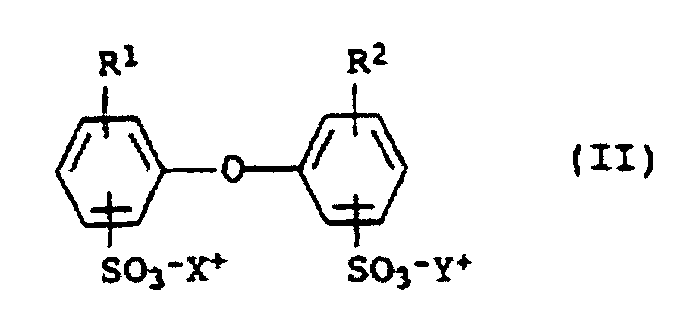
- Compositions suivant l'une des revendications précédentes, dans lesquelles la quantité totale d'agents émulsifiants est de l'ordre de 0,2 à 10% en poids par rapport au polymère P.
- Compositions suivant l'une des revendications précédentes, dans lesquelles les monomères M comprennenti. 70 à 99,9% en poids d'au moins un monomère M1, choisi parmi des monomères vinyl-aromatiques, les esters d'acides monocarboxyliques en C3-C8 monoéthyléniquement insaturés avec des alcanols en C1-C12 et les esters vinyliques d'acides monocarboxyliques en C1-C18 aliphatiques, etii. 0,1 à 30% en poids d'au moins un monomère M2 copolymérisable avec eux.
- Compositions suivant l'une des revendications précédentes, contenant, par rapport à leur poids total :au moins un agent émulsifiant anionique, comportant au moins un sel de la formule générale I et éventuellement un ou plusieurs sels de la formule générale II,éventuellement un ou plusieurs agents émulsifiants non ioniques,10 à 60% en poids d'au moins un polymère P,0,1 à 30% en poids d'adjuvants courants, et0 à 60% en poids de pigments et/ou de substances de remplissage finement divisées,ainsi que de l'eau à 100% en poids.
- Utilisation de compositions aqueuses suivant l'une des revendications 1 à 8, pour le revêtement de corps façonnés minéraux.
- Dispersion aqueuse de polymère, que l'on peut obtenir par polymérisation d'une émulsion aqueuse d'au moins un monomère éthyléniquement insaturé M selon la méthode de la polymérisation en émulsion aqueuse radicalaire en présence d'au moins un amorceur de polymérisation radicalaire et d'au moins deux agents émulsifiants anioniques différents, comportant au moins un sel de la formule générale I suivant la définition donnée dans la revendication 1 et au moins un sel de la formule générale II conforme à la définition donnée dans la revendication 5.
Applications Claiming Priority (2)
| Application Number | Priority Date | Filing Date | Title |
|---|---|---|---|
| DE19833917A DE19833917A1 (de) | 1998-07-28 | 1998-07-28 | Wässrige Zubereitungen, die wenigstens ein Polymer P als filmbildenden Bestandteil enthalten |
| DE19833917 | 1998-07-28 |
Publications (3)
| Publication Number | Publication Date |
|---|---|
| EP0982279A1 EP0982279A1 (fr) | 2000-03-01 |
| EP0982279B1 true EP0982279B1 (fr) | 2005-08-17 |
| EP0982279B2 EP0982279B2 (fr) | 2012-10-17 |
Family
ID=7875560
Family Applications (1)
| Application Number | Title | Priority Date | Filing Date |
|---|---|---|---|
| EP99114672A Expired - Lifetime EP0982279B2 (fr) | 1998-07-28 | 1999-07-27 | Composition aqueuse comprenant un polymère filmifiant et un émulsifiant anionique |
Country Status (6)
| Country | Link |
|---|---|
| US (1) | US6472024B1 (fr) |
| EP (1) | EP0982279B2 (fr) |
| JP (1) | JP4421703B2 (fr) |
| AU (1) | AU4117299A (fr) |
| DE (2) | DE19833917A1 (fr) |
| NO (1) | NO333093B1 (fr) |
Cited By (2)
| Publication number | Priority date | Publication date | Assignee | Title |
|---|---|---|---|---|
| CN105860677A (zh) * | 2016-05-09 | 2016-08-17 | 江苏建中能源科技有限公司 | 一种橡胶涂料配方及其制备方法 |
| CN105885549A (zh) * | 2016-05-09 | 2016-08-24 | 江苏建中能源科技有限公司 | 一种防水橡胶涂料配方及其制备方法 |
Families Citing this family (7)
| Publication number | Priority date | Publication date | Assignee | Title |
|---|---|---|---|---|
| IT1320087B1 (it) * | 2000-11-21 | 2003-11-18 | Atofina | Dispersioni acquose di polimeri acrilici. |
| US20090004468A1 (en) * | 2007-06-28 | 2009-01-01 | Yongjun Chen | Primer for composite building materials |
| DE102009014600C5 (de) * | 2009-03-24 | 2015-04-02 | Dyckerhoff Gmbh | Photokatalytisch aktivierte Bauteile aus einer mit einem mineralischen Bindemittel gebundenen Matrix sowie Verfahren zur Herstellung der Bauteile |
| MX2018004940A (es) | 2015-10-20 | 2018-08-01 | Basf Se | Composiciones de recubrimiento para recubrir placas de fibrocemento. |
| EP4093718A1 (fr) * | 2020-01-22 | 2022-11-30 | Celanese International Corporation | Compositions de revêtement de tuile de toiture |
| EP4136130A1 (fr) * | 2020-04-17 | 2023-02-22 | Basf Se | Dispersions aqueuses de polymère |
| US12344757B2 (en) | 2020-04-24 | 2025-07-01 | Rohm And Haas Company | Method for preparing coating composition with improved color retention |
Family Cites Families (19)
| Publication number | Priority date | Publication date | Assignee | Title |
|---|---|---|---|---|
| FR1343230A (fr) † | 1961-12-23 | 1963-11-15 | Basf Ag | Masses pour l'enduction du papier |
| BE789223A (fr) | 1971-09-28 | 1973-03-26 | Wacker Chemie Gmbh | Dispersions de polymeres vinyliques |
| DE2148458C2 (de) | 1971-09-28 | 1984-03-29 | Wacker-Chemie GmbH, 8000 München | Verfahren zur Herstellung von Polyvinylesterdispersionen mit verbesserter Haftung |
| SE408062B (sv) | 1975-03-24 | 1979-05-14 | Bofors Ab | Ytbeleggnigskomposition innehallande akrylsampolymerlatex med lag tendens till klibbning |
| DE3820154A1 (de) * | 1988-06-14 | 1989-12-21 | Basf Ag | Waessrige dispersionen von copolymerisaten, die epoxidgruppen enthalten und deren anwendung |
| DE3901073A1 (de) | 1989-01-16 | 1990-07-19 | Basf Ag | Betondachstein |
| CA2020629C (fr) | 1989-07-21 | 2000-02-01 | Frank Landy | Revetement aqueux de longue conservation a cure rapide |
| DE4021502A1 (de) | 1990-07-05 | 1992-01-16 | Basf Ag | Mit copolymerfilmen beschichteter betonstein |
| US5420195A (en) † | 1992-01-10 | 1995-05-30 | Avery Dennison Corporation | Water resistant, removable acrylic emulsion pressure sensitive adhesive |
| DE4202301A1 (de) * | 1992-01-28 | 1993-10-21 | Basf Ag | Beschichtungsmittel |
| CA2088655A1 (fr) † | 1992-02-29 | 1993-08-30 | Bernd Daeumer | Dispersions polymeres aqueuses |
| DE4341260A1 (de) * | 1993-12-03 | 1994-05-11 | Basf Ag | Verfahren zur Verhinderung von Ausblüherscheinungen auf mineralischen Substraten |
| DE4344149A1 (de) † | 1993-12-23 | 1995-06-29 | Basf Ag | Formaldehydfreie wäßrige Kunstharzdispersionen |
| DE4447550C2 (de) † | 1994-09-22 | 1997-09-18 | Dainippon Ink & Chemicals | Wäßrige Polymeremulsionen |
| DE19514266A1 (de) * | 1995-04-15 | 1996-10-17 | Basf Ag | Verfahren zur Konservierung eines mineralischen Formkörpers |
| SE508224C2 (sv) † | 1996-01-18 | 1998-09-14 | Akzo Nobel Ind Coatings Ab | Vattenburen hybridbindemedelskomposition samt användning därav |
| US5763012A (en) * | 1996-10-16 | 1998-06-09 | Basf Aktiengesellschaft | Coating of substrates |
| DE19649383A1 (de) † | 1996-11-29 | 1998-06-04 | Basf Ag | Kaschierklebstoffe |
| DE19705753A1 (de) † | 1997-02-14 | 1998-08-20 | Basf Ag | Emulgatorsystem für die wässrige Emulsionspolymerisation |
-
1998
- 1998-07-28 DE DE19833917A patent/DE19833917A1/de not_active Withdrawn
-
1999
- 1999-07-09 US US09/349,511 patent/US6472024B1/en not_active Expired - Lifetime
- 1999-07-26 JP JP21085499A patent/JP4421703B2/ja not_active Expired - Fee Related
- 1999-07-27 AU AU41172/99A patent/AU4117299A/en not_active Abandoned
- 1999-07-27 EP EP99114672A patent/EP0982279B2/fr not_active Expired - Lifetime
- 1999-07-27 DE DE59912421T patent/DE59912421D1/de not_active Expired - Lifetime
- 1999-07-27 NO NO19993632A patent/NO333093B1/no not_active IP Right Cessation
Cited By (2)
| Publication number | Priority date | Publication date | Assignee | Title |
|---|---|---|---|---|
| CN105860677A (zh) * | 2016-05-09 | 2016-08-17 | 江苏建中能源科技有限公司 | 一种橡胶涂料配方及其制备方法 |
| CN105885549A (zh) * | 2016-05-09 | 2016-08-24 | 江苏建中能源科技有限公司 | 一种防水橡胶涂料配方及其制备方法 |
Also Published As
| Publication number | Publication date |
|---|---|
| NO993632D0 (no) | 1999-07-27 |
| NO333093B1 (no) | 2013-03-04 |
| EP0982279B2 (fr) | 2012-10-17 |
| NO993632L (no) | 2000-01-31 |
| JP4421703B2 (ja) | 2010-02-24 |
| DE19833917A1 (de) | 2000-02-03 |
| AU4117299A (en) | 2000-02-17 |
| DE59912421D1 (de) | 2005-09-22 |
| EP0982279A1 (fr) | 2000-03-01 |
| JP2000053911A (ja) | 2000-02-22 |
| US6472024B1 (en) | 2002-10-29 |
Similar Documents
| Publication | Publication Date | Title |
|---|---|---|
| EP0821660B1 (fr) | Procede de conservation d'un corps moule mineral | |
| EP2225289B1 (fr) | Procédé de fabrication de dispersions polymères aqueuses | |
| EP1029009B1 (fr) | Preparations a base de pigments et de resine contenant du phosphonate | |
| EP1046682B1 (fr) | Revêtements aqueux pigmentés | |
| EP1070101B1 (fr) | Resines de dispersion contenant de l'acide itaconique et permettant d'augmenter la resistance a l'abrasion humide | |
| EP1199341B1 (fr) | Composition aqueuse de revêtement pigmenté | |
| EP0915071B1 (fr) | Utilisation des préparations aqueuses contenant un copolymère P comme composantes formant un film | |
| EP1518846B1 (fr) | Articles moulés en béton à haute brillance, leur procédé de fabrication et leur utilisation | |
| EP0982279B2 (fr) | Composition aqueuse comprenant un polymère filmifiant et un émulsifiant anionique | |
| EP1114806B2 (fr) | Utilisation de dispersions aqueuses de polymères pour modifier des enduits minéraux pour des tuiles en béton | |
| EP0941977A1 (fr) | Procédé de revêtement des pièces minérales | |
| EP1129049B1 (fr) | Utilisation de preparations aqueuses filmogenes pour appliquer un revetement sur des corps moules mineraux | |
| EP1062186B1 (fr) | Utilisation de preparations filmogenes aqueuses a base de copolymeres d'alkylesters d'acide methacrylique pour le recouvrement de materiaux moules mineraux | |
| EP1069093B1 (fr) | Matériau de revêtement et procédé de revêtement de corps minéraux | |
| EP1315687B1 (fr) | Corps moule comportant un revetement mineral argileux | |
| DE19856148B4 (de) | Wässriges pigmenthaltiges Beschichtungsmittel, Verwendung und Verfahren zur Beschichtung bituminöser Substrate | |
| DE19810053A1 (de) | Verfahren zum Neutralisieren von wässrigen Dispersionen von filmbildenden Copolymerisaten und so erhältliche Beschichtungen |
Legal Events
| Date | Code | Title | Description |
|---|---|---|---|
| PUAI | Public reference made under article 153(3) epc to a published international application that has entered the european phase |
Free format text: ORIGINAL CODE: 0009012 |
|
| AK | Designated contracting states |
Kind code of ref document: A1 Designated state(s): DE FR GB SE |
|
| AX | Request for extension of the european patent |
Free format text: AL;LT;LV;MK;RO;SI |
|
| 17P | Request for examination filed |
Effective date: 20000823 |
|
| AKX | Designation fees paid |
Free format text: DE FR GB SE |
|
| GRAP | Despatch of communication of intention to grant a patent |
Free format text: ORIGINAL CODE: EPIDOSNIGR1 |
|
| GRAS | Grant fee paid |
Free format text: ORIGINAL CODE: EPIDOSNIGR3 |
|
| GRAA | (expected) grant |
Free format text: ORIGINAL CODE: 0009210 |
|
| AK | Designated contracting states |
Kind code of ref document: B1 Designated state(s): DE FR GB SE |
|
| REG | Reference to a national code |
Ref country code: GB Ref legal event code: FG4D Free format text: NOT ENGLISH |
|
| REF | Corresponds to: |
Ref document number: 59912421 Country of ref document: DE Date of ref document: 20050922 Kind code of ref document: P |
|
| REG | Reference to a national code |
Ref country code: SE Ref legal event code: TRGR |
|
| GBT | Gb: translation of ep patent filed (gb section 77(6)(a)/1977) |
Effective date: 20051114 |
|
| ET | Fr: translation filed | ||
| PLBI | Opposition filed |
Free format text: ORIGINAL CODE: 0009260 |
|
| 26 | Opposition filed |
Opponent name: CELANESE EMULSIONS GMBH Effective date: 20060512 |
|
| PLAX | Notice of opposition and request to file observation + time limit sent |
Free format text: ORIGINAL CODE: EPIDOSNOBS2 |
|
| PLAF | Information modified related to communication of a notice of opposition and request to file observations + time limit |
Free format text: ORIGINAL CODE: EPIDOSCOBS2 |
|
| PLAF | Information modified related to communication of a notice of opposition and request to file observations + time limit |
Free format text: ORIGINAL CODE: EPIDOSCOBS2 |
|
| PLBB | Reply of patent proprietor to notice(s) of opposition received |
Free format text: ORIGINAL CODE: EPIDOSNOBS3 |
|
| PLAY | Examination report in opposition despatched + time limit |
Free format text: ORIGINAL CODE: EPIDOSNORE2 |
|
| PLBC | Reply to examination report in opposition received |
Free format text: ORIGINAL CODE: EPIDOSNORE3 |
|
| RAP2 | Party data changed (patent owner data changed or rights of a patent transferred) |
Owner name: BASF SE |
|
| PLAY | Examination report in opposition despatched + time limit |
Free format text: ORIGINAL CODE: EPIDOSNORE2 |
|
| PLBC | Reply to examination report in opposition received |
Free format text: ORIGINAL CODE: EPIDOSNORE3 |
|
| PUAH | Patent maintained in amended form |
Free format text: ORIGINAL CODE: 0009272 |
|
| STAA | Information on the status of an ep patent application or granted ep patent |
Free format text: STATUS: PATENT MAINTAINED AS AMENDED |
|
| 27A | Patent maintained in amended form |
Effective date: 20121017 |
|
| AK | Designated contracting states |
Kind code of ref document: B2 Designated state(s): DE FR GB SE |
|
| REG | Reference to a national code |
Ref country code: DE Ref legal event code: R102 Ref document number: 59912421 Country of ref document: DE Effective date: 20121017 |
|
| REG | Reference to a national code |
Ref country code: SE Ref legal event code: RPEO |
|
| REG | Reference to a national code |
Ref country code: FR Ref legal event code: PLFP Year of fee payment: 17 |
|
| REG | Reference to a national code |
Ref country code: FR Ref legal event code: PLFP Year of fee payment: 18 |
|
| REG | Reference to a national code |
Ref country code: FR Ref legal event code: PLFP Year of fee payment: 19 |
|
| REG | Reference to a national code |
Ref country code: FR Ref legal event code: PLFP Year of fee payment: 20 |
|
| PGFP | Annual fee paid to national office [announced via postgrant information from national office to epo] |
Ref country code: FR Payment date: 20180726 Year of fee payment: 20 |
|
| PGFP | Annual fee paid to national office [announced via postgrant information from national office to epo] |
Ref country code: GB Payment date: 20180731 Year of fee payment: 20 Ref country code: SE Payment date: 20180731 Year of fee payment: 20 |
|
| PGFP | Annual fee paid to national office [announced via postgrant information from national office to epo] |
Ref country code: DE Payment date: 20180928 Year of fee payment: 20 |
|
| REG | Reference to a national code |
Ref country code: DE Ref legal event code: R071 Ref document number: 59912421 Country of ref document: DE |
|
| REG | Reference to a national code |
Ref country code: GB Ref legal event code: PE20 Expiry date: 20190726 |
|
| PG25 | Lapsed in a contracting state [announced via postgrant information from national office to epo] |
Ref country code: GB Free format text: LAPSE BECAUSE OF EXPIRATION OF PROTECTION Effective date: 20190726 |