EP0982895A2 - Dispositif de traitement cryptographique de données, système de communication et support d'enregistrement y relatif - Google Patents
Dispositif de traitement cryptographique de données, système de communication et support d'enregistrement y relatif Download PDFInfo
- Publication number
- EP0982895A2 EP0982895A2 EP99306672A EP99306672A EP0982895A2 EP 0982895 A2 EP0982895 A2 EP 0982895A2 EP 99306672 A EP99306672 A EP 99306672A EP 99306672 A EP99306672 A EP 99306672A EP 0982895 A2 EP0982895 A2 EP 0982895A2
- Authority
- EP
- European Patent Office
- Prior art keywords
- key
- encryption
- decryption
- conversion
- functions
- Prior art date
- Legal status (The legal status is an assumption and is not a legal conclusion. Google has not performed a legal analysis and makes no representation as to the accuracy of the status listed.)
- Withdrawn
Links
- 238000004891 communication Methods 0.000 title claims description 76
- 238000006243 chemical reaction Methods 0.000 claims abstract description 187
- 230000006870 function Effects 0.000 claims abstract description 166
- 238000012545 processing Methods 0.000 claims abstract description 40
- 238000013501 data transformation Methods 0.000 claims 1
- 230000009466 transformation Effects 0.000 claims 1
- 238000010586 diagram Methods 0.000 description 14
- 239000000470 constituent Substances 0.000 description 9
- 238000000034 method Methods 0.000 description 6
- 230000005540 biological transmission Effects 0.000 description 5
- 230000017105 transposition Effects 0.000 description 5
- 230000000694 effects Effects 0.000 description 4
- 238000005516 engineering process Methods 0.000 description 2
- 238000012886 linear function Methods 0.000 description 2
- 238000013507 mapping Methods 0.000 description 2
- 239000002131 composite material Substances 0.000 description 1
- 238000007796 conventional method Methods 0.000 description 1
- 230000002708 enhancing effect Effects 0.000 description 1
- 230000003287 optical effect Effects 0.000 description 1
- 230000008707 rearrangement Effects 0.000 description 1
- 239000004065 semiconductor Substances 0.000 description 1
- 238000012360 testing method Methods 0.000 description 1
Images


Classifications
-
- H—ELECTRICITY
- H04—ELECTRIC COMMUNICATION TECHNIQUE
- H04L—TRANSMISSION OF DIGITAL INFORMATION, e.g. TELEGRAPHIC COMMUNICATION
- H04L9/00—Cryptographic mechanisms or cryptographic arrangements for secret or secure communications; Network security protocols
- H04L9/06—Cryptographic mechanisms or cryptographic arrangements for secret or secure communications; Network security protocols the encryption apparatus using shift registers or memories for block-wise or stream coding, e.g. DES systems or RC4; Hash functions; Pseudorandom sequence generators
- H04L9/0618—Block ciphers, i.e. encrypting groups of characters of a plain text message using fixed encryption transformation
- H04L9/0625—Block ciphers, i.e. encrypting groups of characters of a plain text message using fixed encryption transformation with splitting of the data block into left and right halves, e.g. Feistel based algorithms, DES, FEAL, IDEA or KASUMI
-
- H—ELECTRICITY
- H04—ELECTRIC COMMUNICATION TECHNIQUE
- H04L—TRANSMISSION OF DIGITAL INFORMATION, e.g. TELEGRAPHIC COMMUNICATION
- H04L2209/00—Additional information or applications relating to cryptographic mechanisms or cryptographic arrangements for secret or secure communication H04L9/00
- H04L2209/08—Randomization, e.g. dummy operations or using noise
-
- H—ELECTRICITY
- H04—ELECTRIC COMMUNICATION TECHNIQUE
- H04L—TRANSMISSION OF DIGITAL INFORMATION, e.g. TELEGRAPHIC COMMUNICATION
- H04L2209/00—Additional information or applications relating to cryptographic mechanisms or cryptographic arrangements for secret or secure communication H04L9/00
- H04L2209/24—Key scheduling, i.e. generating round keys or sub-keys for block encryption
Definitions
- This invention relates to a data processor, a communication system and a recording medium.
- Encryption in data transmission is generally performed due to recent progresses in computers and a communication technology.
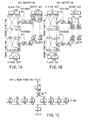
- FIGS. 1A to 1C are block diagrams for illustrating the DES encryption system.
- an encryption device adopted in the DES system is mainly constructed of a data randomize section in which data as an object to be encrypted through numerous round functions are randomized and a key conversion section which provides the round functions of the data randomize section with extended keys.
- decryption in the DES system is achieved in such a manner that data as an object to be decrypted are subjected to processing through round functions in the order reverse in the encryption as shown in FIG. 1B. Therefore, extended keys supplied from the key conversion section are generated in the reverse order in which the keys are used in the encryption starting with a key used in the last round function in the encryption.
- a first advantage of the DES system is that a considerable part of encryption circuitry is commonly adopted in decryption. That is, round functions for encryption and decryption used in the data randomize section are the same between both processing only with the exception that the order of use of the functions are reversed as shown in FIGS. 1A and 1B.
- a second advantage of the DES system is that only one key is always an object of management since the same secret key is used in both ways of encryption and decryption.
- the following processing is performed in the key conversion section so that extended keys can be generated in the reverse order using the only one key.
- the secret key receives a left rotate shift to generate extended keys.
- the extended keys can be generated in the reverse order by designating the sum of shifts to a given value. That is, in the decryption, the secret key is only required to be subjected to a right rotate shift to generate the extended keys. Thereby, the last extended key in the encryption and the first extended key in the decryption are the same.
- Processing in the key conversion section first, includes a left rotate shift in encryption and a right rotate shift in decryption, which are different in terms of processing, and therefore, the same circuitry cannot be shared in function between encryption and decryption devices in the key conversion section. That is, when an encryption/decryption device for encrypting and decrypting data is constructed as an actual device, part of the circuitry which is commonly used in both of encryption and decryption is not necessarily much enough. Hence, the overall scale of the encryption/decryption device cannot be constructed to be sufficiently small.
- Non-linear part of the DES system is limited to part called as an S-box in a function f in a round function shown in FIG. 1C.
- oneway function such as a hash function has been employed in the key conversion section as trial.
- FEAL calculates extended keys which the data randomize section requires in a case where oneway function is used for the conversion.
- the present invention has been made in light of such circumstances and accordingly it is an object of the present invention to provide a data processor, a communication system and a recording medium whereby the scale of a secrete key encryption device can be small, security of a key is increased and further, key management can be made easy.
- the essence of the present invention is not only to employ an involution function in which conversion and inverse conversion are same for generation of an extended key, but also to enable generation of an extended key in a reverse order by using the involution function in a reverse order based on a decryption key in decryption which key is a result of processing a encryption key in a key conversion section.
- the key conversion section since there is no limitation on a function to be employed in the key conversion section with the exception that an original key is converted by using an involution function and further it is not necessary for an encryption key and a decryption key to be same, there is only very little limitation imposed on functions which can be employed in the key conversion section. Hence, it is possible that functions by which extended keys with high security are generated are selected and the key conversion section can be constructed of such functions. Besides, since an extended key can be generated from a decryption key in a reverse order, the same key conversion section can be employed in encryption and decryption, which entails a smaller scale of a device circuit.
- Encryption algorithms can classify encryption into two kinds: symmetric key encryption and asymmetric key encryption according to whether or not the same key is employed for encryption and decryption. Further, the algorithms can classify encryption into two kinds: secret key encryption and public key encryption according to whether or not an encryption key is made public and a sender can prepare a cipher text using a public key.
- a cryptosystem in which only if one secret key (an encryption key or a decryption key), though asymmetric, is on hand, encryption and decryption are enabled in both ways, and thereby, a problematic management of a plurality of secret keys is avoided and a practically useful asymmetric, secret key cryptosystem is realized.
- a cipher text encrypted by an encryption key can be decrypted by a decryption key, while a cipher text encrypted by a decryption key can be decrypted by an encryption key.
- encryption and decryption go this way: first, a cipher text prepared from a plain text by one party with an encryption key can be restored to the plain text by processing in a reverse order with a decryption key on the other party side. Then while a cipher text prepared from a plain text by the other party with the decryption key can be restored to the plain text by processing in a reverse order with the encryption key on the one party side.
- a data processor in which at least one of encryption of a plain text to a cipher text by using an encryption key and decryption of a cipher text to a plain text by using a decryption key is performed, comprising:
- a data processor of the first aspect wherein the data randomize section includes a plurality of round functions which are involution functions and which perform at least one of encryption and decryption by using the extended keys, the plurality of round functions are sequentially connected, and results of the processing by the round functions are transferred in an order or in another order reverse to the order transferred between the plurality of round functions.
- the data processor serves as main circuitry which can be used not only in an encryption device but in a decryption device. That is, when a key and data are sequentially processed, data encryption can be realized, while when a key and data are subjected to processing in the reversed order, data decryption can be achieved.
- the reason why such processing are possible is that the key conversion function and the round function are both of an involution type.
- the device scale of the kind can be small and compact.
- a data processor of the first aspect wherein the key conversion functions not only take first keys and results of conversion of the first keys as objects to be processed in the key conversion, but also perform the key conversion by using a second key.
- processing in the key conversion section is similar to that of the data randomize section and extended keys which have a very low probability to be a weak key or the like can be output. Therefore, robustness of a cryptosystem can be increased.
- a data processor of the third aspect wherein the second key is included in at least one of the encryption key and the decryption key.
- a data processor of the fourth aspect wherein the second key has different types of keys, at least one of the encryption key and the decryption key includes the different types of keys and at least one of the encryption key and the decryption key is variable in length.
- a data processor of the second aspect wherein the key conversion functions include round functions same as that of the data randomize section.
- a communication system comprising:
- the communication systems can perform any of an encryption and decryption with one key held by each.
- secret keys of the respective communication systems are not necessarily same as one another. That is, the communication is of an asymmetric, secret key cryptosystem.
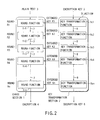
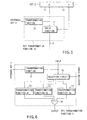
- FIG. 2 is a block diagram showing an example of a main part of a configuration of a data processor and an encryption algorithm according to a first embodiment of the present invention.
- the data processor is constructed as an encryption/decryption section of a computer such as a personal computer and a work station and hereinafter, when the term "data processor" is used, the term means an encryption/decryption device in which encryption and decryption are conducted.
- the encryption/decryption device is mainly constructed of a data randomize section 1 and a key conversion section 2. These sections 1 and 2 are commonly used for both of encryption and decryption. Further, functions such as transposition, though not shown, may be provided before and after the data randomize sections 1 and key conversion section 2.
- the data randomize section 1 outputs a cipher text 4 by encrypting a plain text through n rounds of processing from round R1 to round Rn and a plain text 3 by decrypting a cipher text 4 through rounds Rn to R1.
- round functions frl to frn (hereinafter also simply referred to as a round function fr) are provided corresponding to the rounds R1 to Rn.
- a round function fr outputs an intermediary encryption result 7 or an cipher text 4 by inputting a plain test 3 or an intermediary encryption result 7 and an extended key K from the key conversion section 2.
- the round functions frl to frn are similar to the round functions, for example, in the DES system and cascaded in the order.
- key conversion functions fk1 to fkn (hereinafter also simply referred to as a key conversion function fk) are provided corresponding to rounds R1 to Rn.
- a key conversion function fk outputs an intermediary key conversion result 8 or a decryption key 6 and an extended key K by inputting an encryption key 5 or an intermediary key conversion result 8. That is, the key conversion functions fkl to fkn gives the extended keys K1 to Kn to the round functions frl to frn.
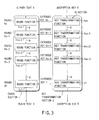
- the key conversion functions fkl to fkn are cascaded in the order. Therefore, the encryption key 5 input from the first round R1 side of the key conversion section 2 is output as the decryption key 6 from the last round Rn side. If the decryption key 6 and the cipher text 4 are input from the last round Rn side, the encryption key 5 and the plain text 3 are output from the first round 1 side, which is shown in FIG. 3.
- FIG. 3 is a block diagram showing an example of a main part of a configuration of the data processor and a decryption algorithm according to the embodiment.
- a key used for encryption of the first plain text 3 is called as an encryption key 5 and a key output as a result of the first encryption is called as a decryption key 6.
- a key input from the fist round R1 side functions as a key for encrypting a plain text while a key input from the last round Rn side functions as a key for decrypting a cipher text, regardless of the terms encryption key 5 or decryption key 6.
- the decryption key 6 functions as a key for encrypting a plain text
- the encryption key 5 functions as a key for decrypting a cipher text
- the encryption key 5 and the decryption key 6 are present as a pair and in the above described case, the encryption key 5 and decryption key 6 are respectively output from the last round Rn side and first round R1 side. Therefore, the decryption can be conducted only by encryption key and decryption key which constitute a pair.
- keys are also referred simply to as follows: a key input from the first round R1 side is referred to as encryption key 5, while a key input from the last round Rn side is referred to as a decryption key.
- a key conversion function fk is constructed of involution functions.
- An involution function is a kind of bi-directional function and the conversion and the reverse conversion of the function are the same. Since the conversion and the reverse conversion are the same in each key conversion function fk, a relationship of the encryption key 5 and decryption key 6, which is described above, is realized.
- the bi-directional function is a function used for conversion between mappings each of which is surjective and injective.
- an involution function allows common use of circuitry between an encryption conversion and a decryption conversion, the function is often used in an encryption algorithm.
- the present invention is characterized by that not only a round function fr, but a key conversion function fk are of an involution type.
- a function used as a key conversion function fk is desired to be high in randomize like no-linear functions f (R, K) within a round function of the DES system.
- the input encryption key 5 is converted, by key conversion functions fk to extended keys K and intermediary key conversion results 9 and finally to the decryption key 6.
- the plain text 3 is converted one by one in the round functions, by a round functions using extended keys K outputs of the key conversion sections 2, to generate intermediary encryption results 7 and the cipher text 4.
- decryption decryption is successively performed in the data randomize section 1 into which the cipher text 4 is input, in the order reverse to in the encryption, and the intermediary decryption results 9 are sequentially output to finally output the plain text 3 as shown FIG. 3.
- the key conversion section 2 as well, the decryption key 6 is also input, key conversion is successively performed in the order reverse to in the encryption to output the encryption key 5. That is, referring to FIG. 2, the input/output in the flow of the encryption is reversed.
- FIG. 3 shows the flow whose directions is reverse to those of FIG. 2 and the data randomize section 1 and key conversion section 2 respectively employ the same circuitries as those of FIG. 2.
- the data processor is provided with the key conversion section 2 in which key conversion functions fk which are a bijective mapping are cascaded, the extended keys K are output based on the input keys and further, is provided with the data randomize section 1 in which the round functions fr are cascaded, so that a plain text or a cipher text and the extended keys K are input and thereby a cipher text or a plain text is output.
- the key conversion section 2 in which key conversion functions fk which are a bijective mapping are cascaded
- the extended keys K are output based on the input keys
- the data randomize section 1 in which the round functions fr are cascaded
- the scale of a composite device can be compact.
- the present embodiment shows a concrete configuration example of a key conversion section and a key used therein in the first embodiment.
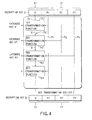
- FIG. 4 is a block diagram showing an example of a configuration of the key conversion section in the data processor according to a second embodiment of the present invention.
- the same constituents as those of FIG. 2 or 3 are indicated by the same reference marks and descriptions thereof are not given, while only constituents which are different from those are described.
- any one of parameters P1, P2 and P3 are input to key conversion function fk in a key conversion section 2 and thereby, extended keys K are generated by using the one of the parameters.
- the other part of the configuration is constructed similar to that of the first embodiment.
- keys 5 and 6 have a variable length and constructed of data portions 11 and 13, and parameter portions 13 and 14.
- the data portion 11 of the encryption key 5 is composed of an object data D to be converted and the parameter portion 12 is composed of conversion parameters P1, P2 and P3. That is, if a data portion and a parameter portion are respectively considered as keys, the keys 5 and 6 may be constructed of two keys. Further since a plurality of parameters can be stored in a parameter portion, the keys 5 and 6 may be constructed of more than two keys.
- a data portion 13 of the decryption key 6 comprises data D' which have been converted and a parameter portion 12 is composed of conversion parameter P1', P2' and P3'.
- the data D of the encryption key 5 or an intermediary key conversion result 8 and any one of the parameters P1, P2 or P3 are input to a key conversion function fk and an intermediary key conversion result 8 or the data D' of the decryption key 6 and a extended key K are output. That is, the key conversion section 2 and the key conversion functions fk can be input with two keys including the data D (or an intermediary key conversion result 8) and the parameter P.
- Processing in the key conversion section 2 will be as follows: The input data D of the encryption key 5 is converted one by one while outputting extended keys K for the rounds R by processing in the key conversion functions fk to which one of the conversion parameters P1, P2 and P3 is input. The data D is finally output as the data D' of the decryption key 6 after being converted to through round conversion.
- the plurality of conversion parameters are sequentially applied for each round.
- the conversion parameters are repeatedly applied. While the repeated application is cyclically effected in the embodiment, another rule for the application may be enforced.
- a parameter portion 14 of the decryption key 6 the parameters of the encryption key 5 are placed as they are or they are placed after being subjected to a prescribed processing.
- the data D and D' which is key bodies and the parameters P and P' as so-called second keys, so to speak, are included in the encryption key 5 and the decryption key 6, in addition to that data processor has the same configuration as that of the first embodiment and the data D (or an intermediary key conversion result 8) and two kinds of keys of parameters P are input to the key conversion functions, effects similar to those of the first embodiment can be achieved, in addition, extended keys which cannot be deciphered can be generated and thereby security of a crypstosystm can be increased.
- a length of a key is variable, for example, by changing the number of parameters, security of the cryptosystem can further be improved.
- the embodiment shows a concrete configuration example of the key conversion section in the second embodiment.
- FIG. 5 is a block diagram showing an example of a configuration of the key conversion section in the data processor according to a third embodiment of the present invention.
- the same constituents as those of FIGS. 2 to 4 are indicated by the same references and descriptions thereof will not be given while those of different constituents will only be made herein.
- the data processor is constructed similar to the second embodiment with the exception that key conversion functions fk are provided with a configuration described below:
- the encryption key 5 includes an object data D to be converted and a conversion parameter P similar to the second embodiment.
- a key conversion function fk comprises a conversion function 21 which outputs an extended key K by converting the input data D or an intermediary key conversion result 8, and a round function 22 which is an involution function, and which has a high randndomize ability to data bits.
- the round function 22 is the same round function as that of the data randomize section 1.
- the data D or an intermediary key conversion result 8 and a conversion parameter P are input to the round function 22, the data and the like receive data conversion and an intermediary key conversion result 8 or the final converted data D' is outputted.
- an input of an extended key K to a round function fk of the data randomize section 1 corresponds to an input of the parameter P.
- An output result 8 of the round function 22 is an input of a key conversion function fk of the next round and the extended key K is obtained by processing data input to the round function 22 in the preceding round in the conversion function 21.
- the conversion function 21 processing such as rearrangement of bits are performed. Incidentally, the conversion function 21 can be omitted.
- an extended key K is not prepared based on a signal on the output side of a round function 22. At least, in the embodiment, an extended key K is necessarily prepared based on a signal on the input side of a round function 22.
- an input data to the key conversion function fk is processed in the conversion function 21 to output an extended key.
- the input data is randomized by the round function 22 and the resulted data is output to the next key conversion function fk.
- the data processor of the embodiment operates similar to the second embodiment with the exception of the above described processing in a key conversion function.
- the same round function 22 as that of the data randomize section 1 is used as the key conversion fk, in addition to a configuration similar to that of the second embodiment, not only can effects similar to the above described embodiment be obtained, but also the security can be increased enhancing the data randomize.
- the extended key K is generated based on the data on the input side of the round function 22, there arises no chance to generate another key same as the extended key K and thereby, a cryptosystem with a high degree of the robustness can be realized.
- the round function 22 can be omitted in the key conversion function fk in the last round. This is because in the embodiment, the extended key K is generated based on data before inputting to the round function 22. In this case, since the decryption key which is an output of the last stage is output without application of the round function, there arises an advantage to save a computation time period.
- the embodiment shows another configuration of the key conversion section of the first embodiment.
- FIG. 6 is a block diagram showing an example of a configuration of the key conversion function in the data processor according to the fourth embodiment of the present invention.
- the same constituents as those of FIGS. 2 to 4 are indicated by the same reference marks. Descriptions thereof are not given, but only the other constituents will be described.
- the data processor is constructed similar to the first embodiment with the exception that that key conversion functions fk are provided with a configuration described below:
- the key conversion function fk is constructed of a conversion function 31 which outputs an extended key K by converting the encryption key 5 or an input data which is an intermediary key conversion result 8, and a key conversion part which outputs an intermediary key conversion result 8 or the decryption key 6 by converting the input data.
- the key conversion part is in turn constructed of a selection circuit 6, a plurality of conversion functions 33 (#1, #2 ..., #n); and an OR gate 34.
- the selection circuit 32 selects the conversion function 33 which converts input data based on a selection signal and transfers the input data to the selected conversion function.
- the conversion function 33 is an involution function and randomizes the input data.
- the conversion function 33 with a high ability to randomize data bits as used in a round function of the data randomize section 1 is adopted.
- the OR gate 34 outputs data after the conversion, which has been output from the conversion function 33 to the outside.
- Data input to the key conversion function fk is converted by the conversion function 31 and output as the extended key K.
- the input data is input to any one of the plurality of conversion functions 33 based on a selection signal given to the selection circuit 32.
- the input data is converted by the selected conversion function 33.
- the data which has been converted by the conversion function 33 is output after the converted data is compiled as one signal by the OR gate 34.
- the output data is input to the key conversion function fk at the next round or output as the decryption key.
- the data processor of the embodiment operates in a similar manner to of the first embodiment with the exception of the above described processing within the key conversion functions.
- a plurality of conversion functions 33 are respectively equipped to the key conversion functions fk and an encryption key is converted by selecting any one of the plurality of conversion functions, in addition to a configuration similar to the first embodiment, not only is effects similar to the first embodiment obtainable, but a result of a key conversion is hard to be predicted, which entails a high degree of security of a cryptosystem.
- FIG. 7 is a block diagram showing an example of a main part of a configuration of the communication system according to a fifth embodiment of the present invention.
- the same constituents as those of the second to sixth embodiments are indicated by the same reference marks.
- the communication system comprises a communication system 41 A which a communication party A uses, a communication system 41B which a communication party B uses, and a communication channel 40 such as internet and a LAN, wherein the communication systems A and B are connected.
- the communication system 41A is a computer system equipped with data communication mean and comprises an encryption/decryption device 42, an encryption key file 43, and storage means (not shown) for storing a plain text file 44 and a cipher text file 45, a key transmission/reception processor 46 and a communication processor 47.
- the communication apparatus 41B comprises a decryption key file 48 instead of the encryption key file 43 of the communication system 41A and the other constituents same as those of the communication system 41A.
- the encryption keys 5 are stored in the encryption key file 43 as a key for encrypting a plain text and a key for decrypting a cipher text
- the decryption key 6 is stored in the decryption key file 48 as a key for encrypting a plain text and a key for decrypting a cipher text.
- the encryption/decryption device 42 is provided with the data randomize section 1 and the key conversion section 2 as a common part for encryption and decryption in any one of the first to fourth embodiments, and in addition, with various circuits for processing before and after encryption and decryption, selection of encryption or decryption, processing control and the like.
- FIG. 7 in the encryption processing, a key and a plain text are input to the encryption/decryption device 42 from the let side and in the decryption processing, a key and a cipher text are input from the right side.
- the key transmission/reception processor 46 is means for transferring a key in a secured manner when the key is transferred or received between the communication systems 41A and 41B.
- decryption keys 6 generated when a cipher text is prepared by the communication system 41A is transferred to the communication system 41B side through the key transmission/reception processor 46.
- the transferred decryption key 6 is stored in the decryption key file 48.
- FIG. 8 is a representation illustrating operations in communication in the fifth embodiment.
- the communication party A encrypts a plain text 51 for which application of encryption communication is desired by using a encryption key 5 which the communication party A owns.
- the plain text 51 and the encryption key 5 are input from the left side of the encryption/decryption device 42 and conversion sequentially proceeds from the first round R1.
- the encrypted cipher text 52 is transmitted to the communication party B through the communication processor 47 and the communication channel 40.
- the communication party B who has received the cipher text 52 retrieves a plain text 53 by decrypting the cipher text 51 by using the decryption key 6 which the communication party B owns.
- the decryption key 6 and the cipher text 52 are input from the left side of the encryption/decryption device 42 in the communication system 41B and conversion is conducted from the last round Rn in the order reverse to that in the encryption.
- the communication party B encrypts a plain text 54 for which application of encryption communication is desired by using the decryption key 6 which the communication party B owns.
- the decryption key 6 and the plain text 54 are input from the right side of the encryption/decryption device 42 and conversion sequentially proceeds from the first round R1.
- the encrypted cipher text 55 is transmitted to the communication system 41A of the communication party A and the communication party A retrieves a plain text 56 by decrypting the cipher text 55 by using the encryption key which the communication party A owns.
- the encryption key 5 and the cipher 55 are input from the right side of the encryption/ decryption device 42 in the communication system 41A and conversion is conducted from the last round Rn in the order reverse to that in the encryption.
- the communication party A uses only the encryption key 5 in either cryptographic data transmission and reception of the data.
- the communication party B uses only the decryption key 6. Accordingly, while the encryption key 5 and the decryption key 6 are different from each other, the communication parties A and B are not necessary to have both but they are only required to manage one key.
- the operational procedures described in the embodiments can be distributed in the form of a recording medium such as a magnetic disk (floppy disk, hard disk etc.), an optical disk (CD-ROM, DVD etc.) and a semiconductor memory in which the operational procedure is stored as programs (software mean) on which a computer run, or alternatively transmitted through a communication medium as the programs.
- the programs stored on the recording medium side include a setting program which enables software mean which is run by a computer (the means includes not only an execution program, but a table and a data structure etc.) to be established in the computer architecture.
- a computer which realizes a communication system reads programs recorded in recording medium, forms software means according to the setting program and activates and runs the constituents in the communication system through the software means so as to execute the above described processing.
- involution functions are employed as key conversion functions for respective rounds of a key conversion section and besides, different keys are respectively used for encryption and decryption and accordingly, there can be provided a data processor, a communication system and a recording medium in which not only can the scale of a secret key encryption device be small but security of the keys can also be increased and key management can also be effected with ease.
Landscapes
- Engineering & Computer Science (AREA)
- Computer Security & Cryptography (AREA)
- Computer Networks & Wireless Communication (AREA)
- Signal Processing (AREA)
- Storage Device Security (AREA)
Applications Claiming Priority (2)
| Application Number | Priority Date | Filing Date | Title |
|---|---|---|---|
| JP10237205A JP2000066586A (ja) | 1998-08-24 | 1998-08-24 | データ処理装置及び通信システム並びに記録媒体 |
| JP23720598 | 1998-08-24 |
Publications (2)
| Publication Number | Publication Date |
|---|---|
| EP0982895A2 true EP0982895A2 (fr) | 2000-03-01 |
| EP0982895A3 EP0982895A3 (fr) | 2004-01-02 |
Family
ID=17011946
Family Applications (1)
| Application Number | Title | Priority Date | Filing Date |
|---|---|---|---|
| EP99306672A Withdrawn EP0982895A3 (fr) | 1998-08-24 | 1999-08-23 | Dispositif de traitement cryptographique de données, système de communication et support d'enregistrement y relatif |
Country Status (3)
| Country | Link |
|---|---|
| US (1) | US6819764B1 (fr) |
| EP (1) | EP0982895A3 (fr) |
| JP (1) | JP2000066586A (fr) |
Cited By (4)
| Publication number | Priority date | Publication date | Assignee | Title |
|---|---|---|---|---|
| EP1172965A3 (fr) * | 2000-07-12 | 2003-06-18 | Kabushiki Kaisha Toshiba | Dispositif de chiffrage, dispositif de déchiffrage, dispositif de génération d'une clé étendue |
| GB2345229B (en) * | 1998-12-23 | 2003-12-03 | Motorola Ltd | Method for encrypting data |
| EP1686720A1 (fr) * | 2000-03-09 | 2006-08-02 | Mitsubishi Denki Kabushiki Kaisha | Dispositif et procédé de chiffrage par blocs contenant un schéma de clés pour une clé de longueur variable |
| US7873166B2 (en) | 2005-09-13 | 2011-01-18 | Avaya Inc. | Method for undetectably impeding key strength of encryption usage for products exported outside the U.S |
Families Citing this family (9)
| Publication number | Priority date | Publication date | Assignee | Title |
|---|---|---|---|---|
| JP2003050745A (ja) * | 2001-08-07 | 2003-02-21 | Sony Corp | 情報処理装置、および情報処理方法、並びにコンピュータ・プログラム |
| JP4515716B2 (ja) * | 2002-04-03 | 2010-08-04 | パナソニック株式会社 | 拡大鍵生成装置、暗号化装置および暗号化システム |
| US7257229B1 (en) * | 2002-06-07 | 2007-08-14 | Winbond Electronics Corporation | Apparatus and method for key scheduling |
| JP4282472B2 (ja) | 2003-12-26 | 2009-06-24 | 株式会社東芝 | マイクロプロセッサ |
| JP4790541B2 (ja) * | 2006-08-25 | 2011-10-12 | 日本電信電話株式会社 | ハッシュ関数回路及びその演算方法 |
| CN101951590B (zh) * | 2010-09-03 | 2015-07-22 | 中兴通讯股份有限公司 | 认证方法、装置及系统 |
| JP2015191107A (ja) * | 2014-03-28 | 2015-11-02 | ソニー株式会社 | 暗号処理装置、および暗号処理方法、並びにプログラム |
| CN103873230A (zh) * | 2014-04-06 | 2014-06-18 | 汪风珍 | 单向加密解密 |
| US11233631B2 (en) * | 2019-10-09 | 2022-01-25 | Google Llc | Key management for encrypted data |
Family Cites Families (4)
| Publication number | Priority date | Publication date | Assignee | Title |
|---|---|---|---|---|
| US3962539A (en) | 1975-02-24 | 1976-06-08 | International Business Machines Corporation | Product block cipher system for data security |
| JP2862030B2 (ja) * | 1991-06-13 | 1999-02-24 | 三菱電機株式会社 | 暗号化方式 |
| US5594797A (en) * | 1995-02-22 | 1997-01-14 | Nokia Mobile Phones | Variable security level encryption |
| JP3086887B2 (ja) * | 1996-08-08 | 2000-09-11 | 株式会社ローレルインテリジェントシステムズ | 情報伝達方法、情報発信方法、情報再生方法及び通信装置 |
-
1998
- 1998-08-24 JP JP10237205A patent/JP2000066586A/ja active Pending
-
1999
- 1999-08-23 EP EP99306672A patent/EP0982895A3/fr not_active Withdrawn
- 1999-08-24 US US09/379,791 patent/US6819764B1/en not_active Expired - Fee Related
Non-Patent Citations (1)
| Title |
|---|
| QUISQUATER J-J ET AL: "THE IMPORTANCE OF GOOD KEY SCHEDULING SCHEMES (HOW TO MAKE A SECURE DES * SCHEME WITH >48 BIT KEYS?)" ADVANCES IN CRYPTOLOGY. SANTA BARBARA, AUG. 18 - 22, 1985, PROCEEDINGS OF THE CONFERENCE ON THEORY AND APPLICATIONS OF CRYPTOGRAPHIC TECHNIQUES (CRYPTO), BERLIN, SPRINGER, DE, vol. CONF. 5, 1985, pages 537-542, XP000089652 * |
Cited By (5)
| Publication number | Priority date | Publication date | Assignee | Title |
|---|---|---|---|---|
| GB2345229B (en) * | 1998-12-23 | 2003-12-03 | Motorola Ltd | Method for encrypting data |
| EP1686720A1 (fr) * | 2000-03-09 | 2006-08-02 | Mitsubishi Denki Kabushiki Kaisha | Dispositif et procédé de chiffrage par blocs contenant un schéma de clés pour une clé de longueur variable |
| EP1172965A3 (fr) * | 2000-07-12 | 2003-06-18 | Kabushiki Kaisha Toshiba | Dispositif de chiffrage, dispositif de déchiffrage, dispositif de génération d'une clé étendue |
| US7194090B2 (en) | 2000-07-12 | 2007-03-20 | Kabushiki Kaisha Toshiba | Encryption apparatus, decryption apparatus, expanded key generating apparatus and method therefor, and recording medium |
| US7873166B2 (en) | 2005-09-13 | 2011-01-18 | Avaya Inc. | Method for undetectably impeding key strength of encryption usage for products exported outside the U.S |
Also Published As
| Publication number | Publication date |
|---|---|
| EP0982895A3 (fr) | 2004-01-02 |
| US6819764B1 (en) | 2004-11-16 |
| JP2000066586A (ja) | 2000-03-03 |
Similar Documents
| Publication | Publication Date | Title |
|---|---|---|
| KR100296958B1 (ko) | 블록 데이터 암호화 장치 | |
| US6917684B1 (en) | Method of encryption and decryption with block number dependant key sets, each set having a different number of keys | |
| KR100889465B1 (ko) | 대칭-키 암호들을 위한 치환-박스 | |
| CN104322002B (zh) | 更新秘钥信息 | |
| US6819764B1 (en) | Data processor, communication system and recording medium | |
| JP6135804B1 (ja) | 情報処理装置、情報処理方法及びプログラム | |
| JP7325689B2 (ja) | 暗号文変換システム、変換鍵生成方法、及び、変換鍵生成プログラム | |
| WO2009087972A1 (fr) | Dispositif d'émission de données, dispositif de réception de données, procédés pour ceux-ci, support d'enregistrement et système de communication de données pour ceux-ci | |
| JP5617845B2 (ja) | 暗号化装置、暗号化方法及びプログラム | |
| Saudagar et al. | Image encryption based on advanced encryption standard (aes) | |
| JP6187624B1 (ja) | 情報処理装置、情報処理方法及びプログラム | |
| WO2012141189A1 (fr) | Procédé, dispositif et programme de cryptage | |
| US20090052656A1 (en) | Method and System for Block Cipher Encryption | |
| Lu et al. | Related-key attacks on the full-round Cobra-F64a and Cobra-F64b | |
| JPH0736672A (ja) | 乱数発生器、及びそれを用いた通信システム及びその方法 | |
| EP1001398B1 (fr) | Dispositif de chiffrement | |
| TWI728933B (zh) | 混合式多階運算加解密系統、其發送端裝置、以及其接收端裝置 | |
| JP2008035305A (ja) | 暗号化方法及びデータ秘匿方法 | |
| Reddy et al. | An efficient hybrid fuzzy image encryption models for the secured cloud accessing in portable robotics devices: KS Reddy et al. | |
| JP2000047580A (ja) | 暗号変換装置、復号変換装置、暗号通信装置および自動料金徴収装置 | |
| Dweik et al. | Lightweight Iot image encryption | |
| US7606363B1 (en) | System and method for context switching of a cryptographic engine | |
| Zekaj et al. | Using incomplete polynomial functions of the odd degree n and their inverses for data encryption and decryption | |
| JP3442010B2 (ja) | 暗号化処理装置、及び、復号化処理装置 | |
| CN114448604B (zh) | 混合式平行运算加解密系统、发射端装置以及接收端装置 |
Legal Events
| Date | Code | Title | Description |
|---|---|---|---|
| PUAI | Public reference made under article 153(3) epc to a published international application that has entered the european phase |
Free format text: ORIGINAL CODE: 0009012 |
|
| 17P | Request for examination filed |
Effective date: 19990921 |
|
| AK | Designated contracting states |
Kind code of ref document: A2 Designated state(s): AT BE CH CY DE DK ES FI FR GB GR IE IT LI LU MC NL PT SE |
|
| AX | Request for extension of the european patent |
Free format text: AL;LT;LV;MK;RO;SI |
|
| PUAL | Search report despatched |
Free format text: ORIGINAL CODE: 0009013 |
|
| AK | Designated contracting states |
Kind code of ref document: A3 Designated state(s): AT BE CH CY DE DK ES FI FR GB GR IE IT LI LU MC NL PT SE |
|
| AX | Request for extension of the european patent |
Extension state: AL LT LV MK RO SI |
|
| 17Q | First examination report despatched |
Effective date: 20040730 |
|
| AKX | Designation fees paid |
Designated state(s): FR GB |
|
| REG | Reference to a national code |
Ref country code: DE Ref legal event code: 8566 |
|
| STAA | Information on the status of an ep patent application or granted ep patent |
Free format text: STATUS: THE APPLICATION IS DEEMED TO BE WITHDRAWN |
|
| 18D | Application deemed to be withdrawn |
Effective date: 20100302 |