EP0982902A2 - ATM Ablauffolgesteuerung - Google Patents
ATM Ablauffolgesteuerung Download PDFInfo
- Publication number
- EP0982902A2 EP0982902A2 EP99306808A EP99306808A EP0982902A2 EP 0982902 A2 EP0982902 A2 EP 0982902A2 EP 99306808 A EP99306808 A EP 99306808A EP 99306808 A EP99306808 A EP 99306808A EP 0982902 A2 EP0982902 A2 EP 0982902A2
- Authority
- EP
- European Patent Office
- Prior art keywords
- session
- scheduler
- server
- revival
- service
- Prior art date
- Legal status (The legal status is an assumption and is not a legal conclusion. Google has not performed a legal analysis and makes no representation as to the accuracy of the status listed.)
- Withdrawn
Links
Images


Classifications
-
- H—ELECTRICITY
- H04—ELECTRIC COMMUNICATION TECHNIQUE
- H04L—TRANSMISSION OF DIGITAL INFORMATION, e.g. TELEGRAPHIC COMMUNICATION
- H04L12/00—Data switching networks
- H04L12/54—Store-and-forward switching systems
- H04L12/56—Packet switching systems
- H04L12/5601—Transfer mode dependent, e.g. ATM
- H04L12/5602—Bandwidth control in ATM Networks, e.g. leaky bucket
-
- H—ELECTRICITY
- H04—ELECTRIC COMMUNICATION TECHNIQUE
- H04Q—SELECTING
- H04Q11/00—Selecting arrangements for multiplex systems
- H04Q11/04—Selecting arrangements for multiplex systems for time-division multiplexing
- H04Q11/0428—Integrated services digital network, i.e. systems for transmission of different types of digitised signals, e.g. speech, data, telecentral, television signals
- H04Q11/0478—Provisions for broadband connections
-
- H—ELECTRICITY
- H04—ELECTRIC COMMUNICATION TECHNIQUE
- H04L—TRANSMISSION OF DIGITAL INFORMATION, e.g. TELEGRAPHIC COMMUNICATION
- H04L12/00—Data switching networks
- H04L12/54—Store-and-forward switching systems
- H04L12/56—Packet switching systems
- H04L12/5601—Transfer mode dependent, e.g. ATM
- H04L2012/5678—Traffic aspects, e.g. arbitration, load balancing, smoothing, buffer management
- H04L2012/5679—Arbitration or scheduling
Definitions
- the present invention is related to a scheduling apparatus and method for scheduling when an entity is to receive service from a server unless the entity will not be in conformance with a predetermined criteria. More specifically, the present invention is related to a scheduling apparatus and method for scheduling when an entity is to receive service from a server unless a session of the entity will not be in conformance with a predetermined criteria based on leaky bucket accounting, in which case the session is stored in a revival queue.
- Emerging broadband networks introduce new challenges in designing high-speed shaper architectures that can scale to a large number of connections with diverse traffic parameters.
- Many new networking applications such as large scale web and video servers, require traffic shaping for hundreds or even thousands of connections with different burst and bandwidth descriptors.
- ATM switches can also amortize implementation costs across multiple end systems by providing traffic shaping at the network edge.
- available bit-rate connections require traffic enforcement in the interior of the network at each virtual source node, where a connection's bandwidth allocation may change over time in response to feedback from the network.
- Variable-bit rate and constant-bit-rate connections may also be reshaped in the interior of the network to limit delay variation and buffer requirements at the downstream switches. Reinforcing the traffic parameters is particularly important when connection traverse switches with different performance characteristics or service providers.
- a leaky bucket controller generates tokens at rate ⁇ , where the token holds at most ⁇ credits; an arriving cell must claim a token before receiving service. Given the status of the token bucket for each connection, the shaper can determine whether an arriving cell is conforming or not.
- leaky bucket based traffic policing algorithms have been used at the ingress of a network or network component to ensure that incoming traffic is within negotiated contract.
- leaky bucket based shaping algorithms have been used at the source or edge of networks to ensure injected traffic is conforming. It has been demonstrated [L. Georgiadis, R. Geurin, V. Peris, and K. N. Sivarajan. Efficient network qos provisioning based on per node traffic shaping. IEEE/ACM Trans. Networking, 4(4):482-501, Aug. 1996, incorporated by reference herein] that conforming traffic entering at the ingress of a network element such as a router or switch, can become non-conforming due to burstiness introduced by buffering and multiplexing with other sessions. Such traffic may be treated as non-conforming at the next router or switch and dropped/tagged, leading to unexpected end-to-end behavior.
- Rate based schedulers [J.C.R. Bennett and H. Zhang. Wf 2 q: Worst-case fair weighted weighted fair queueing. In INFOCOM'96, pages 120-128, Mar. 1996; S. Golestani. A self-clocked fair queueing scheme for broadband applications. In INFOCOM'94, pages 636-646, Jun. 1994, incorporated by reference herein] ensure sessions obtain their minimum guaranteed rate. Bandwidth left over from meeting such guarantees is divided based on some predefined fairness policy among sessions. Thus, although scheduling ensures a minimum to meet guarantee of a session, it does not limit the maximum bandwidth a session may receive while sharing the left-over bandwidth.
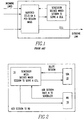
- Figure 1 depicts a block-level diagram of an outgoing link, incoming links feeding to the outgoing link, buffer to store the incoming cells, and a scheduler to serve out cells from the buffer to the outgoing link.
- the present invention includes a leaky-bucket based shaping to ensure conforming traffic at egress. Such out-bound shaping is important to keep within traffic contract specifications like PR, SCR, and ACR.
- the present invention pertains to a scheduling apparatus.
- the apparatus comprises a server for providing service to entities.
- the apparatus comprises a mechanism for determining whether an entity that is to receive service at a future time from the server will be in conformance with a predetermined criteria at the future time when the entity is to receive service from the server.
- the apparatus comprises a scheduler mechanism for scheduling when entities are to receive service from the server unless the determining mechanism determines the entity is not in conformance.
- the present invention pertains to a method for scheduling entities in an ATM network.
- the method comprises the steps of receiving a session of an entity in a memory of an ATM switch connected to the ATM network. Then there is the step of scheduling the session for service by a server of the ATM switch. Next there is the step of determining with a determining mechanism whether the session will be conforming in terms of compliance to traffic contract of the ATM network in the future. Next there is the step of deleting the session if the session will not be conforming in the future.
- Figure 1 A generic diagram depicting the position of a scheduler w.r.t. to outgoing link, incoming links, and buffers.
- the scheduler keeps track of sessions and determines which session to serve. It informs the buffer module to dispatch a cell from such session to the outgoing link.
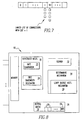
- Figure 2 Depicting the position of a leaky bucket based accounting (LBA) block along with the scheduler block to schedule/shape sessions.
- the scheduler informs the LBA of the session being served out in current slot time.
- the LBA based on leaky bucket constraints, decides if same session was to be served out in very next slot time would it be conforming. To avoid non-conformance, it deletes the session from the scheduler. This ensures the scheduler can not serve this session in the next slot time.
- the LBA decides on the earliest revival time (ERT) when session can again be served in a conformant manner and inserts session in a Revival Queue (RQ).
- ERT earliest revival time
- RQ Revival Queue
- FIG. 3 Block diagram for a general scheduling scheme to which this invention is applicable.
- the scheduler has two parts: a) Rate Guarantor (RG) and b) Free Bandwidth Delegator (FBD). Connections can be belong to either RG, FBD, or both.
- the RG module based on a Packet Fair Queuing (PFQ) algorithms offers smooth service to each connection meeting a specified guaranteed rate.
- PFQ Packet Fair Queuing
- the FBD delegates the left over (free) bandwidth among its connections.
- FIG. 4 Block Diagram Depicting the Apparatus.
- the scheduler is now augmented with two more blocks: the Leaky Bucket Accounting (LBA) and Revival Queue (RQ).
- LBA Leaky Bucket Accounting
- RQ Revival Queue
- the LBA maintains the leaky bucket parameters.
- Figure 5 Flowchart for the Virtual Scheduling Algorithm.
- FIG. 6 Flowchart for Leaky Bucket Computations used to determine if session served out in this cycle t, should be removed/added to the FBD.
- the computation is depicted in three parts. Firstly, the leaky bucket parameter, TAT, is updated to have recent knowledge of bucket state. Secondly, it is checked if bucket state would allow another cell from the same session to be served out in the successive cycle t + 1 . If not, the scheduler is notified to remove the session from FBD, to avoid it being served out next cycle. If the bucket state allows a successive cell, and it is a session of type C2, only then we perform the last part of the computation. This is to handle the worst case, that a C2 session may receive another cell at time t + 2 from the RG. If the session cannot handle this worst case, it is removed from FBD to avoid it, else it is allowed to remain/added back to the FBD (in case it was already deleted in an earlier cycle).
- TAT leaky bucket parameter
- FIG. 7 A suggested implementation of the Revival Queue (RQ) Block.
- a session of type C3, deleted from the FBD is inserted into the RQ in the bin corresponding to the session's Earliest Revival Time (ERT). Sessions are returned back to the FBD from RQ in the following manner.
- Figure 8 is a schematic representation of an apparatus of the present invention.
- the apparatus 10 comprises a server 12 for providing service to entities.
- the apparatus 10 comprises a mechanism 14 for determining whether an entity that is to receive service at a future time from the server 12 will be in conformance with a predetermined criteria at the future time when the entity is to receive service from the server 12.
- the apparatus 10 comprises a scheduler mechanism 16 for scheduling when entities are to receive service from the server 12 unless the determining mechanism 14 determines the entity is not in conformance.
- an entity includes a session, and wherein the scheduler mechanism 16 schedules the session, and the determining mechanism 14 determines whether the session will continue to be in conformance in the future.
- the determining mechanism 14 preferably deletes the session from the scheduler if the session in the future does not conform.
- the determining mechanism 14 preferably includes a leaky bucket accounting mechanism 20 which uses leaky bucket accounting to determine if a session is to continue receiving service from the server 12 by being in conformance.
- the apparatus 10 includes a revival queue 18 in which the determining mechanism 14 stores the session if it is not in conformance until a later time when the session will be in conformance and can receive service from the server 12.
- the revival queue 18 returns the session earlier deleted from the scheduler mechanism 16 back to the scheduler mechanism 16 at the later time when the session will be in conformance.
- the scheduler mechanism 16 preferably is a rate band width scheduler.
- the scheduler mechanism 16 and the revival queue 18 and the leaky bucket accounting mechanism 20 together accomplish out-bound shaping.
- the scheduler mechanism 16 preferably includes a rate guarantor 22 which schedules a guaranteed service to sessions guaranteed service.
- the rate base scheduler mechanism 16 includes a free band width delegator 24 which delegates free bandwidth available for service after the rate guarantor 22 provides service to any session guaranteed sessions.
- the leaky bucket accounting mechanism 20 preferably is connected only with the free band width delegator 24 and the revival queue 18 is only connected with the free band width delegator 24.
- the revival queue 18 preferably has bins 26 in which sessions are stored corresponding to revival times, and wherein a session deleted from the free band width delegator 24 of the scheduler mechanism 16 by the leaky bucket accounting mechanism 20 is inserted by the leaky bucket accounting mechanism 20 into the bin of the revival queue 18 corresponding to the session's earliest revival time.
- the revival queue 18 returns sessions back to the free band width delegator 24 whose revival time equals the scheduler mechanism's cycle time t.
- the sessions preferably are of type C1, C2 or C3, where C1 sessions are only in the rate guarantor 22, C2 sessions are in both the rate guarantor 22 and free band width delegator 24 and C3 sessions are only in the free band width delegator 24.
- the rate guarantor 22 has a service rate which matches the contract traffic rate.
- each session has at least one set of parameters associated with it, each set of parameters has three entries comprised of TAT, I and L.
- the present invention pertains to a method for scheduling entities in an ATM network.
- the method comprises the steps of receiving a session of an entity in a memory of an ATM switch connected to the ATM network. Then there is the step of scheduling the session for service by a server 12 of the ATM switch. Next there is the step of determining with a determining mechanism 14 whether the session will be conforming in terms of compliance to traffic contract of the ATM network in the future. Next there is the step of deleting the session if the session will not be conforming in the future.
- the deleting step there is the step of inserting the deleted session back into the scheduler mechanism 16 at a later time when the deleted session will be conforming.
- the determining step includes the step of determining whether the session will be conforming in the future so the session can continue to receive service from the server 12.
- the deleting step there is the step of placing the deleted session in a revival queue 18.
- the placing step there is preferably the step of sending the session from the revival queue 18 back to the scheduler mechanism 16.
- the receiving step includes the step of receiving the session at a free bandwidth delegator 24 of the scheduler mechanism 16.
- the deleting step preferably includes the step of deleting the session only from the free bandwidth delegator 24.
- the serving step includes the step of serving a cell of the session at cycle time t.
- the determining step includes the steps of updating a leaky bucket parameter TAT of a leaky bucket accounting mechanism 20 of the determining mechanism 14 to reflect the current state of the leaky bucket accounting mechanism 20, and checking if the leaky bucket accounting mechanism 20 state will allow another cell of the session to be served by the server 12 in cycle time t plus 1.
- the deleting step includes the step of deleting the cell if the leaky bucket accounting mechanism 20 state will not allow the other cell to be served by the server 12 in cycle time t plus 1.
- the session is preferably of type C2 and after the checking step there are the steps of identifying that the other cell can be served by the server 12 in cycle time t plus 1, and checking if the leaky bucket accounting mechanism 20 state will allow a third cell of the session to be served by the server 12 in cycle time t plus 2.
- FIG. 2 depicts a block-level diagram of the basic scheme.
- LBA leaky bucket accounting
- RQ Revival queue 18
- the scheduler mechanism 16 informs the LBA of the session being served out in current slot time.
- the LBA based on leaky bucket constraints makes the following decision. If the same session was to be scheduled in very next slot time would the served out cell be conforming?. In case it is not, the session is deleted from the scheduler mechanism 16. This eliminates the possibility of the session being served out in the next slot time and thus being non-conforming.
- the LBA decides on the earliest revival time (ERT) when session can again be served in a conformant manner and inserts session in a Revival queue 18 (RQ). Sessions from the RQ are inserted back into the scheduler mechanism 16 when current time is equal to the ERT of a session.
- ERT earliest revival time
- RQ Revival queue 18
- the apparatus 10 described is applicable to any ATM scheduler mechanism 16 which comprises of two parts a) Rate guarantor 22 (RG) b) Free Bandwidth Delegator 24 (FBD) as shown in Fig. 3.
- An ATM connection can be in one or both of these units, depending on the service type.
- the apparatus 10 demonstrates augmenting such ATM scheduler mechanism 16 to have leaky bucket based out-bound shaping.
- Sessions in the scheduler mechanism 16 can be classified into three types:
- This invention describes an apparatus 10 and method to augment above scheduler mechanisms with leaky bucket based out-bound shaping for sessions of types C2 and C3.
- FIG. 4 depicts the block diagram of the apparatus 10. Two new logical blocks: the leaky bucket accounting (LBA) and the Revival queue 18 (RQ) have been added.
- the LBA is an apparatus 10 contains the per-session leaky bucket parameters and accounting logic.
- the RQ block is an apparatus 10 to keep track of sessions, currently deleted from the scheduler mechanism 16. The sessions in the RQ are maintained in a sorted manner. The sorting being done based on the earliest revival time (ERT) of a session.
- ERT earliest revival time
- Each session has two sets of parameters associated with it. One or both sets may be used for a session.
- the proposed shaping algorithm is similar on the virtual scheduling algorithm described in the ATM Forum TM 4.0. Each set of parameters has three entries as described in Table 1, namely TAT, I, L. The actual algorithm is described in Figure 6. Prior to discussing the details of our algorithm, we provide as reference the virtual scheduling algorithm. Figure 5 depicts the flow chart for it. Per-session Leaky Bucket Parameters. The type of the session: C1/C2/C3 and two sets of triples (I, L, TAT) are maintained.
Landscapes
- Engineering & Computer Science (AREA)
- Computer Networks & Wireless Communication (AREA)
- Signal Processing (AREA)
- Data Exchanges In Wide-Area Networks (AREA)
Applications Claiming Priority (2)
| Application Number | Priority Date | Filing Date | Title |
|---|---|---|---|
| US09/140,923 US6560195B1 (en) | 1998-08-27 | 1998-08-27 | Method and apparatus for leaky bucket based out-bound shaping in an ATM scheduler |
| US140923 | 1998-08-27 |
Publications (1)
| Publication Number | Publication Date |
|---|---|
| EP0982902A2 true EP0982902A2 (de) | 2000-03-01 |
Family
ID=22493390
Family Applications (1)
| Application Number | Title | Priority Date | Filing Date |
|---|---|---|---|
| EP99306808A Withdrawn EP0982902A2 (de) | 1998-08-27 | 1999-08-26 | ATM Ablauffolgesteuerung |
Country Status (3)
| Country | Link |
|---|---|
| US (1) | US6560195B1 (de) |
| EP (1) | EP0982902A2 (de) |
| JP (1) | JP4485622B2 (de) |
Cited By (1)
| Publication number | Priority date | Publication date | Assignee | Title |
|---|---|---|---|---|
| EP1792443A4 (de) * | 2004-09-24 | 2010-03-10 | Cisco Tech Inc | Hierarchische flusssteuerung für router-atm-schnittstellen |
Families Citing this family (9)
| Publication number | Priority date | Publication date | Assignee | Title |
|---|---|---|---|---|
| US6768717B1 (en) * | 1999-05-28 | 2004-07-27 | Network Equipment Technologies, Inc. | Apparatus and method for traffic shaping in a network switch |
| US6904045B1 (en) * | 2000-06-02 | 2005-06-07 | Agere Systems Inc. | Method and apparatus for guaranteeing data transfer rates and delays in asynchronous transfer mode networks using pivot sessions |
| US8032653B1 (en) * | 2000-09-08 | 2011-10-04 | Juniper Networks, Inc. | Guaranteed bandwidth sharing in a traffic shaping system |
| US7457313B2 (en) * | 2000-09-25 | 2008-11-25 | General Instrument Corporation | Hierarchical prioritized round robin (HPRR) scheduling |
| CN1853379A (zh) * | 2002-12-31 | 2006-10-25 | 肯奈克斯特公司 | 在异步传输模式信元传输中提供服务质量的系统和方法 |
| US7385987B1 (en) * | 2003-02-04 | 2008-06-10 | Cisco Technology, Inc. | Scheduling system and method for multi-level class hierarchy |
| US7843825B2 (en) * | 2007-10-02 | 2010-11-30 | Broadcom Corporation | Method and system for packet rate shaping |
| US8416684B2 (en) * | 2010-12-14 | 2013-04-09 | Verizon Patent And Licensing, Inc. | Time and data rate policing |
| CN109861920A (zh) * | 2019-01-16 | 2019-06-07 | 深圳市融汇通金科技有限公司 | 一种弹性限流的方法及装置 |
Family Cites Families (6)
| Publication number | Priority date | Publication date | Assignee | Title |
|---|---|---|---|---|
| US5533020A (en) * | 1994-10-31 | 1996-07-02 | International Business Machines Corporation | ATM cell scheduler |
| US5982749A (en) * | 1996-03-07 | 1999-11-09 | Lsi Logic Corporation | ATM communication system interconnect/termination unit |
| US5831971A (en) * | 1996-08-22 | 1998-11-03 | Lucent Technologies, Inc. | Method for leaky bucket traffic shaping using fair queueing collision arbitration |
| US5864540A (en) * | 1997-04-04 | 1999-01-26 | At&T Corp/Csi Zeinet(A Cabletron Co.) | Method for integrated traffic shaping in a packet-switched network |
| US6266327B1 (en) * | 1998-03-20 | 2001-07-24 | Lucent Technologies Inc. | Non-conformance indicator for the guaranteed frame rate service |
| US6247061B1 (en) * | 1998-06-09 | 2001-06-12 | Microsoft Corporation | Method and computer program product for scheduling network communication packets originating from different flows having unique service requirements |
-
1998
- 1998-08-27 US US09/140,923 patent/US6560195B1/en not_active Expired - Lifetime
-
1999
- 1999-08-26 JP JP23931099A patent/JP4485622B2/ja not_active Expired - Fee Related
- 1999-08-26 EP EP99306808A patent/EP0982902A2/de not_active Withdrawn
Cited By (1)
| Publication number | Priority date | Publication date | Assignee | Title |
|---|---|---|---|---|
| EP1792443A4 (de) * | 2004-09-24 | 2010-03-10 | Cisco Tech Inc | Hierarchische flusssteuerung für router-atm-schnittstellen |
Also Published As
| Publication number | Publication date |
|---|---|
| US6560195B1 (en) | 2003-05-06 |
| JP4485622B2 (ja) | 2010-06-23 |
| JP2000078137A (ja) | 2000-03-14 |
Similar Documents
| Publication | Publication Date | Title |
|---|---|---|
| US6377583B1 (en) | Rate shaping in per-flow output queued routing mechanisms for unspecified bit rate service | |
| US5926459A (en) | Rate shaping in per-flow queued routing mechanisms for available bit rate service | |
| US6038217A (en) | Rate shaping in per-flow output queued routing mechanisms for available bit rate (ABR) service in networks having segmented ABR control loops | |
| US6058114A (en) | Unified network cell scheduler and flow controller | |
| US6064650A (en) | Rate shaping in per-flow output queued routing mechanisms having output links servicing multiple physical layers | |
| Stiliadis et al. | A general methodology for designing efficient traffic scheduling and shaping algorithms | |
| US6064677A (en) | Multiple rate sensitive priority queues for reducing relative data transport unit delay variations in time multiplexed outputs from output queued routing mechanisms | |
| US5748614A (en) | Method for scheduling message cells leaving an ATM node | |
| US6064651A (en) | Rate shaping in per-flow output queued routing mechanisms for statistical bit rate service | |
| EP1177659B1 (de) | Routing-vorrichtung | |
| US6438106B1 (en) | Inter-class schedulers utilizing statistical priority guaranteed queuing and generic cell-rate algorithm priority guaranteed queuing | |
| US5831971A (en) | Method for leaky bucket traffic shaping using fair queueing collision arbitration | |
| US5864540A (en) | Method for integrated traffic shaping in a packet-switched network | |
| US6262986B1 (en) | Method and apparatus for packet scheduling using queue length and connection weight | |
| US6442164B1 (en) | Method and system for allocating bandwidth and buffer resources to constant bit rate (CBR) traffic | |
| US6353618B1 (en) | Method and apparatus for controlling traffic flows in a packet-switched network | |
| US6526062B1 (en) | System and method for scheduling and rescheduling the transmission of cell objects of different traffic types | |
| US6385168B1 (en) | Fair share bandwidth allocation algorithm and device | |
| EP0817433B1 (de) | Paketvermitteltes Kommunikationssystem und Verfahren zur Verkehrsformung | |
| US6560195B1 (en) | Method and apparatus for leaky bucket based out-bound shaping in an ATM scheduler | |
| EP0973304A2 (de) | Vorrichtung und Verfahren zur Bandbreitenverwaltung | |
| Chiussi et al. | Implementing fair queueing in atm switches: The discrete-rate approach | |
| US6542509B1 (en) | Virtual path level fairness | |
| EP0817431B1 (de) | Paketvermitteltes Kommunikationssystem | |
| US6363069B1 (en) | Complete packet discarding |
Legal Events
| Date | Code | Title | Description |
|---|---|---|---|
| PUAI | Public reference made under article 153(3) epc to a published international application that has entered the european phase |
Free format text: ORIGINAL CODE: 0009012 |
|
| AK | Designated contracting states |
Kind code of ref document: A2 Designated state(s): AT BE CH CY DE DK ES FI FR GB GR IE IT LI LU MC NL PT SE |
|
| AX | Request for extension of the european patent |
Free format text: AL;LT;LV;MK;RO;SI |
|
| RAP1 | Party data changed (applicant data changed or rights of an application transferred) |
Owner name: MARCONI COMMUNICATIONS, INC. |
|
| STAA | Information on the status of an ep patent application or granted ep patent |
Free format text: STATUS: THE APPLICATION HAS BEEN WITHDRAWN |
|
| 18W | Application withdrawn |
Effective date: 20030701 |