EP0983459B1 - Kopfventil für pneumatische werkzeuge - Google Patents
Kopfventil für pneumatische werkzeuge Download PDFInfo
- Publication number
- EP0983459B1 EP0983459B1 EP99911390A EP99911390A EP0983459B1 EP 0983459 B1 EP0983459 B1 EP 0983459B1 EP 99911390 A EP99911390 A EP 99911390A EP 99911390 A EP99911390 A EP 99911390A EP 0983459 B1 EP0983459 B1 EP 0983459B1
- Authority
- EP
- European Patent Office
- Prior art keywords
- valve
- stem
- bore
- axis
- valve member
- Prior art date
- Legal status (The legal status is an assumption and is not a legal conclusion. Google has not performed a legal analysis and makes no representation as to the accuracy of the status listed.)
- Expired - Lifetime
Links
- 238000012986 modification Methods 0.000 description 3
- 230000004048 modification Effects 0.000 description 3
- 238000010276 construction Methods 0.000 description 2
- 230000001419 dependent effect Effects 0.000 description 1
- 230000000881 depressing effect Effects 0.000 description 1
- 238000011161 development Methods 0.000 description 1
- 230000018109 developmental process Effects 0.000 description 1
- 238000007689 inspection Methods 0.000 description 1
Images


Classifications
-
- F—MECHANICAL ENGINEERING; LIGHTING; HEATING; WEAPONS; BLASTING
- F16—ENGINEERING ELEMENTS AND UNITS; GENERAL MEASURES FOR PRODUCING AND MAINTAINING EFFECTIVE FUNCTIONING OF MACHINES OR INSTALLATIONS; THERMAL INSULATION IN GENERAL
- F16K—VALVES; TAPS; COCKS; ACTUATING-FLOATS; DEVICES FOR VENTING OR AERATING
- F16K31/00—Actuating devices; Operating means; Releasing devices
-
- F—MECHANICAL ENGINEERING; LIGHTING; HEATING; WEAPONS; BLASTING
- F16—ENGINEERING ELEMENTS AND UNITS; GENERAL MEASURES FOR PRODUCING AND MAINTAINING EFFECTIVE FUNCTIONING OF MACHINES OR INSTALLATIONS; THERMAL INSULATION IN GENERAL
- F16K—VALVES; TAPS; COCKS; ACTUATING-FLOATS; DEVICES FOR VENTING OR AERATING
- F16K31/00—Actuating devices; Operating means; Releasing devices
- F16K31/44—Mechanical actuating means
- F16K31/52—Mechanical actuating means with crank, eccentric, or cam
Definitions
- This invention relates generally to pneumatic tools and in particular to operating valves for such tools.
- valves for restricting and controlling the air flow for these pneumatic tools have previously been provided.
- these prior art valves include a valve seat having a bore (to allow air flow therethrough) with a central axis and a second valve member having an engaging surface biased against the valve seat to form a substantially fluid-tight seal and a stem coupled to the second valve member and coaxially disposed through the bore in the normal closed position.
- the stem is coupled to a trigger mechanism for opening and closing the valve. Depressing of the trigger tilts or tips the stem and the engaging surface away from the valve seat.
- An important feature of the invention is the provision of a tip valve which is of relatively simple and economical construction.
- a still further feature of the tip valve of the present invention is that it allows maximum air flow therethrough without increasing the size of tool wherein it is incorporated.
- a tip valve of the invention has been defined in claim 1. Further developments and modifications of the invention have been defined in the dependent claims.
- a tip valve for a pneumatic tool having a body
- the tip valve comprising: a first valve member having a bore with a central axis and defining a valve seat about the bore; a second valve member having an engaging surface engageable with the valve seat to form a substantially fluid-tight seal therewith; a stem fixedly coupled to the second valve member and disposed through the bore, a valve operating member coupled to the stem and mounted in the body for movement between a closed position wherein the second valve member is engaged with the valve seat and an open position wherein the second valve member is tilted from the valve seat to permit air flow through the bore; resilient structure disposed in the body urging the second valve member against the valve seat and the valve operating member to its closed position, characterized in that at least a portion of the stem is offset from the axis.
- the impact wrench 10 includes a body 12 which includes a hand grip portion 14 and a motor housing portion 16.
- the motor (not shown) of the impact wrench 10 is run in a known manner by compressed air which is supplied through an external air line 18 connected to an air source (not shown) and through a cylindrical air channel 20 formed by a cylindrical wall 21 within the hand grip portion 14.
- a tip valve 22 is provided to control the amount of air delivered to the motor.
- the tip valve 22 includes a first valve member 24 fixed in the upper end of air channel 20 by a friction fit or the like.
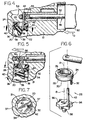
- the first valve member 24 includes a central bore 26 having a central axis "A" (FIG. 6).
- the first valve member has a bottom end 28 which defines a valve seat 30 about the bore 26.
- the first valve member 24 includes a projecting structure 32 which projects and depends from the bottom end 28.
- the tip valve 22 also includes a second valve member 34 having a central axis, an upper star-shaped portion 36 and a bullet-shaped lower portion 38 depending axially therefrom.
- the outer periphery of the star-shaped portion 36 forms a plurality of recesses 37 between the star-shaped portion 36 and the cylindrical wall 21.
- the star-shaped portion 36 has a substantially planar engaging surface 40 engageable, as seen in FIG. 4, with the valve seat 30 to form a substantially fluid-tight seal.
- the tip valve 22 also includes an elongated straight stem 42 having an axis offset from and parallel to the central axis of the second valve member 34.
- the stem 42 has a first end 44 coupled to or imbedded in the second valve member 34 and a second end 46 disposed through the bore 26.
- the tip valve 22 further includes an operating member 48 which includes a trigger button 50 projecting outside the body 12 and coupled to an end of an elongated rod 52.
- the elongated rod 52 includes a bore 54 at its other end.
- the bore 54 is chamfered at both its ends and has a narrower diameter central portion 56.
- the operating member 48 is engageably coupled to the stem 42 which is disposed through the bore 54.
- the tip valve 22 also includes resilient structure, such as a coil spring 58 disposed in the air channel 20 of the body 12 and about the lower portion 38 of the second valve member 34 for biasing the valve closed.
- resilient structure such as a coil spring 58 disposed in the air channel 20 of the body 12 and about the lower portion 38 of the second valve member 34 for biasing the valve closed.
- the stem 42 coupled to the elongated rod 52 maintains the operating member 48 in the closed position.
- the stem 42 is offset from the central axis "A" of the bore 26 and is disposed between axis "A” and the trigger button 50.
- the operating member 48 is moveable from the closed position in FIG. 4 to an open position as shown in FIG. 5.
- a user simply pushes the trigger button 50 in the direction of arrow D in FIG. 5, which causes the elongated rod 52 to move in the same direction and causes the stem 42 coupled thereto to tip the engaging surface 40 of the second valve member 34 away from the valve seat 30 to allow air to flow through the bore 26 to power the pneumatic motor.
- the stem 42 is offset from the axis of the second valve member 34, it allows the engaging surface 40 to be tipped at least 30 degrees away from the plane of the valve seat 30 to reduce restriction of air flow through bore 26 by the second valve member 34. It has been found that, when the angle formed between the plane of the engaging surface 40 and the plane of the valve seat 30 is greater than about 30 degrees, the second valve member 34 substantially does not restrict air flow through the bore 26.
- the prior art tip valve 22' had a second valve member 34' having a central axis and an elongated straight stem 42' which is substantially coaxial with the axis of the second valve member 34'.
- the location of the stem 42' with respect to the axis of the second valve member 34' allows the engaging surface 40' of the second valve member 34' to be tipped only a relatively small angle, substantially less than 30 degrees, with respect to the plane of valve seat 30. At this smaller tipping angle, the second valve member 34' restricts air flow through the bore 26.
- the tip valve 22 of the present invention also includes structure for substantially preventing the second valve member 34 and stem 42 from rotating about either of their respective axes in use. If the second valve member 34 were to be rotated, the stem 42 could no longer be disposed between the axis "A" and the trigger button 50 in the closed position of the operating member 48 thereby preventing the engaging surface 40 from being tipped at as great an angle as shown in FIG. 5. As best seen in FIG. 7, projecting structure 32 is disposed in a recess 37 which prevents such rotation. Alternatively, the projecting structure 32 may not be necessary, if the central portion 56 of bore 54 of the elongated rod 52 is small enough to prevent rotation.
- FIGS. 8-12 show a second tip valve 122 substantially identical to the tip valve 22 of FIGS. 1 and 3-7.
- the tip valve 122 includes a first valve member 124 fixed in the upper end of air channel 20 by a friction fit or the like.
- the first valve member 124 includes a central bore 126 having a central axis "E" (FIG. 8), and a bottom end 128 which defines a valve seat 130 about the bore 126.
- the tip valve 122 also includes a second valve member 134 having a central axis, an upper star-shaped projection 136 and a bullet-shaped lower portion 138 depending axially therefrom.
- the star-shaped portion 136 has a substantially planar engaging surface 140 engageable, as seen in FIG. 10, with the valve seat 130 to form a substantially fluid-tight seal.
- the tip valve 122 also includes a bar-shaped stem 142.
- the stem 142 has a first portion 144 coupled to or embedded in the second valve member 134 coaxially therewith and a second portion 146 disposed through the bore 126 and inclined with respect to the first portion 144.
- the tip valve 122 further includes an operating member 148.
- the operating member 148 includes a trigger button 150 projecting outside the body 12 coupled to an end of an elongated rod 152.
- the other end of the elongated rod 152 is bifurcated to form a slot 154.
- the second portion 146 of the operating member 148 is engaged in the slot 154, as is best seen in FIG. 9.
- the tip valve 122 also includes resilient structure, such as a coil spring 158 disposed about lower portion 138 and in the air channel 20 of the body 12 urging the valve closed.
- the coil spring 158 as seen in FIG. 8 as the coil spring 158 urges the engaging surface 140 of the second valve member 134 into engagement with valve seat 130 to form a substantially fluid-tight seal therebetween.
- the second portion 146 of the stem 142 coupled to the elongated rod 152 maintains the operating member 148 in the closed position. When the operating member 148 is in the closed position, the second portion 146 of stem 142 is inclined from the central axis "E" of the bore 126 and disposed between axis "E” and the trigger button 150.
- the operating member 148 is moveable from the closed position in FIG. 9 to an open position as shown in FIG. 10.
- a user simply pushes the trigger button 150 in the direction of arrow H in FIG. 9, which causes the elongated rod 152 and the stem 142, to move in the same direction, tipping the engaging surface 140 of the second valve member 134 more than 30 degrees away from the valve seat 130 to allow air to flow substantially unrestricted through the bore 126 to power the pneumatic motor.
Landscapes
- Engineering & Computer Science (AREA)
- General Engineering & Computer Science (AREA)
- Mechanical Engineering (AREA)
- Lift Valve (AREA)
- Mechanically-Actuated Valves (AREA)
Claims (13)
- Kopfventil (22) für ein pneumatisches Werkzeug (10) mit einem Körper (12), wobei das Kopfventil (22) folgendes umfaßt:dadurch gekennzeichnet, daß mindestens ein Abschnitt (42, 146) des Schafts (42, 142) gegenüber der Achse (A) versetzt ist.ein erstes Ventilglied (24), das eine Bohrung (26) mit einer mittigen Achse (A) aufweist und einen Ventilsitz (30) um die Bohrung (26) herum aufweist;einem zweiten Ventilglied (34) mit einer Eingriffsfläche (40), die mit dem Ventilsitz (30) in Eingriff gebracht werden kann, um eine im wesentlichen fluiddichte Dichtung mit diesem zu bilden;einen Schaft (42, 142), der fest mit dem zweiten Ventilglied (34) verbunden und durch die Bohrung (26) hindurch angeordnet ist;einem Ventilbetätigungsglied (48), das mit dem Schaft (42; 142) verbunden und in dem Körper (12) angebracht ist, um sich zwischen einer geschlossenen Position, in der das zweite Ventilglied (34) in Eingriff mit dem Ventilsitz (30) steht, und einer offenen Position zu bewegen, in der das zweite Ventilglied (34) gegenüber dem Ventilsitz (30) gekippt ist, um einen Luftstrom durch die Bohrung (26) hindurch zuzulassen; undeine in dem Körper (12) angeordnete federnde Konstruktion (58), welche das zweite Ventilglied (34) gegen den Ventilsitz (30) und das Ventilbetätigungsglied (48) in seine geschlossene Position drückt,
- Ventil (22) nach Anspruch 1, wobei der Schaft (42) gerade ist und eine zu der Achse (A) der Bohrung (26) parallele Schaftachse aufweist.
- Ventil (22) nach Anspruch 2, wobei das Ventilbetätigungsglied (48) ein erstes Ende (54), das mit dem Schaft (42, 142) verbunden ist, und ein zweites Ende aufweist, das mit einem Auslöseknopf (50) verbunden ist, wobei sich die Schaftachse in der geschlossenen Position zwischen dem Auslöseknopf (50) und der Achse (A) der Bohrung (26) befindet.
- Ventil (22) nach Anspruch 3, wobei das zweite Ventilglied (34) einen Außenumfang mit mindestens einer Ausnehmung (37) darin aufweist, und des weiteren eine in Bezug auf den Körper (12) befestigte und in der Ausnehmung (37) angeordnete, vorstehende Konstruktion (32) umfaßt, wodurch die vorstehende Konstruktion (32) im wesentlichen die Drehung des zweiten Ventilglieds (34) verhindert.
- Ventil (22) nach Anspruch 4, wobei die vorstehende Konstruktion (32) mit dem ersten Ventilglied (24) verbunden ist.
- Ventil (22) nach Anspruch 4, wobei der Außenumfang des zweiten Ventilglieds (34) sternförmig ist.
- Ventil (22) nach Anspruch 1, wobei der Schaft (142) einen gewinkelten Abschnitt (146) aufweist, der in Bezug auf die Achse (A) der Bohrung (26) geneigt ist.
- Ventil (22) nach Anspruch 7, wobei das Ventilbetätigungsglied (48) ein geschlitztes erstes Ende (154), das mit dem Schaft (142) verbunden ist, und ein zweites Ende aufweist, das mit einem Auslöseknopf (150) verbunden ist, und wobei der gewinkelte Abschnitt (146) ein freies Ende aufweist, das in der geschlossenen Position zwischen dem Auslöseknopf (150) und der Achse (A) der Bohrung (26) angeordnet ist.
- Ventil (22) nach Anspruch 1, wobei der Sitz (30) eine erste Ebene bildet und die Eingriffsfläche (40) eine zweite Ebene bildet, und wobei der Winkel zwischen der ersten und der zweiten Ebene, wenn sich das Ventilbetätigungsglied (48) in der offenen Position befindet, mindestens etwa 30° beträgt.
- Ventil (22) nach Anspruch 1, wobei das Ventilbetätigungsglied (48) und das zweite Ventilglied (34) jeweils auf einander gegenüberliegenden Seiten des ersten Ventilglieds (24) angeordnet sind.
- Ventil (22) nach Anspruch 10, wobei der Schaft (42) gerade ist und eine zu der Achse (A) der Bohrung (26) parallele Schaftachse aufweist.
- Ventil (22) nach Anspruch 10, wobei der Schaft (142) einen gewinkelten Abschnitt (146) aufweist, der in Bezug auf die Achse (A) der Bohrung (26) geneigt ist.
- Ventil (22) nach Anspruch 12, wobei der Schaft (142) des weiteren einen zweiten Abschnitt (144) umfaßt, der mit dem gewinkelten Abschnitt und dem zweiten Ventilglied (34) verbunden ist.
Applications Claiming Priority (3)
| Application Number | Priority Date | Filing Date | Title |
|---|---|---|---|
| US09/044,942 US6027099A (en) | 1998-03-20 | 1998-03-20 | Tip valve for pneumatic tool |
| US44942 | 1998-03-20 | ||
| PCT/US1999/005543 WO1999049249A1 (en) | 1998-03-20 | 1999-03-12 | Tip valve for pneumatic tool |
Publications (3)
| Publication Number | Publication Date |
|---|---|
| EP0983459A1 EP0983459A1 (de) | 2000-03-08 |
| EP0983459A4 EP0983459A4 (de) | 2004-06-16 |
| EP0983459B1 true EP0983459B1 (de) | 2005-09-28 |
Family
ID=21935170
Family Applications (1)
| Application Number | Title | Priority Date | Filing Date |
|---|---|---|---|
| EP99911390A Expired - Lifetime EP0983459B1 (de) | 1998-03-20 | 1999-03-12 | Kopfventil für pneumatische werkzeuge |
Country Status (10)
| Country | Link |
|---|---|
| US (1) | US6027099A (de) |
| EP (1) | EP0983459B1 (de) |
| JP (1) | JP2002503158A (de) |
| KR (1) | KR20010012670A (de) |
| CN (1) | CN1107185C (de) |
| AU (1) | AU747512B2 (de) |
| CA (1) | CA2288883A1 (de) |
| DE (1) | DE69927452T2 (de) |
| TW (1) | TW584048U (de) |
| WO (1) | WO1999049249A1 (de) |
Families Citing this family (11)
| Publication number | Priority date | Publication date | Assignee | Title |
|---|---|---|---|---|
| US6748846B2 (en) | 2002-02-15 | 2004-06-15 | Delphi Technologies, Inc. | Solenoid valve, vacuum booster diaphragm subassembly, and vacuum booster assembly |
| US20060011366A1 (en) * | 2004-07-19 | 2006-01-19 | Mighty Seven International Co., Ltd. | Inlet valve for pneumatic tool |
| USD507732S1 (en) | 2004-08-09 | 2005-07-26 | Snap-On Incorporated | Impact wrench |
| US7032881B1 (en) * | 2004-10-28 | 2006-04-25 | Basso Industry Corp. | Switch mechanism for a pneumatic tool |
| US7445055B2 (en) * | 2006-11-03 | 2008-11-04 | Snap-On Incorporated | Trigger-actuated tip-type air valve with integrated wear surface |
| CN101670322B (zh) * | 2009-10-01 | 2013-05-15 | 厦门松霖科技有限公司 | 一种按钮止水装置及其控制方法 |
| TWI393616B (zh) * | 2011-06-02 | 2013-04-21 | Tranmax Machinery Co Ltd | Used for pneumatic tools |
| JP6234093B2 (ja) * | 2013-07-12 | 2017-11-22 | 日東工器株式会社 | エア工具 |
| CN105965430A (zh) * | 2013-08-23 | 2016-09-28 | 苏州宝时得电动工具有限公司 | 动力工具 |
| WO2015126435A1 (en) * | 2014-02-21 | 2015-08-27 | HYTORC Division Unex Corporation | Apparatus for tightening threaded fasteners |
| CN105215914B (zh) * | 2015-10-19 | 2017-04-12 | 苏州博众精工科技有限公司 | 一种自动换螺帽机构 |
Family Cites Families (21)
| Publication number | Priority date | Publication date | Assignee | Title |
|---|---|---|---|---|
| US674696A (en) * | 1900-10-20 | 1901-05-21 | Henry Gardenier | Water-supply valve. |
| US1327687A (en) * | 1917-11-08 | 1920-01-13 | Oscar A Smith | Priming and testing cup |
| US2009575A (en) * | 1930-02-12 | 1935-07-30 | Compo Shoe Machinery Corp | Valve device |
| US2605808A (en) * | 1951-02-13 | 1952-08-05 | George C Current | Pneumatic sheet metal hammer |
| US3095896A (en) * | 1959-07-13 | 1963-07-02 | Anthony J Ross | Float valve |
| US3476147A (en) * | 1966-02-21 | 1969-11-04 | Aro Corp | Two-stage control throttle mechanism |
| US3443646A (en) * | 1967-03-16 | 1969-05-13 | Gardner Denver Co | Housing for tool mechanism |
| SE354565B (de) * | 1969-05-08 | 1973-03-19 | J Olde | |
| US3698431A (en) * | 1971-07-12 | 1972-10-17 | Earl Clayton Thompson | Water dispenser for animals |
| US3988001A (en) * | 1975-07-21 | 1976-10-26 | Sybron Corporation | Variable flow control valve for use with dental syringes and the like |
| US4265322A (en) * | 1978-09-19 | 1981-05-05 | Maco-Meudon | Compressed air feed control system for a tapping device |
| US4258799A (en) * | 1979-11-27 | 1981-03-31 | Dresser Industries, Inc. | Inlet control valve |
| SE427811B (sv) * | 1981-11-23 | 1983-05-09 | Atlas Copco Ab | Skruvdragare med reaktionsmomentupptagande organ |
| US4523700A (en) * | 1981-11-27 | 1985-06-18 | Emco Wheaton, Inc. | Low flow control nozzle |
| US4476942A (en) * | 1982-04-28 | 1984-10-16 | Monogram Industries, Inc. | Variable speed inlet control valve |
| US4653722A (en) * | 1984-03-28 | 1987-03-31 | Robert Hupee | Faucet valve |
| US4970920A (en) * | 1989-03-30 | 1990-11-20 | Ingersoll-Rand Company | Lever-actuated, hand-held, power tool |
| US5205540A (en) * | 1992-03-16 | 1993-04-27 | Ingersoll-Rand Company | Trigger valve assembly |
| US5439332A (en) * | 1993-06-11 | 1995-08-08 | Spitznagel; Max W. A. | Pneumatic spot weld drill |
| US5531279A (en) * | 1994-04-12 | 1996-07-02 | Indresco Inc. | Sensor impulse unit |
| JPH0911139A (ja) * | 1995-06-29 | 1997-01-14 | Youtarou Taga | 空気工具におけるハンドル内部のスロットル・バルブ |
-
1998
- 1998-03-20 US US09/044,942 patent/US6027099A/en not_active Expired - Lifetime
-
1999
- 1999-03-12 AU AU30040/99A patent/AU747512B2/en not_active Ceased
- 1999-03-12 CA CA002288883A patent/CA2288883A1/en not_active Abandoned
- 1999-03-12 JP JP54833099A patent/JP2002503158A/ja active Pending
- 1999-03-12 EP EP99911390A patent/EP0983459B1/de not_active Expired - Lifetime
- 1999-03-12 KR KR1019997010631A patent/KR20010012670A/ko not_active Withdrawn
- 1999-03-12 DE DE69927452T patent/DE69927452T2/de not_active Expired - Fee Related
- 1999-03-12 CN CN99800333A patent/CN1107185C/zh not_active Expired - Fee Related
- 1999-03-12 WO PCT/US1999/005543 patent/WO1999049249A1/en not_active Ceased
- 1999-05-05 TW TW092217883U patent/TW584048U/zh not_active IP Right Cessation
Also Published As
| Publication number | Publication date |
|---|---|
| JP2002503158A (ja) | 2002-01-29 |
| DE69927452T2 (de) | 2006-06-29 |
| DE69927452D1 (de) | 2006-02-09 |
| AU747512B2 (en) | 2002-05-16 |
| CN1107185C (zh) | 2003-04-30 |
| KR20010012670A (ko) | 2001-02-26 |
| AU3004099A (en) | 1999-10-18 |
| WO1999049249A1 (en) | 1999-09-30 |
| TW584048U (en) | 2004-04-11 |
| EP0983459A1 (de) | 2000-03-08 |
| HK1032434A1 (en) | 2001-07-20 |
| CA2288883A1 (en) | 1999-09-30 |
| CN1277662A (zh) | 2000-12-20 |
| EP0983459A4 (de) | 2004-06-16 |
| US6027099A (en) | 2000-02-22 |
Similar Documents
| Publication | Publication Date | Title |
|---|---|---|
| EP0983459B1 (de) | Kopfventil für pneumatische werkzeuge | |
| US6789447B1 (en) | Reversible ratchet head assembly | |
| US6568298B1 (en) | Reversible ratchet head assembly | |
| US6062323A (en) | Pneumatic tool with increased power capability | |
| US6370988B1 (en) | Ratcheting screwdriver with reversing cap having projecting pin | |
| CN101472711B (zh) | 带有用于可拆卸地接合工具附件的连接机构的万向接头 | |
| US20090205725A1 (en) | Valve | |
| US6138532A (en) | Wrench having driving direction indicator | |
| US6253647B1 (en) | Reversible ratchet with remote reversing operating mechanism | |
| US7036795B2 (en) | Valve apparatus for air tool | |
| US6438797B1 (en) | Mop handle with improved water flow control | |
| US20140283932A1 (en) | Pneumatic tool driving assembly | |
| US7445055B2 (en) | Trigger-actuated tip-type air valve with integrated wear surface | |
| MXPA99010492A (en) | Tip valve for pneumatic tool | |
| CN113894754A (zh) | 用于动力工具的换向机构 | |
| US6370991B1 (en) | Pliers for use in narrow space | |
| CA2449372C (en) | Cylindrical plug valve | |
| HK1032434B (en) | Tip valve for pneumatic tool | |
| JP2802220B2 (ja) | 流量制御弁 | |
| JP2002254339A (ja) | エアインパクトレンチのリバース装置 | |
| HK40057932A (en) | Reversing mechanism for a power tool | |
| JP2005212082A (ja) | エアーツール | |
| GB2327255A (en) | Tap and valve tool |
Legal Events
| Date | Code | Title | Description |
|---|---|---|---|
| PUAI | Public reference made under article 153(3) epc to a published international application that has entered the european phase |
Free format text: ORIGINAL CODE: 0009012 |
|
| AK | Designated contracting states |
Kind code of ref document: A1 Designated state(s): DE ES FR GB IT |
|
| 17P | Request for examination filed |
Effective date: 20000216 |
|
| A4 | Supplementary search report drawn up and despatched |
Effective date: 20040507 |
|
| RIC1 | Information provided on ipc code assigned before grant |
Ipc: 7B 25F 5/00 B Ipc: 7B 25B 21/00 B Ipc: 7F 16K 31/52 A |
|
| 17Q | First examination report despatched |
Effective date: 20040721 |
|
| GRAP | Despatch of communication of intention to grant a patent |
Free format text: ORIGINAL CODE: EPIDOSNIGR1 |
|
| GRAS | Grant fee paid |
Free format text: ORIGINAL CODE: EPIDOSNIGR3 |
|
| GRAA | (expected) grant |
Free format text: ORIGINAL CODE: 0009210 |
|
| AK | Designated contracting states |
Kind code of ref document: B1 Designated state(s): DE ES FR GB IT |
|
| PG25 | Lapsed in a contracting state [announced via postgrant information from national office to epo] |
Ref country code: IT Free format text: LAPSE BECAUSE OF FAILURE TO SUBMIT A TRANSLATION OF THE DESCRIPTION OR TO PAY THE FEE WITHIN THE PRESCRIBED TIME-LIMIT;WARNING: LAPSES OF ITALIAN PATENTS WITH EFFECTIVE DATE BEFORE 2007 MAY HAVE OCCURRED AT ANY TIME BEFORE 2007. THE CORRECT EFFECTIVE DATE MAY BE DIFFERENT FROM THE ONE RECORDED. Effective date: 20050928 |
|
| REG | Reference to a national code |
Ref country code: GB Ref legal event code: FG4D |
|
| PG25 | Lapsed in a contracting state [announced via postgrant information from national office to epo] |
Ref country code: ES Free format text: LAPSE BECAUSE OF FAILURE TO SUBMIT A TRANSLATION OF THE DESCRIPTION OR TO PAY THE FEE WITHIN THE PRESCRIBED TIME-LIMIT Effective date: 20060108 |
|
| REF | Corresponds to: |
Ref document number: 69927452 Country of ref document: DE Date of ref document: 20060209 Kind code of ref document: P |
|
| PG25 | Lapsed in a contracting state [announced via postgrant information from national office to epo] |
Ref country code: GB Free format text: LAPSE BECAUSE OF NON-PAYMENT OF DUE FEES Effective date: 20060312 |
|
| ET | Fr: translation filed | ||
| PLBE | No opposition filed within time limit |
Free format text: ORIGINAL CODE: 0009261 |
|
| STAA | Information on the status of an ep patent application or granted ep patent |
Free format text: STATUS: NO OPPOSITION FILED WITHIN TIME LIMIT |
|
| 26N | No opposition filed |
Effective date: 20060629 |
|
| PG25 | Lapsed in a contracting state [announced via postgrant information from national office to epo] |
Ref country code: DE Free format text: LAPSE BECAUSE OF NON-PAYMENT OF DUE FEES Effective date: 20061003 |
|
| GBPC | Gb: european patent ceased through non-payment of renewal fee |
Effective date: 20060312 |
|
| REG | Reference to a national code |
Ref country code: FR Ref legal event code: ST Effective date: 20061130 |
|
| PG25 | Lapsed in a contracting state [announced via postgrant information from national office to epo] |
Ref country code: FR Free format text: LAPSE BECAUSE OF NON-PAYMENT OF DUE FEES Effective date: 20060331 |